Can you renovate a rental property on a shoe-string budget is a three-part series by Hank Rossi, our Ask Landlord Hank, a veteran landlord and property manager, on his rental renovation and how to reduce material costs and labor.
By Landlord Hank
In part two of the series we look at flooring.
On my rental renovation there is lots to do on the interior to get this place rent ready. In my mind, it’s better to focus all your energy on one unit so it can be bringing in rent and then you can switch your work to the next unit.
As long as the building looks good from the exterior, tenants will want to move in the rent ready unit even if you are still working on another unit.
I decided to tackle the flooring next so I and workers could be able to walk in the unit to do the work.
Also, I prefer tile to other flooring since it looks great, is relatively inexpensive and is extremely durable.
I want my floors to have a timeless look so I now use tile that looks like wood.
Tile that looks like hardwood
So many people see the floors and assume they are hardwood when they are really tile.
When this project was done, wood-looking floor tiles weren’t available yet at any kind of reasonable price. The big box stores and tile stores had decent looking tiles at good prices but I found them boring and thought I could find what I needed for less.
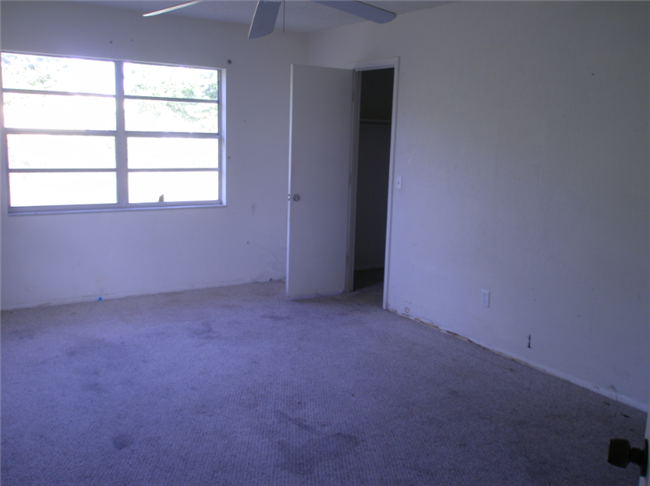
I was replacing carpeting in five bedrooms.
First, I needed a tile guy. My first stop was referrals. I asked around and couldn’t find anybody so my next stop was Craigslist.
Next, I found a tile layer that had great references and a reasonable rate.
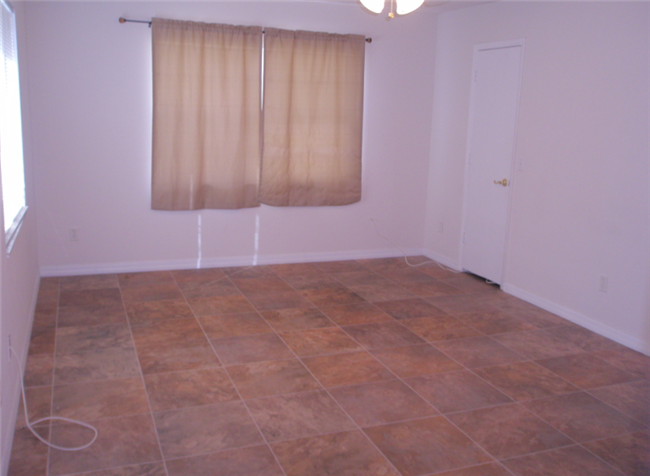
Then, I went to Craigslist again for tile. I found someone that had left over tile from a project that was very nice but was only enough for two bedrooms. I bought that for very little and then found tile that was almost an exact match for other existing floor tile, for the remaining 3 bedrooms.
Again, almost a give away price. I paid about $1,400 for a professional tile job, labor and materials, in 5 bedrooms- both sides of duplex-the largest bedroom being 18 X 13.
Hank’s rental renovation with tile after replacing the damaged carpet.
There is no way I could not have carpeted those rooms for that amount of money. No more carpet cleaning between tenants, and no more worn, stained carpet needing replacement every few years.
Just a great look that is easy to take care of and will be there for a long time.
Let me diverge from this rental renovation for a few minutes to discuss a topic that could save you lots of money on renovation and maintenance, if you are able to use some of these ideas.
Where can you get supplies other than “the store?”
Where can you get needed supplies for your projects other than “the store”?
A little personal history before we get to that information.
When I first decided to get into real estate rentals, I knew I would not be buying brand new properties as I didn’t want to pay top dollar.
I knew that if I could buy a nice rental that needed work I could get a tremendous discount because many people don’t know how to do what is needed to repair a property. Don’t want to do it. Or, are afraid it is going to cost too much money to have professionals do the repairs, bingo!
I knew one area I could save money would be to buy needed supplies cheaply. BUT, I knew I was going to need storage for my supplies and luckily I had a section of my basement that was garage accessible and about 1,200 square feet so I could do some serious storage.
Craigslist can work in a rental renovation
I lived in Atlanta at the time and there is always building going on there. I started going to yard sales looking for things I could use. Folks would buy a home and personalize it-maybe change out appliances to stainless steel-I could sure use spare appliances, or light fixtures, ceiling fans, chandeliers, carpeting, tile, doors, etc. You name it, great renovation supplies on sale every weekend.
Then there is Craigslist! If you live in a large market like Atlanta you almost don’t need to stock anything. You can search “materials” for what you need and often can find it almost immediately, at a huge bargain.
If you live in a smaller town, then you’ll need to look more and it will take longer to find what you need or maybe it would be worth it to look in Craigslist for a nearby larger city. Please see attached ad.
Landlord Hank’s search for low-cost appliances
I needed a dishwasher (white) for a unit, looked on Craigslist, found an ad and made arrangements for pick up. I was going to buy the stove and refrigerator too, but I told the seller the appliances needed to look good at they were going in a rental. The seller disclosed some dents on front of refrigerator that photo doesn’t show, so I didn’t buy that but did purchase the stove and dishwasher for $100.
A key to rental renovation on a shoe-string budget
I’ve been using Craigslist for at least 10 years and have never been cheated. I’ve seen articles that had defects the owners didn’t know about or that didn’t show up in photos. I make sure appliances work before I buy them, I try all switches, lights, etc.
For microwaves (over the stove) I make sure the bracket is there to hang on the wall and the bolts from upper cabinet are there too.
For refrigerators, I make sure all shelves, brackets, door gaskets are intact and look good. I have bought some refrigerators that didn’t work for very long but they were working when I bought them.
My thinking is, if I pay $100-150 for a refrigerator and I have to replace it, then I’ve paid $200 to $300 for an item that could cost $500 and up new.
Most times I get lucky and a refrigerator lasts years. I usually pay so little for my appliances, that if it fails or something breaks that is not an easy fix, I will scrap it and buy another.
Always buyer beware though
Always, buyer beware. Make sure you are inspecting what you are buying very well and you know what you are buying works and functions as it is supposed to. If not, forget it and look elsewhere. If an appliance fails, I usually strip it of all usable parts.
Appliance parts are very expensive if you have to order. If a refrigerator goes down, I often take shelves, brackets, handles, light bulb, etc. Pretty soon you have your own appliance parts warehouse.
Make sure you are organized in your warehousing so you can find what you need when you need it.
If you only have a little storage area, this strategy may not work for you. Builders supply stores-these establishments have used supplies-canceled orders from builders, overstocks, etc. with discount pricing. Also Habitat for Humanity Restores infrequently have some deals, connections you make by talking to people-I met a guy that owned a used appliance store and he was the contractor receiving appliances that were returned to Lowe’s-maybe had a dent in the side, etc. that Lowe’s couldn’t resell.
Another time, I found someone selling their home to a developer. The home was being torn down so many new homes could be built on that site. I was able to strip the house of usable items.
I bought 11 almost new energy efficient windows, sliding glass doors, interior doors, toilets, etc. We had to do the work of removing the items-but when I pay $200 for items that cost over $10,000 new, I’m a happy camper.
If I am buying a property and I know for sure it is going to close, I make my renovation plan prior to closing and in that four to six weeks I start securing materials I’m going to need.
I’ve purchased very few brand new appliances, for my own rentals.
Landlord Hank working on his rental renovation. Landlord Hank says, “Can you renovate a rental property on a strong-string budget? Yes, it can be done and come out great!
Ask veteran landlord and property manager Hank Rossi your questions from tenant screening to leases to pets and more! He provides answers each week to landlords.
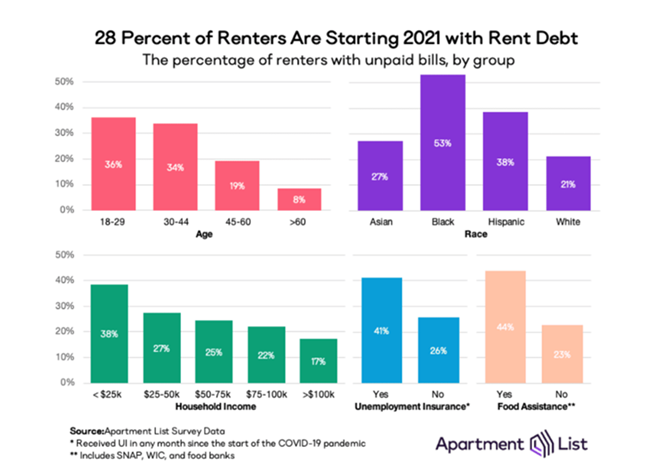
Rent debt will be a persistent threat to the housing security of millions of renters, along with eviction, as 28 percent of renters are starting the year with unpaid rent bills from previous months, amassed while the economy buckled under the coronavirus pandemic, according to the latest Apartment List survey.
For minority renters, the missed-payment crisis has been even more damaging. In the fall of 2020, the missed-payment rate for non-white renters was nearly 50 percent higher than that of white renters. This is just one of many ways that minority groups are burdened with an outsize share of the pandemic’s economic fallout; beyond housing, people of color have disproportionately experienced loss of employment, loss of health insurance, loss of food security, and more severe health impacts.
“As we did throughout much of 2020, our team collected data on housing, race, and financial outcomes using a nationally-representative survey of over 4,000 respondents taken during the first week of January 2021. The findings highlight how the persistent and unequal effects of 2020’s housing crisis are spilling over into the new year,” Apartment List said in the survey.
Rent Debt Is Driving Concerns About Eviction
There has been some rent debt improvements but those have been concentrated among just the wealthiest set of renters. Since October, the rate of rent debt has nearly halved for households making over $100,000, but fallen just a few percentage points for those earning less than $50,000.
This slight decline in rent debt, coupled with federal and local eviction moratoriums, have allayed some broad concerns about renters being evicted from their homes.
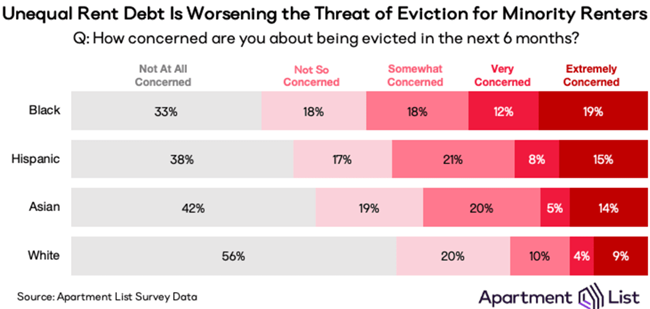
As of January, 51 percent of renters say they are “not at all concerned” about an eviction, up from 39 percent six months ago. But eviction protection does not equal rent forgiveness, and unpaid debts will become due when the federal moratorium expires. This will expose the millions of renters with unpaid bills who aren’t protected by additional state or local laws.
“With that in mind, and considering what we now know about where rent debt is concentrated in America, it comes as little surprise that evictions pose a much greater threat to minority renters,” Apartment List said in the report, as 31 percent of Black renters are “very” or “extremely concerned” about losing their homes, more than any other group and at more than twice the rate of white renters.
Rent debt and eviction concerns are highly correlated
More than 80 percent of renters who are extremely concerned about an eviction owe their landlords money, and on average, they owe much more than less-concerned groups; 45 percent owe more than $1,000, compared to just three percent of those who are not worried about losing housing. This highlights how eviction moratoriums may be short-term safety nets, but not sufficient solutions to deep inequalities. For renters coming into the new year with steep debts, these moratoriums may only be delaying the inevitable: a surge of evictions that will disproportionately displace already-vulnerable groups.
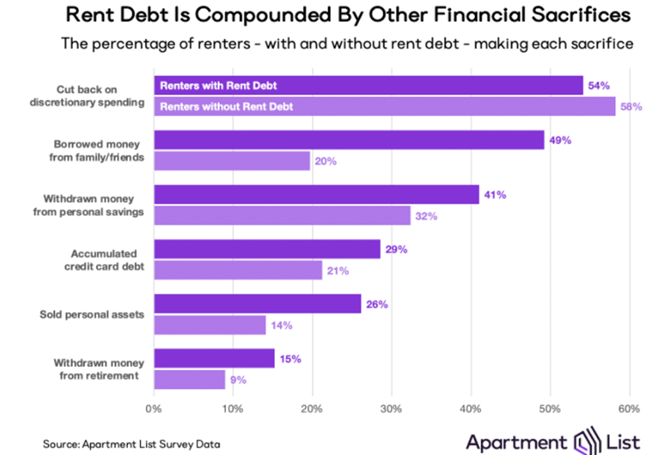
Rent debt – and the looming threat of eviction – are forcing many renters to change the way they spend and save their money, often exacerbating their financial troubles.
“Our survey asks renters what financial sacrifices they have made in response to the pandemic, and in the chart we split the results by whether or not they have accumulated rent debt going into the new year.
“The discrepancies show that for debt-burdened renters, the financial hole can be much greater than just unpaid-rent bills. By creating an immediate need for cash, rent debt leads to new forms of debt and limits short- and long-term savings,” Apartment List says in the report.
Summary
This year the pandemic will remain a persistent threat to the health, finances, and housing security of our nation’s renters.
“And pre-existing economic inequality is compounding the problem for minority renters. People of color, who tend to work in occupations that are more prone to disease exposure and more susceptible to pandemic-related layoffs, are coming into 2021 with greater rent debt and more salient concerns about losing their housing once eviction protections expire,” Apartment List says.
Rent declines led to multifamily rents ending the year relatively flat with a slight downward tilt, but the extreme division between expensive gateway markets and their neighboring lower-cost metros continued into December, according to Yardi Matrix’s national multifamily supply and rent recap.
The year “2020 will go down as the year COVID-19 changed everything. As the pandemic became rampant, many initially feared that rents would rapidly decline. But many metros have emerged from 2020 unscathed, and some have even enjoyed significant rent growth. Others have not been so lucky, especially expensive coastal markets,” the Yardi Matrix report says.
Multifamily rents declined by 0.8 percent in December on a year-over-year basis, a 30-basis-point decline from November and the seventh consecutive month of declines.
Overall rents declined by $4 to $1,462, giving December the largest one-month decline since the beginning of the pandemic, when overall rents dropped by $5 in April.
On the bright side, California’s Inland Empire rents grew by 7.3 percent year-over-year.
Sacramento rents grew by 6.1 percent year-over-year.
Job Loss and Remote Work Cause Rent to Fall
“Throughout 2020, the differences in rent growth between expensive coastal markets and their lower-cost neighboring metros continue to grow,” the report says.
“One of the main reasons for this has been the mass exodus out of the gateway markets. The driving factor out of these markets has been job losses. Most of these job losses have been concentrated in tourist-centric industries like restaurants, nightlife and entertainment.
“As gateway markets are some of the most expensive to live in – and with job losses disproportionately impacting service workers – it became impossible for many to pay rent, so the only choice was to move.
“Another contributing factor to the mass exodus is the ability for employees to work remotely. With most amenities in these urban areas closed, the desirability of living in an urban setting and paying high rents has been lost,” the report says.
Summary
“When the pandemic first began, many predicted a rapid decline followed by a very strong V-shaped recovery. Nine months in, however, we are still on shaky economic ground. By the second half of 2021, the vaccine-distribution process across the U.S. should be coming to an end, and we can begin the road to full economic recovery,” Yardi Matrix said in the report.
About Yardi Matrix:
Yardi Matrix researches and reports on multifamily, office and self-storage properties across the United States, serving the needs of a variety of industry professionals. Yardi Matrix Multifamily provides accurate data on 18+ million units, covering more than 90 percent of the U.S. population. Contact the company at (480) 663-1149.
Seattle landlords, especially smaller mom-and-pop landlords with rental property, have been put in a difficult position by the Seattle City Council’s housing regulations. Attorney Ethan Blevins goes in depth on what has happened and the concern for landlords over copycat cities.
Kelly Lyles is a member of a dying breed: the mom-and-pop Seattle landlord. Her kind has become the target of an increasingly radical city council that has slammed the rental housing industry with a barrage of new-fangled policies over the last five years that protect tenants at all costs, including the cost of landlord property rights. The result is a deepening housing crisis, increased gentrification, and an end to landlords like Kelly.
Kelly lives in West Seattle, not far from a single-family home that she rents out. In every way, Kelly is the consummate Seattleite—an artist with a giant painted pig in her front yard who can often be seen wearing and driving her art, like Leopard Bernstein, a leopard-print Subaru covered in exotic cats.
Like so many artists, Kelly’s artwork, while award-winning and prolific, doesn’t pay the bills. She relies mostly on her rental as her primary source of income. Kelly is hardly unique. A 2018 survey of 4000 Seattle landlords showed that most own or manage a small number of units, and more than half of them rely on rental property as a way to supplement their primary income or support their retirement. Fifty-eight percent of Seattle landlords make less than $75,000 a year, with about 30 percent earning $50,000 or less.
These smaller landlords provide an important niche in the rental housing market. Most privately-owned affordable rentals across the country are mom-and-pop establishments with five or fewer units.
But Kelly’s city council has made her life as a landlord, and the lives of thousands of others like her, increasingly unsustainable. In recent years, the city has passed laws removing landlord discretion over tenant selection, banning criminal background checks, allowing tenants to invite others to live on the premises against the landlords’ will, and banning evictions during the winter (December through March of every year).
Seattle’s dive toward radical and ill-conceived rental housing regulations does no favors to either landlords or tenants: The sum consequence will be far fewer affordable rentals in the city. Below, I examine each of these laws in greater detail as they might apply to landlords like Kelly, to tenants who struggle to find housing in a heated housing market, and to housing in general. We can hope that cities take Seattle as a warning, not an example.
The First-in-Time Rule
While Seattle had already been an aggressive regulator of rental housing, it took a significant turn against landlords in 2016, with the nation’s first “first-in-time” rule.
The rule essentially removes landlord discretion from the tenant selection process. It requires landlords to set minimum criteria for applicants and then offer the unit to the first person who meets the pre-established criteria. The landlord has no option to consider the best candidates among a pool of applicants or provide a unit for a less-qualified tenant who needs a break. If the first in line doesn’t accept the unit, then the landlord must offer the unit to the next in line, and so on. The idea is to remove implicit bias from the tenant selection process. The real-world result, however, is another matter.
Perhaps the most obvious effect of the law is to place all the power in the applicants who apply fastest. It, therefore, favors native English speakers with cars, flexible work hours, and internet access. In other words, it worsens the lot of those renters already hard-pressed to compete for decent housing.
But the rule also encourages landlords to set stricter rental criteria. When landlords had some discretion to choose among a pool of qualified applicants, landlords could afford—and benefit from—using flexible and lenient rental standards. Landlords could also deviate from their rental criteria in special cases where they might want to rent to someone with, for instance, a low income but a solid credit score. No longer. Landlords must now impose heightened criteria to maintain some degree of control over tenant selection, and the law forbids them from deviating from those criteria. The result isn’t hard to predict—lower-income renters have been pushed out of the city.
This isn’t guesswork. A city-commissioned study found that 63.45 percent of 4000 surveyed landlords said they already had raised rental criteria in response to the first-in-time rule or intended to do so. When asked whether the rule “reduced your ability to rent to those with fewer resources,” 65 percent of landlords said yes. A staggering forty percent of landlords, according to the survey, had already sold their rentals or intended to do so in response to city regulations, primarily the first-in-time rule.
The law does no favors to already struggling renters, but what about the law’s impact on landlords themselves? Take Kelly Lyles, for instance. She can no longer control who’s in charge of her key source of income. But there’s also a more personal side to Kelly’s story. Kelly is a single woman and a sexual assault survivor. Unable to afford a property management company, Kelly must interact with her tenants personally, visiting and entering the unit alone when problems arise. Safety is of paramount concern to her, a circumstance she can do little about when she has no control over whom she rents to. As the law’s written, Kelly would be required to rent to her former abuser if he met her rental criteria.
Other examples abound. What if an applicant who checks out on paper shows up with a swastika tattooed on his shoulder? What if the applicant is belligerent on the phone? What if a social media search reveals that an applicant with a satisfactory application is an unapologetic bigot? Maybe landlords would still be comfortable with renting to these individuals, and maybe they wouldn’t. As a basic tenet of a free society, however, it seems that decision should be up to them, not bureaucrats with no skin in the game.
And what if a landlord wanted to help out someone who applied second or third, or didn’t meet the landlords’ written rental criteria? What if a recent college graduate has no rental history, as required by the criteria, but the landlord is impressed by the applicant’s courtesy and willingness to work hard? What if a tenant can’t afford the rent as posted in the advertisement but offers to do yardwork for a discount? The landlord has no discretion in any of these settings. To crush implicit bias, the city has also squashed conscious goodwill.
Unable to get the city council to consider landlord viewpoints, Kelly and several other landlords challenged the legality of the first-in-time rule in 2017 with the help of Pacific Legal Foundation, a nonprofit legal organization. They won at trial, where the judge held that the rule violated takings and due process guarantees but lost on appeal. Now landlords appear stuck with this tremendously tone-deaf and ill-conceived regulation.
Well over a third of landlords say they had or would leave the rental market because of the first-in-time rule. Remarkably, just over five percent of that group managed more than one rental unit. The first-in-time rule has resulted and will continue to result in a massive depletion of the most affordable housing stock—single-family homes owned and managed by small landlords.
Criminal Background Check Ban
In August 2017, Seattle passed the most radical regulation of criminal background checks in housing in the country.
The so-called “Fair Chance Housing Ordinance” deems it an “unfair practice” for a landlord to ask about a tenant’s or applicant’s criminal history, or to deny a rental application because of criminal history. There’s a narrow exception for sex offenses if the landlord can prove to the city’s satisfaction that they have a “legitimate business reason” for denying a sex offender that is “necessary to achieve a substantial, legitimate, nondiscriminatory interest.” The city also exempts all “federally assisted housing,” which would include all the city’s public housing projects plus voucher-subsidized housing.
The rationale for the ban is two-fold. First, the city claims it wants to help the formerly incarcerated reintegrate, and stable housing is an essential factor in preventing recidivism. Second, criminal records tend to have a disproportionate impact on minority groups, so removing them from consideration will promote racial equity. Once again, however, the city remains tone-deaf to the concerns of its landlord constituents or the predictable outcomes of its policies.
There is both a personal injustice and a societal toll that the background check exacts. On the personal front, the ban is an existential threat to landlords like Kelly Lyles, a single woman, sexual assault survivor, and small landlord who relies on her rental income for basic living expenses. The relationship she enters into with a tenant isn’t a one-time exchange at a drive-thru window; it’s a lengthy and often involved relationship. When she rents her home, she places her primary investment and income source in someone else’s hands. No one should be forced to enter into that kind of relationship blind, particularly someone with weighty concerns about personal safety or comfort.
And many landlords live close to their tenants or manage units with roommates. Chong and Marilyn Yim, for instance, two of the plaintiffs joining Kelly in a legal challenge to the ban, own a triplex; they live with their children in one of the units and rent out the other two. They share a yard and other common spaces with their tenants, yet they are unable to refrain from renting to a felon. The Yims’ other two units have roommates, and the Yims have long done background checks on possible new roommates to help tenants’ vet the people they’ll be living with. They can no longer provide this service, and roommates must either share their home with ex-felons or move out.
The city’s cavalier response has been that landlords have nothing to worry about—that there’s supposedly no link between a “successful” tenancy and a tenant’s criminal background. But a quick look at public data says otherwise. About two-thirds of prison releasees re-offend or violate parole within three years of release. Forty-four percent of ex-offenders are rearrested within the first year following release, and a sobering 83 percent of released state prisoners are arrested within nine years of release. This means that a landlord faces a notably stronger likelihood of criminal activity occurring on their premises, and a high probability that a landlord will lose a tenant to incarceration, followed by an expensive unlawful detainer process from which the landlord may recover nothing.
But the landlord, of course, is not the only person affected by this city-mandated blindfold. In multi-family complexes, neighboring tenants may unknowingly share a wall with a violent felon, and neither the landlord nor the surrounding tenants would know or be able to do anything about it if they did know. Seattle Landlords typically would have both a legal and a moral obligation to look after the well-being of their current tenants when vetting rental applicants. They can no longer do so.
The ban has already begun to corrupt the quality and viability of the rental housing stock in Seattle. The Addison, a low-income housing complex in downtown Seattle, is a tragic example. Goodman Real Estate had purchased the Addison in 2012 for $12 million, and it invested another $27 million to convert the property to 254 apartments, a tenth of which are reserved for disabled tenants.
To maintain eligibility for various affordable housing tax credits and exemptions, the Addison rents only to tenants earning up to 60 percent of area median income ($45,600), and adheres to a rent ceiling of about $1200 per month for a one-bedroom unit. From 2013 through mid-2018, the Addison was a model for safe, high-quality, and affordable housing.
About four months after the passage of the Fair Chance Housing Ordinance, however, that began to change. Uncertain whether the Addison would qualify as “federally assisted,” its managers decided to cease criminal background checks, a regular business practice up to that point. In the two years since the Addison’s living conditions have plummeted.
The change is remarkable. The number of 911 calls has more than doubled. Fights break out in the lobby frequently. Used needles, trash, and feces litter halls and stairways. Fire alarms repeatedly scream throughout the night. Turnover is 400 percent, and evictions have tripled. Management had to evict tenants in 42 units over the last year—16 percent of the total—thirty of which were for behavioral issues, typically criminal: a stabbing, drug dealing, assaults on staff, vandalism, and prostitution.
Beyond the apparent toll this takes on Addison’s tenants and management, the economic costs of this deterioration are staggering. Since “Fair Chance” passed, monthly eviction expenses have climbed from $1,442 to $2,983. Monthly security costs have risen from $2,350 to $9,581. Monthly non-recurring capital expenditures have climbed from $4,573 to $15,704. In sum, a successful project has flipped from cash flow positive to cash flow negative in the two years since the Fair Chance Housing Ordinance struck the housing industry. This is not a good outcome for anyone. The Addison has attempted to increase rental criteria such as minimum verifiable income and credit score to stop the bleeding, which only hurts tenants and likely won’t save a once-successful affordable housing project.
The law’s massive exception for federally assisted housing also raises a serious equal protection concern. Why treat housing providers who do not rely on federal assistance differently than those who do? Since the formerly incarcerated will benefit most from federally assisted housing, it would seem that the city has it precisely backward: the law is structured in a manner as to thrust ex-offenders into the fully private housing market instead of helping them obtain housing assistance that will help ensure the housing stability that the city seeks to promote. Richmond, California, which has a similar background check ordinance, only applies rigid background check restrictions to affordable housing rather than the private housing market as a whole. Seattle’s rationale for this exception is that federal law requires it, but that’s simply false. HUD funding only asks that landlords check for a history of methamphetamine production or manufacture on the property of assisted housing. That hardly means the city is justified in wholly exempting assisted housing from the ordinance. Such an arbitrary exception for one category of housing likely won’t survive a legal challenge.
Fair Chance Housing and first-in-time, together, mean that landlords have virtually no say over who occupies and controls their source of retirement, savings, or income source. Yet the city has thrust this burden on landlords without even attempting something that might look like a compromise. The federal government, for example, uses a certification program that gives ex-offenders a means of confirming through parole officers, employers, neighbors, and others that they haven’t been engaged in criminal conduct and have remained clean since release. The city could require landlords to consider such certification and provide a valid reason for nonetheless rejecting the applicant. The city could also indemnify or publicly insure landlords willing to rent to ex-offenders or expand social service programs.
The city is rightly concerned about the disparate impact criminal records have on minorities. But perhaps the city should look to reforming its long history of biased policing rather than saddling its housing market with unsustainable overregulation.
Three small Seattle landlords banded together with two organizations to sue the City of Seattle over a criminal background checks ordinance that keeps landlords from considering certain criminal histories of tenants during the tenant screening process. Sean Martin of the RHAWA, left, Ethan Blevins and William Shadbolt
Seattle Landlords And The Roommate Ordinance
In 2019, Seattle became the first city to mandate that Seattle landlords allow roommates of the tenants’ choosing. As with the other laws discussed above, the veneer may make some initial sense: Seattleites are struggling to find housing, so let’s remove barriers to cohabitation. And as with the other laws, Seattle’s city council appears almost willfully blind to the predictable fallout of their shortsightedness.
This ordinance “restrict[s] a landlord’s ability to limit the number of persons residing in a rental unit.” In essence, a landlord cannot legally prevent a tenant from inviting someone—anyone—to live on the landlord’s property. The landlord must suffer occupancy by “the tenants, a tenant’s immediate family, and the additional resident’s immediate family,” subject to local occupancy limits. The number of unknown and uninvited residents could swell to quite a crowd, given the remarkably broad definition of “immediate family,” which encompasses obvious relationships like parents and siblings, plus “adult persons related by marriage” and anyone with whom the tenant or “additional resident” has ever had a “dating relationship,” which is any “social relationship of a romantic nature.”
The landlord has very little say over a transformation of his property into a small compound. The landlord has no power to screen or otherwise exclude a tenant’s “immediate family” unless the “family” is on a sex offender registry. In other words, a tenant’s deadbeat boyfriend has a nigh unassailable right to the landlord’s property. This is a particularly egregious problem since Seattle has also passed an ordinance that forces landlords to bear the cost of any property damage resulting from domestic violence.
As for an “additional resident” invited by the tenant, the landlord retains only a sliver of control. The landlord can impose whatever screening criteria used to assess the original tenant—credit score, verifiable income, etc.—but must allow the “additional resident” (and that person’s immediate family) to occupy the premises if those basic criteria are satisfied. Even if this “additional resident” ultimately fails to satisfy the landlords’ criteria, they still will have enjoyed at least several months of living on the property because the tenant doesn’t even need to notify the landlord of a new occupant on the property until thirty days have passed, and the landlord must allow that “additional resident” thirty days to join the rental agreement. Then the landlord can issue a written notice requiring the “additional resident” to vacate within 45 days. Nothing, however, prevents that additional resident from just moving back in a week later for another few months of legally protected couch-surfing.
From an affordable housing perspective, there is clear value to roommates. Allowing roommates can also benefit Seattle landlords, who can look to more than one individual should rent default. But stripping landlords of control over how many individuals living in a unit, and who those individuals are, is another matter.
As a practical matter, more occupants mean higher costs for maintenance and utilities, as well as a generally heightened chance of on-site issues that require the landlord’s time and money. Landlords might be able to respond to this problem by increasing rent, but it appears that the city’s prohibition on imposing conditions above those required of the original tenant would also include rent hikes to address increased costs and risks.
But the greater problem is the landlords’ lack of control over the identity of who is living on the premises. In this sense, the “couch-surfer ordinance” resembles the first-in-time and background check laws because it removes control over tenant selection. But it’s arguably worse than both, because, at least with respect to “immediate family” (e.g., deadbeat boyfriends), the landlord has almost no control, through criteria or otherwise, to decide whether that person stays or goes.
As with first-in-time and Fair Chance, the consequences are not difficult to predict. Landlords must now assume that every tenancy will be at maximum occupancy and heighten both rent and rental criteria to adjust. Since landlords have no way to control who these unknown future occupants may be, so they have little choice but to assume the worst and plan ahead by underwriting the risk through rent hike. And yet the city claims to be promoting affordability.
Winter Eviction Ban
Another predictable outcome of all these limits on Seattle landlords’ ability to vet tenants will be increased eviction rates. If Seattle landlords lack control at the front end to pick and choose tenants, they will inevitably have to exercise that control at the back end via eviction. But Seattle is fiddling with the back end, too.
Seattle, once again stepping into uncharted territory, passed the nation’s first ban on winter evictions in early 2020. The ban bars landlords from evicting from December 1 through March 1 of every year, even if the tenant defaults on rent. On the optimistic end, it takes around landlord thirty days to evict a tenant, so the ban effectively makes it impossible for landlords to evict from November through at least February of every year unless the eviction is for certain criminal or dangerous behavior.
Once again, Seattle is engaging in unprecedented policy experiments with a predictably bad outcome: a tougher rental market for lower-income renters. Landlords will impose higher security deposits, stricter rental criteria, and higher rent to reduce the risks and pains of missing out on a full four or five months of rent.
The ban is also likely to encourage landlords to be quicker to evict. With a shorter window for leniency and informal rent reminders, a landlord ever aware that winter is coming will be less likely to work with a tenant on payment plans or bear with promises to catch up. Many landlords will have to budget under the shadow of a five-month yearly rent drought and, therefore can’t afford leniency as renters struggle to catch up on back rent.
A Disastrous Synergy
Each of the four novel housing policies discussed above—first-in-time, background check ban, couch-surfer protections, and winter eviction ban—would alone be adequate to drive smaller landlords from the market, reduce the housing stock, and inflate housing prices. But in concert, these four policies, layered atop an already heavily regulated rental housing market, will transform a housing crisis into a housing disaster.
Many small Seattle landlords have already collapsed under regulatory fatigue, and they will continue to do so, selling their units to buyers looking to occupy or corporate entities that have the sophistication and capital to stomach the regulatory minefield. Either result will reduce the stock of affordable housing, large property management companies tend to charge higher rent. As noted above, 40% of small landlords had already sold or intended to sell as a result of the first-in-time rule and criminal background check ban. A few years and three more radical policies later, that number is only likely to grow.
Other landlords will convert their properties to alternative use, such as short-term rentals or commercial space. After all, the result of making one business more expensive and risky—which these policies all do—is to drive participants into a more profitable and less irritating alternative.
The burden will fall heaviest on the housing providers that Seattle’s housing market needs the most—the small ones. Thanks to the city, landlords will lose an important income source, and renters will face an even tighter and pricier housing market.
The prospects for multi-family housing complexes do not look much better. Investors, wary of the underwriting costs involved in managing multi-family housing complexes in a regulatory labyrinth, will turn to fund other local projects or other communities, a phenomenon observed by the Wall Street Journal. The result is a diminishing rental housing stock and a lag in multi-family housing construction. This kink in supply will inevitably drive up prices, while those daring enough to weather Seattle’s rental housing market will raise rent yet higher to cover the underwriting costs involved in renting in such a risk-laden environment. In 2018, before several of the more onerous ordinances had passed, just over one-fifth of landlords who had recently increased rent cited recent Seattle ordinances as the primary reason for doing so.
In addition to the upward pressures on rent, landlords will continue to ratchet up their rental criteria in an attempt to counter their lack of control over tenants. This cuts out low-income individuals with poor credit or rental histories—i.e., the very individuals that Seattle loudly claims to be helping.
The city has become enraptured with progressive abstractions while forgetting Kelly Lyles. The city, eager to lead the race toward “progress,” has no time to consider the actual outcomes of the policies it continues to hoist on top of the pyre of a housing market that will soon shut out everyone the city intends to help.
Unfortunately, the city’s ideas are spreading. Copycats have sprung up in other cities that lack the prudence to at least wait to see the fruits of Seattle’s policies. Even then, cities are all too likely to point the finger in the wrong direction—at tech wealth, large developers, and avaricious landlords. But the real culprit is not difficult to pick out from the crowd. As a pair of Seattle landlords said in a Seattle Times opinion article early last year, “The council seems to have forgotten small landlords and local businesses. They are not fully considering what kind of Seattle they are creating.” As cities continue to watch Seattle’s novel experiments in housing regulation, they should be sure to take away the right message.
About the author:
Attorney Ethan Blevins. Seattle landlords, especially smaller mom-and-pop landlords with rental property, have been put in a difficult position by the Seattle City Council’s housing regulations.
Ethan Blevins joined Pacific Legal Foundation in August 2014 and works in Salt Lake City, Utah. He litigates cases involving the First Amendment, property rights, and the separation of powers. Ethan began his legal career at Duke University, where he received his JD and an LLM in international and comparative law.
How COVID-19 has changed security for landlords and some of thethe solutions that are solving the problems it has caused.
By Saurabh Bajaj
Property management requires landlords to be constantly accessible to address physical security matters at their properties. Whether accessibility, mitigation of risk, maintaining security protocols, or promoting safety practices, landlords need to be ready and present.
COVID-19 has created a major barrier to complete these responsibilities in property management, and the consequences have left a gap in physical security that has raised an even bigger issue of business continuity and facility resilience.
Visitor Management and Access Control
With social distancing a necessity, landlords and property managers have had to find new ways to manage tenant and guest access from a distance – this includes replacing lost key cards, changing locks or access permissions after a tenant moves out, and giving consistent access to cleaning staff who need to access the facility more often due to the need for more frequent cleaning.
This becomes complicated with legacy access-control and visitor-management systems that are network-based, meaning they operate onsite at the property. Management gets all the more complicated when landlords have more than one property or a high-occupancy property to manage. Without the ability to be flexible with in-person operations, property security can falter.
Secure Delivery
The rise of e-commerce from months of stay-at-home orders has increased opportunities for package theft. Consequently, that is exactly what happened. During COVID-19 however, package theft goes beyond the usual headache and frustration it typically incites, because the pandemic has forced people to turn to home delivery of essentials like prescriptions, food, confidential work-related documents, and more.
Landlords have had to address the high stakes and high volume of package theft at their property. This is easier said than done if protocols were not already in place.
Tenant Occupancy
Renting an apartment typically requires face-to-face interaction for touring and access to different parts of the buildings. In-person showings also allows the building to be seen while respecting the safety and security of current tenants. COVID-19 has completely eliminated the ability to show properties to prospective tenants. So, landlords have needed to find ways to continue business and bring in tenants to their buildings.
Many have adopted virtual apartment tours and viewings, but it has underscored an ever bigger issue that landlords need to address for the future. If they can’t rely on their current operation for business continuity, what is the solution in order to future-proof their property?
Rental Property Security During COVID-19 and for the Future
Cloud-Based Management
Onsite network security has its setbacks in regards to flexibility. Transitioning to a cloud-based management system gives landlords and property managers the flexibility to manage the security of their property remotely. Cloud-based access control, for example, allows landlords to manage tenant permissions and remotely unlock access points within the property without the need for any face-to-face contact. The landlord doesn’t even need to be present to do this.
In addition, remote-management cloud-based systems also offer integration options so that all aspects of facility security can be managed under one platform. Video surveillance can be integrated with access control, for example, so that landlords can get a more holistic idea of the security operations within their property.
The Edge and AI
Artificial intelligence (AI) on edge security such as video surveillance cameras can learn images, patterns, behaviors, and so on. This type of holistic surveillance offers better security for tenants and allows landlords to better understand the physical security behavior in their property.
Contactless and Touchless Solutions
Frictionless security systems are a great solution to combat the risk of COVID-19 and for the future. Granting remote access for authorized visitors reduces the burden on landlords without sacrificing the quality of security, while also keeping physical distance. Touchless solutions eliminate the need to touch high-use surfaces, which mitigates the spread of viruses. Health-conscious solutions like these, which prioritize safety and security, will prevail as a best practice throughout COVID-19 and into the future of rental property security.
About the author:
Saurabh Bajaj is the founder and CEO of Swiftlane, a modern touchless-access control system for facility security. Before Swiftlane, Saurabh built machine-learning infrastructure at Lyft, specifically working on ML and computer vision for self-driving cars. Prior to Lyft, he worked with Facebook and Instagram.
Some suburbs are better-equipped than others with new apartments to meet the potential trend to suburban living that has been caused due to the pandemic shift toward work-from-home solutions, according to a study from Rent Café.
If work-from-home is going to become the new normal, we might expect to see a “significant reversal of recent homebuilding patterns,” according to a housing study by Harvard University.
Regions that have grown significantly in population in recent years are seeing a boom in apartment development, and the southern states clearly dominate the map.
Suburban Texas is a great example, claiming more than a third of the national list.
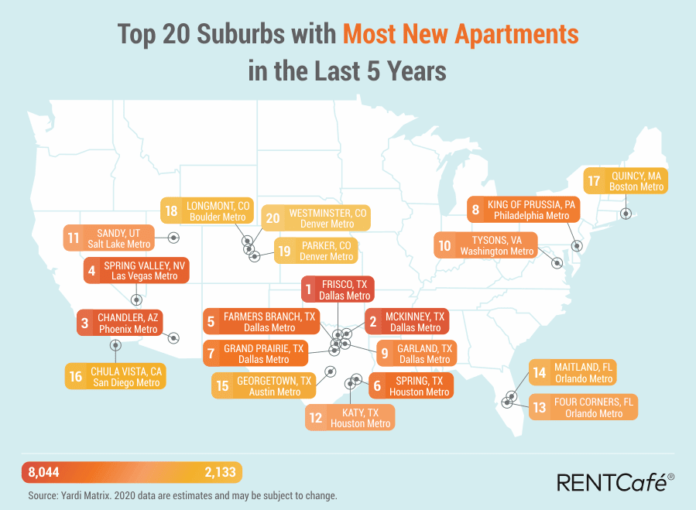
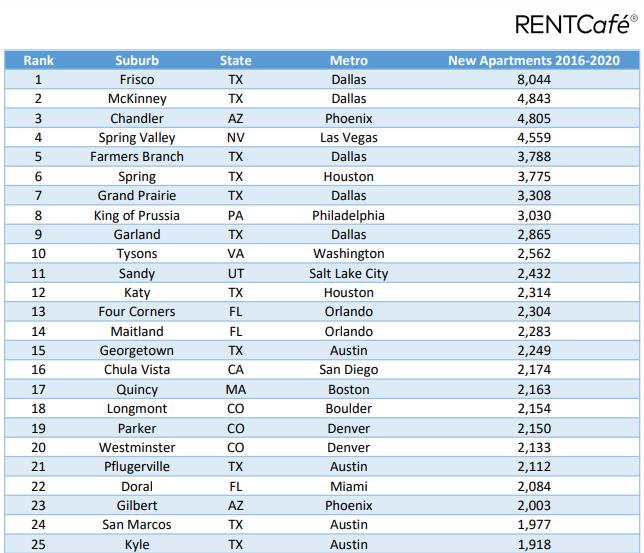
Out of the top 20 suburbs with the most apartment developments delivered since 2016, eight are in the Lone Star state. Second is Colorado with three suburbs in the top for the highest number of newly-built apartments in the country. And Florida, Arizona, and Nevada suburbs are also among the national leaders, the Rent Café study says.
Some highlights:
Nationwide, there were more than 501,600 apartments delivered in the suburbs in the last five years.
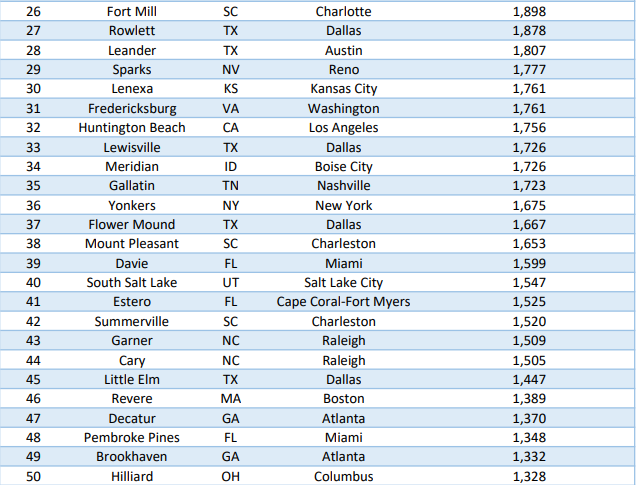
Out of the top 20 suburbs with the most delivered, eight are in Texas, with the Dallas metro accounting for the majority of suburban deliveries here.
With more than 8,000 new units, Frisco, Texas is the suburb with the highest number of apartments built in the last five years. McKinney, Texas came in second with 4,800 new apartments, followed closely by Chandler, Ariz., and Spring Valley, Nev.
Looking at the 1,300 suburbs analyzed, new apartments account for a 30 percent average of the suburban rental stock. Garden apartments were the most popular type of development.
“To find the suburbs that offer the most options for renters, we analyzed Yardi Matrix data for large-scale apartment buildings of 50 units or more, in search of suburban areas that have developed the most,” the report says.
“These locations are also great options for those considering a move to the suburbs because of their proximity to the core cities; 12 out of the 20 suburbs on our list are located no more than 20 miles away from an urban center.”
The No. 1 suburb for new apartments
The suburb with the highest number of apartments built in the last five years is Frisco, Texas.
With 8,044 apartments built and spread across 25 apartment buildings, this fast-growing city in the Dallas metro area has recently built a significant share of new rentals, most of which are in garden-style complexes. Frisco is located just 28 miles from Dallas. Details:
Apartments built in the last 5 years: 8,044
Number of buildings built: 25
Share of apartments built: 42 percent
Population: 200,513
Most common type of building: Garden
Frisco, Texas complex Skyhouse Frisco Station.
Summary
With the suburbs now finding new appeal for renters, some are better-equipped than others to meet the potential change to suburban living.
RENTCafe.com is a nationwide apartment search website and a part of Yardi. Our original city-based research, insights, and in-depth analysis of the real estate market have been used in stories featured on major media publications across the U.S.
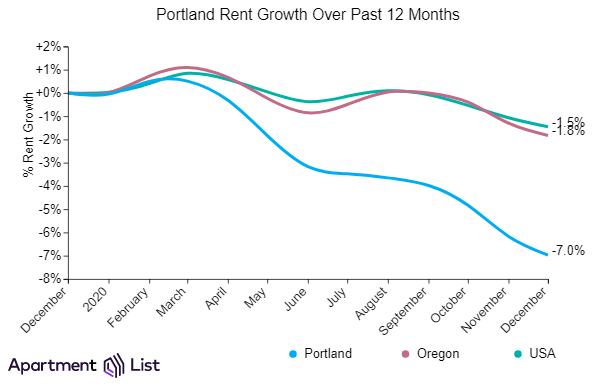
Portland rents have declined 0.9 percent over the past month, and have decreased sharply by 7.0 percent year-over-year, according to the latest report from Apartment List.
This is the ninth straight month the City of Portland has seen rent decreases. The last time any rents went up was back in March of 2020.
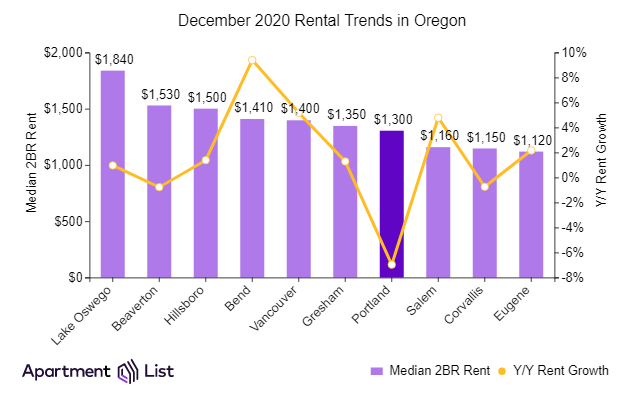
Median rents in Portland are $1,119 for a one-bedroom apartment and $1,305 for a two-bedroom.
“As we enter the New Year, our national rent index has begun to stabilize after a wild 2020. Rents are down 0.4% month-over-month nationally, a seasonal dip consistent with what we’ve seen in prior years,” said Igor Popov, Chief Economist, Apartment List.
“That said, there has been significant regional variation in the impact of the COVID-19 pandemic; while our national rent index is down by a fairly modest 1.5 percent year-over-year, many markets are experiencing greater volatility. The urban cores of San Francisco, Seattle, Boston, and New York City continue to see rent prices fall rapidly, while many smaller markets and suburbs are actually getting more expensive,” Popov said.
Cities in the metro showing year-over-year rent growth
While Portland is seeing continuing rent declines, cities in the rest of the metro are seeing the opposite trend.
Rents have risen in 7 of the largest 10 cities in the Portland metro for which Apartment List has data..
Looking throughout the metro, Lake Oswego is the most expensive of all Portland metro’s major cities, with a median two-bedroom rent of $1,839; of the 10 largest cities in Oregon metro that Apartment List has data for, Beaverton and Corvallis, where two-bedrooms go for $1,529 and $1,147, are the two other major cities in the metro besides Portland to see rents fall year-over-year (-0.8 percent and -0.7 percent).
Bend, Vancouver, and Salem have all experienced year-over-year growth above the state average (9.4 percent, 5.2 percent, and 4.8 percent, respectively).
Why is this happening?
Rents in outlying suburbs are growing much faster than rents in core metropolitan areas, according to research from Apartment List.
There are a number of reasons rent trends in principal cities do not mirror those of nearby suburbs.
The pandemic’s effects on everyday life have certainly been more pronounced in cities than suburbs. Shelter-in-place requirements and business restrictions have ground to a halt many of the events and amenities that attract people to cities in the first place: live entertainment, bars and restaurants, public festivals, and the like.
Many renters today are questioning whether it still makes sense to pay a premium for city living. As a result, migration plays a big factor in the urban and suburban rent divide, according to Apartment List research.
This week the question for Ask Landlord Hank is about using rental property cameras to protect rental property. Remember Landlord Hank is not an attorney and is not giving legal advice so check your local ordinances.
Dear Landlord Hank,
I have been told that cameras are an invasion of privacy. However, I am aware that several professionally managed sites use them.
My situation involves use of cameras (NOT pointed at individual doors) placed to cut down on trash and toys that make my rentals dangerous and unattractive to tenants. Would you please clarify what the law says?
We don’t want to leave our tenants having to report their neighbors.
-Pam
Dear Landlord Pam,
You’d have to check with your state and local laws, but you should be able to place cameras viewing common areas without an issue as long as the cameras are not hidden and not IN someone’s residence, as that could be construed as spying.
Also, cameras with audio capability are another issue you would need to check on.
I think it is a great idea but I would let current and future residents know in advance that cameras are being put in use to cover common areas around the property.
Sincerely,
Hank Rossi
Landlord Hank says about rental property cameras that “cameras with audio capability are another issue you would need to check on.”
Ask Landlord Hank Your Question
Ask veteran landlord and property manager Hank Rossi your questions from tenant screening to leases to pets and more! He provides answers each week to landlords.
By Dwight Kay, Founder & CEO; Betty Friant, Senior Vice President and The Kay Properties Team
“Is that your final answer?” You may recognize the question made famous by the popular TV game show Who Wants to Be a Millionaire? Choosing the right answer in this game gives you a shot at winning big money, while the wrong answer leaves you with nothing. Investors conducting a 1031 Exchange face a similar make or break decision when it comes to identifying suitable replacement properties.
The right choices can help streamline a smooth and successful execution of a 1031 Exchange. Choosing wrong with properties that may not be viable or deals that are unable to close within the 180-day time period can derail the entire 1031 Exchange. The good news is that investors do get to identify more than one replacement property. However, just like the gameshow, once that 45-day deadline hits for identifying replacement options, those answers are final. Making the most of that short list is one reason that the 200% Rule is a popular choice for many investors. The 200% Rule allows an investor to identify the largest number of replacement options with four or more properties or Delaware Statutory Trust (DST) replacement investments.
Under Section 1031 of the Internal Revenue Code, taxpayers who are seeking to defer recognition of capital gains and related federal income tax liability from the sale of a property are required to formally identify a replacement property or properties within 45-days from the date that the original property is relinquished (the day they closed the escrow on the property they sold). The tax code gives taxpayers three different options for identifying replacement properties on that 45-Day Property Identification Form – the 200% Rule, the 3-Property Rule or the 95% Rule. So, which is the best option to use? Every situation is different. However, for those investors who want to maximize their potential options and identify four or more replacement properties, the 200% Rule is a good choice to explore.
How does the 200% Rule work?
Exchangers can identify any number of properties as long as the gross price does not exceed 200% of the fair market value of the relinquished property (twice the sale price). It is typically used when an investor wants to identify four or more properties. This is the most commonly used rule for investors considering DST investments, because of the flexibility in being able to list multiple properties to build a diversified DST portfolio. The minimum investment amount for DSTs typically starts at $100,000 whereas most commercial real estate properties are priced above $1 million. So, for an investor who has $1 million to reinvest, they could opt to put all of that $1 million into one DST (which is typically not recommended even when the DST has many properties inside of it), or they can divide that $1 million into as many as 10 completely separate DSTs.
An important mistake to avoid is to make sure the list of identified properties does not exceed the 200% limit. The IRS is a stickler for rules. If the combined price of the identified replacement properties exceeds the 200% maximum limit – even by a fraction of a percent – it won’t be accepted.
Hypothetical Example: Expanding your options
A married couple sold their manufacturing business that included the sale of the property that housed the business, giving the couple $2 million to invest in a 1031 Exchange. The couple plans to retire and both agree that they don’t want a replacement property or properties that will require hands-on management. The husband wants to buy a Triple Net Leased (NNN) fast food restaurant for $1.2 million, while the wife is in favor of a $1.5 million NNN dollar store. Both properties are listed on the 45-Day Form, bringing the total to $2.7 million. They decide to use the 200% Rule, which allows for up to $1.3 million in additional property listings.
The couple agrees to split the remaining $1.3 million across multiple DST investments, and they choose to identify:
$100,000 in a multifamily apartment DST property located in Denver
$200,000 in a multifamily apartment DST property located in Dallas
$250,000 in a debt free DST portfolio of NNN leased pharmacies and e-commerce distribution facilities
$250,000 in a NNN dialysis facility DST portfolio with locations nationwide
$500,000 in a DST portfolio of NNN dollar stores
Overall, the 200% Rule allows the couple to identify these seven possible options within their 45-Day period. The DSTs are all packaged and ready to go with closings that can easily close within a week. The couple uses the remaining time to conduct more research and due diligence on the NNN Dollar General and KFC. In the end, they decide to buy the KFC for $1.2 million, but they like the diversity of being about to buy a $500,000 DST interest in a portfolio of dollar stores versus a single location. The remaining $300,000 is spent in the two apartment DSTs.
In this case, the ability to leverage the 200% rule was advantageous in giving the couple more options and more time to make a final investment decision. The outcome also was successful in that their 1031 Exchange was fully executed, and their $2 million is now invested across a diversified portfolio of multiple different income-producing properties versus only one or two. However, it also is important to note that every situation is unique. Individuals should review all three 1031 identification options to choose the rule that works best for your particular situation as well as always should speak with their CPA prior to making any decisions.
Kay Properties is a national Delaware Statutory Trust (DST) investment firm. The www.kpi1031.com platform provides access to the marketplace of DSTs from over 25 different sponsor companies, custom DSTs only available to Kay clients, independent advice on DST sponsor companies, full due diligence and vetting on each DST (typically 20-40 DSTs) and a DST secondary market. Kay Properties team members collectively have over 115 years of real estate experience, are licensed in all 50 states, and have participated in over 15 Billion of DST 1031 investments.
This material does not constitute an offer to sell nor a solicitation of an offer to buy any security. Such offers can be made only by the confidential Private Placement Memorandum (the “Memorandum”). Please read the entire Memorandum paying special attention to the risk section prior investing. IRC Section 1031, IRC Section 1033 and IRC Section 721 are complex tax codes therefore you should consult your tax or legal professional for details regarding your situation. There are material risks associated with investing in real estate securities including illiquidity, vacancies, general market conditions and competition, lack of operating history, interest rate risks, general risks of owning/operating commercial and multifamily properties, financing risks, potential adverse tax consequences, general economic risks, development risks and long hold periods. There is a risk of loss of the entire investment principal. Past performance is not a guarantee of future results. Potential cash flow, potential returns and potential appreciation are not guaranteed. Securities offered through Growth Capital Services, member FINRA, SIPC, Office of Supervisory Jurisdiction located at 582 Market Street, Suite 300, San Francisco, CA 94104.
We all strive to find a good tenant, so here are five signs that an applicant will be a good tenant for your rental property from Keepe, the on-demand maintenance and repair company.
When you’re receiving lots of applications for tenant positions at your rental properties, sometimes it can be difficult and overwhelming trying to sift through everything.
After all, with so many applications in front of you, where do you begin? How do you know which applicants will make good tenants?
There are a few telling signs as to whether or not your applicants will be good tenants. You just have to know what to look for to easily identify the good from the bad and put your mind at ease.
No. 1: They Fill Out the Application Properly
A sign of a good potential tenant is that they properly fill out the application.
That may sound overly simple, but this means that they include the appropriate documents that are asked for and fill out everything correctly.
A potential good tenant will be able to fill out an application completely and correctly.
Completing some simple paperwork properly is a good sign that they’re responsible and reliable, whereas if the applicant can’t even fill out the application correctly or doesn’t provide the appropriate documents, that’s a bad sign — especially in the very beginning stages of the application process.
No. 2: They Don’t Move Too Often
Along with knowing the reason why your applicants want to move, it’s also important to know how often they’ve moved in the past.
One of the main (if not the main) qualities you should be looking for in a tenant is stability and financial responsibility.
If they haven’t moved around too much in the past, that’s a good indicator that they got along well with their previous landlords and didn’t have anything disruptive happen while they were living there.
No. 3: A Good Tenant Has Good References
References are a great way to predict how a tenant will behave. Good references show that a tenant paid rent on time, didn’t damage the property and stayed in communication with the property manager.
If a reference from a past landlord says that the tenant did thousands of dollars in damage to their last rental, well, obviously that should be an immediate red flag. Also be sure you are getting the reference from a real landlord and not someone posing as a landlord to help the tenant.
No. 4: A Clean Background Check
During the tenant screening process, of course you’ll want to conduct a background check. A good tenant will have no past discretions and a clean criminal record.
If they have a history of drug use or brush-ins with the law, chances are it will become a problem you’ll have to deal with, so it’s advised to kindly decline and move right along to the next applicant. However, some jurisdictions have restrictions around criminal background checks, so be sure to check your local ordinances.
No. 5: A Good Credit Report
Don’t skip or underestimate the credit check; It’s a good indicator of the character and payment habits of your applicant.
Neglecting the credit check is the most common mistake landlords make. Not paying their current bills? It’s likely they won’t pay the rent.
Final Thoughts
Finding a good tenant does take some patience, but it’s worth it for later peace of mind. Careful tenant screening is one of the most important tasks for a landlord or property manager, but with these specific screening tips, you’ll be on your way to a happy and easy renting experience.
About Keepe:
Keepe is an on-demand maintenance solution for property managers and independent landlords. The company makes a network of hundreds of independent contractors and handymen available for maintenance projects at rental properties. Keepe is available in the Greater Seattle area, Greater Phoenix area, San Francisco Bay area, Portland, San Diego and is coming soon to an area near you. Learn more about Keepe at https://www.keepe.com