Fewer rent concessions in the fourth quarter suggest that demand is recovering or rents are being reset, according to the most recent report from Yardi Matrix.
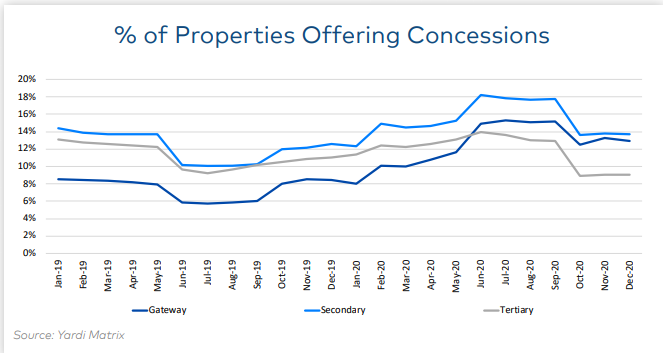
“Multifamily concessions rose sharply in the spring and fall of 2020 as multifamily demand waned due to job losses and social distancing measures. The impact was felt most in high-cost gateway markets, while secondary and tertiary markets benefited from the shift in demand,” Yardi Matrix says in the report.
“Concessions declined in the fourth quarter, raising possibilities that demand is recovering or rents are being reset.”
Concessions increased the most in the upper tier of the market: gateway metros and Class A and high-rise properties. Gateway markets had the largest percentage increase in concessions and the highest value of concessions as a share of monthly rent.
Strategies employed by owners to optimize income—such as offering concessions or lowering asking rent—are affected by competitive pressures, which may differ by metro.
Metros with the highest percentage of properties offering concessions are those with a pandemic-driven drop in demand and those with copious amounts of supply coming online.
Concessions peaked in the middle of the year and then declined in the fourth quarter. This could be a sign that the market is stabilizing or that owners are shifting strategies to attract and retain tenants. The decline could signal that new asking-rent levels are being set that will be carried into the post-pandemic market.
Is the market being reset?
“The data shows a pattern of apartment demand shifting from more expensive properties and metros to lower-cost properties and metros, which makes sense given the economic situation. More owners are choosing concessions to attract renters in the hope of returning to pre-COVID-19 levels of rent when the economy rebounds,” Yardi Matrix says.
“Concessions, however, are but one tactic for apartment owners trying to maximize revenue. Other options include lowering rent. Differences in metro-level data could mean that concession strategies depend in part on what competitors are doing,” the report says.
Yardi Matrix researchers say there are several reasons for the decline in the use of rent concessions. One reason could be there is some optimism around the vaccines being available and the prospect of the jobs and economy beginning to return closer to normal conditions.
“Another factor is that the natural leasing cycle was delayed for several months. Concessions tend to rise and fall with the season, increasing during the winter, when demand is weak, and decreasing in the spring, when demand is at its highest,” Paul Fiorilla, Director of Research, and Maddie Harper, Senior Research Analyst for Yardi Matrix write in the report.
“The pandemic may not have eliminated the 2020 leasing cycle so much as pushed it back a few months. Although it is still too soon to draw firm conclusions, the recent decline in concessions might also indicate that in some metros the dominant trend is to reset rents at lower levels rather than using incentives.
“Moving forward, the big question facing multifamily is how much employment trends such as work-from-home and lifestyle preferences for city versus suburbs have changed the demand equation. The answer will determine the use of concessions and whether rents reset at new levels,” Fiorilla and Harper write.
Yardi Matrix researches and reports on multifamily, office and self-storage properties across the United States, serving the needs of a variety of industry professionals. Yardi Matrix Multifamily provides accurate data on 18+ million units, covering more than 90 percent of the U.S. population. Contact the company at (480) 663-1149.
Attorney Bradley Kraus says Oregon’s HB 4401 creates a confusing mix of timelines related to important time periods—the “emergency period” and the “grace period” – and continues the implicit punishment of landlords for a problem they did not create
When 2020 came to a close, many landlords waited to see what new laws would be handed down to them from the December special session. As these laws regulate their businesses—and often their livelihoods—landlords hoped for clarity, assistance, and understanding from our elected officials. What they received, instead, was House Bill 4401.
HB 4401 continues to complicate the dynamics of the landlord/tenant relationship and, with seeming intent, places further pitfalls for landlords.
Most landlords have been hoping for a simple answer to the question of when they can expect to see rental payments again, either from their tenants directly or from the state. On that point, HB 4401 fails the test, creating a confusing mix of timelines related to important time periods—the “emergency period” and the “grace period.”
The emergency period was defined previously in House Bill 4213, the legislature’s eviction moratorium law passed last summer. The emergency period was effectively the period of time wherein landlords could not demand payment from their tenants. HB 4213 also provided a grace period for tenants in the form of a six-month window—ending on March 31, 2021—in which tenants would need to pay back the balances that arose during the emergency period. Those time frames are now fluctuating, depending on whether certain events defined in HB 4401 have occurred.
Whether these events have occurred is important, due to the structure of HB 4401.
For starters, HB 4401 provided an avenue for landlords to serve non-payment notices again, at least for January rent only. As good as that sounds, a closer look reveals an empty offering. HB 4401 requires landlords to serve statutory declarations of hardship and a statutory notice of tenants’ rights along with every non-payment notice, every balance- due notice of any kind, and every summons for evictions of any kind. If the landlord fails to do so, the emergency period and grace period are automatically extended until June 30, 2021. The tenant is also provided a defense to any eviction based on non-payment, while the landlord could face exposure under HB 4401’s damages provision.
The automatic extensions of the emergency period and grace period are the unfortunate reality that landlords face, thanks to HB 4401.
The declaration of hardship form mentioned above can be returned to the landlord from the tenant at almost any time and is unchallengeable. If your tenant returns the form to you, the emergency period and grace period are automatically extended until June 30, 2021, meaning landlords cannot demand rent until at least July. Landlords cannot demand further documentation from their tenants, question the declaration, or require multiple declarations. Doing so violates HB 4401, and triggers the damages provision.
HB 4401 and financial assistance for landlords
Landlords expecting HB 4401 to lend financial assistance to them are also likely to be disappointed.
While HB 4401 did set up a landlord-compensation fund of sorts, as of this writing, no process to apply for said funding exists.
Additionally, and most important, landlords are required to forgive 20 percent of the tenants’ unpaid balance in exchange for funding from the state, along with other restrictions which exist during the “pendency of” their “distribution application.”
Forgiving 20 percent of unpaid rent likely wipes away the profit margin for any landlord, which is typically not large to begin with. Finally, the fund will likely benefit small mom-and-pops first, which, while immensely helpful to them, will likely leave landlords with medium to large portfolios out to dry through no fault of their own, other than the fact that they own more rental units.
While COVID-19 cannot be minimized in the problems it has caused, HB 4401 continues the failure to distinguish between tenants who actually need help (i.e., those who can prove that COVID-19 has caused financial hardship for them) and those who are simply gaming the system (i.e., not paying rent simply because they do not have to).
While I am confident our elected officials think that the latter does not exist, I encourage them to give me a call to discuss that very issue.
In short, HB 4401 continues the implicit punishment of landlords for a problem they did not create. Given the complexity of this new law, and the potential exposure it creates, landlords are encouraged to fully understand this law before taking actions that could trigger it.
Bradley Kraus, Portland attorney
Brad Kraus is a partner at Warren Allen LLP. His primary practice area is landlord/tenant law, but he also assists clients with various litigation matters, probate matters, real estate disputes, and family-law matters. A native of New Ulm, Minnesota, he continues to root for Minnesota sports teams in his free time. You can reach him via email kraus@warrenallen.com or 503-255-8795.
‘After a year ravaged by a global pandemic and political division, nothing would be more satisfying in 2021 than a return to normal” … but “it will take some months to get most of the country vaccinated and get businesses operating as normal,” the report says.
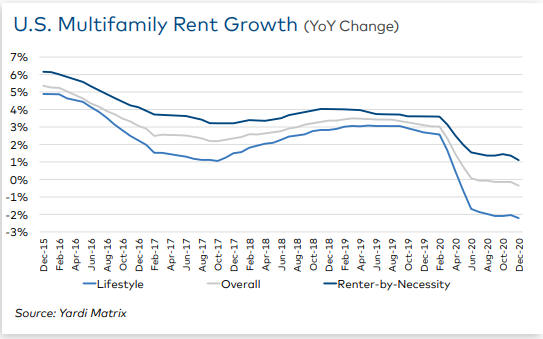
“Despite the COVID-19 pandemic, national rent growth remained relatively flat on a year-over-year basis, ending the year at -0.8 percent. There was a large divergence in performance between markets, though. High-cost gateway markets struggled the most, while many tech hub and tertiary markets thrived,” the Yardi Matrix report says. Some highlights of the report:
“Job growth has been mostly positive since the summer, but the economy remains nearly 10 million jobs off its peak.
“Nationally, rent growth fell only slightly in 2020, but there was a huge variation among metros. Rents and occupancy levels fell sharply in high-cost gateway markets, as renters left crowded and expensive coastal centers. More affordable markets in the Sun Belt, Southwest, Midwest and Mid-Atlantic saw modest rent growth.
“The pandemic slowed construction. With more than 750,000 units under construction, new supply should stay in the 300,000 range for a few years.
“We expect 2021 to be better than 2020, particularly the second half, but the year won’t be without tumult. Gateway markets will continue to struggle, and the industry will have to deal with weak rent collections, eviction bans, forbearance requests, lobbying for renter aid and a new federal mortgage oversight regime,” Yardi Matrix says in the report.
Rent payment concerns for rental housing
Yardi Matrix said although rents held up better than expected in 2020, considering the circumstances, the market has issues to work through. One is the rate of collections. With the excessive job losses caused by COVID-19, many forecasted a decline in rent payments. For the most part, that hasn’t materialized, as tenants have prioritized their rent payments.
However, rent payments did decline slightly at year-end as federal aid wound down. According to the National Multifamily Housing Council’s Rent Payment Tracker, 93.8 percent of apartment households paid rent by the end of December—down 2.1 percentage points from December 2019.
“There is hope for a strong economic recovery as 2021 proceeds, but much of that hope will depend on the pace of vaccine adoption and the reopening of businesses nationwide. In the early stages, the vaccine rollout appears to be lagging initial expectations; however, a new presidential administration and an organized national effort for vaccine deployment may increase the speed of the recovery,” the report says.
Yardi Matrix researches and reports on multifamily, office and self-storage properties across the United States, serving the needs of a variety of industry professionals. Yardi Matrix Multifamily provides accurate data on 18+ million units, covering more than 90 percent of the U.S. population. Contact the company at (480) 663-1149.
Landlords and building managers have to deal with several kinds of issues daily. Most of these are routine: a leaky faucet, a faulty smoke alarm, and so on. However, in view of the current pandemic, the issue of smoking (especially when you have non-smoking apartments) and secondhand smoke is more serious than ever.
Here’s what’s going on right now: A lot more people are at home every single day. The concept of remote working will become even more common in the future.
Plus, people are becoming more attuned to their health issues, especially when it comes to their respiratory system. Previously, it wasn’t exactly ethical when secondhand smoke from one tenant affected the apartment of their neighbors. Today, a landlord could get sued for the same.
Not sure how to get that smoking issue under control?
Here are a few ways to get you started.
1. Conducting Resident Surveys
You can start off by conducting resident surveys about the issues of secondhand smoke and how to combat it. This way, you can learn what your residents think about the smoking policy as it stands now.
You’ll also be able to receive feedback on any potential restrictions on smoking in the future. By collecting this information, it will be possible to learn about the concerns, potential points of conflict, and questions that your residents might have. When you do start implementing the changes, it will be easier to enforce them when you keep all concerns in mind.
2. Educating the Residents
It’s also a good idea to educate the people who will be affected by the non-smoking apartments policies. After all, having apartments for rent doesn’t mean that you just sit back and collect money. It also means that you have a responsibility to give people the information they need to work as a community.
Start by releasing educational messages that will affect the residents’ way of thinking and also prepare them mentally for the changes. Include information on how secondhand smoke affects the health of the whole family. Getting secondhand smoke under control might even help reduce asthma in children. Once you wake people up to their basic right to a clean, healthy, and safe living environment, it will signal a lot of ease for future rules.
Many residents have been depressed during the pandemic so work on ways to provide education.
3. Clearing up Confusion About Non-Smoking Apartments
When you tell a smoker that they can’t enjoy their pipe or cigarette, it often triggers some feelings of rebellion. Make sure that the smoking residents in your apartment buildings don’t feel like they’re being controlled or that the new policies about non-smoking apartments are extreme.
Instead, clarify how smokers don’t have to give up that habit right away, nor do they have to find a new place to live. All the new policies mean is that they won’t be able to smoke in certain areas for the good of the community.
The policy should also be worded in such a way that the smoke is held up as the culprit, not the smokers.
4. Holding Meetings
It’s helpful if you host community meetings to give out the information we’ve mentioned above. This will also provide a platform where concerned residents can ask questions, discuss answers, and generally reach a mutual agreement about making the air cleaner if you want non-smoking apartments.
Hold these meetings when you’re considering a certain policy such as non-smoking apartments or when the new policy is being implemented. Seek out partners who are working on related projects within the housing community already. This way, you have trusted resources at your disposal. Some examples include asthma programs, health workers, etc.
Above all, these meetings will allow you to give residents information about cessation resources. You’ll be acknowledging their concerns and addressing them in the best way possible. People living in your apartments for rent will probably have a more closely knit community as a result. There will be more related advantages when this occurs, including the smoke-free aspect.
5. Sharing Stories
Whether it’s at these meetings or just when seeing them in general, encourage your residents to share whatever stories they have about secondhand smoke. Their homes and everyday lives are being changed by the new policies. So, they deserve to be empowered and acknowledged.
What’s more, getting to know everyone’s perspective will also gain more traction for finally adopting the new policies. This may result in more buy-in from the residents’ part as well to the idea of non-smoking apartments.
6. Having Appropriate Outreach
All the community meetings, information, surveys, and signage you use needs to be sensitive and culturally appropriate. This means having the text printed in different languages.
It also includes having bilingual and people of color invited to speak at the meetings. Neglecting this aspect of reaching out can alienate some residents and weaken the impact of your efforts.
7. Getting Into Collaborations
Think about how the existing programs can work with new efforts to go smoke-free. It’s important to get in touch with community leaders and stakeholders who agree with your views on providing smoke-free housing.
Having partnerships with such groups will also give you the benefit of their trust, goodwill, experience, and connections with both the residents as well as housing providers.
When you sit down with such groups, address the areas where you have common concerns and how all parties can collaborate to achieve their goals. At this point, it’s also essential to discuss how the parties can share their recourse, including time and expertise.
It’s also best to include all your staff in this kind of planning. Give them the training they need to properly implement, enforce, and uphold the new policies. Staff members should be aware of what the new smoke-free rules entail, when they start, and how they can help residents with their issues and queries.
Non-Smoking Apartments – The Takeaway
Secondhand smoke is harmful to both kids and adults. In condominiums and apartment buildings, this concern is even more pressing due to the pandemic. Ventilation systems, wall cracks, and even plumbing could take the smoke from one place to another.
The only solution here is to make the housing system smoke-free. You’ll be safe on the legal front, along with a reduction in fire risk and turnover costs. It’s a win-win all around. So, consider following these steps today. You’ll feel the difference soon.
Justin Becker is a property owner in the state of Michigan and has a passion for managing communities. He owns apartment complexes and mobile home communities, and has been writing his own blogs for his properties for several years.
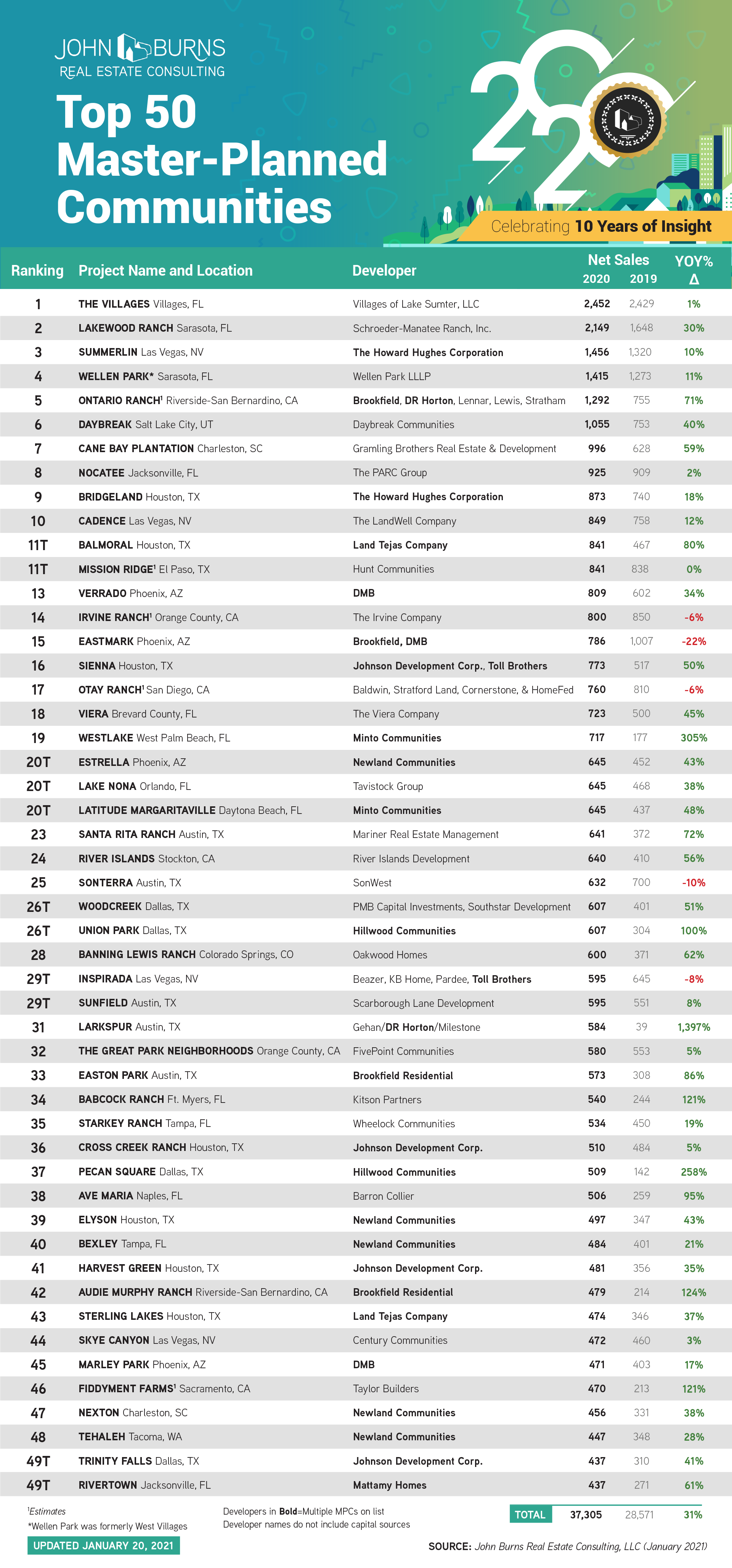
Working from home has proven to be a sweet freedom amid a year of COVID-19 restrictions, as there has been a home-buying boom in master-planned communities, according to John Burns Real Estate Consulting.
“Master plans’ new-home sales boomed across the country as work-from-home opportunities became permanent for many, and commute times became a drudgery of the past. Our consulting associates connect this newfound flexibility to skyrocketing sales in 2020.”
Master-planned communities “embody several trends that our team chronicled in client reports, a podcast, and articles we released in 2020. “
These themes include:
The home-buying sales boom supported by massive numbers of buyers working and learning from home;
A shift to the suburbs (and sometimes other metros) from higher-density urban locations;
The search for outdoor spaces and ways to exercise and play while socially distanced;
The balancing of our human need for connection with separation for safety and sanity.
Chart courtesy of John Burns Real Estate Consulting
Buyer urgency drives a new Top 50 sales record in master-planned communities
“No doubt the low mortgage rates helped, but home buyers’ urgency to improve their living spaces contributed significantly to the burst in sales.
“Together, the top 50 (nationwide) master plans sold 37,305 new homes in 2020, setting a new record in our ranking history. Our updated ranking includes a few adjustments to sales numbers and developer names from those quickly shared with us in the first 2–3 days of the new year,” the report says.
Chart courtesy of John Burns Real Estate Consulting
Tacoma master-planned community one of the top in sales
“Seattle’s tech companies have embraced working from home, and employees who do not plan on returning to offices five days per week are willing to drive further to find their ideal communities.
“Master plans such as Tehaleh in Tacoma offer family-oriented outdoorsy lifestyles and active adult housing that are attractive to Pacific Northwest buyers,” the report says.
For help maximizing sales and price in 2021, please contact our local consulting leaders or Ken Perlman, our Consulting Principal who has become (in our opinion) the national expert on successful master plan segmentation and amenity programs, working closely with our local leadership.
For more information on the MPC rankings, metro and regional new home sales and pricing trends, and our residential land, builder, and single-family rental operator surveys, please contact Jody Kahn, Devyn Bachman, or Nicole Luszczak.
Two attorneys last year joined the National Real Estate Investors Association for an online discussion to help landlords and property managers understand how best to deal with the federal eviction moratorium.
The nationwide federal eviction moratorium has been ordered through the Centers for Disease Control (CDC) to halt residential evictions through the end of March 2021 for non-payment of rent due to Covid-19.
Both lawyers discussed the issues, the affidavits that tenants must provide to show how they have been affected by COVID-19 in order to qualify under the federal eviction moratorium, and how attorneys could challenge the affidavits in court when necessary.
Attorneys Jeff Watson, in Cleveland, and Jeffrey Greenberger, in Cincinnati, gave their thoughts – not legal advice – on how landlords could best react to the moratorium. They were introduced by Charles Tassell, chief operating officer of the National Real Estate Investors Association.
“We have gone from unprecedented to crazy,” Watson said. “What concerns me the most is that this is now creating precedent for future administrations, future agencies, to use this as a rationale, to stop all sorts of economic commerce across the United States of America, any particular form of commerce, any type of interaction, any type of business agreement, (or) consumer agreement that they don’t like.”
No. 1- Landlords can still file evictions
“I need you to understand it’s called a moratorium,” Greenberger said. “It doesn’t mean you can’t file evictions against your tenants.”
Greenberger explained that legal-aid societies are going to provide copies of affidavits for tenants to sign, “and they’re going to ask everyone going in, ‘Are you a tenant?’ And they’re going to say, ‘Sign it.’ And they’re not going to tell people that there’s the possibility they could go to prison if it’s not accurate, which is true,” he said.
They are going to tell the tenant, “You don’t have to leave. You don’t have to pay your rent for the next, at least four months, probably a year,” Greenberger continued. “All you do is sign this piece of paper, no harm, and that’s all wrong, but that’s what’s going to happen. And the problem is that as soon as the tenant signs, that piece of paper – and I’m oversimplifying it a little bit – the court has to stop the eviction.”
He pointed out that attorneys could challenge the affidavits in court and that landlords and property managers need to help out their eviction attorneys by documenting all the proper evidence needed by the courts.
Landlords should be asking local attorneys in their city or state lots of questions.
No. 2 – Is it better now to use month-to-month leases?
Are month-to-month leases better right now?
One of the possibilities discussed is whether landlords would be better in this environment to go to shorter leases.
Is it better to continue doing your long leases?
Or should you move to a month-to-month leasing process? And does that help get around the moratorium issue? Because with a month-to-month lease, a landlord or property manager can say, “I am not renewing your lease. I am just not renting to you any longer.”
Both attorneys pointed out that there are many laws on this lease issue in different states, counties and cities, so landlords need to consult their local attorneys. But “that’s been one of the suggestions brought forward in Ohio.”
They pointed out the CARES Act is still in place, with its eviction rules.
No. 3 – Sue tenants for rent, not eviction
“There is no moratorium on suing people for rent,” Greenberger said. “I think the new moratorium might allow a little crack of light, but it’s a state-by-state, city-by-city possibility. And I think it’s a very slim crack of light. What I’m recommending to people (is) you just sue people for rent – not for eviction – in small-claims court,” he said.
“Some of my clients are hiring me out hourly” to sue tenants, Greenberger said. “We’re not evicting them. We’re just saying ‘you now owe four months in rent and it continues to accrue. And on the day of judgment, we’ll take a judgment against you.’ “ He said once a judgment is entered and the tenant is working, a landlord can take wage garnishment or go after bank accounts.
No. 4 – Establish communication with tenants and document it
Communication and documentation with tenants is important in the federal eviction moratorium
Watson said that he’s been advising landlords and property managers to be proactive with tenants.
“I have maintained a lot of communication, much more than the normal, with all my tenants during this particular season. And if there’s something wrong, I want to know about it.
“And so, I’m telling folks (to) establish a pattern of communication, because under that CDC moratorium, there’s got to be communication. And if there’s not bilateral communication, then that’s a very big piece of evidence,” which can be presented to the court in the landlord’s favor.
Watson suggested it might be appropriate to start putting back into rental agreements that a tenant’s failure to communicate with the landlord is evidence of a non-monetary default on the lease.
Watson said he has learned how to communicate with his millennial tenants in the way they want to be communicated with, which is text messages. He can take screen shots of these messages, and keep records to show a court if needed.
Watson said he’s eager to work with tenants who communicate.
He said he tells tenants, “ ‘Talk to me. How can I help you?’ Just last week we had a tenant come in and go, ‘Hey, I changed jobs. This is what’s going on.’ We work with them. We’ve got a track record.
“This is going to be a test of how well do you do your business of being a landlord. Yes, it’s getting infinitely harder. You’ve got a vested interest. You’ve got communication skills. You understand why every word in that lease is there,” he said.
No. 5 – Landlords don’t bring your phone to court to show evidence
“As a practicing attorney, lots of my clients come into court with me and say, ‘I’ve got text messages,’ and they try to show me their phone,” Greenberger said.
“If you don’t want your phone held as evidence in the court files for the next two years, you need to bring those printed-out multiple copies if you want those entered into evidence, otherwise I have to have your phone seized and entered into evidence. So please don’t do that to me or your own attorney,” Greenberger said.
No. 6 – Federal eviction moratorium only applies to tenants not paying rent
Watson pointed out that the CDC moratorium applies only to tenants who are not paying rent, who are being evicted for nonpayment of rent. If they’re a bad actor – or in other terms, if they have breached the rental agreement in other ways – you can go through the regular process under the CDC federal eviction moratorium and move for their eviction, though it will take longer. You’ll have to do the proper notice procedures as your state dictates.
Charles Tassell of National REIA pointed out the Ohio Supreme court came out with a ruling that evictions still may be filed for reasons other than nonpayment of rent. “You’re going to see this as pretty much standard across the board, but that’s the kind of thing to keep in mind. There are still venues, but it depends on … are they violating their lease or not?”
In terms of working out payment agreements with tenants, Tassell pointed out that the CDC says tenants are supposed to make payments “to the best of their ability, up to the full amount of the rent.”
Watson said this “goes back to best efforts. The tenant has to show you that they’re making their best efforts. So if they’re down at Best Buy buying another big-screen TV … I’m sorry, that’s not going to work. They are going to have to show you their spending habits when they are not paying rent.”
Tenants have to show how much they have available to pay rent.
In the affidavit the tenant is supposed to provide, they have to say, “I have used best efforts to obtain all available government assistance for rent or housing,” Greenberger said. He said the law says everyone in the household must sign an affidavit.
The attorneys said it might make sense – but consult your local attorney – to file your eviction case before you get the tenant’s affidavit. Then your attorney can argue to strike the affidavit, unless you are under some other kind of eviction order from your state.
No. 7 – The problem is the “one-size-fits-all” with the CDC eviction moratorium
“This is not the time to be doing your own evictions,” Watson said. There is a $200,000 penalty or fine for violating the order.”
Tassell said to focus on what landlords can do about the federal eviction moratorium is to contact local elected officials using Voter Voice. He said he expects constitutional lawyers will address this issue at the national level. This is a developing situation, he said, and he expects lawsuits to be coming across the country.
Can you renovate a rental property on a shoe-string budget is a three-part series by Hank Rossi, our Ask Landlord Hank, a veteran landlord and property manager, on how to reduce material costs and labor.
By Landlord Hank
Can you renovate a rental property on a strong-string budget? Yes, it can be done and come out great!
The easy way to renovate is to hire a designer, architect, general contractor and tell them what you want and make your choices for colors, material etc.
Then you wait for the finished product.
That is never how I’ve used my budget.
Champagne results on a beer budget to renovate a rental property
I want champagne results on a beer budget. I’ve been pleased with results and the tenants have too.
This is going to be a multi-part article on how to reduce costs on material and labor and where not to cut costs, if you want a good and safe outcome.
Real life is a little different from what you see on TV.
You don’t walk in the door on the first day and start swinging the sledge hammers.
If you are going to knock down walls and destroy kitchens, preparations need to be done first.
TV shows don’t show someone disconnecting the plumbing fixtures and making sure the water cut offs are really keeping the water off before the sledge hammers are knocking down cabinets and breaking thru countertops.
Your refrigerator may be connected to a water line for the ice maker-it has to be pulled out gently to check and be disconnected, if needed.
Not fixing to flip – but fixing for cash flow
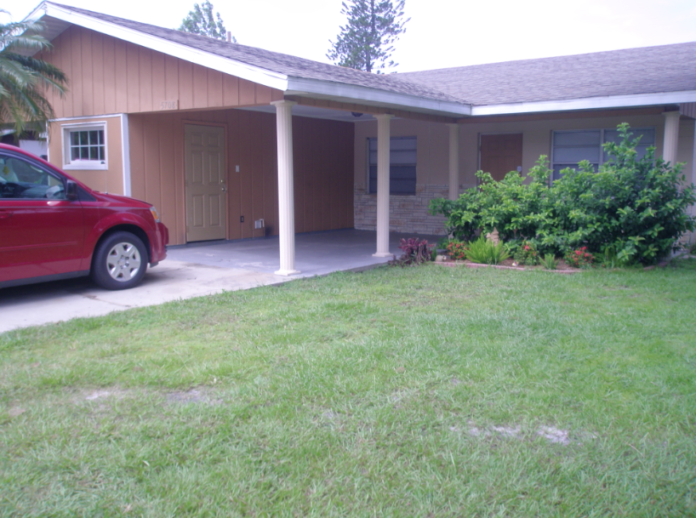
Landlord Hank’s duplex which he renovated on a shoe-string budget Renovate rental property on a budget by working with the existing floor plan. All photos copyright Hank Rossi.
Most of the shows on TV are concerned with flipping houses and getting top dollar.
I’m not going to flip my property. I’ve bought a money-making machine with my investment. Why would I sell that only to buy a bigger and better one?
One way I cut costs is to work with the existing floor plan.
Work with the existing floor plan to renovate a rental property
I’m not moving walls and creating open-concept living.
The properties I buy are themselves usually distressed, but in a decent and desirable location.
So how can you save money with a renovation?
There are several avenues one can use to control the bottom line and keep costs low for both labor and materials.
If you are skilled and have the time to do the job, you can do some of the work yourself. If you are not particularly skilled but have the time, you can learn from watching others do the job (on you-tube, if necessary).
Or, you can take classes at big box stores for all kinds of do-it-yourself projects..
Or, you can start with something small. For me it was door knobs and deadbolts.
I could take off the old ones, see how they were installed that way and read the directions in box from new ones and successfully do that little job. You have to start somewhere!
In my opinion, most folks can paint if they have the surface properly prepared for paint and make the effort to do a good job and have the right paint for the job (ask where you are buying paint, make sure it is fresh (new) and shaken.
Paint is the single biggest job that a novice can do to renovate a rental property while making a huge statement about your property.
You want to find a color that will appeal to the most tenants, and do a good job. Painting needs to be done after any construction is already finished but before carpeting is laid (you’ll probably have to touch up).
Find a talented handyman
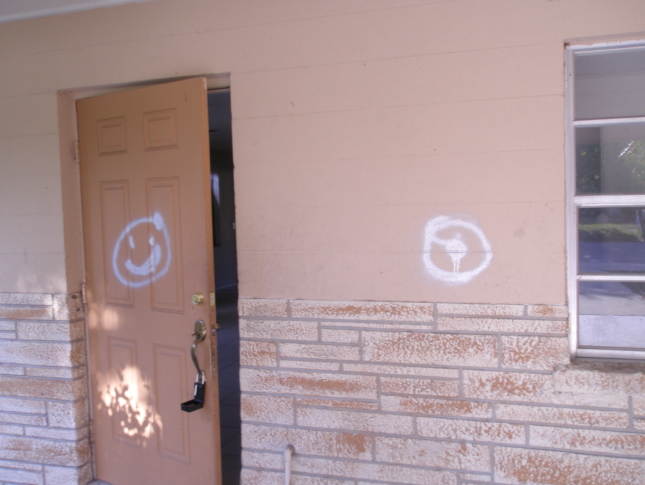
Landlord Hank’s duplex with the graffiti before he began the renovation.
You’ll also want to find a talented handyman that has the time and skill to devote to your project.
He doesn’t have to do every job but should be able to do many facets of the work needed.
You may need an electrician, HVAC contractor, or plumber, too.
So start asking friends and family who they’ve used and would recommend-then check references and work.
What about material for you property? This can be a huge expense depending upon source.
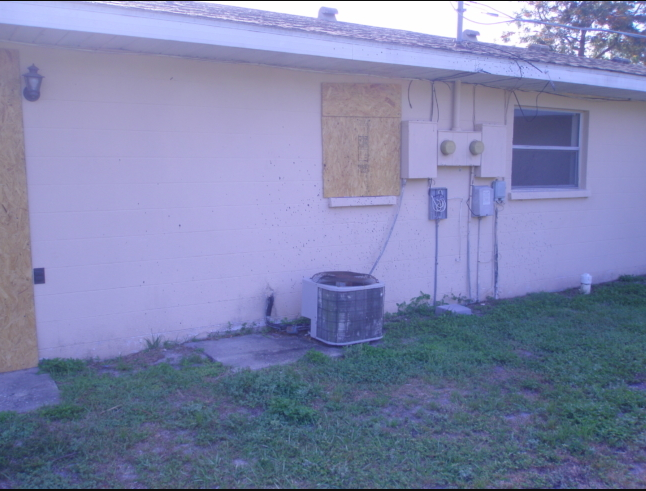
I want to walk you thru a relatively recent acquisition and renovation. It was a light job. The property had a relatively new roof, is block construction so it is solid. This property is a duplex-3 bedrooms and 2 bathrooms on the left and 2 bedrooms 1 bathroom on the right. There is a laundry room off the car port. Here are some before photos:
Here is what I was facing in my renovation of a rental property
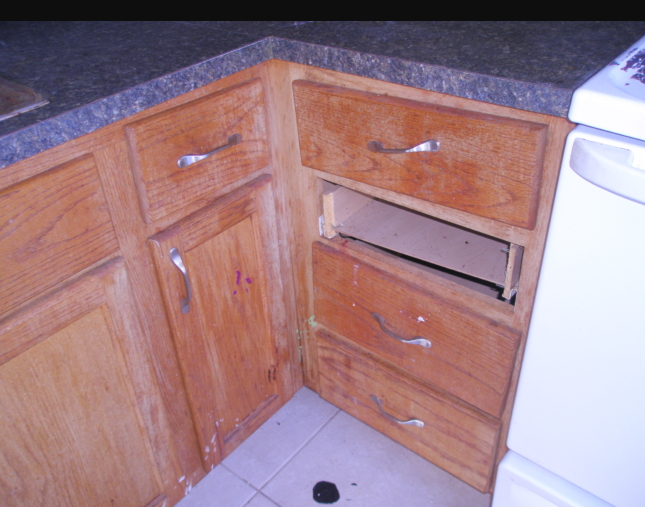
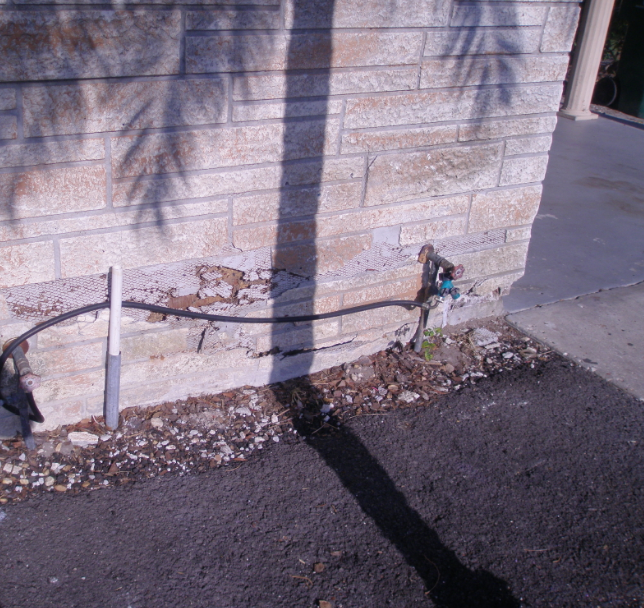
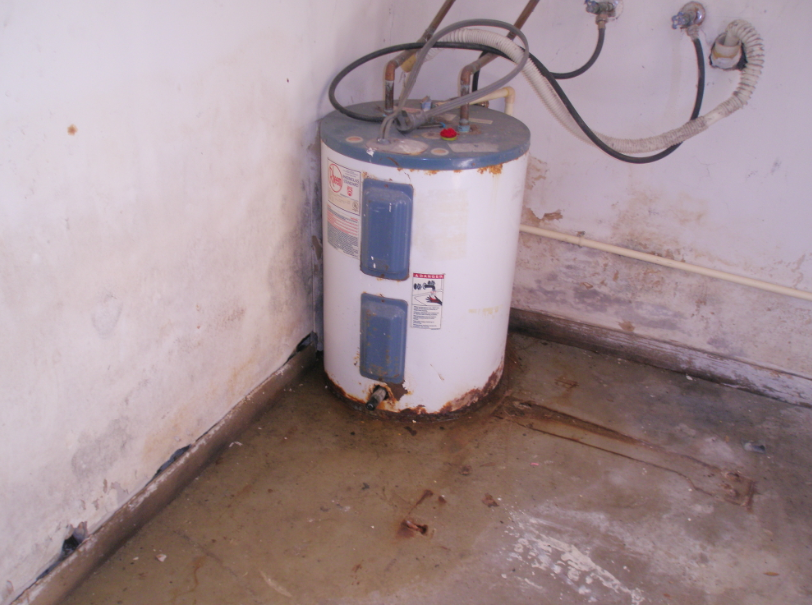
Landlord Hank’s duplex renovation included kitchen cabinet issues seen here before he began workAn area of termite damageOne non-functional hot water heater and one missing hot water heater.
This is what I knew was needing repair or replacement at time of purchase from my own inspection and my home inspectors report.
Termite damage to porch and front wall of laundry room.
Boarded up windows and doors.
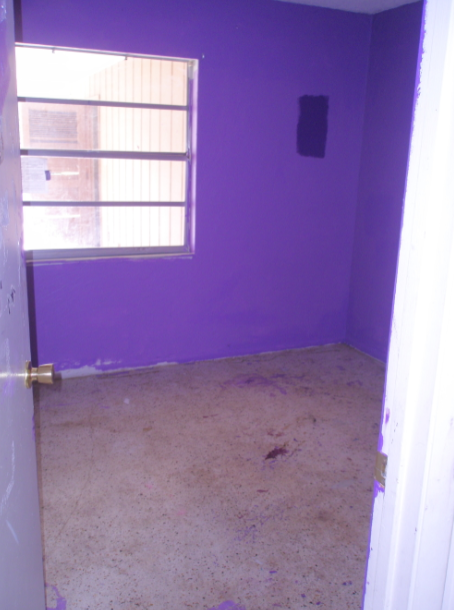
Vandalized paint on the exterior and interior of the property.
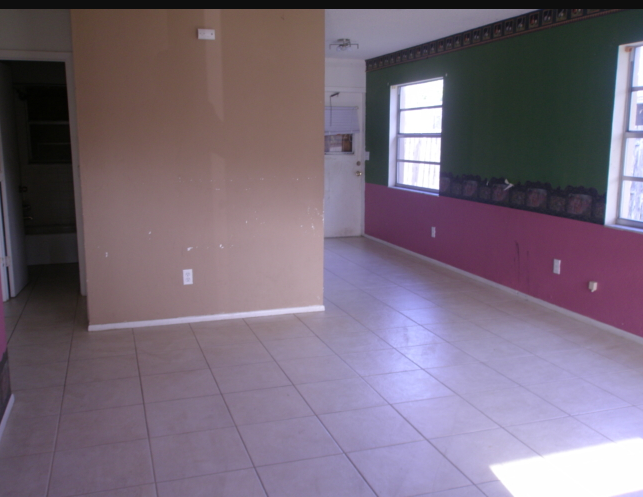
Filthy carpeting in all five bedrooms
Sheet rock damage to walls
Doors with holes in them
One AC condensing unit worked (kind of-this is the outside portion of the AC system)
Kitchen cabinetry damaged-some door fronts missing, etc.
One missing hot water heater and one non-functional one.
Falling down fence around sides and rear of property.
Missing appliances in one unit-the other had a functional stove and refrigerator.
No dishwasher or microwave, nor place for one in either kitchen.
Stripped and leaking bathroom shower handles and diverter valve ( the middle shower handle that controls if water goes to spout or shower head).
Both circuit breaker panels were good and functional
The plumbing drains all worked and didn’t leak.
Filthy carpeting in all five bedrooms was what Hank was facing in his renovation.
The property was well laid out with good floor plans and rooms were of good size.
I had my renovation planned out after closing
After closing, I had my renovation planned out, with my mind always on the bottom line.
First, I wanted to stop any more possible damage and deterioration.
I knew the roof wasn’t leaking. So that everything is safe from the rain, except the boarded up and broken window. Also there was the plumbing leaking into walls and mold.
I kept the water to the plumbing fixtures off and repaired the windows first. Luckily the windows themselves were not damaged. The glass had been broken and since it was single pane glass, I could easily repair myself.
I removed old glass and glazing from the broken windows, carefully measured, went to a big box store, had glass cut to fit, replaced the glass and reglazed. That job was done on first day.
I also replaced all the blinds with one-inch mini-blinds. They are inexpensive. They look good and are easy to install.
Next we cut into the wall by the leaking shower. How did I know where to look?
The mold growing on the outside of the wall was a big clue. Found out the shower was leaking due to missing grout between the tiles on the wall.
This was an easy fix. Then the mold cleaned up properly and after lots of testing over a couple of weeks the wall was closed up.
I didn’t want my new property looking like it should be condemned so I bought some matching paint for the exterior and painted over the vandalism. I picked up all the trash and cut the grass and trimmed bushes.
Now the property looked decent from the street. There were no windows boarded up. The signs of vandalism were gone. The property neat, clean and well groomed.
Next up on renovating a rental property on a shoe-string budget
Next time, we move forward with the renovation and now I have to buy appliances, flooring, doors, trim, molding, light fixtures, ceiling fans, paint, etc.
If you go to the big box stores for these purchases that is certainly an easy way and maybe the only way to get what you need but are there options that could save you a ton of cash? Yes!
Read Part Two In The Series:
Landlord Hank working on his rental renovation. Landlord Hank says, “Can you renovate a rental property on a strong-string budget? Yes, it can be done and come out great!
Ask veteran landlord and property manager Hank Rossi your questions from tenant screening to leases to pets and more! He provides answers each week to landlords.
Veteran property owner and manager Justin Becker has some ways you can get more rental applications in this time of the pandemic.
By Justin Becker
How do you get more rental applications? This is the cornerstone question for any property manager. Quite simply, to draw in new business and ensure you have the tenants that are right for you, you need to have good strategies to increase the number of rental applications you take in. However, the ways that we garner new tenants are constantly evolving.
Property managers must consider that what has worked in the past now has to be shifted for the future. What are the new solutions to get more rental applications by increasing innovation and strategy?
Here are six ways you get can get more rental applications:
No. 1: Lower the Price of Rental Applications
The rental-screening process is imperative to ensure that the right people move into our apartments and rental houses.
By looking at the prospective tenant’s household information, income, and longevity of employment, as well as general background information, we can vet an applicant before they even set foot on our property. For this reason, rental applications are paid for by the renter to recover the cost incurred and so that potential tenants are well-informed of the requirements of renting the property.
However, since rental applications are not priced for profit, and the screening-report fee is nominal, this is a great way to get more rental applications during the pandemic. Show potential tenants that you have their best interests at heart by offering free or discounted rental applications. Since filling out an application is a commitment, tenants who see free or discounted applications are more likely to connect. If you have income-based apartments, this is even more of a great selling point.
No. 2: Offer Specials and Move-In Perks
Move-in perks and rental specials are always a phenomenal way to get more rental applications.
For instance, you can offer a $399 security deposit to entice potential tenants. However, you must also mention any requirements there might be, such as credit-score restrictions. Another special could be a free first month’s rent or delayed rent—for instance, no rent until February 1st. Move-in perks like discounts on local eateries or simply offering a welcome package are fun ways to get tenants interested.
When a tenant thinks they may get a stellar deal on a new place, they are more inclined to fill out a rental application and seal the deal.
No. 3: Unleash the Power of Digital Marketing
Digital marketing refers to marketing efforts made through websites, email, and other internet applications.
The pandemic has made the use of digital marketing and digital applications a must-have for property managers. Social media, email marketing, and digital advertising are powerful ways to help your properties get seen. For instance, while social media is already a common way to get in touch with potential tenants, the pandemic has made it a premier way to respond to inquiries about properties. Tenants that can no longer visit the property face-to-face can still get in touch through social media at a time that is convenient for them.
Among the above efforts, one of the most effective is digital advertising, especially when it comes to niche display.
For instance, many sites such as Trello.com, Apartments.com, Trulia.com, and more, offer advertising. Research has shown that the pandemic has caused these sites to get more hits than they did pre-pandemic. You can capitalize on this increase in search by tapping into the digital-advertising realm. For many of these sites, you can pay a slight fee to get your apartment or rental home shown at the top of search listings. The key to using these sites is to understand the return on investment based on the advertising dollar spent. For instance, Zillow charges $9.99 a week and has become one of the best sources of quality leads. The return on investment is high because if just one unit is rented, we have made that advertising dollar back 20 times over.
No. 4: Find Programs That Help
Similarly, the pandemic has also created a need to be innovative when it comes to digital applications.
One of the most common is online email and lead capture. By having these on your website, you can automate the process of receiving tenant applications. Future tenants love to fill out the information on their time rather than by calling directly or visiting the property physically.
Another digital application that is helpful to have onsite is a chat-box application. This application will come programmed with a script that will respond to the most common questions. Property managers love this because it allows them to interact with customers without doing so directly. This can cut back significantly on time that can be spent elsewhere, and potential tenants love it because it allows them to reach out 24/7.
Having these programs makes it easier for future renters and yourself, especially during a pandemic, so highlighting them can increase interest in your rental properties and the overall number of rental applications you get. Keep in mind that they can have large upfront costs, and they may not be right for everyone.
No. 5: Showing off Your Amenities
Do you have a swimming pool?
What about other outdoor amenities, such as a dog park or basketball court?
Amenities are one of the best ways to separate your business from those of your competitors. What do you have that other apartment and rental houses do not offer? What do you have that is better or bigger? This is what tenants are interested in.
During the pandemic, however, the amenities you spotlight may need to change.
For instance, you can highlight the regularity with which your amenities are cleaned. You can also highlight any outdoor spaces you have in a way that showcases how open they are. After all, social distancing is easy in a dog park. Another example is those who have mobile homes for rent. You can highlight the fact that there is an ample amount of open space around these units. Since many people are now working from home, you can showcase any community spaces and bill them as co-working spaces. Amenities are a great way to increase your rental applications because future tenants love knowing there are community offerings.
No. 6: Highlighting Your Precautionary Measures
What safety and precautionary measures do you have in place?
While safety should always be the highest priority, you may need to get creative in how you market these health considerations.
To get more rental applications, tenants must first know that you have their health and safety in mind. This is especially true during the pandemic. What precautionary measures are you implementing for COVID-19? Describe specific cleaning schedules, how amenities are cleaned, and what your mask requirements are. You can also highlight any additional health and safety steps you have taken for the guests themselves, such as extra hand sanitizer, gloves, masks, or quarantine boxes. Of course, once you put out this information, you must then do what you say you will do.
Rental Applications Conclusion
Although the pandemic has been a time of unprecedented uncertainty and hardship, it is also a time for solutions.
The best way to increase your rental applications, no matter what time we are living in, is to think outside the box. Creativity breeds results. How can you be creative and proactive when it comes to highlighting your rental property business? This is the key to ensuring that you will always have a plentiful number of rental applications.
About the author:
Justin Becker is a property owner in the state of Michigan and has a passion for managing communities. He owns apartment complexes and mobile home communities, and has been writing his own blogs for his properties for several years.
Landlords need to band together in 2021 to deal with actions of city councils, state legislatures and federal agencies across the United States.
By David Pickron
With the advent of DNA testing, more and more people are looking at their ancestry and learning vital information. What is their heritage? Do they have a direct line to royalty? Are there certain markers in their genetics that expose them to specific illnesses or maladies? It is often by looking backward that we can discover and prepare for our future.
By applying that same methodology to the business of being a landlord, I have discovered the answer to the question I am repeatedly hearing from hundreds of landlords: What do you think 2021 will bring?
Let me begin with a positive response: Great things are around the corner. I also caution that we must prepare for challenges, as the liberal policies that will inevitably come from seemingly united legislative and executive branches of government will directly affect our industry. As a private investigator, if I were hired to do a background check on the more liberal parts of our country in an effort to better understand the how and why of where they are in relation to landlords, I’d simply need to look back at the recent history of actions of city councils, state legislatures and federal agencies across the United States to determine what we can expect in the future.
The Degradation of America’s Great Cities
If you’ve recently visited some of the most notable cities in the country, you see they are riddled with homeless individuals, many mentally ill, some addicted to drugs, some with lengthy criminal records.
While it’s an admirable position to help where we can, the programs and allowances given to these individuals has created a very challenging environment for landlords in these cities. The shortcomings of government assistance and programs is they rarely fix anything. The government shut down mental institutions in the ‘70s, leaving no alternative for many who ended up on the streets. Programs to eliminate illegal drugs seem ineffective, https://neurofitnessfoundation.org/ambien-zolpidem/ as drugs pour over our borders in record numbers. With the legalization of gateway drugs, more and more users could end up committing crimes and eventually joining the ranks of the homeless.
On the legal side, courts are deferring and dismissing most cases that come through the court, removing the consequences of illegal behaviors. For example, if you steal something in San Francisco that is valued under $750 and claim it was an act of survival, then in the eyes of the law, no crime was committed. So, who pays for these changes of the past? Not the government. Business owners, like landlords, are seen as the source of funds to subsidize for the effects of these criminal acts. It’s a modern-day Robin Hood if I’ve ever seen one. Its almost as if these government entities are saying “we can’t fix it,” so let’s make landlords responsible for the fix.
Here are a few examples of how landlords are being treated in cities governed by liberal policies around the country:
Chicago: Windy City landlords have to follow a precise onboarding process dictated by the city. A landlord must first run an applicant’s credit and give a preliminary approval. After that they can run a criminal history, but if you deny them as a tenant, you must provide a reason as to why that crime would affect the rental.
Portland: Rose City landlords may raise rent only seven percent per year. Landlords can terminate a month-to-month lease for any reason for the first year, but after that, you must have a justified reason to ask your tenant to leave or you will be forced to pay the tenant’s relocation cost, which is $4,500 for a three-bedroom.
Seattle: Landlords in the Emerald City must rent to the tenant who has the first qualifying application, called first-in-time, and they cannot perform a criminal background check on a potential tenant. The city controls almost every rent, deposit, and fee you can imagine
Colorado: Centennial State landlords must accept Section 8 housing; they have no choice. They cannot discriminate against “source of income” or who pays the rent.
Nationally: Landlords have been forced to carry tenants for months without being able to evict due to several eviction moratorium decisions handed down through the U.S. Legislature and executive branch.
These are just a few of hundreds of laws stacked against landlords around the country. As you can see, they are coming from all levels of government: city, state and national.
Landlords in Lockstep
As a group, how can smaller landlords even compete with the massive strength of these government entities?
This is the year of banding together. If you are not part of a local or national association, it’s time. We need representatives in our local, state, and federal government to fight for us. We need attorneys filing lawsuits and taking our cause to the Supreme Court. I believe property rights will be on the table, and possibly hang in the balance, in the next 4 years.
It’s not all doom and gloom … just the opposite.
Landlords are smart and, in the end, we will win. Being a landlord is the best job in the world, we just have to be willing to pivot and know we will have some fights that start at city hall and make their way to the highest courts in the land. By banding together, arm in arm, we can overcome any challenge the government throws at us.
I am grateful for the amazing years I took for granted, but my instinct says we must roll up our sleeves and get to work; but we as landlords are used to that. In the end, the Constitution drafted by our founders will be the saving grace, as they were wise enough to know that property rights are at the core of being American.
2021 is the year of getting your house in order and then banding together with others in your local, state and national landlord associations. To find your local REIA go to https://nationalreia.org/find-a-reia/
Think about banding together with other landlords in your local, state and national landlord associations
About the author
David Pickron is President of Rent Perfect and a fellow landlord who manages several short- and long-term rentals. He is a private investigator and teaches organizations across the country the importance of proper screening. His platform, Rent Perfect, was built to help the small landlord find success. Subscribe to his weekly Rent Perfect Podcast (available on YouTube, Spotify, and Apple Podcasts) to stay up to date on the latest industry news and for expert tips on how to manage your properties.
Can you renovate a rental property on a shoe-string budget is a three-part series by Hank Rossi, our Ask Landlord Hank, a veteran landlord and property manager, on his rental renovation how to reduce material costs and labor.
By Landlord Hank
So in Part 2 the floor was finished and it looks fabulous. Here is part three is the final result.
The baseboards in the bedrooms had to be removed and they fell apart in doing so. I found killer deal on Craigslist for brand new baseboards.
Later that week I bought five, six-panel doors to replace damaged doors in my unit for $10 each. Also needed an exterior door-$25 on Craigslist.
I had my maintenance supervisor in Atlanta load up his truck from our supply warehouse (my basement) and bring down five new windows, (from the house being torn down), a new HVAC condensing unit (one was not working), nice lever door handles (yard sale), etc.
He put in baseboards, hung new doors and painted both sides of the duplex and laundry rooms.
Kitchens were too small so I moved the refrigerator
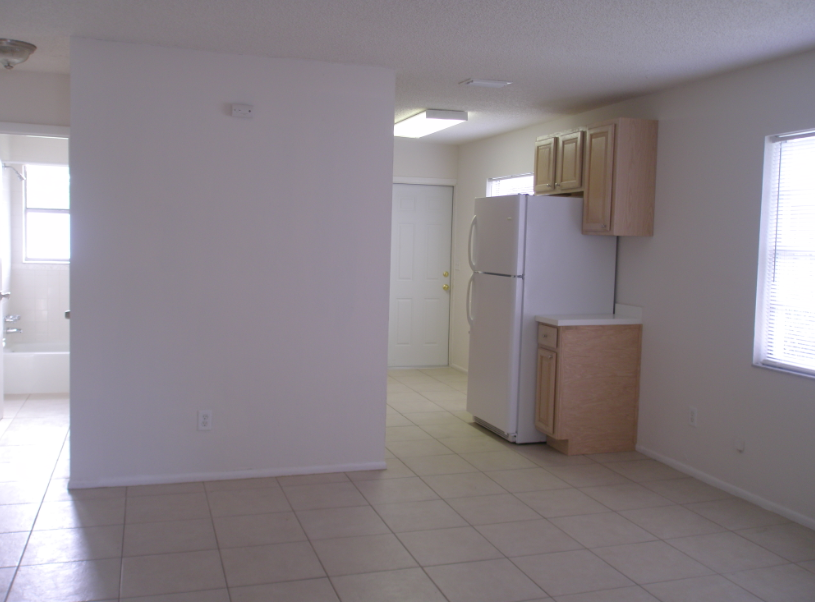
The kitchens were small and not really very functional-no microwave or dishwasher and not enough prep area or storage.
I decided to move refrigerator to other side of the room and put some cabinets around it.
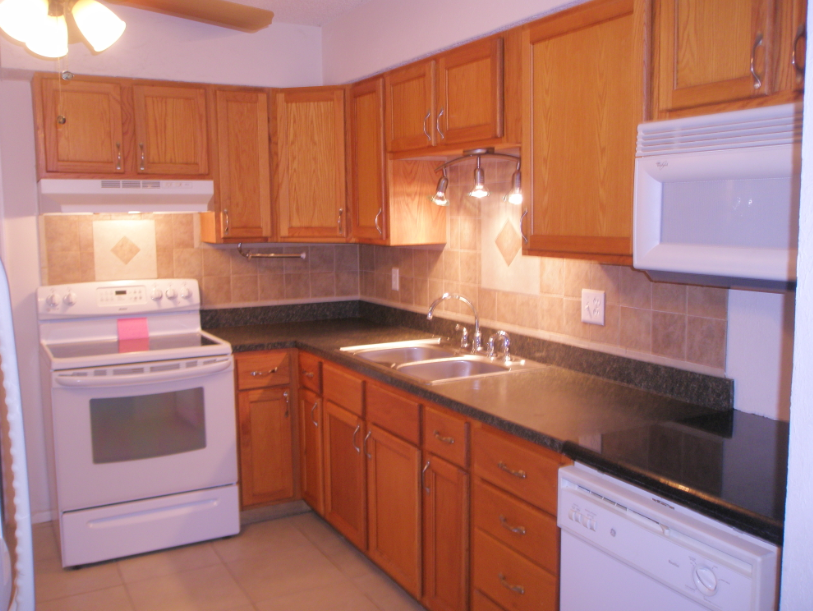
I found a large cabinet on side of the road!! It worked perfectly and was in great shape. I picked up another from a yard sale and it was a perfect match with cabinets.
On the other side of the duplex, we did the same thing.
I had a friend in charge of a kitchen remodel and I picked up some nice cabinets for free. Moving the refrigerator to the other side of the room left space for a dishwasher and microwave and now the kitchens were large and well equipped.
I picked up some scrap granite and fitted it on top of the dishwasher. New yard sale lights and ceiling fans and now kitchens are almost finished.
I had a couple of drawers repaired, all cabinets sanded and stained. Voila! A nice, new kitchen.
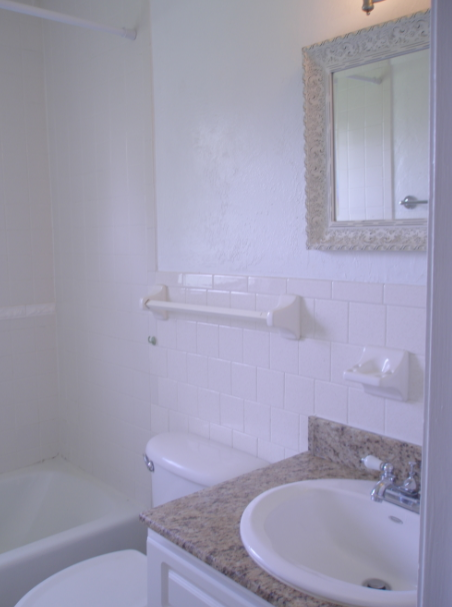
Craigslist also provided a nice granite topped vanity for bathroom ($150). Windows were put in on the left and finishing touches were done.
My neighbor at this property is a landscaper. He also does other related side jobs. He fenced my yard, left side and rear, with fence he had replaced on a job. I stained it all and now we have a private space.
My wife found a Publix grocery store that was re-doing landscaping. We took two truck loads of just removed plants and since she loves gardening it was a no-cost install – well, a backrub and dinner!
Total cost for the renovation of a rental property on a shoe-string budget
Flooring tile and labor – $1,400
Baseboards – $100
Doors – $75
Paint and labor – $700
Termite damage wall and beam – $1,200
HVAC condensing unit which was in my storage – labor $350
Vanity $150
Two dishwashers, two microwaves, one stove and one refrigerator – $475
Labor in kitchen for cabinet installation, repair of existing cabinets, sanding, staining, dishwasher and microwave installation, granite counter tops over dishwasher – $650.
Window installation for five windows I already had – $750
Blinds – $400
Fencing installation and staining – $1,025
Three ceiling fans which came new in box from a friend who changed his mind – $100
One water heater from garage sale -$40 and from Craigslist $50, installation – $100
$1,000 for miscellaneous which was: A few tiles replaced in bathroom surround, new stems and handles in bathrooms, replacement of water cut offs inside and out, medicine cabinet, lights, some switches and outlets, all new door locks, professional cleaning and extermination
Landscaping-free and sweat on our part
Total $8,565
This renovation could easily have cost $30,000 for the scope of work and great result.
Some folks would say I was lucky to have already in stock so many needed replacement items-HVAC condensing unit, windows, etc.
I’d say that is a combination of luck and planning ahead.
I’m very pleased with the renovation results and the overall cost.
We did quality work which should keep the money rolling in on this building for many years.
So how did it go with the tenants?
Note from Hank: I rented my two bedroom side. I took the 7th applicant-the others either didn’t make enough money, had poor credit, or rental history or criminal history. The rent on the two- bedroom is $975 and the three bedroom rents for $1050. The three bedroom folks just renewed so I left the rent at $1050. Tenants pay all utilities and I take care of landscaping.
See finished product below:
Landlord Hank says, “Can you renovate a rental property on a strong-string budget? Yes, it can be done and come out great!
Ask veteran landlord and property manager Hank Rossi your questions from tenant screening to leases to pets and more! He provides answers each week to landlords.