The charge of discrimination under the Fair Housing Act came due to the manager refusing to grant the prospective tenant with a mental health disability a reasonable accommodation to waive the required pet deposit for her assistance animal, according to the release.
The release says HUD charged Dahms Investments LLC, the owner of duplex apartments in Hamilton, Missouri, and their property manager, with the Fair Housing Act violation.
After being told of the pet fees, the prospective tenant told the property manager they could not require a deposit for an assistance animal “and offered to provide a letter from her physician recommending the assistance animal,” according to the complaint.
The manager remained firm on the pet-deposit fee, telling the prospective tenant that “a physician’s letter did not matter,” the complaint says. The charge further alleges that the property manager told the woman that rules related to assistance animals only applied to “individuals who are blind and/or deaf.”
Housing providers do not determine who needs an assistance animal
“It’s not a housing provider’s role to determine who does or does not need an assistance animal,” said Jeanine Worden, HUD’s Acting Assistant Secretary for Fair Housing and Equal Opportunity, in the release.. She added the HUD discrimination “action demonstrates HUD’s commitment to ensuring that the owners and managers of rental properties comply with the nation’s housing laws.”
The Fair Housing Act prohibits housing providers from denying or limiting housing to people with disabilities, or from refusing to make reasonable accommodations in policies or practices when necessary to provide persons with disabilities an equal opportunity to use or enjoy a dwelling. Prohibitions include not allowing people with disabilities to have assistance animals that perform work or tasks, or that provide disability-related emotional support.
According to the HUD discrimination complaint, the manager “responded that complainant (prospective tenant) did not look like she had a disability and asked what the disability was? The prospective tenant told the manager that by law they “could not ask that question” and the manager replied then “I’m sorry then we can’t help you.”
The prospective tenant provided a letter from a psychiatrist dated September 21, 2016 that stated caring for an animal “was a therapeutic experience” for her and “advised that it can be beneficial to have a pet.”
During the fair-housing investigation, the prospective tenant provided an updated letter from the psychiatrist dated October 9, 2019, which reads, “This letter is to recommend allowing to have her pet ‘dog’ https://holisticdental.org/xanax-treat-anxiety/ for her emotional support. She is currently under my care for severe anxiety.”
The prospective tenant “stated that during the period she sought housing, she felt overwhelmed because she could not find quality housing in Hamilton where she was permitted to have her assistance animal, and her work commute and commute to visit her mother were longer… and suffered from headaches and a loss of appetite as a result of her inability to find housing.”
Many landlords and property managers had a tough year in 2020 with lost revenue and continue to struggle with some tenants heading into 2021 so here are 5 ways you may increase rental housing revenue or rent this year.
By Justin Becker
With 2021 finally here, it seems like we might finally be moving toward some semblance of normalcy. In recent months, landlords and building owners were just thankful to receive regular rent from their tenants. Now, however, it might be possible to increase rents and rental housing revenue to start covering your losses.
Raising the rent might not be the best way forward, especially as the pandemic is still going on in most parts of the world. We don’t want to punish anyone simply because they’re renting from us. But it might be possible to generate rental housing revenues in other ways.
Let’s have a look at some of these methods now and decide upon the best ones for your needs.
1. Rent Out an Amenity
Amenities are something you have to provide to renters. But you can provide some extras at an additional price. If any amenity is particularly in demand, such as parking space, you can rent it out to get additional revenue.
You can get even more revenue by charging more for parking during days when the area is more crowded than usual. For instance, if a city has a monthly or yearly festival going on, parking can become a precious commodity. The rates of parking will go up everywhere. So, there’s no reason why the space on your property will remain the same.
Keep in mind that you can offer parking to people who are not your tenants. If the tenants have an issue with cars taking up space so close to their living places, you can offer them a fraction of the revenue collected.
There might also be a permanent demand for parking on your property. In such cases, think about installing a parking lot or parking pad. You might allot one space to each unit you’ve rented out and keep the rest for paid parking.
2. Charge Separately for Utilities
Landlords and managers can increase their rental housing revenue by billing residents for their water usage on a separate basis. You can also raise the water rate instead of directly increasing the rent.
This method might work best in a mobile-home community. When someone sees a sign or commercial advertising mobile homes for sale, they won’t automatically assume that all utilities are included.
It might also be possible to invest and become a utility on your own. This means that you get some solar-powered grids, the kind that allows two-way transfers. This means that you can sell off the excess electricity. Fortunately, modern solar panels are now quite sleek and look more like terracotta or slate tiles.
3. Upgrade Your Services
While your residents might not like to pay higher rent, they might be happy enough to pay for an extra or upgraded service. This option also means that residents who can afford to pay a little extra will do so. Those who are really struggling to make ends meet will have a choice about what to pay for.
One logical way to go about this is to look at present services that might need a bit of tuning up. Consult your residents or tenants. That way, you can put up a suggestion box to get feedback on what needs improvement. For instance, if residents complain about the trash pick-up service, you should take a look at doing something about it.
With that improved service, you can raise the price along with the upgrade. Residents should be happy about the better services and gladly pay up in return. This increase in revenue will also set off the costs of improvement.
Apartments for rent usually have several services. But renters might appreciate some extra options. This could include housekeeping, lawn-mowing, landscaping, and so on. Of course, this doesn’t mean that landlords provide this service through their own labor; you can hopefully find a decent service provider who is local and relatively inexpensive. It might be possible to get a bulk discount based on the number of customers you’d be providing them with. Collaborate with such providers, and you might be offering their services to tenants after getting a cut or a commission.
Take a close look at the resources you have and think about how you can turn them into services for renters. If you have extra office space, think about renting it out as storage. The same goes for an unused basement or a garage.
4. Agricultural Collaboration
While you’re getting creative, think about going to a sort of tenant farming setup. If a landlord has the farming space, they might be able to get some tenants to farm it if they’re interested. Both parties can then share the profits as well as the costs. This activity will reduce the risks and increase the benefits for all concerned.
Don’t think that you have to stop at growing crops, either. Again, think in a flexible and creative manner.
Of course, most urban landlords don’t have this luxury. If you’re one of them, consider other agricultural venues such as a farmer’s market, a community garden, or anything else where you can get together with your tenant to grow crops and sell them for a tidy profit.
Think outside the box here and see what your property has to offer. It’s possible that the soil and/or climate where you live is perfect for producing high-quality grapes or some other fruits/vegetables. In addition to selling these off within your community, the growing plants will enhance the aesthetics of the place, increasing the rental rates automatically. Any new tenants shouldn’t have a problem in paying higher rates for a more natural and beneficial atmosphere.
Don’t think that you have to stop at growing crops, either. Again, think in a flexible and creative manner. Many people are looking at drop-shipping crickets, earthworms, and anything else they can obtain from the soil. The world is changing due to this pandemic. So, we all have to do the same to survive and succeed.
5. Earn More from Existing Residents
When your tenants have been around for some time, you might be able to raise the rents more easily. You’ve developed a relationship with them. So, it’ll be more understandable if you raise the rents of people who’ve been there for over a year.
If you don’t feel right in raising the rate directly, think about offering some perks to old and trusted residents. One of the best ways to do this is to rethink your policy of allowing pets. Many rental properties don’t allow residents to keep pets for several reasons. However, when you’re sure that a tenant is responsible and trustworthy enough, you might be able to let them keep pets in return for a nonrefundable fee or even a monthly amount (or both). When you add up all the fees collected, they could add up to a tidy amount of rental housing revenue.
If you don’t feel right in raising the rate directly, think about offering some perks to old and trusted residents. One of the best ways to do this is to rethink your policy of allowing pets.
Another way of going about this is to implement strict late fees, especially for tenants who’ve made a habit of delaying payments. Landlords might feel all right with waiving late fees for some time. But they do so at their own expense.
The Takeaway
It’s hard to keep up with the costs of maintenance, vacancy rates, and other expenses related to property management. Raising rents and rent revenues will give you the cash flow you need for investing in more property. The ways we’ve discussed above will allow you to get creative and increase revenue without hurting your tenants. So, start thinking about implementing some of them in the near future.
About the author:
Justin Becker is a property owner in the state of Michigan and has a passion for managing communities. He owns apartment complexes and mobile home communities, and has been writing his own blogs for his properties for several years.
The U.S. Department of Housing and Urban Development (HUD) has announced a new directive to begin implementation of the policy set forth in President Joe Biden’s executive order to prevent and combat sexual orientation and gender identity-based discrimination under Fair Housing rules.
HUD’s Office of Fair Housing and Equal Opportunity (FHEO) issued a memorandum stating that HUD interprets the Fair Housing Act to bar discrimination on the basis of sexual orientation and gender identity and directing HUD offices and recipients of HUD funds to enforce the act accordingly.
“Housing discrimination on the basis of sexual orientation and gender identity demands urgent enforcement action,” said Assistant Secretary of FHEO Jeanine M. Worden in a release. “That is why HUD, under the Biden administration, will fully enforce the Fair Housing Act to prohibit discrimination on the basis of gender identity or sexual orientation. Every person should be able to secure a roof over their head free from discrimination, and the action we are taking today will move us closer to that goal.”
The HUD release said the significance of this action is underscored by a number of housing-discrimination studies which indicate that same-sex couples and transgender persons in communities across the country experience demonstrably less favorable treatment than their straight and cisgender counterparts when seeking rental housing.
Despite this reality, the HUD has been constrained in its efforts to address housing discrimination on the basis of sexual orientation and gender identity by legal uncertainty about whether most such discrimination was within HUD’s reach.
The memorandum relies on “HUD’s legal conclusion that the Fair Housing Act’s sex-discrimination provisions are comparable in text and purpose to those of Title VII of the Civil Rights Act, which bars sex discrimination in the workplace. In Bostock v Clayton County, the Supreme Court held that workplace prohibitions on sex discrimination include discrimination because of sexual orientation and gender identity. HUD has now determined that the Fair Housing Act’s prohibition on sex discrimination in housing likewise includes discrimination on the basis of sexual orientation and gender identity. Accordingly, and consistent with President Biden’s executive order, HUD will enforce the Fair Housing Act to prevent and combat such discrimination.”
“Enforcing the Fair Housing Act to combat housing discrimination based on sexual orientation and gender identity isn’t just the right thing to do—it’s the correct reading of the law after Bostock,” said Damon Y. Smith, principal deputy general counsel, in the release. “We are simply saying that the same discrimination that the Supreme Court has said is illegal in the workplace is also illegal in the housing market.”
The memorandum directs actions by HUD’s Office of Fair Housing and Equal Opportunity and HUD-funded fair housing partners to enforce the Fair Housing Act to prohibit discrimination on the basis of gender identity or sexual orientation. Specifically, the memorandum directs the following:
HUD will accept and investigate all jurisdictional complaints of sex discrimination, including discrimination because of gender identity or sexual orientation, and enforce the Fair Housing Act where it finds such discrimination occurred.
HUD will conduct all activities involving the application, interpretation, and enforcement of the Fair Housing Act’s prohibition on sex discrimination consistent with its conclusion that such discrimination includes discrimination because of sexual orientation and gender identity.
State and local jurisdictions funded by HUD’s Fair Housing Assistance Program (FHAP) that enforce the Fair Housing Act through their HUD-certified substantially equivalent laws will be required to administer those laws to prohibit discrimination because of gender identity and sexual orientation.
Organizations and agencies that receive grants through the department’s Fair Housing Initiative Program (FHIP) must carry out their funded activities to also prevent and combat discrimination because of sexual orientation and gender identity.
FHEO Regional Offices, FHAP agencies, and FHIP grantees are instructed to review, within 30 days, all records of allegations (inquiries, complaints, phone logs, etc.) received since January 20, 2020, and notify persons who alleged discrimination because of gender identity or sexual orientation that their claims may be timely and jurisdictional for filing under this memorandum.
An opinion piece by Jeremie Dufault, a member of the Washington State House of Representatives on why rent vouchers are better for tenants and landlords.
Government shouldn’t be able to give away something it doesn’t own. But that’s what happened when Gov. Jay Inslee stopped property owners from evicting nonpaying tenants. He took something of value from the landlords and gave it to the tenants.
Who should pay for this new social policy?
Right now, the governor is forcing property owners to foot the bill, but is that fair, or even legal? Shouldn’t social policy be funded through taxes? Especially during short-term emergencies? After all, government doesn’t force grocery stores to give away food or day-care facilities to give away child care — also necessary parts of everyday life. Instead, it provides prepaid vouchers for those services to the people who need help.
Why doesn’t the state do the same thing for tenants who — through no fault of their own — have been financially affected by COVID-19? Why doesn’t the government give them rent vouchers?
The governor and legislature need to either do this or otherwise craft a plan that reimburses property owners who are serving the public good by housing nonpaying tenants during the COVID-19 pandemic. It is the smart and moral thing to do.
Rent vouchers keep tenants from falling behind in rent
Rent vouchers not only keep tenants from falling behind on their payments but they provide property owners the income they need to pay their mortgages and other bills. An eviction moratorium does neither.
A word about rental-property owners. Did you know that most of them own just a handful of units? Or maybe just one? And that most single-family rentals are long-term retirement investments that take years to produce a nickel of profit? That may not be true in much of urban Washington, but it is definitely true throughout the rest of the state, including in the Yakima Valley, where I live.
Another consideration: Both the federal and state constitutions prohibit government from interfering with private contracts and taking property away from citizens without compensation. The eviction moratorium ignores both of those prohibitions and leaves our state open to expensive litigation down the road.
The governor and the Democrat majority of both houses of the legislature have shown they care more about tenants than property owners — a bias made obvious over the last two sessions as they enacted an assortment of laws that made it harder to collect rent from and evict nonpaying tenants.
But this is different. This is not a tenant-versus-landlord issue. It is about fairness. Should the governor be allowed to use the emergency powers given to him during a pandemic to require private businesses to provide a service for free?
The answer is clearly no.
State government needs to provide extraordinary services during these extraordinary times. But it needs to do so legally and fairly.
Contact your legislators and encourage them to work on a bipartisan basis to create a rental-voucher program for people affected by COVID-19. And ask them to vote to end the eviction moratorium that is bankrupting property owners and burying tenants under a mound of debt.
About the author:
Jeremie Dufault is a Republican member of the Washington State House of Representatives, representing eastern Yakima County (15th District).
Here are 4 categories of apartment rent forecasts for 2021 put together by John Burns Real Estate Consulting for 127 metro-area apartment markets in their latest newsletter.
“We maintain a bullish outlook for demand, with some key differences by market. With such a wide variation across the markets, good timing could lead to great opportunities,” write Jeff Kottmeier, Lesley Deutch, and Ken Perlman, partially in a weather forecast-style presentation.
“To help you ‘weather’ (pun intended) market shifts and assess market ‘forecasts,’ we segmented the trends into four categories
“We see a positive long-term future for apartments, just on varying timelines depending on their unique locations and attributes. But in a year where the for-sale market dominated the headlines, let’s not forget that one-third of the population resides in rental housing, and the long-term future for that is bright,” they write.
Here are what they write about apartment rent forecasts the four categories:
Chart courtesy of John Burns Real Estate Consulting.
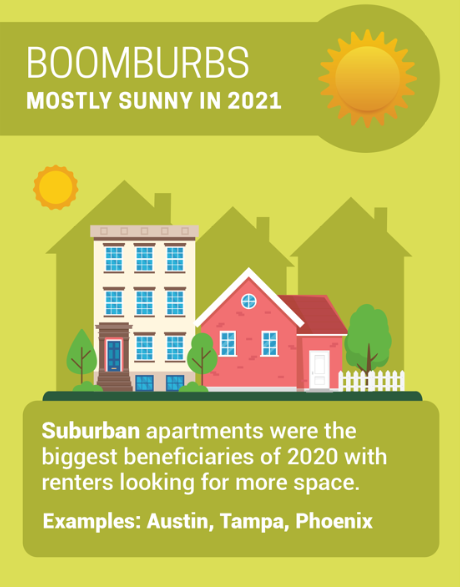
Boomburbs (Suburban Growth):Suburban-growth markets benefited tremendously from migration out of the cities during the pandemic. Their low cost of living, good quality of life, and relative affordability drew residents from across the country seeking space. We expect some (not all) of these renters to return to apartments closer to their jobs after a COVID-19 “all clear.” We are forecasting a small decline in rents (in the one percent to two percent range) in 2021 for these markets due to some outmigration (assuming COVID-19 is all but over by the fall), but a return to rental growth in 2022. Suburban markets have captured most of the positive headlines in 2020, attracting investment and development capital. We are still very bullish on locations close to jobs, retail, and entertainment, and properties that provide an “affordable alternative” to urban apartments.
2021/2022 outlook: Mostly sunny in 2021
40 percent of markets fall into this category.
Examples: Austin, Tampa, Charleston, Indianapolis, Myrtle Beach, Nashville, Phoenix
Chart courtesy John Burns Real Estate Consulting
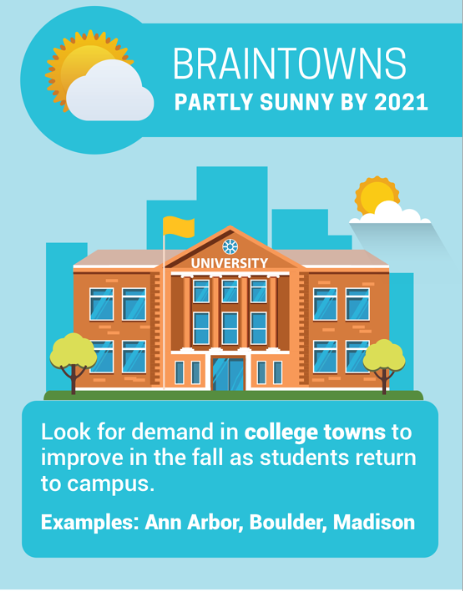
Braintowns (College Towns):These markets depend on students and were heavily affected in 2020 (five percent to 10 percent rent declines). We see demand and rents continuing to soften in the first half of 2021 in the apartments rents forecast with an improvement this fall, as more students return to campus. Properties located close to campus will benefit. More students will likely desire to live off-campus, supporting demand for apartments.
2021/2022 outlook: Partly sunny in 2021
Five percent of markets fall into this category.
Examples: Ann Arbor, Boulder, Charlottesville, VA, Madison.
Chart courtesy of John Burns Real Estate Consulting
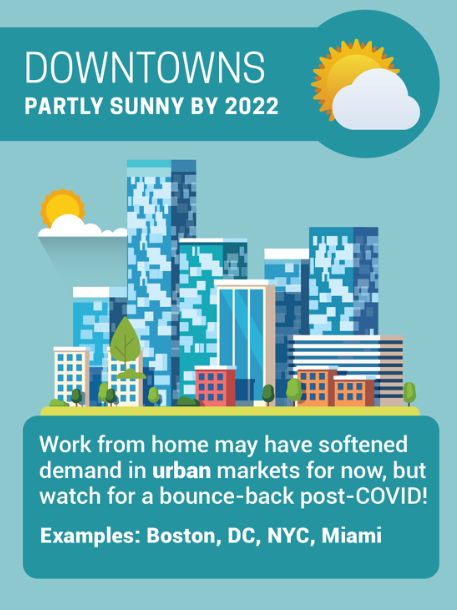
Downtowns (Urban): The pandemic and the resulting ability to work from home softened demand in the urban markets. Most markets have already experienced sizable rent declines (five percent to 15 percent) in 2020. We expect more declines in 2021, but to a lesser degree, as tenants slowly move back to the cities and some people return to work in their offices. Rent growth will be slower to recover in metros and submarkets that have elevated levels of new apartment construction and/or are under prolonged COVID-19 restrictions. Urban markets are not dead. With investors and capital moving away from urban centers, some properties may be undervalued. This could be a great time to consider investing in properties and developing closer to the urban core.
2021/2022 outlook: Partly sunny by 2022
Five percent of markets fall into this category.
Examples: Boston, DC, NYC, Miami, San Francisco
Chart courtesy of John Burns Real Estate Consulting
Dependables (Sizeable Unemployment):These are the markets to watch as eviction moratoriums expire. We expect declining rents in 2021 to early 2022 and potentially rising vacancy rates. Construction levels, however, are relatively low in many of these markets, mitigating some of our concerns. These are markets to consider for longer-term investment or development.
2021/2022 outlook: Cloudy (with a chance of clearing)
50 percent of markets fall into this category.
Examples: Minneapolis, Detroit, Kansas City, Philadelphia, Reno
While the national rent tracker shows 79.2 percent of apartment tenants paying all or some rent by February 6, which means more than 20 percent did not pay, more support is needed according to the National Multifamily Housing Council (NMHC).
“As we approach almost a full year of navigating the pandemic and the resulting financial distress, we remain encouraged by the COVID relief package passed at the end of 2020 that included critical support for apartment residents and the nation’s rental-housing industry, such as $25 billion in rental assistance, extended unemployment benefits and direct payments,” said Doug Bibby, NMHC president, in a release.
“However, as lawmakers consider further relief legislation, additional support for renters is clearly needed,” Bibby said.
Lost rents range from $27 billion to $60 billion
“Estimates of 2020 lost rent alone range from $27 billion to nearly $60 billion, despite the impact of previous federal COVID relief efforts,” Bibby said in the release.
“In the coming days and weeks, we urge members of Congress to pass legislation that directly meets renters’ basic financial hardships, protects the nation’s rental-housing industry and efficiently provides funds to those who need it most.”
Rent Payment Tracker surveyed 11.6 million units of professionally managed apartment units across the country and found that 79.2 percent of apartment households made a full or partial rent payment by February 6. That is a 1.9 percentage point, or 216,479-household, decrease from the share who paid rent through February 6, 2020, and compares to 76.6 percent that had paid by January 6, 2021.
These data encompass a wide variety of market-rate rental properties across the United States, which can vary by size, type and average rental price.
The NMHC Rent Payment Tracker metric provides insight into tenants paying rent and changes in resident rent-payment behavior over the course of each month, and, as the dataset ages, between months. While the tracker is intended to serve as an indicator of resident financial challenges, it is also intended to track the recovery as well, including the effectiveness of government stimulus and subsidies.
However, noteworthy technical issues may make historical comparisons imprecise. For example, factors such as varying days of the week on which data are collected; individual companies’ differing payment-collection policies; shelter-in-place orders’ effects on residents’ ability to deliver payments in person or by mail; the closure of leasing offices, which may delay operators’ payment processing; and other factors can affect how and when rent data is processed and recorded.
Some bright spots in the housing market and the economy are beginning to emerge, writes Yardi Matrix in its January multifamily report, but cautions there is a long road ahead.
“Nationally, rents remained relatively flat in January, declining by 0.2 percent on a year-over-year basis. On the market level, some gateway markets appear to have hit bottom, while low-cost tertiary and secondary markets continue to see strong rent growth,” the report says.
Overall rents increased by $3 to $1,392. In January, Yardi Matrix “expanded its methodology to include all 130 matrix markets in our national average calculation.”
As our market penetration continues to grow and we collect more data, we feel it appropriate to add new markets to our national calculations.
Some gateway markets that have struggled for months have begun to show signs of bottoming out. San Jose (-13.0 percent) and Washington, D.C. (-4.5 percent) both saw month-over-month gains.
“The U.S. is continuing the effort to roll out COVID-19 vaccinations nationwide, the number of workers that filed for unemployment declined for the week ending Jan. 23, and consumer spending held up well in December,” the report says.
The multifamily report points out there may be more government stimulus on the way, though the size of the package is still to be determined.
However, “the big question for many gateway markets remains how permanent out-migration trends will be. Some industry sources are speculating that only about half of the moves out of the gateway markets that occurred during the pandemic are permanent,” the report says. The smaller housing markets continue to provide lower cost rents compared to their denser nearby urban cities.
Of the top 30 housing markets, more than half (16 out of 30) “are still experiencing declines in year-over-year rents. While there are some promising signs in San Jose and Washington, D.C., among other markets, many metros still have a long road ahead.” About Yardi Matrix:
Yardi Matrix researches and reports on multifamily, office and self-storage properties across the United States, serving the needs of a variety of industry professionals. Yardi Matrix Multifamily provides accurate data on 18+ million units, covering more than 90 percent of the U.S. population. Contact the company at (480) 663-1149.
This week the question for Ask Landlord Hank is about how to get tenants out who have damaged rental property in the time of the pandemic and eviction moratoriums. Remember Landlord Hank is not an attorney and is not giving legal advice so check your local ordinances.
Dear Landlord Hank:
A rental home has been occupied by the same tenants on a month to month rental agreement for 13 years. They do not keep the home clean or taken care of. As a result it badly needs a renovation or demolition.
The home must be vacant to do this extent of work.
I would not rent to these people again as they are extremely destructive and have damaged my rental property. They are all living on disability including a handicapped child. Which probably carries different laws of protection for them?
Do I just allow them to keep living there in the filth or can I even evict them to make the home either habitable or tear it down?
They are paying the rent on time. I don’t want to be found as the one at fault for the home being unsafe to inhabit.
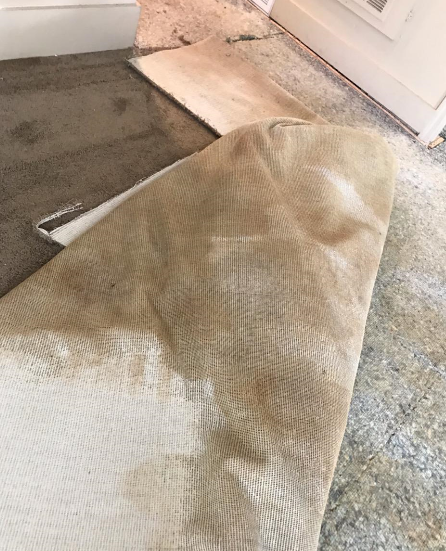
We are currently replacing a stove and found several dead mice and unspeakable unthinkable filthy conditions under the stove and counters. We have to wear hazmat protection to work in the home.
WHAT DO I DO!
-Yvonne
Dear Yvonne,
Sounds like you have a mess on your hands.
If the tenants are paying the rent as required, you may have difficulty with eviction, during a pandemic.
My advice is to wait until the pandemic and eviction moratorium is over and then tell the tenants you are going to renovate the rental property and they will need to move.
Since they have been there for many years, and have paid rent for many years, I would give them time to find a new place, but give them a definite time when they must be out.
Also, let them know, at that time, legally with notice, that the month to month lease is terminating.
I understand your distress at finding the property in poor condition, but if they stay for a few more months, after having been there for 13 years, I can’t see it getting much worse.
If you can wait, your odds for an easy tenant removal go way up.
I know it may be very difficult for you to bide your time right now but if you push to remove these tenants now, especially if they are disabled, in a pandemic, you may not win in court.
Sincerely,
Hank Rossi
Landlord Hank says, “My advice is to wait until the pandemic and eviction moratorium is over and then tell the tenants you are going to renovate the property and they will need to move.”
Ask Landlord Hank Your Question
Ask veteran landlord and property manager Hank Rossi your questions from tenant screening to leases to pets and more! He provides answers each week to landlords.
Good credit is becoming increasingly crucial for renting an apartment and according to RentCafe’s latest report, the credit scores of renters and lease applicants has been going up one point each year since 2018.
“Specifically, according to our analysis of more than five million lease applicants nationwide, the average credit score of renters in the U.S. was 638 in 2020,” the report says.
Some key findings:
Baby boomers have the highest scores (683), while the youngest renters, Gen Z, are at the other end with 586. Still, it’s worth noting that, of all age groups, Gen Z increased their scores the most in the last three years, by 55 points since 2018.
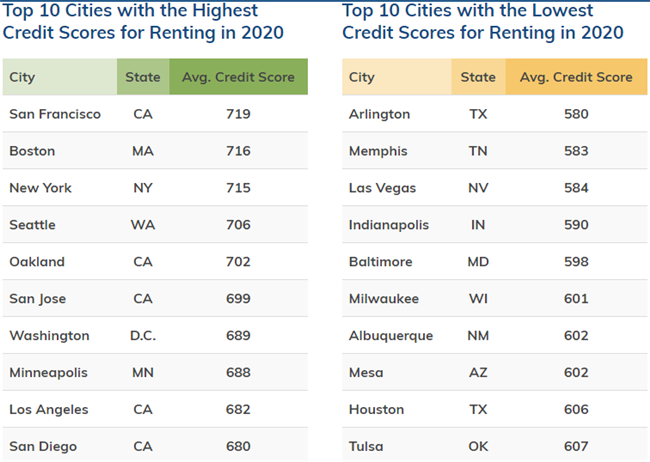
Renters in San Francisco boast the highest scores in the nation, 719, followed by those in Boston (716), New York (715), and Seattle (706).
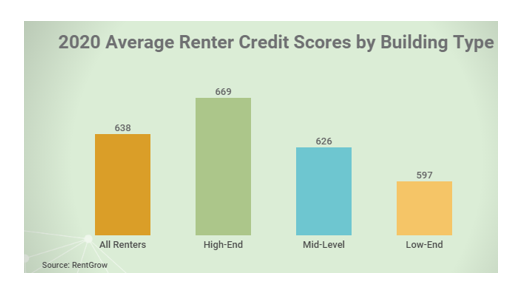
Nationwide, the average credit score of renters clocked in at 638 in 2020. Those living in high-end buildings are the only ones boasting above-average credit scores of 669.
Those with less-than-ideal scores can still find nice apartments in Arlington, TX, or Memphis, TN, cities where renters’ average scores hover around 580. Moreover, an extra 20 points would get them in a luxury building in places like Mesa, AZ, Las Vegas, or Houston. In these cities, the average credit scores for high-end buildings are the lowest in the country.
“Plus, credit scores can also vary widely in different types of buildings. For example, renters in high-end buildings had an average credit score of 669 last year – just 43 points separated them from renters living in mid-priced buildings, whose average score was 626. Meanwhile, the credit score of those living in low-end buildings was 597, exactly 29 points below that of renters in mid-range apartments,” RentCafe says in the study.
Baby boomers lead with the highest average credit scores
By generation, baby-boomer renters led all other generations in 2020 with an average credit score of 683.
Since they’ve had more time to build up their scores, they’re in better shape than Gen Xers (653), millennials (644) and the youngest renters, just starting to live on their own, Gen Z (586).
RENTCafe.com is a nationwide apartment search website and a part of Yardi. Our original city-based research, insights, and in-depth analysis of the real estate market have been used in stories featured on major media publications across the U.S.
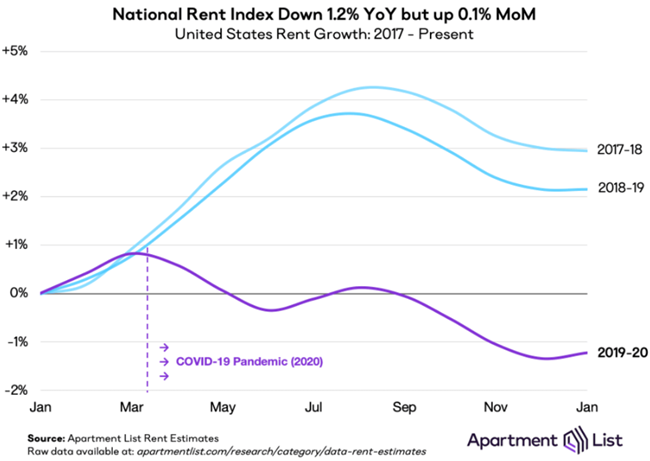
The impact of COVID-19 on the market is continuing to stabilize and “our national index ticked up by 0.1 percent from December to January, the first monthly increase that we’ve seen since last August,” according to the latest report from Apartment List.
“Although the data continue to show significant regional variation, the markets that have been most heavily impacted by the pandemic are beginning to enter calmer waters,” the report says.
Rents may have reached the bottom
In the pricey coastal metros where rents have been plummeting, this month’s data implies that “we may have reached the bottom.” At the other end of the spectrum, many of the mid-sized markets that have seen rents grow rapidly through the pandemic have seen just modest increases this month.
The national index has been masking significant regional variation below the surface, as some markets had been continuing to watch rents plummet, while others experienced a pandemic-related boost to demand.
This month, however, these local fluctuations also appear to be flattening out, Apartment List says in the report.
The San Francisco, Seattle and Portland Examples
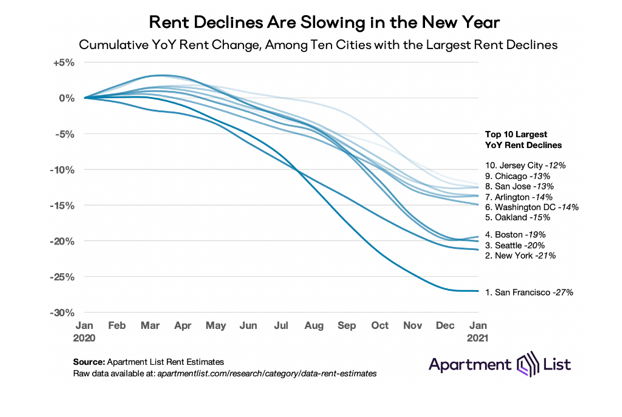
San Francisco has consistently made headlines throughout the pandemic for the staggering rent declines that have led the nation. Rents in San Francisco are down by 27 percent year-over-year, and while there are no signs of prices returning to pre-pandemic levels, it appears that the bottom of the city’s price correction may be at hand.
In January, rents in San Francisco fell by just 0.4 percent month-over-month, compared to an average monthly decline of 3.4 percent from April through December 2020. Although San Francisco rents have yet to increase since the start of the pandemic, the leveling off in this month’s data indicates that the city’s rental market may be on the cusp of turning that corner.
“Seattle is very much in the same conversation as San Francisco and New York,” said Rob Warnock, Research Associate at Apartment List.
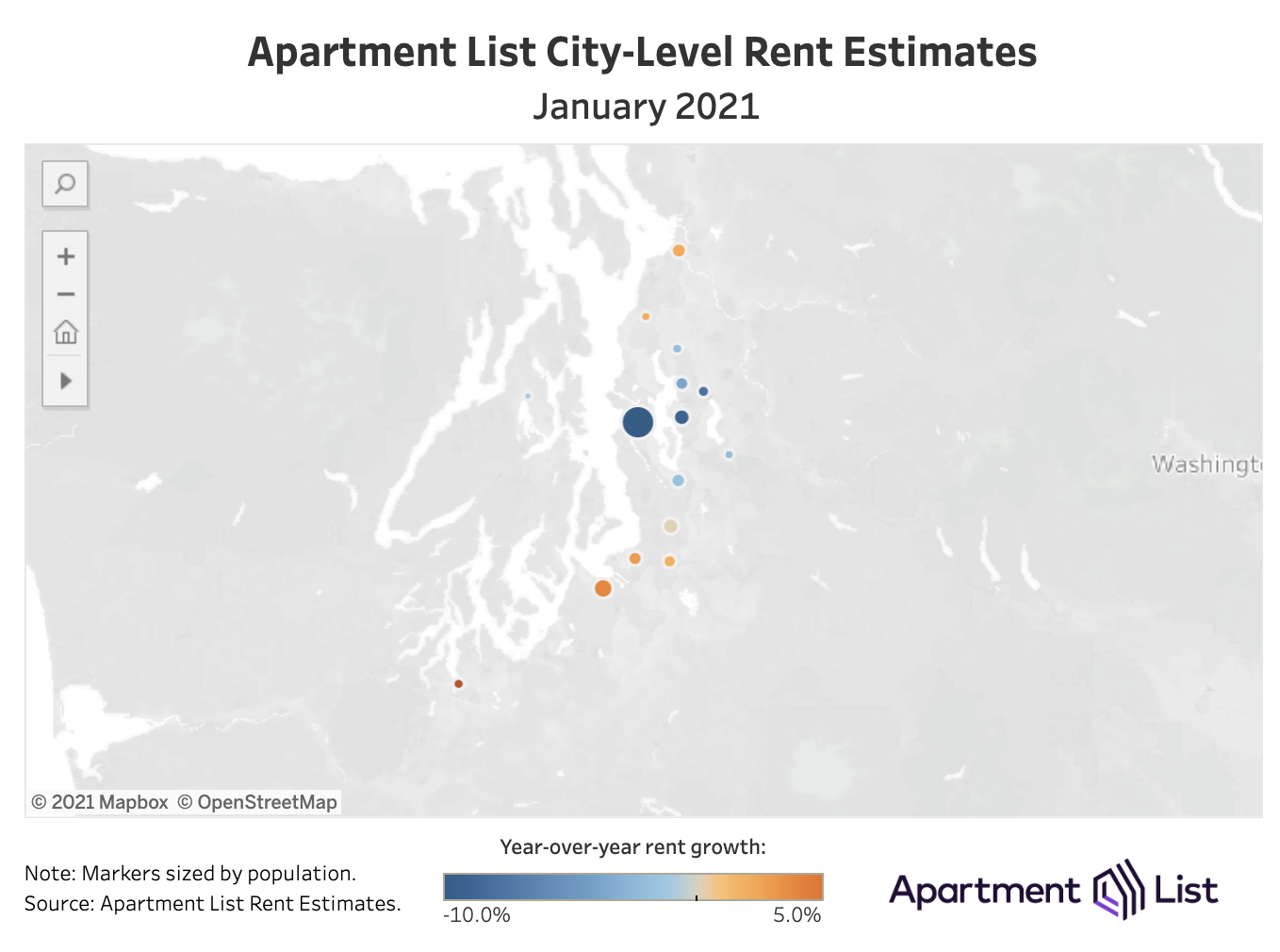
Seattle is one of the hard-hit metros where rents may have reached the bottom. The large dot represents rents lost in the primary city with less rent loss in secondary cities.
“In fact, Seattle has jostled back-and-forth with NYC for the No. 2 spot in the list of steepest annual rent drops. In Portland, the price reduction has been less dramatic (-7 percent year-over year), but I would still group it in the same broad category of expensive coastal cities with a high concentration of expensive apartments and remote work opportunities, i.e. the cities that have experienced an outsize share of pandemic-driven rent declines,” Warnock said.
He added that Seattle and Portland are also great examples of the “principal city versus secondary city” divide that “we explored recently. In short, core cities are experiencing big rent reductions while the markets in nearby, more-suburban areas are staying relatively strong.
“In Greater Seattle, rent drops are concentrated in Seattle and nearby Bellevue, Redmond, Kirkland. But as you move outward, rents in the Everett, Tacoma, Olympia areas are all getting more expensive.
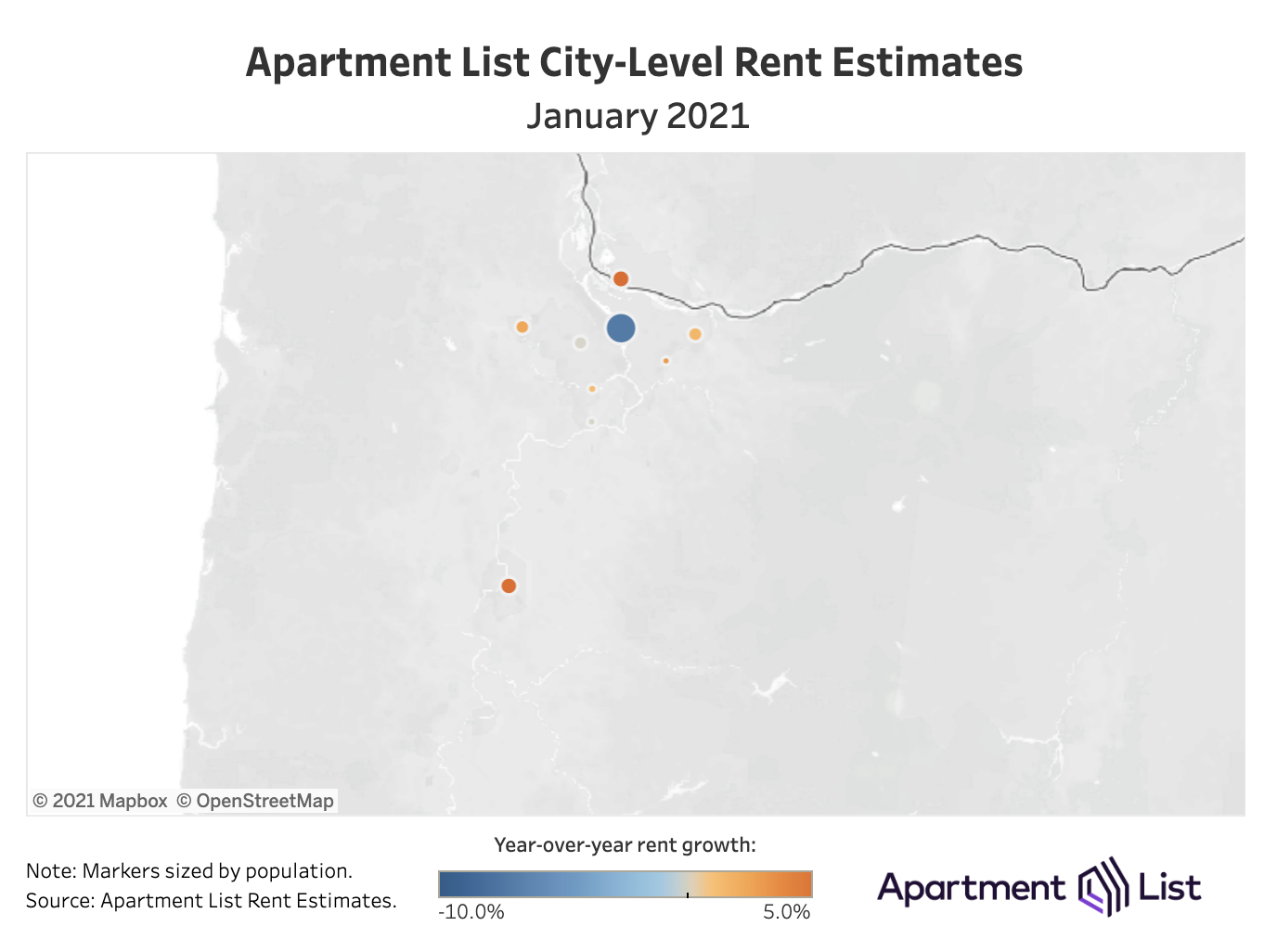
“Similar things (are) happening in Greater Portland: Portland itself has gotten cheaper while YoY rents are up in Vancouver, Hillsboro, Gresham, Happy Valley, and even more so as you move further out into Salem and Bend,” Warnock said.
Portland proper shows the largest rent drop while secondary cities show less