Home Blog

The Consistency Trap: When “Fair” Policies Create Unfair Risk

Managers may apply the same strict rules to all - the consistency trap- and think they’re protected but the legal landscape is shifting.

Many managers assume that as long as they apply the same strict rules to everyone – the consistency trap-  they’re protected from fair housing trouble but the legal landscape is shifting.

By The Fair Housing Institute

In property management, it’s tempting to lean on zero-tolerance screening policies. They’re fast, efficient, and feel like a safe bet against discrimination claims.

But relying solely on an algorithm creates a real problem. When we prioritize a rigid “yes or no” over an actual conversation, we aren’t just being efficient—we’re often creating a legal liability and missing the human context that defines real risk. The challenge today isn’t just about who we let in, but how sophisticated and fair our process is for those we initially turn away.

The Illusion of Objective Safety

A common mistake in the industry is thinking that a blanket ban is a safe harbor.

Many managers assume that as long as they apply the same strict rules to everyone, they’re protected from fair housing trouble. However, the legal landscape is shifting. Regulators now look closely at the disparate impact of these neutral-sounding rules. For example, a policy that automatically rejects anyone with a criminal record might unintentionally hit certain protected groups much harder than others. By sticking to an inflexible standard, you might actually be turning a risk-management tool into a legal target.

Being a pro in this field means moving past the “set it and forget it” mindset of automated screening. We have to acknowledge that data has limits. A low credit score might come from a one-time medical emergency rather than a habit of not paying bills. A conviction from a decade ago might have zero bearing on how someone will behave as a neighbor today. When we refuse to look behind the numbers, we aren’t really protecting the property; we’re just ignoring the nuances that help us understand who a person actually is.

The Strategic Value of the Appeal

Moving from a simple “Yes/No” system to a real appeals process might feel like more paperwork, but it’s actually a smart business move. An individualized assessment shows that you’re making a good-faith effort to follow fair housing laws. By giving applicants a clear way to share their side—whether it’s evidence of rehabilitation or an explanation for a financial dip—you change the story from one of “rejection” to one of “due process.” If a decision is ever challenged, having a documented, person-centered rationale is your best defense.

Handling this well usually means tweaking how your team works. Instead of leaving it all to an algorithm, you might need a small review group or a compliance lead who knows how to look at the “whole person.” This human-in-the-loop model keeps the community safe while making sure the company isn’t wide open to biased claims. The goal is a process that is as rigorous in its empathy as in its standards, ensuring every denial is backed by a solid, defensible reason.

Fair Housing Month Special on YouTube

Also, we are happy to announce that, in honor of Fair Housing Month, The Fair Housing Institute will host a live event on YouTube focusing on HUD updates, emotional support animals, and the impact of AI in fair housing. It will be on April 1st at 2 p.m. e.s.t. Here is a link to register for the event and ask any questions you would like answered during the event. Please feel free to share with your organization!

Building Trust Through a Fair Process

At the end of the day, how you handle appeals is about procedural justice. When people feel they’ve been heard and their situation was actually considered, they are far less likely to walk away angry or file a formal complaint. Being transparent about why a decision was made and how someone can contest it builds massive professional credibility. It tells the market and the regulators that your company operates with integrity and actually understands its social and legal responsibilities.

The long-term value of ditching the “consistency trap” is a more resilient business. A management firm that gets the appeals process right can handle new laws and social changes without breaking a sweat. You stop being reactive to every new mandate and start leading the industry toward a smarter, more legally sound approach. That trust, built through a fair and human process, is the strongest protection your property can have.

About the author:

In 2005, The Fair Housing Institute was founded as a company with one goal: to provide educational and entertaining fair-housing compliance training at an affordable price at the click of a button.

Multifamily Rents Maintain Slow Pace

Multifamily rents maintained a slow pace as advertised rents remained flat in February, with multifamily expecting a year of slow growth

Multifamily rents have maintained a slow pace as advertised rents remained flat in February, with the multifamily market anticipating another year of slow growth, according to the latest report from Yardi Matrix.

“The market faces headwinds in economic conditions that include weak job growth and consumer confidence as well as in demand drivers such as immigration and migration,” the report says.

“While February is typically a slower month, there are longer-term issues of concern. Rents have been essentially unchanged over the past 18 months, while absorption slowed starting in the second half of last year. Domestic migration has slowed and immigration outflows have weighed on household formation. Occupancy rates are negative year-over-year in 28 of the top 30 Matrix markets.

Highlights of the multifamily rents report:

  • Multifamily rents remained stagnant in February as the average U.S. advertised rent was unchanged at $1,740, with year-over-year growth dropping 10 basis points to 0.1%.
  • February is usually a slow month, but the signals do not point to a strong bump in rents in the spring. Drivers of demand such as population growth, immigration and the job market are not robust, while the occupancy rate and absorption have been weak in recent months.
  • As the future of the industry is debated in Washington, rents for single-family build-to-rent properties were unchanged in February at $2,191, while occupancy rates softened slightly. Year-over-year rent growth improved modestly to -0.4%

Lease renewals are strong and renewals positive

Multifamily conditions are by no means dire. Lease renewals are strong and renewal rates continue to be positive, Yardi Matrix says in the report.

“Core markets such as San Francisco and Chicago have bounced back, while Sun Belt markets retain healthy long-term growth characteristics. Equity and debt capital is plentiful, and opportunities exist for core properties and value-add assets with 2020-2022 vintage mortgages that need to be restructured.

“But economic trends signal softness heading into the spring leasing season and raise the possibility that 2026 could shape up to be a weak year for rent growth,” the report says.

Read the full Yardi Matrix report here.

Sign Up For Our Weekly Newsletter And Get Rental Property And Apartment News And Helpful, Useful Content Each Week.

* indicates required

FTC Plans To Set Rules And Regulation On Rental Housing Fees

Apartment Leaders Pull Back From Rent-Controlled Markets

Seattle Landlords Hit By High, Rising Insurance Costs

Seattle landlords are facing rising insurance costs as average monthly insurance costs in the metro area rose 84.61% between 2019 and 2024

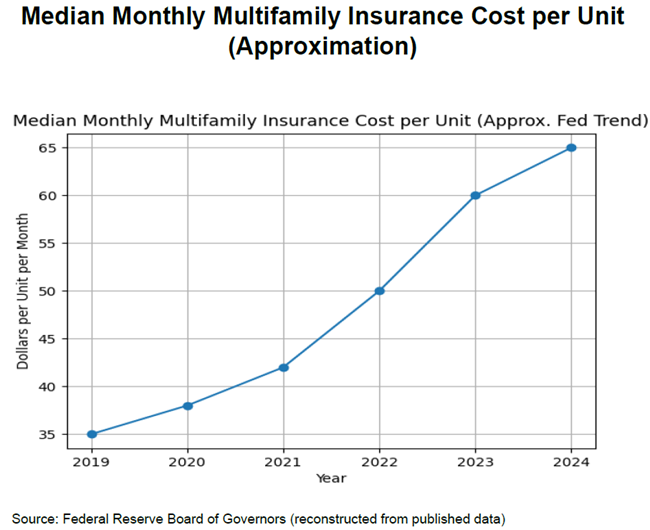
Seattle landlords are leading the nation in facing rising insurance costs as average monthly insurance costs in the Seattle metro area rose 84.61% between 2019 and 2024 to $62.02 per multifamily unit, according to a study published by the Federal Reserve.

National landlords also faced rising insurance costs as nationally the average insurance cost increased 76.5% over the same period.

The study analyzed financial records of thousands of multifamily properties across the U.S. with commercial mortgage-backed securities loans. The data was compiled by analytics company Trepp.

Jake Mayson, director of government affairs at the Washington Multi-Family Housing Association, told the Business Journal that he attributed the sharp jump in insurance costs to the overall economic uncertainties and “increased risk out there in the environment. So every dollar that’s going to pay for property damage and higher insurance premiums, that’s a dollar not going into making the next renovation feasible, that’s not going into creating a new unit of housing to address our supply problems in Washington state.”

“There are larger per-dollar increases in insurance premiums in cities that are experiencing high amounts of property damage and property crime,” he said. The Fed study found that each additional dollar spent on property insurance reduced an owner’s net profit by roughly 75 cents. Insurance costs shaved off 3.83% of revenue for a typical landlord in 2024, up from 2.3% in 2019.

“It’s not like housing providers can raise the rent if their premium goes up,” WMFHA executive director Nick Marin told the Business Journal. “There’s a competitiveness in the market.”

Sign Up For Our Weekly Newsletter And Get Rental Property And Apartment News And Helpful, Useful Content Each Week.

* indicates required

FTC Plans To Set Rules And Regulation On Rental Housing Fees

Apartment Leaders Pull Back From Rent-Controlled Markets

FTC Seeks Comment On Potentially Unfair Rental Housing-Fees

The Federal Trade Commission is seeking written public comment on proposed rules involving potentially unfair rental housing fees

The Federal Trade Commission has announced it is seeking written public comment on a notice of proposed rulemaking to address nationwide potentially unfair rental housing fees or deceptive fee practices in connection with rental housing.

As detailed in a Federal Register notice announcing an Advance Notice of Proposed Rulemaking, the FTC is seeking written comments, including data, evidence, analyses and arguments, regarding rental housing fees and charges throughout a lease lifecycle, from application to moveout.

“Rental-pricing practices that are neither clear nor transparent undermine competition and harm consumers,” said Christopher Mufarrige, director of the FTC’s Bureau of Consumer Protection. “The Trump-Vance FTC is focused on addressing unlawful business conduct that obscures the actual cost of housing and undermines price competition.”

The failure to advertise the true total rent can limit consumers’ ability to make informed financial decisions, increasing their search costs and exposing them to other negative monetary consequences when they take on more rent than they can afford. These practices also may undermine competition by weakening the incentives of rental-housing providers who do advertise the true total rent.

The notice seeks comments on such topics as:

  • Total rent: Do rental housing providers fail to clearly disclose or misrepresent the true total rent for a property, including all mandatory fees or charges?
  • Fees and Charges: Do rental housing providers fail to clearly disclose or misrepresent the nature, purpose, amount, refundability, optionality and recurrence of fees or charges?
  • Application Fees: What practices do rental housing providers engage in relating to application fees that harm consumers?
  • Security Deposits: What practices do rental housing providers engage in relating to security deposits that harm consumers?
  • Billing Issues: What practices do rental housing providers engage in relating to billing that harm consumers?
  • Consumer Choice: What practices do rental housing providers engage in that harm consumers by impeding consumer choice?

Unfair and deceptive rental housing fee practices violate federal law. In the past two years, the FTC has filed two cases challenging these fee practices by nationwide housing providers. Invitation Homes, the largest single-family home rental housing provider in the country, agreed to pay $48 million to settle FTC allegations that the company violated the FTC Act by, among other things, excluding mandatory monthly fees from the advertised rent.

Greystar Real Estate Partners, the largest residential rental property owner and manager in the nation, was ordered to change its fee disclosure practices and pay $23 million in consumer redress to settle a lawsuit by the FTC and the state of Colorado that alleged the company misrepresented the true cost of renting a property and excluded mandatory fees from the advertised rent.

Case-by-case enforcement, while essential, addresses only some aspects of the harmful fee practices in the rental housing industry. The notice announced this week explores whether a rule is needed to address hidden and misleading fees that inflate rent well beyond what is advertised and other problematic fee practices imposed throughout a lease lifecycle. It also would serve as a deterrent against those practices because it would allow the agency to seek civil penalties against violators and more easily obtain redress for harmed consumers.

Consumers can submit comments electronically for 30 days, ending April 11. Consumers also may submit comments in writing by following the instructions in the “Supplementary Information” section of the Federal Register notice.

Sign Up For Our Weekly Newsletter And Get Rental Property And Apartment News And Helpful, Useful Content Each Week.

* indicates required

Trends and Data Illustrate 2026 State Of Pets in Rentals

Trends and data in the 2026 state of pet rentals report shows pet ownership and rental cooperation are rising but challenges exist.

Trends and data in the 2026 state of pet rentals report shows pet ownership and rental cooperation are rising but challenges exist.

A new survey released by PetScreening reports that 81% of rental housing operators report growth in pet ownership, and 68% now consider themselves “pet-friendly,” which means a variety of things ranging from more pets being allowed to more pet-focused amenities onsite.

The 2026 State of Pets in Rental Housing Report, based on feedback from 673 property managers and leasing professionals primarily within the multifamily and single-family sectors, details the effects of pet-inclusivity in the modern rental-housing world.

While 71% of U.S. households own a pet, according to the American Pet Products Association, PetScreening data shows that only 43% of renters report owning one. This figure is nearly 30 percentage points lower than the pet ownership rate reported by housing operators, suggesting that many pets in rentals may be unauthorized or underreported. The report aims to assess reasons for the disparity and ways operators can resolve related challenges.

Trends and data in the 2026 state of pet rentals report shows pet ownership and rental cooperation are rising but challenges exist.

While the rates of pet ownership in rentals continues to rise, operational challenges persist, as operators report pet damage and unauthorized pets are among the primary issues they face at their properties.

“Despite any operational challenges, the survey underscores the clear benefits of welcoming pets at rental communities,” said John Bradford, founder and CEO of PetScreening. “When pet strategies are optimized to embrace pet-inclusivity and reflect the desires of the modern renter, the advantages become more pronounced in the form of a wider resident pool, stronger retention and increased revenue. While the industry still can make significant headway, property managers are doing a commendable job of bridging the gap.”

Some of the gap between the overall U.S. pet ownership rate and the percentage of renters who say they own pets may be attributable to unauthorized and underreported pets onsite. This highlights the importance of accurate tracking, which can help operators collect their rightful pet-related revenue and avoid potential risks associated with unauthorized pets.

Digging into the Data: Popular Amenities, Common Restrictions

The survey also noted that pets are an increasingly key driver in renter decision-making, as renter search data from Apartments.com showed that more than half of renters utilizing pet filters search for dog-friendly communities. The most cited pet amenities offered by survey respondents included pet waste stations (45%) and pet parks (35%)—functional offerings that were significantly more prevalent than experiential features such as dog-walking services (24.9%) or pet-focused events (11.2%).

While some of the industry has shed blanket restrictions in favor of evaluating pets and their owners on an individual basis, most properties continue to have significant restrictions in place. Pet limits per household was the most cited by respondents (78.4%), while other traditional restrictions such as breed (66.7%) and weight limits (59.8%) continue to be prevalent as well.

Metrics specific to PetScreening included that the company’s clients experienced a 30.7% increase in revenue after implementing the platform, which underscored the impact of pet-friendly policies paired with formal tracking and screening tools. Additionally, PetScreening says its customers saved approximately 1.3 million administrative and legal hours reviewing assistance-animal accommodation requests, instead relying on the platform’s expertise, which also helped to reduce risk of regulatory violations and potential litigation.

The entire report can be accessed here.

About PetScreening:

PetScreening is a leading platform for managing pets and assistance animals. Offered at no cost to housing providers, the platform standardizes pet-risk assessment with digital pet profiles and FIDO Scores®, streamlines assistanc- animal reviews in compliance with HUD and Fair Housing guidelines, and helps identify unauthorized pets, all while supporting more pet-inclusive communities. Learn more at petscreening.com.

Pet Owning Renters Face Barriers Despite “Pet-Friendly” Ads

2026 Pets and Housing Awards Are Open For Nominations

Pets Are Family, Not an Apartment Amenity

Sign Up For Our Weekly Newsletter And Get Rental Property And Apartment News And Helpful, Useful Content Each Week.

* indicates required

Oregon Tenant Confidentiality Bill Goes To Governor For Signature

Oregon's 2026 tenant confidentiality bill restricts landlords from disclosing tenant information such as SSNs, immigration status, or medical

Oregon’s 2026 tenant confidentiality bill (HB 4123) restricts landlords from disclosing sensitive tenant information—such as SSNs, immigration status, or medical records—without written consent.

It now goes to the governor for signature and It imposes penalties of up to twice the monthly rent for “knowingly” violating these privacy protections.

The law covers personal details including Social Security numbers, contact information, income details, immigration/citizenship status, and medical or disability records.

The bill includes exceptions for situations involving legal or administrative proceedings, such as court orders, mandatory background checks, insurance claims, or necessary maintenance services.

Clackamas Women’s Services  told kgw.com  the “tenant confidentiality” bill would help protect women trying to escape their abusers.

CWS supports survivors of domestic and sexual violence, stalking, trafficking and other crimes. All too often, a woman’s whereabouts get back to her abuser, she said.

“We know how important it is for survivors when they are finally able to leave a violent situation and get into a safe and secure housing situation — that they’re able to keep that,” Erlbaum said.

When that information gets out, survivors may have to start the process of finding safe housing all over again. Because often, “victims’ information is shared and their abuser shows up at their place of employment or sometimes even at that housing unit itself,” she explained.

“It’s actually fairly common, and I think it’s because information is just shared in the course of conversation,” Erlbaum said. “Again, maybe very well-meaning, but that can create a really high-risk situation for survivors.”

Accidental Landlords Rise To Three-Year High

A near-record number of homeowners are becoming rental property owners as the number of accidental landlords rise

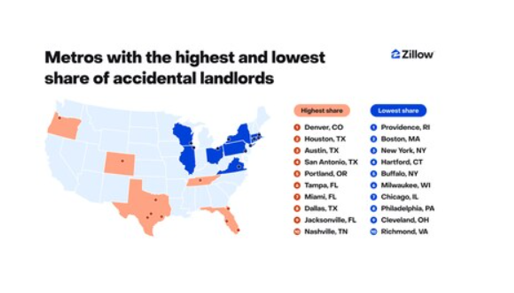
A near-record number of homeowners are becoming rental property owners as accidental landlords rise when they turn their unsold properties into rentals, according to Zillow.

Properties owned by these accidental landlords account for more of the listed rental stock than at any time since 2022 — and the trend may not have peaked yet.

  • 2.3% of homes listed for rent on Zillow were recently listed for sale, according to a new Zillow analysis. Only once in Zillow’s nearly six-year record has the share of “accidental landlords” been higher nationwide.
  • Texas and Florida markets, along with Denver, Portland and Nashville, have the largest share of these accidental-landlord properties.
  • Would-be sellers resorting to renting instead of accepting a serious price cut indicates these homeowners don’t need to liquidate distressed properties.

“Sellers are facing a different reality than they did a few years ago,” said Kara Ng, senior economist at Zillow. “Bargaining power is tilting toward buyers and homes are taking longer to sell, making renting out a property one way to buy time rather than compete aggressively on price.”

An accidental landlord is a property owner who becomes a landlord unintentionally, often by inheriting a home, moving for work without selling their previous house, or due to a slow housing market. Unlike intentional investors, they typically rent out of necessity rather than a planned business strategy

Because Zillow is a destination for both for-sale and rental listings, the platform offers a view into how unsold homes are increasingly reentering the market as rentals.

Detached single-family homes are the most common property type owned by an accidental landlord — 3.4% of single-family homes listed for rent on Zillow are owned by accidental landlords. That’s compared to 2.2% for townhomes and 1.1% for condos.

The rise of would-be sellers turning into accidental landlords rather than selling for a loss — or at least a lower price than they are willing to accept — is a good indication that homeowners aren’t selling out of necessity or because they are at risk of foreclosure.

Oregon Tenant Confidentiality Bill Goes To Governor For Signature

Sign Up For Our Weekly Newsletter And Get Rental Property And Apartment News And Helpful, Useful Content Each Week.

* indicates required

Report Outlines Steps for Multifamily Growth in 2026

Steps operators can take to ensure multifamily growth in 2026 rather than remaining stuck in neutral in 2026

Steps operators can take to ensure they’re moving the needle in the right direction rather than remaining stuck in neutral in 2026 as prospects want transparency, control and consistent touchpoints.

By Paul Willis

For many rental-housing operators, the goal in 2026 is to remain steady. It is a reasonable objective considering the hints of uncertainty surrounding the sector. Occupancy rates are a bit soft in some markets, and overall investor activity hasn’t returned to its peak form.

But for those a bit more ambitious, the intention is to grow in ‘26.

According to the recently released Entrata report The 2026 Playbook for Multifamily Growth, potential for advancement remains prevalent despite some mild headwinds facing the industry.

The report outlines steps operators can take to ensure they’re moving the needle in the right direction rather than remaining stuck in neutral.

 Control, clarity and consistency

 According to the report, the three factors most important to renters are equally crucial for operators: control, clarity and consistency. Control refers to renters’ ability to move at their own pace by using self-serve options when they desire and talking to a live agent when it matters—without having to repeat steps. The report shows a hefty 58% of Gen Z renters—the fastest emerging contingent of renters in the industry—completed the application process nearly exclusively online, and 35% of the generation’s renters indicated they’d prefer a fully self-service leasing process.

Clarity refers to advertised pricing that reflects the true monthly cost, an all-in price including rent, fees and other services that contains no surprises. A convincing 82% of renters indicated that they want more fee transparency within the rental process (put another way, only 18% of respondents believe operators are currently doing enough when disclosing fees and all-in costs).

Consistency refers to the notion that every touchpoint shares the same context, so prospects never have to repeat steps or start the process over. Whether the touchpoint is generated online, by text, by phone or in-person, the messaging should never waver.

Automated leasing journey

 Much like putting together an amazing workplace culture or a perfect game plan in football, there is much talk of a fully automated leasing journey—but what does it look like in actual practice?

According to the report, the ideal automated journey consists of these steps:

  • A prospect searches for a rental home online and clicks a property listing.
  • An AI assistant greets them on the website, answers questions about pricing, availability and amenities, and then recommends floor plans based on their preferences.
  • The prospect takes a virtual tour, selects a home and schedules a visit for an in-person tour through the assistant, which automatically confirms and sends reminders.
  • The prospect then completes an online application after the tour process is complete. The system verifies their information, runs instant screenings, generates a digital lease and collects signatures and payments—all entirely digital and bereft of human involvement, unless the prospect requests the support of a live agent.

This enables prospects to have a seamless online experience with high-touch support when needed. Property teams, meanwhile, have full visibility into the journey and can pinpoint the progress of the prospect in real time. This enables teams to identify which leads might need a direct follow-up, a nudge forward or continued nurturing.

A personalized offer

In the age of convenience, a personalized offer that incorporates a prospect’s preferences serves as an ultra-modern way to secure a lease.

An example of this, according to the report, is a prospect who views a property online and receives a follow-up message with a home tailored to their interests. This includes a floor plan similar to the one they toured and additional preferences, such as a home near the amenity spaces, with a mountain view or in proximity to the parking area. The personalized offer can include a limited-time incentive, such as a discounted first month’s rent or waived application fee, if the prospect applies within a certain time period.

The offer can be delivered automatically through email or text, personalized with the prospect’s preferred move-in date and home type, which creates a sense of urgency and an efficient way to move forward with the process. Offering multiple home choices within the personalized offer is another way operators can provide control for renters, who might not be fully enamored with the initial choice provided.

Entrata research shows that Gen Z renters are more focused on satisfaction and convenience than cost when deciding whether to renew a lease, meaning the same “personalized offer” concept can be equally beneficial in the renewal process.

Primary takeaways

The report’s overriding message is that, while growing in 2026 is certainly plausible, it will take more than a singular action. The heart of the effort should include a mix of message clarity, features designed for prospects and residents to take control, and the right amount of assistance from AI and automation.

While the initiative must be multitiered, the report recommended four immediate steps operators can take to ignite the process:

  • Enhance fee transparency by publishing all-in pricing across your website and listings, with a simple cost estimator.
  • Enable 24/7 coverage through AI and chatbots for web, text and voice, with seamless human handoffs. Little is more frustrating to a prospect than talking to an agent who doesn’t have knowledge of the steps they have already completed.
  • Offer flexible choices—tour types, lease terms, deposit options and payment cadence—and track how often they are utilized.
  • Launch or refine a resident-rewards program linked to on-time payments, renewals, referrals, reviews and compliance.

While taking these steps, operators should constantly monitor how they are performing in actual practice, the report says. Tracking metrics such as time to first reply, percentage of listings with all-in pricing, rewards enrollment and hours saved for onsite teams can provide a snapshot of the effectiveness of the initiative.

Operators that constantly measure and adjust accordingly, the report says, will generate a competitive edge and reap the results in the form of increased demand. They might surpass the ambition of simply remaining steady in 2026, as well.

About the author:

Paul Willis is a content director for LinnellTaylor Marketing.


Oregon Tenant Confidentiality Bill Goes To Governor For Signature

Washington Passes Rental Housing Flood-Risk Disclosure Law

Sign Up For Our Weekly Newsletter And Get Rental Property And Apartment News And Helpful, Useful Content Each Week.

* indicates required

Washington Passes Rental Housing Flood-Risk Disclosure Law

Washington lawmakers approved legislation requiring rental flood risk disclosure by landlords and to inform tenants about insurance

Landlords must inform tenants about the Washington State law requiring flood-risk disclosure and to inform tenants most rental insurance policies do not cover floods.

By Aaron Kirk Douglas

Washington lawmakers approved legislation requiring landlords to disclose when rental units are in areas at risk of flooding and to inform tenants that standard renters’ insurance does not cover flood damage.

The bill, prompted by flooding in Western Washington that displaced renters, would apply to leases signed after Dec. 31, 2026, and recommends tenants consider purchasing flood insurance, according to the Seattle Timess.

Why it matters to rental property owners

Disclosure requirements for rental housing continue to expand nationwide.

While the new Washington rule is relatively narrow, it reflects a broader regulatory trend toward increasing landlord disclosure obligations related to climate risks, insurance coverage, and property conditions.

Unlike some states, including Oregon, California and Texas, Washington only required flood risk disclosures in home sales — not in rental leases.

The bill passed with bipartisan support — and no strong opposition from major landlord groups. But some say there’s still work to be done.

Sean Flynn, president of the Rental Housing Association of Washington, was initially concerned that a disclosure requirement would cause unnecessary fear and ostracism of certain properties. But with the requirement only applying to leases, and not rental advertisements, he’s changed his tune according to the Seattle Times.

“What ended up getting passed, I think, meets everyone’s goals and is a good bill,” he said. “It’s pretty reasonable.”

About the author:

Aaron Kirk Douglas is a multifaceted storyteller and market analyst. His career spans journalism, creative nonfiction, filmmaking, and real estate research. He serves as Director of Market Intelligence at HFO Investment Real Estate/GREA, the Pacific Northwest’s leading multifamily brokerage.

What the Next Generation of Developers Is Learning And Why It Matters for Multifamily

Sign Up For Our Weekly Newsletter And Get Rental Property And Apartment News And Helpful, Useful Content Each Week.

* indicates required

Tennessee Trying To Stop Landlords From Banning Guns

A Tennessee bill would prevent landlords from banning guns and prohibit adding a clause to a lease to ban firearms in rentals

A Tennessee bill, HB 496, would prevent landlords from banning guns and prohibit adding a clause to a lease that would ban tenants from “lawfully possessing, carrying, transporting, or storing a firearm, firearm components, or ammunition on leased premises.”

The bill to stop landlords from banning guns has passed the legislature and heads to the governor for signature.

The protection also extends to firearms kept in vehicles parked in tenant parking areas and in locations controlled by the landlord that tenants must use to enter or exit their residence or parking areas.

If passed, the new law would only apply to residential lease agreements and landlord rules that are entered into, amended, extended or renewed on or after Jan. 1, 2027.

Under the bill, landlords can require tenants to transport a firearm between a vehicle and the tenant’s residence only if the firearm is concealed, holstered or stored in a carrying container. Landlords can also require firearms to remain concealed, holstered or in a container when tenants are in common areas such as hallways or elevators, according to the bill.

Some properties are excluded from the proposal, including premises leased to state agencies or departments, facilities licensed or contracted with the Department of Mental Health and Substance Abuse Services, school properties, or facilities connected to the Department of Children’s Services.

Health care and elder care facilities are also exempt, including hospitals, nursing homes, homes for the aged, assisted care living facilities, memory care facilities and certain independent living facilities connected to those operations.

No Guns In My Apartments: Can A Landlord Say That And Put It In A Lease?

Return To Positive Rent Growth With Small Increase In February

Sign Up For Our Weekly Newsletter And Get Rental Property And Apartment News And Helpful, Useful Content Each Week.

* indicates required