
Portland, mass timber and what the next generation of developers entering the real estate industry is learning and why it matters for multifamily
By Aaron Kirk Douglas
Director of Market Intelligence at HFO Investment Real Estate
In HFO’s recent interview with Noel Johnson, a real estate developer and college professor, I was struck less by technical details and more by mindsets.
Johnson brings decades of experience as a developer, investor, and educator. He not only works with assets and capital, but also helps prepare the next generation who will allocate that capital and shape our cities.
If mass timber was the topic on the table, leadership and long-term thinking were the real themes beneath it. “A real estate developer at the best level is trying to solve dual mandates—what society needs, and what produces good financial returns,” he told us. “That’s the obligation.” It’s a remarkably simple definition. It is also one that many in the industry forget.
The Generational Shift: Students Who Already Understand the Stakeholders
Johnson, who teaches behavioral finance and is the Pierce Faculty Fellow at Lewis & Clark College’s Bates Entrepreneurship Center, sees the shift up close.
Today’s students are not confused about who ultimately owns institutional real estate. They’re not demonizing “the capital stack.” In fact, they grasp it intuitively. As he put it, “Everyone talks about evil ‘institutional investors,’ but when you actually boil it down, the owners are your next-door neighbor, your parents.” It’s a subtle but meaningful shift in the old narrative. The students Johnson teaches—some of whom will become analysts, associates, principals, and founders—are deeply aware of both the social value of housing and the fiduciary duty embedded in every development project. He sees in them what he calls a “dual mindset”—one that no longer treats social impact and financial performance as mutually exclusive. And so when he talks about mass timber, you can see why this generation finds it compelling.
Why Mass Timber Resonates with Future Developers
At its simplest, mass timber is “just using wood instead of steel or concrete.” Mass timber is a category of engineered wood products—such as Cross-Laminated Timber (CLT) and Glulam—created by binding layers of wood together to form large, structurally solid panels and beams.
But as Johnson explained, it’s also an investment theme intertwined with environmental, health, and national security goals, as well as long-term asset differentiation performance. For the students he teaches, these concerns matter. They’re coming of age in a world where climate legislation, carbon accounting, and ESG-aligned capital are increasingly normal. They’re also inheriting a real estate environment where consumer preferences—especially among young renters—are shifting toward healthier, more natural, more human-scaled environments. And growing instead of importing basics to build our homes makes sense. That’s one reason mass timber feels less like a niche interest and more like a generational inflection point.
From Shanghai to Portland: A Material With History and Future
One of the most surprising moments in our conversation came when Johnson mentioned that “old colonial buildings in Shanghai are literally sitting on Oregon Doug fir piles driven into river mud” centuries ago.
Oregon forests have been part of global development far longer than most people realize. Today’s mass timber, of course, uses no old-growth logs. It relies on sustainably managed smaller-diameter lumber, engineered into cross-laminated panels and glue-laminated beams. Modern manufacturing—from Austria to Arkansas to Oregon—has transformed wood into one of the most precise building materials available. Reflecting its modern means of production, one challenge of using mass timber is that it is much more precise than steel and concrete.
Portland Didn’t Adopt Mass Timber Because of Policy—It Was Because of People
Johnson is blunt about this: the growth of mass timber in the Pacific Northwest has little to do with state mandates or activism.
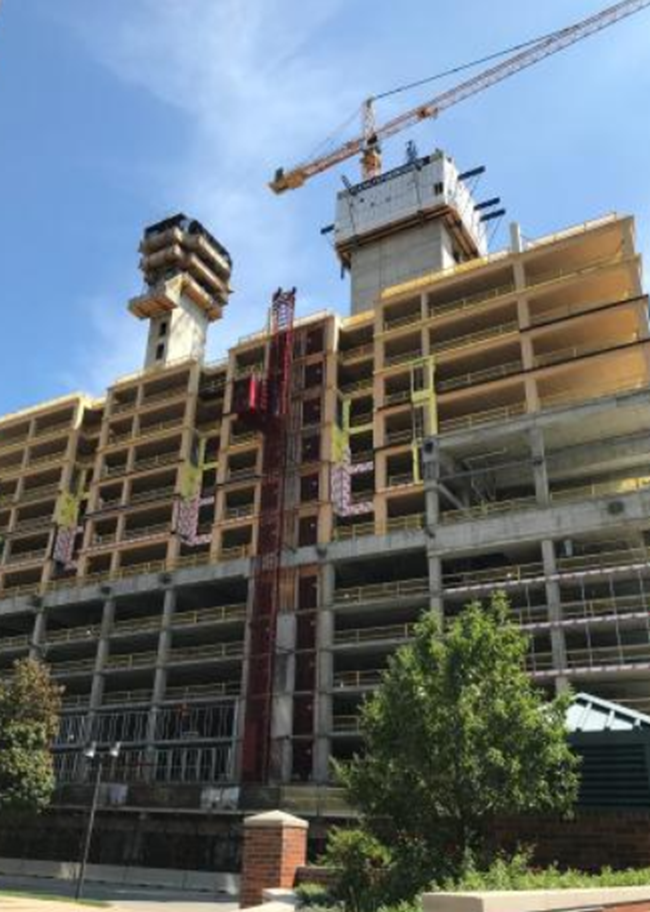
He credits “the mindset of the architects, engineers, and developers” who were willing to innovate long before the rest of the country did. That’s also why Milwaukee—not Portland—built the tallest mass timber tower in the U.S. It simply had a developer willing to try. As Johnson notes, “New Land’s Boris and Tim Gokhman had the right combination of mindset and means to make it manifest.”
And Yes, the Cost Premium Is Shrinking
For a long time, developers assumed mass timber carried an insurmountable cost premium. Johnson’s data says otherwise.
In the only multi-building mass timber case study series published by WoodWorks, he and his coauthors found that costs were typically just 5% higher than those of traditional construction. Not zero. But not a deal-killer either. And Johnson emphasized something most people forget: Investors don’t ask whether something costs more. They ask whether the return is higher. According to Johnson, “It’s not about the cost—it’s about the risk-adjusted return.” He compared the distinction to choosing between a Toyota Corolla and a Tesla Model S Plaid. Both cars get you where you’re going. Only one creates a differentiated experience which consumers value. Buildings work the same way, both for their occupants as well as for their investors.
Differentiation Isn’t a Luxury. It’s an Insurance Policy
Developers often try to measure mass timber’s market impact solely through rents. Johnson cautions against this. The value proposition is broader. He argues real opportunity also lies in reduced long-term risk mitigation:
- Less volatile, more sustained net operating incomes
- Protection from regulatory penalties on carbon-intensive assets
- Broader political appeal (“If you love Trump or Biden, it’s for you”)
- Tenant preferences that endure through economic cycles
- Assets that remain liquid and attractive to sophisticated buyers
Mass timber sequesters carbon; concrete emits it. In a world where New York, Washington, DC, St. Louis – let alone the entire European Union – are imposing carbon penalties on asset owners, that differential will matter. “What’s that worth?” he asked. The truth is, our industry hasn’t quantified it yet.
Insurance: Less Dramatic Than People Fear
When asked about insurance, Johnson almost laughed. He hears the question constantly, but the numbers don’t justify the anxiety. His experience? A slight premium—”maybe one-tenth of one percent of the total capitalization”—and only when the carrier is unfamiliar with the construction type. Mass timber shouldn’t make or break the underwriting. Today’s higher insurance premiums are catching many developers by surprise. “Attribution is hard; it’s often blamed on the mass timber when in reality it’s that the deal’s pro forma had pre-COVID informed assumptions,” notes Johnson.
What Developers Still Haven’t Done
Everything on the supply side—engineering, fire testing, code updates—has accelerated. The remaining bottleneck is the pro forma. Johnson believes the next phase requires:
- Revealed preference studies – longitudinal studies of consumer behaviors and their impacts on occupancy and rent performance
- Comparative analysis across building types to distill risk-adjusted valuation ratios
- Clear modeling of risk reductions and value creation means a taxonomic baseline.
- Academic involvement from finance departments and business schools
Right now, most mass timber case studies involve non-market projects like libraries or affordable housing, which are invaluable, but not true indicators of market behavior. We need market-rate data. And we need it soon.
Why This Matters for Multifamily Owners and Investors
If Johnson’s students are any indication, the next generation entering the real estate industry will bring two qualities our market desperately needs:
- A broader definition of value
- A deeper sense of long-term responsibility
Mass timber is simply the case study that reveals this shift most clearly. Yes, it’s an elegant material. Yes, it smells like a forest when you walk inside. But it also stands for something larger: a willingness to innovate, to take calculated risks, and to build assets with life cycles that extend beyond our own. As Johnson said, “I’m excited for how mass timber can revitalize our rural valleys and connect them to the urban economies we see here.” Students understand this intuitively. The question now is whether the industry will catch up to them.
Noel Johnson is a real estate developer and Pierce Faculty Fellow at the Bates Center for Entrepreneurship and Leadership at Lewis and Clark College. He can be reached at noeljohnson@lclark.edu.
About the author:

Aaron Kirk Douglas is a multifaceted storyteller and market analyst. His career spans journalism, creative nonfiction, filmmaking, and real estate research. He serves as Director of Market Intelligence at HFO Investment Real Estate/GREA, the Pacific Northwest’s leading multifamily brokerage.