
The national median rent dipped by 0.2 percent in January, starting the new year with the sixth straight monthly rent decline, according to the February report from Apartment List.
“That said, this was the most modest dip since last August, signaling that the market is beginning to creep out of the off-season and will likely return to positive rent growth in the months ahead,” Apartment List economists write in the report.
Highlights of the February report:
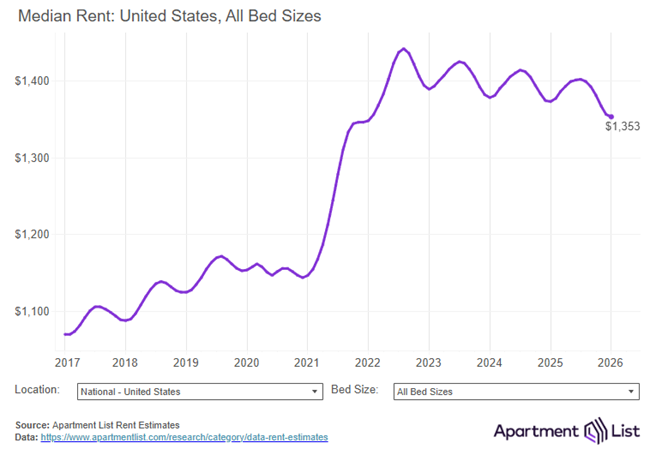
- The national median rent now is $1,353. This is the fourth consecutive winter with a pronounced off-season dip.
- Rent prices nationally are down 1.4% compared to one year ago. Year-over-year rent growth has been slightly negative for more than two full years, and the national median rent has now fallen from its 2022 peak by a total of 6.2%.
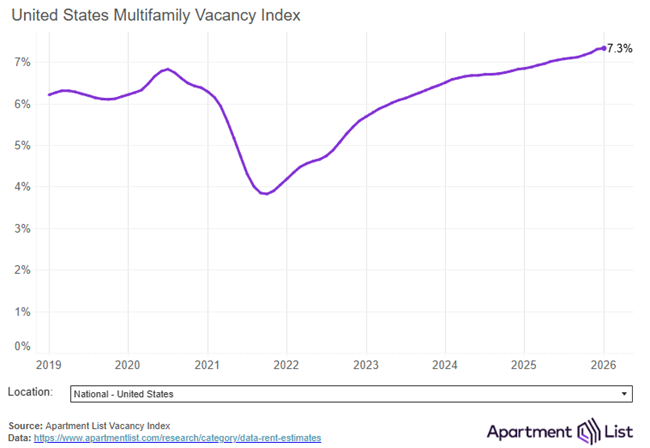
- The national multifamily vacancy rate now sits at 7.3%, “a record high for our index going back to 2017. We’re past the peak of a multifamily construction surge, but a healthy supply of new units is still hitting the market and colliding with sluggish demand, causing vacancies to continue trending up.”
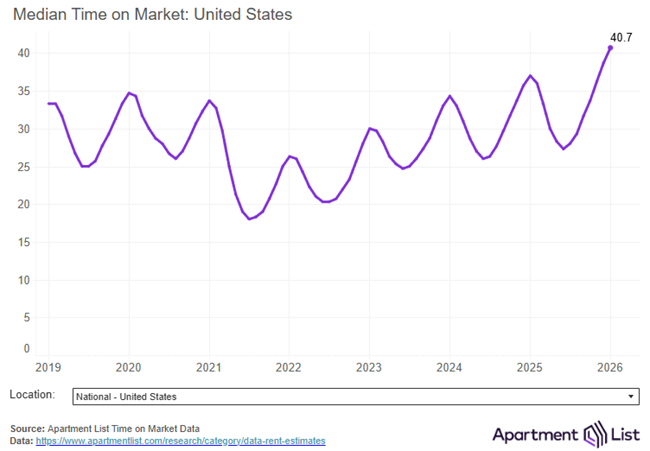
- Units are taking an average of 41 days to get leased after being listed, which is four days longer than one year ago and represents another record high back to 2019.
- The Austin, TX metro continues to have the softest conditions among the nation’s large rental markets, with the median rent there down by 6.3% over the past year. At the other end of the spectrum, the Virginia Beach, VA metro show the fastest year-over-year rent growth at +5%.
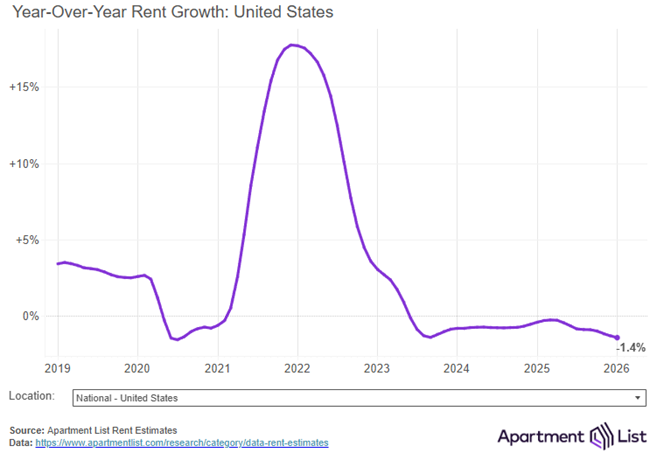
January’s rent decline (-0.2 percent) was a bit steeper than last year’s (-0.1 percent), and so it shows a drop in year-over-year rent growth to -1.4 percent.
Early last year, it appeared that annual rent growth was on track to flip positive for the first time since mid-2023; however, that rebound stalled out and reversed course during a slow summer moving season that has now dragged into the winter. This month’s -1.4 percent reading is the lowest year-over-year rent growth recorded since August 2023.
Multifamily vacancy rate hits 7.3%, highest level since 2017
As a result of new inventory, more vacant units are sitting on the market, meaning that property owners face more competition for renters and have less pricing leverage.
“Our national vacancy index – which measures the average vacancy rate of stabilized properties in our marketplace – sits at 7.3 to start 2026. This represents the highest level since at least 2017, which is when we started tracking occupancy,” the economists write.
List-to-Lease time also reaches a new peak: 41 days
This increase in list-to-lease time is in line with negative rent growth, soft occupancy, and a general off-season cooling of the rental market. Time on market is up four days compared to last January, and more than twice as long as it was in summer 2021, when the average unit was turning over in just 18 days.
Conclusion
“As we start the new year, multifamily conditions remain soft. Year-over-year rent growth remains negative, while vacancies and time-on-market continue to inch up.
“The wave of construction that has been driving these conditions is waning, but whether or not market conditions shift will now depend on rental demand, whose outlook has grown shakier due to weakness in the labor market and general economic uncertainty.
“If demand worsens, it will take longer for the market to metabolize the recent growth in the rent stock, even if the construction industry slows in tandem,” Apartment List economists write in the report.