What Portland’s Inclusionary Zoning started in 2017 for affordable housing actually produced and how it it skewed apartment development.
By Aaron Kirk Douglas
Portland’s affordable-housing mandate skewed apartment development for most of a decade. A 2024 funding fix appears to have corrected course, and a new state law now locks the lesson in. The policy’s long-term shape is still unsettled.
When Portland’s Inclusionary Housing (IH, aka Inclusionary Zoning or IZ) program took effect on February 1, 2017, the idea was simple: Require most new buildings of 20 or more units to set aside a share as affordable, and the city would gain regulated, below-market homes paid for by private development rather than the public treasury. Under the program, a developer sets aside 20 percent of units for households at 80 percent of area median income, or 10 percent at 60 percent, or pays a fee in lieu.
What followed became one of the more instructive cautionary tales in Pacific Northwest housing policy.
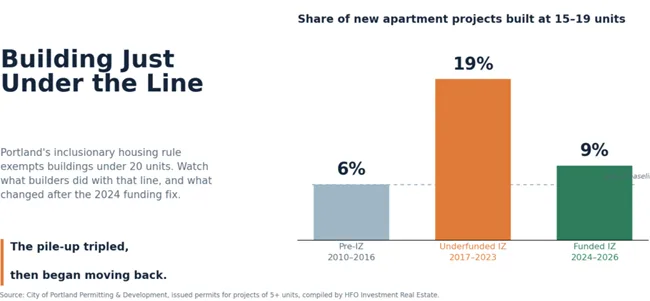
For most of the program’s first seven years, the mandate was not paired with enough financial support to keep larger projects feasible. Including below-market units cut a project’s rental income without cutting its construction, financing, or operating costs by the same amount. Developers faced a clear choice. Build under the 20-unit line and skip the requirement, or absorb the loss. Many chose to build smaller. Sightline Institute found that during the underfunded years, the share of projects coming in just below the 20-unit threshold doubled to nearly half of all multifamily projects.
This was not bad faith. It was a rational response to a rule that made mid-size buildings pencil out poorly. And it almost certainly held back total apartment production in exactly the project sizes the market would otherwise have built.
The program produced affordable homes, though perhaps fewer than the market would have produced had it been left alone.
From 2016 through 2024, 1,967 regulated units were created, affordable at 60 to 80 percent of median family income, and about $5 million in fees were collected in lieu, with several hundred more units in the permitting pipeline. Those are real homes delivered at private expense. But the sub-20-unit migration meant the city likely gave up far more market-rate supply than the headline unit count suggests.
A 2024 city audit sharpened the critique from another direction. The city auditor found the program was not meeting its goal of serving the residents in greatest need, since most units landed at 60 or 80 percent of median income rather than well below. Auditors also found the program’s goals were vague and poorly tracked, that few units were family-sized, and that the Housing Bureau had fallen roughly two years behind on reviewing owner compliance.
The turning point came in early 2024. The City Council voted on January 31, 2024 to expand the program’s full-building property-tax exemption, effective March 1. Portland and Multnomah County together quintupled the value of the 10-year abatement in the neighborhoods ringing downtown. The offset was finally large enough to restore feasibility for larger buildings across much of the city. By Sightline’s reading, the share of sub-20-unit projects returned to its historical range soon after.
Senate Bill 1521 Changed The Housing Landscape
City permit data shows the funded period (2024 was a transition year) running a touch above the pre-IZ baseline on a thin sample.
Oregon then wrote the lesson into state law. Senate Bill 1521, signed by Gov. Tina Kotek on March 31, 2026, requires jurisdictions in the Portland metro area that want to enforce inclusionary zoning to fully offset the cost they impose on developers, through cash, tax abatements, or fee- and system-development charge waivers. The core provisions take effect for rental housing on January 1, 2028, and for all housing on January 1, 2029. In short, a city can still require affordable units, but it can no longer do so for free.
What This Means for Owners and Investors
The 2024 recalibration and SB 1521’s funding mandate are the most meaningful corrections to Portland’s development climate in years. If the abatement structure holds and the city’s ongoing program review does not reinstate an unfunded mandate, Portland could see a modest recovery in larger-project permitting through 2026 and 2027.
That supply, when it arrives, will land in a market that has been starved for two to three years running. New multifamily permit activity in the city fell to about 1,515 units in 2024 and 1,461 in 2025, among the lowest annual totals in more than a decade and far below the 4,000 to 6,000 units a year that was common from 2017 to 2022, according to City of Portland permitting data obtained by HFO Research.
The lag between a policy fix and delivered units typically runs two to three years. In that window, well-located existing assets in supply-constrained submarkets tend to outperform. Owners in those areas have reason to watch permitting closely, because the next wave of competition is being shaped right now, and whether it arrives depends on the funding holding.
Final Note: Inclusionary Zoning May Not Even Be Legal
There is also a longer-term wild card in play. Ballard Spahr LLP attorney Ezra Hammer noted that litigation challenging the legality of inclusionary zoning is active in five states, with advocates pushing to get the issue before the U.S. Supreme Court. “They believe the Supreme Court may strike it down as an unconstitutional taking,” he said, “in which case this conversation could be moot.”
About the author:

Aaron Kirk Douglas is director of market intelligence for HFO Investment Real Estate In Portland.