Home Blog Page 123

A Strange New World: How Do Oregon’s New Drug Laws Affect Landlords?

How Do Oregon’s New Drug Laws Affect Landlords?

Many landlords have questions about new drug laws that go into effect in 2021 so here are some of the issues around Oregon’s new drug laws from attorney Bradley Kraus.

By Bradley S. Kraus,
Attorney at Law, Warren Allen, LLP

If you asked 100 different people to summarize the year 2020 in one word or phrase, I would bet the answers would be as mixed as they were comical. The words “dumpster fire” come to mind for this author. For landlords specifically, the COVID-19 pandemic has required them to change how they do business, how they interact with their tenants, and—for smaller landlords especially—how they are expected to subsidize rents and pay their own mortgages, without help from the legislature.

It was also a year of strange changes in the law, as Oregon voters passed Measure 110 in November. Also known as the Drug Addiction Treatment and Recovery Act, this new law takes effect on February 1, 2021, and decriminalizes small amounts of illegal drugs for personal use. It is important to note that this new law does not legalize drugs. A person caught with a small number of drugs, including Schedule I drugs like heroin and LSD, will face “no more than a Class E violation,” subjecting them to $100 fine, which may be waived if they seek treatment.

For landlords, questions arise related to Oregon’s new drug laws. Must landlords now allow drugs to be on the rental premises? In other words, what rights do landlords have considering these new Oregon drug laws? For starters, a solid rental agreement should protect landlords from any issues.

Good rental agreements contain provisions requiring tenants to comply with all local, state, and federal laws. This last portion is critical. Setting aside the fact that possession is still technically not legalized in Oregon—only punished less—possession of these drugs is still illegal under federal drug laws and classifications. Accordingly, with a solid rental agreement, landlords still have the ability to prohibit the possession of these drugs on the premises, and take action should those provisions of the rental agreement be violated.

Most landlords will likely not know whether their tenants are possessing heavier drugs unless some other issue arises. In other words, if a tenant remains quiet, the world may never know that said tenant is sitting on several pounds of some illicit drug. However, a tenant who is raging through an all-night party with the assistance of cocaine is likely causing other issues. It is these “other issues” that landlords should also focus on.

While drugs may be punished less, these new laws do not provide a license to (a) destroy property, (b) threaten or harm others, or (c) disrupt the quiet use and peaceful enjoyment of other tenants. Each of these defaults are likely violations of the rental agreement, but also violations of the Tenants’ Duties Statute (ORS 90.325). In other words, if you confront your tenants about their conduct, and they—falsely—point to drugs being legal, you can simply point out that there have been no changes to the law regarding bad behavior. And while eviction moratoriums exist regarding non-payment of rent, no eviction moratoriums exist regarding conduct-based notices or evictions.

Landlords have faced many challenges during the COVID-19 pandemic. With the number of laws recently enacted and clearly directed at landlords, one would think landlords collectively caused this pandemic.

As troubling as this is, landlords should continue to focus on protecting good tenants from bad actors. While the people of Oregon have spoken as it relates to drug decriminalization, it is still illegal to possess these drugs. There can be no dispute, however, that the use of some drugs can cause erratic, disruptive, and sometimes violent, behavior. If landlords continue to focus on bad conduct, and continue to direct notices at the same, they will position themselves well to rid themselves of bad tenants, and to protect their many good ones.

How Do Oregon’s New Drug Laws Affect Landlords?
Bradley Kraus, Portland attorney

Brad Kraus is a partner at Warren Allen LLP. His primary practice area is landlord/tenant law, but he also assists clients with various litigation matters, probate matters, real estate disputes, and family-law matters. A native of New Ulm, Minnesota, he continues to root for Minnesota sports teams in his free time. You can reach him via email kraus@warrenallen.com or 503-255-8795.


Fair Housing Matters – Landlord Liability for Tenant-on-Tenant Discrimination

Sign Up For Our Newsletter And Get Apartment News And Helpful, Useful Content Each Week.

* indicates required

Delinquent Landlord Payments Pose Credit Risk for Banks

Delinquent Landlord Payments Pose Credit Risk for Banks due to missed rent

Banks are worried about delinquent landlord payments from small landlords who may not be able to make payments on mortgages for rental property. Smaller landlords are getting hit harder by tenants who miss rent payments due to COVID-19, as well as rent and eviction moratoriums.

About 1.6 percent of an estimated $1.6 trillion market for mortgages on 1- to 4-unit properties were delinquent in November, according to the Mortgage Bankers Association.

And delinquencies are expected to climb.

“Small landlords are getting hit hard with no real way out of the problem until the pandemic ends,” said Chris Nichols, chief strategy officer for the nearly $19 billion-asset CenterState Bank in Winter Haven, Fla., while talking to American Banker.

“Banks have been working closely with landlords to restructure their debt and provide forbearances, but this relief will expire soon and is a concern. Defaults on rental properties are typically caused by mismanagement or economic downturns that are easier to gauge.

“Since none of us have been through a pandemic this large before, there is no playbook and few alternatives,” Nichols said.

The stimulus package enacted in December extended the Centers for Disease Control and Prevention’s moratorium on evictions through Jan. 31 and granted renters other relief. But for many landlords, their mortgage payments are still due, a reality that translates into a looming credit risk for banks, according to American Banker.

Small landlords getting hit harder

For example, Dawn Garza, a landlord and small-business owner in San Antonio, told American Banker she is hoping to get a second loan from the Paycheck Protection Program to cover her property taxes due at the end of January.

She’s short because business is down, and she gave her tenants — one a student and part-time restaurant worker, and the other an out-of-work hairdresser who is recovering from COVID-19 — a three-month break on rent this year.

“I am not going to ask for back rent because I know it’s impossible for them,” Garza told American Banker.

According to Avail, an estimated 44 percent of renters surveyed by the company in October said they did not expect to make a full rent payment that month, up from 35 percent the previous month. And about 57 percent of landlords who did not receive full rent payments reported feeling pressure to sell, according to the Avail survey.

According to a Bloomberg City Lab article, the total owed by Americans in missed rent, late fees, and unpaid utility bills by Jan. 1 was as high as $7 billion. About 11.4 million U.S. renters struggled under the financial pressures of COVID-19, resulting in each household owing an average of $6,000 in past-due rent alone.

A recent study conducted by Avail and Urban Institute confirmed that large numbers of renters are unsure of whether they can afford their rent; of 2,429 renters that responded to the question, 44 percent said they were not able to pay rent in full for October.

Do-it-yourself landlords, which make up the majority of the country’s 48 million rental units, are also struggling to make ends meet due to missed rent. In the same study, Avail and Urban Institute found that delinquent landlord payments represented 12 percent of landlords went into forbearance on at least one of their mortgages due to the pandemic. Of the 12 percent in forbearance, 20 percent are Black and 14 percent are Latino. This is compared to nine percent of white landlords facing the same issue.

Delinquent landlord payments could grow if moratoriums are extended

“I do believe that if the eviction bans are extended much longer, and continuing unemployment rates remain high, we’ll begin to see smaller investors, who are often highly leveraged, begin to default on their loans,” said Rick Sharga, executive vice president of marketing at RealtyTrac.

“Because rental properties owned by mom-and-pop landlords are generally more affordable than those owned by institutional investors, this pressure (to sell) could cause the housing market—which already had a dearth of available units before the COVID-19 pandemic — to lose even more lower-priced rental housing,” researchers at the Urban Institute said in a recent paper regarding the Avail data

Oregon Passes $150 Million Landlord Compensation Fund

Sign Up For Our Newsletter And Get Apartment News And Helpful, Useful Content Each Week.

* indicates required

Reap the Benefits of Owning Your Rental Property through a Retirement Account, Tax-Free or Tax-Deferred

Reap the Benefits of Owning Your Rental Property through a Retirement Account, Tax-Free or Tax-Deferred

By Stephanie Fryar

Real estate is one of the most popular investments to leverage within a retirement account, also known as a Self-Directed IRA (SDIRA). It is a familiar asset if you own your own home or other type of property, it offers diversification from traditional investments, and the rental income and/or capital gains funnel in tax deferred or tax-free depending on the type of account. While the general concept of investing in a rental property through a SDIRA may be similar to investing outside of a qualified account, there are a handful of rules enforced by the IRS that makes the management of this investment quite a bit different. The reason being that your retirement account is meant to benefit you when you retire, not before. Below is a quick overview of the similarities and differences of owning a rental property in a Self-Directed IRA.

What makes it similar?

A SDIRA gives you the opportunity to make investment decisions in areas based on your knowledge and expertise. In other words, you are not limited to residential real estate. Your IRA can hold various investment property types, including commercial buildings, retail properties, raw land, and acreage (improved or unimproved), single family or multi-unit homes, condos or townhomes, mobile homes, apartment buildings and much more. Your IRA may also purchase foreclosure property as long as the property has already been foreclosed upon.

Reap the Benefits of Owning Your Rental Property through a Retirement Account, Tax-Free or Tax-Deferred

What is the difference?

One of the main differences is that all transactions are processed through your SDIRA, from the purchase of the property, to rent collection, expense payments, proceeds from the sale, etc.

Other disparities are driven by IRS regulations, including the prohibition of using of your SDIRA assets in what the IRS considers “self-dealing” transactions. This means that you must utilize 3rd party services for everything from realtor services, to property management, cleaning/landscaping/pool cleaning services, repairs, home improvements, etc. You also cannot use the property for personal use nor rent the property to disqualified persons, which includes family members of “lineal” relation to you such as your parents or your children.

As a custodian, Preferred Trust Company cannot give advice about specific investments or strategies, but we can provide educational resources and point out the legal issues to consider for your real estate transaction(s). Knowing the rules associated with owning real estate in an IRA is essential and conferring with a legal and tax advisor is recommended.

About Preferred Trust Company

Preferred Trust has 10 years of experience specializing in Self-Directed IRAs that hold alternative assets. In the industry, they set the standard for quick processing times, fewer transaction fees, personalized customer service, and the highest standard of compliance. Preferred Trust is currently waiving the establishment fee and first year administration fee for all new Self-Directed IRA accounts through December 31st, 2021. Learn more about this offer by clicking here or calling 888.990.7892 today!

About the author:

Stephanie Fryar is the Content Creator for Preferred Trust Company. All content she produces is to help educate savvy investors and current clients about Self-Directed IRAs. Stephanie specializes in original content and market research related to alternative investments, but more specifically, real estate investments.

Multifamily Transactions Down In 2020, But Set To Rebound

The Benefits of Being Pet-Friendly For Rental Property Owners

The Benefits of Being Pet-Friendly For Rental Property Owners

Rental property owners are now integrating pet-friendly amenities in their apartments to allow renters to keep their favorite animal companions.

By Justin Becker

The dog is humankind’s best friend, and this explains why it is the most domesticated pet. According to statistics in the United States, 63.4 million households own a dog, followed by 43 million households that own a cat. Today, pets are an integral part of most families. Even rental property owners are now integrating pet-friendly amenities in their apartments to allow renters to keep their favorite animal companions.

So, what’s the benefit of your apartments being pet-friendly?

Being Pet-Friendly Means Higher Rent

Just as in the law of demand, fewer housing facilities means higher rent for the few available. Of course, it will cost you more to set up the necessary facilities to make your apartment pet-friendly, but you can compensate for this with a slightly higher rent.

Rental property owners can also set non-refundable pet fees, and because renters want to keep their family together, they will willingly pay the amount. They can again ask for a damage deposit to ensure the property is covered in case of damages, or demand compensation for pet damages.

Besides, you don’t have to worry much about your property. People committed to keeping their pets tend to be careful with their animal companions and ensure they do not become a threat.

Pet-Friendly Apartments Mean Trust

The Benefits of Being Pet-Friendly For Rental Property Owners
Allowing pets indicates that you trust the tenants and believe they can take good care of their pets.

In the traditional tenancy agreements or where pets are not allowed, the relationships between renters and landlords tend to feel tense. A total ban on pets creates the feeling that the landlord mistrusts tenants or believes they will leave the property in bad shape.

On the other hand, allowing pets indicates that you trust the tenants and believe they can take good care of their pets. Renters will obviously feel happy about a landlord who accommodates their lifestyles rather than limiting them.

Prolonged Tenancy

It is challenging to find pet-friendly apartments, making pet owners want to stay longer in your rental property if it is pet-friendly. While they may only be there for lack of other housing options, you still earn your income at the end of the month.

Further, some pets, such as dogs, get fond of the surroundings and will recognize the apartment as home. As such, even the owners will be unwilling to shift to a new residence.

Strained landlord-tenant relationships are also a common cause of residence shifts by renters. Since marking your rental property pet-friendly means trusting your tenants’ level of responsibility, you may have more healthy relationships, so they are less likely to want to shift.

Happier and Healthier Tenants

Pets help keep tenants happy
Pets help keep tenants relaxed so your apartment feels like home for the renters and they will want to stay.

Pets have many health and non-health-related benefits. They provide protection, help ease stress, and provide company, among other advantages. These benefits help landlords to have healthy and happy tenants, thus reducing the chances of strained relationships. The pets keep them relaxed, and your apartment feels like home for the renters.

Also, a pet-friendly apartment means there are no chances of tenants trying to sneak in their pets. The policy may not allow all kinds of animals, but it probably covers the most obvious pets. Attempting to sneak in unauthorized animal companions is among the issues that could strain tenant-landlord relationships.

In addition, pet owners, and especially dog owners, know the importance of exercise. The animals can play around with toys, but a morning run or walk goes a long way. Most owners prefer to take them out for these walks and runs so they benefit from the exercise.

Happy and healthy tenants will feel free to communicate. They can speak out their grievances and allow you to take action rather than opting to find other low-income apartments.

Allowing Pets Gives You an Upper Hand

The Benefits of Being Pet-Friendly For Rental Property Owners
Given that over 70% of renters own pets, making your apartments pet-friendly opens them up to more tenants.

It’s easy for tenants to try to get their pets into an apartment under the radar with the hope of not getting caught if your policy restricts them. Of course, this creates a tense mood, even if you are yet to find out.

However, allowing pets and setting out a clear policy will enable you to be notified of the pets coming in and have a chance to screen them. You can take note of aggressive animals that could be a threat and decide whether to allow them or which safety measures to take.

You can inspect the health of the animals and ascertain that they have the necessary vaccinations. Also, you could take the initiative and provide some services, such as spraying before entry.

You Will Have More Tenants

Given that over 70% of renters own pets, making your apartments pet-friendly opens them up to more tenants. Further, it means there will be fewer vacancy times since tenants will be unwilling to relocate, and so you can earn a steady rental income year-round.

Your Property will Attract Millennials

Millennials are a key demographic.
Millennials are favoring pets to children. This demographic is a significant proportion of the current consumers, and most property owners want them as part of their tenants.

It’s already a fact that millennials are favoring pets to children. This demographic is a significant proportion of the current consumers, and most property owners want them as part of their tenants.

Besides, companies are also applying this trick, and you are likely to find more pet-friendly offices in the corporate world than ever.

The Business Insider released a report in February 2020, claiming that millennials want financial freedom or homeownership. Homeownership comes with the freedom to do what they want, so a restriction on pet ownership would probably not trend well with them.

It Could Mean More Safety

One of the reasons dogs are our best friends is their ability to provide the owner with protection. Trained dogs can detect strangers with ill motives or trespassers, especially at night, and react quickly. They are intelligent animals that can quickly learn and interpret voices and body language.

The skill can help them interpret a situation and know when the owners are in danger or when something is not right. As such, allowing tenants to keep pets will provide safety not just to them, but to your property as well.

Having dogs and other pets around can also help you drive away dangerous animals that find their way into the compound. For instance, cats will keep destructive rodents out of your complex.

Wrapping Up Pet-Friendly Benefits

Although making your rental property pet-friendly might need additional resources that can be a bit costly, it will pay off at the end. Most renters will prefer renting where they feel the landlord understands their needs and gives them the freedom they deserve. Moreover, property owners who make their rentals pet-friendly are likely to increase the rent without experiencing a protest from the tenants.

Given the many benefits associated with making rental properties pet-friendly, owners should  include the resources. That way you can be guaranteed of all your rentals being full throughout the year.

About the author:

Justin Becker is a property owner in the state of Michigan and has a passion for managing communities. He owns apartment complexes and mobile home communities, and has been writing his own blogs for his properties for several years.


7 Questions Landlords Have About Pets and Pet-Friendly Apartments


Ultimate Guide To Assistance Animals And Emotional Support Animals In Rental Housing

Sign Up For Our Newsletter And Get Apartment News And Helpful, Useful Content Each Week.

* indicates required

Portland Apartments’ Digital Passport Supports Local Businesses, Drives Website Traffic

Portland Apartments’ Digital Passport Supports Local Businesses, Drives Website Traffic

How Portland apartments digital passport provides benefits to residents as well as local businesses.

By Paul Bergeron

Like in many parts of the country, downtown local businesses have endured tremendous challenges caused by the COVID-19 economy. For many, operations have had to pivot, and in heartbreaking fashion, others have shut down completely.

Downtown Portland is no different. But with recent vaccine news leading to optimism, and the partnership help delivered by one apartment community, things are looking brighter in 2021.

NBP Capital’s Director of Brand Marketing Sydney Webber noticed last spring that her normally buoyant neighborhood had started to look a lot different when COVID-19 took hold.

She had an idea. To support the area and provide benefits to her residents at Meetinghouse, a 232-unit garden-style community, Webber created a digital passport coupon book in partnership with many nearby merchants in the Sellwood-Moreland neighborhood. From sushi to skating, and for coffee and pets, the passports offers variety.

NBP Capital, a commercial real estate firm, opened Meetinghouse Apartments last fall. The company’s in-house management firm, Templeton, operates the property. People from around the city have been drawn to the small-town, all-are-welcome vibe.

While the apartment building features open floor plans and impressive amenities, Webber says the thriving neighborhood and dozens of local businesses are what draw renters.

“This was the perfect test location because of the relationship we already had with the local business association and the timing with the holiday season,” Webber says of the program, which began Nov. 24. “We hope that if the pilot is successful it is something we can scale to other neighborhoods in Portland and beyond.”

Local Businesses Drive Portland Apartments’ Website Traffic

The winter 2020 digital passport is a variation of one the company used when Meetinghouse first opened in fall 2019. Then, Templeton distributed a paperback passport containing 40 local businesses. It was modeled after a U.S. passport and was included in move-in gifts for new residents. Given the shift in circumstances, Webber decided to overhaul the passport and create something with more flexibility.

The paper passport was reserved for current residents only. Today, it’s a more inclusive experience. As the Portland apartments’ website reads, “You don’t have to live at Meetinghouse apartments to become a passport subscriber or even live in Sellwood-Moreland to unlock coupons. We only require you love Sellwood-Moreland.”

Webber says the program has created local media buzz and the participating businesses’ websites have a link to Meetinghouse, driving traffic to its property website. Anyone who visits the website can subscribe for free.

“It shows that as a company we value our local businesses, and the passport amplifies our brand name to potential renters and beyond,” Webber says. “Introducing the passport is part of the sales process for the leasing team. It helps our brand and neighborhood to stand out.”

Webber advertises the passport through a variety of venues. Participating businesses have a poster with a QR code on display for their customers.

“The passport relies on the power of cross-promotion between businesses as well as user support, establishing it as a valuable consumer resource,” she says. “We hope to continue to partner with local business alliances and media sources to drive traffic to the passport and hope it will continue to grow in 2021 and beyond.”

About the author:

Paul Bergeron has been reporting on the apartment industry since 2002 and served 20 years as editor-in-chief for National Apartment Association’s UNITS magazine. He currently is editor of his LinkedIn media platform Thought Leadership Today and can be reached at pbergeron333@gmail.com.

Solving Junk Removal Problems From Your Rental Property

Sign Up For Our Newsletter And Get Apartment News And Helpful, Useful Content Each Week.

* indicates required

Multifamily Transactions Down In 2020, But Set To Rebound

Multifamily Transactions Down In 2020, But Set To Rebound

The impact of the pandemic was not felt evenly across the county as multifamily transactions in 2020 were down and sales plunged in due to COVID-19, according to a new report from Yardi Matrix, after record multifamily transaction volume in 2019.

A few summary points from the report:

  • Much of the change could be described as a “filtering” effect: investors moving from urban cores to inner-ring suburbs, from primary to secondary metros and from secondary to tertiary metros. This phenomenon results from several factors, including owners putting fewer properties on the market, disagreement between buyers and sellers about prices, the composition of buyers, and the competition for assets.
  • Sales recovered in the third quarter after hitting a trough in 2Q20, but like so much about the economy, a return to “normal” transaction activity is hard to predict. Until the pandemic recedes and people can return to daily activities with the help of an effective vaccine, uncertainty will linger.
  • Despite worrying economic signals—S. unemployment numbers remain high, gateway-market occupancy rates and rents have plummeted, and December rent payment data shows more tenants not making payments—multifamily fundamentals have held up better than in other commercial property segments, and loan delinquencies remain low.
Multifamily Transactions Down In 2020, But Set To Rebound
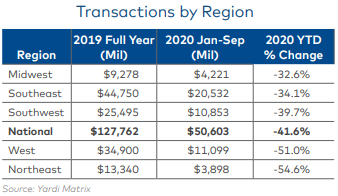
Chart on multifamily transactions courtesy of Yardi Matrix.

Gateway cities took the biggest hit

“Multifamily  transaction activity abruptly hit a wall when shelter-in-place orders started in March. Transaction volume fell to $9.4 billion in the second quarter, the lowest quarterly total since the first quarter of 2011 and a decline of 62 percent from 1Q20 and 67.2 percent year-over-year,” according to Yardi Matrix data.

“Deal flow picked up to $16.5 billion in the third quarter, though that is still 51.1 percent below 3Q19 volume of $33.8 billion. Through three quarters of 2020, total volume was $50.6 billion, down 41.7 percent year-over-year.

“But the impact is not being felt evenly across the country. On a regional basis, the Northeast (-54.6 percent) and West (-51.0 percent) had the biggest declines, while the Midwest (-32.6 percent) and Southeast (-34.1 percent) fell the least. Urban and suburban multifamily sales have dropped by roughly the same percentage, but there has been a difference by region.”

The report says the trend of corporations allowing employees to work from home has contributed to the migration from bigger urban areas to more suburban areas and from urban submarkets in the most expensive metros to suburban markets or even secondary markets.

And equity investors still see multifamily as a highly appealing investment product. “Apartments typically produce 4-6 percent dividend yields, which is a better return than sovereign bonds or investment-grade corporate bonds,” the report says.

Summary

“The upshot is that demand for multifamily properties is high and should remain so for the foreseeable future. Barring a sharp and unexpected economic downturn or a health crisis that would create another shutdown, or disruption in the capital markets, multifamily transaction activity is poised to rebound in 2021 closer to pre-pandemic levels.”

—Paul Fiorilla, Director of Research, and Casey Cobb, Senior Analyst

Get the full white paper here.

Secondary Market Rents Soar While Primary Markets Plummet

About Yardi Matrix:

Yardi Matrix researches and reports on Multifamily, Office and Self Storage properties across the United States, serving the needs of a variety of industry professionals.Yardi Matrix Multifamily provides accurate data on 18+ million units, covering over 90% of the U.S. population. Contact them at (480) 663-1149.

Affordable multifamily markets in high demand

Negative Rent Growth Year-Over-Year For First Time Since 2010

Sign Up For Our Newsletter And Get Apartment News And Helpful, Useful Content Each Week.

* indicates required

How To Determine Competitive Rent In Class C Building?

How To Determine Competitive Rent In Class C Building?

This week the question for Ask Landlord Hank is about how to determine competitive rent in a Class C building. Remember Landlord Hank is not an attorney and is not giving legal advice.

Dear Landlord Hank:

I’m having trouble determining a competitive rent for my vacant three-bedroom in Kenmore. We are a class C building with remodeled upgrades, but no amenities such as an exercise center. – Larry

Dear Landlord Larry,

Let me tell you how I find market rent, as a Realtor, and how I used to do so as a private landlord.

The first data base I check is MLS. I look in the subject property subdivision or if large condo building, I’ll check that, for properties that are actively advertised and that have rented in the last six months.

I want to find a similar unit, so in your case, I’d be searching for a three bedroom with the same number of bathrooms, same square footage, give or take 300 square feet either way, with similar finishes.

First I look at what has actually rented, and if I find a few like the subject property, I’ll be very close to market rent. Then I look at what is advertised but not rented yet. I look at the rate, then how long this equal property has been on the market.

It may be priced too high if it is just sitting there. If the rate is equal to similar properties that have rented or is just a little higher, then I know I have found the market rate for my property.

If there are very few properties to rent in my development or subdivision, I’ll check back to see what has rented in the last year. If not enough are available, I’ll check to see what has rented in the last two years. If I still don’t have good comps, I’ll go outside the subdivision and choose similar properties within one mile; again, if I don’t find enough good comps, I’ll check properties within two miles.

Hopefully, you’ll be able to find adequate comps looking within two miles of the subject property and going back two years.

As a private investor, I used to check what was available in my property area on Craigslist and Facebook marketplace, and I also used to drive the neighborhood and see what my competition looked like.

I’d check the units for rent, terms (first, last and security up front?), what was included in the rent, the unit finishes, state of the property (well cared for?) and the neighborhood.

I was always able to determine my market rent from these sources.

Good luck.

Sincerely,

Hank Rossi

Ask Landlord Hank: How to determine competitive rent in a class C building
Landlord Hank says to determine competitive rent, “Hopefully, you’ll be able to find adequate comps looking within two miles of the subject property and going back two years.”

Ask Landlord Hank Your Question

Ask veteran landlord and property manager Hank Rossi your questions from tenant screening to leases to pets and more! He provides answers each week to landlords.

  • This field is for validation purposes and should be left unchanged.

Do I Have to Paint and Replace Flooring for a Long-Term Tenant?

Sign Up For Our Newsletter And Get Apartment News And Helpful, Useful Content Each Week.

* indicates required

What Properties Can be Used In a 1031 Exchange?

Kay Properties and 1031 and 1033 exchanges and eminent domain options details

By The Kay Properties Team

If you are interested in selling your real estate, the phrase “1031 Exchange” has certainly come up once or twice in your research, as an outright sale can trigger large tax consequences. The capital gains and depreciation recapture taxes can be a serious dent in the return you expected to earn from the sale of your real estate. A 1031 exchange is a process by which an investor can defer the taxes they would pay upon sale of their investment property. It is important to understand how the 1031 exchange can be utilized.

A 1031 exchange may be performed if the property sold and the following property or properties purchased are both considered investment property. Investment properties are those that are used for business or investment purposes. Raw land, land with mineral rights, multifamily, and commercial real estate can all qualify as “like-kind” for the purposes of a 1031 exchange. Any property that falls outside that definition would not qualify. A primary residence or any property in which one stays more than two weeks in a year is NOT considered an investment property.

Again, an investment property must be exchanged for another investment property. Properties can only be exchanged if they are used for investment purposes like residential rentals, multifamily, condominiums for rent, commercial, industrial, retail etc. Furthermore, there are many 1031 exchange alternatives one may consider. A Delaware Statutory Trust is a great example. With DST real estate, an investor is able to exchange into properties and own a fractional interest in the real estate. Instead of investing the entirety of the proceeds into another property, one for one, an individual is able to invest in multiple pieces of property as a fractional and passive owner. Under the DST structure, fractional real estate ownership is still considered eligible for 1031 exchange. This is a helpful way to potentially diversify into a portfolio of properties, thereby buffering the risk of having “all your eggs in one basket” by buying a single property. Utilizing the DST structure, one can own fractional interest of multiple properties with the opportunity for several geographic locations as well as with various asset managers running each real estate investment as part of a diversified 1031 solution into DSTs.

These are illustrative examples of 1031 DST offerings. Future available 1031 DST offerings and tenants may be different. Diversification does not guarantee profits or protect against losses.

Ask Kay Properties about a 1031 exchange

About Kay Properties and www.kpi1031.com 

Kay Properties is a national Delaware Statutory Trust (DST) investment firm. The www.kpi1031.com platform provides access to the marketplace of DSTs from over 25 different sponsor companies, custom DSTs only available to Kay clients, independent advice on DST sponsor companies, full due diligence and vetting on each DST (typically 20-40 DSTs) and a DST secondary market.  Kay Properties team members collectively have over 115 years of real estate experience, are licensed in all 50 states, and have participated in over 15 Billion of DST 1031 investments.

This material does not constitute an offer to sell nor a solicitation of an offer to buy any security. Such offers can be made only by the confidential Private Placement Memorandum (the “Memorandum”). Please read the entire Memorandum paying special attention to the risk section prior investing.  IRC Section 1031, IRC Section 1033 and IRC Section 721 are complex tax codes therefore you should consult your tax or legal professional for details regarding your situation.  There are material risks associated with investing in real estate securities including illiquidity, vacancies, general market conditions and competition, lack of operating history, interest rate risks, general risks of owning/operating commercial and multifamily properties, financing risks, potential adverse tax consequences, general economic risks, development risks and long hold periods. There is a risk of loss of the entire investment principal. Past performance is not a guarantee of future results. Potential cash flow, potential returns and potential appreciation are not guaranteed.

Nothing contained on this website constitutes tax, legal, insurance or investment advice, nor does it constitute a solicitation or an offer to buy or sell any security or other financial instrument. If you are not the intended recipient of this message, any use, dissemination, distribution or copying of this communication is strictly prohibited. If you have received this communication in error, please immediately notify the sender and permanently delete all copies that you may have. Securities offered through Growth Capital Services, member FINRASIPC, Office of Supervisory Jurisdiction located at 582 Market Street, Suite 300, San Francisco, CA 94104.

1031 Exchange Coming Up? Know the Options Before You Reinvest

Oregon Landlords File Federal Lawsuit Against State, City and County

Oregon Landlords File Federal Lawsuit Against State, City and County

Several Oregon landlords have filed suit in federal court in Oregon alleging the legislature, even after passing the most recent bill, has failed to responsibly address the housing crisis.

The lawsuit was filed in the Federal District Court naming Governor Kate Brown, the State of Oregon, Multnomah County and the City of Portland as defendants, according to John DiLorenzo, attorney for the landlords.

DiLorenzo said according to Multifamily NW, Oregon renters are currently in arrears to a total of between $800 to $900 million in unpaid rent.

“Yet, the state has opted to make available only a fraction ($200 million) of the overall need to benefit renters who reside in only certain types of housing owned by certain types of providers,” DiLorenzo said. “Sadly, the state had a chance to address this issue during the third special legislative session by taking up LC 881, a proposal designed to make it easier for all housing providers to provide rent forgiveness for existing tenants in exchange for credits against future Oregon income tax.

“Instead, it adopted a new law (HB 4101) that fails to equitably address the growing crisis and simply kicks the can down the road, increasing the crushing debt that tenants who cannot pay rent will ultimately have to deal with in bankruptcy courts.  The state’s latest response will require both renters and housing providers to wait in a very long line only to discover when they get to the window that the promised support is all sold out.

Oregon Landlords File Federal Lawsuit Against State, City and County

Download the lawsuit here.

“Renters are in need of immediate support, unrestricted by artificial ‘tests’ and unreasonable bureaucratic impediments.  The lion’s share of renters want to pay rent and cannot because they have lost their livelihoods (either due to the governor’s choice to close the businesses which used to employ them or because the governor has closed the schools their children attend, requiring them to provide all-day care for their children).

“Governor Brown, the state, the county and the city determined that the COVID-19 crisis required those actions.  We are sympathetic to all who have been impacted by this horrible disease and are not going to second-guess whether the government’s responses were necessary or appropriate.  But there is no doubt that the state’s choices and the choices of the city and county were the direct causes of the grave financial circumstances which renters and their housing providers are now experiencing.”

The landlords filing suit “are private-sector housing providers who the defendants have required to provide services without compensation,” he said.

DiLorenzo said one of the landlords filing the suit, Moe Farhoud, “is a respected housing provider in the Portland area. Farhoud immigrated to Oregon from Lebanon in 1985, fleeing a war that claimed members of his family.  He has dedicated much of his life and his business to creating safe, good-quality rental housing. Farhoud helps individuals get a second chance at finding stable housing, working with clients who have past infractions. A brief video about Mr. Farhoud and the business he has built is linked here:  http://moefarhoud.com/

Another landlord filing suit is the Sherman family, local housing providers in the mid-Willamette Valley who have invested 18 years of their lives to build their business.

“Crystal and Tyler have renovated dozens of distressed properties into rental homes that have provided a safe space for hundreds of families. They are proud of the business they have built together and the opportunity it has provided them to give back to their community,” DiLorenzo said.

The suit alleges the actions of the defendants violate the contracts clause of the United States Constitution, the prohibition on takings without just compensation in the Fifth and Fourteenth amendments to the United States Constitution, and the prohibition against seizures of property in the fourth and fourteenth amendments to the United States Constitution.

The plaintiffs request that the Federal District Court either declare the moratorium declarations, executive orders and laws invalid and void or, in the alternative, require the state, city and county to design and implement a plan to adequately compensate all private housing providers for their losses incurred in addressing the consequences of the governments’ response to COVID-19.

Oregon Passes $150 Million Landlord Compensation Fund

Sign Up For Our Newsletter And Get Apartment News And Helpful, Useful Content Each Week.

* indicates required

Oregon Passes $150 Million Landlord Compensation Fund

Oregon Passes $150 Million Landlord Compensation Fund

The Oregon State Legislature special session passed a $150 landlord compensation fund that provides up to 80 percent of rent due for landlords, but requires them to forgive the remaining 20 percent.

The legislature also extended the current eviction moratorium to June 30, 2021. The landlord-compensation fund money was part of the overall $800 million set aside by the special session to address several COVID-19 relief issues.

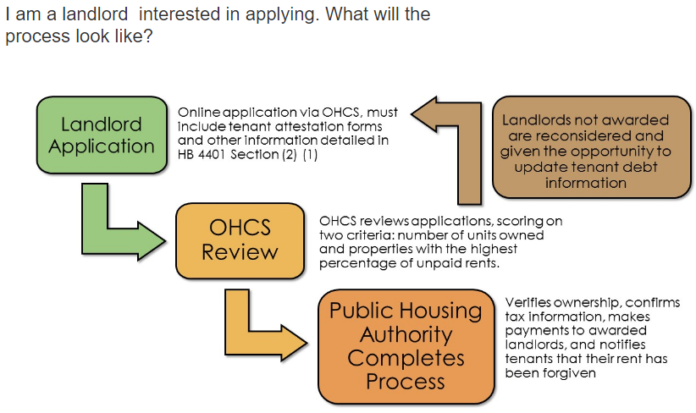
Overall, the legislature allocated $200 million in rent assistance to support tenants and landlords, which includes the $150 million for the Landlord Compensation Fund. The Oregon Housing Stability Council will be developing program materials “in the coming weeks as we prepare to launch the Landlord Compensation Fund in late January,” the council said in a release.

Landlords can sign up here for the program.

The landlord-compensation portion of HB 4401  says, “ The Housing and Community Services Department shall make distributions to compensate residential landlords for 80 percent of the past-due rent of qualified tenants that the landlord has not collected after April 1, 2020, if the landlord or the landlord’s designee” meets the following criteria:

  • Submits an application to the department for all of the landlord’s tenants who have not paid rent and have delivered to the landlord a signed declaration under section 7 (1)(b) of this 2020 third special session act;
  • Includes in the application a copy of the tenants’ declarations;
  • Provides the department with a description of the unpaid rent for all current tenants;
  • Agrees to forgive the remaining 20 percent of the unpaid rent due from qualified tenants that has accrued between April 1, 2020, and the date of the application, upon receiving a distribution under this subsection;
  • Agrees to repay to the department any amount that was forgiven by the landlord or that was paid to the landlord under this section and the landlord later receives from the qualified tenant or on the tenant’s behalf, within the period requested by the department;
  • Is not a member of the tenant’s immediate family as defined by law;
  • During the pendency of the distribution application, agrees to not give a termination notice without cause or for nonpayment.

Rep. Mark Meek, D-Oregon City, echoed the testimony of many smaller landlords that they are struggling to pay their mortgages. Meek noted many landlords continue to have to pay property taxes, insurances and all the other bills related to their property, and many have now said they are at risk for losing their properties.

“Why is it that Oregon housing providers are being forced to forgo 20 percent of their revenue and waive all their rights just to access relief?” Meek said to Oregon Public Broadcasting. “No other industry has been asked to bear such a heavy burden in this pandemic.”

The bill will require tenants to sign a sworn statement in order to benefit from the new relief. It also frees up landlords to more easily evict people “for cause,” such as when they are planning to demolish a property.

For the rent-relief portion, the bill also says landlords may have to provide “any other information or materials required by the department,” which will develop an online application for landlords to apply for distributions.

Landlord compensation fund and protection for smaller landlords

The bill says the department “may establish any qualifications, priorities, restrictions or limits on the distributions made under this section, to prioritize landlords with fewer units and landlords with a higher percentage of unpaid rents.”

The restrictions and limits the department may put in place include:

  • Limits per tenant, per landlord or per time period;
  • The number of units a landlord must own;
  • The percentage or amount of total rent unpaid.

“The department may coordinate with local housing authorities to administer this section, including through making distributions to landlords. The department or local housing authority shall mail to tenants copies of a notice of distribution to their landlords and the amount of rent forgiveness agreed to by their landlords. The department may conduct outreach to landlords and tenants, including outreach to non-English speakers.”

Rental assistance must serve financially distressed households, and payments must be made directly to the landlord.

The extension of the eviction moratorium also extended the requirements for both landlords and tenants.

Read the full text of the bill here.

Oregon Governor Calls Special Session For Tenant, Landlord Aid

Sign Up For Our Newsletter And Get Apartment News And Helpful, Useful Content Each Week.

* indicates required