Home Blog Page 74

Rents Rise Modestly As Interest-Rate Hikes Take Center Stage

Rents Rise Modestly As Interest-Rate Hikes Take Center Stage

Multifamily asking rents rose modestly moving up a bit in October, according to the October National Multifamily Rent and Supply Report from Yardi Matrix, as everyone is watching the Federal Reserve’s big increases in short-term interest rates.

“The Fed’s actions have roiled the housing market, which is sure to impact multifamily demand, property values and investment strategies,” the report says.

While overall multifamily asking rents continued to decline in October, there was a small increase over the previous month in the average U.S. asking rent. This slight increase was seen in a few markets led by New York (0.8 percent), Indianapolis (0.7 percent), Kansas City (0.6 percent) and Portland (0.5 percent).

“These metros benefit from low levels of new supply that are less than the national average,” Yardi Matrix said.

Highlights of the report:

  • Multifamily rents rose modestly in October amid weakening demand and decelerating year-over-year growth. U.S. asking rents increased $3 in October to $1,727. Year-over-year growth fell to 8.2 percent, the lowest level since the summer of 2021.
  • The deceleration in asking rents remains gradual, as every one of the Matrix top 30 metros produced year-over-year rent increases. But there are worries about how the multifamily market will react to the rapid increase in short-term interest rates as the Federal Reserve attempts to reduce inflation.
  • The single-family rental market is cooling from its recent red-hot performance. The average U.S. asking rent was unchanged at $2,088 in October, while the year-over-year increase fell by 160 basis points to 6.6 percent.

On the supply-and-demand side

“The multifamily market has changed dramatically in recent months. Rising rates have weakened demand and rent growth, while transaction activity is slowing as market players gauge how far values are dropping.”

The Fed’s aggressive moves to contain inflation have led commercial real estate investors to downgrade the economic outlook, increasing the likelihood of a recession and the expected depth of that downturn.

Lease renewals continue to decline

National lease renewals fell in September to 60.2 percent, continuing a slide from the peak of 68.0 percent in the fourth quarter of 2021.

The lower renewal numbers reflect a general weakening of overall demand and waning levels of affordability.

Get the full Yardi Matrix report here.

About Yardi Matrix

Yardi Matrix researches and reports on multifamily, office and self-storage properties across the United States, serving the needs of a variety of industry professionals. Yardi Matrix Multifamily provides accurate data on 18+ million units, covering more than 90 percent of the U.S. population. Contact the company at (480) 663-1149.

Sign Up For Our Weekly Newsletter And Get Rental Property And Apartment News And Helpful, Useful Content Each Week.

* indicates required

Multifamily Rents ‘Hit the Brakes’ in September

Rental Price Drops Around The Country

Portland Rents Increase Again In October

Dealing with Habitability issues and Substitute Housing

Dealing with habitability issues and substitute housing as even the smallest of molehills can be made into a mountain by unreasonable individuals.

Dealing with habitability issues and substitute housing as even the smallest of molehills can be made into a mountain by unreasonable individuals.

Bradley S. Kraus
Partner, Warren Allen LLP

Life happens. Common sense tells us that things inevitably break, require replacement, and/or cause issues. This fact also exists in the landlord/tenant context, as fixtures/appliances break, require replacement, and cause irritation to everyone. Most of the time, these repairs/replacements are no big deal, and are quickly and painlessly resolved.

However, even the smallest of molehills can be made into a mountain by unreasonable individuals. As a landlord’s attorney, I have seen cases wherein a simple light bulb being out causes the other side to melt down and claim the premises is uninhabitable. While this is obviously an extreme case, there’s obviously varying degrees of these cases.

Sometimes, a flood or fire occurs, which does in fact render the premises uninhabitable. Landlords intrinsically understand that these problems need to be addressed, as ORS 90.320 requires. However, acting without a plan can create a scattered process—which can paint us in a bad light, should the tenant decide to pursue damages.

As an initial matter, I should go without saying that any reasonable maintenance request should be addressed with as much haste as possible. Varying degrees exist, as a light bulb being out does not have the same urgency as a shower leak. However, when a maintenance request comes that requires action, an entry should be requested from the tenant if the tenant makes a verbal maintenance request. That request should be documented, and if the tenant denies consent to enter, then (a) that should be noted, as it clearly is not severe, and (b) a Notice of Intent to Enter should be served to inspect and document the issues.

If the maintenance request is in writing, then ORS 90.322(1)(c) allows the landlord to enter upon demand to make the repairs without further notice or consent. Many landlords still do request or inquire as to a good time to enter, simply out of courtesy, but the statute would not require it. Once inspecting, photos should be taken of the issue and placed in the file, providing the landlord with evidence of the issues. If they are significant and/or require an outside vendor, those requests/calls should be made immediately and documented.

If the issues/repairs render the place uninhabitable or unusable, then substitute housing may be something to explore, depending on the circumstances (more on that below). If substitute housing is appropriate, then it is important that landlords control this process. If the landlord has a comparable unit available, that should be offered to the tenant with a temporary transfer agreement. It is important that this understanding be put in writing, as I have seen cases wherein tenants refuse to leave their new place of occupancy, even after the repairs are made. Having this agreement in writing is important to spell out what will occur, and when, if the tenant fails to vacate.

Landlords also want to control this process to control the cost. In the context of substitute housing, tenants are only entitled to “comparable housing” which has a specific definition under ORS 90.365. When landlords do not have control, cases can arise wherein tenants decide it is appropriate to stay at the Ritz Carlton. While ORS 90.365 says that they can do this as long as they pay for the additional cost, litigation often arises as to “who pays what” which can be just as expensive.

Finally, keep in mind that the cost of repairs, or the requirement of substitute housing, are only borne by the landlord if the tenant did not cause the issues which necessitated the repairs. In other words, if the tenant causes a flood, then (a) they are responsible for those damages, and (b) the landlord is not required to provide substitute housing. Due to this fact, it is important to quickly identify any issues in the premises, completely document the same, and, if necessary, have a third-party expert/vendor determine the cause and/or extent of the issue. Doing so can set you up for success if litigation arises and save you money in the long run.

About the author:

Bradley S. Kraus is an attorney at Warren Allen LLP. His primary practice area is landlord/tenant law, but he also assists clients with various litigation matters, probate matters, real estate disputes, and family law matters. You can reach him at kraus@warrenallen.com or at 503-255-8795.
Dealing with habitability issues and substitute housing as even the smallest of molehills can be made into a mountain by some individuals.
Bradley Kraus, Portland attorney

Sign Up For Our Weekly Newsletter And Get Apartment News And Helpful, Useful Content Each Week.

* indicates required


Portland Update: Changes to FAIR Ordinance Bring (Some) Necessary Changes

Three Must-Know Property Management Trends For 2023

Three must-know property management trends for 2023 include portfolio expansion as a top item, according to Buildium’s report

Three must-know property management trends for 2023 include portfolio expansion as a top item, according to Buildium’s 2023 Property Management Industry Report .

Here are three of the property management industry trends that the report says will exert major influence over the way in which small and mid-sized companies do business in 2023 and beyond.

No. 1 – Property management portfolio growth

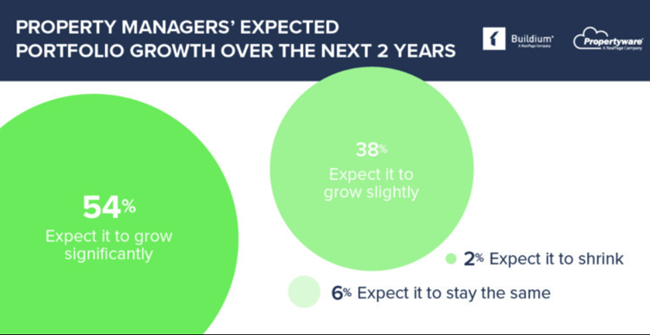
The report says, “Looking specifically at small property management companies who manage rental properties owned by third parties, 92 percent plan to add new doors to their portfolios in 2023 and 2024.

A majority of respondents “said their companies plan to grow by a significant amount—a term that most respondents defined as an increase in the size of their portfolios by between 26 percent  and 50 percent.

Three must-know property management trends for 2023 include portfolio expansion as a top item, according to Buildium’s 2023 Property Management Industry Report .
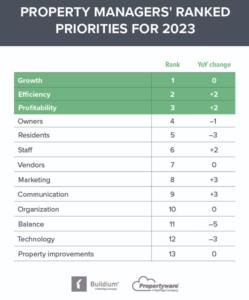
Charts courtesy of Buildium.

These portfolio expansion growth plans represent a more normal return to business which was seen pre-pandemic.

While portfolio expansion took the top spot in Buildium’s report, “efficiency and profitability took second and third place—two priorities that had fallen down the list during the pandemic as issues related to rental owners and renters took priority.”

Three must-know property management trends for 2023 include portfolio expansion as a top item, according to Buildium’s report

No. 2 – Demand for property management services

The industry report says rental owners’ demand for property managers’ expertise remains elevated above the pre-pandemic period.

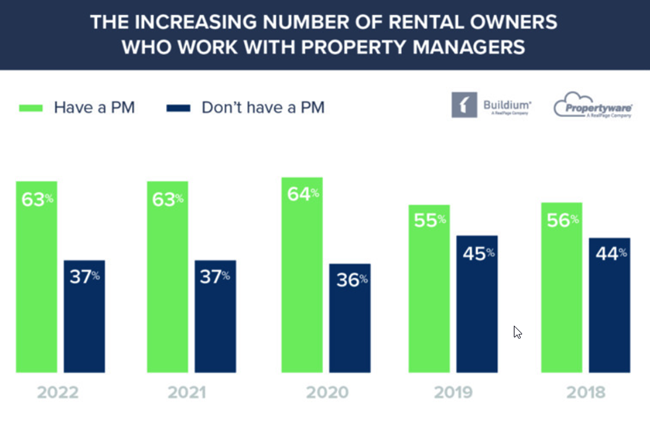
The number of rental owners who reported that they currently had a property manager jumped from 55 percent in 2019 to 64 percent in 2020, and held steady at 63 percent throughout 2021 and 2022.

“The good news is that our surveys have found that for small real estate investors, enlisting an expert’s help in these areas dramatically reduces their stress levels. So, in spite of the temptation to keep costs low by managing their properties themselves, Small-Portfolio Investors and Accidental Landlords alike continue to see the value in professional property management services,” Buildium says in the report.

“Our survey found that this is particularly true when it comes to collections, maintenance, leasing, regulatory compliance, financial reporting, and local market expertise.”

Three must-know property management trends for 2023 include portfolio expansion as a top item, according to Buildium’s 2023 Property Management Industry Report .
Chart courtesy of Buildium.

No. 3 – Competition in the property management industry

One of the keys to staying competitive is technology which is helping small property management companies stay competitive and profitable during the labor shortage.

National firms and institutional investors have expanded into popular markets—particularly in the Sun Belt—to seize the opportunity that those appealing cities present, often acquiring local property management companies for their portfolios, the report says.

“This has been particularly stressful for small property management companies, who have less room to compete on price than larger firms do,” Buildium says in the report.

So, one of the key elements of competition can be embracing more technology, such as:

  • Take on more properties than they otherwise would have been able to.
  • Focus more of their energy on relationships, helping them to attract higher-quality, longer-term clients and tenants.
  • Get rid of their offices, allowing them to reduce their costs significantly while increasing their organization, efficiency, and consistency.
  • Improve team members’ enjoyment of their jobs, allowing them to spend less time on repetitive tasks so they can focus on more impactful and fulfilling work.

Get the full report from Buildium here.

Sign Up For Our Weekly Newsletter And Get Rental Property And Apartment News And Helpful, Useful Content Each Week.

* indicates required

18 Months of Outstanding Rent Growth Coming to An End

Multifamily Rents ‘Hit the Brakes’ in September

Rental Price Drops Around The Country

Portland Rents Increase Again In October

Portland Rent Growth Moderates On Par With U.S.

Portland rent growth has moderated and matches much for what is going on with rents across the U.S., Yardi Matrix says in the autumn report

Portland rent growth has moderated and matches much for what is going on with rents across the U.S., Yardi Matrix says in the early autumn report for Portland.

Portland’s multifamily sector showed steady improvement in 2022, the report says.

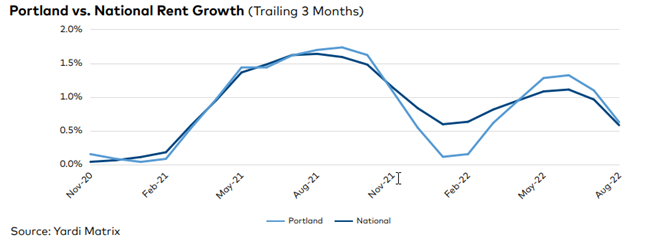
“Rent gains moderated, to 0.6 percent on a trailing three-month basis through August, on par with the national average, but the movement can be attributed to a typical seasonal softening.

“The occupancy rate in stabilized properties declined 30 basis points year-over-year as of July, but at 96.2 percent, it is still a tight rental market,” Yardi Matrix says in the report.

Rent trends

The overall asking rent in the Portland metro rose to $1,759, slightly above the $1,718 U.S. figure. On an annual basis, rates in Portland were up 9.9 percent, 100 basis points behind the national figure.

“Of the 57 submarkets tracked by Yardi Matrix, 26 posted double-digit year-over-year rent growth. In August, six submarkets had an average above the $2,000 mark, up from two a year ago. Lake Oswego (11.3 percent to $2,436) and Pearl District (3 percent to $2,121) remained the most expensive areas.

Portland rent growth has moderated and matches much for what is going on with rents across the U.S., Yardi Matrix says in the autumn report
Chart courtesy of Yardi Matrix

The economy

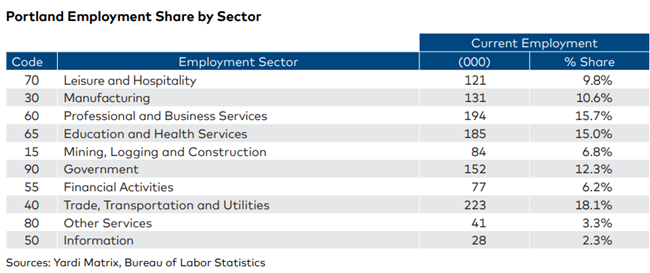
Yardi Matrix says, “Portland’s economy has made good strides since the peak of the health crisis but has yet to fully rebound to pre-pandemic levels.

“Unemployment stood at 3.6 percent in July, according to preliminary data from the Bureau of Labor Statistics but started climbing again from 3.1 percent in May. Still, its performance is only slightly below the state and the U.S., both at 3.5 percent in July.”

“Manufacturing, and especially semiconductor manufacturing, has been one of Oregon’s main economic drivers during the past decade, with the most recent expansion being that of Intel, in April. The company opened its $3 billion factory in Hillsboro, known as Gordon Moore Park at Ronler Acres, where it hired 2,000 employees in the past year. Intel’s decision to expand into Ohio pushed local leaders to form a task force reviewing the state’s legislation pertaining to the chip industry,” Yardi Matrix writes in the report.

Portland rent growth has moderated and matches much for what is going on with rents across the U.S., Yardi Matrix says in the autumn report.
Chart courtesy of Yardi Matrix

Population decrease

For the first time since 2010, Portland’s population decreased during the second year of the pandemic.

The metro lost 4,618 residents in 2021, a 0.2 percent demographic contraction.

Supply

Portland developers added 3,335 units through August.

“The construction pipeline remained robust, with 9,967 units underway and another 28,500 in the planning and permitting stages. Of these, 4,314 units broke ground this year, more than double the 2,009 units that started construction during the same interval last year. The pipeline composition changed slightly, with more fully affordable properties underway (26.7 percent of pipeline), but the bulk is still focused on the Lifestyle segment (73.3 percent),” the report says.

Get the full Portland report here.

About Yardi Matrix

Yardi Matrix researches and reports on multifamily, office and self-storage properties across the United States, serving the needs of a variety of industry professionals. Yardi Matrix Multifamily provides accurate data on 18+ million units, covering more than 90 percent of the U.S. population. Contact the company at (480) 663-1149.

Sign Up For Our Weekly Newsletter And Get Rental Property And Apartment News And Helpful, Useful Content Each Week.

* indicates required

Multifamily Rents ‘Hit the Brakes’ in September

Rental Price Drops Around The Country

Portland Rents Increase Again In October

What a Possible 2023 HUD Announcement Could Mean for Private Landlords

What a possible 2023 HUD government announcement could mean for private landlords and use of criminal history in screening applicants

What a possible 2023 HUD announcement could mean for private landlords and applicant criminal history as often when HUD makes a policy for government housing, they slowly try to implement it into the private sector.

By David Pickron

Have you ever been punished for something you didn’t do or that was completely out of your control?   My guess is you have, and that the thought that flashed through your mind at the time went something like this: But I didn’t do anything wrong!  Frustration sets in as you try and figure out what you could have done differently, reaching the conclusion that sometimes these things are out of your control. The situation below might be one of those times.

************************************************************************

For property owners, although it hasn’t happened yet, this scenario may soon play out based on some recent actions being considered by HUD.

*****************************************************************

On April 12, 2022, Marcia Fudge, Secretary of the U.S. Department of Housing and Urban Development, issued a memorandum to her staff with the subject line: Eliminating Barriers That May Unnecessarily Prevent Individuals with Criminal Histories from Participating in HUD Programs.  In short, HUD is trying to determine what criminal criteria HUD programs should use, if any, when qualifying an applicant.  At that time, she called for a six-month study period that ended October 14, 2022.  History shows, when HUD makes a policy for government housing, they slowly try to implement it into the private sector.  And even though it hasn’t happened yet, it may be coming.

This is where the “unfair” results kick in.  Think about those jurisdictions who have source of income as a protected class, where it is illegal to discriminate against people who use Section 8 vouchers as income.  As a private landlord, whether you want to or not, you are required to take Section 8 housing if your rents are in line with the standard rental rate of local housing providers.  If this happens, the government just took your private housing and turned it into government housing, and you must follow all of HUD’s rules and recommendations or else.

As an example, I have an income-producing rental home in Tucson, Arizona.  The market value of rent is $1,100 per month and a Section 8 voucher is willing to pay $1,100.  Section 8 rationalizes that your financial risk is covered by the government so there is no need for me as a private landlord to financially qualify an applicant any further.  The most I can require is three times the applicant’s portion of the rent, which is usually zero to begin with.  As part of my normal tenant-onboarding process, I then run the applicant through a background check to see if there is any criminal history and subsequently find this individual has several felony drug convictions.  Right now, I can decline this individual based on a “no-felony drug-conviction-in-the-last-seven-years” rule that is a key part of my rental-applicant criteria.  This is where it gets tricky based on what HUD could propose regarding criminal history because of the memo referenced above.  They are trying to justify mandating the removal of any criminal history search, claiming that a criminal history has no correlation with you as a private landlord receiving the rent because the government is covering that part.  That is a scary thought process.

As more jurisdictions vote to add source of income as a protected class, more private rentals will be sucked into government housing rules and criminal histories could become a thing of the past.  And it won’t stop there, as HUD will slowly try and use a similar disparate-impact argument in the other areas that we as private landlords use to protect our investments, forcing the private market to follow the direction of HUD, leading to the demise of criminal history and ultimately private landlords.

Knowing the Section 8 payment tables in your area and comparing them with market rent will help you decide if you want the government as a partner or not.  If you have homes or rentals that can demand higher rents than what the housing authority is willing to pay, you will be able to duck this discrimination claim for now.  But you never know how long that is going to last, as the market has something to say about it.

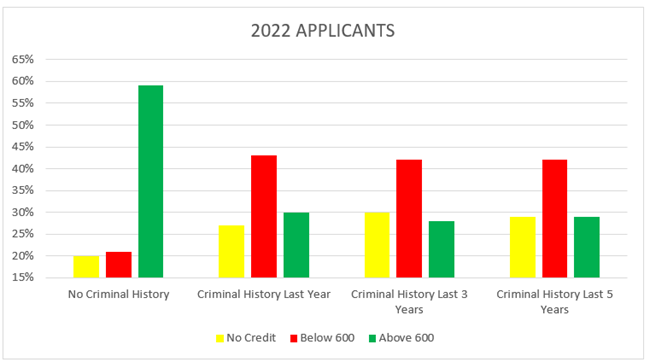
All these moves have made me look at landlords in the private market and get to the root of the HUD study by asking this critical question: Does criminal history affect a person’s ability to pay rent?  I accessed my own data sets from our tenant-background-screening company, Rent Perfect, and analyzed actual and factual numbers to answer this question.  We took all applicants who applied for a qualification to rent either a single-family or multifamily rental across all 50 states from Jan. 1, 2022, through Oct. 15, 2022.  See the graphic for specific results.  Generally speaking, applicants with NO criminal history are twice as likely to have a credit score over 600,, which translates to rent getting paid more consistently and on-time.  As a landlord, those are the type of odds that play in my favor.
What a possible 2023 HUD government announcement could mean for private landlords and use of applicant criminal history in screening applicants

Getting rid of applicant criminal history as a qualifying factor for HUD properties now, and inevitably for private individuals in the future, would put you and your property at risk financially and physically.  At Rent Perfect we know different criminal histories pose more of a threat than others, but we also know landlords are not the judge and jury and hold no special training on how to determine recidivism rates or risk based on each crime.  Our research results clearly show that no matter what the crime is, whether felony or misdemeanor, credit scores go down and collecting rent is riskier for those with a criminal history than without.

So, what do you do about it?  Rather than sulk in the corner – which may have been your childhood response to unfair treatment – we all need to band together and fight to protect our rights as private landlords.  Uniting your voice with a local Real Estate Investment Association (REIA) can help us as landlords stand our ground and protect our investments.  After all, we didn’t do anything wrong.

David Pickron is president of Rent Perfect, a private investigator, and fellow landlord who manages several short- and long-term rentals. Subscribe to his weekly Rent Perfect podcast (available on YouTube, Spotify, and Apple) to stay up to date on the latest industry news and for expert tips on how to manage your properties.

6 Trigger Words And Questions Every Landlord Should Listen For

Sign Up For Our Weekly Newsletter And Get Rental Property And Apartment News And Helpful, Useful Content Each Week.

* indicates required

Prosecutors Decline To Charge Former Tenant Who Killed Landlord With Sword

Portland prosecutors have declined to charge a tenant who killed his landlord with a sword saying the former tenant acted in self-defense

Portland prosecutors have declined to charge a tenant who killed his landlord with a sword saying the former tenant acted in self-defense, according to reports.

The landlord was left dead in a September dispute with his tenants in Northeast Portland.

The tenant fatally stabbed Justin Valdivia, 46, with a sword when the landlord came into the home while dressed as horror villain Michael Myers from the movie “Halloween,” according to Portland’s district attorney’s office.

Valdivia was fatally stabbed in the living room of a four-bedroom house in the Eliot neighborhood.

Willamette Week obtained a memo from the Multnomah County District Attorney’s Office justifying prosecutors’ conclusion that the killing was self-defense.

“The memo lays out a bizarre story while explaining why prosecutors declined to charge anyone involved.  Valdivia, the owner of the property, lived with his wife in a second home recently built at the back of the lot. He rented the front house to four tenants, each paying $750 per month. The man who stabbed him was a former tenant who had just moved out and was now staying in the house as a guest,” Willamette Week reports.

Valdivia is accused of threatening his tenants with a knife, according to police reports cited by the Willamette Week, and tried to break into the house predawn one morning while drunk.

Former tenant killed landlord with sword

The former tenant stabbed Valdivia with a “saberlike” sword and grabbed his gun, and threw it away while Valdivia fell to the floor unresponsive, Willamette Week reported.

The weapon near his body recovered was a pellet gun painted in black to “resemble a real firearm,” the report states.

Both the detective and county prosecutor assigned to the case agreed the killing was justified. Valdivia was committing burglary while “wielding what appeared to be two dangerous and deadly weapons,” the memo states.

About Yardi Matrix

Yardi Matrix researches and reports on multifamily, office and self-storage properties across the United States, serving the needs of a variety of industry professionals. Yardi Matrix Multifamily provides accurate data on 18+ million units, covering more than 90 percent of the U.S. population. Contact the company at (480) 663-1149.

Sign Up For Our Weekly Newsletter And Get Rental Property And Apartment News And Helpful, Useful Content Each Week.

* indicates required

Rental Price Drops Around The Country

Portland Rents Increase Again In October

5 Things Your Company Can Do To Retain Top Talent in Multifamily

The current workforce shortage brings up an important topic: What are 5 things your company can do to retain top talent in multifamily?

The current workforce shortage brings up an important topic: What does your company do to retain top talent in multifamily?

By Nicole Steltenpohl

The average industry tenure in multifamily is three years. At P.B. Bell, the average employee tenure is more than seven years and we’re proud of that.

Here are some things that we do to show our employees how valuable they are:

1. Onboarding – first impressions matter. At P.B. Bell, whether there are two people or seven people starting that week, they all start together.  Every first day at P.B. Bell starts with onboarding at our corporate office, which allows us to give consistent experiences and messaging for every new team member. While consistency is key, we try to make the first day fun and collaborative. In between core training and courses, we carve out time to get to know each new team member on a more personal level.  And it certainly helps that our executive team, including our CEO, stops by and says hi, creating the “family” feel that is integral to our success.

2. Instill your culture – values are more than just words. Onboarding introduces each new employee to the values and behaviors that make up our culture, but reinforcing these values and behaviors daily is critical.  Your culture can’t just be a sign hanging in the corporate office.  At P.B. Bell we have a Culture Club that is dedicated to ensuring that our culture thrives.  We have several programs that recognize and reward team members who demonstrate our values and behaviors through daily actions, and we honor those employees at our annual company events.

 3. Get creative in how you improve – ask and listen.  It doesn’t matter what we do if it isn’t impactful to our employees.  So, we are always asking what we do well and what we can do better.  We gather employee feedback throughout the year with confidential employee surveys and annual reviews.  We then listen to that feedback, continue doing what works, and focus on opportunities to improve the employee experience.

4. Show You Care – not just a value, it’s also an action item.  Recognizing and celebrating employees is a priority at P.B. Bell.  While lunch with the CEO to celebrate an employment milestone is nice, it isn’t the only tool we use.  We also spotlight employees who go above and beyond by living our values, and have several programs designed to show how much we care.  Whether it’s appreciation days (or weeks) where we take time to celebrate our employees for their efforts throughout the year, or volunteer days where we come together as a company to give back to the community, we are always looking for ways to say thank you.

5. Enjoy the ride – employees should look forward to work each day.  Having personal relationships promotes trust, open communication, and a better overall work experience.  We achieve this by encouraging informal social gatherings and providing opportunities for our employees to have fun and really get to know each other.  Whether it’s carving pumpkins to look like your executive team, chili cook offs, ice cream socials, or holiday themed events with terrific prizes, we enjoy just hanging out together.  Of course, we also have more formalized programs like our Meet and Eat program where an executive and members of the corporate team visit properties to simply have lunch and say hi.

Whatever you decide to implement at your company, we believe that culture is the key.  Figure out who you are and just be you.

ABOUT THE AUTHOR

The current workforce shortage brings up an important topic: What does your company do to retain top talent in multifamily?

Nicole Steltenpohl, Human Resources Director, P.B. Bell  is responsible for directing the full scope of human resources initiatives, including policies and procedures, benefits and payroll, talent recruitment and retention, development and training, employee relations, and company culture and growth. With 21 years of human resources experience, Nicole joined P.B. Bell in 2019. In her free time, Nicole enjoys spending time on the lake with family, exploring the culinary offerings throughout Scottsdale and Phoenix and volunteering her time for Hope Kids.

Sign Up For Our Weekly Newsletter And Get Rental Property And Apartment News And Helpful, Useful Content Each Week.

* indicates required

Keeping Your Communications Compliant with Fair Housing

5 Ways to Communicate Better with Challenging Tenants

What to Look for in Property Management Software

Record-Setting Decline In National Median Rent In October

The national median rent fell by 0.7 percent month-over-month in October the largest monthly decline in the index started in January 2017.”

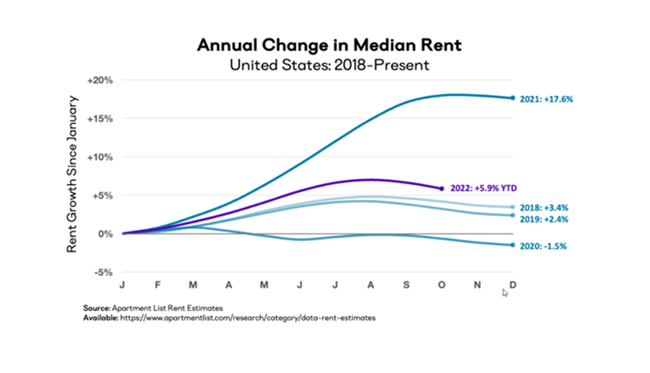
The national median rent fell by 0.7 percent month-over-month in October, according to Apartment List, “the largest monthly decline in the full history of our index, which starts in January 2017.”

“Our national rent index has now declined for two straight months, and is down by 1.1 percent since August.

“October’s record-setting decline marks a rapid cooldown which may signal that we’re entering a new phase of the rental market rollercoaster. It’s likely that rents will decline further in the months ahead, as rental market activity slows during the winter months,” Apartment List says in the report.

Rents fall in 89 of 100 largest cities

Rents decreased this month in 89 of the nation’s 100 largest cities, while an additional two cities saw rents hold steady, and only nine cities saw increases.

And nearly across the board, local rent growth has cooled down since last year – 96 of the top 100 cities have seen slower year-to-date rent growth in 2022 than they did over the same months of 2021, the report says.

Vacancy rate continues to grow

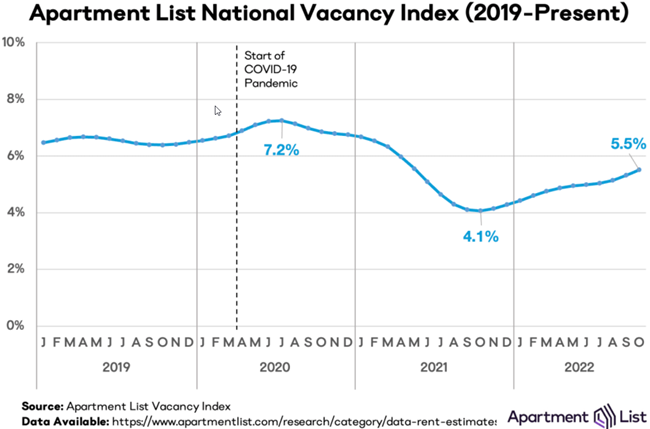
From April through August, “our vacancy index ticked up by just 0.2 percentage points, from 5.1 percent to 5.3 percent. But from August through October, it has increased by 0.4 percentage points, hitting 5.5 percent this month.”

The report says some Americans are moving back in with family or roommates, or delaying striking out on their own. This slowing household formation is “driving the cooldown that we are seeing on both the demand and supply sides of the market.”

The national median rent fell by 0.7 percent month-over-month in October the largest monthly decline in the index started in January 2017.”
Charts courtesy of Apartment List

Conclusion

Growth over the course of the year as a whole continues to pace ahead of pre-pandemic trends, “but we’re now seeing a marked shift in market conditions, with prices cooling and supply constraints continuing to abate. In the winter months ahead, we expect rental activity will continue to slow and we are likely to see continued modest price decreases to close out the year.

“That said, we’re still on pace to end 2022 with full year rent growth exceeding any year from 2017 to 2020,” the report says.

Read the full report here.

Sign Up For Our Weekly Newsletter And Get Rental Property And Apartment News And Helpful, Useful Content Each Week.

* indicates required

18 Months of Outstanding Rent Growth Coming to An End

Multifamily Rents ‘Hit the Brakes’ in September

Rental Price Drops Around The Country

Portland Rents Increase Again In October

How Important Is A Prospective Tenant’s Credit Score?

How Important Is A Prospective Tenant’s Credit Score?

A landlord asks how important is a prospective tenant’s credit score as the question this week for Ask Landlord Hank. Remember Hank is not an attorney and he is not offering legal advice. If you have a question for him please fill out the form below.

Dear Landlord Hank:

I have been a property owner/manager for last 20-plus years. I could write a book on the mistakes I have made! Such as thinking you’re a good judge of people? You got to do the work, you can’t be lazy.

I can’t get the property management company to answer any questions about a certain tenant. I do not believe the person I talked to and was given as a reference was legit. Do you place much value in credit checks? I have found that older people who rent often have bad credit. I honestly wouldn’t have any tenants if I used their credit as a no-go. Thanks for your feedback, Hank.

-Paul


Dear Landlord Paul,

I’m working in a vacation destination so we have a very strong rental market, but I also have many years of experience in a major metropolitan area in Georgia.

We are able to ask and get first, last and security deposit up front. We also require at least three times the rent in gross income, at least a 650 FICO score, clean background and good rental history.

We try to get at least five years’ prior residential history so we know we have a good quality tenant we can count on. In my opinion, good credit is very important as a factor to be considered in a tenant. Sometimes there are good reasons why someone’s credit is less than desirable, such as a bad divorce, etc., but those must be balanced with good income, rental history and clean background.

If someone has poor credit, sometimes we obtain an extra last month’s rent up front, just in case. I’ve made my share of mistakes in this business too, but if we learn from our mistakes we are ahead of the game. I’d rather hold out for a good tenant than take someone iffy. Best of luck!

Sincerely,

Hank Rossi

Each week I answer questions from landlords and property managers across the country in my “Dear Landlord Hank” blog in the digital magazine Rental Housing Journal.  https://rentalhousingjournal.com/asklandlordhank/


A landlord asks how important is a prospective tenant's credit score as the question this week for Landlord Hank from a fellow landlord
Landlord Hank says, “We also require at least three times the rent in gross income, at least a 650 FICO score, clean background and good rental history.”

Ask Landlord Hank Your Question

Ask veteran landlord and property manager Hank Rossi your questions from tenant screening to leases to pets and more! He provides answers each week to landlords.

  • This field is for validation purposes and should be left unchanged.

Do I Have to Paint and Replace Flooring for a Long-Term Tenant?

Sign Up For Our Newsletter And Get Rental Housing And Apartment News And Helpful, Useful Content Each Week.

* indicates required

How Smoke-Free Policy In Housing Saves You Money

Protecting your residents and real estate investments begins with a smoke-free policy, and there are many benefits to getting started.

How a smoke-free policy in your rental housing can save you money on maintenance and other costs.

Department of Health and Human Services
Tobacco Prevention and Control

If you currently manage or have managed smoking-friendly properties, you have encountered the tedious and expensive turnover process of cleaning and refurbishing units damaged by smoking and smoking-related incidents.

In addition to turnovers, smoking and secondhand smoke exposure put your residents at risk for several health issues, including asthma, heart disease and cancer.[1]

Protecting your residents and real estate investments begins with a smoke-free policy, and there are many benefits to getting started.

Maintenance Savings

Allowing renters to smoke in their homes creates additional expenses and requires costly materials needed to repair, refurbish, replace and clean after smoking tenants leave.

Odors, stains on walls, burns in carpet and on countertops, and smoke residue are just a few of the damages to your time and money when preparing your property for a new resident. Aside from visible damages, thirdhand smoke embeds into walls and other surfaces, emitting toxic compounds long after secondhand smoke has disappeared.

A recent study found that properties that allowed smoking had nearly double the costs of smoke-free properties.[2] For example, compared to smoke-free units, cleaning and refurbishing costs can be up to $3,000 more in units with heavy smoking.[3]

And while having to shell out extra money for cleaning fees and updating damaged features and carpets may seem tedious but not very dangerous, the reality is that properties allowing residents to smoke have an increased risk of fires.

An estimated 7,600 smoke-related fires occur in residential buildings each year in the U.S.[4] However, fires caused by smoking are avoidable with a smoke-free policy.

When You Go Smoke-free, You Gain Several Cost-effective Benefits:

 Reduced risk of tobacco-related fires in your apartments

  • Lower fire and liability insurance premiums for the property
  • No expensive, smoking-related repairs when tenants move out
  • Less litter from tobacco waste like cigarette butts
  • Fewer administrative costs to address complaints about unpleasant odors and unhealthy air quality

Keeping You, Your Residents and Your Investments Protected

Smoke-free policies help property managers and owners protect their residents’ health and their real estate investments. Establishing a smoke-free housing policy does not ban anyone from smoking but requires that all residents and visitors abide by the policy while on the property.

Ready to go smoke-free? Find out even more reasons why and learn what steps you can take here.

[1] Danger of Tobacco, WayToQuit, Accessed July 2022.

[2] The Benefits of Smoke-Free Buildings, American Nonsmokers’ Rights Foundations, Accessed July 2022.

[3] The Benefits of Smoke-Free Buildings, American Nonsmokers’ Rights Foundations, Accessed July 2022.

[4] United States Fire Administration, “Smoking-related fires in residential buildings (2008-2010),“ Accessed July 2022.

How Thirdhand Smoke Affects Your Properties

How Do I Prove A Tenant Is Smoking Marijuana In Violation of Lease?

Steps to Make Your Community Smoke-Free

Why Secondhand Smoke Is Bad for Business

Why Homeowners Should Go Smoke-Free

Secondhand smoke is dangerous for your tenants

Sign Up For Our Weekly Newsletter And Get Rental Property And Apartment News And Helpful, Useful Content Each Week.

* indicates required