How to buy your first multifamily investment property as multifamily buildings tend to be more capital intensive yet offer benefits for real estate investors.
Real-estate investing is one of the most reliable methods for wealth creation. While many novice investors start by purchasing a single-family home, once you gain experience, you may consider expanding into multifamily properties. Multifamily buildings tend to be more capital-intensive, yet offer intriguing benefits for investors.
Here’s a step-by-step look at how to buy your first multifamily investment property.
What Is A Multifamily Investment Property?
A multifamily investment property is a residence with more than one housing unit that you intend to rent to tenants. A building with one residence is known as a single-family home – the typical detached home you see in most suburban neighborhoods. Anything larger is known as a multifamily property, which can range from a duplex or triplex to a large apartment building with 100+ units.
Due to the higher earning potential, multifamily investment properties tend to be more expensive. But they can also offer various benefits to investors, including more stability and tax incentives. So, if you want to expand your portfolio, you may consider investing in a multifamily investment property.
Multifamily properties include duplexes, triplexes, townhouses, high-rises, low-rises, condominiums, bungalows, mixed-use buildings, and more.
How To Buy Your First Multi-Family Investment Property
Follow along as we uncover a step-by-step guide on how to buy your first multi-family investment property:
Decide On Your Financials: Before you scout potential investments, take stock of your financial situation and decide how much you can realistically afford. Multifamily properties are often more complex investments because you’ll have multiple tenants and units to maintain. So, if you need to finance the purchase, you’ll need a clear business plan and a proof-of-funds letter to be approved for a loan. You may also join a group of investors and pool your funds to purchase a property to take some of the burdens off yourself. But before doing so, you must analyze your finances and set a realistic budget, so you don’t get in over your head.
Do Your Research: Next, you should start researching different markets and types of multifamily properties to find a wise investment. Multifamily properties include duplexes, triplexes, townhouses, high-rises, low-rises, condominiums, bungalows, mixed-use buildings, and more. Each property type offers unique advantages and disadvantages, so do extensive research on the different subsets of multifamily housing and study the local market to identify good deals.
Choose A Lender and Get Pre-Approved: Once you’ve done your homework, you’ll want to seek preapproval from a lender to show that you have the funding to make a purchase. Before doing so, you’ll want to gather all your financial documents and draft a simple business plan to prove to lenders that you know what you’re doing. You may not have a particular property in mind yet, but let them know what you’re looking for, what kinds of expenses will go into the renovation or management of the property, and how soon you expect to turn a profit. It also helps if you have previous experience as a real estate investor to show that you know the risks and challenges of owning income-producing property.
Find A Real Estate Agent to Work With: Once you’re pre-approved, you’ll want to enlist the help of a real estate agent. Multifamily purchases are often more complicated than single-family homes because there are more factors to consider. There may be zoning concerns or tax implications that you should understand before making a decision that may not be immediately apparent. If you’re new to multifamily investing, you may not understand whether a building is over- or underpriced. So, enlisting the help of a real estate agent with experience purchasing multifamily properties can be a huge help.
Narrow Your Search: You may start with a wide net to see what’s out there, but eventually, you’ll want to narrow your search until you find the perfect property. It helps to identify three to five properties that may work for your budget and business plan and then crunch the numbers to see which offers the most potential value.
Estimate Profits and Losses: Once you have a few potential candidates, you’ll want to estimate the profits and losses. If any properties need renovations before they can be rented, you’ll want to estimate those costs. You’ll also want to calculate the ongoing maintenance costs and general losses due to vacancies. Then you’ll evaluate the property’s potential monthly or yearly income by multiplying the number of units by the average rent for a comparable building in the area. Finally, you’ll subtract the estimated expenses from the profits to determine the potential cash. You can do these calculations on your own using online tools, or you can enlist the help of your agent, general contractor, property manager, or another real estate professional.
Make an Offer: When you’ve found the perfect building, you’ll want to submit an offer as soon as possible. Like a single-family home, you’ll submit an offer letter to the seller stating the price and any other requests or stipulations you have. The seller will consider your offer and either accept it, deny it or make a counteroffer. Depending on the market, you may submit several offers before finding a deal that makes sense for your bottom line. But if you have the necessary funds and make realistic bids, you’ll eventually land a deal.
Close On the Property: After you and the seller agree on a price, all left is to sign a purchase agreement and close on the property. You’ll have time to do your due diligence and look for any red flags that may lead you to return to the negotiating table. Buying a multifamily property is a serious investment; you’ll want to have it inspected thoroughly, so you know it’s a smart purchase. But if everything checks out, you’ll do a final walkthrough and then schedule a closing where you’ll sign the necessary paperwork and hand in the funds.
Final Thoughts
While purchasing a multifamily property may initially sound intimidating, it’s fairly straightforward if you do the research and know what to expect. Although it’s slightly more complex than purchasing a single-family home, it offers increased earning potential and greater stability, among other benefits. So, if you’re an investor looking for a new challenge, consider adding a multifamily investment property to your portfolio.
____
About the author:
Ryan Zomorodi is co-founder and COO of RealEstateSkills.com, an education platform that has trained thousands of students to start and grow real-estate investing businesses. Ryan is the managing editor of the Real Estate Skills blog, ranked as the No. 1 real-estate wholesaling blog on the web. He has over 10 years of investment and management experience, including acquiring over 100 homes for flip, wholesale, and rental across a dozen states.
Here are 7 questions landlords have about pets and pet-friendly apartments as 72 percent of all renters now have pets and the trend toward pet ownership is only going to grow.
By John Triplett
Owners, landlords and property managers may want to consider whether pet-friendly apartments and a welcoming pet policy may be the best way to deal with the issues. Here is a guide to the issues and comments from apartment owners, property managers and The Humane Society of the United States
One landlord said in an interview that the companion pet issue in particular is one where he just does not know where to go to get the right answers.
He said he understands service animals, but when it comes to things like assistance animals, companion pets and emotional support animals, he is confused by the terms.
And he said it seems like today tenants “can get a note from anyone” and “I have to accept their pet.”
While some landlords and property managers struggle with the pet issue, overall there is a trend nationwide to more and more pet-friendly apartments, and many landlords and property managers say pets are a key to their success. The Humane Society of the United States is also working with the multifamily industry through its Pets Are Welcome initiative to help property owners or managers as well as tenants, since 72 percent of all renters now have pets.
“Too many home and apartment owners exclude animals, thinking that the animals are going to damage the properties. That mentality shrinks the pool of living spaces for people and their pets,” Wayne Pacelle, president and CEO of The Humane Society of the United States writes in a blog post.
The story of one pet-friendly apartment community
“We have been pet-friendly apartments since the property was built in the late ‘60s. I’ve been managing Twin Ponds for almost 20 years and I have watched the dogs bring the apartment community closer together,” said Deb Palmer, property manager at Twin Ponds in Nashua, New Hampshire.
“It is down-right silly how many great residents that communities are missing out on because of a certain breed or weight of a dog. You just have to know how to manage dogs as well as the residents. Being dog-friendly without breed or weight restriction is one of our most powerful marketing tools. People come from all over to live here because they could not find anywhere else to live. That’s huge!”
“We have more dogs than children,” she said. Her pet friendly apartment complex has 350 dogs among her 414 units and accepts all breeds, but only two per unit.
“When people drive into our complex they can see how pet-friendly we are,” she said. “I just wish everyone could see how well pet-friendly works.”
The residents are closer because they walk the pets in two pet areas in the complex and talk about their pets. She also uses PooPrints, the pet DNA testing service, and that keeps the pet areas clean.
“We have pet walkers and behavioral trainers” who work with pets in her apartments, and the pet behavior has been consistently good. “We have had a couple of incidents in 20 years,” she said. She requires tenants to have rental insurance in their lease agreements and agree to the pet-DNA testing requirements, but she does not specifically screen individual pets.
Her complex also runs a dog-of-the-month and dog photo contest, where residents send in pictures and vote on the dog of the month with the dog owner’s family winning a prize.
Her website features this: “Congratulations to the October Dog of the Month, Bandit! This watchful pup kept watch on the voting and won with over 70% of the votes! We will be in touch with the winning family soon to go over their prizes for this month’s contest.”
Bandit was pet of the month, a great contest idea for apartments.
Bandit was dog of the month at the pet-friendly apartments Twin Ponds.
Buster was another dog of the month at the Pet-friendly apartments
Buster was another winner at the pet-friendly apartments.
Pet ownership grows as rental population grows
They’ve long been referred to as man’s best friend, and now research from Mintel reveals that no one loves their mutts quite as much as American men. Today, some seven in 10 (71%) younger men aged 18-44 own a dog, compared to just three in five (60%) of their female counterparts.
Mintel research on U.S. pet ownership reveals that while the majority (67%) of Americans own a pet, dogs are the nation’s number one furry companion with half (50%) of all Americans owning a dog. This rises to 52% of all U.S. men, compared to 49% of women. Older Millennials in particular make up a large portion of the nation’s dog lovers, as three quarters (75%) of consumers aged 30-39 own a dog.
“While pet ownership over the last few years has remained near half of all Americans, our research indicates that dog ownership is elevated among younger men. As pets are seen more and more as companions and family members, Americans are taking additional steps to ensure their health and happiness, and are spending more in the process,” Rebecca Cullen, Associate Analyst, Health, Household, Beauty & Personal Care at Mintel, said in a release.
The findings come at a time when Millennials, roughly defined as the generation born between 1980 and 2000, are half as likely to be married or living with a partner than the adults of 50 years ago. They are also delaying parenthood and demanding flexible work arrangements — all of which, researchers say, has translated to higher rates of pet ownership.And pet friendly apartments are something Millennials seek.
Pets as a replacement for children
“Pets are becoming a replacement for children,” Jean Twenge, a psychology professor at San Diego State University and author of “Generation Me,” told the Washington Post. “They’re less expensive. You can get one even if you’re not ready to live with someone or get married, and they can still provide companionship.”
A majority of Millennials — 76 percent — said they are more likely to “splurge” on their pets than for themselves, including for expensive treats (44 percent) or a custom bed (38 percent), according to a 2014 study by Wakefield Research. By comparison, 50 percent of Baby Boomers — those born between 1946 and 1964 –– said they would do so.
Apartment owner says, “No bad dogs, just bad dog owners”
“It is our belief that there are not bad dogs, there are bad dog owners,” said Cliff Orloff, owner of Orloff Property Management, which owns approximately 800 units in Sacramento and Berkeley, California, and Indianapolis, Indiana.
“We have had some bad dogs, but they have been bad dogs because their owners were bad – they didn’t know how to deal with their dogs.”
“The thing about service dogs is that you do not have an option. It’s the law. There are two types of dogs. One type is like Seeing Eye dogs, which you have to take even if you are not a pet-friendly property. There are emotional support dogs and that is iffier. Some tenants try to get away with saying it’s the same, but they are not. When somebody has a legal service dog they have the documentation to prove it. That is our experience. We’ve kicked out people who have had ‘so called’ service dogs – they weren’t really service dogs – but they kept their dogs all day on their outside patio and they were pooping on the neighbors below.”
It is about setting the rules and enforcing them for pet friendly apartments, Orloff said. “This is not true just for pets but also for property management. You have to have rules and enforce them strictly for everyone. If you don’t you run into trouble and you are discriminating. “
A lot of properties do not want the hassle of pets, he said. Or it’s a property management company and it’s not their own property. He said well-managed and well-maintained properties enforce the rules and do it right. And it is a lot of work, and some property management companies do not want to do that.
A credit bureau for pet owners and pet-friendly apartments
“We started a business that is meant to be something like a credit bureau for pet owners,” Orloff said, called NPR4Dogs.com., designed to help pet-frriendly apartment complexes. Here is what he says on the website:
“NPR4dogs was started in 2016 by Cliff Orloff, an owner of more than 800 multi-family units, in response to dog-poop issues at his properties.
“One of those properties, Riverfront Apartments in Sacramento, California, had a big problem. It accepted dogs without weight or breed restrictions (although a dog interview was required to avoid renting to anti-social dogs). It also allowed multiple dogs in a unit. As a result, it had almost as many dogs as apartments, and despite having dedicated dog runs, written rules requiring residents to pick up their dog poop and doggy areas stocked with plastic bags, the dog poop problem became unbearable. Responsible dog owners complained about stepping into dog poop every time they took their dog for a walk. The poop smell became very unpleasant. What to do?
“Researching possible solutions took Cliff to the website of the Veterinary School at University of California at Davis. The Veterinary School developed a state-of- the-art program to DNA-sample dogs at a reasonable cost and to DNA-match dog poop to dogs. Using this DNA technology, Riverfront set up a mandatory registration for dog DNA screening, data management and resident incentive systems to organize this effort efficiently.
“The result was dramatic. The dog poop problem went away overnight. Responsible dog owners who lived on the property hailed the new program. Most of the irresponsible dog owners changed their behavior and became responsible dog owners.
“To see if this result was unique to Riverfront Apartments, NPR4dogs was implemented at a 324-unit apartment complex in Indianapolis called Broad Ripple Trails. Again, the result was dramatic. The dog- poop problem went away almost overnight.
“The dog poop problem is common for most large multi-family properties that accept dogs. NPR4dogs used its experience implementing these programs to develop systems and procedures, and embedded them in a unique smartphone app for property managers. That technology, the related website and databases became the foundation for NPR4dogs. By making a large bulk purchase agreement with UC Davis, NPR4dogs is able to make this technology available to other properties, at less cost than they could do it themselves.”
In terms of managing pet poop in pet-friendly apartments, he said, it is a behavioral thing, like speeding down the highway.
“If you see a police car in the road, you slow down to 70. It’s a behavioral thing. There are some dog owners who just as a matter of fact they pick up after their dogs. There are some dog owners who do pick up after their dogs if they have to, because if they don’t they are going to get fined. Then there are some that don’t. And the ones that don’t, they leave. If we can get this rolling on a large-scale basis it is like a credit bureau for dog owners. These are the responsible dog owners who can say if they move to another property I got an A1 rating from my previous two apartment complexes.
“We own enough property ourselves we can see if it works and it works because it is a behavioral thing.
“It makes it a nicer place to live for everybody. The people who want to follow the rules are so much happier. This is what they have told us, they take their dog for a walk at night and they step in dog poop all the time. And for the responsible dog owners this just bugged the hell out of them. So they were glad when we did this. We did not get any push back at all.”
“I like dogs. My wife is a cat person. It is all about the people,” Orloff said.
Pet-friendly apartments and a welcoming pets policy
Photo by Erin A. Kirk-Cuomo via Wikimedia Commons
The concept of pet-friendly apartments and a welcoming pet policy by landlords helps deal with reasonable accommodation requests.
Matthew Wildman, pet retention manager for The Humane Society of the United States said, “There is so much misinformation out there. Our position is allowing pets in rental housing is good for business. Hundreds of properties allow dogs and cats without restrictions on breed.” He said the number one reason animals are sent to shelters is because of rental situations where they cannot keep a pet.
Wildman said there is confusion over terminology and so he put together answers to 7 of the top questions owners, landlords and property managers have about this issue.
A question and answer on pets and pet-friendly apartments with the Humane Society of the U.S.
No. 1- Question: I am confused over the terminology of service animal, assistance animal and companion animal. Tenants use different terms such as these to refer to their pets. How do I as a landlord know which is which?
Answer: “Companion animals” or “companion pets” are interchangeable terms with the most common term, “pets.” For some reason, the term “companion animal” is perceived by many in the multifamily housing industry to mean something different than a “pet,” but there is no difference. The terms that are of relevance to housing providers encountering requests for reasonable accommodation are “assistance animals” (also commonly referred to as “emotional support animals”) and “service animals.” An assistance animal can be any animal who is commonly referred to as a pet, but the difference is that their owner has a disability for which the animal is needed to either provide assistance in managing activities of daily living, and/or provides support that alleviates the symptoms or effects of the person’s disability. An “emotional support animal” is a type of assistance animal that provides emotional support that improves the symptoms of an individual’s disability.
According to the Department of Justice, a “service animal” may be a dog or miniature horse who has been trained to perform a specific task(s). Under the Americans with Disabilities Act, individuals living with a disability are legally entitled to bring these animals into places of public accommodation as well as their residence regardless of any pet restrictions. The most common example of a service animal is a Seeing-Eye dog, but not all disabilities requiring service animals are obvious. For example, individuals suffering from PTSD may need their dog with them at all times. This dog may be trained to sit calmly beside their owner.
It’s helpful to keep in mind that service and assistance animals are not considered pets, meaning that pet rules – such as no-pet policies, breed and size restrictions, pet deposits and fees – don’t apply to them, but owners are responsible for any damage they cause.
No. 2 – Question: “I am confused about assistance animals. It seems a tenant can get a note from anyone and I have to let them have a pet in my apartments.”
Answer: Federal fair housing laws state that to request a reasonable accommodation, the tenant needs to submit reliable documentation of a disability and the need for an assistance animal. This usually comes in the form of a letter from a doctor or health professional verifying that the tenant has a disability and identifying how the animal assists the person with this disability to enable him to full use and enjoyment of the dwelling. As per federal fair housing laws, if this information is provided the housing provider is required to grant the reasonable accommodation request as long as accommodating the animal does not create an undue financial hardship for the landlord (this is rarely the case) or the specific animal poses a verified nuisance or danger to the health and safety of others.
According to the Centers for Disease Control and Prevention, one out of every five adults lives with a disability. Unless you’re receiving requests for an assistance animal from over 20% of your residents, it’s unlikely you’ll encounter a fraudulent claim. While the verification document may be suspect, the tenant can still have a valid disability and appropriate need for an assistance animal. The accommodation request is intended to be an interactive process between the tenant and housing provider. You don’t have to be afraid to come back to the tenant and let him know that you’re concerned about an aspect of the request and ask the tenant for additional information. It may be helpful to temporarily grant the request until a final determination is made to avoid a claim of undue delay.
An emotional support animal is a type of assistance animal, one who is not trained and who provides emotional support to their owner who suffers from a disability. There are for-profit companies that provide tags and vests stating an animal is a service animal, but these are not government-sanctioned companies, and they create a tremendous amount of confusion for both residents and housing providers alike.
If the housing provider does not believe that the tenant has adequately demonstrated that he or she has a disability or that he has a need for an assistance animal or the request is unreasonable, they have the right to deny the request, but this carries the risk of opening themselves up to a discrimination lawsuit.
No. 3 – Question: Under Fair Housing rules do I have to rent to someone who says they have an assistance animal and they have a note?
Answer: Housing providers have the right to screen disabled applicants as they would any other applicant. However, if the applicant requests a reasonable accommodation for an assistance animal and provides sufficient documentation of the disability and the need for the assistance animal, denying the reasonable accommodation would likely violate fair housing laws unless the request imposed an undue burden. Denying an applicant because of his assistance or service animal is akin to denying an applicant housing because of a wheelchair.
No. 4 – Question: What about service animals? Do I have to rent to anyone anytime they have a service animal under Fair Housing rules?
Answer: Service animals are a type of assistance animal. If the applicant provides reliable documentation of having a disability and needing a service animal and the animal does not pose a direct threat to the health and safety of others, denying an application because of the applicant’s assistance or service animal would likely violate discrimination protections.
No. 5 – Question: Can I legally refuse certain types of large breed dogs or dangerous breed dogs if the tenant says it is an assistance animal?
Answer: Assuming the tenant provides reliable documentation entitling him to the use of a service or assistance animal, The Department of Justice has determined that pet restrictions may not be applied to service or assistance animals. This means that number limits, breed bans or size restrictions may not be applied, and the housing provider may not impose a pet deposit or fee, but the owner is responsible for any damage the assistance animal causes.
The Humane Society of the United States encourages property owners and managers to welcome pets and remove arbitrary and unnecessary breed and size restrictions. This among other benefits, will reduce the number of requests for service and assistance animals. Conversations we’ve had with property owners indicate a strong correlation between assistance animal claims and pet policies. In short, the more welcoming of pets you are, the fewer the requests for reasonable accommodation you’ll receive.
No. 6 – Question: How can I verify that just because a potential tenant has a tag that says the pet is an assistance animal that that tag is legitimate and not a forgery of some type?
Answer: There is no state or federal certification required for assistance or service animals. The only documentation needed is from a reliable health care professional. Complicating matters is the fact that private for-profit companies have sought to fill this vacuum by providing individuals (for a fee) with official-looking tags, vests and documentation that seemingly verify an animal as an assistance or service animal. What’s important to note is that use of these companies does not indicate that the resident is attempting to “fake” their status as someone living with a disability or the animal’s status as an assistance or service animal. These companies use official-sounding names and most of their customers are as in the dark as housing providers that these companies are not officially sanctioned. If a tenant submits documentation from one of these online service providers, you are entitled to engage in the interactive process and ask the tenant for additional information that’s more reliable.
No. 7 – Question: Can I screen a potential pet the same way I screen a potential tenant? Is that legal and how do I do that?
Answer: Housing providers have a right to ensure that pets as well as assistance and service animals do not pose a direct threat to the health and safety of others. The HSUS has guidelines on how to conduct a “meet and greet” for pets, assistance, or service animals. Contact us at petsarewelcome@humanesociety.org for information.
Conclusion: Pet-friendly apartments and pet issues are only going to become larger for the rental housing industry going forward as the pet population and the rental population both continue to grow. Many apartment rules were adopted in the 1990s, when there were far fewer pets and pet-friendly apartments. Rules often have not been updated as the Millennial generation is moving into rentals with more and more pets, and often with larger and more diverse breeds. These seven questions and answers should help owners, landlords and property managers, as well as tenants, going forward with issues around pet-friendly apartments.
Operational excellence is the structure and methodology that creates efficiency and effectiveness at a community, and it is a critical part of a successful business strategy. It is also ever-evolving – your processes and team members must be adaptable, continuously refining operations to suit resident trends and technological innovations. This empowers you to stay at the forefront of the multifamily housing industry.
Imperative to the longevity of your portfolio, here are the key components of promoting operational excellence.
Committed Leadership
Committed leaders are a crucial element of any initiative. Individuals who lead by example with a willingness and vulnerability to continuously learn and adapt are non-negotiable. Creating operational excellence starts with an organized, informed and adaptable front line of leadership – it has a ripple effect and sets teams up for success.
Culture of Trust
Thoughtfully encouraging your team to take ownership is essential, and it starts with hiring the right candidates. A workforce of people who reflect your values will create a collaborative environment of strong work ethic and integrity, and most importantly, build a culture with a foundation of trust.
How do you create the ideal work environment? Fostering open communication creates that important sense of trust. In a trusting workplace, team members feel confident to spot abnormalities in their operations and find new efficiencies, benefiting themselves, their team and the organization as a whole.
Keep It Sophisticated but Simple
Operational excellence does not need to be over complicated. Take the successful systems you have already created and optimize them. Streamlining processes by automating repetitive tasks will save you valuable time and energy. Optimization will leave room for team members to work smarter, not harder. They can narrow their focus on specialized tasks that make the true difference – the in-person connection and delivery of exceptional service to residents.
Innovate Today to Ensure an Excellent Tomorrow
At Mark-Taylor, we approach operational excellence with an innovation-focused mindset of “Do the things today that others will not, and you will achieve the things tomorrow that others cannot.” To achieve excellence in your operations, processes must change as our industry changes.
Tip: When implementing new approaches, be mindful of generational changes in preferences. Understanding evolving audience perspectives is key to attracting and serving your residents.
Values Left Uncompromised
Staying true to your fundamental values keeps your brand alive, and your employee engagement strong. Operational excellence needs to be incorporated into an organized structure that reflects the core values of your company. The standards you hold across your portfolios should be left uncompromised when initiating change.
About the Author
Michael Wilson is Vice President of Asset Management, joined the Mark-Taylor family in 2001 with a background in financial planning. Beginning as a Leasing Consultant, Michael gained his expertise in the operations of the business from the ground up.
Backed with 21 years of tenured experience within Mark-Taylor, he diligently oversees the company’s portfolio of 70+ communities and ensures our investments are consistently performing at their financial operating potential.
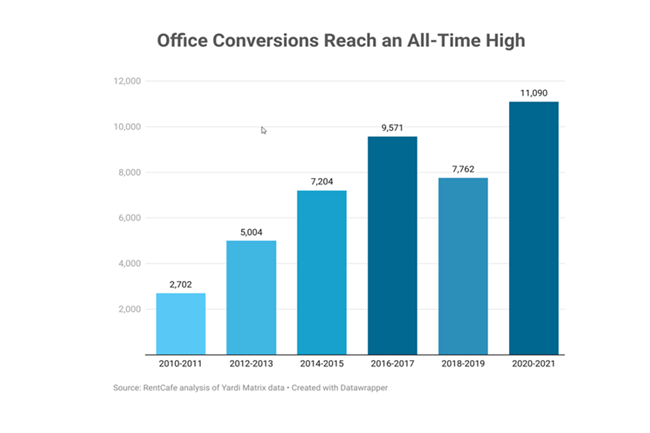
Conversions from office buildings to apartments are at an all-time high, having made way for 11,000 apartments in just the last two years, according to a report from RentCafé.
The report also says there are 77,000 apartments under conversion, setting up the stage for a boom in adaptive reuse in the upcoming years.
“This increasingly popular real estate niche brought a total of 28,000 new rentals in 2020-2021, well above the pre-pandemic years of 2018-2019 when 22,300 apartments were brought to life through adaptive reuse. Amid an ever-growing need for housing, adaptive reuse picked up speed in America’s largest cities, according to the latest data from Yardi Matrix,” the report says.
“Existing building architecture is the critical starting point. Not all buildings are equally threatened by the work-from-home revolution. Larger office buildings in abandoned central business districts are better suited to conversion than the often-smaller office complexes distributed around the suburbs,” said Doug Ressler, manager of business intelligence at Yardi Matrix.
Chart courtesy of RentCafé
Here are the main findings:
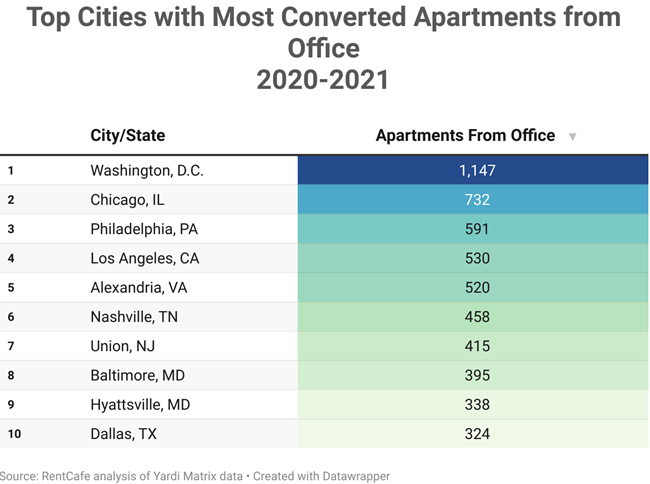
The 25 percent jump in converted apartments compared to pre-pandemic years roughly translates into 28,000 new rentals delivered nationwide in 2020 and 2021 combined. Washington, D.C., Philadelphia, and Chicago are the leaders when it comes to repurposed buildings during the pandemic, boasting a combined 15 percent of all apartment conversions in the United States.
Adaptive-reuse apartments grew faster than new apartments — 25 percent versus 10 percent — during the same timeframe. After maintaining a steady pace of growth of around 35 percent each year between 2012 and 2017, adaptive reuse saw a dramatic decrease of 24 percent between 2018-2019. By the start of 2020, conversions picked up speed again.
Conversions from office to apartment hit a record high, with 11,090 apartments delivered in 2020 and 2021 alone. That’s a 43 percent uptick compared to the previous two-year interval (2018-2019). Washington, D.C., Philadelphia and Chicago lead the way in this category as well.
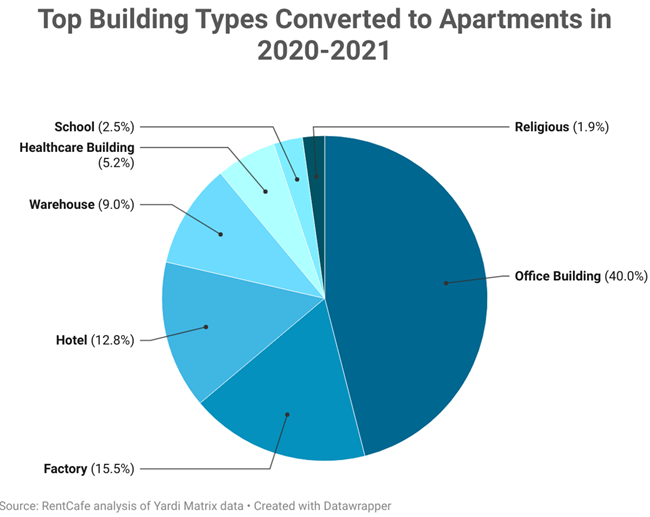
Office buildings are the most popular type post-pandemic, making up 40 percent of all adaptive-reuse apartments. However, smaller niches such as former healthcare buildings are growing at a staggering pace. The number of apartments converted from healthcare buildings more than tripled during the pandemic compared to the 2018-2019 period, increasing by 212 percent. Next up come the religious buildings, with a 73 percent increase, followed by hotel conversions, which grew by 65.6 percent. The next conversion niches are former factories, warehouses and school buildings.
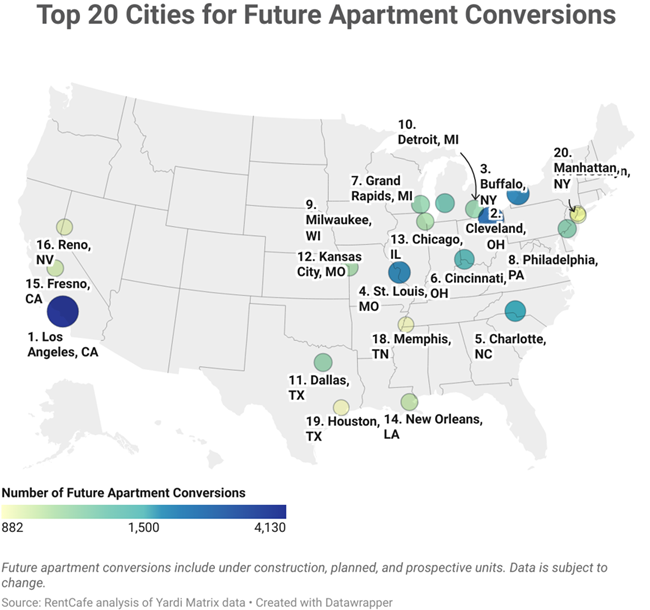
77,000 converted apartments are expected to be opened over the next several years. As a matter of fact, nowhere is the future development of adaptive reuse more evident than in Los Angeles, where a total of 4,130 apartments resulting from conversions are expected. As many as 1,242 apartments came online between January and June in Los Angeles, making this year the best one in the last decade.
When it comes to future projects, office conversions are projected to represent 28% of total apartments under conversion — the largest share of all building types under conversion, according to Yardi Matrix. Hotels represent the second-largest share (22% of future projects), while factories (that make up 16% of the total) are in third place.
About Yardi Matrix
Yardi Matrix researches and reports on multifamily, office and self-storage properties across the United States, serving the needs of a variety of industry professionals. Yardi Matrix Multifamily provides accurate data on 18+ million units, covering more than 90 percent of the U.S. population. Contact the company at (480) 663-1149.
Should a landlord give separate leases to roommate tenants is the question this week for Ask Landlord Hank. Remember Hank is not an attorney and is not offering legal advice. If you have a question for him please fill out his form below.
Dear Landlord Hank,
I have a tenant who is unhappy with their roommate, whom they choose. The tenant is asking to sign separate leases so they would not be held responsible for damages or unpaid rent by the other. Is that a thing now? Is it legal in Washington?
– Deb
Dear Landlady Deb,
Roommates on a lease are a tricky situation that often goes bad.
If your current tenant requested someone new to be added to the lease as a new tenant (hopefully you did credit and background screening), then she is still fully responsible for the lease, as is the roommate.
If someone violates the lease, then you could and probably should evict both.
You’ll need to check the laws in your state though. Do NOT give each person their own lease. That would make each tenant responsible for only half the rent and if one leaves or breaks the lease, you’d have to replace that tenant.
Sincerely,
Hank Rossi
Each week I answer questions from landlords and property managers across the country in my “Dear Landlord Hank” blog in the digital magazine Rental Housing Journal. https://rentalhousingjournal.com/asklandlordhank/
Landlord Hank working on renovation in one of his rentals. Hank says, “Do not give each person their own lease.”
Ask Landlord Hank Your Question
Ask veteran landlord and property manager Hank Rossi your questions from tenant screening to leases to pets and more! He provides answers each week to landlords.
Time is running out to register for Trends the biggest one-day property and innovations conference in the Northwest on Tuesday, November 29 in Seattle.
Trends is a diverse conference and offers a variety of benefits for everyone within the rental housing industry, whether that’s finding new business, networking with new partners, building your contact list or learning best practices and how you should prepare for the future of our industry.
There will be in person this year sponsors, vendor partners, and expert speakers for the largest gathering of housing industry stakeholders on the West Coast where more than 1,500 attendees are expected.
The 38th annual event will be held from 8:30 a.m. to 4 p.m. PST on Nov. 29, 2022, at the Seattle Convention Center, 705 Pike St., Seattle, WA 98101.
Who Should Attend?
Trends is a diverse conference and offers a variety of benefits for a everyone within the rental housing industry, whether that’s finding new business, networking with new partners, building your contact list or learning best practices and how you should prepare for the future of our industry.
Large and Small Property Owners and Their Representatives
The holiday season is upon us, and we should all be preparing to ensure an inclusive and diverse environment for our communities.
This article will share some fantastic tips to help you and your community get ready and have a happy fair housing-friendly holiday season!
Leasing Office Decorations
Many of us have personal opinions about what is and is not acceptable concerning holiday decorations; it’s best to take a step back and see what the law says and then consider some best practices based on that.
On January 9th, 1995, a memorandum was released by HUD (Housing and Urban Development) that in part addressed Fair Housing holiday decorations. The subject was “Guidance Regarding Advertisements Under 804(c) of the Fair Housing Act”. Here is a direct quote from that document.
“The use of secularized terms or symbols relating to religious holidays such as Santa Claus, Easter Bunny, or St.Valentine’s Day images, or phrases such as Merry Christmas, Happy Easter, or the like does not constitute a violation of the Act.”
So does this mean we can throw caution to the wind? As a professional in the housing industry, you may be faced with holiday-related items that are simply viewed as potentially offensive or insensitive but that are not against Fair Housing laws.
While using these secular terms and items may not be a direct violation, they are related to the protected class of religion. So discretion is needed to make certain that no one person feels discriminated against. To help, ask yourself these questions if you are going to decorate your leasing office:
Will everyone be comfortable in this space?
Are the choice of decorations inclusive, or do they only represent certain religions?
Do the decorations promote a sense of equality and community?
Community-Based Holiday Parties
Having neutral policies and procedures in place regarding the use of community common areas ahead of time is a must. In other words, if your policies allow for religious activities, make sure your policy covers all religions. If someone wants to reserve the common area for an activity, it should not be limited because it is not appropriate for the rest of the residents. The limits should only be for disturbing activities, for example, being too loud. All the limits should be equal for every resident.
Resident Decorations
Here again, is where your community policies and procedures come into play. If you do allow residents to hang things on their doors or perhaps decorate the patios or balconies of their apartments, there should be house rules to cover all decorations. This will keep it from being viewed as discrimination against religious or cultural decorations.
Fair Housing Holiday Final Take-Away
By focusing on building an environment focused on inclusivity and diversity, we can help everyone feel welcome and appreciated. However, sometimes despite our best efforts, someone may still complain. Do not dismiss this as holiday stress or burnout. Take every complaint seriously and document everything!
Now would be a great time to add some additional fair housing training for your staff that focuses on the holidays to help make sure everyone is on the same page and ready to spread some holiday cheer!
About the author:
In 2005, The Fair Housing Institute was founded as a company with one goal: to provide educational and entertaining fair-housing compliance training at an affordable price at the click of a button.
Two property management groups have sued the City of Eugene over a city-imposed $10 cap on rental applicant screening fees.
Thorin Properties and Jennings Group, Inc charge in the lawsuit that Oregon law grants landlords the right to collect applicant screening charges sufficient “to cover the costs of obtaining information about an applicant.”
The property management groups say they told Eugene officials that application screening “typically costs four to five times more” than the $10 cap, according to the Eugene Register-Guard.
The city can’t preempt state law by requiring housing providers to charge less than the cost of screenings, said Gary Fisher, deputy executive director of Multifamily NW, the state’s largest association of housing providers and a strong supporter of the lawsuit.
“These regulations are essentially a tax on housing providers and will only cause housing costs to rise throughout the city,” Fisher said in a statement.
Fisher added housing providers have felt left out as the city considers renter protections and saw the legal system as a “last resort” after putting out ideas and compromises and being ignored.
The city is unable to comment on the lawsuit, a spokesperson said.
Thorin Properties is an Oregon Limited Partnership. It owns 16 properties in Eugene, Oregon, consisting of 82 apartment units and six stand-alone rental homes.
Jennings Group, Inc., is an Oregon corporation which is licensed as a property management firm. It manages 1,595 residential department units in the City of Eugene.
Eugene passed the rental applicant screening fees ordinance in July.
“Plaintiffs are adversely affected by the enactment and enforcement of the amendments contained the ordinance, which restricts the amount they are allowed to charge tenants in the screening process and prevents them from recovering their actual screening costs,” the lawsuit says.
Seventeen Democratic members of the U.S. House of Representatives have sent a letter to the Department of Justice and the Federal Trade Commission asking the agencies to investigate RealPage’s rent-setting software, according to ProPublica.
The Justice Department and Federal Trade Commission have not responded to the request.
ProPublica is reporting that RealPage, a Texas-based real estate tech company, is facing a new barrage of questions about whether its software is helping landlords coordinate rental pricing in violation of antitrust laws.
In an Oct. 15 story, ProPublica detailed how RealPage’s pricing algorithm uses competitor data to suggest new prices daily for available apartments. ProPublica raised concerns that the software, sold by RealPage, is potentially pushing rent prices above competitive levels, facilitating price fixing or both.
In the letter, Reps. Jesús “Chuy” García and Jan Schakowsky, both from Illinois, and other Democratic leaders said that if big property managers and RealPage formed a cartel to artificially inflate rents and decrease the supply of apartments, they could face “potential criminal prosecution.”
“Our constituents cannot afford to have anticompetitive — and potentially per se illegal — practices drive up prices for essential goods and services at a time when a full-time, minimum-wage salary does not provide a worker enough money to rent a two-bedroom apartment in any city across this country,” they told ProPublica.
RealPage’s rent-setting software uses an algorithm-based price optimization model. The rent-setting software is called YieldStar and is being used by a growing number of property managers and landlords.
RealPage’s software applies a complex set of mathematical rules to a vast trove of data collected by the company from landlords who are its clients. That data includes the otherwise private data of nearby competitors.
Class action pressure growing with more lawsuits filed
The House letter adds to growing legal and regulatory pressure on RealPage. U.S. Sen. Sherrod Brown recently sent a similar request to the FTC calling for a review of the company’s practices.
“Renters should have the power to negotiate fairly priced housing, free from illicit collusion and deceptive pricing techniques,” Brown said in his letter. “Troublingly, ProPublica reported that a former RealPage executive stated that the data could give insight into how competitors within a half-mile or mile radius are pricing their units,” said the letter, which was addressed to FTC chair Lina Khan.
RealPage has said the data fed into its pricing tool is anonymized and aggregated. It said the company “uses aggregated market data from a variety of sources in a legally compliant manner.”
In a statement, the company said it had not seen the Brown letter, “but we are always willing to engage with policy stakeholders to ensure they have the facts about the competitive dynamics of the housing market and the value and benefits that RealPage creates for renters and housing providers.”
A lawsuit filed on behalf of two Seattle renters alleges a broad pattern of collusive behavior by RealPage and a group of 10 large property managers.
In one neighborhood in Seattle, ProPublica found, 70 percent of apartments were overseen by just 10 property managers, all of which used pricing software sold by RealPage in at least some of their buildings.
The lawsuit says that in addition to using RealPage software to inflate rents in downtown Seattle, property managers had employees call competitors regularly seeking detailed nonpublic information on what they were charging — which the employees would change their prices to match.
A landlord asks about reporting tenants to credit bureaus as the question this week for Ask Landlord Hank. Remember Hank is not an attorney and he is not offering legal advice. If you have a question for him please fill out the form below.
Dear Landlord Hank,
I own a rental house and am new to this rental ownership. I would like to know if I need to report the tenant’s rental payment to the credit bureau?
If so, any recommended credit bureau reporting system I can use? Thanks in advance.
– Sun
Hello New Landlord Sun,
In the past, rent payment was not included in a tenant’s credit report but it is a good tool to help a good tenant keep a good credit score.
If you as a landlord want to help your tenants this way you can sign up fee for service with ClearNow.com, PayYourRent.com, Esusurent.com or several other companies.
Some report to all three major credit bureaus, others don’t.
Tenants are able to sign up too- Pinata.ai is a free service but there are also services tenants can pay for like RentReporters.com, RentalKharma.com and Levelcredit.com.
Sincerely,
Hank Rossi
Each week I answer questions from landlords and property managers across the country in my “Dear Landlord Hank” blog in the digital magazine Rental Housing Journal.https://rentalhousingjournal.com/asklandlordhank/
Landlord Hank says, “In the past, rent payment was not included in a tenant’s credit report but it is a good tool to help a good tenant keep a good credit score.”
Ask Landlord Hank Your Question
Ask veteran landlord and property manager Hank Rossi your questions from tenant screening to leases to pets and more! He provides answers each week to landlords.