Home Blog Page 72

National Rents Take Big Drop in November

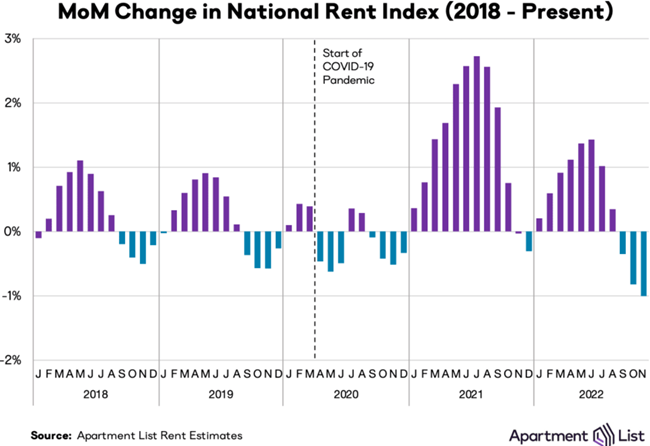
The national rents index fell by 1 percent over the course of November, marking the third straight month-over-month decline.

The national rents index fell by 1 percent over the course of November, marking the third straight month-over-month decline, and the largest single month dip in the history of the Apartment List index, going back to 2017, according to the December report from Apartment List.

The report says rents are likely to continue to dip in the coming winter months as well.

“The timing of the recent cooldown in the rental market is consistent with the typical seasonal trend, but its magnitude has been notably sharper than what we’ve seen in the past, suggesting that the recent swing to falling rents is reflective of a broader shift in market conditions beyond seasonality alone,” the research team writes in the report.

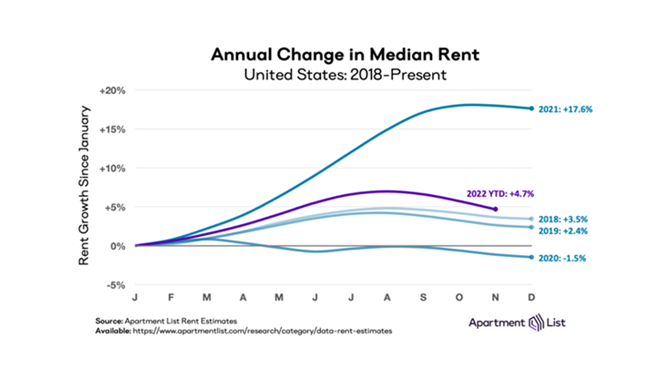
Year-over-year rent growth has slowed considerably since the first of the year and is close to matching pre-pandemic levels.

The national rents index fell by 1 percent over the course of November, marking the third straight month-over-month decline,

Seattle Sees Biggest Rent Drop in November

Rents decreased in 93 of the nation’s 100 largest cities that Apartment List measured.

Among large metros nationwide, Seattle saw the sharpest decline in November, with prices down by 2.6 percent month-over-month.

“And over a longer horizon, we are continuing to see an ongoing cooldown in many of the recently booming Sun Belt markets. Las Vegas, Phoenix, Jacksonville (Fla.), and Riverside (Calif.) have all seen rent growth of 30 percent or more since March 2020, but none of these metros has seen rents increase by more than 1 percent over the past twelve months,” the report says.

“This year’s dip has so far been sharper than what we typically see. Prices have now fallen by a total of 2.2 percent since August, which is the sharpest three-month decline in the history of our index.

“The recent dip suggests that we may be entering a new phase of the rental-market rollercoaster, with changing economic conditions now driving a cooldown rental demand just as supply constraints are easing. It’s likely that rents will decline further in the months ahead, as rental market activity continues to slow during the winter months,” the research team writes.

Vacancy rate continues to climb

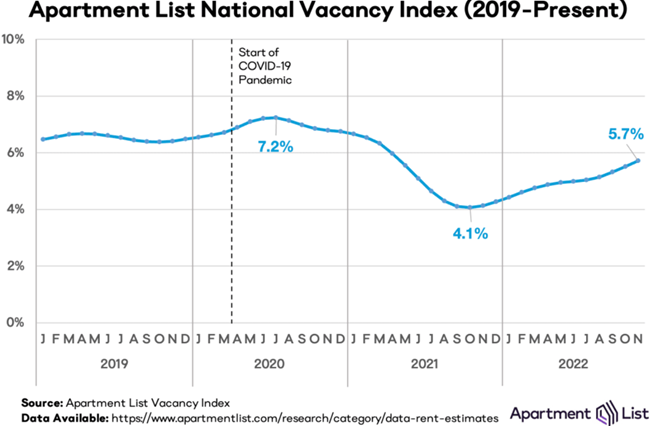
The report says the pace at which the vacancy rate is easing has been picking up a bit of steam in recent months, as rent growth has turned negative.

From April through August, the vacancy index ticked up by a total of just 0.2 percentage points, from 5.1 percent to 5.3 percent. But from August through November, it has increased by 0.6 percentage points, reaching 5.7 percent this month.

The national rents index fell by 1 percent over the course of November, marking the third straight month-over-month decline,

Conclusion

The report summarizes that the recent rent declines are “still quite modest in comparison to the skyrocketing growth of last year, and the national median rent is still 23 percent higher than it was in January 2021.”

Read the full Apartment List report here.

7 Rental Market Trends To Watch In 2023

Sign Up For Our Weekly Newsletter And Get Rental Property And Apartment News And Helpful, Useful Content Each Week.

* indicates required

10 Reasons Investors Should Consider FedEx as a Tenant for DST 1031 Exchange Investment in 2023

By Dwight Kay, Founder & CEO of Kay Properties & Investments

When investors evaluate potential opportunities for their 1031 Exchanges, they should not only consider Delaware Statutory Trust offerings, but also those DST offerings that feature one major distribution and logistics tenant: FedEx. While no one has a crystal ball and can predict the performance of any real estate asset, we are encouraged by one corporation that leases thousands of locations across the country: FedEx.

According to the American Association of Independent Investors (AAII) FedEx Corporation (FedEx) provides a robust portfolio of transportation, e-commerce and business services and operational units under the FedEx brand umbrella, including:

  • FedEx Express:

The FedEx Express segment offers a range of United States domestic and international shipping services for delivery of packages and freight.

  • FedEx Ground:

The FedEx Ground segment provides small-package ground delivery services, which includes day-certain service to any business address in the United States and Canada, as well as residential delivery services through its FedEx Home Delivery service.

  • FedEx Freight:

The FedEx Freight segment offers less-than-truckload (LTL) freight services.

  • FedEx Services:

The FedEx Services segment provides sales, marketing, information technology, communications, customer service, technical support, billing and collection services, and certain back-office functions that support the Company’s operating segments.

As a corporate backed-net lease tenant, Kay Properties likes FedEx for a number of fundamental reasons, including FedEx has a market capitalization of $58.40 Billion making them a very well capitalized tenant to help investors sleep well at night that they have a tenant on a long-term lease that will likely be able to pay rent each month*. Again, while all real estate investments contain no guarantees of monthly distributions and investors should read each PPM paying special attention to the risk section prior to considering an investment, Kay Properties likes FedEx as a tenant for DST properties, especially during turbulent times that need an anchor tenant like FedEx.

Here are ten reasons Key Properties likes FedEx for DST 1031 investments in 2022.

  1. Up, Up and Up – According to a recent article in MarketWatch, FedEx stock continues to soar, reaching its biggest one day gain in 29 years on June 14 th , 2022, resulting in a 14.4% increase in share price. This type of growth occurring during a bear market and at a time when many public companies’ share prices are plummeting, is worth taking note.
  2. Shareholder Heaven: FedEx also just raised its shareholder dividend by 53%…. Again, this occurred during a bear market when the broader stock market is taking a beating.
  3. DST Essential: Over the years, Kay Properties has provided several FedEx DST investments for our investors. While past performance does not guarantee or indicate the likelihood of future results, each FedEx DST investment provided regular monthly rental distributions for our client each and every month – even during COVID-19 pandemic. The essential nature of the FedEx business makes it a popular choice for DST investments.
  4. Just Order it Online: E-Commerce Logistics Market Is Booming Worldwide and FedEx is a recipient of this growth trajectory. An article in Digitaljournal reports that this hyper-growth is being fueled by the increased consumer adoption using e-commerce as a convenient and viable purchasing practice. Additionally, the internet continues to penetrate pockets of consumers worldwide which allows cross-border e-commerce activities, and a growing number of e-commerce business models being developed worldwide. All of this feeds into the need for a reliable, logistics company as FedEx.
  5. More Trucks, Please! Parcel volumes continue to grow. According to Pitney Bowes, a technology company that is known for its postage meters and other mailing equipment, FedEx saw its revenue swell to $62 billion in 2021 while growing its market share. The Pitney Bowes survey also found that 23% of American shoppers are shopping more online than ever in their lives, and that nearly 40% of all purchases are now being conducted online.
  6. Expense Inflation Protection Potential – DST investments with long-term leases to tenants like FedEx are often Net Leased whereby the tenant and not the landlord is responsible for the majority, if not all of, the property level maintenance, taxes and insurance costs. This can be a very nice thing in an inflationary environment when your tenant is responsible for increased costs due to inflation and not you as the landlord. This is not the case with many DST investment asset classes such as multifamily, self storage and others whereby the landlord is responsible for all maintenance, taxes and insurance cost increases due to rising inflation.
  7. A high-margin business model. FedEx has done a remarkable job leveraging its reliable and growing pick-up and delivery (P&D) routes, its linehaul run routes, and its efficient expense management practices. As a result, FedEx continues to deliver higher than average profit margins within the logistics and delivery industries, and presents a real challenge for any competitor to attempt to penetrate its business model.
  8. Room to Grow: FedEx has a “lucrative backdoor” that can grow into a larger role in e-commerce. According to a Citigroup analyst, FedEx can boost its profits by $1 billion annually just by leveraging its recent takeover of ShopRunner and the technology prowess of Microsoft. By doing this, explained the Citigroup analyst, FedEx could become e-commerce’s universal shipping cart that would attract a base of millions of subscribers that would receive free expedited shipping.
  9. The Anchor to a DST 1031 Investors Portfolio – A DST with a long-term lease to a company like FedEx can be a potential anchor to an investors DST 1031 portfolio in turbulent times. With a pending recession and uncertainty throughout the world, having a long-term net lease with one of the world’s largest companies can be an anchor for an investors DST 1031 portfolio. Although all investments have risks and investors should read each Private Placement Memorandum (PPM) carefully, investors are deciding that a piece of their DST 1031 investments in a debt-free FedEx DST property makes a lot of sense in today’s uncertain economic climate.
  10. Demand for Industrial Land Surges: The exponential growth of e-commerce has created a huge need for warehouse and data center space. According to a recent Wall Street Journal article, the e-commerce boom has already turned warehouses and fulfillment centers into one of the hottest property types on the planet. This lack of available space suitable for logistics operations has also meant that rents are surging while vacancy rates are some of the lowest in history.

Ask Bill Exeter

Ask Bill Exeter and his team your questions about 1031 exchanges and he and his team will get back to you.

Name

About Kay Properties and www.kpi1031.com

Kay Properties & Investments is a national Delaware Statutory Trust (DST) investment firm. The www.kpi1031.com platform provides access to the marketplace of DSTs from over 25 different sponsor companies, custom DSTs only available to Kay clients, independent advice on DST sponsor companies, full due diligence and vetting on each DST (typically 20-40 DSTs) and a DST secondary market. Kay Properties team members collectively have over 150 years of real estate experience, are licensed in all 50 states, and have participated in over $30 Billion of DST 1031 investments.

* Past performance does not guarantee or indicate the likelihood of future results.

* No representation is made that any DST investment will or is likely to achieve profits or losses similar to those achieved in the past or that losses will not be incurred on future offerings.

Diversification does not guarantee profits or protect against losses. All real estate investments provide no guarantees for cash flow, distributions or appreciation as well as could result in a full loss of invested principal. Please read the entire Private Placement Memorandum (PPM) prior to making an investment. This case study may not be representative of the outcome of past or future offerings. Please speak with your attorney and CPA before considering an investment.

There are material risks associated with investing in real estate, Delaware Statutory Trust (DST) properties and real estate securities including illiquidity, tenant vacancies, general market conditions and competition, lack of operating history, interest rate risks, the risk of new supply coming to market and softening rental rates, general risks of owning/operating commercial and multifamily properties, short term leases associated with multifamily properties, financing risks, potential adverse tax consequences, general economic risks, development risks and long hold periods. All offerings discussed are Regulation D, Rule 506c offerings. There is a risk of loss of the entire investment principal. Past performance is not a guarantee of future results. Potential distributions, potential returns and potential appreciation are not guaranteed. For an investor to qualify for any type of investment, there are both financial requirements and suitability requirements that must match specific objectives, goals, and risk tolerances. Securities offered through FNEX Capital, member FINRA, SIPC.

Why Delaware Statutory Trust Investors Should Practice “The Anchor and the Buoy Investment Strategy”

Why Real Estate Syndication Is Important for Delaware Statutory Trust 1031 Exchange Real Estate Investors

Six Ways to Ensure Your 1031 Exchange is Successfully Completed

Kay Properties & Investments Has Record Year With $610 Million In Equity Placed

What To Expect When Hiring a Property Manager

What to expect when hiring a property manager in residential management - some concepts apply to commercial as well.

What to expect when hiring a property manager in residential management – some concepts apply to commercial as well.

Mark Christianson

Every property manager or management company is different, with different skills and different goals, but in general property management services are designed to take the work out of owning rental property for an owner.

These are my short answers to some common questions I am asked by potential clients. And remember- this is NOT legal advice!

What does a property management company do for me?

Owning an investment property is very much like owning a small business. You have income and expenses, products and services, warranties and obligations, contracts, legal requirements and so on. Depending on the property this can be an extremely time consuming process. Not only must you handle financial, maintenance and tenant issues, but you should stay abreast of all landlord/tenant and other legal requirements relating to rental properties. A property manager (PM) can take care of all of these issues for you.

During COVID the rules in Oregon were changing several times a year, and rarely with sufficient notification to the public. A good property manager will keep abreast of the law and work to keep you and your tenants in compliance.

An owner should receive monthly financial reports, be contacted if unexpected expenses arise, and be the person steering the boat instead of the one paddling.

 How can I be sure I get good renters in our investment property?

Application screening is the process that ensures that an applicant has the resources to pay the rent that is required and that they have a history of stability and good tenancy. A good property manager will screen every application it receives to ensure that they meet with the companies’ rental criteria. Usually this includes credit, criminal history, SSI check, employment history, rental history and more.

Remember, nobody can guarantee that a tenant will comply with the terms of the rental agreement or lease. It is also important to remember all of the factors that attract good tenants. A clean, nice, updated home will attract more applicants than one that unkempt or in various stages of disrepair. Lower rates attract more applicants and higher rates tend to attract persons in a higher income bracket. Allowing pets may also attract more potential applicants. Longer leases typically attract fewer people, and shorter leases (1 year or less), or month-to-month tenancies, are typically more attractive. The more restrictive the rental criteria are the fewer people will be attracted to rent your property

Also remember that Federal Law prohibits discrimination against protected classes of people. While most people don’t intend to discriminate, it can be easy to do so by accident when advertising or talking to applicants. And the penalties can be severe. Property Managers are trained in how to avoid accidentally discriminating.

When I hire a property manager, will they do everything to take care of the investment?

The short answer is “they can”. The scope of the property manager’s authority is usually negotiated between the owner and the property manager, and is reduced to writing in the property management agreement. This document is the basis from which all future actions are based and you should read it carefully. Typically an Owner will pre-authorize some actions, often with spending limits for various potential maintenance issues.

Some owners prefer a very “hands-on” approach to handling their investments. Others prefer monthly financial reports and occasional phone calls. How much work you want the property manager to cover for you should be discussed in detail so both parties know what to expect.

Do I give up my authority when I sign a management agreement?

Typically you do not “give up” your authority; you confer the authority to the PM to make decisions and act in the best interests of you and the property. You are creating an “agency” relationship with your PM, and you are authorizing them to make daily decisions for you in the manner they believe best address’s your needs. The property management agreement is the basis for the PM’s authority, so you should read it carefully.

It’s important to remember that your property manager cannot break the law for you, and that some things are such an integral part of their policies that they cannot accommodate unusual requests in those areas. Further, they are running a business too. They will not likely do anything that negatively impacts their income. However, you are in control. A last resort is to terminate the management agreement.

Is the property manager financially responsible for making the home or apartment ready to rent, and for all advertising costs?

These questions should be answered in the property management agreement, but usually the answer is No. The PM is responsible for making sure the home is rentable (maintenance, cleaning, safety and habitability problems and so on), for insuring that the bills are paid and that the rent is collected. They are NOT responsible for the financial requirements to make these things happen. In short, the PM will do the legwork and make sure the issues are addressed, but the owner is responsible for the financial burden.

In other words- If the tenant does not pay rent the PM will take appropriate actions but will not cover the missing rent payment. If a tenant damages your rental the PM will schedule repairs but the cost of the work is paid by the property owner. Sometimes those costs can be recovered from the tenant, but if not the cost is paid from the owners funds.

Is the property manager responsible if they don’t collect the rent, or if the tenant damages my property?

Your PM cannot make the tenant do anything. Your PM can negotiate with tenants, remind them of legal obligations, and serve notices and so on to pressure them into conforming to the terms of their agreement. But they have no rights that a property owner does not have- they are acting as your agent.

Remember that the short and long term benefits of investment property ownership are the owners, not the PM’s. The tax benefits, cash flow, appreciation and equity enjoyed by the owner are completely unavailable to the PM. They are paid for their services based on the terms of the management agreement. Because an owner stands to make a considerable sum from an investment property over time, it only makes sense that the Owner is the one who should financially maintain the investment.

How long will it take to rent out any vacant space? How much rent can I charge?

A current market study of the rental prices in an area will give you a good starting point, and most PM’s do this regularly or shortly after a notice to vacate is received. How long renting will take depends on many factors. These include rent rate, interior quality, neighborhood, amount of deposits or prepaid rent (total move-in costs), pet and other restrictions, advertising platforms, availability, the season or time of year and so on.

Remember that this is a sales function, and that likely someone out there that will rent regardless of the situation. The real question is- how long will you wait for them. The best tactic is to advertise early (once a completion or move-in date is established), set the rent rate to a reasonable amount and use signage and online platforms to get the word out.

What happens if the tenant is evicted? Will I ever see the money they owe me?

Though any number of things might occur during the eviction process, typically the tenant moves out or is locked out by the sheriff. In many cases the home will require a considerable amount of work including trash hauling, painting and cleaning, often some minor or major maintenance. Typically it takes 3-5 weeks to evict a tenant, and you can plan on some additional time to make the unit rentable again.

There is usually plenty of documentation supporting the claim of the landlord against the tenant. Some companies will pursue tenants for a short while and then transfer the account to a collection agency. Or, an owner may take the file to small claims court (or civil court). However, the sad truth is that owners rarely see payments from past tenants. It is often such a small amount that owners often decide not to spend the money to pursue legal action.

Can I instruct the PM to do or not do specific things with my property or the tenants?

Yes. Your PM is your agent and they have an obligation to assist you in meeting your needs. However, keep in mind that they are also required to follow the law, that they are regulated and overseen in ways an Owner is not, and that they have a reputation of their own to maintain. If you insist that they do something that is against the law or is detrimental to their own business, they will most likely refuse or even terminate the management agreement.

I am very pleased with the performance of my management company. What should I do?

Tell all your friends and business associates!!! Word of mouth is the best advertising. If you are happy with your property manager, help them out by telling others about your experience.

About the author:

Mark Christianson is principal broker at Markus & Associates, a property management and real estate sales company. 503-646-4909

Property Management Groups Sue Over $10 Cap On Screening Fees

Sign Up For Our Weekly Newsletter And Get Rental Property And Apartment News And Helpful, Useful Content Each Week.

* indicates required

How Do You Handle Potential Tenants Who Are Bad News?

How do you handle potential tenants who lie about jobs, names and income - tenants who are bad news- the question this week for landlord Hank.

How do you handle potential tenants who lie about jobs and income is the question this week for Ask Landlord Hank. Remember Hank is not an attorney and is not offering legal advice. If you have a question for him please fill out his form below.

Dear Landlord Hank,

I’m having a tremendous time getting qualified tenants at the moment. Many applications from people with bad criminal backgrounds.

I have had multiple people lie about names/jobs/income. I recently called someone on the fact they had just been evicted, they had given me false information on last address and landlord. I found the truth and called them on it, they did admit that I was correct but the next day someone tagged the property with graffiti! I’m sure it was them.

Should I not be honest with applicants? It’s a scary world. How do you handle people/tenants who are bad news? Thanks.

-Paul

Hi Paul,

Sorry you are having such a hard time finding a qualified tenant for your place.

I’ve been where you are many times in the past, having to reject multiple candidates who know they wouldn’t pass normal rental screening. On properties like this I ask tenants up front the info I want to know.

You could say you are managing the property for the owner and that the owner requires a credit score of 650 or better, good rental history, clean background and must gross at least three times the rent, plus anything else that is important to you.

That way the candidates won’t waste an application fee only to be denied. I’d also consider putting up a temporary security camera at your place with video recording so you can protect your place.

Good luck!

Sincerely, Hank Rossi

Each week I answer questions from landlords and property managers across the country in my “Dear Landlord Hank” blog in the digital magazine Rental Housing Journal.  https://rentalhousingjournal.com/asklandlordhank/


How do you handle potential tenants who lie about jobs, names and income is the question this week for landlord Hank.
Landlord Hank working himself in one of his rentals. “I’ve been where you are many times in the past, having to reject multiple candidates who know they wouldn’t pass normal rental screening.”

Ask Landlord Hank Your Question

Ask veteran landlord and property manager Hank Rossi your questions from tenant screening to leases to pets and more! He provides answers each week to landlords.

  • This field is for validation purposes and should be left unchanged.

Do I Have to Paint and Replace Flooring for a Long-Term Tenant?

A Tenant Poured Grease Down Drain Who Is Responsible?

Sign Up For Our Newsletter And Get Rental Housing And Apartment News And Helpful, Useful Content Each Week.

* indicates required

6 Winter Maintenance Best Practices for Exceptional Resident Experience

Here are 6 winter maintenance best practices to be pro active and keep your rental property residents informed of actions they should take before they call.

Here are 6 winter maintenance best practices to be pro active and keep your rental property residents informed of actions they should take before they call.

By Derek Studebaker

Strategic planning makes all the difference when successfully managing a multifamily community throughout the seasons. Waiting until changes in weather hit could leave you in a bind. As winter approaches, implement a plan to help your team continue to provide an exceptional living experience.

Is your multifamily community ready for winter? Here are some best practices to better prepare for the change in seasons.

 1. Be Proactive and Prepared

Year after year, we know changes in seasons will present the same challenges at multifamily communities. Set your teams up for success by reviewing protocol and pre-ordering supplies you may need for anticipated maintenance requests, such as heating-system repairs.

When in doubt this winter, be proactive and err on the side of caution. Prepare your teams and help residents enjoy a warm and cozy winter in their homes.

2. Check your Systems Year-Round

During the warmer months, all systems should not only be checked but turned on during routine inspections. If equipment is not in use during a specific time of year, it is still crucial to check that everything is properly functioning. For communities in climates with mild winters, this is even more important because heaters and fireplaces are not used frequently.

When you get comfortable and stop thoroughly performing routine maintenance checks, things can quickly turn into a maintenance emergency. Regular maintenance tune-ups help eliminate unexpected breakdowns and stop problems before they occur. Control the controllable to stay ahead of the game.

3. Keep Residents Informed

Encourage residents to test their HVAC prior to changing seasons, ensuring that it is functioning properly. For a seamless transition from season to season, transparent communication regarding winter preparation is imperative.

Residents need to be informed of any actions they should take to keep themselves safe this winter and receive a list of proper contacts in case of emergency. Over-communicate with them and make sure none of their questions are left unanswered.

4. What should you do when a winter-maintenance emergency occurs?

Unfortunately, unforeseen issues may arise despite a service team’s best efforts. In such instances, make sure the resident is comfortable and work with them to determine a desirable solution if an immediate one is not available. Remain calm but confident – this creates trust and shows that you have the resident’s best interest in mind.

5. Build Relationships with Vendors

Develop relationships with reliable vendors who offer consistent quality and support. The assistance of trusted vendors helps speed up repair processes and ensures issues are fixed the right way, the first time.

Work together to plan ahead with your vendors. Replacement parts are still quite difficult to obtain, especially when needed in a pinch. Stock up on inventory, and secure contracts before you need them.

 6. The Importance of Trust

Encourage your residents to report any maintenance issues promptly. Reiterate to them the importance of bringing anything that is seen as being “off” to your team’s attention – the sooner, the better. It may end up being nothing, but chances are, if a resident notices something of concern in their home, it is a problem and needs your attention.

About the author:

Here are 6 winter maintenance best practices to be pro active and keep your rental property residents informed of actions they should take.
Derek Studebaker

Derek Studebaker is a manager of facilities and services at Mark-Taylor. With tenured experience and well-deserved recognition as MFS of the Year and AMA Team of the Year, Derek diligently heads a portfolio of Mark-Taylor communities’ service teams.

Sign Up For Our Newsletter And Get Apartment News And Helpful, Useful Content Each Week.

* indicates required


How to Promote Operational Excellence Across Your Portfolio

Key Drivers of a Successful Multifamily Community Takeover

 5 Keys To Attracting and Retaining Qualified Team Members

How 2022 Can Positively Affect Your Assets and Rentals in 2023

2022 brought a lot of changes in the rental property industry and property owners have a chance to use these changes to their advantage in 2023.

By Nino Chicoga

As a landlord, you should be well aware of the pandemic’s changes to the rental real estate industry in 2020. The industry has only grown ever since and the investors have been making a big profit due to rising rent prices.

Although the daily rental properties have not been as successful as they were in the past lately, more and more people are looking to rent real estate for long periods. Therefore, many of the property owners switched their focus from renting daily to renting monthly.

Each year tends to affect the next in both negative and positive ways. 2022 has set the grounds to make your investment successful for the next year. We can explain some of the positive effects that 2022 has on your assets and rentals for 2023.

The Short-Term Rental Industry is Making a Comeback

As mentioned, in recent years because of the great fear that the pandemic brought us, many people were too afraid to book rentals for a night or two. Daily rentals turned out to be a failure for many investors in 2020 and 2021. However, in 2022 we saw a bit of change as the Covid 19 panic slowly died down. Although we are far from completely defeating the virus, people have found hope and we can see some positive results in the medicine.

Traveling just came back in style and people are eager to visit the places they couldn’t for years due to lockdown. It’s the property investors’ time to take the spotlight and make a big profit.

Since traveling is not as big of an issue in 2022 as it was in 2021, we can see more and more people visiting a variety of places. As expected, by 2023 short-term rental properties will have renewed their spot on the market. If you own a rental property that you rent out daily, 2023 might be highly beneficial for you.

In 2022, 80 percent of travelers made plans to visit different regions, and 86% of the travelers said they would stay in rental properties. Such surveys bring hope to investors for next year. We suggest you get your property management company to prepare your commercial real estate for daily and weekly visits.

How to Handle the Positive Change

Furnishing properties and changing policies to make them suitable short-term rentals is going to be costly.

If you can’t decide to switch your rental from a long-term one to a short-term rental you are going to need to consider these factors that impact the renters’ choices.

  • Location: Is your rental property located in the part of the region that gives the guests the liberty of visiting multiple attractions in a day?
  • Tenants: Do you have tenants that plan to move out in a short term or do you have the grounds to evict them?
  • Government regulations: Many states have changed certain laws and regulations in the past few years. Are you up to date with the property law in your area?
  • Vacancy: How are the vacancy and the profit going to change by switching to short-term rental?
  • Policies: What are your policies for long-term rental and how are they going to change?

You must also remember that by changing the type of your rental property, you are going to have to publish new advertisements on different platforms. You will need to post your listings on booking websites and change the style of how you present your property online.

By switching to short-term rentals, you will need to consider giving additional services to the guests. When the visitors stay at properties for a short period of time they expect clean towels and help with navigating through the area. If your property is located at a distance from your residence of living you should start thinking about hiring a property manager.

Moreover, you will need to attend to the needs of the guests and oversee their actions daily. Since you will have to host new people every few days, it will be difficult to trust them completely. Therefore, you will need to spend a lot of your time checking up on the visitors.

In conclusion, 2022 has promised us the comeback of the short-term rental industry. As a property investor, you can start receiving guests to your commercial real estate daily again. If it’s your first time renting out properties short-term, you can check some of the pointers we gave you so you can easily navigate this new style of business.

Usually, property owners make much more profit by renting out properties daily, especially if they are located in a tourist zone. Therefore, if you decide to use the advantages that 2022 has given us for 2023, you will not regret switching back to short-term rentals.

About the author:

Nino Chicoga is a content/blog writer at Goodjuju. Before joining the team she had various jobs. She worked as a content writer, a business manager, an HR intern and a logistics assistant. Nino loves to do research on different topics. She enjoys learning about philosophy, psychology, and reading classic literature.

Sign Up For Our Weekly Newsletter And Get Rental Property And Apartment News And Helpful, Useful Content Each Week.

* indicates required

18 Months of Outstanding Rent Growth Coming to An End

Record-Setting Decline In National Median Rent In October

Rental Price Drops Around The Country

Why Delaware Statutory Trust Investors Should Practice “The Anchor and the Buoy Investment Strategy”

Why Delaware Statutory Trust Investors Should Practice “The Anchor and the Buoy Investment Strategy” and how it works Kay Properties

By Dwight Kay, Founder and CEO of Kay Properties & Investments

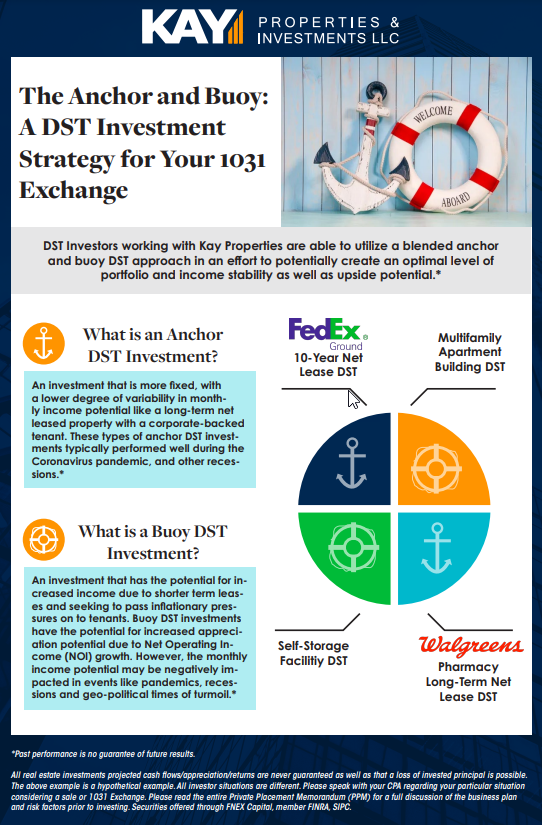
Real estate investors currently considering a Delaware Statutory Trust (DST) investment for a 1031 exchange or even a  direct-cash investment, one of the first things to consider is what specific  investment strategy should you pursue? For example, is the goal to achieve greater appreciation even if it means investing in an asset that carries greater risk? Or is your long-term strategy to have steady monthly income even if it means lower overall appreciation potential? I like to call this the “Anchor and Buoy” investment theory. One of the beautiful things of Delaware Statutory Trust investments is that they can potentially provide investors both the benefits of the anchor and buoy investment strategies.

How “Buoy” Investments Work for Your Delaware Statutory Trust

To better understand how to use the anchor and buoy theory to evaluate potential DST investments, consider a multifamily building that has 500 tenants. First, while residential properties use comparable sales or “comps” to approximate valuation, multifamily properties are also valued based on the amount of Net Operating Income (NOI) they produce. NOI is calculated by subtracting a property’s operating expenses from its gross income. Gross income is derived from the sum of all sources of income for the multifamily property. While the vast majority of income comes from rent payments, there could also be ancillary sources of income like covered parking fees, laundry/vending income, pet rent income and even rent for storage unit access. On the flip side, operating expenses are the costs required to run the multifamily property on a day-to-day basis. Although these amounts will vary depending on the type of building, the line items will be typically very similar. These can include things like utilities, taxes, insurance, maintenance, property management, and even legal fees.

In this example, the multifamily building has a diversified tenant base of 500 tenants that are paying rent each month. Additionally, because most multifamily assets use an annual lease, landlords have the opportunity to potentially increase those leases every year. In addition, any vacancies can provide owners the opportunity to potentially raise rents when filling the vacancy. In this way, multifamily properties act like a buoy, moving and adjusting with the conditions.

While all real estate investments have some form of material risks associated with them like interest rate risks, vacancies, general market conditions, and financing risks, many investors like assets like multifamily and self-storage because they have the potential to gain more appreciation over time as they hopefully are able to increase their income generated through rental increases over the years. In addition, multifamily and self-storage are considered good “buoys” to potentially hedge against inflation because owners can hopefully raise the rents each year to help offset rising costs.
Why Delaware Statutory Trust Investors Should Practice “The Anchor and the Buoy Investment Strategy”

 Why Multi-Family and Self-Storage are Considered Good  Buoy DST Investments

Many investment professionals and accredited investors view self-storage and multifamily markets through the same investment lens. First, both asset classes follow a similar set of metrics to help determine market favorability, including demographic trends and income statistics. Second, both multi-family and self-storage use rent growth and vacancy rates as a way to project future performance. Finally, as mentioned earlier both asset classes are considered to be somewhat recession-defensive, and because operators are able to quickly respond to changing market conditions with rent changes, both property types are also considered to be an inflation hedge option in commercial real estate.

Example of Buoy Multifamily Delaware Statutory Trust Investment

A good example of a buoy DST investment would be Dallas Multifamily 59 DST, a debt-free, unleveraged DST investment currently being offered to accredited investors by Kay Properties.

You can learn more about this Buoy investment by watching this video:


What is an Example of an Anchor Delaware Statutory Trust Investment?

So, if a multifamily building is considered a “Buoy” DST investment, then what is an “Anchor” DST investment? Many investors consider a commercial net lease type of asset as more of an anchor investment for their DST 1031 Exchange investments. First of all, instead of using NOI and market capitalization rates (cap rates) solely as a valuation measurement, most commercial net lease assets are going to additionally tie the valuation of the property with the creditworthiness of the tenant. For example, Joe’s Pizza Shop is not as creditworthy of a tenant as FedEx or Walgreens, both of which are considered investment grade tenants. First of all, Joe’s Pizza Shop can shut down and investors are left with an empty building and the potential for expensive maintenance costs and unpaid rent. While it is possible that FedEx or Walgreens can also shut down a location, the odds are that these multi-billion dollar public companies will continue to pay rent as they have investment grade credit ratings by Standard and Poor’s (S and P).

Why are Long-Term Net Lease Commercial DST Buildings Considered Anchor Investments?

In addition to the creditworthiness of the tenant, anchor investments also use the length of the lease as another important factor to take into account. For example, a FedEx distribution center with a 10-year lease is an inherently valuable asset because there are 10-full years of potential income that has a corporate guarantee on the lease to pay the landlord the predetermined amount each month. However, while this type of asset can act as an anchor over the course of many years, there is typically not an opportunity to raise rents as can be found in multifamily or self-storage facility DST investments.

Example of an Anchor Long-Term Net Lease Delaware Statutory Trust Investment

A good example of a buoy DST investment would be Pharmacy Net Lease 46 DST, a debt-free, unleveraged DST investment currently being offered to accredited investors by Kay Properties.

You can learn more about this Anchor DST investment by watching this video:


How Delaware Statutory Trust Investments Blend Both Anchor/Buoy Philosophies

DST investments provide investors several ways to incorporate both anchor and buoy investment strategies by incorporating diversification into a real estate portfolio. For example, DSTs can create diversification through geography, property type, and investment structure.

●       Geography
The beautiful thing about Delaware Statutory Trust investments is they can hold real estate assets in any state across America, helping investors target properties in specific markets where they believe will deliver a desirable combination of ongoing income and potential appreciation. For example, investors might decide to invest in tax-friendly, high-growth states like Texas, Florida, or North Carolina among others.
●       Property Type

Delaware Statutory Trusts also allow investors to achieve the potential for greater diversification through property types as well. For example, DSTs can include a wide range of asset types including apartments, distribution centers, medical buildings, and self storage facilities. Essentially any asset that can qualify as a “like kind” 1031 exchange property can potentially be structured as a DST.

●       Investment Structure

Another way DSTs help investors incorporate both anchor and buoy investment strategies is through investment structure. A good way to explain this is to recognize that while many DSTs consist of a single property, other DST investments consist of a larger portfolio of similar assets e.g., multiple apartment complexes, self-storage facilities, office buildings, or retail properties. In this way, a DST portfolio can create a “built-in” diversification component that many investors find attractive.

In conclusion, an investor could place their entire exchange proceeds into a multifamily or self-storage DST if they were seeking greater upside potential that the buoy strategy is seeking.  The downside is that if the economy were to suffer, if another pandemic or any other myriad of black swan events were to happen that investor could easily see cash flow cut in half or suspended entirely.  So in an effort to enhance appreciation potential the investor sacrifices the stability of income that many investors are seeking in today’s volatile environment.

However, many investors these days are achieving the goal of potential appreciation by utilizing the buoy investment strategy of multifamily and self storage DSTs and at the same time blending in the anchor strategy in an effort to gain potential stability of income by utilizing long-term net leased DSTs with tenants such as FedEx and Walgreens.  This blended anchor and buoy combination strategy is gaining popularity as investors consider where we are in today’s economic and geopolitical environment.

To see a complete list of anchor and buoy DST properties and other real estate investment options, please visit www.kpi1031.com.
About Kay Properties and www.kpi1031.com

Kay Properties is a national Delaware Statutory Trust (DST) investment firm. The www.kpi1031.com platform provides access to the marketplace of DSTs from over 25 different sponsor companies, custom DSTs only available to Kay clients, independent advice on DST sponsor companies, full due diligence and vetting on each DST (typically 20-40 DSTs) and a DST secondary market.  Kay Properties team members collectively have over 150 years of real estate experience, are licensed in all 50 states, and have participated in over $30 Billion of DST 1031 investments.

This material does not constitute an offer to sell nor a solicitation of an offer to buy any security. Such offers can be made only by the confidential Private Placement Memorandum (the “Memorandum”). Please read the entire Memorandum paying special attention to the risk section prior investing.  IRC Section 1031, IRC Section 1033 and IRC Section 721 are complex tax codes therefore you should consult your tax or legal professional for details regarding your situation.  There are material risks associated with investing in real estate securities including illiquidity, vacancies, general market conditions and competition, lack of operating history, interest rate risks, general risks of owning/operating commercial and multifamily properties, financing risks, potential adverse tax consequences, general economic risks, development risks and long hold periods. There is a risk of loss of the entire investment principal. Past performance is not a guarantee of future results. Potential cash flow, potential returns and potential appreciation are not guaranteed.

Nothing contained on this website constitutes tax, legal, insurance or investment advice, nor does it constitute a solicitation or an offer to buy or sell any security or other financial instrument. Securities offered through FNEX Capital, member FINRA.

Why Real Estate Syndication Is Important for Delaware Statutory Trust 1031 Exchange Real Estate Investors

Six Ways to Ensure Your 1031 Exchange is Successfully Completed

Kay Properties & Investments Has Record Year With $610 Million In Equity Placed

What Rental Property Managers Can Learn From E-commerce

What can rental property managers and owners learn from e-commerce giants to help renter experience? Here are some things to think about.

By Rachel Richardson

What can properties learn from e-commerce giants like Amazon?  Owners and operators can deliver an exceptional experience for the renter by following principles that have transformed the online shopping landscape. Apartment hunting has three factors of success that are also critical in other types of online shopping: customer service, availability & ease of access, and community engagement.

“Everyone wants the Amazon experience online,” said Max Morales, Director of Marketing at Cornerstone group.  In a webinar on how to optimize marketing for a variety of properties, Max shared a fundamental truth about modern living and leasing. “People like simple.” Renters want to easily find and live in their ideal apartment. Much like successful e-commerce businesses, exceptional experiences in leasing require rental property managers to make it easy for renters to find what they’re looking for.

While this is simple in principle, it can be challenging to implement without clear guidelines.  We’ll get into each of these and how property technology comes into play.

Reduce friction in the leasing process

“Customer obsession rather than competitor focus,” is one of the four principles guiding Amazon’s mission.  And this reveals why many of the company’s most sophisticated tech innovations deliver convenience , personalization, and speed. Properties that champion the renter experience find out where there is friction in the renter journey. They then can use technology to remove the roadblocks and make leasing more effortless.

For rental property managers and teams, the challenge is getting all of the tools they manage to seamlessly work together.  Single-point solutions have flooded the market to guide leasing teams through specific steps.  But the next phase of multifamily is in operational efficiency.  Seek automated communications, integrated solutions and FHA-compliant resources that are renter-centric.

Automate when possible, and with intention

Digital shopping allows us to take action, uninterrupted.  Automated tour scheduling and email confirmations show renters that your property can swiftly lead them into the leasing process.

Ensure that your automated communications provide clear next steps for the renter and options to continue exploring in the meantime. For example, your follow-up email may include appointment date and time.  But also providing a virtual video of the apartment they will be touring or a link to the website for further details – ties back to the whole experience and keeps them engaged.

Renters are also often under time constraints.  Make responding easy with two-way email or text communications, simple rescheduling options and clear directions for onsite tours.

Anticipate common renter questions and needs

Exceptional digital experiences answer common questions that shoppers are trying to solve for.  Your property can answer frequently asked questions from your renters in a variety of engaging ways – from property photos and maps to reviews.  Here are a few ways to develop digital experiences with common questions in mind:

“What’s the neighborhood like?”

Renters can quickly get a feel for your community if you have “Places nearby” enabled on your listings.  Photos and videos of events, partnerships with local vendors and welcome kits with local recommendations also showcase your property location in a fun and experiential way.

“Can I trust that it will be this good once I start living there?”

Ratings, reviews and social media are powerful word-of-mouth indicators of what it’s like for residents at the community.  Ensuring that they are available, recent, and responded to will help you build trust early and get ahead of renters’ remorse down the line.

“Is this property pet friendly?”

Clear pet policies in listings and the website, fun photos of community pets, and other examples of your community (dog park photos, pet washing stations, etc.) are all ways to effortlessly address this.

Pets can be an important part of the renter experience.

“What shape is the apartment in?”

The key question most properties answer can inspire a variety of digital content.  Think about how your 3D tours, videos, photos, floor plans and other visual guides reflect the onsite experience.

Work with new browsing behaviors without working against your busy schedule

Touring schedules have changed post-pandemic.  The rise in remote work has prompted many renters to research apartments on their own time – during what used to be off-hours.

In a panel at the 2022 Apartmentize conference, “What do Post-Pandemic Renters Need? Data & Industry Expert Perspectives,” speakers shared how this has impacted leasing schedules.  In the past, days surrounding the weekend, Fridays, Saturdays and Mondays, used to be the most popular times to tour. But Tuesdays have recently become a popular tour day as workers make time to quickly explore a new apartment.

The digital evolution of leasing has also made late-night browsing easier.  Instead of overextending leasing teams, properties use automated communication channels and support to fill in outside of office hours.

To provide a high-quality renter experience, also ensure outside support teams understand your team’s priorities and can interact with renters as an extension of your team.  Virtual leasing solutions, text and email communication, web chat, and other digital messaging services can fulfill this need.  Important to look for here are services that integrate with your PMS (property management system) or other platforms and FHA-compliant vendors.

Can your leasing process pass the ultimate test?

The best way to fully understand the renter journey is by taking it. Test out the leasing process for yourself and with your team.  Fill out a lead form on your listings and property website to see firsthand what automated communications you receive. Test out booking, rescheduling, and canceling a tour to see how simple or difficult moving through each process is.  Write down any questions that came up (where could I call the leasing team from this page?), natural responses you had (I want to see more but am not sure where to find the website) and wish list items for where you want to see improvement.  Then, use your findings to make tweaks to the current process.

The renter experience is constantly evolving.  With simplicity in mind, rental property managers and owners can make adjustments or shift strategies according to a time that works for your team, your budget and your current processes.

About the author:

Rachel Richardson is a Content Manager for Rent. a leading rental marketplace.

Sign Up For Our Weekly Newsletter And Get Rental Property And Apartment News And Helpful, Useful Content Each Week.

* indicates required

18 Months of Outstanding Rent Growth Coming to An End

Rental Price Drops Around The Country

Portland Rents Increase Again In October

Apartment Market Slowdown Continues

The apartment market slowdown continues but apartment executives remain bullish on 2023 according to this John Burns analysis

The apartment market slowdown continues but apartment executives remain bullish on 2023 according to this analysis from John Burns Real Estate Consulting.

By Alex Thomas and Jesse McConnico

The gravitational forces of rising supply, economic uncertainty, and the return of seasonality have all pulled the apartment market back down to earth.

While apartment owners would normally not celebrate a softening in demand, this is exactly what the Fed needs to see in order to tame inflation, which will be great for the economy overall, as well as apartment-owner borrowing costs and cap rates.

The major publicly traded apartment (real-estate investment trusts (REITs) just finished reporting their 3Q22 and preliminary October results, and confirmed what we noted last month: Rent growth is quickly decelerating. The Fed has to be pleased with the latest round of results from America’s largest residential operators.

While rent growth has slowed, the apartment executives remain bullish on 2023 because they see both the financial strength of their renters and the numerous headwinds facing their competition: the for-sale housing market. While many analysts expect job losses next year, including the Fed which is forecasting unemployment to rise to 4.4 percent, most believe the losses will be mild due to today’s labor shortage.

Here are the performance highlights that apartment REIT executives shared over the last few weeks.

New lease rent growth decelerated sharply in October

By October, all REITs reported low- to mid-single-digit new lease rent growth (the best proxy for current demand), a deceleration from recent double-digit growth. While a slowdown is expected this time of the year due to seasonality, that sharp of a decline indicates the apartment market is slowing more than normal. Annual new lease rent growth slowed to 5 percent in October, from 13 percent in 3Q22.

  • Essex Property Trust: 3 percent in October, down from 10 percent in 3Q22.
  • Equity Residential: 5 percent in October, down from 13 percent in 3Q22.
  • UDR, Inc.: 5 percent in October, down from 13 percent in 3Q22.
  • Camden Property Trust: 5 percent in October, down from 12 percent in 3Q22.
  • Mid-America Apartment Communities: 6 percent in October, down from 14 percent in 3Q22.

Renewal rate growth eased but remains high

REITs focused on pushing renewal rents to minimize the difference between in-place rents and market-rate rents (known as loss-to-lease). As a result, renewal rents increased at a similar pace to new leases in the third quarter and outpaced new lease rent growth in October.

Occupancy fell slightly

Weighted-average total occupancy fell to 96.2 percent in 3Q22, from a record high of 96.6 percent one year prior. Mid-America Apartment Communities, with a portfolio located in Sunbelt markets, was the only REIT that reported an increase in occupancy from 2Q22.

Transaction market at a standstill

Apartment sales have almost come to a full stop as buyers wait on the sidelines, expecting either prices or borrowing rates to drop further. Per the REIT CEOs, asset values have already declined 10 percent to 20 percent this year, pushing cap rates up 75 to 100 basis points.

  • Equity Residential: “There’s so little going on in any market. Just sharing anecdotally, a large national broker told us that [in] a large southeastern apartment market, they didn’t have a single listing at this time, so that’s unprecedented.”
  • Camden Property Trust: “We will not be selling or buying properties for the balance of the year. Apartment transactions remain quiet as participants’ cost of capital continues to rise and price discovery continues.”

Read the full report here.

About the authors:

Alex Thomas and Jesse McConnico are senior analysts at John Burns Real Estate Consulting. The six apartment REITs we track in our report include AvalonBay Communities (AVB), Camden Property Trust (CPT), Essex Property Trust (ESS), Equity Residential (EQR), Mid-America Apartment Communities, (MAA), and UDR, Inc. (UDR).

Sign Up For Our Weekly Newsletter And Get Rental Property And Apartment News And Helpful, Useful Content Each Week.

* indicates required

Rent Prices Continue Downward In November Across The U.S.

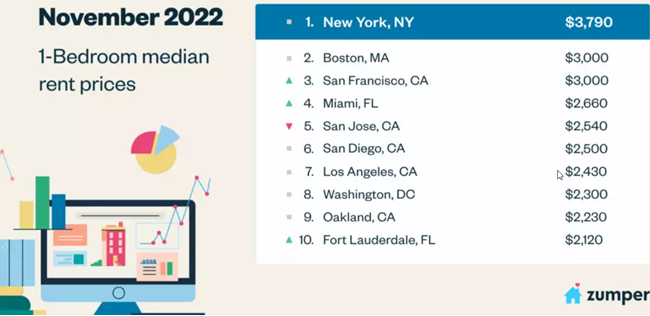
Rent prices continue to decline gradually across much of the United States, according to the November rent report from Zumper.

Rent prices continue to decline gradually across much of the United States, according to the November rent report from Zumper.

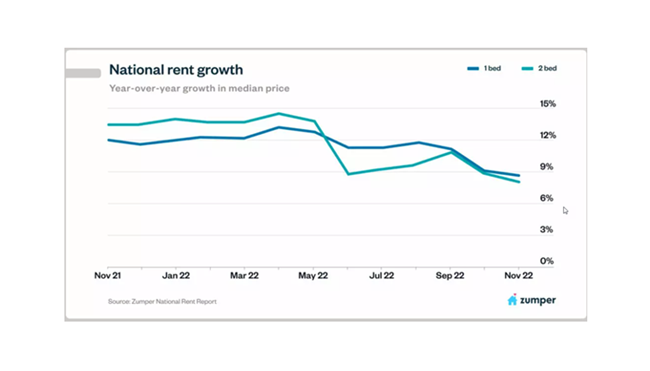
Nationally, the median price for a one-bedroom is flat over last month; the two-bedroom median fell 0.4 percent. Nearly half the cities on Zumper’s list posted decreased or flat one-bedroom prices compared to last month; the two-bedroom median is down or flat in 60 percent of Zumper top 100 cities.

“We’re seeing pandemic trends begin to unwind, and unwind quickly, as renters hunker down in anticipation of a recession,” Zumper CEO Anthemos Georgiades said in a release.

“Over the last two years we saw unprecedented rises in rent prices driven by a booming economy, low interest rates, a one-off spike in demand post vaccines, and supply chain issues that delayed new units coming to market. Now—with inflation and interest rates high and the labor market beginning to tighten—Americans are holding off on major economic decisions. Household formation has paused and even inverted, driving demand down and cooling off rent prices.”

Rent prices continue to decline gradually across much of the United States, according to the November rent report from Zumper.
Charts courtesy of Zumper

Metros beginning to see rent prices leveling off

Several metros accustomed to substantial, sustained price increases are beginning to level off: Median one-bedroom rent is down 2.9 percent in Nashville, 2 percent in Boston and 1.8 percent in New York City.

One-bedroom rent in Tulsa, OK—which previously saw big price hikes thanks to an incentive program to lure remote workers—is down a whopping 6.3 percent over last month. Fresno, CA, dropped 16 spots this month and is now in the bottom half of our list with a median one-bedroom rent of $1,330.

What is this happening?

  • Recession fears and diminishing occupancy are helping nudge rental prices down across much of the country.
  • Pandemic-era trends are beginning to unwind, especially in areas that previously welcomed large numbers of new residents thanks to work-from-home policies. This reversal is especially evident across Arizona.
  • Boston and San Francisco are now tied for second most expensive city in the country, with New York showing no signs of relinquishing its No. 1 spot.

Read the full report here.

Sign Up For Our Weekly Newsletter And Get Rental Property And Apartment News And Helpful, Useful Content Each Week.

* indicates required

18 Months of Outstanding Rent Growth Coming to An End

Record-Setting Decline In National Median Rent In October

Rental Price Drops Around The Country

Portland Rents Increase Again In October