Home Blog Page 75

Will Your Renters Play A Crucial Role In Elections?

Will your renters play a crucial role in elections as in the past renters have historically voted at far lower rates than homeowners.

Will your renters play a crucial role in elections as in the past renters have historically voted at far lower rates than homeowners.

By Chris Salviati and Rob Warnock
Apartment List

The 2022 midterms are less than two weeks away, and the nation’s renters could play a crucial role in determining the outcome, according to a report from Apartment List.

“We’ve argued in the past that increased political engagement among a coalition of renters could have the potential to swing elections, and the upcoming midterms could prove to be a turning point where such a movement gains momentum.

“Renters have historically voted at far lower rates than homeowners, but that gap has been narrowing in recent years. Mobilizing renters could be a winning strategy for Democrats, the party that renters tend to favor by a wide margin. But given their present state of economic frustration and disenchantment, this large voting bloc could present an opportunity for either party,” the report says.

Will renters play a crucial role in elections some key findings:

  • In the 2018 midterm elections, 40 percent of eligible renters voted, compared to 59 percent of homeowners. “Although this turnout gap is significant, 2018 saw the highest renter turnout and the smallest turnout gap of any midterm election that we analyzed, going back to 1990. Similarly, 2020 saw the highest renter turnout and second smallest turnout gap of any presidential election we looked at.”
  • In 2020, renters voted for President Biden by a staggering margin of 36.5 percentage points, and also favored Democratic candidates for the House of Representatives by a similar margin of 35.2 percentage points.
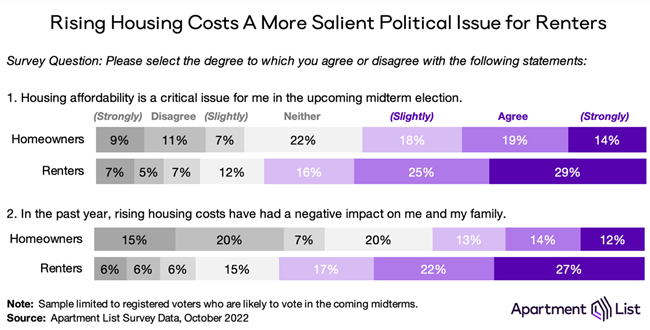
  • Among renters who are registered to vote, 49 percent say that rising housing costs have negatively affected their families in the past year, and 54 percent say that housing is a key issue for them in the upcoming midterms. Also, 61 percent of renters say that they are “very likely” to vote on November 8, compared to 80 percent of homeowners.

Will your renters play a crucial role in elections as in the past renters have historically voted at far lower rates than homeowners.

Why more homeowners than renters vote

Homeowners have a large financial motivation to vote when they perceive that the policies at stake could affect local property values.

Renters, on the other hand, face additional obstacles to voting.

For example, renters are more likely to be struggling financially, such that taking the time to vote may exact a greater cost. Renters also move more frequently than homeowners, which could make it harder to maintain an active voter registration. And renters are far more likely to be members of minority groups who have been plagued by a long history of voter suppression. As a result, there is a wide gap in voter turnout that has persisted for decades.

Can housing affordability be a mobilizing force for voters?

“Our survey also demonstrates how for those experiencing the effects of inflation, housing affordability can be a politically mobilizing force.

“Among renters who agree that rising housing costs have had a negative impact on their lives, 58 percent told us they have become more politically active over the past two years, while only six percent say they are less politically active. Interestingly, this mobilization is even stronger among the relatively small share of homeowners who are feeling the negative effects of housing inflation: Sixty-three percent say they are more active today, while only six percent are less active,” the report says.

What role could renters play in the upcoming midterms and beyond?

“Renter voices are significantly underrepresented in our nation’s politics, and boosting the voter turnout of this large demographic could have dramatic implications in the outcomes of elections,” the report says.

“The most recent few national elections offer evidence that such a shift has already been starting to take place. And with the housing affordability crisis having rapidly grown in magnitude since 2020, there’s good reason to believe that political mobilization of renters may continue to pick up steam in the upcoming 2022 midterms and beyond.”

Read the full report here.

Sign Up For Our Weekly Newsletter And Get Rental Property And Apartment News And Helpful, Useful Content Each Week.

* indicates required

One Sure Way To Increase Tenant Selection Success Rates Part 3

One sure way to increase the tenant selection process part 3 is by creating a tenant selection and screening policy says Rebekah Near

By Rebekah Near
CEO of Orca Information, Inc

Here we are at the 3rd article on creating a detailed Tenant Selection Policy (TSP).  We have covered the following:  1.  Why creating a detailed Tenant Selection Policy is important; 2.  Where to get help formulating such an affective policy; 3.  The Fair Credit Reporting Act and how it requires a landlord to include specific wording.  Now we will learn what tenant screening clients at Orca Information, Inc. have found the most affective in creating their policies.  One basic need is CLARITY!  When your policies are clear and concise, easy to read and understand you not only have informed rental applicants, but your staff is also informed.  The policy guides your applicants and your staff.  Take out the guess-work!  Eliminate confusion.  For a video to help train your staff on Tenant Selection Policies click this link.  https://www.youtube.com/watch?v=AtVZxvzfyOo

There are at least four categories for Tenant Selection Policies.  They are as follows:

  1. The Application Process – Guidelines for applying to the rental property
  2. Rules of the rental property and management company
  3. Potential Disqualifiers identified on the Background Screening Report.
  4. Disclosure documents explaining laws governing the application process – Tenant Rights!

Over the years I have studied many policies – to help landlords clean them up and make them easier to understand and compliant with laws and regulations.  The above 4 categories are more times than not, all mixed together – like a soup! Example:  The Application Process is peppered with reasons why a person could be denied tenancy.  Then stirred into the mix is information on the Security Deposit.  Then back to the Application Process.  Make it simple.  Keep the categories as clean and separate as possible.  Now, let’s break it down even further.

Step 1.  The Application Process:

Our clients often title this document, THE APPLICATION PROCESS or APPLICATION GUIDELINES.  This describes what steps the applicant needs to apply for the rental.

First and foremost is INCOME VERIFICATION.  Proof of Adequate Income could be the following:

    a) Most recent paystub with year-to-date income listed
    b) New hire letter stating salary, job title, starting date, etc.
    c) Self Employed – Tax returns for last two years
    d) Retired – Copies of deposit slips, Investment and/or Social Security earning documentation

Landlords will often first require the applicant to prove their qualifications in every way described in their rental criteria – other than proof of income.  A landlord will ask the applicant to begin by filling out a rental application and pay the non-refundable screening fee.  The application is sent to Orca Information or another screening company to process the Background Check.  The Tenant Screening Report can take several days to complete.  Once the screening report comes back to the landlord and the applicants are approved, then the landlord requires “Proof of Income”?  All that time and money for both parties can be a source of great frustration. Saving time and money for both landlord and applicant is smart.  Make proof of income the first requirement for qualifying!  If they do not qualify for income requirements the application process can stop immediately and Co-signer or Increased Deposit discussed before moving forward.

A LITTLE SECRET.  WANT TO GET YOUR TENANT SCREENING REPORT BACK FAST SO YOU CAN LEASE-UP THAT APPLICANT?  Here is how:  Once your applicant proves they have adequate income and their ID confirmed we recommend our clients have the applicant(s) fill out the rental application carefully and thoroughly.  Next the rental manager reviews the rental application.  Allow me to give kudos to the great rental managers who review the rental applications before sending them to Orca Information for processing.   Over the years we have seen these screening reports processed faster and sent returned completed faster when the rental manager makes sure all information is listed on the rental application and is correct.  Why is this?  I don’t know of a busier person than a rental manager.  Talk about multi-tasking!  That’s exactly why they take the time to review the rental application – they don’t have a lot of extra time on their hands!  In the long run this saves them time.

Yeah, yeah, yeah, I know – many management companies just let the applicant fill out everything online and the cool software absorbs all the information and spits out a great screening report. It is seamless.  Much less work for the managers…..NOT!  Someone at the rental office has to clarify the missing information on those applications AND/OR you end up with a terrible report but you don’t know it.  You do not know the report is missing a lot of important information.  Why would information be missing?  The super-software companies are NOT tenant screening companies.  The computer spits out the best calculations it can with the information given but often it is the wrong or highly limited information.  This results in renting to more troubled tenants.  Greater losses are at the end of tenancy (evictions).

The applicants will often fly through filling out the information required on the rental application.  They make mistakes, leave out important answers to questions, put down the wrong phone numbers for previous landlords.  Along with the applicant guess who usually gets a call from the screening company for help with gathering the required information?  The rental manager!  The process of screening now takes longer and requires more work. Want a quicker turn around time for tenant screening report?  Want a more accurate screening report?  Carefully review all the information on the rental application BEFORE sending in for the actual screening.

Second and just as important as Income Verification is Proof of Identification.  Watch out, this has become a little bit tricky since the passing of the law in WA State – a landlord can not REQUIRE a Social Security number.  In the past a government issued photo ID was required along with a Social Security card.  The SS card can no longer be required.  Neither can the SS number.  Instead, landlords are asking for (but not limited to) the following:  Government issued photo ID and another form of proof of identity such as a Passport or Visa.  There is a complete list of acceptable forms of ID’s titled, Alternative Documents for Screening.

This list was created by the Fair Housing Office of Seattle, King County.  You can find it on their website or by contacting me at rebekahn@orcainfo-com.com  Some of the leading landlord-tenant law attorneys in Washington State strongly recommend you include this form in your rental packet for applicants to view.

In the next article we will continue building a solid, clear and concise Tenant Selection Policy.

About the author:

Rebekah Near has been the owner and operator of Orca Information, Inc, a Tenant and Employment Screening Service located in Burlington, WA since 1995.  She also gives trainings and classes for landlords and property managers in multiple states.  She is not an attorney and the above is not legal advice.  For more educational videos to help train your staff, go to our website and click on the bar at the top titled, EDUCATION.  To contact Rebekah Near, send a message to Rebekahn@orcainfo-com.com

One Sure Way To Increase Tenant Selection Success Rates

One Sure Way To Increase Tenant Selection Success Rates Part 2

Young American Renters Making Changes in Response to Inflation

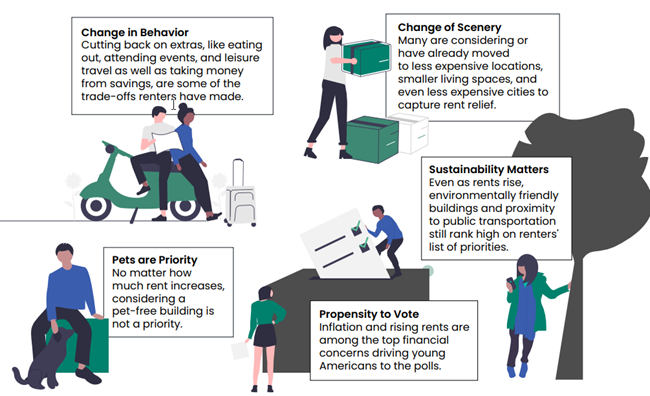
Young American renters are already making trade-offs to address inflation and rent hikes and are considering further changes

Young American renters are already making trade-offs to address inflation and rent hikes and are considering further changes, according to a new survey from Grubb Properties.

Grubb’s State of the Young American Renter Survey polled 1,000 American renters aged 22-35 to gauge their response to the challenging economic environment.

“Young American renters are contending with an extremely supply-strapped housing market, which has made it significantly more difficult to find accessible apartments in desirable locations,” Todd Williams, Grubb’s Chief Investment Officer, said in a release.

“Grubb Properties’ emphasis on essential housing, geared to people earning 60 percent to 140 percent of AMI, had us wondering how Gen Z and Millennial renters are adjusting to this current economic reality. Our research shows that they are taking action and making trade-offs as necessary.”

Highlights of the survey:

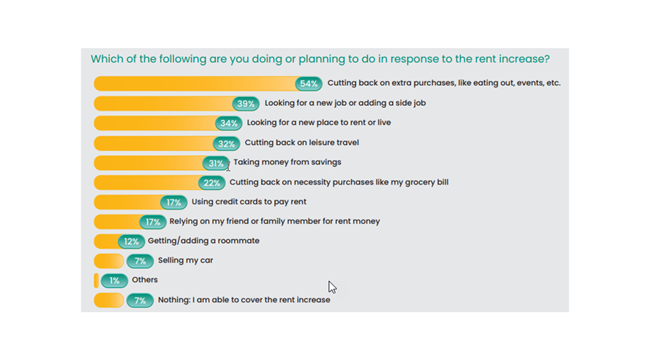
  • 93 percent of respondents who experienced a rent hike have already taken action to address it, primarily cutting back on excess spending, looking for a new job, and looking for a new place to live.
  • If rents continue to rise, young renters are prepared to take bolder action, moving to a smaller apartment, relocating to a less expensive geographic area, or even moving home with mom and dad.
  • Inflation, in the form of both higher prices of goods and higher rents, is top of mind for young renters. When asked to rank their top economic concerns, higher prices of goods was top, followed closely by higher rents.
  • These financial concerns will drive young renters to the polls this November. Of the approximately two-thirds who indicated that they will vote, almost nine out of ten stated that their financial situation is influencing that decision.
  • Green buildings still matter, even as rents rise. The majority state that green features are at least somewhat influential on their rental decisions

The report says more than half (51 percent) of young renters reported they experienced a rent increase in the past year, with an average increase of 30 percent. Of these renters, less than one in ten (7 percent) said they had the resources to cover the increase without changing their lifestyle.

Young American renters are already making trade-offs to address inflation and rent hikes and are considering further changes

Green, Urban Living – and Pets — Still Hold Appeal 

Young renters aren’t willing to compromise on their environmental priorities. More than four out of five (82 percent) agreed that energy-efficient and environmentally friendly buildings are at least somewhat influential in their decision on where to rent, with 40 percent  stating that they’re extremely or very influential.

Similarly, 64 percent at least somewhat agree that proximity to public transportation is important in the rental decision process. Three out of four (75 percent) at least somewhat agree that living in an environment near shops, restaurants, and entertainment is important. This makes it even more critical for more housing at price points attainable to these young renters to be built in urban and connected neighborhoods.

Another compromise young renters are not willing to make is giving up their pet. Of the 74 percent of respondents who own a pet, most (58 percent) agreed that no matter how much rent increases, they would never consider a pet-free building.

Inflation Tops the List of Financial Concerns – and Drives Young Renters to the Polls

Inflation continues to be top of mind for young renters. When asked to rank their financial concerns, the rising prices of goods were cited by 30 percent of respondents as their number-one financial worry, followed by rent increases (25 percent), lack of savings (20 percent), job security (15 percent), and paying back student loans (10 percent).

Young renters report that higher rents also make finding a new apartment more difficult. When asked how easy or hard it would be to find an apartment in their price range, 64 percent said it would be at least somewhat hard.

“Grubb Properties is laser-focused on addressing this housing shortage,” said Williams. “We’re building new communities in some of the most supply-constrained areas, including Los Angeles, New York, the Bay Area, and Washington, DC. We believe that quality urban housing should be accessible to all.”

Survey Background

The Grubb Properties State of the Young American Renter Survey was conducted by Wakefield Research (www.wakefieldresearch.com) among 1,000 young apartment renters (defined as renters ages 22-35), between September 16th and September 29th, 2022, using an email invitation and an online survey. The data was weighted to ensure an accurate representation of young apartment renters ages 22-35. Results of any sample are subject to sampling variation. The magnitude of the variation is measurable and is affected by the number of interviews and the level of the percentages expressing the results. For the interviews conducted in this particular study, the chances are 95 in 100 that a survey result does not vary, plus or minus, by more than 3.1 percentage points from the result that would be obtained if interviews had been conducted with all persons in the universe represented by the sample.

Due to rounding, numbers presented throughout this document may not add up precisely to the totals provided and percentages may not precisely reflect the absolute figures.

About Grubb Properties 

Grubb Properties, founded in 1963, is a vertically integrated real estate fund manager focused on the Essential Housing space through its Link ApartmentsSM brand. The company targets residents earning between 60% and 140% of local area median income (AMI), directly addressing a growing crisis for essential housing, while providing residents with exceptional living spaces. Grubb Properties maintains a long-term perspective and its careful and measured approach to real estate investment has delivered resilient and impressive returns. Grubb Properties has received numerous sustainability designations and recognitions, and undergoes annual ESG assessments through GRESB. For more information, visit www.grubbproperties.com.

Sign Up For Our Weekly Newsletter And Get Rental Property And Apartment News And Helpful, Useful Content Each Week.

* indicates required

Multifamily Rents ‘Hit the Brakes’ in September

Rental Price Drops Around The Country

Portland Rents Increase Again In October

Monetizing The New Tech Reality, Even If it Wasn’t By Choice

Monetizing the new tech reality in multifamily housing even if it was not by choice for apartment operators who scrambled to implement it.

Monetizing the new tech reality in multifamily housing even if it was not by choice for apartment operators who scrambled to implement it.

By Morgan Dzak

Multifamily housing has been propelled into a new era of leasing – and not by choice. Apartment operators had to implement new technologies out of necessity during the pandemic. But in the mad scramble to implement new tech, operators didn’t have adequate time to consider the long-term ROI.

Now that the dust has settled from the early days of the pandemic, operators have taken a step back to rethink their tech stacks and identify opportunities for monetization. Monetizing tech, like community-wide WiFi, smart-home technology and even AI, drives revenue growth, increases asset value and saves operators money.

Here are some ways operators have made that happen, and the opportunities that still exist:

WiFi: The modern tech stack foundation

 Community-wide WiFi is the modern tech stack foundation. It’s not only a feature that residents expect, but it powers other amenities such as smart-home tech, supports new leasing strategies, and enhances day-to-day operations onsite.

“Operators used to think connectivity was the responsibility of the resident,” said Shawn Mahoney, senior advisor at RET Ventures. “Ubiquitous WiFi is not only good for residents, but it’s even better for the operator. It’s the basis of modern leasing, maintenance, operations and the overall resident experience, and the enabling technology that lets operators and onsite teams try all types of strategies they probably haven’t considered before. Once you have true community connectivity, it’s difficult to imagine how you got by for so long without it.”

 Residents will pay for a service like WiFi on their own, but it’s not just a lifestyle-enhancing amenity anymore – it’s a requirement. Apartment communities that offer WiFi as part of the living experience can better accommodate the modern renter lifestyle and support their needs, whether it’s for work or play.

Operators are seizing revenue-sharing opportunities offered by suppliers. Typically, supplier partners and operators agree upon a per-door fee, or operators receive a monthly percentage of revenue. Some operators have opted to make a bulk purchase of – for example, $50 a month per door – then remarket and sell it to residents at a premium.

“There’s a lot of education that still needs to happen in the industry, and that’s one of the biggest challenges that has hindered some operators from taking that step,” Mahoney said. “Once operators realize they can charge for various tech amenities and ubiquitous WiFi, and see the results in their NOI, they won’t just take a step – they will sprint towards the opportunity.”

Community-wide WiFi also offers the benefit of roaming around a community without hitting any “dead zones” – areas commonly found in apartment communities where cell service can’t reach. This capability is essential to new self-guided tours, which require a connection without any interruptions. Reliable connectivity supports every step of a self-guided tour, from initial community access to navigating the community and the capability to contact the leasing team.

“Leasing teams can let a prospect on a self-guided tour into a community with remote access,” Mahoney said. “The prospect can tour the entire community and have a connection. The WiFi is a really big part of self-guided tours, from how prospects enter a community, to the entire tour experience. They’re checking photos, videos, floor plans and even maps during their tour, and if there’s a connection issue, that prospect is going to have some challenges during the tour. It impacts the entire experience and inevitably, lease conversion.”

WiFi enables self-guided tours, and if operators have community-wide WiFi in place, they can not only create a more efficient self-guided tour, but they can support a higher volume of tours. The better the experience, the more likely a prospective renter will sign a lease. The connectivity piece of a self-guided tour is crucial, and if operators can create better leasing experiences for prospects, they will see the results in the lease-conversion rates.

“WiFi is integral to the new tour types being offered,” said Andrew Kusminsky, CEO of GiGstreem, a ubiquitous WiFi provider. “The modern touring experience all comes back to the customer experience. Operators across the country are trying to create better experiences for renters because they see how it impacts the bottom line. The new leasing technologies definitely create better experiences for renters, but without WiFi, they’re not going to operate smoothly.”

Time is money

 Operators have heard the term “The Great Resignation,” and they’ve seen firsthand how it’s affecting  multifamily, notably in leasing and maintenance roles. With thinner onsite teams, operators are now seeing time as currency.

While self-guided touring has been revolutionary for the industry, so have other technologies like AI, automation and mobile maintenance. While these technologies aren’t necessarily being monetized like ubiquitous WiFi, time is currency, and the time savings from these technologies also affects the bottom line.

The maintenance process has evolved with technology, and maintenance teams are now receiving and completing work orders via a maintenance app on their phones, which streamlines the entire process.

“Work orders used to be sent to onsite staff in the office who would then page a maintenance technician to get the key, gather supplies and then go to the unit,” Mahoney said. “That process creates a lot of extra time when maintenance teams are not receiving work orders directly from residents. With mobile maintenance, technicians can receive the work order directly, respond faster and complete a higher volume of requests in the same amount of time. And they also need WiFi for this, so the operator’s WiFi investment isn’t just being monetized, but it’s also saving time in the maintenance process.”

AI chatbots and automation technologies also save time for onsite teams while presenting revenue opportunities. Most renters who look at apartments tend to ask the same questions about apartment-specific details, pet and parking policies, or when the pool or fitness center is open. For the most part, a bot can answer those questions, or they can be published on the website. These technologies provide renters with enough information to make a decision while reducing the lead burden on onsite teams, which keeps payroll costs in check.

“I would say for anyone who is a long-term holder of real estate, it’s very important that they’re looking at this stuff because the payback is fast,” Mahoney said. “The upfront cost may be daunting, but the value you get from it is tremendous and will certainly offset the cost. It’s really a no-brainer from both the operations side as well as the investment side.”

While these strategies aren’t necessarily monetizing tech, they’re still increasing net operating income (NOI) and adding to asset value. Some of the greatest NOI opportunities are expense reductions and on the payroll side. Communities are already working with thinner onsite teams, but technology allows current teams to do more with less.

“You can spread the same number of leasing associates out across more communities because the tech is really filling some of the gaps and streamlining many onsite processes,” Mahoney said. “Centralized leasing is a hot topic in multifamily and more operators are seeing the value in it from a resident perspective and also from a revenue standpoint.”

The industry will continue to evolve with new technologies and software integrations, and they will set the stage for how communities operate and make money. Overall, tech plays a central role in resident satisfaction – arguably the largest revenue-generator. As apartment companies continue to deploy technology into leasing and operations, there will be more opportunities to monetize that tech or save money from the efficiencies it creates and the long-term residents it attracts.

Morgan Dzak is an account manager for LinnellTaylor Marketing, which focuses exclusively on the multifamily industry and its technology space. She previously spent time as a digital content and marketing specialist for Cornerstone Apartment Services in Denver.

Sign Up For Our Weekly Newsletter And Get Rental Property And Apartment News And Helpful, Useful Content Each Week.

* indicates required

Fire Pits, Tenants And Rental Property – Some Things to Think About

Fire Pits And Rental Property - Some Things to Think About

It is that time of the season so landlords should consider fire pits and rental property,  the maintenance tip this week from Keepe , which looks at some of the do’s and don’t for fire pits.

Fire pits are very popular, and no doubt your tenants have thought about gathering around one into the crisp evenings of fall.

However, some freestanding fire pits – especially in a common area – could be unsafe and present major hazards to both tenants and property landowners. So correct setup and handling of fire pits is important.

If you’ve decided to allow a fire pit on your property, there are things you can do to protect both your real estate investment and your tenants.

The pit should be placed far enough away from any residences and in a place where the ground is level.  Before starting to build a fire pit, you should check with the local ordinances about possible restrictions.

Fire or gas fire pits

These are two options for fire pits. When it comes to convenience, gas fire pits can produce instant flames. If you choose gas, you’ll need to change out the gas tanks when empty. With a wood fire, you’ll need to have a dry area for a stockpile of logs. For maintenance of gas fire pits, the gas valves should be cleaned regularly to avoid buildup. Log fire pits, on the other hand, don’t need much maintenance at all. Aesthetically, fire glass for gas fire pits can come in many different colors and give a very contemporary look to any outdoor area, while log fire pits give more of a rustic feel and look.

Fire Pits And Rental Property- Some Things to Think About
The pit should be placed far enough away from any residences and in a place where the ground is level.

 Permanent or portable?

If you have chosen a gas fire pit, you will most likely want it to be a permanent fixture. Portable fire pits are still an option for those who want to store them on a seasonal basis or move them around a common area or yard.

 Materials and size?

Most owners who choose a permanent fire pit tend to use stone, brick or concrete for the basis of the pit.

Portable fire-pit users can choose from many different types of metals, copper being the most popular choice. When choosing the right size, you don’t want the fire pit so big that it takes up too much of the yard or makes too big of a statement. You also don’t want it so small that it wouldn’t be ideal for a group to use.

Fire Pits And Rental Property- Some Things to Think About
With a wood fire, you’ll need to have a dry area for a stockpile of logs.

Fire pits and rental property safety

If you have a tenant who has installed or used a fire pit without permission, you simply cannot trust that they have taken the necessary precautions or that they understand the dangers and liability this brings to you as the property owner or manager.

Not knowing about a fire pit on your property won’t stop it from causing damage and injury.

Remember to monitor what your tenants are doing and if a fire pit is important for your property in a common area, take charge and get it done in a safe, responsible manner.

About Keepe:

Keepe is an on-demand maintenance solution for property managers and independent landlords. The company makes a network of hundreds of independent contractors and handymen available for maintenance projects at rental properties. Keepe is available in the Greater Seattle area, Greater Phoenix area, San Francisco Bay area, Portland, San Diego and is coming soon to an area near you. Learn more about Keepe at https://www.keepe.com

Sign Up For Our Newsletter And Get Rental Property And Apartment News And Helpful, Useful Content Each Week.

* indicates required

5 Fire Safety Tips for Property Managers in 2020

Top 10 Fire Prevention Tips for Landlords And Property Managers

One Of Your Tenants Smells Gas Leak? Here’s What To Do

18 Months of Outstanding Rent Growth Coming to An End

18 months of outstanding rent growth is coming to an end as asking rents are falling in many national multifamily markets Yardi Matrix says.

Asking rents are falling in many national multifamily markets, bringing an end to 18 months of record-breaking rent growth, according to a special bulletin from Yardi Matrix.

The rent growth coming to an end and the decline in rent growth has been steadily expanding in multiple multifamily markets.

“Of the 136 multifamily markets that Yardi Matrix forecasts, 56 had month-over-month declines in asking rents in September, compared to 53 markets with declining rents in August and 18 markets with declining rents in July,” Yardi Matrix writes in the report. “Of the Yardi Top 30, 22 markets saw asking rents fall month-over-month in September, versus 21 markets in August and seven in July.”

Multifamily Rent Forecast Update

“After approximately 18 straight months of record-breaking rent increases in nearly all markets, national rent growth has ground to a halt,” writes Andrew Semmes, senior research analyst, in the report.

“As usual, most of the volatility is being driven by lifestyle buildings, where asking rents are down an average of 0.15 percent month-over-month across all 136 markets we forecast, and down an average of 0.41 percent month-over-month in the Yardi Top 30,” the report says.

More Than Just Regular Seasonal Decline

The report says while we are not in a recession, the chances for one are increasing in the next year.

“Our forecasts for the end of 2022 and for 2023 have broadly been revised downward, as the usual seasonal deceleration has been exacerbated by a more uncertain economic horizon in the medium term.

“Moving into 2023, we do not expect to see rents accelerate again nearly as much as they did in the first half of 2021 and 2022, but inflationary pressures remain high and employment gains are still very strong, so there is potential for a stronger-than-average jump out of the gate in the spring,” the Yardi report says. “However, eventually the Fed’s actions will noticeably cause inflation to fall and unemployment to rise, and when that happens rent growth will largely become anemic. Until the Fed’s policy moves work their way through the economy, though, we should expect a period of increased volatility,” Semmes writes.

Get the full report here.

About Yardi Matrix

Yardi Matrix researches and reports on multifamily, office and self-storage properties across the United States, serving the needs of a variety of industry professionals. Yardi Matrix Multifamily provides accurate data on 18+ million units, covering more than 90 percent of the U.S. population. Contact the company at (480) 663-1149.

Sign Up For Our Weekly Newsletter And Get Rental Property And Apartment News And Helpful, Useful Content Each Week.

* indicates required

Multifamily Rents ‘Hit the Brakes’ in September

Rental Price Drops Around The Country

Portland Rents Increase Again In October

Portland Rents Increase Again In October

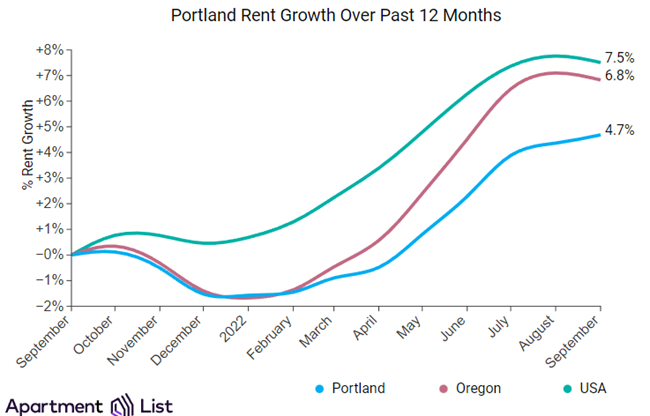
Portland rents have increased 0.3 percent over the past month, and have increased significantly by 4.7 percent in comparison to the same time last year, according to the latest report from Apartment List.

The report says median rents in Portland are $1,309 for a one-bedroom apartment and $1,528 for a two-bedroom.

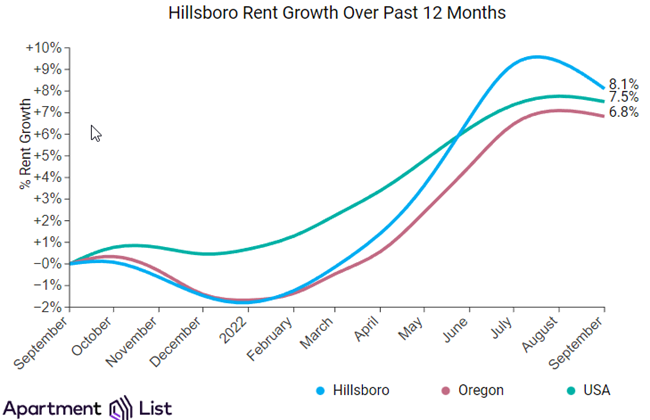
This is the eighth straight month that the city has seen rent increases after a decline in January. Portland’s year-over-year rent growth lags the state average of 6.8 percent, as well as the national average of 7.5 percent.

Vancouver rents increased over the past month

Vancouver rents increased in October
Charts courtesy of Apartment List

Vancouver rents have increased 0.1 percent over the past month, and have increased sharply by 8.2 percent in comparison to the same time last year. Currently, median rents in Vancouver stand at $1,392 for a one-bedroom apartment and $1,604 for a two-bedroom.

Hillsboro rents decline sharply over the past month

Hillsboro rents decreased in October

Hillsboro rents have declined 1.2 percent over the past month, but are up sharply by 8.1 percent in comparison to the same time last year. Currently, median rents in Hillsboro stand at $1,831 for a one-bedroom apartment and $2,026 for a two-bedroom.

Beaverton rents also decline over the past month

Beaverton rents declined in october

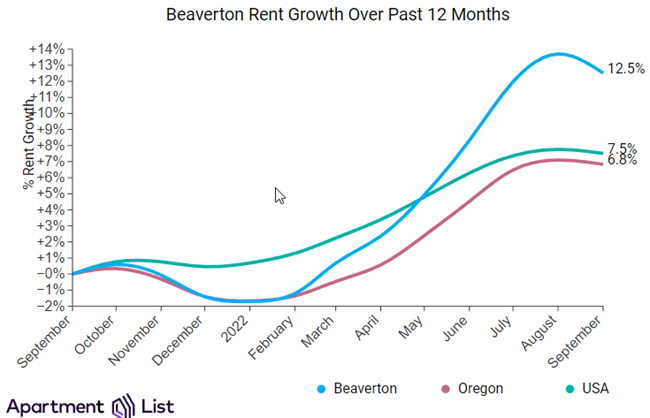
Beaverton rents have declined 1.0 percent over the past month, but are still up by 12.5 percent in comparison to the same time last year. Currently, median rents in Beaverton stand at $1,605 for a one-bedroom apartment and $1,864 for a two-bedroom.

Eugene rents decline sharply over the past month

Eugene rents have declined 2.9 percent over the past month, but have increased by 7.1 percent year-over year. Currently, median rents in Eugene stand at $1,136 for a one-bedroom apartment and $1,564 for a two-bedroom. This is the second straight month that the city has seen rent decreases after an increase in July.


National Multifamily Rent Growth Hits A Wall In August

Sign Up For Our Weekly Newsletter And Get Rental Property And Apartment News And Helpful, Useful Content Each Week.

* indicates required

Rental Price Drops Around The Country

The monthly report reveals significant rental price drops throughout much of the country, according to Zumper.

The monthly report reveals significant rental price drops throughout much of the country, according to Zumper.

National one-bedroom median rent is down 0.8 percent over last month, to $1,491 and the two-bedroom median is down 0.7 percent to $1,832.

“ More than half the cities on our list posted month-over-month declines and 19 cities remained flat, leaving just 20 percent of Zumper’s top 100 list with month-over-month increases. This slowdown is showing up in our year-over-year figures, too: After 12 straight months of double-digit year-over-year jumps, the national median is up a slightly more reasonable 9.2 percent over October of last year,” the report says.

Some highlights of the report

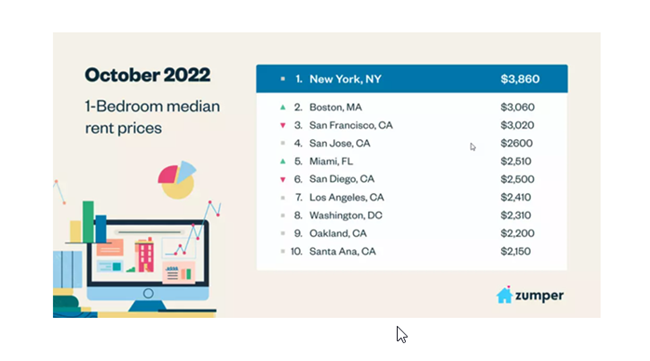
  • Boston surpassed San Francisco to become second most expensive city in the United States—thanks, in part, to especially low supply in Boston (plus a slower pandemic rebound in San Francisco).
  • Both one- and two-bedroom prices are down at a national level. It’s the first time in two years both markers have declined in tandem.
  • More than half the cities on Zumper’s list posted month-over-month declines and 19 cities remained flat, leaving just 20 percent of the top 100 list with month-over-month increases.
  • Several factors are causing prices to slow—including rising vacancy rates in some markets, a return to more typical seasonal moving patterns and, above all, fear of recession. In response to a recent Zumper survey, 76.2 percent of U.S. respondents said they think we’re in a recession.

The report says the reversal of widespread price hikes is fueled by several factors, including rising vacancy rates in some markets, a return to more typical seasonal moving patterns and, above all, fear of recession.

In response to a recent Zumper survey, 76.2 percent of U.S. respondents said they “think we’re in a recession. Since high interest rates and inflation continue pushing potential buyers out of the market, we’re still seeing relatively strong competition for rentals and therefore don’t expect drastic price drops until supply and demand become more closely aligned. However, we do expect a significant amount of new supply will finally hit the market over the next six months, putting pressure on property owners to compete for residents and driving prices down even more.”

“In many metro areas, declining prices are actually a correction to prices that’d become overly inflated,” Zumper CEO Anthemos Georgiades said in a release.

“We saw historic levels of migration throughout the pandemic, as people switched to working from home and re-imagined their living situations. Now—with a turbulent, unpredictable economy causing fear of recession—migrations are slowing, occupancy rates are falling and rent prices are following suit.”

Multifamily Rents ‘Hit the Brakes’ in September

Rate Of Rent Growth Slows At Midyear But Multifamily Still Poised For Strong Year

With Traditional Multifamily Rent Drivers Disrupted What Is The Future?

Another Bullish Year For Multifamily In 2022?

Sign Up For Our Weekly Newsletter And Get Rental Property And Apartment News And Helpful, Useful Content Each Week.

* indicates required

SB 891’s Conclusion and What it Means for Landlords

By Bradley S. Kraus
Partner, Warren Allen LLP

As the calendar turned to October, another important date has come and gone. I have previously covered Senate Bill 891 in depth, and readers may recall that October 1, 2022 was built into SB 891 as the sunset date for many of the bill’s provisions and changes to the Oregon Residential Landlord and Tenant Act. While a few provisions remain related to screening from the former law, SB 891’s departure brings back many of the normal rules and procedures landlords were familiar with prior to the COVID-19 restrictions frequently covered in this article series.

One of the largest changes landlords should be aware of is with respect to non-payment notices and timelines. COVID-19 saw changes to ORS 90.394, requiring non-payment notices to be 10 days long (along with the requirement of additional disclosures in the notice). Those changes have now sunset, and landlords can return to providing only 72 hours’ notice for their non-payment-of-rent notices. As a reminder, non-payment notices can only include full units of rent (partial payments are problematic) and may only be served on or after the eighth day of the rental period.

SB 891 disclosures

Landlords also no longer need to provide the SB 891 disclosures to which they have grown accustomed.

However, landlords should also be aware of, and take stock of, any prior evictions they have/had pending, and how they should proceed with them. As a reminder, many cases from months prior were set over until October if/when the tenant provided documentation that they had applied for rent assistance. Many landlords received that rent assistance, but any evictions related to those cases did not simply go away. In other words, they still must be disposed of through paper filings, or they remain on the court docket. If landlords had eviction cases in which they received rent assistance covering the amount stated in the notice, it is imperative that they dismiss that case as SB 891 previously required.

Many landlords have current cases in which they are either (a) still waiting on rent assistance and (b) have a case setover that is currently on the docket. Those landlords may proceed with their case when that date arrives as normal. While tenants may still apply for rent assistance, landlords are no longer required to pause and/or delay their non-payment eviction matters (in fact, they haven’t been required to do so after June 30).

Finally, landlords should be aware of the court docket situation in larger counties, and what they may mean going forward in the coming months. Many counties have dockets that are packed with setovers related to SB 891. As the court has only so much docket space to set cases, any eviction filings that occur within October could be delayed. This will result in first appearance dates that are more removed from the filing date. While unfortunate, it is a practical reality of what SB 891 required in months past. Going forward, as more cases resolve, those delays will subside, and landlord/tenant law will return to what it was pre-COVID (or as I call it, “in the before time . . . in the long, long ago”).

About the author:

Bradley S. Kraus is an attorney at Warren Allen LLP. His primary practice area is landlord/tenant law, but he also assists clients with various litigation matters, probate matters, real estate disputes, and family law matters. You can reach him at kraus@warrenallen.com or at 503-255-8795.
SB 891’s departure brings back many of the normal rules and procedures landlords were familiar with prior to the COVID-19 restrictions frequently covered in this article series.
Bradley Kraus, Portland attorney

Sign Up For Our Weekly Newsletter And Get Apartment News And Helpful, Useful Content Each Week.

* indicates required


Portland Update: Changes to FAIR Ordinance Bring (Some) Necessary Changes

The Perks and Pitfalls of Prepaid Rent

Something that we are seeing more and more of industry-wide is prepaid rent so Scot Aubrey looks at the perks and pitfalls of prepaid rent.

Something that we are seeing more and more of industry-wide is prepaid rent so Scot Aubrey looks at the perks and pitfalls of prepaid rent.

By Scot Aubrey

The Saturday mornings of my youth were spent eating pancakes and watching cartoons on TV.  One in particular, Popeye, had a character named Wimpy who was a well-known cheapskate.  The line that defined his character most was “I’d gladly pay you Tuesday for a hamburger today.”

Of course, he rarely showed up on Tuesday to pay his debt; as a landlord, you may be all too familiar with this type of scenario.  On the other side of this is something that we are seeing more and more of industry-wide, and that is prepaid rent, where a prospective tenant might say “I’ll gladly pay you today for a roof over my head for the next 6 months.” For applicants that do not qualify for your property in a traditional way due to financial or other issues, prepaid rent may be an option that helps fill a vacancy and assists someone with housing.

As with anything outside the normal transaction, there are some rules to be aware of that vary from state to state so we always advise consulting your local landlord attorney on what works best for you.  With evictions on the rise, please review the following  guidelines to be aware of if presented with this unique way of collecting rent.

What Prepaid Rent is Not

Sometimes the best way to understand what something is, is to understand what it isn’t.  In this case, prepaid rent is not:

  • A substitute for criminal and credit background screening checks. Always adhere to your criteria in every situation and do not be tempted to change a “denied” applicant with disqualifying criminal or credit history into an “approved” as a response to their offer to prepay rent.
  • A security deposit: Most states limit the security deposit to 1.5 times to 2 times the monthly rent.  However, there is normally not a cap on prepaid rent amounts.
  • A holding account for your tenant to use when they need funds: The tenant must understand that they forfeit rights to this money until it has all been used to cover the agreed-to payments for the agreed-to rental term.
  • A source of funds for tenant late fees, court fees, or attorney fees.

As an example, if you collect $6,000 in prepaid rent and the rent is $1,000 per month, you have six months’ rent.  Nothing more, nothing less.

Looking for Volunteers

Don’t go running out and start shouting from the rooftops that you are now accepting prepaid rent for your property.  In every state this will immediately get you in trouble.  The key word to understand when discussing prepaid rent is voluntary.  I can’t stress this enough; the tenant must initiate any and all conversations regarding prepaid rent.  Any mention of it by you as the landlord could be considered coercion, and that will get you an automatic loss in court.

Get It in Writing    

If your tenant initiates a conversation about prepaid rent, make sure before collecting any monies that you have the agreement in writing.  Ideally you would have this included and agreed to in your lease.  If that’s not possible, we recommend creating an addendum that should be signed by both parties.  You can receive a free copy of our recommended addendum language by requesting it from info@rentperfect.com.

Money Management

As recommended earlier, it is a best practice to create a separate account for each property where you can hold any prepaid rent.  Two important things if you accept prepaid rent are:

1) If, and only if a tenant is evicted from the property, you can use any remaining prepaid rent to pay for expenses related to the property that exceed the security deposit, and

2) No refunds of excess funds are considered returnable until the lease/contract has been completed and all accounting is completed.  Let me reemphasize that the security deposit and any prepaid rent are completely separate and should be managed in a way that you can verify their independence.

Ideally, every one of your tenants would come to you financially qualified with a crime-free history and no record of evictions.  In reality,  we know that many of your applicants may present issues that disqualify them from being the ideal tenant.  If they offer to prepay their rent, use this as a reference point and counsel with your landlord attorney to ensure you are following your local and state laws.

About the author:

Scot Aubrey is vice-president of Rent Perfect, a private investigator, and a fellow landlord who manages short-term rentals.  Subscribe to the weekly Rent Perfect podcast (available on YouTube, Spotify, and Apple) to stay up to date on the latest industry news and for expert tips on how to manage your properties.

Using A Code Word Helps You Get the Right Tenant

Tough Times Ahead: Analyze More Than Just A Tenant Applicant’s Income

3Tips to Keep You Out of Landlord Rehab

Sign Up For Our Newsletter And Get Rental Property And Apartment News And Helpful, Useful Content Each Week.

* indicates required

Why I Like My Rental Properties’ Nosy Neighbors

Three Steps to Becoming a Successful, Lazy Landlord