
Home Blog Page 76

Reasonable Accommodation Forms: How Can They Be Helpful?

Reasonable-accommodation requests can be completely obvious and straightforward. Still, more often than not, they require a little bit more due diligence or investigation to verify the need for what is being requested.

By The Fair Housing Institute

Reasonable accommodation requests can be completely obvious and straightforward. Still, more often than not, they require a little bit more due diligence or investigation to verify the need for what is being requested.

Along with that is the range of requests a leasing office can come across: accessible unit, live-in aide, and parking-spot requests, just to name a few. Forms are a practical way to help a leasing office gather the information needed to make a determination. But it raises the questions: What kind of forms should a leasing office use, and what should you do if a resident refuses to fill one out?

Best Practices for Reasonable Accommodation Forms

Many offices have a pretty basic or boilerplate type of form that they use. This is fine but can result in missing information that can be helpful when making a determination. Having forms specific to each type of request can help you avoid this. Also, pre-made forms can ensure that every resident is asked the same questions to avoid any appearance of discrimination.

For example, a resident is requesting that they need to change units because they have allergies and their next-door neighbors own a bird. Having a reasonable accommodation form that asks specific questions regarding allergies will help determine if the tenant has an allergy that meets the definition of a disability, therefore having an identified need which should be accommodated. But what should you do if a request is being made and the resident refuses to fill out your form, perhaps insisting that the doctor’s note they gave you is enough?

I Don’t Need to Fill Out Your Form!

We have all been there. A resident is requesting an accommodation but doesn’t want to do the paperwork. First off, you can try to defuse the situation by stating that the easiest way to get the ball rolling is to complete the form and that you would be happy to help them fill it out. Just be sure that the information contained and the signature authorizing the verifier to provide the information must be from the resident.

Another common hurdle we see is that a resident has brought in a note from their physician insisting that it is all they need to do. While it’s true –  we technically can’t require a resident to use or fill out a form – if the doctor’s note is missing critical information, then the verification process can’t move forward. Only then can you ask that a verification form be completed if there is needed information missing, with the form outlining the specific information required.

Reasonable Accommodation Forms – Final Takeaway

Having carefully created forms for specific reasonable accommodation requests helps to create a streamlined process and reduces the chances of miscommunication that can lead to a charge of discrimination. Having forms ready for your staff, along with proper training on how to execute them, will help your leasing office manage these requests and keep everything fair-housing focused.

In 2005, The Fair Housing Institute was founded as a company with one goal: to provide educational and entertaining fair-housing compliance training at an affordable price at the click of a button.


Sign Up For Our Weekly Newsletter And Get Rental Property And Apartment News And Helpful, Useful Content Each Week.

* indicates required

America’s Best Landlord Contest Enter To Win Now

Enter the landlord contest here to win $10,000 in America's best landlord contest to recognize and reward landlords nationwide. Steadily, a top-rated landlord insurer, is running a national contest to positively highlight landlords nationwide.

Enter the landlord contest here to win $10,000 in America’s best landlord contest to recognize and reward landlords nationwide.

Steadily, a top-rated landlord insurer, is running a national contest to positively highlight landlords nationwide.

The contest launched October 2, 2022 at BPCON, the annual national event hosted by BiggerPockets, a community of more than 2 million real estate investors. Running through till October 31, 2022, the contest is an opportunity for the community to share personal stories, positively recognize and reward landlords, and deepen the relationships between landlords on social media.

“The past several years have presented rental property owners with many unprecedented situations”, says Darren Nix, Founder and President of Steadily. “The pandemic and economic downturn have challenged landlords to adapt and rethink their business in new and innovative ways. From rent relief, to offering options to pay rent via credit card, to quarantine baskets, and beyond – we’ve heard many positive stories emerge of landlords spreading kindness, and going above and beyond to help those in need. Steadily wants to recognize and celebrate the strength of this community, and highlight positive stories of the ways, both big and small, that landlords contribute positively to our lives. This contest is an opportunity to surface these stories, positively recognize landlords, and reward their efforts”.

The contest winner will receive a grand prize of $10,000, as well as their own content series on Steadily’s blog and social channels, a ticket to next year’s exciting annual BPCON event (2023), and a year of Premium Membership to the industry-leading landlord software and tenant screening platform, TurboTenant.

Enter the contest here

To enter, Steadily invites landlords and others in the rental property ecosystem to share their thoughts, experiences, and unique point of view on what makes a great landlord. Entries may be an Instagram feed post or video, and can be submitted by rental property owners, tenants, property managers, real estate investors, and others. Posts must be accompanied by the hashtag #AmericasBestLandlord to increase the discoverability of content among contest entrants and the broader community. Full content entry guidelines and prize pack information can be found on the contest landing page at Steadily.com/contest.

“Biggerpockets is a platform for real estate investors, empowering a community of more than two million members with education, networking, and tools to share ideas and connect with others in the space,” says Scott Trench, CEO of BiggerPockets. “Like Steadily, we believe in providing knowledge, support, and encouragement to rental property owners, as they navigate the complexities of this ever-changing industry. We are delighted to support Steadily’s efforts to highlight the positive impact of landlords within the broader community”.

The contest is hosted on Steadily channels and supported by a cross-channel awareness campaign, including content amplification on BiggerPockets and TurboTenant social media and email newsletters, and the BiggerPockets Podcasts. Influential voices in the space, such as @TheKeyResource, @BeckyNova24, @TheFiCouple, @BernaDebtJoy, and @BlackRealEstateDialogue, have also signed on to promote the campaign. Paid media channels include investments on Instagram, YouTube, Facebook, and the Investor’s Podcast Network.

About Steadily

Steadily was created by industry experts to offer the best landlord insurance service and a top-rated customer experience from quote request to claim resolution. Mobile-first and direct-to-consumer, Steadily is poised to rapidly remake the insurance segment. The company is dual headquartered in Austin, Texas and Overland Park, KS., and is backed by investors including Matrix Partners, Zigg Capital, Next Coast Ventures, Nine Four Ventures, and SV Angel. Learn more at https://www.steadily.com and stay in touch @SteadilyInsure and Facebook.com/SteadilyInsurance.


Apartment Owners To Pay $123,000 To Settle Discrimination Lawsuit

Apartment owners will have to pay $123,000 to settle a racial discrimination lawsuit according to the U.S. Department of Justice

The owners of several apartment complexes in Pearl, Mississippi, SSM Properties LLC, and Steven and Sheila Maulding, and their former rental agent, James Roe, have agreed to pay $123,000 to resolve a racial discrimination lawsuit, according to a release from the U.S. Department of Justice.

The U.S. District Court for the Southern District of Mississippi ruled in August that the defendants had violated the Fair Housing Act by discriminating against Black prospective residents.

The case began when the Louisiana Fair Housing Action Center conducted fair-housing testing at the properties.

“Based on the results of these tests, which showed that Roe treated Black and white testers differently and made discriminatory statements to the Black testers, the center filed a complaint with HUD. HUD conducted an investigation and determined that there was reasonable cause to believe that discrimination occurred, and referred the matter to the department, which filed this lawsuit. The testers subsequently intervened in the lawsuit as plaintiffs. The court found that Roe’s conduct violated the Fair Housing Act and held the owners legally responsible because Roe was acting as their agent,” the Justice Department said in the release.

“Housing discrimination has no place in our society and a person’s race should never determine where that person can live,” Assistant Attorney General Kristen Clarke of the Civil Rights Division, said in the release. “The Justice Department will continue to vigorously pursue and hold accountable those who would deny equal housing opportunities because of the color of one’s skin.”

“We will not tolerate discrimination in housing,” said U.S. Attorney Darren LaMarca for the Southern District of Mississippi. “Those who choose to deny equal housing opportunities will be held to atone for their conduct.”

Under the terms of the consent decree, which must still be approved by the court, the owner-defendants will pay $110,000 in monetary damages and attorneys’ fees to four Black testers and all the defendants will pay civil penalties to the federal government to vindicate the public interest. The consent decree also prohibits Roe from working at any residential rental properties and requires the owner-defendants to hire an independent leasing manager, implement nondiscriminatory standards and procedures, undergo fair housing training and provide periodic reports to the department.

Sign Up For Our Newsletter And Get Rental Property And Apartment News And Helpful, Useful Content Each Week.

* indicates required

Fair Housing and Sexual Harassment – Staff and Resident Relationships

Landlord To Pay $135,000 In Sexual Harassment Lawsuit Settlement

Landlord Charged With Sexually Harassing Female Tenant

Do I Have To Pay Real Estate Agent Again On Lease Renewal?

Does a landlord have to pay a commission again to the real estate agent who initially brought him the tenant if the tenant simply renews the lease is the question for Ask Landlord Hank.

Does a landlord have to pay a commission again to the real estate agent who initially brought him the tenant if the tenant simply renews the lease is the question for Ask Landlord Hank. Remember Hank is not an attorney and is not offering legal advice. If you have a question for him please fill out his form below.

Dear Landlord Hank,

I have rented my property through the real estate agent and paid the one-month commission. The agent did tenant background verification d contract execution.

I would like to know the procedure if the tenant wants to renew the lease. Do I need to pay the agent commission again?

The same agent executes the contract again? Can you give me some info on this? Thanks. -Sun

Hi Sun,

Please review your agreement with the agent that brought you the tenant.

In Florida, I use the standard MLS agreement for finding a tenant for an owner. The standard agreement from MLS indicates that if the same tenant renews, then the owner would owe an additional commission, to be determined. That is not how we work.

We think one commission is fair for a tenant no matter how long they stay- one year or 10.

I can see the reason for the commission for renewal though IF the agent is managing the property.

I usually ask why tenants are not renewing. Usually it’s because they need more space, or found a better location or want more amenities but sometimes I hear that the tenants complain about the property management.

They sometimes say that when they called for maintenance that the property manager took forever to get anything fixed and the tenants felt like property management didn’t care about them so they are moving for that reason.

Anyway, check the agreement you signed with your agent for the answer.

Sincerely,

Hank Rossi

Rent Sarasota

Owner/Broker

www.rentsrq.com

Each week I answer questions from landlords and property managers across the country in my “Dear Landlord Hank” blog in the digital magazine Rental Housing Journal.    https://rentalhousingjournal.com/asklandlordhank/


Does a landlord have to pay a commission again to the real estate agent who initially brought him the tenant if the tenant simply renews the lease is the question
Landlord Hank says, “We think one commission is fair for a tenant no matter how long they stay- one year or 10.”

Ask Landlord Hank Your Question

Ask veteran landlord and property manager Hank Rossi your questions from tenant screening to leases to pets and more! He provides answers each week to landlords.

  • This field is for validation purposes and should be left unchanged.

Did you miss last week’s question on whether a tenant should leave the power on when vacating the unit?


Do I Have to Paint and Replace Flooring for a Long-Term Tenant?

A Tenant Poured Grease Down Drain Who Is Responsible?

Sign Up For Our Newsletter And Get Rental Housing And Apartment News And Helpful, Useful Content Each Week.

* indicates required

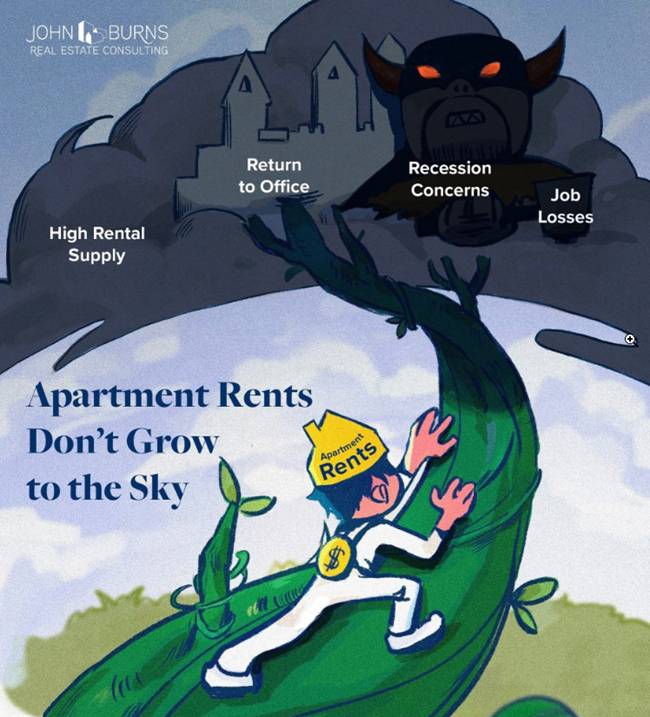
Report: Apartment Rents Won’t Grow to the Sky

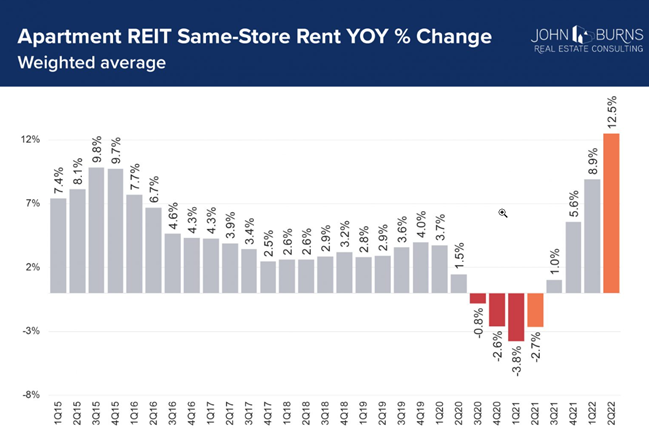
The combination of recession concerns, requests to return to the office, rents that are just too high, and a multi-decade high of new rental supply are all combining to cause apartment rents to soften and potentially decline, writes John Burns Real Estate Consulting.

In a report by Alex Thomas and Jesse McConnico called “Apartment Rents Don’t Grow to the Sky” they write, “Rents are set to fall in many areas around the country, which is exactly what the Fed needs to help get inflation under control. This short-term pain for rental investors should be offset by the long-term gain of a stable economy and lower borrowing rates.

“Every quarter, we summarize the earnings calls of six publicly traded apartment REITs (Real Estate Investment Trusts) for our research clients, and our consultants have been busier than ever helping apartment and build-to-rent developers understand local market dynamics as they build and lease new communities,” they write in the report and in a recent email newsletter.

Why Rents Soared

Rents soared for a couple of reasons, the report says.

It was the combination of record demand due to working from home and relocations, plus capital flowing into apartment construction resulting in a 36-year high of multifamily starts and a 34-year high of multifamily completions.

Even with the level of construction it was still not enough to meet demand.

Recession concerns, requests to return to the office and apartment rents that are just too high are combining to cause rents to soften.
Charts courtesy of John Burns Real Estate Consulting

What Some REITs Told John Burns Real Estate Consulting

  • AvalonBay Communities: “We’ve assumed that [rents] will decline, just at a more modest pace than pre-COVID periods would typically dictate.”
  • Essex Property Trust: “What we are expecting is normal seasonality. We do have headwinds from tougher year-over-year comps. Last year, in the first half, our blended lease rate was -4 percent. But in the second half, it surged to about +13.25 percent. That’s the tough year-over-year comp.”
  • Equity Residential: “We assume we’re going to have rents peak somewhere in this first or second week of August and then have a normal kind of trail off in rents until you get to that January period.”

See what the other REITs had to say here.

Conclusion: Watch Apartment Market for Signs of Job Losses

“Watch the apartment market carefully for early signs of job losses, which is something that the Fed wants and is even forecasting,” the report says.

“The increase in rental demand due to homeownership becoming less attainable doesn’t mean rents can rise to the sky, and the rental market demand/supply balance can quickly turn upside down when job losses coincide with a lot of apartment completions.”

Read the full report here.

About John Burns Real Estate Consulting:

For more information on the apartment market and a comprehensive view on housing demand and supply, or help understanding your local market dynamics, see https://www.realestateconsulting.com or contact us here.

Multifamily Rents ‘Hit the Brakes’ in September

The long run of multifamily rent growth “hit the brakes” in September as the economy continued to cool, Yardi Matrix says

The long run of multifamily rent growth “hit the brakes” in September as the economy continued to cool, Yardi Matrix says in their monthly report.

Yardi Matrix says multifamily rents remained unchanged in September, while Apartment List reported rent declines in a number of metro markets, indicating the accelerated rent growth fueled by the pandemic has officially ended.

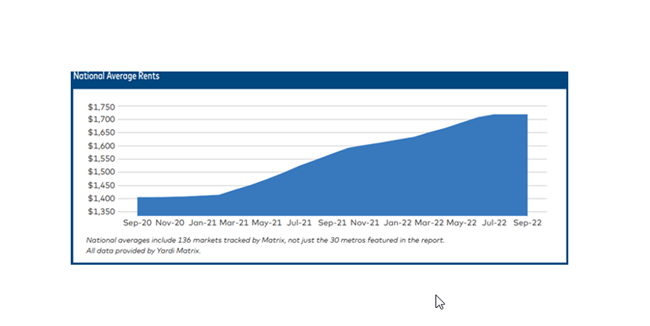
“After a year-and-a-half of record-setting growth, multifamily rents have hit the brakes. Asking rents have flattened this summer at $1,718 for three months in a row. That comes after rents rose more than 20 percent since January 2021,” Yardi Matrix says in the report.

Multifamily Rents September Report highlights:

  • Multifamily rents were flat in September, as the market continues to decelerate along with the rest of the economy. The average national asking rent was $1,718, the same rate as August. Year-over-year growth decelerated 150 basis points to 9.4 percent. National occupancy rates remained steady at 95.9 percent.
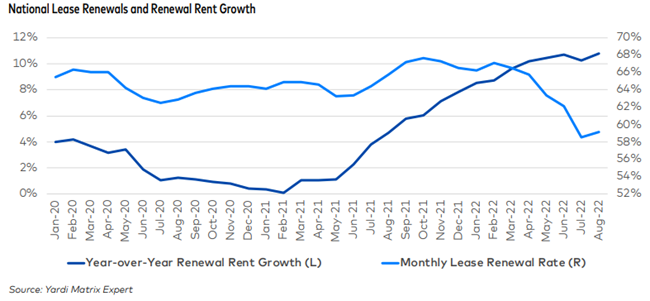
  • After five months of declining lease renewals, the lease renewal rate increased 60 basis points in August to 59.1 percent. Year-over-year renewal rent growth also increased 50 basis points, to 10.8 percent. In addition, rent-to-income ratios rose nine basis points nationally for all units in August.
  • Rents decreased in the single-family sector for the second month in a row in September. The average single-family asking rent decreased by $7 to $2,081, while year-over-year growth dropped by 170 basis points to 7.8 percent. Overall occupancy also decreased 10 basis points, to 1.1 percent.

“The cooling economy is beginning to show its effect on multifamily. However, key fundamentals remain strong,” Yardi Matrix says in the report.

“Rent decreases continue to be concentrated in high-end lifestyle units, which dropped 0.3 percent nationally in September. Rents increased 0.2 percent for renter-by-necessity units and stabilized nationally for all units.

“Despite the flattening rent growth, much about the market remains positive. National asking rents are still at record highs, and national occupancy rates have been hanging around 96 percent since June of 2021.”

Yardi Matrix has two new additions to their monthly report, lease-renewal percentages and rent-to-income ratios in top metros.

  • Monthly lease renewals increased in August after falling each month since February of this year. With the Fed hiking up interest rates, buying a home has grown out of reach for many, and renewal rent growth, while high, is typically lower than rent growth for a new lease.
  • lease renewals The long run of multifamily rent growth “hit the brakes” in September as the economy continued to cool, Yardi Matrix says
    Charts courtesy of Yardi Matrix
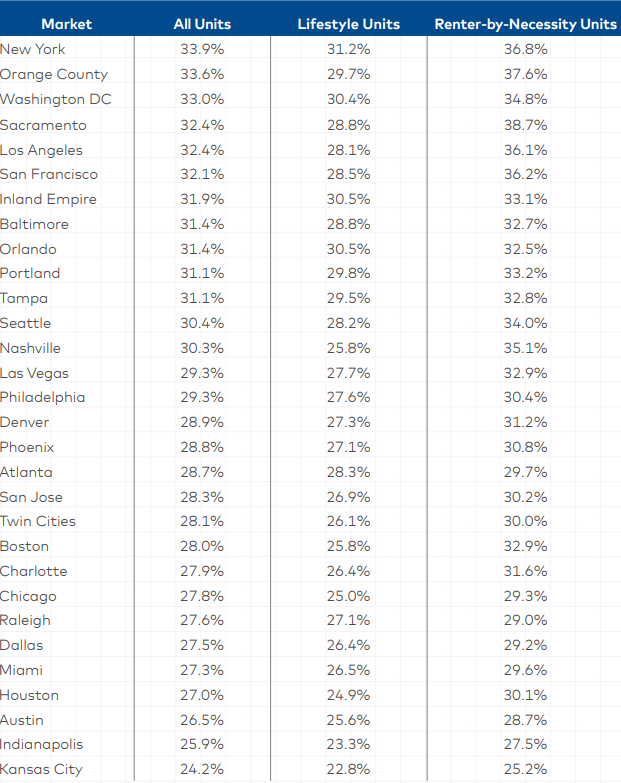
  • National rent-to-income ratios for all units were 29.0 percent in August, 9 basis points higher than July.

Multifamily Rent-to-Income Ratios as of August 2022

rent to income ratios as the long run of multifamily rent growth “hit the brakes” in September as the economy continued to cool, Yardi Matrix says
Charts courtesy of Yardi Matrix

Conclusion:

“The outlook for multifamily remains strong, although the market may be coming to an end of its extraordinary run of rent growth. Demand is slowing as migration and household formation drop to normal levels,” Yardi Matrix says.

Get the full report here.
About Yardi Matrix

Yardi Matrix researches and reports on multifamily, office and self-storage properties across the United States, serving the needs of a variety of industry professionals. Yardi Matrix Multifamily provides accurate data on 18+ million units, covering more than 90 percent of the U.S. population. Contact the company at (480) 663-1149.


Rate Of Rent Growth Slows At Midyear But Multifamily Still Poised For Strong Year

With Traditional Multifamily Rent Drivers Disrupted What Is The Future?

Another Bullish Year For Multifamily In 2022?

Sign Up For Our Weekly Newsletter And Get Rental Property And Apartment News And Helpful, Useful Content Each Week.

* indicates required

Fair Housing Matters: Landlord Liability for Tenant-on-Tenant Discrimination

Dealing with tenant-on-tenant discrimination complaints or disputes between tenants, and how landlord liability figures in.

Dealing with tenant-on-tenant discrimination complaints, or disputes that arise between tenants, takes proper investigative measures to determine what actually happened and where landlord liability figures in.

Bradley S. Kraus
Partner, Warren Allen LLP

As the calendar turns, 2022 rages on towards its eventual—and merciful—end. Winter is almost upon us, which means many people are indoors more often than not. Unfortunately, that increased indoor time can mean more tenant-on-tenant disputes. While seasoned landlords are no strangers to handling such situations, one particular situation, tenant-on-tenant discrimination, requires additional discussion—and immediate action.

Buried within the Oregon Administrative Rules is OAR 839-005-0206, which details specific theories of discrimination involving housing in Oregon. One particular section involves landlords:

(5) Tenant-on-tenant harassment: A housing provider is liable for a resident’s harassment of another resident when the housing provider knew or should have known of the conduct, unless the housing provider took immediate and appropriate corrective action.

What this administrative rule reads as is a theory of liability for tenants against their landlord if they are harassed by other tenants based on a protected status if the landlord did not take “immediate and appropriate corrective action.” Such exposure may seem strange, but some courts have already previously determined that the Fair Housing Act contains the same protections for tenants. If the landlord knew, or should have known, of tenant-on-tenant discrimination, and failed to take action, the victim tenant may sue the landlord based on this discrimination.

What does this mean for landlords? First, a landlord should do as they always do with tenant disputes. If complaints or disputes between tenants arise, take proper investigative measures to determine what actually happened. This would involve interviewing the parties, witnesses, and reviewing any other written statements or documents provided. Second, creating a log book and/or incident report can assist down the row in recreating what, if anything, happened. Landlords should use/create such items anyway as a best practice, as they are infinitely helpful in the event of litigation.

If it appears or is discovered that discriminatory language and/or conduct occurred, a landlord should take immediate action. This would include the proper termination notices under Oregon law. In the event of a he-said/she-said situation, it may behoove the landlord to defer on the side of aggressive action, as opposed to inaction. Fair Housing lawsuits are no laughing matter, often involving substantial attorney fees, costs, and stressful discovery processes, all of which could potentially be avoided through affirmative action.

As a landlords’ attorney, I have learned that not all tenant disputes are created equal. Some are petty, and/or involve people that cannot be placated or made happy unless they live entirely away from each other. Some involve racism, discrimination, and/or bigotry, which should have no place in our world. While these are two extremes which do not encompass the entirety of tenant-on-tenant disputes, if a landlord finds themselves facing the latter of these two scenarios, working with your attorney on an aggressive response can be the difference between resolution and litigation.

About the author:

Fair Housing Matters: Landlord Liability for Tenant-on-Tenant Discrimination
Brad Kraus

Bradley S. Kraus is an attorney at Warren Allen LLP. His primary practice area is landlord/tenant law, but he also assists clients with various litigation matters, probate matters, real estate disputes, and family law matters. You can reach him at kraus@warrenallen.com or at 503-255-8795.

Sign Up For Our Weekly Newsletter And Get Apartment News And Helpful, Useful Content Each Week.

* indicates required

Portland Update: Changes to FAIR Ordinance Bring (Some) Necessary Changes

Dealing with Habitability issues and Substitute Housing

Renting Is At Highest Level In 55 Years

Renters surpass homeowners in 41 percent of the zip codes in the 50 largest cities as more households are renting than in last 55 years

Renters now surpass homeowners in 41 percent of the zip codes in the 50 largest cities in the U.S., according to a new RentCafé report and more households are renting than at any point in the last 55 years.

“Although renting was previously considered an alternative brought on solely by circumstances, one-third of this decade’s renters now say that it’s a matter of choice.”

Some highlights:

  • Renting is at the highest level in half a century, with 43.7 million households currently living in rentals.
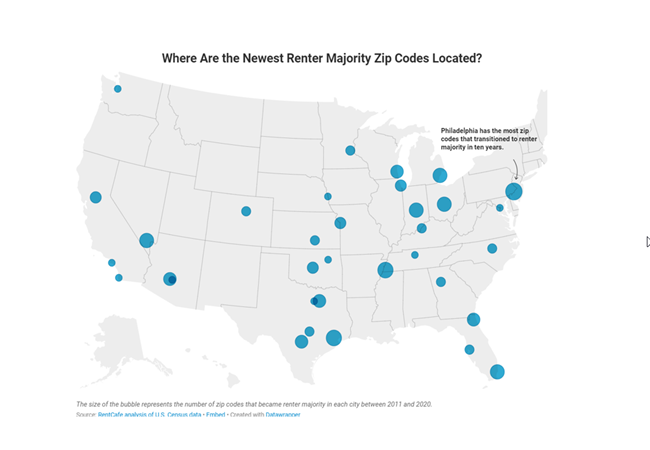
  • As many as 101 zip codes switched to renter majority in the past decade.
  • Renters surpass homeowners in 41% of zip codes in the 50 largest US cities.
  • Downtown areas became more popular for renters in 2020 compared to 10 years prior.
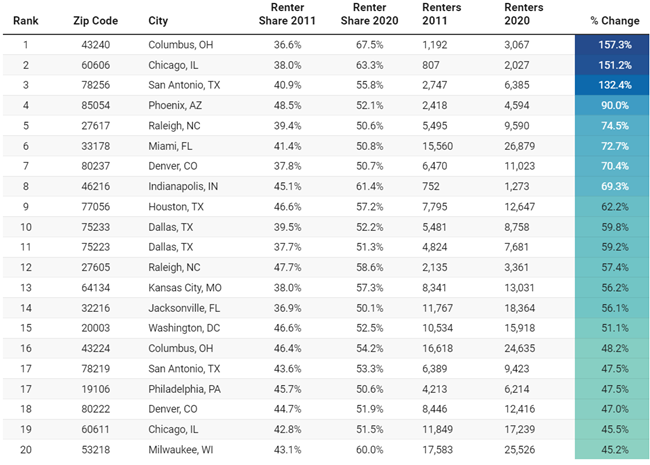
  • Of the new renter majority zip codes, 43240 in Columbus, OH saw the fastest increase in the number of renters.
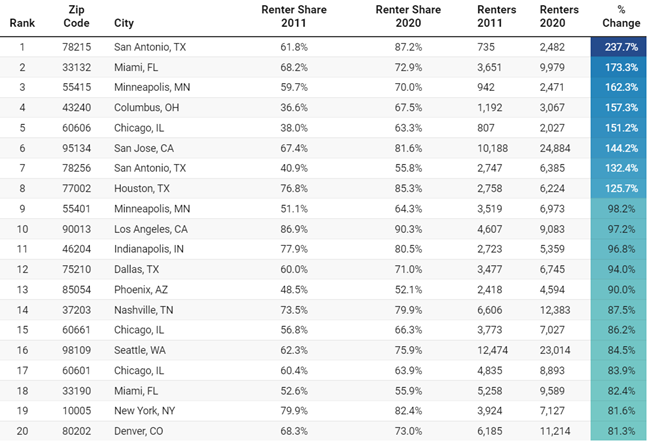
  • San Antonio’s 78215 is the top trending zip code for renters in the nation, tripling its renter population in ten years.

What Zip Codes Do Renters Prefer?

The number of renters in the U.S. rose by 12 percent between 2011 and 2020 — three times faster than the 4 percent increase in homeowners, according to the most recent U.S. Census estimates

“We found that 101 zip codes switched to renter-majority in the last 10 years. With the addition of these communities, renters represent the majority population in 41 percent or 632 of the 1,553 zip codes analyzed in the 50 largest U.S. cities.”

Zip Codes Where Renters Became The Majority

Renters surpass homeowners in 41 percent of the zip codes in the 50 largest cities as more households are renting than in last 55 years
Zip codes where renters outnumbered owners ranked by renter population change between 2011 and 2020. Source: RentCafé analysis of U.S. Census data Embed Created with Datawrapper

Zip Codes With the Fastest Growing Renter Populations

Downtowns are trendy for renters.

Many of the zip codes with the fastest-growing renter populations are located in city cores.

Specifically, eight of the 20 neighborhoods that grew their renter populations by more than 80 percent in the past decade are in or near downtowns.

“Similarly, our latest report on the top neighborhoods for apartment construction showed a historic boom in centrally located areas in the last five years — a timely response to the increased demand for rentals in these locations,” the report says.

“In this respect, San Antonio, TX is home to the top-trending neighborhood for renters nationwide: zip code 78215 in downtown San Antonio boasting an incredible growth rate of 238% in renter population. Here, the proportion of renters more than tripled, going from a mere 735 in 2011 to 2,482 in 2020.”

Fastest-Growing Renter Zip Codes

Renters surpass homeowners in 41 percent of the zip codes in the 50 largest cities as more households are renting than in last 55 years
Trending renter zip codes where the renter population grew faster than that of owners from 2011 to 2020, ranked by the 10-year increase in renter population. Source: RentCafé analysis of U.S. Census data Embed Created with Datawrapper

About the study:

RentCafé is a nationwide apartment search website that enables renters to easily find apartments and houses for rent throughout the United States. For this study, RentCafé  looked at the number of renters and owners in 1,553 zip codes with a minimum population of 1,000 in 2011 and 2020 across the 50 largest U.S cities. To identify the zip codes that switched to renter-majority, they took into consideration those zip codes where the renter share surpassed 50 percent in 2020, compared to 10 years prior and then ranked them based on the increase in renter population in 2020 compared to 2011.


Should Tenants Leave Power On When They Move Out?

Should Tenants Leave Power On When They Move Out?

This week a landlord asks should tenants leave power on when they move out is the question for Ask Landlord Hank. Remember Hank is not an attorney and is not offering legal advice. If you have a question for him please fill out his form below.

Dear Landlord Hank:

Is a tenant who has moved out on good terms by not re-signing the lease required to leave the power connected in their name until a new tenant moves in?

– Jason

Dear Landlord Jason,

Your good tenant’s obligations to the lease and to you end on the last day of the lease.

Normally the landlord will contact the power and water company to have those utilities on for showings, cleaning, etc. until the next tenant moves in.

The new tenant would then normally have those utilities put into their names at the start of the next lease, for that term.

Sincerely,

Hank Rossi

Each week I answer questions from landlords and property managers across the country in my “Dear Landlord Hank” blog in the digital magazine Rental Housing Journal.  https://rentalhousingjournal.com/asklandlordhank/

should the tenants leave the power on when they move out?
Landlord Hank says, “Normally the landlord will contact the power and water company to have those utilities on for showings, cleaning, etc. until the next tenant moves in.”

Ask Landlord Hank Your Question

Ask veteran landlord and property manager Hank Rossi your questions from tenant screening to leases to pets and more! He provides answers each week to landlords.

  • This field is for validation purposes and should be left unchanged.

Did you miss last week’s question? It was very popular

Can I Enter My Rental If It Is Vacated And Eviction Pending?

Last week a landlord asked “can I enter my rental property” if the tenant has vacated and the eviction is still pending was the question. Remember Hank is not an attorney and is not offering legal advice.

Do I Have to Paint and Replace Flooring for a Long-Term Tenant?

A Tenant Poured Grease Down Drain Who Is Responsible?

Sign Up For Our Newsletter And Get Rental Housing And Apartment News And Helpful, Useful Content Each Week.

* indicates required

States Where Tenants are Most Behind on Rent Payments

Tenants are behind on rent payments in a number of states with about 15 percent of renters, or about six million total, according to a report from myelisting.com.

“Our team of analysts at MyEListing.com found that about 15 percent of Americans are not currently caught up on rent. Estimates from the most recent federal data available show this equates to around six million American households.

“Nationally, the cost to rent an apartment rose 17.6 percent in 2021, according to apartmentlist.com. The ever-increasing cost of rent is causing financial hardship for a relatively large percentage of the population in each state,” the report says.

Key findings in the report:

  • Renters in South Dakota, Alabama, and New Jersey have the most trouble making their monthly payments.
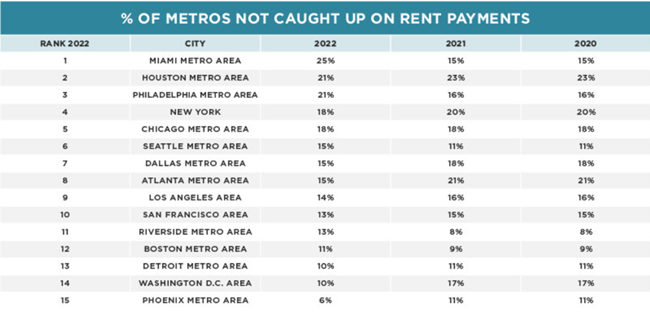
  • Renters in Miami, Houston, and Philadelphia are furthest behind on their rent.
  • Data shows 15 percent, or around six million American households, are behind on their rent payments this fall. This has remained consistent over the last 3 years (2020, 2021, 2022).
  • Americans aged 40 to 54 had the most difficulty keeping up with rent.

Top 10 states where renters are the most behind on payments

The percentages vary from state to state: In South Dakota, 22 percent of renters are behind on rent, while in Idaho, only 3 percent are behind on their rent. Additionally, Minnesota, Wisconsin, and South Dakota had the largest increase of tenants unable to keep up on rent in 2022 compared to 2021.

  1. South Dakota
  2. Alabama
  3. New Jersey
  4. South Carolina
  5. Connecticut
  6. Delaware
  7. Arkansas
  8. Kentucky
  9. Louisiana
  10. New York

Conclusion

“A troubling aspect of these findings is that rent costs keep increasing. While the percentage of Americans unable to keep up on rent has remained consistent over the last three years, it has remained consistently high at 15 percent. The question remains: Will Americans be able to keep up on their rent payments as costs continue to rise?” the report says.

Fannie Mae to Include Rent Payments in Mortgage Approval Process

Sign Up For Our Newsletter And Get Rental Property And Apartment News And Helpful, Useful Content Each Week.

* indicates required

Why I Like My Rental Properties’ Nosy Neighbors

Three Steps to Becoming a Successful, Lazy Landlord