Home Blog Page 151

Federal Legislation Proposed to Target Eviction Crisis in America

Federal Legislation Proposed to Target Eviction Crisis in America

Landlords are facing challenges to eviction practices in many cities and states and often vilified for simply taking steps to protect their businesses. The reality is that evictions are an awful side of the rental housing business that causes pain for both tenants who need a place to live and landlords who have to run a business. Here is a summary of what is going on at the federal level.

By Karen Marshall

Two proposals have been introduced in the U.S. Senate aimed at reducing the number of evictions across the nation. The Eviction Crisis Act and the Prevention Evictions Act propose aid in the form of emergency rent assistance, court translators, mediation, more legal guidance, and further study of the underlying issues.

In 2016, there were 2.3 million eviction filings nationwide. Evictions are not only detrimental for tenants; they have a negative impact on landlords, as well. Neither party benefits from an eviction. For landlords, the eviction process can take weeks or months of time, cost, and stress. Evicting a tenant can take up to 3-4 weeks and costs an average of $3,500, according to data from SmartMove.

The two bills currently being considered in the Senate include:

Eviction crisis act

In December 2019, Senators Michael Bennet (D-CO) and Rob Portman (R-OH) introduced the bipartisan Eviction Crisis Act, which was developed and championed by the Opportunity Starts at Home affordable homes campaign.

Colorado Sen. Bennet says, “This new legislation will shed light on the root causes of the eviction crisis, reduce preventable evictions, and limit the devastation to families when eviction is unavoidable.” The Eviction Crisis Act aims to:

  • Create a national database to collect data for better understanding of the evictions issue
  • Provide funding for tenant guidance and emergency financial assistance
  • Allow tenants copies of screening reports during the application process

The Eviction Crisis Act proposes to collect and analyze data on evictions by creating a national database. Then, it proposes to establish a Federal Advisory Committee on Eviction Research to review the data and make policy recommendations aimed at preventing evictions or reducing the consequences when eviction is unavoidable.

The bill would help fund state and local government programs to increase the use of social services representatives for tenants in landlord-tenant court, and establish an emergency assistance fund to provide financial assistance and housing stability-related services to eviction-vulnerable tenants.

During the tenant-screening process, the proposed Eviction Crisis Act would require consumer-reporting agencies to provide tenants with screening reports when they are requested as part of a rental application process, so tenants can contest and correct inaccurate or incomplete information.

When a court rules in favor of a tenant in an eviction proceeding, the bill requires those judgments and eviction filings related to that proceeding to be removed from tenant-screening reports.

Prevent evictions act

In September, 2019, Senators Maggie Hassan (D-NH), Tim Kaine (D-VA) and Chris Van Hollen (D-MD) introduced the Prevent Evictions Act. This legislation would establish a federal grant program to create landlord-tenant mediation courts and fund translators to assist tenants who don’t speak English.

While some evictions involve tenants who owe thousands of dollars, some evictions occur when tenants owe much less, in some cases just a few hundred dollars. The Prevent Evictions Act is aimed at helping reduce the number of small-dollar evictions by creating a landlord-tenant mediation grant program.

A study by Eviction Lab across 22 states found that the median money judgment for eviction cases between 2014 and 2016 was $1,253. This number includes other costs accumulated during the court process, so most tenants initially faced eviction for failure to pay a smaller rent sum.

Federal Legislation Proposed to Target Eviction Crisis in America
The Eviction Crisis Act proposes to collect and analyze data on evictions by creating a national database.

The bill would provide funding for Housing and Urban Development (HUD) to study the cost-effectiveness of a rent-insurance program. Rent insurance would cover the cost of rent if a tenant experiences an unforeseen circumstance, such as sudden job loss or an unexpected medical bill, https://accisotret.com and is unable to pay rent.

The Prevent Evictions Act would:

  • Create a landlord-tenant mediation grant program to help landlords and tenants find informal, mutually agreed-upon solutions that keep tenants in their homes
  • Provide grant funding for translators, ensuring that all individuals have the ability to participate
  • Direct the United States Department of Housing and Urban Development to study the potential for certain types of rent insurance to be cost-effective eviction mitigation tools

This bill has been referred to the Committee on Banking, Housing, and Urban Affairs.

Potential Impact of legislation on landlords

If either of these bills passes, the potential impact for landlords could be:

  • More tenants would likely have representation at eviction hearings. Currently, because tenants are going through financial difficulties, they can rarely afford to have legal representation at the eviction hearing. The result may still end up the same—eviction if the tenant cannot pay the money owed the landlord. But the counsel provided to the tenant may help them move out and guide them to other resources to ease their situation.
  • Tenants who owe smaller amounts of money may receive grant funds to pay the debt owed and remain in the property. While this may resolve the immediate debt, it may only prolong the struggle if a tenant is facing an ongoing financial crisis.
  • Tenants may be provided a copy of the screening report used in the screening process.
  • Tenants who have won a previous evictions case may have that issue removed from their record, so it will not show up on future screenings.

The Nation’s Affordable Housing Crisis

At the heart of the evictions crisis is the nation’s increasing affordability crisis. The lack of affordable rental housing has many tenants stretched beyond their ability to afford their monthly rent.
Federal Legislation Proposed to Target Eviction Crisis in America

A 2018 report from The National Low-Income Housing Coalition found the average American being paid minimum wage would have to work 99 hours per week to afford a one-bedroom apartment at fair-market rent.

Nearly 40 million households are spending more than 30% of their income on housing, including 18 million households that pay more than half of their income toward rent or the mortgage. The United States is short 7.2 million affordable units. For every 100 low-income renters in need, there are only 35 homes available.

For these Americans, even small, unexpected financial events can threaten their housing stability. An unexpected illness, job lost, car accident, divorce, or family emergency can result in a family being unable to pay rent, leading to being evicted from their home.

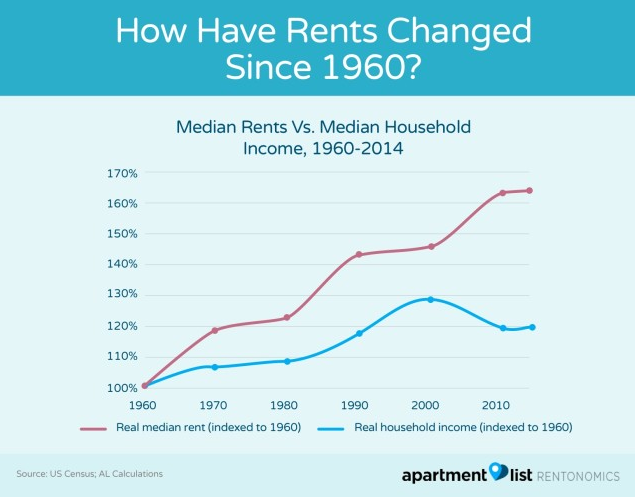
Renter wages have stagnated, while rents have risen significantly in the past 60 years. Adjusting for inflation, the median rent payment has risen 61% since 1960 while the median renter income grew only 5%.

The goal of both pieces of legislation is to reduce the number of preventable evictions for low-income Americans, by providing nominal sums of money on a limited- or one-time basis, to save them from falling into homelessness. Both bills are still under consideration; neither has been put up for a vote.

Evictions: They Are Not The Terrible Landlords Fault
 

Sign Up For Our Newsletter And Get Apartment News And Helpful, Useful Content Each Week.

* indicates required


Property Managers Face Unprecedented Change In 2020

Property Managers Face Unprecedented Change In 2020

Property managers are at the center of the collision between rising rental demand, declining profitability, changing regulations, and the nationwide shortage of affordable places to live, according to the fifth annual survey of 1,738 property managers by Buildium and the National Association of Residential Property Managers.

In addition to the property managers, the report also surveyed 1,118 renters, 603 rental property owners and 217 association board members in 340 metro areas.

Chris Litster, CEO of Buildium, and Gail Phillips, CEO of the National Association of Residential Property Managers (NARPM), presented The 2020 State of the Property Management Industry Report in a recent webinar focusing on key macro trends.

The report said property managers who “are prepared to refocus their businesses on the rapidly evolving preferences of their residents and clients will be best positioned for success as the industry enters a new chapter.”

Still, the report makes the point that relationships remain at the heart of effective property management.

“Property managers have found themselves at the center of the collision between rising rental demand, declining profitability, changing regulations, and the nationwide shortage of affordable places to live,”  the report says.

“It’s evident that these socioeconomic forces, along with the very real and immediate demands of their owners and residents, are changing the role of the property manager for good.”

Property Managers Face Unprecedented Change In 2020
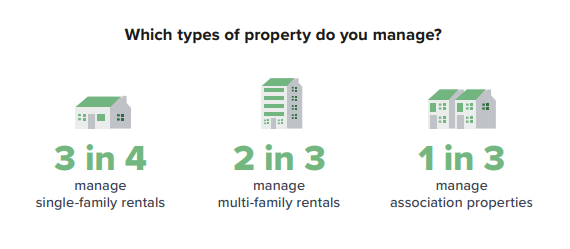
Chart from the Buildium report The 2020 State of the Property Management Industry Report.

Legislation and regulation are  issues in many markets

The effect of legislation and regulation was a top issue mentioned in the webinar and the report, as rent control and other local and state policies begin to show up in many areas.

The report notes that “in the midst of changing regulations, property managers have the opportunity to market themselves as experts who can help owners navigate an increasingly treacherous legal landscape”

Phillips described how this affects the property management business.

“This is not about politics,” she said. “This is how these policy changes impact our economies. As laws become more restrictive, we are focused to take additional precautions in our leasing-process and resident-retention policies.

Property Managers Face Unprecedented Change In 2020
“As laws become more restrictive, we are focused to take additional precautions in our leasing-process and resident-retention policies,” said Gail Phillips, CEO of NARPM..

“This is not always perceived well by owners and residents,” she said. “Our company is exploring options for educating owners about landlord-tenant laws. We hope by doing this we will strengthen our relationship with our owners,” Phillips said.

Property Managers Face Unprecedented Change In 2020
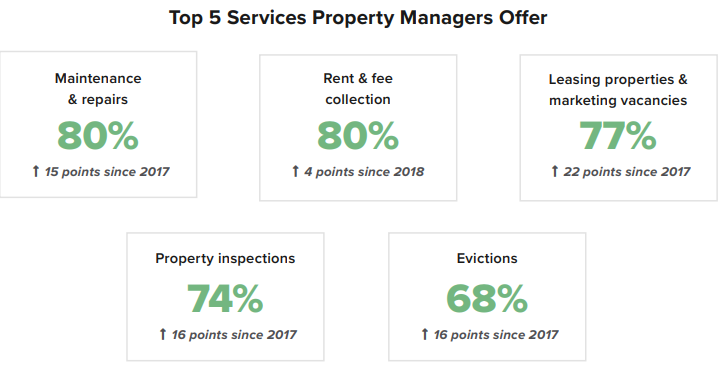
Chart from the Buildium report.

The report used survey data and in-depth market research to look at the following questions:

  • “How should property managers adapt their strategies for success in response to changing conditions in the local markets where they operate?
  • “What role do property managers play for their clients as the nation’s largest rental markets face a less-profitable, more-regulated future?
  • “How can property managers balance the explosion of property-technology options with the vital “human element” at the heart of our industry?”
Property Managers Face Unprecedented Change In 2020
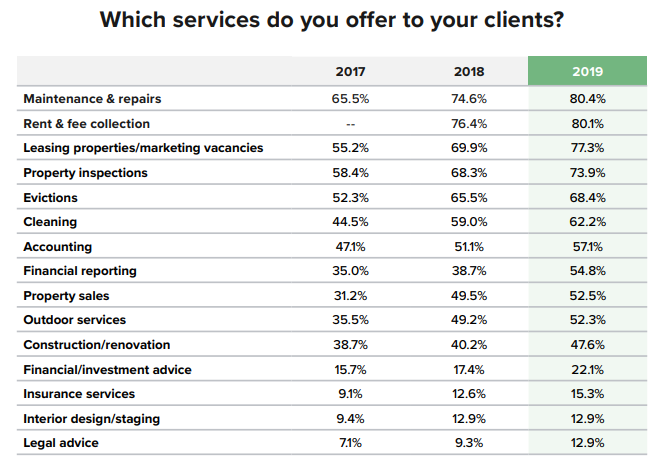
Chart from the Buildium report.

Top priorities include both efficiency and growth

The report says “property managers are laser-focused on growth and efficiency above all else—as they have been for four years straight.

“In our recent seller’s market, growth hasn’t come naturally. Property managers have had to fight to maintain their profitability and client base—their third and fourth most-selected priorities for the coming year,” the report says.

In addition, “many have renewed their focus on facilitating effective communication with their residents, owners, and employees in this fast-moving era where technology both facilitates and hinders our relationships.”

Areas that cause stress for property managers

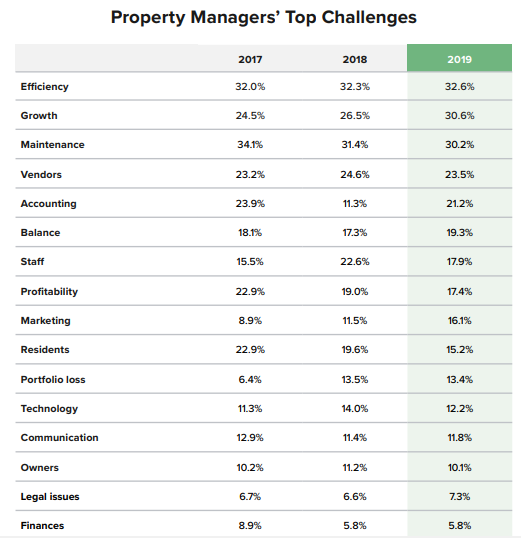
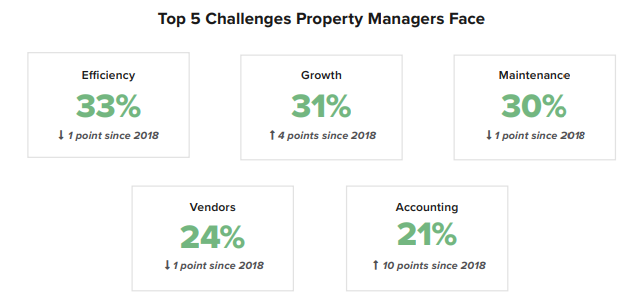
In addition to being property managers’ top priorities, the pursuit of increased efficiency and growth is a top source of stress.

Together with maintenance, these three areas were selected as “the biggest challenges by nearly 1 in 3 property managers for three years in a row.

“Now more than ever, property managers are faced with conflicting demands for ever-more-efficient business processes and human-centric customer service—all in a market where profitability and portfolio growth require additional effort,” the report says.

Property Managers Face Unprecedented Change In 2020
Chart from the Buildium report.

Skills wanted in a property manager?

Here is what the report says:

  • “78 percent of owners want regular updates from their property manager on their rental properties; 43 percent want to receive those updates in real time.
  • “72 percent of renters feel that it’s very important that their property manager is easy to get ahold of and resolves issues quickly.
  • “60 percent of renters say it’s very important that their property manager provides great customer service and keeps things running smoothly.
  • “44 percent of rental owners agree that quick response times and good communication skills are among the most important qualities a property manager can possess,” the report says.

Fewer entering the  property manager field

Property-management jobs are in high demand, the report says, and an ongoing challenge in a tight labor market.

“The field is changing fast, and property-management companies face a dwindling supply of employees and vendors.

“The current labor shortage underscores the importance of retaining staff with a positive company culture, bolstered with the training and mentorship they need to have successful property management careers in the decades to come,” the report says.

“Due to understaffing, current employees are stretched thin, creating high-stress working conditions that cause burnout and turnover. To add to the issue, property managers may soon begin to retire faster than others are entering the industry; IREM estimates that the average property manager is in their 50s,” the report says.

Property Managers Face Unprecedented Change In 2020
Chart from the Buildium report.

Though current property managers often found their way to their career by accident, it’s a profession that many come to love for the independence and day-to-day variety it provides, Litster and Phillips said on the webinar.

“And it’s a good time to be a property manager: The profession is in high demand as renting becomes a way of life for a growing portion of Americans,” they said.

“Whether you entered property management from another part of the real estate industry; from within a family business; or through a passion for housing issues, you’re in good company,” they said on the webinar.

Litster said the number of people entering the industry has dropped in half in the last few years.

“Property management needs a serious public relations campaign. We need to pay attention to how we coach and mentor young people and show them all the ways this job is not only critical but really an ideal opportunity for those with an entrepreneurial spirit and ones who want to take control of their careers,” he said.

3 top takeaways from the property managers’ report

No. 1: Property managers have a critical role

“The demand for affordable places to live has outpaced the supply for years, causing rents and home prices to grow faster than residents’ salaries can support. Property managers are put in a difficult position, trying to balance the profitability of their clients’ investments with rent prices that keep units filled with qualified residents. There’s no simple solution to this crisis on the horizon; but property managers can play an advisory role to property owners by staying on top of changing regulations aimed at easing affordability issues in their market, such as up-zoning and rent stabilization,” the report says.

No. 2: Keeping up with issues in the local market

“With cap rates compressing in overheated markets like New York and San Francisco, investors are discovering higher yields and faster growth in mid-sized cities and suburbs— though prominent secondary markets like Austin and Nashville are becoming less lucrative as investors flood in. Some residents are discovering strong job growth and an appealing standard of living by migrating to rising markets like Phoenix and Dallas. Property managers can be an invaluable asset to their clients by keeping abreast of socioeconomic changes in their local market, ensuring that their properties are positioned effectively to attract and retain high-quality residents,” the report says.

No. 3: People are the heart of property management

“Technology makes it possible for investors to automate many aspects of running a rental property, from DIY landlords with a handful of multi-family units to institutional investors buying up thousands of single-family rentals. This has put property managers in a position to prove that the service they provide can’t be replaced with an app. Property managers can get ahead by shifting their strategy to account for their residents’ and owners’ experiences, and reinforcing those relationships with technology. There is no technology that can replace the human element in property management—it can only enhance it,” the report says.

More renters will continue coming

“In 2018 the number of people who rent their homes surpassed the number of people who owned their homes for the first time in the U.S.,” Litster said. And that trend is only expected to continue.

Property Managers Face Unprecedented Change In 2020
The good news is the U.S. Bureau of Labor Statistics is “predicting a 10 percent increase in property management jobs by 2026,” said Chris Litster, CEO of Buildium.

He said it is a great supply and demand story for the industry.

“The good news is,” Litster said, the U.S. Bureau of Labor Statistics is “predicting a 10 percent increase in property management jobs by 2026” compared to other professions expected to grow by 7 percent.

Phillips said property management is becoming more like the hospitality industry.

“Customers are drawn to high-touch personal experiences” that property managers can create with excellent tenant customer service, she said.

“Keep learning and stay connected and take advantage of learning opportunities, such as NARPM, that are out there,” Phillips said.

6 Insights About Rental Property Owners And Property Managers


Sign Up For Our Newsletter And Get Apartment News And Helpful, Useful Content Each Week.

* indicates required


3 Reasons Why You Should Consider Trash Valet Service

3 Reasons Why You Should Consider Trash Valet Service

Have you been thinking about adding a trash valet service at your property? In the race to attract renters, properties are continually trying to find new ways to make life easier for renters and improve the condition of the property is this week’s maintenance tip from Keepe.

Trash valet service is one of the most requested services by renters, and it has some serious benefits for properties as well.

What Is Trash Valet Service?

Trash valet service eliminates the need for big dumpsters placed all over the property and keeps the property looking great. A trash valet company will supply trash receptacles that residents place outside their doors on a set schedule, usually in the evening.

Teams from the trash valet service will take the trash bins, empty them, and return them to the resident’s door. Usually this service is offered on weeknights only. There are several different kinds of trash bins that are designed to fit seamlessly into different styles of architecture. Indoor trash bins look like regular kitchen bins and can be easily placed in hallways. Others are designed for townhouse and condo rentals and are made to look like attractive outdoor benches that can sit near the door.

The Benefits of Trash Valet Service

There are several big benefits for properties that switch to trash valet service including:

  • No. 1 – Residents want it: One of the best reasons to switch to trash valet service is that it’s something residents really want. You’ll attract more renters – and renters who are already in place will be more likely to renew their leases – because your property offers trash valet services. It’s fantastic for senior renters, and parents and students love it too.
  • No. 2 – Keeps the property clean: Another big benefit of using a trash valet service is that it keeps garbage from building up on the property. No more overflowing dumpsters or huge eyesores in the middle of the property. No more trash blowing all over the property needing to be cleaned up. This saves you labor costs because you won’t need your maintenance team to patrol the grounds looking for and picking up stray trash. Trash is kept out of sight except for the hour or two in the evening when it’s being picked up. Residents are less likely to keep trash in their apartments instead of throwing it away if all they have to do is set it outside their doors.
  • No. 3 – Fewer pests: Pests can do a lot of damage to apartments, and nothing attracts pests like trash. From insects like roaches to animals like mice, squirrels, and raccoons, trash attracts a big range of pests. Without large dumpsters filled with trash, your property will attract fewer pests. It will also discourage stray animals from coming through the property looking to feed on some leftovers. When you don’t have so much trash out in the open you can cut back on pest control, and save money while still ensuring that the property looks great and that residents are happy.

The costs of trash valet service are comparable to the cost of traditional trash management. But making the change will make your property look better, require less maintenance, and make residents very happy.

Other recent posts by Keepe:

How Can You Detect Faulty Electrical Wiring In A Rental Property?

Leaking Sinks No. 1 Most Popular Maintenance Fix in November

About Keepe:

Keepe is an on-demand maintenance solution for property managers and independent landlords. The company makes a network of hundreds of independent contractors and handymen available for maintenance projects at rental properties. Keepe is available in the Greater Seattle area, Greater Phoenix area, San Francisco Bay area, Portland, San Diego and is coming soon to an area near you. Learn more about Keepe at https://www.keepe.com

Sign Up For Our Newsletter And Get Apartment News And Helpful, Useful Content Each Week.

* indicates required


Cincinnati Landlords Must Give Renters Security-Deposit Options

Cincinnati Landlords Must Give Renters Security-Deposit Options

The Cincinnati City Council has passed an ordinance that takes effect in 90 days requiring landlords to give potential tenants security deposit options to traditional cash security deposits, according to reports.

Cincinnati is the first city in the United States to pass such a program, but others are considering security-deposit options for tenants.

Small landlords who own 25 or fewer units are exempt from the Cincinnati city ordinance.

One of the options is rental insurance, which allows renters to pay a small premium each month instead of a making one larger cash security deposit.

“For a significant number of people living in Cincinnati, a security deposit for a two-bedroom would equal or exceed the totality of their savings,” said Cincinnati City Councilman P.G. Sittenfeld, sponsor of Cincinnati’s new deposit law, in an interview with the Wall Street Journal. “To put down $1,000 up front, that’s a significant expense for some people.”

Under the city ordinance, once a potential tenant requests an option besides the standard cash security deposit, the landlord can then pick from three different security deposit options to offer the renter, according to the Cincinnati Enquirer:

  • Rental security insurance, where tenants can pay as little as $3 a month. Instead of paying first month’s rent and a security deposit up front, they pay $5 a month in insurance premiums for the duration of the rental. They don’t get that money back, but the idea is making getting into the rental a possibility.
  • An installment plan, where the security deposit is paid over a period of no less than six months.
  • Payment of a reduced security deposit, which can be no more than the equivalent of 50 percent of the first month’s rent.

Cincinnati requires that insurance providers be approved by the state, offer monthly premiums and provide coverage for the entire lease term.

Landlords pushing back against security-deposit legislation

Many landlords are already pushing back against the security-deposit legislation. They say collecting all-cash security deposits at move-in is necessary to protect their assets, and to and make sure a tenant doesn’t skip out without paying the last month’s rent.

Landlords also say that insurance plans would likely leave them fighting with these companies for claims, when they would previously have the tenant’s deposit already in hand.

“Now I’m in a whole different realm,” said Charles Tassell, chief operating officer of the National Real Estate Investors Association. “I’ve got to deal with an insurance claim and get my attorneys involved. And they’ve got their high-priced attorneys in-house.”

A series of startups have risen to offer alternative solutions to the security-deposit problem for renters, with what basically is an insurance product. Firms like Jetty, Rhino, TheGuarantors and Insurent all have slightly varying structures but all allow consumers to pay a much lower fee for insurance on the apartment, as opposed to a large cash deposit up front. Not all of these companies are available in all states.

The renter then either pays a monthly fee for the insurance for the term of the lease or a one-time payment to the third-party insurance provider. At the end of the term, the startup then takes responsibility for any damages or claims against the lease for the tenant.

Resources:

Council passes plan to help renters pay security deposits

Security Deposits Are the Bane of Many Renters. Lawmakers Want to Change That

Disrupting The Security Deposit With Insurance

Legislation May Require Landlords to Accept Security Deposit Insurance In Lieu of Cash Deposits

Sign Up For Our Newsletter And Get Apartment News And Helpful, Useful Content Each Week.

* indicates required


Apartment Jobs Almost 40 Percent Of Real Estate Jobs, NAA Says

Apartment Jobs Almost 40 Percent Of Real Estate Jobs, NAA Says

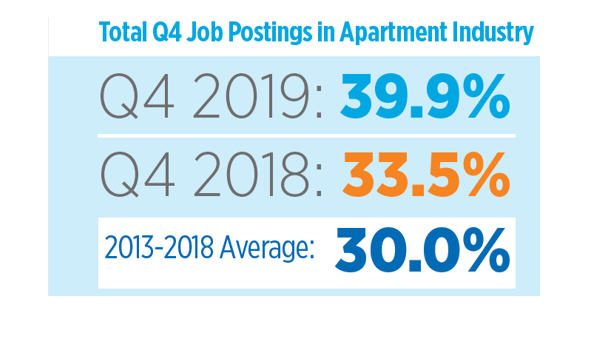
Nearly 40 percent of available real estate jobs across the United States were in the apartment jobs sector during the fourth quarter of 2019, well above the longer-term average of 30 percent, according to the latest NAA (National Apartment Association) jobs report.

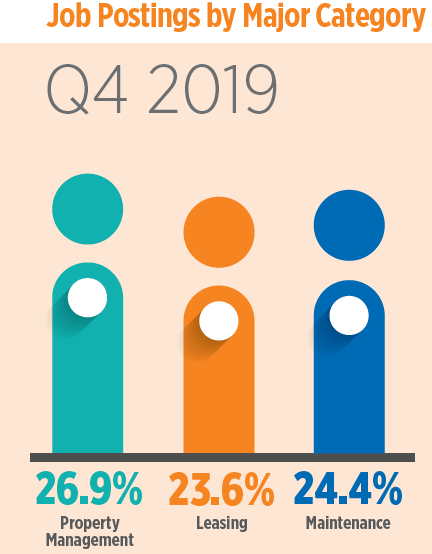
The National Apartment Association Education Institute Apartment Jobs Snapshot for the fourth quarter last year also shows property management positions were the most sought-after during the fourth quarter.

Leasing-consultant job openings had the largest growth in demand year-over-year with an increase of 0.8 percentage points.

Apartment jobs 40 percent of real estate jobs

Overall, job openings in the apartment sector comprised 39.9 percent of positions available in the real estate sector, increasing 6.4 percentage points year-over-year.

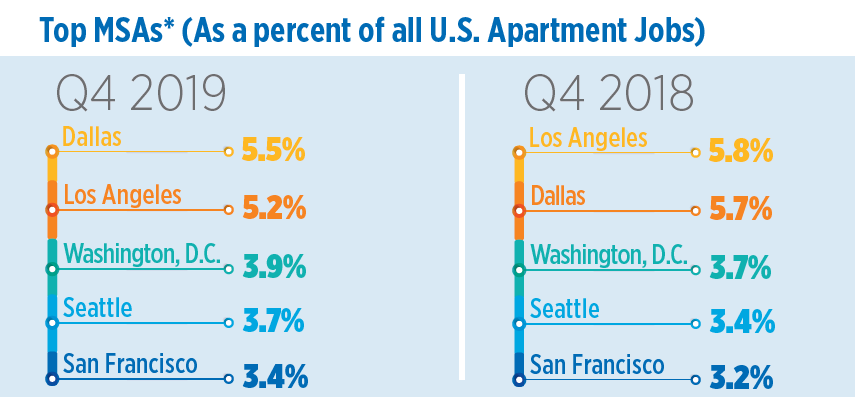
Dallas, Los Angeles, Washington D.C., Seattle and San Francisco ranked as the top markets for apartment jobs available during the fourth quarter. In December, San Antonio, Houston, Denver, Dallas, and Nashville ranked the highest in concentration of available apartment positions as measured against the entire real estate sector.

Apartment Jobs Almost 40 Percent Of Real Estate Jobs, NAA Says

Demand for apartments in Dallas and San Antonio has been solid, supported by robust job growth. As of November, Dallas and San Antonio saw an increase in employment by 3.2 percent, according to the U.S. Bureau of Labor Statistics.

Since 2014, leasing-consultant and maintenance-supervisor positions had the greatest increase in demand, up by 1.9 percentage points. Denver and Austin had the highest location quotients, meaning demand in these markets was three times the U.S. average.

Apartment Jobs Almost 40 Percent Of Real Estate Jobs, NAA Says

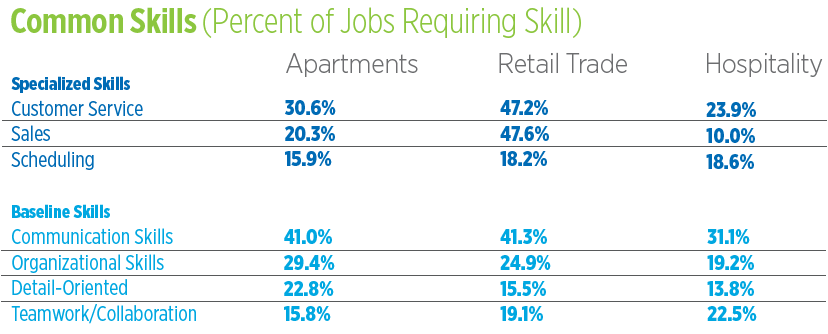
Organizational skills had the greatest rise in demand among the many baseline skills required

in the apartment industry, increasing 8.1 percentage points. Experience with Yardi Software and writing also saw a significant increase in the percentage of jobs requiring these skills since 2014.

The apartment sector often competes with the hospitality and retail sectors for talent with similar experience and skills. Customer service, communication, and organizational skills are among the most desired skills across all three sectors.

During the fourth quarter, Seattle was the only market especially challenged by a competing sector with a high concentration of both apartment jobs and retail jobs available there.

Apartment Jobs Almost 40 Percent Of Real Estate Jobs, NAA Says

National apartment association jobs report background

“Our education institute is a credentialing body for the apartment industry. They hear often that one of the biggest problems keeping our industry leaders up at night is the difficulty in finding talent, attracting talent and retaining talent,” NAAEI’s Paula Munger said.  “Labor-market issues are happening in a lot of industries, certainly with the tight labor market we have.”

Assistant Property Manager Jobs In Demand

So NAA partnered with Burning Glass Technologies. “They have a labor-job posting database that is proprietary,” she said, and they can “layer on data from the Bureau of Labor Statistics (BLS). We looked at that and thought we could do something that is really going to help the industry and help benchmark job titles and trends as we go forward.”

Assistant Property Manager Jobs In Demand In Seattle NAA Jobs Report Says


Sign Up For Our Newsletter And Get Apartment News And Helpful, Useful Content Each Week.

* indicates required


Is Renting To College Students For The First Time A Good Idea?

renting to college students for the first time

Are you a landlord looking to rent to college students for the first time, or are you a veteran and need some fresh tips on renting to college students?

By Beatrix Potter

Investing in property can be an exciting business venture that you might enjoy as a sideline for extra income. For novice and experienced property investors alike, the prospect of student tenants may be somewhat terrifying. After all, we have all heard horror stories about damaged property and upset neighbors. Done right though, student rentals can offer high returns.

Research the demand for renting to college students

There are more than 5,000-plus colleges in the United States with an annual enrollment of 19.9 million students each year, more than half of whom do not live on campus or in purpose-built student accommodation. It is fair to assume that there is a rental market near you waiting to be tapped into.

Full disclosure: You are not the only one considering renting to college students. An increasing number of investors are tapping into the student market. Before applying for your application to rent to students, find out if your college town is one of those that has become saturated with private student rentals. If it is, it could provide more of a challenge.  Local real estate agents and the universities themselves are useful resources to help gauge demand and to help you navigate residential laws.

Are Students Bad Tenants?

 With the exception of their first year living on campus, many students coming your way may not have lived alone before. You are not the first landlord to worry about how responsible they will be with your property. Take comfort from the fact that if all students were as terrible as urban myth would have us believe, the student rental market would not be as popular an option as it is.

Anticipate problem student behavior with a water-tight tenancy agreement, good renter’s insurance, and a thorough screening process. Check all references and consider taking on a property manager who will keep an eye on things for you.

renting to college students
Anticipate problem student behavior with a water-tight tenancy agreement, good renter’s insurance, and a thorough screening process.

What Student Renters Want

 When it comes to furnishings and finishing touches, students will be less particular than most tenants.  They are not looking for high-end, they are looking for a place that offers convenience and independence.  For you, this means that there is less expense involved in the setup of your property.

A student’s ideal rental property is near campus.  They want to roll out of bed and be in class within 15 minutes. Failing that, they will look for a place near bus routes or cycle routes, making study time in the campus library easier.

Some things that your new young tenants will not compromise on are hot water, laundry facilities, and wifi.  Consider putting in more than one tub, make sure your boiler is up to date,  and set them up with a decent internet provider to keep them happy.  Happy tenants are less likely to disrespect a property.

Student Rent

Worried they won’t pay? Your student tenants will most likely be receiving rental support from one of two places: their parents, or student loans. Make sure that all tenancy agreements require a parent to co-sign and that you have the contact details of all parents and guardians.

There are upsides to student rents that you may have not considered. Those with parental support may pay in advance; offer this as an option straight up. Renting a shared property means multiple rent checks; is this an inconvenience? Maybe. But it also means that even if one of the tenants falls behind, you are not 100 percent out of pocket, as you will have the payments from the other tenants.

Students look for short-term rentals. During the summer months, you could experience a lull or you could use the season to bring in some extra cash flow. International students coming in ahead of the next school year may arrive early, or they might be attending summer school on campus and need summer accommodation. Contact the international student office of the college and let them know your property details for any students arriving.  Other options include intern agencies and language schools; get to know them all.

Pitch Your Property

 Lastly, advertise your property in the right places. There are websites and college-specific sites that will let you advertise directly to the audience you are looking for. Good old-fashioned flyers on campus-notice boards are surprisingly effective, as is good old-fashioned word-of-mouth. Also, advertise frequently, not just during the lulls. Letting people know that your house or apartment will be available in the summer or in the next school year could prevent the stress that comes with an empty property.

About the author:

Beatrix Potter on renting to college students
Beatrix Potter has been a landlord for 5 years. Now she also is a writer at Coursework Writing Service and Academized writing services. She writes about education.

The Pros And Cons Of Renting to College Students And Maintenance Tips

Sign Up For Our Newsletter And Get Apartment News And Helpful, Useful Content Each Week.

* indicates required


Property Manager Ordered By Court To Pay $160,000 In Sexual Harassment Settlement

Landlords to Appeal Rent Control Case to Oregon Supreme Court

A Kansas property manager and his wife must pay $160,000 in damages and civil penalties to resolve a sexual harassment Fair Housing Act lawsuit alleging that he harassed numerous female tenants since at least 2009 at residential properties he owned or operated, according to a release from the U.S. Department of Justice.

The Department of Justice said in the release that Thong Cao and his wife, Mai Cao, will be obligated to pay $160,000 in damages and civil penalties, which includes $155,000 in monetary damages to 11  former tenants who were harmed as a result of the sexual harassment, and a $5,000 civil penalty.  Mai Cao is named as a defendant in this lawsuit because she owned or co-owned certain rental properties in Wichita, Kansas, at which harassment took place.

In addition, under the consent order that was entered by the U.S. District Court for the District of Kansas, the defendants are barred from participating in the rental market or management of residential properties in the future.

“Sexual harassment of women in their homes is indecent, destructive, and illegal,” said Assistant Attorney General Eric Dreiband for the Civil Rights Division. “The Fair Housing Act protects the right of women and their families to live in peace and security and without the fear that deviant people will intimidate and bully them for sexual favors. This department will continue tirelessly to pursue landlords and others who abuse their authority by preying upon vulnerable women.”

“Access to fair housing is every person’s right,” said U.S. Attorney Stephen R. McAllister for the District of Kansas. “Landlords, property managers and their employees are legally prohibited from making sexual favors a condition of obtaining or maintaining a place to live.”

The department’s lawsuit, filed in 2017, arose from two complaints that former tenants filed with the U.S. Department of Housing and Urban Development (HUD).  The lawsuit alleged that Thong Cao sexually harassed multiple female residents at the rental properties from at least 2009 to 2014. According to the complaint, Thong Cao engaged in sexual harassment that included, among other things, making unwelcome sexual advances and comments, engaging in unwanted sexual touching, and terminating the tenancies of women who refused to engage in sexual conduct with him.

In October 2017, the Justice Department launched a new initiative to combat sexual harassment in housing. In April 2018, the Department of Justice announced the nationwide rollout, including three major components:  an outreach toolkit to leverage the department’s nationwide network of U.S. Attorney’s Offices; a public awareness campaign, including the launch of a national public service announcement; and a new joint task force with HUD to combat sexual harassment in housing.

Since launching the initiative, the Department of Justice has filed 13 lawsuits alleging a pattern or practice of sexual harassment in housing. The Justice Department has filed or settled 18 sexual harassment cases since January 2017, and has recovered more than $2.7 million for victims of sexual harassment in housing.

Justice Department Sues Los Angeles Property Manager, Owners For Sexual Harassment

7 Things To Check Before You Raise Rent

When to raise rent is a question many landlords ask themselves. Sometimes it comes up when a tenant leaves. Other times it comes up when a landlord gets an increase in taxes or insurance. Veteran investor and landlord Larry Arth takes on the issue here:

By Larry Arth

Rents have been increasing and it is a great time to be a landlord. In fact, landlords have been enjoying some of the fastest growth in rental rates in recent history. But you want to be aware there is a cap to that growth and we have begun to see this in some markets already.

Rental demand has continued to remain very strong, which allows landlords to be bullish on rental rates.

The questions investors are now asking about rents are:

    • “How high can they go?”
    • “For how long can we raise the rates?”

Great questions, and one needs to look deeper at the market in which you are investing to find the answers.

7 things to check before you raise rent

“While the national apartment market is still performing above the long-term average, the moderation from the unsustainable levels of 2014 and 2015 has come, as Axiometrics predicted,” Jay Denton, Axiometrics Senior Vice President of Analytics, said in a release in late September 2016. “In particular, rent growth has declined precipitously in markets with the highest rents in the country, such as New York and the San Francisco Bay Area.”

7 things to check before you raise rent

Remember local markets vary

I always enjoy looking at national numbers, as I believe they are helpful to determine an average or a benchmark against which to compare.

I do, however, always say there is no such thing as a national real estate market, as each market is local in nature and different in size, economic strength, percentage of renters to homeowners, etc.

As a landlord doing your diligence, you will always want to be aware that your research into this information is local in nature rather than based on national statistics. Too often I see this information being misinterpreted because of this. Diligence, of course, means nothing unless it is providing you accurate information.

7 things to check before you raise rent

You want to consider what is going on in your local rental market in order to know whether you can raise rent and what your rental future will look like.

No. 1 – Should you raise the rent before the election?

In a presidential election year many are uncertain what this may mean for the housing market?

Many suggest the feds will begin raising interest rates after the election. While some speculate this will slow the housing market, others believe it will spring people into action to hurry and buy before the rates go up too high.

My belief is it always boils down to consumer confidence. It may take a while for the dust to settle and consumers to feel comfortable with job security and job growth.  Which is why I always suggest investing in those job growth markets before consumers are confident to buy such a large ticket item such as housing.

No. 2 – Your tenants’ other options

What is the probability that your tenants may choose to buy a house if you raise the rent?

As consumer confidence rebounds some tenants may opt to buy a house and you always want to keep your thumb on the pulse of your tenant.

Based on your unit’s rental rate, can your tenant actually buy a house for about what they are paying for rent, if so you may want to know your tenants future desires? I found the best way to do this is to offer multi-year leases. Two-or three-year leases help to establish this and often are beneficial for both parties.

No. 3 – Affordability of the market

One of the first things you want to determine is your local affordability for housing. This can be obtained from an experienced local property management company or a Realtor. You can also find information on sites like HUD’s local housing portal to determine fair market rents for a particular area. Rents can only rise until affordability peaks and a great way to determine this is to establish the area’s median income. This may be subject to change after the election so if you think you already know this it is important to update this information annually.

Affordability based on national averages is when a monthly rent payment is around one-third of what the average person’s monthly gross income would be in that market. Once it gets beyond this point it may be getting too high. This is when apartment owners, managers and investors may experience vacancies and/or late rents suggesting that affordability has peaked. If you are evaluating property where you need high rents you may want to look deeper, as sustainability of cash flow may be threatened.

No. 4 – Know what your competitors are charging because your tenants know

An interesting thing happens when the rental market is hot.Landlords raise rents every time a unit becomes available. How easily we slip into complacency as landlords. We think this rise in rents will continue forever. Before you know it, the market takes a swing and suddenly it becomes harder to rent and as a landlord you wonder why.

Do what you know your tenants are doing.They shop the competition so you should be too. Here is a great tool to do just that, rentometer.com which will tell you what other homes have recently rented for in your area. Also, this cool tool is a great asset when buying property to make sure your anticipated rents are in line with the market.

No. 5 – Housing availability

While bigger cities tend to be building more houses and apartment complexes to help fulfill the needs of renters, this is not the case everywhere.

Most local newspapers display building permit activity. I always suggest you watch this for insights. Talking to Realtors can also provide information.

No. 6 – Renter-to-population ratio

It goes without saying that markets with a higher ratio of renters are better safe havens for apartment owners, managers and investors who have a larger pool of tenants from which to choose.

This also puts the leverage in favor of the landlord.

Knowing your investment market’s renter ratio is important for all owners and investors to know. If you do not already know what your investment market ratios are, this information and chart from the National Multifamily Housing Council is a resource.

No. 7 – Directional swings

Many of these items are prone to swing in one direction or another.This untapped resource can give you a huge clue as to where the market is heading. Often the information is readily available but are you looking for it?

    • For example No. 5, housing availability, how does this compare to a year ago? Is it becoming more or less available?
    • Or No. 6, are more people opting to rent in your market? Or buy?  As business owners it is paramount to know your numbers. Keep this information updated and compare the directional trends.

Summary:  Pigs get fat, hogs get slaughtered

I always share this sentiment with owners, managers and investors who are looking to raise rent.

I am a firm believer in maximizing profits. I like to raise rents each year even if it is just a few dollars because, quite simply, I like to set the boundaries up front for the tenant to expect a rental increase at each anniversary date. This way they are not surprised or upset when it happens.

First and foremost, I look at what changes may have happened to my expenses and of course adjust rents accordingly. When the market will bear more, I believe each owner, manager or investor must decide what is best from a big-picture standpoint. As a business owner it is paramount to know your numbers such as in No. 7 – directional swings. Those who know their numbers, are able to make decisions about raising rents much more comfortably.

A larger increase in monthly rents may be warranted, as long as it does not inspire tenants to start to compare their current rents with the prospect of moving on for a better, lower rent. We all know how costly tenant turnover can be. This will quickly consume the increased rents that you may have obtained.

So to that tune, remember: pigs get fat, and hogs may get slaughtered. Do your diligence, know your numbers and respond accordingly.

Visit Larry’s Website here.

About the Author:

Larry Arth is the founder and CEO of Equity Builders Group, a Florida based Real Estate investment Group. As a 36 year veteran to real estate investing, Larry understands that we are now in a global economy and as times have changed, investment strategies must change as well. Larry is an international recognized consultant and speaker and assists hundreds of investors per year, both foreign and domestic to realize their investment potential. He analyzes locations across the country for economic strength and the locations that yield the largest most sustainable return on investment. Within these locations he seeks out and gathers the best teams to deliver sound, high performing and most importantly sustainable turnkey investment. He works with investors to ride the wave of each area-specific market surge. Larry’s primary focus is offering (Non Listed) safe and sustainable turnkey investments to the passive investor.

Resources:

Apartment market shows signs of losing steam

Apartment vacancy rose 4.5% in first quarter of 2016

National increases in rental rates down in first quarter 2016

Demand for apartments is slowing

U.S. Housing and Urban Development local housing portal

Find local prices in your area at rentometer.com

National Multifamily Housing Council statistics


Justice Department Sues Los Angeles Property Manager, Owners For Sexual Harassment

Justice Department Sues Owner, Manager of Rental Properties for Sexual Harassment of Female Tenant

The U.S. Department of Justice has sued the property manager and owners of Los Angeles apartment buildings near MacArthur Park alleging that female tenants in the buildings were subjected to sexual harassment and retaliation in violation of the federal Fair Housing Act, according to a release.

The suit alleges that property manager Filomeno Hernandez sexually harassed female residents at the rental properties since at least 2006 through the present.

According to the complaint, Hernandez engaged in harassment that included, among other things, frequently and repeatedly engaging in unwanted sexual touching, including sexual assault, making unwelcome sexual advances and comments, offering to reduce rent or excusing late or unpaid rent in exchange for sex, and entering the homes of female tenants without their consent.

The apartment buildings are located at 729 South Bonnie Brae Street and 720 Westlake Avenue, near MacArthur Park. The Department’s complaint names Filomeno Hernandez, Ramin Akhavan, Bonnie Brae Investment Services LLC, and Westlake Property Services LLC as defendants. Defendants manage or own properties where the illegal conduct occurred, according to the release.

Sexual harassment in housing initiative by Justice Department

“No woman should have to endure sexual harassment, especially in her own home,” Assistant Attorney General Eric Dreiband of the Justice Department’s Civil Rights Division said in the release. “Sexual harassment in housing is unacceptable and illegal, and the Justice Department will continue vigorously to enforce the Fair Housing Act to combat this type of discrimination and to obtain relief for its victims.”

Nick Hanna, the United States Attorney for the Central District of California, said in the release, “The sexual harassment of vulnerable women is unacceptable, and we will not tolerate this behavior by any landlord or property manager. Those who abuse their positions of power will be held accountable under the Fair Housing Act.”

Justice Department Sues Los Angeles Property Manager, Owners For Sexual Harassment
“We will not tolerate this behavior by any landlord or property manager,” Nick Hanna, United States Attorney.

The lawsuit seeks monetary damages to compensate the victims, civil penalties, and a court order barring future discrimination. The complaint contains allegations of unlawful conduct, which must be proven in federal court.

In October 2017, the Department of Justice launched an initiative to combat sexual harassment in housing. In April 2018, the Department announced the nationwide rollout of the initiative, including three major components: an outreach toolkit to leverage the Department’s nationwide network of U.S. Attorney’s Offices, a public awareness campaign, including the release of a national Public Service Announcement, and a new joint task force with HUD to combat sexual harassment in housing. Since launching the initiative, the Department of Justice has filed thirteen lawsuits.

Related story:

Sexual Harassment In Housing Target Of New HUD And Justice Department Campaign

Resources:

Justice Department sues L.A. property manager for allegedly sexually harassing female tenants

Westlake Rental Property Manager Sexually Harassed, Assaulted Female Tenants for Years: DOJ

LA Property Manager Sued by DOJ for Sexual Harassment

Sign Up For Our Newsletter And Get Apartment News And Helpful, Useful Content Each Week.

* indicates required


Lack of New Construction Underlying Cause of Oregon Housing Affordability Crisis

Lack of New Construction Underlying Cause of Oregon Housing Affordability Crisis

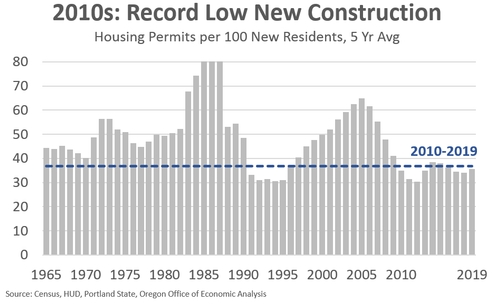
The Oregon housing affordability crisis that rose in the last decade is tied to the lack of new housing construction over the past 10 years, according to the Oregon Office of Economic Analysis report.

“While much of the attention is paid to rising housing costs, we know they are the symptom and not the cause of the disease. The chief underlying cause is the ongoing low levels of new construction this decade,” the report says.

“On a population-growth-adjusted basis, Oregon built fewer new housing units this decade than we have since at least World War II. With data going back nearly 60 years, never have we built fewer new units on a sustained basis than we did in the 2010s.

Lack of New Construction Underlying Cause of Oregon Housing Affordability Crisis

“It is both a near-term concern in that it makes it harder for our neighbors to make ends meet, and it is a long-term risk to the outlook of young, working-age households that cannot afford to move here in the first place,” the report says.

Oregon housing affordability and median household income

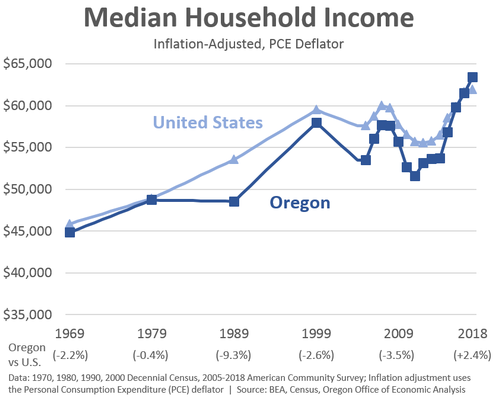
The report also pointed out that despite the housing issues, growth of income was good in the past decade.

Lack of New Construction Underlying Cause of Oregon Housing Affordability Crisis

“For the first time in at least 50 years, Oregon’s median household income is higher than (the national median). And assuming another solid year of income gains in 2019, Oregon will end the decade with inflation-adjusted household incomes somewhere around 13 percent higher than they ever have been before,” the report said.

Oregon employment was uneven across the state

Lack of New Construction Underlying Cause of Oregon Housing Affordability Crisis

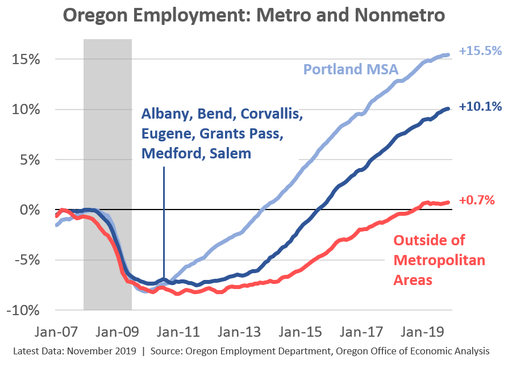
Portland’s growth has “been transformational, as it outpaced all but a few other metro areas” in terms of things like increases in educational attainment, household income gains, and growth in the number of high-wage jobs, the report says.

The urban-rural divide increased in the past decade.

“Rural Oregon overall basically spent half the decade seeing no gains, but has seen solid growth the past handful of years. That said, just nine of Oregon’s 23 rural counties have more jobs today than they did last decade. Encouragingly, rural Oregon has very few places in permanent demographic or economic decline relative to patterns seen throughout the country,” the report says.

Oregon house affordability report summary

Josh Lehner of the Oregon Office of Economic Analysis writes, “All told, the 2010s were a bad economic decade. We spent much of the past 10 years simply digging our way out of the Great Recession, which means we underperformed overall. That said, we are ending the decade in great shape and with an economy that has rarely been better. It’s a low bar to overcome, but taken as a whole, the 2020s should be better.”

Sign Up For Our Newsletter And Get Apartment News And Helpful, Useful Content Each Week.

* indicates required