
Home Blog Page 150

Security Deposits: Common and Costly Mistakes

Security Deposits: Common and Costly Mistakes

Security deposits and many of the issues surrounding them are the topic of the article this month by veteran property manager Corey Brewer.

By Cory Brewer

In my role as a general manager, disagreements over security-deposit resolutions cross my desk more often than most other issues.

I’ve lost count of how many times a former tenant explained that they, “left the home in better shape” than they found it, while at the same time I have had numerous conversations with our landlord clients about how they are being too aggressive with their charges.  It can be a contentious issue on both sides of the table.

We all hope that a tenant treats the rental home with respect, and that we can refund most – if not all – of  security deposits quickly after they vacate.

On the landlord’s end, timing and accuracy are extremely important when dealing with security deposits.

The law in Washington state currently prescribes that a landlord must mail a statement specifying the basis for withholding of security deposit funds within 21 days of the tenant vacating – which is not  always the last day of the lease.  If a tenant were to move out two weeks early and return the keys, then the 21-day clock would start ticking two weeks sooner.  Mailing the statement to the tenant’s last known address is also crucial, so if they have provided this to you before your statement has been mailed out you need to make sure you’re mailing it to their new address.  A simple error (delivered late or to the wrong address) can be very costly in that it could a) eliminate your ability to keep any of the deposit at all, and/or b) entitle the tenant to financial damages above and beyond the full return of their deposit.

Security deposits and pet deposits

Pet deposits (particularly in Seattle) have added a new wrinkle to this process in that a landlord cannot apply pet-deposit funds to cover “people damage.”

For example, a security deposit of $1,000 is collected plus a $250 pet deposit.  At move out, there is no pet-related damage, but it is discovered that the garage door is damaged due to the tenant hitting it with their car. If the door repair costs $1,500, the landlord may apply the $1,000 security deposit toward this repair, but must refund the $250 pet deposit to the tenant.  Ultimately the tenant would owe an additional $500 in damages, not $250 (because you can’t keep the $250 pet deposit for people damage – at least not without the tenant’s consent).  So, in this situation you are simultaneously sending them a refund check and a bill for the balance of the garage door repair cost.

Every penny of security-deposit funds withheld to cover damages, cleaning, or any other unpaid amounts (back rent, late fees, utility bills, etc.) must be supported by an invoice (or copy of tenant ledger indicating delinquent amounts owed).

In addition, the withholding of funds must be supported by clear move-in and move-out inspection reports. Back at move in, you were to have completed a property-condition inspection report and had the tenant sign it in acknowledgment.  At move-out, you would review those notes and make a comparison to the current condition of the property to establish a basis for charging the tenant for damages.

While photos are not legally required, they are highly recommended – at our brokerage, we take more than 100 photos to supplement the majority of our move-in reports.  The photos can be your saving grace if you ever end up in small-claims court arguing over the validity of your charges.

When it comes to security deposits: document, document, document!

Finally, a landlord may not charge a tenant for “normal wear-and-tear,” which can often be difficult to define.

Best practice is to supply the tenant at lease signing with a list of examples of things that would be considered damage vs. wear-and-tear to set the expectation.

A landlord also may not charge a tenant for any improvements post-tenancy.

For example, if a vinyl floor was damaged, a landlord may not take advantage of the situation by charging the tenant to install porcelain tile.  The landlord may still replace the floor with porcelain tile, but may only charge the tenant the equivalent of what it would have cost to replace it with like-kind vinyl.  Depending on the damaged item, depreciation must also be considered – certain elements of the property (appliances, hardwood flooring, carpet, paint, etc.) have their own general “useful-life” spans.

So for example, if a tenant dents the door of a 25-year-old refrigerator, the landlord cannot charge the full cost of a brand new one to replace it.  The word “reasonable” is found littered throughout RCW 59.18 of the Washington state Residential Landlord-Tenant Act, and if you find yourself in front of a judge you will have to come up with a “reasonable” explanation for your actions.

So to recap on security deposits – when your tenant vacates you’ve got to act quickly, keep a clear paper trail, and make sure that you are being reasonable.  Good luck!

Cincinnati Landlords Must Give Renters Security-Deposit Options
Sign Up For Our Newsletter And Get Apartment News And Helpful, Useful Content Each Week.

* indicates required


Salt Lake City Rents Held Steady Over The Past Month

Salt Lake City Rents Held Steady Over The Past Month

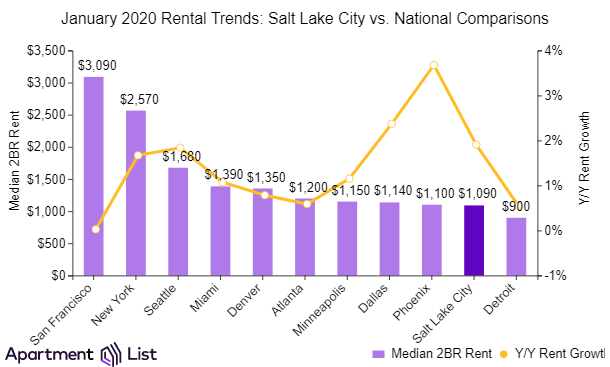
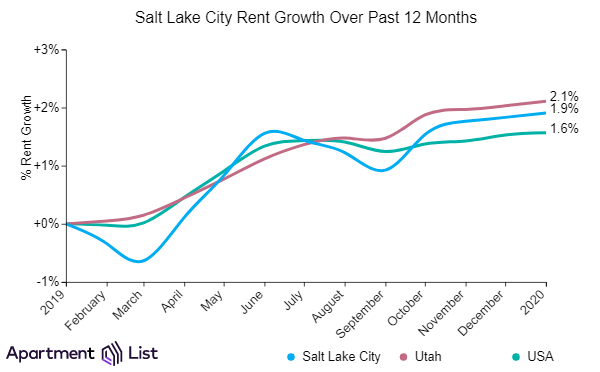
Salt Lake City rents have increased 0.1 percent over the past month, and are up slightly by 1.9 percent year-over-year according to the latest report from Apartment List.

Currently, median rents in the city stand at $879 for a one-bedroom apartment and $1,090 for a two-bedroom.

Salt Lake City’s year-over-year rent growth lags the state average of 2.1 percent, but exceeds the national average of 1.6 percent.

Salt Lake City rents more affordable than many large cities nationwide

As rents have increased slightly in Salt Lake City, a few large cities nationwide have also seen rental income grow modestly. Salt Lake City is still more affordable than most large cities across the country.

  • Salt Lake City’s median two-bedroom rent of $1,090 is below the national average of $1,193. Nationwide, rents have grown by 1.6 percent over the past year compared to the 1.9 percent rise in Salt Lake City.
  • While Salt Lake City’s rents rose slightly over the past year, many cities nationwide also saw increases, including Phoenix (+3.7 percent), Dallas (+2.4 percent), and Seattle (+1.8 percent).

Utah rent

Ogden rents increased slightly over the past month

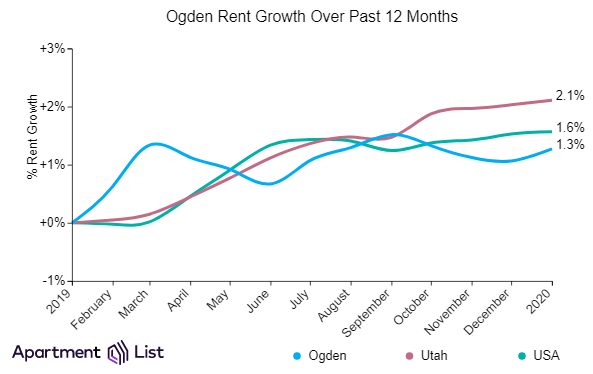
Ogden rents have increased 0.2 percent over the past month, and have increased slightly by 1.3 percent in comparison to the same time last year.

Currently, median rents in Ogden stand at $697 for a one-bedroom apartment and $893 for a two-bedroom. Ogden’s year-over-year rent growth lags the state average of 2.1%, as well as the national average of 1.6%.

ogden apartments

Salt Lake City Rents Up For Second Month In A Row

Seattle City Council to Consider Banning Evictions In Winter

Seattle City Council to Consider Banning Evictions In Winter
The legislature provided pro and con statements on the bill based on testimony.

The Seattle City Council has voted out of committee a proposed ordinance banning evictions in winter, according to reports.

The proposal would ban evictions in Seattle during the five months between November 1 and March 31. It would prevent a landlord from evicting a tenant for failure to pay rent for up to five months.

The exceptions to the proposal would be for landlords who live on their own rental property or if a tenant is doing something illegal in or around the building.

The proposed law from Seattle City Councilmember Kshama Sawant has been voted out of committee, with changes that would allow evictions in special circumstances.

To help survive potential legal challenges, Sawant added an amendment to position the winter months as a defense to getting evicted, rather than an outright ban, and includes a few “just cause” exemptions that include crimes by the tenant and any illegal actions from the landlord, according to SCC Insight.

Sawant originally introduced the idea of banning winter evictions late last year. She said in a release that the City of Seattle Renters’ Commission sent a letter urging the City Council to pass an emergency moratorium – effective immediately – on evictions during the winter. In their letter, the Commissioners said, “Passing such a moratorium will keep neighbors from being displaced to the streets during the months with the harshest weather and poorest living conditions for neighbors living unsheltered.

“I am grateful to the Renters’ Commission for recommending an emergency moratorium on winter eviction,” Sawant said in the release. “I strongly agree that Council needs to put this into effect immediately.”

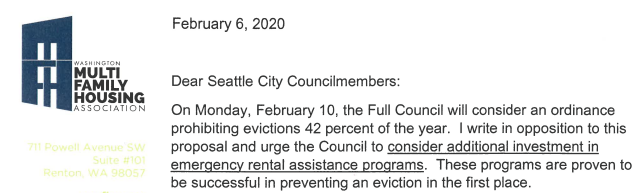
The Washington Multifamily Housing Association wrote a letter to the council opposing the ban on evictions and suggesting instead that they consider additional investment in emergency rental-assistance programs.

Seattle City Council to Consider Banning Evictions In Winter
Please click here to read the full letter.

“It is financially prudent to invest in emergency rental assistance before an eviction is filed, than wait for an eviction action to be filed, risking the tenant’s housing and increasing the cost burden on programs dedicated to preventing displacement due to eviction,” the association said in the letter.

“We support a modest increase in the emergency rental assistance to provide tenants experiencing financial hardship the opportunity to recover their tenancy prior to an eviction action starting, and ask that you consider this approach as an alternative to preventing the court from considering  evictions altogether 42 percent of the year,” the association said in the letter.

King County saw approximately 3,200 evictions in 2017, with more than 85 percent of them filed for nonpayment of rent, and more than half involving the nonpayment of one month’s rent or less, according to The Seattle Times.

The average temperatures in Seattle in the winter months according to Climate-Data.org are: November, high 51, low 40; December, high 46, low 37; January, high 45, low 35; February, high 49, low 37; and March, high 52, low 38. The average number of days per month when the temperature dips below freezing are: November, three; December, eight; January, six; February, five; March, two.

Resources:

Bipartisan Legislative Support To Ban Seattle’s Eviction Ban

COUNCIL VOTES BAN ON “WINTER EVICTIONS” OUT OF COMMITTEE

Sawant’s proposed ban on winter evictions voted out of committee

Winter evictions could be banned in Seattle

Letter from the Washington Multifamily Housing Association

Sign Up For Our Newsletter And Get Apartment News And Helpful, Useful Content Each Week.

* indicates required


The Best Appliances In Rental Property

The Best Appliances In Rental Property

What are the best appliances in rental property to attract tenants is this week’s maintenance tip from Keepe.

Upgrading appliances in a rental property is one way for property managers to command higher rent and attract high-end tenants. These appliances, when safe and reliable, add great value to your rentals, which eventually translates into increased income over time.

Besides enhancing value, appliances are also tax-deductible. Under Section 179 of the U.S. tax law, property managers are mandated to deduct appliances (as of 2018) – another reason to upgrade to better appliances. Before you upgrade appliances in a rental unit, we have suggested some tips on which appliances are most ideal and safest to use for your properties.

Appliances In Rental Property: Electric Stove or Gas Stove?

Before deciding on which stove to use for your property, a property manager should first consider the risks and the long-term costs of each. Some factors to consider are the cooking range, safety, and prices of each type of stove.

Range

Tenants who cook daily can hardly tell the difference between these two stoves. However, an interesting insight: a chef would prefer a gas stove over an electric stove, while a baker would choose the opposite.

Safety

There are certainly different safety hazards associated with using either of these stoves. By using an electric stove, a tenant could risk an electrical fire or electrocution, especially if improperly installed or under-maintained. Alternatively, using a gas stove puts a tenant at risk of carbon monoxide poisoning.

Price

Gas stoves are a more expensive option. However, natural gas is more affordable in the long run. Consider these factors before choosing the right stove for your property.

Faux Stainless Steel Refrigerator or Traditional Stainless Steel Refrigerator?

When it comes to appliances in rental property, having a white refrigerator is good, but not good enough for tenants who like to see stainless steel refrigerators in their living space.

Traditional stainless steel refrigerators often complement other appliances in a rental property. However, they are unfortunately not more stain-resistant than faux stainless steel refrigerators.

While it’s easy to invest in a new refrigerator, it’s important to consider whether there would be enough space in the rental unit to swing it open and if the unit’s dimensions of the kitchen can allow the main compartment and freezer to freely open.

Dishwashers

Like stoves, dishwashers add considerable value to rental properties. Before buying one, property managers need to consider a few things:

Garbage disposal

For the long-term maintenance of a dishwasher, it’s important to know whether a dishwasher has self-cleaning filters or requires manual cleaning.

Energy

Opt for a dishwasher with an energy star symbol on it. Your tenants are likely to save money on electricity when using it.

Capacity

Get a standard size dishwasher if your rental units have huge kitchen spaces or multiple tenants. A compact dishwasher is enough for a small kitchen, though.

To attract high-end tenants and command higher rents for your rental property, make sure to upgrade your appliances in rental property to fit their needs and exceed expectations.

Other recent posts from Keepe.

Top Maintenance Call In January: Broken Garbage Disposals

3 Reasons Why You Should Consider Trash Valet Service

How Can You Detect Faulty Electrical Wiring In A Rental Property?

About Keepe:

Keepe is an on-demand maintenance solution for property managers and independent landlords. The company makes a network of hundreds of independent contractors and handymen available for maintenance projects at rental properties. Keepe is available in the Greater Seattle area, Greater Phoenix area, San Francisco Bay area, Portland, San Diego and is coming soon to an area near you. Learn more about Keepe at https://www.keepe.com

Sign Up For Our Newsletter And Get Apartment News And Helpful, Useful Content Each Week.

* indicates required


January Quarterly Survey Indicates Apartment Conditions Mixed

January Quarterly Survey Indicates Apartment Conditions Mixed

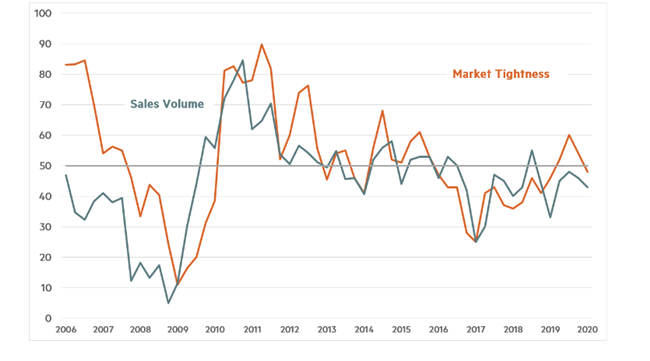
Chart courtesy of the National Multifamily Housing Council.

Rental housing In January showed mixed results for apartment conditions with some softening of the market, according to a release from the National Multifamily Housing Council (NMHC).

Certain market conditions are loosening. And the sales-volume index slipped further below the break-even level (50) to 43, indicating a continued softness in property sales, according to the NMHC Quarterly Survey of Apartment Market Conditions

“This reflects some seasonal decline; along with the paucity of available deals, some respondents also noted the negative impact of the new rent laws in New York,” said NMHC Chief Economist Mark Obrinsky in the release.

Additionally, the Market Tightness Index (48) slipped below the breakeven level (50).

“Apartment markets showed some softening in line with the slower leasing in the winter months,”  Obrinsky said. “Even so, the Market Tightness Index reading of 48 was the highest January reading in five years, and slightly higher than the January average of 45 in the survey’s 21-year history.”

On the financing side, the survey results painted a much different picture. The Equity Financing (61) and Debt Financing (68) indexes signaled improving availability of capital, coming in well above the breakeven level (50).

The survey also included a question on zoning reforms. Thirty-six percent of respondents indicated that they operate in a locality considering zoning changes, with eight percent of those respondents stating that their jurisdiction has already taken action. Of respondents in localities discussing revamped zoning regulations, 44 percent have observed strong community opposition.

More details:

  • The Market Tightness Index decreased from 54 to 48, indicating the first sign of looser market conditions since January 2019. Nearly one-quarter (23 percent) of respondents reported looser market conditions than three months prior, compared to 18 percent who reported tighter conditions. Over half (59 percent) of respondents felt that conditions were no different from last quarter.
  • The Sales Volume Index decreased from 46 to 43, with 28 percent of respondents reporting lower sales volume than three months prior. Over half (58 percent) of respondents regarded volume as unchanged, while a much smaller group – 14 percent of respondents – reported higher sales volume. The share of respondents indicating increased sales volume has not been this low for eleven quarters.
  • The Equity Financing Index rose from 55 to 61, marking the ninth straight quarter of improving or unchanged conditions. Twenty-seven percent of respondents reported that equity financing was more available than in the three months prior, compared to only five percent who believed equity financing was less available. Meanwhile, the majority of respondents (58 percent) thought that conditions were unchanged in the equity market.
  • The Debt Financing Index decreased from 75 to 68, with 40 percent of respondents still reporting better conditions for debt financing compared to the three months prior, while only five percent felt that financing conditions were less favorable. This quarter, the largest share of respondents (45 percent) felt there were unchanged conditions.

About the Survey: The January 2020 Quarterly Survey of Apartment Market Conditions was conducted January 21-28, 2020; 78 CEOs and other senior executives of apartment-related firms nationwide responded.

Sign Up For Our Newsletter And Get Apartment News And Helpful, Useful Content Each Week.

* indicates required


How Technology is Changing Property Management and Why You Should Care

5 Online Tools for Managing Your Rental Properties Remotely

Sponsored Article
By  Alex Britton

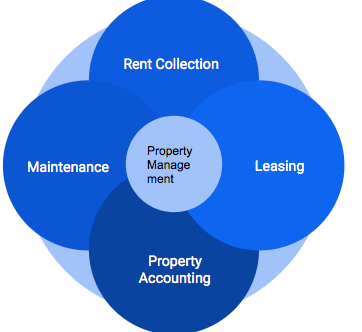
Like most industries, property management is being disrupted by technology. As a property owner and former tenant, I’ve experienced each side of property management, with and without technology being involved. From rent collection and handling maintenance issues to property accounting and leasing, there are new ways to leverage technology to efficiently manage your properties, and your portfolio.

Let’s consider technology and property management on a spectrum, going from manual on one end to automate on the other. The traditional way of managing property where almost everything is handled manually: Tenants send or drop off checks and cash, leave messages when a maintenance issue comes up, and look through classifieds to find apartment rentals.

Things gradually became more automated with options like PayPal and Venmo to collect rent, and web portals were created by large management companies to handle online rent payments and in-building messaging to alert tenants of upcoming building repairs. Today, apps are now available to assist in automated rent collection; in-app messaging to provide maintenance communications that allow tenants to identify the type of problem and send images so that the issues can be dealt with sooner rather than later, and to notify tenants of an event or an upcoming building repair; and built-in marketing tools to list vacant apartments on popular rental websites.

Studies and surveys from leading real estate blogs and publications show that incorporating technology into the property management mix is the new norm. Millennials and Gen Z are the largest groups renting and Mashvisor says that automation is going to be a necessity in the 2020’s. A 2020 CBRE report goes a step further saying that tech integration, including mobile app payment for rent, is an important amenity for multi-family properties.

So how does tech measure up in real terms? Let’s take a look at how it is directly shaping the four pillars of property management.

How Technology is Changing Property Management and Why You Should Care

Rent Collection:

Late payments and inputting cash and checks manually slows down the accounting cycle, among other things. With an app, payment reminders and notifications go directly to the tenant when rent is due. Tenants can pay from anywhere, with one tap of their phone, enabling landlords to collect rent two times as fast.

Maintenance:

Decentralized communications from messages coming from different places -vms, email, or texts, and delays in response time due to a lack of organization, all contribute to the problems that arise when maintenance issues are not dealt with in a timely manner. Technology is driving more efficient ways to manage maintenance issues, from in-app reporting to contacting your maintenance provider, all communication is in one location and easily tracked.

Property Accounting:

Weekly and monthly reports are time consuming to keep up with manually, especially when you have multiple properties to track and documents are coming from different sources. Incorporating property management software will enable you to automatically log and track all revenue and expenses in a general ledger, making it much easier to manage.

Leasing:

Writing copy and placing your listing on multiple real estate sites is tedious and takes time. Property management software allows you to quickly publish and edit your listings to multiple sites at once, respond to inbound leads, order background and credit checks, and eviction reports, all from one hub.

Like any disruptor, there are barriers to entry to consider- cost, ease of use, and security. Although it can cost a property manager hundreds, if not thousands of dollars a month to use property management software, there are platforms that are free to use, and have the same, if not better features than their more expensive competitors.

For some, adopting a new process seems to be too time consuming to change and too difficult to learn. But contrary to this belief, there are platforms that have been built intuitively by property managers, for property managers, keeping easy onboarding, inputting, and reporting top of mind and easy to use.

Lastly, like other ACH payment options, online rent payment software adheres to the same strict guidelines to keep both tenant, landlord, and third party transactions secure. Banking credentials are verified and protected.

As technology continues to shape the way properties are managed and how tenants and landlords communicate, adopting new processes to improve efficiency and ultimately, your bottom line, is well worth the time to explore. Learn more about what technology is right for you.

‍About the author:

How Technology is Changing Property Management and Why You Should Care
Alex Britton has extensive experience working in the technology industry, where he has led software development;  go-to-market strategy; and operations teams. Alex has worked as a growth product manager at Toast Inc. and Blue Apron where he gained a strong understanding of B2B and consumer software businesses, and is a  tech entrepreneur and co-founder of getrentroom.com, a real estate technology company. Alex holds a B.A. in Entrepreneurship and Computer Science from NYU.

The Utility of Reviewing Your Tenant Utility Billing Practices

The Utility of Reviewing Your Tenant Utility Billing Practices

Bradley S. Kraus
Attorney, Warren Allen, LLP

Every year, new issues seem to take the landlord/tenant world by storm. Some have a larger effect than others, but these new issues often result in lawsuits or an increased frequency of counterclaims in eviction actions.

Wherever these issues are litigated, they complicate the business of being a landlord.

The newest issue involves challenges to the practice of billing tenants for utilities. Given the dollar figures involved in some of these lawsuits, there’s new utility in reviewing how you bill utilities.

As an initial matter, ORS 90.315, the utility-billing statute of the Oregon Residential Landlord and Tenant Act (ORLTA), requires that the rental agreement describe the utilities a landlord intends to bill to the tenant.

While that may seem like an obvious requirement, I occasionally encounter issues with clients believing their rental agreements allow them to charge for a utility when the rental agreement is devoid of any language allowing them to do so. If these landlords are billing those undisclosed or unmentioned utilities, it can have disastrous consequences.

Assuming a landlord has a written rental agreement allowing him or her to charge for utilities, ORS 90.315(4) is where I see landlords trip up the most. This section contains a variety of disclosure requirements, which many landlords—or their third-party billing agents—overlook.

Litigation involving this statute centers around three separate requirements:

  • A landlord must bill the tenant in writing for the utility within 30 days after receipt of the provider’s bill.

This requirement starts the clock on the landlord from the time they receive the provider’s bill. Many landlords go through third-party billing companies that bill the tenants for the landlord, but the same timeline requirements would apply to those third-party billing companies. If the third-party billing company is not sending the tenant a bill within 30 days of receipt of the utility provider’s bill, the landlord is likely liable for that failure.

  • The landlord must make certain disclosures in the rental agreement or in a bill to the tenant.

ORS 90.315 requires the landlord to disclose the following information, either in the written rental agreement or in a bill to the tenant:

(i)            The manner in which the provider assesses a utility or service charge; and

(ii)    The manner in which the charge is allocated among the tenants if the provider’s bill to the landlord covers multiple Tenants.

Claims arising under the statute usually target this provision due, in my opinion, to the vagueness of the same and also because no guidance on these disclosures exists. Often, rental agreements or the bill provided by the landlord/third-party billing agent may not be specific enough as to how the provider (as opposed to the landlord) assesses the charges. No one really knows for sure how detailed this explanation must be. As more litigation asserting utility claims floods the courthouse, erring on the side of caution and providing as much detail as possible on the provider’s assessment of charges is recommended.

  • The landlord must include the provider’s bill with the utility bill or inform the tenant they can inspect the provider’s bill.

The disclosure requirements require a landlord to do one of the following, with regard to the utility provider’s bill:

  • Include in the bill to the tenant a copy of the provider’s bill; or
  • If the provider’s bill is not included, state that the tenant may inspect the provider’s bill at a reasonable time and place and that the tenant may obtain a copy of the provider’s bill by making a request to the landlord during the inspection and upon payment to the landlord for the reasonable cost of making copies.

Reviewing the above, compliance with this statutory requirement requires only one of these tasks. Landlords can either send the provider’s bill directly with any tenant-specific bill (which may require copying and other administrative tasks), or simply state in the tenant-specific bill that the “tenant may inspect the provider’s bill at a reasonable time and place and that the tenant may obtain a copy of the provider’s bill by making a request to the landlord during the inspection and upon payment to the landlord for the reasonable cost of making copies.”

The damages provision of the statute is also the subject of dispute among landlord/tenant attorneys.

Tenants’ attorneys are taking the position that any violation of the above disclosure requirements entitles a tenant to one month of rent in every month for every utility for which a landlord fails to comply with the above requirements. While attorneys disagree on the scope and amounts of damages involved, such claims are stressful, time-consuming, and costly.

The above only scratches the surface of ORS 90.315 and the practice of tenant-utility billing in general. Accordingly, find and use competent legal counsel, and ensure that your utility-billing practices comply with the statute.

About the author:

Brad Kraus is an attorney at Warren Allen LLP. You can reach him at kraus@warrenallen.com or 503-255-8795

New Year, New Laws: A Brief Overview of the Newest Landlord/Tenant Legislation

Sign Up For Our Newsletter And Get Apartment News And Helpful, Useful Content Each Week.

* indicates required


Five Things To Remember When Deciding To Do A 1031 Exchange

Kay Properties and 1031 and 1033 exchanges and eminent domain options details

Sponsored Article

By Dwight Kay and the Kay Properties Team

A 1031 exchange is a legal way for investors to defer their capital gains taxes on the sale of real estate held for investment or business purposes. It allows one to defer taxes on a property sale as long as they follow specific 1031 rules and guidelines. In other words, you have the potential to keep all your profits working for you with the purchase of your next investment property, without the IRS coming after you looking for their share of the pie. Here are five things to remember before a 1031 exchange.

1. Taxes are Applicable in a Non-1031 Exchange

When an investor sells a property that has gone up in value this results in several types of taxes. These include capital gains taxes, which the investor must pay if they sell the asset at a price higher than they initially paid for it. Federal capital gains are taxed at 15-20% of the increase in value, while state capital gains are taxed between 0- 13.3% of the increase in value.

Depreciation recapture taxes are taxes due when the seller had claimed depreciation expenses on the sold property. Depreciation recapture is currently taxed at 25% of the amount you have depreciated over the years. Other taxes incurred on property sales include the 3.8% Medicare surtax.

All these taxes are able to be deferred if you do a 1031 exchange. But if you choose to sell your property without a 1031 exchange, ensure you consult a reputable attorney and CPA so you can know what your full tax bill will be when adding up federal capital gains, state capital gains, depreciation recapture and the medicare surtax.

2. You Need a Qualified Intermediary

A 1031 exchange isn’t as simple as selling and reinvesting in another property. You must first transfer the relinquished property to an intermediary or an accommodator so they can execute the sale on your behalf. This is a process whereby your sale contract is assigned to the qualified intermediary and when the property closes your funds are then wired to your account at the qualified intermediary. From there you will instruct which properties you would like the qualified intermediary to purchase on your behalf. Kay Properties is not a qualified intermediary however we work with many throughout the country so if you would like a referral please let us know.

3. You Can Only Purchase a Like-Kind Asset

For you to defer taxes via a 1031 exchange, you must reinvest the profits from the sale in like-kind property. In other words, if you sell a property held for investment or business purposes in a 1031 exchange, the replacement property must be of the same character. For example, you could sell an apartment building and purchase a commercial building or you could sell a rental home and purchase a DST 1031 investment.

4. Remember Deadlines

1031 exchanges are subject to deadlines. If you sell a property today, you’re expected to have identified the replacement property within the next 45 days and reinvested the proceeds in it within 180 days. But if you’d already identified the replacement property, you can reinvest immediately.

5. Understand Your 1031 Exchange Options

Once investors have decided to do a 1031 exchange they should consider their options. First, they could purchase another type of investment property that they would manage on their own. Second, they could purchase a triple net lease property whereby a national tenant such as Walgreens or FedEx has leased the property for typically 10-15 years. The problem with the triple net leased properties is that it causes investors to place a large portion of their net worth into a single property which could be disastrous (think Blockbuster Video). Third, if the investor is wanting to get out of active management and the day to day issues of dealing with tenants, toilets and trash as well as they are wanting to diversify their investments into multiple properties then a DST 1031 exchange may be a solution. The DST (or Delaware Statutory Trust) is a type of property whereby the management is handled by a third party trustee and since the typical minimum investment of a 1031 DST offering is $100,000 investors are able to purchase a diversified portfolio of Delaware statutory trust properties that may include a piece of Walgreens for 100k, piece of a FedEx distribution warehouse for 100k and a piece of a 800 unit portfolio of multifamily properties located throughout the south east and Texas*.

If you are interested in learning more about your 1031 exchange options please get in touch with us today to learn more.

The Fundamentals of 1031 Exchanges

About Kay Properties and Investments, LLC:

Kay Properties and Investments, LLC is a national Delaware Statutory Trust (DST) investment firm with offices in Los Angeles, San Diego, San Francisco, Seattle, New York City and Washington DC. Kay Properties team members collectively have over 114 years of real estate experience, are licensed in all 50 states, and have participated in over $9 Billion of DST real estate. Our clients have the ability to participate in private, exclusively available, DST properties as well as those presented to the wider DST marketplace; with the exception of those that fail our due-diligence process.

To learn more about Kay Properties please visit: www.kpi1031.com

* These are illustrative examples of 1031 DST offerings. Future available 1031 DST offerings and tenants may be

different. Diversification does not guarantee profits or protect against losses.

This material does not constitute an offer to sell nor a solicitation of an offer to buy any security. Such offers can be made only by the confidential Private Placement Memorandum (the “Memorandum”). Please read the entire Memorandum paying special attention to the risk section prior investing. This email contains information that has been obtained from sources believed to be reliable. However, Kay Properties and Investments, LLC, WealthForge Securities, LLC and their representatives do not guarantee the accuracy and validity of the information herein. Investors should perform their own investigations before considering any investment. IRC Section 1031, IRC Section 1033 and IRC Section 721 are complex tax codes therefore you should consult your tax or legal professional for details regarding your situation. This material is not intended as tax or legal advice.

There are material risks associated with investing in real estate, Delaware Statutory Trust (DST) properties and real estate securities including illiquidity, tenant vacancies, general market conditions and competition, lack of operating history, interest rate risks, the risk of new supply coming to market and softening rental rates, general risks of owning/operating commercial and multifamily properties, short term leases associated with multifamily properties, financing risks, potential adverse tax consequences, general economic risks, development risks and long hold periods. There is a risk of loss of the entire investment principal. Past performance is not a guarantee of future results. Potential cash flow, potential returns and potential appreciation are not guaranteed. For an investor to qualify for any type of investment, there are both financial requirements and suitability requirements that must match specific objectives, goals and risk tolerances.

Securities offered through WealthForge Securities, LLC, Member FINRA/SIPC. Kay Properties and Investments, LLC and WealthForge Securities, LLC are separate entities. There are material risks associated with investing in DST properties and real estate securities including illiquidity, tenant vacancies, general market conditions and competition, lack of operating history, interest rate risks, the risk of new supply coming to market and softening rental rates, general risks of owning/operating commercial and multifamily properties, short term leases associated with multi- family properties, financing risks, potential adverse tax consequences, general economic risks, development risks, long hold periods, and potential loss of the entire investment principal. Past performance is not a guarantee of future results. Potential cash flow, returns and appreciation are not guaranteed. IRC Section 1031 is a complex tax concept; consult your legal or tax professional regarding the specifics of your particular situation. This is not a solicitation or an offer to see any securities. Please read the Private Placement Memorandum (PPM) in its entirety, paying careful attention to the risk section prior to investing.


7 Things I Would Tell My Younger Self About Multifamily Real Estate Investing

7 Things I Would Tell My Younger Self About Multifamily Real Estate Investing

Larry Arth started his successful single-family and multifamily real estate investing career helping his dad fix up rental houses and mowing vacant lots around vacant houses. One day at age 15, he asked about buying a lot where he had been mowing. While his dad was not like Donald Trump’s father, Larry’s dad did help Larry a small amount to buy that vacant lot. He sold the lot three years later at age 18 and bought a duplex, his first multifamily real estate investment.

By Larry Arth

Driving down the road yesterday, I was heavy in thought about the investment properties I just been looking at when the song, “If I Could Turn Back Time,” by Cher, came on the radio. While the song is more about relationships, the title and lyrics “If I Could Turn Back Time” continue to resonate with me. It reminds me, growing up, listening to my Dad talk about real estate investing and saying, “If I knew then what I know now,” I would have done things much differently.

7 things I would tell my younger self about multifamily real estate investing

So this got me thinking: If I could turn back time knowing what I know now, what would I do differently?

Align your work with what your passion and interests

Find your strengths and weaknesses, perhaps complete an interest assessment test and create an understanding of yourself.

As a child who was always helping my dad fix up his properties, I was fascinated by houses. When I was a teenager I would sit in open houses for the local real estate broker, (simplifier rules and times then as I basically was babysitting the house.) I loved the architecture and seeing all the different floor plans. I just loved viewing property and wanted to be a Realtor someday.

Yet it took me 18 years before aligning myself in a career that was congruent with my passion. I invested in real estate but did not work in the real estate industry.

Begin with the end in mind when you think about real estate investing

Remember to think long-term.

    •  How do you see yourself living as you age?
    • What are things you want for your family and how you do want to spend your later years?
    • Think back, close your eyes and dream big.
    • Establishing a road map to obtain that lifestyle will be easy if you know where you’re heading.

What career you choose and how you invest in your future will have purpose and meaning. As a young adult, it was more about paying my bills and be able to have new cars and the latest gadgets. Living for the moment was exciting but that excitement fades as years go by and future lifestyles start to take center stage.

Start planning early for your career in real estate or property management

Work smart, not hard to get ahead. “Spend the next 5 years doing what most people will not, so you can spend the rest of your life doing what most people cannot.” Growing up in the Midwest, the old-fashioned Midwestern work ethic had me spending 12, 14 or even 18-hour days. I was making a living but not making a life. In the rural Midwest, there is so much emphasis on hard work. As I moved into bigger cities I was introduced to the concept of working smart instead of working hard. This is when life started changing for me.

Smart work is leveraging your intellect instead of simply swapping hours for dollars. Working smart is creating a plan (yes a written plan) of what you want from life, plan your lifestyle and the money it will take to live that lifestyle, then develop a strategy to get it. For me it meant going from simple goals like buying a property with a $200 monthly cash flow to strategizing the big picture of creating a residual positive cash flow of at least $30,000 per month. These end goals will be the driving force to propel your multifamily real estate investing to the next level with purposeful activity.

I started doing renovations – something I was passionate about

Do what excites you and trust the rewards will follow. Your creative juices will flow more freely when you are coming from a spirit of passion. I grew up and got a job working hard and doing what society wanted from me. It was not until I started my own business doing home renovations- something I was passionate about- that opportunities opened up for me.

I bought my first boat which was another passion, as an outdoors man who, loves the water, boating allowed me to enjoy the great outdoors. Within minutes of starting up the boat my stress vanished. Living a life of passion and purpose is when my investments starting growing exponentially. It is said that the average person has over 130 opportunities pass by them each and every day and most go unrecognized.

So live with passion and the world of multifamily real estate investing can open up for you.

Keep it simple

Focus on simplification and net worth: Simplification is the most overlooked opportunity for creating wealth.

Reducing your monthly obligations gives you more investment capital which can be used to generate more income.

What it took me 40 years to realize

Spend at least five years focusing on wealth creation instead of wasting money on the latest gadgets and things.

Focus on your net worth not your working income. I truly wish I had this advice early on. This took me better than 40 years to realize.

This is part of thinking big and for the long term. Today’s income is simply consumable. When you focus on your net worth, you will think twice about whether the money you are about to lay out is buying you an asset or a liability.

Reinvest to earn more passive income

Savings is paramount to create money for investing. This investing money will now create more passive income.

You can spend the earnings of the investments, but the initial investment should always be re-invested to keep earning more passive income.

The right mindset can open doors

My biggest “Aha” was the realization – and I trust you too have found yourself thinking – “If I knew then what I know now,” you would have done things differently.

Interestingly enough (for me anyhow) the lessons are much deeper than how to invest or what to invest in.

It comes from preparing the mindset. I find it is the proper mindset that opens the doors to the opportunities.

Conclusion

    • Align your passions and your career
    • Begin with the end in mind
    • Start planning for the next 5 years now
    • Do what you are passionate about
    • Keep it simple
    • Focus on wealth creation
    • Reinvest to save
    • Have the right mindset

Resources

What is net worth?

How to access capital and get funded

Four Ways to kick-start your real estate investment

Field guide to multifamily property

U.S. Department of Housing and Urban Development’s Multifamily Housing Programs

About the Author

Larry Arth is the founder and CEO of Equity Builders Group, a Florida based Real Estate investment Group. As a 36 year veteran to real estate investing, Larry understands that we are now in a global economy and as times have changed, investment strategies must change as well. Larry is an international recognized consultant and speaker and assists hundreds of investors per year, both foreign and domestic to realize their investment potential. He analyzes locations across the country for economic strength and the locations that yield the largest most sustainable return on investment.  Within these locations he seeks out and gathers the best teams to deliver sound, high performing and most importantly sustainable turnkey investment. He works with investors to ride the wave of each area-specific market surge. Larry’s primary focus is offering (Non Listed) safe and sustainable turnkey investments to the passive investor.

5 Multifamily Investing Predictions And Expectations For 2020

Sign Up For Our Newsletter And Get Apartment News And Helpful, Useful Content Each Week.

* indicates required


Top Maintenance Call In January: Broken Garbage Disposals

Top Maintenance Call In January: Broken Garbage Disposals

Imagine your tenants switch on the garbage disposal, and instead of hearing the familiar buzz, they hear the bland hum that signals a broken garbage disposal. The next call is to you for repairs.

A working garbage disposal is really important, that is until it’s not working. Broken garbage disposals were the most in-demand maintenance call for Keepe in January.

Tenants calling in to property managers need help immediately. The common message is that their garbage disposal is not working, and their sink is jammed or clogged.

In one instance, a property manager in Phoenix put in an urgent maintenance call to request service as soon as possible. When the technicians arrived, they found a clogged sink and knew that they needed to further examine the garbage disposal to determine the problem.

Let’s Take a Closer Look at the Steps Taken

  • First, they checked the circuit breaker to determine if the power had gone out in the kitchen; they attempted to reset the circuit breaker by flipping it on and off.
  • Next, they looked under the sink to see if the garbage disposal was plugged in.
  • Once the electricity was turned off and the garbage disposal unit unplugged, they needed to unclog the sink.

They removed all the bits in the sink, then used a plunger multiple times to force the drain to unclog. This allowed some of the water to move freely down the drain.

Maintenance technicians understand that garbage disposals are used heavily and can get jammed by stuffing too much down the drain at once. Property managers need to let tenants know and make them aware that stuffing the disposal can lead to a broken garbage disposal.

The maintenance workers started removing any fragments and food particles like raw meat, bones, and vegetable peelings by using tongs, not their hands. Once they finished cleaning the debris out, they pressed the reset button (located under the sink on the unit itself).

When looking under the sink the technicians checked extensively to see if there was a water leak, which can mean a worn-out seal, caused by wear and tear. At this point they did not find any leaks and felt confident that they would not need to replace any parts of the unit, or the unit itself, which saved on maintenance costs.

The technicians were convinced that the broken garbage disposal was now in working order and proceeded to turn the power back on, after ensuring that no one’s hands were in the disposal. At this point, they tested it out to find that their efforts worked.

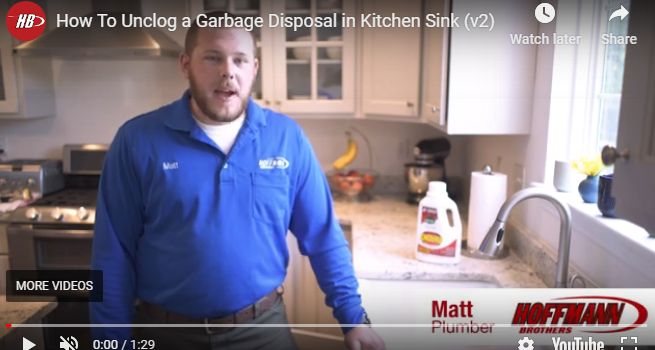
Video on how to unclog a garbage disposal.

broken garbage disposal

It is important to note:

  • the garbage disposal should be used daily, and never over-stuffed with waste.
  • Grease should never be poured down the drain.
  • Water should be running before using and while using the disposal.
  • Only the right kinds of food waste should be put down the drain.

From beginning to end, the entire process took just 30 minutes. Both the tenant and property manager were both happy with the result.

Top Maintenance Call In January: Broken Garbage Disposals
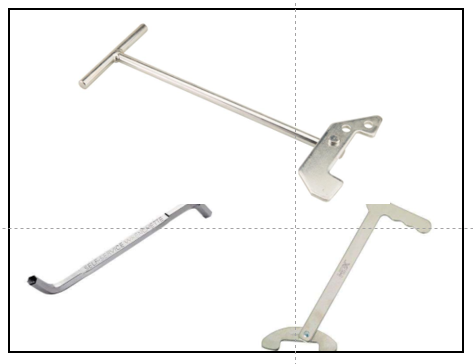
Wrenches that can be used in broken garbage disposal repair.

Other recent posts by Keepe:

How Can You Detect Faulty Electrical Wiring In A Rental Property?

Leaking Sinks No. 1 Most Popular Maintenance Fix in November

About Keepe:

Keepe is an on-demand maintenance solution for property managers and independent landlords. The company makes a network of hundreds of independent contractors and handymen available for maintenance projects at rental properties. Keepe is available in the Greater Seattle area, Greater Phoenix area, San Francisco Bay area, Portland, San Diego and is coming soon to an area near you. Learn more about Keepe at https://www.keepe.com

Sign Up For Our Newsletter And Get Apartment News And Helpful, Useful Content Each Week.

* indicates required