
Home Blog Page 129

Ask Landlord Hank – A Tenant Has Questions About Landlord Obligations

Ask Landlord Hank – A Tenant Has Questions About Landlord Obligations

This week the question for Ask Landlord Hank comes from a tenant asking about repairs and landlord obligations for rental property.

Dear Landlord Hank,

I live in subsidized housing and have been having many issues with the condition of my apartment. Mold is the biggest issue, but my most urgent need affects my stove. Every time it rains, the range/vent hood leaks. This has been going on for over two years. Needless to say, as time goes on it gets worse; today I woke up to my entire counter being wet and dripping onto the floor.

My property manager is well aware of the issue, but no one has come to fix it. It’s getting so bad that I am now afraid to use the range hood or even use the overhead light because I’m afraid of what could happen due to the water. Honestly, no one from that organization has come to do any repairs on any of the units that are on this property since March. I realize that with the pandemic going on that getting help may take more time than usual, but I have watched maintenance come and do yard work every other week and seen several of the workers work on an apartment here that has been empty for well over a year. Please help, I don’t know what else to do.

I have already filed two complaints regarding mold in my house with the city’s code department; the owner was cited with violations, but nothing has been done. I have even had a conversation with the property manager, who said they would send someone to fix my stove ASAP. That was over a month ago.

With winter coming, I need someone to fix these rental property issues. I feel forgotten, and that my wellbeing is of no concern to them. Any real resources would be greatly appreciated.

Thank you,

Amor

Dear Amor,

The landlord and property owner has basic obligations under Landlord Tenant law.

These are fairly universal through the United States. The landlord has the responsibility to maintain the property, including keeping it habitable, safe and clean, as well as adhering to building codes and health and safety codes and federal, state and local laws.

The landlord must perform needed repairs, keep vital services such as plumbing and water, electric and heat in good working order, maintain common areas, and provide for trash removal.

Mold and mildew can be a health hazard, and the landlord must take care of that and keep it from coming back by getting to the root of the moisture.

It sounds like you have a roof leak, and the lack of repair for two years is not acceptable. I would talk to the property manager again, as well as email him or her, so you have a paper trail of the problem.

Find out when someone is coming to take care of the problem. If no one comes by that date, I would contact the manager again, and if still no maintenance, I’d contact someone in the agency that is subsidizing this rental property. Let them know about the multitude of issues and lack of maintenance, on-going long-term requests by you, and the mold problem.

It’s good to keep up the landscaping so the property looks nice, but it would be great to keep up the building as well, so it not only looks nice but is a decent place to live. Good luck!

Sincerely,

Hank Rossi

Ask Landlord Hank - A tenant has questions about landlord obligations in rental property
Landlord Hank says landlord obligations include needed repairs, keep vital services such as plumbing and water, electric and heat in good working order, maintain common areas, and provide for trash removal

Ask Landlord Hank Your Question

Ask veteran landlord and property manager Hank Rossi your questions from tenant screening to leases to pets and more! He provides answers each week to landlords.

  • This field is for validation purposes and should be left unchanged.

Do I Have to Paint and Replace Flooring for a Long-Term Tenant?

Sign Up For Our Newsletter And Get Apartment News And Helpful, Useful Content Each Week.

* indicates required

Should I Turn On The Utilities and Power For New Tenant Moving In?

 

Help for a Portland Landlord Trying to Decide What to Do

5 Things to Keep In Mind When Choosing Property Management Software

5 Things to Keep In Mind When Choosing Property Management Software

Property management involves a lot of hurdles that leaves managers frustrated and stressful at times, so here are 5 tips on choosing property management software from Keepe, the on-demand maintenance company.

The job profile is challenging; it can include managing multiple portfolios of real estate assets dispersed across varied locations, coupled with maintenance requests, routine inspections, and responding to inquiries concerning vacant properties.

Investing in apartment property management software elevates and rethinks how landlords and property managers manage their properties. Whether small-sized condos, multifamily apartments or dedicated commercial hubs, using property-management software takes the business to the next level.

When choosing property management software for your business, you should keep the following five things in mind.

1. Flexibility

Finding property-management software that has the flexibility to add different property types is critical for continuity as your business model evolves. The software should also be able to adapt as your business focus adjusts to changes in the market.

2. Integration

A solid property-management software will have the ability to integrate with other systems and tools. By doing so, you will reduce the amount of double-handling of information and data across projects and programs, saving more time and improving business processes.

3. Ease of Use

Nobody wants to make life harder with a residential property-management system; it’s supposed to do exactly the opposite. And it certainly can, if you make the right choice.

Opt for software that has a simple user interface. One example is a user dashboard, which clearly outlines all the sections and actions users can choose. Remember, it’s not just you and your staff who will be using it, but your residents – who are less likely to do so if it’s complex and confusing.

4. Managing property maintenance

A lot of good property-management software products will have additional features and be capable of seamlessly managing property-maintenance tasks, which can be one of the most time-consuming aspects of the job.

The software must have simple and easy-to-follow workflows, as this feature will allow your managers to record all necessary information, and also access with ease any quotes, work orders, and photos of the jobs required. The software must have an array of functionality and be designed to make your job easier and enable teams to be more productive.

5. Reporting

A great advantage that most property-management software systems now include is the ability to generate insight reports in seconds. This will not only help property managers save time but will also assist them in offering better customer service and staying on top of their workload.

Final Thoughts

Picking the best property management software isn’t easy. But if you follow the advice above, you’ll be well on your way to getting the right software for your business. If you are unsure about the software to choose, you should request a demonstration of the product to make sure it’s mobile-ready and that it integrates with the other programs you use.


About Keepe:

Keepe is an on-demand maintenance solution for property managers and independent landlords. The company makes a network of hundreds of independent contractors and handymen available for maintenance projects at rental properties. Keepe is available in the Greater Seattle area, Greater Phoenix area, San Francisco Bay area, Portland, San Diego and is coming soon to an area near you. Learn more about Keepe at https://www.keepe.com

Are You Making Any Of These 5 Rental Property Management Mistakes?

Sign Up For Our Newsletter And Get Apartment News And Helpful, Useful Content Each Week.

* indicates required

Affordable multifamily markets in high demand

Yardi Matrix September report Affordable multifamily markets in high demand

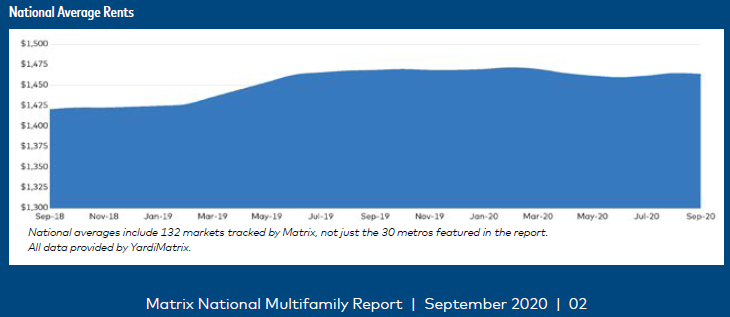
Since the beginning of the pandemic, rents have only fluctuated by a few dollars each month – contrary to what many in the multifamily markets initially feared, according to Yardi Matrix.

“However, there are significant rent variations at the metro level, and given a lack of government stimulus and ongoing layoffs, the fall and winter months will be telling,” Yardi Matrix says in its September report.

“As we move into the fall and winter months, the return to normal remains slow and volatile. Political disruptions are causing further uncertainty, and consumer confidence fell to its lowest level in more than six years in August.

“In September, the unemployment rate declined to 7.9 percent, but there are still more than 12 million people unemployed. With the extreme uncertainty surrounding the country today, the multifamily industry has held up better so far than many predicted,” the report says. In addition:

  • Multifamily markets rents decreased by a dollar in September, to $1,463. Since the beginning of the pandemic, overall rents have only been up or down by a few dollars each month. Many initially feared that the decline would be much steeper than the $8.00 overall national rent decline since February.
  • However, there are significant rent variations at the metro level. Higher-cost metros that have had some of the highest rents this cycle have seen dramatic declines. San Jose (-6.6 percent) and San Francisco (-5.8 percent), the two metros with the largest year-over-year declines in September, have seen overall rents decline by $205 and $136, respectively, since February.
  • The two best-performing metros in September for year-over-year rents, the Inland Empire (3.4 percent), and Sacramento (3.1 percent), have seen overall rents increase by $35 and $37, respectively, since February.

“The commonality among the top-performing metros is their lower cost of living,” the report says.

Yardi Matrix multifamily market report for September shows Affordable multifamily markets in high demand
Chart courtesy of Yardi Matrix.

Cautions about the labor market and permanent job losses

Yardi Matrix cautions to watch the labor market going forward.

“While the unemployment rate continues to improve, another metric to keep an eye on is the number of permanent job losses. In September, the number of permanent job losses increased by 345,000 to 3.8 million; this measure has increased by 2.5 million since February.

“Among the unemployed, the number of people on temporary layoff decreased by 1.5 million in September to 4.6 million.

“As furloughs inevitably become permanent job losses, the economic recovery remains at risk,” the report says. “Eight months into the pandemic, with little aid in sight, companies are being forced to make tough staffing decisions.”

See the full report from Yardi Matrix here.

About Yardi Matrix

Yardi Matrix is a leading source for originating, pre-underwriting and managing assets for profitable loans and investments. Yardi Matrix Multifamily provides accurate data on 18+ million units, covering over 90% of the U.S. population.

More Pain Ahead for the Rental Housing Industry Says Multifamily Outlook

Negative Rent Growth Year-Over-Year For First Time Since 2010

Sign Up For Our Newsletter And Get Apartment News And Helpful, Useful Content Each Week.

* indicates required

Three 1031 Exchange Alternatives

Kay Properties and 1031 and 1033 exchanges and eminent domain options details

By Jason Salmon
Senior Vice President; Managing Director of Real Estate Analytics
Kay Properties and Investments, LLC

1031 Exchange Alternative #1 — Utilizing a 1031 exchange into DST 1031 properties:

Delaware Statutory Trust (DST) real estate has been a great way for investors to participate in passive, professionally managed real estate for their 1031 exchanges since the IRS enacted Revenue Ruling 2004-86 which effectively blessed the use of a properly structured DST 1031 investment as “like kind” for the purposes of a 1031 exchange. The DST investment structure of real estate ownership has given investors the potential to diversify across several property sectors, geographic locations and with various managers. For those that wish to focus on areas of life like family, hobbies and travel instead of dealing with tenants or just having to be constantly concerned with the value of hands-on real estate and the best time to sell, DSTs can potentially be the right thing at the right time.

1031 Exchange Alternative #2 — Utilizing a Qualified Opportunity Zone Fund in lieu of a 1031 Exchange:

Qualified Opportunity Zone Funds are relatively recent investment vehicles whereby investors can place capital gains (within a certain timeline of selling) into real estate investments. Through the Tax Cuts and Jobs Act, certain areas that have been mandated as Opportunity Zones according to the IRS as “an economically distressed community where new investments, under certain conditions, may be eligible for preferential tax treatment.” It should be noted though, that Opportunity Zones are not necessarily used as a 1031 exchange, but rather another option in the case of a failed 1031 exchange or a potential tax-deferral tool for other investments with gains such as stock or the sale of a business.

1031 Exchange Alternative #3 — The 721 Exchange or UPREIT:

Many investors that want to do a 1031 exchange, but don’t want the hassle of day-to-day management, and/or want diversification–and with a working knowledge of Real Estate Investment Trusts (REITs) ask “why can’t I invest in these vehicles for my 1031 exchange?” Because of very specific guidelines for what is considered “like-kind” real estate, REITs are not eligible for 1031 exchange. However, through an UPREIT transaction which stands for Umbrella Partnership Real Estate Investment Trust, it can potentially be possible through a series of steps. With a 721 exchange, instead of a 1031 exchange, investors may exchange property for OP or Operating Partnership units in the REIT. This might be easier said than done since the REIT would have to want to bring the relinquished property in and all parties would have to agree on terms, but it’s possible. Investors should also consider whether the REIT is public or private and the likelihood that they would have interest in conducting another tax-deferred exchange going forward since that would not be possible once this type of transaction has been made.

About Kay Properties and www.kpi1031.com 

Kay Properties is a national Delaware Statutory Trust (DST) investment firm. The www.kpi1031.com platform provides access to the marketplace of DSTs from over 25 different sponsor companies, custom DSTs only available to Kay clients, independent advice on DST sponsor companies, full due diligence and vetting on each DST (typically 20-40 DSTs) and a DST secondary market.  Kay Properties team members collectively have over 115 years of real estate experience, are licensed in all 50 states, and have participated in over 15 Billion of DST 1031 investments.

This material does not constitute an offer to sell nor a solicitation of an offer to buy any security. Such offers can be made only by the confidential Private Placement Memorandum (the “Memorandum”). Please read the entire Memorandum paying special attention to the risk section prior investing.  IRC Section 1031, IRC Section 1033 and IRC Section 721 are complex tax codes therefore you should consult your tax or legal professional for details regarding your situation.  There are material risks associated with investing in real estate securities including illiquidity, vacancies, general market conditions and competition, lack of operating history, interest rate risks, general risks of owning/operating commercial and multifamily properties, financing risks, potential adverse tax consequences, general economic risks, development risks and long hold periods. There is a risk of loss of the entire investment principal. Past performance is not a guarantee of future results. Potential cash flow, potential returns and potential appreciation are not guaranteed.

Nothing contained on this website constitutes tax, legal, insurance or investment advice, nor does it constitute a solicitation or an offer to buy or sell any security or other financial instrument. If you are not the intended recipient of this message, any use, dissemination, distribution or copying of this communication is strictly prohibited. If you have received this communication in error, please immediately notify the sender and permanently delete all copies that you may have. Securities offered through Growth Capital Services, member FINRASIPC, Office of Supervisory Jurisdiction located at 582 Market Street, Suite 300, San Francisco, CA 94104.

Can I Cash-Out a Portion of my 1031 Exchange Proceeds? The Ins-and-Outs of A Partial 1031 Exchange

CDC Issues Guidance on FAQs About its Eviction Moratorium

CDC Extends Temporary Halt in Residential Evictions to June 30

Some guidance on frequently asked questions about the CDC eviction moratorium has been provided by the CDC, and the National Apartment Association (NAA) has provided a look at these questions and answers, according to a release.

The NAA had asked for the additional guidance from the CDC, which was provided in early October.

“There is no doubt that National Apartment Association’s (NAA) aggressive advocacy and legal efforts, including first-hand conversations with the Trump administration and the U.S. Department of Justice (DOJ), played a major role in this guidance.

“NAA voiced concern over the outstanding issues related to the federal eviction restrictions and requested specific supplemental guidance to help housing providers operationalize these confusing and sometimes conflicting mandates, which ultimately culminated in the CDC’s response. Though we continue to advocate against any extension or expansion of federal eviction restrictions, this significant development creates a path forward for the apartment industry,” the NAA said in the release.

CDC eviction moratorium explanations and guidance:

  • The CDC order is not intended to terminate or suspend the operations of any state or local court. Nor is it intended to prevent housing providers from starting eviction proceedings, provided that the actual eviction of a covered person for non-payment of rent does NOT take place during the period of the order.
CDC Issues Guidance on FAQs About its Eviction Moratorium with a release from the National Apartment Association
Covered people still owe rent to their housing provider. The order halts residential evictions only temporarily.
  • The order does not preclude a housing provider from challenging the truthfulness of the resident’s declaration in any state or municipal court. The protections of the order apply to the resident until the court decides the issue as long as the order remains in effect.
  • Housing providers are not required to make their tenants aware of the order and declaration.
  • To seek the protections of the order, each adult listed on the lease, rental agreement, or housing contract should complete and sign a declaration and provide it to the housing provider where they live.
  • Covered people still owe rent to their housing provider. The order halts residential evictions only temporarily. Covered persons still must fulfill their obligation to pay rent and follow all the other terms of their lease and rules of the place where they live. Covered persons must use best efforts to make timely partial payments that are as close to the full payment as their individual circumstances permit, considering other nondiscretionary expenses.
  • Anyone who falsely claims to be a covered person would be subject to prosecution by the DOJ.
  • To make the administration’s stance on these issues abundantly clear, the FAQS represent the views of the U.S. Department of Health and Human Services, U.S. Department of Housing and Urban Development, and DOJ.

“This development is a significant nod to the power of NAA as we continue to lead the fight for our members and the viability of the industry. An additional COVID-19 relief package is likely, and NAA is meeting with lawmakers and staff daily to tell them that apartment owners, operators and residents need direct rental assistance.

CDC Issues Guidance on FAQs About its Eviction Moratorium

“Eviction moratoria are not the answer and will do nothing to solve renters’ housing insecurity. Further, our lawsuit against the CDC is ongoing. While the new guidance provides some important clarification for the industry, we are seeking a final ruling that will decide whether the CDC exceeded its authority; that decision may not come until the new year,” the NAA said in the release.

7 Insights for Landlords on the New Federal Eviction Moratorium

Sign Up For Our Newsletter And Get Apartment News And Helpful, Useful Content Each Week.

* indicates required

What Eviction Reporting Codes to STOP Using Now, and a New CDC Eviction Moratorium

What Eviction Reporting Codes to STOP Using Now and credit reporting

The COVID-19 pandemic has thrown everything out of whack, including credit reporting. Creditors have made unprecedented accommodations to help struggling debtors. As a result, you’ve had to shift the way you reported credit to ensure your clients and tenants aren’t adversely impacted. Datalinx has tried to keep you abreast of all the latest changes in credit reporting to ensure you have the most up-to-date reporting guidance.

Changes in eviction reporting codes

If you are a property owner or manager who reports evictions, you’ll want to pay attention to this latest advice from TransUnion:

Based on various state regulations and executive orders related to COVID-19, TransUnion is advising that you discontinue reporting Special Comment Codes QQ‐Eviction (non‐legal action) and RR‐Eviction until further notice. TransUnion has made the decision to remove accounts reported with these Special Comment Codes from our database.  We will advise once you can resume reporting Special Comment Codes QQ‐Eviction (non‐legal action) & RR‐ Eviction.

 As previously communicated, if a resident is confirmed to be affected by a natural or declared disaster and is not able to make payments, you should report the resident as Current (Rental/Lease Status = 11) with a Current Balance of $0 and Payment Amount Confirmed of $0. Subsequently, for any month that was impacted, you should report a “D” in the Rental History Profile to indicate that no Payment History was available for those months.

What Eviction Reporting Codes to STOP Using Now and credit reporting

More eviction guidance

On September 4, 2020, the Centers for Disease Control and Prevention (CDC) issued a temporary eviction moratorium that extends through December 31, 2020. (You may remember that the CARES Act included an eviction moratorium, which expired on July 24, 2020.) The CDC’s goal is to prevent further spread of COVID-19 by evicted individuals and families, but nonetheless has a direct impact on creditors.

The CDC’s moratorium temporarily halts certain residential evictions for nonpayment of rent for those who qualify. Renters must declare (under penalty of perjury) that they:

  • Have tried to obtain all available government assistance,
  • Expect to meet certain maximum earnings guidelines,
  • Are unable to pay full rent,
  • Are trying to make partial payments,
  • Would become homeless or need to move into a shared residence if evicted, and
  • Still have to comply with other rental obligations.

Renters seeking protection under this moratorium are required to submit the declaration to their property owners/managers. After the moratorium expires on December 31, 2020, property owners may require payment in full. Failure to pay at that time could result in a legal eviction.

Questions?

If you have questions about reporting evictions and eviction reporting codes to the credit bureaus, reach out to Datalinx. Our experts can help you navigate the complicated waters of COVID-19 credit reporting!

Please visit our website at www.datalinxllc.com, or contact us at support@datalinxllc.com or (425) 780-4530 if you have any questions or need our assistance.

Credit Bureau Report Reveals Pandemic’s Impact on Rental Industry

Sign Up For Our Newsletter And Get Apartment News And Helpful, Useful Content Each Week.

* indicates required

Help for a Portland Landlord Trying to Decide What to Do

Help for a Portland Landlord Trying to Decide What to Do on subletting

This week a Portland landlord asks about tenant subletting while rental property is on the market and what they should do – the question for Ask Landlord Hank. Remember Hank is not an attorney and is not giving legal advice.

Dear Landlord Hank,

We own a rental in Portland, Oregon. Thank you for your condolences… we have put our rental on the market. One of the two tenants has moved out. The remaining tenant wants to get another roommate to cover the rent expense. Our rental agreement says no subletting, etc., but with the weird rules Portland keeps implementing, can we still say “no” to the present tenant’s request to get a new roommate in this rental?

-Betsy

Dear Landlady Betsy,

You’re right, it’s really complicated in Portland and Oregon right now. I don’t know exactly what your local laws are now regarding leases and leasing, but if one tenant broke the lease, and your lease forbids subletting, then you should be able to enforce that.

The problem is that most tenants that have roommates do so for economic reasons; it is more manageable to pay half the bills than all of them.

Can your current tenant pay the rent by himself or herself and still make ends meet, or will this desertion by the co-tenant make this tenant unstable, eventually having to move or be evicted?

You may need to compromise. Do you want to keep this tenant?

Does the tenant have a good long history with you, and how much time is left on the current lease?

If your tenant can’t pay rent alone, you may want to let him or her out of the lease and start over with a new, more economically sound tenant. Or, you could let current tenant find a roommate, subject to background-screening approval, to ride out the rest of the lease.

Not sure what current economy is like in Portland, but if it is strong, it may be better to start over.

Sincerely,

Hank Rossi

Ask Landlord Hank - Help for a Portland Landlord Trying to Decide What to Do and the subletting issue
Landlord Hank says If your tenant can’t pay rent alone, you may want to let him or her out of the lease and start over with a new, more economically sound tenant.

Ask Landlord Hank Your Question

Ask veteran landlord and property manager Hank Rossi your questions from tenant screening to leases to pets and more! He provides answers each week to landlords.

  • This field is for validation purposes and should be left unchanged.

Do I Have to Paint and Replace Flooring for a Long-Term Tenant?

Sign Up For Our Newsletter And Get Apartment News And Helpful, Useful Content Each Week.

* indicates required

Should I Turn On The Utilities and Power For New Tenant Moving In?
Hottest Cities for Millennial Renters

Hottest Cities for Millennial Renters

Most millennials are renters, and have been shifting away from the two-kid, white-picket-fence American dream. This means they’re also less likely to get tied down to a specific city. So where are the hottest cities for millennial renters?

RentCafe analyzed 13 million renter applications nationwide to identify the cities where millennials represent the highest share of those who applied for apartments.

“Specifically, we focused on large and mid-sized cities — where millennials represent 38.5 percent of applications — and ranked them based on each city’s share. Finally, we looked at the hottest cities for millennial renters in 2020 to get a snapshot of the emerging hubs where this trend-setting generation is heading next,” RentCafe said in the survey.

Here are the main findings about millennial renters:

  • Austin is set to dethrone Seattle to become the next No. 1 millennial city. This year, more than half of the renters who applied for an apartment in the Texas capital were millennials (50.5 percent).
  • Seattle, the capital of the millennial nation for five years, dropped to fourth place in 2020.
  • Oakland made an astounding entrance into the list of top 15 future millennial hotspots, shooting straight up to 3rd place with a 48.4 percent share of millennials applying for apartments there in 2020.
  • Philadelphia, San Jose, Virginia Beach, and Los Angeles are new additions to the top 15, replacing cities like Denver, Atlanta, or Portland, whose popularity among millennial renters might be dwindling.
  • Despite the looming tech exodus, San Francisco stays strong. With 48.6 percent of all rental applications coming from millennials, the city maintained its second spot in 2020 by attracting a significant share of New York’s millennial renters (8.2 percent) in the last five years.

Conclusion

Now that they’ve officially overtaken baby boomers as the largest U.S. generation to date – as well as making up the majority of the workforce – millennials have become the most instrumental group in shaping the future of America’s urban cores.

Residents Working from Home Require More Space in Apartments, Homes

Security Deposit vs. Move-In Fee: Which is Better?

Sign Up For Our Newsletter And Get Apartment News And Helpful, Useful Content Each Week.

* indicates required

Are You Making Any Of These 5 Rental Property Management Mistakes?

Are You Making Any Of These 5 Rental Property Management Mistakes?

Here are 5 rental property management mistakes that Keepe, the on-demand maintenance company, sometimes sees at rental properties.

Managing a rental property can be challenging even for the most experienced property managers. As a property manager, you need to ensure that your tenants, workers, contractors, and your properties are in good shape.

If you are a property manager managing 1 or 100 rental properties, here are five rental-property management mistakes from Keepe that you want to avoid.

No. 1: You Don’t Have A Screening Process in Place

 As a property manager you are most likely to deal with all kinds of tenants­.

When you rent your property to a destructive or troublesome tenant, you are sure to lose money and deal with problems every day. One sure way to save yourself of these issues is to have a detailed formal tenant-screening process that helps you select the right kind of tenants for your rental.

No. 2: You Don’t Have A Reliable Contractor When Issues Happen

 Your tenants want the best service and quick solutions to their maintenance problems.

Not having a dedicated and reliable handyperson you can call immediately will likely affect your tenant satisfaction and retention rates.

As a property manager, you should have a list of reliable contractors for specific types of property-maintenance issues.

No. 3: You Don’t Have A Maintenance Schedule

Most property managers wait until the appliances in their property develop faults or cause damage before doing maintenance.

Not only does this delay aggravate the repair issue, you may be face with constant crises. As a property manager seeking to offer your tenants the best service, you should have a dedicated monthly or quarterly maintenance schedule.

Do a monthly maintenance check of your property alarms, electrical fittings, and outdoor landscape. By being proactive in your property maintenance, you keep your tenants satisfied and your home safe from sudden equipment breakdown. Don’t make this common rental property management mistake.

No. 4: You Don’t Understand How To Attract New Tenants

 Just as with any other businesses, managing a rental property requires that you market your property aggressively to attract new renters.

You need to understand what potential renters are looking for and what attracts new renters.

An easy way to do this is to create a profile of the neighborhood where your rental property is located and make a list of the amenities, economic activities, recreational centers, and the type of schools. This will help you target the right potential renters during your marketing process.

No. 5: Your Management System is Still Paper-Based

 Shockingly, many property-management companies’ systems are purely paper-based, with little or no influence of technology.

Not only does it make the process unorganized, it also leaves room for failure. As a property manager, you should adopt more technology in the day-to-day running of your properties to save you and your tenants’ time.

And with the coronavirus pandemic, there has never been a better time to make the switch. Property managers are beginning to adopt online showings of their properties to potential renters.

Potential tenants can now pay rent online, tour houses, and electronically sign lease agreements without the need to physically visit the property.

Rental property management mistakes conclusion

As a property manager, it is important that you satisfy your tenants and keep your rental properties in great condition. By having a dedicated maintenance schedule, you save not only money but improve the safety of your rental.

Most importantly, having a reliable contractor on call to handle your rental repair issues will help in increasing your tenant satisfaction rate.

About Keepe:

Keepe is an on-demand maintenance solution for property managers and independent landlords. The company makes a network of hundreds of independent contractors and handymen available for maintenance projects at rental properties. Keepe is available in the Greater Seattle area, Greater Phoenix area, San Francisco Bay area, Portland, San Diego and is coming soon to an area near you. Learn more about Keepe at https://www.keepe.com

Become a Master Strategist: Today’s Key for Successful Landlords

Successful Landlords Know All Tenant Screening Companies Are Not The Same

Manage in the Past and Forget the Present

Sign Up For Our Newsletter And Get Apartment News And Helpful, Useful Content Each Week.

* indicates required

Renters Struggling to Make Housing Payments Less Likely to Vote

Renters Struggling to Make Housing Payments Less Likely to Vote

Americans who are not able to make housing payments today are significantly less likely to vote and those who are struggling most are least likely to make their voices heard at the ballot box, according to a new survey from Apartment List.

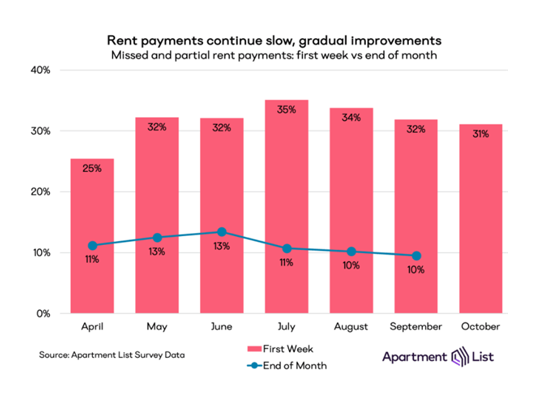
“In the first week of October, 31 percent of renters failed to make a complete on-time payment of their rent bill,” Apartment List writes in the survey. “This represents the third straight month that we’ve seen improvement in this figure and the best rate of on-time payment since April.

“The changes here have been extremely slow and gradual, but as talks for additional stimulus continue to stall out in Congress, any improvement whatsoever can be taken as a positive signal. That said, this improvement may also be driven by a composition effect if those renters who are struggling most have moved back in with family or friends and are simply no longer appearing in our renter sample.”

Although nearly one in three renters failed to pay their full rent in the first week of the month, “we continue to find that the majority of these missed payments are made up with late payments by the end of the month.”

Key findings from the report include:

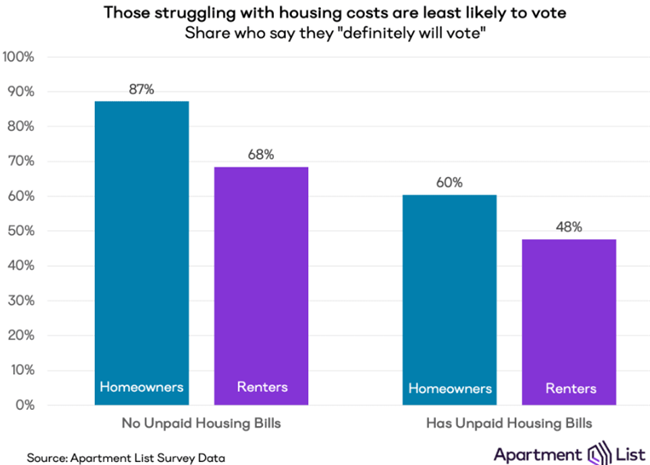
  • 79 percent of those who began October fully caught up on their rent or mortgage say that they “definitely will vote,” compared to just 55 percent of those with unpaid housing bills from prior months.
  • 78 percent of homeowners say that they will definitely vote, compared to just 62 percent of renters, mirroring prior research on the disparities in political engagement between the two groups.
  • Overall, 31 percent of renters failed to make a complete rent payment in the first week of October, and 10 percent had not fully paid their September rent by the end of the month. These struggling renters with the most pressing needs are least likely to have their voices heard in the upcoming election.

Those struggling with rent and housing payments are less likely to vote

As the election rapidly approaches, “we asked this month’s survey respondents about their intent to vote on November 3. The results point to a concerning trend in the way that economic hardship interacts with political participation.

“We find that those who entered October with unpaid housing bills from prior months are significantly less likely to say that they ‘definitely will vote’ in the upcoming election. Among homeowners, 87 percent of those who started the month without any unpaid mortgage bills plan to vote, compared to just 60 percent of those who had unpaid bills.

“We observe a similarly large gap between renters who are fully caught up on their rent payments and those who have outstanding rent debt,” the survey said.

“This gap is not explained by political-party preference. We find that rent debt and missed housing payments are common across the political spectrum, and missed-payment rates were consistent across respondents in counties that Trump won and counties that Clinton won in 2016. Those with no unpaid housing bills report being more likely to vote regardless of whether they report leaning Democrat or Republican.

“In addition to finding that those who are struggling with housing costs are less likely to vote, we also observe a significant gap in expected voter turnout between renters and homeowners, a phenomenon which we’ve explored in detail in the past. Although the gap between renters and homeowners is partially driven by demographics, homeowners are also motivated by a significant financial interest in policies that could affect local property values.

Renters Struggling to Make Housing Payments Less Likely to Vote

“Among the four groups displayed in the chart (above), renters with unpaid rent bills are by far the least likely to say that they plan to vote. This finding implies that those Americans with the most pressing needs are least likely to have their voices heard in the political process. While we did not explicitly ask why respondents do or do not plan to vote, we have previously found that renters are more likely to be non-citizen immigrants, and therefore ineligible to vote.

“However, prior analysis of census data has also shown that renters have lower turnout than homeowners even when limiting to the voting-eligible population. This is likely at least partly driven by the difficulty of their circumstances. For example, these renters are more likely to work hourly wage jobs, and voting may require taking time off work that impacts their paychecks in a way that salaried workers need not worry about. Furthermore, low-income renters are more likely than homeowners to be members of minority groups that may be subject to voter-suppression tactics.”

Housing payments conclusion

“We found that those who are currently bearing the brunt of the economic pain are actually least likely to vote. While partially driven by demographics, this result also reflects the fact that voting often entails an extra burden for many low-income minority renters.” The payment survey is showing “the various ways that societal inequities play out in the housing market,” Apartment List said in the report.

Read the full report from Apartment List here.

The Looming Debt Trap Facing Renters

Governor Extends Oregon Foreclosure Moratorium to End Of The Year

Sign Up For Our Newsletter And Get Apartment News And Helpful, Useful Content Each Week.

* indicates required