HUD is charging Post Presidential Property Owner, LLC, and Post Commercial Real Estate, LLC, the owner and manager respectively of Presidential City Apartments in Philadelphia, with disability discrimination.
A tenant with a disability requiring an emotional support animal reached out to HUD alleging that she had been denied a reasonable accommodation to have pet fees waived at the apartments for such an animal.
The Fair Housing Act prohibits housing discrimination based on disabilities, including denying reasonable-accommodation requests for the waiver of pet fees for assistance animals and rejecting requests for a designated handicapped parking space needed by a person with a disability.
The complaint said “the tenant received an email from apartment’s counsel stating ‘a landlord is entitled to charge pet fees for an emotional support animal, which is considered a pet, unlike a service animal’.”
Based upon this evidence, HUD recommended testing the subject property.
The tests focused on reasonable accommodations relating to designated accessible parking and emotional-support animals for prospective tenants with disabilities.
According to the complaint, several testers were told there was a $250 pet deposit required. One tester who visited and toured the property told leasing specialist Dayanna Reeves she was looking for an apartment for her niece. When Reeves asked if the niece had any pets, the tester said that her niece had an emotional-support dog. Reeves told the tester about the $250 refundable deposit for the animal and the monthly pet fee of $25.
Leasing director Crystal Ayers confirmed that the apartments had a policy that it would not waive pet deposits and monthly pet fees for tenants with emotional-support animals. Ayers further stated that respondents applied this policy to all the properties it owned and managed, according to the complaint.
“The department found that respondents denied reasonable accommodation requests of testers representing prospective tenants with a disability-related need for an emotional-support animal.”
The Fair Housing Act was violated, according to the complaint, denying testers’ reasonable accommodation requests for designated parking and the waiver of pet fees for emotional-support animals for prospective tenants with a disability.
“Reasonable accommodations enable persons with disabilities to fully utilize and enjoy their homes and shouldn’t be denied,” said Anna María Farías, HUD’s Assistant Secretary for Fair Housing and Equal Opportunity, in the release.
“HUD will continue taking action to protect their rights by ensuring that housing providers meet their obligations under the Fair Housing Act.”
Landlords and tenants are facing rent delinquencies due to covid-19 so here are some thoughts to help from a veteran property manager.
By Justin Becker
Property Manager
There is no denying that right now, COVID-19 continues to affect the real-estate and rental market.
If you’re a property manager or landlord of a multifamily housing community or complex, navigating these waters for the last eight months has been somewhat challenging.
Nevertheless, with no real end in sight, mass unemployment, fluctuation in available job opportunities, and the ongoing pandemic, it is still very difficult for tenants to be able to pay their rent and still afford their other monthly expenses.
Working with tenants who are experiencing economic hardships due to COVID-19 has been par for the course for these last couple of months. Moreover, with most property managers’ and landlords’ hands being essentially tied in regard to legally dealing with late rent payments or lack of payments, it is not too surprising that people are starting to get creative by finding proactive ways to deal with rent delinquencies.
Other than being more flexible, many property managers are not sure what else they can do during these uncertain times. But the good news is that there is definitely more that can be done.
That said, here are the five best ways to deal with rent delinquencies right now.
No. 1: Build Proactive Partnerships
One of the best things you can do as a property manager right now is to collaborate with your tenants to ease the pressure and address financial hardships.
Obviously, open lines of communication are key here, and looking for a win-win solution to the problem makes everyone walk away from negotiations feeling a little better. A prime example of building proactive landlord-tenant partnerships is deferring a portion of rent and establishing a reasonable repayment plan.
Alternatively, you can decide if a low rental rate moving forward is a feasible option for tenants affected by the ongoing pandemic. This may be a better option for property managers who have mobile homes for rent or those leasing single-family dwellings. Otherwise, if you have apartments for rent, you may need to consider if finding new tenants is more cost-effective in the long run.
No. 2: Invest in Tenant Loyalty
Yet another proactive option for dealing with rent delinquencies now is to invest in tenant loyalty.
For instance, if you know tenants and residents are struggling during this time but are still finding a way to make the rent, why not acknowledge that?
Invest in tenant loyalty and reward action where you can.
Try hosting appreciation events that get the community out and having fun (using, of course, the CDC guidelines). This allows your residents to relieve some stress but also breaks down walls between landlord and tenant.
Similarly, providing tenants with incentives to stay even after all of this is over, by giving a small rental credit or even a gift basket with needed supplies (masks, hand sanitizers, etc.), can lead to long-term retention. Such incentives can also be effective if you manage a community with mobile homes for sale. Here, homeowners can easily relocate their manufactured home once their lot-rent lease is up; thus, it pays to invest in these particular tenants especially.
No. 3: Paying Close Attention to Future Changes
It is also beneficial to keep your ear to the ground.
Apartment-eviction moratoriums did not spring up overnight, and there was definitely talk of what local and state governments might do before they happened.
Therefore, as more and more people are falling ill to COVID-19 and businesses continue to close their doors, paying closer attention to what the future of renting and leasing holds is crucial.
Furthermore, it is important to note that landlords and owners are not without a voice right now. Becoming actively involved, as much as you can, may just help save your business and keep roofs over your tenants’ heads.
So, stay apprised of relevant industry organizations and support those that will end up playing a role in how things look, legislatively speaking, and moving forward.
No. 4: Offer Job Postings
Along those same lines, if you know of potential job openings or industries that are hiring during COVID-19, why not share it with your tenants?
There is a whole host of employment opportunities online for remote workers, essential workers, and healthcare providers. So, if you stumble upon jobs that are perfect for any of your unemployed residents, it might be worth the mention.
And, since you are still actively keeping lines of communication open, you can send job-posting emails, as well as adding a section to your website page for local employment opportunities. In fact, little things like this will help your tenants feel like they are not alone in this and will help to foster positive relationships within the community.
No. 5: Provide Assistance Information
Making it easier for your tenants and residents to get in touch with agencies that are providing much-needed assistance is another way to make a difference.
Helping your residents secure food, homeschooling supplies, affordable medications at NYGoodHealth, cleaning supplies, utility-payment assistance, and so on makes their financial responsibilities a little easier to manage.
This, in turn, is likely to increase the chances that your tenants or residents will be able to pay rent or adhere to their new rental agreement and payment arrangements. Leasing-office staff can help take it a step further by helping to set up appointments with delinquent residents so they can contact the necessary parties via phone with a property management team member.
Remember, at the end of the day, you and your tenants are truly a community; thus, working together in this manner should not be difficult because when your tenants are good, by extension, so are you.
Likewise, you may even want to consider partnering with local charities and non-profit organizations if you know a large sector of your community could benefit. For example, if you have several tenants that are veterans or many residents with kids, then it does not hurt to see what is available in the way of assistance for them right now.
Bonus suggestion: Early-Payment Raffles
Lastly, a bonus suggestion that property managers and landlords may want to consider is hosting early-payment raffles.
This is a great way to show appreciation to tenants that are still meeting their financial obligations. Moreover, early-payment raffles can be a wonderful incentive for people who are torn between paying rent in full or allocating a portion of those funds to something else. Plus, the entire raffle program can be done without requiring anything additional from your residents or making management team members’ jobs harder.
Everyone that pays a month in advance will automatically be entered into a raffle each month to receive money off the following month’s rent. What’s more, you can up the stakes by offering anyone who pays two months’ rent upfront a guaranteed $100.00 off their rent the next month.
Final Thought on Rent Delinquencies
Real estate or rental housing is fundamentally a relationship business, even in the midst of an ongoing pandemic.
While no one can truly predict the future, people need housing. As a result, looking for viable or proactive solutions to keeping people in their homes is what matters now. That said, property managers or landlords also have financial obligations to meet and their own housing costs.
So, it is imperative that we all work together to weather the storm. Through effective communication and landlord-tenant collaboration, collective anxiety and distrust can be diffused. By following these suggestions mentioned above, you can help curate solutions that will bridge the shutdown, which means landlord-tenant relationships ultimately can be preserved, and on-time rental payments will no longer be a thing of the past.
About the author:
Justin Becker is a property owner in the state of Michigan and has a passion for managing communities. He owns apartment complexes and mobile home communities, and has been writing his own blogs for his properties for several years.
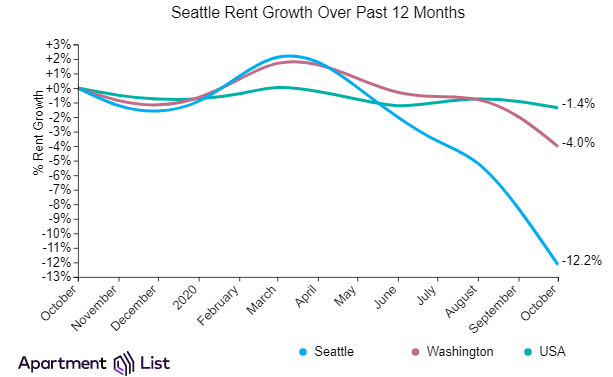
Seattle rents declined 4.2 percent over the past month, and are down sharply by 12.2 percent year-over-year, according to the latest report from Apartment List.
Currently, median rents in Seattle are $1,483 for a one-bedroom apartment and $1,849 for a two-bedroom.
This is the seventh straight month that the city has seen rent decreases after an increase in March. Seattle’s year-over-year rent growth lags the state average of -4.0 percent, as well as the national average of -1.4 percent.
“As the COVID-19 pandemic and its ensuing economic fallout continue to overwhelm renters across the country, our monthly rent estimates paint the picture of a protracted national slowdown and uneven recovery,” said Chris Salviati, Housing Economist at Apartment List.
“Our national rent index is down 1.4% year-over-year, but there is tremendous regional variation beneath the surface. San Francisco and New York City continue to lead the nation in pandemic rent drops, while smaller markets like Boise and Colorado Springs are heating up,” Salviati said.
Rents rising across the Seattle Metro
While Seattle rents decline, rent prices in the rest of the metro are seeing the opposite trend.
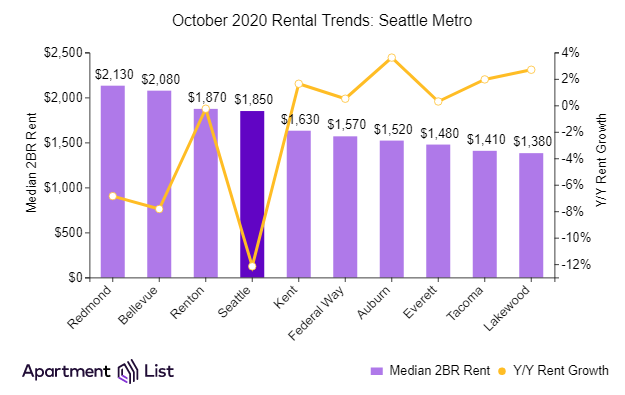
Rents have risen in 6 of the largest 10 cities in the Seattle metro for which Apartment List has data. Here’s a look at how rents compare across some of the largest cities in the metro.
Lakewood has the least expensive rents in the Seattle metro, with a two-bedroom median of $1,382; additionally, the city has seen rent growth of 0.4 percent over the past month, the fastest in the metro.
Seattle proper has seen the biggest rent drop in the metro.
Redmond has the most expensive rents of the largest cities in the Seattle metro, with a two-bedroom median of $2,131; rents went down 2.3 percent over the past month and 6.9 percent over the past year.
A property manager who added rooms and walls to rental properties without the owners’ consents has been ordered to pay $585,000 in restitution, according to a release.
A King County Superior Court Commissioner in Seattle ordered an Auburn property management company to pay after the company’s owner hijacked the homes of people who hired his company by adding new walls and rooms without the owners’ knowledge or consent, and refusing to pay homeowners.
In addition to financial penalties, the commissioner also barred company owner Travis A. Jackson from marketing property management services without first obtaining a license; making unauthorized modifications to homes; and making false and misleading representations. The court intended for $256,000 to go toward restitution for people affected by the scheme and an additional $252,000 in civil penalties. The civil penalties go to the Washington state general fund. Jackson must also pay just more than $76,000 in attorney costs and fees.
In March, Washington Attorney General Bob Ferguson asserted Jackson formed a property-management company, NW Property Solutions, without getting a license. He then began preying on homeowners who wanted help renting out their homes, according to the release.
Jackson advertised his property-management services for free, then pressured homeowners to sign contracts the commissioner described as “unfair” and “unconscionable.” The contracts gave him sole control over the properties in exchange for monthly rental payments to the homeowners. Those contracts contained provisions hidden in fine print that gave Jackson’s company the right to withhold rental payments if the owners attempted to contact Jackson via phone about issues at the properties.
Without telling homeowners or obtaining their approval, Jackson built new interior walls to expand the number of bedrooms in the rental properties he controlled. For example, in one case, Jackson built three additional bedrooms into a home zoned for no more than six people, then packed the home with 14 tenants. When local government officials imposed fines and penalties, Jackson then refused to pay and left homeowners to foot the bill.
The order noted that Jackson’s conduct was deceptive and “substantively ‘unconscionable’ and unfair.”
“Our office has a robust team of attorneys who protect Washingtonians from scams,” Ferguson said. “The court described this scam as unconscionable. If you feel like someone is taking advantage of you, please let my office know.”
Washington Attorney General Bob Ferguson said, ““The court described this scam as unconscionable. If you feel like someone is taking advantage of you, please let my office know.”
Jackson also operated a separate house-cleaning business. In October 2019, Ferguson filed criminal charges against Jackson for $33,000 in unpaid wages in connection with his ownership and operation of the cleaning service.
Other than one telephonic conference with the court, Jackson never responded to the charges and he never produced any information requested by the state or court. Because Jackson failed to provide information, the attorney general’s office is unaware of the full scope of his scheme, except for the half dozen people who complained to the office about incurring thousands of dollars of repair bills, unpaid rent and unpaid utilities due to Jackson’s mismanagement of their property, according to the release.
Property manager left homeowners helpless
The property manager, Jackson, was routinely late in paying rent to the homeowners and in many cases simply stopped paying altogether. When homeowners contacted him with concerns, he accused them of violating the contracts and threatened to withhold additional payments and to take legal action against them.
One homeowner — a legally blind woman who owned a house in Tacoma — described her experience to the attorney general’s office. She noted in a declaration provided to the court she had found Jackson’s business online around September 2019 and contacted him because she wanted to rent her house out to tenants. Jackson informed her he was a real estate agent and had a license.
A month later, Jackson asked her to sign a new contract that covered additional parts of her house. Jackson had not paid the first month of rent and the homeowner said she would not sign anything until he paid. When Jackson continued to withhold payments, putting the homeowner at risk of defaulting on her mortgage, she signed the new contract and added the words “under duress” next to her signature.
Home inspectors who subsequently went into her house told her Jackson, the property manager, had turned her living room into multiple bedrooms and placed most of her furniture in the back yard. She noted she had lost thousands of dollars in unpaid rent and utility payments. When she placed her house on the market, an offer came in that was significantly less than an offer she had received before Jackson went into her home, reflecting the extent of damage to the home. She also has received a foreclosure notice on her house from her lender.
Another homeowner in the Bothell area said he contracted with Jackson in May 2019 after a friend recommended the service. Two months later, a city building inspector told the homeowner the house had far too many bedrooms and tenants for the home’s septic system to support. The inspector sent a letter noting the homeowner was liable for multiple penalties for the operation of a “congregate living facility.” Jackson denied the city inspector’s report, and told the homeowner only “five or six” people lived in his house. Jackson said he would not pay the homeowner at all if he kept calling.
The city gave the homeowner until October 2019 to reduce the number of bedrooms in the home or upgrade the sewage connection. The city charged the homeowner $22,000 in civil penalties and Jackson told the homeowner he would pay the costs. Jackson never paid. Jackson ultimately gave the homeowner a post-dated check in December 2019 to cover unpaid rent. A month later, Jackson told the homeowner not to cash the check. The homeowner switched to a new property manager, then worked out living arrangements with the tenants.
A resurgence of apartment leasing activity during the third quarter of 2020 yielded a strong demand for skilled professionals, according to the latest jobs report from the National Apartment Association (NAA).
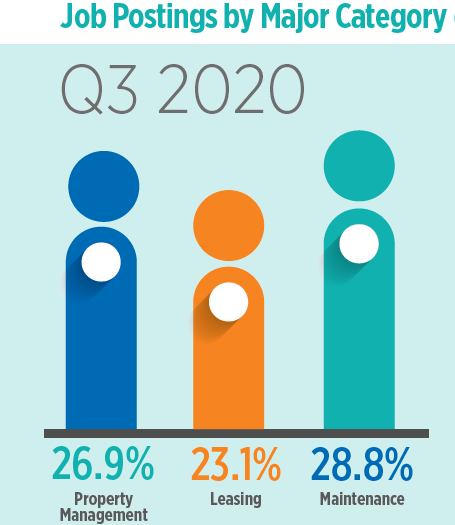
The NAA Education Institute’s Apartment Jobs Snapshot showed job openings in the multifamily sector comprised nearly 44.0 percent of positions available in the real estate sector, surpassing the 5-year average of 30.9 percent.
Maintenance talent was the most sought after; with residents spending more time at home, the need for repairs and maintenance has increased significantly.
Dallas, Los Angeles, Washington, D.C., Atlanta, and Houston lead the nation for apartment job demand.
Leasing activity was also resilient in the student housing sector, as students are in search of housing near their campuses.
According to RealPage, net move-ins totaled 146,517 units in the third quarter.
Student housing apartment jobs
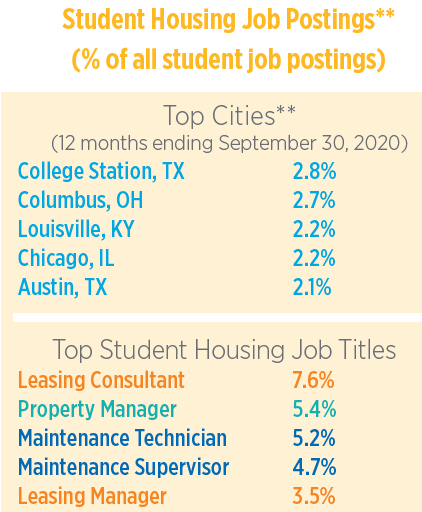
During the past 12 months ending September 30, 2020, demand for student housing management professionals was highest in College Station, Columbus, Louisville, Chicago and Austin.
Leasing consultants were in highest demand, representing almost 8.0 percent of all student housing job postings. Overall, the off-campus student housing sector remains resilient. Demand has been solid, mainly driven by students who prefer to live nearby their campus.
California voters rejected rent control In Tuesday’s election by defeating a ballot measure called Proposition 21 that would have rolled back state limits on rent control.
Proposition 21, which failed, would have allowed local governments in California to put rent control on all kinds of rental property. Although ballots are still being counted, the “no” votes accounted for almost 60 percent of the more than 11 million votes counted so far, according to reports.
Voters had rejected a similar proposal in the past.
The Apartment Association of Greater Los Angeles said Proposition 21 was soundly defeated by a large majority of California’s voters. “If it had passed, Proposition 21 would have imposed irreversible and adverse impacts on rental housing throughout the state,” said Daniel Yukelson, executive director of the Apartment Association, in a release.
“Proposition 21’s proposed, extreme price controls on virtually all of California’s rental properties would have exasperated our already existing housing shortages and affordability issues. The proposal would not have created even one unit of new housing, let alone a unit of affordable housing. Had Proposition 21 passed, it would have been nothing more than a ‘bankruptcy bill’ for the rental housing industry here in California,” the association said.
If you have a 1031 exchange coming up, you have multiple choices to reinvest the proceeds from your sale. That’s a good thing, because coming out of your prior investment, maybe you’re tired of the three Ts — tenants, toilets and trash — and you’d rather leave the day-to-day property management to others.
A 1031 exchange (also known as a like-kind exchange) allows an investor to defer capital gains, depreciation recapture and other taxes at the time an investment or business property is sold if the net equity from the sale is reinvested in a property of the same or greater value. Fortunately, “property” does not mean the proceeds have to be reinvested directly into another property that you purchase outright and manage on your own. There are multiple ways the gain can be reinvested to qualify for preferential tax treatment.
Here’s a look at four alternative 1031 exchange investment options for investors to know.
#1: Qualified Opportunity Zone Funds
Qualified Opportunity Zone Funds, which were enabled by the Tax Cuts and Jobs Act of 2017, offer benefits including tax deferral and elimination that many investors nationwide have utilized. A fund of this type can invest in real property or operating businesses within an Opportunity Zone, typically a geographic area in the U.S. that has been so designated because it may be underserved or neglected. As such, there may be a higher level of investment risk. Also, the time horizon of the fund may be as long as 10 years, which means tying up your capital for that length of time in an illiquid real estate fund.
If you seriously consider this investment option, be aware that these funds may have been set up to invest in only one property or business, in which case there is no diversification. But the opposite may also be true. With a fund of this type, there can be potential cash flow and appreciation, as well as positive economic and social impacts on a community. This fund option also works if you are selling other appreciated assets like stocks or businesses.
#2: Tenants-in-Common Cash-Out
In addition to using a 1031 exchange to defer taxes, some investors also want to improve liquidity so they can potentially take advantage of other buying opportunities in the future. With a Tenants-in-Common (TIC) investment, you own a fractional interest in a commercial, multifamily, self-storage or other type of investment property. The TIC cash-out is a specific strategy where the investment property is purchased using zero leverage so it is debt-free, with no mortgage, going in. Then, after a year or two, the property can be refinanced at 40% to 60% loan to value, effectively providing investors with a large portion of their initial invested principal tax-free in the form of a cash-out refinance. Under this scenario, the remaining equity in the investment stays in the TIC property, providing potential distributions to investors while they get to enjoy liquidity with a large portion of their funds.
#3: Direct Purchase of Triple-Net (NNN) Properties
With a triple-net leased property, the tenant is responsible for the majority, if not all, of the maintenance, taxes and insurance expenses related to the real estate. Investors utilizing a 1031 exchange often are interested in purchasing NNN properties, which typically are retail, medical or industrial facilities occupied by a single tenant. On the surface, these investments may seem passive, but there are three distinct downsides, namely concentration risk if an investor places a large portion of their net worth into a single property with one tenant; potential exposure to a black swan event like COVID-19 if the tenant turns out to be hard hit; and management risk.
Remember the three Ts I alluded to above. If you’d prefer a passive investment, the direct purchase of a triple-net property is not likely for you. Others may allude to triple-nets being management free. However, having owned dozens of net lease properties throughout my career I can tell you they are anything but management free. (Just ask my in-house legal counsel, and asset management and accounting teams.)
#4: Delaware Statutory Trusts
In contrast to the example above where you buy the whole property yourself, Delaware Statutory Trusts (DSTs) are a form of co-ownership that allows diversification and true passive investing. Most types of real estate can be owned in a DST, including retail, self-storage, industrial and multifamily properties. A DST can own a single property or multiple properties. In a 1031 exchange scenario, you can invest proceeds from the prior property sale into one or more DSTs (holding one or more properties) to achieve diversification.
DSTs often hold institutional-quality properties. The properties could be occupied by single tenants operating under long-term net leases, such as a FedEx distribution center, an Amazon distribution center, a Walgreens Pharmacy or a Fresenius dialysis center. DSTs can be one of the easiest 1031 replacement property options to access because the real estate already has been acquired by the DST sponsor company that offers the DST to investors.
Regardless of the approach you choose to reinvest the proceeds from your prior sale, the net effect of 1031 exchange investing is generally the same. The initial invested capital and the gain can continue to grow, potentially, without immediate tax consequences. Then, if and when the new investment is sold down the road without the equity reinvested in another exchange property, the prior gain would be recognized.
Dwight Kay is founder and CEO of Kay Properties and Investments, LLC, which operates a 1031 exchange property marketplace at www.kpi1031.com.
About Kay Properties and www.kpi1031.com
Kay Properties is a national Delaware Statutory Trust (DST) investment firm. The www.kpi1031.com platform provides access to the marketplace of DSTs from over 25 different sponsor companies, custom DSTs only available to Kay clients, independent advice on DST sponsor companies, full due diligence and vetting on each DST (typically 20-40 DSTs) and a DST secondary market. Kay Properties team members collectively have over 115 years of real estate experience, are licensed in all 50 states, and have participated in over 15 Billion of DST 1031 investments.
This material does not constitute an offer to sell nor a solicitation of an offer to buy any security. Such offers can be made only by the confidential Private Placement Memorandum (the “Memorandum”). Please read the entire Memorandum paying special attention to the risk section prior investing. IRC Section 1031, IRC Section 1033 and IRC Section 721 are complex tax codes therefore you should consult your tax or legal professional for details regarding your situation. There are material risks associated with investing in real estate securities including illiquidity, vacancies, general market conditions and competition, lack of operating history, interest rate risks, general risks of owning/operating commercial and multifamily properties, financing risks, potential adverse tax consequences, general economic risks, development risks and long hold periods. There is a risk of loss of the entire investment principal. Past performance is not a guarantee of future results. Potential cash flow, potential returns and potential appreciation are not guaranteed.
Nothing contained on this website constitutes tax, legal, insurance or investment advice, nor does it constitute a solicitation or an offer to buy or sell any security or other financial instrument. If you are not the intended recipient of this message, any use, dissemination, distribution or copying of this communication is strictly prohibited. If you have received this communication in error, please immediately notify the sender and permanently delete all copies that you may have. Securities offered through Growth Capital Services, member FINRA, SIPC, Office of Supervisory Jurisdiction located at 582 Market Street, Suite 300, San Francisco, CA 94104.
This week the question for Ask Landlord Hank comes from a landlord asking whether he can evict tenants who have damaged his rental. Remember Hank is not an attorney and is not giving legal advice.
Dear Landlord Hank,
Tenants of 10 years have done substantial damage to the home, not normal wear and tear, but that could be subjective upon the beliefs of a judge.
The home needs a complete renovation that cannot be completed with tenants living in the home. Can they be evicted because the home has become unsafe to continue to inhabit? Without being responsible to pay their rent or moving costs for them to move out?
–Yvonne
Dear Landlady Yvonne,
We now have a federal moratorium on evictions until the end of the year, and the interpretation of the order varies from one jurisdiction to another and from one judge to another.
If these tenants are paying rent and are satisfied to stay in their rental for now, I would not rock the boat.
You can always renovate when their lease is up.
When the eviction moratorium has ended, the courts will likely be packed – meaning the time it normally takes to evict a tenant will be substantially increased, and it could take months.
If you feel that you can’t wait and want to move forward now, I would engage an attorney that specializes in landlord/tenant law, as they will be up to date on the situation in your county. Good luck.
Sincerely,
Hank Rossi
On the question of whether to evict tenants due to damage Hank says, “If these tenants are paying rent and are satisfied to stay in their rental for now, I would not rock the boat.”
Ask Landlord Hank Your Question
Ask veteran landlord and property manager Hank Rossi your questions from tenant screening to leases to pets and more! He provides answers each week to landlords.
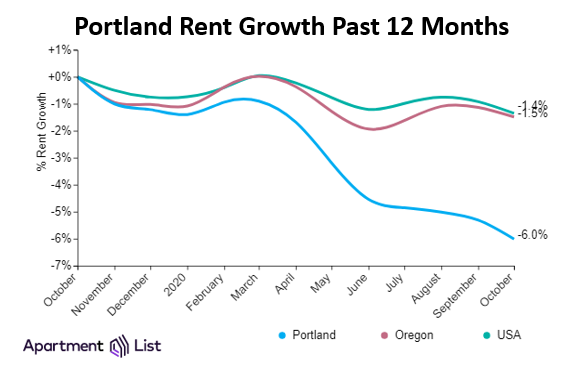
Portland rents declined again last month for the seventh straight month, while rent continues to increase in some cities in the metro area, according to the latest report from Apartment List.
Portland rents were down 0.7 percent over the past month, and have decreased sharply by 6.0 percent year-over-year.
Portland’s year-over-year rent growth lags the state average of -1.5 percent, as well as the national average of -1.4 percent.
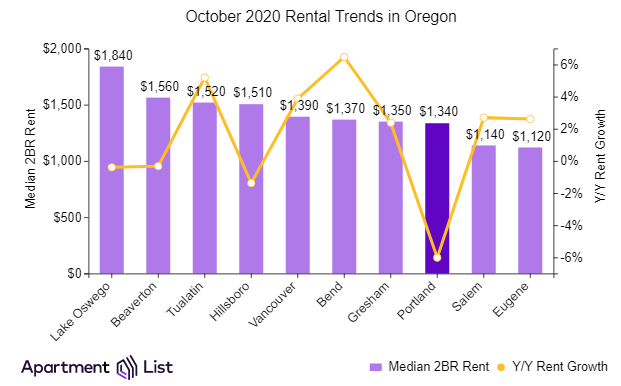
Median rents in Portland are $1,146 for a one-bedroom apartment and $1,336 for a two-bedroom.
“As the COVID-19 pandemic and its ensuing economic fallout continue to overwhelm renters across the country, our monthly rent estimates paint the picture of a protracted national slowdown and uneven recovery,” said Chris Salviati, housing economist at Apartment List.
“Our national rent index is down 1.4 percent year-over-year, but there is tremendous regional variation beneath the surface. San Francisco and New York City continue to lead the nation in pandemic rent drops, while smaller markets like Boise and Colorado Springs are heating up,” Salviati said.
While Portland rents declined, the metro was a different story.
Rents rising across cities in the Portland Metro
While rent decreases have been occurring in the city of Portland over the past year, cities in the rest of the metro are seeing the opposite trend.
Rents are up in six of the 10 cities in the Portland metro for which Apartment List has data.
For example, Tualatin rents have increased 0.6 percent over the past month, and have increased significantly by 5.2 percent in comparison to the same time last year. Median rents in Tualatin are $1,404 for a one-bedroom apartment and $1,519 for a two-bedroom.
This is the fourth straight month that the city has seen rent increases.
And in Vancouver, rents have increased 0.4 percent over the past month, and have increased moderately by 3.9 percent year-over-year. Median rents in Vancouver are $1,180 for a one-bedroom apartment and $1,394 for a two-bedroom. This is the fifth straight month that the city has seen rent increases.
However, Beaverton and Lake Oswego, two of the more expensive rent locations in the metro, have both seen declines. Beaverton was down 0.7 percent in the past month and Lake Oswego down 0.6 percent.
Eugene, Salem Rents Continue Steady Growth
Eugene rents have increased 0.2 percent over the past month, and are up moderately by 2.6 percent year-over-year, according to the most recent report from Apartment List.
This is the eleventh straight month that the city has seen rent increases.
Currently, median rents in Eugene are $843 for a one-bedroom apartment and $1,120 for a two-bedroom.
Salem rent trends were flat over the past month
While Salem rents remained flat over the past month they have increased moderately by 2.7 percent year-over-year.
Currently, median rents in Salem stand at $874 for a one-bedroom apartment and $1,138 for a two-bedroom.
Tenants spending more time indoors can mean issues for landlords such as tenant-on-tenant discrimination which attorney Bradley Kraus takes on this month.
As the calendar turns, 2020 rages on towards its eventual—and merciful—end. Winter is almost upon us, which means many people are indoors more often than not. Unfortunately, that increased indoor time can mean more tenant-on-tenant disputes. While seasoned landlords are no strangers to handling such situations, one particular situation, tenant-on-tenant discrimination, requires additional discussion—and immediate action.
Buried within the Oregon Administrative Rules is OAR 839-005-0206, which details specific theories of discrimination involving housing in Oregon. One particular section involves landlords:
(5) Tenant-on-tenant harassment: A housing provider is liable for a resident’s harassment of another resident when the housing provider knew or should have known of the conduct, unless the housing provider took immediate and appropriate corrective action.
What this administrative rule reads as is a theory of liability for tenants against their landlord if they are harassed by other tenants, based on a protected status if the landlord did not take “immediate and appropriate corrective action.” Such exposure may seem strange, but some courts have already previously determined that the Fair Housing Act contains the same protections for tenants. If the landlord knew, or should have known, of tenant-on-tenant discrimination, and failed to take action, the victim tenant may sue the landlord based on this discrimination.
Tenant-on- tenant discrimination – what does this mean for landlords?
First, a landlord should do as they always do with tenant disputes. If complaints or disputes between tenants arise, take proper investigative measures to determine what actually happened. This would involve interviewing the parties, witnesses, and reviewing any other written statements or documents provided.
Second, creating a log book and/or incident report can assist down the road in recreating what, if anything, happened. Landlords should utilize/create such items anyway as a best practice, as they are infinitely helpful in the event of litigation.
If it appears or is discovered that discriminatory language and/or conduct occurred, a landlord should take immediate action. This would include the property-termination notices under Oregon law. In the event of a he-said/she-said situation, it may behoove the landlord to defer on the side of aggressive action, as opposed to inaction. Fair Housing lawsuits are no laughing matter, often involving substantial attorney fees, costs, and stressful discovery processes, all of which could potentially be avoided through affirmative action.
As a landlord’s attorney, I have learned that not all tenant disputes are created equal.
Some are petty, and/or involve people that cannot be placated or made happy unless they live entirely away from one another. Some involve racism, discrimination, and/or bigotry, which should have no place in our world. While these are two extremes that do not encompass the entirety of tenant-on-tenant disputes, if a landlord finds himself or herself facing the latter of these two scenarios, working with your attorney on an aggressive response can be the difference between resolution and litigation.
About the author:
Brad Kraus is an attorney at Warren Allen LLP. His primary practice area is landlord/tenant law, but he also assists clients with various litigation matters, probate matters, real estate disputes, and family law matters. A native of New Ulm, Minnesota, he continues to root for Minnesota sports teams in his free time. He is an avid sports fan, enjoys exercise, and spending time with friends and his fiancée, Vicky. You can reach Mr. Kraus via email at kraus@warrenallen.com or by phone by 503-255-8795.