The Oregon Supreme Court has granted review of the Owen decision, which relates to landlords’ appeal to invalidate the Portland Relocation Ordinance, according to attorney John DiLorenzo.
“They are not limiting argument to any particular issue, so I assume it means each of the arguments we made in the petition will be in play in the Supreme Court,” DiLorenzo said.
“Winning on any of those arguments would result in invalidating the Relocation Ordinance and possibly other city ordinances,” he said.
The landlords argue the city ordinance is in conflict with state laws that ban rent control. On March 7, 2018, the Portland City Council made the ordinance permanent and extended its application to landlords who own as few as one rental unit.
The background on the case
“The legislature has determined that rent control is a matter of statewide concern and proclaimed that no local government may enact any ordinance that either ‘controls the rent that may be charged for the rental of any dwelling unit,’ ORS 91.225(2), or that is inconsistent with that prohibition, ORS 91.225(7).,” DiLorenzo said when the trial court’s decision was appealed to the Court of Appeals.
John A. DiLorenzo Jr. said, “They are not limiting argument to any particular issue, so I assume it means each of the arguments we made in the petition will be in play in the Supreme Court.”
“Notwithstanding the legislature’s unambiguously expressed intent to preempt local rent-control legislation, the city enacted the ordinance, which requires landlords to pay thousands of dollars to tenants upon the tenants’ demand when a landlord gives notice of a rent increase of 10 percent or more in a 12-month period—meaning the ordinance penalizes rent increases that cumulatively total 10 percent or more in any rolling 12-month period.”
DiLorenzo explained why the ordinance is in violation of state law.
“The ordinance calls the payments ‘relocation assistance,’ but tenants are not required to use the money for that or any other designated purpose. Further, the requirement to make the payments is triggered solely by the size of the rent increase and is intended to limit those rent increases. By penalizing rent increases greater than a certain size, the ordinance is designed to control the rent that may be charged. Accordingly, the ordinance runs afoul of ORS 91.225(2) and ORS 91.225(7), which forbid the rent-control aspects of the ordinance.”
The U.S. Department of Justice has filed a lawsuit alleging racial discrimination by the owners, operators and rental agent of several apartment complexes in Pearl, Miss., and violation of the Fair Housing Act by discriminating against African Americans based on their race, according to a release.
The department’s complaint seeks relief against three owners and operators of the properties — SSM Properties LLC; Steven Maulding; and Sheila Maulding — as well as James Roe, who acted as a rental agent for the apartment complexes on behalf of the other defendants. The lawsuit is based on the results of testing conducted by the Louisiana Fair Housing Action Center and a charge of discrimination issued by the Department of Housing and Urban Development (HUD). Testing is a simulation of a housing transaction that compares responses given by housing providers to different types of home-seekers to determine whether or not illegal discrimination is occurring.
According to the department’s complaint, Roe encouraged white testers to rent at Pearl Manor Apartments but discouraged African-American testers from renting there, telling one African-American tester that if he rented to her at this complex, the residents would think he had “let the zoo out.”
In addition, Roe told African-American testers about fewer rental units than white testers, allowed white testers to view certain apartments while not offering or allowing African-American testers the same opportunity, and imposed more stringent financial and employment criteria and inquiries on African-American testers than on white testers. The lawsuit alleges that SSM Properties and Steven and Sheila Maulding are legally responsible for Roe’s alleged racial discrimination because he worked as their rental agent.
Fair Housing Act prohibits racial discrimination
“More than a half century ago, Congress enacted the Fair Housing Act to prohibit landlords and others from denying people the opportunity to live where they want because of their race, color, or other protected characteristics,” said Assistant Attorney General Eric Dreiband of the Civil Rights Division in the release.
Eric S. Dreiband said, “Congress enacted the Fair Housing Act to prohibit landlords and others from denying people the opportunity to live where they want because of their race, color, or other protected characteristics.”
“Some misguided people unfortunately continue to defy this law by segregating and excluding people because of their skin color. This uncivilized and cruel discrimination hurts people; it must end, now, and the Department of Justice is determined to put a stop to it. All Americans should be free to live anywhere in the United States without regard to the color of their skin. No one’s housing choices should be limited because of race or color or by more subtle differences in the way home-seekers are treated when they ask about available properties. This department is committed to ensuring equal housing opportunities, regardless of race, including by using fair-housing testing to uncover hidden discrimination that might otherwise go undetected.”
“Treating people differently in housing based on the color of their skin is not only morally and ethically reprehensible and incompatible with American principles, but against federal law,” said U.S. Attorney Mike Hurst of the Southern District of Mississippi. “We in the Department of Justice will always strive to ensure that justice is done and that people are treated equitably and fairly, especially when seeking and trying to access such an essential cornerstone of a free society as housing.”
David Pickron offers some thoughts on how the year 2020, like any challenging circumstance, should cause us to take the time to pause and reflect on what we learned and how that will serve as a guide moving forward on whether to acquire, sell or hold steady on rentals.
By David Pickron
As an early adopter of new technology, I was so excited when MapQuest became mainstream in the early 2000s. After having worked as a process server for about 10 years at the time, I knew my way around my home city of Phoenix fairly well.
But with this new technology I felt that I could work faster and smarter than anyone else out there. I began relying on the directions provided by this service, setting aside my hard-earned knowledge of a growing metropolis. Like anyone who has relied wholly on a mapping software, I soon found myself becoming an expert “U-turner,” as I was often off-course.
Off-course may be the perfect term to sum up 2020. But like any challenging circumstance, it does give us the time to pause and reflect on what we learned and how that will serve as a guide moving forward. As a serious investor, I spend a good part of my end-of-year review with my wife (who runs our investments) analyzing our current situation and then creating a plan for the next year. Below are two of the key areas that I analyze annually and recommend focusing on as you look to a new year and new opportunities.
Acquire, Sell or Hold Steady
If there were ever a year where we may have felt like throwing our hands in the air and selling everything, 2020 fits the bill: COVID-19, the loss of income and resulting inability for some of our renters to pay, and eventually an eviction moratorium mandate from the federal government.
Hard times call for hard decisions. Your analysis in this area must involve thoroughly reviewing each of your properties and devising a game plan specific to each one. As an example, after one of our review and planning sessions five years ago, we made the decision to acquire some short-term rentals. Being in Phoenix, we focused on winter visitors looking to escape the cold for three months. We mapped out how and where we wanted to buy, considered if any of our current properties could work in this model, determined the platform we would use to advertise, and evaluated the ROI for this model versus traditional renting. We executed our plan and eventually bought six homes and condos that worked well for winter visitors, but also have been filled year-round with other short-term renters. They have been great investments so far, generating four times more income than a traditional rental. But the big question is, will they be the same in 2021?
Pivot Usage Type
Continuing our story, due to COVID-19 our winter visitors are not booking like they have in the past.
This has led us to a healthy discussion on how we can pivot the primary usage of our properties to ensure they are still income generators. That discussion created a lot of questions:
Is it time to convert these short-term rentals into more of a traditional model?
What would we do with 6 washers and dryers, 18 beds, 8 couches, dining room tables and more?
What happens next year if the rentals come back?
Will that require $30,000 for furnishing those units again?
Where is the market today in regard to new homes in a hot market like ours?
Answering those questions led us to decide to keep these properties as furnished short-term rentals, but to switch our focus to people who are between selling their existing home and buying a new one.
This decision then generated a whole slew of new questions, such as how would we find renters, what would we charge for rent, and how are these renters different from winter visitors? All valid questions that we are figuring out. My next step is to visit the realtors in the new home communities to let them know what I have available. Although this is a new strategy that pivots from where we were previously, I am confident it will work based on our analysis.
These are just two of the many topics we review in-depth each year. Every rental is unique and poses different challenges and opportunities.
In addition to the two key areas we discussed, we also consider the following:
Location: Is it time to sell or acquire based on what is happening in a certain market?
Tenants: Are we happy with our current tenants or should we be looking for someone new?
Government regulations: Are there changes that help or hurt our investments?
Improvements: What does each property need to ensure it is desirable?
Taxes: How do changes in state, county and city taxes affect our bottom line?
Vacancy: What vacancy rate do we aim for to ensure short- and long-term profitability?
Policies: Do we add, alter, or eliminate current policies to entice renters to stay or rent?
Performing this type of analysis will easily help you identify whether you are currently in the best position with your properties or if you need to change a few things. These property-specific questions are great, but you also need to consider how you manage your property. Is it time to hire a property-management company, or can you continue doing it yourself? Are there available technology platforms that help you onboard tenants, manage, and collect rent?
No doubt there is room for adjustment or improvement in how we manage our properties. Although 2020 has taken most of us into uncharted territory, investing the time to map out your 2021 goals will make you a better investor and manager. After all, U-turns or adjustments are okay as long as they help us successfully reach our destination.
I would love to hear your creative ideas on how you are dealing with today’s uncertain environment. David@rentperfect.com
About the author
David Pickron is President of Rent Perfect and a fellow landlord who manages several short- and long-term rentals. He is a private investigator and teaches organizations across the country the importance of proper screening. His platform, Rent Perfect, was built to help the small landlord find success.
The truth is that apartment amenities have changed during the COVID-19 pandemic, and they will continue to do so for the foreseeable future so here are 10 ways and more they have changed.
By Justin Becker
Property Manager
As we approach 2021, the COVID-19 pandemic shows no signs of slowing down. There is no denying that adjustments have had to be made for the real estate industry and the multifamily housing industry.
Still, the reality is that online services,virtual apartment tourshowings, and frequent cleaning of high-touch surfaces are not enough to make our everyday world a less contagious place.
Unfortunately, this is more than evident as cases continue to rise, and states and businesses continue to open and close to safety concerns.
With only two months left in 2020, it is not too surprising that many real estate developers and property managers are looking for more long-term solutions to ensure that their tenants or occupants are safe. This is especially true when it comes to things like multifamily-housing amenities.
For the last couple of months, many have noticed a shift in how things are being designed and what measures property managers are putting in place to ensure that people can still use rent apartments, use gym facilities, and still enjoy some of the features that brought many of their tenants to multifamily housing in the first place.
The truth is that apartment amenities have changed during the pandemic, and they will continue to do so for the foreseeable future.
That said, many property-management teams and landlords are asking themselves what they can do to make their buildings in complexes safer for everyone and reduce the spread of COVID-19.
No. 1- Changes in Apartment Gathering Places
One of the very first things that many landlords and property managers did during the onset of COVID-19 is turn gathering places into multi-purpose spaces that people could be in and safely social distance.
For instance, lounges and other areas are now being repurposed for homeschooling and remote work. Furthermore, landlords are investing in more movable furniture, which allows them to set seating, dining, and studying/work areas six or more feet apart.
No. 2- Converting Clubhouses and Game Rooms into Co-Working Spaces
Similarly, game rooms are also being converted into more practical spaces for residents who are now essentially homebound.
Moreover, outdoor spaces have been heavily used this summer and fall, as CDC guidelines have indicated that being outdoors is less of a health risk. In warmer places, property managers are still relying on rooftop decks and other outdoor spaces to facilitate social distancing and add some ventilation.
In warmer climates, property managers use outdoor spaces to facilitate social distancing and add some ventilation.
In contrast, in cities or areas where it is quickly getting colder, management teams are looking into outdoor heaters and enclosures that will allow residents to safely socialize while still being in a similar or almost comparable outdoor setting.
No. 3- Rethinking Living Spaces inside Apartment Units
In an effort to showcase apartments for rent, property managers have been rethinking living spaces inside their apartment homes.
For example, multi-bedroom units are now being advertised as one-bedroom apartments with home offices or remote learning spaces, instead of the traditional marketing for 2-bedroom or 3-bedroom apartments. Single-bedroom apartments are showcasing a creative space/working area where residents can earn a living in the comfort of their own home, since a significant number of people are now working from home.
No. 4- Creating Co-Working Spaces with Dividers As Apartment Amenities
Property managers also turned to coworking spaces that already existed in their apartment buildings and added dividers so their residents could still use the spaces but have an additional layer or barrier between them and the next person due to COVID-19. Note, residents are still required to wear masks in such settings and observe social distancing.
No. 5- New Spacing Requirements
What’s more, landlords and property managers are having to get creative with spacing out everything and observing social-distancing protocols. As previously mentioned, this is evident with new lounge spaces and so on.
No. 6- Better Ventilation and Ionization Systems
In addition to new spacing requirements, landlords have found unique and creative ways to increase ventilation throughout their apartment buildings.
In fact, some have gone so far as to invest in hospital-grade ventilation systems. For instance, MERV 13 filters have been integrated into units, amenity rooms, and common areas. Plus, high-end apartment communities are also adding an extra safeguard with special ionization systems in various building ducts. These unique ionization systems zap viruses that may have snuck through building ventilation systems.
No. 7- Fewer Touch Surfaces and Frequent Cleaning
Moreover, if you walk into an apartment complex or building these days, you will notice that there are fewer touch surfaces, which means now there are more key fobs to unlock lobby doors, motion-triggered faucets, and automated toilets.
High-touch areas that cannot be motion-triggered are required to be cleaned every hour—or there are automated mists that disinfect small, poorly ventilated spaces.
No. 8- More Copper or Antimicrobial Surfaces
Similarly, there has been an increase in copper and antimicrobial surfaces.
Anything that can now be made out of copper, even some workout equipment, is now showing up in multifamily housing developments throughout the country.
No. 9- Fitness Facilities and Half-Capacity
Speaking of fitness facilities, many apartment communities are imposing half-capacity rules for gyms and other common areas.
To deal with high-demand, fitness facilities that used to be open during the day or as long as the leasing office was open have now become 24-hour gyms so that all residents can use the facilities. Gym equipment is also being spaced out to ensure social distancing. That said, since many tenants or residents barely use fitness facilities in general, these types of accommodations have not necessarily been widespread.
No. 10- More Assistance via Apps
There has also been a major shift to apps.
For example, some property managers have created apps for residents that allow them to schedule time in common areas. Plus, apartment communities that once upon a time only had in-person or mail-in rent policies have now embraced online rent portals. There has been an increase in virtual/electronic communication as well between landlords, staff, and residents—more email newsletters, online forums, etc.
Common Post-Pandemic Apartment Amenities Renters Will Seek
Landlords will need to embrace post-pandemic apartment amenities if they want to continue to attract new or prospective tenants. This means you should expect to see more contactless methods of paying rent and dedicated personal outdoor space (like balconies/patios) on renters’ must-have lists.
Other coveted items will likely be included—a second bedroom/bathroom (for office space or in case a member of the household is ill), more closet/pantry space (for stock buying), kitchens with room for in-home cooking, plus an in-unit washer/dryer. Besides offering these in-unit features, property managers should invest in smart locks to avoid touching keys for building entrances as well as for apartment homes.
And as a direct response to the previous moratorium on evictions, many landlords are expected to offer longer leases with a controlled rent rate to avoid rent raises when employment may be affected. Likewise, there is talk of including most, if not all, utilities in the monthly rent rate. This is also in case employment is affected.
Finally, post-pandemic renters are expected to seek out pet-friendly units more than ever before. as stay-at-home orders have significantly increased pet adoption over the last 10 to 11 months.
Post-pandemic renters are expected to seek out pet-friendly units more than ever before.
Take Away
COVID-19 and the ongoing pandemic will definitely have a lasting impact on how people interact with one another in multifamily housing. Moreover, there is no denying that certain apartment amenities will need to get with the times or be left behind. That said, any way you slice it, the overall goal here remains the same—to reduce the likelihood of COVID-19 being transmitted.
About the author:
Justin Becker is a property owner in the state of Michigan and has a passion for managing communities. He owns apartment complexes and mobile home communities, and has been writing his own blogs for his properties for several years.
Given current market conditions, now is the time to analyze who are your renters and who they will be in the future, recommends John Burns Real Estate Consulting.
The consulting group analyzes trends for their clients and provides insight into today’s renters.
This analysis shows insight into market-appropriate unit sizes and configurations, new amenity trends, and the appropriate rent levels necessary for successful apartment lease-up and tenant retention.
Who are your renters? Not as young as you may think
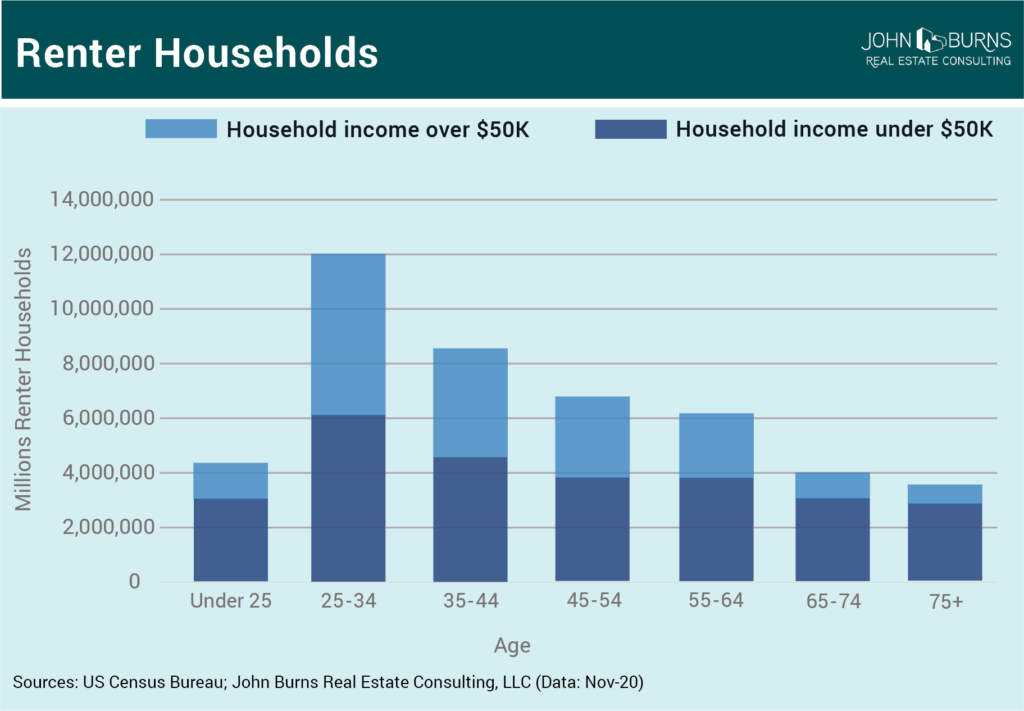
“While 26 percent of renter households in the U.S. are between the ages of 25 and 34 today, the next largest segment of the market is between the ages of 35 and 44 (families), and beyond that, between the ages of 45 and 54 (empty nesters).
“These older renters will continue to seek more space in a suburban environment with good work-from-home amenities,” write Lesley Deutch and Ken Perlman of John Burns Real Estate Consulting.
Renters may not be as young as you think. Charts courtesy of John Burns Real Estate Consulting.
Affordable rents continue to be a challenge
“More than half of renters in the U.S. can only afford rents less than $1,200.
“John Burns Real Estate Consulting’s national apartment-demand model is based on income levels across the U.S. and indicates about 60 percent of renter households earn less than $50,000 per year, which translates to a maximum rent of about $1,200 per month.
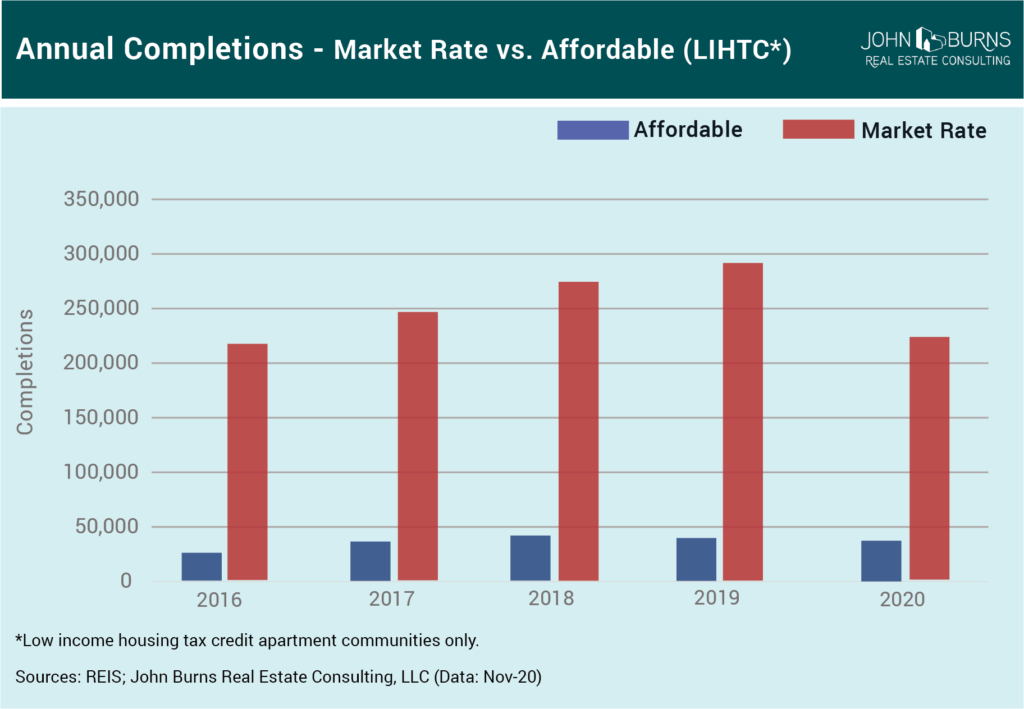
“While construction activity is increasing for luxury apartments (due largely to increasing costs associated with new building), the affordable sector continues to be hampered by the limited availability of tax credits and capital financing. The opportunity here is not just to provide affordable housing, but creative use of space in market-rate product, including more roommate-friendly units and smaller spaces to keep overall rents lower,” they write in the report.
Affordable rentals continue to be a challenge. Chart courtesy of John Burns Real Estate Consulting.
Summary
The apartment market offers many opportunities, even in the era of COVID-19 and a recovering job market. Understanding renter profiles to design the appropriate product will be key in the years ahead as the U.S. economy recovers from the recession and you find your future renters.
Please contact Lesley Deutch or Ken Perlman for more local insight. John Burns team is always available for assistance.
Affordable housing demand is greater than ever and the pandemic exacerbated a problem that is already approaching crisis levels.
By Matthew Davies
President Harmony Communities
The affordable housing industry is in dire straits. Record-high costs for construction materials coupled with labor shortages have hampered the development of new affordable housing communities. Yet the demand for affordable homes is greater than ever. According to the National Low Income Housing Coalition, the U.S. has a shortage of 7.2 million affordable and available rental homes.
In existing communities, eviction moratoriums put in place during the COVID-19 pandemic mean that many landlords and owners and operators of affordable housing communities must maintain their operations without the major source of their income – rent. At the same time, families are struggling while housing costs rise faster than incomes; Harvard University’s Joint Center for Housing Studies estimates that nearly half of renter households spend more than 30 percent of their income on rent.
In many ways, the pandemic exacerbated a problem that is already approaching crisis levels; missed work due to illness, joblessness, and wage reductions during the pandemic could drive an estimated 250,000 new people into homelessness, according to a Columbia University study.
In the state of California, the need for affordable housing expands past lower and middle-income families. With an average median home price upwards of $600,000, California housing is among the most expensive in the country. According to a study from the California Department of Housing and Community Development, in every major metropolitan area and its surrounding counties, between 30 and 60 percent of residents cannot afford market rent.
It’s no longer just cities that are seeing a demand for more affordable housing either. With fewer people required to physically report to work in cities, many have fled urban areas in search of a more affordable solution.
In California, multiple attempts to solve the affordable housing demand problem at the government level have been either proposed or implemented. But a state law passed in 2020 to cap the amount by which landlords raise rent and eighteen other bills aimed at increasing housing production, the problem remains, demonstrating that other solutions are needed. In this article, I’ll discuss four alternative solutions to increase the supply of affordable homes where they are needed and help those who truly need assistance.
Solution #1: Reduce regulatory barriers to affordable housing
In many areas, zoning laws prohibit affordable housing development.
For example, in most U.S. cities, it is illegal to build anything other than single-family detached homes on three-quarters of an acre of land. When multifamily housing is allowed, zoning rules including building height caps can limit the profitability of these developments. To increase the affordable housing supply in areas where it is needed most requires reducing the regulatory hurdles that developers need to go through in order to build more affordable homes.
Solution #2: Maximize land space with greater densities
With zoning regulations relaxed, developers can utilize density to maximize the available land and provide housing for more people. Two creative ways to do this are through tiny homes or by going vertical, an approach known as upzoning.
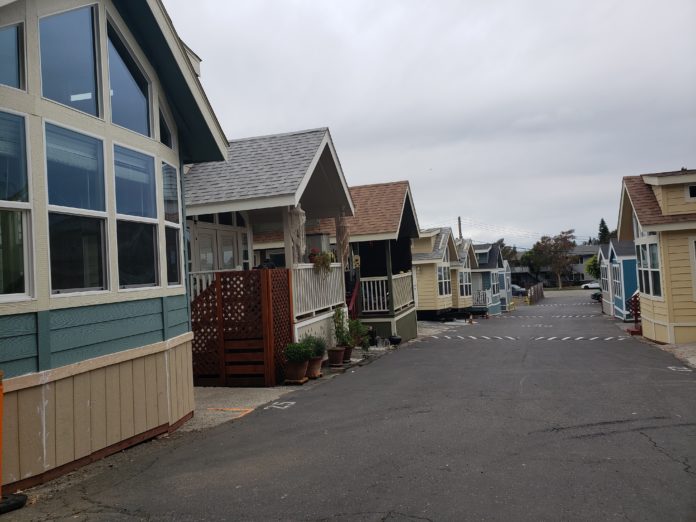
A typical subdivision with site-built, single-family homes requires on average about an acre for every 4-5 homes. By contrast, a community of tiny homes holds up to 25 or even 30 residences per acre. Tiny homes are economical, practical, and can go a long way toward solving many of our nation’s housing concerns.
Likewise, high-rise buildings can house more people per acre than their single-family home counterparts. A typical high-rise building provides about 100 housing units on an acre of land. If each unit houses three people, a single acre can provide housing for 300 people.
Solution #3: Incentivize density with tax incentives
When paired with relaxed zoning restrictions, putting higher taxes on expensive, but underused, land can also incentivize affordable housing development.
Unlike property taxes, which charge a similar rate for buildings and land, land value taxes charge a higher tax rate on the land and a lower rate on the structures themselves. In other words, the land tax rate is the same whether the land owner uses it for commercial space, apartments, or any other use. Tax abatement programs are available in some cities to offset the cost of providing affordable housing.
Solution #4: Grant rent subsidies – not rent control – to ensure help is given where it’s needed most
Rental subsidies provide financial assistance to households who need it. By contrast, rent control caps the frequency and amount by which landlords and property owners can increase the rent in residential units across the board. On the surface, rent control may appear to be a viable solution to making rent more affordable, but upon closer inspection it becomes apparent that the opposite is true.
When a state, city, or county government adopts rent control, the regulation is applied to everyone, regardless of need. As a result, in rent-controlled communities, everyone — even those who can easily afford market rent — receives a subsidy that is paid for by the government, the property owner, or some combination of the two.
Rent control can make it difficult for property owners to maintain their business. When owns and operators of affordable housing communities find themselves unable to maintain their businesses, they may seek out a more lucrative option, displacing people from their homes and lessening the affordable housing supply, ultimately driving up prices for homes in the area and making them the polar opposite of affordable.
Unlike rent control, rental assistance programs target people based on need. Instead of imposing a ceiling mandate on rent prices, governments provide rental assistance only to people who meet certain income criteria. These programs offer a more targeted approach to helping those in need while requiring those who can afford the rent to pay market rates, thereby taking some of the burden off the property owners.
Conclusion: A Multifaceted Plan
Conquering a complex problem like affordable housing demand requires a multifaceted solution that addresses both housing supply and assists those truly in need.
The greatest way that government can help solve the affordable crisis in our country is to use a twofold approach that involves (1) reducing the number of regulatory and legal hurdles that developers have to face (which spurs development and works to increase the housing supply, therefore keeping prices down) and (2) providing help where it’s needed, to ensure tenants get the assistance they need while ensuring landlords and property managers continue to receive the income they need to ensure their communities thrive and their businesses stay operative.
A final note: when considering solutions like land value tax reform and upzoning, caution must be taken to prevent displacement of existing renters, especially in high-demand real estate markets, where newer, larger buildings could have broad appeal and subsequently drive rent prices up. In these instances, housing vouchers can help.
About the Author:
Matthew Davies is the founder of Stockton, CA-based Harmony Communities, which currently owns and operates thirty-three manufactured housing communities in the western United States. An investor and community development professional working for affordable housing solutions, Davies’ goal is to help bring the opportunity for homeownership to people in his home state who otherwise could not afford to buy a home.
This week the question for Ask Landlord Hank is about tenants refusing to heat bathrooms and whether it can can cause mold. Remember Landlord Hank is not an attorney and is not giving legal advice.
Dear Landlord Hank,
I have several tenants who refuse to run the heat in the bedrooms and bathroom because they say it costs too much for the electricity.
They also leave all the doors shut in their units, thus causing black microbial growth in the unit.
My questions are: First, did not using the heat in these rooms in fact cause this growth? And second, how do I get them to understand that they need the heat and air flow?
-David
Dear Landlord David,
Black mold can grow on material that has a high cellulose content such as drywall, paper, and so on in moist and damp conditions.
The area has to be constantly damp or moist.
If the rooms are cold and not damp, I don’t think you have mold, but you might want to buy a mold test kit from Home Depot or Lowe’s and check.
I would worry about water pipes bursting in freezing temperatures; I put out freeze warnings when the temperature drops to the mid-20s on my multifamily properties, with instructions to drip water in all faucets and leave cabinet doors open under vanities and the kitchen sink to allow warm air to keep pipes from freezing.
My tenants know that if a pipe breaks in their unit because of their negligence they are responsible for repair costs.
Sincerely,
Hank Rossi
On the question of mold and mold cause, Landlord Hank says “You might want to buy a mold test kit from Home Depot or Lowe’s and check.”
Ask Landlord Hank Your Question
Ask veteran landlord and property manager Hank Rossi your questions from tenant screening to leases to pets and more! He provides answers each week to landlords.
Renters became a majority in 23 cities over the past decade even as ownership increased, according to a new study by Rent Café.
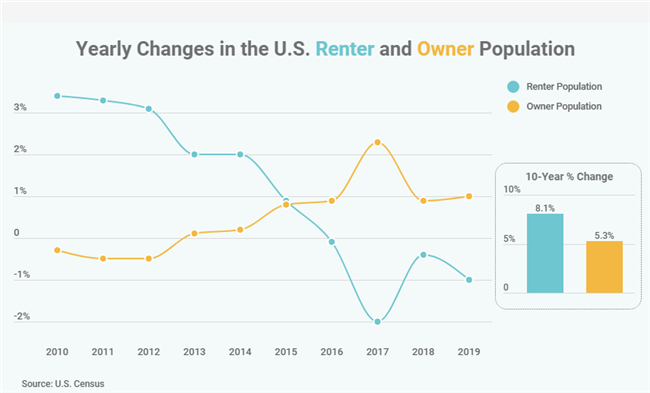
“We looked at 10 years of U.S. Census housing data to determine where we stand now in terms of renter and owner population. Renting made significant gains in the last decade but dipped in the latter half, reaching a 7-year low in 2019. In the meantime, ownership rose to an all-time high, slowly rebounding after the great recession,” Rent Café said in the study.
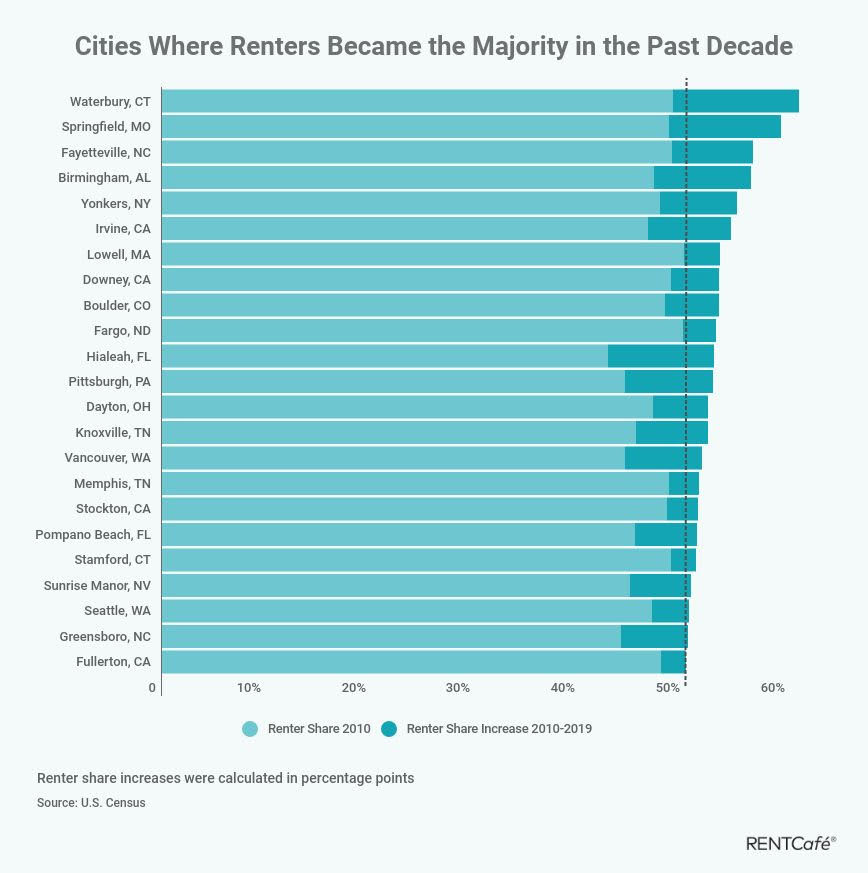
Renters took over 23 cities with more than 100,000 residents between 2010 and 2019. Established hotspots such as Seattle or up-and-comers like Memphis and Pittsburgh transitioned from an owner to a renter majority.
In a surprising turn, Chicago, Sacramento, Reno, and Baltimore are among the 12 new owner-majority cities.
Looking at the cities with the fastest-growing share of renter population, four of the top 10 cities are in Texas. Frisco and Plano are in the lead with a 41 percent and 59 percent change since 2010. On the other side, ownership gains were much smaller; Hartford, Conn. saw the largest increase in owner share, 27 percent.
Renting made significant gains in the past decade but dipped in the last 5 years
The renter population grew by eight million in the last decade, and is now 107 million strong.
Specifically, renters currently make up 33.6 percent of the U.S. population — up from 33 percent in 2010. However, the latest numbers are far from the 2015 peak in renting, when 111 million Americans rented their homes for a 35.5 percent share. In fact, the number of renters reached a seven-year low at the end of the decade.
The number of renters entered a downward trend while ownership has been slowly rebounding
The start of the decade saw a sharp rise in the number of renters – following the housing crisis of 2008 – which climbed by 3.4 percent in 2010 and continued to increase by more than 3.0 percent until 2012.
However, by the time renting peaked in 2015, the growth rate had slowed to 0.9 percent. In 2016, the number of renters dipped – the first time since 2004 – by a slight 0.1 percent. Since then, the renter population has been on a downward trend, decreasing by 1.0 percent in 2019.
Renters took over 23 cities in the past decade, including Seattle
However, renting was still the decade’s winner among the nation’s large- and mid-sized cities.
Despite the recent downward trend, 23 cities with more than 100,000 residents transitioned from an owner to a renter majority in the last 10 years — from job hubs such as Seattle to up-and-comers like Boulder, Colo.
Summary
Overall, the housing trends of the past decade suggest that renting is maintaining its popularity in the nation’s large- and mid-sized cities, while homeownership has and will continue to rebound. But, with Gen Z entering adulthood and millennials settling down, the coming decade will likely see more shifts in the housing landscape.
This week the question for Ask Landlord Hank is about a non-paying tenant, who was already a problem, who has now filed a COVID-19 form. Remember Landlord Hank is not an attorney and is not giving legal advice.
Dear Landlord Hank:
Our 20-acre privately owned rental duplex community is only experiencing one non-paying tenant, for which we are very grateful. We do have one problem tenant who received an eviction notice between the last two moratoriums’ time frames.
This man submitted the required form for COVID-19 job loss, but as yet, refuses to identify his new employer or the income he and the mother of his child are receiving from her job. They have not paid rent since September. They are allowing dog feces to pile up on the common lawn between them and their neighbor, a lease violation. We live in Garland County, Ark.; the sheriff’s department is not processing evictions during the moratorium.
Is there any hope for us to evict this couple, or must we wait, and pray, the moratorium is not extended again?
Thank you so much for any guidance you may share.
-Diana
Dear Landlady Diana,
You have been very lucky you only have one bad apple.
If the sheriff’s department is not processing evictions and setting tenants out, then you are stuck.
I would call a landlord/tenant attorney in your area just to make sure, and also talk to the county court division that handles evictions – often magistrate court – and see what they say.
I think that if your tenant has filed the COVID-19 forms, you’ll have this tenant until the moratorium has been lifted. Good luck.
Sincerely,
Hank Rossi
On the question of a problem non-paying tenant and covid-19 form Hank says, “If the sheriff’s department is not processing evictions and setting tenants out, then you are stuck..”
Ask Landlord Hank Your Question
Ask veteran landlord and property manager Hank Rossi your questions from tenant screening to leases to pets and more! He provides answers each week to landlords.
Veteran investor John Wilhoit blogs this week about the four reasons a rental property may look beat-up and not be getting the attention it should from the owner.
A rental property may look beat-up for several reasons as rental property assets can fall into disrepair in many ways and for many reasons.
Often, just walking or driving by an asset will show signs of disrepair or a lack of care all without stepping on property!
Why do people allow potentially valuable assets left to fall back into the sand? There are a myriad of reasons, of course.
Following are the categories that most often result in assets looking like they have been beat with an ugly stick. The next time you see one it is probably due to one of the following factors.
No. 1 – Inattentive Ownership
Owning real property assets is not the same as knowing how to manage real property assets.
This distinction is clear every day. To me, it is in the same category as making a baby versus raising a child; these are two completely different skill sets, yes? Thus, if ownership is unconcerned about operational efficiencies, property presentation and safety, then all is lost (eventually).
Ownership that has a stake in asset operations on paper only requires professional property management to succeed. Of course, asset owners are not required to be professional property managers, however, they should be engaged in the selection of quality management for their investment to have and maintain future value. Institutional owners hire professional asset management for this function.
The success or failure of an investment beings and ends with management expertise.
There is professional management and then every other type of management; piecemeal, unqualified, inexperienced, half-baked, etc. Knowing that management is a key component to successful operations; why not deploy the professionals? Some will say that it is too expensive. Well, so is incompetence and on-the-job-training for the ill-equipped. The property suffers, yield suffers, turnover increases, expenses are untamed. Non-professional management brings no upside potential.
No. 3 – Antiquated Financing
Getting the capital stack right is no small task, particularly in an ever-changing marketplace.
Considering that appropriate leverage means different things to different people, the best approach is to align the financing package with the long-term objectives of the primary owners. With this structure, you are applying the same perspective to individually owned assets as you would institutionally owned assets.
Each property should have its own plan for achieving asset-level goals, first, followed with guidance about intended term of ownership and how the asset-level goals fold into investor objectives.
No. 4 – Changes in Market Dynamics
Markets do shift.
Markets do deteriorate for all sorts of reasons. Changes to the number and type of jobs within close proximity to residential assets has significant affect on the value of these assets. If a “boatload” of jobs disappear there is little a property can do in the short run to usurp this. Earlier this decade every class of apartment property in Houston Texas had specials including two-months free with a twelve month lease.
This changed with the oil boom returning. Then the hurricane. Same for Detroit metro with auto makers going from producing 15M cars a year to 11M. That type of free-fall decimates entire submarkets.
So before making “absolute” assumptions about why a particular property is looking dowdy (or worse) consider the cause could be any one of the above or a combination of these with other factors sprinkled in. Remember the bed bug scare in New York City? Flooding in New Orleans? The “assume” word runs in the same circle as “if”. These are seldom good words on which to make sound business decisions.