
Home Blog Page 125

COVID-19: How it Changed the Multifamily Leasing Industry

COVID-19: How it Changed the Multifamily Leasing Industry

How the Covid-19 pandemic has significantly changed the multifamily leasing industry and the means by which apartments are marketed and leased.

By Karen Dwyer
Mark-Taylor Properties

Apartment searching as we know it has changed dramatically.

As the manager of a Mark-Taylor apartment community located in North Scottsdale, Az., I have witnessed the current pandemic significantly shift the means in which apartments are being marketed and leased.

While many in the multifamily industry resisted change, the pandemic prompted a much-needed advancement in how we work with potential renters wherein advanced technology is matched with well-trained leasing professionals. Skilled professionals capable of securing high closing ratios while leasing in this diverse “virtual” environment are paramount.

Prior to the pandemic, far fewer apartments were leased sight unseen. Previously, sight-unseen customers were often those relocating hurriedly, who were not available to tour in person. Due to the popularity of mobile searches, we consistently provided virtual tours through our expansive website with 2-D floorplans with relative success.

When the pandemic mandated social distancing restrictions, Mark-Taylor Residential knew we had to act fast. With our previous online experience, coupled with the vision to create hundreds of prerecorded videos of all aspects of our apartment communities, we were well-equipped for virtual leasing. We trained our team on how to communicate effectively, provide links for videos, and other means to create a vision for someone selecting their home virtually.

Multifamily leasing industry changes

Self-guided touring had just begun picking up momentum prior to the pandemic.

This is a tour that allows a prospect to gain access to a property and tour without a leasing professional present. While this is a new take on self-guided touring with the use of Smart Rent technology, it has become quite popular within our industry, and we expect the majority of tours to occur this way in the future.

The vast majority of our leases during the past six months were secured through virtual and self-guided SmartRent tours. Activity from self-guided tours has been highly successful within our communities. We anticipate approximately 70 percent of new touring prospects to choose self-guided as their preferred option. Many potential tenants are using virtual tours to help narrow down their options and then following up with a self-guided, or in-person, showing for their top choices. I expect this trend will continue, especially for relocating renters who can be even more efficient in their research when moving to a new city. Self-guided and virtual leasing creates significant efficiency in apartment leasing.

SmartRent enables communities to offer self-guided tours and more easily reach the large number (approximately 60 percent) of renters who are searching for their next home solely on their mobile device. This allows for viewing a property online, filling out a prequalifying form and receiving a text with access code info for their self- guided tour, all within the same experience. SmartRent has made this possible and many prospective residents are embracing this approach. Prospective renters are appreciative of the social distancing this offers as well as the time to view the homes at their leisure without the pressure of a restrictive timeline.

COVID-19: How it Changed the Multifamily Leasing Industry
Karen Dwyer says, “Many potential tenants are using virtual tours to help narrow down their options and then following up with a self-guided, or in-person, showing for their top choices.”

The main reason most renters enjoy a self-guided tour is to view apartments at their own pace. Today’s apartment seekers value the opportunity to enjoy a space without a leasing consultant present, all while envisioning themselves living there. This has been a big change in the multifamily leasing industry.

Since implementing the SmartRent access, the community I manage, San Portales in Scottsdale, has experienced a substantial gain in leasing activity, a subsequent rise in physical occupancy, and the team is far more productive based on the assistance of this technology. Significant numbers of our touring prospects make their own determination during the self-tour as to whether or not the community is a fit for them, and they return and rent on their own accord after viewing the model homes.

In addition to the ease in which the system operates, it also keeps building entries and gates secure while granting access to prospects. It allows for showing off community model homes while maintaining security for staff and residents with access controls through temporary credentials.

Meeting customers where they feel most comfortable

As we enter the next phase of the new normal, meeting customers where they feel most comfortable will be essential in providing the highest level of service. Apartment-leasing innovation was brought on by the pandemic, but these modern variations are here to stay.

Properties have the ability to configure and fully customize their self-guided tour experience, giving prospects detailed information regarding the community’s amenity offerings such as a 24-hour pool, clubhouse and fitness center. As a result, the prospect gets the full tour experience and doesn’t miss out on any important property features.

The majority of prospective residents use online resources to assist in their search before they even reach out to schedule a tour. And for the most part, they have already formulated a determination based on online reviews, amenities offered, photos of the community or word of mouth.

The last step is physically visiting the property before deciding to sign a lease. Offering self-guided tours is an efficient way to keep prospective renters engaged and turn a lead into a lease.

About the author:

Karen Dwyer is Manager of Community Operations, Mark-Taylor’s San Portales Luxury Apartments, Scottsdale, Ariz. Established in 1985, Mark-Taylor Companies is a privately held, Arizona based developer, owner and investment manager of multifamily communities. The company ranks as the largest apartment developer in Arizona’s history, the second largest owner of rental communities in the state and is the investment manager to more than $3 billion in multifamily real estate on behalf of numerous third-party owners. For more information, visit www.mark-taylor.com.
10 Ways Apartment Amenities Have Changed During Covid-19

Sign Up For Our Newsletter And Get Apartment News And Helpful, Useful Content Each Week.

* indicates required

Seattle Rents Declined Sharply Over The Past Month

Seattle Rents Declined Sharply Over The Past Month

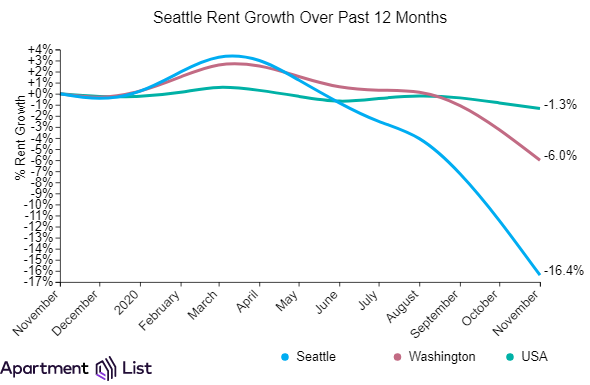
Seattle rents declined 5.6 percent over the past month, and have decreased sharply by 16.4 percent in comparison to the same time last year, according to the latest report from Apartment List.

This is the eighth straight month that the city has seen rent decreases after an increase in March.

Currently, median rents in Seattle stand at $1,395 for a one-bedroom apartment and $1,739 for a two-bedroom.

Seattle’s year-over-year rent growth lags the state average of -6.0 percent, as well as the national average of -1.3 percent.

“As the COVID-19 pandemic and its ensuing economic fallout continue to overwhelm renters across the country, our monthly rent estimates paint the picture of a protracted national slowdown and uneven recovery,” said Chris Salviati, Housing Economist at Apartment List.

“Our national rent index is down 1.4 percent year-over-year, but there is tremendous regional variation beneath the surface. San Francisco and New York City continue to lead the nation in pandemic rent drops, while smaller markets like Boise and Colorado Springs are heating up,” Salviati said.

Rent trends vary across the Seattle Metro

While rent prices have decreased in Seattle over the past year, the rest of the metro is seeing varying rent trends.

Of the largest 10 cities that Apartment List has data for in the Seattle metro, half have seen increases, while the other half have been decreasing.

Here’s a look at how rents compare across some of the largest cities in the metro.

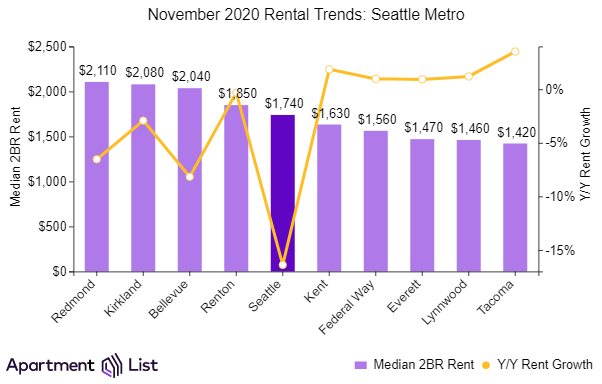
  • Tacoma has the least expensive rents in the Seattle metro, with a two-bedroom median of $1,422; the city has also experienced the fastest rent growth in the metro, with a year-over-year increase of 3.5 percent.
  • Redmond has the most expensive rents of the largest cities in the Seattle metro, with a two-bedroom median of $2,106; rents fell 1.2 percent over the past month and 6.5 percent over the past year.
  • Seattle proper has seen the biggest drop in the metro area.

Seattle Rents Declined Sharply Over The Past Month

Secondary Market Rents Soar While Primary Markets Plummet

Sign Up For Our Newsletter And Get Apartment News And Helpful, Useful Content Each Week.

* indicates required

Washington Courts Launch Eviction Resolution Program

A federal judge has ruled a landlord did not have to automatically waive its animal fee for a tenant with an emotional support animal

King County Superior Court has established an Eviction Resolution Program (ERP) that will require problem-solving steps in situations involving non-payment of rent so that there will be no need to file an eviction case, according to a release.

“The program began as a pilot project in Clark, King, Pierce, Snohomish, Spokane, and Thurston Counties on November 9th.  Though state and federal eviction moratoria have not lifted yet, the program is available now in hopes landlords and tenants will join in the resolution programs early to take advantage of the assistance and get a head start on problem-solving,” the court said in the release.

The courts are expecting to face a large number of eviction cases after state and federal moratoriums on evictions are lifted, and put the program in place “in hopes of reducing the severity of a wave of evictions in the community.”

Tenants and landlords meet with resolution specialists who can mediate efforts to create repayment plans, resolve disputes and connect with rental-assistance programs.

Landlords are required to participate before they can file rent-related evictions. If a renter chooses not to participate in the program, landlords can proceed with rent-related evictions.

“I am very pleased to announce the launch of the state’s first pilot Eviction Resolution Program (ERP),” said Chief Justice Debra L. Stephens.

Washington Courts Launch Eviction Resolution Program
Chief Justice Debra L. Stephens said, “I am very pleased to announce the launch of the state’s first pilot Eviction Resolution Program (ERP)”

The goal of the program is to bring all parties together with trained resolution specialists to explore solutions such as available state and local rental assistance, or achievable payment plans that could help tenants retain their housing and divert many situations from the legal eviction process. The program was developed by the state Superior Court Judges’ Association (SCJA) in partnership with the state Office of Civil Legal Aid.

Washington Courts Launch Eviction Resolution Program

The objective of the ERP is to: 

  • Bring all parties to the table with the assistance of qualified and trained eviction-resolution specialists;
  • Explore the amount of rent arrears, the current and prospective circumstances of the tenant, the availability of rent, and other assistance to cure or partially cure the arrearage;
  • Discover a range of other terms that might resolve the matter in a way that allows the tenant to retain housing (and avoid the need for filing of an unlawful detainer action).

Landlords and tenants can find details about the eviction resolution program, and how they can participate, on the statewide web site dedicated to the program here: Eviction Resolution Pilot Program .  http://www.courts.wa.gov/newsinfo/index.cfm?fa=newsinfo.EvictionResolutionProgram

7 Insights for Landlords on the New Federal Eviction Moratorium

Sign Up For Our Newsletter And Get Apartment News And Helpful, Useful Content Each Week.

* indicates required

Transitioning from Landlord to Seller: Using a Qualifying Landlord Exemption for a Sale

Transitioning from Landlord to Seller: Using a Qualifying Landlord Exemption for a Sale

Many landlords are looking to sell so here are some of the issues around transitioning from landlord to seller from attorney Bradley Kraus.

By Bradley S. Kraus
Attorney at Law, Warren Allen, LLP

As we approach the end of 2020, the hopes of quickly moving beyond, and triumphing over, COVID-19 appear to be fading.

Oregon Governor Kate Brown has placed new restrictions on businesses to head off the rising spread of the virus. The legislature is discussing further legislation involving an extension of the eviction moratorium and a rent-reimbursement fund for landlords.

While plans for the latter do not appear finalized as of this writing, it does appear that the moratoriums will be extended in some form.

Transitioning from landlord to seller

As a result of the above legislation, and that which preceded it, many landlords are looking to sell their rental properties.

While most no-cause notices are prohibited in current eviction moratoriums, both the state and local moratoriums allow for landlords to serve a no-cause notice related to sale of the property. While it seems simple, there is far more coordination involved—and necessary—to serve such a notice due to the many elements landlords must meet to qualify for the exemption.

ORS 90.427(5)(d) and ORS 90.427(6) discuss the No-Cause Notice Qualifying Landlord Exemption involving sale of property.

As with every qualifying landlord exemption, they require that the landlord provide a 90-day notice specifying the reason for the termination and supporting facts. It also requires the payment of one month’s rent for relocation assistance at the time of service of the notice unless the landlord owns four or fewer rental properties. The landlord may also be required to pay additional relocation assistance, depending on local relocation-assistance requirements.

The above requirements are the same for all qualifying landlord exemptions, but the sale exemption is more burdensome than others.

The Landlord must have:

(a) Accepted an offer to purchase the dwelling unit separately from any other dwelling unit from a person who intends in good faith to occupy the dwelling unit as the person’s primary residence; and

(b) Provided the notice and written evidence of the offer to purchase the dwelling unit  to the tenant not more than 120 days after accepting the offer to purchase.

The requirements of (a) complicate matters greatly.

The landlord simply cannot rely on the fact that they intend to sell the property; they must have accepted an offer to purchase the dwelling unit from someone who intends to occupy the same. Many buyers wish to occupy the home promptly. However, due to the 90-day notice requirement of the statute, that simply cannot occur, which can complicate sale matters. Additionally, the purchase of the dwelling must be separate from any other dwelling unit—which causes the sale of duplexes and triplexes to fall outside of the exemption.

Transition from landlord to seller is not easy

Landlords/owners who cannot meet the above requirements may have other options at their disposal to assist with the sale of the property.

However, these likely require cooperation with your tenants, and therefore, those options should be used in close conjunction with your attorney.

The penalties and complications from missteps can involve lost time, lost sales, and potential exposure to claims.

Accordingly, a proactive approach, as opposed to a reactive one, is appropriate for any landlord seeking to use this—or any—qualifying landlord exemption to transition from landlord to seller.

About the author:

Transitioning from landlord to seller in Oregon needs help from an experienced attorney.
Bradley Kraus, Portland attorney

Brad Kraus is an attorney at Warren Allen LLP. His primary practice area is landlord/tenant law, but he also assists clients with various litigation matters, probate matters, real estate disputes, and family-law matters. A native of New Ulm, Minnesota, he continues to root for Minnesota sports teams in his free time. You can reach him via email kraus@warrenallen.com or 503-255-8795.

Fair Housing Matters – Landlord Liability for Tenant-on-Tenant Discrimination

Sign Up For Our Newsletter And Get Apartment News And Helpful, Useful Content Each Week.

* indicates required

Job Losses During COVID-19 Differ Greatly By Metro

Job Losses During COVID-19 Differ Greatly By Metro

Job losses during COVID-19 have varied greatly by metro area. An analysis by Yardi Matrix found that high-cost gateway metros and metros with large tourism concentrations have fared the worst, while growing Sun Belt and Midwest markets lost the fewest jobs.

However, the numbers provide hope for struggling markets to recover post-pandemic.

Some highlights from the Yardi Matrix report:

  • Through September, 7.0 percent of jobs were lost nationally, but by metro the number ranged from a high of 12.6 percent job loss in Las Vegas to just 2.6 percent job lossin Salt Lake City. The gateway metros of New York, San Francisco, Boston, and Los Angeles were all among the top 10 in percentage of jobs lost.
  • By job segment, leisure and hospitality was by far the biggest loser, with 3.8 million jobs lost, or 22.8 percent of the jobs that existed in February. Meanwhile, only 1.8 percent of the jobs in financial services have been lost since the start of the pandemic.
  • Metros with the best job performance include those with relatively small leisure and hospitality industries and those that have lost relatively few jobs in the segment (Indianapolis lost only 6.5 percent, for example). And some cities have done well in other job segments. Austin, for example, has added 8,200 professional and business services jobs and 7,300 financial services jobs since February.
  • None of this is to make a judgment about what represents the best public-health policy, or what the impact on jobs will be if the pandemic worsens over the winter. From a job-performance point of view, however, metros that encountered the coronavirus early on have paid a price.
  • “The data does show hope for the future for the gateway metros that have been hard hit, because the core industries in those metros, such as finance and professional services, remain viable. Once a vaccine is available and people feel safe going back to entertainment venues, restaurants and the like, gateway cities will have the ability to rebound,” the report says.

Job Losses During COVID-19 Differ Greatly By Metro

Sun Belt, Midwest Metros Least Affected

“Metros that have held up relatively well during COVID-19 include secondary markets that are attracting businesses and households moving from high-cost coastal areas, those that have not implemented strict shutdowns, and those that have a relatively small tourism component, especially conference and luxury travel,” the Yardi report says.

“Of the top 10 metros with the fewest job losses through September, only Austin (-25.6 percent) and Dallas (-23.2 percent) had job losses in hospitality above the national average, and most were well below.”

Wildcards: Virus, Government Support

“The final impact of COVID-19 has yet to be written. Far from over, almost eight months into the pandemic the number of new cases has grown to new highs, even if the number of deaths produced per case is shrinking. Going forward, the job picture depends to a large degree on the course of the virus, whether another set of shutdowns is implemented and whether and when a vaccine becomes readily available to the public. If effective vaccines become available in the spring or summer, as has been reported, a substantial recovery in economic activity and employment could happen in 2021,” Yardi Matrix writes in the report.
About Yardi Matrix:

Yardi Matrix researches and reports on Multifamily, Office and Self Storage properties across the United States, serving the needs of a variety of industry professionals.Yardi Matrix Multifamily provides accurate data on 18+ million units, covering over 90% of the U.S. population. Contact them at (480) 663-1149.

Affordable multifamily markets in high demand

Negative Rent Growth Year-Over-Year For First Time Since 2010

Sign Up For Our Newsletter And Get Apartment News And Helpful, Useful Content Each Week.

* indicates required

Secondary Market Rents Soar While Primary Markets Plummet

What Properties Can be Used In a 1031 Exchange?

What Properties Can be Used In a 1031 Exchange?

By The Kay Properties Team

If you are interested in selling your real estate, the phrase “1031 Exchange” has certainly come up once or twice in your research, as an outright sale can trigger large tax consequences. The capital gains and depreciation recapture taxes can be a serious dent in the return you expected to earn from the sale of your real estate. A 1031 exchange is a process by which an investor can defer the taxes they would pay upon sale of their investment property. It is important to understand how the 1031 exchange can be utilized.

A 1031 exchange may be performed if the property sold and the following property or properties purchased are both considered investment property. Investment properties are those that are used for business or investment purposes. Raw land, land with mineral rights, multifamily, and commercial real estate can all qualify as “like-kind” for the purposes of a 1031 exchange. Any property that falls outside that definition would not qualify. A primary residence or any property in which one stays more than two weeks in a year is NOT considered an investment property.

Again, an investment property must be exchanged for another investment property. Properties can only be exchanged if they are used for investment purposes like residential rentals, multifamily, condominiums for rent, commercial, industrial, retail etc. Furthermore, there are many 1031 exchange properties and alternatives one may consider. A Delaware Statutory Trust is a great example. With DST real estate, an investor is able to exchange into properties and own a fractional interest in the real estate. Instead of investing the entirety of the proceeds into another property, one for one, an individual is able to invest in multiple pieces of property as a fractional and passive owner. Under the DST structure, fractional real estate ownership is still considered eligible for 1031 exchange. This is a helpful way to potentially diversify into a portfolio of properties, thereby buffering the risk of having “all your eggs in one basket” by buying a single property. Utilizing the DST structure, one can own fractional interest of multiple properties with the opportunity for several geographic locations as well as with various asset managers running each real estate investment as part of a diversified 1031 solution into DSTs.

These are illustrative examples of 1031 DST offerings. Future available 1031 DST offerings and tenants may be different. Diversification does not guarantee profits or protect against losses.

About Kay Properties and www.kpi1031.com 

Kay Properties is a national Delaware Statutory Trust (DST) investment firm. The www.kpi1031.com platform provides access to the marketplace of DSTs from over 25 different sponsor companies, custom DSTs only available to Kay clients, independent advice on DST sponsor companies, full due diligence and vetting on each DST (typically 20-40 DSTs) and a DST secondary market.  Kay Properties team members collectively have over 115 years of real estate experience, are licensed in all 50 states, and have participated in over 15 Billion of DST 1031 investments.

This material does not constitute an offer to sell nor a solicitation of an offer to buy any security. Such offers can be made only by the confidential Private Placement Memorandum (the “Memorandum”). Please read the entire Memorandum paying special attention to the risk section prior investing.  IRC Section 1031, IRC Section 1033 and IRC Section 721 are complex tax codes therefore you should consult your tax or legal professional for details regarding your situation.  There are material risks associated with investing in real estate securities including illiquidity, vacancies, general market conditions and competition, lack of operating history, interest rate risks, general risks of owning/operating commercial and multifamily properties, financing risks, potential adverse tax consequences, general economic risks, development risks and long hold periods. There is a risk of loss of the entire investment principal. Past performance is not a guarantee of future results. Potential cash flow, potential returns and potential appreciation are not guaranteed.

Nothing contained on this website constitutes tax, legal, insurance or investment advice, nor does it constitute a solicitation or an offer to buy or sell any security or other financial instrument. If you are not the intended recipient of this message, any use, dissemination, distribution or copying of this communication is strictly prohibited. If you have received this communication in error, please immediately notify the sender and permanently delete all copies that you may have. Securities offered through Growth Capital Services, member FINRASIPC, Office of Supervisory Jurisdiction located at 582 Market Street, Suite 300, San Francisco, CA 94104.

1031 Exchange Coming Up? Know the Options Before You Reinvest

Portland Rents Continue On Downward Track For Another Month

Portland Rents Continue On Downward Track For Another Month

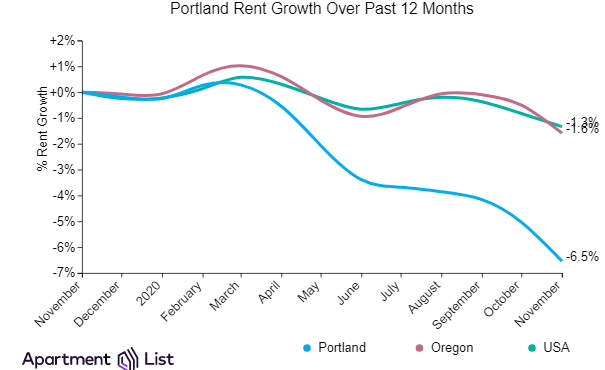
Portland rents have declined sharply by 1.6 percent over the past month, and have decreased by 6.5 percent year-over-year, according to the latest report from Apartment List.

This is the eighth straight month the city has seen rent decreases.

Median rents in Portland are now $1,126 for a one-bedroom apartment and $1,313 for a two-bedroom.

Portland Rents Continue On Downward Track For Another Month

While rents have declined steadily in the larger, denser, principal cities at the core of each metropolitan region, like Portland rents, in many outlying suburban areas rents have, on the whole, rebounded to pre-pandemic levels.

Around the Portland metro:

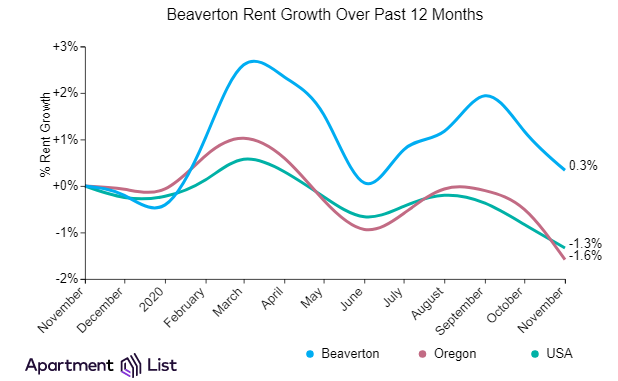
  • Beaverton rents have declined 0.8 percent over the past month, but have remained steady at 0.3 percent in comparison to the same time last year.

Beverton rent growth

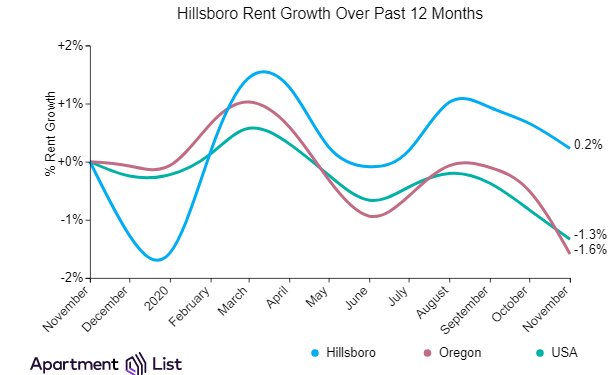
  • Hillsboro rents have declined 0.4 percent over the past month, but have remained steady at 0.2 percent in comparison to the same time last year.

Hillsboro rent growth in the Portland metro area

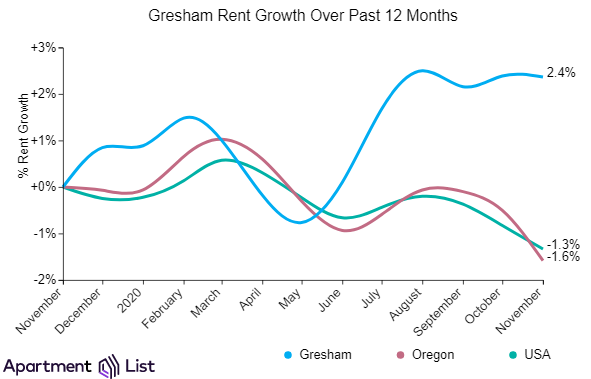
  • Gresham rents have remained flat over the past month; however, they have increased moderately by 2.4 percent year-over-year.

Portland rents and Gresham rent growth in the Portland metro

“After a wild summer in which the rental market saw unprecedented price drops, rents are beginning to line up with seasonal expectations. As the market cools in the fall, rents are down 0.5 percent month-over-month, consistent with the last two years,” said Rob Warnock with Apartment List.

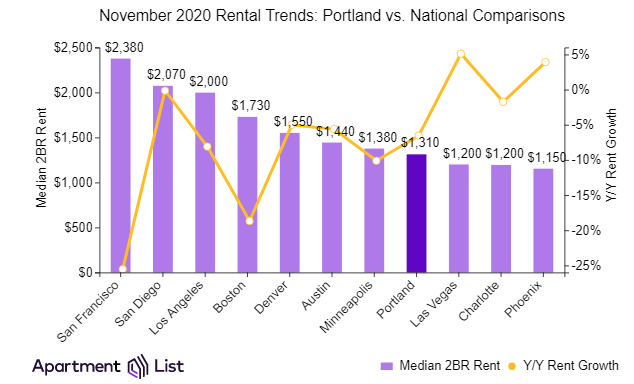
“But the fallout from the COVID-19 pandemic has been unequal, so while our national rent index is down 1.3 percent year-over-year, there is tremendous regional variation beneath the surface. San Francisco, Seattle, Boston, and New York City continue to lead the nation in pandemic rent drops, while smaller markets like Boise and Central California are getting more expensive,” Warnock said.

While Portland rents decline, rents continue to grow In Eugene and Salem

Eugene rents have continued to grow steadily and are up moderately by 3.4 percent year-over-year. Currently, median rents in Eugene are $845 for a one-bedroom apartment and $1,123 for a two-bedroom.

Meanwhile, Salem rents have increased 0.9 percent over the past month, and have increased moderately by 3.8 percent in comparison to the same time last year. Currently, median rents in Salem stand at $882 for a one-bedroom apartment and $1,150 for a two-bedroom.

How Property Managers Can Build a Winning Tenant Referral Program

Manage in the Past and Forget the Present

Sign Up For Our Newsletter And Get Apartment News And Helpful, Useful Content Each Week.

* indicates required

9 Ways to Get Rid of Mice in Rental Properties

9 Ways to Get Rid of Mice in Rental Properties

Mice in rental properties can be a real headache for property managers and landlords so here are some ways to get rid of them.

By Evelyn Long

Mice are an occasional reality for any homeowner, but they can wreak even more havoc in a rental property. Multiple units and occupants can attract rodents in different ways, and it’s hard to properly control an infestation once it’s under way. Property managers know they need to remedy the problem immediately, but how can they do so effectively?

Prevention, management and communication with tenants can help everyone get on the same page to drive rodents out. The following nine tips can help landlords effectively get rid of mice in their units.

1. Eliminate Points of Entry

The first step is to determine how the little pests gain access in the first place. Unfortunately, even the smallest crack or entry point can invite mice inside. Mice can eat through walls and they only need a hole the size of a dime to get inside.

The bulk of prevention here can be done with thorough inspection. Landlords should schedule appointments to walk through the property — if it is occupied, they need to give their tenants notice — and seal up any cracks in doors or windows. Steel wool and caulk work best because rodents can’t chew through them. Pay close attention to areas around plumbing fixtures and cable lines — these can provide ingress points.

If a tenant is dealing with an ongoing mouse problem, ask them to look for these holes on a regular basis and share tips for plugging them quickly with steel wool. Then, you can find time to do a more thorough repair job to keep the rodents at bay.

2. Banish Temptation as Much as Possible

It isn’t that mice eat much — but they can contaminate entire stashes of food. That giant box of cereal a tenants bought at Costco is now waste unless they want to risk a bowl of hantavirus for breakfast. Mice are resourceful creatures and will investigate kitchens to find new things to eat.

Tenants should banish temptation by keeping the premises clean. While property owners can’t demand they mop and dust weekly, they can include clauses to prevent common causes of mouse bait — like leaving out used pizza boxes. Landlords should review these documents when their properties are  unoccupied, because you can’t issue one retroactively once a prospective customer signs.

Another tactic to use — with caution — is the right to inspect. While states usually require a 24-hour or more notice, property owners may go through and document the unit’s condition. Photographs will become valuable evidence should an infestation result in a court battle.

Bear in mind that even the best tenants won’t appreciate having someone tramping through their home, particularly during a pandemic. However, when mice in rental properties are threatening not only your tenants’ health but your other units and property as a whole, be firm in reminding troublesome renters of their responsibilities to keep their property clean.

9 Ways to Get Rid of Mice in Rental Properties
Mice in rental properties can be very resourceful.

3. Lay Traps

Traps should be laid to get rid of an existing infestation. Mice typically travel with family, so multiple traps will be required. Whether you prefer the classic snap trap or the capture-and-release, be prepared to check frequently for success, and dispose of mice quickly.

Property managers and tenants, depending on whether the unit is occupied, should place traps along walls and consider bait such as peanut butter to attract mice. Rodents are smart, so you may need to switch up tactics and try new traps or locations if nobody is biting.

4. Prevent Property Problems with Better Traps

It’s often better to stay away from the inhumane glue traps that leave mice to dehydrate and starve to death, especially if they can’t be checked frequently. Mice may even chew off their limbs in an attempt to escape, which can also leave an unpleasant clean-up for property managers or tenants once the trap is found.

The same goes for poison pellets. These don’t kill instantly by design, meaning mice will wander off after consumption. The sick animal can crawl off into a wall or hidden area to decompose, which can lead to odor concerns later.

If you don’t have much empathy for mice, the classic snap trap is reliable and quick to kill without prolonging suffering. Considering the catch-and-release method? Varmints should be released at a considerable distance from the property to prevent re-entry. Mice have a keen sense of smell. Plus, no one wants them potentially infesting other units.

5. Clean Out Storage Areas

If you own a building with shared space like an attached storage unit or basement, rodents can infest these areas before you or your tenants notice. Landlords should host an annual cleanout and inspect and treat the space for pests in order to prevent greater infestation.

Stacks of old books and magazines make ripe nesting grounds for mice in rental properties and insect pests alike. Control efforts should continue year-round. Don’t slack off in the winter — that’s when rodents reproduce and add to their broods.

6. Try Peppermint Oil

Some people claim that peppermint essential oil or peppermint plants effectively dissuade both mice and spiders — two critters most tenants are happy to bid farewell to.

Property managers can apply a small amount of peppermint oil around areas of potential ingress. However, repeated applications are required, so work with tenants if choosing this method. Tenants with a green thumb can even consider growing some peppermint at home — even if it isn’t the most effective, they can still enjoy a pleasant smell.

7. Go Ultrasonic

Another humane way to deter rodents from returning is to use ultrasonic repellers. These devices emit a high-pitched sound that’s inaudible to humans but painful to rodents. Most models are safe to use around household pets like dogs and cats.

However, actual results are mixed with this method, and property managers may not get a strong return on investment in providing these systems to tenants. If attempted, these repellents are best used in conjunction with more proven traps.

8. Keep Landscaping Trimmed

Mice are little thieves, and as with the human variety, they seek places to hide when breaking and entering. Keeping outside landscaping trimmed can deter both types of miscreants. Property managers who practice regular upkeep can enjoy pest prevention on top of other benefits, like curb appeal.

9. Say Yes to Cats

This isn’t a guaranteed solution, but there’s something to be said for having a nature-engineered pest-control service living in a unit. If you’re on the fence about pets, allowing responsible tenants to have cats could entice renters while taking care of mice in rental properties.

As with any allowance, review your lease and add protective clauses to make sure the arrangement works for both parties. Landlords should set a reasonable limit on the number of animals allowed per residence, but most felines adore keeping the rodent population in check.

Get Rid of Mice in Rental Properties

Getting rid of mice in rental properties can take time and dedication. If possible, it’s best to focus on prevention so tenants don’t have to worry about pest-control visits and trap management. However, since mice are a fact of life, a combination of property maintenance and pest control is usually the key to solving the problem.

Property owners can get rid of mice with the nine tips above. Doing so protects their investment and can attract a more highly qualified — and timely-paying — tenant.

About the author

Evelyn Long is the editor-in-chief of Renovated, where she shares real-estate market and maintenance advice for investors and their tenants. Based in Baltimore, Evelyn is enthusiastic about both brownstones and crab cakes.

How to Rent a Pest-Free Home to Your Tenants

7 Pest Preventative Maintenance Steps For Rental Housing

Sign Up For Our Newsletter And Get Apartment News And Helpful, Useful Content Each Week.

* indicates required


Secondary Market Rents Soar While Primary Markets Plummet

Cars pass by the Amazon distribution warehouse in the industrial area of Fontana, California in the Inland Empire where Secondary Market Rents Soar

Secondary market rents are growing as rent growth is varying across markets as the divide between gateway and secondary metros continues to increase with the pandemic, according to the October report from Yardi Matrix.

“With each passing month, outmigration from large gateway markets to secondary and tertiary tech hubs is amplifying. At this point, the apparent winners are markets in close proximity to large gateways but with significantly lower costs of living,” the report says.

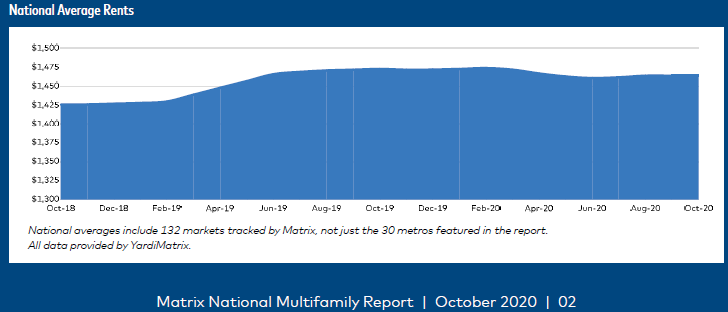
  • Multifamily rents were flat for the third consecutive month in October, but the national numbers appear misleading, as the sector is experiencing an ever-increasing divergence between outperforming and underperforming markets. On a year-over-year basis, rents fell 0.6 percent nationwide.
  • Secondary and tertiary markets are performing the best, as high costs and limited community amenities drive outmigration from gateway markets. The Inland Empire (6.0 percent), Sacramento (5.0 percent), Las Vegas (3.9 percent) and Phoenix (3.8 percent) lead our top 30 markets, with each market benefiting from migration out of the Bay Area and Los Angeles.
  • Not surprisingly, New York (-10.0 percent), San Francisco (-8.2 percent), Washington, D.C. (-3.7 percent), Boston (-3.1 percent), Chicago (-2.9 percent) and Los Angeles (-2.8 percent) all fell at or near the bottom of our rankings.

For example, the average rent in Sacramento is 34 percent less than in San Francisco. The report says even tertiary markets with a strong tech presence, such as Boise, Idaho and Portland, Maine, are attracting people from expensive coastal markets.

Secondary Market Rents Soar While Primary Markets Plummet
Yardi Matrix says demand remains strong, as gateway residents are not only moving to nearby secondary metros but also relocating to other tech hubs in the Sun Belt and Southwest. Chart courtesy of Yardi Matrix.

“As many workers, especially those in creative and knowledge-based industries, enjoy increased flexibility to work remotely, many individuals are weighing the costs and limitations of gateway markets versus the benefits of smaller cities and are choosing to relocate.

‘‘Demand remains strong, as gateway residents are not only moving to nearby secondary metros but also relocating to other tech hubs in the Sun Belt and Southwest.

“Primary markets will not suffer forever, but their recovery will depend on how much newly relocated individuals enjoy their adopted homes and cities and whether they choose to stay,” Yardi Matrix says in the report.

Short-term rent growth was flat in October

Rents were flat month-over-month in October for the third consecutive month, the report says.

“However, secondary markets made significant rent gains, with the Inland Empire, Las Vegas, Sacramento and Phoenix all increasing 1.0 percent or more on a monthly basis. These markets tend to outperform during fall and winter months, as they are not susceptible to seasonal weather that slows renting in northern markets, but this year’s performance is even better than normal, as migration into these markets continues to increase.”

Rents are falling in gateway markets, “as some analysts predict five years of outmigration has been accelerated into the past six months,” the report says. The trend toward suburban submarkets and smaller markets has hurt the denser urban cores of the major markets. “Some secondary markets—including Seattle, Austin and Minneapolis—are also getting squeezed on both rent and occupancy, specifically in their urban submarkets,” the report says.

Help for apartment owners?

“There will likely be another round of government stimulus, but given the divided Congress, the total package will be less than if the Senate had flipped Democratic. (A runoff election in Georgia on Jan. 5 will determine the winners of two senate seats).

“For apartment owners and operators, additional stimulus and unemployment benefits paid to residents will help cover housing costs, especially in the workforce housing sector, where job loss is most concentrated.

“As the pandemic grinds on, there does appear to be hope for an economic recovery on the horizon, although there may be a few more months of pain in the near term,” Yardi Matrix says in the report.

Get the full report here from Yardi Matrix.

About Yardi Matrix:

Yardi Matrix researches and reports on Multifamily, Office and Self Storage properties across the United States, serving the needs of a variety of industry professionals.Yardi Matrix Multifamily provides accurate data on 18+ million units, covering over 90% of the U.S. population. Contact them at (480) 663-1149.

Affordable multifamily markets in high demand

Negative Rent Growth Year-Over-Year For First Time Since 2010

Sign Up For Our Newsletter And Get Apartment News And Helpful, Useful Content Each Week.

* indicates required

Do We Have Any Recourse With Property Management Company Over Tenant Damages?

Do We Have Any Recourse With Property Management Company Over Tenant Damages?

This week the question for Ask Landlord Hank is about how a property management company deals with tenant damage. Remember Landlord Hank is not an attorney and is not giving legal advice.

Dear Landlord Hank,

We inherited a single-family home that already had a property management company.

Lucky for us, the tenant moved out just before moratorium!

However, the home was trashed and it was clear that this had been going on for quite a while. Garbage bags and damage were everywhere. For instance, a glass shower door had broken glass and large pieces of glass protruding! And the tenant was still using the shower with just a curtain hanging! And there were 4 small children living in the home!

My question is, do I have any recourse with the property management company?

They had done their walk-through and had asked the tenant to replace the door, but failed to follow up. We also had smoke detectors beeping from June till December, when I was granted permission to enter with the property-management owner. Clearly there was neglect. We sold the house with a loss of more than $50,000 due to all the problems, including the pandemic.

Please advise if there is any way to recapture all the money lost?

Sincerely,

Pat

Dear Pat,

I’m so sorry to hear about your situation.

Tenants like these are exactly why more people aren’t landlords; and in this case, you had a property management company that put these tenants into your place!

The property management company hopefully did a complete background screen on these tenants and shared these results with you.

Even though the company didn’t directly cause the damage to your property, they have a duty to you to protect and maintain your property and do periodic inspections (that is in my MLS agreement, anyway).

When the property management company did a walk-through inspection and noted the damage in addition to the shower door, they should have contacted you and made you aware of the situation. Did the company owner talk to you about evicting the tenants?

The eviction moratorium has put a strain on many landlords and driven some to foreclosure. I’d consult an attorney after you review your management agreement with the property-management company. Best of luck!

Sincerely,

Hank Rossi

Ask Landlord Hank: This week the question for Ask Landlord Hank is about a property management company and tenant damages to a rental property.
Landlord Hank says, “When the property management company did a walk-through inspection and noted the damage in addition to the shower door, they should have contacted you and made you aware of the situation.”

Ask Landlord Hank Your Question

Ask veteran landlord and property manager Hank Rossi your questions from tenant screening to leases to pets and more! He provides answers each week to landlords.

  • This field is for validation purposes and should be left unchanged.

Do I Have to Paint and Replace Flooring for a Long-Term Tenant?

Sign Up For Our Newsletter And Get Apartment News And Helpful, Useful Content Each Week.

* indicates required

Should I Turn On The Utilities and Power For New Tenant Moving In?


Help for a Portland Landlord Trying to Decide What to Do

Ask Landlord Hank – A Tenant Has Questions About Landlord Obligations


Ask Landlord Hank: Can I Evict Tenants Due To Damage To The Home?

If Tenants Don’t Keep Bathroom Heat On, Can it Cause Mold?