Home Blog Page 87

Workplace Culture No Longer Enough to Attract and Retain Associates

Workplace Culture No Longer Enough to Attract and Retain Associates

As apartment and multifamily companies compete for a limited pool of candidates, here are seven best practices to create a competitive advantage as workplace culture is no longer enough to attract and retain associates.

By Maritza Riquelmy-Romero 
Vice President of Human Resources
Richman Property Services, Inc.

Culture is incredibly important to an organization. But as the multifamily industry is rapidly discovering as it emerges from the pandemic, culture can no longer compensate for foundational needs when it comes to hiring and associate retention in the workplace.

While a relaxed dress code and a ping-pong table in the break room may have once indicated a fun and edgy corporate culture worth signing up for despite a slightly lower salary and lesser benefits, prospective employees now want it all. And they’re getting it.

With the hiring and retention challenges currently faced by nearly all industries, apartment companies included, job seekers are firmly in the driver’s seat. They don’t have to settle or sacrifice their work/life balance. They want an enjoyable workplace culture, as well as all the tangibles that serve as the cornerstones of a positive and fruitful employment situation. Now, it’s up to multifamily owner/operators to deliver.

As multifamily companies compete for a limited pool of candidates, here are seven best practices to create a competitive advantage:

1. Competitive Compensation

As competitive as multifamily has become in terms of recruitment, operators can’t afford to offer anything less than top of market wages and compensation. Whether hourly or salaried, associates know their value and have a baseline expectation for pay. While job seekers still seek out top companies and fun workplace environments, they aren’t willing to join an organization that doesn’t also meet their income requirements.

2. Bolstered Benefits

When pay is equal across the industry, operators can create a competitive advantage through their benefits packages. Especially for entry-level associates, comprehensive health benefits can be a huge enticement. Scaled company contributions, where associates earning less also pay less for health benefits, can help to recruit new associates because less of their earnings will go toward insurance coverage.

Increased vacation time, an extensive list of paid holidays and creatively structured time-off opportunities can also tilt the scales when a prospective hire is weighing job offers. Organizations are also going a step further, offering education reimbursement, rent discounts, pet insurance and sabbatical leave for tenured associates.

3. Comprehensive Training

New hires who enter their roles prepared to hit the ground running typically express increased job satisfaction in the early stages of their employment. Training programs that position new associates to contribute immediately and feel competent in their work can prove invaluable, both in terms of associate satisfaction and property performance.

But training shouldn’t cease after the onboarding process. Ongoing training platforms that keep associates up-to-speed with new technology implementations, renter preferences and company objectives also serve to increase associate retention. Employees who feel like they are evolving in their roles and provided with career development opportunities are more engaged with their work. And engaged employees are loyal employees.

4. Emphasize Retention

Recruitment and hiring often receive an inordinate amount of attention when it comes to maintaining a multifamily workforce. The real challenge in maintaining teams is not attracting new associates but keeping current employees in place.

Operators need to be cognizant of rising starting salaries compared to current employee compensation. By taking care of existing team members first, and not offering new hire benefits that aren’t first extended to active associates, companies can demonstrate a commitment to employee retention.

People don’t leave companies. People leave people. When operators can curb associate turnover, they create more cohesive and productive teams and forge deeper interpersonal connections. Associates working in an environment of continuous turnover don’t form the same connections with their coworkers, making it easier to leave. In contrast, when coworkers have been side-by-side for years, the workplace develops more of a family feel.

5. Solicit Associate Feedback

Culture and interpersonal connections are significant factors in associate retention. Operators can take employee engagement a step further by regularly soliciting associate feedback. When employees have a valued and respected voice in the company, it builds loyalty and grows associate tenure. Companies that poll associate sentiment and satisfaction through periodic surveys or other platforms for direct feedback develop more involved and invested teams.

It is equally important for associates to know that their feedback is received and incorporated into company decision-making processes. Two-way communication between associates and upper tiers of the company is vital to establishing an environment of trust and respect.

6. Maintain Flexibility

Associates at all levels of multifamily operations have grown accustomed to remote work environments in recent years and maintaining a flexible business model will go a long way toward attracting and retaining associates in the current job market. Operators who view the fading pandemic as a chance to revert to traditional methods of property management will only encourage employee turnover and hamper hiring efforts.

Operators who embrace opportunities for remote work or even introduce options for increased flexibility will find themselves in the favor of both current and prospective associates. Some companies have started rolling out hybrid staffing models and four-day work weeks to boost employee satisfaction.

7. Celebrate Associates

Company successes are built on the backs of associates. Taking the time to recognize the people who helped the organization reach a milestone or surpass previous performance levels validates their hard work.

Tangible rewards – bonuses, gift cards, an extra day of PTO – for significant achievements demonstrate appreciation and incentivize continued productivity. Direct recognition from the executive team confirms the visibility of individual or team efforts and promotes unity across the company. The gesture doesn’t need to be extravagant, but opportunities to recognize associates and celebrate their achievements must be seized.

While corporate culture remains a differentiator for multifamily organizations, it’s not the panacea it once was for hiring and retention. People seeking employment in the multifamily sector now demand a complete workplace package that includes peak compensation and benefits, as well as career development and engagement opportunities. Without that foundation to attract and retain associates, corporate culture begins to crumble.

About the author:

Maritza Riquelmy-Romero is a Senior level Human Resources professional with over 20 years’ experience. Maritza is focused on operational success through strong partnerships, leadership assessment and strategic vision development. Maritza holds a MBA from University of Phoenix, a Bachelor’s in International Human Resources Management from Eckerd College and is a certificated PHR from the Society for Human Resource Management.

Sign Up For Our Weekly Newsletter And Get Rental Property And Apartment News And Helpful, Useful Content Each Week.

* indicates required

Property Management Apartment Jobs In High Demand

7 Top Challenges Facing Rental Housing Property Managers

11 Questions to Ask When Hiring a Property Manager or Company

Multifamily Rents Defy Expectations And Keep Climbing

Multifamily rents have defied expectations and kept climbing as asking prices rose $15 in April, an all-time high Yardi Matrix reports

Multifamily rents have defied expectations and kept climbing as asking prices rose $15 in April, an all-time high, as weakening U.S. economic growth has not stopped multifamily rents, according to the latest Yardi Matrix report.

Overall the rate of rent growth remains elevated due to strong demand and a long-term shortage of housing that analysts estimate is between two million and five million units, the report says.

Also single-family monthly rental asking prices topped $2,000 per month for the first time as build-to-rent grows.

Yardi Matrix writes that, “Coming off a record year of growth, in a weakening economy, there was not much doubt that multifamily growth would slow down in 2022, but by how much?

“So far into the spring leasing season, the market is holding up well.”

Highlights from the report:

  • Despite the U.S. economy’s recent hiccups, multifamily performance continues to be stellar with asking prices up in April to all-time high of $1,659. Year-over-year growth moderated by 50 basis points but remains high at 14.3 percent.
  • Although there is a small handful of weak numbers, multifamily demand and rent growth remain incredibly strong throughout the country.
  • “Of our top 30 metros, rent growth was up at least 8.8 percent over the last year in all but one. Rent growth was positive in each of the top 30 metros over the last one-month, three-month and 12-month periods.
  • The average single-family asking rent in the U.S. topped $2,000 for the first time and stood at an all-time high of $2,018 in April. Year-over-year growth dropped 110 basis points to 13.2 percent.

Some cautions in the future

Yardi Matrix writes, “Certainly, deceleration will happen, and there are warning signs on the horizon” with the economy.

However, “The demand-supply equation for multifamily should remain favorable even in the event of a modest economic slowdown.

The job market is strong, and household finances remain healthy, as evidenced by a robust increase in consumer spending during the first quarter. Higher mortgage rates have put a crimp in the for-sale housing market, which is likely to keep some renters in apartments, while household formation growth is expected to remain strong,” Yardi Matrix says.

Build-To-Rent Single-Family Rentals Grow

“Rapidly rising house prices and increasing interest rates are keeping homeownership out of reach for some potential buyers, while others are losing bids to the growing competition from institutional investors.

“The increasing preference for suburban housing has added to demand for single-family rentals. New development is on the rise as more and more investors enter the sector, though that will be tested as development and borrowing costs increase,” the report says.

Read the full Yardi Matrix report here.

About Yardi Matrix:

Yardi Matrix researches and reports on multifamily, office and self-storage properties across the United States, serving the needs of a variety of industry professionals. Yardi Matrix Multifamily provides accurate data on 18+ million units, covering more than 90 percent of the U.S. population. Contact the company at (480) 663-1149.

Sign Up For Our Weekly Newsletter And Get Rental Property And Apartment News And Helpful, Useful Content Each Week.

* indicates required

Ask Landlord Hank: What to Do About Hoarder-Tenant Friend

What to do about a hoarder tenant who is also a good long-time family friend is the question this week for Ask Landlord Hank.

What to do about a hoarder tenant who is also a good long-time family friend is the question this week for Ask Landlord Hank. Remember Hank is not an attorney and he is not offering legal advice. If you have a question for him please fill out the form below.

Dear Landlord Hank:

We rent out a house next to us to a lifelong friend of my husband’s. She used to babysit him when he was little. She is now in her 60s, with very poor physical and mental health. She is a hoarder and as her physical health has deteriorated, this problem has become out of control and unhealthy for her.

My husband has gone in with her permission several times and cleaned up the place. Within two weeks it is always a mess again. There is literally just a path through from the front door to a chair she lives and sleeps in. She can no longer reach a bedroom or the bathroom. She wears adult diapers and cleans herself up afterward, but is now getting too weak to even do that very well. It takes her an hour.

She also has a dog and a cat, which just use a back room of the house to go to the bathroom because she can no longer take care of their needs either. There is no family willing to help. We have repeatedly tried to talk her into assisted living, which she shoots down immediately.

At this point, she really needs nursing home care. She refuses to go to the hospital and insists she wants to stay here and that she is fine.

At what point do we override her free will and take legal action to get her help? We are concerned for her, of course, but are also worried we could be held responsible for her unsanitary living conditions. We have tried to help. She just won’t let us.

But her health is so poor, we could be calling an ambulance for her someday soon. At that point, the state of her living conditions would no doubt be reported to somebody. Could that come back on us in the form of criminal charges or something similar? If we take action to get her out into assisted living or whatever she needs, she will see it as the ultimate betrayal. She thinks that families that allow a loved one to go into a nursing home are just terrible people.

Some thoughts or insight into our level of responsibility? We live in Ohio. Thanks so much for your time. –Crystal

Dear Landlady Crystal,

This is a very tough situation to be in, as your tenant is far more than a tenant.

It seems like you consider her “family” and she has the same feelings. I’m not able to diagnose this person but from your description of the situation it appears that this tenant may be battling a hoarder disorder, which has been officially designated as a subtype of obsessive/compulsive disorder.

This disorder is also considered a disability by the American Psychiatric Association, meaning that she would also be protected by the Fair Housing Act. She would be protected on many levels, and I know eviction is not any part of the plan – nor should it be.  Since she is failing both physically and mentally and has basically created a toxic environment, this is no longer a safe place for her to be.

You may have to be the mother figure here and tell her that since she can no longer take care of herself properly you are very concerned about her continued well-being and she is going to need more care than she is getting and a clean, safe environment in which to live. This is not up for discussion, and she can either be a part of the decision or she can fight you, in which case she’ll have less say so in where she moves from your place.

I would talk to your local social services and health department and ask for help. You could also visit some assisted living communities for advice and availability.  I would first contact a local Ohio attorney dealing in landlord-tenant law and ask for advice. This is not going to be an easy battle since she is in denial about her health and the need for more care. I know you care for her very much and hopefully she will come to see that you only have her best interests at heart.

Sincerely,

Hank Rossi
www.rentsrq.com

Each week I answer questions from landlords and property managers across the country in my “Dear Landlord Hank” blog in the digital magazine Rental Housing Journal.  https://rentalhousingjournal.com/asklandlordhank/


Can a landlord prohibit tenants using small portable washers and dryers in a rental unit is the question this week for Ask Landlord Hank.
Landlord Hank says, “I would talk to your local social services and health department and ask for help.”

Ask Landlord Hank Your Question

Ask veteran landlord and property manager Hank Rossi your questions from tenant screening to leases to pets and more! He provides answers each week to landlords.

  • This field is for validation purposes and should be left unchanged.

Do I Have to Paint and Replace Flooring for a Long-Term Tenant?

Sign Up For Our Newsletter And Get Rental Housing And Apartment News And Helpful, Useful Content Each Week.

* indicates required

Landlord To Pay $135,000 In Sexual Harassment Lawsuit Settlement

An Iowa landlord will pay $135,000 to settle with the U.S. Department of Justice and resolve a lawsuit alleging sexual harassment.

An Iowa landlord will pay $135,000 to settle with the U.S. Department of Justice and resolve a lawsuit alleging that the Davenport, Iowa, landlord Juan Goitia violated the Fair Housing Act by sexually harassing female tenants, according to a release.

The settlement also resolves claims against 908 Bridge Cooperative which, along with Goitia, owned the properties where the harassment occurred.

Under the consent order, which still must be approved by the U.S. District Court for the Southern District of Iowa, defendants are required to pay $135,000 to compensate individuals harmed by the harassment and pay a civil penalty to the United States. The consent order also:

  • Prohibits Goitia from continuing to manage rental housing;
  • Requires Goitia to retain an independent property manager to manage any rental properties he owns now or in the future; and
  • Requires defendants to obtain fair housing training and implement comprehensive non-discrimination policies and complaint procedures to prevent sexual harassment at their properties in the future.

“Sexual harassment by housing providers is an illegal and egregious abuse of power that deprives tenants of their right to be safe and secure in their homes,” Assistant Attorney General Kristen Clarke for the Justice Department’s Civil Rights Division said in the release.

“The Justice Department is committed to protecting the rights of vulnerable tenants subjected to sexual harassment and will continue to hold landlords accountable and obtain relief for survivors.”

The lawsuit, filed in 2020, alleged that since at least 2010, Goitia subjected female tenants to harassment that included making unwelcome sexual comments and advances, touching tenants’ bodies without their consent, entering the homes of female tenants without their consent and without prior notice, and taking adverse actions against tenants who resisted his sexual overtures or complained about the harassment, according to the release.

This case was litigated by attorneys in the department’s Civil Rights Division and the Civil Division of the U.S. Attorney’s Office for the Southern District of Iowa. The Justice Department’s Sexual Harassment in Housing Initiative is led by the Civil Rights Division, in coordination with U.S. Attorneys’ Offices across the country. The goal of the department’s initiative is to address and raise awareness about sexual harassment by landlords, property managers, maintenance workers, loan officers, or other people who have control over housing. Since launching the initiative in October 2017, the Department of Justice has filed 23 lawsuits alleging sexual harassment in housing and recovered over $9.6 million for victims of such harassment.

Landlord Charged With Sexually Harassing Female Tenant

Sign Up For Our Weekly Newsletter And Get Rental Property And Apartment News And Helpful, Useful Content Each Week.

* indicates required

5 Signs You Need To Call A Professional About Water Damage

Here are 5 signs you need to know when to call a professional about water damage in your rental property instead of doing it yourself.

Here are 5 signs that you need to know that will tell you when to call an expert and professional about water damage in your rental property instead of doing it yourself.

1. Moisture has gone from one unit to another unit or space

  • The professional will make appropriate recommendations based on type of water damage, how long it has been wet, if materials can be salvaged and more.

2. When you have identified microbial growth on any building surface

  • The company can determine if it related to plumbing, siding or roof failures, poor air circulation or other causes to then make recommendations as to how to best handle it.

3. Drain water backs up out of a toilet, sink or tub

  • The company professional knows how to properly handle these situations as this type of back up can have adverse health effects along with be a super fuel for other types of microbial growth.
Here are 5 signs you need to know when to call a professional about water damage in your rental property instead of doing it yourself.
Water backing up in sink can be an issue that requires expert help.

4. When you need help finding a leak

  • You need an expert who has the experience to help expose if something is coming from the roof, windows, siding or more along with eliminating various sources to determine the root cause.

5. To assess the extent of a complex water-related incident

  • The expert can also address the many issues related to a complex water related incident based on proper knowledge, skill and experience. Your tenants will appreciate this.

It is always best to err on the side of caution and call a professional when dealing with the many scenarios that arise to get the proper care and to prevent something small from becoming bigger over time in your rental property.

About the author:

For more than 40 years, the Fischer family of companies has proudly served the greater Seattle community – starting with Fischer Plumbing in 1977, and adding restoration, electric, and heating and air divisions over the years. Fischer Restoration at 6608 220th St. SW. Mountlake Terrace, WA 98043. Call us today at 206-633-2065!

Sign Up For Our Newsletter And Get Rental Housing And Apartment News And Helpful, Useful Content Each Week.

* indicates required

The Green Resident Wave Is Coming Are You Ready?

The green resident wave is coming to the multifamily industry as environmentally conscious residents begin to dominate the leasing market.

The green resident wave is already bearing down on the multifamily industry as more environmentally conscious residents begin to dominate the leasing market.

By Regan Hartley

Environmental measures have faced slow adoption in the multifamily industry. The reluctance is understandable. After all, owner/operators, along with everyone else, have been told for years that the green boom was on the way.

The truth, however, is that the green resident wave is already bearing down on the multifamily industry. As more environmentally conscious residents begin to dominate the leasing market, it’s the green buildings that are set to rise above the competition. Multifamily communities are faced with taking action now to adapt and thrive in the shifting leasing environment. Those that don’t will face the inevitable consequences of needing to rebuild.

Greater Demand for Sustainability Pushing Multifamily Investing

About 36 percent of multifamily developers are involved in green projects, a number that’s expected to increase to 47 percent in 2022, according to a recent report by the National Association of Home Builders. In addition, a recent analysis by Bloomberg predicted that global environmental, social and governance (ESG) assets are expected to top $53 trillion by 2025, which is more than double what they were in 2016 and which make up around 33 percent of the market.

Sound environmental preparation is not only important for a community to distinguish itself from competitors, but it’s also developing into a necessity to secure investment funding for new projects, updates and conversions. ESG is becoming an important factor for investors, looking at the increased demand by society and becoming more green-conscious themselves. Fannie Mae offers preferential pricing on loans for multifamily projects that seek one of the lender’s recognized green building certifications.

ESG certifications, such as LEED, significantly raise the value of a building, making them necessary moving forward. The multifamily industry is reaching the point where ESG certification and sustainable building practices will become an unavoidable part of projects. ESG is no longer daunting, and both private and public companies are putting greater focus on it. Private companies are creating policies and programs, as well as sharing their efforts online. On the public side, earnings calls contain a greater focus on the company’s ESG efforts, and even private companies are beginning to feel the pressure.

The race to be at the forefront of ESG allows owner/operators to begin implementing the amenities that are soon to be must-haves, not nice-to-haves.

Explosive Growth for EV Driving Mandates Charging Stations

Electric vehicle (EV) demand among consumers has been on the rise for years. It regained steam after a brief dip in sales during the pandemic, bolstered by economic and global turmoil. Sales of EVs more than doubled from 2020 to 2021 and tripled from 2019, according to sales data from Green Car Report.

Nearly 23 percent of licensed U.S. drivers stated they would purchase a new or used electric vehicle, according to a YouGov poll conducted for Forbes Wheels. While this may not seem jarring, this number is significant, as it’s eight times the number currently on the road. In the same group, 65 percent of respondents said they believed EV is the future of the automobile industry.

The auto industry is in agreement with this view, developing fully electric and hybrid vehicles at unprecedented and accelerated rates. There are more than 50 electric vehicle and plug-in hybrid electric vehicles (PHEV) models currently available on the market. Acura, Audi, Chevy, Chrysler, GMC, Honda and every other major car manufacturer is slated to release at least one, if not many, EV models in the next five years. Ford recently stopped reservations on the base model of its new 2022 F-150 Lightning after receiving 200,000 requests in just months.

New companies, such as Rivian, Canoo, and Byton, are not making splashes in the auto industry, but massive waves. California-based FISKER has more than 40,000 reservations for their Ocean SUV model being fulfilled in July 2022. Lucid, another new electric company, had their model Air named the 2022 MotorTrend Car of the Year.

As the number of electric vehicles on the road begins to increase, owners need EV chargers – and they’re going to put their rental dollars into housing and communities that offer this amenity. This is going to create a snowball effect: As the number of communities that supply chargers increases, sales of electric vehicles are predicted to increase, thus creating greater demand for chargers.

Smart Tech Now a Priority for Residents

A recent study by NMHC/Grace Hill showed that close to half of millennial and Gen Z renters put a greater emphasis on smart tech than other generations. In 2021, Gen Z was the only generation that saw an increase in the number of leasing applications, and they are credited with the recent resurgence in urban multifamily leasing.

Of the top two smart tech gadgets these green residents desire, one of those is smart thermostats, which provide residents greater control over energy use and access to local usage programs. They aren’t just for residents, however. Owner/operators can utilize smart tech to control utilities in unoccupied units to maximize savings.

In addition, there is smart tech that can detect leaks, control water usage, control lighting and HVAC in common areas, and improve building health, along with a whole host of other environmentally friendly, cost-saving measures. Not only will these increase net operating income, but they’re also the green items residents are seeking out.

The Next Wave

When it comes to the environment, “As California goes, so goes the nation” tends to hold true. The state has been a bellwether for social change for a while now, even if many don’t want to agree. California ushered in a composting requirement, which includes multifamily, at the beginning of 2022. There are several other states, counties and municipalities that have also started efforts to require or encourage composting efforts.

Denver ran a pilot program for recycling to reduce waste in the near future. The goal is to eventually make proper recycling a condition of a resident’s lease.

The number of people who grew at least a portion of their own food rose to around 35 percent in the summer of 2020 during the pandemic. Now that restrictions have eased, community gardens in multifamily housing is a great amenity that brings residents together and can provide people with a new skill.

The EPA Water Score provides owner/operators with an analysis of their water use compared to similar properties and shows how to make adjustments to a property to maximize its water, energy and sewage systems.

After years of false starts and predictions, the green resident wave is arriving on the shores of the United States with full force. Multifamily owner/operators will need to begin a serious evaluation of their current portfolio and upcoming projects to determine if they’re ready for this unstoppable change in the culture.

About the author:

Regan Hartley serves as the vice president of sales for Xeal Energy, where her focus is on strategic partnerships and new business development, sales strategy and collateral development, national accounts, marketing and brand development, and product and market growth. Regan is an investor, innovator, and advisor with more than 8 years of experience in the multifamily industry.

Renter Preferences Survey Report Shows The Future Is Remote Work

Sign Up For Our Newsletter And Get Rental Property And Apartment News And Helpful, Useful Content Each Week.

* indicates required

Why I Like My Rental Properties’ Nosy Neighbors

Three Steps to Becoming a Successful, Lazy Landlord

Can We Put A Stop To Renters Using Small Portable Washers And Dryers?

Can a landlord prohibit tenants using small portable washers and dryers in a rental unit is the question this week for Ask Landlord Hank.

Can a landlord prohibit tenants using small washers and dryers in a rental unit is the question this week for Ask Landlord Hank. Remember Hank is not an attorney and he is not offering legal advice. If you have a question for him please fill out the form below.

Dear Landlord Hank:

A lot of our renters are using small washers and dryers in their unit. Can we put a stop to it and how many people per unit?

Dear Landlord John:

You had two questions:

  1. How many people per unit?  Normally the lease will detail who is renting (adults) and other occupants (children) and a clause about guests (how long they can stay without written permission). The general rule of thumb is maximum occupancy is two people per bedroom.
  2. Some tenants are using portable washers and dryers in the units and can landlord stop this practice?  Again, John, check your lease – often under the Use of Premises clause there is this language: Tenant shall secure insurance for any water filled devices with loss payable to landlord. You could also add that to your lease – a prohibition of portable washers and dryers since there is the possibility of flooding and damage to your property. Good luck!

Sincerely,

Hank Rossi

Each week I answer questions from landlords and property managers across the country in my “Dear Landlord Hank” blog in the digital magazine Rental Housing Journal.    https://rentalhousingjournal.com/asklandlordhank/

Can a landlord prohibit tenants using small portable washers and dryers in a rental unit is the question this week for Ask Landlord Hank.
Landlord Hank says, “often under the Use of Premises clause there is this language: Tenant shall secure insurance for any water filled devices with loss payable to landlord.”

Ask Landlord Hank Your Question

Ask veteran landlord and property manager Hank Rossi your questions from tenant screening to leases to pets and more! He provides answers each week to landlords.

  • This field is for validation purposes and should be left unchanged.

Do I Have to Paint and Replace Flooring for a Long-Term Tenant?

Sign Up For Our Newsletter And Get Rental Housing And Apartment News And Helpful, Useful Content Each Week.

* indicates required

Portland Rents Increase For Third Straight Month

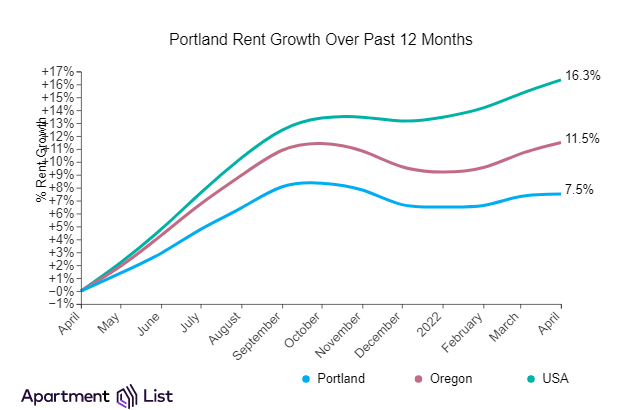
Portland rents increased again in April for the third straight month and are up by 7.5 percent year-over-year, according to the latest report from Apartment List.

Portland rents increased again in April for the third straight month and are up by 7.5 percent year-over-year, according to the latest report from Apartment List.

With the 0.2 percent increase in April, median rents in Portland are now $1,220 for a one-bedroom apartment and $1,423 for a two-bedroom.

Portland’s last rent decline was in January. Portland’s year-over-year rent growth lags the state average of 11.5 percent, as well as the national average of 16.3 percent.

Beaverton rents increase sharply over the past month

Beaverton rents have increased 1.6 percent over the past month, and have increased sharply by 17.0% percent in comparison to the same time last year.

Median rents in Beaverton are $1,544 for a one-bedroom apartment and $1,874 for a two-bedroom. This is the third straight month that the city has seen rent increases.

Hillsboro rents also increase sharply

Hillsboro rents have increased 1.0 percent over the past month, and have increased sharply by 18.7 percent in comparison to the same time last year.

Median rents in Hillsboro are $1,685 for a one-bedroom apartment and $1,850 for a two-bedroom.

Vancouver rents also up over the past month

Vancouver rents have increased 0.7 percent over the past month, and are up sharply by 12.3 percent in comparison to the same time last year.

Median rents in Vancouver are $1,390 for a one-bedroom apartment and $1,641 for a two-bedroom.

Eugene rents increase sharply

Portland rents increased again in April for the third straight month and are up by 7.5 percent year-over-year, according to the latest report from Apartment List.

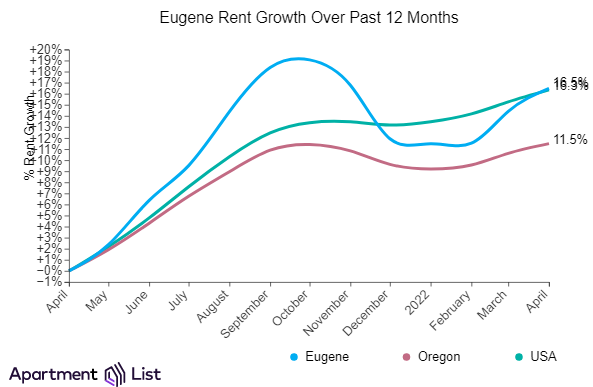
Eugene rents have increased 1.8 percent over the past month, and have increased sharply by 16.5 percent year-over-year.

Median rents in Eugene are $1,026 for a one-bedroom apartment and $1,364 for a two-bedroom. This is the third straight month that the city has seen rent increases.

National rent growth      

“Over the first four months of 2022, rents have increased by a total of just 2.5 percent, though we’re only beginning to enter the busy season for the rental market, when the bulk of annual rent growth typically occurs,” according to the Apartment List Research Team.

“Even if prices don’t rise as rapidly as they did in 2021, it’s likely that this year will continue to bring rent growth in excess of the pre-pandemic trend,” the report says.

Sign Up For Our Weekly Newsletter And Get Rental Property And Apartment News And Helpful, Useful Content Each Week.

* indicates required

Application of Rental Payments – A Reminder About ORS 90.220(9)

A reminder about application of rental payments, Oregon laws, and how landlords must comply to correctly apply tenants back rent payments.

A reminder about application of rental payments and the Oregon laws that landlords must comply with to correctly apply tenants back rent payments.

Bradley S. Kraus
Partner, Warren Allen LLP

With the March 1 deadline come and gone, the landlord/tenant world continues to return to some semblance of normalcy. Due to the same, large debts remain due, and bewildered landlords are rediscovering previously enacted laws governing how and where to apply tenants’ payments. I’m talking about ORS 90.220(9), affectionately known as the “application of payments statute” in the ORLTA.

Prior to ORS 90.220(9), any payments received from tenants could be applied in the manner described in the rental agreement. If the rental agreement was silent, the landlord could simply “fill the bottom of the barrel first.” During COVID, amounts had to be applied first toward the current month’s rent, thanks to SB 282. With ORS 90.220(9), the legislature requires landlords to apply payments received by tenants in a predetermined order. Pursuant to ORS 90.220(9), any payments received from your tenants must now be applied as follows:

“(A) Outstanding rent from prior rental periods;

(B) Rent for the current rental period;

(C) Utility or service charges;

(D) Late-rent-payment charges; and

(E) Fees or charges owed by the tenant under ORS 90.302 or other fees or charges related to damage claims or other claims against the tenant.”

At first glance, the statute is pretty straightforward. However, when put into practice, the statute causes waiver problems galore, especially when tenants carry arrearages from one month to the next. A simple example will illustrate the waiver problem:

Terry’s monthly rent is $1,000.00. If Terry pays only $500.00 in January, and the landlord accepts it, a partial payment has been created. If Terry thereafter pays $1,000.00 in February, $500.00 of that would first go to January’s outstanding balance. The remainder could then either be applied to February’s rent (thereby creating another partial-payment issue) or returned pursuant to ORS 90.414 (thereby preserving the landlord’s non-payment termination rights under ORS 90.394).

Simple enough… right? Not so fast! Here’s where it could get complicated . . .

Terry’s monthly rent is $1,000.00, but Terry also owes the landlord utilities every month (and hasn’t paid them for more than 10 months, causing a utility arrearage of $600.00). Terry also hasn’t paid his rent on time for the past 10 months, incurring a $100.00 late fee each month. Accordingly, Terry’s ledger balance, including his January and February unpaid rent, is $3,600.00. Yikes!

Let’s say that Terry tenders a payment of $1,500.00, which the landlord accepts. The landlord wrongly assumes that, due to Terry’s large balance, $2,100.00 (of the $3,600.00 balance) is still owed for rent. Accordingly, the landlord serves a Non-Payment of Rent Notice, Terry fails to cure, and the landlord files an FED. The parties then appear at the first appearance, and a tenants’ attorney appears on Terry’s behalf, demanding a dismissal (due to the waiver problem) and $750.00 in attorney’s fees. Unfortunately, the tenants’ attorney’s position is legally sound, and the landlord is in trouble.

Why? Remember, due to the application-of-payments statute, the first $1,000.00 applied to January’s outstanding rent due. The remaining $500.00 then applied to February’s outstanding rent, regardless of how much money Terry owed. Maddening, right?

So, what can be done to prevent such a disastrous outcome? While every situation must be analyzed on its own merits, some best practices can be articulated. First, landlords must know how the application-of-payments statute works in practice. This can be difficult when the landlord’s ledger software merely throws payments at the oldest (or total) balance. Second, landlords should protect themselves (and their books) by serving valid for-cause notices. Third, if the landlord desires to accept a partial payment, the parties should execute a partial-payment agreement, in order to protect the landlord. Finally, prior to service of any non-payment-of-rent notice upon tenants who carry a substantial balance, landlords should look at their ledgers and determine whether or not, in the current month, a payment of larger than the outstanding previous month’s rent was made. If so, the application of payments statute may negate the landlord’s ability to serve a non-payment-of-rent notice, and a for-cause notice may be the only remaining option.

While it’s difficult to discuss and outline every possible way ORS 90.220(9) can complicate your life, knowing that the statute exists is half the battle. Once you acclimate yourself with the statute, and understand its practical effects, you can better protect yourself from potential waiver issues.

About the author:

Bradley S. Kraus is an attorney at Warren Allen LLP. His primary practice area is landlord/tenant law, but he also assists clients with various litigation matters, probate matters, real estate disputes, and family law matters. You can reach him at kraus@warrenallen.com or at 503-255-8795.
A reminder about application of rental payments and the Oregon laws that landlords must comply with to correctly apply tenants back rent payments.
Bradley Kraus, Portland attorney

Sign Up For Our Weekly Newsletter And Get Apartment News And Helpful, Useful Content Each Week.

* indicates required

Portable Cooling Devices and the ORLTA: How SB 1536 Affects You

The End of the Grace Period, Part Deux

The End of the Grace Period, and How Landlords Should Approach it

Senate Bill 891: More Changes to Ring in the New Year

National Rent Growth Continues Up 0.9 Percent in April

National rent growth continued upward with a national index increase of 0.9 percent over the course of April, according to Apartment List.

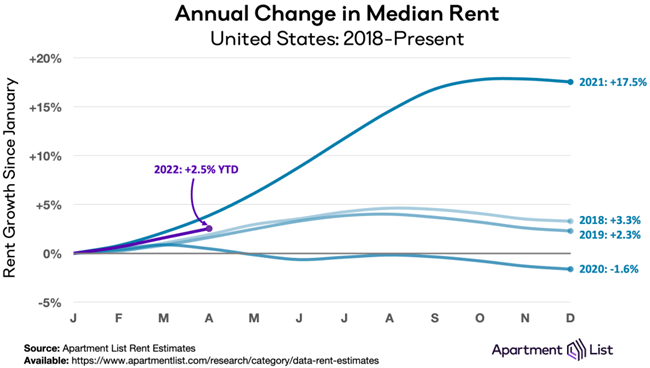
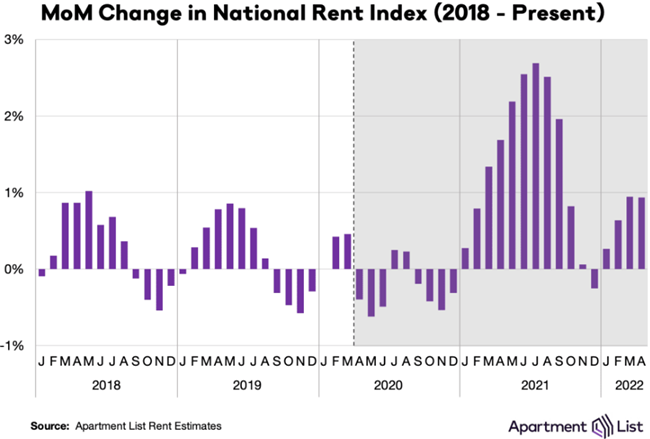
National rent growth continued upward with a national index increase of 0.9 percent over the course of April, according to the latest report from Apartment List.

While rents are growing more slowly than they did in 2021 at this point in the year, they are still growing faster than in the years immediately preceding the pandemic.

In April, rents were up in 93 of the 100 largest cities.

Year-over-year national rent growth currently stands at a staggering 16.3 percent, but most of that growth took place last spring and summer.

National rent growth continued upward with a national index increase of 0.9 percent over the course of April, according to Apartment List.

“Over the first four months of 2022, rents have increased by a total of just 2.5 percent, though we’re only beginning to enter the busy season for the rental market, when the bulk of annual rent growth typically occurs,” according to the Apartment List Research Team.

“Even if prices don’t rise as rapidly as they did in 2021, it’s likely that this year will continue to bring rent growth in excess of the pre-pandemic trend,” the report says.

Vacancy remains low entering the busy rental season

National rent growth continued upward with a national index increase of 0.9 percent over the course of April, according to the latest report from Apartment List.

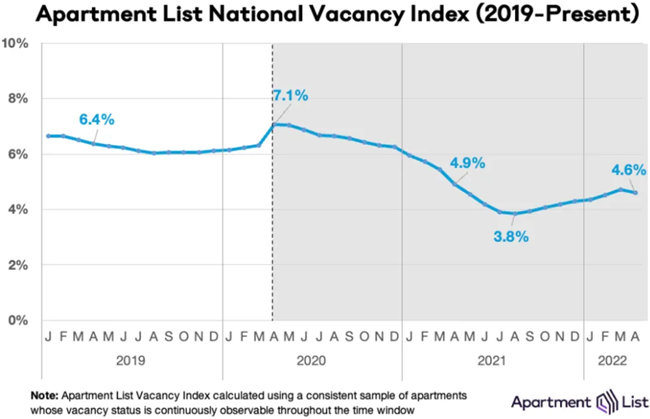
“As we’ve explored in detail, much of the 2021 rent boom was attributed to a tight market in which more households were competing for fewer vacant units.

“Our vacancy index spiked above 7 percent at the onset of the pandemic in 2020, as many Americans moved in with family or friends amid the uncertainty and economic disruption of the pandemic’s onset. After that, however, vacancies began a steady decline, eventually falling below 4 percent,” the report says.

After bottoming out at 3.8 percent last August, “Our vacancy index slowly ticked back up for seven consecutive months, until dipping slightly this month. Our index fell from 4.7 percent in March to 4.6 percent in April.

“We should be hesitant to put too much stock into a single data point, but it’s possible that as we enter the traditional busy season for the rental market, the gradual easing of our vacancy index may begin to level off. The vacancy situation remains historically tight, and even if it were to continue gradually easing, it will likely be some time before we get back to the pre-pandemic norm.”

Miami Continues As King of Rent Growth

National rent growth continued upward with a national index increase of 0.9 percent over the course of April, according to the latest report from Apartment List.

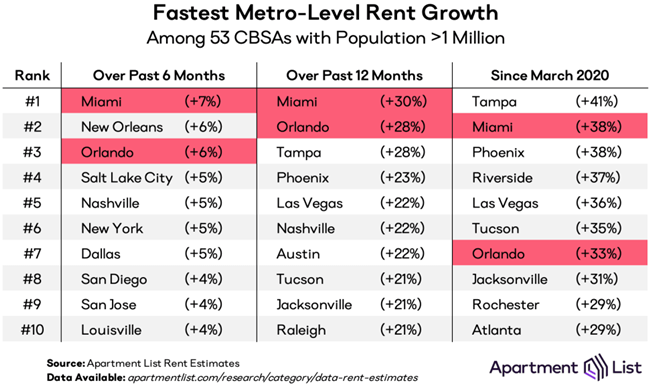
The Miami metro has seen the nation’s fastest growth over the past six months (+7 percent), nearly tripling the growth rate of the national index over that period.

The Miami metro also ranks No. 1 for year-over-year rent growth, and No. 2 for growth since March 2020.

Conclusion

“As we enter the spring and summer months, rental activity is likely to pick up, and rent growth is likely to accelerate. Despite a recent cool-down, many American renters are likely to remain burdened throughout 2022 by historically high housing costs,” the report says.

Read the full report here.

Sign Up For Our Weekly Newsletter And Get Rental Property And Apartment News And Helpful, Useful Content Each Week.

* indicates required