Home Blog Page 85

Where Are The Most Competitive Rental Markets?

A look at the 100 largest markets in the U.S. shows where the most competitive rental markets are and what is driving the competition

A look at the 100 largest markets in the U.S. shows where the most competitive rental markets are and what is driving the competition, according to research from RentCafé.

Using Yardi proprietary data, RentCafe looked at how many days rentals were vacant in the first part of 2022, occupancy rates, the number of renters competing for an apartment, share of renters who renewed their leases and how much the apartment inventory increased.

Here’s what RentCafé found:

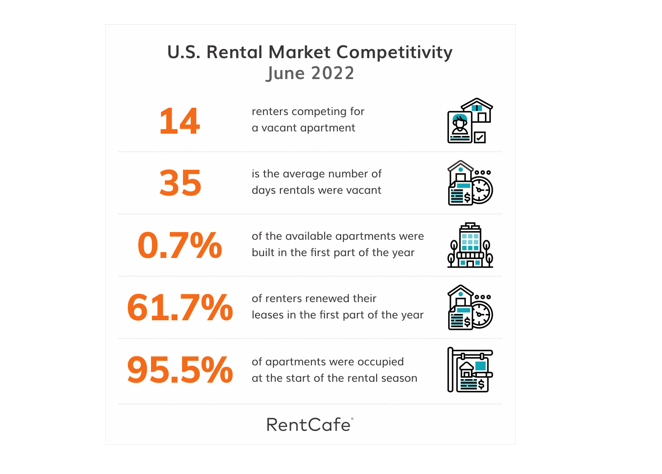
  • Competition intensifies as more renters opt to stay put. Nationwide, almost two-thirds of renters renewed their leases. Amid a soaring 95.5 percent occupancy and a modest 0.7 percent increase in inventory, a vacant apartment was filled within 35 days on average, with 14 renters competing for it.
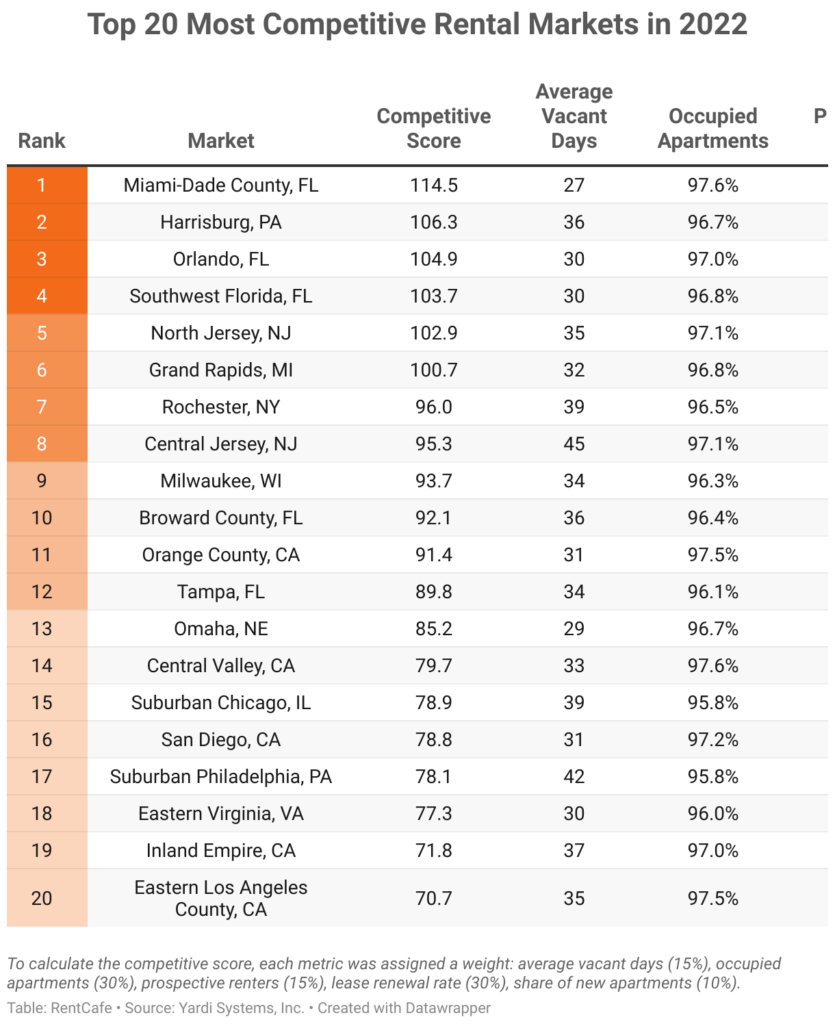
  • Whole regions across Florida are red hot with competition. In Miami-Dade County, three quarters of all leases got renewed, and 31 renters competed for the same apartment, in a market that is 97.6 percent occupied. While the apartment supply grew by almost 2 percent, this was not enough to stem the tide of renters moving here. What’s more, Orlando and Southwest Florida are facing the same situation.
  • In the Northeast Harrisburg, PA ranks 2nd nationally, as no new apartments were built in the first half of the year. Other highly competitive locations in the area are Rochester, NY, and some of the best alternatives to renting in NYC: North and Central Jersey.
  • Certain locations in the Midwest are in the top 20. The hottest markets here include Grand Rapids, MI; Milwaukee, WI; Omaha, NE; and suburban Chicago. Securing an apartment in the fast-growing Grand Rapids will require some effort. With only a few units built in the first part of 2022, almost all rentals are occupied. The average vacant unit got filled in 32 days, and 18 prospective renters competed for an apartment here.
  • Orange County became California’s most sought-after market as LA renters on tight budgets went searching for better options. The area boasts a more relaxed lifestyle, cheaper entertainment, and a thriving economy with better job opportunities, as O.C. is home to many Fortune 500 & 1000 companies that are on the lookout for skilled professionals. No less than 20 renters compete here for one apartment, while the occupancy rate is a sky-high 97.5 percent.

most competitive rental markets in the U.S.

Why Competitive Rental Markets?

The wave of migration to Florida during and after the pandemic is one reason for the big jump in Florida lease competition.  Good weather, low taxes and good employment opportunities also are a reason.

Also in some markets the lack to any new apartment availability has led to the competition.

For example in Harrisburg no new apartments were opened between January and April prompting about 75 percent of renters to stay in their existing apartments, creating a highly competitive environment for anyone seeking to find rent. As a consequence, the average rental unit was filled in just 36 days, and as many as 19 renters competed for an apartment here.

“More and more house hunters are starting to feel the strain of surging inflation and mortgage rates. As a result, they are delaying or completely giving up on their dream to become homeowners, which puts even more pressure on the apartment market,” RentCafé writes in the report.

Read the full report here.

With Traditional Multifamily Rent Drivers Disrupted What Is The Future?

Multifamily Rents Defy Expectations And Keep Climbing

Sign Up For Our Weekly Newsletter And Get Rental Property And Apartment News And Helpful, Useful Content Each Week.

* indicates required

Court Upholds Law Requiring Landlords Pay Rent To Evicted Tenants

A federal appeals court in California has upheld a law requiring landlords to pay one month of rent to evicted tenants, according to reports.

A federal appeals court in California has upheld a law requiring landlords to pay one month of rent to evicted tenants, according to reports.

The San Francisco Chronicle reported that the  court has upheld a California law requiring a property owner who legally evicts a tenant to pay one month of the tenant’s rent in order to reduce the costs of relocation.

The law, sponsored by then-Assembly Member David Chiu, D-San Francisco, took effect in 2020. In addition to limiting rent increases to 10 percent a year in areas without local rent control, the law provided some financial assistance to renters who were evicted because the owner was moving into the property, converting it to a condominium or demolishing it. The owner must either repay a month’s rent to the tenant or cancel the final month’s payment, the newspaper reported.

A lawsuit by the owners’ group Better Housing for Long Beach accused the state of unconstitutionally confiscating their property by requiring the payments. But while the suit was pending, the Ninth U.S. Circuit Court of Appeals upheld an Oakland ordinance, similar to laws in San Francisco, San Jose and Los Angeles, requiring property owners to pay all of a legally evicted tenant’s relocation expenses.

Better Housing for Long Beach, a grassroots group that has consistently opposed efforts to enact rent control or measures similar to it in Long Beach, filed the federal court lawsuit challenging the Long Beach City Council majority-enacted “Tenant Relocation Ordinance” and California’s “Rent Cap/Just Cause Eviction” law (AB 1482) signed into law by Gov. Gavin Newsom.

Paul Beard, a lawyer for the Long Beach property owners, had argued that the law was a “forced transfer of hard-earned funds” and that the state “cannot force owners to bear public burdens” that should be paid by the general public, such as the relocation costs of legally evicted tenants, the San Francisco Chronicle reported.

Sign Up For Our Newsletter And Get Rental Housing and Apartment News And Helpful, Useful Content Each Week.

* indicates required

Ask Attorney Brad: Why Can’t A Landlord Give a 30-Day Notice to Vacate?

Understanding a Landlord’s Rights, Obligations in Domestic Violence Situations

Ask Attorney Brad: Tenants Want to Know Why There’s a Dog in No-Pet Building?

Solving The Multifamily Labor Shortage With Technology

Here are some of the impacts of the multifamily labor shortage and how technology and automation are alleviating the burden.

Here are some of the impacts of the multifamily labor shortage and how technology and automation are alleviating the burden.

By Morgan Dzak

The multifamily industry has been hesitant to discuss automation in previous years, fearing backlash from onsite teams. Automation was viewed as a replacement to human associates, and not necessarily as a supplement. But in the wake of the pandemic, the industry has become faced with new challenges – notably The Great Resignation.

The Great Resignation refers to the post-pandemic era in which millions of American workers either left their jobs or switched careers. According to data from the Society for Human Resource Management, 47.8 million workers quit their jobs last year – an average of nearly 4 million each month – for the highest average on record. It created a massive labor shortage for multifamily, as most of the workers who left jobs were in onsite roles.

“When the shutdown occurred in 2020, many individuals were forced into different careers, having to learn different trades and skill sets,” said Lindsay Duffy, director of marketing and training at Western Wealth Communities. “Many employees became conditioned to the flexibility of remote positions, making it harder to retain workers when businesses opened and needed them to come back to work. This gave job searchers a competitive advantage on salary and work-life balance negotiations when accepting an offer.”

As the labor shortage from The Great Resignation persists, the use of automation has become more prevalent and operators are not only implementing new technologies, but also centralizing functions that used to stay solely onsite. Automation and other technologies are reducing pain points for thinner onsite teams, increasing efficiencies and maximizing lease-conversion ratios, all while improving prospect, resident and associate experiences.

Here are some of the impacts of the labor shortage on multifamily and how automation technologies are alleviating the burden by creating a new caliber of modern apartment leasing and living:

Automation: Doing More with Less

 Multifamily is most feeling the effects of the labor shortage in maintenance and leasing roles. Both of these roles have historically high turnover, and The Great Resignation has further fueled the turnover trend.

The wave of new technologies that rapidly entered multifamily since the pandemic have not only taken on some of the more tedious onsite tasks, like fielding an influx of online leads and following up with prospective residents, but they’ve also created efficiencies for existing teams that aren’t as robust as in the past. New technologies have allowed onsite teams to do their jobs more effectively while modernizing and refining several processes, for the benefit of associates and customers alike.

One of the most helpful technologies during the labor shortage has been automation. Automating tasks like aggregating guest cards, following up with prospects and residents, and scheduling tours have had big impacts on onsite team workload. It has also created better customer experiences for both prospects and residents, and allows onsite teams to do more with less.

“Using AI tools and CRM systems has allowed our onsite teams to capitalize on every lead that is generated to be more efficient and service-oriented,” Duffy said. “It’s alleviating a lot of the mundane onsite work so the people we do have onsite can focus more on providing amazing customer service, taking care of residents and building rapport with prospects that come in.”

According to internal data from Nurture Boss, a lease- and renewal-conversion automation provider, 45 percent of prospects who reach out to a community say they never hear back. With a lease-conversion automation tool, it takes an hour on average to respond to all leads – which is particularly helpful considering that renters almost always sign a lease with the first community that gets back to them.

In a digital leasing environment, following up with prospects has become critical to community success and increasing lease conversions. Apartment operators are finding that consistent, timely and personalized follow-ups with prospects are not only increasing tour conversions and applications, but also boosting overall lead-to-lease conversions.

“When reviewing reports, we learned that many leads were not being followed up on and calls were being missed due to limited staff,” Duffy said. “Like most companies at this time, we run with lean teams where individuals wear multiple hats and need to multitask throughout the day. We saw a huge gap in customer satisfaction and poor communication, and knew we needed a partner that would provide a better prospect experience and allow teams to focus on resident satisfaction. In leveraging technology and partnerships with supplier partners, we have increased lead-to-lease conversion rates while improving overall prospect and resident satisfaction and increasing employee morale.”

Based on Nurture Boss’ clients’ CRMs, the overall lead-to-lease conversion rate without automation is 19 percent, but with it, the conversion rate is 30 percent.

“Prospective residents are all looking for something different, and some may need to move in 30 days while others are looking to move months down the road,” said Jacob Carter, CEO of Nurture Boss. “Nurturing all types of leads can be extremely taxing on onsite teams, especially when the onsite teams of today are working with more leads than ever before from multiple platforms, and there aren’t as many people onsite to handle that type of volume.”

Operators have started automating the entire resident lifecycle, from the initial apartment search all the way to becoming a resident, and even when it’s time for a renewal. Whether it’s automating communication and tour scheduling by utilizing an AI chatbot on the frontline of leasing or integrating lease-conversion automation within a CRM, operators have noticed a significant difference in both the caliber of customer service from onsite teams and overall resident satisfaction. And they’re accomplishing this with smaller teams.

“We know that the leasing journey does not stop when residents move in,” Duffy said. “The resident relationship needs nurturing and constant communication for our customer journey to be a positive one, and for them to be an advocate of your community and company brand.”

Beyond Automation: Other Technologies Solving the Labor Shortage

Aside from automation, some other technologies have proven to be invaluable for operators during the labor shortage. Ubiquitous WiFi, for example, has completely transformed modern maintenance workflows and paved the way for more streamlined self-guided tour methods.

“Community-wide WiFi allows maintenance technicians to respond to and fulfill work orders faster,” said Shawn Mahoney, senior advisor at RET Ventures. “If the entire community is connected, it eliminates the onsite team from playing middleman when it comes to work orders. Maintenance technicians can directly receive the work order and have a credential dynamically assigned to them that allows access to the apartment for a certain period of time, and the resident can also be notified every step of the way.”

Connected communities also set the foundation for self-service options, which the industry unanimously agrees are here to stay. Prospective residents can enter and tour a community without a dropped connection, and they can also tour communities beyond standard office hours.

“This benefits apartment operators because the onsite teams can process more tours with less people while providing the self-service options that many modern residents want,” Mahoney said. “If you can lower costs with technology, it’s going to increase your NOI. Operators already have less staff because of the labor shortage, but existing teams are able to do more and they can also extend their hours of operation with self-guided touring.”

The entire world is now connected by technology and online access. Businesses rely on connectivity, and without it, day-to-day operations are severely hindered within any industry.

“With all the new PropTech and tech amenities multifamily has implemented over the last few years, a WiFi connection is really the foundation of all those new tools to operate seamlessly,” said Andrew Kusminsky, CEO of GiGstreem, a WiFi provider. “Multifamily has really become a tech-focused industry, and operators need that reliable connectivity not only for leasing and operations, but also for the residents who have now come to expect WiFi as a standard amenity offering.”

Even with fewer people working onsite, multifamily has discovered new technologies, like automation, to alleviate the burden of the labor shortage by allowing thinner onsite teams to execute their jobs more effectively, creating efficiencies and streamlining workflows. The multifamily tech of today isn’t just solving the labor shortage – it’s boosting NOI and increasing asset value for operators while creating better experiences for associates and residents alike.

About the author:

Morgan Dzak is an account manager for LinnellTaylor Marketing, which focuses exclusively on the multifamily industry and its technology space. She previously spent time as a digital content and marketing specialist for Cornerstone Apartment Services in Denver.

Sign Up For Our Weekly Newsletter And Get Rental Property And Apartment News And Helpful, Useful Content Each Week.

* indicates required

Why Customer Service Is An Important Part of Fair Housing

Why Customer Service Is An Important Part of Fair Housing

Here are 3 aspects that can lead to excellent customer service because when our customers or residents feel well-cared-for, they are less likely to file a fair housing complaint.

By The Fair Housing Institute

It’s easy to get hyper-focused on fair housing rules and regulations when it comes to property management. But we need to remember that an integral part of what we do is steeped in customer service.

Our residents and prospects are customers and need to be treated accordingly. In addition, it stands to reason that when our customers or residents feel well-cared-for, they are less likely to file a complaint. Let’s discuss three aspects that can lead to an exceptional customer or resident experience.

1. Effective Communication

Your resident is speaking, but are you truly listening? An effective communicator will listen intently. Listening intently requires that you are focused on what’s being said, not how you are going to reply. By doing this, not only do you get a better understanding of what’s needed, the resident will feel valued and understood.

Follow-up is another part of effective communication. Many issues raised by residents are seldom resolved in one visit or phone call. Make sure that you continue communicating with your residents until the situation is resolved.

Effective communication can come easily when everyone involved is in a good place or state of mind, but it may be particularly challenging when emotions are running high. What can you do? The next aspect we will consider is imperative to handling these types of situations.

2. Respect While Being Disrespected

There is a saying that respect is a two-way street. We naturally want to be treated with the same dignity and respect we show our residents. Unfortunately, this may not always be the case.

A common situation we see is when a maintenance request has not been handled in a timely manner, at least as far as the resident is concerned. Remember that it is imperative that you always stay calm. Reassure your resident that they have been heard, and you will take appropriate action to try and find a resolution. Hopefully, by showing them respect and maintaining your patience, you can defuse the situation and create an environment that encourages the resident to do the same.

Part of effective communication and being respectful is having a thorough knowledge and training of your company’s policies and procedures. It stands to reason that in order to help your resident, you need to know how to answer their questions. The final part of this article will detail why this is important.

3. Know Your Policies and Procedures, so You Know How to Answer

Imagine you are the resident, and you need information. Would you be happy if the person behind the desk or on the grounds gave you a vague or confusing response? Probably not. Being well-versed in your company’s policies and procedures allows you to answer quickly and efficiently, which can go a long way if the person is already agitated. It can also help us avoid giving out misinformation.

To that point, every person who has contact with your residents should be trained in your policies and procedures so that the information disbursed is the same and will help you avoid a potential fair housing complaint or accusation of discrimination.

Property management companies face many different and challenging situations every day. Training and role-playing can help you develop the skills of effective communication, respect, and a thorough knowledge of policies and procedures, which in turn will help you deliver the exceptional customer experience you want to give.

About the author:

In 2005, The Fair Housing Institute was founded as a company with one goal: to provide educational and entertaining fair-housing compliance training at an affordable price at the click of a button.

Why Renters Move: Affordability And How Your Property Can Compete

A look at why renters move, affordability and how your property can prove its value to renters in a time of skyrocketing rent rates.

A look at why renters move, affordability and how your property can prove its value to renters in a time of skyrocketing rent rates.

By Rachel Richardson

With rising inflation and rent costs, budget concerns are causing renters to start looking for new places. Property teams can address growing concerns and keep demand high by showing the value they offer renters.

Home seekers have laundry lists of needs when deciding on that final place. Yet, research has found one major deciding factor that is common among renters—affordability. Skyrocketing rent rates, big grocery bills and higher cost of living are hitting home seekers during this time of high demand for finding a new home. In a new survey from Redfin,1 64 percent of renters said that inflation is affecting their moving plans, and 62 percent shared that they are concerned about rising rent costs.

Many are turning away from overpriced units and toward new opportunities, with one in five renters saying they plan to move to find lower rent. This adds challenges for leasing teams that strive to maintain trust with renters and retain residents. Promotions, showcasing savings of onsite amenities, effective communication about rates and improving overall brand value are all ways to navigate this growing need.

Let’s get into how your property can prove its value to renters.

Make renters aware of move-in deals and specials

If you have move-in deals, weeks off rent, or any specials going on at your property, this is the perfect time to highlight them. Plus, there are ample channels to do so—whether that’s through listings, advertisements, your onsite team or even social-media marketing.

Most ILS platforms allow you to highlight different specials that your property has. Platforms like rent.com and ApartmentGuide.com can even show when rent price decreases on your listing. This allows renters to instantly see that you offer added value compared to other properties in their area while they browse listings.

Good news can spread quickly, especially for properties that see spikes in move-ins during peak leasing season and have high demand among a specific group such as student housing communities. If your property has a referral program or other promotions, onsite staff can also share specials via word-of-mouth during onsite tours or follow-up communications. What better way to get the word out than renters who have already viewed the property and have high interest?

Share how your onsite amenities can help renters save

Look at your amenities from a different angle—how much they help renters save on extra expenses. People will often pay more for convenience, but the great thing about onsite amenities is the instant access residents have to fitness centers, common areas, pools or other amenities your community offers.

For instance, having an at-home gym can save renters time and money that would otherwise be spent offsite. Similarly, hosting a pool party or a gathering in the comfort of their community allows residents to remain social while avoiding the cost of going out.

Here are a few fun ideas for showcasing savings. You can even share creative and free ideas on your property’s social media that relate to onsite amenities:

  • Gym work-out groups or classes
  • Pet grooming
  • Pool parties and barbecue
  • Afternoon walk clubs
  • Book clubs that can be hosted in common areas

Don’t forget about work-from-home culture

Another major factor in savings is the trend of many renters working remotely. Working from home saves time in commuting and getting ready, money on travel, and let’s face it—often peace of mind by avoiding the morning traffic. If your community offers units with space for an at-home office, business rooms, printing stations, or smart home features that make work-from-home a breeze, share the value of those benefits.

Educate staff on responding to pricing questions

Rates and budget can be sensitive topics, so it is important to educate staff on your team’s policies. Make sure your team aligns on the best ways to approach conversations on any rate increases that occur, whether that’s in initial communications, during property tours, or even in review responses.

This is also critical for reputation management, because rates can be a topic that renters bring up in their reviews of your property. Your property’s responses to reviews that mention rates are opportunities to address questions around fair pricing and show prospects that you take these matters seriously.

Raise the perceived value of your property with branding

Every expense comes with the question of “Is this worth the cost?” If rates are higher or there are added fees, renters will want to know why. Your property’s brand is often the answer to that question.

In a multifamily master class, branding maven and RentPath CMO Kathy Neumann talked about the importance of brand value for properties. She shared that weaving brand value into every detail is critical—especially when it comes to affordability-focused renters.

For example, if you’re known as a luxury community with best-in-class service, those elements stand out to renters, from the way staff answers the phone, to the website design and the apartment features.

Elevate the currency of your property’s brand by looking at it through the lens of what you offer renters. Opportunities to strengthen a renter’s perceived value of your community are in every detail, including onsite operations, your apartment listings, the community itself, and marketing.

About the author:

Rachel Richardson is a Demand Generation Specialist with RentPath, a digital marketing solutions company.

Why Customer Service Is An Important Part of Fair Housing

No Wonder Smaller Landlords Want To Call It Quits

No Wonder Smaller Landlords Want To Call It Quits

Many smaller landlords are compelled to call it quits and get out of town as the more the rental market is regulated, the more “unintended consequences” arise creating more problems.

By Ron Garcia
Rental Housing Alliance Oregon

June is here. The Portland Rose Festival is happening at Waterfront Park. The NBA playoffs, Stanley Cup finals, and Indy Car races are all running at full speed. Golf courses and hiking trails are packed, and rush-hour traffic is at a standstill, exaggerated by summer roadwork and detours. Google calendars are jammed with happy hour events and networking groups and business coffees and lunch appointments. Zoom meetings are now arranged only for their convenience rather than their necessity. Everyone seems to be making vacation plans despite higher gas prices, while real estate values continue to rise.

It could easily lead us to forget that the COVID-19 pandemic ever happened. Except that it did, and it is still threatening, and there are reminders everywhere we turn. Its negative effects linger in cautious handshakes and arise every time someone sneezes in public or stands apart while wearing a mask.

As a landlord, you may still be feeling the throbbing headache of your tenants’ unpaid rent as they continue to be protected under Oregon’s Safe Harbor regulations. Today it’s not uncommon for tenants who had been approved for Emergency Rental Assistance, and who were already paid thousands of dollars for back-owed rent by the state, to still be delinquent either for recent months or for some gap that occurred in 2020 or 2021 that remained uncovered and unpaid by any assistance dollars.

It is frustrating especially to smaller landlords who are straddled with mortgage payments and burdened by a lack of income from their investment property. They are unable to terminate the tenancy to either sell or re-rent the unit and they can’t do much about raising old, below-market rents beyond the small percentages now prescribed by state law.

Many tenants are equally distressed because they have been incentivized by the state to not pay rent. They have fallen behind beyond any amount they might qualify for, even if their applications for assistance get approved. Those dollars are drying up and OHCS announced that the portal has closed. Meantime, the market has tightened up with very few vacancies and higher rents, so tenants are now left with limited alternatives for replacement housing when that day finally comes, and they are forced to pay up.

How did we get here? The more the market is regulated, the more “unintended consequences” arise creating more problems. The pandemic was not the only catalyst creating bad regulations, but it sure piled a lot more of them on! Hello – is anybody home?

One example is a law passed last year called SB 291. It’s a requirement to lower screening guidelines stating that criminal backgrounds should rarely be used as they do not indicate an applicant’s ability to pay rent.

Consider this: When an existing tenant feels threatened by a newer neighbor’s behavior, they are also generally too intimidated to testify against it, thus providing the landlord with little or no ability to terminate the bad actor for cause. So, what happens? The existing neighbor moves out and is now forced to pay a much higher rent for a new unit. Then, what happens to that vacancy? The landlord renovates it and raises its rent, of course, to cover their losses. Is this any way to solve affordable housing issues? Are lawmakers so far removed that they don’t see what is actually happening at home?  And even though both the landlord and the existing tenant were each negatively affected by this forced arrangement brought on by a convoluted regulation, some advocates try to use these optics to “prove” that discrimination exists and that the only thing that matters to landlords are higher returns.

Many affordable housing advocates are now using the homeless crisis to demand even more regulation. As they re-brand the problem as “houselessness,” it’s easy to see where they expect to find solutions. Wide-ranging, all-encompassing statutes that claim to defend and protect classes of people who are disproportionality affected and who are rent-burdened due to long-standing social injustices are having the exact opposite effect on the people they claim to be defending.

No wonder so many smaller landlords are compelled to call it quits and get out of town. We need a break!

Affordable and safe housing is paramount to a thriving community. We elect lawmakers to help create solutions to improve the well being of us all. As we collectively relax this summer in our re-opened social endeavors, let’s all agree to write a postcard to our representatives at the state house and tell them our stories of frustration. Maybe let them know that “we wish they were here” to protect us, too.

About the author:

Many smaller landlords are compelled to call it quits and get out of town as the more the rental market is regulated, the more “unintended consequences” arise creating more problems.
Ron Garcia

Ron Garcia is Executive Director of Public Policy at Rental Housing Alliance Oregon. He can be reached at ron@rhaoregon.org

Sign Up For Our Weekly Newsletter And Get Apartment News And Helpful, Useful Content Each Week.

* indicates required

Changes to Tenant Screening in Senate Bill 291

Portable Cooling Devices and the ORLTA: How SB 1536 Affects You

Application of Rental Payments – A Reminder About ORS 90.220(9)

Multifamily Rent Growth Continues To Defy Gravity

Multifamily Rent Growth Continues To Defy Gravity

Multifamily rent growth continued its strong run in May even as year-over-year rent growth decelerated slightly to 13.9 percent. However, demand remains robust and regionally broad-based, according to Yardi Matrix in its May multifamily report.

“Multifamily rents continue to defy gravity, increasing a robust $19 in May to a U.S. average of $1,680,” the report said.

“Decelerating economic growth and concerns about gas prices and inflation have not eroded multifamily demand much, nor slowed down the upward climb of rents.”

Some highlights of the report:

  • Multifamily performance continues to outpace every year other than 2021. The average U.S. asking rent rose $19 in May to an all-time high of $1,680.
  • Year-over-year growth decelerated by 40 basis points to 13.9 percent. That’s 130 basis points off the peak last summer, but still exceptional performance.
  • Demand and rent growth continue to increase throughout the country. Rent growth rose at least 10 percent year-over-year in 26 of Yardi’s top 30 metros.
  • The average single-family asking rent increased by $19 in May to $2,038, as year-over-year growth dropped by 70 basis points to 12.7 percent. Although the national occupancy rate fell 0.2 percent, the sector will continue to ride strong demand, especially as home sales wane due to higher interest rates.

The report also points out the continued growth of metros in the Sun Belt – especially Florida, Texas, and Arizona – which are benefiting from migration due to the inflow of population and jobs. Gateway metros continue to rebound from the pandemic slump, backfilling the renters who moved to suburbs and/or more affordable places during the pandemic. Now there are a new set of households that want an urban experience.

Multifamily rent growth continued its strong run in May even as year-over-year rent growth decelerated slightly to 13.9 percent

Interest rates are affecting transactions

The increase in interest rates shows that transaction activity is slowing.

“Buyers using leverage of 70 percent or more are finding that financing is drying up, and deals with aggressive bids have fallen through. Property values—which rose around 20 percent in 2021—are down 10-15 percent, based on reports from investors and sellers.

“However, the change in pricing has been slow to be recorded because many sellers are holding out rather than accepting lower bids,” the report says.

Conclusion

“The expectations for solid rent growth in coming years should prevent acquisition yields from ballooning, even if rates keep increasing.

“Even taking the bullish expectations into account, however, investors and lenders must heed the lesson of the Global Financial Crisis and maintain discipline, avoiding underwriting unrealistic assumptions into transactions,” Yardi Matrix says.

Read the full report here.

About Yardi Matrix:

Yardi Matrix researches and reports on multifamily, office and self-storage properties across the United States, serving the needs of a variety of industry professionals. Yardi Matrix Multifamily provides accurate data on 18+ million units, covering more than 90 percent of the U.S. population. Contact the company at (480) 663-1149.

Multifamily Rents Defy Expectations And Keep Climbing

Sign Up For Our Weekly Newsletter And Get Rental Property And Apartment News And Helpful, Useful Content Each Week.

* indicates required

Seattle Mayor Vetoes Plan To Make Landlords Report Rent They Charge

See the article from the Washington Multi-Family Housing Association on what owners and investors say about new rent control in Washington.

Seattle Mayor Bruce Harrell has vetoed a Seattle City Council ordinance that would have required landlords twice a year to report the rent and other fees they charge for each rental.

The council can override the veto but observers say that is unlikely because it would take 6 votes and the original proposal passed by a 5-4 vote.

Testifying before the council when the original ordinance passed, landlords said it would require them to reveal confidential business information and could contribute to property owners deciding to sell their rentals. It was also unclear has to how accurate the reporting would be.

In a letter to the Seattle City Clerk, Seattle Mayor Harrell said, “I have the utmost respect for the legislation’s sponsors who seek quality data to make policy decisions. However, I do not believe CB 120325 will achieve its stated aims; the reliability of the data’s accuracy will be questionable according to the University of Washington; it will be costly to create with no funding source identified; and it will be difficult to implement in enough time to inform the update to the City’s Comprehensive Plan.”

Harrell also wrote in the letter that James Young, Director of the University of Washington’s Washington Center for Real Estate Research, “makes a convincing case that a mandatory system compelling landlords to provide commercially sensitive business information about the size, characteristics, price, and occupancy status of rental units is unlikely to yield reliable data.

“Beyond problems with the approach, the likely financial costs associated with designing a mandatory reporting system are too high. City department staff provided estimates that the costs to stand up a new system and provide staffing support could be at least $2 million and as much as $5 million – money that could otherwise directly serve people suffering in the ongoing homelessness crisis.”

City Councilmembers Alex Pedersen and Tammy Morales  expressed disappointment in Mayor Bruce Harrell’s veto of their legislation to collect data about rental rates in the City of Seattle.

“I am deeply disappointed our solution to collect housing data helpful for preventing displacement of economically vulnerable people was not signed into law. Similar laws to collect rental housing data are already in place throughout the nation, so the veto means Seattle is still behind the times,” Pedersen said in a release.

Sign Up For Our Weekly Newsletter And Get Apartment News And Helpful, Useful Content Each Week.

* indicates required

Seattle Landlords May Have To Report How Much Rent They Charge

What Does Landlord Insurance Cover?

What Does Landlord Insurance Cover?

Owning and renting real estate can prove to be one of the best decisions you make in your financial life. Yet, in order to protect your investment, you have to have proper insurance in place. Many more people are renting than used to, and each one needs a quality place to call their own. While the number of rental units grows, it is the responsibility of the investor and landlord to do what they can to minimize the risk of financial loss. One component of that is having landlord insurance coverage in place.

Consider the risks to your investment. A storm could lead to a lightning strike that causes a fire. That could damage your property considerably, and the repairs would have to come from your pocket. What if someone vandalizes your property? There is no way to prevent all types of risks from occurring, but there are steps you can take to ensure your financial integrity.

What Is Landlord Insurance?

Landlord insurance provides financial protection for rental property owners. It covers the financial losses you suffer as a result of covered incidents. When a tragedy strikes, you want to know your property is going to be repaired or replaced for you.

Keep in mind that most insurance companies require you to alert them if you are renting the property owner. This may change your coverage needs as well as your costs.

A landlord insurance policy is often the best choice. It provides ample coverage for many of the risks you are most likely to face. Consider some of them.

Coverage in a Landlord Insurance Policy

Insurance companies vary significantly. Many of the following coverages are a part of landlord policies. There are three main components of these policies. Within each type are several ways the policy can help you.

Dwelling Coverage

This component of landlord insurance typically covers the physical damage to the property. Some coverages include:

Fire Damage

If your property suffers fire damage that you did not cause, the policy may apply. In this situation, it may cover the damage to the structure so you can make repairs or rebuild it in some situations. It also covers your contents – the items you own that are within the structure.

Water Damage

Many types of water damage may be covered under your policy. That includes the water heater breaking or the pipes freezing in the middle of the winter. It may not cover all types of flooding, though. You’ll need flood insurance in some areas to minimize this risk.

Windstorm, Hail, and Lightning 

Most of the time, landlord insurance covers damage brought on by storms. That includes falling tree branches that damage the roof of the home. It may cover damage to windows and the roof from hail strikes. If lightning hits your home, causing damage or a fire, this component of property damage will help you recover by paying for those losses.

Riot and Civil Commotion 

Your landlord insurance may also cover the cost of repairing the damage that is brought on by rioting and civil commotion. Be sure that you verify that this is a part of your policy if it is a valued feature to you. Policies vary in terms of what they will and will not cover under this.

Vandalism 

Should someone cause damage to the property as an act of vandalism, your landlord insurance policy may be able to help. This could include repairing broken windows, cleaning off graffiti, or handling other types of damage caused by vandalism. Keep in mind that this applies to vandalism done by a person that does not live within the home.

Burglary 

Should a person break into your home or otherwise steal your personal property, your insurance policy may help to cover those losses. This includes damage to the property – such as a broken door or window to get in – as well as the loss of your belongings. Your policy may offer actual value coverage or replacement cost (depending on what you select). Be sure to know that your landlord policy covers the loss of your belongings, but not the loss of those of your renter. They can purchase a separate renter’s policy to cover their losses.

Liability Insurance

Another component of your landlord policy covers liability risks. Liability occurs when someone files a claim against you because of an accident or incident that occurred while on your property and believes you are responsible for making it right. Legal liability is a critical component of your property. In some situations, your renters, a person walking by the home, or even a visitor on the property may be hurt while there. If they fall and hit their head, they could be facing thousands of dollars in loss. You could be responsible for those costs if they show that the property was unsafe and caused that accident to occur.

Liability insurance helps you in several ways. It may help to pay for the individual’s losses. It may also help you in a court of law, helping to provide you with an attorney who can defend your case. If a settlement or a judgment occurs, the insurance company pays that up to the maximum coverage of the policy.

Umbrella Coverage 

Umbrella coverage is a type of liability insurance that goes up and over the amount of liability policies. Today, lawsuits often lead to a significant amount of loss. A basic liability insurance policy may not be enough. This type of policy adds another layer of protection for you in this situation. It could help cover more of the medical losses a person has as well as the settlement or judgment against you.

Loss of Income Insurance

The third type of coverage provided by landlord insurance is loss of rent or loss of income, which is applicable as part of a covered claim. When something significant occurs to the property that makes it unable to be rented out at least for a period of time, this component of the insurance policy works to help you. It can help to cover a portion of the rental income you were getting prior to the incident, allowing you to meet your financial obligations while you cannot rent out the property.

Additional Components of Landlord Insurance

There are other components that may be applied to your landlord insurance. If these situations apply to you, be sure to speak to your real estate agent about your needs for this type of custom coverage.

Fix n’ Flip and Builder’s Risk Insurance

It is not uncommon for investors to purchase a property that they plan to fix and then flip. This type of process is difficult because you may not know exactly what types of problems will exist when you start working on the project. Builder’s risk insurance may offer the help you need. It helps to cover certain types of property damage that occur during the repairs. It may provide protection while the property is under construction, including damage from fires, lightning, vandalism, theft, explosions, and others.

Short Term / Vacation Rental

If you are planning to rent your property out for short-term rentals, especially for vacation rentals, it is critical to have a policy that defines that specific type of use. Vacation rentals are a higher risk to insurance companies than a typical renter who is more likely to care about the property itself. Your insurer wants to be sure that they fully understand the risks associated with the property, so they can be sure you have enough coverage for those risks.

What Does Landlord Insurance Not Cover?

When it comes to selecting the right type of insurance for your needs, you need to know what is covered and what these policies do not cover. The only way to know that for sure is to read the terms and conditions of the policy you are selecting. This can vary from one policy and one insurer to the next.

Some of the most important exclusions to landlord insurance include the following:

  • The tenant’s property – most policies do not cover the tenant’s property, and many landlords require or encourage renters to obtain their own policy for these items.
  • The tenant’s car – the same applies here, as the tenant should seek out their own coverage
  • Landlord insurance does not cover repairs to major systems
  • It does not cover damage caused by the property owner, such as if a property owner causes damage to the rental itself
  • It does not cover anything that stops working due to normal wear and tear or a lack of maintenance

How Much Can You Expect to Pay for Landlord Insurance?

The only way to know what you can expect to pay for landlord coverage is to request a formal quote. Your location, the type of property the risks present, and more factors all play a role in the costs. Landlord insurance is typically based on risks present, as well as the value of replacing your policy or the amount of coverage you want to purchase, in the case of liability protection. A general rule of thumb is that landlord insurance costs 20-25% more than traditional homeowners insurance.

Get a quote with Steadily in minutes to determine what the best level of insurance coverage is for your needs.


How A “Property Specialist” Can Streamline Your Rental

https://www.rentalriff.com/

By Phil Schaller

Being a landlord can be challenging. Finding the right tenants, navigating pandemics, ever-changing landlord/tenant laws, fixing the kitchen sink that’s leaking, the list goes on. Luckily here at RentalRiff, we’ve come up with a cost-efficient solution to take a lot of the burden from landlords.

What exactly is a property specialist?

A property specialist is a licensed/insured general contractor or professional handyman who serves as the main point of contact for the tenants and can help out with any repairs or property-level support. Every RentalRiff property specialist goes through a lengthy interview, trial, and training process before starting to work with our customers.

We put a huge emphasis on customer service, punctuality, and communication skills as it is critical to providing a successful solution (we also leverage quite a bit of technology to assist with this). At the end of the day, property specialists are simply good people who communicate well and can fix just about anything.

What kind of work can a property specialist do?

Our property specialists are very well-rounded and can tackle just about anything themselves. The services a property specialist can provide fall into ad-hoc repairs/maintenance, preventative maintenance, turnovers, showings, improvement projects, and tenant support (if a tenant can’t program the thermostat, for example). Here is a more detailed list of skills property specialists possess.

Of course, there will always be situations where outside help will be needed (replacing a sewer line, for example), but in 2021 our specialists were able to complete 91% of all tenant/owner requests themselves. We have a large team of specialists who can hop in and help, or we can tap into our network and bring in outside folks.

How exactly does it work?

It’s a pretty straightforward process – when a new customer signs up, we assign a property specialist who is on-call for the property (or properties). Tenants can reach out directly to their property specialist with any questions or property needs, and the specialist will head over to the property and address the situation.

No more fielding tenant requests, finding a handyman or pro, and coordinating the whole process. Your property specialist will know the property, know what to do, and the tenants know who’s coming over to help – the landlord can sit back and relax.

How much does it cost?

There are a few different plans landlords can choose from (based on the amount of included maintenance and based on property type), but overall our service is significantly less than hiring a property manager. Take our Standard Plan for a single-family home: the cost is $140/month and includes 1 visit to the property every month. If you were to hire a property manager they’d charge 10% of the monthly rent collected, and you’d pay for any handyman or maintenance visits on top of that.

If you take a property that charges $3,000/month in rent, you’d be looking at $3,600 for the year and zero maintenance included. With RentalRiff, you’d be looking at $1,680 for the year and ample maintenance included (and we believe a much better experience for your tenants).

What about tenant experience?

Tenant retention is a critical element of running a successful rental. Vacancy costs money via lost rent, turnover costs, time finding a new tenant, etc. The tenants we work with absolutely love our service. They feel supported, property needs are addressed quickly, and they know the person coming over to help (as opposed to a stranger from the internet).

There’s a better way to be hands-off, make sure your property stays in great shape, and provide a fantastic support system for your tenants. Happy landlording!

About the author:

Phil Schaller is an experienced landlord and the founder/CEO of RentalRiff – an alternative service to traditional property management. With RentalRiff, landlords can hire a dedicated “property specialist” (licensed/insured general contractor or handyman) who will provide ongoing support and upkeep of rental properties, while serving as the main point of contact for tenants. Maintenance and repair costs are included in the monthly fee. Phil is a Pacific Northwest native, father of two, and fly-fishing addict. You can reach RentalRiff at 541-600-3200.

Sign Up For Our Weekly Newsletter And Get Rental Property And Apartment News And Helpful, Useful Content Each Week.

* indicates required