An El Paso property management company that handles 55 multifamily apartment properties has been ordered to pay $107,000 for alleged violations of the Servicemembers Civil Relief Act, according to a release from the U.S. Department of Justice.
Integrity Asset Management LLC agreed to pay $107,000 to resolve allegations that it violated the Servicemembers Civil Relief Act (SCRA) by charging unlawful fees to servicemembers who terminated their residential leases early and by denying other servicemembers’ requests to terminate their leases.
El Paso is home to Fort Bliss and the 1st Armored Division. There are approximately 90,000 soldiers and family members at Fort Bliss.
The SCRA allows servicemembers to terminate a lease early after entering military service or receiving qualifying military orders, such as permanent change of station orders, orders for a deployment of at least 90 days, stop movement orders, and separation or retirement orders. If a service member terminates a lease due to a deployment or other qualifying military orders, the SCRA prohibits the landlord from imposing any early termination charges.
“The SCRA requires that landlords allow servicemembers to terminate their leases without penalty if they receive qualifying military orders,” Assistant Attorney General Kristen Clarke of the Justice Department’s Civil Rights Division said in the release.
“Early lease termination rights are critically important for members of our armed forces as they limit the costs and expenses associated with military moves and deployments. This consent order reaffirms the Justice Department’s firm commitment to protecting the rights of servicemembers, veterans, and their families,” she said.
Unlawful Early Termination Charges
The department filed a complaint in federal court alleging that Integrity charged unlawful early termination fees to at least 17 servicemembers, according to the release.
Some of these early termination fees took the form of “concession chargebacks,” which required the servicemembers to pay back rent concessions or discounts that they had received during their tenancies. These charges ranged from $132 to $2,032 per service member. The suit also alleges that Integrity wrongfully denied two other servicemembers’ lease termination requests.
Under the proposed consent order that was filed concurrent with the complaint, and which still must be approved by the court, Integrity has agreed to pay $45,325 to the affected servicemembers and a $62,029 civil penalty to the United States. The order also requires the property management company to repair the servicemembers’ credit, provide SCRA training to its employees, and develop new policies and procedures that comply with the SCRA.
The White House hosted a first of its kind virtual Eviction Reform Summit in early August so here is a summary from the National Apartment Association (NAA).
The White House invited federal, state and local policymakers, as well as community advocates, to share feedback on strategies for limiting evictions in the U.S. rental housing market. Discussion also formed around building consensus on how excess American Rescue Plan Act (ARPA) funds, including emergency rental assistance (ERA) dollars, can further efforts in eviction prevention. Notably missing from the summit’s panelists were representatives from the housing industry.
During the summit, chief justices from the Michigan and New Mexico supreme courts discussed court-based reforms in their states that have resulted in positive outcomes for renters facing eviction. Michigan renters were among the first to receive eviction protections for those with pending ERA applications. In New Mexico, the court-ordered eviction-diversion program required, among several provisions, a mandatory extension of lease terms if a housing provider accepted rental assistance. Both speakers highlighted the significant role that courts have played in COVID-19-related policy and the undeniable role they will play in determining future policy solutions.
Policymakers also offered a high-level examination of the programs halting evictions in cities around the country, highlighting the impact of eviction diversion and right-to-counsel programs. In Philadelphia, 85 percent of eviction cases resulted in settlement or agreement to continue negotiations in part due to the city’s diversion program. The city of Cleveland reported that right-to-counsel prevented 93 percent of eviction judgments in cases between August 2021 and March 2022, while Chicago suggests that more than 3,000 renters will benefit from its own $8 million right-to-counsel pilot program, funded through available ERA money.
While these models for eviction reform suggest promising outcomes for renters, they are merely solutions that target symptoms of housing stability, rather than the source. Policymakers must focus on addressing the financial insecurity experienced by so many renters through funding emergency rental-assistance programs and increasing investment in housing vouchers. These means-tested solutions ensure that those most at risk for housing displacement have access to the resources necessary to remain in housing. Simply put, these types of solutions prevent evictions.
Throughout the summit, the speakers reinforced the idea that because of the protections put in place by federal, state and local governments, the “tsunami of evictions” never occurred. The “tsunami” argument was used by many advocate groups to push for longer, more stringent eviction moratoriums across the country. It is critical to remember that housing providers, working in tandem with their residents and acting in compliance with applicable regulation, bore the responsibility of keeping their communities housed, healthy and safe throughout the pandemic, all the while shouldering lost revenue, deferred maintenance and burdensome moratoriums.
The National Apartment Association (NAA) looks forward to continuing its work with the Biden Administration to pursue solutions that promote safe, quality and affordable housing.
Renters living in smaller multifamily properties have lived in their units for one year longer than the average renter, and are slightly less likely to have plans to move out over the next year, according to a new survey from Buildium and Propertyware.
The survey of properties with two to four units is designed to help property managers understand what it is that keeps small multifamily renters in place from year to year, and what will attract new renters to their properties in an environment where they’re frequently competing with more amenity-rich apartment buildings.
While smaller multifamily properties often provide affordable alternatives in more centrally located neighborhoods, the Renter’s Survey found some may be unhappy with their current rental.
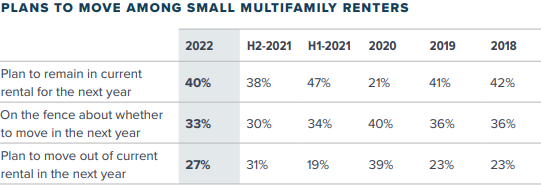
The survey shows 40 percent of small multifamily renters feel certain that they’ll renew their lease this year—and an additional 33 percent are on the fence.
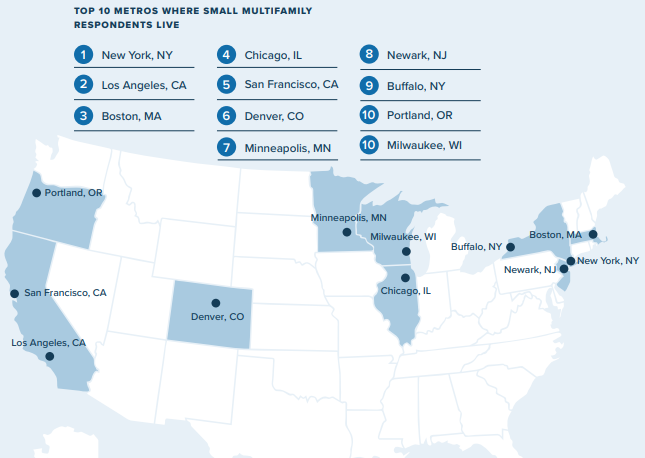
Neighborhoods where smaller multifamily residents live tend to be in areas with older properties “because multifamily construction has focused on larger apartment projects since the 1980s,” the report says. This includes neighborhoods in Boston, Chicago, Portland and others.
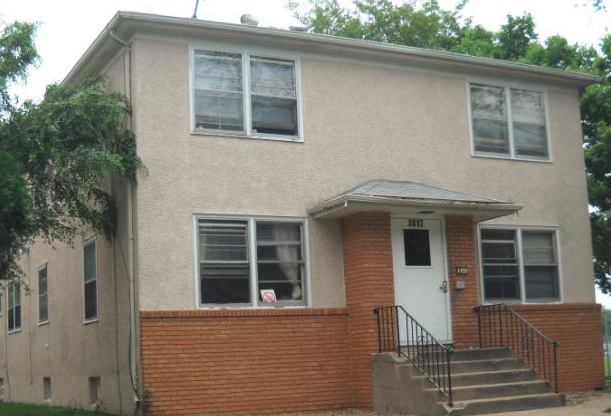
Smaller multifamily properties tend to be older buildings in older neighborhoods more centrally located.Chart courtesy of Buildium
Why Smaller Multifamily Properties Appeal To Renters
While these smaller properties represent only 14 percent of rental properties across the country, they play an important role in housing.
Here are some key reasons why:
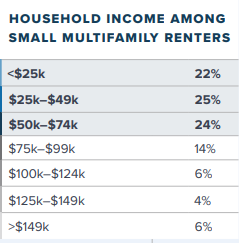
They allow low- and middle-income renters to live in neighborhoods close to jobs, schools, and other resources by splitting land prices, property taxes, and other costs across multiple units at more affordable price points than newer apartment buildings provide.
They give renters access to some of the comforts of a home without leaving centrally located neighborhoods. “In comparison with apartment building residents, the small multifamily renters we surveyed place a higher premium on living in a property that offers private outdoor space and the option to have a pet; and on living in neighborhoods that are safe, quiet, family-friendly, and lower-density,” the Buildium report says. But in comparison with single-family renters, they’re willing to sacrifice a little space to keep work, school, stores, restaurants, and transportation options within arm’s reach.
They provide renters with more space than apartment buildings, but less than single-family rentals. “In our survey, households living in small multifamily rentals had an average of two to three occupants living in properties with two to three bedrooms, providing them with a space that’s larger than in a typical apartment building (which house an average of two renters in 1- to 2-bedroom units), but smaller and more affordable than most single-family rentals (with an average of three renters living in three-bedroom properties).”
Chart courtesy of Buildium
Smaller Multifamily Properties Attract Individual Real Estate Investors
The survey found that two-to four-unit properties present a lower barrier to entry for aspiring rental property investors.
As a result, more than three quarters of small multifamily properties were owned by individual investors rather than larger investment firms in 2015.
“In our 2022 survey of small-portfolio rental owners, we found that 41 percent of small multifamily owners only own a single rental property,” the survey says.
Who Lives In Smaller Multifamily Properties?
Chart courtesy of Buildium
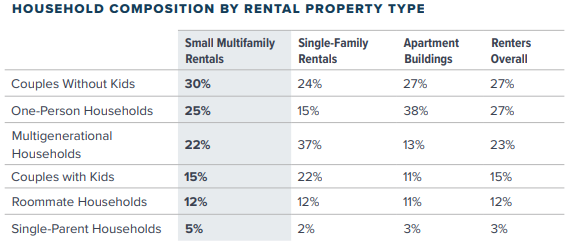
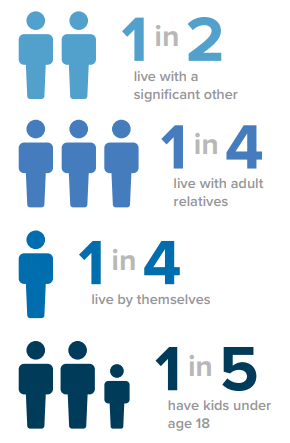
Small multifamily properties have households that are slightly larger and are more likely to contain couples, children, and adult family members.
These properties also house a slightly larger percentage of couples without kids than other property types do.
Chart courtesy of Buildium
Many Smaller Multifamily Properties’ Renters Plan to Stay
The retention rate in these properties is stronger than most.
The survey says 40 percent of small multifamily renters plan to stay put for the next year—4 percentage points higher than the rate among renters overall.
Chart courtesy of Buildium
“Overall, however, renters seem to be feeling greater uncertainty about whether or not to move than they have for the last few years. This is particularly true for younger renters, as rapidly changing conditions in the rental and housing markets impact the affordability and availability of potential homes,” the survey says.
How Renters Prefer to Communicate in 2022
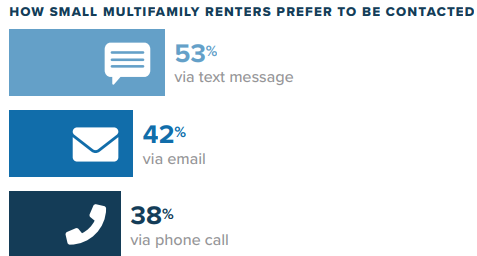
“When it comes to how renters want to be able to get in touch with their property manager, email remains the most popular method on the whole.
Chart courtesy of Buildium
“However, we’ve seen text messaging rise up the ranks over the last year, particularly among young and middle-aged adults; and in fact, within small multifamily properties, text messaging is now residents’ contact method of choice,” the survey says.
Buildium says, “In our Annual Renters’ Survey we survey more than a thousand renters across the U.S., with recruiting assistance from Survey Monkey. This year’s survey (conducted in April 2022) gathered the perspectives of 1,569 renters of all ages and living in a variety of rental property types, though this report focuses exclusively on those living in rental homes with between two and four units.”
About Buildium.com
Buildium is the property management solution that helps real estate professionals win new business from property owners and community associations seeking services. Backed by expert advice and relentless support, Buildium enables you to outperform across all facets of your business with intuitive software that balances power, simplicity, and ease of use. Buildium services nearly 13,000 customers in 46 countries, totaling over one million residential units under management. In 2015, Buildium acquired All Property Management, a leading online marketing service for property managers, making Buildium the only company to give property managers a way to acquire new customers and increase revenue.
Guns in apartments have become a heated issue in many states so what liability may landlords have when it comes to guns or weapons on their rental property and who is to blame if something goes wrong? Attorney Denny Dobbins explores this issue.
If you have spent more than 30 seconds in the last year watching cable news, you are more than familiar with something called “the blame game.”
Regardless of political party affiliation, age, race, gender, sexual orientation or any of a host of other categories, it appears that our society has become a place of great divide.
As a landlord you are not immune to this growing epidemic of blame and, in fact, you’re likely to take more than your fair share of blame when it comes to tenants and their problems. After all, those same media outlets have spent years painting the picture of the big, bad landlord, creating an evil, money-focused image that even the happiest of tenants sometimes buy into believing.
Guns In Apartments Or On Your Rental Property
Let’s create a blame framework for this by using a scenario where a tenant or guest of a tenant is injured by a weapon that the landlord allowed on the property.
To create some protection for you as a landlord we must first turn to the general principle of negligence law and liability. It is helpful to understand the basic law and how to apply it in a real landlord-tenant situation.
Every landlord must have a handle on these basic principles, so we’ll first discuss the law and then get back to the questions. Whatever the cause of the injury/damages to the tenant, occupant, guest, or invitee, the landlord does have some basic duties to the tenant in every residential lease, single-family or multifamily home of every kind and variety.
Here is the basic legal test for this scenario:
Duty: Generally, the duty of the landlord is to provide a reasonably safe place to live for the tenant, occupants, guests, and invitees (and there may be more than just this duty, depending on the lease and the applicable laws). The basic legal theory about a landlord’s duty from settled case law is, “if the landlord knew or should have known about a danger or peril in, or on, the property, the landlord must ensure reasonable and timely remedies to prevent damages (injuries) to whom the landlord owes the duty of reasonable safety.” Did the landlord have a duty to allow the tenant to have a weapon inside of the private, inside quarters of the home that the tenant controls in order to protect the tenant’s family/household? That is a big question. Arguably, if the tenant had nothing in their background that would put a landlord on notice that the tenant had a propensity for violence, and the tenant is an ordinary, law-abiding citizen, why would anyone not allow that person to have adequate home protection? So, is there such a duty? The question does not seem to be resolved by any court. Although, some states prohibit a landlord from such a prohibition. Do you want to fight this case in court?
Then:
Causation: “But for” the landlord actions or inactions, would a particular event or damage have occurred? “But for” the landlord allowing the tenant to have a gun or weapon for protection, would the injury/damage likely not have not occurred? Here the answer is probably, yes.
Then:
Foreseeability: Even if there is a duty and there is causation, there is one more test to be applied before we can determine if the landlord actually has any liability for the damages/injuries. Was it foreseeable by a reasonable person that if the landlord allowed the tenant to have a weapon to protect his/her private home that this very injury/damage would take place? Here the answer is again probably, yes.
I suggest running any scenario where you as a landlord feel you may be vulnerable through the three prongs of the legal test as described above.
In fact, I invite you to do that right now with the above scenario, only reversed, where the landlord prohibited the tenant from having a weapon on the property and the tenant or their guest was injured because they did not have a weapon for self-defense.
What is your duty, what could your actions cause, and is a specific outcome foreseeable?
What is the course for best practices to avoid blame and liability? Examine your property, your practices, and your policies through the lens of an attorney and make the proper adjustments to boost the protection of both your tenant and your property. After all, the best way to avoid any blame at all is to anticipate potential problems, remedy them, and document what you have done.
About the author:
Denny Dobbins is vice-President and legal counsel for Rent Perfect, the creator of the Crime Free Addendum, a private investigator, and fellow investor. Subscribe to the weekly Rent Perfect podcast (available on YouTube, Spotify, and Apple podcasts) to stay up to date on the latest industry news and for expert tips on how to manage your properties.
You look out of your office window and see a car slowly driving by.
They stop for a quick second and seem to be taking pictures.
Who is this? A potential resident, or perhaps a drive-by accessibility tester?
Drive-By Accessibility Testing
Drive-by accessibility testing is becoming more commonplace. This is an easy way for testers to find properties that are violating accessibility laws without ever having to set foot out of their vehicle.
Accessibility testers can come from multiple different sources. For example, they could be hired by an advocacy group or a state agency. Or they could be operating individually with the help of a lawyer. Regardless of whom they work for, they are out there ready to act if they stumble across any accessibility violations.
Once a violation is found, a claim can be filed, and so begins a very expensive and troublesome situation for any property management company to deal with. Keep in mind that once a lawsuit is filed, it is not limited to the specific violation already found; your entire property is put under the microscope, with each additional violation added on.
Is Your Property Truly Accessible?
Most landlords and property management companies are aware of common accessibility touchpoints, such as having accessible parking spots, adequate signage, and a clear path to the main entrance. In addition, there are many other laws and different requirements when it comes to accessibility, either federal, state, or sometimes municipal, and some of them may overlap.
For example, the Americans with Disabilities Act (ADA) law states that for every 25 parking spaces, you must have one accessible space, regardless of the age of the building. However, the Fair Housing Act also comes into play with its rules as far as accessibility for buildings that were built after March of 1991. Knowing which laws are applicable to you can get tricky, and it can become difficult to ensure that your property is truly accessible.
Get the Help You Need
One way to combat this is by hiring an accessibility consultant or attorney to do a walk-through of your property to identify any potential violations. If you are hesitant due to the cost, keep in mind what the cost will be if a lawsuit happens. Lawyer fees, court costs, and potential fines or damage compensation are all on top of what will have to be paid out for any needed repairs or renovations. So, in the long run, it’s more than cost-effective; it can also potentially save you thousands of dollars.
If accessibility problems have been identified, it’s best to avoid the flawed thinking that you can just slap some paint on a few spots or put up a few more signs and call it a day. Create a list with the most visible issues being at the top and immediately create a plan to tackle them in an appropriate and lawful manner. By repairing or modifying the most visible or outside problems first, you are not giving the drive-by testers any reason to stop and investigate further. Once those repairs are completed, you can move on to any indoor maintenance that needs to be addressed to fully ensure that your property is compliant, inside and out.
By taking a proactive approach, you can avoid many costly and time-consuming problems. Keeping up to date on fair housing laws and training will aid in this. If your property meets its accessibility criteria, then you can have peace of mind that the person who was snapping pictures just might want to live there.
About the author:
In 2005, The Fair Housing Institute was founded as a company with one goal: to provide educational and entertaining fair-housing compliance training at an affordable price at the click of a button.
How should a landlord deal with a tenant who has taken over a shared driveway is the question this week for Ask Landlord Hank. Remember Hank is not an attorney and is not offering legal advice. If you have a question for him please fill out his form below.
Dear Landlord Hank:
My tenant has taken over my driveway with her SUV, picnic table, bike, scooter, and plastic pool.
Although there is room for three or four cars in the driveway, with all her paraphernalia, there is no way for me or my family or workers maintaining my house to use the driveway. What rights do I have? I have already told her I will not be renewing the six-month lease we signed.
Dear Landlady Fay,
The lease is the governing document of your landlord-tenant relationship.
There should be a vehicles clause stating that the tenant’s vehicle must be properly parked. There should be another clause relating to use of premises stating that tenant must keep premises clean and sanitary and not disturb residents or the peaceful and quiet enjoyment of the premises.
Your inquiry sounds as if the tenant is living in your house or on your property. Remember, it is your property and you are the boss. She is not in charge. You are, but you must work within your lease.
She is violating the lease if she has her belongings strewn all over your exterior. Give her a three-day notice to clean up her things. Is there a better place for her to put these items? Could her picnic table and children’s toys go in the back yard?
Good luck!
Sincerely, Hank Rossi
Each week I answer questions from landlords and property managers across the country in my “Dear Landlord Hank” blog in the digital magazine Rental Housing Journal.https://rentalhousingjournal.com/asklandlordhank/
Landlord Hank says, “Remember, it is your property and you are the boss. She is not in charge. You are, but you must work within your lease.” Hank is working on a renovation here of one of his properties.
Ask Landlord Hank Your Question
Ask veteran landlord and property manager Hank Rossi your questions from tenant screening to leases to pets and more! He provides answers each week to landlords.
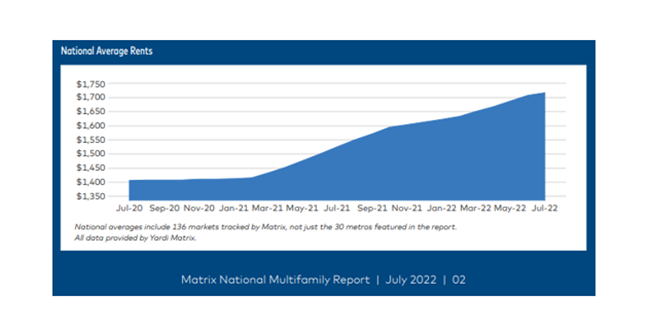
U.S. multifamily rent growth remains strong despite a deceleration in rent growth performance as asking rents are up 12.6 percent year-over-year through July, as demand continues to exceed supply, Yardi Matrix says in the July Multifamily Report.
Supply continues to be an issue and the National Multifamily Housing Council estimates that the U.S. needs 4.3 million new units built through 2035 to meet demand.
“Rent growth remains lofty just about everywhere by historical standards, but the rate of increase in high-growth metros is falling,” Yardi Matrix says in the report.
Here are some highlights in the report:
Multifamily performance continued to improve steadily in July, albeit modestly. National asking rents increased $10 in July, bringing the average rent in the U.S. to a record $1,717.
Year-over-year growth decelerated by 110 basis points to 12.6 percent, 260 basis points off the February peak of 15.2 percent.
Demand and rent growth remained strong throughout the country. Rent growth increased at least 10 percent year-over-year in 24 of Yardi Matrix’s top 30 metros. National occupancy rates were 96.0 percent for the third month in a row.
The single-family sector continues to grow at a steady pace. The average single-family asking rent increased by $7 in July to $2,092, while year-over-year growth dropped by 60 basis points to 11.2 percent.
Economic growth is slowing and polls show consumer confidence is weakening as the Federal Reserve has raised policy rates 150 basis points over the last two months in an effort to slow inflation.
“A weaker economy could cool gains, though apartment asking rents may not immediately respond to the Fed’s actions because rising mortgage rates have slowed the for-sale housing market.
“That might help demand for apartments as first-time homebuyers continue to rent and wait for a more opportune time to buy,” Yardi Matrix says in the report.
Apartment Rent Growth Fueled By Supply Issues
Yardi Matrix says, “A big part of the recent growth in apartment rents has been the supply-demand imbalance. The U.S. currently has a 600,000-unit apartment shortfall with another 3.7 million units needed through 2035 to meet demand.”
A new study commissioned by the National Multifamily Housing Council and the National Apartment Association details the severe shortage of multifamily housing in America.
The report estimates that the U.S. needs to build 4.3 million multifamily units by 2035 to meet the needs of the growing population.
The NMHC-NAA study recommends streamlining the entitlement process and incentivizing more affordable units.
Yardi Matrix researches and reports on multifamily, office and self-storage properties across the United States, serving the needs of a variety of industry professionals. Yardi Matrix Multifamily provides accurate data on 18+ million units, covering more than 90 percent of the U.S. population. Contact the company at (480) 663-1149.
As markets fluctuate, laws change, and taxes inevitably increase, it is more apparent than ever before that American’s need to employ every advantage at their disposal to reach their retirement goals.
As a savvy real estate investor, you know that this asset is a consistent, high performing investment. But have you considered taking advantage of your expertise in your retirement strategy?
This can be accomplished in 2 simple steps. Step one – become a Trust Deed investor with a company that shares your values, such as mitigated risk, transparency, and predictable returns. Step two – establish a Self-Directed IRA with the leading IRA custodian in the real estate industry.
Since 2011, Ignite Funding has been providing private investors with passive investments in real estate throughout the Western U.S. Many choose to supplement their retirement savings by investing in Trust Deeds through a retirement account. Our sister company, Preferred Trust Company, has over 15 years of experience of working with Trust Deed investors, making them the leading IRA custodian for speed, quality of service, and excellence in client experience.
On Wednesday, August 24th at 10AM PST you are invited to a FREE virtual event where you will learn how to add passive investments collateralized by real property to your retirement portfolio.
Unable to attend the event on that date? CLICK HERE to schedule a one-on-one Zoom session at a time that works best for you.
PREFERRED TRUST COMPANY, LLC (“Preferred Trust”) | 6700 Via Austi Parkway | Suite 301 | Las Vegas, NV 89119 | 702.990.7892 | www. preferredtrustcompany.com | Financial Institutions Division of Nevada License No. TR10025. Preferred Trust performs duties of a custodian and as such, does not sell investments or provide investment, tax, or legal advice. Preferred Trust is committed to safeguarding all non-public personal information provided to us by our customers. Preferred Trust collects, retains, and uses customer information where we reasonably believe that it will help administer our business or provide services to our customers. We collect and retain customer information only for specific business purposes and upon request will inform customers why we are collecting and retaining the information. We use information to protect and administer records, accounts, and funds; to comply with certain laws and regulations; to help us design or improve our services; and to understand the financial needs of our customers. Preferred Trust is an accredited member of the Better Business Bureau.
The apartment jobs market remained strong in the second quarter of 2022, because of the robust U.S labor market fueling apartment demand.
The National Apartment Association’s Education Institute Apartment Jobs Snapshot showed employers posted more than 41,600 multifamily openings in the second quarter.
Although the apartment market has begun to cool, job growth in the apartment industry has not, according to the report.
Apartment Job Growth To Continue
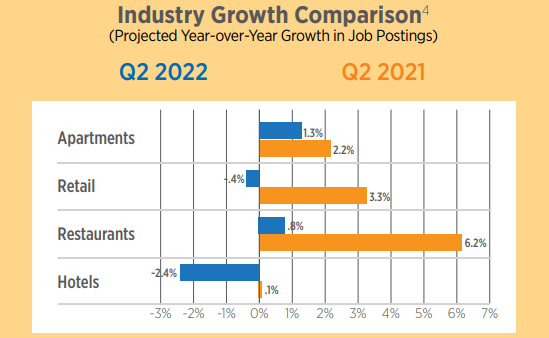
Postings for multifamily jobs are predicted to grow 1.3 percent year-over-year by the end of the 2022, outpacing competing sectors.
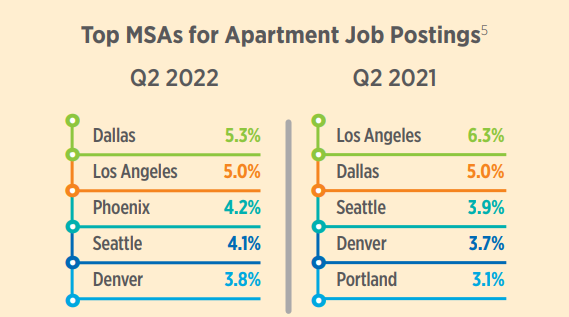
Though migration and household formation slowed down, labor force demand in the apartment sector remained solid in Dallas, Los Angeles, Phoenix, Seattle, and Denver.
Demand for both leasing and maintenance talent increased by 0.7 and 0.1 percentage points, respectively. In contrast, property management job openings declined by 1.1 percentage points.
Apartment employers published an average of three job postings for each open position.
About the numbers:
Industry projections are built from Lightcast final industry data. Industry data comes from the Bureau of Labor Statistics’ Quarterly Census of Employment and Wages (QCEW) dataset, plus some supplemental datasets that provide information for industries not covered by QCEW. NAA Research also in addition to Lightcast and Bureau of Labor Statistics. Job postings as of June 30, 2022.
The dangers of smoking and exposure to secondhand smoke are well-known. Inhaling nicotine and other toxic chemicals from cigarette smoke can cause illnesses like heart diseases, stroke and cancer.[1]
What isn’t as well-known are the effects of thirdhand smoke.
Thirdhand smoke (THS) is the chemical residue that lingers after secondhand smoke has disappeared from the air. While secondhand smoke is a combination of the smoke coming off a cigarette and the smoke exhaled by smokers, thirdhand smoke is the mixture of smoke and toxic chemicals that stick to surfaces and become embedded in household materials.[2] These materials include carpets, walls, furniture, and all surface areas that make up your residents’ homes.
Thirdhand smoke lowers the value of your properties by contaminating the carpet, furniture and walls. In fact, a news report from realtor.com revealed that smoking in a home and the resulting damage of thirdhand smoke can reduce property value by 29%.[3]
Creating a smoke-free policy protects your tenants, and your investments, from the costly effects of thirdhand smoke.
Does THS pose a danger to tenants once the home has been deep cleaned?
The short answer: Yes. Thirdhand smoke can linger indoors for years. Despite deep cleaning and renovating, thirdhand smoke can be reemitted through dust and becomes embedded in carpets, furniture, fabric and building materials. Residents, including pets and children, can be exposed to this toxicity by just breathing within the same apartment that a previous smoking tenant occupied and through touching surfaces in past smokers’ homes.
New research shows that thirdhand smoke carries a unique chemical compound called 1-(N-methyl-N-nitrosamino)-1-(3-pyridinyl)-4-butanal (NNA). NNA is one of the many tobacco-specific nitrosamines – a group of cancer-causing compounds found in tobacco products. Tenants are exposed to NNA by touching surfaces polluted by thirdhand smoke or by inhaling dust contaminated with smoke residue.[4]
The U.S. Surgeon General has concluded that there is no safe level of exposure to tobacco smoke, including thirdhand smoke.[5] The greatest line of defense to protect your residents and your properties is to enact a smoke-free policy.
Comprehensive smoking bans are essential for protecting everyone
Thirdhand smoke is toxic to residents and other people entering your properties. It puts renters and their families at risk for a decision they did not choose to make. The benefits of going smoke-free not only support the health and well-being of your residents, but also support the longevity of your properties.
Find out what steps to take to ensure you are creating a healthy place for all to live and work. For more information on smoke-free housing, visit tobaccofreeutah.org. For free resources to help you quit, visit waytoquit.org.