Home Blog Page 164

Building Affordable Apartments Means Skipping the Amenities

Building Affordable Apartments Means Skipping the Amenities

Skipping the amenities may be a key to building more affordable apartments, according to new consumer research that shows that the most-valued amenity is frequently “low rent.”

One way to provide more affordable rental options is by building smaller apartment communities without amenities or with fewer amenities, the research says.

John Burns Real Estate Consulting cites a recent survey by the National Multifamily Housing Council (NMHC) showing that the two top community amenities nationwide are:

  • Reliable cell reception (78 percent)
  • Secure resident parking (71 percent)

Just 60 percent desired a swimming pool, and 55 percent wanted a fitness center, writes Adam Artunian, Vice President, and Pete Reeb, Principal, of John Burns Real Estate Consulting.

“As rental rates continue to rise nationwide, rental affordability has become a big concern and the need for affordable rental options has never been greater,” Artunian and Reeb write.

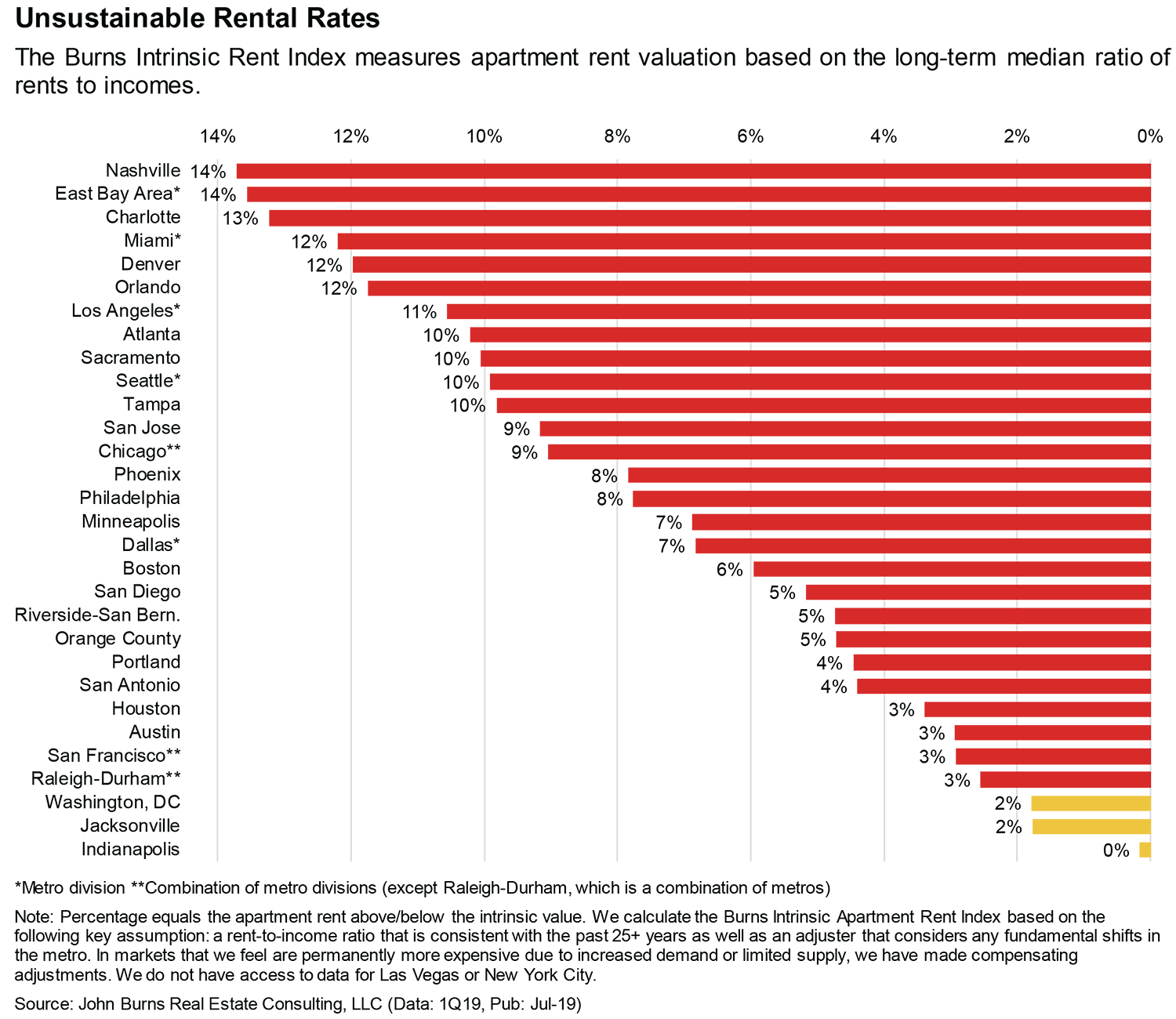
“Our Burns Intrinsic Apartment Rent Index, which measures apartment-rent valuation based on the long-term median ratio of rents to incomes, suggests that about half of the major markets in the country are overvalued by more than 5 percent and many by 10+ percent. San Francisco East Bay Area rents are 13 percent higher than they should be, meaning that we think a 13 percent correction is needed to get back to norm. This likely will not happen until the next recession.”
Building Affordable Apartments Means Skipping the Amenities

Multifamily developers’ focus on expensive urban markets pushes up apartment prices

Developers’ focus on building Class A apartments in expensive urban markets over the last decade increased the number of higher-priced apartments. At the same time, rents rising faster than inflation and investors’ thirst for value-add opportunities decreased the overall supply of lower-priced apartments.

Building smaller apartment communities or communities not focused on amenities – in fact skipping amenities – can provide more affordable rental options. Forgoing traditional community amenities (pool, fitness center, etc.) reduces development and operating costs, allowing for more affordable rental rates. Consider the following:

  • Zoning laws and high land prices often make it difficult to build housing that low- and moderate-income people can afford.
  • Many renters don’t want to live in a 400-unit apartment complex because they feel less safe, and like they are just a number. These people prefer small communities and are willing to have fewer amenities.
  • Land is scarce in infill neighborhoods close to jobs, limiting the feasibility for large communities with amenities.

Smaller, low-rise apartment communities may be a key to affordability and skipping the amenities

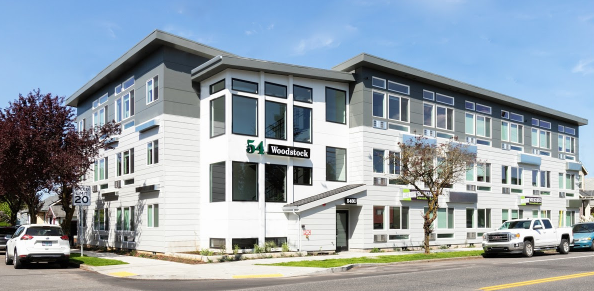
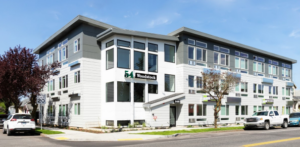
54 Woodstock in Portland is an example of a small apartment community with no amenities. The community is pet-friendly and includes bike storage, surface parking, individual utility meters, outdoor mailboxes, and wifi. The community has a high walk score (73) and is within a few miles of downtown Portland.
Building Affordable Apartments Means Skipping the Amenities
Image source https://www.54woodstock.com/

“We suggest looking for locations where the amenities are nearby and free,” the authors write. Below are a few strategies to keep in mind:

  • Walkability. Locations with easy access to parks, restaurants, shopping, and/or mass transit command high rents. Advertise your proximity to the local fitness center, park/community pool, hiking/bike trails, and dog park. If applicable, promote high walk or bike scores. Market the surrounding neighborhood as the amenity.
  • Create community. Allow your tenants to create a “high-touch” community where they can come together to enjoy life. Groups that do things together are wonderful amenities, and they are free. Social connection can be a wonderful amenity.
  • Nearby businesses. Build partnerships with the local fitness centers where residents get discounted monthly gym fees, yoga/cycling classes, etc.
About the authors and John Burns Real Estate Consulting:

“The rental market has changed, providing developers with great opportunities. If you have any questions, please contact Adam Artunian at (949) 870-1213 or Pete Reeb at (858) 281-7216, and we will put you in touch with the expert you need.”
Greystar Breaks Ground on First Portland Development Project

Greystar Breaks Ground on First Portland Development Project

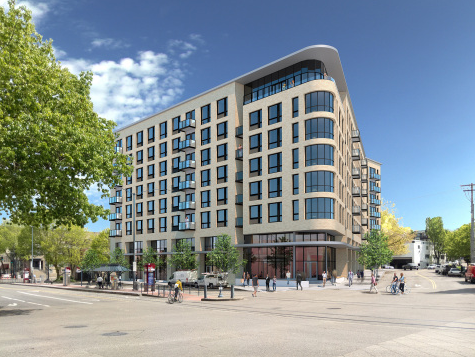
One of the leaders in multifamily development has broken ground on its first-ever residential Portland development project of 182 apartments and 8,000 square feet of retail space, according to a release.

The project in Goose Hollow by Greystar, a global leader in the development, investment, and management of multifamily housing,  began with an official groundbreaking ceremony. Located at the corner of Southwest 18th Avenue and Southwest Salmon Street in the neighborhood of Goose Hollow, the project marks Greystar’s expansion across the Pacific Northwest, which currently includes offices in Seattle and now Portland.

“As the burgeoning city of Portland evolves in its wide array of job offerings and housing demands, we are thrilled to begin construction and bring to market our first of, hopefully, many great projects for local area residents,” said Aaron Keeler, Senior Director, Development at Greystar, Pacific Northwest, in the release.

Portland development project to open in 2021

The eight-story community, scheduled to open in 2021, will introduce both market-rate and affordable rental residences under Portland’s inclusionary zoning mandate.

Purchased from TriMet, the transit-oriented site will provide easy access to nearby light rail transportation stops, including Kings Hill Station, which provides direct access to downtown Portland.

The community will be minutes away from Providence Park, multiple bus stops and the 405-Interstate freeway, according to the release.  Future residents will also have convenient access to Multnomah Athletic Club, Lincoln High, and Providence Park, home to the Major League Soccer team the Portland Timbers, and the American professional women’s soccer team, the Portland Thorns. Designed by SERA Architects, the community’s design will draw inspiration from New York City’s iconic Flatiron Building and reflect a sustainable design with dynamic spaces for its residents.

“At the heart of Goose Hollow’s best amenities and local entertainment, this community will introduce a modern and eclectic address for future residents looking to live in the center of one of Portland’s most exciting neighborhoods,” said Doug Burges, Director of Development at Greystar, Pacific Northwest, in the release.

About Greystar

Greystar is a fully integrated real estate company offering expertise in investment management, development and property management of rental housing properties globally. Headquartered in Charleston, South Carolina, with offices throughout the United States, Europe, and Latin America, Greystar is the largest operator of apartments in the United States, managing over 400,000 units in over 150 markets globally. Greystar also has a robust institutional investment management platform dedicated to managing capital on behalf of a global network of institutional investors with nearly $16 billion in gross assets under management including more than $7 billion of developments that have been sold or are underway. Greystar was founded by Bob Faith in 1993 with the intent to become a provider of world-class service in the rental housing real estate business. To learn more about Greystar, visit www.greystar.com.

Related story:

Lake Oswego Mercantile Village Construction Underway


How to Get the Best Lighting for Your Rentals

How to Get the Best Lighting for Your Rentals

Here is a useful guide to understanding the best, most economical way to use lighting for your rentals from Keepe, the maintenance company.

First let’s look at the different types of light bulbs out there:

  • Incandescent ~ The most commonly used bulb because it is also the least expensive. Tends to have a warm hue. Can last up to 1,000 hours, but is not always the most energy efficient.
  • Halogen ~ Similar to incandescent, these bulbs give off a cooler color, trying to imitate natural light. They are a little more energy-efficient, but also more expensive. You must remember not to use bare hands when changing a halogen bulb because the smallest residue of oil from a human hand can rub off on the bulb and create an atmosphere where the bulb warms too quickly when the lamp is turned on. This can cause the bulb to explode, so be careful!
  • Fluorescent ~ A flat cold light, typically used to light up large areas like classrooms, offices, basements or attics.
  • Compact Fluorescent ~ These consume a quarter of the energy of incandescent bulbs and last ten times as long. Compact Fluorescent Bulbs (or CFLs) tend to have warmer tones.
  • LED ~ This stands for “Light-Emitting Diode,” and although it is the most energy-efficient and longest-lasting bulb on the market, LEDs only give off directional light and don’t light an entire room. To fix this issue, there are some LEDs that come in clustered groups, but these tend to be the most expensive model available.

How to Get the Best Lighting for Your Rentals

Before getting into the nitty gritty of lighting for your rentals, you should understand some common terms used

  • Ambient Light ~ general light
  • Task Lights ~ useful lights (example, food prep)
  • Accent Lights ~ used to highlight artwork or other details in your home
  • Kelvin ~ determines the color of a bulb; a higher number means a cooler color, a lower number means a warmer color
  • Lumens ~ measures brightness
  • Wattage ~ measures energy consumption

Lighting For Your Rentals Guide by Room

 Living room (1,500 – 3,000 total lumens)

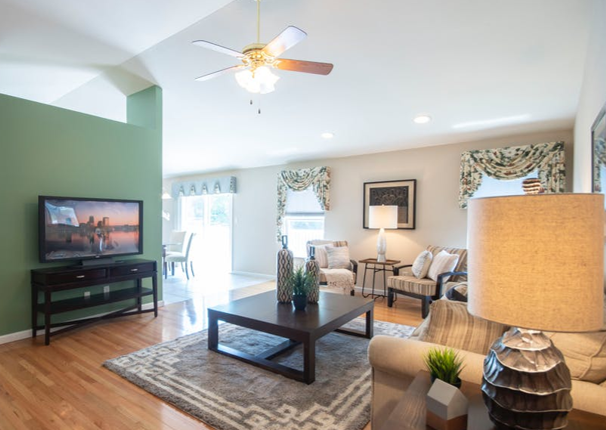
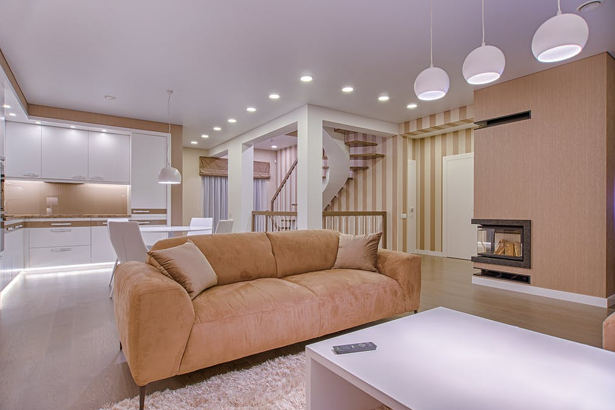
Living rooms will take all three levels of lighting mentioned earlier. For ambient lighting, the best option is to have a central ceiling light combined with corner ceiling lights for maximum illumination. Task lighting can be accomplished by using lamps with LED bulbs near seating areas that are used for reading and other close work. Accent lighting can be spotlights used to highlight any artwork or special decorations in the room. Dimmers can also be added to the room for versatility.

How to Get the Best Lighting for Your Rentals
The best option for living rooms is to have a central ceiling light combined with corner ceiling lights for maximum illumination.

Kitchen (5,000 – 10,000 total lumens)

Kitchens are always a challenge when it comes to lighting because they need ambient and multiple task lights at the same time. A dimly lit kitchen can feel small and gloomy,  while a brightly lit one feels open and welcoming. Try to allow sunlight to enter the room if you can. Think about replacing the curtains with sheers, or maybe remove them altogether. Pendant lights can be used as a source of lighting and a beautiful focal point for the room, especially if there is an island. Lights above, below and even inside the cupboards can help with task lighting and food-prep visibility. Additionally, placing the sink underneath a window is always a good strategy to use natural light to your advantage.

Bathroom (4,000 – 8,000 total lumens)

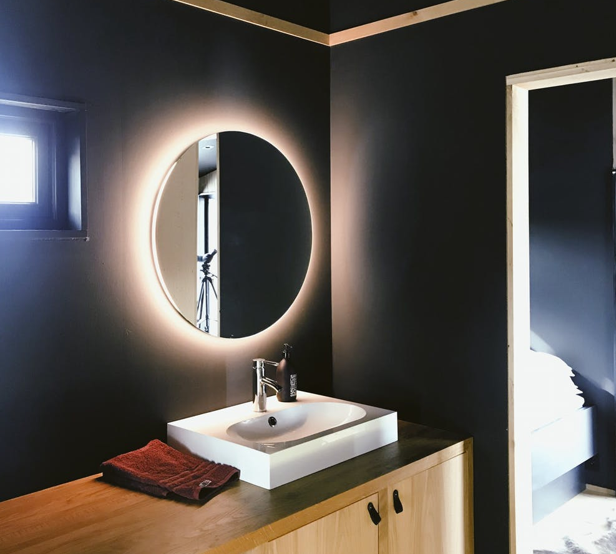
Task lighting is crucial for any bathroom and can be accomplished by using vanity lighting around the mirror, illuminating faces for grooming. The best way to do this is to add lights on either side of the mirror. A common mistake is to put lights on the ceiling above the mirror; this will cause unwanted shadows on the face. In addition to the vanity lighting, a central fixed ceiling light can be used as a substitute for natural light. When it comes to choosing bulbs, a crisp white is best for making the room seem more open and natural. Try to add a light above the tub or shower in the room because these areas tend to be very dim. If possible, install dimmers to allow for eye adjustment when using the bathroom in the middle of the night or early morning.

the best option is to have a central ceiling light combined with corner ceiling lights for maximum illumination
Using vanity lighting around the mirror in one way to make bathrooms look great.

Bedroom (2,000 – 4,000 total lumens)

For ambient light, choose a central light fixture for the middle of the ceiling. Central lighting can also help as a substitute for natural light. Small table lamps placed on nightstands near the bed can be used for task lighting or for a dim light for relaxation. Closet lighting is also essential to be able to see all your belongings and help with organization.

 Dining room (3,000 – 6,000 total lumens)

Lights above the dining room chairs can cast unwanted shadows on people’s faces. Instead, opt for lights that showcase the table. A chandelier is frequently used in this case, and creates a great focal point for the room. Wall sconces can also be used in the dining room to provide visibility and add an aesthetic element. Typically, warm lighting is recommended to provide a cozy and relaxed feeling.

Hallways & Stairs (1,200 – 4,000 total lumens)

Typically, these areas only require ambient lighting, with the exception of the occasional artwork or any other special architecture. These areas can be illuminated with a simple ceiling fixture or wall sconce. For accent lighting, use bulbs with narrow beams or directional shades.

Here are other recent rental property maintenance Keepe posts you may have missed:

 How To Pick The Perfect Exterior Paint Color For Your Rental Property

4 Outdoor Flooring Options For Your Rentals

20 Easy, Affordable Maintenance Projects To Update Your Rentals

7 Tech Gadgets For A Safer And More Efficient Rental Property

5 Maintenance Tips For Long-Lasting Rental Carpet Flooring

Is The Water Heater At Your Rental Property Ready For The Big One?

7 Types Of Kitchen Countertops For Your Apartments

Which Cooktop Is Best For Your Rental Property?

A Guide To 4 Types Of Flat Roof Systems

6 Ways To Trash Your Apartment Waste Management Issues

Top 5 Apartment Maintenance Emergencies vs. Maintenance Requests

5 Tips for Preparing Your Apartments for the Summer Season

4 Air Conditioning Maintenance Best Practices For Summer

About Keepe:

Keepe is an on-demand maintenance solution for property managers and independent landlords. We make hundreds of independent contractors and handymen available for maintenance projects at rental properties. Keepe is available in the Greater Seattle area, Greater Phoenix area, San Francisco Bay area, and Portland area, and we are continuing to expand. Learn more at http://www.keepe.com

National Average Rent Reaches $1,465 in June

National Average Rent Reaches $1,465 in June

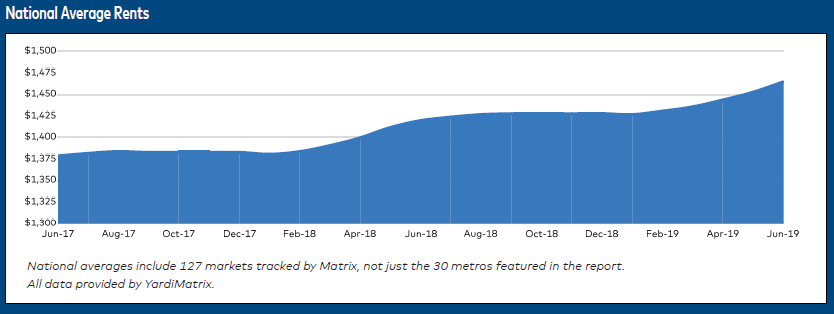
As the peak rental season got into full swing, the national average rent reached $1,465 in June – that’s an extra $37 added to the average rent since the beginning of the year and $45 more compared to June 2018, according to a new report from Rent Café.

Compared to last June, renters pay $45 more on average, according to the latest rent survey from Yardi Matrix.

“With renting remaining the preferred housing option, the first half of 2019 saw accelerated rates in apartment-leasing activity, as well as an effective rise in occupancy,” said Doug Ressler, Director of Business Intelligence at Yardi Matrix, in the report.

National Average Rent Reaches $1,465 in June

Some of the key points from the national average rent report

  • The U.S. average rent increased by 3.2% ($45) year over year reaching $1,465 in June 2019, up by 0.8% ($12) month over month, according to Yardi Matrix data.
  • Throughout the first half of 2019, the national average rent has increased by 2.6% ($37).
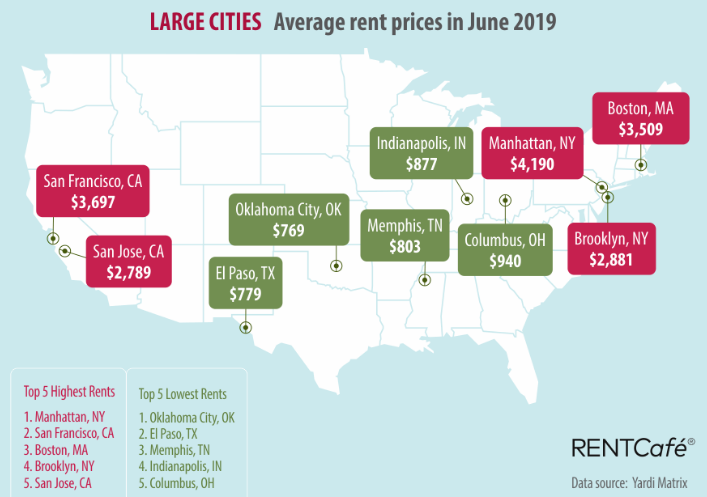
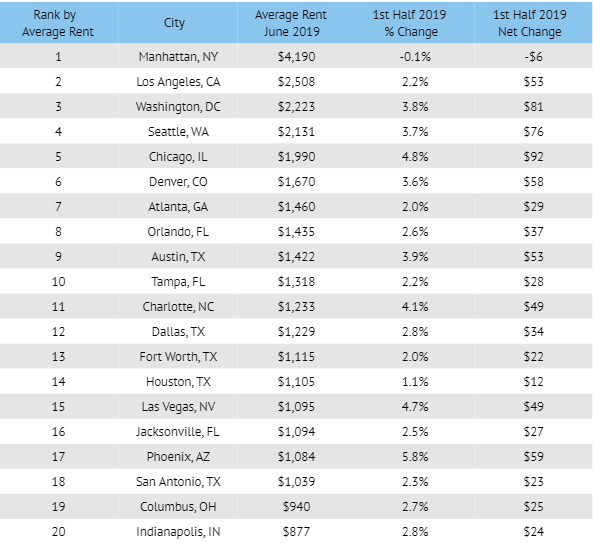
  • Wichita, Kan., is the country’s most affordable city to rent in, at $656 per month, while the average monthly rent in Manhattan, NYC is $4,190.

National Average Rent Reaches $1,465 in June

Rent increases during the first half of the year are typically more accelerated, whereas during the second half of the year they’re expected to slow down, a typical pattern confirmed by rent evolution in past years, the report says.

June rents in the 20 largest renter mega-hubs

National Average Rent Reaches $1,465 in June

More highlights from the national average rent report

  • In the first half of 2019, rents in 88% of the cities analyzed went up, while in 12% of cities apartment prices remained more or less the same.
  • Which were the most popular search terms this year so far? “Rentals near me” and its variations had by far the largest search volume on Google, at 74%. The other primary keywords were  “studio” (6%) and “cheap” (4%).
  • Of the large markets analyzed, Manhattan ($4,190) was the only one where rents have decreased since January, although by just $6. Houston and Baltimore each saw modest rent growth of $12 in the last six months. On the flip side, Boston ($3,509) and Queens ($2,598) witnessed the most significant price gains in H1, $208 and $104 respectively.
  • The largest increase recorded by a mid-size market was in Long Beach ($2,071), where rents swelled by $62 since the start of the year. Among the smaller markets, Cambridge ($3,210) and Sunnyvale ($3,057) lead the way with high 6-month net increases, $165 and $158 respectively.

National Average Rent Reaches $1,465 in June

Most-searched apartment types in first half of 2019

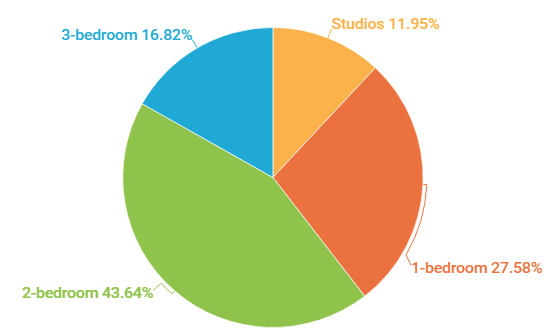
On RENTCafe, two-bedroom apartments have been the most-searched unit type since the beginning of the year, when they made up more than 50% of searches.

Traffic data shows that in June, around 44% of the searches on the website were for two-bedrooms, followed by almost 28% hits on one-bedrooms, and 17% on three-bedrooms.

Although popular in overall online searches, studios make up only around 12% of searches on RENTCafé.

National Average Rent Reaches $1,465 in June

Methodology:

RENTCafe.com is a nationwide apartment search website that enables renters to easily find apartments and houses for rent throughout the United States.

To compile this report, RENTCafe’s research team analyzed rent data across the 260 largest cities in the United States. The data comes directly from competitively rented (market-rate) large-scale multifamily properties (50+ units in size), via telephone survey. The data is compiled and reported by our sister company, Yardi Matrix, a business development and asset management tool for brokers, sponsors, banks and equity sources underwriting investments in the multifamily, office, industrial and self-storage sectors. Fully affordable properties are not included in the survey and are not reported in rental rate averages. The national average rent includes over 130 markets across the United States., as reported by Yardi Matrix.


5 Rental Features That Appeal To Young Professionals

5 Rental Features That Appeal To Young Professionals

Which 5 rental features appeal to young professionals is the rental property maintenance checkup this week provided by Keepe.

Demand from millennials and young professionals with higher incomes are major drivers of the current rental market. Rental properties can easily be redeveloped or rebranded to include target-market needs and amenities.

If your property wants to target young professionals, here are 5 rental features that are emerging trends

  1. Easy access to center-city jobs: Easy travel to the main city center is a key factor for young professional renters. Short commutes to town centers and multiple transportation options can boost interest in your rental.
  2. Competitive rental prices: Young professionals are not very price-sensitive, but in a competitive market, it’s important to be sensitive to your competitors’ rates and take into account what other amenities they are offering that could capitalize on this renter market.
  3. Trendy area: City centers and areas with an abundance of new restaurants, bars and nightlife make for the best areas for millennials and young professionals. If your property is in an urban area, be sure to spotlight these areas in your marketing efforts.
5 Rental Features That Appeal To Young Professionals
An abundance of new restaurants, bars and nightlife make for the best areas for millennials and young professionals.

4. Social amenities: A fitness center, clubhouse or common spaces for socializing are very attractive to this demographic. Young professionals are out and about working and networking most of the day, so smaller apartments will fit their needs perfectly well. On the other hand, social amenities – areas in the property that can allow for entertaining and shared activity – become more valuable and necessary. As for fitness centers, offering free classes that encourage group participation and socializing trends to draw in more young professionals.

5 Rental Features That Appeal To Young Professionals

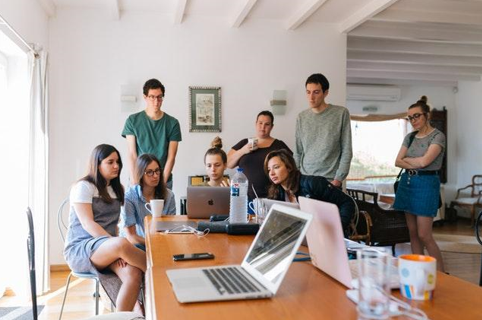
Young professionals are out and about working and networking most of the day, so smaller apartments will fit their needs perfectly well.

5. Business center: Similarly, renters are demanding a co-living environment where they can entertain but also work. A common space for co-working and remote office work is an important element that this demographic desires.

5 Rental Features That Appeal To Young Professionals
A common space for co-working and remote office work is an important element that this demographic desires.

Other recent rental property maintenance Keepe posts you may have missed:

4 Outdoor Flooring Options For Your Rentals

20 Easy, Affordable Maintenance Projects To Update Your Rentals

7 Tech Gadgets For A Safer And More Efficient Rental Property

5 Maintenance Tips For Long-Lasting Rental Carpet Flooring

Is The Water Heater At Your Rental Property Ready For The Big One?

7 Types Of Kitchen Countertops For Your Apartments

Which Cooktop Is Best For Your Rental Property?

A Guide To 4 Types Of Flat Roof Systems

6 Ways To Trash Your Apartment Waste Management Issues

About Keepe:

Keepe is an on-demand maintenance solution for property managers and independent landlords. The company makes a network of hundreds of independent contractors and handymen available for maintenance projects at rental properties. Keepe is available in the Greater Seattle area, Greater Phoenix area, San Francisco Bay area, Portland, San Diego and is coming soon to an area near you. Learn more about Keepe at https://www.keepe.com


Why Is Only Hot Water Coming Out of the Kitchen Faucet?

Mystery Maintenance Call Of The Week: Why Is Only Hot Water Coming Out of the Kitchen Faucet?

We provide an apartment maintenance odd job of the week from our friends at Keepe and this week it is about why only hot water is coming out of the kitchen faucet?

Keepe got a job request in the greater Seattle area for a kitchen sink in which the water would only come out scalding hot.

When the issue was reported, the property manager stated that, “When you turn all the way to cold you only get a trickle of cold water. You can’t even get warm water, it’s always super-hot.”

The issue had been going on for a few months.

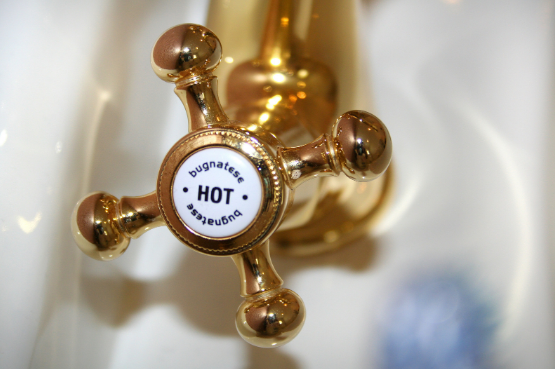
The faucet valve was malfunctioning and killing the pressure on cold side, stopping the flow of cold water and only letting the hot water in.

When our worker came in, they were able to assess the situation and find that the faucet valve was malfunctioning and killing the pressure on cold side, stopping the flow of cold water and only letting the hot water through.

After the source of the issue was found, the faucet was replaced and is now working great!

See other apartment maintenance odd job of the week features here:


5 Rental Housing Siding Materials And The Pros And Cons Of Each

rental housing siding

Rental housing siding is not very sexy but it is important to your tenants and your budget long-term so here are 5 siding materials and the pros and cons of each as the maintenance checkup from Keepe.

When it comes to the siding on your rental properties, many things come into play such as the look and appeal to tenants, energy efficiency and of course your budget which is most important.

Knowing about the needs of different materials can allow you to plan how to best take care of your property’s siding and make an informed decision about which kind really is best for your property, needs, expectations, tenants and budget.

Let’s look at the pros and cons of 5 common rental housing siding materials.

No. 1 – Wood shingles and clapboard rental housing siding materials

Wood shingles and clapboard are a timeless favorite because they create a naturally warm and rustic look that many people like.

What are the pros?

    • Wood siding comes in numerous varieties, which can be customized further by utilizing unique paint and/or stain colors.
    • Fairly easy and thus affordable to install – on average, it’s about $8 per square foot
    • When it is well maintained, it ages beautifully and can last for decades.
    • The Forest Stewardship Council certifies sustainable varieties to offer environmentally-friendly and repurposed options.

What are the cons?

    • Wood requires regular treatments to last. Stains, sealants and paints must be re-applied as directed by the manufacturer to avoid the extensive and costly damage that occurs when untreated wood is exposed to moisture, harsh weather, sun rays and pests. Regular maintenance itself can also be costly, and should be anticipated.
    • Wood is a uniquely attractive material for pests, which makes it fundamental to regularly check for signs of rodent or termite activity.
    • Higher grade types of wood are more durable and do not present as many imperfections, but are more expensive than low-grade wood.

No. 2 – Vinyl siding

Vinyl siding has become one of the most popular siding materials, with thousands of satisfied rental property owners and contractors raving about it.

What are the pros?

    • Budget-friendly vinyl is one of the cheapest materials to purchase and install.
    • Low-maintenance vinyl does not require special treatments and is easy to clean. Pressure washing every few years generally restores vinyl siding back to a like-new condition.
    • Long-lasting vinyl is waterproof, fade resistant and does not retain or absorb moisture.
    • Customizable vinyl is available in many different colors, textures and finishes. Some kinds are manufactured to specifically resemble wood grains.

What are the cons?

– Vinyl is water resistant, but not completely waterproof. It is of utmost importance for it to be installed correctly to avoid water permeating and reaching the property’s core structure, which can lead to internal rotting, mold growth and more serious water damage.

– Vinyl can be easily damaged, dented and scratched,  by branches. It’s important to keep this in mind and ideally trim back any vegetation.

rental housing siding vinyl options

Created by Schantalao – Freepik.com

No. 3 – Brick siding 

Like wood siding, brick siding creates a one-of-a-kind look that is preferred by lovers of Colonial and Tudor architecture. Bricks are typically made from fired clay that can be engineered to present special colors and textures.

What are the pros?

    • When correctly installed, brick siding can last a lifetime or longer.
    • Countless colors and varieties exist to realize custom looks.
    • Brick is a great insulator, and unlink wood, is fire and pest-proof.
    • It requires minimal to no maintenance; as time passes, bricks can be restored by simply scheduling a pressure-washing treatment.

What are the cons?

– Brick installation requires skill and is labor-intensive, which makes it quite expensive to install. Brick siding is one of the most expensive siding options.

– Additional work is typically required prior to installation to prep a property’s walls before brick is installed. This includes extending foundations and insulating exterior walls.

– The main issue with brick siding is that it is known to be vulnerable to water finding its way between the layer of bricks and the actual wall, which can lead to mold growths and water damage.

No. 4 – Stone and stone veneer rental housing siding materials

Similarly to brick siding, stone and stone veneer add a beautiful rustic finish to a property’s exterior. The naturally occurring variegations in the coloration and texture of natural stone make it a popular siding option featured as an accent. Stone veeners are made with “faux stone” and are often referred as Cast or Manufactured Stone Veneer (MSV). MSV’s are created from synthetic blends and resins.

What are the pros?

    • Stone is incredibly durable: it is not easily damaged by water, weather exposure or fire.
    • Stone is one of the most naturally abundant materials on the planet, which makes it easy to repurpose and source it sustainably.
    • Natural stone offers unique variations of color and texture that are prized by lovers of natural, beautifully rugged aesthetics.
    • Synthetic stone can resemble the look of natural stone but is considerably less pricey since it is more lightweight and easily manufactured.

What are the cons?

    • Stone is another labor-intensive material to install. It is heavy and required to comply with a state building codes. This all contributes to making stone and stone veneer installation particularly expensive.
    • While it does not require regular maintenance, stone can crack. Cracks must be repaired as soon as possible to avoid water infiltrations.
    • Rental housing siding brick options

No. 5 – Stucco rental housing siding materials

Stucco results from mixing Portland cement, limestone, sand, water and other chemical additives. Once applied, stucco creates a concrete-like layer on top of a property’s core structure.

What the pros?

    • Since stucco acts as an exterior “shell”, it has amazing insulating properties, which can help with making it so less energy is required to keep a property’s interiors hot in the winter and cool in the summer. It can also help with making a property more insulated from exterior noise.
    • Stucco can be mixed with numerous available dyes to create a variety of color options for a property’s exteriors.
    • In an emergency, stucco can act as a fire-retardant.
    • When it’s properly maintained, stucco can last a lifetime.

What are the cons?

    • Stucco is installed in layers, which is a labor-intensive process. This contributes to stucco installation being a quite expensive project.
    • It does not perform well in wet climates. Continued exposure to regular downpours and moist weather damages stucco finishes, which are water-resistant only up to a certain point. When water permeates, serious issues result from moisture infiltration into the property’s interior – from mold growth to cracking and rotting. Stucco is most popular in the Southwest – which indeed presents the ideal weather for stucco to last in.
    • Stucco is not intended to be painted over, which makes choosing a color quite a permanent decision that will be not so practical to change post-application.
    •  Stucco is prone to cracking: earthquakes and the more common shifting of the property’s structure will easily create cracks over the years. Cracks must be tended to and repaired immediately to avoid their expansion and resulting damage.

Other recent rental property maintenance Keepe posts you may have missed:

4 Outdoor Flooring Options For Your Rentals

20 Easy, Affordable Maintenance Projects To Update Your Rentals


Keepe is an on-demand maintenance solution for property managers and independent landlords. The company makes hundreds of independent contractors and handymen available for maintenance projects at rental properties. Keepe is available in the Greater Seattle area, Portland, Phoenix, San Francisco Bay and San Diego areas.


Multifamily Rents Stay Robust; Average Rent Rose $12 in June

Multifamily Rents Stay Robust; Average Rent Rose $12 in June

Multifamily rents rose robustly in the second quarter, and the market’s consistent growth once again shows no signs of waning, according to the June report from Yardi Matrix.

“After a $12 jump in June, average rents increased by 2.0% in the second quarter of 2019, and they are up 2.6% so far this year. Those are not the biggest percentage increases achieved in recent years, but both come close to the best performance,” the Yardi Matrix report says.

Highlights of first half of the year ending with a flourish for multifamily

  • A year of moderate multifamily rent growth turned serious in June, as the average U.S. multifamily rent increased by $12 to $1,465. Year-over-year growth increased to 3.3%, up by 40 basis points from May.
  • Average U.S. rents grew by 2.6% in the first half of 2019, and 2.0% in the second quarter. Although growth tends to slow down in the second half of most years, the multifamily market’s extended run of strong performance does not appear to be winding down soon.
  • Las Vegas (8.4% year-over-year growth) and Phoenix (8.1%) remain blazing hot, but the strong gains are not limited to any particular region. Rents in every metro on our Top 30 list increased by at least 1.3% on a trailing 12-month basis in the second quarter.

Multifamily Rents Stay Robust; Average Rent Rose $12 in June

Multifamily rents solid fundamentals continue to be favorable

“As has been the case for years, favorable funda­mentals are behind the shift. The economy has added 172,000 jobs per month this year, a slow­down from the 200,000-per-month average since the recovery began in 2010, but solid growth con­sidering the below-4.0% unemployment rate and the lateness of the economic cycle,” the report says.

“Absent an unforeseen exogenous event, demand for multifamily shows no signs of abating.

“That doesn’t address whether rent growth can remain elevated, but rents have stayed at above-trend levels during several years of robust supply in­creases and ongoing issues with affordability, so it seems foolish to discount the market’s potential to maintain its performance over the near term,” the report says.

Lifestyle rents rose faster than renter-by-necessity rents for first time in recent years

Lifestyle rents outpaced renter-by-necessity (RBN) rents in 17 of the top 30 markets, indicating healthy demand for the new luxury product being delivered in many cities, the report says.

Housing affordability has recently come into the spotlight, not just for the real estate industry but for the 2020 presidential candidates, as well. Rent-control legislation has passed in New York and Or­egon, with a number of other states also intro­ducing bills.

Many of these bills focus on rent con­trol for older stock, most of it RBN. As rent control expands, the ability to raise rents may put a ceil­ing on RBN rent growth and continue to narrow the gap between Lifestyle and RBN rent growth.

Related stories:

Portland Multifamily Rent Growth Cools
Multifamily Rent Growth Remains Consistent


Seattle Sees Six Straight Months Of Rent Increases

Seattle Sees Six Straight Months Of Rent Increases

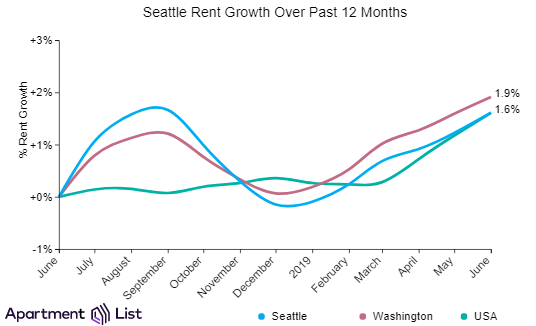
Seattle rents have increased 0.4% during June, and are up slightly by 1.6% in comparison to the same time last year, according to the most recent monthly report from Apartment List.

Currently, median rents in Seattle stand at $1,340 for a one-bedroom apartment and $1,670 for a two-bedroom.

This is the sixth straight month that the city has seen rent increases after a decline in December of last year.

Seattle’s year-over-year rent growth lags the state average of 1.9%, but is in line with the national average of 1.6%.

Seattle Sees Six Straight Months Of Rent Increases

Rents rising across the Seattle Metro

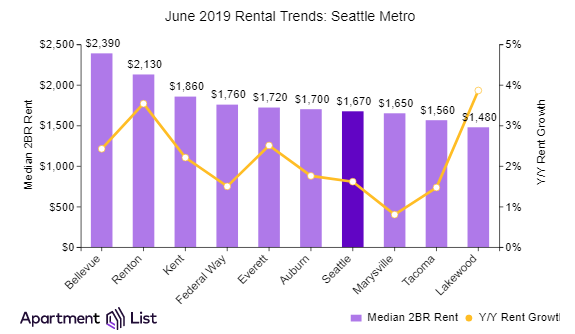
Throughout the past year, rent increases have been occurring not just in the city of Seattle, but across the entire metro. Of the largest 10 cities that we have data for in the Seattle metro, all of them have seen prices rise. Here’s a look at how rents compare across some of the largest cities in the metro.

  • Lakewood has the least expensive rents in the Seattle metro, with a two-bedroom median of $1,480; the city has also experienced the fastest rent growth in the metro, with a year-over-year increase of 3.9%.
  • Bellevue has the most expensive rents of the largest cities in the Seattle metro, with a two-bedroom median of $2,390; rents were up 0.6% over the past month and 2.4% over the past year.

Similar cities nationwide show more affordable rents compared to Seattle

As rents have increased slightly in Seattle, a few other large cities nationwide have also seen rents grow modestly. Compared to most similar cities across the country, Seattle is less affordable for renters.

  • Rents increased slightly in other cities across the state, with Washington as a whole logging rent growth of 1.9% over the past year. For example, rents have grown by 2.0% in Vancouver and 1.4% in Spokane.
  • Seattle’s median two-bedroom rent of $1,670 is above the national average of $1,190. Nationwide, rents have grown by 1.6% over the past year, which matches the rise in Seattle.
  • While Seattle’s rents rose slightly over the past year, many cities nationwide also saw increases, including Phoenix (+3.8%), Austin (+3.5%), and Boston (+2.5%).
  • Renters will generally find more expensive prices in Seattle than most other large cities. For example, Spokane has a median 2BR rent of $890, where Seattle is nearly twice that price.


Apartment Industry Jobs Continue Strong Growth in Second Quarter, NAA Report Says

Apartment Industry Jobs Continue Strong Growth in Second Quarter, NAA Report Says

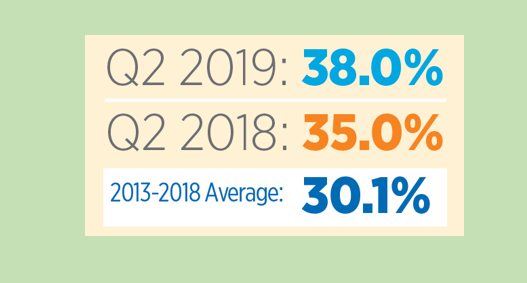
Apartment industry jobs continued strong growth in the second quarter, amounting to 38 percent of available real estate jobs in the United States, well above recent averages and an increase from 2018, according to the most recent jobs report from the National Apartment Association.

Job demand was partly due to the surge in demand for apartments during the second quarter of 2019, reaching a five-year high.

According to RealPage, net move-ins totaled 155,515 units, which outpaced the second quarter of 2018 by 11 percent, according to the NAAEI’s Apartment Jobs Snapshot.

Openings in the apartment sector comprised 38 percent of positions available in the real estate sector, well above the average of 30.1 percent.

Los Angeles, Dallas and Washington, D.C. had the highest concentration of apartment jobs during the second quarter of 2019, unchanged from last year.

Dallas performed well, leading the United States in apartment-leasing activity during the second quarter by renting more than 10,400 units, RealPage reported.

Apartment Industry Jobs Continue Strong Growth in Second Quarter, NAA Report Says

Apartment industry jobs in maintenance show strong demand

Apartment Industry Jobs Continue Strong Growth in Second Quarter, NAA Report Says

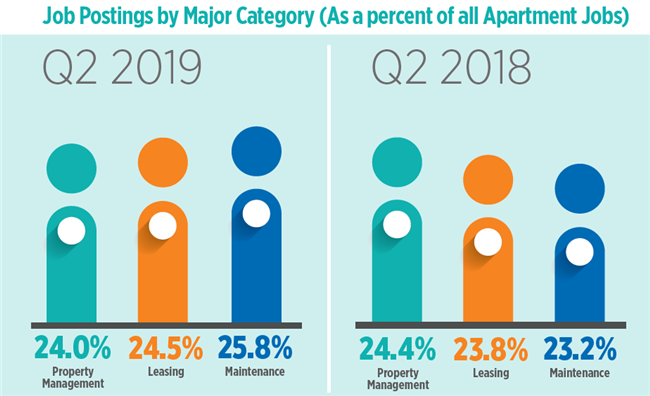
Available maintenance positions had a significant year-over-year increase, up by 2.6 percent.

Positions in maintenance were in greatest demand during the second quarter.

Maintenance technicians and maintenance supervisors landed within the top 5 job titles, comprising more than 7,500 postings combined.

Maintenance-technician and maintenance-supervisor positions experienced the highest growth in demand since 2014, increasing their share of apartment jobs by 3.5 and 1.2 percentage points, respectively.

Software skills needed

Apartment Industry Jobs Continue Strong Growth in Second Quarter, NAA Report Says

Since 2014, positions requiring skills in Yardi Software, team collaboration, and time management have notably increased.

Yardi software skills were up 7.2 percentage points. Positions requiring strong team collaboration and time management increased significantly since 2014.

National apartment association jobs report background

 The NAA jobs report focuses on jobs that are being advertised in the apartment industry as being available, according to Paula Munger, Director, Industry Research and Analysis, for the National Apartment Association’s Education Institute.

“Our education institute is a credentialing body for the apartment industry. They hear often that one of the biggest problems keeping our industry leaders up at night is the difficulty in finding talent, attracting talent and retaining talent,” Munger said.  “Labor-market issues are happening in a lot of industries, certainly with the tight labor market we have.”

NAA partnered with Burning Glass Technologies. “They have a labor-job posting database that is proprietary,” she said, and they can “layer on data from the Bureau of Labor Statistics (BLS). We looked at that and thought we could do something that is really going to help the industry and help benchmark job titles and trends as we go forward,” Munger said.

Last month’s report:

Portland has Highest Number of Apartment Job Openings in the Country