Home Blog Page 163

Triple Net Properties and Delaware Statutory Trusts

Kay Properties and 1031 and 1033 exchanges and eminent domain options details

Sponsored Article

By Sebastian Moya
Associate- Kay Properties and Investments, LLC

 The Great Recession probably resulted in a seismic shift in many real estate investor’s risk profiles. In 2007, the primary investment strategy was aimed at residential properties with large amounts of market speculation. These properties were largely financed with debt and when the market collapsed, well we all know the story. In 2019 we are experiencing a 1) very peaky market with 2) compressed cap rates on residential properties 3) throughout secondary markets that are assigned values relative to 4) large growth in that market. This all sounds a little too familiar. There is no need to be Chicken Little in this market as the imminent correction (and it is imminent) will probably not strike investors as starkly as it did in 2008. Multi- family and single-family homes can be worthwhile investments with the right placement of capital. However, there are lessons to be learned about other investment strategies that were pervasive in the years following the recent economic downturn.

Many investors that held onto their real estate or invested in the price-trough from 2008 until now are considering what to do with their properties considering the price peak we are currently experiencing. It is an excellent time to sell, but with cap rate compression across the board it is a difficult time to find the right placement of capital. Investors that are looking for lucrative IRRs may go towards the residential route, which is fair but potentially risky. Other investors that want to weather the ensuing market slowdown have looked towards a less speculative route. Triple Net properties have skyrocketed in the last ten years as a result of this investor desire

Triple Net Property

A piece of property that is usually being leased by a single tenant (i.e., single-tenant net-leased or STNL). The building on that property is typically built to their needs and business model. The tenant typically has contractual obligations in their lease to make monthly rent payments to the property owner over the life of the lease. Higher quality tenants would usually be of a high credit grade, large in scale, and/or is financially robust in a way that will assure they pay their rent consistently.

Why would a company do this?

In an effort for companies to reduce the amount of liabilities on their balance sheet, they choose not to purchase the real estate on which they conduct business. Instead, the companies decide to rent it from real investors who own said properties.

What does Triple Net lease mean?

“Net” helps describes the responsibilities attributed to either the tenant or the landlord. A “single Net” lease hands over more costs and responsibilities to the landlord in exchange for higher rent. The rent may be higher in a Single Net, but the costs vary much more and affect cash flow.
“Triple Net” is a type of lease structure wherein little to no responsibilities are given to the landlord and the variable costs of the property (taxes, insurance, maintenance, etc.) are handled by the tenant.

Triple Net properties have emerged as a pervasive investment strategy over the last decade for many reasons.

Consistent Cash Flow

The lease structure described for NNN properties should allow for dependable cash flow that passes through to investors on a monthly basis. These cash distributions are effective income, and yours to keep. There are little to no costs that bite into your bottom line. This is ideal for the retirement or passive income profile investor.

Triplet Net Lease Guarantees

More often than not, the tenant will guarantee payment of rent throughout an established period of time. A typical rent period exists between seven and fifteen years. In shorter leases, tenants will incentivize investors with “rent bumps” that could increase their net operating income by 1- 2% each year. If a tenant vacates the building, or “goes dark,” they would be liable to pay the remaining term. The tenants are varying degrees of credit quality as ranked by the large ratings agencies or backed by large franchisees. This is not a total guarantee, however. Any business can go bankrupt or fail to meet its obligations for any number of reasons. It is important to understand your tenants’ profile and backing before entering into a contract with them. Triple Net Properties provide the opportunity to invest money into real estate and benefit from potential appreciation on property, while playing it relatively safe with a consistent cash flow from their asset. But at the end of the day, this is still real estate we are talking about. There are
many risks and obstacles and investor should we weary about.

Inflation Risk

Triple Net lease buildings can act as a sort of “one-trick pony.” You know what you are getting for how long and how much, but your property could end up being stagnant in cash flow or relative value. The longer the lease that is negotiated with a tenant, the less they are willing to pay. This means the likelihood of “rent bumps” goes down or does not exist. You are effectively trading a longer “guaranteed” income for less cash to your bottom line. If inflation increase on average one percent a year, then without significant cash flow escalations you may be losing money on your cash investment. This is why it is important to analyze a lease structure when you are looking for a tenant and negotiate rents and lease terms appropriately.

Tenant Risk

Although a tenant may be guaranteed on the triplet net lease, there is always the possibility that they default on their payments or go dark. If they default on their payments this is really the worst case scenario. Your cash flow stops completely, and the value of your building potentially decreases immensely. With Triple Net leases, the value is inherently tied to the tenant filling the property and paying rent. The cash flow is what would entice potential investors to buy the property from you. Even if the building goes dark and cash flows are rolling in, there is no exit strategy when the lease terminates. Again, the building’s value is inherently tied to the tenant that provides cash flow to it.

Re-Tenant Risk

The leases on these properties are structured for extensions, or “options.” This means tenants can exercise a clause in the lease that would add more time to their rental period. However, this usually involves a lot of negotiation with a large company that has many units across the country. Since your property value is tied to the tenant, and the tenant knows this all too well, they will try to strong arm you into paying tenant improvements or adjusting the lease to their benefit. If you don’t play ball, there is a chance they will relocate or simply vacate upon termination of the lease. In reality, a lot of these large companies don’t care to negotiate at all and may move before the lease is up. Then it is potentially the job of the investor to commit capital towards finding a new tenant through brokerage, advertising, attorney fees when negotiating the lease, and other costs.

Operations

Although this property is a relatively cost-free venture, you are still in charge of managing the property. If there is a power outage, you are in charge of finding a solution. If it hails, you may have to repair the roof. The tenant might reimburse you for the costs, but ultimately it is the investor’s obligation to take care of the building. Those looking for a completely hands-off investment may be turned off by this.

Investment Risk

The ultimate risk in investing in Triple Net lease properties is that you are investing in a venture that costs hundreds of thousands of dollars, if not millions, into one investment. As any person that has remote financial knowledge will tell you, diversification is key when investing. Putting all your eggs in one basket is scary It is a large risk in any real estate venture, but with triple-net properties it is nonetheless a substantial factor to recognize. So, there are many ways to look at triple net properties. The benefits are unique to most real estate assets. The risks are also diverse and require astute attention when considering them as an investment opportunity. It seems that the risks can outweigh the benefits in many ways. How would someone who is looking to exercise passive investments mitigate the risks mentioned above. Let’s talk about Delaware Statutory Trusts. The tools that a Delaware Statutory Trust can give you to smooth out some of the obstacles you would encounter when investing in triple net properties while emphasizing the positive points.

Delaware Statutory Trust (DST)

DSTs are a financial structure that allows for investors who are looking to invest in real estate to diversify their opportunities into different properties. It is a shared ownership structure wherein an investor puts in a piece of capital for a property instead of the entire backing. DSTs are passive investments, which means that all management responsibilities are removed from investors and income is passed through. This is meant to be a refresher on DSTs and if you are interested in learning more we recommend you visit our website www.kpi1031.com or speak to one of our representatives. In a DST structure, your eggs are not all in one basket. Chunks of capital can be distributed to different assets. Amongst the types of properties that can utilized in this structure are triple net properties. There are several advantages to investing in triple nets through DSTs that help absorb some of the risks you may encounter when investing in one on your own.

Sponsor Companies – an important concept to understand when it comes to DSTs are their sponsor companies. Sponsor companies are the entities that underwrite, acquire, and manage properties for investors. These large entities manage billions of dollars in real estate and have years of experience under their belt that help investors make educated DST investments. They are a huge advantage when it comes to investing as will be demonstrated.

Negotiation

One of the primary ways to mitigate risks when investing in triple net lease properties is the way in which the lease between the tenant and the investor is negotiated. In a situation wherein an investor is investing in a property on their own or perhaps in a small group of investors (such as an LLC, LP), negotiating a lease will be difficult. Large tenants that are creditworthy and therefore increase the value of a potential property also have more negotiating leverage. These large companies negotiate leases all the time in ways that may affect rent bumps, which means an investor could be exposed to inflation risks. The tenant improvements they require in order to stay, or their capacity to leave overnight are also pieces of a lease that can be negotiated and need to be considered. DST properties are managed and negotiated by sponsor companies that have years of experience and immense deal flow that allows them to get more at the negotiating table than the average investor could.

Operations

In a DST structure, investors will experience a more realized passive investment. Instead of worrying about management of the property or fretting about tenant demands, sponsor companies take care of all operations and management concerns. Investors are given monthly or quarterly updates about any changes to the properties, but there are no hands-on requirements asked of anyone participating in a DST. Diversification Of the benefits offered by DSTs, arguably the most helpful is the diversification that they can provide. When you are investing into DSTs, it is possible to split a chunk of capital into pieces and distribute said capital amongst several properties. For example, you can invest one hundred thousand in a FedEx property in Seattle, and three hundred thousand in a triple net Walgreens in Phoenix. The point is that you are not placing all of your capital into one place. If your property in Seattle “goes dark,” for some reason, you are not at a total loss because you still have your investment in Phoenix. Hedging your investment and receiving a blended return on those investments protects you from more risks. This is especially useful in triple net properties where tenants can be finicky. Protecting yourself from risk is something rarely afforded in the world of real estate.

Through DSTs, the benefits of triple net properties are realized while spreading the risks out through negotiation, operation, and diversification advantages. At the end of the day, we are talking about real estate. Any property can have a bad run or sail smoothly throughout an ownership period. Anyone interested in DSTS should consult their CPA or attorney about their specific situation. DSTs are not for everyone, but they can provide an alternative way to invest in triple net properties if that is your interest.

Related story:

A Client’s First Experience with DSTs

Kay Properties and Investments, LLC is a national Delaware Statutory Trust (DST) investment firm with offices in Los Angeles, San Diego, San Francisco, Seattle, New York City and Washington DC. Kay Properties team members collectively have over 114 years of real estate experience, are licensed in all 50 states, and have participated in over $7 Billion of DST real estate. Our clients have the ability to participate in private, exclusively available, DST properties as well as those presented to the wider DST marketplace; with the exception of those that fail our due-diligence process. To learn more about Kay Properties please visit: www.kpi1031.com

This material does not constitute an offer to sell nor a solicitation of an offer to buy any security. Such offers can be made only by the confidential Private Placement Memorandum (the “Memorandum”). Please read the entire Memorandum paying special attention to the risk section prior investing. This email contains information that has been obtained from sources believed to be reliable. However, Kay Properties and Investments, LLC, WealthForge Securities, LLC and their representatives do not guarantee the accuracy and validity of the information herein. Investors should perform their own investigations before considering any investment. IRC Section 1031, IRC Section 1033 and IRC Section 721 are complex tax codes therefore you should consult your tax or legal professional for details regarding your situation. This material is not intended as tax or legal advice.

There are material risks associated with investing in real estate, Delaware Statutory Trust (DST) properties and real estate securities including illiquidity, tenant vacancies, general market conditions and competition, lack of operating history, interest rate risks, the risk of new supply coming to market and softening rental rates, general risks of owning/operating commercial and multifamily properties, short term leases associated with multi-family properties, financing risks, potential adverse tax consequences, general economic risks, development risks and long hold periods. There is a risk of loss of the entire investment principal. Past performance is not a guarantee of future results. Potential cash flow, potential returns and potential appreciation are not guaranteed. For an investor to qualify for any type of investment, there are both financial requirements and suitability requirements that must match specific objectives, goals and risk tolerances.

Securities offered through WealthForge Securities, LLC. Member FINRA/SIPC. Kay Properties and Investments, LLC and WealthForge Securities, LLC are separate entities

 

What Safeguards Do You Tie To Your Lease Offers?

There are reasons why you do not want to move in everyone who applies, obviously, but what safeguards are you putting in place with your lease offers? Read what an expert with 25+ years in marketing communications experience with Fortune 500 and entrepreneurial companies has to say about this topic.

By Ellen Calmas

It’s pretty obvious that occupancy drives revenue, and leasing (among other things) drives occupancy.

What’s less obvious is that there are times it makes more sense to let a prospective lease walk away.

Property owners and managers spend millions of dollars annually screening prospective residents to gain better insights into their ability to afford, retain and adhere to the specifications of a lease.

Screening results in a rejection, an acceptance without conditions, a conditional lease offer, or a lease offer with mandatory requirements. The conditional and mandatory categories typically include safeguards for timely rent delivery and/or protection against future inability or unwillingness to pay rent on time.

Herein lies the rub in that the prospective resident who agrees to extra conditions upfront – no matter how relatively easy or onerous – is typically the resident who wants to perform reliably. Yet sometimes things work out and other times they don’t. That’s why safeguards are tied to lease offers in the first place – to protect the property company.

So what’s the implication when a prospective resident declines a conditional or mandatory lease offer?

Lease offers and what options you have as a landlord

A few options come to mind:

    • The prospect can’t afford what’s being asked
    • The prospect doesn’t want to move in with the lease offer terms
    • The prospect doesn’t want pay rent on time

Pick any one of the above and you’re better off letting that prospect walk away. Yet with upwards of 35-45 percent of all lease acceptances falling into a conditional or mandatory category, it makes sense to have alternatives built into your lease offers to help protect a community’s bottom line that also contribute to increased leasing velocity.

NPS Rent Assurance does just that as an alternative to a higher security deposit that enables prospective residents to better afford move in costs while demonstrating their commitment to deliver rent reliably throughout the life of a lease.

Residents who enroll in our rent budgeting program linking rent to payroll tend to stay in their apartment homes over 550 days, or twice the industry average, so things work by design. On the flip side, the prospect who walks away from a lease offer that includes rent budgeting flunks a secondary, less obvious layer of screening that illustrates either their financial insecurity or their future intention to fall down on their lease.

Stated differently: prospects typically enroll in our program unless they really don’t want to put structure in place to assure their rent will be paid on time – and that’s not a resident you want to move in.  Period, full stop.

For more information on NPS Rent Assurance, you can download their recent white paper at https://www.npsrentassurance.com/nps-position-papers

About the Author: 

Lease options for landlords

Ellen Calmas is co-founder and executive vice president of Neighborhood Pay Services, LLC / NPS Rent Assurance and brings 25+ years marketing communications experience with Fortune 500 and entrepreneurial companies to her role in strategic planning and marketing and sales support. She is also responsible for brand positioning, outbound marketing and digital networking as well as coordination of partner programs. Ellen has held senior management positions for marketing communications firms serving such clients as GlaxoWellcome, Bausch & Lomb, Avon Products, Heinz USA, AT&T, The House of Seagram, among others. She actively supports numerous health, civic and arts organizations throughout the Boston area and currently holds board positions for Silent Spring Institute, a leading research and advocacy group dedicated to identifying links between women’s health and the environment. She received her B.S. from the Roy H. Park School of Communications at Ithaca College. She can be reached at 617.209.3048 ext 104.

Why Property Managers Are Skeptical When Tenants Decline Lease Offers

Salt Lake City Rents Declined Over The Past Month

Salt Lake City Rents Declined Over The Past Month

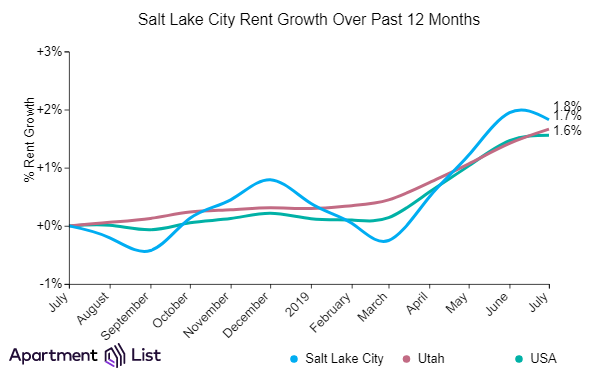
Salt Lake City rents have remained flat over the past month, however, they are up slightly by 1.8% year-over-year, according to the August report from Apartment List.

Currently, median rent stands at $875 for a one-bedroom apartment and $1,085 for a two-bedroom.

Salt Lake City’s year-over-year rent growth leads the state average of 1.7%, as well as the national average of 1.6%.

Ogden rents increased significantly over the past month

Salt Lake City Rents Declined Over The Past Month and Ogden rents increased

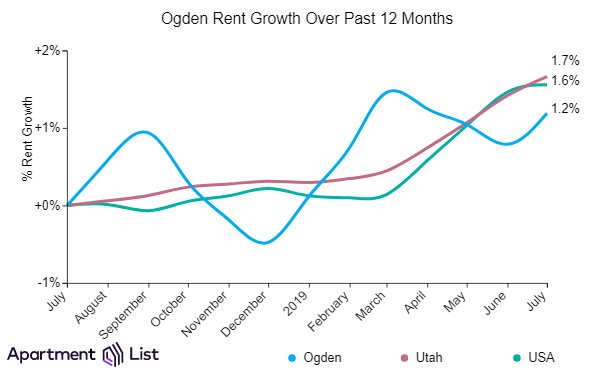
Ogden rents have increased 0.4% over the past month, and are up slightly by 1.2% in comparison to the same time last year.

Currently, median rents in Ogden stand at $695 for a one-bedroom apartment and $891 for a two-bedroom. Ogden’s year-over-year rent growth lags the state average of 1.7%, as well as the national average of 1.6%.

Salt Lake City rents more affordable than many large cities nationwide

Salt Lake City Rents Declined Over The Past Month

As rents have increased slightly in Salt Lake City, a few large cities nationwide have also seen moderate rent growth. Salt Lake City is still more affordable than most large cities across the country.

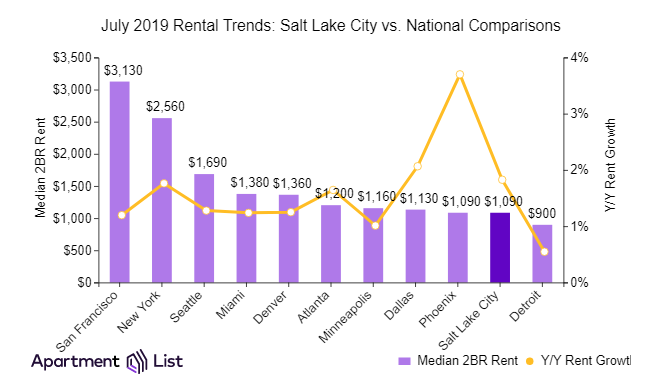
  • Salt Lake City’s median two-bedroom rent of $1,085 is below the national average of $1,191. Nationwide, rents have grown by 1.6% over the past year compared to the 1.8% rise in Salt Lake City.
  • While Salt Lake rents rose slightly over the past year, many cities nationwide also saw increases, including Phoenix (+3.7%), Dallas (+2.1%), and New York (+1.8%).
  • Renters will find more reasonable prices in Salt Lake City than most large cities. For example, San Francisco has a median 2BR rent of $3,126, which is more than two-and-a-half times the price in Salt Lake City.

Previous story: Rents Increase Sharply Over The Past Month

How Has Approved Housing Construction Kept Pace with Job Growth In The West?

How Has Approved Housing Construction Kept Pace with Job Growth In The West?

A new report shows that approved housing construction and development nationally remains 38 percent below its pre-recession peak, according to Apartment List. Stagnant single-family home construction and a select group of coastal markets are to blame. Meanwhile multifamily apartment buildings are increasing in size.

Smaller metros and booming multifamily construction, on the other hand, are picking up the slack.

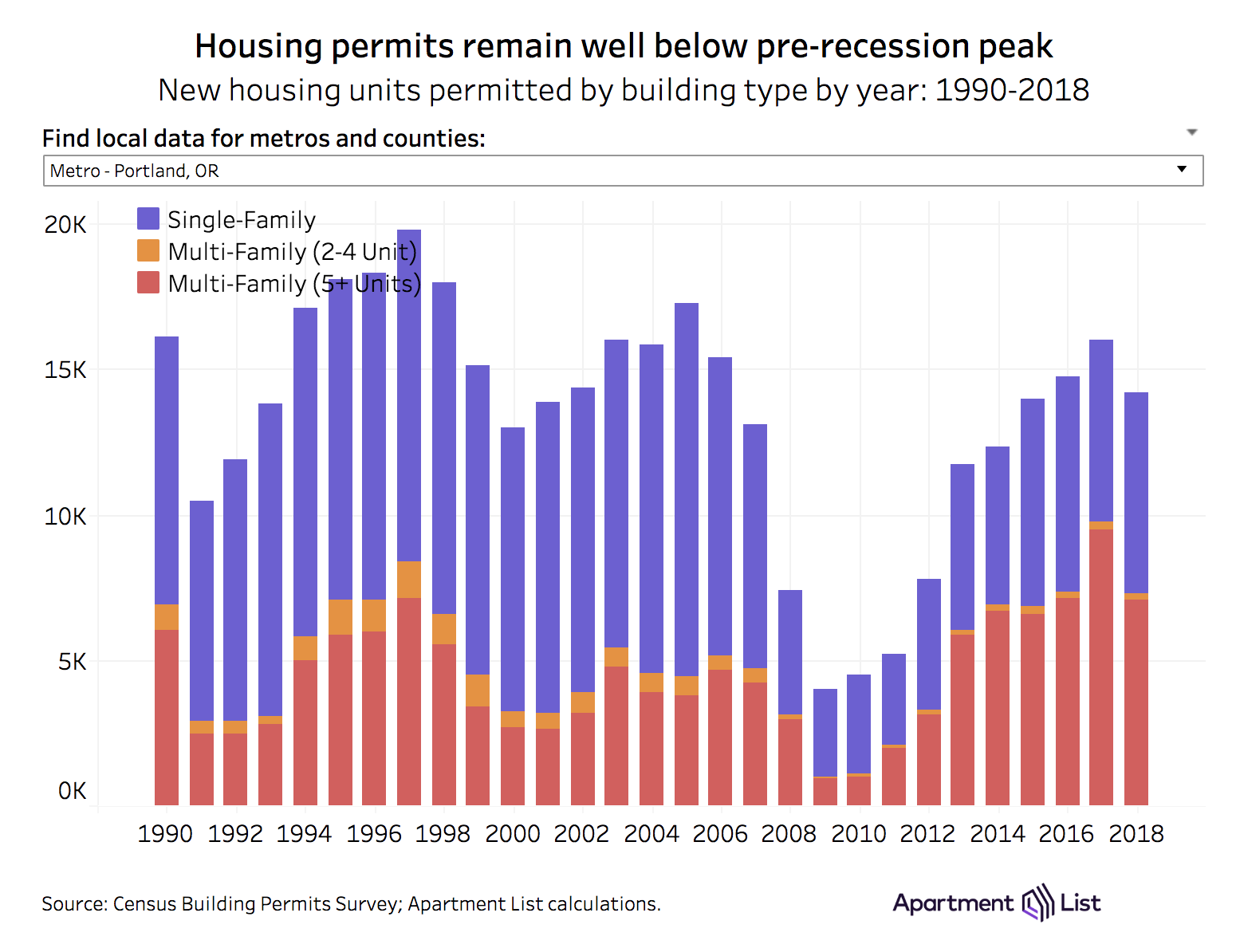
Portland housing construction analysis

  • An average of 4.4 new housing units per 1,000 residents were permitted in Portland from 2008 to 2018. The rate of permitting activity ranks #12 among the nation’s 50 largest metros.
  • Over the same period, Portland added 6.7 jobs per 1,000 residents, ranking #13. This implies that 1.5 jobs were added for every new housing unit in the metro, a level which indicates a balance between supply and demand for new housing.
  • Since 2006, multifamily units have accounted for 46% of housing permits in Portland, compared to 32% in the pre-recession period from 1990-2005. Nationally, the multi-family permit share increased from 23.4% in the pre-recession period to 33.9% in more recent years.

How Has Approved Housing Construction Kept Pace with Job Growth In The West?

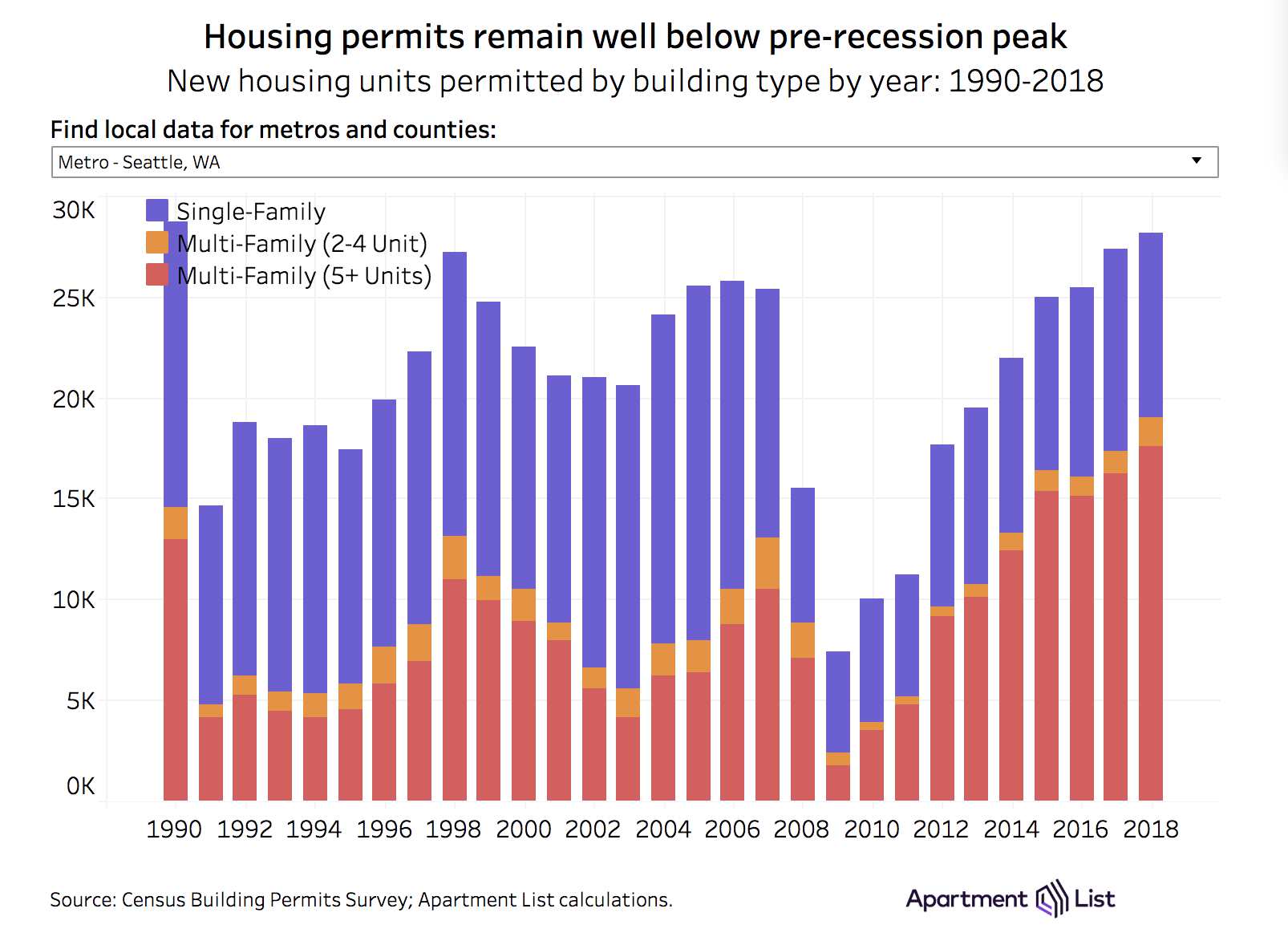
Seattle housing construction analysis

  • An average of 5.2 new housing units per 1,000 residents were permitted in Seattle from 2008 to 2018. The rate of permitting activity ranks #9 among the nation’s 50 largest metros.
  • Over the same period, Seattle added 7.4 jobs per 1,000 residents, ranking #12. This implies that 1.4 jobs were added for every new housing unit in the metro, a level which indicates a balance between supply and demand for new housing.
  • Since 2006, multifamily units have accounted for 56% of housing permits in Seattle, compared to 38% in the pre-recession period from 1990-2005. Nationally, the multi-family permit share increased from 23.4% in the pre-recession period to 33.9% in more recent years.

How Has Approved Housing Construction Kept Pace with Job Growth In The West?

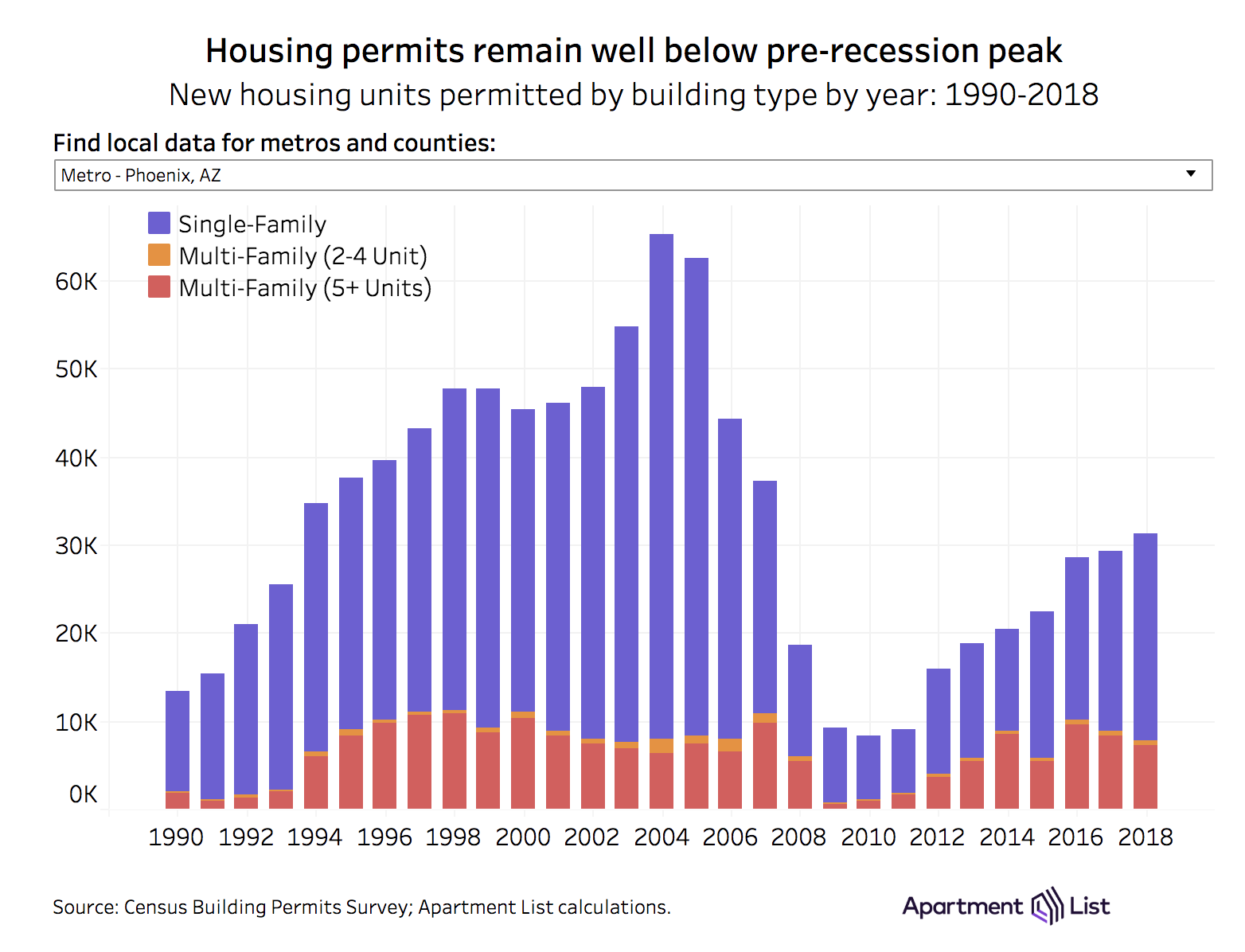
Phoenix housing construction analysis

  • An average of 4.2 new housing units per 1,000 residents was permitted in Phoenix from 2008 to 2018. The rate of permitting activity ranks #14 among the nation’s 50 largest metros.
  • Over the same period, Phoenix added 5.1 jobs per 1,000 residents, ranking #21. This implies that 1.2 jobs were added for every new housing unit in the metro, a level that indicates a balance between supply and demand for new housing.
  • Since 2006, multifamily units have accounted for 27 percent of housing permits in Phoenix, compared to 18 percent in the pre-recession period from 1990-2005. Nationally, the multifamily permit share increased from 23.4 percent in the pre-recession period to 33.9 percent in more recent years.

How Has Approved Housing Construction Kept Pace with Job Growth In The West?

Single-family construction lags while multifamily has rebounded

Apartment List economist Chris Salviati writes in the report that housing affordability has emerged as a key issue in national politics, as millions of American households struggle with their housing costs. That said, housing and labor markets are inherently local, and distinct trends are playing out in different regions of the county.

In many of the nation’s largest coastal metros, acute housing shortages have led to rapid increases in housing costs. However, many smaller metros are actually adding more than enough new housing to keep pace with job growth, indicating that affordability issues in these regions may be driven more by a lack of well-paid jobs than by a shortage of housing.

“In order to better understand these issues, we analyzed data from the Census and Bureau of Labor Statistics to better understand how much new housing is being built and where. We study how that new housing supply lines up with job growth for counties and metro areas across the U.S., and discuss how these findings fit within the broader conversation around housing affordability across America,” Salviati writes in the report here.

In the recovery years that followed, multi-family housing construction rebounded fairly quickly, driven by a trend toward urbanization that increased demand for housing in and around city centers. The number of multi-family units permitted surpassed its pre-recession peak in 2015 and has since maintained that pace.

Meanwhile, construction of single-family homes has recovered much more slowly — the number of single-family housing units permitted in 2018 was barely half the number permitted in 2005. Consequently, multifamily units have made up a much greater share of new housing in the post-recession period. From 1990 to 2005, multi-family units made up 23.4 percent of all residential building permits issued, while from 2006 to 2018, that share increased to 33.9 percent.

Despite the boom in apartment construction, multi-family housing has not been able to fully compensate for the lack of new single-family construction. The total number of residential housing units permitted in 2018 was roughly the same as the number permitted in 1994, when the country’s population was 20 percent less than it is today. While multi-family housing may be better suited to meet the demand for walkable, transit-oriented neighborhoods, local zoning codes severely limit the locations where multi-family housing can be built. Consequently, the slowdown in single-family construction has contributed to a tightening of starter home inventory, which may be preventing some prospective millennial homebuyers from purchasing homes.

Multifamily share increasing fastest in the places where it was already high

The increase in the share of residential building permits comprised of multifamily units is a trend that holds true not just at the national level, but in each of the nation’s 25 largest metro areas.

While the multifamily category made up a greater share of new housing in all of the 25 largest metros, the size of the increase varies dramatically. The biggest jumps in the multifamily share have occurred in the nation’s densest metros, places that had already been building a significant amount of multifamily. The New York City metro experienced the biggest jump. In the pre-recession years from 1990 to 2005, multi-family comprised 44.8 percent of all building permits issued in the New York City metro — then the second-highest share among the 25 largest metros. In the mostly post-recession years from 2006 to 2018, that share spiked to 76.3.

“We see similarly large increases in other dense coastal metros, with Boston, San Francisco, Philadelphia, and San Diego rounding out the top five list for metros with the largest increases in the multifamily permit share. Notably, Philadelphia is the only metro among those five that has built enough new housing over the past decade to keep pace with job growth, according to our jobs-per-permit metric, and as a result has seen relative stability in their housing market,” Salviati writes in the report.

Phoenix is one of the metros building sufficient new housing to keep pace with jobs

There is a subset of metro areas that are thriving economically and building sufficient new housing to keep pace with job growth.

This group is primarily comprised of Sun Belt metros such as Phoenix, Dallas, Atlanta, and Charlotte. Notably, single-family is still the dominant type of new housing being built in these metros, and while the multifamily share is on the rise in these regions, the increases are much more muted than those observed in the dense coastal metros discussed above.

In Phoenix, for example, single-family accounted for nearly three-in-four new housing units permitted from 2006 to 2018. It seems that the metros most effectively meeting the demand for new housing are still primarily doing so by continuing to sprawl, despite an increasing demand for dense, walkable neighborhoods that prioritize sustainability.

In new multifamily construction, the ‘missing middle’ is still missing

These disparate patterns of residential development are playing out at a time when single-family housing has begun to face unprecedented criticism from both housing experts and policy makers. For the latter half of the 20th century, suburban single-family homes were synonymous with the popular understanding of the “American Dream.”

In recent years, however, a more nuanced view has emerged, which acknowledges that single-family zoning policies were often inextricably linked to redlining practices that served to explicitly enforce patterns of residential racial segregation. Single-family zoning also impedes the development of dense multifamily housing units, which can be an important source of market-rate affordable housing. Furthermore, denser cities are significantly more sustainable, and growing our cities with more dense development can play an important role in combating climate change.

Consequently, policy makers across the country are making efforts to enable multifamily development in areas that were previously reserved for single-family homes.

In 2018, an ambitious set of zoning reforms known as Minneapolis 2040 upzoned half of that city’s land in a way that aims to explicitly address patterns of racial and economic inequality. The city of Seattle also recently eliminated single-family zoning in a subset of its neighborhoods, and a statewide upzoning bill in Oregon has passed. In California, where the housing shortage is most acute, the upzoning bill SB 50 is currently stalled in the state senate, awaiting a vote next year.

Many of the zoning reforms described above strive to remove barriers to building a type of housing that has been referred to as the “missing middle.”

This type of housing — two- to four-unit buildings, accessory dwelling units, townhouses, and low-rise apartment buildings — can play an important role in increasing density and creating walkable neighborhoods, without affecting neighborhood character is the same way as mid- and high-rise apartment buildings. Despite the benefits of this type of housing, the multifamily housing that has been built in recent years increasingly takes the form of large apartment complexes.

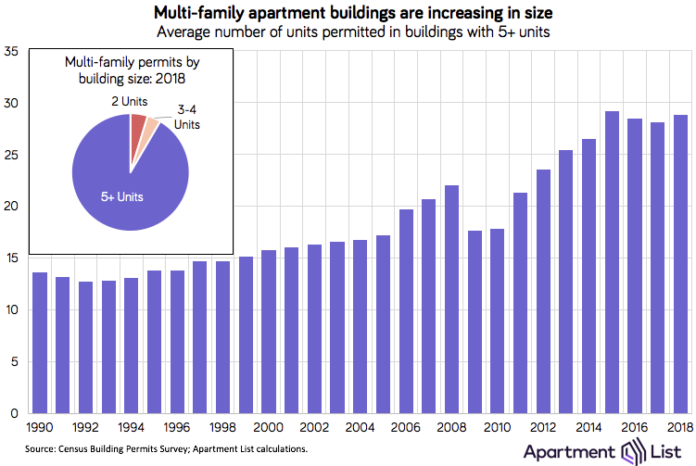
Multifamily apartment buildings are increasing in size

We find that two- to four-unit properties made up just 3.0 percent of all housing units permitted in 2018. That share has been on a downward trajectory since 1990, when duplexes, triplexes, and fourplexes comprised 4.9 percent of residential permits. Two- to four-unit properties account for 8.0 percent of the nation’s total housing stock, indicating that this type of construction was far more prevalent in the past. Meanwhile, buildings with five or more units accounted for 91.6 percent of multifamily units permitted in 2018, and the average size of these properties has been steadily increasing. In 1990, the average number of units in buildings with five or more units was 13.6, but by 2018 that average building size more than doubled to 28.7, the report says.

While these large multifamily developments are an important form of new housing supply, they are usually confined to locations in and around the downtown areas of major cities.

Due to high construction costs — for land, labor, materials, and regulatory costs — developers build larger properties at luxury price points in order to achieve economies of scale and ensure that projects prove profitable. Zoning reform can remove bureaucratic hurdles to allow denser development in varying forms throughout a metro area.

Conclusion

“As millions of Americans struggle with housing costs, the issue has come to take center stage in both national and local politics. A number of 2020 Democratic frontrunners have issued policy platforms that address housing affordability, while cities and states across the country have begun to debate and enact fundamental reforms to their zoning codes,” Salviati writes.

“Much of this debate has centered on the need for dense, transit-oriented development in our nation’s cities. Dense housing plays an important role in maintaining inclusive housing affordability and cities developed in this manner are also significantly more environmentally sustainable.

“While we find that proportionally more multifamily housing has been built in recent years, the metros where it is most prevalent tend to be the coastal superstar cities that have struggled to build enough new housing overall.

“Meanwhile, fast-growing Sun Belt metros have continued to rely on single-family homes to maintain sufficient housing supply. These contrasting trends emphasize that decisions around what type of housing gets built and where are crucial to determining the future of America’s cities,” Salviati says in the report.

Read the full report here.

About the author:

Chris Salviati is a housing economist at Apartment List, where he conducts research on economic trends in the housing market. Chris previously worked as a research assistant at the Federal Reserve and an economic consultant, and he has BA and MA degrees in economics from Boston University.


Apartment Mystery Maintenance Call Of The Week: Why Is Only Hot Water Coming Out of the Kitchen Faucet?

Mystery Maintenance Call Of The Week: Why Is Only Hot Water Coming Out of the Kitchen Faucet?

The mystery maintenance call of the week and the job came from Seattle this week.

The maintenance call was for a kitchen sink in the greater Seattle area in which the water would only come out scalding hot.

When the issue was reported, the property manager said, “When you turn all the way to cold you only get a trickle of cold water. You can’t even get warm water, it’s always super-hot.”

The issue had been going on for a few months.

When the Keepe worker came out, they were able to solve the mystery.

The faucet valve was malfunctioning and killing the pressure on cold side, stopping the flow of cold water and only letting the hot water through.

After the source of the issue was found, the faucet was replaced and is now working great!

Keepe is an on-demand maintenance solution for property managers and independent landlords and provides our weekly mystery  call.

Read other apartment mystery maintenance call of the week stories here.

Rental Applicant Credit Risk Declines For Fifth Straight Year

Credit Bureau Report Reveals Pandemic’s Impact on Rental Industry

The rental applicant credit risk has declined for the fifth straight year which “indicates a decline in tenant risk, which could suggest the rental market will see an uptick in profitable lease activity,” according to a new report from CoreLogic.

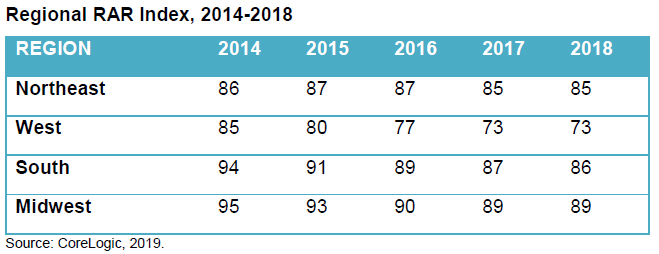
The 2019 Rental Applicant Risk (RAR) Report found the credit quality of prospective property renters in the U.S. improved over the past five years across the Northeast, West, South and Midwest regions.

The annual report provides a benchmark of national and regional applicant traffic credit quality scores and indicates the relative risk of an applicant pool fulfilling lease obligations.

“It’s encouraging to see an increase in qualified rental applicants over the previous five years, which could indicate continued improvement of economic health,” Dr. Ralph McLaughlin, deputy chief economist for CoreLogic, said in a release about the report.

“Rents have since rebounded from the Great Recession and are now growing at the same pace as house prices.

“However, it’s important to note that these rising rents might be causing Middle Rent applicants to apply for Low Rent properties, which can indicate that a subset of the population now is becoming priced out of the traditional rental market,” McLaughlin said in the release.

Rental Applicant Credit Risk Declines For Fifth Straight Year

Key points from the rental applicant credit risk report

  • From 2017 to 2018, the national rental application risk index declined two points to 83.
  • The report finds that credit quality of prospective renters in the Northeast, South, West and Midwest regions has improved over the past five years.
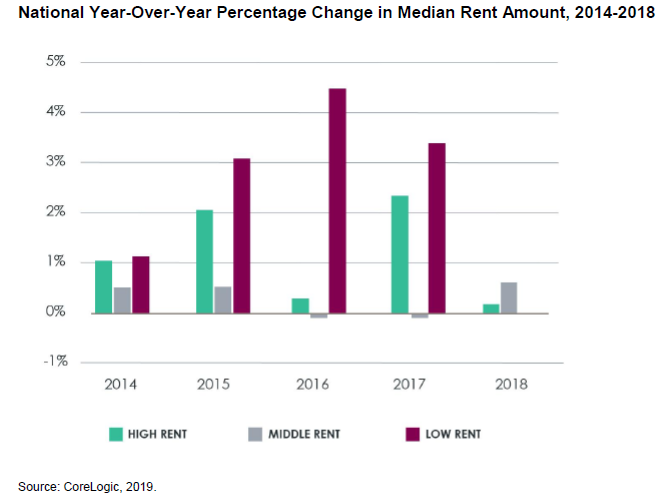
  • Renter income for low rent properties rose 4.7%, but remained flat for middle and high rent properties from 2017 to 2018.
  • The average rent price for low rent properties remained flat from 2017 to 2018 at $675, whereas it increased 0.7% for middle rent properties at $899 and 0.26% for high rent properties at $1,524.

The report says rent-to-income levels decreased for renters of the least expensive rentals, indicating more available capital for those applicants. Incomes rose 4.7% for applicants of Low Rent properties  (under $750 per month), while income of applicants of Middle Rent properties (between $750 to $1,100 per month) and High Rent properties (over $1,100 per month) remained flat from 2017 to 2018.

The West has a lower rental applicant credit risk

Rental Applicant Credit Risk Declines For Fifth Straight Year

 Regionally, the West is below average in rental applicant risk, while the Northeast, South and Midwest are above average compared to the U.S. index value of 83.

The West had the lowest index value at 73, indicating a higher potential for positive lease performance in the region. The Northeast is the second least risky region, with a value of 85. The South and Midwest regions show higher index scores and thus illustrate lower credit quality among prospective renters.

Methodology:

The Index is calculated exclusively from applicant-traffic credit quality scores from the CoreLogic SafeRent® statistical lease scoring model, Registry ScorePLUS®. Registry ScorePLUS® is the multifamily industry’s only screening model that is both empirically derived and statistically validated.

CoreLogic RAR Index Methodology The CoreLogic® Renter Applicant Risk (RAR) Report is published annually by CoreLogic. The RAR Index is calculated exclusively from applicant-traffic credit quality scores from the CoreLogic SafeRent® statistical lease scoring model, Registry ScorePLUS® , and is based on an analysis of 31,000 properties representing apartment homes and single-family rentals.

Rental Applicant Credit Risk Declines For Fifth Straight Year

Portland City Council Set to Assess Landlords $60 Per Unit Per Year

A proposed Utah bill would require rental fee disclosure before a prospective tenant sees an agreement and be disclosed in advertising

The Portland City Council is getting ready to vote to fund the new Rental Services Office by assessing landlords an annual fee of $60 per unit to pay for the services, according to reports.

The Rental Services Office will help with the new rent-control measure passed by the Oregon Legislature, as well as the tenant-relocation services and other new measures passed by the Portland City Council.

The Portland City Council is expected to take up the fee at a meeting on Wednesday.

The Portland Oregonian estimated the new per-unit fee would raise about $3.9 million its first year.

A central element of the office is the promise that it will establish and monitor an accurate census of rental units in Portland. Landlords are to register their units on yearly tax filings.

According to the proposed ordinance, “The Portland Housing Bureau and the Revenue Division recommend an initial annual residential-rental-unit registration fee rate of $60. Thereafter, the fee would be adjusted annually for inflation or deflation using the Consumer Price Index West.

“Regulated affordable housing at 60 percent of the area median income and below would be exempt from the fee but would still be required to register residential rental units. With the average market rate rent in Portland at $1,425 per month, the fee equates to approximately one-third of one percent of the average Portland rent collected annually,” the proposal states.

The Portland City Council says the new fee would be effective with the 2019 tax year.

Cannabis funds had been providing some revenue

The Rental Services Office is responsible for contracting out funding for fair housing and landlord tenant services, developing code and administrative rules associated with local landlord-tenant law, processing exemptions to local mandatory relocation assistance, and providing technical assistance and information (in person, via email, and over the phone) to renters and landlords on general landlord-tenant law, according to the ordinance.

The ordinance says 54 percent of current funding for the Rental Services Office in the current fiscal year is supported by onetime general or onetime cannabis funds.

The Rental Services Office funding would support multiple programs and services including:

  • Tenant Protections Team Program: The Community Alliance of Tenants (CAT) offers education and advocacy support to renters identified through their Renter’s Rights Hotline or referred by social service agencies, and facilitates fast-tracking to appropriate legal or health and human services. Partner agencies include Portland Defender, Self-Enhancement Inc., Asian Pacific American Network of Oregon, and Immigrant & Refugee Community Organization.
  • Fair Housing Enforcement Program: The Urban League facilitates a partnership with El Programa Hispano Católico, the Fair Housing Council of Oregon, and Legal Aid Services of Oregon to serve as cultural mediators between renters who believe they have been victims of housing discrimination and their assigned attorneys to assist them in navigating a smooth and supportive journey through the legal process.
  • Renter’s Rights Hotline and Tenant Education: The Community Alliance of Tenants (CAT) provides a Renter’s Rights Hotline, workshops, and other means of educating renters about their rights. CAT also assists protected classes in Portland with fair housing issues, and offers intensive one-on-one renter counseling, assistance with letter writing on tenancy matters, and referral/consulting with Legal Aid Services of Oregon and/or Fair Housing Council of Oregon.
  • Landlord-Tenant Legal Services: Legal Aid Services of Oregon provides intake, investigation, representation and referrals for fair-housing and landlord-tenant issues. This work is done in partnership with Native American Youth and Family Association, Self-Enhancement Inc., Urban League, Immigrant and Refugee Community Organization, and El Programa Hispano Cató
  • Fair Housing Testing: The Fair Housing Council of Oregon conducts audit testing for potential violations of the Fair Housing Act. Testing identifies differential treatment or practices occurring in the marketplace, laying the foundation for further action in the form of services, regulation, or enforcement to affirmatively further fair housing law.

Resources:

Portland Housing Bureau ordinance proposal

Portland City Council to vote on $60 per-unit landlord fee

Your City Hall: Council to vote on $60 fee for rentals

Portland City Council Approves Controversial Tenant Screening Ordinance 3-1

4 Ways To Avoid Tenant Screening Pitfalls With Applicants 

new landlord tenant laws and tenant screening

“I didn’t know” is not an acceptable defense if you face a discrimination charge, so the Grace Hill training tip of the week focuses on some of the tenant screening pitfalls to avoid with applicants for your rentals.

By Ellen Clark

Here are some tips for conducting applicant screening in a way that complies with fair housing law, and makes all people feel welcome in your community and helps you avoid the screening pitfalls.

No. 1 – Think before you speak

It is natural to make friendly conversation with prospects during the application process. This is fine but think carefully about questions you ask or comments you make.

For example asking, “Where is your accent from?” or saying, “You have such an interesting look!” may seem harmless, but could be viewed as discrimination, particularly if you end up rejecting the applicant for some reason.

No. 2 – Know and comply with your state laws and company policies

Applicant screening is an area in which it is particularly important to know and follow your state and local laws. Take the time to educate yourself. “I didn’t know” will not be an acceptable defense should you face a discrimination claim.

Your company should have clear policies and procedures for determining which applicants are accepted to live in your community. Follow these policies and procedures at all times, and apply them uniformly to all applicants.

Make sure all applicants understand selection criteria and related policies and procedures. This will help them see that you don’t choose residents arbitrarily; rather you have a standard process that you follow for all applicants.

No. 3 – Ask for a “government-issued photo ID” rather than a driver’s license specifically

Consult your company’s policies to determine which forms of photo identification are acceptable to verify identity during the application process.

However, be mindful that it is better to ask for a “government-issued photo identification” rather than to ask specifically for a driver’s license.

Not everyone has a driver’s license, and asking for one could be viewed as discriminatory.

No. 4 – Be consistent in all interactions to avoid screening pitfalls

Most importantly, be consistent in all of your interactions with applicants, and follow your company’s policies and procedures in the same way for all applicants.

If you make an exception to any policy or procedure, make sure you provide the same information and options to all applicants who are in the same situation.

Making a habit of treating applicants fairly and equally reduces your risk of discrimination claims and creates a welcoming atmosphere for all people who meet your qualifications and wish to live in your community.

 Summary:

Avoid discrimination within the screening process by carefully considering how you approach your application process.

Claims of discrimination often arise in relation to the applicant screening process. This can be a tricky area to navigate, and one where even well-intentioned people can find themselves on the wrong end of a discrimination claim.

Read Ellen’s full blog post here.

Resources:

Recent Grace Hill training tips you may have missed:

7 Ways To Stay Out Of Trouble When Checking Criminal History

5 Ways To Protect Applicants, Residents And Employees From Sexual Harassment

Do You Have A Smoke-Free Policy That Adequately Protects Residents?

How To Handle Suspicious Documentation For Assistance Animals

How A No Pet Policy Can Be Discriminatory

Property Management Cyberattack Risks Overlooked, Underestimated

Do You Know How To Respond To a Sexual Harassment Complaint?

Have You Reviewed Your Criminal Background Checks Policy Lately?

Multifamily Managers And Marijuana: Caught In A Pot Crossfire

Fair Housing Discrimination Against Someone You’ve Never Talked To?

About the author:

Ellen Clark is the Director of Assessment at Grace Hill.  Her work has spanned the entire learner lifecycle, from elementary school through professional education. She spent over 10 years working with K12 Inc.’s network of online charter schools – measuring learning, developing learning improvement plans using evidence-based strategies, and conducting learning studies. Later, at Kaplan Inc., she worked in the vocational education and job training divisions, improving online, blended and face-to-face training programs, and working directly with business leadership and trainers to improve learner outcomes and job performance. Ellen lives and works in Maryland, where she was born and raised.

About Grace Hill

For nearly two decades, Grace Hill has been developing best-in-class online training courseware and administration solely for the Property Management Industry, designed to help people, teams and companies improve performance and reduce risk.

Photo credit YakobchukOlena via istockphoto.com


More Tips on Fixing Tenants’ Clogged Drains

More Tips on Fixing Tenants’ Clogged Drains

Fixing tenants’ clogged drains was a really popular topic with our audience, so we are expanding it with a few more ideas. Many calls for clogged drains in tenant apartments have been pouring into Keepe lately.

Remember, drains can become blocked by an excessive amount of waste or grease that settles in the trap. The first time you have to deal with a clogged drain can be daunting, but it does not always have to be a mess and a hassle.

The best way to keep the drains clog-free is to do regular routine maintenance – either by the landlord or the tenant. It doesn’t take much time or money to perform this regular maintenance, and it can save you from the cost of a severely clogged drain.

Over the long term, clogging can be caused by biofilm or fungal growth in piping, the settling of particulate matter and the buildup of materials such as food and hair. But there are many measures you can take to prevent or fix drain-system problems.

 Tips for Tenant Showers and Baths

More Tips on Fixing Tenants’ Clogged Drains

  • Ask tenants try to avoid letting hair go down the drain, this is the No. 1 cause of clogged shower drains
  • Treat the drain regularly with baking soda and vinegar
  • Use a drain plunger for shower drains
  • If you don’t have a drain snake, try using a coat hanger as a last-minute solution (although you should probably invest in a drain snake).
  • If using chemicals:
    • Don’t look down the drain after pouring in a chemical. The solution often boils up and gives off toxic fumes.
    • Don’t mix chemicals or follow one brand with another brand without checking for compatibility. Mixing cleaners can cause an explosion.
    • Never use a plunger if a chemical cleaner is present in the drain; you risk splashing the chemical on yourself.

Tips for Fixing Tenants’ Sinks

More Tips on Fixing Tenants’ Clogged Drains

  • Things you should tell tenants to never put down the drain:
    • Eggshells, because their edges catch on other items and grow into larger clogs.
    • Coffee grounds, because they stick to pipe walls and build into a paste when crammed into small areas.
    • Unused medications, because they could leach into water reservoirs.
    • Grease; buildups can cause clogs easily
  • Try pouring hot water down clogged drains to melt away waste.
  • Use cup plungers to work on the small clogs, and snakes on the bigger ones.
  • Always follow waste with water to flush the drain.
  • Once a week, fill the sink with water and then release it to flush your piping.
  • Run ice down the garbage disposal to sharpen the blades easily and dislodge any food remnants that may have become attached to the blades.

Other recent maintenance tips you may have missed:

7 Types Of Kitchen Countertops For Your Apartments

Which Cooktop Is Best For Your Rental Property?

A Guide To 4 Types Of Flat Roof Systems

6 Ways To Trash Your Apartment Waste Management Issues

 About Keepe:

Keepe is an on-demand maintenance solution for property managers and independent landlords. We make hundreds of independent contractors and handymen available for maintenance projects at rental properties. We are available in the Greater Seattle area, Greater Phoenix area, San Francisco Bay area, Portland area, and are expanding. Learn more about us at http://www.keepe.com

Evictions: They Are Not The Terrible Landlords Fault

Evictions: They Are Not The Terrible Landlords Fault

Evictions are an awful side of the rental housing business that causes pain for both tenants who need a place to live and landlords who have to run a business.

A book that won a Pulitzer Prize in 2017, Evicted: Poverty and Profit in the American City, by Matthew Desmond, looks at how mass evictions after the 2008 economic crash were less a consequence than a cause of poverty.

As America faces an affordable housing crisis, there are many sides to the story on what causes evictions besides just poverty. Evictions are not just the terrible landlords fault, but a more complex issue, which ApartmentHeadlines.com explored in an interview with Charles Tassell, Director of Governmental Affairs for the Greater Cincinnati and Northern Kentucky Apartment Association.

“What everybody in the multifamily world needs to know is, there’s a book that came out called Evicted: Poverty and Profit in the American City. It is based on stories and studies that were done in Milwaukee, Wisconsin. This is a sociologist who went and met with individuals and followed them over a couple of years.

Tassell said the book “makes the pitch that landlords make money off evictions. Contrary to what the book says, evictions cost landlords a fortune.”

Evictions book ignores key factors like drug use and drug abuse

“One of the things that the book focuses on, is the idea that eviction is actually the cause of poverty, not a result of poverty. It really kind of flips things on its head. It ignores some very key factors like drug use and drug abuse, of the people who are involved,” Tassell said.

“So, if you ignore the fact that I think three out of the four, or four out of the five participants were drug abusers, then yeah eviction is what caused the poverty.

“But if you look at the fact of their behavior, they don’t want to talk about that. So, Evicted, has come out as kind of a focal point for a movement on renters’ rights and the victimization of the individual through a capitalist society,” Tassell said.

Evicted is an agenda for renters’ rights groups

Tassell said what is going on “is a very focused effort by progressive groups and affordable housing activists.

“These activists want to speak out on behalf of these noble poor and increase and ensure their expanded set of rights, including rights to housing. Also, rights to not have to pay their rent for literally months on end – tear up property, abuse it, and be able to walk away and it’s the terrible landlord’s fault,” Tassell said.

Tassell said “there are a number of recommendations that are coming out of the Evicted book” that are the views of a sociologist but do not reflect the landlord point of view. ”Students then read the book, go out and take some limited studies of their area, and say, ‘Here’s the answers you need. They come out of the Evicted book, and here’s how we should move forward.”

Half of evictions in Hamilton County were dismissed before they got to court

“There were 50,000 evictions filed for in Hamilton County, Ohio, in 2017 where 88.2 percent of the landlords had legal representation, but only 2.3 percent of the residents had legal representation. The court requires that any LLC (Limited Liability Company) have legal representation in order to file. Since most landlords own their property in an LLC, that is the reason landlord representation is so high.

“The fact that they ignored was that 25,000 of the evictions were actually dismissed before they even go to court, usually because the person pays,” Tassell said.

No focus on paying rent

“There’s not a focus on paying the rent,” Tassell said.

“It’s an issue of ‘how do we cut back on evictions because these poor people are being victimized.’ But we don’t talk about the fact that they don’t go to a restaurant and not pay.

“They can’t get a house and not pay without a foreclosure coming forward. But somehow property owners are supposed to rent property to someone and not worry about whether or not they actually pay.

“Or if it comes down to getting them out, that the bar is set so high, that police and community leaders want these people out of the community, but the landlord’s hands are so tied that they can’t even do anything to get this person removed from the community. That’s kind of what the eviction issue focuses on,” Tassell said.

The book is a catalyst for activists across the country

 “The book was a catalyst for activists to move forward across the country and they are doing so,” Tassell said.

“There are similar studies, and the studies are usually, actually promoted by legal aid societies and fair housing advocates, under the guise of helping these noble poor folks. They completely ignore the fact that there are people who are damaging property and not paying their rent.

“One of the most striking things to me, was the study that came back and immediately said, the two organizations that supported putting this together, didn’t fund it, but they supported putting this study forward, should both get money.

“To me, it’s nothing but a money grab, and you have a study, that is really nothing more than an agenda to reach into the taxpayer’s pockets on behalf of these renters,” Tassell said.

What is the solution to the problem of evictions?

With all that said “there is one aspect of real actual, sustainable help that could be provided,” Tassell said.

“There are charitable organizations, for example in Cincinnati, such as the Greater Cincinnati and Northern Kentucky Apartment Association Apartment Outreach  and other organizations to help people who are in a difficult situation.

“For example, we all talk about people who live paycheck to paycheck. They say 50 percent of Americans cannot put their hands on $1,000 in emergency cash if they needed to.  If you’re in a situation where you’re living paycheck to paycheck, and there’s a major hiccup, what it results in is that somebody can get behind on their rent.

“Most landlords and property owners recognize that and work with people. There are organizations out there that are charitable, that can also work with them and help and cover the rent. They can say, ‘Okay you had a hiccup. Your car engine blew out on it. Something happened. You lost a couple tires. There was a medical issue, you had to take some time off work. Here’s some ways to cover over that time frame so that you don’t have to lose your housing or have it at risk. This is a way to handle it.’

“That charitable aspect of helping families and helping people who are working paycheck to paycheck and have a hiccup, those people we want to help. That’s people who are doing the right things,” Tassell said.

“It’s pretty well known that there is Welcome House. There’s actually about eight different organizations. Freestore Food Bank has housing counselors and does this as well. What people are starting to realize, especially the attorneys and the fair housing advocates is, there’s more money to be had here, so they are pushing now to get more money brought in to their organizations,” Tassell said.

“What’s amazing is, for example, for every eviction filing, that is done in Hamilton County, Legal Aid Society – and this is true across the state of Ohio – receives 10 percent. This is roughly $15 or $16, on every filing. If there were 50,000 filings last year, and 25,000 of them are dismissed, they still get paid on that 25,000 that were dismissed – even though there’s no legal work they had to do.

“Even on the other 25,000, they look at it and say, ‘Yes.’ They admit that, ‘We do only represent them based on the merit of their case.’ Maybe the reason they’re only covering 2.3 percent of the people with attorneys is because that’s where the merit of the case is. The other people haven’t paid. Evidently they don’t deserve to have representation according to legal aid,” Tassell said.

Evictions book is an agenda

“Across the country associations and organizations have been made aware that this Evicted book is out there” and being used by renters’ rights activists, Tassell said. “It is an agenda and it’s an agenda done through stories.

“You’ve got chronic drug abusers who are losing their housing and somehow we’re supposed to bend over backwards for the chronic drug user,” Tassell said. He pointed out an example in the book where participants are quoted saying ‘Well, I could put some of this money towards rent, but I’d rather just go ahead and spend it.’ “

“How is the taxpayer supposed to be on the hook? How are we supposed to put more regulations in place to protect them when that’s the behavior that we’re seeing?” Tassell asked.

Regulation pushes up the cost of housing

“Everybody recognizes that the more red tape that is put in place, the more regulation that is layered on to an industry, the more expensive it is to provide the services or product of that industry,” Tassell said.

“That is completely true for the housing industry as well. In the Midwest you have some of the lowest housing costs around the country. If you look at areas that have the highest regulations, highest amount of regulations on housing, they have some of the highest cost of housing.

“It’s a simple issue of supply and demand. When you limit the supply the cost is going to go through the roof. What happens is, the more red tape that’s put in place, the fewer people want to participate. Fewer people want to open a building up for rent. Fewer people want to invest capital into rentals. What happens is, there’s a smaller and smaller pool of rental property available, which means that people don’t have a choice. They have less choice and the choices that they have to make are more and more expensive.

“People are not going to put their money at risk in capital when there’s all this red tape and somebody can literally destroy your property and walk away and you have no recourse,” Tassell said.

Tassell was on a Scott Sloan podcast on WLW radio. You can hear the podcast here.

Evictions Resources:

Evicted: Poverty and Profit in the American City, by Matthew Desmond

The American Bar Association: “2017 Silver Gavel Awards: Winner for Books, video on Youtube.

In 83 Million Eviction Records, a Sweeping and Intimate New Look at Housing in America

Federal Legislation Proposed to Target Eviction Crisis in America