A slowdown in month-over-month rent increases is visible across the United States, with only eight out of the 260 cities in the Rent Café study showing month-over-month jumps of more than one percent.
July also displayed the slowest month-over-month increase since February, which at 0.2 percent is a clear signal that peak rental season is nearing its end, the report from Rent Café and Yardi Matrix shows.
“The trend is in line with last year’s data – once the busy late-spring-to-early-summer period winds down, rents are expected to slow their growth throughout the rest of the year,” the report says.
Rent Increases In The Largest Renter Hubs Up An Average of $64
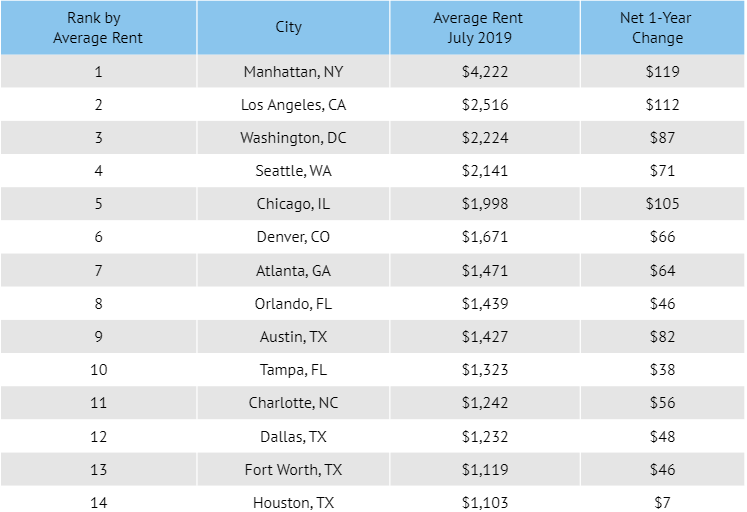
Overall, rent increases in the largest hubs increased by an average of $64 year-over-year, by net numbers ranging from a symbolic $7 in Houston ($1,103) to a significant $119 in the nation’s priciest market, Manhattan ($4,222).
Rents continue to rise partly because more and more Americans are looking for apartments while too few are being built.
Doug Ressler, Manager of Business Intelligence at Yardi Matrix, said in the report that a slow recovery in construction has led to a nationwide housing shortage. The number of households is now rising at the same level as in the 1990s and early 2000s, but apartment development is not keeping up with demand, leading to rising prices.
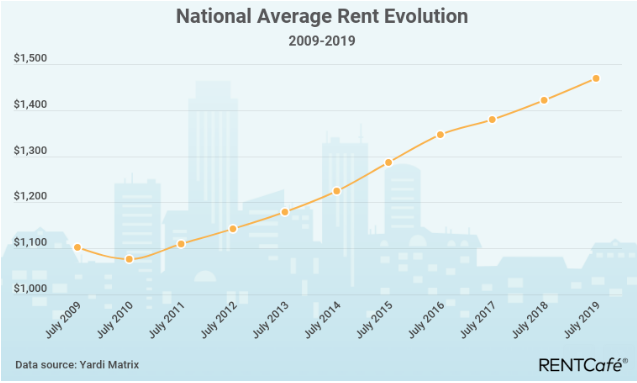
Still, a majority of the nation’s mega-hubs – 65 percent, to be exact – had rents below the $1,469 national average.
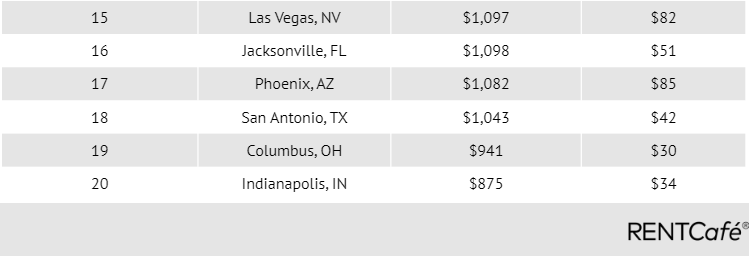
July Rents In The 20 Largest Renter Mega Hubs
After a $34 year-over-year increase, Indianapolis ($875) remains the most affordable renter hub, followed by Columbus ($941), and San Antonio ($1,043). Unsurprisingly, rents continued to rise in the priciest of the nations’ renter mega-hubs, with apartments in Los Angeles ($2,516) going up by $112, and Washington D.C. apartment rents ($2,224) increasing by $87. Seattle ($2,141) came in fourth and is the last city on the list with an average rent above $2,000.
Mid-size California cities priciest in their category
After a 1.9 percent ($52) increase, the average rent in Oakland, the highest of all mid-sized cities, reached $2,854 in July, continuing its upward trend.
Coming in second but at a significant $777 lower, Long Beach registered a $2,077 rent average. The two cities are followed by Santa Ana ($1,936), Anaheim ($1,809) and Miami, which at $1,729 is the only mid-sized city outside of California to make it to the Top 5 most expensive for renting.
Interest in one-bedroom apartments is rising
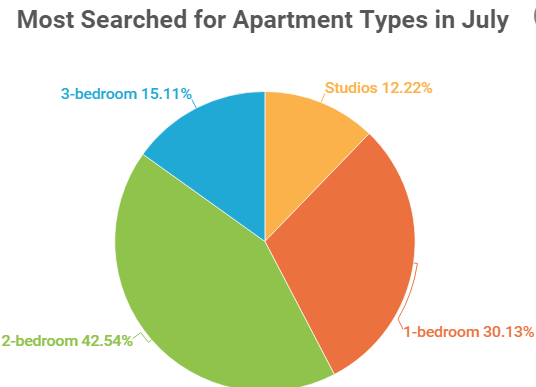
With 43 percent of renters searching for two-bedroom apartments, they’re still the most popular unit type on RentCafe.com.
However, for the past two months, one-bedroom apartments have been catching up.
Searches for one-bedroom apartments fell to 26 percent in May but have bounced back since then, and now represent up to 30 percent of all searches.
Three-bedroom apartments, meanwhile, make up 15 percent of searches, while studios are still the least popular on the platform, with a share of 12 percent.
Methodology:
RENTCafe.com is a nationwide apartment-search website featuring apartments and houses for rent throughout the United States. To compile this report, RENTCafe’s research team analyzed rental data from the 260 largest cities in the United States. The data on average rents comes directly from competitively-rented (market-rate) large-scale multifamily properties (50+ units in size), via telephone survey.
The Portland City Council passed by a vote of 3-1 a new city ordinance to assess an annual $60-per-rental unit fee to fund the rental-services office.
The council voted 3-1 to approve the fee with Commissioner Amanda Fritz opposed and Commissioner Jo Ann Hardesty absent. Fritz cited concerns about the number of new regulations on landlords as a reason for her no vote. She also questioned leveling a $60 fee on mobile homes as well as apartments.
“I would have supported this if it had come to us last year, before all the other changes,” Fritz said.
Rental unit fee too much on top of other regulations
“I agree that we need a rental registration program and that it needs to be funded. However, on top of all of the other additional regulations that we’ve put on landlords, and the fact that this fee is not going to help pay for universal inspections, which most other rental registration fees do.
“I would have supported this if it had come to us last year, before all the other changes,” Fritz said.
“And also, it’s regressive and doesn’t exempt the really low-cost housing such as manufactured-home parks. So regretfully I vote ‘no’, “Fritz said.
Mayor said rental unit fee was a commitment of his
Mayor Ted Wheeler said the rental unit fee has “long been a commitment and a priority of mine since I took office, and to help support the office of rental services and establish a system to collect more accurate data of the rental market in Portland.”
Quality data, Wheeler noted, is something for which landlords, developers, and tenants’-rights organizations all have pointed out the need regarding rental costs, landlord practices, and the city’s supply of rental units.
“This is the way we help fund the program to do that,” Wheeler said.
Mayor Ted Wheeler said the fee has “long been a commitment and a priority of mine since I took office.”
Commissioner Chloe Eudaly said passage of the ordinance will mean, “Portland will join with many other major cities in the country that require a simple registration of rental units. The $60 fee will not fully fund the office, but I believe it should cover the cost of registration and support information referral for landlords and tenants.”
Landlords previously objected to the new per-unit fee as just putting more regulation on the backs of landlords, and that the new fee would be passed on to renters.
Michael Havlik, deputy executive director of Multifamily NW, told the council, “My association members are dismayed with the current rendition of the proposed rental registration fee. It is yet another layer of tax on housing, adding cost to a market already in crisis.
“Not only is the amount proposed excessive at a $60-per-unit fee, but (it) offends common sense that the implementation of our registration system will cost millions of dollars each year.”
Havlik said for a 200-unit property in Seattle, the fee is $575 for $2.88 cents a unit, compared to $12,000 for a comparable 200-unit property in Portland with the $60-a-unit rate.
“In other words, the city of Portland’s rate will be over 20 times the amount of Seattle. We estimate that by year 10 of this fee scheme, the city of Portland will have collected $58 million that will do nothing to create more affordable housing,” Havlik said.
“It’s ultimately a tax on renters, impacting those most who have lower incomes and do not have the good fortune of living in regulated affordable housing, which receives the special carve-out with a housing supply shortage,” he said.
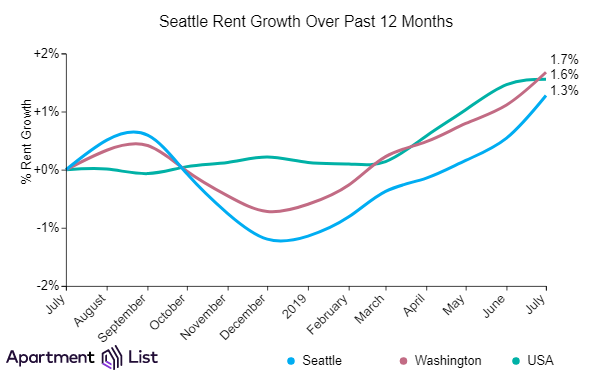
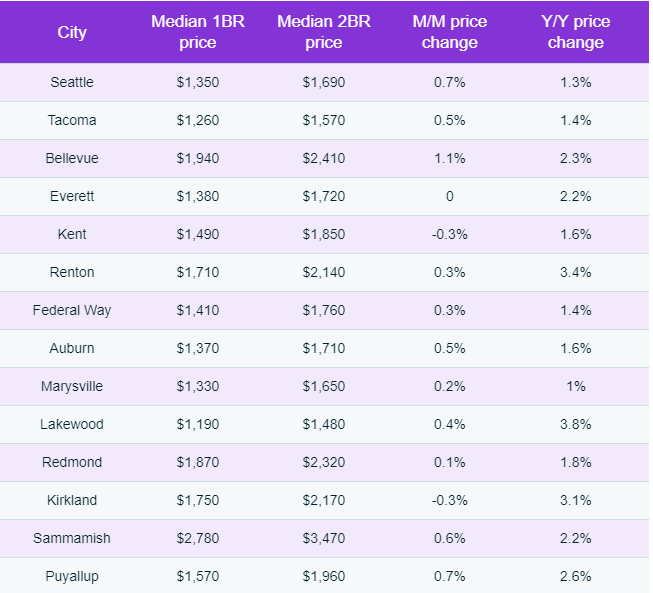
Seattle rents increased sharply over the past month, up 0.7 percent over the past month, the seventh straight month that the city has seen rent increases after a decline in December of last year, according to the July report from Apartment List.
Rents in Seattle have increased slightly by 1.3 percent in comparison to the same time last year. Seattle’s year-over-year rent growth lags the state average of 1.7 percent, as well as the national average of 1.6 percent, according to the report.
Tacoma rents also increased significantly over the past month
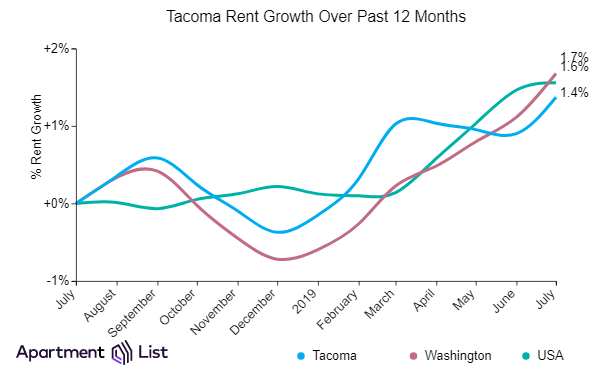
Tacoma rents have increased 0.5 percent over the past month, and are up slightly by 1.4 percent in comparison to the same time last year.
Currently, median rents in Tacoma stand at $1,262 for a one-bedroom apartment and $1,572 for a two-bedroom. Tacoma’s year-over-year rent growth lags the state average of 1.7 percent, as well as the national average of 1.6 percent.
Rents rising across the Seattle Metro
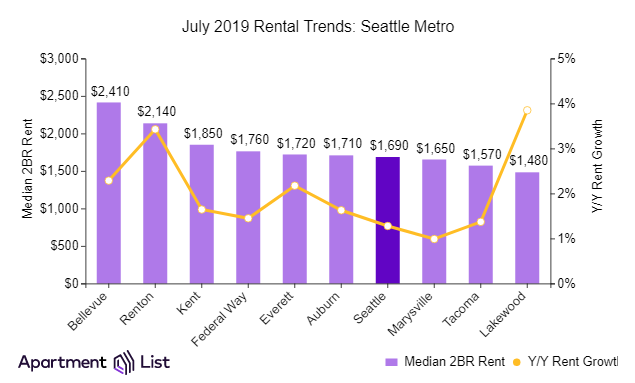
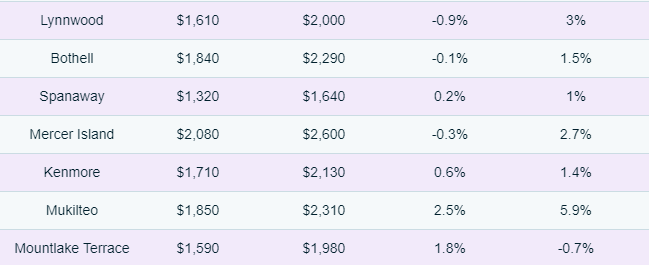
In the largest 10 cities that Apartment List has data for in the Seattle metro, all of them have seen prices rise. Here’s a look at how rents compare across some of the largest cities in the metro.
Lakewood has the least expensive rents in the Seattle metro, with a two-bedroom median of $1,482; the city has also experienced the fastest rent growth in the metro, with a year-over-year increase of 3.8 percent.
Over the past month, Kent has seen the biggest rent drop in the metro, with a decline of 0.3 percent. Median two-bedrooms there cost $1,850, while one-bedrooms go for $1,486.
Similar cities nationwide show more affordable rents compared to Seattle
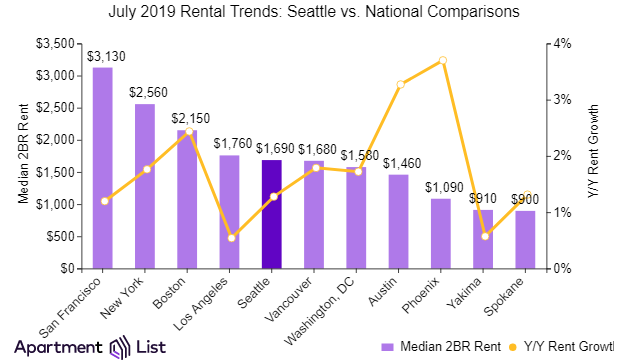
As rents have increased slightly in Seattle, a few similar cities nationwide have also seen rents grow modestly. Compared to most other large cities across the country, Seattle is less affordable for renters.
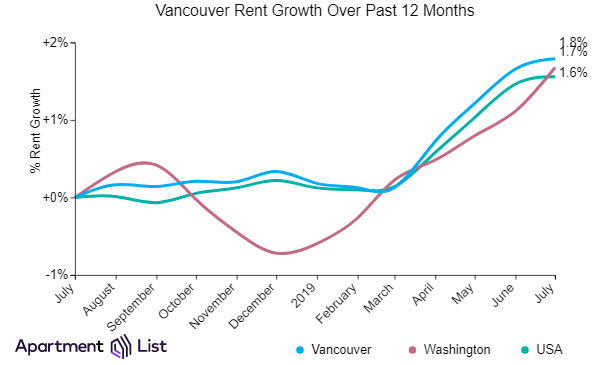
Rents increased slightly in other cities across the state, with Washington as a whole logging rent growth of 1.7 percent over the past year. For example, rents have grown by 1.8 percent in Vancouver and 1.3 percent in Spokane.
Seattle’s median two-bedroom rent of $1,686 is above the national average of $1,191. Nationwide, rents have grown by 1.6 percent over the past year compared to the 1.3 percent increase in Seattle.
While Seattle’s rents rose slightly over the past year, many cities nationwide also saw increases, including Phoenix (+3.7 percent), Austin (+3.3 percent), and Boston (+2.4 percent).
Renters will generally find more expensive prices in Seattle than most similar cities. For example, Spokane has a median 2BR rent of $896, where Seattle is more than one-and-a-half times that price.
The current multifamily growth cycle still has “room to run” as rent growth is on target to exceed 2.5 percent for the seventh straight year, 300,000 units of new supply are coming online, and investor demand for U.S. apartments remains robust, says Yardi Matrix in their summer multifamily report for 2019.
“But will looming trade tensions, slowing global economic growth and an inverted Treasury yield spoil the party?” the company asks in the report.
Here is what the current multifamily growth cycle shows:
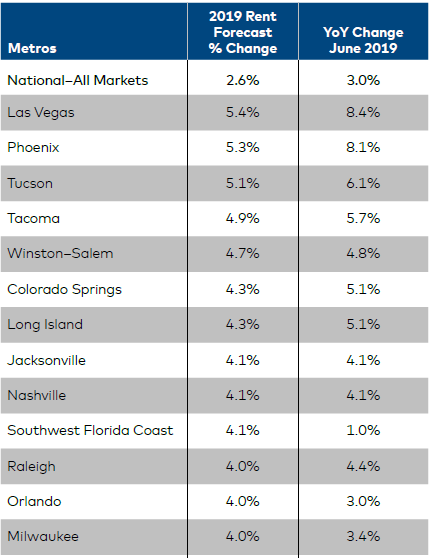
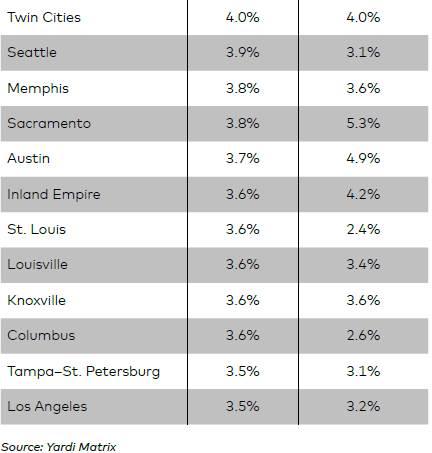
At mid-year 2019, the multifamily market is continuing its strong fundamental performance with prospects for the next few years remaining bullish. Rent growth has stabilized at just over 3 percent, and we expect a 2.6 percent increase for the full year—the seventh straight year above the 2.5 percent long-term average.
Rent growth is led by metros in the Southwest and South with fast-growing economies and relatively affordable housing, but strong gains are being recorded in most metros across the country. The strong economy and employment market, along with demographic and social factors, are creating healthy demand for apartments.
Although growth remains steady, there are concerns about the U.S. economy as the strong and steady growth trajectory of the last few years has begun to show some cracks. Trade tensions, slowing global growth and an inverted Treasury yield curve may be starting to outweigh healthy employment, steady energy prices and continued growth of the technology industry.
Supply nationally has increased by about 300,000 units annually, and this is expected to continue for another couple of years. There are 600,000 units under construction but, with the construction labor shortage, the units are taking longer from start to finish.
Capital markets are supportive of a healthy market. Investor demand for U.S. apartments is robust, as the sector is seen as a safe haven in an increasingly uncertain environment. The 100-basis point drop in the 10-year Treasury yield also restores a high premium over borrowing costs. Demand for debt is so high that agency lenders are burning through their allocations and other lenders are picking up any slack.
The likelihood of a recession in the next two years is small, the report says
“The saving grace for the U.S. economy continues to be the labor market. New job formation, low unemployment and steadily increasing wages provide stability and support to an otherwise unsettled economic situation,” Yardi Matrix says in the report.
“As of June, U.S. employers have added jobs in 105 consecutive months, by far the longest expansion in the post-WWII era. Unemployment sits near 50-year lows at 3.7% and, with such a significant number of job openings, candidates that in previous cycles remained on the sidelines are being pulled into the labor force. Minorities, older workers and individuals with criminal records are entering the labor market in large quantities, as employers cannot be as selective or discriminatory as they have been in years past.
“All indications point to additional employment growth, as workforce participation increases and job formation remains hot,” the report says.
Multifamily rent growth trends
Multifamily rent growth got out of the gate slowly in 2019, leading the industry to wonder if the above-average-increase streak would end in 2019. But since rent growth resumed in the second quarter, the answer seems to be “no.”
Through mid-year, rents are up 2.6 percent year-to-date and 3.3 percent year-over-year. The market now looks poised to further extend what has been an already protracted cycle, with rent growth unwavering in a large swath of markets.
As of midyear, only a handful of markets saw increases of 2.5 percent or less. We expect normal seasonal leveling of rent growth in the second half but a full-year increase of 2.6 percent, or 10 basis points above the 2.5 percent long-term average.
By class, apartments aimed at the middle and lower end of the spectrum continue to lead in rent growth.
Demand should remain strong for the foreseeable future due to the healthy employment market and demographic trends, according to the report.
Yardi Matrix is a business development and asset management tool for investment professionals, equity investors, lenders, and property managers who underwrite and manage investments in commercial real estate. Yardi Matrix covers multifamily, industrial, office and self storage property types. Email matrix@yardi.com, call 480-663-1149 or visit yardimatrix.com to learn more.
About Yardi
Yardi develops and supports industry-leading investment and property management software for all types and sizes of real estate companies. Established in 1984, Yardi is based in Santa Barbara, Calif., and serves clients worldwide. For more information on how Yardi is Energized for Tomorrow, visit yardi.com.
To learn more about Yardi® Matrix and subscribing, please visit www.yardimatrix.com or call Ron Brock, Jr., at 480-663-1149 x2404.
Landlords are not the enemy and do not want eviction of tenants, so BYU Law and University of Arizona Law have created a new online tenant-landlord communication tool to help deal with the eviction crisis across the country.
The new online tenant-landlord communication tool called Hello Landlord is intended to help with issues that can lead to evictions was created by the two university law schools and a subsidiary of a law firm.
“Eviction is a national crisis, and the ripple effects of an eviction are devastating to families and communities. We went into this challenge knowing that we wanted to design a scalable, bilingual, jurisdiction-agnostic solution that could positively affect widespread change,” said Stacy Butler, director of the UofA’s Innovation for Justice program, in a release.
“For most people, that eviction notice is the last chapter in a much longer story about systems failure. We hope that by spreading the word about this new access-to-justice tool and making Hello Landlord available to as many people in as many states as possible, we can encourage communities to think preventatively about the justice gap.”
The free web-based tool helps tenants communicate with their landlords about issues that can lead to eviction. This nationwide resource is a result of a semester-long collaboration between BYU’s LawX Legal Design Lab and UofA Law’s Innovation for Justice program, which share a commitment to addressing pressing legal service issues with new products and solutions.
Landlords are not the enemy and do not want eviction of tenants
“As we train the next generation of lawyers, we want to instill the notion that going to court is not always the solution,” said Kimball D. Parker, LawX director and president of SixFifty, in a release.
“When it comes to evictions, the adage ‘an ounce of prevention is worth a pound of cure’ certainly applies.
“We found that most landlords don’t want to evict tenants and are receptive to working with those who proactively reach out. The collaboration with the University of Arizona and SixFifty has resulted in an online de-escalation tool that has the potential to help anyone who has missed rent, or is experiencing an issue with the condition of their rental, avoid legal problems,” Parker said.
More than two million evictions in 2016
“We found that most landlords don’t want to evict tenants and are receptive to working with those who proactively reach out,” Parker said.
In 2016, more than two million people in the United States were evicted from their homes. Tucson is a Top 25 evicting city according to Eviction Lab. Less than 20 percent of tenants there appear in eviction proceedings; of those who appear, 90 percent do so without counsel; and 96 percent of cases result in eviction judgments against tenants. Lack of legal representation is also an issue in Utah, with a 15:1 defendant-to-lawyer ratio in the state.
Hello Landlord is available for free at www.hellolandlord.org with English and Spanish language options for tenants to generate a letter about a missed rental payment or a problem with their rental.
Developed by the BYU and UA students, and built on SixFifty’s automation platform, it features simple, guided questions such as “What is your landlord’s first name?” and “Why can’t you pay rent?” The software then generates a letter that clearly and respectfully explains the tenant’s situation and proposes a solution.
Nearly 90 percent of the landlords who have previewed the tool said they would be willing to work with the tenant to resolve the problem if they received a similar letter.
At the beginning of the fall 2018 semester, five LawX and 10 Innovation for Justice legal-design lab students were tasked with utilizing a design- and systems-thinking framework to develop one or more scalable solutions to increase housing stability for tenants in underserved communities by reducing the frequency of eviction. The diverse group of students brought different skills and experiences to the process, including one student who was served with an eviction notice during the semester. Together, the students observed more than 220 eviction court proceedings and spoke with dozens of stakeholders, including judges, landlords, tenants, social services providers, attorneys and journalists. They found that by the time a tenant is served with an eviction notice, the eviction process in both Arizona and Utah is too rapid and rigid to afford an opportunity to stabilize the situation at stake. In many states, there are few legal defenses available to tenants once an eviction lawsuit has been filed.
The students were interested in developing an upstream solution that could increase the likelihood that tenants and landlords would resolve issues that can lead to evictions. Specifically, students were interested in targeting a communication gap they observed between tenants and landlords, in which tenants felt powerless to reach out to landlords when at risk of missing a payment or experiencing a problem with a rental property, and landlords felt that tenants did not reach out to try and resolve payment or rental issues.
Hello Landlord is the second web-based brainchild to come from BYU’s LawX innovation lab, which also created SoloSuit – an award-winning online tool that helps Utahns who cannot afford legal services to respond to debt collection lawsuits.
If you are an apartment owner involved in property management, a property manager yourself or a real estate investor, there are property management questions to ask about how the property is managed from different viewpoints.
Here is a look at 30 questions that touch on the issues no matter what your job, or job title, with your rental property based on blogger Larry Arth’s 30 years in real estate investing.
I have had my share of property management issues, so speaking from a position of strength, allow me to share some diligence that I have uncovered over the years on asking and interviewing property managers.
Understanding this principle I asked myself why anyone who invests part-time would try to manage their own properties.
The reason we have so many bad tenant stories is answered in this discovery.
If it takes 10,000 hours of diligence and passion invested in a discipline to be successful, it is then imperative to have a professional who has the credentials of these 10,000 hours of practice behind them to successfully manage tenants and the landlord business.
We understand that a property manager is to your investment, as your engine is to your car. Without a great finely tuned engine your car does not deliver you your intended outcome which is a safe journey without accident or incident.
Likewise, without a systemized, knowledgeable, experienced property manager, you will never get to your intended outcome which is a safe profitable business operated without incident.
The first questions have to do with finding good tenants. A building with good tenants tends to have fewer maintenance and other issues.
How many vacancies do you have right now? Out of how many total units that you manage?
What is the average length of time it takes to fill a vacancy?
Is that average time getting longer or shorter?
How do you market your rental units?
How do you use the web site to attract new tenants and to keep prospects informed?
What factors would make you reject a prospect?
Would you accept a tenant who met your qualifications in some areas, but not others? Which qualifications are most important to you?
What screening methods do you use?
Property Management Questions – Tenant Management
The next questions relate to tenant management. It’s just as important to keep good tenants as it is to find them.
How do you collect rents?
What is your late rent policy?
What other rules do you set for tenants?
What percentage of tenants do you have to evict?
How does the eviction process work here?
How do your tenants contact you?
Property Management Questions – Maintenance
Which kinds of maintenance jobs are handled in-house?
Which kinds of maintenance jobs are handled in-house?
Which ones do you use an outside handyman for?
Which ones do you use professional contractors for?
How many quotes do you get for jobs?
How expensive does a job have to be for you to contact me before doing it?
What are your rules for contractors being inside occupied rental units?
Who are your preferred contractors?
Property Management Questions – Experience
You want managers to know the local real estate world inside and out.
How long have you been a property manager?
Do you have any certifications?
Does your locality require landlords to have a license or permit to operate a rental and if so what are those fees?
Do you understand the local rules and ordinances to accommodate things such as local licensure requirements and or section 8 requirements?
Do you personally invest in real estate in this area?
Finally, you need to understand your arrangement with the property manager
What is your fee structure?
Are your reports web based if not how do we get them?
Do you require an exclusive arrangement to broker the property?
How much notice will you give before terminating a contract?
Additionally you can always be on the watch out for the easy tell-tales signs of expertise, or lack thereof, things like:
A manager with a messy office.
Managers who are hard to connect with by phone or email.
I always believe that how you do anything is how you do everything.
About the Author:
Larry Arth is a landlord and the founder and CEO of Equity Builders Group, a Florida based Real Estate investment Group. As a 36 year veteran to real estate investing, Larry understands that we are now in a global economy and as times have changed, investment strategies must change as well. Larry is an international recognized consultant and speaker and assists hundreds of investors per year, both foreign and domestic to realize their investment potential. He analyzes locations across the country for economic strength and the locations that yield the largest most sustainable return on investment. Within these locations he seeks out and gathers the best teams to deliver sound, high performing and most importantly sustainable turnkey investment. He works with investors to ride the wave of each area-specific market surge. Larry’s primary focus is offering (Non Listed) safe and sustainable turnkey investments to the passive investor.
Portland City Council members heard testimony from landlords opposed to the proposed $60 per unit fee saying it is nothing but a “tax on renters” and “one more thing being dumped on the backs of landlords.”
Two landlords, Marc and Kathy Rogers, spoke against the proposed fee saying they own an apartment building at 19th and Hawthorn and provide an affordable housing alternative in that area.
Marc Rogers shared information about an email exchange he wanted to keep anonymous with another landlord who said, “I would likely email all my tenants and let them know that due to policies of city council, their rents would be going up by $25 a month.”
Demonizing landlords
“It’s a very polarizing subject and I think it’s easy to look at landlords and demonize them as not caring and interested only in the bottom line,” Rogers said. Then in response to a council question he said, “I think that maybe the use of demonization was not the correct word to use. I think that the policies of council over the last couple of years have been very negative towards landlords.”
Commissioner Chloe Eudaly spoke up to say, “It’s not my intention to demonize landlords. Some of my best friends are landlords.” She also questioned why a landlord would raise rent $25 a month to cover a fee that is $60 a year.
Rogers said that any time the price of a commodity goes up “that’s typically passed on to the end user. If the price of diesel to deliver bread to Fred Meyers goes up, Fred Meyers is going to pass that along for a loaf of bread at their store. And that’s just typically the way businesses work.
“I think sometimes, in my opinion, landlords aren’t necessarily looked at as small businesses. We’re a small business. We’re really not any different than any other mechanic shop or coffee shop or restaurant. We’re small business people. In my opinion the attitude of this council in the last two years has been that we’re in some way not a small business. That we’re something different than that, and that we are not good people,” he said.
Eudaly responded that she was a small business owner of a bookstore for 22 years and said, “Granted, I had a bookstore and books come with a preprinted price on them. Unfortunately, rental units don’t.”
“I want landlords to recognize the fact that they are business owners. We hear from a lot of, especially small landlords, who feel like this is something they do on the side. It’s almost more of a hobby or a supplement. And, they feel some of the regulations are forcing them to professionalize in a way they’re not equipped to do. So I see you as a small business,” Eudaly said. In response to Roger’s friend who said he would raise rent $25 to cover the new fee she said it was “hard for me to take your friends’ comment seriously because that’s just not reasonable.”
Rogers gave some perspective to what is going on in Portland saying “we are commercial Realtors.” He said they deal in smaller properties such as duplexes and fourplexes.
More landlords putting their rentals up for sale
Rogers said two years ago you would be lucky to find a dozen duplexes on the market in close-in zip codes.
“I checked two days ago, there were 61 duplexes on the market” in close in zip codes he said.
“The feedback we get consistently is that the small mom and pops who own the duplexes don’t want to deal with the lower barrier of entry with security deposits, with amortization schedules, with rent control, and the sophistication level for them.
“They’ve decided to get out. So that takes inventory off the market and adds cost,” Rogers said.
Eudaly responded saying, “Well, I don’t think that we can draw a direct correlation between our regulations or policies and changes in the real estate market without adequate data.
“But I will say there’s a plus side to having more housing on the line. I don’t disagree with you at all. And that rental services office will actually help landlords navigate these little changes. So it kind of supports this item,” she said.
Why Not Make The Tenants Pay The Fee Since The Services Are For Them?
Kathy Rogers told the council, ““I think a lot of small landlords feel like all of the costs and fees and complexity are being dumped on the landlord and not shared by the tenant.”
Kathy Rogers added to Marc’s comments saying, “This fee in and of itself may not seem like a huge deal, but I think as Mark alluded to, coming on the heels of everything else that’s been thrown at landlords over the last two years, it feels a lot like the straw that’s breaking the camel’s back.
“And I think a lot of small landlords feel like all of the costs and fees and complexity are being dumped on the landlord and not shared by the tenant,” she said
“If this is to support the rental services commission, which I’ve been in contact with and as far as I can tell about 90% of what they do supports tenants. Why are the tenants not paying the fee,” she asked.
“How about with every lease renewal? The tenant pays the $60 fee. Why is it 100 percent paid by landlords?
She said “all of this has come at us in the last two years, you know, with the mandatory renting relocation assistance, the elimination of no cause notice evictions, rent control, new tenant screening ordinances, which our attorney can’t even figure out and he’s a real estate attorney, plus the security deposit ordinance and the rental registration program. And now this,” she said.
“It’s very difficult to navigate and I will tell you that a lot of small landlords are afraid to rent out their properties. They’re afraid of being sued. They’re afraid of not following the rules. A lot of the single-family and duplexes that are being sold are now being purchased by owner occupants. Those are rental units that are be taken off of the market,” she said.
Hurting the people you are trying to protect
Kathy Rogers said, “We never used to raise our rents every year. We have two now every year on the anniversary, 100 percent of the time we raise our rents to the 100 percent maximum that we’re allowed to do because of the actions taken by the city council. And we never used to do that.
“So I just want you to think about everything you’re throwing at us may be hurting the people you’re trying to protect,” she said.
It’s a Portland thing to do
Marc Rogers also told the council “I’d like to share a story and it might take more than 27 seconds. But for the last 11 years I’ve had somebody living in my building on 19th and Hawthorne for free.
“We pay his utilities and we provide him with a cell phone. Probably $1,000 a month, maybe $12,000 a year. We don’t have a formal agreement. We don’t even have a handshake, but what we have done is he looks out for my interest and I look out for his and I think that’s the right thing to do.
“I think it’s a Portland thing to do and I think that’s what we’ve shown that we’re willing to do and have done for the last 11 years. So that’s really my closing and I would hope that you would reconsider this and maybe take more input,” Rogers told the council.
$60 per unit fee is “just too high”
Jill Warren, who described herself as a mom and pop landlord in Portland for the past 30 years, said she owns 34 units.
“So we will be paying $2,040 a year to support the program. I just think that’s too high, $60 per unit fee,” she said.
Small landlord Jill Warren told the council, “I just think that’s too high.”
Then she added, “I appreciate the previous conversation about the demonization. I feel that some of the mandates that are being brought down by this body actually it hurts our industry.
“For example you don’t want us to factor in the criminal background for a tenant and that’s very dangerous. I just screened an applicant who had 17 pages of felony convictions, including felon in possession of a firearm, theft, burglary, possession of methamphetamine.
“I protect the safety of my tenants. My primary goal is their welfare and their safety. So that’s why I screen. It’s all about screening.
“Also the mandate to pick the first applicant that comes along. I mean that’s not a very intelligent to do that. That’s why we screen. I run a criminal check. I do a background search. I check your credit history and your previous and current landlord referrals. So I just throw that all in a pot, and I stir it up, and that’s how I determine their eligibility,” Warren said.
Commissioner Chloe Eudaly said, ““I can’t allow this forum to be used to spread misinformation about our policy. We are not requiring landlords to not consider a prior convictions. That’s a choice.”
Eudaly then responded to Warren saying, “I can’t allow this forum to be used to spread misinformation about our policy. We are not requiring landlords to not consider a prior convictions. That’s a choice.
“And the first-come first-served as first come first to qualify. We’re not requiring landlords to literally rent their units to the first person that applies. So those are two false statements that you made. And I just want to ask everyone else who comes up here to try to avoid spreading misinformation.”
Portland’s proposed $60 per unit fee 20 times higher than Seattle’s fee
Michael Havlik, deputy executive director of Multifamily NW, told the council, “My association members are dismayed with the current rendition of the proposed rental registration fee. It is yet another layer of tax on housing adding cost to a market already in crisis.
“Not only is the amount proposed excessive at a $60 per unit fee, but offends common sense that the implementation of our registration system will cost millions of dollars each year.”
Michael Havlik, deputy executive director of Multifamily NW, told the council, “My association members are dismayed with the current rendition of the proposed rental registration fee.”
Havlik said in the past he worked for several property management firms and home forward as director of asset management. “I have a passion for housing affordability and rental services and I’ve spent my life dedicated to it all. I have 26 years of experience in property management including conventional multifamily housing, affordable tax credit, public housing, permanent supportive housing as well as special needs housing.”
He said the members of Multifamily NW “make up 40% of Oregon’s rental housing supply and as such we are the leaders in property management and development within the state.
He said for a comparable 200-unit property in Seattle the fee is $575 for $2.88 cents a unit compared to $12,000 for a comparable 200-unit property in Portland.
Ultimately a tax on renters
“In other words, the city of Portland’s rate will be over 20 times the amount of Seattle. We estimate that by year 10 of this fee scheme, the city of Portland will have collected $58 million that will do nothing to create more affordable housing,” Havlik said.
“It’s ultimately a tax on renters. Impacting those most who have lower incomes and do not have the good fortune of living in regulated affordable housing, which receives the special carve out with a housing supply shortage.
“What rational jurisdiction would meet out punitive disincentives to housing providers?
“The city of Portland is creating inequity across all rental housing providers by imposing a fee for the sole purpose of funding multiple duplicative programs already implemented or addressed by other better equipped agencies.
If you’re truly striving to provide solutions to the problem for the lack of affordable housing across the continuum of housing, then you would continue the path outlined by the legislature through house bill 2001 and 2003 which both work to create diverse, inclusive and vibrant housing opportunities throughout our city.
Additionally, the city should reassess its posture towards housing providers It has demonized over the last several years. These providers are a big piece of the solution and you should view our members as willing partners in the goal of making housing more affordable and accessible to all Portlanders.”
Director of Operations for Commerce Properties, Chris Nguyen, said the fee “will be harmful to Portland renters by reducing new development in low- to moderate-priced rental housing, putting upward pressure on housing cost, and reducing the quality of existing rental housing.
Chris Nguyen said the $60 per unit fee could “hire a part-time maintenance technician. Could allow us to replace 23 carpets. Allow us to put appliances in 16 new apartment homes.”
“Now this tax combined with additional state and local legislation introduced over the last few years makes it difficult for housing providers to provide affordable housing and it reduces the incentive to develop new units or keep existing units on the market,” Nguyen said.
Maintenance could suffer due to new fee
Nguyen said the proposed rental fee reduces funds available for maintenance.
“This tax for the company I work for will have a $27,000 annual impact. This fee could hire a part-time maintenance technician. Could allow us to replace 23 carpets. Allow us to put appliances in 16 new apartment homes.
“So this means that many housing providers will have to pay fees with funds that they would have normally used to improve or maintain existing housing.
Testimony in favor of the new fee
Several spoke in favor of the new fee, including Margot Black from Portland Tenants United, a registered lobby organization with the city of Portland who is also a member of the rental services commission.
“I’m here to testify today in support of rental registration fee with some minor reservations. But I’m going to bypass most of my testimony just to respond to a couple of the concerns that I’ve heard come before the council.
“Just so you know, fees are strictly regulated by the state and the landlords of Portland would not be able to explicitly pass this fee on in their lease as a fee. However, I just got a 90 day notice for $150 a month rent increase that will start this November. I’ll be paying $150 every single month. One of the reasons my landlord gave me for that was increased fees by city council,” Black said.
“Frankly as a tenant every time we hear about tenant protections or things that are going to help tenants costing us money and ultimately hurting us, when my rent can already go up by hundreds of dollars a month, I would much rather some of that money be going to the city to provide programs and services for renters than just going in my landlord’s pocket,” Black said.
Mayor said fee has long been a priority of his
Mayor Ted Wheeler introduced the discussion on the fee by saying, “I’m pleased to bring forward the rental registration fee, which is long been a commitment and a priority of mine to help support the office of rental services and establish a system to collect more accurate data of the rental market in Portland.
“In 2017 we set a rental registration requirement for all units in the city of Portland. In the first year of registration, we did not charge a fee. That was deliberate. We wanted to encourage voluntary compliance for landlords, but it’s been clear from the beginning that a fee would need to be established,” the mayor said.
“We asked the revenue division in the Portland Housing Bureau to return to us this year with the established fee. Since 2017 we’ve made consistent progress and increasing the city’s role in landlord tenant law and services, including establishing the rental services office, the Rental Services Commission, adopting local landlord, tenant law, increasing landlord tenant services and increasing training and education services.
“Portland is one of the only cities our size to not have a rental system in place and fees to cover the basic services. We’re behind the curve and this is an imperative first step to allowing us to have a more robust and streamlined support for renters in our community.
“This council has also made it clear the importance for data may data-driven policy making. This fee will support the maintenance of an expanded registration system. Something that I’ll be back in the fall bump to ask for support of this council for funding for the procurement of the expanded system so that we have data not just on the number of units and their location, but accessibility, general unit characteristics and other relevant market data. The recommended fee is in response to the budget note. We included in our adopted budget this fiscal year and it’s reasonable when compared to other cities in the region and across the country,” Wheeler said in his opening statement.
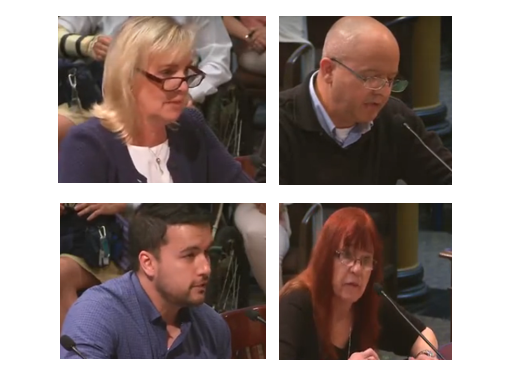
From top left to right clockwise, Kathy Rogers, Mike Havlik, Jill Warren and Chris Nguyen
We’ve been getting a lot of calls in the past few weeks at Keepe about how to fix tenants’ clogged toilets. Here’s some interesting information about toilets, and six unclogging tips from our professionals!
The average person flushes the toilet five to six times each day, adding up to nearly 2,000 flushes per year.
When a toilet stops working, it’s an emergency maintenance situation that needs to be fixed as soon as possible because it creates an immense inconvenience for your tenants.
Toilets account for nearly 30 percent of the water usage in bathrooms, so keeping these essential plumbing fixtures in good condition is a must.
Doing routine maintenance for toilets can go a long way. If you do not catch simple leaks early, you may find the problem months later, when the water bill is $100 more than usual. Some actions as simple as having your maintenance people regularly clean and check for leaks can catch a toilet problem early and save money in the long run.
If a toilet is clogged, the first thing you should try is using a toilet plunger, which can dislodge the clog so it can be flushed through.
If the plunger doesn’t work, try using a toilet auger, which can reach deeper into the plumbing of the toilet in order to dislodge clogs.
6 Tips for Fixing Those Annoying Clogged Toilets
Inspect the toilet’s inner workings every six months.
Never pour a chemical drain cleaner down your toilet; it can cause damage to your plumbing pipes.
Clean your toilet regularly with baking soda, vinegar or mild soap.
Consider what kind of toilet paper you are using; some break down less effectively than others and can cause clogs to happen more often.
If you get brown water backing up into your shower or sink when you flush, call a plumber immediately; these are signs of a more serious issue.
Inspect for leaks using food coloring. Add 6 drops of food coloring to your tank. If your toilet bowl water changes color, you have a leak!
About Keepe:
Keepe is an on-demand maintenance solution for property managers and independent landlords. We make hundreds of independent contractors and handymen available for maintenance projects at rental properties in the Greater Seattle, Greater Phoenix, Greater San Francisco Bay and Greater Portland areas. We’re also expanding. Learn more about Keepe at http://www.keepe.com
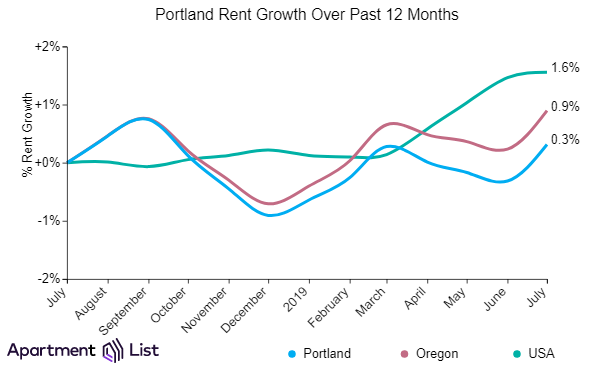
Portland rents have increased 0.6% over the past month after two months of declines, but have been relatively flat at 0.3% in comparison to the same time last year, according to the July report from Apartment List.
Currently, median rents in Portland stand at $1,131 for a one-bedroom apartment and $1,334 for a two-bedroom. Portland’s year-over-year rent growth lags the state average of 0.9%, as well as the national average of 1.6%.
Rents rising across cities in the Portland Metro
Throughout the past year, rents have remained steady in the city of Portland, but other cities across the entire metro have seen rents increase. Of the largest 10 cities that Apartment List has have data for in the Portland metro, all of them have seen prices rise.
Oregon as a whole logged rent growth of 0.9% over the past year.
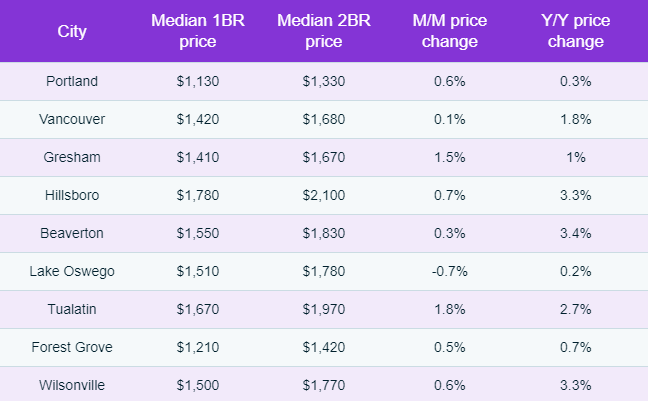
Here’s a look at how rents compare across some of the largest cities in the metro.
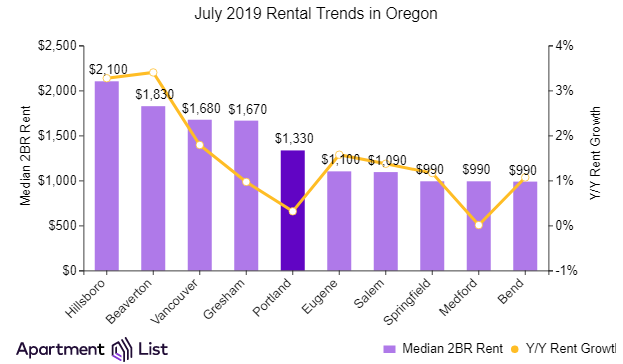
Looking throughout the metro, Hillsboro is the most expensive of all Portland metro’s major cities, with a median two-bedroom rent of $2,102; of the 10 largest Oregon metro cities that we have data for, all have seen rents rise year-over-year, with Beaverton experiencing the fastest growth (+3.4%).
Hillsboro, Vancouver, and Eugene have all experienced year-over-year growth above the state average (3.3%, 1.8%, and 1.6%, respectively).
Vancouver rents increased over the past month
Vancouver rents have increased 0.1% over the past month, and are up slightly by 1.8% in comparison to the same time last year.
Currently, median rents in Vancouver stand at $1,420 for a one-bedroom apartment and $1,675 for a two-bedroom. Vancouver’s year-over-year rent growth leads the state average of 1.7%, as well as the national average of 1.6%.
Portland rents more affordable than many comparable cities nationwide
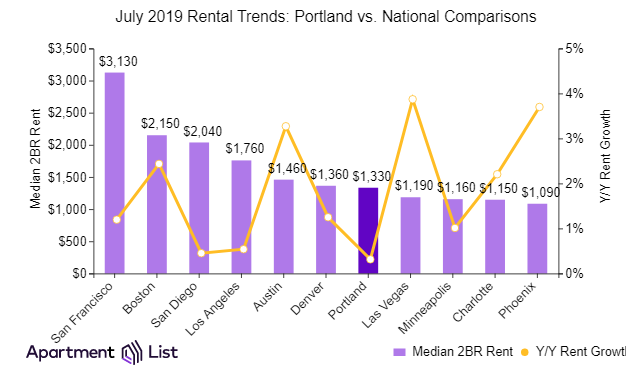
Rent growth in Portland has been relatively stable over the past year – some other large cities have seen more substantial increases. Portland is still more affordable than most similar cities across the country.
Portland’s median two-bedroom rent of $1,334 is above the national average of $1,191. Nationwide, rents have grown by 1.6% over the past year compared to the stagnant growth in Portland.
While rents in Portland remained moderately stable this year, similar cities saw increases, including Las Vegas (+3.9%), Phoenix (+3.7%), and Austin (+3.3%); note that median 2BR rents in these cities go for $1,186, $1,085, and $1,460 respectively.
Renters will find more reasonable prices in Portland than most other large cities. For example, San Francisco has a median 2BR rent of $3,126, which is more than twice the price in Portland.