
Home Blog Page 165

5 Tips for Fixing Tenant Drain Clogs

5 Tips for Fixing Tenant Drain Clogs

Fixing tenant drain clogs was one of the most popular maintenance jobs this week performed by Keepe, so here are some tips to help.

 Recently, Keepe has been getting many jobs for clogged drains; these situations are never ideal for anyone.

Your tenants are trying to take a shower and the water keeps coming up on their feet (or even higher). If you are dealing with a lot of standing water, the drain is probably clogged and fixing tenant drain clogs is something you should address as soon as possible.

Standing water for long periods of time can lead to more problems for you. Depending on the severity of your drain’s clog, you might be dealing with standing water sitting in your tub for hours or even days.

Insects tend to breed in standing water; mainly mosquitoes, flies, and dragonflies, and they’ll be a nuisance if allowed to reach adult form and continue to breed. These insects can also carry diseases that can harm your family or your pets. Standing water also causes mold and mildew to form; this is a breathing hazard for anyone in the home.

To get rid of nasty clogs, try using baking soda and vinegar. Mix 1/3 of a cup of baking soda with 1/3 of a cup of vinegar in a measuring cup. It will fizz immediately; pour it down the clogged drain right away. The fizzing action will help to remove the gunk, hair, and grime that has built up in the pipe. Let it sit for an hour, or even overnight if you can. Flush with hot water to melt whatever is clogging your drain away.

 5 drain tips to help with fixing tenant drain clogs

  • Use a drain claw to help grab hair or anything else that may be blocking the drain.
  • Pour dishwashing liquid and hot water down to clean drains.
  • Invest in a drain wig to help prevent hair clogs.
  • Use granular drain and trap cleaner to help prevent food or grease-based clogs.
  • To help prevent future clogs, regularly fill the tub or sink with hot water and let it drain. This helps flush away small levels of debris before they can become a bigger problem.

 Odd Job of the Week

This week, Keepe got a job request in the greater Seattle area for a kitchen sink in which the water would only come out scalding hot. When the issue was reported, the property manager stated that, “When you turn all the way to cold you only get a trickle of cold water. You can’t even get warm water, it’s always super hot.” The issue had been going on for a few months.

5 Tips for Fixing Tenant Drain Clogs
The faucet valve was malfunctioning and killing the pressure on cold side, stopping the flow of cold water and only letting the hot water in.

When our worker came in, they were able to assess the situation and find that the faucet valve was malfunctioning and killing the pressure on cold side, stopping the flow of cold water and only letting the hot water through. After the source of the issue was found, the faucet was replaced and is now working great!

Here are other recent rental property maintenance Keepe posts you may have missed:

 How To Pick The Perfect Exterior Paint Color For Your Rental Property

4 Outdoor Flooring Options For Your Rentals

20 Easy, Affordable Maintenance Projects To Update Your Rentals

7 Tech Gadgets For A Safer And More Efficient Rental Property

5 Maintenance Tips For Long-Lasting Rental Carpet Flooring

Is The Water Heater At Your Rental Property Ready For The Big One?

7 Types Of Kitchen Countertops For Your Apartments

Which Cooktop Is Best For Your Rental Property?

A Guide To 4 Types Of Flat Roof Systems

6 Ways To Trash Your Apartment Waste Management Issues

Top 5 Apartment Maintenance Emergencies vs. Maintenance Requests

5 Tips for Preparing Your Apartments for the Summer Season

4 Air Conditioning Maintenance Best Practices For Summer

About Keepe:

Keepe is an on-demand maintenance solution for property managers and independent landlords. We make hundreds of independent contractors and handymen available for maintenance projects at rental properties. Keepe is available in the Greater Seattle area, Greater Phoenix area, San Francisco Bay area, and Portland area, and we are continuing to expand. Learn more at http://www.keepe.com

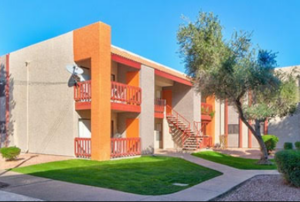
561-Unit Phoenix Apartment Complexes Sell For $56.7 Million

561-Unit Phoenix Apartment Complexes Sell For $56.7 Million

Phoenix apartment complexes Solano Ridge I and Solano Ridge II Apartments, a 561-unit multifamily housing community located near 35th Avenue and Northern, have sold for a combined price of $56.7 million, according to a release.

The complex was purchased in December 2016 by 3rd Ave Investments of Phoenix for $35.95 million. Over the last 30 months, 3rd Ave Investments invested $2.5 million into the property to upgrade the apartments, clubhouse and common areas.

The NorthMarq Phoenix team of Trevor Koskovich, Bill Hahn, and Jesse Hudson represented both the seller and the buyer, Intercapital Partners of Chicago, in this transaction.

Phoenix apartment complexes unique multifamily investment

“Solano Ridge was a unique investment for the buyers to acquire two properties and significant economies of scale,” Koskovich said in a release. “The seller deployed capital into the common areas and amenities, but left upside for new investors via interior renovations and in-unit washer/dryer installation.”

Built in 1982, the apartment communities feature studio, one- and two-bedroom apartments, along with three swimming pools, a dog park and upgraded outdoor living spaces. Solano Ridge is in close proximity to major employment hubs, retail centers, and universities.

561-Unit Phoenix Apartment Complexes Sell For $56.7 Million
The apartment communities feature studio, one- and two-bedroom apartments, along with three swimming pools, a dog park and upgraded outdoor living spaces.

About NorthMarg

As a capital markets leader, NorthMarq offers commercial real estate investors access to experts in debt, equity, investment sales, and loan servicing to protect and add value to their assets. For capital sources, we offer partnership and financial acumen that support long- and short-term investment goals. Our culture of integrity and innovation is evident in our 60-year history, annual transaction volume of $13 billion, loan servicing portfolio of more than $57 billion and the multi-year tenure of our more than 500 people.

 About 3rd Ave Investments
3rd Ave Investments is a real estate investment and management firm specializing in the acquisition and re-positioning of Arizona multifamily assets through a value-add private equity fund structure. Founded in 2015 by Zev Hendeles, 3rd Ave Investments has acquired more than 3,050 apartments with an aggregate market value of more than $320 million.

3rd Ave Investments targets poorly managed, undervalued and off-market investments, where opportunities exist to create value with an active management approach. 3rd Ave Investments is directly involved in all aspects of the acquisition, re-positioning and/or redevelopment process.


Portland Rents Declined in June for Third Straight Month

Portland Rents Declined in June for Third Straight Month

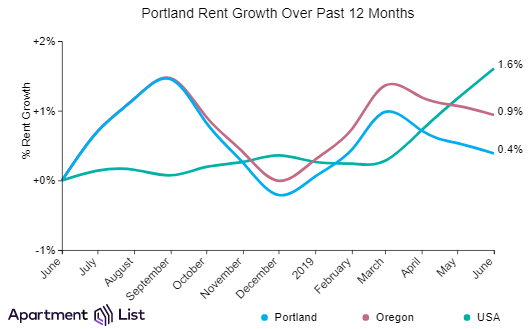
Portland rents have declined 0.1% during June, but have remained steady at 0.4% in comparison to the same time last year, according to the latest report from Apartment List.

Currently, median rents in Portland stand at $1,120 for a one-bedroom apartment and $1,330 for a two-bedroom.

This is the third straight month that the city has seen rent decreases after an increase in March.

Portland’s year-over-year rent growth lags the state average of 0.9%, as well as the national average of 1.6%.

Portland Rents Declined in June for Third Straight Month

Rents rising across cities in Oregon

Throughout the past year, rents have remained steady in the city of Portland, but other cities across the state have seen rents increase.

Of the largest 10 cities that Apartment List has data for in Oregon, 9 of them have seen prices rise. The state as a whole logged rent growth of 0.9% over the past year.

Here’s a look at how rents compare across some of the largest cities in the state.

  • Hillsboro is the most expensive of all Oregon’s major cities, with a median two-bedroom rent of $2,090; Medford, where a two-bedroom goes for $990, is the only major city to see rents fall year-over-year (-0.3%).
  • Hillsboro, Beaverton, and Vancouver all have experienced year-over-year growth above the state average (4.2%, 3.3%, and 2.0%, respectively).

Portland Rents Declined in June for Third Straight Month

Portland Rents Declined in June for Third Straight Month

Portland rents in June more affordable than many comparable cities nationwide

Rent growth in Portland has been relatively stable over the past year; there are other large cities that have seen more substantial increases. Portland is still more affordable than most other large cities across the country.

Portland’s median two-bedroom rent of $1,330 is above the national average of $1,190. Nationwide, rents have grown by 1.6% over the past year compared to the stagnant growth in Portland.

While rents in Portland remained moderately stable this year, similar cities saw increases, including Las Vegas (+3.9%), Phoenix (+3.8%), and Austin (+3.5%); note that median 2BR rents in these cities go for $1,180, $1,080, and $1,450 respectively.

Portland Rents Declined in June for Third Straight Month

Last month: Portland Rents Declined Moderately Over the Past Month

Rental Housing Requests For Assistance Animal Accommodation Shows About 40% Approval

Rental Housing Requests For Assistance Animal Accommodation Shows About 40% Approval

A new study of 8,600 assistance animal accommodation requests for rental housing shows that 39 percent of requests were recommended for approval, 43 percent did not continue with the review and 18 percent did not provide sufficient documentation, were unresponsive or were possible fraud.

The study, done by PetScreening.com, of 8,600 reasonable accommodation requests submitted to the company by prospective residents, also known as requesters, found that the pit bull variety is the dog breed most commonly submitted for reasonable accommodation requests.

The results of the study highlight the importance of properly confirming the reliability and credibility of third-party verifier documentation for reasonable accommodation requests, according to John R. Bradford, III, CEO and founder of PetScreening.com, which is based in Charlotte, N.C., and operates in all 50 states and Canada.

Reasonable assistance animal accommodation

“For individuals who do not have a readily apparent disability, requiring and reviewing third-party verifier documentation to support the requester’s reasonable accommodation request is critical. This maintains the integrity of necessary and legitimate assistance animals for individuals with a disability and disability-related need for the animals,” Bradford said in a release.

“Unfortunately, there are bad actors that are abusing this process to possibly avoid pet rent or circumvent pet policies, such as breed restrictions. There are many individuals with legitimate disabilities and disability-related needs for assistance animals, who shouldn’t be put at risk or receive a negative reputation just because of these bad actors.”

The pet-screening platform empowers property managers to outsource their pet-risk assessment and assistance animal-validation processes at no charge.

According to the release, property managers are often hesitant to ask for third-party verifier documentation for fear of violating Fair Housing laws and HUD guidelines, making it difficult to uphold the integrity of the accommodation-request review process. But new technology and databases, like PetScreening.com, help address these concerns by using electronic accommodation-request review processes and an in-house legal-review team. They review each reasonable accommodation request, adhere to the FHAct guidelines, and validate the third-party verifier documentation as being reliable, credible and meeting the test of reasonableness.

This standardizes the property manager’s reasonable-accommodation-request review process, saves time and helps mitigate liability for a possible discrimination complaint. Submitting a reasonable accommodation request for an assistance animal through the PetScreening platform is free to both the requester and the property manager, according to the release.

There is a cost for screening regular household pets who are not assistance animals. Applicants with a regular pet pay a $20 fee at the time they apply for a rental home and enter information about their specific pet, including their general care and understanding of pet policies, into the only centralized pet-screening database to analyze rental-housing-related risk. The platform reviews various pet-related factors, including community-specific restrictions, such as breed, weight and age, and then creates a “FIDO Score.” This proprietary scoring system can be used to generate new pet-related revenue opportunities such as additional pet rents, non-refundable fees, and deposits – with the primary purpose being to help cover any additional risk the housing provider is taking with the pet and its owner.

Property managers can also require non-pet owners, at no charge, to formally acknowledge pet-related policies that apply to them at the time of application. Through Petscreening.com, non-pet owners agree to policies that, among other examples, prohibit them from using their homes for pet-sitting services and require them to properly report any pet or animal they acquire during their lease term. PetScreening also provides property managers with the ability to record and report noteworthy pet and animal incidents. Examples include bites, property damage, unauthorized pets, pet-waste offenders and more. These incident reports are shown in the digital profiles and follow the pet and pet owner to future rentals – ensuring that future property managers and owners are aware of previous concerning behavior.

About PetScreening.com
PetScreening.com helps property managers and housing providers manage their housing-related pet risk and validate assistance animals for free while generating more opportunities for pet-related revenue. The proprietary screening platform adds an additional layer of liability protection by having a standardized process when dealing with household pets and assistance animals. It also helps with assistance-animal accommodation-request validation through a comprehensive legal and FHAct/HUD guideline review process. The end result is a Pet Profile with FIDO Score based on pet specific information such as breed, pictures, weight, vaccination records, and behavior.

The Pros And Cons Of Having A Pet Friendly Apartment Or Rental Property

Rental Housing Requests For Assistance Animal Accommodation Shows About 40% Approval
Photo credit Cylonphoto via istockphoto.com

How Does Rent Control Affect the Value of Multifamily Property?

How Does Rent Control Affect the Value of Multifamily Property?

By Gabe Johansen
SMI Commercial Real Estate

Over the last few months, you have undoubtedly read numerous articles about rent control.

With the passage of SB 608, Oregon has become the first state in the nation to introduce a form of statewide rent control, passed under the guise of rent “stabilization.”  While the new changes for landlords are many, there is one question on a lot of minds that has not been answered:

 How does rent control affect the value of multifamily property?

The answer to this question is multifaceted.

There are many factors that weigh on the value of real estate, especially when considering the income-generating nature of multifamily real estate.  With rent control now in place for 2019, rent increases can no longer exceed 7% plus the West Region Consumer Pricing Index (currently 3.1%).  For the average property owner, this is not an onerous restriction.

In most cases, managers do not increase rents by more than 10% in any given year because landlords prefer to keep their current tenancy in place and avoid costly turnover expense and vacancy loss.  But what happens if one decides to sell or refinance their property?

Let’s take a look at 3 factors that affect the value of rental property

1. Income Approach

Prior to the passage of SB 608 in February 2019, the common practice of listing brokers was to price properties based on pro forma rents.

In a seller’s market when rents are on the rise, buyers are lined up and willing to pay top dollar for an income stream that does not yet fully exist.  It is then the job of the buyer to increase rents as quickly as possible in order to make their investment cash flow.  If a property’s rent roll is already near market levels, the value of the property can be based on current income.

However, if there are tenants currently paying below-market rents, the new rent-control laws are going to make repositioning the asset a much longer process.  This is already having a negative effect on the values of underperforming properties.  Sophisticated buyers are not willing to underwrite the value of a property based on rents that will not be achieved within the first year or two of ownership.

Since the passage of statewide rent control in Oregon, multifamily brokers have begun to take a new approach to pricing.

Brokers are now arriving at listing prices based on the income that a property will produce after its initial round of rent increases, within the guidelines of SB 608.  This means that if a property’s rent roll is trailing the market by more than 10%, it will be difficult to maximize its appraised value in the event of a sale or refinance, thus bringing the market value of the property down.

How Does Rent Control Affect the Value of Multifamily Property?

2. Supply and Demand

While the legislature is currently working on ways to increase the supply of housing, historical data shows that rent control slows development, creating a greater shortage.

If this holds true for Oregon, we will see a decline in the number of multifamily units being developed and a further increase in demand.  For investors, this is good news in regards to the value of their multifamily holdings because it limits competition from new properties that are coming online.

An artificially low inventory will drive rents higher and thus continue to push the value of multifamily properties to greater heights.  As long as the demand from renters remains, multifamily property will appreciate as a result of higher yields – albeit at the cost of Oregon families, many of whom are already struggling to make ends meet.

3. The Market

Supply and demand will drive the market to value property based on scarcity.

In the second quarter of 2019, Oregon saw a 38% decline in multifamily transactions and out-of-state investment dropped to nearly zero.  Much of this could be due to the pipeline shadow of 2019’s first quarter, which had many investors scared to make a move, not knowing what the new rent-control laws might look like.  This may be a boon for local buyers because it will reduce acquisition competition, but the value of multifamily property could decline due to a decrease in overall buyer demand.

Now that the dust has settled on Oregon rent control, investors are coming back to the market.

So how does rent control affect the value of multifamily property?

Some owners have decided to sell because they no longer wish to deal with the tightening landlord-tenant laws; other owners have decided it is a good time to reposition their portfolios and are now more aggressively pursuing 1031 tax-deferred exchanges.  Listings are going live at a pace we have not seen for some time, which creates a different form of competition and can place downward pressure on prices.  With more sellers and less buyers, we are beginning to see equilibrium in the marketplace, and while property values will continue to improve over time due to supply and demand, the days of explosive growth are probably over for now.

About the author:

Gabe Johansen is the Willamette Valley’s #1 apartment broker and the principal broker and owner of SMI Commercial Real Estate, LLC.

How Does Rent Control Affect the Value of Multifamily Property?


Assistance Animals Are Not Pets, Repeat, Assistance Animals Are Not Pets

“I didn’t know” is not an acceptable defense if you face a discrimination charge, so the Grace Hill training tip of the week focuses on repeating advice that assistance animals are not pets when it comes to leasing your rentals.

By Ellen Clark

The typical story goes like this, where a prospective renter provides documentation from her doctor showing she needs an assistance animal because of her disability and she is told by a leasing agent that the owner does not allow pets.

One of the most common accommodation requests is to have an animal that would otherwise be restricted by a community’s rules.

In these cases, it is important to understand that service and assistance animals are not pets. Rather, they provide an important service to people with disabilities. You must know how to handle these accommodation requests in compliance with the law.

So in the example above, HUD recently announced a conciliation agreement between two Nevada real estate companies and a prospective resident to resolve a claim that the companies denied the prospective resident’s request to have an assistance animal live with her in her apartment home. Read the agreement here.

After the prospective tenant was told the owner did not allow pets because hardwood floors had recently been installed, at that point, the prospective resident did not continue trying to lease the apartment.

Apartments must pay $6,000 under the agreement involving assistance animal

Under the agreement, the two companies must pay the prospective resident $6,000, take fair housing training and adopt policies that handle reasonable accommodation requests on a timely way and maintain records related to the accommodation requests.

Remember, to remove barriers that people with disabilities often face when searching for and living in rental homes, it may be necessary to make changes to community rules, policies, procedures, or services.

These kinds of changes are called reasonable accommodations. If the requests are reasonable and would not cause undue hardship to your community’s business operations, fair housing laws require you to make accommodations for people with disabilities.

Here are some important points to remember about assistance animals

    • Stay up to date on the guidelines for reviewing assistance animal accommodation requests.Under the FHA and Section 504, individuals with a disability may be entitled to an assistance animal as a reasonable accommodation in housing that otherwise restricts or prohibits animals. Assistance animals include service, companion, and emotional support animals. Assistance animals may be any type of animal, and no training is required.
    • There are strict guidelines for what you may ask a person requesting a reasonable accommodation. Not following them puts you at risk of committing disability discrimination.
    • Never ask for specifics about a person’s disability. All that’s required is reliable documentation of a disability and that the animal provides disability-related assistance or emotional support.
    • If you doubt the credibility of documentation related to an accommodation request, you can ask for more information. Be sure to proceed carefully and consult your legal counsel.

If you have doubts about how to proceed with any request related to assistance animals, reach out to your supervisor or legal counsel for help.  Not doing so may cost you and your company dearly.

Resources:

Recent Grace Hill training tips you may have missed:

7 Ways To Stay Out Of Trouble When Checking Criminal History

5 Ways To Protect Applicants, Residents And Employees From Sexual Harassment

Do You Have A Smoke-Free Policy That Adequately Protects Residents?

How To Handle Suspicious Documentation For Assistance Animals

How A No Pet Policy Can Be Discriminatory

Property Management Cyberattack Risks Overlooked, Underestimated

Do You Know How To Respond To a Sexual Harassment Complaint?

Have You Reviewed Your Criminal Background Checks Policy Lately?

Multifamily Managers And Marijuana: Caught In A Pot Crossfire

Fair Housing Discrimination Against Someone You’ve Never Talked To?

4 Ways To Avoid Screening Pitfalls With Applicants

About the author:

Ellen Clark is the Director of Assessment at Grace Hill.  Her work has spanned the entire learner lifecycle, from elementary school through professional education. She spent over 10 years working with K12 Inc.’s network of online charter schools – measuring learning, developing learning improvement plans using evidence-based strategies, and conducting learning studies. Later, at Kaplan Inc., she worked in the vocational education and job training divisions, improving online, blended and face-to-face training programs, and working directly with business leadership and trainers to improve learner outcomes and job performance. Ellen lives and works in Maryland, where she was born and raised.

About Grace Hill

For nearly two decades, Grace Hill has been developing best-in-class online training courseware and administration solely for the Property Management Industry, designed to help people, teams and companies improve performance and reduce risk.


Assistance animals are not pets

An assistance dog is shown during a performance before given to an individual with a disability. The animal is trained by an assistance dog organization with the help of a professional trainer. Photo credit Cylonphoto via istockphoto.com


Sign Up For Our Newsletter And Get Apartment News And Helpful, Useful Content Each Week.

* indicates required


Blind Replacement and Repair For Your Rental Property

Blind Replacement and Repair For Your Rental Property

Maintenance folks have seen a lot of window-blinds replacement and repair calls lately, so here are 6 tips to help with blind replacement and repair for your rental property from Keepe.

Blind replacement and repair for your rental property

Blinds are popular. And whether your blinds are new or old, broken blinds seem to be an ongoing issue for many rental property owners.

If you were ever wondering why mini-blinds break so frequently, here’s your answer: Basically, the holes in the top of each vane – which are also called slats – are squarely “hole-punched” and, unfortunately, aren’t as reinforced as they should be.

Sometimes kids rip them out or pets pull them down, but one of the primary reasons blinds break is because people are lazy.

Blind Replacement and Repair For Your Rental Property
Using blinds correctly can save maintenance time and expense.

Using blinds correctly can seem like a hassle. You have to take the time to turn the wand, open the slats, and then pull the string slowly. Not using the wand and rushing the process causes a bunch of tension on each vane, causing it eventually to crack and snap off. Happily, there are some easy fixes to minimize this from happening…

 Blind replacement and repair for your rental property tips!

  • Invest in some “vane savers” as reinforcements or as a way to fix broken vanes;
  • You may also use paperclips instead of “vane savers,” by taping one over the end of each vane where a piece has broken off;
  • Let the cords hang freely, this can help the cords last longer;
  • Clean blinds by vacuuming them regularly with a brush attachment on low suction, brushing across the slats for venetian and pleated blinds and down the fabric or slats for vertical and roller blinds;
  • Spot-clean any stubborn stains by blotting with a mild detergent solution or alcohol-free wipe (but never spray cleaner directly onto fabric);
  • To prevent vanes from getting out of sync, always tilt the vanes open fully before drawing the blinds open or closed.

 The maintenance odd job of the week

Blind Replacement and Repair For Your Rental Property and the odd maintenance job of the week.
The sink faucet began spraying water in all directions!

This week, we got a job request in the greater Seattle area to repair a sink faucet that “began spraying in different directions.” We checked it out and realized it was the aerator, which was fixed in no time. Aerators are often found at the end of the faucet. Essentially, the aerator pushes a mixture of air and water through the end of the faucet. They are used to prevent splashing, conserve energy and increase water pressure.

Here are other recent rental property maintenance Keepe posts you may have missed:

 How To Pick The Perfect Exterior Paint Color For Your Rental Property

4 Outdoor Flooring Options For Your Rentals

20 Easy, Affordable Maintenance Projects To Update Your Rentals

7 Tech Gadgets For A Safer And More Efficient Rental Property

5 Maintenance Tips For Long-Lasting Rental Carpet Flooring

Is The Water Heater At Your Rental Property Ready For The Big One?

7 Types Of Kitchen Countertops For Your Apartments

Which Cooktop Is Best For Your Rental Property?

A Guide To 4 Types Of Flat Roof Systems

6 Ways To Trash Your Apartment Waste Management Issues

Top 5 Apartment Maintenance Emergencies vs. Maintenance Requests

5 Tips for Preparing Your Apartments for the Summer Season

4 Air Conditioning Maintenance Best Practices For Summer


About Keepe:

Keepe is an on-demand maintenance solution for property managers and independent landlords, making hundreds of independent contractors and handymen/women available for maintenance projects at rental properties. Keepe is available in the Greater Seattle area, Greater Phoenix area, San Francisco Bay area, and Portland area, and is still expanding. Learn more at http://www.keepe.com
Surging Demand for Apartments in Second Quarter of 2019

Surging Demand for Apartments in Second Quarter of 2019

The surging demand for apartments in the second quarter of 2019 saw occupancy climbing to 95.8 percent and new lease rents up three percent annually, according to a release from RealPage, Inc.

Net move-ins totaling 155,515 units in the April-through-June time frame topped second quarter 2018 product absorption by 11 percent, climbing to a five-year high, the report said.

“Apartment leasing activity accelerates during the warmer weather months, and demand is proving especially strong in this year’s primary leasing season,” said RealPage chief economist Greg Willett said in the release.

“Solid economic growth is encouraging new household formation, and rentals are capturing a sizable share of the resulting housing demand,” he said. “At the same time, loss of existing renters to home purchase remains limited relative to historical levels.”

Surging Demand for Apartments in Second Quarter of 2019

Surging Demand for Apartments in Second Quarter of 2019
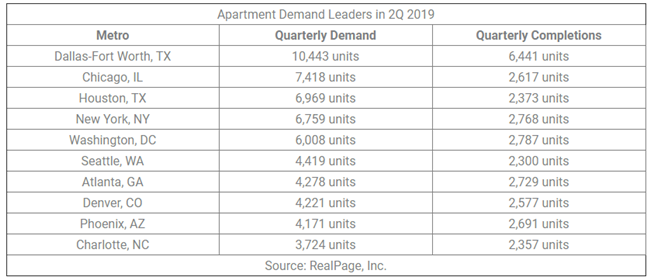
The fast-growing Dallas-Fort Worth area led the nation in apartment-leasing activity during the second quarter, as renters snapped up 10,443 units. Net move-ins also reached robust levels of more than 6,000 units in Chicago, Houston, New York and Washington, D.C.

With demand proving so strong in the second quarter, occupancy tightened despite the delivery of quite a bit of new product. Occupancy climbed to 95.8 percent in second quarter, up from 95.4 percent a year earlier.

Rents Rise with Phoenix and Las Vegas leading

Rents for new leases increased 1.8 percent during the second quarter, which normally is when pricing moves most rapidly during the course of the year. Rents are up 3 percent from year-ago levels, reaching an average of $1,390 per month.

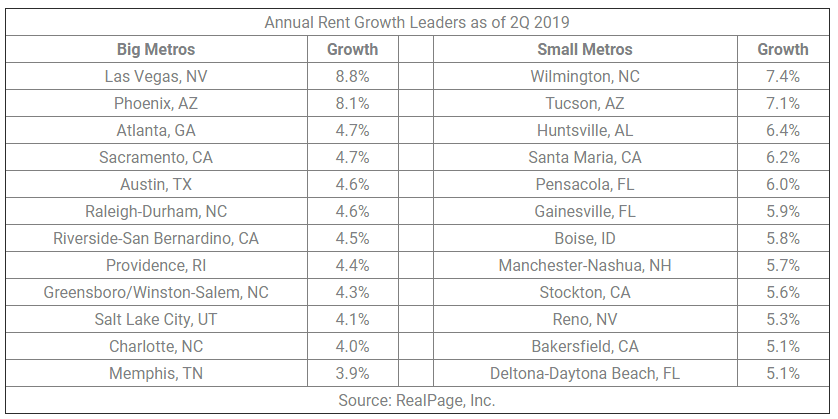
Among the country’s large metros, local rent-growth leaders are Las Vegas and Phoenix, with each area posting annual price jumps of more than 8 percent. At the next tier of performance, rent growth comes in at roughly 4 percent to 5 percent in a long list of markets: Atlanta, Sacramento, Austin, Raleigh-Durham, Riverside-San Bernardino, Providence, Greensboro/Winston-Salem, Salt Lake City, Charlotte and Memphis.

Surging Demand for Apartments in Second Quarter of 2019
Houston’s performance is the weakest among big metros, with rents in the second quarter up just 0.1 percent from the pricing seen a year earlier. Slight rent cuts are occurring in a few small markets: Des Moines, Iowa; Fargo, N.D.; College Station, Texas; Baton Rouge, La.; and Santa Rosa, Calif.

Building in the U.S. apartment sector remains at three-decade highs. Market-rate apartment properties under construction contain more than 418,000 units that will be finished during roughly the next 18 months.

Dallas-Fort Worth remains the country’s leader in apartment construction activity. More than 34,000 apartments are on the way in North Texas, compared to about 20,000 units in Washington, D.C., the second-busiest metro for building. Near-term deliveries will run around 18,000 units in Los Angeles and Houston.

“While the apartment sector’s performance has been terrific of late, the amount of product under construction does point to some near-term risk,” Willett said in the release.

“Most economists are anticipating a slowdown in economic growth, cooling support for housing demand. It would be tough to maintain price growth with so many new properties moving through initial lease-up at a time when demand has weakened.”

About RealPage

RealPage is a leading global provider of software and data analytics to the real estate industry. Clients use its platform to improve operating performance and increase capital returns. Founded in 1998 and headquartered in Richardson, Texas, RealPage serves more than 12,100 clients worldwide from offices in North America, Europe and Asia. For more information, visit http://www.realpage.com.

https://www.businesswire.com/news/home/20190701005020/en

6 Ways to Make Your Rental Property Kitchens Feel Bigger

6 Ways to Make Your Rental Property Kitchens Feel Bigger

Keeping tenants happy with a nice kitchen is important to rental property owners, so the maintenance tip from Keepe is about 6 ways to make your rental property kitchens feel bigger.

Rental-property kitchens can be small, and tend to feel cramped.

Luckily, there are ways to make your kitchen feel bigger without physically expanding the space!

Small fixes like a paint change or adding additional lighting can make a huge difference in the way your kitchen looks and feels.

Here are 6 ways to make your rental property kitchens feel bigger:

No. 1 – White paint

White paint reflects light, which makes a room feel bigger and brighter. Try matching the countertops (and table, if appropriate) with a similar light color. It also helps to repaint bulky items to match the walls, which will camouflage them. If the room stays within a relatively similar color scheme, it creates an illusion of infinite space because the eye doesn’t have to jump from light to dark so often.

6 Ways to Make Your Rental Property Kitchens Feel Bigger
White paint it creates an illusion of infinite space in the kitchen because the eye doesn’t have to jump from light to dark so often.

No. 2 – Patterned floors

Horizontal lines make your eyes move from one side to the other, creating the illusion of a wider and more open space. Hardwood floors are an option for this. Try aligning the panels horizontally when looking from the entrance of the room. Any other floor style with a similar pattern could have the same widening effect.

No. 3 – Lighting

A dimly lit kitchen can make it feel small and gloomy, while a brightly lit one feels open and welcoming. Try to encourage sunlight to enter the room if you can. Think about replacing any curtains with sheer curtains, or maybe removing them altogether. Pendant lights can be used as a source of lighting and a beautiful focal point for the room. Lights above, below and even inside the cupboards can help create the illusion of a bigger room by highlighting a once-dim area.

No. 4 – Shiny appliances

By switching appliances for newer, shiny ones, the light reflects off of the appliances, furthering the illusion of an “infinite” space. The brighter appliances also highlight the feeling of having a fully upgraded kitchen. Maybe this is one reason why stainless steel has never gone out of style!

No. 5 – Lightweight furnishing

Furnishings are always a focal point when it comes to kitchens. When looking to create the illusion of a bigger space, slim and lightweight furnishings are the way to go. Lightweight furnishings give the room a more airy feeling and also helps with the actual physical space of the room. Some options for this include kitchen stools, narrow chairs or slim tables/counter tops.

it creates an illusion of infinite space because the eye doesn’t have to jump from light to dark so often.
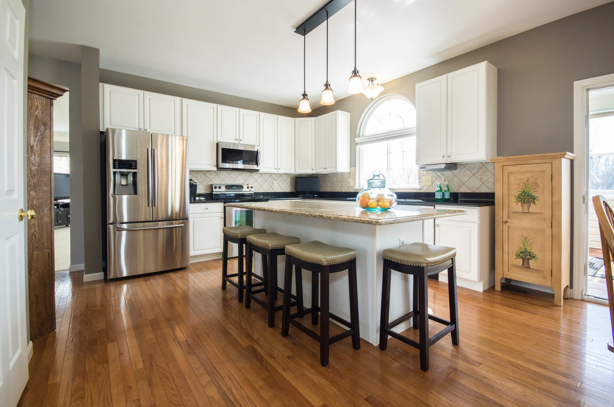
Lightweight furnishings like stools give the kitchen a more airy feeling and also helps with the actual physical space of the room.

No. 6 – Organization

As with any room, organization is key. In a smaller kitchen, storage and floor space can be scarce. Taking advantage of vertical wall space can help with removing clutter from countertops. Hanging shelves help with storage and add a sophisticated look to any kitchen. Think about adding magnetic holders for kitchen utensils, like knives, or pegboards for hanging pots and pans.

Here are other recent rental property maintenance Keepe posts you may have missed:

 How To Pick The Perfect Exterior Paint Color For Your Rental Property

4 Outdoor Flooring Options For Your Rentals

20 Easy, Affordable Maintenance Projects To Update Your Rentals

7 Tech Gadgets For A Safer And More Efficient Rental Property

5 Maintenance Tips For Long-Lasting Rental Carpet Flooring

Is The Water Heater At Your Rental Property Ready For The Big One?

7 Types Of Kitchen Countertops For Your Apartments

Which Cooktop Is Best For Your Rental Property?

A Guide To 4 Types Of Flat Roof Systems

6 Ways To Trash Your Apartment Waste Management Issues

Top 5 Apartment Maintenance Emergencies vs. Maintenance Requests

5 Tips for Preparing Your Apartments for the Summer Season

4 Air Conditioning Maintenance Best Practices For Summer

About Keepe:

Keepe is an on-demand maintenance solution for property managers and independent landlords. The company makes a network of hundreds of independent contractors and handymen available for maintenance projects at rental properties. Keepe is available in the Greater Seattle area, Greater Phoenix area, San Francisco Bay area, Portland, San Diego and is coming soon to an area near you. Learn more about Keepe at https://www.keepe.com


A Client’s First Experience with DSTs

Kay Properties and 1031 and 1033 exchanges and eminent domain options details

Sponsored Blog

Case Study: A Client’s First Experience with DSTs
By Betty Friant, Senior Vice President, Kay Properties & Investments, LLC

The client has invested in real estate since 1987. After experiencing difficulties in renting an industrial property she owned for the past 13 years, it was time to sell. Having sold many properties in the past, the concept of doing a 1031 exchange was all too familiar to her. She questioned whether or not to do it this time.

In consulting her financial advisor and CPA, she was informed of the tax consequences in selling this property. In hearing this information, she inquired into the best course of action for her tax situation. The advice was based on a simple question, “Do you want another rental property”? Emotionally, the client was tired of the responsibilities associated in being a landlord, in addition to everything involved in purchasing another rental. Logically, however, it was concluded that the best course of action was to purchase a replacement property and defer the taxes.

The search began for a replacement property, with the industrial unit settlement coming in 60 days. Within a few days, she was tired of looking through 100’s of listings provided by residential realtors and commercial properties, that did not meet the financial criteria. Despite these challenges, the search continued until she reached a point of frustration and considered paying the tax, rather than deal with this long process. Why invest in another property, doing the same things she has already been doing such as rent collections, paying bills, and solving all sorts of problems? She called her commercial broker to discuss the situation, who said the DST’s sound like the perfect solution for her situation.

The client was then introduced by the commercial broker to Kay Properties and Investments, LLC. She was hesitant at first, not knowing how DST’s (Delaware Statutory Trust) work. Taking it upon herself to read all of the educational material and asking many questions, the client studied DST’s prior to the settlement for her warehouse.

Client spent six weeks prior to her warehouse settlement, immersed in numerous PPM’s and in study mode with Kay Properties. In the end, the client was grateful to Kay Properties for helping her to avoid a huge tax consequence and educating her through various channels.

The client was able to successfully complete her 1031 exchange into a diversified portfolio of DSTs consisting of Class A apartments, Class B apartments, and also single tenant net lease industrial. The process from the close of the warehouse to the selected DST’s took place within a week! She was delighted to start receiving income from her DST investment because for the two and a half years prior, her relinquished property had been vacant and not producing income. She now enjoys sharing her new acquired knowledge with other investors, who are tired of property management, but still love the passive income real estate offers.

This is an example of the experience of one of our clients and may not be representative of the experience of other clients. Past performance does not guarantee or indicate the likelihood of future results. Diversification does not guarantee profits or protect against losses.

A Client’s First Experience with DSTs

About Kay Properties and Investments, LLC:

Kay Properties and Investments, LLC is a national Delaware Statutory Trust (DST) investment firm with offices in Los Angeles, San Diego, San Francisco, Seattle, New York City and Washington DC. Kay Properties team members collectively have over 114 years of real estate experience, are licensed in all 50 states, and have participated in over $7 Billion of DST real estate. Our clients have the ability to participate in private, exclusively available, DST properties as well as those presented to the wider DST marketplace; with the exception of those that fail our due-diligence process. To learn more about Kay Properties please visit: www.kpi1031.com

This material does not constitute an offer to sell nor a solicitation of an offer to buy any security. Such offers can be made only by the confidential Private Placement Memorandum (the “Memorandum”). Please read the entire Memorandum paying special attention to the risk section prior investing. This email contains information that has been obtained from sources believed to be reliable. However, Kay Properties and Investments, LLC, WealthForge Securities, LLC and their representatives do not guarantee the accuracy and validity of the information herein. Investors should perform their own investigations before considering any investment. IRC Section 1031, IRC Section 1033 and IRC Section 721 are complex tax codes therefore you should consult your tax or legal professional for details regarding your situation. This material is not intended as tax or legal advice.

There are material risks associated with investing in real estate, Delaware Statutory Trust (DST) properties and real estate securities including illiquidity, tenant vacancies, general market conditions and competition, lack of operating history, interest rate risks, the risk of new supply coming to market and softening rental rates, general risks of owning/operating commercial and multifamily properties, short term leases associated with multi-family properties, financing risks, potential adverse tax consequences, general economic risks, development risks and long hold periods. There is a risk of loss of the entire investment principal. Past performance is not a guarantee of future results. Potential cash flow, potential returns and potential appreciation are not guaranteed. For an investor to qualify for any type of investment, there are both financial requirements and suitability requirements that must match specific objectives, goals and risk tolerances.

Securities offered through WealthForge Securities, LLC. Member FINRA/SIPC. Kay Properties and Investments, LLC and WealthForge Securities, LLC are separate entities. This email, including attachments, may include non-public, proprietary, confidential or legally privileged information. If you are not an intended recipient or an authorized agent of an intended recipient, you are hereby notified that any dissemination, distribution or copying of the information contained in or transmitted with this e-mail is unauthorized and strictly prohibited. If you have received this email in error, please notify the sender by replying to this message and permanently delete this e-mail, its attachments, and any copies of it immediately. You should not retain, copy or use this e-mail or any attachment for any purpose, nor disclose all or any part of the contents to any other person. For your protection, please do not transmit orders or instructions by email or include account numbers, social security numbers, credit card numbers, passwords, or other personal information.

1031 Exchange Investors Are Choosing DST Properties for Passive Real Estate Ownership