Home Blog Page 137

Unemployed Renters Stand to Lose Lifeline of Federal Unemployment Benefits

Unemployed Renters Stand to Lose Lifeline of Federal Unemployment Benefits

Unemployed renters stand to lose the weekly federal $600 payments which, along with eviction moratoriums, have been a lifeline for many renters out of work, a Zillow analysis shows. Expiration dates loom for both measures.

More than 32 million people collected an extra $600 a week in unemployment benefits at the end of June as part of the Federal Pandemic Unemployment Compensation (FPUC) program, helping to keep missed rent payments only slightly higher than last year, according to a Zillow analysis.

Unemployed renters suffer financially 

Expanded unemployment benefits have had an incredible impact on unemployed renters households suffering financially from the coronavirus pandemic. However, missed rent payments have grown — 12.4 percent of renter households paid no rent during the first two weeks of July, up from 9.9 percent the previous year — but by much less than might be expected given record levels of unemployment.

“The boost to unemployment benefits from the federal government has played a crucial role in keeping renters afloat, and has helped insulate the rental market as a whole,” said Zillow economist Jeff Tucker in a release.

“The rate of missed rental payments hasn’t risen nearly as much as expected, and eviction moratoriums are keeping many of those unable to make payments in their homes. But those temporary measures are mostly expiring soon, so without some form of extension to the unemployment benefits boost or eviction moratoriums, we could see a widespread eviction crisis as summer turns to fall,”  he said.

Evictions in Milwaukee up 17 percent

The additional federal benefits are set to expire around the same time that many eviction moratoriums will end, potentially causing a wave of double problems.

Early signs of this wave have been seen in areas where evictions have resumed — evictions in Milwaukee in June were 17 percent higher than average, though some of that could be attributed to a backlog built while they were largely halted in April and May with a moratorium.

Contact-intensive workers are 28 percent of renters

Zillow’s analysis illustrates the potential difficulties unemployed renters might face. Contact-intensive workers — those in jobs that require a high degree of face-to-face and close physical interaction, such as healthcare professionals and front-line service workers — are present in about 28 percent of renter households, and have been vulnerable to both job loss and a risk of illness during the pandemic.

With the assistance currently provided, an estimated three percent of renter households with at least one earner in a contact-intensive occupation who is receiving all available benefits would spend more than half of their income on rent. If benefits from the FPUC program were to cease altogether, 41 percent would face this severe housing cost burden. Even if FPUC benefits were extended at half their current scale — $300 per week — just 14 percent would.

Renters with contact-intensive jobs who rent their homes typically have lower incomes than their homeowner counterparts — $32,000 is the median income for renters in these jobs, compared to $49,800 for homeowners.

These renters are also more likely to be the primary earners, so income shocks usually have a greater effect on overall household income.

Contact-intensive workers contribute 72 percent of household income in African-American households, compared to 53 percent in white households, even though the median household income of African-American households with a contact-intensive worker is 15 percent lower than that of similar white households. This means African-American renters are more vulnerable to the widespread income loss prevalent in these industries.

Almost a Third of Renters Failed To Make Full Rent Payments July 1

Landlord Must Pay Tenant Allergic to Neighbor’s Emotional Support Dog

Emotional support dog - Landlord must pay tenant whose allergies were triggered by neighbor's emotional support dog

A court has ruled that a landlord caught in a “pickle” must pay a tenant with dog allergies the value of one month’s rent because a nearby apartment was leased to another tenant with an emotional support dog, according to The Gazette, in Cedar Rapids, Iowa.

The apartment building had a no-pet policy, but the landlord made an accommodation required under Fair Housing rules for the tenant with the emotional-support dog.

After years of litigation, In a 4-3 decision, the Iowa Supreme Court overturned a district court ruling that concluded the landlord, 2800-1 LLC, shouldn’t have allowed the tenant to have a dog because of the other tenant’s pet allergies; the lower court then dismissed the case because the law governing accommodations for emotional-support animals wasn’t clear, The Gazette newspaper said.

Iowa Supreme Court Chief Justice Susan Christensen, who wrote for the majority, said the two tenants — Karen Cohen, who had severe allergies, and David Clark, who had the emotional support dog — had the landlord in a “pickle” trying to accommodate both of them.


Apartment emotional support dog and nearby tenant with dog allergy
Landlord was caught “in a pickle” trying to accommodate emotional support dog and a nearby tenant with allergies to dogs.

Should landlord have denied emotional support dog request?

However, the landlord, who isn’t identified by name in the ruling, should have denied the dog request because Cohen lived there first and the dog posed a direct threat to her health.

Christensen pointed out that this ruling is based on the specific facts of this case.

“Our balancing in this case is not a one-size-fits-all test that will create the same result under different circumstances, such as when the animal at issue is a service animal for a visually disabled person,” Christensen told the newspaper.

The court concluded that Cohen, who suffered allergic attacks, was entitled to her claims of breach of lease and breach of the “covenant of quiet enjoyment.”

The ruling shows Cohen has a “medically documented severe allergy” to pet dander that causes nasal congestion, swollen sinuses and excess coughing. Her allergic reaction is more severe when exposed to cats, requiring her to carry an epinephrine auto-injectable device to protect against anaphylactic shock.

She needed an apartment that didn’t allow pets and signed a lease from 2800-1 LLC on Nov. 11, 2015 for the term of July 2016 to July 2017. Cohen relied on the lease that stated no pets were allowed in the building.

On Jan. 18, 2016, Clark signed a lease to rent an apartment down the hall from Cohen during the same lease period, according to the ruling. Clark’s lease also included the no-pet provision.

On or around Aug. 23, 2016, Clark gave the landlord a letter from his psychiatrist that explained he had an “impairment in his ability to function.” The psychiatrist asked the landlord to allow Clark to have an emotional support dog to benefit his “health and well-being.”

The leasing and property manager notified other tenants in the building to see if anyone had allergies to dogs, according to the ruling. Cohen responded, detailing her allergies to dogs and cats.

The property manager then contacted the Iowa Civil Rights Commission and requested a formal agency determination, even though nobody had filed a complaint, the ruling states. The commission employee said the property manager and landlord should accommodate Clark and Cohen, instead of denying the request for the emotional support dog.

There was no formal finding by the commission regarding this situation, according to the ruling.

The first-in-time factor and emotional support dog

The Davis Brown law firm writes on https://www.jdsupra.com/legalnews/conflict-over-emotional-support-animals-36699/  that “The court noted that the first-in-time factor ‘tipped the balance’ in Cohen’s favor.” The court also explained that the first-in-time factor aligned with those of other courts that have rejected requested changes to a residential complex’s contract when those changes interfere with the rights of third parties.

“The takeaway: Landlords can and should consider this first-in-time principle in their analysis of accommodation requests where the well-being of two tenants conflict with one another. Though, landlords must remember the first-in-time principle is only one factor in their analysis,” the Davis Brown firm writes.

Landlord tried to work things out with emotional support dog

The landlord allowed the dog and assigned Cohen and Clark to use separate stairwells to keep Cohen free from pet dander, according to the ruling. The landlord also bought an air purifier for Cohen’s apartment.

The yearlong efforts were insufficient to prevent Cohen from having allergic reactions to the dog, and she had to limit the time she spent in her apartment. Cohen said she felt as if she had a permanent cold.

Then Cohen filed a small-claims action against the landlord for one month’s rent as damages. After a hearing, the court dismissed Cohen’s case, concluding the landlord made reasonable accommodations of both Clark’s and Cohen’s needs. There was no breach of contract of quiet enjoyment.

Cohen appealed to the district court, which concluded that the landlord made sufficient efforts that would justify denying Clark’s request for the emotional support dog, and dismissed Cohen’s claims because the law was unclear. The Iowa Supreme Court then overturned that decision.

Final Thoughts

The Brown Davis law firm on JD Supra writes, “While this landlord seemed to try its best navigating the waters of fair-housing law and conflicting tenant interests, such efforts were not sufficient.

“Hindsight is always 20/20, but perhaps this landlord should have continued to work through the interactive process with both tenants to find a goal that was acceptable to both tenants, should have informed Clark of the option of moving to another building, could have tried to obtain a formal opinion ruling from the ICRC (Iowa Civil Rights Commission) on, and/or should have sought legal counsel earlier in the process.”

Ultimate guide to assistance animals in rental housing


Resources:

Conflict over Emotional Support Animals – What are landlords to do?

Landlord must pay tenant whose allergies were triggered by neighbor’s support dog, court rules

Iowa Supreme Court sides with pet allergies over support animal in tenant dispute

Sign Up For Our Newsletter And Get Apartment News And Helpful, Useful Content Each Week.

* indicates required

Apartment Search Data Not Showing Exit from Cities

Apartment Search Data Not Showing Exit from Cities

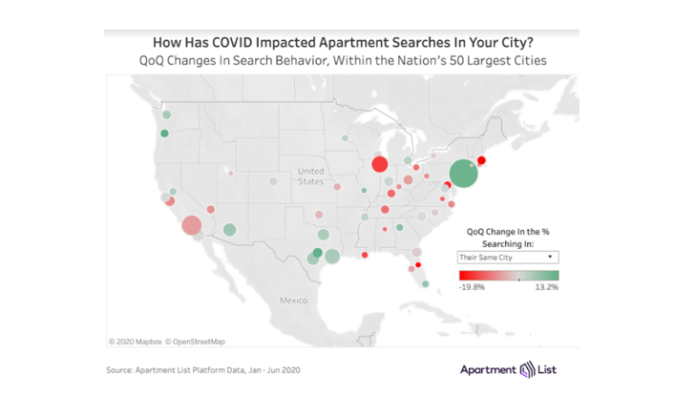
Apartment search data and behavior show subtle regional shifts, but no overwhelming evidence of a large-scale urban exodus, according to behavior on the Apartment List marketplace, the company says.

“While the coronavirus’s short-term impact on the housing market has already started to materialize in the form of softening rents, the long-term implications for the urban landscape are still far from certain and being hotly debated,” the release said.

“We’ve heard a lot of talk recently about an oncoming ‘urban exodus,’ but our data simply isn’t showing any evidence of such a trend at this point,” said Chris Salviati, Housing Economist at Apartment List.

“While there are certainly plenty of anecdotes about folks who have been spurred to make major moves out of the city since the onset of the pandemic, this isn’t something that we see happening at a large enough scale to really move the needle.

“Since the start of the pandemic, we actually see a slightly greater share of suburban renters looking to move into urban areas, rather than the other way around,” Salviati said.

Apartment search data report key findings

  • Nationally, America’s appetite for urban life remains strong. Since the start of the pandemic, apartment search data shows searches targeting higher-density cities rose from 33.8 percent to 35.2 percent.
  • In recent months, the share of users living in suburban areas and searching to move to large central cities increased, not the other way around. Suburb-to-central city searches are up 11 percent quarter-over-quarter.
  • Data trends vary by city. While users in New York and San Francisco don’t appear to be fleeing for the suburbs, those in Chicago and Boston appear more interested in suburban life.

apartment search data shows renters looking for something new

Renters looking for someplace new

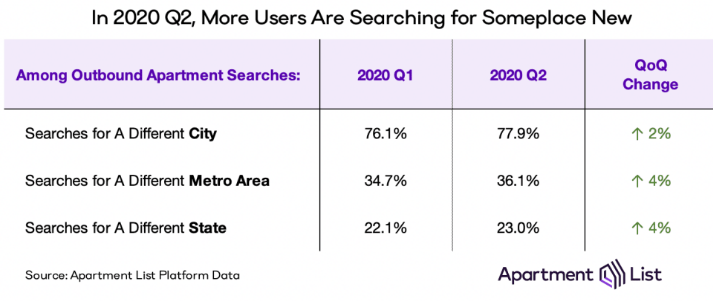
“We do see a slight uptick in the share of renters looking to move someplace new,” the study says, with 78 percent of renters “searching in a different city from where they currently live” in the second quarter, up from 76 percent in the first quarter of 2020.

“Similarly, the share of users searching in a different metro rose slightly from 35 percent to 36 percent, and the share searching out-of-state ticked up from 22 percent to 23 percent.

“But even if renters are a bit more likely to search in new locations, they are not eschewing density,” the apartment search data report says.

Summary

While stories of Americans abandoning cities proliferate, “our apartment search data present a far more nuanced account of COVID-19’s impact on housing choice,” Apartment List says in the study.

“That said, these aggregate statistics mask that in certain markets, we are seeing early signs of a shift away from downtown. In Boston and the Bay Area, for example, search activity is up in the more affordable suburbs. In New York City, however, the opposite is true. If anything, these data show that search patterns in the COVID(-19) era defy broad generalizations.

“In prior research, we have found that to the extent that the pandemic is incentivizing moves, it is doing so primarily among those who have fallen victim to the economic fallout of the crisis and who now need to find more affordable housing.

“In this sense, the pandemic’s impact on migration trends may not be so different from what we’ve seen in prior recessions. We also find evidence that a growing embrace of remote work will play a role, but this represents an acceleration of trends observed prior to the pandemic, and these shifts are likely to play out over years, not months. The long-term implications of this continually evolving situation are still far from clear — we will continue monitoring the data closely and reporting changes as they occur,” the apartment search data report says.

Renters Still Optimistic About Finding New Apartments

Sign Up For Our Newsletter And Get Apartment News And Helpful, Useful Content Each Week.

* indicates required

5 Tips for Child-proofing Rental Property as a Property Manager

5 Tips for Child-proofing Rental Property as a Property Manager

Here are 5 tips for child-proofing rental property to help property managers keep their rentals safe, according to Keepe the maintenance company.

As a property manager, there are lots of safety upgrades that you can do to attract prospective tenants. Baby/child-proofing your rental property is a simple yet effective way to not only attract families but protect your tenants from danger.

For most renters with kids looking to rent an apartment, safety is usually their topmost priority.

Thankfully, proper child-proofing upgrades often do not require a large investment.

Below are five ways you can childproof your rental property to protect your tenants’ children and prevent lawsuits.

Child-proofing rental property stairs

 If you have staircases within your property, you should ensure that the railings are locked in place to prevent pulling by kids.

Install stair gates at the top and bottom of each outdoor staircase to prevent falls. You should also make use of non-slip materials around staircase areas to prevent slip-and-fall accidents.

For child-proofing needs on a stairway inside a unit, consider allowing a tenant with very young children to install a baby gate (at their own expense) at the top of stairwells.

Window Locks

 A simple slip-and-fall accident can have a severe effect on a child. It is advisable that you ensure that your windows are made from strong materials.

Install secure window locks and latches on all windows within the property and units.

In states like New York, window guards must be installed in a building with 3 or more apartments if a child under 10 is a resident. Child-proofing your property windows are important for preventing children from opening and tumbling out the window.

Pools

 If your property has a pool in the garden, bear in mind that a baby can drown in just 2 inches of water. Fence pools off or cover them securely. Check your local jurisdictions’ rules on this and size of fence required.

Depending on the number of kids in your rental, you should consider installing a pool cover that prevents kids from falling in.

Most importantly, place warning signs around the pool area. A simple “Children under age five must be accompanied by an adult” sign will save you from lawsuits and liability.

In-Unit Hazard Prevention

Every year, thousands of children are hospitalized for injuries sustained at home. As a property manager, one of your goals is to make sure that your property units are safe for living.

For electrical appliances, make sure you keep all extension cables out of reach to avoid strangulation.

Provide plug guards to any sockets within reach to prevent children from putting their fingers in. Also, protect all cabinets that may be used to store harmful substances (such as bleach and cleaners) with  magnetic locks or adhesive strips.

Alarms and Detectors

 Make sure that all the alarms and detectors are properly installed and functional.

It is important that you regularly inspect your smoke alarms and carbon monoxide detectors. Even if there hasn’t been any incident, this simple step can save your tenants’ lives and save your property from unexpected danger.

In conclusion

Many property managers think that child-proofing would be a costly endeavor, and end up paying huge fines or facing liability lawsuits.

When renting your property to a family with kids, you need to take multiple precautions and safety investments. It is important to sit down with your renters and discuss their opinions about child-proofing.

4 Steps to Make Rental Home Carpet Last Longer

About Keepe:

Keepe is an on-demand maintenance solution for property managers and independent landlords. The company makes a network of hundreds of independent contractors and handymen available for maintenance projects at rental properties.

Keepe is available in the Greater Seattle area, Greater Phoenix area, San Francisco Bay area, Portland, San Diego and is coming soon to an area near you. Learn more about Keepe at https://www.keepe.com.

Sign Up For Our Newsletter And Get Apartment News And Helpful, Useful Content Each Week.

* indicates required

Window locks can be importing in Child-proofing Rental Property
Photo credit bukharova via istockphoto.com

How Property Managers Are Managing COVID-19 Cautions in Apartment Communal Spaces

How Property Managers Are Managing COVID-19 Cautions in Apartment Communal Spaces

How property managers, landlords and other apartment operators are making decisions on how to open apartment communal spaces.

By Holly Welles

It’s now time for many businesses across different industries to reopen their doors amid the COVID-19 pandemic. Unfortunately, it’s impossible to predict the future. That’s why most companies have heeded health guidelines while they remain flexible. There’s no one-size-fits-all approach — even for property managers.

Here’s a look at how property managers,  landlords and other apartment operators have decided to open apartment communal spaces.

What Does the CDC Recommend?

The Centers for Disease Control and Protection continue to release information geared toward company owners. They update their coronavirus rules and recommendations frequently, providing an essential resource for many. The CDC maintains a few guides that detail how to clean and disinfect various surfaces — whether or not someone has become sick.

A property manager who wants to reopen apartment communal spaces such as gyms, lounges and pools should reference these regulations when necessary. It’s also essential to keep employees informed about personal protective equipment. All businesses need to establish maintenance practices before they open, so they can keep everyone safe from the start. It’s far better to take time to prepare than to open immediately without precautions.

Landlords must keep their residents informed. It’s clear that many people don’t want to take any risks, preferring to reintroduce themselves gradually to public spaces. The more educated people are about the process, the longer these areas can stay open.

Government Regulations on Masks

Masks are another factor that many business owners have to handle. There’s currently no national government mandate on whether the public needs to wear a mask. Instead, it’s up to state jurisdictions to decide where and when they want their residents to do so. Those who own a few properties shouldn’t have to keep up with many different rules unless they manage facilities across county lines.

Property managers should make masks mandatory for their employees. It’s a move many essential businesses in the housing industry are making to reduce virus spread and exposure on site. While it may not be possible or enforceable to mandate masks for residents, it’s also smart to post signs reminding people of safety guidelines and requirements for community spaces.

All apartment operators should keep up with their state’s mask guidelines so they can make safe choices for their employees and residents.

Reconfigurations for Public Areas

It may be necessary for property managers to make alterations to communal areas. It’s essential to keep people separated so that COVID-19 doesn’t have a chance to spread from a carrier. Places like fitness centers and leasing offices may need to undergo a reconfiguration to keep everyone protected. The same goes for outdoor areas, where residents may gather by the pool, for example.

The National Apartment Association recommends that staff workspaces should maintain a 6-foot distance as a precaution. Property managers should also place markers to keep residents within specific boundaries when necessary. If there’s a clubhouse, it’s vital to rearrange tables and chairs so that they’re not too close together. The same goes for gym equipment.

These spaces should also feature hand sanitizer and other products to keep everyone healthy. Additionally, property managers should consider how they’ll clean every area before they make any changes. Property managers and their employees should work out a dedicated cleaning schedule.

cleaning apartment common areas and property maintenance cleaning covid 19

Reduced Capacity Procedures

Those who wish to reopen communal spaces must consider reduced-capacity procedures. Property managers who have already opened their public spaces have done so with extra caution regarding how many people can visit a location at once. Areas like pools and gyms should contain as few residents as possible to prevent any risks. It’s also easier to clean a space when there are fewer people present.

It’s up to property managers to figure out their state’s guidelines as to how many people can gather safely. Apartment operators need to implement these reduce- capacity regulations beforehand, so residents know what to expect. It’s also crucial for property managers to maintain these guidelines. If people can come and go to a pool or fitness center as they please, it’s highly likely that the virus will spread.

These reduced-capacity rules should be a top priority for anyone who operates an apartment complex.

Property Managers Should Take Several Precautions

As property managers reopen their apartment communal spaces, it’s essential to consider regulations on overall maintenance. Many rules are up to individual states, so these companies must consult their local area’s recommendations. Those who create a comprehensive plan can provide a safe environment for their employees and residents.

How to Manage Tenant Communication During COVID-19

How to Avoid Crossing the Line with Tenants’ Privacy 

Sign Up For Our Newsletter And Get Apartment News And Helpful, Useful Content Each Week.

* indicates required

Rental Has No-Pet Policy;  What Are My Rights Regarding Therapy Or Service Dogs?

Rental Has No-Pet Policy;  What Are My Rights Regarding Therapy Or Service Dogs?

The Ask Landlord Hank question this week for veteran real estate investor and landlord Hank Ross involves a landlord’s question about a no-pet policy and therapy or service dogs

Dear Landlord Hank:

I am in the process of re-renting a home in Puyallup. There is a no-pet policy in place at this property, as previous tenants with a dog destroyed some areas. Now that the house has been upgraded, with a no pet policy. What are my rights regarding the “therapy or service dog?” Can I ask for paperwork and/or anything else???

Dear Landlady Lois:

I am not able to give legal advice. Here is my understanding of the situation.

The federal Fair Housing Act requires landlords to make reasonable accommodations for tenants with disabilities, and allowing an assistive animal in a no-pet building can be such an accommodation. (See Fair Housing Amendments Act, 42 U.S.C. -3601-3619.) There are service animals that provide assistance to disabled people, like Seeing Eye dog, for instance, and there are emotional-support animals that have not been trained to perform a service, but are a companion animal. In this case, a letter from a medical doctor or therapist is all that is needed to classify the animal as an assistance animal.

My understanding is that when a person’s disability is not readily apparent, the landlord can request information to support the claim of a disability. This proof could be state disability benefits or a letter from a treating health provider stating that this person does indeed have a disability.

OK, so once it’s determined the applicant has a disability, they need to establish the need for an emotional-support animal.

If the need is not apparent, you can ask for supporting documentation that the person has a need for an emotional-support animal. The information or proof that the animal provides assistance should come from https://phenadip.com a qualified health care provider who is licensed or certified, is in good standing with their professional regulatory board, and has personal knowledge of the individual. Under the new law in Florida, a certificate or online registration from the internet, by itself, does not establish a disability or the need for an emotional=support animal.

What you can’t do is ask for a pet deposit, as the animal is not classified as a pet but as a medical device. You also cannot require information disclosing the actual diagnosis of the person, nor any medical records relating to that diagnosis. If the applicant is willing to provide that information, it would be at the applicant’s discretion.

I suggest, as always, that you do an in-depth background screening of all individuals, at their expense. If you have a good rental history, and prior landlords have said that the tenants were good tenants and that they would re rent to them, I’m normally satisfied with that portion of the screening. I like a 5-year residential history. If a tenant can’t control their service animal or emotional support animal or they damage property or are a nuisance, this is not something you have to put up with. Be very careful here though.

Sincerely,

Hank Rossi

No-pet policy and rules
Landlord Hank

Ask Landlord Hank Your Question

Ask veteran landlord and property manager Hank Rossi your questions from tenant screening to leases to pets and more! He provides answers each week to landlords.

  • This field is for validation purposes and should be left unchanged.

Do I Have to Paint and Replace Flooring for a Long-Term Tenant?

Sign Up For Our Newsletter And Get Apartment News And Helpful, Useful Content Each Week.

* indicates required

Landlords to Appeal Rent Control Case to Oregon Supreme Court

Oregon Supreme Court Hears Landlords’ Appeal of Relocation Ordinance

Portland landlords plan to appeal to the Oregon Supreme Court after losing the appeal of the Portland rent control ordinance in the Oregon Court of Appeals.

John DiLorenzo, attorney for the landlords who filed suit, confirmed the landlords plan to appeal the rent control issue to the Oregon Supreme Court.

The landlords argue the city ordinance is in conflict with state laws that ban rent control. On March 7, 2018, the Portland City Council made the ordinance permanent and extended its application to landlords who own as few as one rental unit.

DiLorenzo said the petition for the Supreme Court to review the case would likely be filed before it goes back to Multnomah County Circuit Court, pausing the lower court process until the higher court rules on whether to hear the case.

“We are talking about narrowing our appeal this time. We will likely dispense with the impairment of contract arguments since the leases which that argument pertained to are long since expired,” DiLorenzo said.

“Also, we may further our Sims argument, i.e., the city has no right to establish a cause of action for the state courts.  Here, the City of Portland has created a private right of action which can be enforced by tenants in Circuit Court.  We do not believe the City of Portland has a right to do that,” he said.

Rent control is a state-wide matter

“The legislature has determined that rent control is a matter of statewide concern and proclaimed that no local government may enact any ordinance that either ‘controls the rent that may be charged for the rental of any dwelling unit,’ ORS 91.225(2), or that is inconsistent with that prohibition, ORS 91.225(7).,” DiLorenzo said when the trial court’s decision was appealed to the Court of Appeals.

“Notwithstanding the legislature’s unambiguously expressed intent to preempt local rent control legislation, the city enacted the ordinance, which requires landlords to pay thousands of dollars to tenants upon the tenants’ demand when a landlord gives notice of a rent increase of 10 percent or more in a 12-month period—meaning the ordinance penalizes rent increases that cumulatively total 10 percent or more in any rolling 12-month period.”

Landlords to Appeal Rent Control Case to Oregon Supreme Court

Tenants not required to use the money for relocation

DiLorenzo explained why the ordinance is in violation of state law.

“The ordinance calls the payments ‘relocation assistance,’ but tenants are not required to use the money for that or any other designated purpose. Further, the requirement to make the payments is triggered solely by the size of the rent increase and is intended to limit those rent increases. By penalizing rent increases greater than a certain size, the ordinance is designed to control the rent that may be charged. Accordingly, the ordinance runs afoul of ORS 91.225(2) and ORS 91.225(7), which forbid the rent-control aspects of the ordinance.

“In a separate provision, the ordinance also imposes payment requirements when a landlord issues a ‘no-cause stated’ termination; that is, the landlord exercises her state-granted right to terminate a periodic tenancy by giving notice without having to state a reason for the termination. See ORS 90.427. Under the ordinance, a landlord cannot give notice and regain possession of the property at the end of the notice period, as the legislature has chosen to allow.

“Instead, the ordinance requires a landlord to give more notice than state law requires and also to pay thousands of dollars to the tenant before the landlord may regain possession. Given those requirements, the ordinance is incompatible and with and contrary to ORS 90.427 and is preempted for that reason.

“The ordinance has yet a third provision that state law preempts. Where a landlord and tenant have a fixed-term lease, the ordinance requires the landlord ‘to renew or replace an expiring fixed-term lease on substantially the same terms except for the amount of rent or associated housing costs’ or pay relocation assistance to the tenant. That requirement destroys the very essence of a fixed-term lease, which by definition terminates without further notice or obligations. The ordinance’s fixed-term provision is incompatible and cannot operate concurrently with state law authorizing fixed-term leases.

“Finally, the ordinance, in violation of the Oregon Constitution, impairs existing contracts because it applies retrospectively to contracts entered into before the ordinance was adopted.

“Before the ordinance, landlords could raise rent or issue a no-cause-stated termination without penalty. Tenants also had an obligation to vacate the premises upon expiration of a fixed-term lease. The ordinance dramatically changes the landlords’ rights and tenants’ obligations by imposing significant penalties if landlords exercise their preexisting contractual rights, unconstitutionally impairing the parties’ contracts,” DiLorenzo said.

How Rent Control Limits Owner Profits and Maintenance in Portland, Seattle

Sign Up For Our Newsletter And Get Apartment News And Helpful, Useful Content Each Week.

* indicates required

Why Is The Internet In Apartment Complexes So Bad?

Why internet in apartment complexes so bad is a complicated question so here are some explanations.

Sponsored Blog

Can A Multifamily Internet System With WiFi Installation Be The Ticket?

By Hart Steen

An Educational Series for Apartment Owners Part 1 – Modem Service

A busy, always connected lifestyle demands the Internet. So much so the FCC, in a 2016 ruling, deemed the Internet a utility and it will be regulated as such. Regardless of government policy, the fact remains, access and experience are extremely important to consumers. Internet, as a utility, is an important distinction in today’s marketplace. Most Internet users experience a “Dirty City Water” Internet experience because its poorly maintained and rarely managed by monopolistic Internet Service providers (ISPs ) leaving a bad taste in the consumers mouth. Most agree the Industry needs improving; just as there are quality options for drinking water in the market, there are quality options for Internet. A “Glacier Water” Internet experience stands apart from typical Internet offerings for the residents, simultaneously generating revenue, increasing brand loyalty and maximizing retention for an apartment owner.

Comparing “Dirty City Water” to “Crystal Clean Glacier Water” is like comparing best-effort Cable Modem or DSL services (a.k.a. Modem Service) to a professionally managed, highly reliable, Fiber Backed Property-Wide WiFi service (a.k.a. Pure Internet). When a network is installed and managed correctly, the true essence of “Pure Internet” can be achieved; if not, the likely experience is the status-quo (or worse) that plagues American Internet services today. Most have always known they’re paying too much for an inconsistent, inferior service and it ‘s no secret Big Box Internet Service Providers (ISPs) are often ranked last in customer surveys. What’s not as intuitive is why.

4 Pillars of Slow Internet

Internet Speeds – Pillar 1

Calculating Internet speeds are often misunderstood by consumers. The industry has done a fabulous job of masking what’s important in achieving true speeds and a pure Internet experience. But why is interest in apartment complexes so bad?

A) Internet Speeds: Bad news! Buying more Mbps (Megabits per Second) seemed the answer to faster Internet speeds but that’s not exactly true. Purchasing more Mbps buys capacity not speed. Speed, how we comprehend it, is perceived in distance; like with miles per hour (MPH). Contrary to most beliefs, Internet speed is more accurately expressed as latency. Lower the latency, increase webpage load times. Isn’t that what we are looking for?

Picture the Internet like a freeway; purchasing more Mbps buys you more lanes not a higher speed limit. Unknown by most, your lanes still move at the speed of your latency regardless of how many lanes you buy. Latency is something most ISP’s won’t discuss. They cannot control, manage or sell lower latencies effectively; instead they sell you more slow lanes of capacity. What’s important to note here, and this confuses a lot of people, is that your internet isn’t any faster from 1 Mbps to 5 Mbps, or however much bandwidth your connection has. Your data is just transferred to you at a faster rate because more data can be sent at the same time. It’s more efficient, making your internet perceptually faster, not technically faster.

Your true Internet speed is the relationship between bandwidth (how much) and latency (how fast); not just bandwidth alone.

B) Over subscription: Modem Services are notorious for over-subscription ratios that routinely surpass 100 to 1. Meaning, 100 people are sharing the same allocation of bandwidth on the same internet pipe. There’s nothing inherently wrong with oversubscribing bandwidth; most people aren’t fully utilizing their bandwidth. Further, it increases the cost efficiencies of a network. However, when over subscriptions are high, it causes peak period slow-downs for end-users. One hundred (100) households with 5 devices or more, all sharing the same internet pipe, is simply too much.

C) Symmetrical Speeds: Many forms of Internet, namely modem services, have asymmetrical speeds. This means higher downloads speeds than upload speeds. It’s common to see a 10-to-1 ratio. This can be a problem for live communication applications; like video streaming (e.g. Skype), VoIP or chat. If you are... running any real-time applications like Microsoft Office365, VPN, VoIP, video conferencing, web conferencing, and/or you have a need for large file transfers, you will benefit from high speeds in both directions.Read more about this here. A growing number of businesses facilitate remote work from home. Hence, the virtual work force is rapidly growing; it’s imaginable to see a majority of the workforce working remotely in the future.

D) Privacy: Make no mistake your Internet habits are being monitored, recorded and stored. With recent Internet laws being passed, it’s now legal for ISPs to collect and sell ALL of your browser history and other relevant data. IT professionals can dodge this; however, for the rest of us, prepare to share your online habits with your ISP.


Why Is The Internet In Apartment Complexes So Bad?

Managed Internet & Support – Pillar 2

A) Dirty Data: Modem services are a WIDE OPEN pipe from the Internet to your home. This means that hackers have the ability to penetrate your network; the only obstacle is your $60 router from Best Buy, configured and managed by you. The average Joe is expected to configure their router in an attempt to protect against these professional hackers. Managing a network at this level is not for the faint at heart, yet we have been relegated to figuring-it-out. Millions of Americans are on-their-own which creates legitimate risks and concerns.

B) Customer Support: Unfortunately support from most Big Box companies only exists to maintain THEIR wiring and equipment. If they confirm it’s not THEIR fault, you’re on your own. In some cases, you may find they offer expensive network support to help guide you through the perils. However, most ISPs simply confirm the signal to your modem and don’t support it further. A perfect storm of bad equipment, bad wiring, monopolistic attitudes and profit-first philosophies fuel this lackluster and inept support experience. In the end, customer support falls short of par for most ISPs. Without competition, there’s no incentive for internet providers to improve infrastructure. These massive telecom companies create a bottleneck in the last mile of service by refusing to upgrade critical infrastructure. And they can charge exorbitant prices for the sub-par service while they’re at it.

C) Best Effort Service: Unfortunately, most Americans are relegated to “Dirty City Water” because they have “best effort” modem service as their primary residential connection. Somehow the industry has thrived by offering lowest-common-dominator-services. They even named it similarly, Best Effort. The ISP is saying they will try their best to provide what you paid for. Only, there are no Internet-quality-police to hold them accountable. Worst yet, there’s often a monopoly or duopoly which creates very little incentive to improve quality of service and customer support. That’s why the industry’s biggest providers are routinely voted the most hated in the U.S.

D) Security: You are on your own in terms of security. Relying on virus protection or your operating systems firewalls can certainly help stop certain types of online threats. However, you are still in grave danger from hackers. Without professional management the network is left with a Mom and Pop security environment that lamely attempts to thwart determined threats.

A study by CNET.com stated …

all 14 top home routers had critical security vulnerabilities that could be exploited by a remote adversary and could lead to unauthorized remote control of the router.

Wifi Design & Configuration – Pillar 3 

A) WiFi Installation & Design: In a small space it may appear like WiFi design doesn’t really matter and there isn’t enough square footage to cause coverage issues, right? Not exactly, the WiFi radio frequencies (RF) from neighboring routers are all fighting for the same limited air space, with zero synergy. This is compounded in a multifamily environment; more WiFi interference means slower connections and decreased security, effectively creating a hodge-podge design that is counter-productive to Pure Internet.

B) Configuration: Configuring a home router may seem intuitive if you know the basics. However, your home network is inherently disadvantaged because of the limited-feature-set found in a home router. They usually don’t include enterprise firewalls, bandwidth shaping, black lists and interference mitigation. The lack of features vastly limits proper security. Even if an enterprise router was used, the weakest link is still the novice home network engineer. A BBC article titled How easy is it to hack a home network? puts novice configurations and home networking blunders into perspective.

I found out just how severely compromised my home network was in a very creepy fashion. I was on the phone when the web-connected camera sitting on the window sill next to me started moving. The lens crept round until it pointed right at me. I knew that the attackers were on the other end watching what I was doing, and potentially, listening to the conversation.

Why is internet so bad in apartment complexes

Internet & Wifi Installation – Pillar 4

A) Competition: It’s all about the bottom line, thus your local ISP plans on using their antiquated wiring infrastructure for as long as possible. Most ISPs enjoy monopolistic environments. They won’t ordinarily upgrade unless there are extenuating forces. For example, in Google Fiber territories, local ISPs magically upgraded their fiber infrastructure to compete. Googles expansion has since come to a halt. Google knows if they expand to new cities the local incumbents will simply ramp-up services in that area. Atlanta is the perfect example — 99% of the country is not so fortunate to have a turf war driving down prices and forcing fiber upgrades. With little to no competition there’s no incentive to upgrade wiring and cannibalize profits. Unless something changes, most of America will have to wait for fiber — hunker down and get used to antiquated wiring for decades.

B) Antiquated Delivery: Bandwidth delivered over coaxial or copper wire is outdated, and, by association, the entire delivery process has technological bottlenecks. Your delivery is only as strong as the weakest link. Even with fiber-to-the-home (FTTH), your bottleneck may still be the wiring inside the home, fiber media convertor, router or modem. There are many places the delivery could be bottle necked when dealing with old wiring which is one reason internet is so bad in apartment complexes.

Most of America’s telecommunications infrastructure relies on outdated technology, and it runs over the same copper cables invented by Alexander Graham Bell over 100 years ago. This copper infrastructure made up of twisted pair and coaxial cables was originally designed to carry telephone and video services. The internet wasn’t built to handle streaming video or audio.

C) Over-the-Counter Routers: Most people either rent a modem/router or buy one and, while over-the-counter WiFi equipment is priced to sell, it does not provide premium technology. Bigger living spaces can experience dead spots and most turn to mesh equipment, repeaters or other consumer grade Whole-Home WiFi Solutions. These types of solutions commonly relay the WiFi signal, which slows speeds around 50% per hop.Internet is only as fast as the weakest link. Next to bandwidth, equipment is the most common area that contributes to bad Internet experiences. Underserved/Overpriced The typical Internet connection sucks and is overpriced. The average cost of residential Internet is around $75. Additionally, most pay $10 a month to rent their modem. The cost of Internet is not necessarily more than other utilities but definitely comes with the lowest quality and reliability. It is as essential as running water, but has all the problems of a do-it-your-self environment. Other utilities don’t pose the same dynamics. For most, the water pressure doesn’t drop every time neighbors run a bath. We pay $75+ for an essential utility service; we want the service to work; no headaches or training involved. From an antiquated infrastructure to user-error the entire experience is often a nightmare which is why internet in apartment complexes is so bad.

Next month: Part II How to Fix Slow Internet for Apartment Residents, Generate Revenue and Ditch the Cable Guys With a Multifamily Internet Service

Fiber Stream is a provider of futuristic high speed Internet and TV services. Fiber Stream’s target markets include Apartments, HOA’s, MDU’s, and senior living communities. Headquartered in Phoenix, Arizona, Fiber Stream is a nationwide Full Service Internet provider, offering Fiber to the Unit (FTTU), Fiber-Backed Property-Wide Wi-Fi, Gigabit Internet, Managed Wi-Fi solutions and IPTV. Fiber Stream developed one of the first Revenue Generating Internet Systems of its kind. For more information visit www.FiberStreamWIFI.com or call 1-888-644-9434.

Photos courtesy of FiberStream

Sign Up For Our Newsletter And Get Apartment News And Helpful, Useful Content Each Week.

* indicates required


Apartment Jobs Hiring Resilient in 2nd Quarter

Apartment Jobs Hiring Resilient in 2nd Quarter

Despite the uncertainty and economic damage caused by the COVID-19 pandemic, apartment jobs hiring was resilient during the second quarter of 2020, according to the latest report from the National Apartment Association.

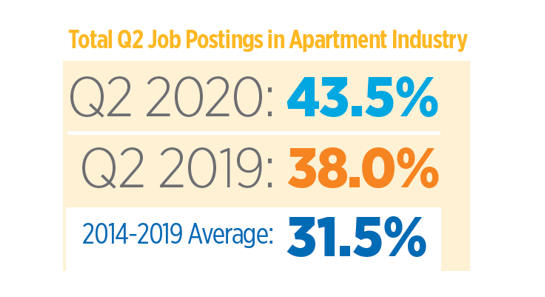
In the June report of the National Apartment Association’s Education Institute (NAAEI) Apartment Jobs Snapshot, job openings in the apartment industry comprised nearly 44 percent of positions available in real-estate sector jobs across the county.

This level of available apartment jobs is well above the 5-year average of 31.5 percent.

Many property management companies have increased hiring and staffing efforts in preparation for pent-up apartment demand due to stay at home orders.

Property manager jobs in high demand due to Covid-19

Property manager jobs were in high demand in June 2020
Charts courtesy of the National Apartment Association

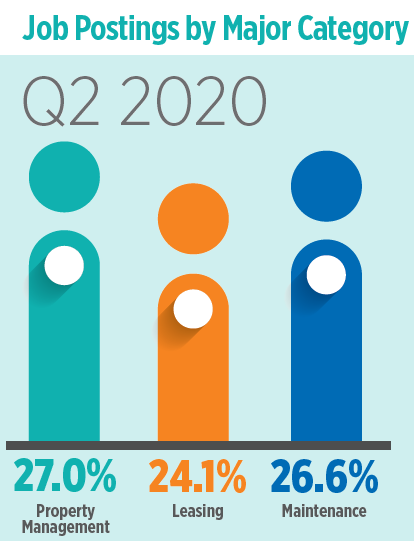
In terms of specific jobs, property-manager positions were the most sought after. Property management positions were in high demand during Q2 2020 and had the largest growth in demand, increasing three percentage points. Property managers are on the front lines for ensuring that all COVID-19 safety precautions are in effect and making residents feel safe in their communities.

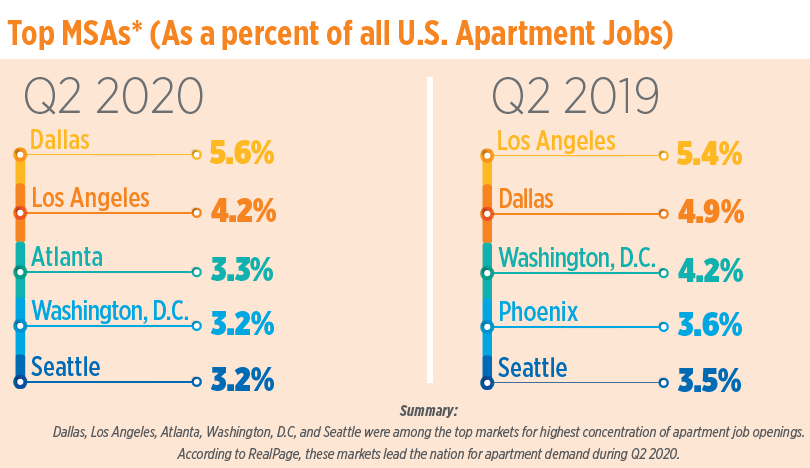
Around the country, Seattle, Dallas, Los Angeles, Atlanta and Washington, D.C. ranked highest for apartment-job demand.

Leasing momentum for student housing is increasing as universities plan to open on-campus classes, resulting in high demand for leasing consultants. However, this could be subject to change depending on pandemic issues in certain states.

Student housing

During the past 12 months ending June 30, 2020, demand for student housing management professionals was highest in Columbus, College Station, Chicago, Austin, and Tempe.

Leasing consultants were in highest demand, accounting for almost 14.0 percent of all student housing job postings. As of late June, leasing velocity for the fall semester has regained momentum, only 2.3 percentage points down from 2019. According to CBRE, demand for on-campus student housing has remained steady since 92.0 percent of international students have stayed in the U.S and 80 percent of American students studying abroad have returned home.

Summary:

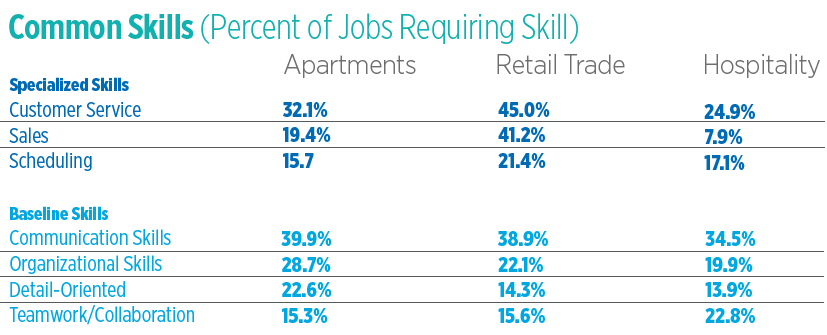
The apartment sector often competes with the hospitality and retail sectors for personnel with similar experience and skills. Customer service, communication, and organizational skills were among the most desired skills across all three sectors.

Common skills needed for working apartments

The hiring back of retail and hospitality employees has intensified competition for talent, particularly since the labor pool has begun to shrink. In June, the retail and hospitality sectors led the US in job growth. The leisure and hospitality industry hired back 2.1 million employees. The retail trade hired 740,000 people, nearly doubling the job growth it made in May.

Cities That Keep the Most Jobs During Downturns

Sign Up For Our Newsletter And Get Apartment News And Helpful, Useful Content Each Week.

* indicates required

Rent Control Still Not the Solution to Housing Affordability

California Voters Reject Rent Control

The pandemic is intensifying the housing affordability problems that have existed for decades, according to Growing Homes Together, a National Multifamily Housing Council (NMHC) resource center, however, they are firm in believing that rent control is still not the solution.

In a recent blog post, “Rent Control: The Wrong Prescription Then, The Wrong Prescription Now,” Growing Homes together points outA significant percentage of renters were already struggling before the pandemic. According to Harvard’s Joint Center for Housing Studies, nearly half of all U.S. renters were cost-burdened, meaning they are spending more than 30 percent of their monthly income on rent. A May 2019 report from the Federal Reserve highlighted that 40 percent of Americans didn’t have $400 available for an emergency bill. At a time when incomes have been decimated from this pandemic, these issues are only getting more severe.”

Not the time for politicians to try and advance rent-control agendas

“Naturally, housing providers and elected officials have been looking for smart solutions to keep Americans safe and secure in these trying times. Some, though, are attempting to politicize this moment to take advantage of the crisis and advance their own agendas,” Growing Homes Together writes in the blog.

“Namely, we’re seeing a resurgence of calls for rent control from activists bent on forcing property owners — who themselves are being challenged by this pandemic — to bear the brunt of this crisis. Groups such as Tenants Together have taken even more extreme measures and gone as far to call for rent strikes – yet again demonstrating that they are not above taking advantage of this pandemic to achieve their political goals. Rent-control proposals vary from state-to-state and across municipalities. Some call for cutting rents by 25 percent across the board; others follow in the footsteps of previous failed ballot initiatives already rejected by voters. All of them are built on the false premise that price controls are an adequate solution to a supply-and-demand imbalance.

“Now more than ever, it’s incumbent upon us to find smart solutions to the problems facing working Americans. Many housing providers have taken steps to work with residents to implement rent=payment plans, waive late fees, and freeze rents for 90 days. But the truth is that longer-term rent control would only hinder housing providers from fulfilling their own financial obligations and further endangering apartment communities.

“Make no mistake: Rrent control wasn’t a viable solution to our housing affordability crisis before this pandemic started. And it certainly isn’t any better of an idea now. Instead of pursuing misguided policies like rent control, there’s plenty our leaders in Congress can do to help residents and property owners. To start, Congress should create an Emergency Rental Assistance Program for those who have been impacted by the crisis and do not already receive federal housing subsidies. Additionally, mortgage forbearance protections should be expanded to match any eviction moratoriums to help property owners maintain their residences.

“We all have a role to play in overcoming this crisis. Housing providers will continue to work with residents to keep apartment communities safe and whole. At the same time, elected officials should reject tired and misguided policies like rent control and instead work towards meaningful solutions that address the challenges of residents and housing providers,” Growing Homes Together writes in the blog post.

About the author:

Growing Homes Together (GHT), a project of the National Multifamily Housing Council (NMHC), is a resource center designed to spark discussions at the state and local levels about policy solutions to improve America’s housing crisis. NMHC is a national organization of more than 1,100 member firms involved in the multifamily housing industry.

See related stories below:

What Is Rent Control?

How Rent Control Limits Owner Profits and Maintenance in Portland, Seattle

Sign Up For Our Newsletter And Get Apartment News And Helpful, Useful Content Each Week.

* indicates required