
Home Blog Page 136

What Is A Landlord to Do in These Difficult Times?

What Is A Landlord to Do in These Difficult Times

What is a landlord to do in these difficult times dealing with covid-19, moratoriums from city, state and federal governments along with rent not coming in regularly from tenants. Here are some thoughts from two Oregon attorneys that may help landlords.

By John Triplett
Rental Housing Journal

Many landlords have been without clear guidance on how to deal with late rent payments, tenants and laws during the moratoriums around COVID-19.

Rental Housing Journal asked a couple of expert Oregon attorneys recently to weigh in on the question: What is a landlord to do in these difficult times?

The attorneys, Bill Miner, partner-in-charge, with Davis Wright Tremaine in Portland, and David J. Petersen, partner, Tonkon Torp LLP and chair of the Real Estate and Land Use Practice Group,  each had several suggestions for landlords.

Under the current Oregon moratorium, a landlord cannot terminate a tenancy or threaten to terminate a tenancy for nonpayment of rent due based on Oregon law under HB 4213. So far, the moratorium has been extended to September 30.

Landlords so far have avoided being stuck between “a rock and a hard place” Petersen said, “because there’s both a moratorium on evictions for nonpayment of rent and a moratorium on foreclosure for nonpayment of mortgages, and they both expire September 30. “But unless tenants can start paying rent on October 1 (including back rent), or the foreclosure moratorium is extended, then landlords will be between a rock and a hard place at that time.”

“So for landlords and tenants both, and for their attorneys for that matter, we’re all kind of just in a holding pattern,” Petersen said. “Many tenants are not paying the rent. But many landlords are not paying their mortgages. And nobody can really do anything about it, but come October 1, assuming that the legislature or the governor do not act to do something to extend it or change it, as long as those two things move in lockstep with each other, then it’s not so bad.”

During this difficult time, Miner added, “I think you could probably ask 20 different landlords on the best tactics, and you’ll get 20 different answers. Alternatively, you can ask 20 different landlord attorneys and get 20 different answers.”

Landlords need income for more reasons than just paying the mortgage

Petersen said in the case of landlords, “They’ve got to upkeep the facility. They’ve got to eat. So it’s not a perfect situation, but certainly probably the biggest single expense landlords have is their mortgage. And they got some relief there because the foreclosure moratorium is big.”

So with the rent moratorium and foreclosure moratorium, “if those two things were to get out of whack, then I think things will tend to go haywire. That’s actually what we were worried about before June 30 when (the moratorium) was extended to September 30, because previously the moratorium was set to expire on July 1.”

What Is A Landlord to Do in These Difficult Times?
“So for landlords and tenants both, and for their attorneys for that matter, we’re all kind of just in a holding pattern,” David Petersen said.

So, what is a landlord to do?

Petersen said while not perfect, he would offer a couple of suggestions.

“No. 1, when October 1 rolls around, assuming things don’t change, the rent that’s going to come due from October 1 onward is presently due. The deferred rent, or the pre-October 1 period, is not due until April 1, 2021, so landlords would be best positioned to make clear with their tenant that the money they start receiving on October 1 is applied to past-due rent if you can achieve that because then you’ll be both collecting the past-due rent and you’ll be collecting the current rent, assuming of course the tenant can pay.

“On the other hand, if it’s just applicable to the current rent, then you still got this nut for the past-due rent that you’re not going to collect until April.

“So it’s advantageous for the landlord starting October 1 to apply payments first to the past-due rent. So if you can achieve that, that’s good. The way the law is set up in Oregon is that the tenant has to specifically notify the landlord what the rent applies to, the payments apply to, so if they don’t then the landlord would be free to apply it to past-due rent. So that’s the first thing that I would suggest,” Petersen said.

Miner also offered a couple of suggestions.

“If landlords have instances where they have tenants who they know can pay, but (those) people are taking advantage of this bill, the landlord should contact their legislator and give them specific examples of tenants who are taking advantage of the bill.

“To be fair, I haven’t heard of a lot of tenants who are acting in bad faith. But I think we need to know about it if there are, because there’s no means-testing to this bill. It just says: ‘you don’t have to pay rent.’ It doesn’t matter if you can pay, it doesn’t matter if you’ve been negatively affected by COVID-19, or if you’re just being a jerk. So that’s No. 1. Legislators need to know if there are bad apples out there.”

What else is a landlord to do?

“There’s nothing in the bill that says you can’t remind tenants of what they owe,” Miner said. “It’s okay to continue to send a monthly statement saying, ‘Here’s what you owe. Here are all of your utilities.’ You can send those types of statements.”

Other than that, “a landlord needs to wait until the end of September,” when landlords can send notice in October.

What Is A Landlord to Do in These Difficult Times?
“So it’s advantageous for the landlord starting October 1 to apply payments first to the past-due rent. So if you can achieve that, that’s good,” said Bill Miner.

If a landlord asks a tenant to provide information concerning how they plan to pay the rent or a rent payment plan, Miner said that “offering a payment plan and suggesting a payment plan is perfectly okay.” However he said landlords should avoid making any types of threats, or doing anything that sounds like a threat, to the tenant. He said landlords should be very careful especially to stay away from any threats suggesting what may happen after September 30.

Miner says that approaching tenants in a collegial fashion – “We’re assuming that you’re not paying because you’re being negatively affected by COVID, right? We understand these are hard times and trying times … is there some type of repayment plan that we can work out?” will get the best response.

Put the magic language in any agreement with tenants

Put the magic language in any agreement with tenants
“If landlords already have a lease amendment in place that they entered into with their tenants, pre-June 30, and that amendment is stricter for the tenant than the current rules of the current moratorium, chances are it’s unknown whether or not that will be enforceable,” Petersen said.

“If a landlord does end up working out a repayment plan, it’s of course important to get that in writing, get it signed by both parties,”  Miner said, adding that  HB 4213 set aside some of the  waiver arguments found in Oregon law.

“I think if you have a payment plan, you’re still going to want to put the magic language in there that preserves a landlord’s right to bring an action down the road once a landlord is able to bring an action.”

Some attorneys may advise landlords that if they accept partial rent payments, such action could permanently change the amount of rent due in the lease. However, Miner said, “right now the bill suspends the waiver provisions of the statute, which is ORS 90.412” The current language should protect a landlord from waiver.

“However, tenants’ lawyers are very creative in what they do. And so I think a tenant lawyer could potentially find a run-around of that exception. So I would follow the rules that are found in 90.412 to be safe.

“A landlord should work with their attorney or with their management company to make sure that they have the magic language in there. And the magic language essentially being: ‘Hey, look, I’m accepting a partial payment. By accepting a partial payment I’m not waiving my right to send you a notice of termination in the future. And everybody agrees that I can, at some point in the future, actually terminate your tenancy if you don’t pay the balance.’ I think something along those lines. Most forms that management companies or attorneys use have that magic language included.” Miner said.

Petersen pointed out another issue involving current leases.
Security Deposits: Common and Costly Mistakes
Miner said landlords should avoid making any types of threats, or doing anything that sounds like a threat, to the tenant.

“If landlords already have a lease amendment in place that they entered into with their tenants, pre-June 30, and that amendment is stricter for the tenant than the current rules of the current moratorium, chances are it’s unknown whether or not that will be enforceable.

“The legislature tried to address that in the bill and said that basically any other private arrangement reached between landlords and tenants that was harsher for the tenant than this bill aren’t enforceable. I think it remains to be determined whether that’s legal – if they can interfere with a private contract in that fashion.

“So landlords who have lease amendments in place that attempted to deal with COVID-19 that were less generous to the tenant than the law, depending on the financial incentives, may have an incentive to try to enforce that nonetheless, but it remains to be seen whether or not that’s going to happen.”

Petersen added, “I suspect some landlord somewhere will test it, sooner or later, and then we’ll know.”

When asked about the ability to change private agreements, Miner added, “it is an important question of whether the Legislature is violating the Contract Clauses of the Oregon and U.S. Constitutions, especially when the Legislature is allowing individuals who may not be negatively affected by the emergency declarations. If a landlord ends up in a lawsuit alleging violations of the law, the landlord should talk with their lawyer about such an argument. Is the law Constitutional?”

Maintenance, habitability requirements and security deposits

Both attorneys agreed that landlords and property managers may want to put some maintenance or other improvements on hold unless it affects the landlord’s habitability requirements under Oregon law.

“Defer all the maintenance you can defer,” Petersen said. “You have very limited cash flow and you’re going to have to do triage. Non-essential building maintenance is probably just going to have to wait. I think a tenant would have a hard time complaining that their building is not being maintained to the standards that they’re used to given that they’re not paying the rent.

“There is an implied warranty of habitability in all residential property in Oregon, so the landlord is still going to have to meet that minimum habitability standard,” Petersen said.

4 Ways to Reduce Rental Property Maintenance and Repair Costs so what is a landlord to do
“Defer all the maintenance you can defer,” Petersen said. “You have very limited cash flow and you’re going to have to do triage.

As far as the maintenance side, “that’s another problem with this bill,” Miner said. “Landlords continue to have habitability requirements. They have to meet their duties for maintenance. But if you have improvements or something along those lines, (it’s) probably best to put those things on hold until we get through this pandemic,” Miner said.

Miner said landlords and property managers cannot use security deposits to help pay for maintenance or to help with mortgage payments.

Landlords and their mortgage payments

“Those security deposits are still security deposits that you are holding under the Landlord Tenant Act. If you are having a difficult time with making a mortgage payment, the best thing to do is to contact your mortgage provider and ask if you can get relief, especially if you’ve been economically harmed. Of course, the landlord as a borrower is probably going to have to actually show some economic harm.” Miner said.

Petersen said his advice for landlords who are not getting rent payments from tenants is “to get out in front of it with your lenders. Lenders right now, in our experience, my experience and my firm and my creditors’ rights group, is that lenders are also in a kind of a cooperative mood right now, and they’re perfectly willing to work out payment plans, forbearance agreements.

“Everybody likes certainty, and lenders particularly like certainty. If they can get something on paper that will give them an understanding of how they might get partially paid or when they’re going to get paid, in my experience most lenders are interested in that. So don’t wait until October 1 when you’re in default of your mortgage to call them. Get out in front of it and find out what they’re doing for borrowers now because you may feel alone, but there’s a gazillion similarly situated parties,” Petersen said.

Other kinds of lease breaches and the courts

Miner said while many people are focused on and talking about the non-payment of rent, “If there were other violations going on, or other breaches of the rental agreement, make sure that you’re enforcing those breaches.”

Petersen said the courts are operating in Oregon on a limited basis.

“So at least in theory, you could even get into court today on a lease-enforcement action if your tenant was in default for something other than nonpayment of rent, by violation of a use clause or hazardous materials, or who knows? Anything that’s not nonpayment of rent is still at least, in theory, something that could result in a termination of a lease and an eviction. Now, I highly doubt you’re going to get the kind of rapid response that you normally get for forcible entry and detainer, or unlawful detainer as they call it in California, but you still should be able to do it,” Petersen said.

The coming clash of political forces

political forces will challenge landlords in the future
Miner said, “At this moment in time, the tenant lobby is very powerful. They have the ears of important legislators and have been effective in getting their message out.”

Petersen compared some of the differences between commercial landlords and the residential side.

Petersen said on the residential side, there’s going to be an interesting clash between tenants who just can’t make up the past rent and the trend in Oregon to protect tenants.

“That’s going to be really interesting to see how that plays out. On the commercial side, I guess there’s a little less sympathy for the tenant that can’t pay its rent. I think we probably are going to see come April next year – or even October – a rash of evictions, tenants just walking away or filing for bankruptcy. Those are probably the three most likely outcomes.

“I think in the residential market is where the rubber’s really going to hit the road, because the legislature and the governor are going to be stuck between the financial reality for landlords who aren’t getting paid rent, and kind of the political winds that blow in favor of tenants,” Petersen said.

The legislature and the tenant lobby

Miner said, “At this moment in time, the tenant lobby is very powerful. They have the ears of important legislators and have been effective in getting their message out. They have also been able to use actions a few bad apple landlords to push through sweeping laws that has a negative effect on the vast majority of landlords. For whatever reason, the legislature is afraid to go up against these tenant groups.”
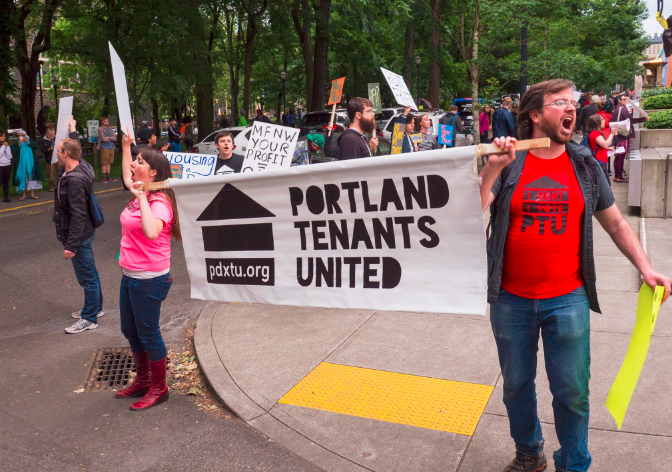
The tenant lobby is very powerful as landlords in Oregon know.
Photo courtesy of Multifamily NW

“I think it is really important for the landlords to get organized. Right now, they are not speaking with a cohesive voice. Landlords need to understand what their associations are doing and saying, because I do think that there have been some instances i where some pro-landlord organizations or individuals associated with those organizations are saying, ‘Oh, these types of changes are just fine.’ And so some of the pro-tenant legislators are saying, ‘Oh, look, we have at least one landlord that’s okay with this; therefore we’re covered.’

“Again, it’s important for landlords to know what’s going on with their associations. Ask the questions like, ‘What do you think of this? What are you doing to protect us?’ Ultimately I think we’re going to keep seeing the same types of proposals and disregard for the negative affects of landlords until we start fighting it at the Legislative level and in the Courts. How far can a Legislature go to challenge our existing contracts? How far can a Legislature go to lump all landlords in the same category? How are we expected to continue paying our obligations?’

“It’s one thing to have an emergency, and to be able to interfere with people’s contracts because of an emergency, but is the Legislature’s response to the emergency too broad?” Miner said.

“If there are people out there who are taking advantage of this, if there are tenants out there who can pay but are choosing not to pay for whatever reason, then they’re taking advantage of the situation. I would imagine that the governor and the legislature – that’s not their intent either.

“So we need to really narrow future laws to make sure we have common sense solutions, and the best way to do that is to get the landlords to the table,” Miner said.

Resources:

What is a landlord to do

David J. Petersen, partner, Tonkon Torp LLP, 503-802-2054 [email protected]
Chair of the Real Estate and Land Use Practice Group

William D. Miner, partner-in-charge, Davis Wright Tremaine, 503-778-5477 [email protected]

Landlords to Appeal Rent Control Case to Oregon Supreme Court

Lawsuit Seeks To Allow Landlords To Start Evicting Tenants

Sign Up For Our Newsletter And Get Apartment News And Helpful, Useful Content Each Week.

* indicates required

What Is A Landlord to Do in These Difficult Times
Photo credit via istockphoto.com

New Administrative Rules Proposed To Fair Access in Renting Ordinance

Portland's New F.A.I.R. Housing Ordinance

Some new rules are proposed for Portland’s fair access in renting ordinance so Ron Garcia offers his opinion.

By Ron Garcia
The Garcia Group

“We’re in the middle of one the greatest transformational periods of our lifetime. We get to write the future. And the city (of Portland) will be proudly at the center of that transformation.” On July 30, Mayor Ted Wheeler made this opening remark addressing a news conference (held online due to COVID-19 restrictions of assembly). It was staged to address the controversial deployment of federal troops stationed in Portland to stop the nightly rioting in front of the federal courthouse.

I believe his statement is revealing as to the nature of our current city council’s self-vision toward the leadership roles they have assumed as they navigate our city through uncharted areas of governance. Whether it’s an effort to install more green bike boxes, or to “de-fund” the police force, or requiring  landlords to pay large relocation fees to tenants in order to reclaim their property, the Portland City Council has been on a trek to re-engineer social norms for some time now.

New Administrative Rules Proposed To Fair Access in Renting Ordinance
Ron Garcia said, “As city leaders speak proudly of their dreams for our future, it is worth noting that FAIR has been roundly criticized by landlords and industry associations as over-reaching and onerous.”

And while most current news from city hall is focused on the frenzied chaos in the streets, there is still much happening behind its boarded-up doors and windows. On March 1, Portland adopted its Fair Access In Renting (FAIR) ordinance. This law landed on the community just as quarantine rules began to take effect and the pandemic absorbed our full attention. The FAIR ordinance became even further disregarded with the death of George Floyd and the escalation of protests and social unrest. Yet quiet, it is not dormant, and now this new law is actually growing!

The mayor’s bold proclamation to stand up for Portland community values came just 24 hours after the Portland Housing Bureau (under his command) proposed new, additional administrative rules to its FAIR law. These additions and the resolve to carry this ordinance forward are sure to antagonize Portland rental-property owners and create deeper divisions between tenants and landlords. These protests may not be as loud, but are likely still to come (if not on the streets, maybe in the courthouses left standing).

As city leaders speak proudly of their dreams for our future, it is worth noting that FAIR has been roundly criticized by landlords and industry associations as over-reaching and onerous. Many argue that it does nothing to alleviate our well-publicized affordable-housing shortage and, in fact, may hinder any real efforts to address the issue. This is a law that when written had claimed to seek professional input, but upon implementation summarily dismissed all the recommendations that were offered. And however it is read, it is obviously intended to re-engineer long-held established industry standards of practice.  It is an ordinance without precedence in any other city of America. Does that qualify it as an apt centerpiece of transformation? You be the judge.

What does FAIR do? It regulates two activities:

  1. Rental-housing application and screening procedures, and
  2. Rental-housing security-deposit accounting.

You may wonder if those topics are not already regulated; the answer is a resounding yes. Local, state and federal housing laws abound. So, you may ask, why must they be further regulated? Simply put, the authors believe that tenants are abused and routinely taken advantage of. They believe that the existing laws present insurmountable barriers to vulnerable segments of our society trying to find a home. They want to stamp out homelessness. Okay, that sounds “fair,” right?

Imagine if there were a movement to cure hunger – but it required that all restaurants in a city were to book all parties at all requested times in their eateries, no matter what style food they serve and at what prices they charge. If the diner was late, they could not give the table to someone in line until they allowed three missed mealtimes over the course of the day (effectively holding the table for a no-show). Imagine further that if the diner didn’t like the food or was allergic to the ingredients, the chef would be required to change the meal to fit their needs. Or if they couldn’t afford the bill, the owner would be required to pay the tab on behalf of the customer.

Not only that, imagine that all restaurants would be required to post all of the rules and regulations and options for all of the diners on all of their advertising at all times to insure that all the people who came into contact with it were made aware of all of their rights, including the penalties they might seek for any misunderstanding or oversight (long waits, no water refills, dirty silverware, and so on) that may occur from any actions or statements of any of their staff at the establishment.

Enter FAIR. This is how it treats landlords.  Are these rules made with good intentions? Maybe, but they’re all a bit Draconian and confrontational. Do I exaggerate? What is really bad about the Fair Access In Rentals law in Portland, you ask? Google it. The first thing you will notice is how confusing it is, and how many conditions it addresses.

Fair access in renting ordinance changes

On March 1st one section (of many) read: “If a landlord simultaneously advertised the availability of more than one dwelling unit in the same property, the landlord can fulfill the requirements (of the ordinance) by publishing notices at least 72 hours prior to the open application period for rental of the available dwelling units through a combined notice that specifies… ( and it then lists 7 specific conditions).

Today, the proposed rule adds more conditions: “If a landlord publishes multiple notices at different times or through different methods for the same availability and same dwelling unit, the open application period must be at least 72 hours after publishing the initial notice of dwelling-unit availability.”  Got it? Hmm. Me neither. The pamphlet the city publishes to explain how to screen a tenant is 24 pages long.

The rules for security deposits in the fair access in renting ordinance are even more challenging. They require specific depreciation schedules for damages that they define, and specific timelines when the value must be established with the tenant (prior to the “commencement date”), new provisions now proposed include: F. 3: “ Within one week following the termination date, as defined in Subsection B.10 of the Rental Housing Security Deposit Administrative Rule, a landlord shall conduct a final inspection to document any damage beyond ordinary wear and tear not noted on the condition report.” Sounds easy, right? Add to that the documentation process: “2. The landlord shall update the condition report to reflect all repairs and replacements impacting the dwelling unit during the term of the rental agreement that the landlord intends to apply against the tenant security deposit. The landlord shall provide to the tenant the updated condition report within 10 business days of repair or replacement…. “

The penalties for noncompliance are stiff.  There are eight sections to this rule (A through H). In Section C, they establish the time frames from which the new accounting methods they demand must take effect. Section C – 4. states: “For rental agreements entered into prior to March 1, 2020, PCC 30.01.087 (FAIR ordinance) subsections C.2, C.4, C.5, E, F, G and H apply…”  In other words, the law is essentially retroactive.

Does it sound a little scary? I repeat, Google it. The link I am working from here is this: https://www.portland.gov/phb/rental-services/news/2020/7/29/public-comment-proposed-permanent-administrative-rules-fair

As a property-management firm, at The Garcia Group, we are doing everything to digest, learn and implement the best practices to comply with the law. It’s our business. I recommend any self-managing landlord to take a class as soon as possible to learn what they need to do to implement this law. It’s either that or sign up to become (voluntarily or non-voluntarily) the test case in court. (It could be safer to volunteer for a drug trial.)

It’s not a new epiphany on this particular mayor’s part to push Portland’s trajectory in the path of daring social reasoning. Remember (it was about 10 years ago) when the green bike lanes were first painted on our streets by the city? At that time, they were challenged by ODOT as non-compliant with Oregon traffic codes. Drivers were confused. Many bicyclists worried they’d be more vulnerable. Tourists had (and still have) no clue what they mean…. But to their credit, the green lanes and boxes have remained, and we car drivers have learned to navigate around and through them as best as we can and to respect their directions.  Maybe FAIR will seem that transformational and tame in 10 years from now too. (Or not).

About the author:

Ron Garcia, C.R.B. is principal broker for The GARCIA Group and OR & WA Real Estate Service and Rental Property Management 503-595-4747 Ext. 4, www.GarciaGrp.com, 5331 SW Macadam Avenue, Ste 361 Portland, OR 97239

Portland’s New F.A.I.R. Housing Ordinance

Sign Up For Our Newsletter And Get Apartment News And Helpful, Useful Content Each Week.

* indicates required

What Is A Landlord to Do in These Difficult Times
Photo credit via istockphoto.com

Credit Bureau Report Reveals Pandemic’s Impact on Rental Industry

Credit Bureau Report Reveals Pandemic’s Impact on Rental Industry

The COVID-19 pandemic has wreaked havoc on our global economies. Some populations, though, including renters, have been particularly hard-hit. TransUnion recently conducted an intensive analysis to better understand the impact of shutdowns, illness, and quarantines on the financial health of renters. The results, published in June 2020, offer valuable insight for rental-property owners and operators on the pandemic impact on the rental industry.

Understanding renters

You most likely have a clear knowledge of your rental demographics. However, it’s good to have a more holistic picture, especially when considering national statistics. The National Multifamily Housing Council (NMHC) updated its rental characteristics in December. Here’s a snapshot:

  • More renters than homeowners own no vehicles or own only one
  • 27 percent of apartments are rented by single females, with 22 percent rented by single males
  • 11 percent of renters are married, 9 percent are married with children, and 13 percent are single parents
  • The highest percentage of renters (49 percent) are under 30 years old
  • 42 percent of renters telecommute, working from home at least a few times a month
  • Many renters (28 percent) make less than $20,000 per year

Paying the rent

Perhaps the most significant impact of the pandemic impact on the rental industry by COVID-19 is your renters’ ability to pay on time and in full. TransUnion’s May 2020 survey of renters whose income had been impacted supported this concern. It found that 32 percent of respondents were worried about their ability to pay.

However, according to the NMHC’s Rent Tracker, most renters are still making their payments. Only 3.1 percent fewer renters paid rent in April 2020 than paid in April 2019. This gap has decreased in May and June, as well. In May 2019, 96.6 percent of renters made their payments; in May 2020, this number was 95.1 percent, a decrease of 1.5 percent year over year. In June, the gap shrunk to 0.1 percent (96.0 percent in 2019 vs. 95.9 percent in 2020). This ever-improving trend is good news for property owners and managers.

CARES Act impact

The Coronavirus Aid, Relief, and Economic Security (CARES) Act offered several forms of financial aid that may have directly impacted your renters. In addition to one-time stimulus payments and enhanced unemployment benefits, the act provides special credit reporting allowances.

TransUnion’s survey asked consumers how they’d use their government stimulus checks. Thirty-eight percent said they’d use the check to pay current bills or loans, including rent. Some of those reported the check would allow them to pay only partial payments to creditors.

Tools like deferred payments and forbearance have always been options creditors could offer debtors. However, before April 2020, 99.6 percent of trades taking advantage of these tools were student loans. The CARES Act encouraged data furnishers to offer these allowances for other types of debt under the “Natural Disaster” code. Accounts with this designation are effectively ignored when calculating credit scores.

The government issued the CARES Act in late March, and in April, accounts reported with a Natural Disaster code grew by more than 1,100 percent. More than 4 percent of those accounts were non-student loans. TransUnion found that 3.8 percent of renters took advantage of these credit allowances on at least one account.

Renters’ spending trends

Another key indicator of renters’ financial stability is credit usage. Some experts believed renters would use debt to finance their expenses during the pandemic. This didn’t happen, though. Renters’ total debt balances decreased nearly 1 percent from January to April. Plus, balances on open credit-card accounts actually went down about 13.7 percent.

Even though personal income went down 2.2 percent in March, expenditures didn’t increase. In fact, personal expenditures decreased by nearly 7 percent in March, and nearly 14 percent in April.

These figures indicate renters are spending more conservatively, saving money where possible. TransUnion’s survey found that 60 percent of renters cut back on discretionary spending, 30 percent canceled subscriptions or memberships, and 23 percent cut back on retirement savings.

Pandemic impact on the rental industry and the bottom line for property owners

So what does this data mean to you as a property owner or operator? Well, despite the constant doom and gloom in the nightly news reports, things may not be as bad as they seem — at least for renters.

The percentage of renters who are making their payments is increasing every month. They’re spending wisely. Lastly, they’re taking advantage of allowances like forbearance and deferred payments. As a data furnisher, you’re not obligated to offer allowances to your renters. However, if you do, remember to add the Natural Disaster codes to these accounts to help your renters out in the long run.

To learn more about reporting your renters’ payment data to the credit bureaus, reach out to Datalinx. We’ve partnered with hundreds of property owners just like you to help them report consumer rental credit. We’d like to help you, too.

Please visit our website at www.datalinxllc.com, or contact us at [email protected] or (425) 780-4530 if you have any questions or need our assistance.

Do You Know Credit Reporting Rules and What The CARES Act Says?

Some Types of Rent Payments Show Less Decline During Pandemic

Some Types of Rent Payments Show Less Decline During Pandemic

Property manager Justin Becker shares some of his thoughts on why some types of rent payments show less decline during the pandemic.

By Justin Becker
Property Manager

Facing a pandemic has been difficult enough on its own, but its impact on the overall economy has only added to the situation.

As a more tech-savvy or advanced society, we have definitely proven that we are not going to take this lying down. The good news is that remote work and online commerce are surging.

Of course, this does not take away the fact that millions are currently unemployed, or that their $600 a week Pandemic Unemployment Assistance was being spent on the essentials like food and healthcare – and that was before it ran out July 31.

But what about housing?

Having a place to live is a necessity, so why is it that a significant number of people are unable to make their rent?

Clearly, many Americans are unable to work from home or have lost their jobs during this time. When this reality is coupled with the fact that many people were already struggling to afford their cost-of-living expenses, it is understandable that tenants, in these uncertain times, are having even greater difficulty paying rent.  In response to this, many states have adopted eviction moratoriums, and property managers have become more flexible with late rent payments or lack thereof.

For most, this information is not news, since much of 2020 has been spent on lockdown. However, what has suddenly changed is the U.S. government has officially put a stop to the Pandemic Unemployment Assistance.

The reality is that rent payments received across the United States have been steadily declining since April. According to Rentec Direct, rent payments are down 26 percent as of July 10, 2020, compared to rents received in March 2020. Furthermore, there has been a two percent decrease from June to July 2020. In fact, looking at these numbers alone, many are concerned that this is just the tip of the iceberg. As a result, COVID-19 has truly had an impact on the rental and real estate industries.

Rent payments decline

As briefly mentioned, there has been a steady decline in rent payments received, and this is particularly true when it comes to multifamily houses and traditional home rentals.

That said, the majority of people are still paying their rent – or at least making partial payments/adhering to financial-hardship agreements they made with their landlords. A particularly interesting thing to note here, however, is that a significant number of people who are renting mobile or manufactured homes are still making on-time rent payments. When you think about it, this makes perfect sense, as both manufactured and mobile homes for rent are more affordable. In other words, paying mobile-park-lot rent is generally only a few hundred dollars.

Similarly, manufactured homes for sale or that have been purchased, typically cost less than a traditional house. Thus, even if the home was financed, mortgage payments are more inexpensive.

That said, overall, there is still a clear decline in rent payments and mortgage payments due to COVID-19. Moreover, despite many in the industry being optimistic, the truth is the unemployment rate continues to fall, and very few people these days have more than three months’ worth of savings (only one in four Americans currently have three or more months of savings). Likewise, only 28 percent of U.S. adults have an in-case-of-emergency savings, and things have not been this bleak since the Great Depression.

Consequently, all people can do is wait.

The next few months will clearly demonstrate if people are able to make their rent without additional government assistance. The possible silver lining in all of this is that there continues to be talk of a possible second round of stimulus checks.

If another stimulus package happens, then tenants may just be able to get by for a few more months or hopefully until researchers come up with a viable vaccine. Ultimately, landlords and property managers are going to have to continue to find the best way to navigate the adverse effects of this ongoing pandemic.

Online rent payments show less decline

However, a caveat to COVID-19’s impact on rental and real-estate industries is that there has been less of an adverse effect on rent payments received online.

In fact, there has only been a 1.4 percent decrease in online rent payments, which started in June 2020. Prior to June, tenants who paid their rent online continued to do so, despite the pandemic. Many online rent payers are seemingly staying afloat because this particular payment method allows for direct transfers from financial institutions (both checking and savings accounts), and generally accepts credit or debit cards.

Besides easy online payments, many mobile or manufactured home communities allow their tenants to pay by phone.

Ultimately, both payment methods make it easier for renters to pay and to pay on-time. Thus, if you do not have a tenant portal or online-payment system in place, then it is time to change that. The statistics clearly show that you are more likely to receive rent payments this way, so what are you waiting for?

Whether you are a landlord with only a few tenants or a property management company with several mobile home parks under your belt, offering alternative payment methods like the ones discussed above will help ensure your business/rental community can survive COVID-19.

Moving Forward

As you can see, the futures of the real-estate and rental industries are unclear. We are still in the midst of a pandemic, with no indication that the administration can truly handle the task at hand. In only a few months, COIVD-19 has dealt a devastating blow to the American economy. Thus, as a property manager or landlord, you need to have certain securities in place.

Tenant screening services for landlords include criminal background checks. Some Types of Rent Payments Show Less Decline During Pandemic

If you are currently accepting new tenants, thorough tenant screening is a must, now more than ever. Obviously, if your prospective tenant has a history of debt or trouble maintaining their particular expenses, then now is not the time to turn a blind eye.

Along those same lines, your income-verification method should also be automated if it is not already. Before the onset of the pandemic, people provided false information and old pay stubs, which led to all sorts of problems. Through automated income verification, you can ensure that you receive only accurate and current information, which means you no longer have to scrutinize someone’s ability to pay rent in the future—everything you need to know is provided for you in a manipulation-free report.  Note, you should also run an automated income-verification report at the time of renewal with existing tenants.

Final Thought

COVID-19 has changed life as we all know it.  In fact, you would be hard-pressed to find an industry that has not been drastically affected.

Therefore, a certain amount of flexibility and understanding is required now. For instance, if you have tenants that are trying to end their lease early without penalty because they can no longer afford their rent payments, as a property manager, you need to know what rights your tenants currently have. Moreover, you need to be realistic with your expectations.

If your tenant is already struggling to stay afloat, the likelihood that you will receive any additional monies is very low (outside of keeping their security deposit). That said, former tenants can still influence your ability to rent to others in the future, so you should choose your battles wisely. This is just one example of the possible situations that you are likely to encounter in the months ahead.

Ultimately, all you can do right now is be as accommodating as possible and stay optimistic in the face of so much uncertainty.

5 Ways Property Managers Can Help Tenants Who Have Been Laid Off

About the author:

Justin Becker is a property owner in Michigan and has a passion for managing communities. He owns apartment complexes and mobile-home communities, and has been writing blogs for his properties for several years.

Sign Up For Our Newsletter And Get Apartment News And Helpful, Useful Content Each Week.

* indicates required

More Pain Ahead for the Rental Housing Industry Says Multifamily Outlook

Yardi Matrix multifamily outlook for the summer of 2020 shows more pain ahead for the rental housing industry

With the pandemic continuing to spread and additional federal funds to help uncertain, the second half of the year could mean pain ahead for rental housing and a challenging time for apartments, Yardi Matrix says in their summer multifamily outlook.

Rents are falling as COVID-19 weighs on the multifamily rental housing industry, and “more pain” is coming, the report says.

While the pandemic ended the long run of multifamily rent growth, expectations of widespread non-payment of rent did not materialize immediately. Federal unemployment and stimulus payments helped tenants make rent payments. The second half of the year, however, is more of an unknown.

Some summary points Yardi Matrix makes in the summer multifamily outlook report:

  • Tenants were subsidized by emergency unemployment aid, which ended in July with an unknown future. At the same time, initial hopes for a “V-shaped” recovery were too optimistic, and the effects of the pandemic will linger until the population is confident about health measures.
  • Rents turned negative in the second quarter for the first time since the aftermath of the global financial crisis. Property owners concerned with maintaining occupancy renewed leases with no rent increases. New luxury units are taking longer to lease up, as demand is concentrated on less expensive product. Rents are likely to drop further in the second half of 2020 before rebounding in 2021.
  • Multifamily capital remains abundant, but deal flow has slowed as underwriting future growth has become more difficult. Fannie Mae and Freddie Mac remain active, though with more conservative terms and higher reserve requirements. Investment activity dropped sharply, but opportunistic capital is circling, waiting for signs of distressed assets.
  • The pandemic will weaken the supply pipeline and delay projects that have not yet started construction.
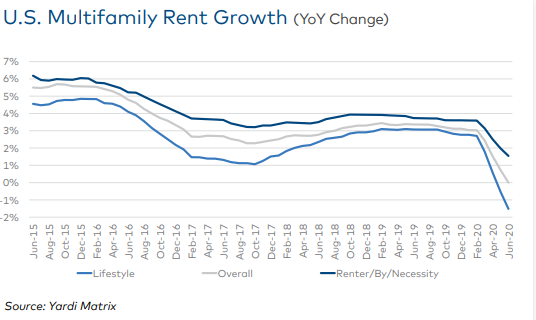
The Yardi Matrix multifamily outlook for summer 2020 shows more pain ahead for the industry
Chart courtesy of Yardi Matrix

“The rent situation is uneven at the metro level. Those that have had the largest decreases in rent growth include large coastal markets such as New York, Los Angeles, San Francisco and Silicon Valley, where rents were extremely high to begin with. Some residents are leaving (temporarily, for now) to avoid crowds and to get more space,” the report says.

“Other markets with rent declines in the second quarter include fast-growing locations such as Austin, Seattle, Miami and Denver. Those markets have had large amounts of deliveries of luxury product in recent years, and thousands of new units are coming online just as demand was diminishing due to the pandemic.

“With millions furloughed and employment less certain, demand is being concentrated in lower-cost apartments, which is showing up clearly in the rent numbers. At the end of the first half, rents of luxury lifestyle units fell 1.8 percent year-over-year, while working-class Renter-by-Necessity units were up 1.4 percent,“ Yardi Matrix says.

“Uncertain is the policy support that has allowed rents to remain fairly level to date. If the federal aid ends while unemployment is still elevated, that would be bad news for apartment rents,” the company says.

About Yardi Matrix

Yardi Matrix is a leading source for originating, pre-underwriting and managing assets for profitable loans and investments. Yardi Matrix Multifamily provides accurate data on 18+ million units, covering over 90% of the U.S. population.

Negative Rent Growth Year-Over-Year For First Time Since 2010

How to Manage Tenant Communication During COVID-19

Sign Up For Our Newsletter And Get Apartment News And Helpful, Useful Content Each Week.

* indicates required

Summer Humidity: 5 Steps To Find Mold Problems in Your Rental Property

5 Steps To Detect Mold Problems in Your Properties

With the humidity of summer hitting, here are 5 steps to check to detect mold problems in your rental property, the weekly maintenance tip from Keepe.

Mold can not only lead to structural damage to your property, but also cause serious health risks to you and your tenants if not caught and treated in a timely manner in your rental property.

Because of the severe and broad effects that mold can have, responsible ways to detect mold problems and evaluated them will require both physical examinations of your property as well as open communication with your tenants and/or on-site building manager.

Here are some tips to check during the summer humidity season:

No. 1 – Mold spores or dark spots

Let’s start with the most severe. If you can see mold, you likely have a significant problem on your hands.  Visible mold usually indicates just a small portion of a problem that lies underneath.

No. 2 -Water or moisture collection

Mold needs moisture and dampness to settle and grow. Elevated moisture levels in building materials can be another sign of possible mold.  A common complaint, for instance, may be a water stain on the ceiling.  Official assessment will require a professional with the appropriate materials to confirm whether it’s just a leak to be fixed, or mold.

No. 3 – Musty or damp smell

Not all mold has the same scent, so this may be hard to pinpoint. Generally, the scent of mold is unpleasant and as though something is moist in the area.  Some compare the smell to rotten wood or wet socks.  Bottom line—if it is not a common scent in the building or apartment, it should be investigated.

No. 4 – Flooding

If your building or any apartment within it has a history of flooding, you should keep a watchful eye on that space. If the flood was not handled by an appropriate professional, you stand the risk of growing mold on both a short- and long-term basis.

No. 5 – Health symptoms

There are several symptoms that could mean exposure to mold. These can be tricky, because the symptoms alone cannot prove a mold problem.  However, if you are evaluating all of the above factors on a periodic basis, any additional health reactions can help you determine whether you have a problem.  Signs of health symptoms from residents (or others who spend significant time on your property) that may be problematic:

    1. A lingering cold or flu-like symptoms;
    2. Frequent headaches that perpetuate and/or get worse;
    3. Nosebleeds;
    4. Difficulty breathing or other respiratory issues;
    5. Irritated eyes, skin, throat or nose.

5 Steps To Detect Mold Problems in Your Properties

Mold detection should be part of your regularly scheduled property inspections.

Keep in mind that problem areas can include places that have the most exposure to moisture and little access to light, such as basements, bathroom ceilings and ductwork of your HVAC systems.

However, if you notice (or your residents report) any of the listed red flags in the interim and detect mold problems, don’t wait to take action.  A mold problem will only get worse and cannot be solved by a simple cleaning in your rental property.

If you stay proactive, you will be better positioned to minimize your mold risks, keep costs down and keep your tenants happy.

The Best Appliances In Rental Property

About Keepe:

Keepe is an on-demand maintenance solution for property managers and independent landlords. The company makes a network of hundreds of independent contractors and handymen available for maintenance projects at rental properties. Keepe is available in the Greater Seattle area, Greater Phoenix area, San Francisco Bay area, Portland, San Diego and is coming soon to an area near you. Learn more about Keepe at https://www.keepe.com

Sign Up For Our Newsletter And Get Apartment News And Helpful, Useful Content Each Week.

* indicates required


Grateful To Be Debt-Free: A Client 1031 Exchange Success Story

Kay Properties and 1031 and 1033 exchanges and eminent domain options details

Grateful to be Debt-Free: Kay Properties Helps a Client Stay Debt-Free in their $1million 1031 Exchange into DST Properties for Sale

Kay Properties is proud to announce the successful completion of five debt-free DST purchases for a couple selling a single-family home in Southern California.  They were excited to be able to defer the accumulated capital gains and depreciation recapture taxes that they have accumulated over the many years of owning and managing the property by utilizing Internal Revenue Code, Section 1031.  In addition to deferring the taxes by successfully utilizing the 1031 exchange, the clients were grateful to invest and diversify into more passive real estate investments by utilizing the Kay Properties 1031 DST marketplace at www.kpi1031.com.

The Delaware Statutory Trust exchange investments were completed by Kay Properties and Investments team members Chay Lapin, Senior Vice President, and Matt McFarland, Associate.

Chay Lapin, Senior Vice President, stated, “Over a period of approximately 6 months, we helped educate the clients on the potential pros and cons of real estate, 1031 exchanges and DST structured investments.  Through ongoing dialogue and correspondence, the clients decided that they wanted to remain debt-free and take a conservative position in their DST 1031 investments.  By the time their single-family investment property sold and they officially entered into a 1031 exchange, we were able to work with them to select 5 different debt free DST properties, diversified across five states and across 4 different asset classes.”

Matt McFarland, Associate at Kay Properties, stated, “After successfully completing their DST 1031 investment purchases, the clients informed me that they were confident with their purchases and diversification profile of their 1031 DST portfolio as we head into an ever-changing and uncertain future.”

About Kay Properties and www.kpi1031.com

Kay properties 1031 exchange and Delaware Statutory Trust information

Kay Properties is a national Delaware Statutory Trust (DST) investment firm. The www.kpi1031.com platform provides access to the marketplace of DSTs from over 25 different sponsor companies, custom DSTs only available to Kay clients, independent advice on DST sponsor companies, full due diligence and vetting on each DST (typically 20-40 DSTs) and a DST secondary market. Kay Properties team members collectively have over 115 years of real estate experience, are licensed in all 50 states, and have participated in over $15 billion of DST 1031 investments.

*Diversification does not guarantee profits or protect against losses.
*This case study may not be representative of the experience of other clients. Past performance does not guarantee or indicate the likelihood of future results. Please speak with your attorney and CPA before considering an investment.

This material does not constitute an offer to sell nor a solicitation of an offer to buy any security. Such offers can be made only by the confidential Private Placement Memorandum (the “Memorandum”). Please read the entire Memorandum paying special attention to the risk section prior to investing. IRC Section 1031, IRC Section 1033 and IRC Section 721 are complex tax codes therefore you should consult your tax or legal professional for details regarding your situation. There are material risks associated with investing in real estate securities including illiquidity, vacancies, general market conditions and competition, lack of operating history, interest rate risks, general risks of owning/operating commercial and multifamily properties, financing risks, potential adverse tax consequences, general economic risks, development risks and long hold periods. There is a risk of loss of the entire investment principal. Past performance is not a guarantee of future results. Potential cash flow, potential returns and potential appreciation are not guaranteed. Securities offered through WealthForge Securities, LLC. Member FINRA/SIPC. Kay Properties and Investments, LLC and WealthForge Securities, LLC are separate entities.

Looking for DST Properties for Sale? See Our 1031 DST Marketplace

In a 1031 Exchange? Why waiting until after COVID-19 to complete your exchange could potentially be a bad idea

Group Says Multifamily Should Ban Smoking Inside and Near Buildings

multifamily smoking should be banned in buildings and near buildings group says

Multifamily buildings should have complete smoking bans inside and near buildings in order to protect nonsmoking adults and children, according to the American Society of Heating, Refrigerating and Air-Conditioning Engineers (ASHRAE).

The association said in information provided by the Colorado Group to Alleviate Smoking Pollution that while smoking has become less common in recent years, the only way to ensure nonsmoking adults and children are protected is a full multifamily ban on smoking because “the building and its systems can reduce odor and discomfort but cannot eliminate exposure when smoking is allowed inside or near a building.

“This position is supported by the conclusions of health authorities that any level of environmental-tobacco-smoke (ETS) exposure leads to adverse health effects.”

The multifamily smoking ban is needed because:

  • “Even when all practical means of separation and isolation of smoking areas are employed, adverse health effects from exposure in non-smoking spaces in the same building cannot be eliminated.
  • “Neither dilution ventilation, air distribution (e.g., “air curtains”) nor air cleaning should be relied upon to control ETS exposure.”

The association said that while smoking has become less common, it continues to have significant impacts on health and maintenance costs.

“While ASHRAE does not conduct research on the health effects of indoor contaminants, ASHRAE has been involved in this topic for many years. Through its committees, standards, handbooks, guides, and conferences, ASHRAE has long been providing information to support healthful and comfortable indoor environments, including efforts to reduce indoor ETS exposure.”

  • ASHRAE is committed to encouraging lawmakers, policymakers and others who exercise control over buildings to eliminate smoking inside and near buildings.
  • ASHRAE’s current policy is that its Standards and Guidelines shall not prescribe ventilation rates or claim to provide acceptable indoor air quality in smoking spaces.
  • ASHRAE holds the position that the only means of avoiding health effects and eliminating indoor ETS exposure is to ban all smoking activity inside and near buildings. This position is supported by the conclusions of health authorities that any level of ETS exposure leads to adverse health effects. Therefore,
  • ASHRAE recommends that building-design practitioners work with their clients to define their intent, where smoking is still permitted, for addressing ETS exposure in their buildings and educate and inform their clients of the limits of engineering controls in regard to ETS.
  • ASHRAE recommends that multifamily buildings have complete smoking bans inside and near them in order to protect nonsmoking adults and children.
  • ASHRAE recommends, given current and developing trends, that further research be conducted by cognizant health authorities on the health effects of involuntary exposure in the indoor environment from smoking cannabis, using hookahs, using electronic nicotine delivery systems (ENDS) and engaging in other activities commonly referred to as vaping or using e-cigarettes.

See the full report here: https://www.ashrae.org/File%20Library/About/Position%20Documents/pd_environmental-tobacco-smoke-2020-07-1.pdf

About:

This information was provided by the Colorado Group to Alleviate Smoking Pollution and Pete Bialick, President. He can be reached at [email protected]. The organization provides tips for housing providers looking to make their communities smoke-free at mysmokefreehousing.org.

Ask Landlord Hank: I Think My Tenants Have Been Smoking Inside; How Do I Prove it?

multifamily smoking should be banned in buildings and near buildings group says
Photo credit idil toffolo via istockimages.com

Sign Up For Our Newsletter And Get Apartment News And Helpful, Useful Content Each Week.

* indicates required

Negative Rent Growth Year-Over-Year For First Time Since 2010

Negative rent growth has showed up for the first time since 2010 according to the June Multifamily Report from Yardi Matrix

The pandemic is impacting rents now and negative rent growth year-over-year is showing up in statistics across the country for the first time since 2010, according to Yardi Matrix.

National rents declined by $2 in June, falling to $1,457, Yardi Matrix reported in the June National Multifamily Report.

“Since January, U.S. multifamily average rents have declined by $12. A few months ago, many were hopeful that economic expansion would return by July, but with a rise in cases in many southern states, the economic recovery will likely be pushed out further than many initially hoped,” the report said.

“Given the rapid decline in rents since March, we may not see positive year-over-year rent growth for the remainder of 2020.”

Highlights of the report:

  • Multifamily rents decreased by $2 in June, falling to $1,457, continuing the four-month trend of negative rent growth. Year-over-year growth turned negative for the first time since December 2010, falling to -0.4 percent, a 70-basis-point decline from May.
  • Average U.S. rents declined by 0.8 percent in the first half of 2020 and 0.4 percent in the second quarter. This is a stark contrast from 2.6 percent rent growth in the first half of 2019 and 1.2 percent growth in the second quarter. Rent growth typically slows down in the second half of the year, but we could see a reversal of that trend if the fall becomes the new leasing season.
  • West Coast and tech hub markets were among the hardest hit in the first half of 2020. Since the beginning of the year, rents are down 4.6 percent in San Jose and 3.8 percent in San Francisco. On the other hand, more affordable California markets like Sacramento (2.2 percent) and the Inland Empire (2.9 percent) have held up relatively well. The ability to work remotely and the desire to live in a less densely populated area are likely contributing to the strength of the latter two California markets.

Yardi Matrix said another stimulus package “seems even more likely now than it did a month ago, as coronavirus cases continue to skyrocket in many Southern states and the economy doesn’t recover as quickly as many had hoped.

“Second quarter GDP is scheduled to be released by the end of July, as well. Estimates currently range from -30 percent to -50 percent. The passage of another stimulus package could help to boost spending for the second half of the year.

About Yardi Matrix

Yardi Matrix is a leading source for originating, pre-underwriting and managing assets for profitable loans and investments. Yardi Matrix Multifamily provides accurate data on 18+ million units, covering over 90% of the U.S. population.

Negative rent growth for the first time since 2010.

Rent Growth Shows Significant 1-Month Decline

Sign Up For Our Newsletter And Get Apartment News And Helpful, Useful Content Each Week.

* indicates required

Apartment Market Conditions Weaken Due to Continued COVID-19 Impact

Apartment Market Conditions Weaken Due to Continued COVID-19 Impact

Apartment market conditions weakened in the National Multifamily Housing Council’s Quarterly Survey of Apartment Market Conditions for July 2020, as the industry continues to deal with the ongoing COVID-19 pandemic, according to a release.

The Market Tightness (19), Sales Volume (18) and Equity Financing (34) indexes all came in well below the breakeven level (50). However, in a positive sign, the index for Debt Financing (60) signaled improving conditions.

“Recent spikes in COVID-19 cases have caused many areas of the U.S. to scale back or completely reverse their attempts at reopening their local economy. As a result, unemployment levels stand elevated in double digits, as much of the nation’s business activity remains temporarily shuttered,” said NMHC Chief Economist Mark Obrinsky in the release.

“Amidst this COVID economy, 71 percent of respondents reported looser market conditions this quarter compared to the prior three months, marking the second consecutive quarter of deteriorating conditions.

“The Federal Reserve has countered this economic malaise with aggressively accommodative monetary policy, resulting in historically low interest rates. This, in turn, has created favorable pricing for debt financing, leading more respondents than not (44 percent to 25 percent) in this round of the survey to report improving conditions for borrowing. Nevertheless, these improved financing conditions have been largely confined to stabilized multifamily assets, and underwriting standards remain fairly stringent,” he said.

  • The Market Tightness Index increased from 12 to 19, indicating looser market conditions. The majority (71 percent) of respondents reported looser market conditions than three months prior, compared to 8 percent who reported tighter conditions. One in five respondents (21 percent) felt that conditions were no different from last quarter.
  • The Sales Volume Index rose from 6 to 18, with 73 percent of respondents reporting lower sales volume than three months prior. While a small group of respondents (13 percent) deemed sales volume unchanged, even fewer (8 percent) indicated higher sales volume.
  • The Equity Financing Index rose from 13 to 34, indicating the second consecutive quarter of worsening conditions for the equity market, albeit with less of a consensus among respondents than last quarter. Nearly half (49 percent) of respondents reported that equity financing was less available than in the three months prior, while a small portion (16 percent) believed equity financing was more available. Over a fifth of respondents (22 percent), meanwhile, thought that conditions were unchanged in the equity market.
  • The Debt Financing Index increased from 20 to 60, the only index to rise above the breakeven mark of 50 this quarter. While one quarter (25 percent) of respondents reported worse conditions for debt financing compared to the three months prior, 44 percent felt that financing conditions were more favorable. A number of respondents (17 percent) felt that conditions were unchanged in the debt market.

Given the extraordinary pandemic-related economic shutdown in March and April, residents in many apartment communities asked for, and received, short-term lease renewals. The majority of respondents (51 percent) thought that, while this will result in a somewhat more difficult summer leasing season with lease expirations being greater than normal, renewals will likely continue at an above-average rate and/or new lease-up activity should remain healthy. Nearly one-third (30 percent) of respondents believed, however, that it will be a much more difficult leasing season this summer, with larger-than-normal expirations and uncertain renewal and new lease rates. Still, a small portion (13 percent) believed there should not be any serious problems this leasing season, as apartments remain the preferred housing option for most current renters. (The remaining 6 percent of respondents were unsure.)

About the Survey:

The July 2020 Quarterly Survey of Apartment Market Conditions was conducted July 13-July 20, 2020; 96 CEOs and other senior executives of apartment-related firms nationwide responded.

View the full data online