Companies and millennials will be moving to suburbs as a result of the pandemic and the increasing trend of working from home and desire for shorter commuting times, according to new research and special report from Marcus & Millichap.
The research says the pandemic will increase the trend of moving to the suburbs, which will potentially create “a structural shift” in demand for multifamily housing, single-family housing and suburban office space.
“Even without additional health concerns, suburban popularity had already begun to rise. While a decade ago the pace of population growth was higher in downtown areas, now that activity has shifted to the suburbs. This trend is being accelerated by health concerns, but demographics are at the root,” Marcus & Millichap says in the report.
Other research has shown people value more living space now that they stay at home more, and they need home office space as well. Plus they prefer not to have to commute into the office in a downtown location.
The other research, a poll conducted by The Harris Poll, finds that 75 percent of Americans working from home due to COVID-19 say they would prefer to continue doing so at least half the time, if given the option, after the pandemic subsides.
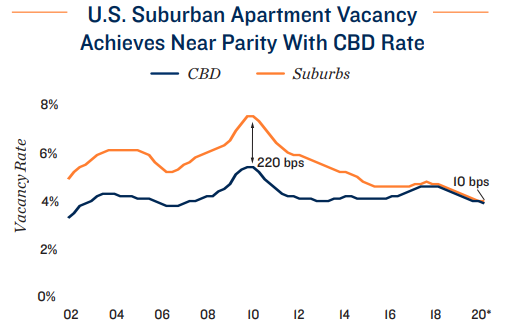
Chart courtesy of Marcus & Millichap
Companies will follow workers moving to suburbs
As millennials lead the move to suburban multifamily and single-family residences, this will drive the need for nearby office as well as retail space.
“The gap between suburban and urban apartment and office vacancies, which both reached peaks of over 200 basis points during the Great Recession, has since fallen to less than 40 basis points,” Marcus & Millichap write in the report.
“While partly influenced by varying construction levels, this near parity is largely a result of more millennials moving out of urban cores. Firms are following suit, with rising foot-traffic levels also catching the eye of retailers.”
The survey also points out that even if a company wanted to bring back workers to a central urban location, “there are several logistical challenges to overcome. Taking public transit to the center of town and riding an elevator to a top-floor suite pose health risks that a drive to a low-rise suburban office does not,” the report says.
Costs are lower in the suburbs, so companies may move there while holding on to a central business location. However, the shift to suburban office space “in conjunction with suburban residential growth, would also influence the retail and industrial sectors. Retailers will want to be close to both suburban residential and commercial hubs, with distributors seeking space to support last-mile deliveries to consumers,” Marcus & Millichap says in the report.
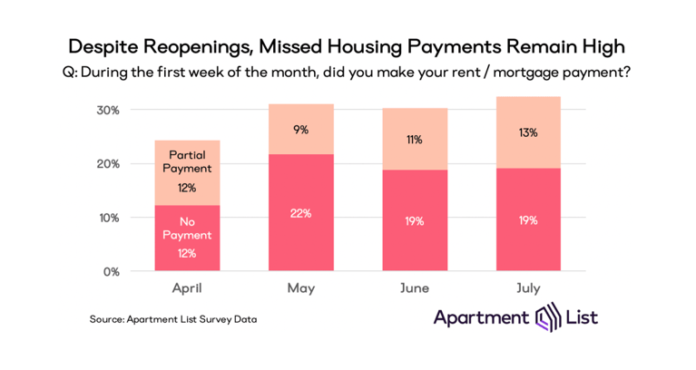
A recent rent-payments survey shows that 32 percent of renters failed to make their full July housing payments on time as new cases of COVID-19 surge and reopening plans have been paused or rolled back throughout the country, according to Apartment List.
“This is the highest non-payment of rent since we began running this survey in April,” Apartment List said in the survey results. “Fears around evictions and foreclosures have also worsened, and more Americans today are considering a move as a result of the pandemic.”
Key findings in the rent payments survey
19 percent of respondents have not yet made a housing payment for July, and an additional 13 percent have made only a partial payment. Missed payments remain common for renters and homeowners alike.
21 percent of renters say they are “very” or “extremely” concerned about facing eviction in the next six months, up from 18 percent in June. Meanwhile, 17 percent of homeowners expressed serious concern about foreclosure, up from 14 percent last month.
More than half of respondents have had their moving plans affected by the pandemic. About 33 percent say that they are now less likely to move during the remainder of 2020, driven primarily by health concerns, while 21 percent say that they are now more likely to move, driven primarily by the need to find more affordable housing.
Renters in large multifamily buildings have less trouble paying rent
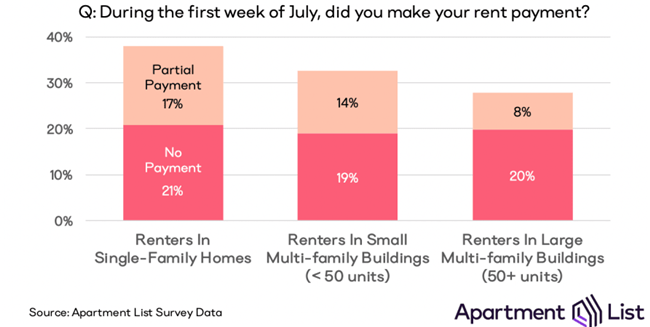
In July, here is what Apartment List found in terms of which renters were missing payments:
38 percent of renters in single-family homes had the most difficulty affording their housing, with 21 percent making no payment and 17 percent made a partial payment.
33 percent of residents of small-to-medium-sized multifamily buildings with fewer than 50 units missed payments.
28 percent of those in large multifamily buildings containing 50 or more units missed payments.
Coronavirus is Having a Greater Impact on Moving Plans
According to last month’s Apartment List survey, the financial fallout from the pandemic is simultaneously encouraging and discouraging people thinking about moving.
“Loss of income has left some households with no choice but to move to a more-affordable home. For others, the costs associated with moving now seem overly burdensome, leading them to stay put. We also find that the virus itself is continuing to have a major impact on moving plans, with many reporting they are less likely to move because they do not believe it is safe to do so.
“Meanwhile, the opportunity to work remotely is inspiring some to consider locations that, prior to the pandemic, were not feasible because of work constraints.
“This month’s survey shows that the pandemic’s impact on migration is deepening in both directions. The share of Americans who say that they are more likely to move this year due to the pandemic increased from 17 to 21 percent, while the share who say that they are less likely to move increased from 30 to 33 percent.
“Health risks continue to be the biggest factor discouraging moves, and the percentage who cite safety concerns rose from 37 percent to 44 percent. As for those considering a move, the opportunity to work from home is becoming more of a driver, as 23 percent say it’s playing a role in their decision, up from 19 percent last month.”
Conclusion
Economic reopenings swept the nation in June and provided some unemployment relief, but did little to ease the rent payments crisis. Despite some Americans getting back to work in June, the rate of missed housing payments actually increased. Looking ahead to July, the majority of states have either paused or are reversing their scheduled re-openings. If local displacement bans are allowed to expire before local economies begin to recover, the missed payments we have been tracking over the past four months could lead to a wave of downgrade moves as renters and homeowners seek more affordable housing. We are already witnessing unprecedented declines in rent prices as demand for expensive housing wanes.
While the world has been all but flipped on its axis during the first half of 2020 in reaction to the COVID-19 pandemic, let’s take a look at what has been going on in the single-family rental market throughout King and Snohomish Counties.
For context, we review data published by our local Northwest Multiple Listing Service (NWMLS) which includes primarily single-family rental houses and condominium units. There are some apartment units mixed in with the condominium category, but the vast majority of apartments in the region are not listed by NWMLS member brokerages.
With that in mind…
The total number of homes rented decreased by about 15 percent from the same period last year.
Like the real-estate sales industry, our ability to tour homes with prospective renters was (and to some degree still is) affected by health-protection measures. We also attribute this drop-off to the reality that people didn’t move as much as they normally do this spring compared to previous years. Mobility has been restricted and a lot more people have chosen to renew their leases instead. Compared to the first half of last year, renewals increased by 10.9 percent among our portfolio (1,500+ homes), and looking back two years, renewals spiked by 29.4 percent comparatively.
We have also executed lots of short-term lease extensions for residents who had planned to move, but put their plans on hold for the time being.
Generally speaking, for the homes that did hit the market and rent between January and June, you would barely know that COVID-19 was a factor (at least on paper). Average days-on-market slowed from 38 to 40, but this is a minor difference; 40 days on market is identical to this time in 2018. Overall rental values are up 2.8 percent from last year, and price per square foot jumped even more, by approximately 4.8 percent.
The migrating demand trend
As you start to look closer, however, you’ll see where the true impact of COVID-19 hit the Seattle rental-housing market, and that is with condominium and multifamily units. I am going to call this a “migrating demand” trend.
“Migrating demand” is the story of housing in response to COVID-19.
Around the world, people are fleeing dense city centers and searching for housing in suburbs or even in remote areas. Recently published articles from sources such as the Wall Street Journal document this trend around New York City, and in other parts of the world migrant workers are leaving crowded cities and making their way back to the more remote areas from where their families originate.
Back to our specific region, market times for condos and multifamily specifically in the city of Seattle have suffered, slowing down by a significant 38.8 percent compared to the same time period last year. As mentioned earlier, rents across the board have trended up in Seattle rental housing, but what you can’t see in the NWMLS data is how often concessions are being offered on executed leases (such as “first month free” on a condo or apartment rental, which is prevalent if you go looking around the various advertising sites).
We believe there are three key factors that explain the “migrating-demand” trend in Seattle rental housing.
No. 1 – Health concerns:
The term “social distancing” has become inescapable and this speaks directly to the proximity of neighbors in condo and multifamily settings. Shared amenities such as entryways, elevators, mail rooms, and other common areas have residents on edge as they yearn for more private living spaces.
No. 2 – Square footage:
Another familiar term is “sheltering in place,” which is a lot easier to do when there is a basement, deck, or back yard to retreat to. Some local readers may have seen the TV commercial that our brokerage ran earlier this year, highlighting one of our residents who was in a big hurry to move out of her smaller rental unit and into a two-story house.
No. 3 – Working From Home:
If a large number of jobs are moving out of offices and into a more remote scenario, then the need to live in close proximity to downtown office buildings is no more. Without a commute to worry about, living further away from the city is not as much of a concern for many.
When you start to look beyond housing, there may be even more changes to the way people live their lives. Crowded restaurants, concerts, festivals, and sporting events – are they a thing of the past? At least temporarily?
Given the non-permanent nature of renting a home (as opposed to buying), expect to see this “migrating-demand” trend intensify for renters as they look to take a break from in-city living, and maybe come back in a few years when pandemic concerns have softened.
We expect this will also give significant rise to the demand for the Accessory Dwelling Unit (“ADU”) housing product. Also known as a “backyard cottage” or a “mother-in-law” apartment, whether attached or detached, this type of housing unit offers a good mix of affordability and personal space.
Since the term “essential” also became a buzzword in reaction to the pandemic, we have taken the position that housing is always essential. In relation to some other industries such as restaurants or airlines, we are grateful to be involved in an industry that continues to show resilience, stability, and strength.
Also, one in 10 renters were ready to buy a home this year, but the pandemic forced 43 percent of them to delay their homeownership plans.
Some survey highlights:
Things were finally looking up for Gen X and older millennial renters, of whom 15 percent and 14 percent, respectively, were confident they’d become homeowners by the end of the year.
As 43 percent of would-be home buyers changed their plans due to the pandemic, “economic uncertainty” and “loss of income” were the most cited reasons for delaying homeownership.
As many as 50 percent of older millennials were forced by the crisis to let go of their dream, followed by younger millennials (43 percent) and Gen Xers (42 percent).
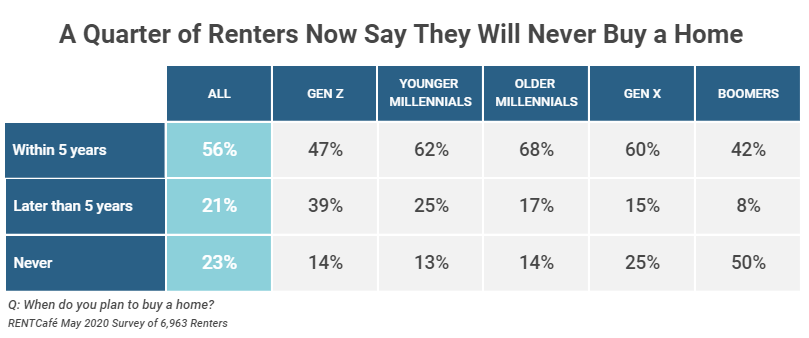
Considering the current market conditions, “We asked renters about when they would finally be able to buy a home; while 56 percent were optimistic about becoming owners in the next 5 years, a significant 23 percent said that they’re never buying,” the survey says.
Millennials were most eager to buy a home soon, particularly the older cohort, with 68 percent of older millennials planning to become homeowners in the next 5 years. Long-considered renters-at-heart, this cohort is now set on making the transition.
On the other side, half of baby-boomer renters expressed no intention of ever buying again, as they seem to be getting more and more comfortable with renting.
Renters not buying homes
Doug Ressler, manager of business intelligence at Yardi Matrix, had these answers to questions posed about the survey:
Doug Ressler
Q: What one piece of advice would you give to Gen Zers and younger millennials who want to become homeowners sooner?
A: The buy vs. rent analysis is partially financial and partially emotional. The financial part of the analysis is difficult to work out because of future assumptions. However, one also needs to understand the level of risk and flexibility that come with each option, as well as individual desires, before making a purchase-vs-rental decision.
Q: There’s a large share of renters who think they’ll never become homeowners. Why is that?
A: When it comes to the complexities of real-estate investment, personal finances, and future economic time horizons, the conventional wisdom of buying being better than renting does not always hold true.
Many renters don’t think that they’ll ever own a home because they might not be able to afford the additional expenses that come with this decision, such as interest, property taxes, insurance, and maintenance for the entire ownership period. On the other hand, renting consists only of monthly rent and a possible one-time deposit; therefore, economically, renting might make more sense than buying a home.
Q: In your opinion, what is the No. 1 reason millennials, Gen Xers, and boomers do not purchase a home, renting instead?
A: As more millennials are moving up the earnings ladder, get married, and start families, housing is increasingly taking center stage. Although they have a higher number of graduates than Gen Xers and baby boomers, they are less likely to own a home. Some of the barriers to homeownership could be delayed marriage, student debt, and choosing to live in high-cost cities.
Q: Is it a good idea to buy a home now? In which cities?
A: This would depend on financial considerations and the targeted area of purchase. In more than half (59 percent) of housing markets nationwide — 442 of 755 U.S. counties — renting a three-bedroom property is now more affordable than buying a median-priced home.
The lowest median home prices would be in the Houston metro area, Orlando metro area, or Chicago metro area, all three of which boast a high percentage of millennials.
Doug Ressler is the director of business intelligence at Yardi Matrix, where he is responsible for the creation of business and statistical research models for the commercial real estate industry. Previously, he was an analyst at the multifamily market research company Pierce-Eislen. He holds a master’s degree in business administration from Arizona State University and a bachelor’s degree in business administration from Pennsylvania State University.
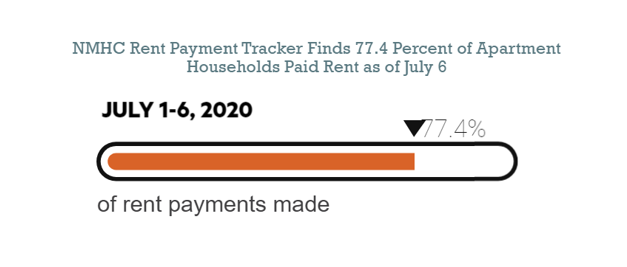
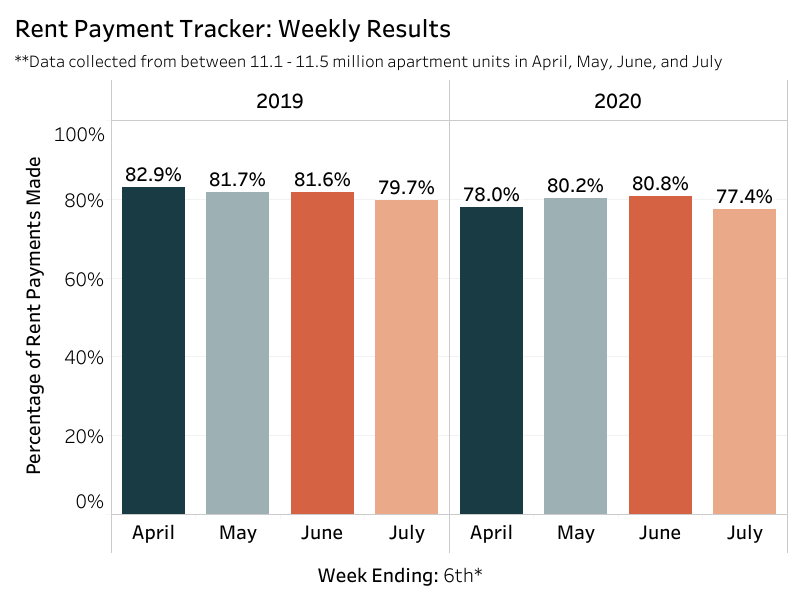
The most recent July Rent Payment Tracker found 77.4 percent of apartment households made a full or partial rent payment by July 6 in its survey of 11.4 million units of professionally managed apartment units across the country.
“This is a 2.3-percentage-point decrease from the share who paid rent through July 6, 2019 and compares to 80.8 percent that had paid by June 6, 2020. These data encompass a wide variety of market-rate rental properties across the United States, which can vary by size, type and average rental price,” the NMHC said in a release.
More government assistance needed for renters and landlords for rental payments
“It is clear that state and federal unemployment assistance benefits have served as a lifeline for renters, making it possible for them to pay their rent,” said Doug Bibby, NMHC President, in the release.
“Unfortunately, there is a looming July 31 deadline when that aid ends. Without an extension or a direct renter-assistance program, that NMHC has been calling for since the start of the pandemic, the U.S. could be headed toward historic dislocations of renters and business failures among apartment firms, exacerbating both unemployment and homelessness.”
Chart courtesy of the National Multifamily Housing Council.
Enter to win our parking lot makeover contest and get your potholes and rough pavement fixed to keep you and your tenants happy.
NYS Enterprises is providing $2,500 of paving services in the State of Washington to make your parking lot look a lot better and keep your on-going maintenance much lower.
It’s easy to enter. Just put in your email address and you are in.
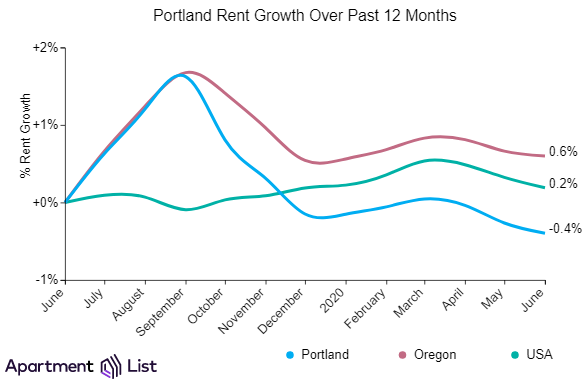
Rents in Portland continued to decline in June, dropping another 0.1 percent after a 0.3 percent drop in May, according to the latest report from Apartment List.
Portland rents year-over-year have decreased by 0.4 percent in comparison to the same time last year.
Median rents in Portland stand at $1,119 for a one-bedroom apartment and $1,321 for a two-bedroom.
“It’s important to note that the magnitudes of these rent decreases are all quite modest, but on the other hand, this may just be the beginning of a prolonged trend,” said Chris Salviati, Housing Economist at Apartment List.
“I would note that the areas where we’re seeing the most significant rent dips are in local economies that are heavily dependent on tourism, such as Las Vegas, Orlando, and Miami. Compared to those cities, Portland has higher shares of workers employed in knowledge occupations that can be done from home, so they’re a bit more protected from the harshest economic impacts,” he said.
Rents are also dropping rapidly in San Francisco and the Bay Area of California.
Rent trends vary across the Portland Metro
While rent prices have decreased in Portland over the past year, the rest of the metro is seeing varying rent trends.
Of the largest 10 cities that Apartment List has data for in the Portland metro, half have seen increases, while the other half have been decreasing.
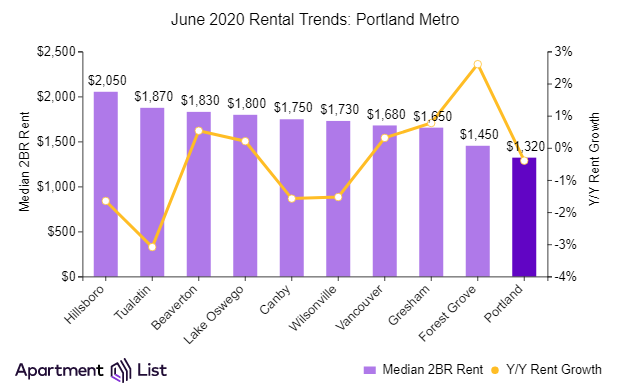
Here’s a look at how rents compare across some of the largest cities in the metro.
Over the past year, Tualatin has seen the biggest rent drop in the metro, with a decline of 3.1 percent. Median two-bedrooms there cost $1,874, while one-bedrooms go for $1,589.
Forest Grove has seen the fastest rent growth in the metro, with a year-over-year increase of 2.6 percent. The median two-bedroom there costs $1,453, while one-bedrooms go for $1,231.
Hillsboro has the most expensive rents of the largest cities in the Portland metro, with a two-bedroom median of $2,053; rents went down 0.5 percent over the past month and 1.6 percent over the past year.
Portland proper has the least expensive rents in the Portland metro.
Salviati said as far as longer-term impact, the pandemic’s effect on rent prices will depend heavily on how quickly the economy is able to recover.
“Even in the best-case scenario, it’s highly possible that we could see a protracted uptick in downgrade moves as many households facing financial hardship begin looking for more affordable housing,” Salviati said.
What to consider when buying a duplex is this week’s question for veteran real estate investor and property manager Hank Rossi for Ask Landlord Hank.
Dear Landlord Hank,
I am interested in buying a duplex, can you tell me the requirements I should have?
-Melanie
Dear Landlady Melanie,
When I’m buying any rental property, I want to make sure that it will really produce income.
I look at all fixed expenses – taxes, HOA fees if any, insurance, lawn/pool care, mortgage monthly payment, etc. – and add those all up.
Then I determine what I need to do to have the rentals rent-ready, such as painting the units, maybe changing out flooring, etc.
Then I check the rental rates those units will command. Then, I subtract fixed expenses from monthly rents and I know how much I’ll net every month.
If that is a number that works for me and the upfront costs to make the rentals rent-ready are not too high, then I’m ready to move forward.
It’s best to be a little conservative on market rents and a little high on renovation costs, as renovations often cost more than expected.
Sincerely,
Hank Rossi
Landlord Hank
Ask Landlord Hank Your Question
Ask veteran landlord and property manager Hank Rossi your questions from tenant screening to leases to pets and more! He provides answers each week to landlords.
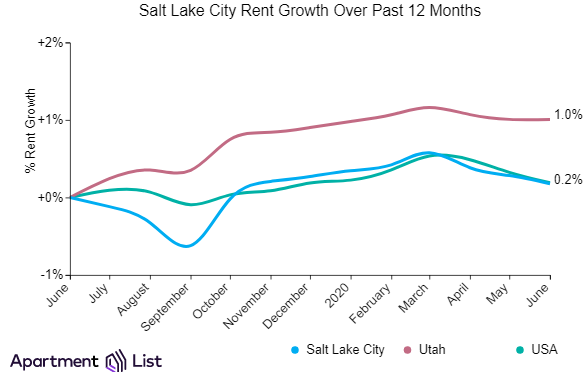
Salt Lake City rents have declined 0.1 percent over the past month, but have remained steady at 0.2 percent in comparison to the same time last year, according to the June report from Apartment List.
Median rents in Salt Lake City stand at $877 for a one-bedroom apartment and $1,088 for a two-bedroom. Salt Lake City’s year-over-year rent growth lags the state average of 1.0 percent, but is in line with the national average of 0.2 percent.
Ogden rents increased over the past month
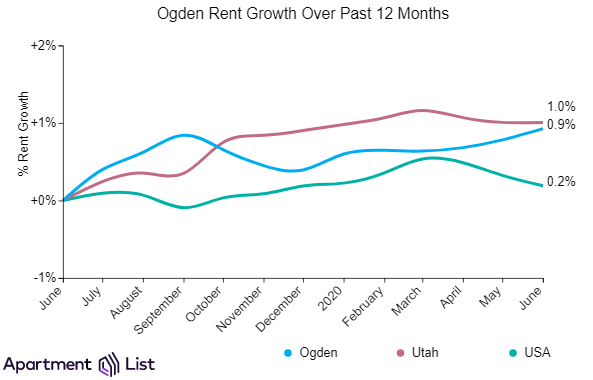
Ogden rents have remained flat over the past month, however, they are up marginally by 0.9 percent year-over-year.
Currently, median rents in Ogden stand at $699 for a one-bedroom apartment and $896 for a two-bedroom. Ogden’s year-over-year rent growth lags the state average of 1.0 percent, but exceeds the national average of 0.2 percent.
“It’s important to note that the magnitudes of these rent decreases are all quite modest, but on the other hand, this may just be the beginning of a prolonged trend,” said Chris Salviati, Housing Economist at Apartment List.
“I would note that the areas where we’re seeing the most significant rent dips are in local economies that are heavily dependent on tourism, such as Las Vegas, Orlando, and Miami. Compared to those cities, Salt Lake City, Seattle and Portland have higher shares of workers employed in knowledge occupations that can be done from home, so they’re a bit more protected from the harshest economic impacts,” he said.
Property managers can get in trouble in Oregon with some innovative services due to the archaic Oregon Landlord/Tenant Act attorney Brad Kraus points out this month.
With the COVID-19 outbreak and shutdowns running strong after three months, now is likely a fantastic time to discuss something different. Given the changing dynamics between landlords and tenants, I often hear of new, exciting programs and innovative services presented to my clients.
The moment I hear about these programs, the wheels begin to spin, analyzing what exposure, if any, these programs present for my clients.
The Oregon Residential Landlord and Tenant Act governs landlord-tenant relationships in the state of Oregon. Enacted in the 1970s, this body of law has failed to catch up to the times regarding many issues or interactions between landlords and their tenants. As such, many new and innovative approaches to certain landlord/tenant interactions are challenging to enact without risk, given the archaic nature of this body of law. It is, unfortunately, within that archaic body of laws that any new programs must be analyzed.
There are only three types of recurring charges recognized by the ORLTA: rent, utilities, and fees. Each has a statutory definition under the ORLTA. Any charges a landlord imposes on a tenant must fit within—and comply with the requirements of—one of those particular statutes. Many companies trying to market products for Oregon landlords have products that either (a) do not fit into one of these three categories, and/or (b) require the landlord to charge tenants illegal fees. That makes them problematic and presents potential exposure for landlords.
What the rent statute category says
Whether something can be classified as “rent” is the first—and easiest—portion of the analytical discussion. If something is not “rent,” it must be either a utility—and be properly billed as such—or comply with the fee statute.
What the utilities category says
A utility or service under ORS 90.315 is defined as “include[ing], but is not limited to electricity, natural or liquid propane gas, oil, water, hot water, heat, air conditioning, cable television, direct satellite or other video-subscription services, Internet access or usage, sewer service, public services and garbage collection and disposal. Many services offered by out-of-state companies do not neatly fit into this definition. Even if they do, and the landlord wishes to charge back any costs to the tenant, there are required monthly billing disclosures that present additional hurdles.
What the fee statute says
If any charge is not “rent” or a “utility,” then it must be a “fee.” The fee statute, ORS 90.302, strictly defines the fees for which a landlord can charge. This list is exclusive; if the fee is not listed in ORS 90.302 (and it is not rent or a utility), the landlord cannot charge for it. Common examples I see are things like “notice service fees” or “month-to-month fees.” Such fees are illegal in Oregon. Similarly, if a company provides a service that requires you to pass along a fee of some kind to your tenant, such a fee is likely illegal, and should give you pause.
Summary
As landlords continue their attempts to provide better customer service and amenities to their tenants, there will always be companies marketing new and exciting services. Those companies will try their hardest to sell you on their products. Some of the innovative exciting services that could get a property manager in trouble in Oregon involve services related to security deposits.
As landlords, do not fall for the “shiny red ball” trick. Carefully analyze any such services with your attorney. The potential exposure for any missteps can be costly.
Brad Kraus is an attorney at Warren Allen LLP. His primary practice area is Landlord/Tenant law, but he also assists clients with various litigation matters, probate matters, real estate disputes, and family law matters. A native of New Ulm, Minnesota, he continues to root for Minnesota sports teams in his free time. He is an avid sports fan, enjoys exercise, spending time friends and his fiancée, Vicky. You can reach Mr. Kraus via email at [email protected], or by phone at 503-255-8795.