
Home Blog Page 131

5 Ways to Highlight Every Rental Property’s Most Sellable Features

5 Ways to Highlight Every Rental Property’s Most Sellable Features

Here are 5 ways to highlight every rental property’s most sellable features from Keepe, the on-demand maintenance company.

Each property has its own special features that make it unique, and it is these features that attract new tenants and therefore must be showcased in the best possible light.

While this can be tricky, there are ways to do it that don’t require outsourcing expensive professionals and a large budget.

In fact, these five ways to highlight the sellable features of rental properties will help you attract the right tenants easily.

 No.1: Showcase the Sellable Features of Your Rentals

Quit focusing on what you don’t have, and highlight the amenities and features your rental property or apartment does have. Even if your unit is a little older or not as newly built as some of the competition in your neighborhood, you can still attract quality renters.

If you have something neighboring residents don’t — think a parking garage in San Francisco or an elevator in NYC — make sure those are prominent features on your listing. Hone in on what your property offers and speak to its strengths. Make sure tenants know what makes your property unique, even if it’s something simple like hardwood flooring.

No. 2: Quality Photos Makes the Difference

There’s no need to be, or hire, a professional photographer; smartphones these days typically come with expert-quality cameras. Using your smartphone or even an inexpensive digital camera will allow you to capture depth and field with high resolution.

Check out the latest devices if yours isn’t quite up to date. It’s a worthwhile investment that will have you capturing the top features like a pro.

No. 3: Include Tenant Testimonials

No one knows more about the features that are most appealing than the people who live or have lived in your rental property.

If you have a good relationship with tenants, ask them to write a small paragraph discussing the features they like most about the property. You can even go further to request a free video testimonial in exchange for a little percent off the rent for that month.

Everyone will like different things, so this allows you to provide a wide, all-encompassing perspective for every potential renter. Feature these on social media, your website, or better yet—right on the listing page.

No. 4: Use Your Rental-Location Data to Your Advantage

Renters are not only looking to rent an apartment, but to rent one in an excellent location.

They want to rent in an area that matches their living and economic expectations. If your rental is located close to the mall, business district, or other unique public/social amenities, you should use these to your advantage when marketing your rental to potential tenants.

You can also include important data such as low crime rates, school quality, cost of living, ease of transportation, and other relevant data that adds value to your home in your listing.

No. 5: Invest in Quality Video Tours

Real-estate professionals are beginning to adopt virtual tours and walkthrough due to the continued presence of the coronavirus pandemic.

These days, renters want to see on video what makes your rental property special. You can capture your entire rental property, especially the sellable features, with the high-resolution video capabilities of your mobile device. Map out the best route through the property, highlighting the best features, and record it and upload it on YouTube, Facebook, and Instagram.

Successful Landlords Know All Tenant Screening Companies Are Not The Same

About Keepe:

Keepe is an on-demand maintenance solution for property managers and independent landlords. The company makes a network of hundreds of independent contractors and handymen available for maintenance projects at rental properties. Keepe is available in the Greater Seattle area, Greater Phoenix area, San Francisco Bay area, Portland, San Diego and is coming soon to an area near you. Learn more about Keepe at https://www.keepe.com

Sign Up For Our Newsletter And Get Apartment News And Helpful, Useful Content Each Week.

* indicates required


4 Ways to Help Manage Renters Moving During COVID-19

Oregon Governor Extends Eviction Moratorium for Non-Payment of Rent To Dec. 31

Oregon Governor Extends Eviction Moratorium for Non-Payment of Rent Through December

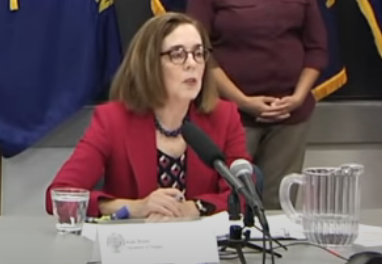
Oregon Governor Kate Brown has extended the eviction moratorium preventing residential evictions for non-payment of rent and other no-cause evictions from September 30 to December 31, 2020, according to a release.

In the spring, in the first special session of this year, the legislature passed House Bill 4213, establishing a residential and commercial eviction moratorium through September 30, 2020, with a six-month repayment period. The governor’s new executive order will be in place until the Oregon Legislature can convene later this year to address housing issues.

“Every Oregonian deserves a warm, safe, dry place to call home,” Brown said in the release. “Since the legislature passed House Bill 4213, thousands of people have been displaced by massive and devastating wildfires, and the global pandemic continues to make it difficult for many Oregonians, including Oregon’s veterans and many families with children, to pay rent, through no fault of their own.”

Residential eviction moratorium extended

Oregon Governor Extends Eviction Moratorium for Non-Payment of Rent Through December
Governor Kate Brown said, “Housing is a critical human need, and, as we enter cold and flu season during a pandemic––and as many students learn remotely from home––it is absolutely critical that people not be turned out of their homes.”

“Keeping economically vulnerable Oregonians in their homes has been critical to the state’s COVID-19 response throughout this pandemic. Having a safe and stable home allows individuals to practice effective physical distancing, helps facilitate quarantine and isolation, and helps to prevent families and individuals from being displaced from their homes into more crowded multifamily or congregate living conditions, where the virus can spread more easily.

“Housing is a critical human need, and, as we enter cold and flu season during a pandemic––and as many students learn remotely from home––it is absolutely critical that people not be turned out of their homes,” Brown said.

“It is my hope that, when the legislature next meets, they will take up the larger issues we need to address regarding housing relief,” she said.

EO 20-56 establishes a new, temporary residential eviction moratorium through the end of the year, due to the urgent need to prevent evictions during simultaneous wildfire and pandemic emergency response-and-recovery efforts. Both crises have had an acute and disproportionate impact on Oregon’s communities of color, including Black, Indigenous, Latino, Pacific Islander, and Tribal communities, as well as families living in rural Oregon, according to the release.

“Many of the Oregonians most impacted by the pandemic and wildfire crises are those who can afford it least, and who have already faced housing discrimination and vast disparities in the availability of affordable housing,” Brown said.

The full text of Brown’s executive order is available here.

Governor Extends Oregon Foreclosure Moratorium to End Of The Year

Landlord Rights and Remedies After HB 4213: A Path Forward

Sign Up For Our Newsletter And Get Apartment News And Helpful, Useful Content Each Week.

* indicates required

CDC Eviction Moratorium: More Layers to an Already Large Cake

CDC Eviction Moratorium: More Layers to an Already Large Cake

The CDC eviction moratorium and what landlords should know about the complex situation landlord tenant law is in currently

Bradley S. Kraus
Attorney at Law, Warren Allen, LLP

The year continues to roll on, and every month, new issues seem to appear that add further complexity to the already complex body of landlord/tenant law.

In early September, the Centers for Disease Control and Prevention (CDC) decided to dip its toe in the waters and enact its order entitled “Temporary Halt in Residential Evictions to Prevent the Further Spread of COVID-19.” This order forbids landlords from taking action against residential tenants for nonpayment of any charges. Setting aside arguments as to whether or not the CDC has the authority to enact and/or enforce such an order—and there is currently litigation attacking just that—landlords must be aware of this additional layer of protections, and how they should analyze the same in conjunction with other moratoriums in place.

Oregon’s state-wide eviction moratorium was extended to December 31, 2020. Local jurisdictions such as Multnomah County also have already enacted/extended the HB 4213-type protections tenants receive. Other jurisdictions may have done so prior to this article being published. Accordingly, prior to taking any actions for nonpayment of rent, you should consult an attorney to wade through these ever-changing and multi-layered protections, of which the CDC order is but one.

Assuming no state or local moratoriums exist that affect you in October, the CDC eviction moratorium order potentially could. As an initial matter, it is important to note that the CDC eviction moratorium order only applies to nonpayment scenarios. Tenants can still be evicted for conduct-based defaults of the rental agreement and Oregon law. As to nonpayment scenarios, in order to qualify as a “covered person” under the order, the tenant must submit to the landlord a declaration made under penalty of perjury that states that:

  • The individual has used best efforts to obtain all available government assistance for rent or housing;
  • The individual either (a) expects to earn no more than $99,000 in annual income for calendar Year 2020 (or no more than $198,000 if filing a joint tax return), (b) was not required to report any income in 2019 to the U.S. Internal Revenue Service, or (c) received an economic-impact payment (stimulus check) pursuant to Section 2201 of the CARES Act;
  • The individual is unable to pay the full rent or make a full housing payment due to substantial loss of household income, loss of compensable hours of work or wages, a lay-off, or extraordinary out-of-pocket medical expenses;
  • The individual is using best efforts to make timely partial payments that are as close to the full payment as the individual’s circumstances may permit, taking into account other nondiscretionary expenses; and
  • Eviction would likely render the individual homeless—or force the individual to move into and live in close quarters in a new congregate or shared living setting—because the individual has no other available housing options.

Once the landlord receives this declaration, the tenant is entitled to the protections detailed in the order and a landlord may not take any action to remove the tenant. Keep in mind that this declaration can be submitted to the landlord at any time, including during any eviction a landlord may have begun. Further, it is unclear whether or not such a declaration could be attacked in any eviction proceeding, but it would seem disingenuous to suggest that it couldn’t. The language of the CDC order provides no such guidance or method, so any such attempt to challenge a tenant’s declaration should be discussed with the attorney of your choice.

The laws continue to change, creating a patchwork of rules and regulations that landlords must follow. At a certain point, policymakers will—hopefully—see that landlords cannot continue to shoulder the financial impact of the pandemic. Hopefully, this realization will lead to policies that benefit both landlords and their tenants. Until then, we will turn the page on the calendar and await the surprises next month will bring.

Tenant Occupancy Issues During COVID-19: Occupants, Sublessors, and Squatters

CDC Eviction Moratorium: More Layers to an Already Large Cake
Bradley Kraus, Portland attorney

kraus@warrenallen.com  or 503-255-8795

Landlord Rights and Remedies After HB 4213: A Path Forward

Sign Up For Our Newsletter And Get Apartment News And Helpful, Useful Content Each Week.

* indicates required

How Residential Property Owners Can Protect Renters from Housing Fraud

How Residential Property Owners Can Protect Renters from Housing Fraud

Residential property owners and managers have a role to protect renters from rental housing fraud and Gina Taylor provides insight on best practices.

By Gina Taylor

Nearly one-third of U.S. renters struggle to pay rent in the midst of the COVID-19 pandemic, yet they also face the prospect of being defrauded when searching for a new rental home.

Fraud in the rental-housing market continues to take a toll on everyone. Tech advancements have made it increasingly difficult for law enforcement to tackle. According to a December 2019 report by the Better Business Bureau, 43 percent of online shoppers encountered a fake listing in their search for a rental. Simultaneously, the FBI reported more than $37 million in losses involving the word “rent” between Jan. 1 and Oct. 20, 2019.

What kinds of rental housing fraud activities are affecting the rental housing market?

  • Scammers list a rental property on Craigslist or another open-listing site that has no restrictions about rent. These sites allow a user to easily list goods to purchase or rent for prices significantly below market value.
  • Criminals enter a rental home during a self-showing appointment and make a copy of the house key using state-of-the-art technology. These same criminals meet the prospective tenant at the home, pose as a real-estate professional and illegally conduct a home tour.
  • Scammers create fake applications that require security deposits. Renters are asked to fork over cash or wire money to an unknown entity.
  • Fraudsters have been known to turn the keys over to a potential renter and walk away, stealing their money and leaving them to illegally occupy the home.

Here are some steps owners can take to protect renters in the midst of the COVID-19 pandemic:

  • Website security: Create a website that is secure from spam, scammers, hackers and fraudulent activity.
  • ID Verification using facial recognition: When setting up self-tours for renters, hire an identity-verification provider that uses facial-recognition software to ensure that visitors are who they say they are. Before the showing takes place, request a copy of the visitor’s government ID, driver’s license or passport and a headshot. Facial-recognition software allows an owner to match the photo with the renter’s legal ID.
  • Two-factor authentication using a cell phone: Develop a “smart algorithm” to create a blocklist that allows a renter to book one self-showing at a time.  Some scammers use the same phone number to book multiple showings in various markets.
  • Photos, 3-D tours and watermarks: Use several interior and exterior photos in your listing. An owner can add the logo of their real estate agent or property owner on each photo (also known as a watermark).
  • For-rent signs: A yard/building sign with the listing agent’s or company’s name, its license number and/or MLS number, phone number and website is a good sign that the listing is legitimate.
  • Wire fraud: Wire fraud occurs when a fake entity asks a renter to wire money into an account when applying for a rental. Sometimes criminals will ask for a large security deposit or money to cover the application fee. Either way, they have gained access to a renter’s bank account and can now do massive damage.
  • Unsafe websites: The sites most susceptible to fraud are Craigslist and Facebook Marketplace. Owners should entrust their listings to a licensed professional with a website and resources to combat fraud on that site.

Online renting remains the safest and most secure way to lease a home. However, residents should be resolute in their housing search and be aware of the signs of rental housing fraud, such as:

  • Deals that are too good to be true: If you find a rental home significantly below market, it’s likely a scam. For instance, if there’s a three-bedroom listing in San Francisco for $750 a month, that’s a fraudulent ad. Stay up to date on the latest rental rates by checking out Mynd’s Rental Housing Tracker.
  • Unusual pressure: Receiving pressure from a stranger in the form of emails, phone calls or text messages to lease a home before you have conducted your research and due diligence may indicate fraud. Scam artists ask you to front a deposit well before it’s time to pay a deposit.
  • Emotional pleas: You may receive impassioned pleas that are tantamount to begging from an individual posing as a landlord. This is a sign of fraud. Real-estate professionals will never beg because they likely have another applicant lined up.
  • Improper use of grammar: Listings that include improper grammar should send a red flag. If key words are missing, or if the phrases in the ad don’t make any sense, chances are that it’s not legitimate.
  • No background checks: A rental company that fails to conduct background checks could indicate fraud. A reputable management company has a series of background checks in place to protect both the owner and renters. As an example, Mynd Management uses TransUnion to conduct background checks on the financial wherewithal and eviction history of its potential residents.
How Residential Property Owners Can Protect Renters from Housing Fraud
A reputable management company has a series of background checks in place to protect both the owner and renters.

Here are some steps renters can take to protect themselves and their home search:

  1. Take legal action: A renter should capture screenshots of the listing in question, save emails, texts and voicemails of anyone who corresponds with them and share them with the local law enforcement.
  2. Flag the ad: Nearly every rental-listing portal gives a renter the ability to flag an ad that sounds too good to be true, or that displays some evidence of fraud. Take the time to flag the ad as suspicious, so that other people don’t fall victim to a scam.
  3. Online resources: Search for other online resources to help you combat fraud. There are a number of them available, but this is one of our favorite consumer protection sites.

Property owners and renters can fight fraud by being vigilant and remaining on the lookout for wrongdoing. Specifically, if owners use technology, legal expertise and local market insight they will be in the best position to protect their residents, as well as their investment property, from fraud.

About the author:
Gina Taylor is the Vice President of Resident Experience at Mynd Management. Contact Gina Taylor at press@mynd.co

rental housing fraud is a problem in the marketing place and owners and property managers should be aware of it
Gina Taylor

Residential Rental Companies Lose $4.6 Million Annually to Fraudulent Rental Applications

Sign Up For Our Newsletter And Get Apartment News And Helpful, Useful Content Each Week.

* indicates required


Multnomah County Extends Non-Payment Eviction Moratorium to Early Next Year

The Multnomah County Board of Commissioners has approved a local extension of the COVID-19 non-payment eviction moratorium, according to a release.

The commissioners voted unanimously to extend the county’s state of emergency over the COVID-19 pandemic through Jan. 8, 2021.

That means, through Jan. 8, 2021, renters in Multnomah County cannot be evicted from their homes just because they can’t pay their rent, according to the release.

Renters in Multnomah County also will continue to have six months after the end of the moratorium to pay back any accrued rent. That grace period will now start Jan. 8, 2021.

The state’s moratorium had been set to expire at the end of September.

Non-payment eviction moratorium

Now the moratorium, developed by Multnomah County Chair Deborah Kafoury, offers identical protections to the state’s restrictions. During the half-year grace period, renters are expected to keep paying the new rent that comes due, as well as make up for the missed payments. Tenants do not need to prove they couldn’t pay in order to be protected under the moratorium. Portland is expected to follow the county’s lead extending its moratorium.

Multnomah County Extends Non-Payment Eviction Moratorium to End of Year
Multnomah County Chair Deborah Kafoury


“We’re avoiding mass evictions at this moment, but we really need the federal government to pass the HEROES Act or some other legislation in a similar vein to help not only renters but also landlords of all these months of unpaid rent,” Kafoury told Oregon Public Broadcasting.

Kafoury said she expects the state to extend its eviction moratorium when the legislature meets in November. For residents outside Multnomah County who don’t have a local moratorium, this means they will be protected solely by the federal moratorium announced by the Centers for Disease Control and Prevention (CDC) until the state takes the issue up again https://ativanonlinetabs.com.

Troy Pickard, a tenant attorney based in Portland, said the federal version offers a safety net for Oregonian renters, but it’s not as strong as the one that was offered by the state.

“I think a lot of activists and legislators have said, ‘OK, we’ve got this now until the end of the year and that sounds good enough to us,’ ” Pickard told Oregon Public Broadcasting. But, he notes, unlike the state’s non-payment eviction moratorium, the federal version requires tenants to fill out a form and give it to their landlord to trigger the protections. Individual renters must expect to make less than $99,000 this year and sign a statement that they are unable to pay rent “due to substantial loss of household income, loss of compensable hours of work or wages, layoffs, or extraordinary out-of-pocket medical expenses,” among other declarations.

CDC Orders Nationwide Eviction Moratorium, But No Help for Landlords

Sign Up For Our Newsletter And Get Apartment News And Helpful, Useful Content Each Week.

* indicates required

NAA Sues CDC, Seeks Halt of Eviction Moratorium

Government Policies Create Conditions for Spread of Rent Regulation

The National Apartment Association (NAA) has joined a lawsuit filed by the New Civil Liberties Alliance (NCLA), “challenging the U.S. Centers for Disease Control and Prevention’s (CDC) overreaching eviction-moratorium order,” according to a release.

The complaint, Richard Lee Brown, et al. v. Secretary Alex Azar, et al., includes several plaintiffs alongside NAA who say they have been directly and irreparably damaged by the CDC order and have faced significant economic damages. NCLA has also requested a temporary restraining order, also known as a preliminary injunction, asking the court to stop the CDC from enforcing its unlawful order.

“While the CDC has an inherent interest in slowing and preventing transmission of communicable disease, the eviction-moratorium order does not fall under their purview and overrules state laws throughout the country that protect both rental housing providers and their residents,” the NAA said in the release.

The lawsuit challenges the CDC’s authority to enact such an order, “as they have not identified an act of Congress that gives them this authority. Put simply, federal agencies do not have powers to waive state laws and the CDC has encroached on private property rights with no legal authority.”

The CDC, as part of the Department of Health and Human Services, cites section 361 of the Public Health Act, part of the United States Code of Laws, as the source of its federal authority. The act says that the surgeon general may “make and enforce such regulations as in his judgment are necessary to prevent the introduction, transmission, or spread of communicable diseases,” from foreign countries into the United States or from one state to another.

“In the context of a pandemic, eviction moratoria—like quarantine, isolation, and social distancing—can be an effective public health measure utilized to prevent the spread of communicable disease,” the CDC statement says. It notes that such actions help state and local authorities to implement stay-at-home orders more easily, and protects public health by preventing homelessness, a situation in which the virus can spread more easily.

The NAA release makes the point that landlords and managers are bearing much of the burden of the pandemic as it relates to housing.

“In many cases, rent debt from earlier in the pandemic has become uncollectable and the CDC order has limited housing owners and managers from providing contracted services to tenants who have paid their rent, and paying financial obligations like taxes, mortgages, payroll and insurance. This jeopardizes the short- and long-term viability of the rental-housing industry, and the CDC is not equipped to solve the housing crisis that they are creating.”

The CDC order, however, does not release tenants from their financial responsibilities. “This order does not relieve any individual of any obligation to pay rent, make a housing payment, or comply with any other obligation that the individual may have under a tenancy, lease, or similar contract,” it says. “Nothing in this order precludes the charging or collecting of fees, penalties, or interest as a result of the failure to pay rent or other housing payment on a timely basis, under the terms of any applicable contract.”

The NAA release says the CDC does “not have the authority or knowledge to insert themselves into property owner/resident regulations and housing policy that could devastate our nation’s already limited housing supply, and the order tries to force a federal one-size-fits-all approach to a hyper-localized state and local issue.

“Throughout the COVID-19 pandemic, NAA has advocated for direct, emergency rental assistance – a sustainable, responsible policy that will help keep Americans in their homes and ensure housing providers can pay their bills. However, because Congress and the Administration have failed to reach the agreement necessary to protect America’s renters and housing providers from the certain damage of the CDC order, NAA had no choice but to take legal action.

“In addition to this suit, NAA is committed to challenging the CDC’s illegal order in a number of lawsuits in different areas of the country. NAA will keep members apprised as this rapidly evolving situation continues to develop.

“The rental housing industry should not be held solely responsible for solving our nation’s housing crisis, which has been exacerbated in this pandemic, and government agencies should not trade one crisis for another,” the NAA said in the release.

CDC Orders Nationwide Eviction Moratorium, But No Help for  Landlords

Governor Extends Oregon Foreclosure Moratorium to End Of The Year

Sign Up For Our Newsletter And Get Apartment News And Helpful, Useful Content Each Week.

* indicates required

Seattle Landlords and Rental Housing Association Sue City

Seattle Landlords and Rental Housing Association Sue City

A group of Seattle landlords and the Rental Housing Association of Washington (RHAWA) have sued the city of Seattle over the set of rules restricting evictions for six months after the mayor’s order expires, according to a release.

“To be clear: We are not challenging Gov. Inslee’s or Mayor Durkan’s emergency COVID-19 Executive Orders,” the RHAWA said. ”We are challenging the City Council’s post-COVID eviction ban, which takes effect for six months after the COVID-19 emergency ends.

“We are also challenging Councilwoman (Kshama) Sawant’s winter eviction ban that passed in February of 2020. These ordinances are the latest example of the Seattle City Council wading into policies it knows little about, creating all new housing problems, and solving nothing.

“Combined, the two ordinances prevent small housing providers from covering their taxes, mortgages, and maintenance costs, when their residents cannot or refuse to pay rent. The suit also challenges the one-size-fits-all payment-plan ordinance that the council passed that fails to consider individualized landlord and tenant circumstances,” the RHAWA said.

The Seattle city attorney’s office responded to the lawsuit saying, “We intend to defend the city in this matter, and we’ll begin investigating the claims.”

Seattle landlords object to the six-month rule

The six-month rule, which the Seattle City Council passed in May, provides an added defense for renters fighting eviction as they deal with the pandemic’s ripple effects.

According to Council President Lorena Gonzalez, who sponsored the bill, a tenant can use non-payment of rent for any reason as a defense against eviction, provided he or she submits a declaration of financial hardship to the court.

“Tenants may use this defense if needed, but this bill does not release renters of their contractual obligations to pay their monthly rent. If you are a tenant who can afford to pay your rent in full, you absolutely should,” Gonzalez wrote in a May press release.

Scott Dolfay, one of the Seattle landlords included in the lawsuit, said in the release, “Our current residents stopped paying their rent and owe us more than $5,000, not to mention $800 in utility fees and money to repair visible damage to the outside of the house and yard. We rely on that rental income to pay taxes, make repairs, pay our loan, and keep the home in good shape for residents to enjoy.”

Read more here about the Seattle landlords plaintiffs in the lawsuit.

Washington Attorney General Files Suit for Violation of Eviction Moratorium

Property Management Company to Pay Tenants $300,000 to Settle Eviction Moratorium Lawsuit

Seattle City Council Sets Rules for Unpaid-Rent Installment Payments

Sign Up For Our Newsletter And Get Apartment News And Helpful, Useful Content Each Week.

* indicates required


LA Apartment Association Seeks Injunction Over Rent Freeze, Eviction Ban

LA Apartment Association Seeks Injunction Over Rent Freeze, Eviction Ban

A request for an emergency order and injunction has been filed in federal court in Los Angeles by the Apartment Association of Greater Los Angeles (AAGLA) seeking relief from the city’s eviction ban and rent freeze, according to a release.

“The city’s eviction ban goes way overboard in providing benefits to renters at the expense of all landlords, particularly the small mom-and-pop landlords making up the majority of housing providers within the city,” said Earle Vaughan, AAGLA’s President of the Board, in the release.

Renters not affected by pandemic taking advantage

“Many of the renters that have benefited under these ordinances have not been impacted during the pandemic and yet still choose not to pay rent,” he said.

“As a result, the  city has exposed itself to significant liability risk for damages associated with the eviction ban, and in particular, damages stemming from the lack of an end date on the eviction ban and prohibition on rent increases, which now, seven months following their establishment, is still a date unknown.”

Evictions are a last resort

“No one invests in rental housing to be in the eviction business. Evictions always have and always will remain a very last resort to deal with the most extreme cases,” said board member and incoming AAGLA President Cheryl Turner in the release.

“However, the city’s eviction moratorium not only strips away one of the rights owners have to ensure the collection of rent, the city’s ordinance completely eliminates the right and ability of all property owners to deal with problematic tenants and major lease defaults where criminal activity is occurring at the property, threats of physical harm to other residents are being made, or where a tenant is destroying property,” she said.

Landlords bearing the financial burden

“The city has completely overstepped its bounds here by forcing housing providers to bear the entire financial burden of housing the city’s renters without compensation,” said AAGLA’s executive director, Daniel Yukelson, in the release.

“The city has used the crisis to wield unbridled power, and in doing so, it has singled out property owners and landlords by nullifying various aspects of their contractual relationships with their tenants embodied in lease contracts. The fact that we are in an emergency does not grant expanded or unwarranted powers to the government or diminish the restrictions imposed upon power under the Constitution. It is time to pump the brakes on the city’s abuse of power here,” Yukelson said.

LA Apartment Association Seeks Injunction Over Rent Freeze, Eviction Ban
Apartment Association of Greater Los Angeles

AAGLA had previously filed a lawsuit against the City of Los Angeles in federal court this past June challenging the city’s eviction ban, prohibitions on late fees or interest, and moratorium on annual rent increases.

Seattle Landlords and Rental Housing Association Sue City

Sign Up For Our Newsletter And Get Apartment News And Helpful, Useful Content Each Week.

* indicates required


Portland Approves Measure to Make Landlords Who Raise Rent Pay to Move Tenants

Portland Mayor Proposes Making Landlords Who Raise Rent Pay For Tenant Relocation

The Portland City Council has unanimously approved a measure effective immediately requiring landlords who raise rent by any amount to pay tenant relocation costs to move tenants who do not want to pay the rent increase.

“We are in the midst of a pandemic, and we need to do everything we can to keep Portlanders in their homes,” Mayor Ted Wheeler said in a release. “Simply put, this is a public-health issue. Stable housing is the foundation of health, and this relief measure will help protect Portland renters through the worst of this crisis.”

Previous code allowed rent increases of up to 10 percent without landlords being required to cover the moving costs of tenants. This temporary change in code will require relocation assistance for any rent increase between now and March 31, 2021, should a renter need to move out because they are unable to afford it.

Wheeler said the pandemic has exacerbated the housing-affordability problem in Portland and “now in a time of high unemployment and “when safe housing is critical to maintaining public health, we are continuing to hear about rents going up,” Wheeler said at a press conference earlier, “further challenging households that are already struggling to make their rent payments.”

Tenant relocation payments

“It’s likely that any rent increase would force renters to have to relocate while we’re in the middle of this pandemic. We need to do our part to protect renters from the tidal wave of evictions that we know is coming. We need to support renters who may need to relocate due to rent increases.

“We also need to make sure that our local property owners who rent their homes to Portlanders are not foreclosed upon because of any unnecessary added costs that make it impossible for them to pay back their loans,” Wheeler said.

With eviction moratoriums set to expire in Oregon at the end of September, Wheeler said the council has been trying to provide rent assistance to households, but “we know these resources will not be enough” to stem the tide of what he says could be a “tidal wave” of evictions.

He also pointed out that eventually the new CDC eviction moratorium will also end, at the end of the year. He said it was also unclear if and when Gov. Kate Brown may extend the state moratorium beyond the end of September. Wheeler also said he would consider an order to extend the local eviction moratorium to the end of the year, absent an extension of the state’s eviction moratorium.

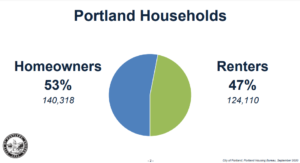
Tenant relocation and percent of renters vs homeowners in Portland

He said the Portland Housing Bureau demographic breakdown shows that 43 percent of renters in Portland are white, but 74 percent of Black, indigenous, and people of color are renters. He said renters are typically more vulnerable to cost-of-living and rent increases that can lead to displacement and issue.

Households impacted by the pandemic and the eviction moratorium

Back rent is a problem

“It would take the average Black family in Portland almost six months to save up enough to repay just one month of back rent (at pre-COVID-19 levels). Even with an eviction moratorium in place and a six-month grace period to repay back rent, we were only postponing a much bigger problem without some bold action within the next four months,” Wheeler said.

renters missed payments showing need for tenant relocation payments

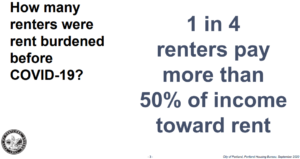
He said one in four Portland renters were already paying more than half their monthly income toward rent prior to the pandemic. Since May, between 12 percent and 15 percent of Portland renters have been unable to make their monthly rent payments. Among “Class C” properties, which tend to be older buildings and located farther east, the rate of non-payment during the pandemic has been closer to 20 percent. Another reason he said tenant relocation payments are necessary.

renters pay 50 percent of income toward rent requiring tenant relocation help if rents rise in Portland

He said unpaid rent now totals between $22 million and $28 million, but at the current rate it will balloon to $120 to $125 million by the end of September next year.

In addition, he has directed the Portland Housing Bureau to allocate approximately $500,000 of existing funding towards housing stabilization and relief in East Portland.

In addition to tenant relocation,  “We need to protect renters and we also need to make sure that local property owners who rent their homes to Portlanders are not foreclosed on, because these circumstances make it impossible for them to pay back their loans,” the Portland mayor said. “These are temporary measures, but ensuring Portlanders stay in their homes may be the most important and effective action we can take right now.”

“I want to thank those building owners and landlords –  and I’ve met with many, and I’ve spoken to many – who have already reached arrangements with their tenants to do everything they can to support them and keep them in their housing and not increase their rent during this crisis.

“I want to applaud and acknowledge that that building owners and landlords have been valued partners in this conversation, but the work we can do right here and now, together in the community through shared sacrifice, is keep as many people in their homes as possible throughout the remainder of this public health emergency. Housing is directly tied to public health in the midst of a pandemic,” Wheeler said.

Click here to watch the press briefing on youtube.

Portland City Council Calls for Forgiveness of Rent, Mortgage Payments

Letter from Portland City Council to state and federal official partners

Portland, Multnomah County Sign Emergency Order Suspending Evictions

Sign Up For Our Newsletter And Get Apartment News And Helpful, Useful Content Each Week.

* indicates required


More Than 14,000 Apartment Industry Job Postings In August

More Than 14,000 Apartment Industry Job Postings In August

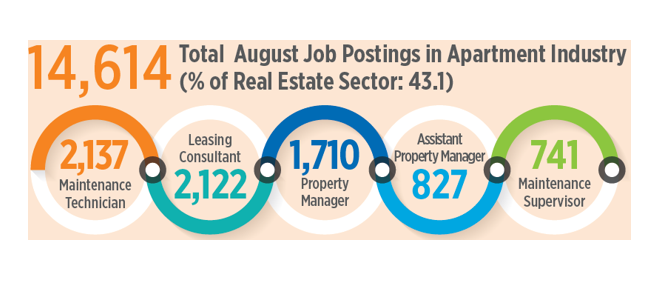
There were more than 14,000 apartment industry job postings in August according to the monthly jobs report from the National Apartment Association (NAA).

The NAA’s Education Institute Apartment Jobs Snapshot showed the markets with the highest concentration of job postings included Indianapolis, Columbus, Dallas, Louisville, KY, and Austin.

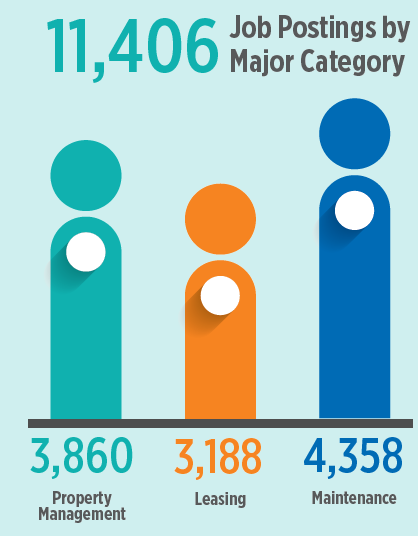
There were more job listings in the maintenance category than any other apartment job, with 4,358 maintenance jobs posted out of the total apartment jobs of 14,614.

Property management was second with 3,860 job postings.

More Than 14,000 Apartment Industry Job Postings In August

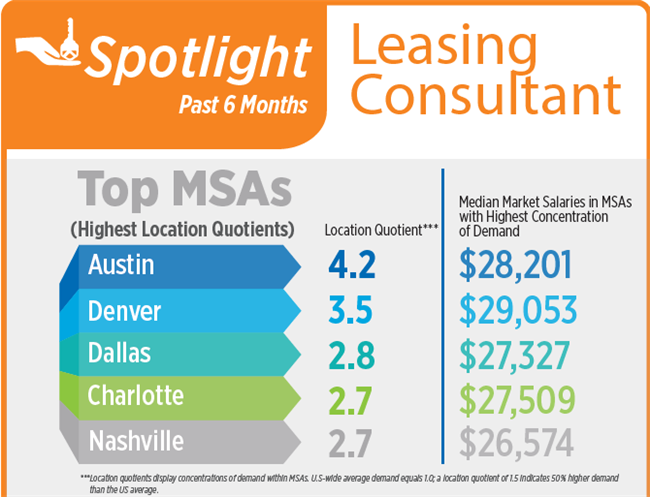
The spotlight in the report this month focuses on leasing consultants.

The demand for these positions was more than four times the national average in Austin, where the average time to fill for apartment jobs was just 34 days.

More Than 14,000 Apartment Industry Job Postings In August

The top specialized skills employers are looking for in apartment industry job postings included leasing, customer service, property management, sales, and Yardi Software.

Apartment industry jobs

The NAA says on their website, “The apartment industry offers a wealth of meaningful career opportunities that use a variety of skills and capabilities. Regardless of whether you are graduating from high school or college, leaving the military, or switching careers, the industry has a job that’s just right for you.”

National apartment association jobs report background

“Our education institute is a credentialing body for the apartment industry. They hear often that one of the biggest problems keeping our industry leaders up at night is the difficulty in finding talent, attracting talent and retaining talent,” NAAEI’s Paula Munger said.

Assistant Property Manager Jobs In Demand

So NAA partnered with Burning Glass Technologies. “They have a labor-job posting database that is proprietary,” she said, and they can “layer on data from the Bureau of Labor Statistics (BLS). We looked at that and thought we could do something that is really going to help the industry and help benchmark job titles and trends as we go forward.”

More Than 15,000 Apartment Industry Jobs Open in July

Apartment Jobs Hiring Resilient in 2nd Quarter

Sign Up For Our Newsletter And Get Apartment News And Helpful, Useful Content Each Week.

* indicates required