Rent prices in college towns have fallen this summer as colleges and universities across the country have opted for remote learning during the coronavirus pandemic, according to a Zillow analysis.
“The drop throughout college areas stands out even in a rental market that has softened across the board since February with rent-price growth slowing and landlords offering more concessions,” Zillow says in a release.
Data from The Chronicle of Higher Education and Davidson College show 44 percent of U.S. colleges and universities are operating fully or primarily online for the fall semester, while only 27 percent are offering classes fully or primarily in person.
A new Zillow analysis shows that reduced demand in this largely remote environment is having a noticeable impact on rents in ZIP codes in which at least 20 percent of the population is college students, who make up about eight percent of the U.S. rental market in a typical year.
Softening college towns rental market
“The softening rental market across the country is starker in college neighborhoods as pandemic-mandated campus closures and opportunities to complete courses online have provided motivation for young people to move back home,” said Zillow senior economist Cheryl Young in the release.
“With many leases ending at the end of the summer or the beginning of the fall, we can expect even greater impacts in the months ahead. The good news for rental owners is administrators seem to be itching to bring students back to campus as soon as they can do so safely, so it’s possible this will be a relatively short-term shock to rent prices,” she said.
Rent prices in college towns had been growing but now are dropping
In neighborhoods with a high share of college students, average rent prices were growing by 4.7 percent year-over-year in February.
By August, when many students would typically move back near campus, rents were down 0.5 percent from the year before, marking the first time since at least 2017 — the earliest Zillow data is available — in which college-area rents were lower than the previous year. Meanwhile, rents in ZIP codes with a lower share of college students were up 2.6 percent annually.
In May, the average rent was only 1 percent lower in college areas than non-college areas. By August, that gap had widened to 3.4 percent as rents continued to fall in college areas but rose elsewhere. That’s the furthest college-area rents have fallen below rents elsewhere since at least 2017.
Pricier areas with a high share of college students are often seeing steeper rent declines.
For example, the average rent is down seven percent year-over-year in Boston’s 02115 ZIP code, which includes Northeastern University – made up of about 60 percent college students – and down five percent in the 94704 ZIP code in Berkeley, Calif., with about 70 percent of the population being college students.
Being successful landlords and property managers in today’s environment involves some key strategies, including your eviction process, that veteran landlord David Pickron sets out.
By David Pickron
I have always had a lead foot. It is hard to admit, but with my hard-charging personality, I just want to get where I am going… fast.
As a young man, to prevent countless tickets, I purchased a radar detector that allowed me to sense a police officer before he or she could see me. Police departments realized they were being outsmarted by this technology and needed to make a change, so they started using a different band that most consumer radar detectors did not have at the time.
The private market reacted as it always does, and soon you could buy a radar detector that included the new bands used by law enforcement. This produced a battle between radar-detector companies and police, with one making a move, only to be met with a counter move by the other.
Evictions tug of war
We find ourselves in a similar tug-of-war when it comes to evictions, where the CDC has now made a move to stop all evictions nationwide until Dec. 31 in an attempt to limit COVID-19 spread through homeless shelters or crowded family shelters.
As successful landlords, we are being forced to react to what I personally believe is an overreach. After spending the last few days fuming about this decision and asking myself if I still live in a free country, I have gone through four of the five steps of grief (denial, anger, bargaining, and depression), and now am working my way to the 5th step: acceptance.
Acceptance, that is, of the fact that this is happening, but by no means rolling over when it comes to managing properties. It is time to make a move and consider strategies to protect your investments.
Every property is different and certain strategies might not work for your property. This is not legal counsel and I always recommend when you make a change to any process you run it by your local attorney to make sure it is legal in your state. Please consider these as potential ways to better position yourself in relation to your rental properties.
The following are strategies that many of my clients and I have discussed concerning our policies and criteria to be successful landlords:
Strategy 1: Inspect your rental properties monthly
We are not targeting, merely being cautious, as we might have to get our homes or apartments ready to sell in these uncertain times.
Does the carpet need to be replaced?
Are the filters to the cooling and heating system in good shape, helping to preserve the HVAC unit?
Does the landscaping need maintenance?
There is no better time to get your properties in condition to sell.
The CDC order only limits evictions for non-payment of rent. If there are violations of the lease like unauthorized residents, criminal behavior, pets, smoking, damage to the property or other violations, you can give a proper notice to cure in most states and then move to eviction.
Monthly visits help you stay on top of any of these types of violations.
If you choose to implement this strategy, make sure you are inspecting every property you own in a similar manner, and not just singling out a few.
Strategy 2: Raise your criteria
With the inability to evict tenants for nonpayment of rent, finding the right tenants in the first place becomes paramount.
Raising the credit-score requirements will help find people who have shown responsibility in the past, giving you a good idea of how they will perform in the future. It should be noted here that evictions, judgments, and liens are no longer noted in credit bureaus, so those actions will not lower the score like they would have in the past. You need to make sure your screening companies are using other sources to obtain that data.
Timelines for considering past evictions might also need to be changed. Many of our clients indicate that any evictions or rental collections in the past two years would result in a “no-qualify” decision for their properties. Consider the type of rental you have and consider adjusting appropriately here.
Strategy 3: Create a relationship with a collection company
Collection companies and attorneys are currently the only organizations that can place a collection account on the credit bureaus.
There is nothing that prohibits you from turning over past rent owed to a collection company for collection, even if the tenant still lives in your property. If you choose this route, please remember your tenant has control of your property and could cause unnecessary damages.
In the current situation, my fear is that a tenant who owes eight months’ rent may just skip out of the property. At that point you have to start from the beginning of the collections process. This means finding out where they moved, getting them served, and waiting months to get a judgment.
Why not start the process now and turn it over to a professional who knows how to collect? You will probably have to give up 40 percent of the money owed if it is collected, but that is better than nothing. It will also indicate to your tenant how serious you are about collecting future rent.
Strategy 4: Call past two landlords and employers on every new applicant
Landlords over the years have gotten away from making calls to employers and past landlords, mostly because they are time-consuming and often ineffective.
Some companies charge $50 for verifications and others won’t give you any information at all, per their attorneys’ direction.
I can promise you that right now landlords are talking, but just make sure you go at least two landlords back, as the current landlord may say anything to get a bad tenant out. I would also ask only factual, “yes” or “no” questions.
Has your current tenant paid rent on time in the last six months?
Do your tenants currently owe you any money?
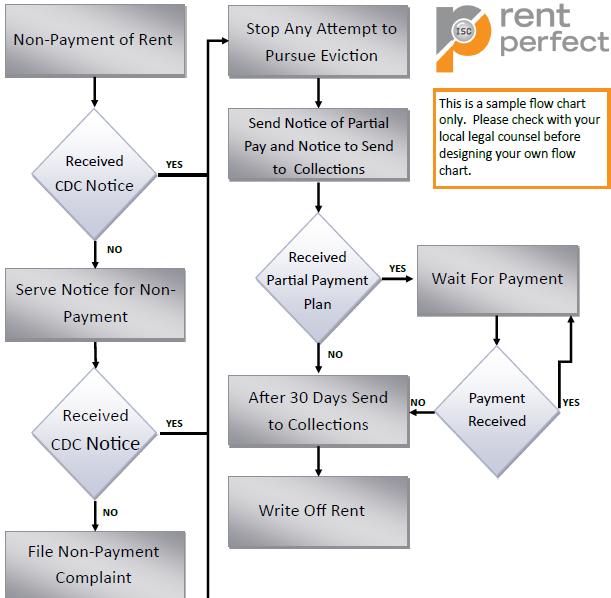
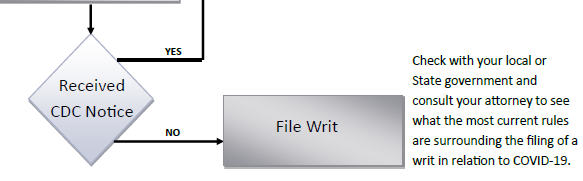
Regardless of whether you implement any or all of these strategies, as a successful landlord you need to pay particular attention to your eviction process. It would be beneficial to create an eviction flow chart to help you fully understand your policies and how they are affected during each step of the process. See the sample eviction process flowchart below.
As landlords we have to be flexible and sometime creative, as our survival depends on it.
When a roadblock appears, we thoroughly analyze it and develop a way to speed around it. Just make sure to have the right tools when you do to avoid the “speed traps” that may be out there.
I would love to hear your creative ideas on how you are dealing with today’s uncertain environment. David@rentperfect.com
It would be beneficial to create an eviction flow chart to help you fully understand your policies and how they are affected during each step of the process.
About the author
David Pickron is President of Rent Perfect and a fellow landlord who manages several short- and long-term rentals. He is a private investigator and teaches organizations across the country the importance of proper screening. His platform, Rent Perfect, was built to help the small landlord find success.
Property management companies are paying attention to budget-friendly, conscientious junk removal to meet diversion mandates to gain LEED certification or for meeting state or local guidelines.
By Paul Bergeron
Challenges involving the proper removal of bulk junk, non-traditional waste products and organics continue to mount for commercial real estate operators, particularly those managing apartment buildings and retail space.
Waste-removal service companies’ inconsistency in performance and expense is complicating the operations side of this necessary responsibility.
Conscientious property groups with sustainability goals in mind continue to seek reliable and efficient methods for these services to help their landfill-diversion goals and maintain acceptable curb appeal.
“Bulk-item removal has been really difficult because of lack of viable donation outlets and reuse consumers,” says Sydney Mainster, vice-president of sustainability for The Durst Organization, a family-run real-estate company. “It’s a lot of labor to handle, and oftentimes we need it removed quickly, whereas the end user may take weeks or months to identify. Also, we’ve often had to use our own in-house labor, even when donating items like furniture.”
Tenants can leave behind all types of stuff that will require junk removal when they move out.
Junk Removal That’s Calm, Cool, Collected
CheckSammy is a growing national company that provides same-day, on-demand removal services as well as monthly subscription-based service at a flat-rate.
“Junk hauling is the reactive, often problematic segment of the apartment industry’s waste hauling process,” says Cameron Funk, Vendor Relations Manager, Cass Waste Expense Management, Jacksonville. Funk manages thousands of residential real estate waste-management accounts nationwide.
“A community could have two move-outs on a given Monday and nothing else the rest of the month,” Funk says. “This causes complications for onsite management teams when budgeting costs and scheduling pickups. There’s no normality to it. Depending on the market, you’ll get different haulers at different rates at different times.”
Mainster says that more than anything, it saves on staff labor. “It also minimizes how many times someone has to move an item. If we have to move large items in house, someone from the building has to move a couch, for example, from the apartment to the basement for storage. Then, when it is either discarded or donated, that piece of furniture has to be handled a second time. With this service, it’s both removed from the apartment and from the building site at the same time.”
CheckSammy contracts locally with its staff, who are trained on the art of junk collection. They are currently the only company in the U.S. doing this. Offering a monthly subscription rate is far better than working through franchised waste haulers, who are generally less reliable and can be costlier.
“They make the entire process just a little bit smoother and that can go a long way economically and logistically,” Funk says.
Property managers say the predictability of its services takes some of the logistical and budgetary stress out of the process. Because the service does not involve franchises, it provides significant cost savings because no marketing charges are passed along to customers, the company says.
Remove That Eyesore
Junk hauling often can become a curb-appeal hazard for a community.
“A leasing staff doesn’t want to show an apartment with old mattresses laying outside,” Funk says. “If they are having to wait for a pick-up, they might as well have to set up an open-top container, but that’s not ideal, either. In a crowded area, it can come down to a space issue. With CheckSammy, you know they are going to show up when they say they are. The junk won’t linger.”
Junk-removal hurdles are becoming more prevalent during this uptick in apartment-home clear-outs, often required for residents who abandon possessions following a move-out or an eviction.
“Being able to resolve and remove junk/bulk in a timely manner while having a simplified pricing structure is essential to client satisfaction,” Funk says.
Satisfying Diversion-Data Goals
A company he’s used for about a year, its data collection has also been beneficial, particularly for apartment owners and managers who are tracking diversion percentage, Funk says, as well as those needing to meet the growing number of local areas where metrics are mandated.
“Instead of getting a percentage estimate for diversion rates, you get the exact number,” Funk says. “This is very helpful for apartment firms looking to gain LEED certification or for meeting state or local guidelines.”
The data-collection process, which includes photos of the bins for each pickup, are more granular than most, Funk says. “For commercial clients, for example, if they are seeing the same widget showing up in 70 percent of the pickups, this is a signal to them that maybe they don’t need to be making so many of that widget,” Funk says.
“You can tell that CheckSammy invested a lot of time and money in data collection for its product. This data can then be fed into our propriety software as well as Microsoft Power BI analytics tool. Clients love the visibility and insight that is able to provide.”
Mainster says the data transparency about where these items actually end up once they’re removed through this process is important for integrity and upholding company values.
“We don’t just want it gone and forgotten about – we want to make sure it’s recycled or, ideally, reused when it leaves our buildings,” she says.
CheckSammy is being described as the next-generation sustainability solution for the waste industry, offering not only bulk junk/sustainability services but key data, by providing verified reporting that allows clients to meet or exceed their owners’ and investors’ sustainability metrics.
“Until now, no one had visibility into their bulk-junk spend, volumes, seasonality, and tracking for end of life and sustainability metrics,” says Sam Scoten, company CEO. “Through our software, we are able to generate detailed quarterly reporting, showcasing not only sustainability metrics, but spend and photos, and all backed by real-time verified data,” Scoten explains.
The provider’s streamlined reporting has eased such data-collection efforts for sustainability in areas such as Dallas, Fort Worth, and throughout California, and other municipalities around the country.
For Most, this is ‘Serious’
Mainster says Durst “takes diverting recyclable or compostable items from landfill seriously.”
How seriously? Durst offer organics collection for composting at no charge to all commercial tenants at its office buildings and to all residents at its multifamily buildings.
“We continue to offer organics collection through a private hauler at the apartment properties, even though DSNY has halted its city-wide organics program,” Mainster says. “We also offer battery recycling, light bulb recycling, e-waste collection and recycling, and bulk-removal options at our commercial properties. At our multifamily buildings, we collect batteries, e-waste, light bulbs and textiles for recycling.”
Mainster says her company has struggled with bulk removal at its commercial properties and residential buildings due to timing, lack of adequate storage, labor requirements and lack of viable outlets for items such as office furniture and sofas.
“A company that provides professional labor for removal, storage, and transparent outlets for bulks items and goods is in theory, an ideal solution,” she says.
Funk says he’s used CheckSammy in other collections verticals, such as shopping malls. “The good thing about it is that it’s a system that is set up that can work in any vertical,” he says.
About the author:
Paul Bergeron has been reporting on the apartment industry since 2002 and served 20 years as Editor in Chief for National Apartment Association’s UNITS magazine. He currently is Editor of his LinkedIn media platform Thought Leadership Today and can be reached at pbergeron333@gmail.com.
Whether you or your tenants are paying the heating bills, it’s a significant expense; heating accounts for about 42 percent of our energy consumption. With winter approaching, it will benefit you to think ahead. Here are five ways to lower rental property heating costs for everyone from Keepe the maintenance company.
No. 1 – Have Your Furnace Cleaned and Checked
Regular maintenance is a simple step that can lower energy needs and utility bills.
When your furnace is running at its best, it can save you money every month, and it will continue operating longer without needing expensive repairs. Check for soot, rust, and corrosion in, on and around the furnace and on the floor surrounding it and the flue. These indicate the system requires immediate service.
Getting tenants to change the air filter every month is a challenge, but it will save them money and save you maintenance costs.
No. 2 – Turn Down the Temperature
The U.S. Energy Department says that setting the thermostat to 68 degrees when tenants are home and awake, and lowering it when they’re away or sleeping, saves money. This may be harder to do in the time of the pandemic, as many people are working from home.
Lowering the thermostat seven to 10 degrees for eight hours daily from its normal setting can save as much as 10 percent a year, on average, depending on your location.
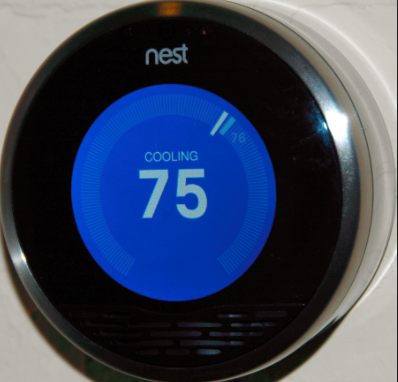
No. 3 – Get Smart with Your Thermostat
The thermostat is a valve between your energy supplier and lower rental property heating costs.
For every degree it is turned down, you use as much as two percent less heating energy. A 10-degree setback overnight cuts the heating bill by up to 10 percent. More importantly, you can switch to a smart programmable thermostat, which saves energy without you even thinking about it.
Adjust the settings to turn down the temperature to fit your lifestyle. When programming, keep in mind that it may take as little as 15 minutes to heat your home to a comfortable level.
No. 4 – Stop the Drafts
Warm air leaking out of your rental property can be responsible for about 20 percent of heating costs, according to the Department of Energy.
The irony is that this problem could easily be fixed after a quick shopping trip to the local hardware store; weather stripping for doors can cost less than $15 and is easy to install.
Don’t forget the windows, which are another big source of drafts. There are a variety of solutions –from hot-air-sealed window plastic to window films and window shades – that could fit your needs. Be careful, though, because sunlight filtering through your windows can actually provide heating benefits.
No. 5 – Wrap the Water Heater
While you’re at it, give the water heater or water tank a hug by wrapping it in an insulation blanket.
An insulating blanket on the water heater and insulating wraps on your hot-water pipes prevents them from losing heat to the outside air. It helps you save energy and money, and you won’t have to wait as long for the water to get hot at the faucet.
Lower rental property heating costs conclusion
There are several ways to reduce your rental property heating and lower heating costs during the winter season. From conducting regular maintenance to adopting an energy-saving lifestyle, you are guaranteed of a lower monthly energy cost.
You can also hire the services of an energy auditor to help you discover new ways to reduce heating costs in your property.
About Keepe:
Keepe is an on-demand maintenance solution for property managers and independent landlords. The company makes a network of hundreds of independent contractors and handymen available for maintenance projects at rental properties.
Keepe is available in the Greater Seattle area, Greater Phoenix area, San Francisco Bay area, Portland, San Diego and is coming soon to an area near you. Learn more about Keepe at https://www.keepe.com.
5 Maintenance Tips For Long-Lasting Carpet In Your Rentals
The San Francisco Chronicle has joined many other newspapers in California warning against passage of Proposition 21, the “housing-freeze” initiative, joining nearly all of the other state’s major newspaper editorial boards in opposing the measure.
In an editorial titled, “Vote no on Prop. 21, a rent-control retread unimproved by age,” the Chronicle’s editorial board notes “the case for rent control, overwhelmingly rejected by experts and refuted by research, might have seemed unlikely to grow weaker. And yet it has.
“In the two years since Californians rejected the last attempt to double down on the failed policy by letting more cities impose and expand rent control, the reasons to vote against this fall’s rehash, Proposition 21, have multiplied… Californians should vote no on Prop. 21 or risk aggravating the crisis it purports to address,” the newspaper writes.
The San Jose Mercury News writes in an editorial:
The basic principles of economics haven’t changed in two years.
That’s when 59 percent of California voters wisely rejected a measure that would have allowed cities to impose tougher local rent-control restrictions.
Since then, the legislature and Gov. Gavin Newsom have nevertheless approved legislation imposing rent control statewide, albeit a more-tempered version. Now rent-control advocates have gone back to the ballot to try once again to enable tougher local standards.
Throughout all this, however, the economic fundamentals remain the same: High rents in California are due to a shortage in the housing supply. We simply haven’t built homes fast enough to keep up with population growth. As a result, more people are competing for limited numbers of dwellings.
But the tougher the rent restrictions in the state, the less likely developers will construct desperately needed units. Rent control will only make the housing shortage worse. Which is why voters should reject Proposition 21 on the Nov. 3 ballot.
Rent control is a feel-good idea. A quick fix to a complicated problem. But it is not very effective at protecting poor or vulnerable tenants. In the short run, rent control helps those who live in rent-controlled units. But in the long-run it drives up the overall cost of rental housing because it exacerbates the short supply, the San Jose Mercury News writes.
According to a release, The Chronicle is the latest California in urging its readers to vote no on Proposition 21. McClatchy Newspapers, the publishers of the Sacramento Bee, Fresno Bee, Modesto Bee, San Luis Obispo Tribune, and Merced Sun-Star, urged their readers to oppose Proposition 21 month. The Bakersfield Californian, the Bay Area News Group (San Jose Mercury News, East Bay Times, Marin Independent Journal), the Santa Rosa Press Democrat, and the Southern California Newspaper Group (publishers of multiple newspapers including the Los Angeles Daily News, Riverside Press Enterprise, and Orange County Register) also have issued editorials opposing Proposition 21.
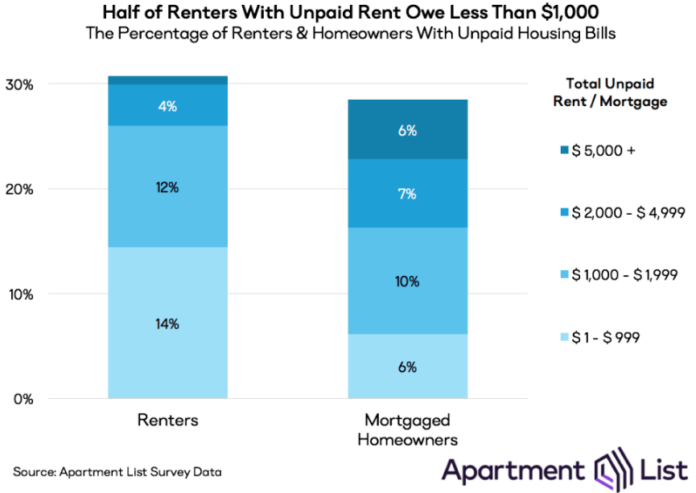
A new survey shows 32 percent of renters had pandemic-rent debt from previous months still due in the first week of September, but that number had dropped to 10 percent by the second week of the month, according to Apartment List.
“Renters continue to struggle to make housing payments. This month, we found 10 percent of renters failed to make their full August payment by the end of the month, and one in six started September owing about $1,000 in missed rent,” the survey said.
“While our first-week non-payment rate came in at 32 percent, most of these are made up with late payments throughout the remainder of the month,” said Chris Salviati, Housing Economist for Apartment List. He said non-payment of rent is less prevalent in large multifamily buildings.
Many still struggling to catch up on pandemic rent debt from prior months
“Despite the slight improvement in September payments, many renters are still worried about unpaid rent obligations from prior months.
“One-in-three renters started September with outstanding back rent owed, nearly unchanged from August. Among those with unpaid rent bills, close to half owe their landlords less than $1,000, while just five percent of all renters owe more than $2,000.
“These results indicate that another round of stimulus payments of a scale similar to those that went out earlier this year could help a significant share of renters catch up on their rent,” the report said.
Rent struggles illuminate racial disparities
The pandemic has exacerbated long-standing concerns around financial instability and housing insecurity.
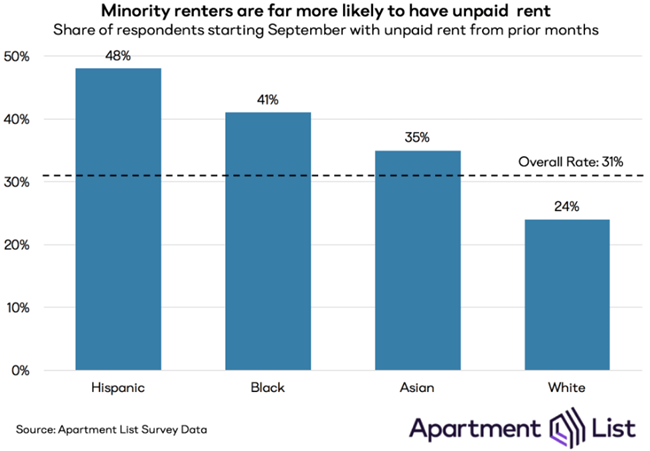
“These challenges, however, have not affected all segments of the population evenly. Segmenting our survey data by race illuminates significant variation in the prevalence of unpaid housing bills.
“The share of white renters with unpaid rent is well below the overall rate at 24 percent. Meanwhile, black and Hispanic renters are far more likely to owe unpaid rent, with rates of 48 percent and 41 percent, respectively,” the report says.
With less discretionary spending to cut and fewer savings to draw on, these households are more likely to turn to other sources. Black respondents are most likely to have borrowed money from family or friends (28 percent compared to the overall rate of 18 percent) and Hispanic respondents are most likely to have sold assets (23 percent compared to 16 percent overall).
Pandemic Rent Debt Conclusion
“As the COVID-19 pandemic continues to disrupt all aspects of daily life, making housing payments remains a struggle for a startlingly high share of Americans.
Although this month’s data represents a slight improvement, nearly one in three survey respondents started this month with unpaid rent or mortgage owed from a prior month. In order to meet their financial obligations amid heightened economic uncertainty, renters and homeowners alike are making a variety of financial sacrifices as a direct result of the pandemic.
“Although the CDC’s recent pause on evictions has delayed the worst outcomes, missed housing payments remain a major concern in today’s economy,” Apartment List says in the report.
“The initial rent payment figures from September have begun to demonstrate the increasing challenges apartment residents are facing,” said NMHC President Doug Bibby in a statement.
“Falling rent payments mean that apartment owners and operators will increasingly have difficulty meeting their mortgages, paying their taxes and utilities, and meeting payroll. The enactment of a nationwide eviction moratorium last week did nothing to help renters or alleviate the financial distress they are facing. Instead, it only is a stopgap measure that puts the entire housing finance system at jeopardy and saddles apartment residents with untenable levels of debt.
“Federal policymakers would have been better advised to continue to provide support as they successfully did through the CARES Act,” Bibby said.
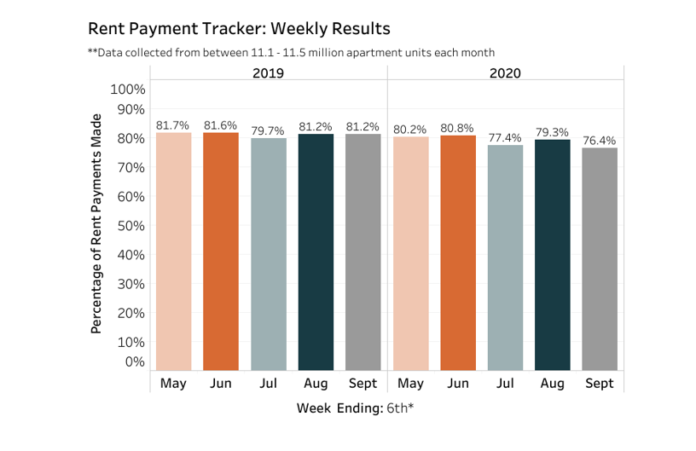
The September payments are an almost 5 percent decrease compared to the same time in August.
These data encompass a wide variety of market-rate rental properties across the United States, which can vary by size, type and average rental price.
“NMHC strongly urges members of Congress and administration leaders to come back to the table and pass meaningful legislation to protect, support and assist America’s tens of millions of apartment residents,” Bibby said.
“It is worth noting that the Labor Day weekend, which occurred a week later than in 2019, may have impacted the collections data for the first week of the month, just as our data showed a comparable dip the first week of July because of the Fourth of July holiday,” said Bibby. “Next week’s rent-payment tracker numbers will help indicate the degree to which the drop in payments was a result of the holiday weekend or a decreased ability of residents to pay their rent.”
The NMHC Rent Payment Tracker metric provides insight into changes in resident rent-payment behavior over the course of each month, and, as the dataset ages, between months. While the tracker is intended to serve as an indicator of resident financial challenges, it is also intended to track the recovery as well, including the effectiveness of government stimulus and subsidies.
However, noteworthy technical issues may make historical comparisons imprecise. For example, factors such as varying days of the week on which data are collected; individual companies’ differing payment collection policies; shelter-in-place orders’ effects on residents’ ability to deliver payments in person or by mail; the closure of leasing offices, which may delay operators’ payment processing; and other factors can affect how and when rent data is processed and recorded.
The pandemic has meant our homes are required to double as entertainment and working spaces, with nearly half of the U.S. labor force working from home full-time, StorageCafe writes in a new report, but apartments have gotten smaller in the past 10 years.
Colorado, the top state for working from home pre-pandemic, barely had 7.7 percent of its population working from home then.
How prepared are American homes for this new reality, space-wise?
Apartments have gotten smaller as homes have gotten bigger
“On a national average level, apartments lost a bedroom over the last decade, while single family homes gained one,” Yardi Matrix says in the report.
“Single-family homes are generally large enough to respond to the growing need for space. Apartments, however, will make it harder for people to adjust, as space is at a premium in most cities.”
Some highlights from the report:
The McMansion comes in handy for a change as it’s now in line with people’s need for more space. New single-family homes built in 2019 have an average of 2,611 square feet, 18 percent bigger than the overall U.S. inventory.
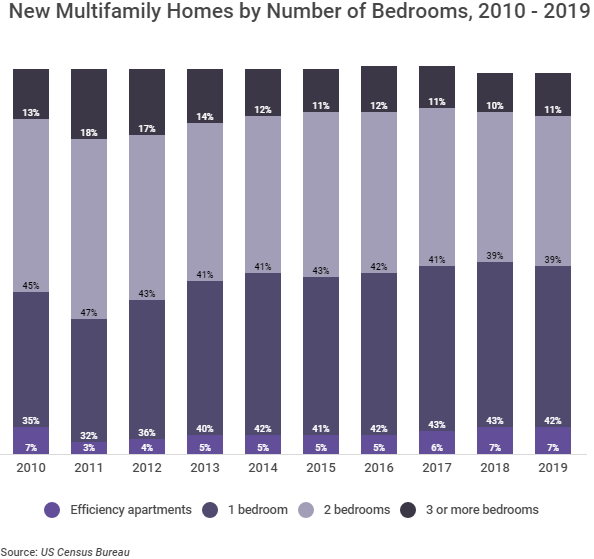
Multi-bedroom homes grew considerably — 43 percent of the single family homes built in 2019 have 4+ bedrooms, compared to 35 percent in 2010. The percentage of newly built homes with two bedrooms or fewer decreased from 13 percent in 2010 to 11 percent in 2019.
Apartments, however, lag behind in responding to this need for more space at home. The average size of an apartment built in 2019 was 1,156 square feet, 90 square feet smaller than those built in 2010.
One-bedroom apartments saw an increase in new construction, from 35 percent in 2010 to 42 percent in 2019, while two-bedroom apartments lost ground, from 45 percent of newly built apartments having two bedrooms in 2010 to 39 percent in 2019.
Among the nation’s largest 20 cities, Chicago saw the highest increase in home sizes. New homes in Chicago are now 916 sq. ft. larger than those built in 2010, and offer a whopping 3,330 sq. ft. of living space on average.
San Francisco experienced the highest increase in new apartment size among the country’s largest 20 cities, adding a significant 107 square feet between 2010 and 2019.
Size of single-family homes growing
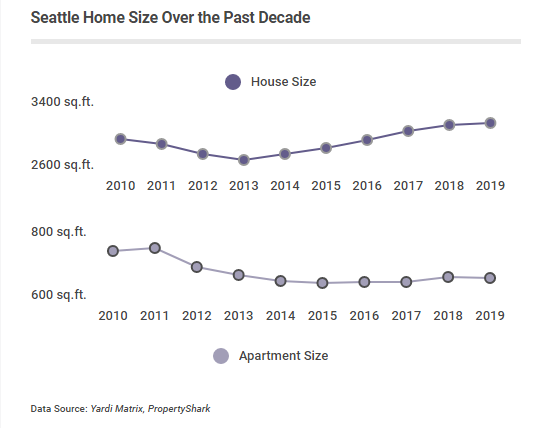
Seattle is a good example of a city that saw a definite increase in single-family-home space from 2010 to 2019. Houses built in 2010 had 3,025 square feet, while new 2019 houses were 192 square feet larger, encompassing an average of 3,217 square feet.
At the same time, Seattle built smaller apartments in 2019 than in 2010. New apartments built in Seattle in 2010 had 762 square feet on average, and shrunk to a meager average 676 square feet in 2019.
Apartment residents need storage space
Living in smaller apartments doesn’t mean that Americans like to live small. Incomes rose over the last decade and so did consumer spending, which gave way to a need for more space – enter self-storage.
Yardi Matrix data shows that there’s currently over 1.4 billion square feet of self-storage space in the United States, out of which 190 million square feet – or 13 percent – were built over the last five years.
Residents of cities like Seattle, for example, where apartments are notoriously small (and continue to shrink), can really benefit from using self-storage. There are 4.5 square feet of storage space per capita in the city, and the monthly rent for a 10×10 self-storage unit is around $178.
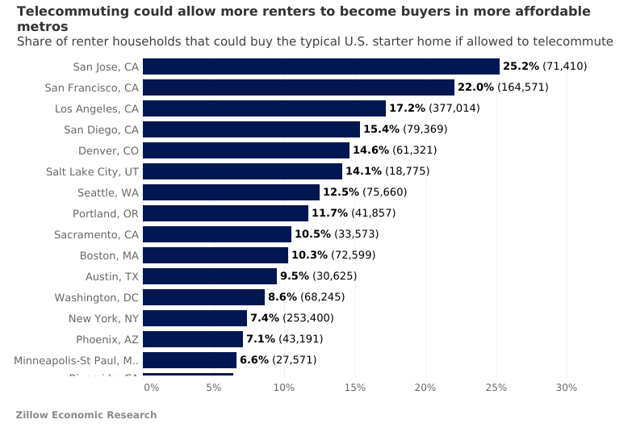
Remote work trends mean many renter households could likely telecommute and afford monthly payments on the typical U.S. starter home, but couldn’t afford a starter home in their current metro, says a new Zillow analysis.
Zillow’s analysis looked at renter households for whom monthly payments on a starter home in their metro are unaffordable, but would be affordable on the typical U.S. starter home. Those households were then assigned a probability of being able to telecommute based on income, the worker’s industry and occupation.
“If remote work becomes a bona fide long-term option, especially with the pandemic, that could reshape the U.S. housing market by opening up home-ownership to people renting in expensive parts of the country,” said Zillow economist Jeff Tucker in a release.
“However, it’s unclear how many people would make the move to buy their first home. Proximity to work is just one of the factors people consider when choosing where to live. Other factors may keep them from moving, including proximity to friends and family, cultural and natural amenities, and their kids’ schools.”
Remote work and housing costs
The numbers are more pronounced in expensive coastal metros like San Francisco, where 22 percent of renters priced out of their metro could afford monthly payments on a typical U.S. starter home, estimated at $725.
Monthly payments on a typical San Francisco city starter home are more than seven times higher, at $5,181. More than 10 percent of renters who couldn’t afford to buy in the city of San Francisco, could afford a starter home within the greater San Francisco metro area, offering more options farther afield to aspiring buyers who no longer need to commute to the office five days a week.
In cities such as Minneapolis, Phoenix and Denver, the opposite is true. In Denver, for example, starter homes in the city are more affordable than in the metro area, yet 14.5 percent of renter households priced out of homeownership in the Denver metro could afford a typical starter home elsewhere in the country.
Millennials are now buyers
“Two-thirds of our buyers are millennials,” said Zillow Premier Agent Holly Mellstrom, a Pelham, NY-based associate broker at Julia B. Fee Sotheby’s International Realty, in the release. “They’re looking to put down roots and get more space for their money after high-rise city living. Many have young families and were planning to move to the suburbs in the future, but they’re making the move now because they don’t anticipate having to commute into the city to work every day.”
Chris Chan, 40, and his wife, Eunice Lee, 35, became home buyers during the pandemic, moving from a two-bedroom co-op in Brooklyn to a five-bedroom house in Westchester County, NY.
“The tipping point was envisioning both of us working from home indefinitely alongside our daughter and a second child on the way,” said Chan, who works in Connecticut, in the release. “We wanted to maintain the balance between space and proximity to the city. We could get more for our money just outside city limits and we’re still only 30 minutes from Grand Central Station.”
Washington Attorney General Bob Ferguson has filed suit against a property management company in Spokane for violation of the eviction moratorium in the state and threatening residents with eviction for unpaid rent.
Ferguson sued Whitewater Creek, an Idaho company that manages low-income housing complexes in Spokane, according to a release.
“Emails obtained by the attorney general’s office show that at the express direction of Maryann Prescott, a majority owner of Whitewater Creek, Whitewater Creek personnel verbally threatened at least four residents at properties it was responsible for,” Ferguson said in the release.
“Prescott wanted tenants to know they would be evicted for unpaid rent and/or fees as soon as courts reopened for eviction proceedings. These residents were also informed that they would be responsible for unspecified legal fees associated with their evictions.
“These threats came one month after Gov. Jay Inslee’s eviction moratorium was well-known throughout the state. Whitewater Creek personnel did not disclose the eviction moratorium protected the residents from such action,” according to the release.
An April 20 email Prescott sent to a Whitewater Creek site manager asked to, “confirm you explained that (the resident) will be evicted for past due rent when courts reopen.” Ms. Prescott received the response, “yes she did tell them all about the eviction.” On April 21, Prescott sent another email noting a site manager needed “to hold these (residents) accountable” to pay past-due rent.
Violation of eviction moratorium in Washington
“Washingtonians are struggling, yet Whitewater Creek illegally threatened tenants with evictions in the middle of a pandemic,” Ferguson said in the release. “They violated the clear text of the governor’s emergency proclamation. Their actions were cruel, unacceptable and illegal. They will be held accountable.”
Whitewater Creek, Inc. is a Hayden, Idaho-based real-estate company that, through a number of related entities, manages and owns 1,000 low-income housing units across 12 housing complexes in eastern Washington. Many of their properties were developed with millions of dollars in taxpayer funding in the form of tax-credit equity and tax-exempt notes authorized by the Washington State Housing Finance Commission.
The attorney general’s office received complaints from multiple tenants at Whitewater Creek properties alleging various violations of the eviction moratorium and the governor’s proclamations, including verbal threats of eviction for non-payment of rent or other fees, according to the release.
In April, one tenant suspected that the threats were not being memorialized in writing to avoid evidence of violating the eviction proclamations.
Another resident asked to make a partial payment or go on a repayment plan based on the federal stimulus payment she expected. Whitewater Creek informed the resident, who is a single mother of young children, she would be evicted the day courts reopened for eviction proceedings if she did not pay the full balance owed.
When she attempted to contact Whitewater Creek’s corporate office to dispute the eviction threat and find out how much the legal fees would be, she was informed that she would be “charged with harassment” if she did not stop calling. This resident expressed fear of retaliation for attempting to contest the eviction threat and also worried she would lose custody of her children if evicted.
Around the same time in April, Whitewater Creek personnel threatened another resident with eviction for being one month behind on the balance she owed. After the resident, who is an unemployed single mother with two young children, informed Whitewater Creek staff that she had just been approved for unemployment and hoped to soon be caught up on payments by the end of the month, a Whitewater Creek property manager instructed her to “turn in any monies (she has) to help avoid eviction.”
The Attorney General’s Office sent a letter in May requesting, among other actions, that Whitewater Creek immediately notify all residents the Emergency Proclamations prohibit threats of eviction and that Whitewater Creek would comply with the Proclamations. Instead of issuing such notices and providing copies to the Attorney General’s Office, as requested, Whitewater Creek consistently and falsely denied that it threatened to evict anyone, contrary to internal email communications confirming that it threatened residents with eviction at Prescott’s direction.
This is the second lawsuit Ferguson filed to enforce the eviction moratorium. The previous lawsuit against JRK Residential, a Nevada-based property management company with units in Tacoma, Silverdale and Marysville, resulted in May of a payment of nearly $350,000 — including almost $300,000 directly to tenants in the form of refunds, payments and rent forgiveness.