Home Blog Page 66

Bill Passes Requiring Landlords To Substantiate Damage Claims

The Washington House has passed a bill requiring landlords to substantiate damage claims by tenants in order to retain security deposits

The Washington House has passed a bill requiring landlords to substantiate damage claims by tenants in order to retain security deposits, according to reports.

The bill also extends the timeline landlords in the State of Washington have to provide documentation showing that they are right in retaining all or part of a tenant’s deposit. That timeline would be extended from 21 days to 30 days.

Additionally, landlords must provide documents or receipts to substantiate damage costs withheld from a tenant’s deposit. It also prohibits landlords from keeping a deposit in certain instances, such as normal wear and tear, or replacement of fixtures, appliances and equipment if the condition of those items was not documented during the tenant’s move-in.

The bill, House Bill 1074, is sponsored by Rep. My-Linh Thai, D-Bellevue, and was passed with a 57-40 vote. It will now head for the Senate.

“Tenants continue to tell us they are being denied deposit refunds due to unsubstantiated damage claims. This bill doesn’t deny landlords the ability to recoup their expenses for damages, it simply ensures fair treatment of renters,” Thai said in a press statement released after the bill passage. “As a landlord myself, this is about setting a precedent for landlords to stop charging tenants thousands of dollars in uncorroborated damages.”

Many lawmakers who also are landlords argued against the bill requiring landlords to substantiate damage claims in order to retain security deposits, including Rep. Andrew Barkis, R-Olympia.

Barkis said amendments were offered that could have gotten the bill to a place that was agreeable to landlords. “The intent of this policy is good — most housing providers are already doing most of everything that’s in here, and with a few tweaks, all could have done this policy better,” he told The Olumpian. But, Barkis said, the power dynamic is shifting out of the landlord’s favor, and “thousands” of rental housing units are being lost.

Sign Up For Our Weekly Newsletter And Get Rental Property And Apartment News And Helpful, Useful Content Each Week.

* indicates required

One In Three Small Portfolio Owners Say They Are Profitable

The majority of rental owners surveyed in 2022 said that they’re struggling to stay in the black, especially small portfolio owners

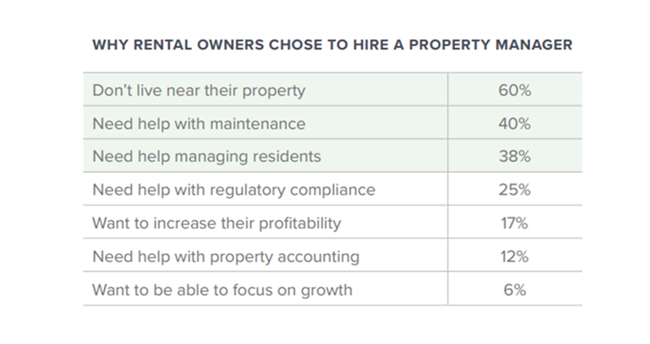
The majority of rental owners surveyed in 2022 said that they’re struggling to stay in the black, Buildium says in a new survey.

And, just one in three small-portfolio rental owners report that their properties are consistently profitable.

“They need the professional services (and expertise) of property management companies. But that’s not all our research shows,” Buildium says in the report titled Opportunities for Property Managers in Rental Owners’ Shifting Needs. The study was done by Buildium and Propertyware, both RealPage companies, and the National Association of Residential Property Managers (NARPM).

More small-portfolio owners are turned to professional property management going from 55 percent using professional management before the pandemic to now 63 percent.

Why the change?

The pandemic-era rental market has complicated the business of owning rental property, from increased regulations to inflated costs, supply chain delays, and labor shortages, Buildium says.

As a result, rental owners of all experience levels are turning to property management companies for assistance with regulatory compliance, resident management, maintenance and repairs, and more—which makes particular sense when you consider that nearly two-thirds of owners don’t live near their rental properties.

What Type Of Landlord Hires A Property Manager?

Today, 76 percent of rental owners consider themselves investors, while just 24 percent identify as accidental landlords.

However, accidental landlords may appear to be more prevalent within property managers’ client base because they’re still the most likely to seek out their services: 71 percent of accidental landlords currently have a property manager, in comparison with 62 percent of Intentional Investors and 59 percent of unintentional investors.

The majority of rental owners surveyed in 2022 said that they’re struggling to stay in the black, especially small portfolio owners
Charts courtesy of Buildium

What Are The Three Types Of Rental Property Owners?

  1. Intentional Investors acquired their rental property as an investment from the start. They represent 52 percent of today’s rental owners—an increase of eight percentage points since 2018—marking a high point for this type of investor within the population of small-portfolio rental owners.
  2. Unintentional Investors came to own rental property due to circumstance, but they now consider themselves investors. They comprise 24 percent of small-portfolio rental owners—a number that’s stayed relatively stable over time—but 2022 is the first year in which this group is as prevalent within the rental owner population as Accidental Landlords.
  3. Accidental Landlords came to own their property due to circumstance, and they don’t consider themselves investors (though some make the transition from Accidental Landlord to Unintentional Investor). They represent 24 percent of today’s rental owners—a decrease of eight percentage points since 2018, and five points in the last year alone.

The Stress of Rental Property Ownership

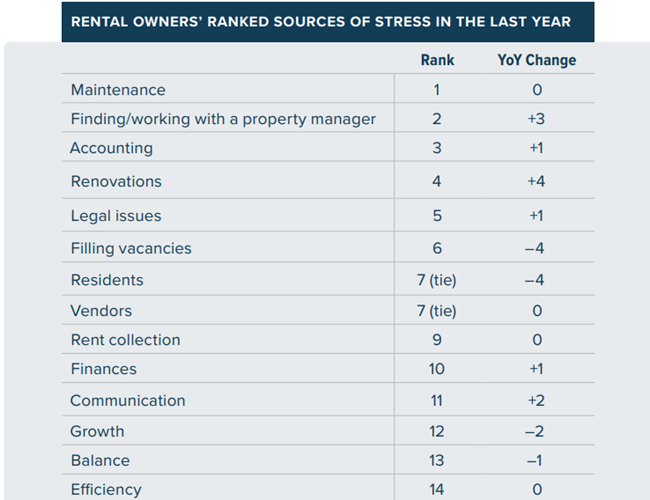
Rental property owners who work with a property manager to run their rentals are less stressed than owners who attempt to do so on their own by a full 16 percentage points, the survey says.

The majority of rental owners surveyed in 2022 said that they’re struggling to stay in the black, especially small portfolio owners
Chart courtesy of Buildium

Another one in four owners with a property manager report that they didn’t experience any stress related to their property in the last year, in comparison with just  one in 10 owners who run their properties on their own.

Read the full report here.

The majority of rental owners surveyed in 2022 said that they’re struggling to stay in the black, especially small portfolio owners

Sign Up For Our Newsletter And Get Rental Property And Apartment News And Helpful, Useful Content Each Week.

* indicates required

Four Ways to Use Delaware Statutory Trusts for Your 1031 Exchange

Four ways to use Delaware Statutory Trusts for your 1031 exchange as they provide real estate investors four timeless benefits

By Dwight Kay
Founder and CEO
Kay Properties & Investments

Key Highlights:

  • How DSTs help investors successfully complete a 1031 exchange
  • Can DSTs potentially provide investors greater diversification?
  • How DSTs are utilized to help investors easily replace debt for their 1031 exchange
  • DSTs can provide investors a good back-up option for a 1031 exchange

Regardless of what economic trends are taking place, Delaware Statutory Trusts provide investors four timeless benefits for their 1031 Exchanges including deferring capital gains taxes, eliminating the headaches of active management (think the Three T’s: tenants, toilets, and trash), and the ability to create a more diversified* portfolio. Additionally, DSTs have the potential to provide investors potentially consistent and durable income streams with the ability to achieve modest appreciation potential**.

Understanding how to best utilize DSTs for 1031 exchanges can be an important ingredient to maximizing the potential benefits DSTs can potentially provide investors. Here are four specific strategies real estate investors can leverage DSTs for their 1031 exchanges.

 Delaware Statutory Trusts can be used by 1031 Exchange Investors in these four ways:

  1. Debt Replacement
  2. Cover Strategy
  3. Diversification and Passive Investing
  4. Back-Up Option

If you are considering a 1031 Exchange, here are four ways you can use DSTs as a strategic tool for today’s challenging real estate market:

  1. Debt Replacement.

One of the most popular uses of DSTs for a 1031 Exchange involves not having to secure financing. For example, if you are in the midst of a 1031 Exchange in today’s unstable debt market, you are likely having a difficult time finding a mortgage to satisfy your 1031 exchange requirements. DSTs, however, are designed to make it easy to invest in without having to deal with qualifying for and taking on a mortgage on own’s own . That’s why many investors find DSTs also make a suitable primary investment option for 1031 Exchanges. Kay Properties has a variety of leveraged DSTs that are pre-structured with non-recourse debt already built-in typically ranging from 30% to 70% offering loan to value (LTV). Because DSTs typically do not require you to have to qualify for a loan or even fill out loan documents, DSTs can create a reliable tool for you to access high-quality real estate investments without having to jump through the hoops of getting approved for a loan.

  1. Cover strategy.

Another popular use of DST investments comes in the form of providing a cover strategy for left over equity. Let’s say you sell one property and cannot find a suitable replacement property that uses the full exchange proceeds, and you now have leftover equity you need to place.  One of the benefits DSTs can provide you in this situation is the ability to enter one without investing a lot of money.  Because DSTs require a low minimum investment amount (typically $100k), they can be a good way for you to use any extra 1031 Exchange proceeds to avoid having a “boot” to pay taxes on. Placing the leftover exchange proceeds into a DST property can potentially allow you to achieve full tax deferral for your 1031 exchange.

An Example of How DSTs Can Provide Cover for a 1031 Exchange

Here’s an example of how DSTs can provide a cover strategy for your 1031 Exchange:

Let’s say you need to replace a $3,000,000 purchase price for a 1031 Exchange, but your real estate broker finds a property for $2,700,000. By investing the leftover $300,000 in a DST, you could successfully avoid the taxable boot. In this way, you could successfully complete your 1031 Exchange by acquiring both a real property investment and a DST investment with an aggregate value of $3,000,000.

  1. Diversification* and true passivity.

You have probably heard the expression, “why put all your eggs in one basket?” If you decide to invest in one single tenant net leased property or one multifamily apartment building for your 1031 Exchange, that’s exactly what you could be doing. However, DST properties can potentially allow you to achieve a level of diversification that you would not be able to achieve if you only bought a single NNN asset or multifamily building on your own. By investing in a DST, you have access to a diversified* portfolio of properties that are often high-quality real estate offerings with very large tenants that are professionally managed and potentially provide monthly cash distributions. In addition, you can also achieve a truly passive management structure, eliminating the headaches of the Three T’s: “tenants, toilets, and trash.”

Investing in a single-tenant property, on the other hand, means you are relying heavily on the quality of a sole tenant. If that tenant fails to pay rent or even files bankruptcy, your income could likely be reduced or even completely eliminated. Similarly, would you invest all of your 401k into one company’s stock, even if that company is Amazon or Apple? Your answer is probably No. No matter how great a company is, you probably do not trust it with all of your family’s wealth. In the same way, there is no perfect investment property. You may be able to mitigate your potential exposure to the various risks of real estate by diversifying*. DSTs allow for diversification* amongst a number of different income producing properties.

  1. Back-up option.

One of the many reasons investors should consider DSTs is as a back-up option for their 1031 Exchange. Why is this an important factor to consider? Let’s say that you have successfully sold your investment property and are now proceeding to search for replacement properties that you can manage on your own. In today’s market, you may discover that identifying and closing on high-quality “like-kind” assets within the specified timeframe is not as easy as it sounds. This is when DSTs can be used as a backup option. The reason for this is because DSTs are pre-packaged specifically for 1031 Exchanges, so they can potentially be a very helpful tool to have in the bag in case your primary real property option falls through and you’re facing a failed exchange. In addition, because of the turnkey nature of DSTs, you can often close on them within just 3 -5 days to give you a strategy to successfully complete your 1031 Exchange.

DST properties continue to be one of the most popular passive investment option for 1031 Exchanges. Knowing how to best use DSTs to avoid common 1031 Exchange challenges, you will be better situated to potentially complete your exchange and avoid the expensive taxes that could accompany a failed exchange.

Kay Properties team members are always available for in-person meetings, zoom meetings and conference calls with investors to educate and explain various DST options, strategies, and potential benefits and risks.

For a complete list of current 1031 eligible exchange DST properties, use the convenient QR code below and receive your FREE DST 1031 Exchange Toolkit.


Ask Bill Exeter

Ask Bill Exeter and his team your questions about 1031 exchanges and he and his team will get back to you.

Name

About the author:

Four ways to use Delaware Statutory Trusts for your 1031 exchange as they provide real estate investors four timeless benefits

Dwight Kay is the Founder and CEO of Kay Properties and Investments, LLC. Kay Properties is a national 1031 exchange investment firm. The www.kpi1031.com platform provides access to the marketplace of 1031 exchange properties, custom 1031 exchange properties only available to Kay clients, independent advice on sponsor companies, full due diligence and vetting on each 1031 exchange offering (typically 20-40 offerings) and a 1031 secondary market. Kay Properties team members collectively have over 150 years of real estate experience, are licensed in all 50 states, and have participated in over $30 Billion of 1031 investments.

About Kay Properties and www.kpi1031.com

Kay Properties is a national Delaware Statutory Trust (DST) investment firm. The www.kpi1031.com platform provides access to the marketplace of DSTs from over 25 different sponsor companies, custom DSTs only available to Kay clients, independent advice on DST sponsor companies, full due diligence and vetting on each DST (typically 20-40 DSTs) and a DST secondary market.  Kay Properties team members collectively have over 150 years of real estate experience, are licensed in all 50 states, and have participated in over $30 Billion of DST 1031 investments.

*Diversification does not guarantee returns and does not protect against loss.

** Past performance does not guarantee or indicate the likelihood of future results. No representation is made that any DST investment will or is likely to achieve profits or losses similar to those achieved in the past or that losses will not be incurred on future offerings.

This material does not constitute an offer to sell nor a solicitation of an offer to buy any security. Such offers can be made only by the confidential Private Placement Memorandum (the “Memorandum”). Please read the entire Memorandum paying special attention to the risk section prior investing.  IRC Section 1031, IRC Section 1033 and IRC Section 721 are complex tax codes therefore you should consult your tax or legal professional for details regarding your situation.  There are material risks associated with investing in real estate securities including illiquidity, vacancies, general market conditions and competition, lack of operating history, interest rate risks, general risks of owning/operating commercial and multifamily properties, financing risks, potential adverse tax consequences, general economic risks, development risks and long hold periods. There is a risk of loss of the entire investment principal. Past performance is not a guarantee of future results. Potential cash flow, potential returns and potential appreciation are not guaranteed.

Nothing contained on this website constitutes tax, legal, insurance or investment advice, nor does it constitute a solicitation or an offer to buy or sell any security or other financial instrument. Securities offered through FNEX Capital , member FINRA, SIPC.

2-1-23 KPI_ToolKit_Jan2023_RHJ_9.75x15.5



National Rent Growth Turns Positive In February

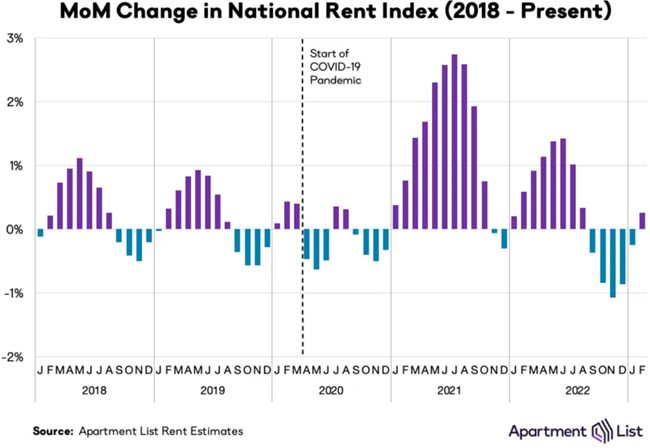
After months of decline, national rent growth turned positive in February, up by 0.3 percent Apartment List says in the 2023 March report.

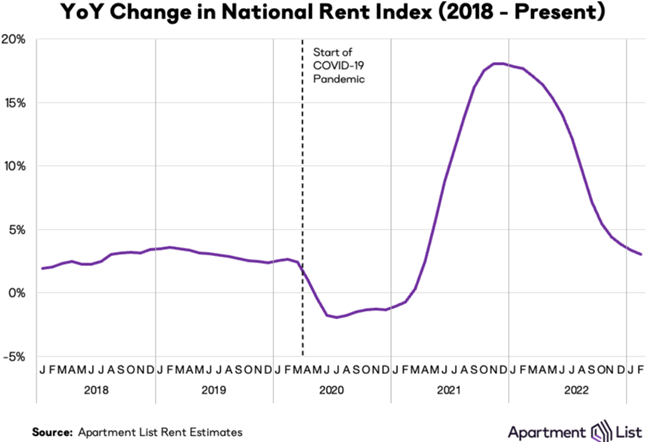
After months of decline, national rent growth turned positive in February, up by 0.3 percent, according to the March report from Apartment List.

“This month’s increase is of a similar magnitude to the typical February price change that we saw in pre-pandemic years. After a few months of record-setting price declines, it appears that rental demand is rebounding in line with the usual seasonal trend,” the Apartment List research team writes in the report.

After several months of rent declines, the year-over-year rent increase number now stands at 3 percent.

“Year-over-year growth is now pacing just slightly ahead of the average rate from 2018 to 2019 (2.8 percent), and is likely to decline further in the months ahead,” the Apartment List report says.

After months of decline, national rent growth turned positive in February, up by 0.3 percent Apartment List says in the 2023 March report.

Property Owners May Soon Be Competing For Renters

As apartment construction continues, and more and more new multifamily apartments are completed, this additional new supply of housing will cause more new supply to become available to renters.

With more options then available to renters, “2023 could be the first time since the early stages of the pandemic that we see property owners competing for renters, rather than the other way around,” the research team writes.

The national rent growth turned positive and the report says rents increased in February in 62 of the nation’s 100 largest cities.

After months of decline, national rent growth turned positive in February, up by 0.3 percent Apartment List says in the 2023 March report.

Vacancy Index Highest In Two Years

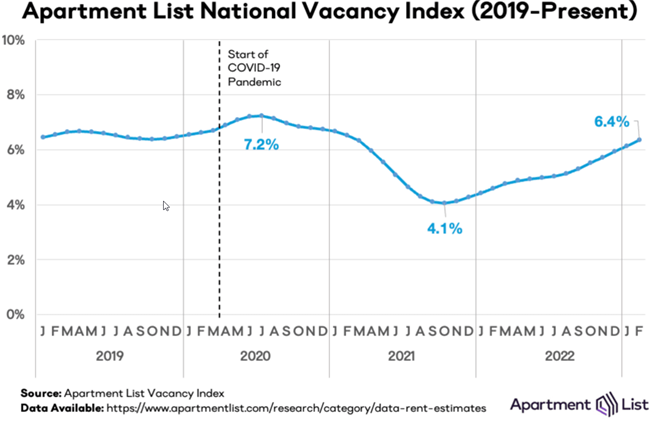
The report says it took ten months for the vacancy index to increase from 4.1 percent to 5.1 percent, but just six months for it to jump from 5.1 percent to 6.4 percent, where it sits today.

This month’s reading is the highest since February 2021, and is just barely below the 6.6 percent average rate from 2018 to 2019.

After months of decline, national rent growth turned positive in February, up by 0.3 percent Apartment List says in the 2023 March report.
Charts courtesy of Apartment List

With more apartments under construction than at any point since 1970, the vacancy rate could continue to increase.

“As this new inventory hits the market over the course of the year, we could begin to see property owners competing for renters to fill their units, a marked change from the prevailing conditions of the past two years, in which renters have been competing for a limited supply of available inventory.”

Conclusion: A Year of Modest Rent Growth

Rent prices may not fall further, but they are also unlikely to increase significantly.

“This month’s data suggests that we’re beginning to see a mild rebound in rental demand, following a particularly slow off-season to close out 2022. That said, the surging rent growth that we saw in 2021 and the first half of last year should still be solidly behind us.

“Even if demand continues to strengthen, a robust supply of new inventory hitting the market this year should keep prices in check. It looks like 2023 is shaping to be a year of modest positive rent growth,” the Apartment List research team says.

Read the full Apartment List report here.

Sign Up For Our Weekly Newsletter And Get Rental Property And Apartment News And Helpful, Useful Content Each Week.

* indicates required

How To Fix Noisy Upstairs Tenants Bothering Downstairs Tenants?

Noisy upstairs tenants bothering downstairs tenants can be a challenge for landlords so that is the question this week

Noisy upstairs tenants bothering downstairs tenants can be a challenge for landlords so that is the question this week for Ask Landlord Hank. Remember Hank is not an attorney and is not offering legal advice. If you have a question for him please fill out his form below.

Dear Hank:

I have a problem with a tenant on the top third floor that has two kids and all they do is run around all hours of the day and night.

The older couple live right underneath them and constantly complain about the noise.

They want to renew their lease. What can I do to help this matter?

-Marie

Dear Marie,

When you have apartments with wood framing instead of cement flooring, sound transmission is usually a problem.

In this situation, I’ve tried to put tenants with young children in ground floor apartments. But, since they are already living on an upper floor, can you modify the ceiling for some reduction in sound transmission?

It is not easy nor cheap, but you can add a second layer of 5/8 thick drywall and spread a liquid sound proofing product between the original sheetrock and the additional layer.

The sound proofing compound costs about $45-60 per sheet of drywall using two tubes of the compound per sheet. This may be enough relief for your current tenants underneath the noisy upstairs tenants and children to be happy residents again.

Sincerely,

Hank Rossi

Rent Sarasota

www.rentsrq.com

Each week I answer questions from landlords and property managers across the country in my “Dear Landlord Hank” blog in the digital magazine Rental Housing Journal.    https://rentalhousingjournal.com/asklandlordhank/

Noise from upstairs tenants bothering downstairs tenants can be a challenge for landlords so that is the question this week
Landlord Hank says, “It is not easy nor cheap, but you can add a second layer of 5/8 thick drywall and spread a liquid sound proofing product between the original sheetrock and the additional layer.”

Ask Landlord Hank Your Question

Ask veteran landlord and property manager Hank Rossi your questions from tenant screening to leases to pets and more! He provides answers each week to landlords.

  • This field is for validation purposes and should be left unchanged.

7 Ways To Handle Noise Complaints In Rental Housing

Do I Have to Paint and Replace Flooring for a Long-Term Tenant?

A Tenant Poured Grease Down Drain Who Is Responsible?

Sign Up For Our Newsletter And Get Rental Housing And Apartment News And Helpful, Useful Content Each Week.

* indicates required

36 Percent Of Remote Workers Planning To Move in 2023

The remote worker migration in rental property is expected to continue in 2023 with 36 percent of remote workers planning to move in 2023

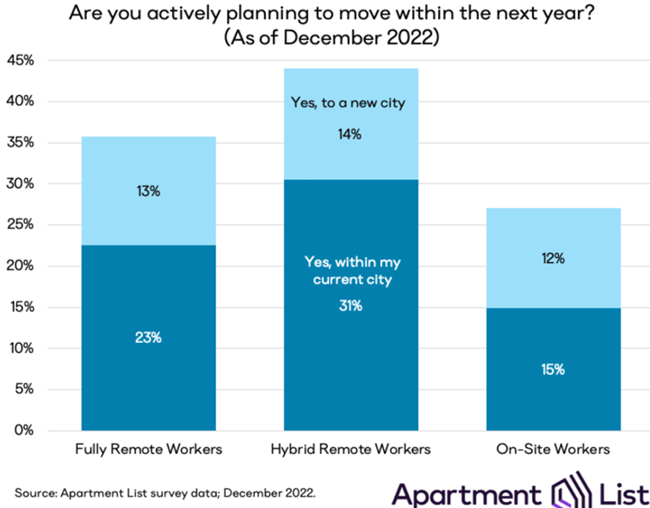
The remote worker migration in rental property that started in 2022, is expected to continue in 2023 with 36 percent of remote workers planning to move in 2023, a new Apartment List survey says.

The flexibility of remote work, despite bosses wanting workers to return to the office, is still a major factor in rental housing.

“We found that the flexibility afforded by remote work is indeed leading to higher rates of mobility and shifting geographic preferences,” Apartment List economist Chris Salviati writes.

“Given their heightened propensity to move, remote workers have been having a disproportionate impact on housing market trends, and this is expected to continue into 2023 and beyond,” he says.

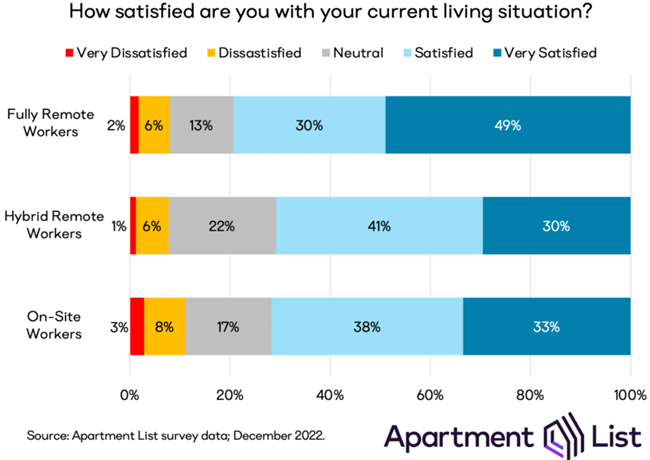
Compared to on-site workers, remote workers were more likely to move in 2022 and considered different factors when they did so, the report says.

Hybrid Workers Most Likely To Move

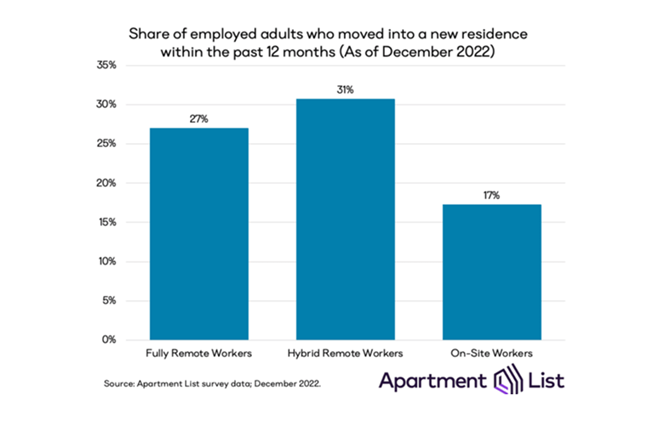
Salviati said the highest moving rates were observed among workers with hybrid remote arrangements – those who split time between working at home and on-site – 31 percent of whom moved in 2022, a rate of mobility that was 78 percent greater than that of on-site workers.

The remote worker migration in rental property is expected to continue in 2023 with 36 percent of remote workers planning to move in 2023
Chart courtesy of Apartment List

The survey was conducted of almost 6,000 employed adults in December 2022.

The results “imply that remote work, even in hybrid form, is allowing some workers to move to locations that better suit their preferences now that they are less bound by job locations.

“In fact, more than one-in-five remote workers who moved in 2022 specifically told us that their remote work status was a motivating factor for their move,” the report says.

Freedom Of Choice In Housing

The freedom of choice in housing when not tied to an on-site job location result in “greater satisfaction in living arrangements for remote workers.”

Hybrid workers may be able to consider a wider range of geographic locations – assuming that they’re willing to commute longer distances if those commutes are not daily – however, their options are still largely contingent on their job location.

The remote worker migration in rental property is expected to continue in 2023 with 36 percent of remote workers planning to move in 2023

Knowledge Sector Jobs Can Be Performed Anywhere

The report concludes that the pandemic-caused change in how workplaces are organized proved that “a significant share of knowledge sector jobs can be performed from anywhere with an internet connection.

“The rapid uncoupling of housing choice from job choice has had profound implications for the housing market in recent years, and there is good reason to believe that the dust has yet to fully settle.

“Those with remote flexibility are still a minority in the workforce, but a rapidly growing one. And as they continue to account for an even greater share of moves, these workers will play a key role in driving domestic migration patterns this year and into the future,” Salviati writes.

Read the full report here.

Sign Up For Our Newsletter And Get Rental Property And Apartment News And Helpful, Useful Content Each Week.

* indicates required

When Will Sagging Multifamily Sales Rebound?

Yardi Matrix says in a new research bulletin that investor demand and multifamily sales are continuing to evolve in 2023.

Yardi Matrix says in a new research bulletin that investor demand and multifamily sales are continuing to evolve in 2023.

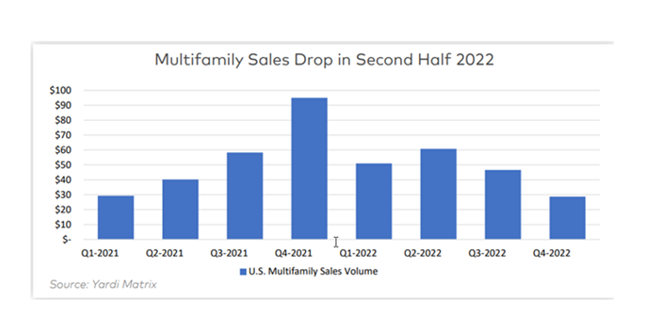
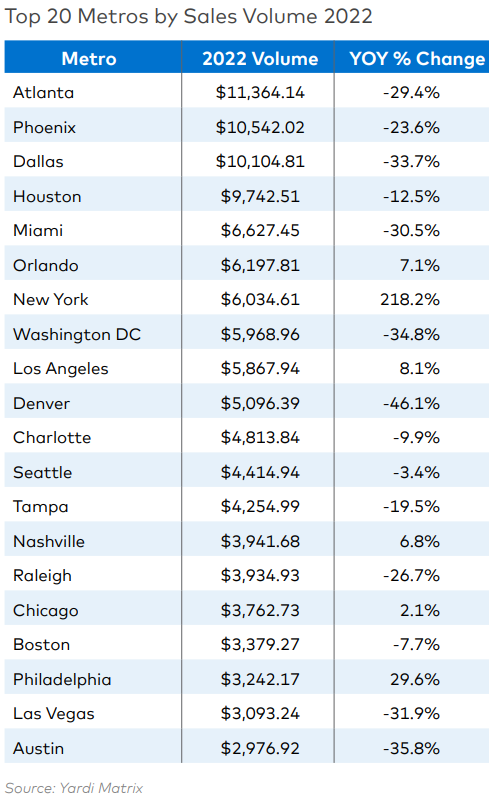
Multifamily property sales continued to shift toward secondary tech markets in 2022, as volume waned in the fourth quarter due to rising acquisition yields and pricing uncertainty.

This Yardi Matrix bulletin examines the prospect for deal flow in 2023 and what needs to happen for market activity to return.

Paul Fiorilla, Director of Research, Yardi Matrix, writes that at the moment deal flow is stalled by pricing uncertainty and multifamily investors are increasingly focused on markets with growth in jobs and population which is where investor demand and interest is.

Multifamily Sales Drop In Second Half Of 2022

First-half 2022 volume was 60.4 percent above the first half of the 2021 record year. But volume in the second half of 2022 was 51.8 percent below the same period in 2021, with fourth quarter 2022 volume 70 percent below the fourth quarter of 2021. Rising interest rates were a big impact.

“The pricing uncertainty has created a large bid-ask spread between buyers, who are taking higher financing costs and projections of an economic downturn into account, and sellers, who are loath to accept what they perceive as a discount,” Fiorilla writes.

Yardi Matrix says in a new research bulletin that investor demand and multifamily sales are continuing to evolve in 2023.
Charts courtesy of Yardi Matrix

Now most apartment owners are holding on to properties unless there is an urgent reason to sell.

“Indeed, the biggest question the market faces is not whether we will see more distressed assets but by how much distress will increase. Banks have become conservative with the prospect of a widely projected economic downturn, so borrowers are facing both rising rates and less leverage,” the report says.

“As most economic scenarios contain mixed blessings for deal flow, volatility may be the most critical factor for transaction activity.

“Transaction activity will pick up when market conditions return to some semblance of stability and market players believe they can underwrite with a higher level of certainty than exists today,” Fiorilla writes.

About Yardi Matrix

Yardi Matrix researches and reports on multifamily, office and self-storage properties across the United States, serving the needs of a variety of industry professionals. Yardi Matrix Multifamily provides accurate data on 18+ million units, covering more than 90 percent of the U.S. population. Contact the company at (480) 663-1149.

Sign Up For Our Weekly Newsletter And Get Rental Property And Apartment News And Helpful, Useful Content Each Week.

* indicates required

Compliance Monitoring – A Fair Housing Must

Compliance monitoring is a checks-and-balances procedure to be done regularly to assure Fair Housing policies are met.

Compliance monitoring is a checks-and-balances procedure to be done regularly to assure Fair Housing policies are met.

By The Fair Housing Institute

When was the last time your office did a compliance audit of your documentation forms and procedures? Why is it a critical practice that should be done regularly? This article will explain why compliance monitoring is important, and will share some helpful tips to either get you started or fine-tune your process.

Compliance Monitoring – Fair Housing Implications

Let’s start by defining what compliance monitoring is: Just what it sounds like. It is a checks-and-balances procedure that should be done regularly to see if every staff member is following your predetermined policies and procedures, especially when there could be fair housing implications.

A large company may have an entire department dedicated to overseeing compliance. But for smaller companies, the responsibility will fall on a specific manager or person in a leadership role. Either way, compliance monitoring helps a company identify any potential problems and correct them before they snowball or, even worse, are discovered during a fair-housing investigation.

A Common Breakdown Point – Documentation

Consider this scenario: A rather irate resident calls to complain that they received a rent increase when their neighbor did not. You immediately check both residents’ files to see if there is supporting documentation as to why this happened, but find nothing. Now what? More than likely, this is just an oversight, but unfortunately, you now have no way to prove why one resident received a rent increase when another did not, and it could be construed as discrimination.

In this scenario, we have not one but two failures. First, there was the failure to document the reason for the difference in rent. Second, the failure could have been caught before a resident became involved if there had been a regular check or compliance-monitoring procedure in place.

Steps for Better Compliance Monitoring

The first and most important step in compliance monitoring is training! As a supervisor or manager, you should never assume that everyone knows what they need to be documenting or what your company’s policies and procedures are. Every staff member, whether they are new or a seasoned veteran, should receive training as to your policies and procedures. Also, training should not be a one-and-done thing, but a continual process instead.

Once you have established a regular training regime, you need to think about how you are going to check in to ensure that it’s working. As we mentioned earlier, some larger companies have entire departments dedicated to this, but if you are a smaller company, you need to clearly identify who will be responsible and how often they will be performing a spot-check or audit.

If a compliance issue is identified, the next step is to take a deep breath and use it as a teachable moment for all involved. Share where the breakdown happened, discuss better practices to avoid it in the future, and be sure to follow up that they are followed.

The final takeaway when it comes to proper compliance monitoring is that training and follow-up are essential to identify problems to avoid or challenge a fair housing complaint.

About the author:
In 2005, The Fair Housing Institute was founded as a company with one goal: to provide educational and entertaining fair-housing compliance training at an affordable price at the click of a button.

Newly Built Apartments Getting Smaller

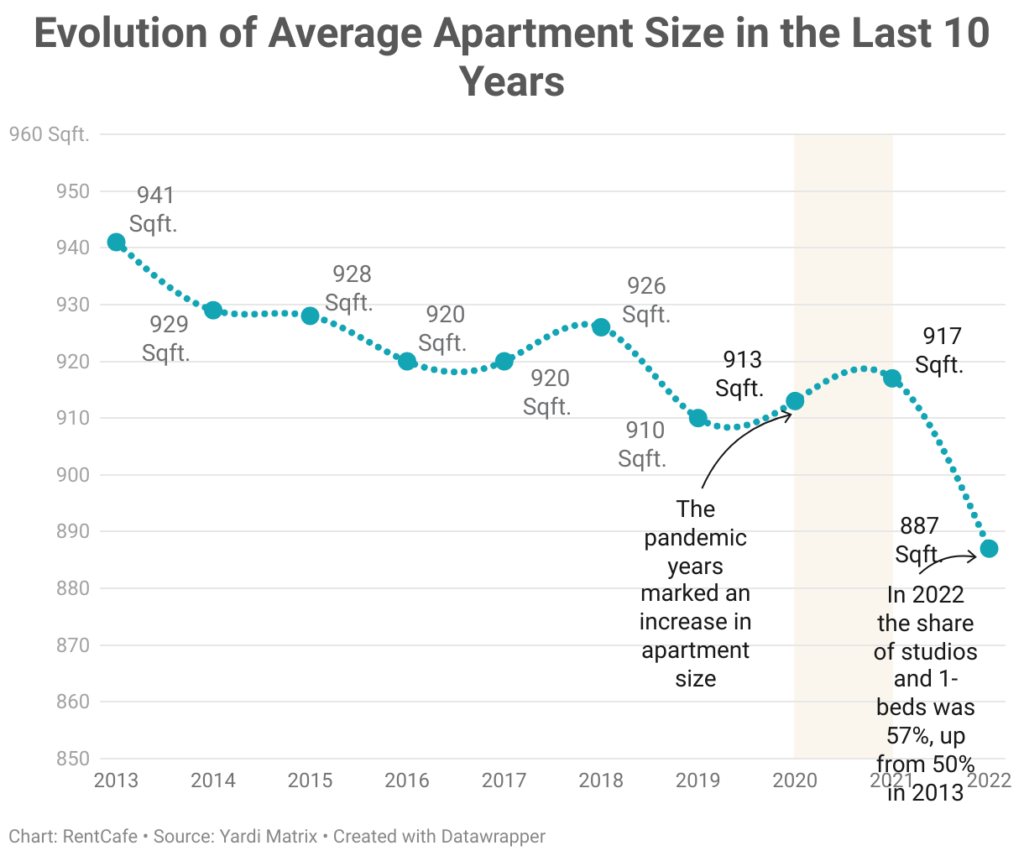
The average size of newly built apartments in 2022 has decreased to 887 square feet, down from the  941 square foot average 10 years ago

The average size of newly built apartments in 2022 has decreased to 887 square feet, down from the  941 square foot average 10 years ago, RentCafe reports.

In a report using Yardi Matrix data to analyze the top 100 cities and newly built apartments, the study found that the need for more housing created one of the highest levels of construction activity in 50 years.

Some highlights of the report:

  • Studios and one-bedrooms accounted for a record-breaking 57 percent of all new apartments built last year, amid a construction boom.
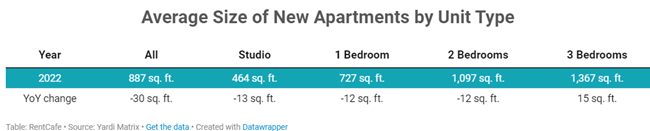
  • 2022 saw the largest year-over-year decrease in apartment size in a decade, down 30 square feet. Despite the pandemic putting a spotlight on the importance of elbow room, the trend persisted after some minor spikes in 2020 and 2021.
  • Seattle is one of the few large cities that continues to have the smallest apartments in the country — with an average of only 659 square feet in 2022, or 30 square feet less than 10 years prior.
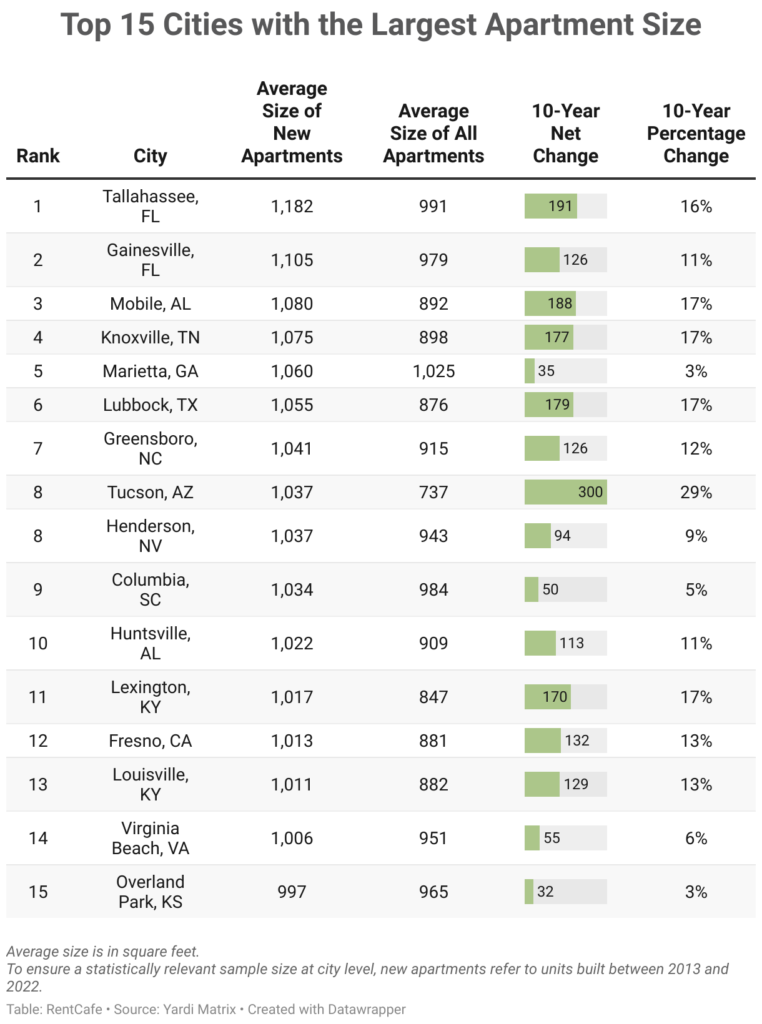
  • Tallahassee, FL, boasts the largest apartments in the country (1,182 square feet), followed by Gainesville, FL; Mobile, AL; Knoxville, TN; and Marietta, GA. In fact, Tallahassee apartments increased by 191 square feet in the last decade (or 16.2%).
  • Apartments in Tucson, AZ, saw the largest increase in apartment size.

The average size of newly built apartments in 2022 has decreased to 887 square feet, down from the  941 square foot average 10 years ago

Not All Types Of Apartments Grew Smaller

The 30-square-foot decline in the size of new apartments doesn’t mean that all types of units shrank when compared to 2021.

Rather, larger apartments with three bedrooms actually grew by 15 square feet.

The average size of newly built apartments in 2022 has decreased to 887 square feet, down from the  941 square foot average 10 years ago

Apartments In The South Are Largest

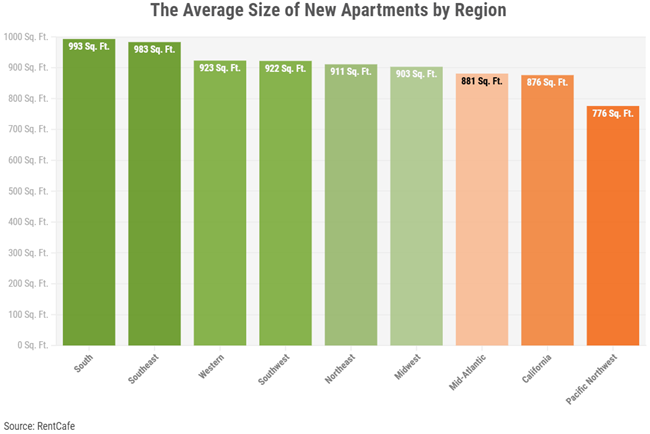
In 2022, the average size of an apartment in the South was 993 square feet.

That means that renters in the South enjoyed an extra 106 square feet compared to the national average. On the other hand, renters in the Pacific Northwest had the least amount of space with only 776 square feet — 111 less than the national average apartment size.

Tucson was one exception

With the average size of apartments in Tucson, AZ, increasing by 300 square feet (29 percent), renters enjoyed the biggest gain in terms of space out of all 100 cities on our list. Moreover, the average size of new apartments during the last 10 years here was 1,037 square feet. This makes Tucson one of the best cities for renters who need the extra space.

The average size of newly built apartments in 2022 has decreased to 887 square feet, down from the  941 square foot average 10 years ago

Read the full report from RentCafe here.

Sign Up For Our Newsletter And Get Rental Property And Apartment News And Helpful, Useful Content Each Week.

* indicates required

Why Coliving Should Be Part of Your Rental Property Portfolio

Why Coliving Should Be Part of Your Rental Property Portfolio

Why coliving should be part of your rental property portfolio as this housing trend could provide real value for landlords.

By David Mazza

I’d love to give you a rock-solid, Merriam-Webster-esque definition of “coliving.” The truth is, I can’t.

Coliving is the newest buzz word in the housing market, and it might be a confusing concept for landlords and property managers to understand.

It’s a catch-all term that applies to many different new-age solutions to apartment renting. A coliving situation could encompass a group of roommates living together in an apartment, a pre-furnished room in a house meant for shorter-term stays, or a dormitory-style tower for adults.

The concept isn’t new, but it’s going to change the way the rental market works. For us at SplitSpot.com, we are often categorized as “coliving” since we enable tenants to rent individual rooms in a shared apartment.

No matter what way you slice it, anyone who has multifamily real estate in their portfolio should be exploring a form of coliving as a potential option for renters.

Let’s investigate more.

The demand for coliving is real

Data from the U.S. Census Bureau reveals that the number of 18- to 34-year-olds living alone decreased by 10.3 percent from 2005 to 2015. Estimates for the potential of the coliving market worldwide in the next decade have ranged as high as  $550 billion. Rising real estate prices, increased student debt and other factors have made buddying up the norm for young renters. Remote work is also increasing and workers are expecting the rest of the world to follow suit in terms of flexibility.

Coliving is a concept that helps meet the needs of these younger apartment hunters. While the term itself can refer to different housing structures, it’s hinting at a simpler reality: Renters are seeking more flexibility with shorter and/or more customized leases and veering away from the ultra-structured, long-term leases that used to dominate the market.

Landlords seeking to fill rooms across their entire portfolio need to adapt to this reality and find some creative solutions that work for apartment renters.

Coliving is a useful asset for property owners

Coliving is an asset class that is growing; it makes sense for any rental property owner to have some exposure.

Ground-up coliving developments are now part of the market. Research from CBRE shows that the United States had more than 5,000 beds in 150 coliving spaces in 2019. On top of that, it’s estimated that these spaces could bring in a premium, above-market rate – up to 38 percent higher than conventional apartments.

That’s a testament to the market need for a coliving solution, and whether it’s a new, purpose-built coliving facility or an existing multi-bedroom unit that allows renters to easily lease one bedroom without any hassle, consumers will be increasingly demanding this type of rental agreement.

Navigating coliving as part of a rental property portfolio

Most of the world is used to doing leasing in the traditional way: groups of roommates sign a 12-month lease and the property owner comes back half a year later to see if the group will stick around. This method of leasing has more or less worked for decades, but increasing demands for flexibility and the new realities of the urban multi-family landscape have made it more challenging to continue on with “business as usual.”

As the aforementioned need for flexibility increases among renters, landlords will have to adjust to some of the new realities of coliving. Finding tailor-made roommate groups and then managing the churn of more-constantly changing roommates is becoming more and more daunting. And standing out in the competitive urban rental market is a challenge in itself, especially considering the many new offerings coming to market, as mentioned above. Luckily, there are tools at a landlord’s disposal – tools that make coliving (and its accompanying above-market rates) a realistic, and advantageous, option for all parties.

How can SplitSpot help?

SplitSpot is a solution to landlords and renters to meet the growing demand for coliving situations. In addition to marketing and leasing your vacant apartment rooms to prospective tenants, SplitSpot will manage each household’s bill payment and collection, and provide landlords ancillary benefits (like triaging maintenance tickets) to make renting rooms easy. We’ll manage the churn of renters – all while providing the positive tenant experience that your renters crave.

About the Author:

David Mazza is the co-founder of SplitSpot, the flex-lease platform built to make apartment rentals easier for both tenants and landlords. David manages many of the company’s day-to-day operations, and is a key driver of SplitSpot’s strategy and mission to improve flexibility, affordability, and accessibility of renting in cities. Prior to SplitSpot, David worked at Amazon and at investment bank Sonenshine Partners. David holds an MBA from MIT’s Sloan School of Management and an A.B. from Harvard.

Sign Up For Our Weekly Newsletter And Get Rental Property And Apartment News And Helpful, Useful Content Each Week.

* indicates required