Home Blog Page 65

HUD Restores “Discriminatory Effects” Rule In Fair Housing

How the Fair Housing Act has been applied in courts and administrative proceedings is at the roof of a

How the Fair Housing Act has been applied in the courts and in administrative proceedings is at the roof of a “discriminatory effects” rule change the U.S. Department of Housing and Urban Development (HUD) is taking in rescinding a 2020 rule.

HUD said in a statement, it is rescinding a 2020 Fair Housing Act rule and reinstating HUD’s Discriminatory Effects Standard, which dates back to 2013.

HUD submitted to the Federal Register for publication a Final Rule entitled Restoring HUD’s Discriminatory Effects Standard because the “2013 rule is more consistent with how the Fair Housing Act has been applied in the courts and in front of the agency for more than 50 years, and that it more effectively implements the Act’s broad remedial purpose of eliminating unnecessary discriminatory practices from the housing market,” HUD said in the statement.

This Final Rule will go into effect 30 days after it is published in the Federal Register. Due to a preliminary injunction staying the implementation of the 2020 Rule in Massachusetts Fair Housing Center v. HUD, the 2020 Rule never went into effect, and the 2013 Rule – which has been in place for nearly a decade – has been and is currently still in effect. Accordingly, regulated entities that were complying with the 2013 Rule have no need to change any practices they have in place to comply with this rule.

What Is The Discriminatory Effects Doctrine?

The discriminatory effects doctrine (which includes disparate impact and perpetuation of segregation) is a tool for addressing policies that unnecessarily cause systemic inequality in housing, regardless of whether they were adopted with discriminatory intent.

It has long been used to challenge policies that unnecessarily exclude people from housing opportunities, including zoning requirements, lending and property insurance policies, and criminal records policies.

“Accordingly, having a workable discriminatory effects standard is vital for the Biden-Harris Administration to accomplish its goal of creating a housing market that is free from both intentional discrimination and policies and practices that have unjustified discriminatory effects,” HUD said in the release.

HUD’s 2013 discriminatory effects rule codified long-standing caselaw for adjudication of Fair Housing Act cases under the discriminatory effects doctrine, for cases filed administratively with HUD and for federal court actions brought by private plaintiffs.

Under the 2013 rule, the discriminatory effects framework was straightforward: a policy that had a discriminatory effect on a protected class was unlawful if it was not necessary to achieve a substantial, legitimate, nondiscriminatory interest or if a less discriminatory alternative could also serve that interest.

“The 2020 rule complicated that analysis by adding new pleading requirements, new proof requirements, and new defenses, all of which made it more difficult to establish that a policy violates the Fair Housing Act and harder for entities regulated by the Fair Housing Act to assess whether their policies were lawful. HUD now returns to the 2013 rule’s straightforward analysis.

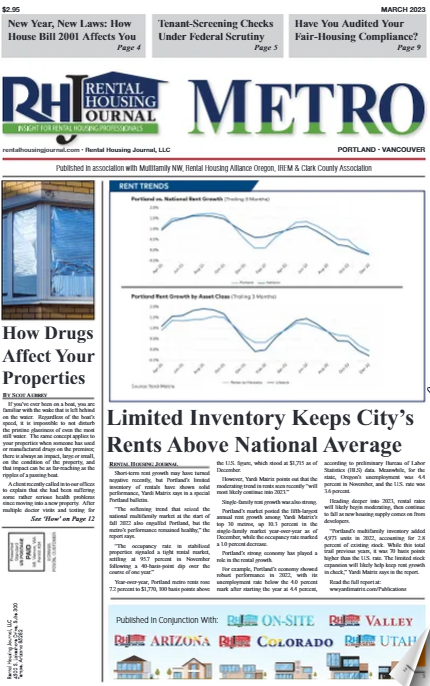
Rental Housing Journal Portland Metro March 2023

Portland Metro Rental Housing Journal March 2023 helpful, useful content for rental property owners, property managers, landlords and maintenance personnel

The Rental Housing Journal Portland Metro print publication for March of 2023 is now available in our new flipping book format here. Please check it out.

Read how Portland’s limited inventory of rentals have shown solid performance, Yardi Matrix says in a special Portland bulletin.

“The softening trend that seized the national multifamily market at the start of fall 2022 also engulfed Portland, but the metro’s performance remained healthy,” the report says.

“The occupancy rate in stabilized properties signaled a tight rental market, settling at 95.7 percent in November following a 40-basis-point dip over the course of one year.”

Year-over-year, Portland metro rents rose 7.2 percent to $1,770, 100 basis points above the U.S. figure, which stood at $1,715 as of December.

However, Yardi Matrix points out that the moderating trend in rents seen recently “will most likely continue into 2023.”

Sign Up For Our Weekly Newsletter And Get Rental Property And Apartment News And Helpful, Useful Content Each Week.

* indicates required

Tenant Moved RV Into Rental Backyard And Someone Living In It

What should you do if a tenant moves an RV into the backyard of your rental and then someone starts living in

What should you do if a tenant moves an RV into the backyard of your rental and then someone starts living in it is the question this week for Ask Landlord Hank. Remember Hank is not an attorney and is not offering legal advice. If you have a question for him please fill out his form below.

Dear Hank:

My tenants moved an RV into the back yard and have someone living in it with electric and water running from the home.
A plastic container sewerage is going into and grey water spilling on the ground.
They refuse to move it off the property.
They also have a trailer they are storing household trash in

-Yvonne

Dear Landlady Yvonne,

It’s past time to evict.

Most leases have a clause entitled “Use of Premises” that states that the tenant shall maintain the premises in a clean and sanitary condition, etc. Also, the lease will be written between the landlord, you, and the tenant. So, specific people are renting your property. There is normally another clause entitled Occupants stating: only the following individuals shall occupy the premises unless written consent of the landlord is obtained.

A reasonable number of guests may occupy the premises without written consent if the stay is limited to 72 hours. Subletting for any length of time is strictly prohibited.

I would post a three-day day notice on the tenants door which is a legal notice saying that the tenants have three days to cure (fix) the lease violations which consist of subletting the premises, and creating an unhealthy condition on your property.

If the tenants haven’t taken care of the issues by the end of the third day, on the foruth day begin the eviction process.

From what you’ve written to me, it seems like the tenants think they are in charge of your property. It is your place and you don’t need to put up with nuisance, disrespectful tenants.

Take care of this tomorrow. It is not going to get any better by itself. Good luck.

Sincerely,

Hank Rossi

www.rentsrq.com

Each week I answer questions from landlords and property managers across the country in my “Dear Landlord Hank” blog in the digital magazine Rental Housing Journal.    https://rentalhousingjournal.com/asklandlordhank/

What should you do if a tenant moves an RV into the backyard of your rental and then someone starts living in
Landlord Hank says, “Most leases have a clause entitled “Use of Premises” that states that the tenant shall maintain the premises in a clean and sanitary condition, etc.”

Ask Landlord Hank Your Question

Ask veteran landlord and property manager Hank Rossi your questions from tenant screening to leases to pets and more! He provides answers each week to landlords.

  • This field is for validation purposes and should be left unchanged.

Do I Have to Paint and Replace Flooring for a Long-Term Tenant?

A Tenant Poured Grease Down Drain Who Is Responsible?

Sign Up For Our Newsletter And Get Rental Housing And Apartment News And Helpful, Useful Content Each Week.

* indicates required

Website Accessibility – A Fair Housing Requirement?

What website accessibility is and why every property management company should be reviewing its websites today.

What website accessibility is and why every property management company should be reviewing its websites today.

By The Fair Housing Institute

Accessibility is a familiar term to housing providers. Management is keenly aware of accessibility requirements around its properties to ensure fair housing compliance. But what about website accessibility? This article will review what website accessibility is and why every property management company should be reviewing its websites today.

What is Website Accessibility and Why Is It Important?

Website accessibility refers to the ability of a website to be accessed and consumed by anyone, including those with physical disabilities. For instance, individuals with visual impairments rely on screen readers to access content, which requires a website to have the necessary technology.

Recently, website accessibility has become a hot topic due to an increase in complaints against companies that do not offer accessible websites. While there is a lack of consensus on whether accessible websites are a legal requirement under the Americans with Disabilities Act (ADA), some companies have been found liable under ADA laws for not having websites equipped with technology that makes content accessible to people with disabilities.

Although the 11th Circuit, which is the Court of Appeals for the southeast region, recently ruled that the ADA does not require website accessibility, an advocacy group in Florida is attempting to make the case that an inaccessible website for housing providers violates the Fair Housing Act. As we can see, website accessibility is an evolving situation. Thus, it is essential for property management companies to prioritize website accessibility in their business practices.

Website Accessibility – A Fair Housing Best Practice

While having an accessible website is not yet a legal requirement, companies should consider it a best business practice to ensure inclusivity and compliance with fair housing laws. Having an inaccessible website can potentially lead to lost business opportunities or even legal consequences.

For example, an individual looking to book an appointment to view a unit may not be able to fill out an online form due to inaccessible fields, leading to frustration and potential loss of interest or, even worse, a claim that your site is not accessible and, therefore, discriminatory.

Accessible Fixes for Websites

It used to be that accessible websites were costly and had to be specifically built and maintained, making them out of reach for most small or moderate-sized companies.

However, today technology has come a long way. Companies can easily ensure website accessibility with the help of easily added-on programs or plugins that do the heavy lifting. They are relatively inexpensive and are quite literally plug-and-play.

Additionally, there is a marketing advantage to having an accessible website. Google prefers and ranks websites that are easy to use, have readable text and elements, and have images that use good descriptive text. All of which is included in an accessible-enabled website.

In conclusion, property management companies should prioritize website accessibility as a best business and fair housing practice. We here at The Fair Housing Institute have already upgraded our site, and it was quite easy. While it is not yet a legal requirement, it can improve inclusivity and avoid potential negative consequences. With accessible website technology now easily accessible, there is no excuse for companies not to ensure their websites are accessible to all.

About the author:
In 2005, The Fair Housing Institute was founded as a company with one goal: to provide educational and entertaining fair-housing compliance training at an affordable price at the click of a button. Registration is now open for their exclusive online event register at FHI Partnership Live Event

February National Multifamily Rents Unchanged–No Pain, No Gain

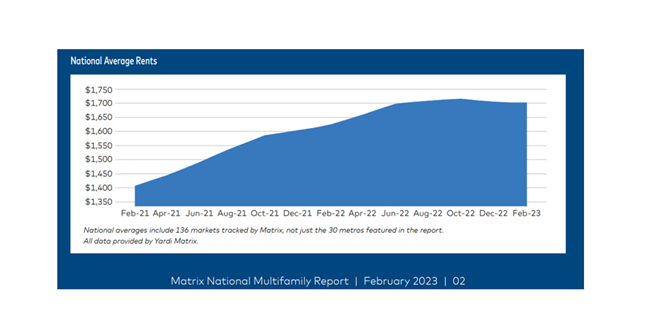
Yardi Matrix reports “no pain, no gain for multifamily in February” as national rents remained unchanged from February.

Yardi Matrix reports “no pain, no gain for multifamily in February” as national rents remained unchanged from February.

“Moderate absorption was matched by an increase in deliveries in some metros. All eyes are on the Federal Reserve and the impact of interest rate increases on job growth and multifamily demand,” Yardi Matrix writes in their February report.

“Multifamily rents are playing a waiting game, as rents have essentially leveled over the seasonal winter slowdown,” Yardi Matrix says.

Highlights of the February Multifamily Rents Report

  • Multifamily rents were flat in February, as U.S. asking rates averaged $1,702, unchanged from January. Year-over-year growth continued its downward slide, and is now 4.8 percent nationally, down 70 basis points from the previous month and the lowest level in nearly two years.
  • Asking rent growth remains positive year-over-year in almost every metro, but 23 of Matrix’s top 30 metros recorded negative growth over the last three months and 17 were negative in February. Affordability, household growth and deliveries of new stock are key rent drivers.
  • The story was much the same in the single-family rental market, as the average U.S. asking rent was flat at $2,071. The year-over-year increase fell by 80 basis points to 3.4 percent, far below the 14.8 percent growth rate a year ago.
  • National lease renewal rates fell to 64.0% in December, down from 65.6% in November. Renewal rates are low in metros with high rent costs, such as Los Angeles (43.3%), San Francisco (46.5%) and San Jose (46.5%), where renters are more transient and are shopping for better deals.

The report summarizes that rent performance in the coming months “will hinge not only on demand-supply dynamics at the local level but affordability and the economy.

“Although metrics such as the job market and consumer spending growth remain healthy, the Federal Reserve has resolved to induce job losses to reduce inflation, which will impact multifamily demand,” Yardi Matrix writes in the report.

“Multifamily owners must focus on operating more efficiently, while investors looking to deploy capital will find opportunities arising from distress.”

Please read the full report here.

About Yardi Matrix

Yardi Matrix researches and reports on multifamily, office and self-storage properties across the United States, serving the needs of a variety of industry professionals. Yardi Matrix Multifamily provides accurate data on 18+ million units, covering more than 90 percent of the U.S. population. Contact the company at (480) 663-1149.

Sign Up For Our Weekly Newsletter And Get Rental Property And Apartment News And Helpful, Useful Content Each Week.

* indicates required

Multifamily Housing Construction Hot As Single-Family Sputters

Permitting activity for new multifamily housing construction units is stronger than it has been in decades, while single-family building lags

Permitting activity for new multifamily housing construction units is currently stronger than it has been in decades, while single-family construction continues to lag, keeping homeownership out of reach for many younger Americans, Apartment List says in a new report.

As multifamily construction remains hot, the construction of new single-family homes has recently begun to sputter.

“As renters face a growing affordability crisis, it is critical that cities plan for new home construction that keep pace with population growth and housing demand,” housing economists  Chris Salviati and Rob Warnock write in the study.

Permitting activity for new multifamily housing construction units is stronger than it has been in decades, while single-family building lags

Salviati and Warnock say many Sun Belt markets “are doing a decent job of building enough new housing to keep pace with growth, but the nation’s most expensive markets are continuing to severely under build. An influx of new multifamily supply should keep rent growth in check in 2023, but the longer-term national picture is still characterized by shortage.”

“Over the past decade, many of the nation’s large coastal markets – including New York City, Boston, San Francisco, and Los Angeles – have not built nearly enough new housing to keep pace with local job growth, resulting in deep housing affordability crises. In contrast, Sun Belt markets throughout Texas, Arizona and Florida have experienced rapid growth in both jobs and housing.”

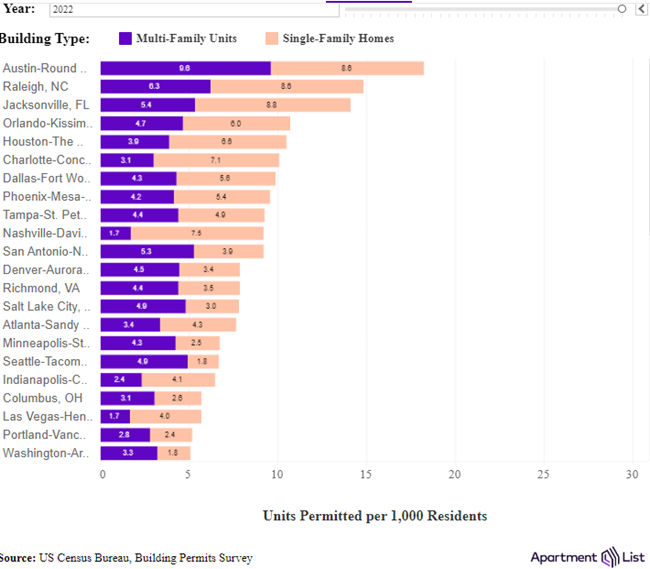
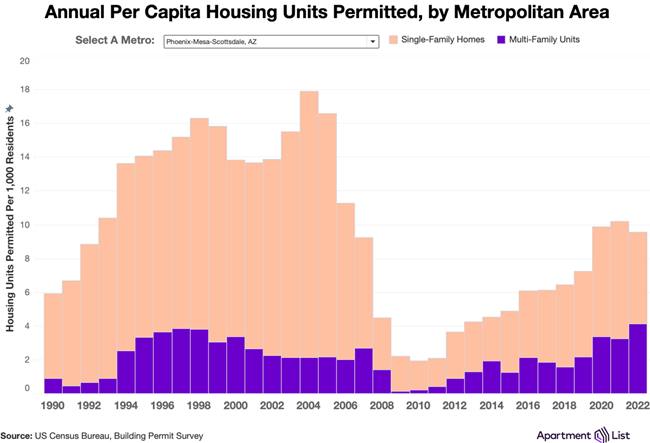
See the chart for Phoenix, Arizona metro multifamily housing construction below

Permitting activity for new multifamily housing construction units is stronger than it has been in decades, while single-family building lags

Highlights include:

  • Today’s high interest rate environment has slowed single-family home construction, but multifamily housing construction remains strong. Today there are nearly 1 million apartments under construction across the nation, more than at any point since 1970. An additional 679,000 were permitted for construction in 2022, an increase of 9 percent compared to 2021.
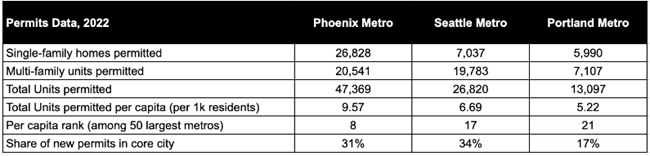
  • In Phoenix metro specifically, 20,541 new apartments and 26,828 new single-family homes were permitted last year. On a per-capita basis, this ranks #8 out of the nation’s 50 largest metros.
  • 31 percent of these newly-permitted homes are set to be built in Phoenix proper, while the remainder will be located in outer-lying suburbs.
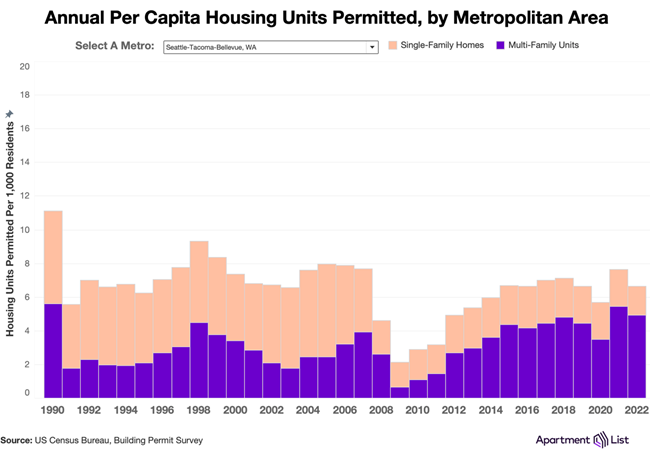
  • In Seattle, 19,783 new multifamily homes were permitted.
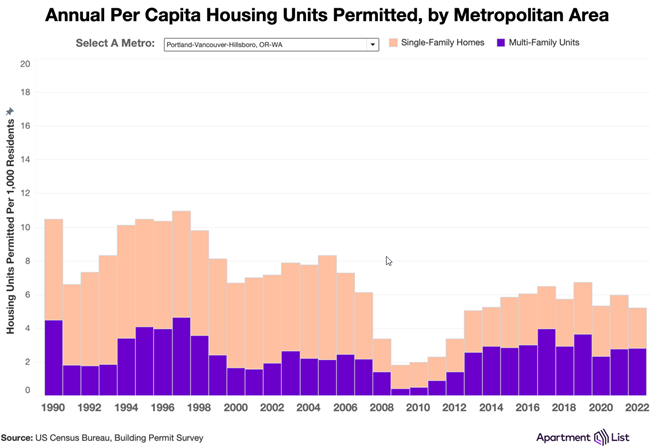
  • In Portland, only 7,107 new multifamily units were permitted.
Permitting activity for new multifamily housing construction units is stronger than it has been in decades, while single-family building lags
Chart courtesy of Apartment List

Chart for Portland Metro Below

Permitting activity for new multifamily housing construction units is stronger than it has been in decades, while single-family building lags

Chart for Seattle Metro Below

Permitting activity for new multifamily housing construction units is stronger than it has been in decades, while single-family building lags

Read the full report here.

Sign Up For Our Weekly Newsletter And Get Rental Property And Apartment News And Helpful, Useful Content Each Week.

* indicates required

The Effects of Drugs on Your Rental Properties

The effects of drugs on your rental properties can cause many problems for both landlord and tenant so here are some tell-tale signs

The effects of drugs on your rental properties can cause many problems for both landlord and tenant so here are some tell-tale signs of the residual effects of drug manufacturing or use on your property.

By Scot Aubrey

If you ‘ve ever been on a boat, you are familiar with the wake that is left behind on the water.  Regardless of the boat’s speed, it is impossible not to disturb the pristine glassiness of even the most still water.

The same concept applies to your properties when someone has used or manufactured drugs on the premises; there is always an impact, large or small, on the condition of the property, and that impact can be as far-reaching as the ripples of a passing boat.

A client recently called in to our offices to explain that she had been suffering some rather serious health problems since moving into a new property.  After multiple doctor visits and testing for mold, they hired a professional to come in to see if the property had been used for drugs.  Results came back that the kitchen held extremely high levels of methamphetamine residue while the common areas and bedrooms of the home also showed significant levels.  Mystery solved, but that was just the beginning for this unfortunate tenant and for the unknowing landlord and the effect of drugs on their rental properties.

For landlords, the legal standard of “what you knew or should have known” is critical when applying it to a situation like the one described above.  Here are a few practical applications for you to consider while your properties are occupied, but especially after the tenants move out and you are doing your post-occupancy inspections.  There are always tell-tale signs of the residual effects of drug manufacturing or use on your property.

  • Inspect anything porous; drug residue can find its way into many parts of your property, but especially any porous areas. Pay special attention to rugs/carpets, exhaust fans, HVAC vents and returns, and even plumbing.  The P-traps in plumbing are notorious for being a place for drug residue to hide and wreak havoc.
  • Yellow residue around the roof vents is one place even the most meticulous drug manufacturers overlook. Bring binoculars to inspect closely without having to climb up on the roof.
  • Foil over the windows is one way that paranoid users and manufacturers try to hide their illegal behavior. Inspect each window for any left over foil that may remain.
  • If the property smells like dirty socks, dirty diapers, or even ammonia, this can be a clue to illegal drug use and manufacturing taking place in your property.
  • A high volume of visitors to the property, usually taking place during irregular hours and for short-term visits, could be a sign that your property is being compromised. Being friendly with the neighbors of your properties can be beneficial as they can be the eyes and ears that you need for regular oversight of activities on your property.
  • Drug users or manufacturers rarely, if ever, leave a property in good condition. The importance of having a consistent and timely move-out inspection will almost always give you hints as to how your property was used (or misused).

If you find any of these things, or if a tenant complains about any of these things, you have a duty to take those findings or complaints seriously.  Again, the standard of “what you knew or should have known” about drugs on your rental properties comes into play.  It is bad enough that your property may have been damaged by drugs; don’t double down on the problem by trying to ignore or hide it from the next tenant, or, if selling the property, the next owner.  You are obligated by law to remediate the property to a safe and habitable state, regardless of the expense.

The best way to avoid the “wake” of a bad tenant is to properly onboard the tenant, use in-person inspections of the property during tenancy, and perform a move-out inspection with the tenant prior to them leaving the property.  There are no guarantees, but using these tools will help create a process that results in smoother sailing during your journey as a property owner.

About the author:

Scot Aubrey is vice-president of Rent Perfect, a private investigator, and a fellow landlord who manages short-term rentals.  Subscribe to the weekly Rent Perfect podcast (available on YouTube, Spotify, and Apple) to stay up to date on the latest industry news and for expert tips on how to manage your properties.


Sign Up For Our Newsletter And Get Rental Property And Apartment News And Helpful, Useful Content Each Week.

* indicates required

Why I Like My Rental Properties’ Nosy Neighbors

Three Steps to Becoming a Successful, Lazy Landlord

Why Preventative Maintenance Looks Different In The Age Of Technology

Using technology to raise the alarm as problems occur is the preventative maintenance essential that modern property managers are adopting. 

Using technology to raise the alarm as soon as problems occur is the preventative maintenance essential that modern property managers are adopting.

By Mike Branam
Head of Multifamily
PointCentral

Preventative maintenance has long been one of the secrets to a successful multifamily enterprise.

Efforts that go toward maintaining a high standard for each apartment unit can help create both trust and loyalty from the resident perspective, and can help lead to positive reviews which help attract new residents.

If quality maintenance standards and expectations are not met, the consequences can be damaging to the asset and the resident base.  Even small issues can cause thousands, if not hundreds of thousands of dollars in damage, and the associated ripple effect on resident retention also carries significant financial consequences.

A comprehensive preventative maintenance program does have a lot of moving parts and it can be tempting to leave some out to save a few hundred dollars — but it’s never worth the risk over the long term.

The traditional take on preventative maintenance has also recently given way to a totally different approach in today’s multifamily assets. In the past, it meant an effort to carry out maintenance to stop small problems getting worse. Now, the focus is on using technology to raise the alarm as soon as problems occur. Preventative technology tells property managers what maintenance is needed and when.

This is what really characterizes modern preventative maintenance. Smart home technology can spot problems sooner, leading to overall savings and preventing inconvenience for residents when major problems need resolving. It lowers costs for operators while giving residents a superior experience.

It also has a positive environmental impact, producing energy savings of between 9 percent and 23 percent. All this is extremely attractive in an economic climate where demand has softened and rent growth has slowed. A reduced carbon footprint and a lighter, cheaper maintenance schedule are attractive to residents, who are becoming more discerning. Meanwhile, the resulting lower operating costs support operators’ bottom lines, helping them to compete in a crowded marketplace.

Some up-front investment is required, but operating costs come down long-term, helping owners and operators to optimize revenue. Operators are doing this alongside other strategies such as repurposing or centralizing staffing models.

What follows are the tech-led preventative maintenance essentials that modern property managers are adopting. They represent the biggest threats to your bottom line and sustainability credentials. The last isn’t a solution in itself but is an approach that means operators get a superior return on their initial investment in technology.

 Water management & leaks

Water leaks can be devastating and have the potential to cause extensive damage to multiple units, the costs of which can run to hundreds of thousands of dollars.

The multifamily sector is still adopting the right technology to solve these problems, and not all operators are yet making the most of the best-in-class preventative maintenance technology solution to this problem. Many asset managers have installed leak detection, but the gold standard, which is well worth the investment, is the automatic shut-off valve that instantly responds to serious leaks. This feature minimizes damage to almost nothing and prevents the serious damage that can occur in the time it takes an engineer to arrive. The consequences of not having automatic shut-off valves are even more extreme when properties are empty, as there is no one to raise the alarm.

Water management systems are smart enough to spot when water flows for longer than a normal shower or when unusually large volumes of water begin flowing through the pipes.

The alerts themselves aren’t just for serious defects. The system can recognize excessive water usage, dangerous temperature drops that may freeze pipes, dripping faucets and toilets that are running continually. Most importantly, the shut-off valve doesn’t activate in all circumstances to avoid inconveniencing residents over minor faults. The ability to spot and resolve even minor water leaks can save up to 90 gallons of water a day, further bolstering an operator’s environmental credentials and lowering running costs. It can also dramatically reduce insurance premiums — a PointCentral study established that a multifamily operator could save $2,000 each year in insurance fees by fitting smart water management technology to a main serving 30 units.

It’s not widely known, but obvious water damage to expensive electronics and furnishings aren’t necessarily the most expensive to rectify. One of the worst after effects of water damage actually relates to mildew and mold, which establish themselves quickly and can be almost impossible to eradicate.

 Heating, Ventilation And Air Conditioning

Homeowners are now very familiar with the sort of HVAC system monitoring sold for domestic use, but these solutions started life in professionally managed rental businesses, where the technology has continued to evolve. In this kind of setting, these systems don’t just spot serious heating and cooling malfunctions, they report on minor faults that can turn into bigger problems through accelerated wear and tear. These issues normally reveal themselves to residents on the first really hot or cold day of the year – just when they need everything to be working perfectly. This results in elevated reputational risk for the operator when things go wrong, which can ultimately affect resident retention.

 Alongside periodic reminders to replace things like filters, clues picked up by modern HVAC monitoring systems include small differences between the desired and actual temperature of a home, or irregular delays in arriving at the target temperature. They will tell you when large temperature differences suggest a more serious problem requiring a quicker response, and alerts like this can be sent straight to an HVAC engineer, not just the property manager.

A unified solution

 There are a number of preventative maintenance technologies on the market but they don’t all talk to each other. This creates an operational headache for property managers which, on the ground, makes it much more likely that they will not be able to respond fast enough. Some property managers are monitoring systems across thousands of units, and only a unified solution will make it cost-efficient to monitor units on that scale. So, while there are a number of ‘point solutions’ available that operate independently, it’s better to adopt a unified technology platform that automates and controls aspects of a larger, centralized technology plan.

 About The Author:

Using technology to raise the alarm as problems occur is the preventative maintenance essential that modern property managers are adopting. 

Mike Branam is the Director of Multifamily Sales at PointCentral, a property automation platform for apartment owners & operators. PointCentral is a wholly owned subsidiary of Alarm.com, the leading platform for the intelligently connected property. Millions of consumers and businesses across 50+ countries depend on Alarm.com’s technology to manage and control their properties from anywhere in the world. www.pointcentral.com

Sign Up For Our Newsletter And Get Rental Property And Apartment News And Helpful, Useful Content Each Week.

* indicates required

Why I Like My Rental Properties’ Nosy Neighbors

Three Steps to Becoming a Successful, Lazy Landlord

Arizona AG Says Source-of-Income Ordinances OK

The Arizona attorney general has reversed an opinion by her predecessor and says source-of-income ordinances are OK in Arizona.

The Arizona attorney general has reversed an opinion by her predecessor and says source-of-income ordinances are OK in Arizona, according to her opinion.

Attorney General Kris Mayes said “legal errors were made” and reversed a decision by previous Attorney General Mark Brnovich in December 2022, which had said the source-of-income ordinance passed by Tucson violated state law.  Mayes said the city of Tucson’s ordinance does not violate state law or the Arizona Constitution

Tucson’s ordinance barred discrimination against renters and prospective homebuyers based on their source of income, such as those who use Section 8 housing vouchers or foster-care subsidies

“The source-of-income protection is one of the solutions for the housing crisis in Arizona,” said Tucson Mayor Regina Romero in a release. “I applaud Arizona Attorney General Mayes for reversing the opinion of the previous AG and recognizing that the city of Tucson has the authority as a chartered city to make the decisions that protect our most vulnerable residents.”

The Phoenix City Council also passed a similar source-of-income ordinance and the city was waiting on Mayes’ approval before enforcing the ordinance.

“Discrimination has no place in Phoenix, especially as we continue taking on the challenge of creating affordable housing options for our residents,” Mayor Kate Gallego said in a statement.

“The source-of-income ordinance we passed will help us move closer to our goal of housing more residents with an eye towards equity. I want to thank Attorney General Mayes for her thoughtful and quick work to correct the course on this issue, and I look forward to the positive impact it will have on thousands of Phoenicians,” Gallego said.

In the opinion, Mayes said, “Among other things, these legal errors would discourage cities and towns from amending their fair-housing ordinances to reflect changes in state and federal fair-housing laws, and would undermine all post-1995 amendments made to those ordinances even if the amendments brought the local ordinances into compliance with federal and state law. These legal errors and their concerning consequences necessitated reconsideration” and reversal of Brnovich’s opinion.

Read the full attorney general’s opinion here.

Sign Up For Our Weekly Newsletter And Get Rental Property And Apartment News And Helpful, Useful Content Each Week.

* indicates required

Tenant Background Screening Checks Under Federal Scrutiny

Two agencies have asked for comment on tenant background screening issues, especially use of criminal and eviction records and algorithms.

The Federal Trade Commission (FTC) and the Consumer Financial Protection Bureau (CFPB) have asked for comment on tenant background screening checks especially use of criminal and eviction records and algorithms, according to a release.

The FTC and CFPB are working closely to identify practices that may unfairly prevent consumers from obtaining and retaining housing

The FTC and CFPB are asking current tenants, prospective tenants, advocacy groups, commercial and individual landlords, property managers, background screening companies, other consumer reporting agencies, and others to weigh in on a wide array of issues that affect tenant screening such as:

  • How criminal and eviction records are used by landlords and property managers in making housing decisions.
  • How potential inaccuracies in criminal and other records affect rental housing decisions.
  • Whether consumers are informed about the criteria used in tenant screening or notified about what information in their background check led to their rejection.
  • How landlords and property managers are setting application and screening fees.
  • How algorithms, automated decision-making, artificial intelligence, or similar technology are used in the tenant screening process.
  • Whether there are ways to improve the current tenant screening process.

“No one should be shut out of housing because of inaccurate or unfair background screening practices,” Samuel Levine, Director of the FTC’s Bureau of Consumer Protection, said in the release. “We are proud to be part of a whole-of-government effort to ensure fairness and equity in the rental market, and we are looking forward to hearing from the public on this vital issue.”

“Error-ridden background checks are increasingly used by corporate landlords to deny housing to Americans,” Rohit Chopra, Director of the CFPB, said in the release. “We will continue to work together to protect the integrity of our credit reporting system from sloppy background check companies.”

The public will have 90 days to submit comments at Regulations.gov. Once submitted, comments will be posted to Regulations.gov.

Late last year 17 Democratic members of the U.S. House of Representatives sent a letter to the Department of Justice and the Federal Trade Commission asking the agencies to investigate RealPage’s rent-setting software, according to ProPublica.

RealPage has said the data fed into its pricing tool is anonymized and aggregated. It said the company “uses aggregated market data from a variety of sources in a legally compliant manner.”

ProPublica is reporting that RealPage, a Texas-based real estate tech company, is facing a new barrage of questions about whether its software is helping landlords coordinate rental pricing in violation of antitrust laws.

In an Oct. 15 story, ProPublica detailed how RealPage’s pricing algorithm uses competitor data to suggest new prices daily for available apartments. ProPublica raised concerns that the software, sold by RealPage, is potentially pushing rent prices above competitive levels, facilitating price fixing or both.

Sign Up For Our Weekly Newsletter And Get Rental Property And Apartment News And Helpful, Useful Content Each Week.

* indicates required