Home Blog Page 67

6 Takeaways From The National Multifamily Housing Conference

6 takeaways for readers from the National Multifamily Housing Council's conference by the John Burns Real Estate Consulting team

The John Burns Real Estate Consulting team attended the National Multifamily Housing Council’s recent conference and came away with 6 takeaways to share with our readers.

The report points out that both rent and occupancy are good in most markets compared to history, “the homeownership premium is over $1,000 per month in most major markets, and lead traffic is starting to improve.

“While all real-estate sectors are going through a reset, we think multifamily will outperform, but there are some things to watch out for too,” Dane Drewry, Jesse McConnico, and Chris Montgomery, research analysts and consultants, write in John Burns newsletter.

Here are the 6 takeaways

No. 1

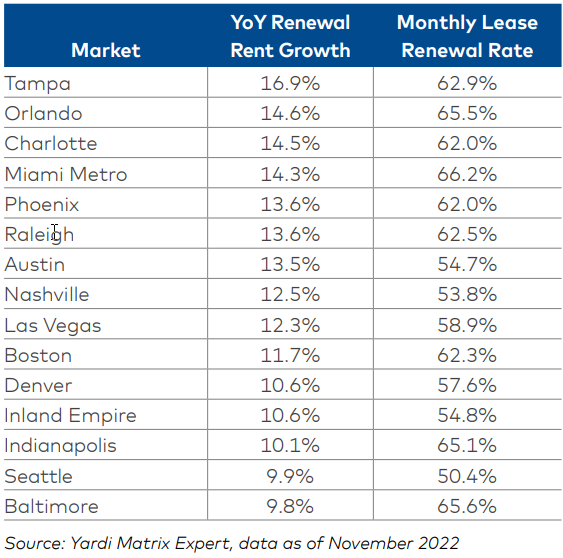
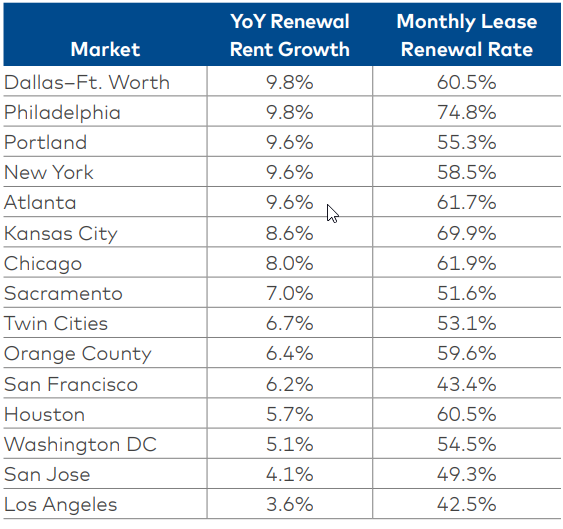
Q4 2022: The market cooled, due in large part to massive rent growth of 14 percent YOY for those deciding to relocate (renewals were less).

No. 2

January 2023: Apartment market is off to a strong start in 2023, thanks to pent-up demand to move and a ridiculously high premium to purchase a home.

No. 3

Oversupply warning: More than 1.1 million apartments units are in the pipeline, which is far more than needed and will likely produce a supply surplus later in the year and next year.

No. 4

Demand warning: Most apartment owners are planning on a recession later this year, which is never good for apartment owners.

No. 5

Plunging values ahead: Cap rates have risen—but experts say not enough. Expect cap rates to rise and values to decline.

No. 6

Controlling expenses: Most apartment developers are focused on improving efficiencies to combat increases in expenses.

The Risk Of Oversupply

“Despite the current delays, the number of completions will be greatly elevated through 2024. The massive apartment pipeline has led many to speculate about oversupply risk.

However, new supply will be largely concentrated in markets with stellar job growth and overpriced for-sale housing,” the authors say.

Conclusion: 6 takeaways from National Multifamily Housing Council Conference

The authors say that the current challenge is “how to successfully build and execute a strong strategy around the changing environment. To remain competitive, developers and operators will need to be hyper focused on where they are going and the game plan to get them there.”

Read the full report here at John Burns Real Estate Consulting.

Sign Up For Our Newsletter And Get Rental Property And Apartment News And Helpful, Useful Content Each Week.

* indicates required

Economic Indicators Show Positive Multifamily Outlook

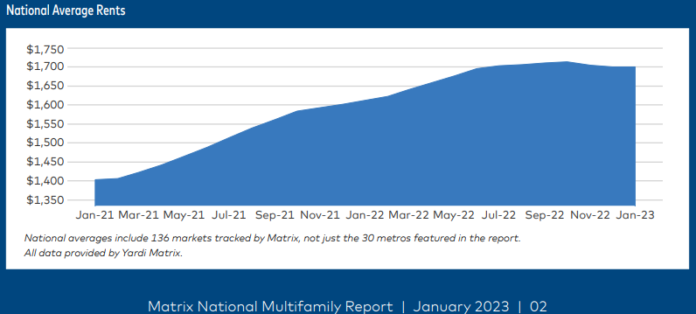
Multifamily demand remained steady in January, with rents leveling off after a fourth-quarter dip, to show a positive multifamily outlook.

Multifamily demand remained steady in January, with rents leveling off after a fourth-quarter dip, to show a positive multifamily outlook, Yardi Matrix said in their January report.

“The sturdy job market is creating optimism for a soft landing in 2023, though industry players are apprehensive about the growing number of rent control measures and rapidly rising expenses,” the report says.

“All things considered, the performance is a positive indicator for the sector. Going into the year—since it would be impossible to maintain the growth of the last two years—the debate was about how much demand would decline and the impact on rents,” the report says.

Highlights of the report

  • After declining in the fourth quarter as growth decelerates, multifamily rents were flat in January. U.S. asking rents averaged $1,701, unchanged from December. Year-over-year growth continues to decline, and is now 5.5 percent, down 70 basis points from the previous month.
  • Participants at the annual National Multifamily Housing Council conference in Las Vegas were generally optimistic about demand fundamentals, but concerns centered around issues such as the wave of proposed rent control measures, increasing expenses and high mortgage rates.
  • The single-family rental market remained strong amid volatility in the homebuying sector. The average U.S. asking rent increased $1 in January to $2,070, while the year-over-year increase fell by 85 basis points to 4.2 percent.

Rent Growth Steady In Yardi Matrix Markets

The report says that, “Early signs are encouraging. Rents remained consistent during the month in the middle of the seasonally slow winter season.

“And although markets where rents were well above trend in 2022—such as Miami, Tampa, Orange County and Nashville —have come back to the pack, overall growth is steady in most of Yardi Matrix’s top 30 metros.”

Multifamily demand remained steady in January, with rents leveling off after a fourth-quarter dip, to show a positive multifamily outlook.

Lease Renewal Rates Continue Decline

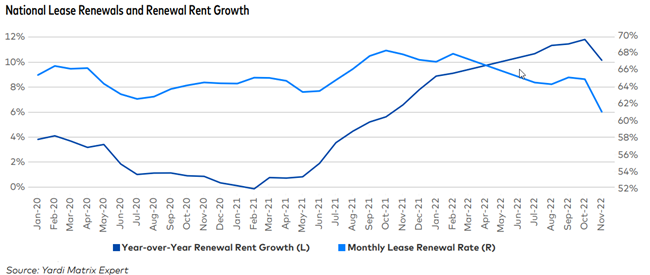
National lease renewal rates fell to 61.1 percent in November, down from 64.9 percent in October and the lowest level since before the pandemic.

The decline could reflect that tenants facing increases and lower wage growth are starting to shop for lower rents, although the month could be an outlier.

Multifamily demand remained steady in January, with rents leveling off after a fourth-quarter dip, to show a positive multifamily outlook.

Multifamily demand remained steady in January, with rents leveling off after a fourth-quarter dip, to show a positive multifamily outlook.

About Yardi Matrix

Yardi Matrix researches and reports on multifamily, office and self-storage properties across the United States, serving the needs of a variety of industry professionals. Yardi Matrix Multifamily provides accurate data on 18+ million units, covering more than 90 percent of the U.S. population. Contact the company at (480) 663-1149.

Sign Up For Our Weekly Newsletter And Get Rental Property And Apartment News And Helpful, Useful Content Each Week.

* indicates required

Rental Property Maintenance: Security, Pest Control, & Exteriors

Rental property maintenance checklist part two, security, pest control and exteriors, is the second in a series provided by Landlord Gurus.

Rental property maintenance checklist part two, security, pest control and exteriors, is the second in a three-part series provided by Landlord Gurus.

By Eli Secor

Keeping your rental property in top condition ultimately saves on maintenance costs, and helps attract and retain good tenants. This article is the second in our three-part series on routine maintenance, which focuses primarily on security, pest control, and exterior issues.

Security

Here are some of the ways you can improve the safety of your renters as well as your rental property.

  • Doors – Ensure all doors close securely, and have functional locking hardware such as deadbolts.  We do not recommend hollow-core exterior doors, and suggest making sure long screws secure the deadbolt plate on the door frame.
  • Re-keying – Change keying at every turnover to protect your renters and avoid the possible liability that could arise if a previous tenant re-enters a unit.  We use keypad entry deadbolts almost exclusively at this point, as they can be re-programmed easily.
  •  Windows – Ensure all windows latch securely. Use adjustable stops or wood dowels to limit how far sliding windows and patio doors can open in case they’re left unlocked.
  • Lights, alarms, and cameras – Consider using cameras, lights, and alarms to increase the security of your property.

Pest Control

It’s best to hire a professional for pest control. However, if you decide to handle everything on your own, we recommend the following measures:

  • Remove entry points – Cover or seal openings with materials that can’t be chewed. You can stuff a wire screen into smaller openings and fill the space with building spray foam.
  • Exterior bait – Place poison outside the building in child and animal-safe containers. You may use bait boxes for rodents or bait traps (such as gel products) for ants and insects.
  • Interior bait – For ants and insects there are solutions such as traps and sprays that are applied along baseboards. However, we don’t recommend this for rodents as you can end up with stinky dead critters in your building.
  • Bed bugs and fleas –Very high temperatures can kill pests and there are specialized heaters that can be used to treat belongings, furniture, and even rooms.  Often, however, we have found that hiring a professional is necessary.  Tidbit: dogs are often used to locate bed bugs!

Exterior

Here are some leak prevention and routine rental maintenance checklist measures to keep up the exterior of your rental buildings:

  • Roof –Keep an eye on moss growth, loose flashing, and broken shingles. Hire a professional to deal with roof maintenance, as they can spot separating seams and other signs of wear or failure.
  • Gutters – Clean gutters and downspouts every fall to avoid backups that can cause flooding.
  • Chimney – Monitor the condition of any chimney to avoid leaking. For old masonry chimneys, replace mortar before bricks come loose and fall.
  • Window and door sealant –Inspect caulking joints yearly and renew those that are cracked or separated from the surfaces they’re sealing.
  • Paint – Replace paint before it starts bubbling and flaking, as this will keep exterior surfaces from degrading in the weather.

Key Takeaway

We hope this checklist will help you create an effective rental maintenance plan. Check out our third part upcoming next month to learn about how to tackle electrical, fire safety, & HVAC-related issues.

About the author:

Eli Secor started LandlordGurus.com with long-time friend and fellow landlord Chris Lee.  After many a discussion about how to manage various tricky rental property issues, they decided to share their experiences and expertise with other independent landlords.  Along the way they are finding new answers and new tools, which they also share.

Sign Up For Our Newsletter And Get Apartment News And Helpful, Useful Content Each Week.

* indicates required

Rental Property Maintenance Checklist, Part One: Plumbing

rental property maintenance plumbing and water heater secured with straps in earthquake prone areas of the country

3 Common Plumbing Emergencies In Rental Properties And What To Do

Rental Property Maintenance: 6 Items to Troubleshoot in Your Crawl Spaces

How to Waterproof Your Basement

One Sure Way To Increase Tenant Selection Success Rates Part 4

One sure way to increase tenant selection success rates part 4 By Rebekah Near, CEO of Orca Information, Inc on developing a policy

By Rebekah Near,
CEO of Orca Information, Inc
Nationwide Tenant and Employment Screening Service

Here we are at article number four on creating a detailed Tenant Selection Policy (TSP).  Now it is time for an example of a working policy described in my previous articles.  Each management company and or property has their own unique details in a policy.  Not one of our client policies are exactly alike!  However, the format and certain required legal information would be included.  Keep in mind, when it comes to legal wording, not all attorneys word things the same.  I am providing an EXAMPLE of what we help our clients create.  So far, they have been working like a charm!  I have been working with clients on their policies since 1996. IF YOU CHANGE YOUR POLICY DUE TO MY SUGGESTIONS OR ANY OTHERS, A LANDLORD TENANT LAW ATTORNEY NEEDS TO APPROVE IT BEFORE BEING USED.  IT IS ALSO IMPERATIVE YOU STAY ABREAST OF ANY CHANGES TO THE LAWS AND MAKE CHANGES TO YOUR POLICY ACCORDINGLY.  Your Tenant Screening company is required to assist you in providing you with any new rules and regulations affecting Tenant Screening.  It is also up to you to reach out to them periodically for such information.  This example policy is Washington State specific, however much applies to every State.

Due to size of the file, this policy is only a partial example.  This “example policy” will address numbers one and two of the four categories listed below.

There are at least four categories for Tenant Selection Policies.  They are as follows: 

  1. The requirements to apply for the property – the Application Process
  2. Rules of the Property
  3. Potential Disqualifiers identified on the Background Screening Report.
  4. Disclosure documents explaining laws governing the application process – Tenant Rights!


(YOUR LOGO, ADDRESS AND CONTACT INFORMATION WOULD BE AT TOP OF THE PAGE)

RENTAL CRITERIA

WE DO NOT ACCEPT REUSABLE TENANT SCREENING REPORTS

Thank you for applying to rent from our company.  This process should be completed within 72 hours (excluding weekends and holidays).  Want your screening report to come back to our office fast as possible?  Then fill it out thoroughly, include all phone numbers, type or write legibly.  We are happy to help you with any questions.

All rentals are on a “first come, first serve” basis.  The only thing that will “hold” a rental for you is a completed application and a paid screening fee.  *Screening Fee is non-refundable.

THE APPLICATION PROCESS

  1. Each person who is 18 years and older must fill out a Rental Application. The following applies:

a. Fully completed Rental Applications and $____ non-refundable processing fee needs to accompany each tenant/Lease Holder(s) application.

b. Rental Applications submitted online are charged an additional $3.00 processing fee.

c. The Tenant Screening process will include credit reports, rental references, court records and employment verification.

d. For screening services, ABC Management uses: ORCA Information, Inc., 120 E George Hopper Rd, Suite 108, Burlington, WA 98233, 800-341-0022.

2. For each property ABC Management accepts and processes one set of Rental Applications (or co-tenant applications) at a time. The following documents are required upon submission of each application:

    • Copies of government photo ID and
    • Equivalent proof of identity (Visa, Passport, etc.). See attached, Suggested Alternative Documents for Screening Immigrant Populations.
    • Documents proving income is 2.5 times the rent amount.
    • Signed document titled, WASHINGTON STATE FAIR TENANT SCREENING ACT OF 2012

3. Commercial Rentals – Complete a Commercial Rental Application. Application fee is $_____.

REQUIREMENTS

  1. A rental applicants gross monthly income must equal at least 2.5 times the rent. Income must be lawful and verifiable.  Documents proving earnings need to be submitted to the office BEFORE THE SCREENING PROCESS WILL BEGIN.
  2. Proof of Adequate Income – Example:
    • Most recent check stub with year-to-date earnings
    • Self Employed – Tax Returns for last two years
    • Retired – Copies of Deposit slips, Investment Earnings and/or Social Security Earnings Documents, Bank Deposit History
    • Additional Sources of Income – Ex: Child Support, Bank Deposit History, etc.

POTENTIAL DISQUALIFIERS (Overview)

  1. The following are issues that may cause a denial of your application:
    • Credit score below 600
    • Unpaid Collections
    • Bankruptcy within past two years
    • Less than two years of positive credit history.
    • Unlawful Detainer (Eviction)
    • Negative/Incomplete rental reference
    • Court Records – History of criminal activity on the part of any proposed occupant and which presents a danger to persons and/or property, or the peace and enjoyment of the others in the apartment/community could negatively impact your application. Example: drugs, sex offense, robbery, assault, etc.

Determinations as to criminal screening will be made on a case-by-case basis and based on several factors and information. There will be no automatic denials for arrests or criminal convictions.

  • False information and/or omission of material fact on Rental Application
  • Lack of information provided on Rental Application
  • Lack of proper documentation of earnings – 2.5 times rent amount
  • Lack of 24 months positive, consecutive, objective rental references.

Exceptions to Standards – “Adverse Action Options”

Due to extenuating circumstances – exceptions to one of the above standards may be considered.  A qualified co-signer or additional deposit may be required.

CONSUMER RIGHTS INFORMATION

  • Consumer Information is kept confidential.
  • A credit report is considered a “hard hit” by all three major credit bureaus.
  • In the event of Adverse Action (denial of tenancy, cosigner or increased deposit required) you have the right to a FREE copy of the background check we reviewed and processed by Orca Information, Inc. You also have the right to dispute the accuracy of any information therein.
  • Per FCRA, the company, Orca Information, Inc. provided all, or part of the information included in the background check. However, Orca Information did not make the decision to take Adverse Action.
  • Decision to rent is made solely by ABC Management.
  • You have the right to obtain a FREE copy of your credit report each year from every credit bureau. For a FREE copy log onto: www.annualcreditreport.com.
  • Orca Information obtains credit reports from Trans Union.

CO-SIGNER

  1. If applicant does not meet the minimum requirements a co-signer may be required. Required qualifications are the following:
    • Proper documentation of earnings/income
    • Proof of Adequate Income – Example:
      • Most recent check stub with year-to-date earnings
      • Self Employed – Tax Returns for last two years
      • Retired – Copies of Deposit slips, Investment Earnings and/or Social Security Earnings Documents, Bank Deposit History
    • Earn 5 times the rent amount

PET POLICY

  1. A $250.00 pet deposit is required for each pet. There is a $50.00 non-refundable fee retained to probe the carpet for pet urine upon vacating the property.  If there is no pet damage, deposit will be refunded, less the probe fee.
  2. Additional monthly pet rent is charged in the amount of $25.00.

 ASSISTANCE ANIMALS

  1. Assistance animals accepted with written verification of a disability related need.

MOVE – IN PROCESS

  1. A $_____ Nonrefundable Administrative Fee must be paid within 24 hours of approval notification.
    • The move-in costs are divided into three parts:
      • A $_____ Nonrefundable Administrative Fee
      • The Security Deposit
      • The Rent.
  1. CHECK-IN: An appointment will be scheduled at our office when the property is ready for occupancy. The deposit needs to be paid. The lease and all rental documents will be reviewed and signed.

3. RENT: Pro-rated rent will be charged from the date the property is “rent ready” and be paid on the date the lease is signed.

4. UTILITIES: Local utilities must be established in the tenant’s name by the tenant before the check-in. The utility company will require a deposit.

OFFICE USE ONLY – SUBMISSION CHECKLIST

____ Completed application(s) with signature

____ Documents proving 2.5 X’s Rent

____ WA State FTSA signature page

____ Screening fee payment

____ Gov’t issued photo ID

  The above example policy helps clarify how to make a Tenant Selection Policy more clear and concise for both applicant and management company staff.  There are many more documents included in my client Tenant Selection Policies but time and space will not allow all of them to be published here.  My objective in this series of articles is to address the different ways to keep the policy clear and easy to understand to applicants and staff.  The above example policy covers only the following:

  1. The requirements to apply for the property – the Application Process
  2. Rules of the Property

 Next article will describe – specifically the reasons a landlord might take adverse action against an applicant.  It is laid out in a special, easy to read form.  It applies ONLY to the information provided on a tenant screening report – credit, court, reference, etc

 The above is not legal advice.  Rebekah Near is not an attorney.  Questions may be directed to Rebekah Near at the following email address:  Rebekahn@orcainfo-com.com  For training videos on this subject and others, log on to, http://www.Orcainfo-com.com  At the top of page is a menu. Click on Education.  One of your choices will be our educational and training videos.

Part 1: One Sure Way To Increase Tenant Selection Success Rates

One Sure Way To Increase Tenant Selection Success Rates Part 2

One Sure Way To Increase Tenant Selection Success Rates Part 3

Judge Sides With Landlords Over Tenant Screening Cap Flap

An Oregon judge has sided with landlords over the City of Eugene’s attempt to cap tenant screening fees at $10, according to reports.
Property management groups sue city.

An Oregon judge has sided with landlords over the City of Eugene’s attempt to cap tenant screening fees at $10, according to reports.

Two property management groups had sued the city over a city-imposed $10 cap on rental applicant screening fees. Thorin Properties and Jennings Group, Inc charged in the lawsuit that Oregon law grants landlords the right to collect applicant screening charges sufficient “to cover the costs of obtaining information about an applicant.”

Lane County Circuit Court Judge Erin Fennerty ruled in favor of the property management groups. She said state law allows landlords to charge for the actual cost of the background checks, and that supersedes the city ordinance.

“Operation of the Ordinance ultimately defeats the purpose of applicant screening charge, as a landlord cannot recoup its average actual costs as provided for by (state law) while complying with the Ordinance’s cap on recouping actual costs above $10,” Fennerty wrote in her opinion.

The Eugene City Council voted last summer in favor of a tenant screening cap and put a $10 cap on the amount that property owners could charge prospective renters for a background check.

“We were confident from the outset that this policy was unlawful,” Multifamily NW Deputy Executive Director Gary Fisher, told KLCC.org. “Despite sharing our perspectives and experience with the city council, the policy passed last year. While a legal challenge is always a last resort, we are pleased that Judge Fennerty upheld the law.”

A spokesperson for the City of Eugene said the city is reviewing the court’s decision.

Thorin Properties is an Oregon Limited Partnership. It owns 16 properties in Eugene, Oregon, consisting of 82 apartment units and six stand-alone rental homes.

Jennings Group, Inc., is an Oregon corporation which is licensed as a property management firm. It manages 1,595 residential department units in the City of Eugene.

Sign Up For Our Weekly Newsletter And Get Rental Property And Apartment News And Helpful, Useful Content Each Week.

* indicates required

Portland Rents Hold Steady In January

Portland rents fell by only 0.1 percent – essentially flat-  over the course of January while rents fell in many other large metros

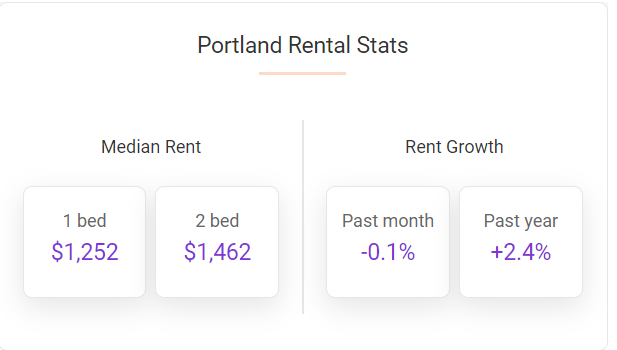
The median rent in Portland fell by only 0.1 percent – essentially flat-  over the course of January while rents fell in many other large metros, according to the February report from Apartment List.

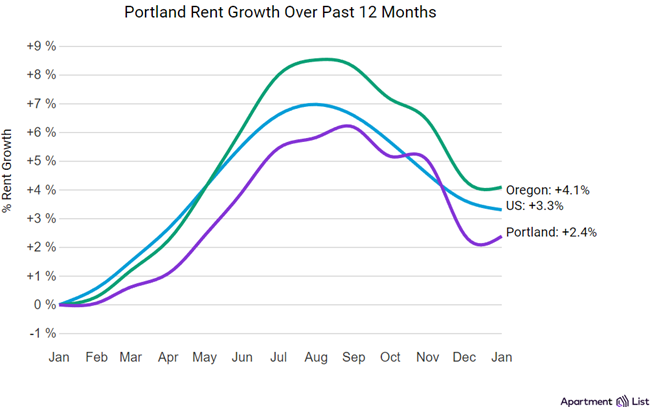
Portland rents have now increased by a total of 2.4 percent over the past 12 months.

Portland is the No. 53 most expensive large city in the U.S. with a median rent of $1,492.

Portland rents fell by only 0.1 percent – essentially flat-  over the course of January while rents fell in many other large metros

Citywide, the median rent currently stands at $1,253 for a 1-bedroom apartment and $1,462 for a 2-bedroom. Across all bedroom sizes (ie, the entire rental market), the median rent is $1,392.

For comparison, the median rent across the nation as a whole is $1,148 for a 1-bedroom, $1,316 for a 2-bedroom, and $1,338 overall.

Across the Portland metro rents are higher, where the median rent is $1,550.

Metro-wide annual rent growth stands at 4.2 percent, above the rate of rent growth within just the city.

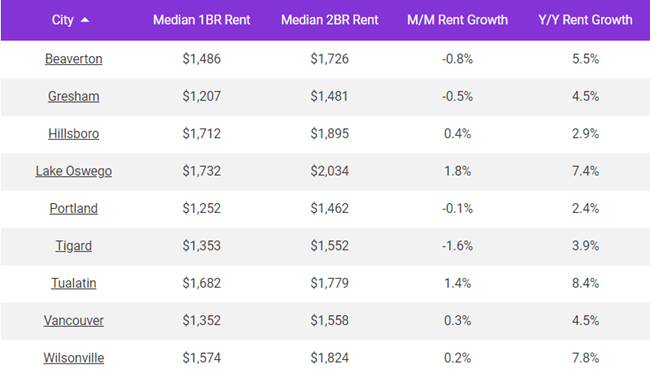
Across the metro, Lake Oswego is currently the most expensive, with a median rent of $2,037. The metro’s fastest annual rent growth is occurring in Tualatin at 8.4 percent while the slowest is in Portland at 2.4 percent.

Portland remains the most affordable city in the metro.

For comparison, the median rent across the nation as a whole is $1,148 for a 1-bedroom, $1,316 for a 2-bedroom, and $1,338 overall.

The median rent in Portland is 4.0 percent higher than the national, and is similar to the prices you would find in Paradise, NV ($1,405) and Chicago, IL ($1,372).

The table below shows the latest rent stats for 9 cities in the Portland metro area that are included in the Apartment List database.

Portland rents fell by only 0.1 percent – essentially flat-  over the course of January while rents fell in many other large metros

Vancouver rents are flat month-over-month and up 4.5 percent year-over-year. The median rent in Vancouver rose by 0.3 percent over the course of January, and has now increased by a total of 4.5 percent over the past 12 months.

Sign Up For Our Weekly Newsletter And Get Rental Property And Apartment News And Helpful, Useful Content Each Week.

* indicates required

A Dose of Patience Can Be The Cure For Landlord Anxiety

Patience with applicants, tenants and the market is tough for landlords' anxiety but leads to better tenants and long-term investing success.

Patience with applicants, tenants and the market can be tough for landlords with anxiety,  but it leads to better tenants and long-term investing success.

By Scot Aubrey

As one of the famous seven virtues, patience has been pondered over and preached about for most of human history.  Just doing a quick internet search will produce quotes regarding patience from every century and from people as diverse as Gandhi to Axl Rose.

For most of us, there is no greater test of patience than driving in the car, where we are clearly a better driver than everyone else on the road; there’s just something about being behind a slow driver in the fast lane that brings out our inner traffic monster.  Believe it or not, patience, and its evil twin impatience, affect each of us as property owners in a couple of different ways that we will discuss below.

PATIENCE WITH THE MARKET

Anyone who owns property has experienced the whiplash of the real estate market rollercoaster over the past few years.

You likely fall into one of two categories: 1) you bought property as a knee jerk reaction to rising prices and now are panicking as the market has softened over the last 6 months, or 2) you sold your property at the top of the market and are anxious to get back in the game but are afraid you haven’t seen the bottom of the market yet.

Both scenarios present their own unique challenges, but the same solution applies to both; have a little patience.

Although your situation may be an anomaly, most of us can wait 3-6 months to see where the market is headed, allowing us to take a deep breath and make a calculated and educated decision on what to do with your portfolio.  Don’t go chasing the latest trend and stick with the tried-and-true principles that have made investing in property the best game in town.

Patience almost always prevails in an unpredictable market.

PATIENCE WITH APPLICANTS

Given our diversity in what we own and how we manage, we all share the same goal as a property owner, and that is to have our properties full of good, qualified, paying tenants but it takes patience with applicants.

The pipeline for good tenants starts with being consistent in applying your criteria during the on-boarding process.

We tend to want to get the property filled and get cash flowing, even if it means skimping on our requirements or skipping them altogether.  Our goal when we have a vacant property is to fill it as quickly as possible, so it is the tenant’s cash covering the bills and not our own.  Operating in “survival” mode is the worst way to manage as it forces us to make decisions out of desperation.

If you are in a hurry to get that security deposit and the first month’s rent just so you don’t have to cover one month’s payment, you will take the first warm body and that almost always ends in disaster.  Instead, adopt a long view approach and use your well-established processes of criminal background screening and financial qualifications to identify a 5-year type of applicant that will cover your next 60 mortgage payments, not just the next one.  Again, patience will pay dividends

 PATIENCE WITH TENANTS

Every landlord has at one time, or another had a tenant that pushes them to their limits, whether they are extremely needy or delinquent in getting you the rent.

Unfortunately, it’s just part of the business… but so is being patient with them.  Just like us, life has a way of reaching into our tenants’ lives and dealing them a bad hand from time to time.  When it comes to protecting the roof over their heads, tenants can quickly become extremely defensive and start making thoughtless decisions that cause most rational people to shake their heads.

An extra dose of patience goes a long way in calming down a situation and re-establishing the expectations of you as the landlord.  Plus, it protects the property as an out-of-control tenant can do more damage to the property in a matter of minutes than their security deposit can cover.  As a professional you do need to include the rules and regulations regarding your property in your lease so when patience has run its course and it’s time to remove them from the property, you aren’t the one making impatient, irrational decisions,

Mahatma Gandhi famously stated, “To lose patience is to lose the battle.”  Those words rang true 100 years ago and they are just as true today.  Although we don’t always view this way, our business, our livelihoods, are a battle, and patience is a key to victory.  When you are confronted with the next challenge in your investment career, whether it is the market, your applicant, or your tenant, just remember what Axl Rose sang into existence: “Need a little patience, just a little patience, some more patience.”

About the author:

Scot Aubrey is Vice-President of Rent Perfect, a private investigator, and fellow landlord who manages short-term rentals.  Subscribe to their weekly Rent Perfect Podcast (available on YouTube, Spotify, and Apple Podcasts) to stay up to date on the latest industry news and for expert tips on how to manage your properties.

Sign Up For Our Newsletter And Get Rental Property And Apartment News And Helpful, Useful Content Each Week.

* indicates required

Why I Like My Rental Properties’ Nosy Neighbors

Three Steps to Becoming a Successful, Lazy Landlord

Colorado Bill Seeks To Ban Pet Rent Charges

A bill introduced in the Colorado legislature would prohibit landlords from charging pet rent or extra security deposits for pets.

A bill introduced in the Colorado legislature would prohibit landlords from charging pet rent or extra security deposits for pets.

The Pet Ownership In Housing bill, HB-23-1068, was introduced to the Colorado legislature on Jan. 19 and is sponsored by Rep. Alex Valdez.

In downtown Denver on a warm day, it’s nearly impossible to go a block without seeing an array of dogs walking with their owners. This new bill would tackle an issue that affects animal owners and their housing, according to kdvr.com.

Highlights of what the pet rent bill would do:

  • Prohibit restrictions on dog breeds for obtaining homeowner’s insurance
  • Provide for the manner in which pet animals are handled when a writ of restitution is executed
  • Prohibit security deposits or rent for pet animals
  • Create the pet friendly landlord damage mitigation program
  • Exclude pet animals from personal property liens

Insurance implications

The bill would also, “Prohibit insurers from denying a homeowner’s insurance policy based on the breed or mixture of breeds of dog that resides at the insured dwelling, while allowing denial if a specific individual dog is a dangerous dog. Insurers are also prohibited from asking or otherwise inquiring about the specific breed or mixture of breeds of dog kept at a dwelling except to ask if the dog is known to be or has been declared a dangerous dog.”

How any pet damage would be handled

The bill would also create the pet friendly landlord damage mitigation program to be administered by the department of local affairs, subject to availability of funding.

Under the program, a landlord may receive reimbursement for actual damage caused to a rental premises by a pet animal allowed to reside with the tenant up to $1,000. Reimbursements are granted on a first come, first served basis, and a landlord must provide documentation in support of the damages for which the landlord makes the claim of reimbursement.

The department has authority to promulgate rules to implement the program. A landlord who receives reimbursement under the program is prohibited from taking legal action against the tenant for the damages or from pursing collection against the tenant for the damages.

Sign Up For Our Weekly Newsletter And Get Rental Property And Apartment News And Helpful, Useful Content Each Week.

* indicates required

Welcoming Pets Is a Smart Financial Move In Rental Housing

Emotional Support Animals and the Fair Housing Act

Everything Landlords Should Know About Emotional Support Animals

Oregon Bill Seeks To Restore 60-Day Grace Period For Evictions

An Oregon Senate bill seeks to require landlords to extend notice periods and restore the 60-day grace period for evictions for nonpayment of rent which were part of the pandemic protections.

The bill, SB 799, would postpone evictions for not paying rent for up to 60 days while tenants seek rental assistance, and it would require courts to set aside certain eviction judgments. Lawmakers will work to compromise on the bill, according to committee chair Sen. Kayse Jama, D-Portland.

“It’s my intention to make sure we have some sort of protection being passed this session for eviction prevention, but I also understand that this is a really complicated issue,” Jama told the Oregon Capital Chronicle.

The grace period of evictions was originally part of the pandemic protections passed by the legislature.

Beginning Oct. 1, 2022, landlords were able to resume giving tenants notices of either 72 hours or 144 hours to pay their overdue rent or move out – 72 hours when their rent is eight days overdue and 144 hours or six days when it is five days overdue. The bill would change those notice periods to 10 or 13 days.

More rules for landlords

Jason Miller, legislative director for the Oregon Rental Housing Association, told lawmakers that the eviction protections approved during the pandemic were never meant to be permanent.

“They were extreme measures taken during extreme times, where thousands of people were out of work for months because of government-mandated shutdowns,” Miller said.

He said that restoring the 60-day grace period would cause small landlords to sell their rental properties, and property managers of all sizes would increase rent, charge higher security deposits and have stricter criteria for rental applications to mitigate the risk of going months without rent payments.

Tenants who sign a lease know when rent is due

Dianne Cassidy, a Lake Oswego resident who owns apartments and opposes the bill, said renters should know as soon as they sign a lease when rent is due and that they need to pay it on time. Extending notice periods just means that landlords will be forced to pay the costs for housing people for free, she said according to the report in the Oregon Capital Chronicle.

Cassidy said three recent evictions cost her about $45,000: roughly $10,000 to repair damage in each unit and $15,000 in unpaid rent. That’s money she planned to use to save for retirement and to care for her son, who has disabilities, she said.

“Seventy-two-hour notice is simply the title of the notice,” Cassidy said. “Everybody who signs a lease knows from the day they sign it, what day the rent is due and how much is due. So when they come up short, they know in advance that something is going to happen.”

Read the full article here.

Sign Up For Our Weekly Newsletter And Get Rental Property And Apartment News And Helpful, Useful Content Each Week.

* indicates required

National Rents Decline In January For Fifth Straight Month

National rents declined as the index fell by 0.3 percent over the course of January, marking the fifth straight month-over-month decline

The national rent index fell by 0.3 percent over the course of January, marking the fifth straight month-over-month decline, Apartment List says in their February report, while the vacancy rate rose.

The rent decline in January was a little less than last fall, but still different from the usual seasonable patterns of the past, “signaling the continuation of a broader cooldown in market conditions,” the report says.

Some highlights from the report:

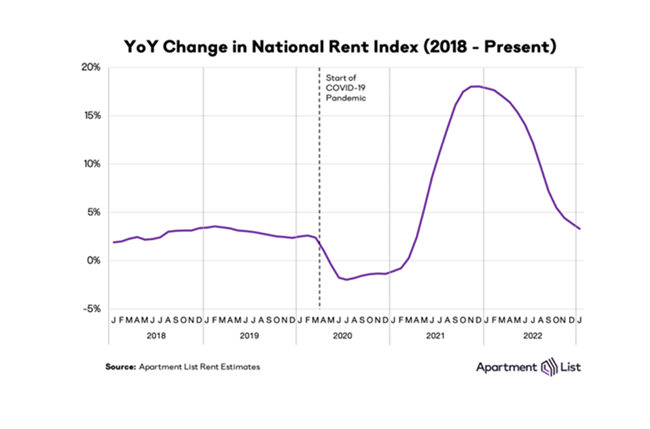
  • Year-over-year rent growth is continuing to decelerate, and now stands at 3.3 percent, its lowest level since April 2021.
  • Year-over-year growth is now pacing just slightly ahead of the average rate from 2018 to 2019 (2.8 percent), and is likely to decline further in the months ahead.
  • The cooldown in rent growth is being mirrored by continued easing on the supply side of the market.
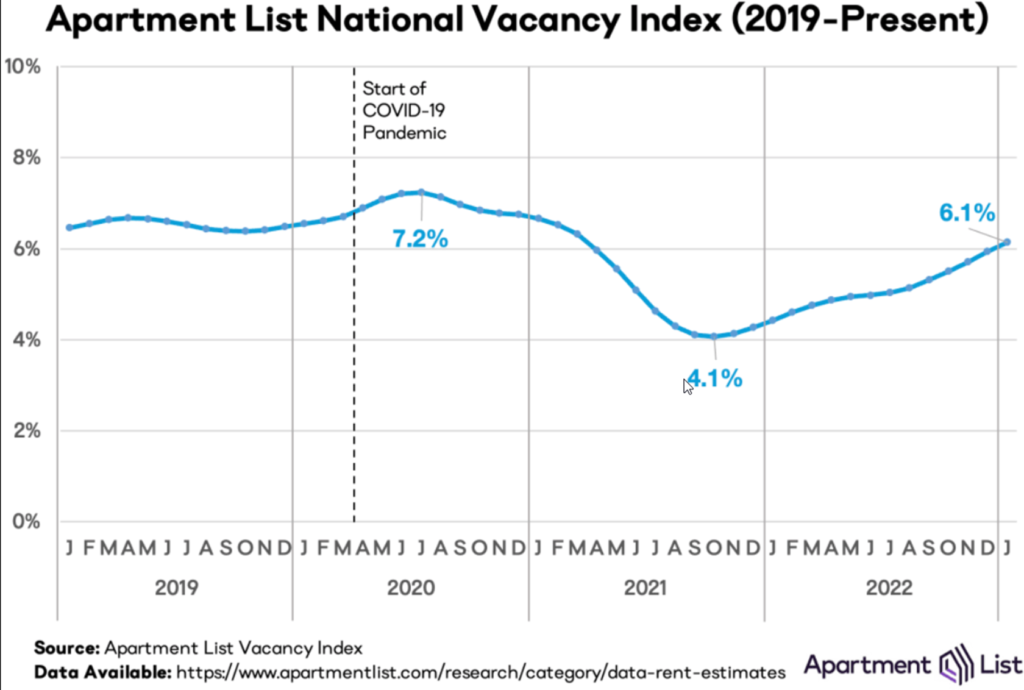
  • This month’s reading represents the first time that our vacancy index has surpassed the 6 percent threshold since April 2021. The vacancy rate is now just barely below the pre-pandemic norm.

National rents declined as the index fell by 0.3 percent over the course of January, marking the fifth straight month-over-month decline ad the vacancy rate topped 6 percent

Property owners may be competing for renters in 2023

“Our vacancy index now stands at 6.1 percent, surpassing 6 percent for the first time since spring of 2021.

“With a record number of multifamily apartment units currently under construction, we expect that supply constraints will continue to soften. 2023 could be the first time in years that we see property owners competing for renters, rather than the other way around,” the Apartment List Research Team writes.

Rent slowdown has been widespread

The recent rent slowdown has been widespread across the country.

Big metros such as Seattle, New York City, Washington, D.C. and San Francisco all experienced rent declines more than double the national rate.

“Over the past six months as a whole, no large metro area in the country has experienced positive rent growth,” the report says.

Conclusion

This recent cooldown shows a shift in market conditions that goes beyond seasonality alone, as cooling demand collides with growing supply.

“We’re likely to see a return to positive rent growth as moving activity picks back up in the coming months, but we expect that growth will remain modest throughout 2023, and year-over-year growth rates are likely to continue dipping as monthly growth remains slower than the 2022 pace,” the Apartment List Research Team writes.

Read the full report here.

Sign Up For Our Weekly Newsletter And Get Rental Property And Apartment News And Helpful, Useful Content Each Week.

* indicates required