Home Blog Page 68

Amenities That Will Turn the Heads of Prospective Residents

Many renters and prospective residents are willing to increase their budgets if you have amenities that will turn their heads

Many renters and prospective residents are willing to increase their budgets if you have amenities that will turn their heads and elevate their lifestyle.

By Austin Harte

When searching for a new home, it may seem as if the options are endless – amenities serve as a key attraction point for renters and can assist in securing a lease. In today’s market, it is more important than ever to help your prospective residents understand the full value of your multifamily community. Having amenity-rich spaces will assist in setting your community apart from competitors, attracting new residents and fostering a positive living experience for each of your existing valued residents.

The ideal amenity is not chosen because everyone else in the market has it. An amenity is chosen because it elevates one’s lifestyle in one or more of the following areas:

  1. Physical and mental wellbeing
  2. Safety and security
  3. Convenience
  4. Luxury
  5. Community comradery

What amenities are prospective residents looking for in a multifamily community?

Renters expect more than just a stylish pool and an upgraded fitness center, they expect modern in-home and community amenities that will enhance their quality of life. They desire convenience and many renters are willing to increase their budget if there are features that will help simplify their life by addressing their needs.

No. 1 Smart technology packages

In-home technology (tech) offers residents an enhanced living experience while also lowering operating costs.

Tech features have grown to be a favorable selling point because it empowers your residents to take full advantage of a convenient, seamless living experience.

Technology packages may include a keyless entry, thermostat hub and smart light switches.

No. 2 Updated kitchens

Prospective residents are willing to pay more if they see up-to-date appliances and finishes when touring.

Granite countertops, appliance packages with water dispensers and ice makers, designer-grade finishes, hardwood-inspired flooring, or even wine fridges create an elevated space that many are seeking.

No. 3 Flexible work from home spaces

We have seen an increased demand for hybrid work environments in multifamily communities.

Home offices and collaborative co-working spaces, such as a clubhouse or computer room, are often on people’s “must have” list.

Other amenities that are highly sought after

  • Pet-friendly communities and self-service pet amenities
  • Trash services
  • In-home washer and dryer
  • Secured and/or reserved parking
  • Package delivery solutions

Leave a memorable first impression

First impressions can easily determine whether someone will choose to live in your community or the one down the road. While wow factors such as a resort style pool and expansive fitness centers are not considered an absolute must, they are an effective way to draw the attention of prospective residents.

Alternative amenity offerings – such as exclusive resident events – create a sense of community that many desire. Options such as yoga classes with personal trainers and movie nights in the pool are inviting and a great way to retain your residents.

Which amenities are worth your investment in?

The question is a matter of return on capital. Is it worth investing in the next generation of amenities? The right amenity will aid as a marketing tool to attract tenants while adding long-term value to the community.

Outpacing your competition with the right amenities

Prospective residents tend to tour multiple communities in the same area. So how can you differentiate your community while incorporating the same base features as others, creating a unique personality or image?

Although not an easy feat, here are some tips to help your community stand out from the crowd.

  1. Listen, learn, and stay up to date with your renter base
    The most efficient way to decide what amenities are worth investing in is to learn directly from your renter base, understanding both their wants and needs. Doing so will help identify what amenities your community needs to stay relevant.
  2. Acknowledge changes in consumer preferences
    Evolving interests are considered an important factor when deciding on amenities. Do not be afraid of change – possessing a willingness to be adaptable is crucial to stay at the forefront of the multifamily industry.
  3. Consider lifestyle and location.

Lifestyle and location go hand-in-hand. Each aspect has a significant impact on what prospective residents desire and how much they are willing to pay for it. Lifestyle-focused amenities attract long-term residents and create a living environment meant to meet ongoing needs.

Enhanced resident experience

Arguably more important than choosing the most desirable amenities – is upholding a high level of customer service that creates a positive experience at each milestone in the resident journey.

Maintaining, as well as providing, an elevated standard of service across your community not only keeps amenities in pristine condition, but it prioritizes your valued residents’ wellbeing.

As the multifamily housing market takes shape for 2023, integrating new and/or improved amenities can greatly impact your business. Residents want to be proud of where they live as well as take full advantage of the added perks of luxury apartment living.

 ABOUT THE AUTHOR

Many renters and prospective residents are willing to increase their budgets if you have amenities that will turn their heads

Austin Harte, Managing Director of Multifamily Investments at Mark-Taylor, ensures his communities operate at peak performance and align with client goals. His committed leadership enables his portfolio of community teams to serve valued residents with signature five-star service.

Sign Up For Our Newsletter And Get Apartment News And Helpful, Useful Content Each Week.

* indicates required


3 Best Practices for Communicating with Residents

5 Proven Methods to Enhance Your Apartment Community’s Digital Reputation

4 Ways to Balance the Needs of Pets and Residents in Multifamily Communities

Building Teams by Building Community

Take time to give back to communities that surround your rental properties will build stronger teams across the entire organization

Taking moments to give back to the communities that surround your rental properties and offices will build stronger teams across the entire organizational spectrum.

By  Kendall Pretzer

Community doesn’t end at the property line. One of the amazing things about this industry is the chance to make lasting contributions and have a meaningful impact on the communities in which we serve.

A big lesson from the recent hiring and retention challenges is that employees possess a powerful desire to thrive in their careers, to go beyond a job and a paycheck. This presents owners and operators an opportunity to build lasting connections with their employees, which in turn creates success in hiring and retention.

As we turn the page on a new year and take time for reflection and goal-setting, organizations may want to take a step back from their normal day-to-day operations and create ways for their corporate and on-site associates to make a positive impact in our communities. Taking moments to give back to the communities that surround your properties and offices will build stronger teams across the entire organizational spectrum.

The Effects on Mental Wellness and Morale

The pandemic provided the nation’s workforce a window to reflect on their work-life balance, as well as their personal well-being. For some, this meant career changes, while for others it was seeking out ways to optimize their current role. Employee policy and culture have been placed under the microscope.

A study by Deloitte showed that more than 70 percent of employees said volunteer programs boosted their morale, 89 percent thought it improved the environment of the organization and 77 percent found it essential for their well-being. With these programs making your associates feel better about themselves and the organization, it’s one of the best tools for retention efforts. Happy and satisfied employees rarely leave their jobs.

Now more than ever, employers must navigate shifting employee expectations. Work-life balance isn’t just about less time at work for employees, but it can also be about finding professional and personal fulfillment. Community involvement can be a great tool to build company culture and employee satisfaction.

Volunteer Programs and PTO

Philanthropy and community impact can happen in countless ways. Owner/operators can help employees achieve their goals via a volunteer program or by granting employees the time to work on these or their own volunteer projects. In fact, more employees prefer time to give back over company social events, according to a study on workplace volunteerism by Deloitte. The same survey found that only 40 percent of companies actually provide those opportunities.

There are different types of volunteer programs that multifamily organizations can integrate to achieve their goals to build better teams and improve their communities, as well as their standing within those communities.

More and more companies in the multifamily industry are offering support and PTO for volunteering. In a small, recent LinkedIn poll, I asked about company volunteering policies. I was thrilled to find out that almost 50 percent of respondents said that their companies offered PTO for volunteering, and another 25 percent offered PTO for internal company volunteering initiatives. For example, MC Residential, the management arm of MC Companies, offers its employees 16 hours of paid volunteer time each year, which translates to more than 1,500 hours of giving back.

If you’re looking to build team connections, it may be time to consider employer-sponsored or employer-planned programs.

This is an opportune moment to engage your employees with their communities and to incentivize, recognize and encourage team members to give back in a way that speaks to them personally. Showing that a company cares about individual passions carries great benefits. One of Grace Hill’s Hero Impact Award Winners, Sara Ogle of Westwinds Apartments, was inspired by Red Nose Day to address child poverty in her community. She later expanded on that by creating RHCares, now a company-wide philanthropic movement for Westwinds’ parent company, Ripley Heatwole Company, Inc.

Making Connections and Building Skills

While volunteering may temporarily take your employees away from their structured workday, it will result in greater benefits in the future. A day-long hiatus that encourages an employee to remain, especially for charitable work, is always better financially for a company than the time and cost required to fill a vacant position.

Volunteer projects oftentimes require a significant level of leadership and collaboration, cultivating and showcasing the important skills of team members that may otherwise go unnoticed in a busy workplace. Identifying potential assets in associates that can be nurtured is invaluable to any organization.

The challenges in hiring and retention have put a greater burden on the current teams in multifamily communities. They don’t necessarily have time to get to know each other during work hours, particularly if they are in different departments or areas of the property. While new approaches to training and technology have helped counter some of this, companies will need to strike a balance that still promotes employee connection.

When associates spend time working together to build their community, they have a chance to build relationships with those they work with in various departments and at different career levels. Constructing stronger personal relationships improves the morale of everyone and provides insight into the work environment and sharing ideas. This can also foster mentorship and goal-setting.

Hiring and retention will always present some challenges for multifamily owner/operators, and providing a paycheck and benefits is no longer enough to meet those. Employees today want their well-being to be part of their careers and they want to work with socially-conscious companies.

Volunteer work and giving back aren’t just part of building your brand, they’re also necessary to build employee morale. Employees, especially those in younger generations, are seeking employers who are socially responsible and want to partner with their teams in order to make a positive, powerful impact.

About the author:

Kendall Pretzer brings more than 30 years of experience in property management and supplier solutions to her role as the Chief Executive Officer at Grace Hill. Kendall joined the team in 2018 after Grace Hill purchased her company, The Strategic Solution, bringing together policies and procedures with training. Today, she and Grace Hill champion making a positive impact in our communities in multifamily, as demonstrated in company initiatives like the annual Impact Hero Awards, Breast Cancer Awareness Month and Human Trafficking Awareness Month. In recognition of her dedication to the industry, Kendall was recently named a GlobeSt. Woman of Influence and one of the Top 25 Women Leaders in US PE-Backed Software by Calibre One.

Giving Back: How to Engage Your Team and Get Involved in Your Community

5 Things Your Company Can Do To Retain Top Talent in Multifamily

Staying Competitive and Sticking to the Basics in Multifamily

Changing the Perception of Apartment Living

Sign Up For Our Weekly Newsletter And Get Rental Property And Apartment News And Helpful, Useful Content Each Week.

* indicates required

Property Managers Optimistic Despite Economic Challenges

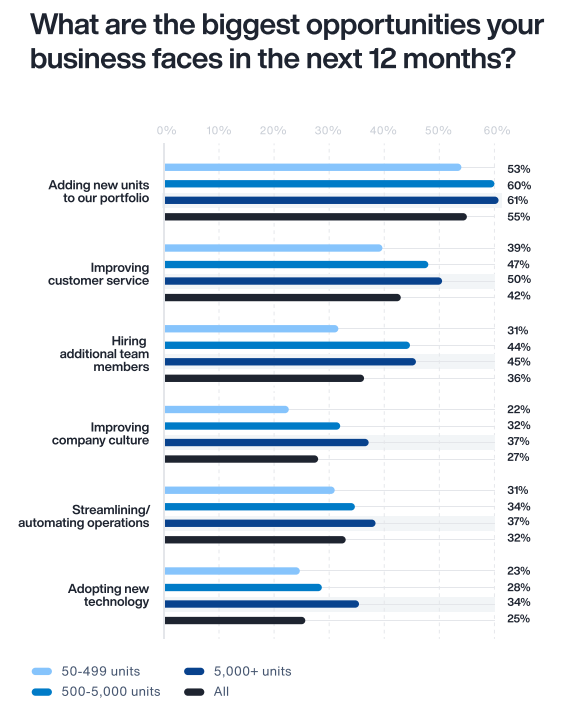
Property managers cite expanding property portfolios, growing revenue, improving service and growing staff as opportunities in 2023.

In a new report, property managers cite expanding property portfolios, growing revenue, and improving service and growing staff as the greatest opportunities in 2023.

AppFolio, Inc.  released its inaugural Property Management Benchmark Report, which examines property management industry sentiment and outlook for 2023.

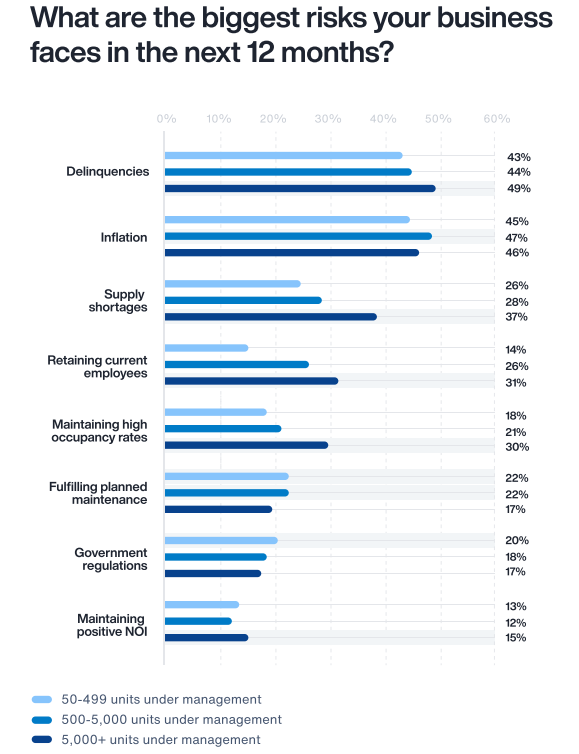
According to responses from nearly 5,000 employees at U.S.-based property management companies, there is a strong sense of optimism – one that significantly surpasses other industries – even as challenges such as delinquencies, hiring difficulties and inflation (the three most frequently cited concerns) persist:

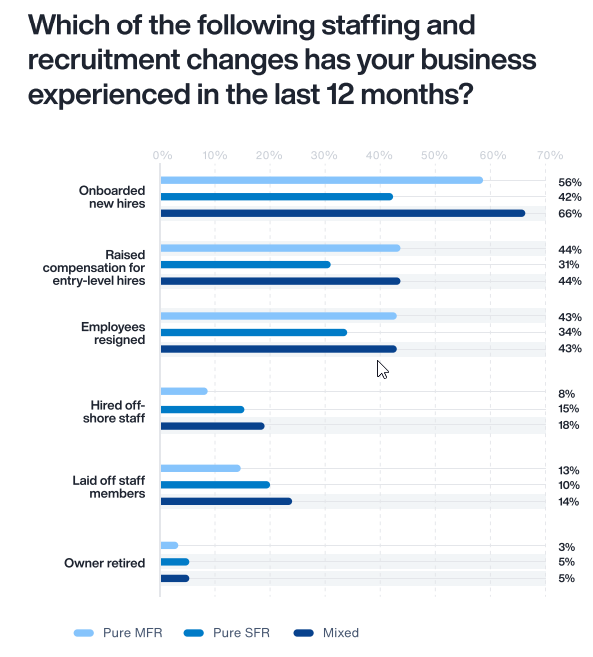
  • More than half (52%) intend to hire additional staff
  • Four out of five respondents (81%) expect their organization’s revenue to increase in 2023
  • Nearly three-quarters (72%) expect net operating income (NOI) to grow
Property managers cite expanding property portfolios, growing revenue, improving service and growing staff as opportunities in 2023.
Chart courtesy of AppFolio

“Property managers see the challenges before them, but still view 2023 as a year of growth, whether that means expanding their portfolios, hiring new staff and improving culture, or  streamlining and automating existing processes to create a more efficient organization,” Shane Trigg, General Manager of Real Estate at AppFolio, said in a release.

“Notably, there’s a strong focus on staff happiness and hiring new employees — it’s encouraging to see the property management industry contributing to U.S. job growth. We are thrilled to power the industry leaders that look at the projected challenges of 2023 not just as something to overcome but as opportunities to improve and thrive.”

Property managers cite expanding property portfolios, growing revenue, improving service and growing staff as opportunities in 2023.
Chart courtesy of AppFolio

Highlights of the property managers report

  • Risks remain, but property managers see more opportunities.
    • Inflation and delinquencies are the two primary concerns across all sizes of residential property management organizations, as cited by nearly half of respondents (46%).
    • Hiring and retaining talent are top of mind for all, but increase in prominence amongst larger organizations with more staff.
  • Property managers cite expanding property portfolios, growing revenue, improving service and growing staff as opportunities in 2023.
    Chart courtesy of AppFolio
    • Expected revenue and NOI increases are driven by opportunities for growth and improvement, led by the addition of new units (cited by 55% of respondents) and improving customer service (42%).
  • Improving operations, particularly streamlining financial functions, is key – but motivations vary with organization size.
    • Nearly three in five respondents (59%) working for a company with more than 5,000 units cite cost reduction as a top focus, while just 40% of these respondents note freeing up teams from labor-intensive processes as a top motivation.
    • Across the board, however, respondents want to make financial interactions easier for both residents and the businesses they work with – 46% of all respondents want to process more rent payments online and 42% want to improve their accounts payable process.
  • Property managers have room to improve their tech stacks as they scale.
    • Large property management companies are much more likely to use tech built for specific functions. More than half of respondents from organizations with more than 5,000 units use document management and storage (73%), maintenance management (57%), utility management (53%), and CRM (51%) solutions.
    • Fewer than a quarter of all respondents have added smart entry or IoT services (24%) or AI or chatbots for leasing communications (15%) into their existing tech stack, showing room for growth across all organizational sizes as function-specific proptech solutions, like those provided via AppFolio Stack™, become available for integration directly into core property management systems.

Download the 2023 AppFolio Property Manager Benchmark Report to review additional findings and insights.

Survey Methodology
AppFolio surveyed 4,972 employees at U.S.-based property management companies from August 10, 2022 to September 10, 2022.

About AppFolio, Inc.
AppFolio, Inc. is a leading provider of cloud business management solutions for the real estate industry. Our solutions enable our customers to digitally transform their businesses, address critical business operations and deliver a better customer experience. For more information about AppFolio, visit www.appfolioinc.com.

How Text Messages Help With Tenant Communication

Sign Up For Our Weekly Newsletter And Get Rental Property And Apartment News And Helpful, Useful Content Each Week.

* indicates required

How Text Messages Help With Tenant Communication

Text messages can be an important property manager tool for tenant communication so here are some important things to know.

Text messages can be an important property manager tool for tenant communication so here are some important things to know about communicating with residents by text.

By Tom Sheahan

A big component of a property manager’s job is communicating with residents. There is no one, single way to perform that job. Certainly, it has been done through in-person communication and phone calls for decades, but email, social media communication and text messages have entered the property managers’ toolkit more recently.

There are a few attributes of text messages that make it stand out when compared to other methods of communication.

Here are 4 ways text messages help property managers with tenant communication

  1. Save time: Utilizing texts ensures people will actually read your message. Calls, on the other hand, may or may not be answered, and voicemails (which can be time-consuming) may or may not be listened to.
  2. Record-keeping: Most texting software keeps a log of communication, so it is easy to go back and see what was sent to who and when. This makes record-keeping streamlined and easy.
  3. High read rates: Research from OpenMarket indicates 83 percent of millennials would rather text message a business than call a customer service line. This is important with the millennial age group renting housing at a higher rate than older generations.
  4.  Reliability: Text messages are a reliable form of communication, as the vast majority of texts sent are delivered (different SMS providers tout varying deliverability stats, but many are above 90 percent), even when the internet is down and the power’s out.

While deliverability stats for texts are indeed impressive, the sender has to do their part to make sure messages don’t get blocked due to content.

There are stringent rules and regulations put in place by carriers to make sure spam content is not being sent.

Key Steps For Property Managers In Tenant Communication By Text

In order to ensure messages are reaching the intended people, property managers should take a few key steps, including:

  • Always including an option for people to opt-out: An easy opt-out is essential, and it benefits property managers, too (you don’t want the wrong people receiving information about your properties or its residents). Include opt-out messaging in every text send.
  • Include personalization when possible: Not all text messages that aren’t personalized get blocked, but phone carriers are definitely on the lookout when the same, exact message is sent to many people. To personalize the message, you can include the name of the recipient in the message, or reference the name of the property being addressed.
  • Use full URLs: Generic, public link shortening tools may sound convenient, as they reduce message characters, but they can spur a blocked message. Utilize the full company domain in the URL. If the carriers can’t trace a URL back to the owner or sender, it will likely be blocked.
  • Ensure text content is free of anything that could get flagged as spam: Follow the acronym of “SHAFT,” which indicates the following should be avoided:
  • Sexually inappropriate content
  • Hate speech or profanity
  • Alcohol or references to it
  • Firearms and depictions or endorsements of violence
  • Tobacco or illicit drugs

There are many different types of messages that can be sent to residents.

Property managers can text potential residents to schedule tours, send appointment reminders or share alternate rental options. Property managers can send current residents rent deadline reminders, event information, maintenance updates and more.

Texting software, or application to person (A2P) SMS software can be especially helpful for property managers looking for more opportunities to communicate with their residents and provide additional customer service. With most SMS software, property managers can:

  • Set up two-way texting, empowering residents to either initiate a message to property leaders, or respond back and forth to a message sent originally by the property manager
  • Allow property manager’s personal phone numbers not to be made public (they’ll instead get a consistent, assigned number for texting)
  • Automatically respond to non-emergent texts
  • Send messages in bulk and utilize templates (without relying on the dreaded group text function)
  • Allow property managers to save resident phone numbers within their residential management software
  • Residents can, in turn, save the property manager’s number in their phone contacts, then they can directly report issues within the community, ask questions or share valuable community feedback

No matter how you plan to utilize text messages in 2023, keep in mind that privacy matters.

Do not disclose personal information via text, and ask that residents don’t either. Update text message lists regularly to ensure only current tenants are included.

By taking these steps, property managers are able to utilize an extremely powerful communication tool that provides quick, effective and direct access to residents, strengthening the tenant/property manager relationship.

About the author:

Tom Sheahan is the CEO of CompleteSMS, a leading business SMS solutions provider that works within the rental housing industry and more.

How Property Managers Can Adapt to Changing Resident Expectations

Sign Up For Our Weekly Newsletter And Get Rental Property And Apartment News And Helpful, Useful Content Each Week.

* indicates required

On-Going Battle Over Rent Control Continues

Already in 2023 many states and localities have taken steps to implement rent control policies as the on-going rent control battle continues.

The National Multifamily Housing Council (NMHC) reports that although we’re only weeks into the new year, many states and localities have already taken steps to implement rent control policies as the on-going rent control battle continues.

Jim Lapides, Vice President, Advocacy & Strategic Communications for the NMHC, writes that, “This comes as no surprise to those tuned into these ongoing battles, but it’s no less concerning.

“As highlighted in NMHC’s 2023 Rent Control Outlook resource, we predict 2023 policy activities in this space to potentially surpass what we saw in 2022. Some of the recently introduced bills, like in South Carolina and Virginia, are unlikely to gain much traction, but others may pose a true risk,” he writes.

NMHC Tracking Rent Control Battle

  • Minnesota: A bill introduced in the State Senate would lift rent control preemption, meaning cities would no longer be required to use ballot initiatives to adopt rent control. (SF 130)
  • New Hampshire: A bill in the State House would allow city or town councils to pass emergency bylaws without voter approval to lengthen the notification time and place caps on rent increases. The state currently maintains rent control preemption. (HB 95)
  • New Mexico: Like SF 130 in Minnesota, this Senate bill would lift statewide rent control preemption. (SB 99)
  • South Carolina: A bill in the State House would restrict rent increases to seven percent plus the change on the Consumer Price Index. The state currently maintains rent control preemption. (HR 3264)
  • Virginia: A measure introduced in the General Assembly provides that any locality may by ordinance adopt rent stabilization provisions. (HB 1532)
  • Washington State: A bill in the Washington State House would cap rent increases to no greater than the rate of inflation as measured by the Consumer Price Index or three percent, whichever is greater, up to a maximum of seven percent. (SB 5435 and HB 1389)
  • Montana: On a positive note, the Montana Senate introduced a bill that would enact statewide rent control preemption (SB 105).
  • Massachusetts: Our greatest threat this year may be in Massachusetts. Media reports indicate that Boston Mayor Michelle Wu is preparing to release a rent control proposal that would cap increases at six percent plus the change in the Consumer Price Index. State lawmakers would need to lift rent control preemption for the measure to be enacted.

“At a time of widespread housing affordability, it’s critical lawmakers remain focused on real, actionable solutions. Implementing “quick fix” solutions like rent control only further exacerbate housing shortages, cause existing buildings to deteriorate and disproportionately benefit higher-income households,” Lapides writes.

“NMHC is continuing to work with on-the-ground stakeholders to push back on efforts to implement rent control and to arm its supporters with the materials they need to echo NMHC’s arguments. For those in states with active battles, please contact NMHC so they can assist with your efforts,” he writes.

Stay in the Loop

NMHC will share updates as they occur. To stay updated, subscribe to our rent control alerts mailing list and the biweekly Growing Homes Together newsletter.

In addition, please feel free to reach out to NMHC’s Jim Lapides with any questions.

About the author:

Already in 2023 many states and localities have taken steps to implement rent control policies as the on-going rent control battle continues.

Jim Lapides is the Vice President, Advocacy & Strategic Communications at the National Multifamily Housing Council (NMHC) in Washington, D.C. He can be reached at jlapides@nmhc.org.

Multifamily Outlook Generally Positive For 2023

The Multifamily Book Is Closed On 2022–What’s In Store For 2023?

Multifamily Rent Growth Turned Negative In November

9 Key Rental Market Trends From 2022 and Impact on 2023

Sign Up For Our Weekly Newsletter And Get Rental Property And Apartment News And Helpful, Useful Content Each Week.

* indicates required

Rent Growth in 2023 Likely On Low Side of Normal

Asking rent forecast for 2023 has been downgraded from 3.1 percent to 2.6 percent rent growth in the latest Yardi Matrix Special Bulletin.

The asking rent forecast for 2023 has been downgraded from 3.1 percent to 2.6 percent rent growth in the latest Yardi Matrix Special Bulletin.

The report says rent growth continues to moderate and is “largely driven by the downward revision of some large markets that have an outsize effect on the average, including Eastern Los Angeles County, Miami, the South Bay Area, Tampa and Manhattan,” the report says.

Yardi Matrix expects to see changes coming throughout 2023 impacting asking rents and rent growth.

“We do not anticipate significant rent declines, either, but rather a return to growth that is much more in line with what was “normal” before the pandemic, although likely on the lower side of normal,” Andrew Semmes, Senior Research Analyst at Yardi Matrix, writes in the report.

Full Impact Of Federal Reserve Rate Increases Not Yet Felt

Many are predicting the Federal Reserve will continue to increase interest rates in February and again in March.

However, the report says, “Pressure will continue to build on the Fed to stop rate hikes as layoffs mount in the tech sector and begin to spread more broadly into other sectors, and as inflation continues to show real signs of cooling. “

Volatility In Rents In Class A

The report predicts the most volatility in rents will happen in the higher-end Class A properties.

“That volatility will be exacerbated in markets with large amounts of supply being delivered, as new market-rate housing almost always comes in at the top of the market. However, while we expect to see turbulence for Class A properties, we do not expect to see the bottom fall out,” Yardi Matrix says.

“Our overall outlook for multifamily asking rents has not changed much, although we have reduced our expectation for average asking rent growth for 2023 to 2.6 percent from 3.1 percent. The magnitude of that change is largely driven by the lowering of our forecasts in some large markets,” Semmes writes in the report.

About Yardi Matrix

Yardi Matrix researches and reports on multifamily, office and self-storage properties across the United States, serving the needs of a variety of industry professionals. Yardi Matrix Multifamily provides accurate data on 18+ million units, covering more than 90 percent of the U.S. population. Contact the company at (480) 663-1149.

The Multifamily Book Is Closed On 2022–What’s In Store For 2023?

Multifamily Rent Growth Turned Negative In November

9 Key Rental Market Trends From 2022 and Impact on 2023

Sign Up For Our Weekly Newsletter And Get Rental Property And Apartment News And Helpful, Useful Content Each Week.

* indicates required

Revamping Multifamily Pet Waste Management Efforts

Multifarmily's pet waste management is challenged by unscooped pet waste which increases the health risks that both individuals and pets face

Multifamily’s pet waste management is challenged by unscooped pet waste which increases the health risks that both individuals and pets face, it’s also a potent cause of environmental impact.

By Andrew Ruhland

In order to protect the well-being of residents and onsite associates alike, apartment communities have a myriad of health procedures and best practices in place.

From doing routine smoke alarm testing and changing air filters to cleaning up trash around properties and ensuring well-kept curb appeal, operators aim to protect the health and safety of their residents and onsite team members.

Beyond the obvious issues like excessive trash or insufficient smoke alarms, one of the more sinister health threats at apartment communities is pet waste.

Per internal data from PooPrints, a staggering 40 percent of pet owners fail to pick up after their pet. The unscooped pet waste issue is a serious challenge at millions of communities across the globe and due to the extreme illnesses it can cause – Salmonella, E. Coli, Ringworm and Cat Scratch Disease – it’s time operators revamp the protocols they currently have in place to address it.

Unscooped Pet Waste

Unscooped pet waste not only harms the health of humans and pets, but it wreaks havoc on the environment in a day and age when the entire world is trying to be more eco-conscious and enact greener initiatives. With wellness and sustainability at the forefront of many residents’ minds, it’s worth reexamining some of the best practices being implemented at apartment communities when it comes to keeping residents, associates and pets safe and healthy.

“The fact is, we are responsible for the well-being of our residents and team members and we don’t take that duty lightly,” said Susan Passmore, executive vice president of Blue Ridge Companies. “It’s definitely a nuisance when people don’t pick up after their pets, but it’s also a threat to everybody’s health and the entire environment around us. If residents are not going to pick up after their pets, there are countless reasons we’ve got to establish effective and proactive ways to take care of it.”

While unscooped pet waste significantly increases the health risks that both individuals and pets face, it’s also a potent cause of environmental impact. In fact, pet waste has been classified as a considerable source of nonpoint environmental contamination by The U.S. Environmental Protection Agency. After a period of time, unscooped pet waste washes into neighboring bodies of water through storm sewers, and subsequently, it ends up in local lakes, rivers and streams.

“Any health risk to our residents and surrounding community is something we proactively mitigate,” said Jamin Harkness, President of The Life Properties. “We have a responsibility to our residents and the surrounding neighborhoods in which we operate to make a positive impact and contribute to the overall ecosystem – not harm it.”

Multifamily Efforts

In the past, pet waste management and mitigation involved supplying bag and disposal stations throughout a community and perhaps having associates keep an eye out for irresponsible pet owners.

If unscooped pet waste was found onsite, then maintenance teams would be tasked with the chore of picking it up. But those practices have proven to be slightly effective at best. In reality, they most likely only encouraged the behavior of a resident not picking up after their pet because they knew that eventually somebody else would do it and there would be no penalty.

To truly have an effect on reducing the amount of pet waste left behind at a property and promote responsible behavior by pet owning residents, operators need to adopt a more sophisticated method of identifying who the culpable party is. In an effort to eliminate unscooped pet waste on a micro level at individual communities and have a positive impact on a macro level for the environment, operators are opting to enlist biotechnology solutions consisting of DNA testing services.

“At Blue Ridge, we utilize biotechnology services to address any pet waste management issues we experience at our communities,” Passmore said. “We incorporate it into the residents’ leases, and per the agreement we collect a DNA sample via a mouth swab of the pet. The service stores the DNA information for us and if pet waste is located onsite and a match comes back, there is no question exactly who it belongs to.”

Welcoming More Pets Can Lead To Better Retention, More Revenue but you need pet waste management in place for unscooped pet waste


Biotechnology Solutions For Pet Waste Management

Unlike previous methods of diminishing unscooped pet waste in a community, biotechnology services are not a short-term solution – they offer long-term benefits for people, pets and the environment and pet waste management.

“Residents are far less likely to leave their pet’s waste behind when there is real accountability involved,” Harkness said. “When there is real accountability, it fosters responsible pet ownership, which creates a better overall community culture.”

Operators that use biotech services at their communities have reported an average reduction of 95 percent in the amount of unscooped pet waste being left onsite.

“I know that not every pet owner is leaving their pet’s waste behind out of spite or laziness,” Passmore said. “While some certainly do, the majority of them simply lack the knowledge surrounding the negative impact it can have on residents and other pets’ health, as well as the lasting damage it can do to the environment. Biotechnology solutions provide a layer of protection to the health of those individuals who live in our communities, while keeping residents honest when it comes to picking up after their pet.”

At the end of the day, operators want to have happy residents who want to stay at their communities. And to keep them satisfied, it is in the best interest of everybody to have the most current and effective health protocols available.

“We want to be at the forefront of improving the health and well-being of residents and the environment around us,” Harkness said. “There is a lot at stake and we want to make sure we’re doing our part. Many changes are happening within the industry and we like to stay ahead of the curve and continue making a positive impact on people, neighborhoods and the environment.”

About the author:
Andrew Ruhland is an account executive and content writer for LinnellTaylor Marketing, which focuses exclusively on the rental housing industry, its trends and technology innovations.

How Pet Poop DNA Testing Fixes Your Apartment Poop Problem

Welcoming More Pets Can Lead To Better Retention, More Revenue

7 Questions Landlords Have About Pets and Pet-Friendly Apartments

Sign Up For Our Weekly Newsletter And Get Rental Property And Apartment News And Helpful, Useful Content Each Week.

* indicates required

Welcoming Pets Is a Smart Financial Move In Rental Housing

Emotional Support Animals and the Fair Housing Act

Everything Landlords Should Know About Emotional Support Animals

Striking the Balance of Automation In Multifamily

Automation in multifamily that saves time is a good fit but there is a balance to strike on execution and onboarding training for teams.

Automation in multifamily that saves time is probably a good fit but there is a balance to strike on execution with your teams and training.

By Chase Harrington

Automation is no longer an abstract concept to multifamily operators. Previously deployed by only the most tech-savvy of properties, automation has firmly woven its way into the daily routine of the apartment landscape.

Operators are leaning on automation solutions more than ever to create efficiencies and save invaluable time, including the use of chatbots, automated lead follow-ups, self-guided tours, automated screening software and data management. But as automation possibilities continue to evolve, overload becomes a plausible reality. Yes, there is such thing as too much automation.

A firm gauge of the effectiveness of automation solutions can be measured in time. When it saves time, it’s probably a solid fit. If the setup and execution processes take longer than manual efforts to tackle the same task, maybe it’s something to avoid. While that idea can serve as a general guidepost, striking the balance of which solutions to implement can be a bit more complicated—but doing so is key to the overall efficiency of an operation.

Four Key Questions In Assessing Tech Additions To Your Organization

When assessing any tech-related additions to an organization, four key questions can help shape the roadmap: What happened under the existing way of doing things? Why did it happen? What could happen with the new solution? And how do I make it happen? The same holds true for automation solutions, as operators can analyze small snippets of data pertaining to the challenge they are aiming to solve, learn how to adjust the application of the solution and slowly expand its usage. In fact, automation solutions can be used by operators to analyze and aggregate the data stemming from all kinds of solutions, automated or not.

For instance, an operator aiming to streamline the lead management process might start by blasting out automated follow-ups to a small sample size of prospective residents. They then can finetune the process based upon the follow-up schedules that are most effective and slowly roll it out across the portfolio. Essentially, the operator shifts from an analytic perspective to prescriptive as they learn how automation can best assist day-to-day processes.

Perhaps the most critical component to effectively onboarding an automation solution is training, which enables teams to know what tools to apply for certain situations. For instance, you wouldn’t use a hammer to knock down tree branches when a hacksaw is available, and a fluency level must be reached with automation tools, as well. Associates must be comfortable enough with the technology to drive a desirable result based upon what they’re hearing and seeing.

For example, while chatbots might be effective for answering upfront questions from prospects, the chat will sometimes reach a point where human interaction is genuinely needed. An organization’s chatbot should be configured to transfer the prospect to a live agent once it reaches this threshold, as prospects will often move along if they get stuck in a loop and cannot have their questions answered effectively. As always, the implementation of these solutions and the fine-tuning of them should be done on a realistic, non-stressful timeline.

Most automation solutions are fueled by artificial intelligence and machine learning, and as these concepts continue to evolve, the possibilities will increase for multifamily. A gradual adoption works well for operators, as those too hasty to implement every new solution might find themselves overburdened rather than on the forefront of the innovation curve.

That said, AI and machine learning promise to bring unparalleled efficiency to tasks like marketing, building maintenance and even answering phone calls from prospects and residents. They will also have the ability to take scores of unstructured data and ultimately convert it into organized, actionable information.

The possibilities for maintenance teams alone could constitute a separate story, as technicians are already achieving automation efficiencies through quicker communication to residents; automated notices of malfunctioning appliances, boilers and LED lighting; and assignment notices through apps that tell them where to go next. The days of returning to the office and realizing the next assignment was only a few doors away are dwindling.

The common denominator with all current and upcoming automation solutions is that community teams—whether leasing associates or maintenance techs—still have a vital role to play. The human touch remains crucial in serving residents, and that won’t change. In fact, automation enables teams to offer higher service levels because time is freed when many day-to-day tasks can be automated.

Striking the balance between automation in multifamily and the human touch is paramount. Too little automation leaves too much manual work. Too much automation can create challenges and, even if effective, lend something of a cold feel. Operators who best blend automation with tried-and-true soft skills are a step ahead of the game.

About the author:

As president of Entrata, Chase Harrington commands the product strategies of the company’s suite of more than 30 products. Because of his leadership, Entrata now serves more than 3 million apartment units across the U.S. He also is a regular speaker at conferences hosted by the National Apartment Association and National Multifamily Housing Council as well as the annual Entrata Summit. He was named a 2022 Multifamily Influencer by GlobeSt. Real Estate Forum.

9 Key Rental Market Trends From 2022 and Impact on 2023

Multifamily Outlook Generally Positive For 2023

Sign Up For Our Weekly Newsletter And Get Rental Property And Apartment News And Helpful, Useful Content Each Week.

* indicates required

18 Months of Outstanding Rent Growth Coming to An End

Multifamily Outlook Generally Positive For 2023

Multifamily outlook faces challenges in 2023, but indications are apartment demand will remain strong and the outlook generally is positive

Multifamily faces a number of challenges heading into 2023, but all indications are that apartment demand will remain strong and the outlook generally is positive, according to Yardi Matrix Winter 2023 Outlook.

Multifamily rent growth has been slowing since the fall and faces the following issues.

  • A softening economy
  • Slowing migration
  • Issues with affordability
  • Pricing uncertainty
  • Higher mortgage rates

“Nonetheless, Yardi Matrix expects that apartment demand will remain strong and the outlook is generally positive,” the report says.

Exceptional rent growth the previous two years, including 6.4 percent in 2022, is ending and will return to more normal patterns.

“This year we foresee rent growth dropping in half to 3.1 percent as demand lessens and deliveries remain high. Factors that drive demand include less migration, fewer new households and declining affordability,” Yardi Matrix writes in the report.

“The bottom line is we expect rents will be propped up by the lack of housing options while single-family development declines and first-time homebuyers are frozen out. Meanwhile, property owners will continue to bring renewal rents closer to the rates on new leases.”

Multifamily outlook faces challenges in 2023, but indications are apartment demand will remain strong and the outlook generally is positive
Chart courtesy of Yardi Matrix

Multifamily outlook faces challenges in 2023, but indications are apartment demand will remain strong and the outlook generally is positive

More new apartments coming

More new apartments continue to be built, which will impact rental rates as more units become available to renters.

“The robust pipeline of projects under construction will ensure a sizeable number of deliveries. Our forecast calls for 440,000 new deliveries this year, an increase in stock of 2.9 percent,” the report says.

“ The 1 million units under construction in January under normal circumstances would produce close to 500,000 units coming online. But the time between start and completion of projects has lengthened considerably due to shortages of materials and labor,” Yardi Matrix reports.

Slowing migration between metros

“The post-COVID-19 surge in migration from high-cost coastal markets to Sun Belt metros is cooling. Although that migration to the Sun Belt predates the pandemic and will continue, it has decelerated in some locales.

Some Sun Belt markets such as Austin and Miami continue to see strong migration and job growth, but others such as Phoenix, Las Vegas and Sacramento are seeing demand wane,” Yardi Matrix writes.

Read the full report here.

About Yardi Matrix

Yardi Matrix researches and reports on multifamily, office and self-storage properties across the United States, serving the needs of a variety of industry professionals. Yardi Matrix Multifamily provides accurate data on 18+ million units, covering more than 90 percent of the U.S. population. Contact the company at (480) 663-1149.

The Multifamily Book Is Closed On 2022–What’s In Store For 2023?

Multifamily Rent Growth Turned Negative In November

9 Key Rental Market Trends From 2022 and Impact on 2023

Sign Up For Our Weekly Newsletter And Get Rental Property And Apartment News And Helpful, Useful Content Each Week.

* indicates required

Do I Have To Pay Agent Again If Tenant Renews Lease?

If a tenant renews lease does landlord have to pay the original real estate agent again who brought the tenant is the question this week

If a tenant renews lease does landlord have to pay the original real estate agent again who brought the tenant is the question this week for Ask Landlord Hank. Remember Hank is not an attorney and is not offering legal advice. If you have a question for him please fill out his form below.

Dear Hank:

Does the agent who initially found you a tenant and got commission on one month’s rent get a commission again if the same tenant renews the lease agreement for a second year?

And if they do how much is the total amount or  percentage?

Thank you.

-Helen

Hello Landlady Helen,

I would check your agreement with the agent that found your tenant.

In Florida, we use the standard MLS agreement and that agreement says that if the owner enters into any new lease or renewal of the original lease with a tenant placed in the property by or through broker, owner agrees to pay broker as compensation in connection with the new lease or renewals the amount specified in another section.

When I hear that a tenant is leaving a property at the end of the lease, I usually ask why.

Sometimes I hear that the tenant found a less expensive property, or one closer to work, or a larger property or is being transferred to another city, you get the idea, but other times I hear that the property manager was a poor communicator or made the tenant feel insignificant or didn’t take care of maintenance issues promptly.

So, I can see some rationale for charging renewal fees if tenant renews lease, stays and the owner is not managing. My company doesn’t charge renewal fees. We feel that when you pay for a good quality tenant and they stay for one year or ten years that the owner has already paid for the tenant.

Sincerely,

Hank Rossi

www.rentsrq.com

Each week I answer questions from landlords and property managers across the country in my “Dear Landlord Hank” blog in the digital magazine Rental Housing Journal.    https://rentalhousingjournal.com/asklandlordhank/

If a tenant renews lease does landlord have to pay the original real estate agent again who brought the tenant is the question this week
Landlord Hank says, “My company doesn’t charge renewal fees. We feel that when you pay for a good quality tenant and they stay for one year or ten years that the owner has already paid for the tenant.”

Ask Landlord Hank Your Question

Ask veteran landlord and property manager Hank Rossi your questions from tenant screening to leases to pets and more! He provides answers each week to landlords.

  • This field is for validation purposes and should be left unchanged.

Do I Have to Paint and Replace Flooring for a Long-Term Tenant?

A Tenant Poured Grease Down Drain Who Is Responsible?

Sign Up For Our Newsletter And Get Rental Housing And Apartment News And Helpful, Useful Content Each Week.

* indicates required