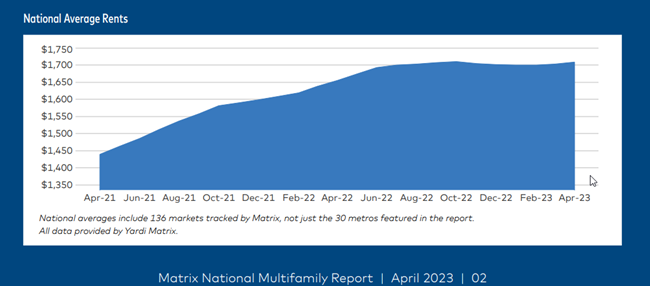
Multifamily rents were up slightly in April “but less than previous years and in line with our forecast deceleration,” Yardi Matrix writes in the April report.
“Demand remains stable despite the slowing economy and tighter loan underwriting standards that will likely increase distress,” Yardi Matrix writes.
Highlights of the April Multifamily Rents Report
The multifamily market continues to display resilience in the face of headwinds, as rents increased for the second straight month in April. The average U.S. asking rent rose $5 in April to $1,709, while year-over-year growth decelerated to 3.2 percent, down 80 basis points from March.
Rent growth is broadly positive nationally, but regional differences are emerging. High-demand Sun Belt metros are feeling the impact of reduced affordability and robust deliveries, while primary metros have less supply growth and some benefit from rebounding immigration.
Single-family unit rents hit a new all-time high of $2,089 in April, but year-over-year rates once again decelerated, dropping 60 basis points to 2.3 percent. Occupancy rates decreased in March to 95.5 percent, but have stabilized after peaking at 97.0 percent in 2021.
“Early indications at the start of the spring confirm our forecast for moderate rent growth in 2023,” the report says.
While demand for rentals have been supported by a strong job market and strong consumer spending, it is unclear how long those conditions will continue.
Other factors that will impact rents and rent growth:
Economic growth is likely to ebb in coming quarters
A slowdown in housing sales and construction due to higher interest rates
Dwindling post-pandemic consumer savings
A squeeze on credit as banks try to de-risk loan portfolios
The reduction of the Federal Reserve’s balance sheet
Yardi Matrix says as affordability remains a major factor for tenants rent growth will likely be increasingly concentrated in renter-by-necessity properties (5.1 percent year-over-year, 0.3 percent trailing three months) relative to luxury lifestyle properties (1.5 percent year-over-year, 0.1 percent trailing three months).
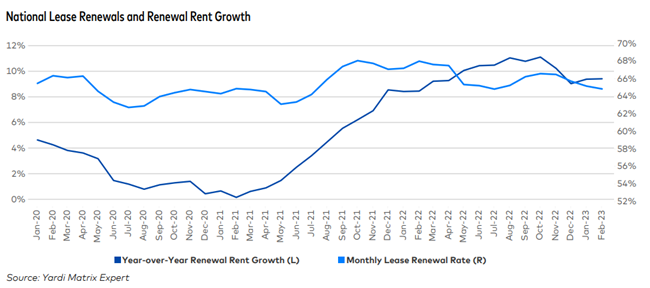
Lease Renewal Rents Persist At High Rates
Renewal rent growth nationally was unchanged in February, remaining high at 9.4 percent year-over-year.
Renewals represent the increases for tenants that are rolling over existing leases, which typically lag growth in asking rents of vacant units. U.S. asking rent growth dipped to 3.2 percent year-over-year through April, “so renewal rents will eventually decline, as well.
Renewal lease rates persisting so high is an indication of the outsize increases for new leases and the lack of supply, as tenants that wish to move into units with a lower rate have limited options,” Yardi Matrix says.
Yardi Matrix researches and reports on multifamily, office and self-storage properties across the United States, serving the needs of a variety of industry professionals. Yardi Matrix Multifamily provides accurate data on 18+ million units, covering more than 90 percent of the U.S. population. Contact the company at (480) 663-1149.
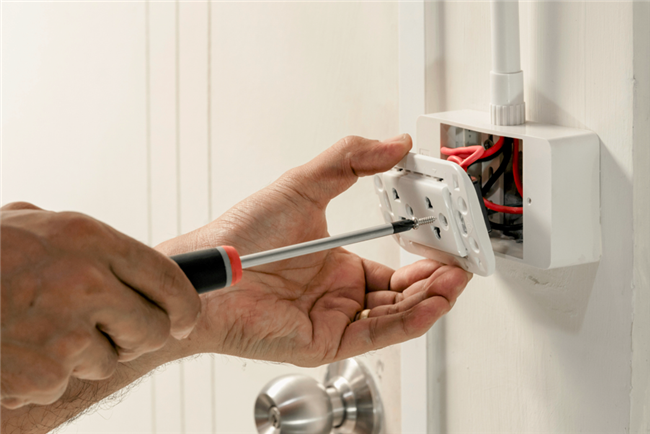
How often do you check for whether there’s an electrical problem in your rental property? Or whether you need some electric supplies?
By Jeson Pitt
Most people don’t check until they face an electric failure. But that’s the wrong practice.
Both landlords and tenants must keep checking circuit breakers and wiring from time to time, especially while renting or taking a property on rent. But what exactly do you need to check?
9 Prime Indicators of an Impending Electric Problem in Your Rental Property
Here are nine tell-tale signs that you need to call an electrician or order new electrical products for your rental property.
1. Frequent Tripping of Circuit Breaker
The job of a circuit breaker is to shut down the power when it detects a power surge. This way, it prevents your electric equipment and your life from electrical hazards. So when your circuit breaker trips regularly instead of occasionally, there can be some underlying electric problem or fault in your property.
2. Wiring Appearing to be Chewed up or Frayed
If the wiring looks chewed up or frayed, you must replace it, as it’s an electric hazard. Many factors like a rodent infestation or improper installation can lead to the wiring appearing to be chewed or frayed. Contact someone who can provide quality electric supplies and proper installation.
3. Warm Power Outlets
Another primary indicator of an electric problem in your property is warm or hot power outlets. Vibrating outlets and outlet sparks are also some warning signs. In this condition, also you need someone to fix the wiring and procure high-quality electric products to replace outlets and wiring.
4. Unexplained Burning Smell
Do you sniff a burning smell but can’t pinpoint its origin? There are high chances that the odor is coming from the wiring inside the walls. The wires can be damaged due to an electric spark or fire. Switch off all power outlets if you see smoke. This can happen while using equipment that demands high power.
5. Sparking Outlets Appearing Discolored
Any signs of warping, scorching, or discoloration of the power outlets indicate a serious electrical problem. The damaged wires behind the outlets are probably releasing the heat. Don’t delay calling a professional if you see sparks coming out of an outlet.
6. Light Switches and Outlets Going Out of Order
If your light switches or outlets often stop working, there is definitely an electrical problem in your rental. It can be either loose wiring or burnt wiring behind the walls. Call a professional to find out which one it is. Keep all outlets switched off till then for safety reasons.
7. Flickering or Dimming Lights
Buzzing, dimming, and flickering lights trouble you mostly when there is a power surge. That means the wiring of your rental is not capable of handling the electric equipment you are using. You need a reliable source of electric supplies to fetch new wires and outlets.
8. Noise Coming Out of Electrical Panels
When your wires get overloaded, you can hear crackling and humming sounds from the electrical panel. This sound comes only when you plug a device into the outlet. This electric problem happens due to damage to the wire or aging of the wire.
9. Outdated Wiring
When you witness all these signs of trouble, you might want to check the relevance of your wiring. Outdated wiring goes through a lot of wear and tear. It’s often been used beyond its lifespan. To avoid more electrical problems, update the wiring in accordance with modern electrical devices.
In Conclusion
It’s crucial to run proper electrical checks before moving tenants into a rental home for the safety. Check as to whether circuit breakers, wires, outlets, etc., need any replacement. If you spot any of these nine signs of an electrical problem in your rental property, call a professional right away to inspect. Better safe than sorry!
About the author: Jeson Pitt works with the marketing department of D&F Liquidators and regularly writes to share his knowledge while enlightening people about electrical products and solving their electrical dilemmas.
The Fair Housing Act makes it illegal for a housing provider to attempt to influence or steer where a prospect lives due to the prospect’s race, color, religion, national origin, sex, familial status, or disabilities—otherwise known as protected categories.
An important point to remember is while the Fair Housing Act is applicable in all states, some states have additional protected categories. For example, in addition to the seven categories listed above, California’s fair housing law also protects prospects on the basis of their citizenship, immigration status, primary language, age, sexual orientation, gender identity and expression, genetic information, marital status, source of income, and military or veteran status.
Not being knowledgeable of your state’s particular laws or additional protected categories can leave you open to complaints and violations.
What is Steering?
The two elements of a steering violation are 1) an effort to influence a prospect’s choice of a house or apartment; 2) the housing provider’s effort is related to the prospect’s protected category. Notably, this “effort to influence” does not have to be malicious or result in injury to the prospect in order to establish illegal steering. In other words, all steering is illegal even when it is well-intentioned.
There are many fair housing cases involving a housing provider who had the best of intentions and was just “looking out,” so to speak, for the prospect’s best interests. The general rule is that it is up to the applicants to determine where they want to live. Any efforts by a housing provider to encourage, discourage, or redirect a prospect based on any of the protected categories will be viewed as illegal acts of steering and are prohibited by the Fair Housing Act.
Examples of Steering
“Since you have several children, our experience has shown that we will have fewer complaints from neighbors if you live on the first floor.”
“That area of the property is viewed as our ‘quiet’ area, so you should choose an apartment in a different area closer to other young families.”
“This property has a lot of Latino residents, so you should fit right in.”
“I assume from the last name you are Jewish, like me. I have a vacant apartment that is next door to another Jewish family. Would you like to see it?”
“The only available unit we have is on the second floor, so since I see you use a wheelchair, I can put you on a waitlist for a first-floor unit.”
How To Handle Questions That Could Lead To Steering
It is common and helpful when a prospect shares what they are looking for in a home and their specific preferences with the leasing agent. However, if a prospect starts asking questions regarding the property, such as “What kind of people live here?” (looking for a breakdown of race), or “My church is close by, are there many of my denomination living here?” these types of questions should not be answered!
Regardless of the prospect’s motivation, answering questions like these could have either an encouraging or discouraging effect and are based on protected categories, making it illegal steering. Another point to keep in mind is that it is also considered steering if a housing provider attempts to protect the prospect from one or more of the neighbors who are known to be prejudiced against people in the prospect’s protected category. Housing should be determined based only upon availability and any preferences provided by the applicant, unless those preferences are based on protected categories.
Another more subtle pitfall can be in discussing local schools. For families with school-age children, the local schools are often a topic of discussion. The National Association of Realtors recommends that agents use caution when answering questions about the local schools, as this can be a method for describing the surrounding community’s racial and national origin characteristics. To avoid inadvertently steering prospects, housing providers should only discuss the schools’ known facts, not include their personal opinions. It may be helpful to maintain a list of resources containing factual information about the local schools. When the topic of local schools is raised, you can refer the prospect to your list of websites instead of offering your personal opinions.
Policies and Best Practices When Showing Vacancies
Having a clear policy as to the way vacancies are shown can help avoid any appearance of steering. One best practice is to show the units that have been vacant the longest. If your policy is to show units based on the prospect’s answers to interview questions, it is a good idea to keep notes or guest cards describing the areas of the community the prospect requested and the reasons for their preferences. This way, if a claim of steering is ever made, you have documentation to prove exactly what happened.
Steering – The Final Takeaway
It is part of every property’s job to lease vacant units. Using sales techniques like showcasing amenities or brand-new appliances is the right way to encourage a prospect to lease an apartment or house. The efforts to influence a prospect’s choice of a home should never include consideration of either the prospects’ or the existing residents’ protected categories. Proper training is essential for every employee to understand what steering is and how to avoid it.
About the author:
In 2005, The Fair Housing Institute was founded as a company with one goal: to provide educational and entertaining fair-housing compliance training at an affordable price at the click of a button.
The emerging single-family rentals (SFR) communities have rapidly grown in popularity, filling the void between traditional multifamily rentals and owning a home.
By Brian Rodriguez
Associate Managing Director of Multifamily Investments
A common misconception within the real estate industry is that single-family rentals (SFR), build-to-rent (BTR) communities and detached homes for rent are synonymous with one another.
Although these three types of housing may seem similar at first glance, subtle yet distinct characteristics set them apart from one another. Let us break it down.
Photos provided by Mark-Taylor. Copyright photo credit Cole Wilder Horchler at https://colehorchler.photos/
Multifamily vs. single-family asset class
The rental property market is comprised of two main types of asset classes: Single-family rentals and multifamily properties.
Multifamily properties are residential buildings that can house multiple families or households, ranging from small apartment buildings to large complexes made up of hundreds of units. In comparison, SFRs are designed to accommodate a single-family household and offer more space than multifamily properties.
SFRs are an excellent option for renters who prefer the experience of living in a standalone home without the commitment and responsibility that comes with homeownership. A wide range of options exists – from small one-bedroom homes to large luxury estates. SFRs provide an ideal solution for many residents as the rental itself feels similar to owning an entry-level starter home.
The emerging single-family rental market
Recently, SFR communities have rapidly grown in popularity, filling the void between traditional multifamily rentals and owning a home.
As home prices and interest rates remain at an all-time high, securing a home loan can be seen as a daunting task for many. Consequently, it has led to a shift in the housing landscape; significant growth is being observed in the SFR asset class with a particular emphasis on the rise of BTR communities.
Photos provided by Mark-Taylor. Copyright photo credit Cole Wilder Horchler at https://colehorchler.photos/
What are build-to-rent communities?
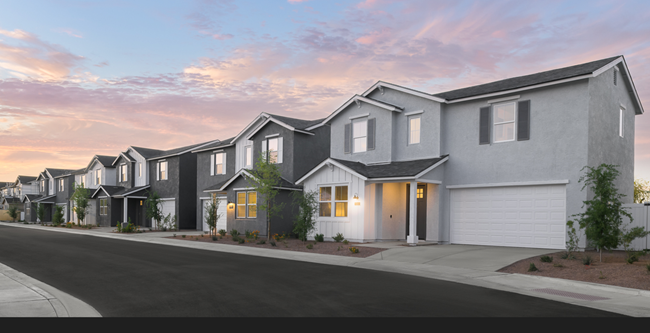
BTR communities are a subset of the SFR asset class and are gated communities consisting of single-family homes for rent.
These communities are primarily developed in suburban areas, where land utilization can be maximized. They are highly sought-after, offering family- and pet-friendly accommodations with private-fenced backyards, controlled access entry, and various amenities – inclusive of pools, fitness centers, and community clubhouses. In partnership with ownership groups, property management companies handle the day-to-day admin and maintenance operations of BTR communities.
Photos provided by Mark-Taylor. Copyright photo credit Cole Wilder Horchler at https://colehorchler.photos/
Investors are drawn to BTR due to high demand from renters and the financial viability of the asset class. Additionally, developers prefer BTR as they require less land compared to detached homes.
Are detached homes included in the SFR asset class?
Detached homes, which are standalone properties owned by landlords or property management companies and rented out to tenants, are also part of the SFR asset class. These homes provide residents with more privacy and autonomy over their living spaces than multi-unit buildings such as apartments or townhouses.
The key identifiers to determine if a community contains detached homes are:
Detached homes require more land and separation, opposed to homes within a BTR community
Detached homes do not have to be within a gated community
Detached homes do not come with a standard set of amenities that is traditionally expected at a multifamily community; instead, they are part of an HOA.
Advantages of the SFR asset class
Arguably the greatest advantage of single-family rentals is that they offer more control over the asset. Investors can choose the location, size and condition of the property, and can make changes and upgrades as they see fit.
Today’s housing solutions are centered around providing residents with an exceptional living experience tailored to their needs. Build-to-rent communities, detached homes or any other type of single-family rental allow residents access to the convenience of apartment living without having to sacrifice the added perks of owning a home, including the luxury of space and privacy.
Renters can now confidentially choose a space that feels like home.
ABOUT AUTHOR
Brian Rodriguez, Associate Managing Director of Multifamily Investments.
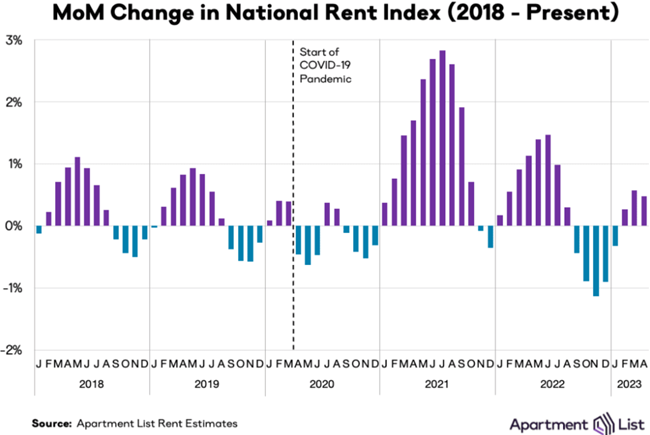
Nationwide rents increased another 0.5 percent in April, but even as the busy season picks up, rent growth is coming in slower than in previous years, Apartment List says in their May report.
“When prices skyrocketed during the pandemic, April rent growth clocked in at 1.1 percent in 2022 and 1.7 percent in 2021. And even before the pandemic, April rent growth was higher than it is today. Of course, regional variation exists, but the national numbers speak to a continued, broad cooldown of the rental market.,” the report says.
While April was the third straight month showing some rent increases, a combination of sluggish demand and increasing supply is keeping rent growth in check.
Year-Over-Year Rent Growth
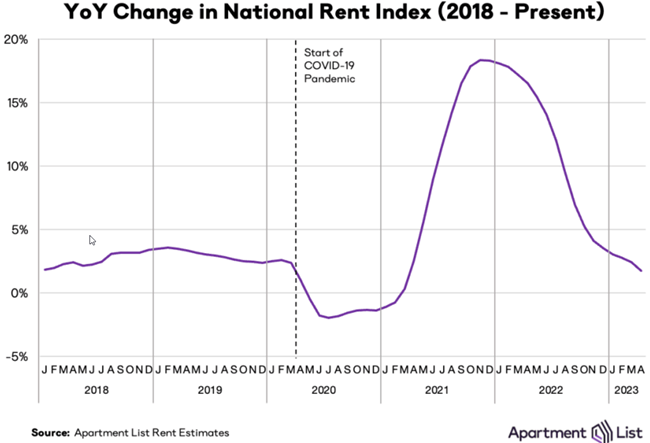
Year-over-year rent growth is continuing to decelerate, and now stands at 1.7 percent, its lowest level since March 2021.
Year-over-year growth is now below the average rate from 2018 to 2019 (2.8 percent), and it is likely to decline even further in the months ahead.
What Is Happening On The Supply Side?
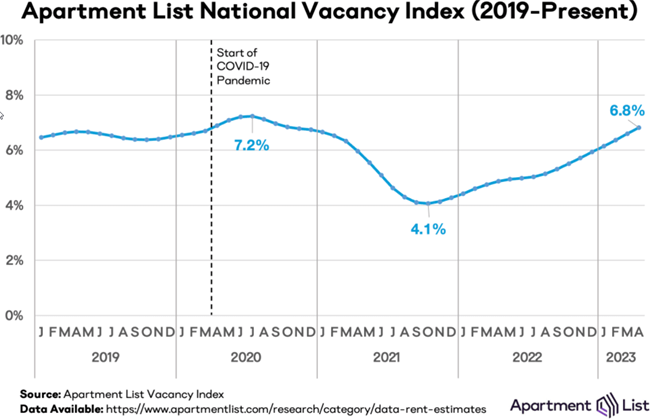
On the supply side, “our vacancy index currently stands at 6.8 percent, surpassing the average pre-pandemic rate and continuing to trend upward.
“With a record number of multi-family apartment units currently under construction, some property owners may start struggling to fill vacancies for the first time since the early stages of the pandemic,” Apartment List economists write in the report.
What Is Happening In The Largest Cities?
Rents increased in April in 69 of the nation’s 100 largest cities, down from 83 cities that saw prices rise last month.
At the same time, 40 of the top 100 cities are currently logging negative year-over-year growth up sharply from 28 cities last month. New York City saw the nation’s sharpest month-over-month increase, with prices there up by 1.9 percent in April.
Midwestern markets have seen the fastest rent growth over the past year
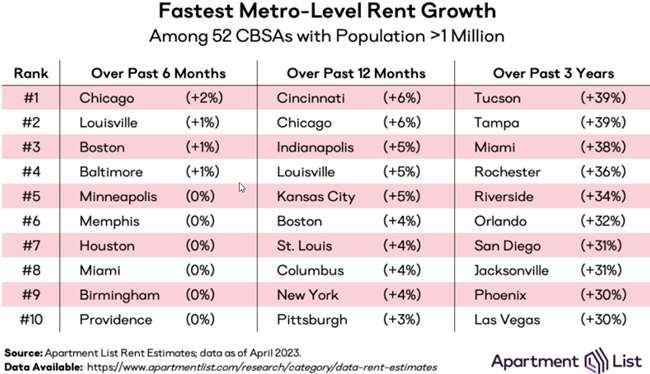
At the metro level, the fastest rent growth over the past 12 months has been occurring in the Midwest.
The following table shows the ten metropolitan areas that have experienced the fastest rent growth over the past six months, over the past year, and over the past three years.
Conclusion
April’s 0.5 percent increase “represents a slightly slower rate of growth than we saw last month, indicating that the market remains sluggish even as rents continue on an upward trajectory. Year-over-year growth fell again to 1.7 percent – putting it solidly below the pre-pandemic average from 2018 to 2019 – and will likely decelerate even further in the months ahead. And even if demand rebounds over the summer, a strong construction pipeline should temper rent growth for the remainder of the year. Prices may not fall further, but they are also unlikely to increase significantly.”
The Seattle City Council has passed an ordinance to cap late rent fees at $10, according to reports, frustrating many small landlords who opposed it.
The city council put in place the $10 cap on late fees for rental payments after the council passed the decision on a 7-2 vote. Councilmembers Alex Pedersen and Sara Nelson voted against it. It now goes to the mayor for signature.
“Unfortunately, the Seattle City Council once again has decided to make providing rental housing a more risky and economically unsound endeavor,” said Ryan Makinster, Director of Governmental Affairs for the Washington Multi-Family Housing Association.
“While the housing crisis has been created by years of bad policy decisions at the local and state level, elected officials are still blaming and passing law directed at the industry that they should instead be encouraging, housing providers. It is short sighted policies like this that will only exacerbate the housing crisis, not help it,” Makinster said.
The frustration was clear from one small landlord, Alley, who told Jason Rantz on KTTH 770 AM, ““This comes on the back of about two dozen other laws that have changed in really substantial ways, as well as the pandemic eviction moratorium that had a lot of impacts for small landlords. And that context is really never discussed by the city council, which is kind of astounding.”
Alley argued that a $10 fee is not enough to incentivize tenants to pay on time, creating more hassle for local landlords.
See the print edition of Seattle On-Site Rental Housing Journal please click on the image above to read it.
The $10 late rent fee cap mirrors existing laws in Burien and Auburn. Councilmember Kshama Sawant told the Seattle Times the bill would make sure renters do not face compounding or exorbitant late fees, which can result in evictions.
“Late fees can suck renters into a debt vortex,” Sawant told the Seattle Times. Leases often include a per day late fee that accumulates until the rent is paid. Some tenants may face hundreds of dollars in late fees in a month.
“Most people really do try to pay their rent on time. Most people do have a decent relationship with their landlords,” Alley said. “There are good landlords, bad landlords, good tenants, bad tenants, we’re all just people. And there were systems in place for regulating that.”
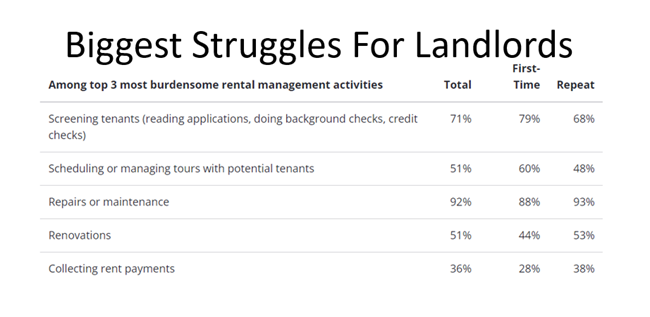
Maintenance and tenant screening are the biggest struggles than landlords and property managers face on a day-to-day basis, according to a Zillow survey of more than 1,000 rental property owners.
Zillow surveyed first-time and repeat landlords to learn what the most burdensome parts of the process are for them. The typical (median) landlord who completed the survey reported having two rental properties.
Scheduling or managing tours with potential tenants
Renovations
Collecting payments
According to Zillow’s survey data, almost all landlords (92 percent) said repairs or maintenance were among the top three most demanding responsibilities of managing a rental property, and 40 percent considered it the No. 1 most burdensome. Screening tenants (reading applications, completing background checks and credit checks) was a close second, with 71 percent of landlords reporting it among their top three most burdensome activities.
More than one-third of landlords (36 percent) said they wished they would have known how hard it would be to find reliable renters, and managing the rental (communicating with tenants, accounting, etc.) was more time-consuming than they had anticipated. Thirty-four percent also noted that they wished they would have known the leasing process (processing applications, scheduling tours, writing a lease, etc.) would take more effort than expected.
“Investing in a rental property can provide reliable income and housing for a renter who needs it, but it’s crucial for landlords to understand the responsibilities,” Manny Garcia, a population scientist at Zillow, said in the release. “Many landlords wish they had known more about the effort required to find tenants and keep the property in good condition.”
Zillow Group Population Science conducted a nationally representative survey of more than 1,000 people who own at least one property that they rent out. The study was fielded in February 2023.
The Zillow release said Zillow Rental Manager “provides landlords with the right tools to support them throughout the process, for free. In addition to offering housing providers an easy way to create their listing and get free access to the most visited rental network, Zillow Rental Manager has a ton of resources available now (and coming soon) to help them manage their portfolio and optimize their investment.”
Delivering reliable and seamless Wi-Fi to residents isn’t at all easy. Property owners need to contend with complex networks, multiple users, no inhouse IT staff, no time to test – and no room for mistakes. Many are partnering up with managed service providers (MSP) who focus on delivering the capacity and coverage that thrills multi-dwelling unit (MDU) tenants and staff.
This is no time for speed dating or trial and error. The best way to get it right is to start by asking for the perfect MSP partner for your properties.
Specific domain experience in MDUs
Of course, you will check references, but better questions yield better understanding. Ask how many MDU properties they have connected. You will want to understand how the MSP’s services have changed the business of their other MDU property owners. They should be able to provide specific metrics that stand out on resident satisfaction, trouble call rates and costs. They should also be able to detail what property owners can do now that they could not do before (implement smart building digital transformation and IoT initiatives).
Technical expertise and experiences
The network is complex, and no one size fits all use cases. Time to sort out the “one trick ponies.” Are they specifically experienced in ALL the following technologies?
Broadband infrastructure
Cloud services
Network optimization
Security
Systems and APIs
Wi-Fi and switching
Also, ask what criteria and procedures they use to select the technologies to deploy. For extra points, learn about their proven interoperability by asking for a list of certified technology partners.
Trust
Do they meet your day-to-day needs? Review a sample of their monthly reports and look for trends in the specific parameters. Everyone says they are responsive but review the actual response times when problems occur, and escalation is required. Understand their backup and recovery processes and how they are executed.
Enduring Engagement
Sort out the ones who truly want to be your partner from the transactional types who only want you to sign a contract. Look for an understanding of different types of MDUs and the long-term needs of residents. See that they understand your goals and priorities as a property owner. Review how they regard trends and anticipate changes in the industry. Look for ongoing and regular collaboration sessions to discuss and select a solution from possible alternatives.
Choose the Best Option for MDU Solutions
Cambium Networks works with several leading MSPs that help property owners get access to reliable, fast internet. For more information on the various architectures and the views of property owners and MSPs, read the solution paper, “Take Control of Your MDU Network.” You can download the paper here. Contact us to connect you with qualified MSP’s that fit your needs.
About Cambium Networks Cambium Networks enables service providers, enterprises, industrial organizations, and governments to deliver exceptional digital experiences, and device connectivity, with compelling economics. Our ONE Network platform simplifies management of Cambium Networks’ wired and wireless broadband and network edge technologies. Our customers can focus more resources on managing their business rather than the network. We deliver connectivity that just works.
Buildium writes about the 7 rental market trends for 2023 the company is seeing in its annual property management and industry report and analyses from leading real estate sources in the industry.
The company reports that over the last two years, many property managers’ business plans “were reactionary, keeping their businesses afloat amid lockdowns, record inflation, panicked residents, and a supply shortage on practically everything.
“As we get ready for 2023, we are waiting to see if the Federal Reserve will continue to raise interest rates to rein in inflation. That leaves rental-market predictions a bit tough to make, but there are some clear trends coming to the fore,” Buildium says.
7 biggest rental market trends for 2023
Charts courtesy of Buildium.
1. More Investment-Minded Owners in the Rental Real Estate Market
According to the 2023 Property Management Industry Report published by Buildium, Propertyware, and NARPM, 52 percent of rental owners surveyed consider themselves intentional investors, while just 24 percent think of themselves as accidental landlords—those who own or inherited a property they couldn’t sell and so had to rent out—or unintentional investors, who became landlords by accident, but now consider themselves investors. That marks a significant increase in the share of investors that are a part of property managers’ client base over the last five years.
With more investment-minded owners in their client base, property managers have had to pivot their own service offerings. The prior typical landlord just needed a professional to handle maintenance, rent collection, and tenant turnover; today, more owners want a partner in their investment strategy.
Many property managers now advise their clients on property upgrades and services that will help increase value and portfolio expansion. Being experts in their local market, some investors rely on their property manager to find properties in which to invest.
Think about the services you currently offer. How could you capitalize on your team’s expertise to meet the demands of more investment-minded rental owners? Could you partner with a local contractor to offer property upgrades, or build your own team in-house, for example? Then, rethink your marketing strategy to ensure your new service offerings are included.
2. Mixed-Use Properties Are Back
While mixed-use properties—those that include a blend of residential, retail/entertainment, and business properties—lost some ground during the pandemic, the trend is making a comeback as construction gets under way once more.
According to Price Waterhouse Cooper’s (PwC) Emerging Trends in Real Estate 2023, of the 1,300 malls in the United States, 500 are undergoing renovation into mixed-use spaces. The properties offer plenty of attractive features for residents, including easy access to restaurants, shops, and entertainment, as well as such essentials as grocery stores and medical centers.
Mixed-use properties may be worth a look for investment-minded property managers, particularly those who have the staff and resources to add commercial spaces to their portfolios.
Even if mixed-use is not on your radar, in terms of your clientele, it’s still worth knowing how those properties could affect your current portfolio. For example, properties near a mixed-use complex will benefit from the convenience of being near so many shops, restaurants, and other resources.
3. The Suburbs and Single-Family Rentals Are Still Attractive
Both PwC and Buildium’s reports point to the continued popularity of single-family rentals. According to the latter, 68 percent of respondents lived in suburban or rural areas, a number that has steadily increased over the last five years. These tenants are looking for:
A safe, quiet, family-friendly neighborhood
The indoor and outdoor space that allows them to grow their families, whether that means welcoming children, pets, or other family members
A child-friendly home that provides air conditioning, a washer and dryer, and a dishwasher
Property managers with single-family properties in their portfolios can attract residents by providing these amenities.
One thing property managers should keep in mind, however, is the amount of debt and lack of savings single-family renters tend to have. In our Single-Family Renter’s Survey, we found that single-family renters had larger families to support, less savings and more debt. As the economy continues to slide as we move toward 2023, it’s important to keep in constant communication with residents and to work with those who may be affected by the current economic climate.
4. Record Inflation Will Most Likely Continue in 2023
From food to gas to home heating fuel, everything costs more now. In fact, according to the Federal Reserve Bank of Dallas, inflation is now at a 40-year high. Despite the passing of the Inflation Reduction Act, the cost of living is still rising as we move into 2023.
According to the 2023 Property Management Industry Report, 26 percent of renter respondents paid most bills on time and in full and 11 percent reported that they’re struggling to keep up with their household expenses.
During the height of the pandemic, property managers found that open lines of communication between themselves and their residents helped ease the burden of missed rent payments. Those lines will continue to play a vital role in your property-management strategy. Property managers can continue to help residents find government assistance programs, for example.
At the same time, rising costs will affect how property managers keep their businesses profitable, as well. Look at your vendor costs and overhead, for example, to see where you can renegotiate contracts or find more economic solutions.
5. Mortgage Interest Rates May Continue to Rise
In early November, the Fed raised interest rates for the fourth time in 2022 to just over 7 percent. The Nasdaq is predicting that they could reach as high as 9 percent in 2023. The dramatic increase has forced Americans who were looking to become homeowners to reconsider, and continue to rent.
Property managers should keep an eye on the Fed to see how mortgage rates net out in the coming months and adjust their marketing and resident onboarding strategies to keep vacancy rates at a minimum.
6. Renters Are Now Coming from Multiple Age Groups
Baby boomers, who are becoming tired of the hassle of keeping up a house, now make up a significant portion of renters in the United States. At the same time, more millennials, the largest generation in the country, enter the housing market every year, usually as renters first.
For property managers, this means a shift in the types of housing and services they provide their residents. Older residents, for example, will look for accessibility and convenience to help them age at home. Elevators, ramps, safety rails in bathrooms, and other ADA-compliant equipment are sought-after features in rental properties.
Communications, marketing, and amenities will also shift. Residents—even baby boomers—will be looking for more convenience, more digital options for communication and rent payment, as well as services that cater to multiple generations within a household.
7. Renters Are Looking for Diversified Space
The shift to work-from-home and the increased number of families-as-renters will continue to have an effect on the types of spaces renters are looking for. According to PwC and our Industry Report, rental market trends show more residents want:
Homes with an extra room or flex space: Owners are borrowing space from larger open rooms to create smaller private spaces, or adding an office in dead space off a hallway.
Units with outdoor space: That doesn’t necessarily mean a large yard. Outdoor spaces could be a simple patio or a small garden.
A mix of public and private spaces: For example, a home may have a larger kitchen and living room with adjacent food prep spaces or book nooks.
“As 2023 draws closer, the buzz around rental-market predictions becomes louder, and the opportunities for property managers and owners to invest in, improve, and expand their properties become more apparent.
Can you test a furnace filter to detect smoking and nicotine in your rental property is the question this week for Ask Landlord Hank. Remember Hank is not an attorney and is not offering legal advice. If you have a question for him please fill out his form below.
Dear Landlord Hank,
Can nicotine be detected in a furnace filter that hasn’t been changed in three years? (It is now a no-longer-smokers furnace in the rental.) How reliable is it to test a furnace filter for nicotine?
–Carol
Hi, Carol,
If you’ve had a smoking tenant in your property for quite some time, just changing the filter is not going to be sufficient to get rid of the smoke smell in your system to detect smoking.
It is more than likely that cigarette smoke has left a film on the system’s ducting and condenser coils, which will continue to produce that stale-smoke odor until it is removed by a special cleaning process.
It is a good idea to have your system cleaned once or twice per year to get rid of any buildup of dirt, dust, smoke particles, etc., as these things create an insulating layer on the coils and reduce the coolness from leaving the coils.
You can also have an in-duct air-purification system installed to prevent any outdoor smoke from getting into your home.
Sincerely,
Hank Rossi
Each week I answer questions from landlords and property managers across the country in my “Dear Landlord Hank” blog in the digital magazine Rental Housing Journal. https://rentalhousingjournal.com/asklandlordhank/
Landlord Hank says, “If you’ve had a smoking tenant in your property for quite some time, just changing the filter is not going to be sufficient to get rid of the smoke smell in your system.”
Ask Landlord Hank Your Question
Ask veteran landlord and property manager Hank Rossi your questions from tenant screening to leases to pets and more! He provides answers each week to landlords.