As apartment size shrinks in newly built apartment communities, renters are seeing a higher demand now for storage-unit space, according to a survey by StorageCafe.
“As new apartment units are mostly built in large-scale communities, living space is dwindling, making many people seek storage solutions away from home. In fact, our survey shows that self-storage is now particularly popular among renters,” the survey says.
“We asked approximately 18,000 people why they use self-storage, what they keep there, what types of unit they use, and more.”
Key takeaways from storage unit study:
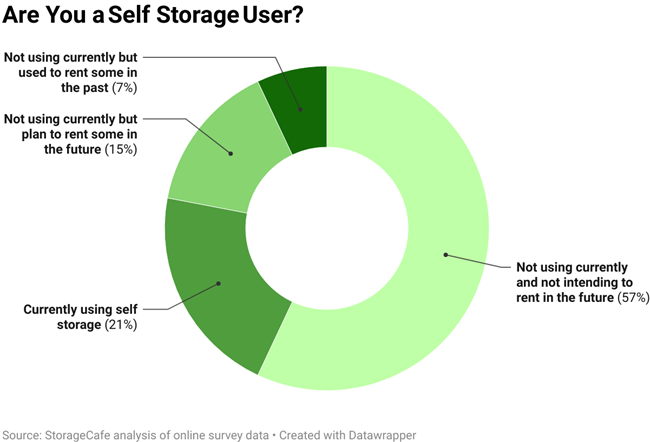
More than a fifth (21 percent) of Americans currently use self-storage, with another 15 percent saying they intend to do so in the future.
Furniture is the item most commonly put in a self-storage unit.
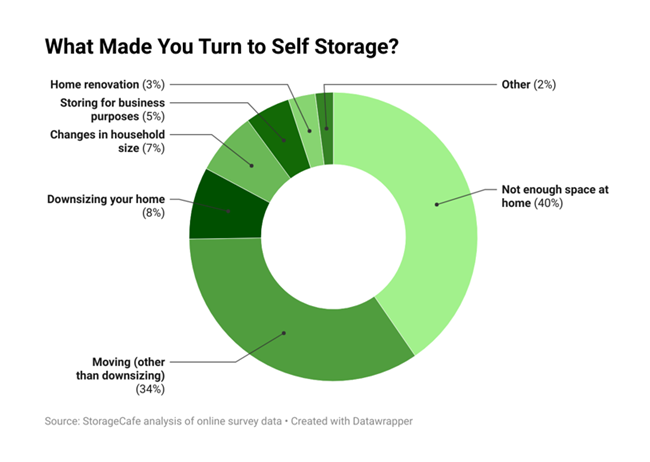
Not having enough space at home is now the main reason for using self-storage, reported by 40 percent of current storage users. That overtook moving, reported by 34 percent.
Larger households have more need for self-storage — 27 percent of those with five or more members currently turn to storage away from home.
People between ages 40 and 55 — mostly the Gen Xers — are in the age group most likely to be renting self-storage right now.
New York, Chicago, and Houston were the U.S. cities that showed the greatest interest in self-storage in 2022.
Las Vegas, Nev., is the city that gets the most searches for all types of vehicle-storage units.
Conclusion
The report says, “the keenest self-storage renters are Gen Xers living in averaged-sized residences, perhaps with large households, and more commonly renting than owning their homes — they appear to be rather keen on putting sports gear in storage, too.
“These days, in a shift from previous patterns, people are more likely to rent storage to take the strain off their living space than because they are moving home. Self-storage is searched for more than ever across the nation’s largest cities — particularly in the Southwest — and its costs are always much more reasonable than residential space, enabling residents in all types of accommodation to maximize their lifestyles,” the Storage Café report says.
Here are five principles in the proposed renters bill of rights and while it does not carry any mandate, landlords still need to be aware of what it contains.
By Scot Aubrey
Depending on where you live in the country, as a landlord you operate under a varying set of rules and regulations. Those who occupy your properties also are entitled to their own set of rules and regulations, and to quote Kipling, “never the twain shall meet.”
Regardless of your location, there will always be a perceived or actual inequality when it comes to who the rules favor, an inequality which the Federal Government appears poised to throw their efforts at to resolve.
Enter “The White House Blueprint for a Renters Bill of Rights,” a white paper which does not create an official policy and carries no mandate for policymakers or individuals. This Bill of Rights identifies five basic principles and associated best practices that the Biden administration believes, if implemented, would decrease tenant exploitation, create a more equitable rental market, and help ensure fair housing practices are more closely adhered to by landlords.
Since rules put in place to protect renters become the responsibility of the landlord, it is critical to understand what could be proposed in the near future. The Blueprint for a Renters Bill of Rights is comprised of the five following principles and their application as follows:
Access to Safe, Quality, Accessible and Affordable Housing: At the heart of this principle is the suggestion that a renter should pay no more than 30 percent of their household income on housing costs. This puts the onus on owners to provide habitable properties, with functioning appliances, and to utilize fairly priced on-boarding practices and fair rental rates.
Clear and Fair Leases: The majority of landlords already subscribe to the model of having clear and fair leases; that’s why they find success and longevity as an investor. In this principle the government is looking to somehow normalize the actions that you and I already do as part of managing our portfolio: a) use clear and simple language, b) use transparent policies related to security deposits, and c) provide reasonable notice of actions relating to the property.
Education, Enforcement, and Enhancement of Rights: Emphasizes that all governments should ensure that renters know their rights so they can be protected against discrimination. In addition to the standard protected classes covered under the Fair Housing Act, their proposal is that “source of income” should be added to the list of protected areas. Again, most landlords have adhered to these principles and practices as part of their successful management style.
The Right to Organize: Renters would have the “freedom to organize without obstruction or harassment from their housing provider” without jeopardizing their housing. Per the research behind this paper, organizing by tenants “has been met with retaliation” like prohibition of use of public spaces and the threat of eviction, resulting in tenant fear to approach their landlord.
Eviction Prevention, Diversion and Relief: A renter’s access to resources to avoid eviction, a fair and legal eviction process, and a proposal to immediately seal eviction cases so they can’t be used by potentially future landlords are all part of the final principle. Efforts proposed in this blueprint would have immediate and far-reaching effects into your business as a landlord, even if only partially adopted.
As stated before, this is only a white paper published by the White House Domestic Policy Council and National Economic Council, and while it is not in place now, it can and will have an impact on the development of policies in our state and local governments. As a landlord you should dedicate the time to read it in its entirety to see what could be coming your way in a future legislative session near you. You can also listen to a thorough analysis of each principle on the Rent Perfect channel on YouTube.
About the author:
Scot Aubrey is Vice-President of Rent Perfect, a private investigator, and fellow landlord who manages short-term rentals. Subscribe to their weekly Rent Perfect Podcast (available on YouTube, Spotify, and Apple Podcasts) to stay up to date on the latest industry news and for expert tips on how to manage your properties.
New residential projects in Dubai are often concrete skyscrapers with fine dining restaurants, rooftop pools, and sky-high observation decks. However, the United Arab Emirates is more than just high-rise towers; the country is committed to clean air, sustainable private communities, exotic gardens, and vast green spaces. Dubai’s Keturah Reserve residential project takes sustainable living to the next level, as it is the first Middle Eastern development project applying the Bio Living concept. It’s a place where nature is juxtaposed with living spaces, creating an ideal destination for those seeking to harmonise themselves with the environment.
A residential project in Dubai where humanity and nature become one
The residential project of Keturah Reserve in the UAE offers a collection of exclusive one- to four-bedroom apartments and townhouses in Meydan, one of the most prestigious neighborhoods in Dubai. The project’s developer is the multinational MAG Group Holding, which has masterfully created a unique community where residents can enjoy luxury-class features and premium hotel service. Keturah Reserve’s ultra-modern townhouses and the surrounding ecology blend together seamlessly, resulting in a one-of-a-kind marriage of nature and architecture.
The interior and exterior of the houses will be made of the same materials, evoking a sensation of complete serenity. Minimalistic shapes, an abundance of daylight, and huge windows are but a few hallmarks of the project. The design melds stone, wood, bronze, linen fabrics, and plants to complement the nature-inspired interior. Pools and bodies of water abound on the grounds and are flush with the floor and walking paths. In the heart of the community will be a large park lined with majestic olive trees sourced from all over the world.
Hisham El Assaad, Head of Off-plan at AX CAPITAL agency.
“Keturah Reserve will be an extension of the Downtown and Business Bay area as road work improvements are underway. It is a haven of tranquility living in an unparalleled location within the master-planned Meydan City, a mega master-planned 3.67-million-square-metre development that is surrounded by greenery and entertainment. The epicenter for bio-living, Keturah Reserve is the only location that protrudes exclusivity, elegance, and sustainability and promotes holistic wellness. It’s a sanctuary surrounded by natural lush greenery, diverse hundred-year-old olive trees, plans, and invigorating public spaces to rejuvenate the soul,” said Hisham El Assaad, Head of Off-plan at AX CAPITAL agency.
Keturah Reserve: Wellness in all aspects of life
In addition to the unique modern design, the new project under development in Dubai brings you closer to nature, making it a perfect place to wind down after a busy day. Residents of the project by MAG Group will have access to gyms with top-notch equipment and various pools, including a pool with water exercise bikes.
Residents will also be able to practice yoga and meditation, gymnastics, martial arts, shooting, and fencing, have access to a dance studio, and play basketball, volleyball, football, and tennis. What’s more, the project will have a cross-fit club and spa and hair salons for women and men.
All residents—regardless of age—will be able to attend an art school on the premises. Entrepreneurs will be able to stay close to home and their families if work calls by being a short walk from co-working spaces and a business centre, which will have a large live tree inside and noise-cancelling equipment. Kids, meanwhile, will have the opportunity to let their curiosities run free in areas with designer textile sculptures, a children’s pool, a park, and a garden.
Property prices in Keturah Reserve
Today, while the project is under development, you can buy a property in the wellness-focused project in Dubai at a bargain price that is lower than the market price. For instance, you can buy a one-bedroom apartment for AED 2.73 million (USD 743,500), while a two-bedroom apartment in the new residential project in Dubai costs AED 3.82 million (USD 1.04 million). A three-bedroom unit starts at AED 7.28 million (USD 1.98 million) and a four-bedroom residence from AED 10.53 million (USD 2.87 million).
You can purchase a new villa in Dubai at Keturah Reserve for a price starting from AED 11.94 million (USD 3.25 million).
When buying any unit in this upscale project, investors are entitled to apply for a residence visa.
Project under development in Dubai: The best investment solution
Investing in luxury real estate in Dubai today is one of the safest and most profitable strategies. Expensive housing in prestigious communities of the Emirate is in high demand today and has been trending upward. Over the past year, the number of transactions for elite properties has almost doubled. Analysts predict that the growth rate of property prices this year in some neighborhoods can reach 46%, with an average of +15%. In addition, during the construction phase, the property’s value will increase by 20%–30%. Therefore, buying real estate at the first stage of construction to sell it once you’ve fully possessed it will allow you to make a significant profit.
“Prices in Keturah Reserve have experienced an increase slightly above the five percentile since launch. The value remains underpriced in relation to the luxury segment that hovers around the AED 2,900s/sq. ft upwards with a reserved outlook of a 20% increase by handover.
Fundamentals are numerous to the accelerated growth and momentum in Dubai’s real estate market. The support by the government through the ongoing introduction of policies and regulations aimed at promoting transparency in real estate dealings continue to attract foreign investment.
In addition, a growing population projected for the coming years and a favorable regulatory environment for investors and businesses are pillars to the appreciation in property value that buyers can benefit from,” said El Assaad.
Real estate in Keturah Reserve is not only a smart investment but also a unique opportunity to live in a futuristic neighborhood in a tranquil nature setting.
Real estate agency experts at AX CAPITAL https://www.axcapital.ae/ are ready to guide you through the top property offers regardless of whether you are a first-time buyer or an experienced investor. We will help you choose an option with a high return on investment and arrange all the paperwork.
About the author:
AX CAPITAL is a real estate agency helping customers to buy or rent real estate in Dubai, United Arab Emirates. The company has closed over 6,000 deals. Over 70 leading developers, such as Emaar Properties, Sobha Group, Damac Properties, etc., are the agency’s long-term partners, which enables it to select a suitable option for everyone from over 5,000 listings in its database. Contact the company at axcapital.ae.”
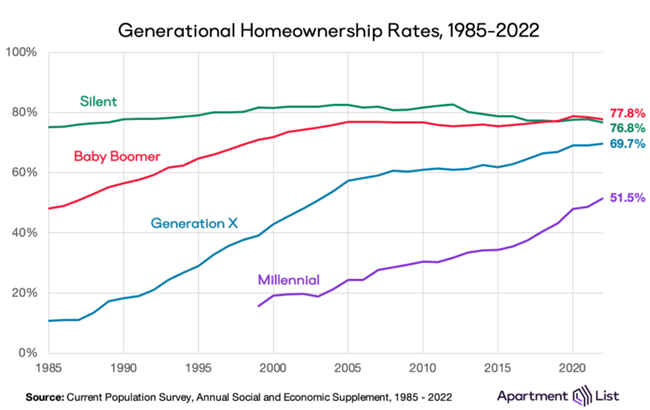
Millennials have finally reached a significant milestone as more than 50 percent of millennials now own their homes, according to the latest data from the Census Bureau, Apartment List writes in the fourth installment of their annual Apartment List Millennial Homeownership Report.
“For a generation whose identity has been shaped by a tumultuous relationship with the housing market, homeownership has been a lofty goal, growing exceedingly expensive and competitive compared to when their parents were coming of age.
“But today the median millennial is a homeowner, with the latest millennial homeownership rate standing at 51.5 percent,” Apartment List economists say in the report.
Highlights from this year’s report:
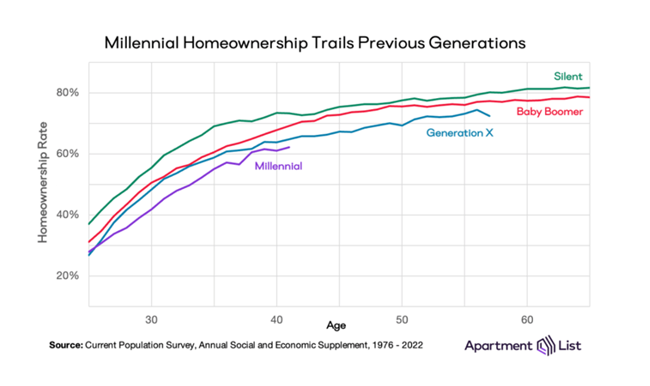
Nationwide, millennials have finally passed 50 percent homeownership, but they have purchased homes slower than previous generations. For instance, when Gen X was the same age as millennials today, their homeownership rate was 58 percent.
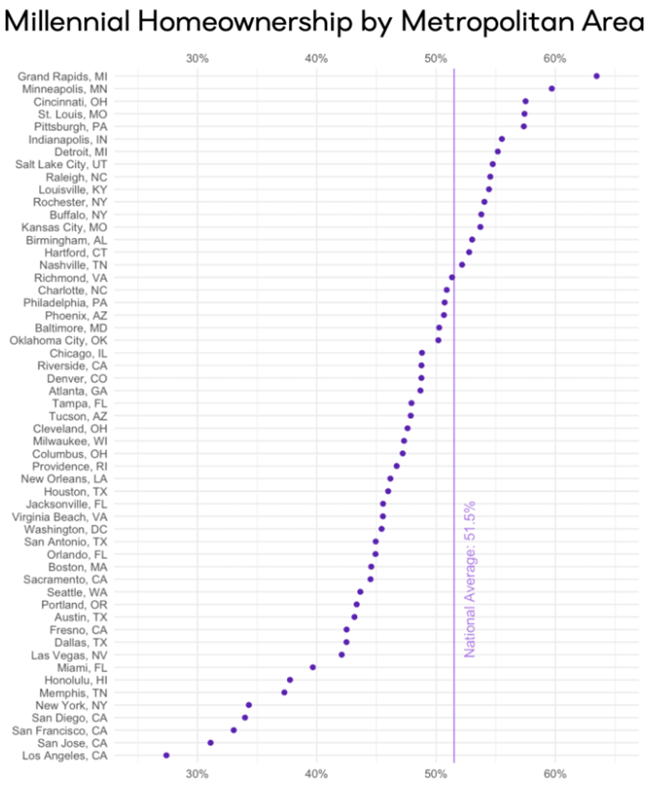
Homeownership varies greatly by location. In Phoenix metro, the millennial homeownership rate is 51 percent, just shy of the national average. In general, millennials own more homes in the nation’s smaller markets, particularly those in the Midwest and Great Lakes regions.
Millennials who continue to rent are getting priced out of homeownership by rapidly rising prices. In our latest survey, 25 percent of millennial renters say they will rent forever, and two-thirds have no money set aside for a down payment.
Impact of the Great Recession of 2008
The report says the most important factor in millennial home purchase was the Great Recession, “which suppressed homeownership across all generations but was particularly damaging to millennials, whose early career trajectories were shaped by a historically unstable economy.
“During the economic recovery that followed, many millennials were drawn to centrally located jobs in cities where starter homes became increasingly scarce and expensive. While many millennials purchased homes during these years, others spent more time living at home or in rentals, delaying major life events like homeownership, marriage, and childbearing when compared to earlier generations,” the economists write.
The Growing Importance of the Multifamily Industry
The report points out that many millennials will continue to rent, as housing is in short supply and prices are high.
“This highlights the growing importance of multifamily housing, the industry sector that rebounded fastest after the Great Recession and has continued to receive steady investment over the past year even as rising interest rates tempered single-family development.
“The record number of new multifamily units currently under construction are expected to bring some relief to the rental side of the housing market this year and beyond. Historically, the vast majority of these units have been built for rent, but as YIMBY (Yes In My Backyard)-backed zoning reforms and densification slowly gains traction, we may see more of them built for sale in the years ahead.
“It is possible that if attitudes towards homeownership shift to de-emphasize single-family homes, multifamily could provide an alternate path to homeownership as Gen Z reaches their homebuying years,” the Apartment List economists write in the report.
Chart courtesy of Apartment List. Source U.S. Census Bureau. Cities with at least one million residents.
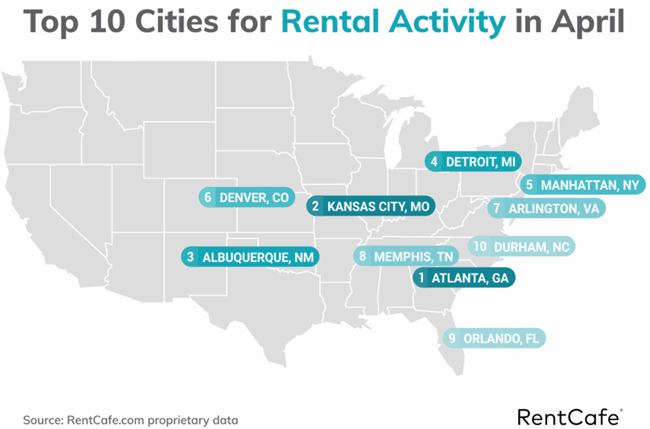
Atlanta is the most sought-after city for renters, according to a new April renter-activity report from RentCafe.
The report says “renting is now the new buying,” due to high home prices. Also, the spring season brings out more renters looking for apartments.
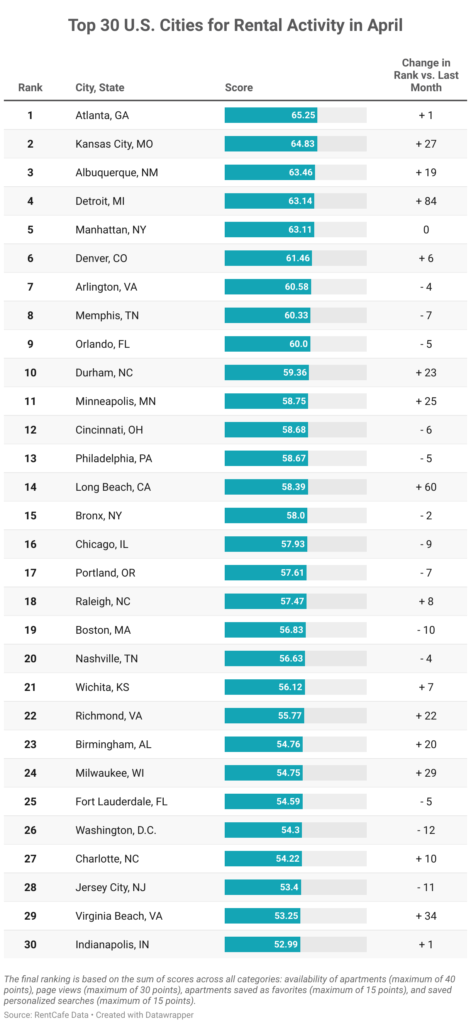
RentCafe analyzed millions of interactions “on our own apartment search website, RentCafe.com, to find the most active locations for renting in the nation. Our brand-new monthly rental activity report will keep you updated on the latest movements and shifts in renting demand across the 150 largest cities” in the United States.
The RentCafe ranking was based on:
availability of apartments
listing views
apartments saved as favorites
saved personalized searches
Which cities are most popular with renters?
Atlanta is the most popular, with the highest search activity this month. Apartment hunters in Atlanta added twice as many listings to their favorites lists compared to this time last year.
Apartment listings in Kansas City, Mo., and Albuquerque, N.M., were in second and third place respectively, according to the listing’s activity data. They climbed +18 positions and +27, respectively, compared to last month, thanks to the highest page views on properties.
Detroit landed in fourth place with the highest climb in rankings from March, rising by 84 spots. Minneapolis (11th place), Milwaukee (24th place) and Indianapolis (30th place) are the other newcomers in the Top 30 most-searched renting cities this month.
Manhattan completed the top five, maintaining its position on the top compared to the first month of spring. The big comeback as a top favorite for renters is driven by a quick rise in the number of apartments saved to favorites on Rentcafe.com: eight times more than one year ago.
Big cities like Philly, Boston and Chicago are seeing a surge in rental activity, with more favorites, saved searches and high demand resulting in fewer listings and decreased availability. Northeastern cities are popular with renters, claiming five spots on the top 30 list.
Any disparity in how you conduct your prospect tours could leave you open for potential fair housing complaints so here are four fundamental areas to review for best practices.
As a leasing professional, conducting prospect tours is an everyday task that requires you to be mindful of fair housing laws.
Discrimination in housing is illegal and can result in severe legal consequences. Therefore, implementing fair housing best practices can help ensure that you and your team remain compliant at all times.
Consistent Tour Policy
Having a consistent policy on how and when tours are offered is essential to avoid potential fair housing violations.
Discrimination can occur if one prospect is offered a tour while another is not based on their protected class. Another thing to keep in mind is what is shown on the tour.
For example, you shouldn’t give a tour of the grounds, amenities, and units to Prospect A and then only show the grounds and units to Prospect B. Any disparity in how you conduct your tours is leaving you open for potential fair housing complaints.
Documentation
Why is documentation a critical part of prospect tours? Consider the following scenario:
Several tours have been scheduled, but the leasing agent was called away before they could complete them. What should you do?
We all know that a leasing office can be incredibly busy at times and potentially short-staffed. Documentation is crucial when situations arise and you must reschedule a tour or have another leasing agent step in. Ensure that all information about what happened, why it happened, and what alternatives were offered are clearly noted. If there is ever a question as to why some tours were done and not others, you will have clear documentation to show precisely what happened.
Unit Tours
Having a policy regarding which units are shown is also essential.
Of course, we want to show potential residents what we think will interest them based on their guest card or conversations you have had. However, if leasing agents offer different units to different prospects, the reasons for showing those particular units must be noted to avoid any appearance of discrimination or illegal steering.
Non-Accessible Units and Media Accessibility
Showing units that are on a second floor or higher to a disabled prospect can prove to be a challenge, notably if the building happens to be older and does not have elevators. You cannot just shrug your shoulders and only show units on the first floor, as this is blatant discrimination.
Offering an alternative tour is crucial. A video or picture book can be used as a substitute as long as it provides a complete description of the unit. Additionally, when using videos or offering virtual tours, it is crucial to ensure that the media is accessible to people with visual or auditory impairments. All media must include full-text descriptions and audio components.
Final Thoughts
Implementing fair housing best practices in your leasing operations is essential. This article reviewed four fundamental areas that need to be regularly reviewed for fair housing compliance. With a little bit of thought, thorough documentation, and a clear tour policy, you can avoid potential fair housing problems. And as always, remember: fair housing training for all staff is critical to help everyone stay compliant.
About the author:
In 2005, The Fair Housing Institute was founded as a company with one goal: to provide educational and entertaining fair-housing compliance training at an affordable price at the click of a button.
Operators are now seeing that improving how resident communication is directly correlated to lease renewals and how long residents will choose to stay at their property.
By Andrew Ruhland
The tides of renewals may be changing, but that doesn’t mean operators need to be left underwater. There are some lifeboats available to help keep them afloat and even thrive in these ever-evolving digital times.
While many communities have found innovative ways to attract new residents and satisfy current residents, the day will come when an individual heavily considers moving on to another property. However, operators are looking for new ways to sway a resident’s renewal decision in an effort to increase renewal rates and keep residents within their ecosystem.
According to internal data from Nurture Boss, nearly 60 percent of residents will move out when their initial lease is up. Although modern residents have their reasons for moving out –moving to a new city, upgrading to a single-family home or simply wanting different apartment features and amenities – it’s worth building relationships with residents from the very beginning, before they even move in. Not only will establishing a meaningful relationship with prospective residents escalate the likelihood of them signing a lease, it will also enhance the chances of them choosing to renew their lease agreement when the time comes.
Implementing an effective strategy that facilitates hyper-personalized and consistent communication and marketing practices helps to establish that relationship with residents earlier on in the customer lifecycle. Once a lease is signed, some communities may halt communicating with residents until it’s time to renew, but this strategy causes them to lose out on potential renewal opportunities. After all, the manner in which operators communicate with prospective residents and current residents alike influences their decision when signing a lease or renewal.
“The biggest impact on renewals continues to be the communication between residents and onsite teams,” said Tony Sousa, vice president of operations at RPM Living. “The pandemic seemed to have amplified the residents’ expectation of receiving personalized communication on a frequent basis in the manner that they prefer, and we’ve found it’s that consistent, customized messaging that really strengthens the relationship between the residents and onsite teams.”
In an effort to replace the antiquated communication and marketing tactics operators previously turned to, a number of them are opting to implement leasing and renewal conversion automation tools. Having a relationship with onsite teams and receiving personalized communication is vital to a residents satisfaction with the community in which they live.
Operators are now seeing that improving how they communicate with residents is directly correlated to how long they will choose to stay at their property. Enhancing resident communication efforts and crafting more customized messaging not only strengthens relationships, but it incentivizes residents to sign a renewal.
“The more you engage with your residents and provide them with the information that pertains uniquely to them, the probability that they will renew their agreement significantly rises,” said Lindsay Duffy, director of marketing and training at Western Wealth Communities. “Connecting with residents and maintaining those relationships is essential for properties to be successful and automation has allowed us to never miss a beat and keep those channels of communications open and fluid.”
Engaging with residents at multiple touchpoints throughout their journey provides operators with the information necessary to message residents regarding the areas that they show the most interest in. Automation allows for the augmentation of communication in ways never seen before and that undisputedly leads to both higher lease and renewal conversion rates. Of course there’s still a human component that impacts resident satisfaction but automation certainly fills in the gaps and facilitates the communication when onsite teams simply cannot.
Despite having the most knowledgeable and experienced teams available, there is just not enough time in the day to respond to every inquiry that comes into a community and automation ensures a timely response no matter how or when a resident reaches out.
“The golden rule is to respond back swiftly and in a way that the residents choose, which is generally the same way they reached out to us,” Sousa said. “Email still accounts for a large percentage of our communication but text messaging is definitely gaining traction. Either way, automation makes it possible for us to contact each and every lead and create a bond with them, not just with onsite associates but the entire community. Once that relationship exists, the chances of a resident renewing skyrockets.”
Great communication is no longer a bonus attribute of a community, it’s now an expectation of residents. Operators that utilize the technology available to communicate in an ongoing fashion typically see higher retention rates. Effective communication is key to maintaining resident satisfaction and optimal occupancy rates, and even if it’s not at their current property, truly satisfied residents will at least consider a community’s sister property.
“Creating a consistency of communication is of paramount importance to meeting the expectations of both prospects and residents, “Duffy said. “It really opens up a channel for us to continue that personalized interaction with them regularly and gain tremendous insights as to what they’re looking for in a community.”
Automation gives way to an efficient, centralized mode of communication and marketing that continues to engage residents throughout their entire life cycle at a community. It also helps leasing teams establish relationships with residents up front and set the foundation needed to increase renewals and maintain long-term residents.
About the author:
Andrew Ruhland is an account executive and content writer for LinnellTaylor Marketing, which focuses exclusively on the rental housing industry, its trends and technology innovations.
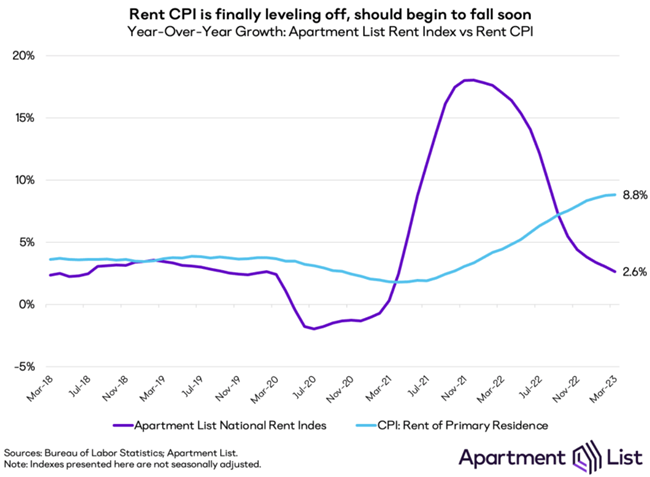
The new numbers showing the rent component of the consumer price increase is no longer rising is crucially important as housing costs have been a major driver of inflation, Apartment List economists say in a new report.
The report says the year-over-year growth rate of the rent component “has finally leveled off, coming in at 8.8 percent in March, which is flat compared last month.
“On a month-over-month basis, rent CPI increased 0.5 percent in March, down from 0.7 percent in February. In contrast, the Apartment List national rent index is currently up by just 2.6 percent year-over-year, a growth rate that has been cooling rapidly for over a year after peaking at a staggering 18 percent in December 2021.”
Topline CPI increased 0.3 percent month-over-month, but year-over-year inflation continued to cool, falling to 5 percent, down from 6 percent last month. Even though overall inflation is cooling, the housing component is continuing to keep it elevated, and was the dominant factor contributing to this month’s overall increase.
CPI rents, however, reliably lag movements in market rents by 3-5 quarters. The Federal Reserve is well aware of this relationship, clarifying that they also track private market-based indices, including Apartment List Rent Estimates, to understand where CPI rents will trend in coming months.
“Because our index serves as a leading indicator for the housing components of CPI, we expect rent CPI to cool steadily in the months ahead,” the report says.
Why Housing Costs Are Keeping Overall Inflation Elevated
As a reminder, the “shelter” component of CPI – which includes both renter-occupied and owner-occupied housing costs – is the single largest component of topline CPI, comprising one-third of the overall index.
“And because costs for owner-occupied housing are measured with the concept of “owner’s equivalent rent,” trends in market rents are the key determinant of not just the rent component, but of the shelter component as a whole,” Apartment List economists write.
Despite a first quarter that showed little rent gains, March did come through with a slight uptick in rent gains in some markets, according to the Yardi Matrix report.
“Multifamily demand held up well despite the attention given to the Federal Reserve-induced economic slowdown, bank failures and the deceleration from the outsize rent gains of the last two years.
“Rents and occupancy are stable as the market heads into the growth season,” writes Yardi Matrix in the report.
Highlights of the report
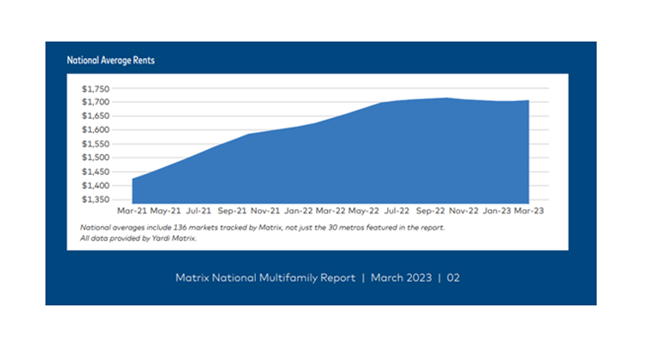
With demand remaining firm, multifamily rents rose slightly in March. The average U.S. asking rent rose $3 in March to $1,706. Year-over-year growth fell to 4.0 percent nationally, 90 basis points less than February and the lowest level since rents started an unprecedented climb in April 2021.
Although financial markets remain volatile due to the collapse of two banks in 2023 (there were none in 2022), multifamily property fundamentals are stable. Rents and the national occupancy rate were unchanged during the first quarter of 2023, and 21 of the top 30 Matrix metros recorded rent gains in March.
Single-family rental rates increased in March by $5 to $2,079, while the year-over-year increase fell by 80 basis points to 2.8 percent. Occupancy rates decreased in February by 10 basis points, but remain strong at 95.5 percent.
Watching for the impact of interest rates later this year
With inflation still an issue and uncertainty with potential interest rates continuing to rise, “affordability (is) a growing concern” that the consumer may be “constrained by high inflation.”
“It is likely that rent growth in 2023 will be modest,” Yardi Matrix writes. “Yet a multifamily hard landing is not yet in the cards, since household formation is still boosted by the tight job market.”
Also, high prices for single family homes and increasing mortgage rates “are keeping homeownership out of reach for some renters.” Meanwhile, “consumer balance sheets remain strong (for now). The big question continues to be how the economy will react to sharp interest rate increases.”
Lease renewals
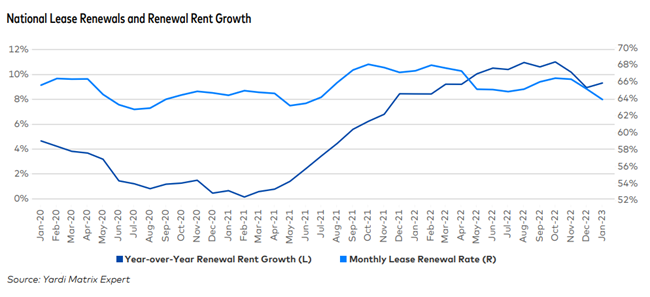
Yardi Matrix says many renters have the wherewithal to afford increases at lease renewal time and that demand “is not falling as significantly as feared, and that tenants looking to move to reduce their monthly charges have limited options in many metros”
National lease renewal rates were 63.9 percent in January, down from 65.2 percent in December. “Renewal rates have been very consistent over the past year, both nationally and on a metro level. That could change as a wave of supply comes online if absorption does not stay positive,” Yardi Matrix says in the report.
Yardi Matrix researches and reports on multifamily, office and self-storage properties across the United States, serving the needs of a variety of industry professionals. Yardi Matrix Multifamily provides accurate data on 18+ million units, covering more than 90 percent of the U.S. population. Contact the company at (480) 663-1149.
Multifamily operators are finding new revenue streams by identifying new net operating income (NOI) strategies within day-to-day operations and things such as short-term leases and flexible stay.
A historic period of rent growth ended last year, subsequently followed by several months of decline that have carried into 2023. According to the April Apartment List National Rent Report, year-over-year rent growth continues to decelerate. Those headwinds pose a significant challenge to multifamily owner/operators, and their response to eroding market factors could dictate their portfolio performance for the foreseeable future.
While the typical industry reaction is to cut costs and batten down the hatches, inflation rates continue to limit the efficacy of expense reductions. Cutting staff and services can trim budgets but also impairs resident retention efforts. Operators are finding that focusing on resident renewals and identifying new revenue streams and net operating income (NOI) strategies within day-to-day operations better positions them to weather the storm.
Budget cuts enable owner/operators to survive economic challenges, but they represent a reactionary approach. From an NOI perspective, creating new revenue streams for growth is easier and more effective than cutting costs, and enables operators to maintain full-scale operations. Here are a few proactive revenue-generating tactics owner/operators can implement to thrive in the face of rent growth challenges.
Flexible Leases
One of the most effective generators of new revenue streams in multifamily is short-term leases, which command higher premiums.
But, historically speaking, they haven’t been effectively leveraged in the industry. Savvy owners have finally recognized that any-length-of-stay management models, which offer furnished short-term homes alongside traditional 12-month leases, can be powerful revenue drivers as it de-risks the asset by attracting an array of customers. Variable-stay programs that allow the agility to customize the unit mix based on market and seasonal demand have proven capable of boosting upside revenue by as much as 40%, and averaging a 10% NOI uplift.
“Flexible stay models are effective because they cater to consumer demand, whereas communities with 100 percent traditional leases require the renter to conform to a pre-established structure with limitations on revenue,” said Lisa Yeh, chief operating officer with Sentral — a full-service, whole-community management and hospitality company that features any-length-of-stay leases. “The continually growing remote workforce means a large percentage of renters aren’t tethered to a desk in an office or a specific city. They have the freedom to roam because they aren’t required to live where they work. People want to take advantage of that newfound flexibility, they want to travel and experience new places, and they’re willing to pay more for homes that accommodate that lifestyle. Additionally, flexible leases accommodate others wanting flexibility including those in between homes and second homes.”
Communities with flex living models attract not only traditional renters, but also business travelers, vacationers and digital nomads. By eliminating dependency on a particular renter demographic, variable stay programs also mitigate operational risk by diversifying a community’s renter profile. And owners always retain the ability to default back to 100% traditional leases.
Repurposing Package Facilities
In addition to leveraging their homes, owner/operators have also found opportunities to repurpose former amenity spaces to drive revenue. Due to explosive e-commerce trends, third-party, off-site package management is rapidly replacing untenable package rooms and package locker systems. The switch makes on-site package facilities unnecessary, enabling owners to repurpose the physical space previously dedicated to those amenities.
Reclaimed space within a multifamily community is ripe with revenue-generating potential. Former package rooms have been converted into leasable offices, podcast or recording studios, and storage facilities. Depending on the recovered square footage, communities have even turned package rooms into short-term guest rentals or an extra studio apartment home.
“If we acquire an asset that has a package system or package room, we talk about how we can repurpose that area into an income generator as part of our value-add projects,” said Dana Caudell, executive vice president of operations at Wood Residential. “There are all sorts of things you can do to repurpose a package room. You can turn it into work from home stations that you rent out, or even into an amenity like a dog spa to attract prospective renters. As a forward-thinking operator, there are so many things you can do with the former package room space to add asset value to the owner.”
Electric Vehicle Charging
Electric vehicles are now undeniably the future, and sales reached the tipping point in the United States in 2022, achieving a level where new technology reaches the point of acceptance. This means that the increases in EV model introductions aren’t going to subside, and annual sales records will continue to be broken. A YouGov poll showed that 23% of licensed U.S. drivers planned to make their next vehicle EV or PHEV with 65% stating a belief that electric vehicles are the future of the automotive industry. The federal government is making increased infrastructure investments in EV charging to help encourage growth. Multifamily investors are also beginning to realize that EV charging stations are becoming an essential part of their revenue stream structure.
“We asked our residents about EVs and other sustainability topics with a series of surveys. An overwhelming two-thirds indicated they had very high interest in making the switch to an EV,” said Thomas Stanchak, director of sustainability at Stoneweg US. “We’re confident our addition of EV chargers is helping us to attract and retain the best tenants. In a competitive rental market, amenities like EV charging can make your property stand out from the competition. EV charging is also a meaningful part of Stoneweg’s overall environmental strategy, which is to implement practical and effective solutions that support residents through this transition to a cleaner energy future.”
Not only does the early installation of reliable, well-placed EV stations provide communities with a competitive advantage for environmentally and socially conscious residents, but they can also share in the revenues generated by EV owners bringing their batteries to 100%. According to Xeal, an EV charging provider for the multifamily and commercial industries, EV charging stations enable owner/operators to provide a necessary service to residents while also achieving an ROI on each session by installing chargers at their communities.
Reduced Pet Restrictions
Breed and weight restrictions have been the norm in many multifamily communities, even among those that are pet-friendly. However, this approach could also restrict NOI across a portfolio. Numerous case studies have shown the lifting of restrictions and resulting increase in the number of pets on site leads to more connected communities and boosts retention rates, which minimizes vacancy loss and turn costs.
“Setting aside that many of the reasons for restrictions are based on long-held misconceptions and have been proven to be scientifically inaccurate, lifting them has proven to be of significant financial benefit for rental housing operators,” said Judy Bellack, Industry Principal for Michelson Found Animals. “Research shows that pet-owning residents build community through their shared love of pets and the activities surrounding them. This creates strong bonds that in turn create longer-tenured residents. And while many operators cite the potential for damages as a key concern, only about 9% of units report pet damages, averaging only $210 per unit – a number more than covered by the average security deposit.”
Upside revenue is available for owner/operators looking for a new approach and tired of negatively impacting operations through continual cuts to labor and services. Expense reductions aren’t the only way to balance the NOI ledger in times of rent growth decline. An emphasis on new revenue generation, either through subtle or wide-scale operational changes, could permanently tip the scales to the red.