Home Blog Page 61

Evicted Tenant Charged With Arson In Portland Apartment Fire

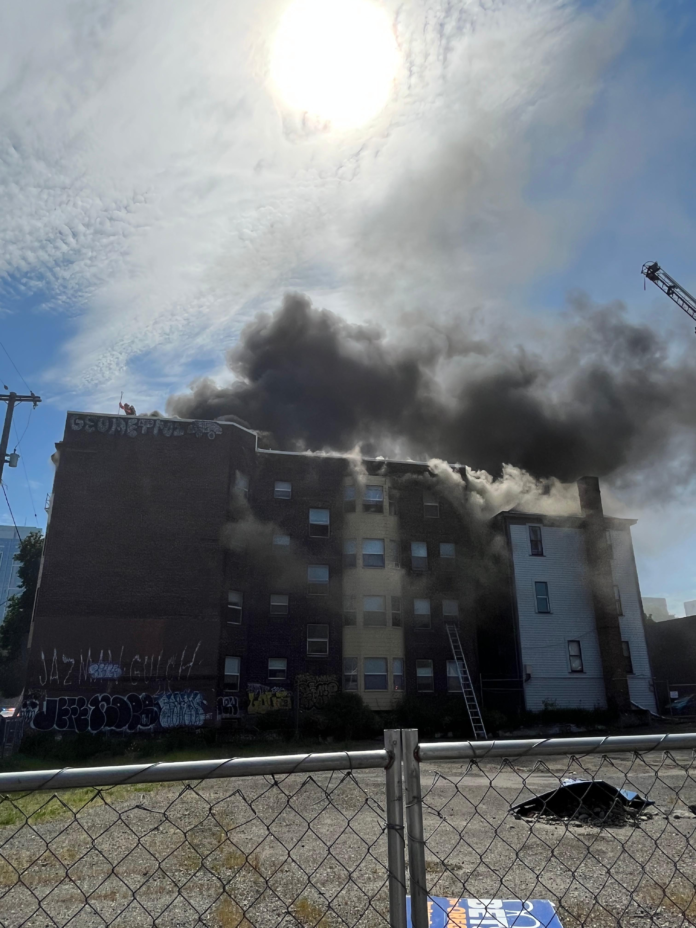
Police have charged an evicted tenant with felony arson and reckless endangerment in a fire that destroyed a Portland apartment building.
Photo courtesy of Portland Fire & Rescue

Police have charged an evicted tenant with felony arson, criminal mischief and misdemeanor reckless endangerment in a fire that destroyed a Portland apartment building, according to reports.

The 116-year-old apartment building was destroyed and residents of all 42 units of the May Apartments, were displaced. No one was seriously injured in the fire but an unknown number of pets were lost in the arson fire according to a spokesman for Portland Fire & Rescue.

Officials said the apartment building will likely be torn down.

Police arrested 30-year-old Garrett Repp, a former tenant who was evicted in May, on 31 charges,including arson, related to the fire.

Repp’s ex-girlfriend told The Oregonian/OregonLive he had lived in the May Apartments since November. The landlord, SkyNat Property Management, initiated an eviction order against Repp in February saying he owed $3,180 in rent and late fees, court records show.

The Oregonian reported that on April 17, the Multnomah County Circuit Court Landlord Tenant Department ordered Repp to move out by midnight on April 23. An amended order was filed May 1, ordering him to move out by midnight May 7. A third order was issued May 3, ordering him to move out by midnight May 8. On May 10 a judge ordered sheriff’s deputies to remove him from his third-floor apartment. The fire broke out May 16.

The four-alarm fire at the May Apartments at 1410 S.W. Taylor Street in the Goose Hollow neighborhood sent heavy, black smoke throughout downtown Portland and surrounding areas, leading to the closure of streets and highways.

Portland Police spokesperson Sgt. Kevin Allen said Repp, 30, was arrested the day of the blaze because building management had reported him on May 9 for “breaking through the wall of his apartment” and tunneling into the vacant unit next door. Repp was charged with one count of first-degree criminal mischief and released later on May 16. The case has since been closed.

Repp was well-known to residents at The May Apartments, according to interviews with three tenants and a former property manager, who said he had pulled the fire alarm for no reason more than a dozen times since he moved in last December and had repeatedly clashed with other residents.

According to its website, SkyNat is a family business with more than 500 residential units in Portland, Gresham, Vancouver and Tigard.

Sign Up For Our Weekly Newsletter And Get Rental Property And Apartment News And Helpful, Useful Content Each Week.

* indicates required

Leasing Season Is Here, and Pet-Friendly Rentals Can Help You Attract New Residents

Residents say pet-friendly rentals are hard to find so here are some ideas on how to help during leasing season to attract pet lovers

Residents say pet-friendly rentals are hard to find so here are some ideas on how to help during leasing season to attract pet lovers to your community.

By David Stunja

It may be hard to believe, but summer is almost here. And in the apartment industry, that means it’s leasing season.

Forward-thinking operators are always thinking about how they can maximize the appeal of their communities to new residents. Innovative marketing campaigns, self-guided and virtual tours, and cutting-edge onsite amenities are just a few of the ways that today’s apartment owners and managers are trying to lure new renters.

But operators shouldn’t overlook the impact that their pet policies and amenities can have on their efforts to attract new residents. After all, we are a nation of pet lovers: 70 percent of U.S. households own a pet, according to the American Pet Products Association.

The 2021 Pet-Inclusive Housing Report, from Michelson Found Animals and the Human Animal Bond Research Institute, hints at some of the business opportunities and benefits of rolling out the welcome mat to pet owners. According to the report, 72 percent of rental-housing residents say pet-friendly housing is hard to find, pointing to the competitive advantage of offering communities that pet-owning residents find appealing. In addition, 83 percent of owner/operators say pet-friendly vacancies are filled faster, and the report also found that residents in pet-friendly housing stay 21 percent longer than those in non-pet-friendly housing.

So how can operators best position their communities to attract pet lovers? Below are some steps to consider.

  • Relax breed and weight restrictions. A reduction or elimination of these restrictions results in a larger pool of potential residents who will now consider your communities. Scaling back creates the opportunity for other operational and financial benefits, as well.

For example, with more pets onsite, operators can collect more pet rent. Reduced restrictions also make it less likely that a resident will try to hide a pet or sneak a pet into the community under the guise of it being an assistance animal. Operators lose out on pet-related revenue when this happens because HUD and the Fair Housing Act prohibit charging pet rent or other pet fees for legitimate service or support animals.

Operators that are considering reducing or eliminating their pet restrictions shouldn’t worry too much that these changes will be met with stiff opposition from residents. According to the Pet Policies and Amenities in Multifamily report by PetScreening and J. Turner Research, 53% of residents are against breed restrictions and 23% are indifferent. Only 24% are in favor. Similarly, 56% of residents are against weight-related restrictions, while 24% are indifferent. Only 20% support these restrictions.

Operators should also know that these restrictions often have their basis in the myth of the dangerous breed. However, a 2022 study published in the journal Science showed that a dog’s breed is not a good predictor of its behavior.

MAA and RPM Living are among the operators that have dropped breed restrictions to create more welcoming environments for pet-owning residents. The Management Group, Oculus Realty and Milhaus have eliminated both breed and weight restrictions.

Despite the host of potential benefits offered by reducing or eliminating restrictions, this article is not advocating that operators immediately eliminate breed and weight restrictions and just accept all pets with no questions asked. Apartment communities should thoroughly screen pets and pet owners on an individual basis to determine if they pose any risk and make data-driven decisions accordingly.

  • Have the right pet amenities in place. It’s not enough to simply allow more pets than your competitors. Prospective residents will want to know that they and their pets will have a high quality of life after they move in. And that’s where amenities come in. Across the industry, operators are equipping their communities with shady pet parks, pet-washing stations, pet-sitting services and pet concierges.

The good news is that residents’ needs in this area are fairly straightforward and easy to meet. According to the PetScreening-J Turner report, the two pet-related amenities most desired by residents are waste-bag stations and onsite dog parks, both of which can be relatively affordable to install.

Additionally, when you have progressive pet policies and appealing pet amenities, be sure to feature them prominently in your marketing campaigns, community websites, ILSs and social media outlets. Be assertive in spreading the good  word that your communities want to provide pet owners and their pets with a best-in-class living experience. After all, it creates a meaningful and relevantl competitive advantage for your communities.

Apartment residents – just like the rest of the U.S. population – are simply crazy about their pets. And when apartment owners and operators lean into this fact, they’re bound to find that their leasing seasons will be extremely busy with pet-friendly rentals.

David Stunja is chief operating officer at PetScreening.

Sign Up For Our Weekly Newsletter And Get Rental Property And Apartment News And Helpful, Useful Content Each Week.

* indicates required

When It Comes to Residential Wi-Fi, Invest in a Managed Solution with a Measurable Difference

To evaluate quality of managed Wi-Fi solutions in Multi-Dwelling Units (MDU), property owners typically look at numbers that drive up costs

It’s easy to know who is winning when you keep score. To evaluate the quality of managed Wi-Fi solutions in Multi-Dwelling Units (MDU), property owners typically keep score by looking at the hard numbers that drive costs up. These include the following:

  • Number of resident complaints about the Wi-Fi per month
  • Hours of Wi-Fi downtime per month
  • Hours of a technician monitoring the network per month
  • Hours of a technician performing maintenance and repair per month

This is why it’s important to select a technology solution that will drive those hard numbers down and keep them at a minimum. But how do you achieve that? Which factors should you take into consideration?

High-Performance Wi-Fi for Tenants

Are all residents able to use the Wi-Fi for the applications they need? Is there sufficient bandwidth to support multiple streaming services in a unit for streaming conference calls on one device and concurrently streaming entertainment on others?

Seamless Roaming Across the Property

Are tenants able to roam the entire property without logging in multiple times? Does this include all indoor locations such as gathering areas, laundry and other facilities? Does this include outdoor patio areas?

Simple Onboarding of All Devices

Is it easy for tenants to add a new device without assistance? Each unit can have 12 or more devices, and new ones are added every day. Are their guests able to easily log in without a conversation with their host?

Secure Personal Networks

Is each unit’s traffic private and password protected? Can you ensure that other residents are unable to see a tenant’s activity?

Easy Monitoring and Reporting

How is the network performance monitored, and who monitors it? Does it require a skilled technician to look at the data on demand? Or is there a system that senses problems, makes adjustments and notifies an administrative person with no technical training when problems require attention?

 Choose the Best Option for the Long Run

It costs time and money to handle complaints, describe problems and dispatch skilled technicians. When choosing a solution, remember that the initial cost is only the starting point. A few dollars saved on the front-end can be easily wiped out by a solution that simply does not work. It could drive the total cost of ownership through the roof with outages and repair costs – and ultimately a significant total replacement cost.

Cambium Networks works with several leading MSPs that help property owners get access to reliable, fast internet. For more information on the various architectures and the views of property owners and MSPs, read the solution paper, “Take Control of Your MDU Network.” You can download the paper here. Contact us to connect you with qualified MSPs that fit your needs.

To evaluate quality of managed Wi-Fi solutions in Multi-Dwelling Units (MDU), property owners typically look at numbers that drive up costs

About Cambium Networks
Cambium Networks enables service providers, enterprises, industrial organizations, and governments to deliver exceptional digital experiences, and device connectivity, with compelling economics. Our ONE Network platform simplifies management of Cambium Networks’ wired and wireless broadband and network edge technologies. Our customers can focus more resources on managing their business rather than the network. We deliver connectivity that just works.

Cheap isn’t Always Cheerful: When it’s time to Retrofit Your Building with Seamless Wi-Fi, Choose the Right MSP Partner

Improve MDU Profitability AND Resident Satisfaction

Can I Ask Prospective Tenant To Visit Their Current Residence?

Can you ask a prospective tenant to visit their current residence is the question this week for Ask Landlord Hank.

Can you ask a prospective tenant to visit their current residence is the question this week for Ask Landlord Hank. Remember Hank is not an attorney and is not offering legal advice. If you have a question for him please fill out his form below.

Hello Hank:

Can I legally ask to meet a prospective tenant to visit at their current residence ?

I think it would be enlightening to see how they maintain their present residence before they move into mine.

-Kathy

Hello Landlady Kathy,

Most landlords rarely ask this question.

But, if the prospective tenant is Ok with you visiting their current residence this would give you a good idea of how they maintain a property and there are no legal prohibitions that I’m aware of regarding a visit.

Sincerely,

Hank Rossi

www.rentsrq.com

Each week I answer questions from landlords and property managers across the country in my “Dear Landlord Hank” blog in the digital magazine Rental Housing Journal.    https://rentalhousingjournal.com/asklandlordhank/

Can I ask a prospective tenant to visit their current residence?
Landlord Hank says, “if the prospective tenant is Ok with you visiting their current residence this would give you a good idea of how they maintain a property.”

Ask Landlord Hank Your Question

Ask veteran landlord and property manager Hank Rossi your questions from tenant screening to leases to pets and more! He provides answers each week to landlords.

Can I Monitor Tenant Smoking In My No-Smoking Rental?

Can I Limit the Number of People in My Rental?

Do I Have to Paint and Replace Flooring for a Long-Term Tenant?

A Tenant Poured Grease Down Drain Who Is Responsible?


Sign Up For Our Newsletter And Get Rental Housing And Apartment News And Helpful, Useful Content Each Week.

NOI Drivers to Combat Rent Growth Decline Part 2: Revenue Recovery

operators are finding ways to combat rent growth decline focusing on resident renewals and identifying new NOI strategies

As year-over-year rent growth slows, operators are finding ways to combat the rent growth decline focusing on resident renewals and identifying new NOI strategies so here are some examples.

By Kevin Juhasz

A historic period of rent growth ended last year, subsequently followed by several months of decline that have carried into 2023.

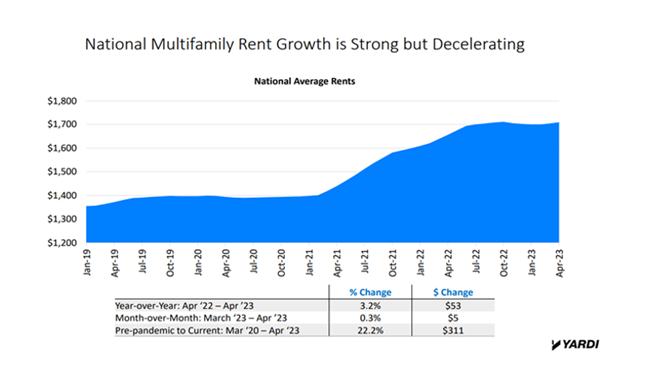
According to the latest update from the Apartment List National Rent Report, year-over-year rent growth continues to decelerate and is projected to decline further in the coming months. Those headwinds pose a significant challenge to multifamily owner/operators, and their response to eroding market factors could dictate their portfolio performance for the foreseeable future.

While the typical industry reaction is to cut costs and batten down the hatches, inflation rates continue to limit the efficacy of expense reductions. Cutting staff and services can trim budgets but it also impairs resident retention efforts. Operators are finding that focusing on resident renewals and identifying new NOI strategies within day-to-day operations better positions them to weather the storm.

Here are other ways owner/operators can increase NOI in a potentially stagnant, inflationary period in 2023. In addition to developing new revenue sources, operators are increasingly seeking opportunities to limit revenue loss on the back end of leases.

Maximizing Rent Collection

According to the latest Household Pulse Survey from the Census Department, more than 8 million renters were not current on their rent payments at the beginning of 2023. While delinquency is always a concern in the industry, renters are at an even higher risk of becoming delinquent during an inflationary period or a recession.

Many operators are turning to rent payment innovation to proactively mitigate delinquencies, increase collections and position residents to successfully pay rent on time – no matter what’s happening in the economy. The most effective rent payment platforms allow renters to set up automated, customized payment schedules that align with their income and support them in sustainably paying on time and catching up on arrears. This comprehensive payment methodology caters to residents, but ultimately gears operators with a long-term tactic to maximize rental income and improve their NOI.

According to internal data from Circa, an innovative payment technology company, operators that extend a comprehensive payment platform to their residents experience a 17.5% increase in on-time payments at their communities.

“Many aspects of rental housing are customized for residents, but one area that operators can make a notable improvement to NOI is by extending that customized experience to rent,” said Leslie Hyman, CEO and co-founder of Circa. “When renters can customize their largest monthly payment on an automated schedule, it sets operators up to maximize rental income and recoup any losses. It’s an additional security tactic operators utilize to improve both their NOI and asset value.”

Eviction Optimization

The rental industry files eviction proceedings on about 2.5 percent of units every year. While that number is small when viewed as a percentage, it can be overwhelming when looking at actual units. Even when things go well dealing with delinquent residents, the task can be overwhelming for property teams and managers. It’s when challenges arise that costs for even a single eviction can balloon quickly.

The smallest of errors or a missed deadline can result in a judge pushing an eviction back another 30 days or more. That’s additional rental income that may be lost, additional fees to re-file and additional costs for legal counsel. Add to that the fact that leasing teams chasing delinquencies are directing a lesser amount of effort into growing a community and its NOI. It’s easier than you might believe to introduce a mistake or miss a deadline, and it’s not necessarily the fault of the onsite teams.

“Evictions don’t just vary from state to state; you have different things going on at the county and municipal levels, as well,” explained Larry Bellack, Executive Vice President of Possession Partner. “The Los Angeles City Council recently moved to end eviction moratoriums, but the Los Angeles County Council is considering extending them to June 2023, and not all communities in the city are required to follow the county moratorium. With so many government entities making so many different decisions that apply differently to communities in the same area, it’s a monumental challenge to keep track and an invitation to error and increased costs.”

Some of the costs can be avoided with the implementation of a third-party eviction management system that can automate much of the process to meet deadlines and employ a team of experts trained to track and fully understand the frequent changes to eviction laws and regulations

Security Deposit Replacement

Operators are also realizing the benefits of optimized claims by replacing traditional security deposits and surety bonds with lease insurance. The deposit refund and claims process often prevents property teams from effectively turning the page on former residents, leading to bad debt and unnecessary vacancy.

Lease insurance replaces prohibitive upfront deposits with a modest monthly fee, streamlining the application and move-in process but more importantly expediting claims on the back end.

“Historically, security deposits have always presented a financial barrier to residency. Lease insurance eliminates that upfront expense for prospective renters who otherwise meet qualifications,” said Ed Wolff, president of LeaseLock. “That creates opportunities for renters and a much larger prospect pool for operators. It also erases the friction that often accompanies security deposit conversations at move-out. Without security deposits to manage or dispute, departing residents can move on without looking over their shoulders and management teams are protected from bad debt.”

Lease insurance technology helps operators start the claims process earlier to speed up the rate of return on that revenue by absorbing account balances at move-out. Claim returns are processed in roughly a week, establishing reliable back-end revenue capture and boosting NOI. Property teams simply need to close out the final account statement to initiate claims immediately through the native receivables process.

Whether managing an eviction or debt recovery, these processes are time-consuming and contentious. Lease insurance eases the burden of claims management for on-site teams and allows overstretched associates to focus on leasing and customer service. By removing security deposits from the equation, it also eliminates any brand damage stemming from the negative reviews that frequently accompany deposit refund disputes.

About the author:

Kevin Juhasz is a content manager for LinnellTaylor  Marketing and a writer, editor, and storyteller.

NOI Drivers Combat Rent Growth Decline: New Revenue Streams- Part One

Sign Up For Our Weekly Newsletter And Get Rental Property And Apartment News And Helpful, Useful Content Each Week.

* indicates required

Revamping Multifamily Pet Waste Management Efforts

Everything Landlords Should Know About Emotional Support Animals

How Pet Poop DNA Testing Fixes Your Apartment Poop Problem

Leveraging Federal, State, and Utility Incentives to Fund Solar

The business case to fund solar for multifamily affordable housing is the best it’s ever been with the Inflation Reduction Act

By Ravi Malhotra
Tax Credit Advisor

The business case for solar-for-multifamily affordable housing is the best it’s ever been with the Inflation Reduction Act (IRA) and Bipartisan Infrastructure Law (BIL).

Multifamily properties can leverage Solar Photovoltaic (PV) (and energy storage) to cut utility bills and/or bridge financing gaps.

The business case to fund solar for multifamily affordable housing is the best it’s ever been with the Inflation Reduction Act

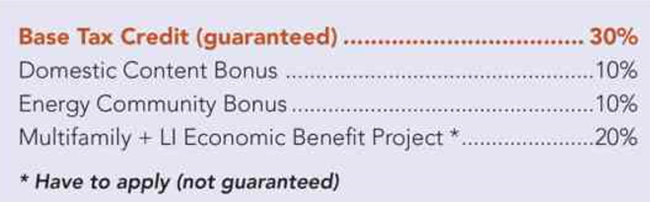
The IRA increases the baseline Solar Investment Tax Credit (ITC) to 30 percent and offers bonus ITC for various conditions.

For example, multifamily properties can receive a 20 percent bonus ITC if they share over 50 percent of utility savings with their tenants. ITCs can be braided with other credits (e.g., Low-Income Housing Tax Credits, 45L, 179D, etc.) and incentives (e.g., utility rebates or Solar Renewable Energy Credits (SRECs)). Further, they can be transferred to third parties and nonprofits can claim them as cash from the U.S. Treasury Department. Though, cashing out is uncommon—it was last done during the American Recovery and Reinvestment Act period—it is a game changer for nonprofits who can cash out the value of ITC (they lose the value of accelerated depreciation but gain full value for ITC). The transferability is also valuable for both nonprofit and for-profit developers since the multifamily property does not have much of a tax liability to monetize the ITC. The ability to ‘sell’ to investors opens solar up for many more properties. The downside is that most ITC investors want volume, not one project, so the aggregation of projects to meet investor volume requirements becomes important.

There is also the possibility of deploying solar using the ~$3.2 billion in funding allocated to the Weatherization Assistance Program (WAP) through the BIL, as, in contrast to standard WAP, these funds allow for solar. Solar is treated like any other efficiency measure and evaluated on the savings-to-investment ratio, and it must meet the average cost-per-unit rules. However, you can only avail yourself of these resources if your state allows multifamily projects.

The business case to fund solar for multifamily affordable housing is the best it’s ever been with the Inflation Reduction Act

So, how does solar save on utility costs and/or help bridge a funding gap?

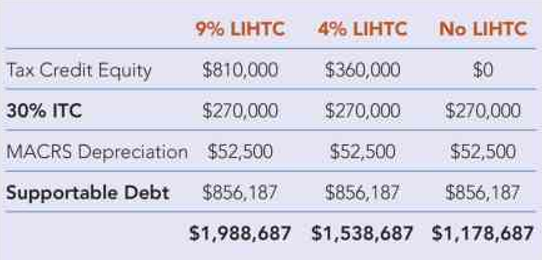
Say you invest $1 million in solar for your multifamily property, it should generate at least $64,000 in utility bill savings, which at a debt-service coverage ratio (DSCR) of 1.15 gives you $55,652 in extra cash for financing, and at a 6.5 percent debt constant, yields $856,187 in additional debt for the project. Additionally, the $1 million solar investment increases the tax basis by $1 million, thus providing ~$810,000 in nine percent LIHTC value (or ~$360,000 in four percent LIHTC value) plus ~$270,000 for the solar 30 percent ITC. Add the modified accelerated cost recovery system (MACRS) depreciation, utility rebates, SREC value and WAP grants, and your solar can be at no cost, plus you get additional debt for your project. Furthermore, you can transfer the tenant’s utility savings into rent through a utility allowance adjustment to support additional debt.

This is all good news, but only if your state allows you to create a shared solar project via community solar law or virtual net metering (VNM). Both allow you to allocate the energy generated from your solar project to your tenants and house meters, without having to create individual solar systems for each meter (besides the higher costs of such a solution, it has other downsides that impact financial viability significantly). And unfortunately, a master-metered property has other issues, such as utility rate structures that impact the viability of solar for those projects. That is to say: the devil is in the details, but again, the business case for solar-for-multifamily affordable housing is the best it’s ever been – especially if you have a LIHTC project or other opportunities to braid the solar ITC with other incentives and are in a solar-friendly state.

The Opportunity to Increase Energy Efficiency in Rentals

Sign Up For Our Newsletter And Get Rental Property And Apartment News And Helpful, Useful Content Each Week.

* indicates required

Multifamily Fundamentals Strong But Mild Recession Predicted

Multifamily fundamentals have been holding up better than expected through the first quarter, but there is still a looming mild recession

Multifamily fundamentals have been holding up better than expected through the first quarter, but there is still a looming mild recession expected later this year, Yardi Matrix experts explained in a recent Multifamily National Outlook For Spring 2023 webinar.

“Things are quite a bit more nuanced and more variables in play than there have been as we go through this on-going adjustment in this post covid world,” Jeff Adler, Vice President, Yardi Matrix said.

“The current investment environment requires increased creativity to find potential investable opportunities, which Yardi Matrix is designed to do,” said the presenters, Adler and Paul Fiorilla Editorial Director, Yardi Matrix.

Macroeconomic Update

  • U.S. economic growth slowed in the first quarter, with GDP growth falling to 1.1 percent, further deceleration to come.
  • The Fed is still in a tightening cycle, but will slow the pace of rate increases soon, as there is a less than one-year lag to actions
  • Inflationary pressures have started to cool, but remain elevated due to underlying price pressures
  • De-globalization continues
  • The SVB/Signature/Credit Suisse/First Republic banking crisis is a natural consequence of financial tightening.
  • The labor market is tight, but showing signs of weakness at the upper end, w/ no consensus on immigration policy.
  • U.S. economy is slowing, yield curve (10 year- three month) is inverted, mild recession very likely in second half of 2023.

How Does Multifamily Fit into This?

  • Multifamily fundamentals have been strong, but we expect deceleration within a seasonal uptick.
  • Market rotation occurring, with rent-by-necessity less impacted by new supply.
  • Affordability is still a key concern, with little political will to resolve and significantly more regulatory risk.
  • Demographic trends will keep the labor market tight, and entrenchment of hybrid work has tilted consumer budgets toward housing.
  • Construction financing is in short supply, and deliveries could be significantly reduced in 2025.
  • The supply shortage of U.S. housing is likely to last 5-10 years, supporting continued rent growth and capital appreciation.
  • The bid/ask spread for acquisitions remains very wide, with initial pre-distress and distress emerging.
  • Transactions have, and will, slow over the next 18 months until inflation moderates and interest rates come down.

Multifamily Outlook Highlights

Yardi Matrix says multifamily rent growth, occupancy, demand remain strong, but less than 2021 and 2022 as “deceleration” occurs.

Reasons for rent deceleration:

No. 1 – Post-pandemic migration is slowing, but a major reset has occurred

  • Return to “normal” migration to Sunbelt markets, i.e. Southeast, FL, TX, Mountain West
  • Intra-state migration slowing to secondary metros such as Sacramento, Inland Empire
  • Resort Towns will remain beneficiaries of the 20 percent of office employees fully remote
  • Gateway rebound led by young workers, retirees, immigrants
  • “Work from Office” varies by industry and function, but hybrid dominates
  • Growth highest in suburbs of major markets

No. 2 – Household growth is slowing

  • 2020/21 boom in households from job, wage growth, stimulus and pent-up demand
  • Job growth slowing, consumer excess savings ebbing from $2.7 trillion peak, now ~$1T

No. 3Supply growth, especially in high-demand metros in Texas, Southeast

  • 1 million units U/C nationally, but starts are waning as financing dries up
  • 400,000 to 450,000 deliveries in 2023-24, slowdown in following years

See the full report from Yardi Matrix here.

About Yardi Matrix

Yardi Matrix researches and reports on multifamily, office and self-storage properties across the United States, serving the needs of a variety of industry professionals. Yardi Matrix Multifamily provides accurate data on 18+ million units, covering more than 90 percent of the U.S. population. Contact the company at (480) 663-1149.

Remote Work Wipes Out Decade Of Super Commuters Growth

Super commuters have declined as the recent proliferation of remote work and hybrid jobs reversed the trend, economist Chris Salviati writes.

Super commuters have declined as the recent proliferation of remote and hybrid jobs has reversed this trend, Apartment List’s economist Chris Salviati writes.

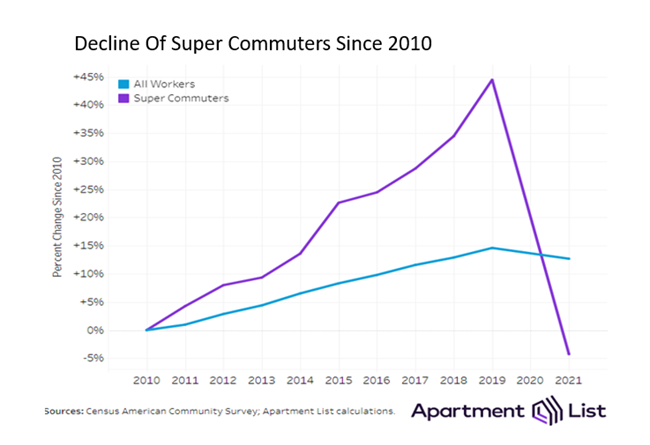
Today there are 1.5 million fewer super commuters than in 2019, and the metros with the largest concentrations of remote work have seen the largest improvements in commute times.

As of 2021 – the most recent data currently available from the Census Bureau’s American Community Survey – the number of super commuters had fallen back to 3.1 million, 4 percent fewer than there were in 2010. In 2019, super commuters comprised 3 percent of the American workforce, but as of 2021, that figure has fallen by one-third to 2 percent.

Highlights of the report:

  • After increasing from 3.2 million in 2010 to 4.6 million in 2019, the number of “super commuters” who travel 90 minutes or more each way to work has fallen back to 3.1 million as of 2021, driven by the widespread adoption of remote work. 2 percent of the U.S. workforce are super commuters, down from 3 percent in 2019.
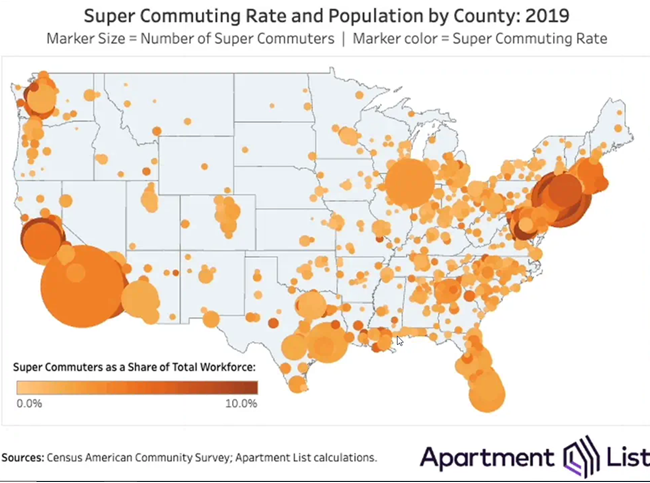
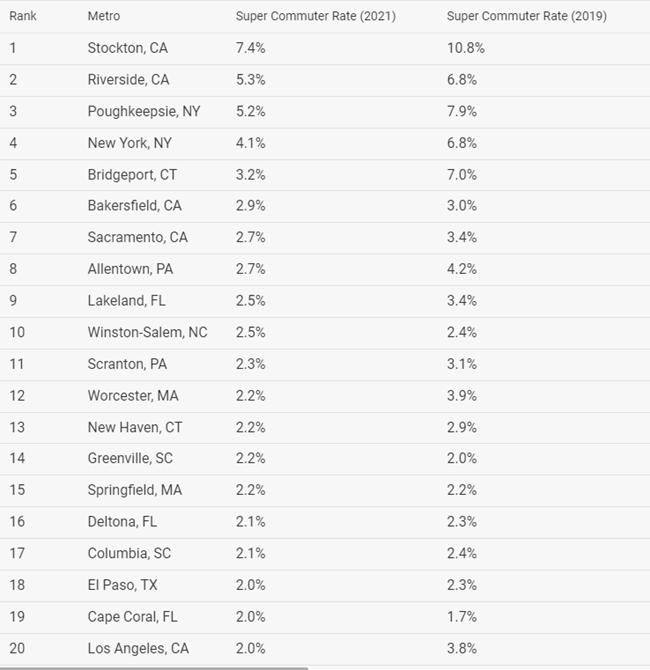
  • Despite the improvements, there remain significant populations of super commuters in and around the nation’s most expensive markets, especially the San Francisco Bay Area and the region surrounding New York City. Stockton, CA – on the outskirts of the Bay Area – has the nation’s highest super commuting rate at 7.4 percent.
  • Super commuting has historically been most common among high earners, but that gap is closing. The super commuting rate for six-figure earners fell from 4.4 percent in 2019 to 2.2 percent in 2021, while the rate for workers earning less than $25K fell from 2.1 percent to 1.7 percent.
  • Workers who rely on public transit to get to work are more than three times as likely to be super commuters as those who commute by car; 6.8 percent of all transit riders were super commuters in 2021, compared to 2.1 percent of drivers.

Super commuters have declined as the recent proliferation of remote work and hybrid jobs reversed the trend, economist Chris Salviati writes.

Housing affordability still driving super commuters

The report concludes that, the rise of remote work has led to a corresponding drop off in commuting. And no commute category has dropped off faster than lengthy super commutes of 90 minutes or more.

“From 2019 to 2021, the number of super commuters in the U.S. fell by 1.5 million, erasing a full decade of expansion during which the super commuter population was growing at triple the rate of the overall workforce.

“But even as the burden of super commuting has been somewhat ameliorated, the underlying cause of the trend has not. Acute housing affordability crises are still driving workers away from the nation’s most expensive cities, but more of them are now working remotely rather than bearing arduous commutes to downtown offices.

In fact, remote work has the potential to accelerate migration to the far-flung exurbs of large metros.

Top 20 Metros With Highest Rate Of Super Commuters

Super commuters have declined as the recent proliferation of remote work and hybrid jobs reversed the trend, economist Chris Salviati writes.

Read the full report from Apartment List here.

Sign Up For Our Weekly Newsletter And Get Rental Property And Apartment News And Helpful, Useful Content Each Week.

* indicates required

Are You Prepared for Fair Housing Testing?

It is crucial to be prepared for fair housing testing when a tester comes to call so here are some tips to help you pass with flying colors.

It is crucial to be prepared for fair housing testing when a tester comes to call so here are some tips to help you pass with flying colors.

By The Fair Housing Institute

Fair housing testing is an essential tool for ensuring that property owners and managers comply with fair housing laws. The practice involves sending testers, who pose as potential renters, to assess whether landlords and property managers are engaging in discriminatory practices.

As a landlord or property manager, it’s crucial to be prepared for when a tester comes to call. In this article, we’ll explore who can be a tester and the common methods they employ. We’ll also share tips to help ensure that you don’t fail your fair housing test.

Who Can Be a Tester and Where Can They Test?

Testers can come from various backgrounds and organizations. They can work for state fair housing departments, private fair housing advocacy groups, or the Department of Justice. Regardless of who they work for, their goal is to ascertain whether landlords and property managers are following the law and are fair housing compliant.

Testers use leading questions to target known trouble spots within the industry. Vague or leading questions should immediately set off warning bells in your mind that you are talking to a tester. You need to be sure that you are not saying or doing anything that could be interpreted as a violation.

Where might you come across a tester?

Essentially, any place a potential renter would cross paths with a leasing agent can be a testing ground. Testers employ all forms of contact, including phone, email, social media outlets, and on-site visits. By far, though, the phone is the most widely used as it is the most cost- and time-efficient.

Let’s consider two common topics used by telephone testers.

What Are Your Pet Policies?

One of the most common topics used in testing is about animals or pets.

Testers will give just enough information to see how you or your staff respond. For example, a person calls in and says they are interested in your property but want to make sure their dog would be allowed, and the dog is a German Shepherd. It’s essential to note that the person said “their dog,” not “their pet.”

By assuming that the dog is a pet and wouldn’t pass your breed restriction policy, you could be setting yourself up for a fair housing complaint.

Best practices dictate that pet policies can be discussed as long as assistance-animal policies are also shared. Along with that, it is always a good policy to encourage the person to come in and fill out an application, as that is what will genuinely determine eligibility.

Is Your Property Accessible?

Another common question during fair housing testing is about accessibility.

Consider this scenario, a person calls in and asks if the property is accessible because they require the use of mobility aids. It’s crucial to note that even if a property is not very accessible, and you have the best of intentions, you should never disclose this information and should avoid recommending more accessible properties.

This can appear as discrimination and steering, which are violations of fair housing laws.

The correct response is to encourage them to visit the property’s website to see more images and arrange for a tour if they wish. You should never discourage a potential renter from coming in to take a tour or fill out an application under any circumstances.

Tips to Help Ensure You Pass Your Fair Housing Test

Educate yourself and your team: Proper training is key to ensuring fair housing compliance. It’s essential to educate yourself and your team on fair housing laws, including federal, state, and local laws. Make sure you are familiar with protected classes and any exemptions that may apply to your property.

Have clear policies and procedures: Develop clear policies and procedures for renting your property, including pet policies and assistance-animal policies. Make sure they are easily accessible to anyone who needs them.

Document everything: Document everything, including conversations with potential renters and any decisions you make regarding their eligibility. This documentation can be helpful in case of a fair complaint.

These are just a few topics that can come up during a fair housing test, but anything related to fair housing can be utilized. Regardless of whether you agree with testing and the tactics testers are legally allowed to use, fair housing training is key to ensuring fair housing compliance.
About the author:

In 2005, The Fair Housing Institute was founded as a company with one goal: to provide educational and entertaining fair-housing compliance training at an affordable price at the click of a button.

The Do’s and Don’ts of Fair Housing Advertising

ADA, HUD, the Fair Housing Act: Which One Applies to Housing and Support Animals?

Allergies and Reasonable Accommodation Requests In Rental Housing

Sign Up For Our Weekly Newsletter And Get Rental Property And Apartment News And Helpful, Useful Content Each Week.

* indicates required

4 Steps To Fight Mold and Mildew In Rentals

Here are 4 steps to fight mold and mildew in your rentals and reasons you must act quickly at the first signs of mold or mildew.

By Eli Secor

Surface mildew or mold is not terrible if it is dealt with promptly, however, the longer it is left the more it will damage finishes.

It can also pose a health risk as many people are allergic to mold, leading to costly repairs and tenants needing to move out of the unit while repairs are made.

When mold and mildew issues arise the first thing to do is to make sure that there are no problems with the building itself. A few of the most common causes are roof leaks, plumbing leaks, crawl space moisture, and lack of proper ventilation. For the sake of their renter’s health and their investment in the property, landlords must act quickly to repair any kind of water issues in the building.

If the tenant is creating a moisture problem in their rental unit, however, it is important for landlords to have good clauses within their leases that deal with mildew and mold. Such clauses hold tenants responsible for preventing such growth.

If tenants do not hold up their end of the deal, landlords may need to issue a comply or vacate notice.

4 Steps To Fight Mold And Mildew In Rentals

Here are our tips to prevent mildew and mold:

  1. Take care of ventilation in the building, including bathroom and kitchen fans. You can also install moisture-detecting switches to turn fans on when moisture levels become elevated.
  2. In places where it is wet often, landlords should provide tenants with information regarding what mold is, how it occurs, and what to do about it. Tenants should also be given another form to say that it is their responsibility to take care of mildew and mold problems, and to notify the landlord if one is occurring.
  3. Send out reminders at the start of winter reminding tenants about ventilating units. When it’s cold out, tenants may have the tendency to close the windows, but forget to turn on the fans.
  4. Be proactive in preventing leaks. Check roofs and windows for leakage regularly, replace water heaters according to the manufacturer’s instructions, install high quality fans that vent outdoors, and install leak detectors under your sinks, just to name a few measures landlords can take.

Key Takeaway

Be proactive. Avoid leaks by replacing equipment when instructed and installing moisture detectors where it is possible. Additionally, send your tenants reminders and tips and tricks regarding mold and mildew prevention. If mold and mildew start to occur, it can become a big, costly project.

Get a head start and make sure that you prevent it from happening in the first place.

About the author:

Eli Secor started LandlordGurus.com with long-time friend and fellow landlord Chris Lee. After many a discussion about how to manage various tricky rental property issues, they decided to share their experiences and expertise with other independent landlords.  Along the way they are finding new answers and new tools, which they also share.

Sign Up For Our Newsletter And Get Apartment News And Helpful, Useful Content Each Week.

* indicates required

Rental Property Maintenance Checklist, Part One: Plumbing

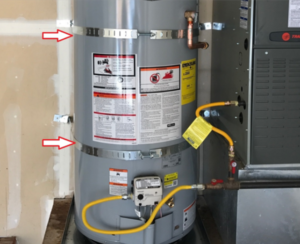
rental property maintenance plumbing and water heater secured with straps in earthquake prone areas of the country

3 Common Plumbing Emergencies In Rental Properties And What To Do

Rental Property Maintenance: 6 Items to Troubleshoot in Your Crawl Spaces

How to Waterproof Your Basement</

Part 2 – Rental Property Maintenance: Security, Pest Control, & Exteriors