
Home Blog Page 159

California Passes Rent Cap Bill 0f 5 Percent

California Passes Rent Cap Bill 0f 5 Percent

California lawmakers have passed a five-percent-plus-inflation rent cap bill that will have an effect on the state’s estimated eight million renters of apartments and some rental homes.

California Rent Control Bill 1482 means yearly rent increases over the next decade will be limited to five percent plus inflation, up to a maximum of 10 percent, and tenants will receive protections against being evicted without cause.

Gov. Gavin Newsom, who put together the deal to pass the bill, said he would sign it. The California rent cap would take effect January 1.

“These anti-gouging and eviction protections will help families afford to keep a roof over their heads, and they will provide California with important new tools to combat our state’s broader housing and affordability crisis,” the governor told the Los Angeles Times.

California rent cap not the way to fix housing crisis

“The most effective way to fix California’s housing crisis is by building more housing across a range of price points, and AB-1482 makes that harder to do,” said Doug Bibby, President of the National Multifamily Housing Council, in a statement.

“After Californians overwhelmingly rejected the rent-control ballot initiative less than a year ago, lawmakers went against their constituents by passing a measure that will discourage investment, shrink the availability of affordable housing that already exists and squeeze even more people struggling in the housing market.

“This makes the problem worse. The housing affordability crisis is real; real Americans are being harmed by it every day, and we need real solutions – not restrictive policies that we know don’t work,” Bibby said in the statement.

The California Apartment Association, which represents large corporate apartment owners, agreed not to oppose the bill during last-minute talks. But amendments adopted in the past 1½ weeks alienated another ally, the California Association of Realtors, which ended up opposing the legislation, according to reports.

California follows Oregon, which passed a similar rent cap earlier this year.

The measure would affect all apartments in the state that are at least 15 years old. Houses and condos owned by corporations and real-estate investment trusts, or REITs, that are 15 years old or older would also be subject to the rent caps.

The measure also provides just-cause eviction protections for tenants who have lived in their rental for at least a year, meaning a landlord can’t order renters who are following terms of their lease to move out unless the owner plans to move in, demolish or renovate the unit, or cease renting it at all.

The measure would not affect rent limits in local jurisdictions with existing rent-control laws. Owners who share a home with their tenants or owner-occupied duplexes would be exempt from the caps.

California rent cap bill sponsor says protecting tenants is critical

“The housing crisis is reaching every corner of America, where you’re seeing high home prices, high rents, evictions and homelessness that we’re all struggling to grapple with,”  said Assemblyman David Chiu, a San Francisco Democrat who was the bill’s author, to the New York Times. “Protecting tenants is a critical and obvious component of any strategy to address this.”

Resources:

California Approves Statewide Rent Control to Ease Housing Crisis

California tenants will see cap on rent increases under bill sent to Newsom

AB 1482: California Senate advances statewide cap on rent hikes

13 Ways You Can Pet Proof Your Rental Property

Here are 13 ways you can pet proof your rental properties as more and more tenants have pets and some landlords and property managers are concerned about opening their properties to pets.

However, they also know they can attract and keep more good tenants if they are a pet-friendly property. The maintenance checkup this week provided by Keepe focuses on ways to pet proof your rental property to be sure you are protecting your investment and income as well as keeping your tenants happy.

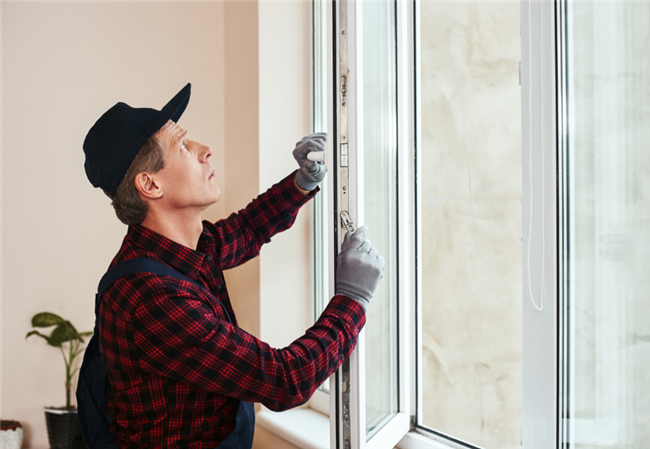
Ways to pet proof your rental with a property makeover

Property makeovers are the best way to minimize property damage by investing in durable, long-lasting solutions.

While they may require additional costs and work, property makeovers designed to thoroughly pet-proof are the most secure way to protect a property and increase the safety of pets.

No. 1 – Vinyl, linoleum and tile floors are tough, impermeable and scratch resistant. Converting existing flooring into one of those durable alternatives significantly reduces the likelihood of flooring damage that results from the activity of pets and their potential ‘indoor accidents’.

No. 2 –  Bamboo is a good option if a warmer look is desired, as it is harder than most wooden flooring, making it not so vulnerable to scratches, and it is also not as permeable having less natural grooves.

No. 3 – Polyurethane can be utilized to seal wooden floors if pursuing a complete floor makeover is out of the question.

No. 4 – High-gloss, semi-gloss and satin paints result in hard, moisture-proof finishes that are preferable when it comes to preserving and protecting walls. These finishes create washable surfaces that are not vulnerable to stains and chips.

13 Ways To Pet Proof Your Rental Property

Affordable ways to pet proof your rental property

If pursuing a complete property makeover is not feasible, encouraging tenants to pet-proof their living space is still possible and certainly adequate to avoid the likelihood of damages.

The ideas below describe affordable, easy and efficient ways to protect indoor spaces and promoting the safety of pets.

No. 5 – Area rugs are ideal for making spaces look welcoming and cozy while avoiding risks associated with carpet flooring. They add a personal touch to pet-resistant flooring, while also being easy to replace as needed.

No. 6 – Outdoor rugs can be utilized indoors as they are naturally more durable and designed for easy cleanup. They are available in many different patterns and shapes that can suit most indoor spaces.

No. 7 – Shelves and wall hangings allow decorative pieces, houseplants and more delicate items to be displayed while being out of reach of curious pets. Taking into account how far off the ground pets can reach is fundamental to make sure that anything sharp, valuable or toxic is safely stored, and shelving helps with utilizing height as a practical advantage.

No. 8 – Thick, heavy blinds are preferable to fabric curtains and flimsy plastic shades. Dragging fabric, noisy blinds and hanging cords invite biting and pulling, which is why shorter draw strings and heavier materials are a safer option.

13 Ways To Pet Proof Your Rental Property

No. 9 – Plexiglass and lucite panels are inexpensive and can be affixed to doors and windows to add a layer of protection from scratches.

No. 10 – Non-textured furnishings minimizes the scratching and biting appeal that most texturized materials have for pets.

No. 11- Metal, plastics and resin furnishings are sleek and thus less stimulating than wool, leather, and other coarse surfaces that make for inviting scratch and bite posts.

No. 12 – Microfiber and heavy, tightly-woven fabrics are most resistant to tear and wear, which is important to consider when choosing linens, couches, armchairs and similar home decor.

No. 13 – Baby gates can be used to separate pet-friendly spaces from other areas, especially those prone to housing products that are not safe for pets or displaying more delicate furnishings or flooring.

13 Ways To Pet Proof Your Rental Property

Resources:

Why A Pets Allowed Policy Makes Cents

Recommended Pet Policies for Condominiums and Apartment Buildings

7 Questions Landlords Have About Pets and Pet-Friendly Apartments

About Keepe:

Keepe is an on-demand maintenance solution for property managers and independent landlords. Keepe provides a network of trusted independent contractors and handymen who are available for maintenance projects in the Greater Seattle Area, Portland, Greater Phoenix area, San Francisco Bay area, and soon to an area near you. Learn more about Keepe at https://www.keepe.com


Apartment Economy In Oregon And Washington Contributes $121 Billion Annually

Apartment Economy In Oregon And Washington Contributes $121 Billion Annually

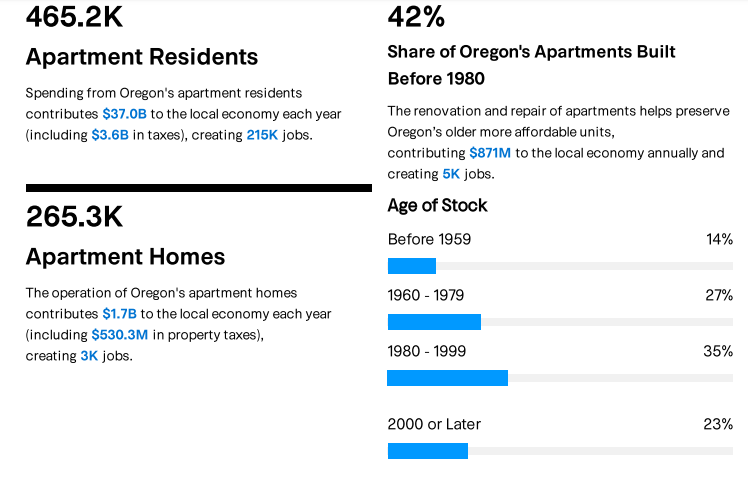
The apartment economy in Oregon, apartments and their residents, contribute $41.4 billion each year to the state economy and support 232,000 jobs while apartments in Washington State contribute $80 billion, according to the new Hoyt Advisory Council study.

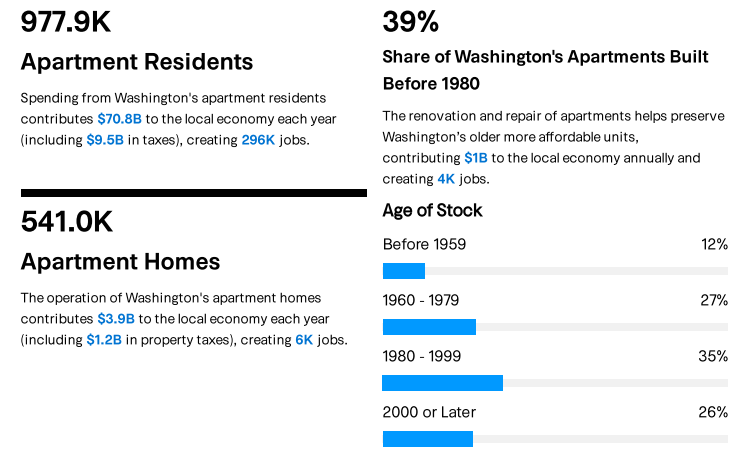
Meanwhile in Washington, apartments and their residents contribute the $80.1 billion to the state economy annually and support 322,000 jobs.

The study also says Oregon needs to build 4,000 new apartment homes each year to meet demand. Apartment construction contributes $1.8 billion to Oregon’s economy annually, creating 10,000 jobs.

Apartment economy impact in Oregon

Impact of apartment economy in Oregon

In addition, Washington needs to build 10,000 new apartment homes each year to meet demand. Apartment construction contributes $4.2 billion to Washington’s economy annually, creating 16,000 jobs.

Apartment economy impact in Washington

Impact of apartment economy in Washington state

Overall, apartments contribute $3.4 trillion to the U.S. economy and support 17.5 million jobs, according to the report.

The Hoyt Advisory Study was commissioned by the National Apartment Association (NAA) and National Multifamily Housing Council (NMHC) to show the economic impact of the apartment economy and multifamily industry.

Resident spending contributes $3.0 trillion to the U.S. economy, while operations adds $175.2 billion. New construction contributes $150.1 billion and renovation and repair adds $68.8 billion.

Apartment economy report highlights:

  • All four sectors of the industry have posted very strong growth, punctuated by the construction industry ramping up to meet the unprecedented demand for apartments this cycle – reaching a height of 346,900 completions in 2017, up from 129,900 in 2011.
  • Previous research by Hoyt Advisory Services found that we need to build an average of 328,000 apartments per year at a variety of price points to meet existing demand, which would bring continued economic activity. This number of multifamily completions has only been surpassed twice since 1989.
  • Hoyt research also found that a significant portion of the existing apartment stock will need to be renovated in the coming years, boosting spending in the renovation and repair sector.
  • The combined contribution of apartment construction, operations, renovation, and resident spending equals $3.4 trillion per year, or more than $9.3 billion daily.

“The apartment industry’s contribution is one that has grown in recent years, fueled by increased rental demand overall as population and employment growth continue and renting becomes a preferred tenure choice for millions of Americans,” Eileen Marrinan, Managing Director of Eigen 10 Advisors, which partnered with Hoyt, said in a release.

“Construction is still moving ahead, as there’s a need for additional apartments in many states. And, due to an abundance of aging stock, there’s a growing need for renovations and improvements on existing apartment buildings. Construction and renovation/repair will provide a sizable boost in jobs – and the economy – nationwide, and will continue to be a hefty contribution to the country’s economy for decades,” NMHC President Douglas M. Bibby said in the release

“The multifamily industry is an economic engine powering the economy very significantly at the national, state and local levels,” NAA President Robert Pinnegar said in the release. “This clearly illustrates the tremendous positive impact our apartments have on the communities they serve.”

Visit www.WeAreApartments.org and view the data, which is broken down by state and metro area. Visitors can also use the Apartment Community Estimator (ACE), a tool that allows users to enter the number of apartment homes of an existing or proposed community to determine the potential economic impact within a particular state or metro area.

NAA Study: Barriers To Affordable Apartment Housing In Many Cities

Apartment Economy In Oregon And Washington Contributes $121 Billion Annually
Photo courtesy of the National Apartment Association and the Industry report.

Landlord and Employee Who Subjected Women to Sexual Harassment Sued

Man Who Threatened to Kill His Landlords Sentenced to 40 Years

A landlord and his employee, a registered sex offender, subjected female tenants of his residential rental properties to sexual harassment and retaliation, such as refusing to assist with maintenance at their properties after the tenants rejected their advances, the U.S. Department of Justice charges in a lawsuit.

The lawsuit, filed in Massachusetts, charges that female tenants of residential rental properties in Worcester were subjected to sexual harassment and retaliation going back to 2009, in violation of the federal Fair Housing Act.

The landlord, Mohan Prashad, is accused of making unwanted advances, touching tenants sexually without consent, and offering to “grant tangible benefits—such as reducing rent amounts” in exchange for sexual acts. He is also accused of retaliating against tenants who resisted his harassment by intimidating them with eviction threats and refusing necessary maintenance services, according to the lawsuit.

One woman alleged Prashad stopped providing heat to her apartment and initiated eviction proceedings after she denied his advances. He reportedly asked another tenant if she was a stripper and offered to pay her $1,000 for “an hour.”

“No one should ever have to choose between housing and sexual harassment,” U.S. Attorney Andrew E. Lelling, said in the release.  “Sexual harassment is illegal under the Fair Housing Act, and my office is committed to achieving justice and compensation for individuals whose civil rights have been violated. I encourage anyone who has been subjected to sexual harassment by his or her landlord or employee of a landlord to report it to my office.”

Prashad also allegedly hired a level 3 sex offender David Besaw, and did not take action against him when he was accused of raping a tenant’s guest while she slept, according to the Boston Globe.

Besaw, a Level 3 registered sex offender in Massachusetts, has been employed by Prashad since at least 2014 to assist with the management and maintenance of his rental properties, according to the release.

Prashad owns about 15 residential properties in Worcester under his name and through Lanaton LLC and Savton LLC, which are also named defendants in the suit.

“Landlords or their employees who sexually harass tenants will be held accountable under the law by the Department of Justice,” Assistant Attorney General Eric Dreiband said in the release. “Such depraved conduct, targeting some of the most vulnerable in our communities, violates the Fair Housing Act and will not be tolerated. The Civil Rights Division will continue to enforce the law vigorously and work to secure justice for victims of these offenses.”

“No one should ever have to choose between housing and sexual harassment,”  U.S. Attorney Andrew E. Lelling, said in the release.

“Sexual harassment is illegal under the Fair Housing Act, and my office is committed to achieving justice and compensation for individuals whose civil rights have been violated.  I encourage anyone who has been subjected to sexual harassment by his or her landlord or employee of a landlord to report it to my office.”

Anna María Farías, HUD’s Assistant Secretary for Fair Housing and Equal Opportunity, said in the release, “Subjecting a person to sexual harassment not only violates the law, it robs that individual of the ability to feel safe and secure in the place they call home.” She said HUD will “continue working in partnership with the Justice Department to address this form of discrimination.”

Landlord sexual harassment

The complaint alleges that Prashad:

  • Engaged in harassment that included making unwelcome sexual advances and comments
  • Engaging in unwanted sexual touching
  • Offering to grant tangible benefits — such as reducing rent amounts — in exchange for engaging in sexual acts
  • Refusing to provide needed maintenance services
  • Taking other adverse housing actions against female tenants who resisted or objected to his unwelcome sexual harassment
  • Intimidating female tenants by monitoring them from outside their apartments or rooms.
  • After receiving notice of Besaw’s sexual harassment of female tenants, failing to take any action to prevent Besaw from future sexual harassment, according to the release.

The complaint further alleges that “Besaw subjected female tenants to unwelcome sexual contact including groping, sexual assault, and forced touching of their bodies, without consent; unwanted exposure to female tenants; making unwelcome sexual comments and sexual advances toward female tenants; and making intrusive, unannounced visits to female tenants’ units to conduct and further his sexual advances.”

This is the 11th lawsuit alleging a pattern or practice of sexual harassment in housing filed since  October 2017 when the Justice Department launched an initiative to combat sexual harassment in housing.  In April 2018, the Department announced the nationwide rollout of the initiative, including three major components: an outreach toolkit to leverage the Department’s nationwide network of U.S. Attorney’s Offices, a public awareness campaign, including the release of a national Public Service Announcement and a new joint Task Force with HUD to combat sexual harassment in housing.

The lawsuit seeks monetary damages to compensate the victims, civil penalties and a court order barring future discrimination.

Individuals who have information about this case can contact the U.S. Attorney’s Office Civil Rights Unit by calling 617-748-3100 and asking for the Civil Rights Intake Specialist, or emailing usama.victimassistance@doj.gov. Victims of sexual harassment related to housing nationwide can also contact the Justice Department’s Sexual Harassment in Housing Initiative by calling 1-844-380-6178, or through email at fairhousing@usdoj.gov.

Victims of sexual harassment related to housing nationwide can also contact the Justice Department’s Sexual Harassment in Housing Initiative by calling 1-844-380-6178, or through email at fairhousing@usdoj.gov.

Related article

Sexual Harassment In Housing And Unwelcome Comments And Requests

Resources:

Justice Department Files Lawsuit Against Massachusetts Landlord and Employee Who Subjected Women to Sexual Harassment

Worcester landlord and his employee accused of sexually harassing female tenants for 10 years

Worcester Landlord, Employee Sued for Sexual Harassment of Tenants

Worcester Landlord, Employee Harassed Tenants, Feds Allege

3 Ways To Maximize Rents At Your Apartment Building

3 Ways To Maximize Rents At Your Apartment Building

Before you advertise your next apartment vacancy, here are three ways to maximize rents that many property managers and investors in multifamily properties are looking to do.

No. 1 – Do the little things to maximize rents

Tenants don’t want to show up to a property where the landscaping is overrun, paint is peeling, or trash is strewn about.

Take the time to address these low-cost fixes. First impressions matter when you are trying to achieve market rents.

Just as you wouldn’t want to show up to your own home in this condition, tenants feel the same way. They will reward you with fair rents and longer-term tenancy.

3 Ways to Maximize Rents at Your Apartment Building
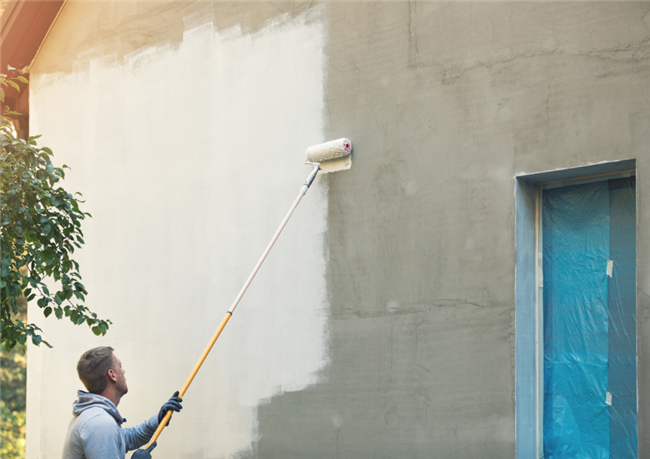
Exterior paint is a key to letting tenants know you take care of the property.

No. 2 – Complete a thorough renovation of an older or dilapidated unit

Could your rent be $100, $200 or even $500 higher if the apartment was remodeled?

If so, you may be missing out on a great opportunity to gain a high return on your investment.

Many owners look at the time it will take to recover the cost of the remodel and get discouraged. However, if you invest $10,000 into a unit that allows you to achieve $200 more per month, that is a whopping 24 percent annual return on your investment!

A $200 rent bump also translates into almost $50,000 in value at a 5 percent capitalization rate. Now that’s a great investment!

how to maximize rents
If you invest $10,000 into a unit that allows you to achieve $200 more per month, that is a whopping 24 percent annual return on your investment!

No. 3 – Understand your market’s rents

A wise person once said, “If you don’t know where you’re going, then you don’t know where you are.”

In other words, how can you tell if your rents are below or even far below the market if you don’t know where market rents are?

Market rents will vary between quality, condition and location even within the same neighborhood.

You can do your own research by going online and see what others are asking and what they are offering. For insider info, you can consult with a local property manager or an apartment real estate broker.

An experienced apartment broker would provide this information for free and with a high level of detail.

About the author:

Carlos Azucena is a real estate broker with 15 years of experience in apartment sales, representing buyers and sellers. He serves the San Francisco Bay Area and can be reached at 650-391-1746 or cazucena@marcusmillichap.com. Find out more at www.cfapropertyadvisors.com.

Related story: How Does Rent Control Affect the Value of Multifamily Property?

New Smart Submetering Partnership For The Multifamily Industry

New Smart Submetering Partnership For The Multifamily Industry

Multifamily submetering is quickly becoming the standard for utility management in the industry and Dwelo has announced an integration partnership with NextCentury to provide a solution for multifamily communities.

Dwelo, provider of smart-home solutions purpose-built for apartments, and NextCentury, the first and only completely cloud-based submetering solution, announced an integration partnership in a release.

Utility submetering is a system that allows a landlord, property management firm, condominium association, homeowners association, or other multi-tenant property to bill tenants for individual measured utility usage. The approach makes use of individual water meters, gas meters, or electricity meters.

Multifamily submetering becoming the standard

The partnerships will allow owners and managers to have more information and control over their communities specifically through increased smart utility management and leak detection and mitigation.

“We believe bringing submetering into the next century is critical to the success of multifamily communities,” Mike Clements, CEO at NextCentury Meters, said in the release.

“NextCentury provides owners the ability to bill residents for exact utility consumption while also providing custom reporting and timely alert notifications to managers. Like Dwelo, we aim to give owners more data and control over their communities. This partnership continues our focus on creating the future of submetering, passing tremendous savings back to the owners and adding value for residents.”

Submetering is becoming the standard and states like California, Texas, and Georgia require submeters in all new construction projects.

“Partnering with Next Century continues Dwelo’s mission of offering managers and owners increased efficiency through access to more data and control of their communities,” Mike Rovito, CEO at Dwelo, said in the release.

“We are excited to provide submetering alerts to our customers. Poor utility management can result in costly occurrences that can be better prevented with this partnership with Next Century.”

Submeter systems capture water data on a unit level. Capturing this data is a win-win for both residents and management staff, according to the release.

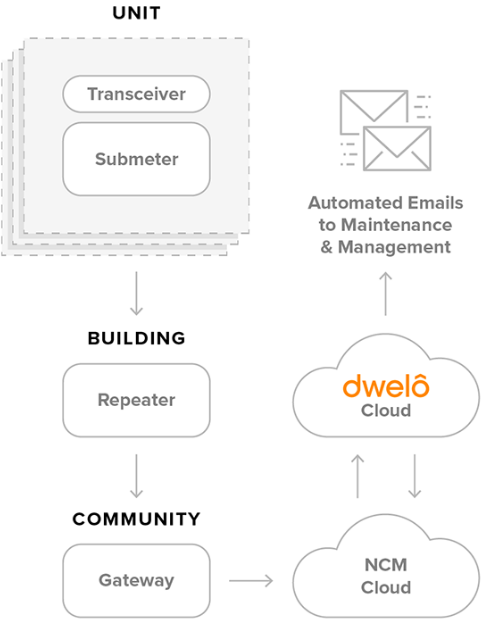
How Dwelo and NextCentury Meters Work Together

New Smart Submetering Partnership For The Multifamily Industry

Residents win because they can now be billed for their exact water usage which typically results in conservation. Management wins through the ability to monitor and mitigate water leaks with this data.

Non-catastrophic leaks are common in multifamily communities.

Examples of non-catastrophic leaks include:

  • Constantly running toilets
  • Slowly dripping faucets
  • Leaky pipes in less frequently visited areas like mechanical rooms or crawl spaces.

These types of leaks often go undetected for days or weeks, resulting in wasted money – in the form of wasted water – and in some cases, costly water damage or mold.

The following are typical costs that a property could expect to incur due to non-catastrophic leaks and inefficient utility management:

  • $10 per day for undetected running toilets and faucets.
  • $10,000 average in damage for typical appliance or plumbing leaks.

The partnership between Dwelo and NextCentury offers owners, managers, and maintenance, the necessary tools and notifications to significantly mitigate the costs caused by these occurrences, according to the release.

It works by allowing property management and maintenance staff to receive notifications in the event that a water leak or water temperatures that could cause freezing pipes are detected. Staff are notified of the community and unit that these events are occurring.

Related story: Dwelo Investing $20 Million To Bring Smart Technology To Apartments

About Dwelo Smart Apartments

Dwelo provides simple, seamless, smart apartments to the owners and managers of multifamily communities. Dwelo connects popular smart devices from Z-Wave, Nest, Kwikset, Yale, and voice platforms like Amazon Echo and Google Home. Dwelo’s platform enables residents to enjoy the benefits of a smart home in a rental setting, while helping managers run their communities more efficiently

Utah Apartments And Residents Contribute $17 Billion To The Utah Economy Annually

Utah Apartments And Residents Contribute $17 Billion To The Utah Economy Annually

Utah apartments and their residents contribute $17.1 billion to the state economy annually, supporting 95,000 jobs, according to the new Hoyt Advisory Council study.

Apartment demand is growing and the industry needs to keep up. However, producing enough new apartments to meet demand requires new development approaches, more incentives and fewer restrictions.

More Utah apartments needed

Utah needs to build 3,000 new apartment homes each year to meet demand. Apartment construction contributes $1.3billion to Utah’s economy annually, creating 7,000 jobs.

Utah Apartments And Residents Contribute $17 Billion To The Utah Economy Annually

Overall, apartments contribute $3.4 trillion to the U.S. economy and support 17.5 million jobs, according to the report.

The Hoyt Advisory Study was commissioned by the National Apartment Association (NAA) and National Multifamily Housing Council (NMHC).

Resident spending contributes $3.0 trillion to the U.S. economy, while operations adds $175.2 billion. New construction contributes $150.1 billion and renovation and repair adds $68.8 billion.

Highlights from the report include:

  • All four sectors of the industry have posted very strong growth, punctuated by the construction industry ramping up to meet the unprecedented demand for apartments this cycle – reaching a height of 346,900 completions in 2017, up from 129,900 in 2011.
  • Previous research by Hoyt Advisory Services found that we need to build an average of 328,000 apartments per year at a variety of price points to meet existing demand, which would bring continued economic activity. This number of multifamily completions has only been surpassed twice since 1989.
  • Hoyt research also found that a significant portion of the existing apartment stock will need to be renovated in the coming years, boosting spending in the renovation and repair sector.
  • The combined contribution of apartment construction, operations, renovation, and resident spending equals $3.4 trillion per year, or more than $9.3 billion daily.

“The apartment industry’s contribution is one that has grown in recent years, fueled by increased rental demand overall as population and employment growth continue and renting becomes a preferred tenure choice for millions of Americans,” Eileen Marrinan, Managing Director of Eigen 10 Advisors, which partnered with Hoyt, said in a release.

“Construction is still moving ahead, as there’s a need for additional apartments in many states. And, due to an abundance of aging stock, there’s a growing need for renovations and improvements on existing apartment buildings. Construction and renovation/repair will provide a sizable boost in jobs – and the economy – nationwide, and will continue to be a hefty contribution to the country’s economy for decades,” NMHC President Douglas M. Bibby said in the release

“The multifamily industry is an economic engine powering the economy very significantly at the national, state and local levels,” NAA President Robert Pinnegar said in the release. “This clearly illustrates the tremendous positive impact our apartments have on the communities they serve.”

Visit www.WeAreApartments.org and view the data, which is broken down by state and metro area. Visitors can also use the Apartment Community Estimator (ACE), a tool that allows users to enter the number of apartment homes of an existing or proposed community to determine the potential economic impact within a particular state or metro area.


Seattle Rents Increase Again For Eighth Straight Month

Seattle Rents Increase Again For Eighth Straight Month

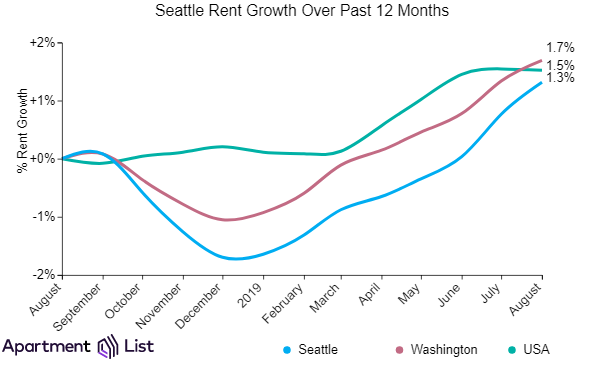
Seattle rents have increased again for 0.5 percent over the past month, and have increased slightly by 1.3 percent in comparison to the same time last year, according to the most recent report from Apartment List.

Currently, median rents in Seattle stand at $1,362 for a one-bedroom apartment and $1,696 for a two-bedroom. This is the eighth straight month that the city has seen rent increases after a decline in December of last year.

Seattle’s year-over-year rent growth lags the state average of 1.7 percent, as well as the national average of 1.5 percent.

Rents rising across the Seattle metro

Seattle Rents Increase Again For Eighth Straight Month

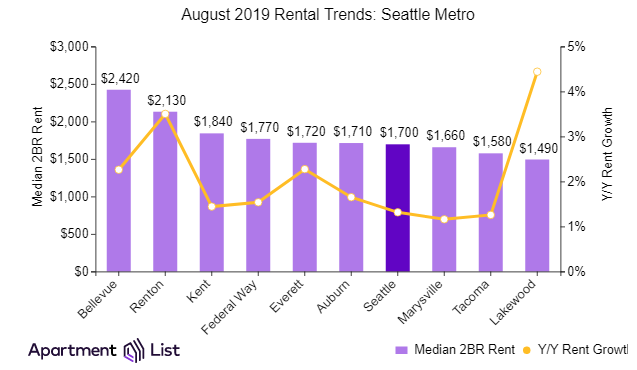
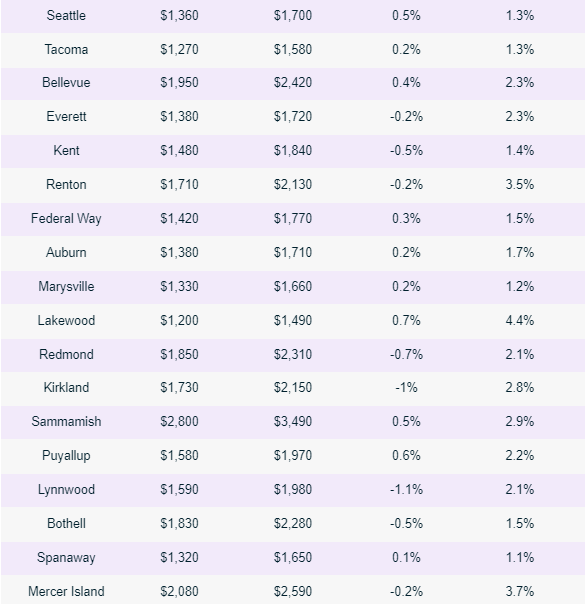
Throughout the past year, rent increases have been occurring not just in the city of Seattle, but across the entire metro. Of the largest 10 cities that Apartment List has data for in the Seattle metro, all have seen prices rise.

Here’s a look at how rents compare across some of the largest cities in the metro.

  • Lakewood has the least expensive rents in the Seattle metro, with a two-bedroom median of $1,493; the city also has experienced the fastest rent growth in the metro, with a year-over-year increase of 4.4 percent.
  • Over the past month, Kent has seen the biggest rent drop in the metro, with a decline of 0.5 percent. Median two-bedrooms there cost $1,842, while one-bedrooms go for $1,479.
  • Bellevue has the most expensive rents of the largest cities in the Seattle metro, with a two-bedroom median of $2,424; rents grew 0.4 percent over the past month and 2.3 percent over the past year.

Rents Increase Again For Eighth Straight Month Around The Seattle metro

Around the metro

Similar cities nationwide show more affordable rents compared to Seattle

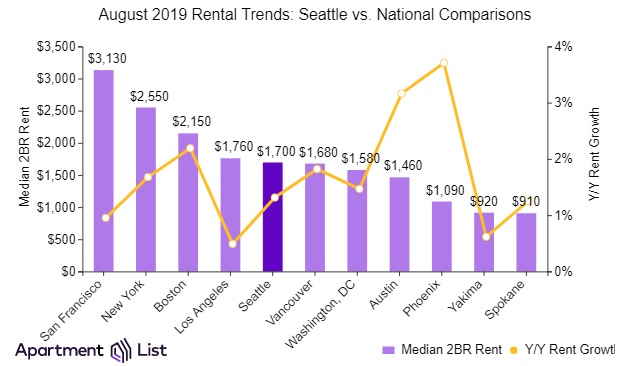
As rents have increased slightly in Seattle, a few similar cities nationwide have also seen rents grow modestly. Compared to most other large cities across the country, Seattle is less affordable for renters.

  • Rents increased slightly in other cities across the state, with Washington as a whole logging rent growth of 1.7 percent over the past year. For example, rents have grown by 1.8 percent in Vancouver and 1.3 percent in Spokane. Spokane has a median two-bedroom rent of $905, where Seattle is more than one-and-a-half times that price.
  • Seattle’s median two-bedroom rent of $1,696 is above the national average of $1,191. Nationwide, rents have grown by 1.5 percent over the past year compared to the 1.3 percent increase in Seattle.
  • While Seattle’s rents rose slightly over the past year, many cities nationwide also saw increases, including Phoenix (+3.7 percent), Austin (+3.2 percent), and Boston (+2.2 percent).

How Seattle compares to other cities nationally

Last month: Seattle Rents Continue Upward For Seventh Straight Month

Salt Lake City Rents Declined Slightly Over The Past Month

Ogden rents up

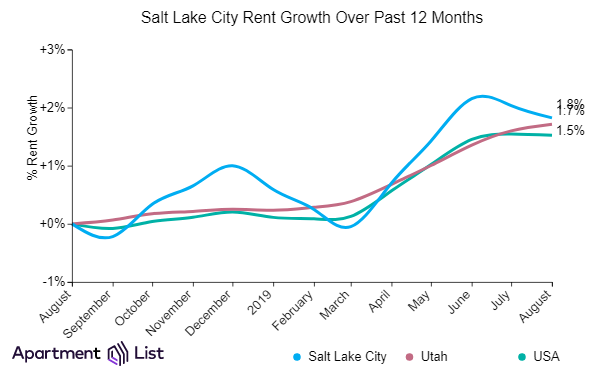
Salt Lake City rents have declined 0.2% over the past month, but have increased slightly by 1.8% in comparison to the same time last year, according to the latest report from Apartment List.

Currently, median rents in Salt Lake City stand at $873 for a one-bedroom apartment and $1,083 for a two-bedroom.

This is the second straight month that the city has seen rent decreases after an increase in June. Salt Lake City’s year-over-year growth leads the state average of 1.7%, as well as the national average of 1.5%.

Ogden rents increased slightly over the past month

Ogden rents up

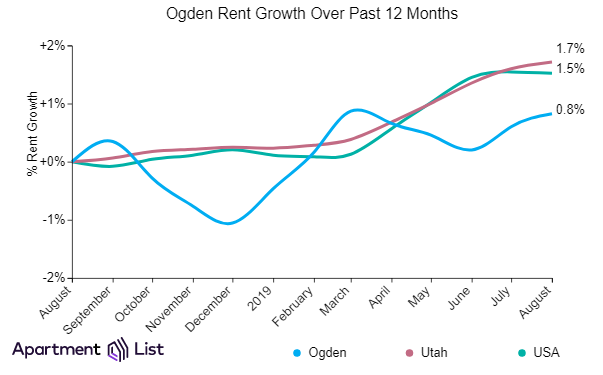
Ogden rents have increased 0.2% over the past month, and are up marginally by 0.8% in comparison to the same time last year.

Currently, median rents in Ogden stand at $697 for a one-bedroom apartment and $893 for a two-bedroom.

This is the second straight month that the city has seen rent increases after a decline in June. Ogden’s year-over-year rent growth lags the state average of 1.7%, as well as the national average of 1.5%.

Salt Lake City Rents Declined Slightly Over The Past Month

Salt Lake City more affordable than many large cities nationwide

As rents have increased slightly in Salt Lake City, a few large cities nationwide have also seen rents grow modestly. Salt Lake City is still more affordable than most large cities across the country.

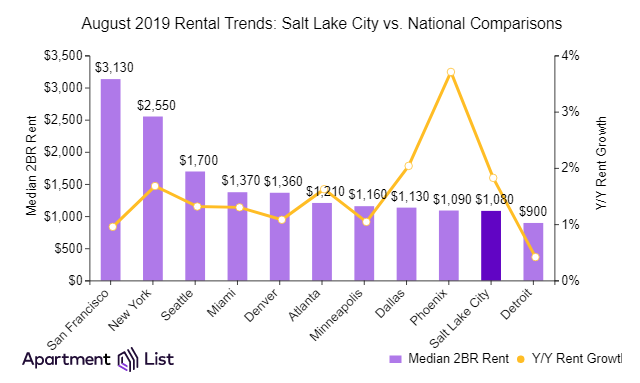
  • Salt Lake City’s median two-bedroom rent of $1,083 is below the national average of $1,191. Nationwide, rents have grown by 1.5% over the past year compared to the 1.8% increase in Salt Lake City.
  • While Salt Lake City’s rents rose slightly over the past year, many cities nationwide also saw increases, including Phoenix (+3.7%), Dallas (+2.0%), and New York (+1.7%).
  • Renters will find more reasonable prices in Salt Lake City than most large cities. For example, San Francisco has a median 2BR rent of $3,133, which is more than two-and-a-half times the price in Salt Lake City.

Last month’s report:

Salt Lake City Rents Declined Over The Past Month

Methodology:

Apartment List is committed to making rent estimates the best and most accurate available. To do this, they use reliable median rent statistics from the Census Bureau, then extrapolate them forward to the current month using a growth rate calculated from their listing data. They use a same-unit analysis similar to Case-Shiller’s approach, comparing only units that are available across both time periods to provide an accurate picture of rent growth in cities across the country.

Think Like A Tenant: Qualifying Repair and Renovation Landlord Exemption Under SB 608

A federal judge has ruled a landlord did not have to automatically waive its animal fee for a tenant with an emotional support animal

Portland Attorney Brad Kraus takes on the issue of qualifying repair and renovation landlord exemption under SB 608 and urges landlords to think like a tenant.

By Brad Kraus
Attorney, Warren Allen LLP

Senate Bill 608 is in full force and effect. Many Landlords are wrestling with SB 608’s language and meaning, along with its effect on landlords’ rights, if any they still have.

Many Landlords’ biggest fear over SB 608 was its purported elimination of Landlords’ rights to serve No Cause Notices of Termination. While SB 608 has significantly undermined Landlords’ rights to serve No Cause Notices, certain exemptions remain which still allow for No Cause Notices. One such exemption – the Repair/Renovation Exemption – functions by placing Landlords in the intriguingly awkward position of arguing that their premises are uninhabitable. In other words, it causes Landlords to think like a Tenant, when assessing the magnitude of their habitability problems during the repairs/renovations.

If you’re thinking, “I’ve had tenants raise habitability allegations in an effort to avoid paying rent,” you’re already familiar with habitability disputes. Oregon’s “habitability statute” lists several items that, if substantially lacking, render the premises uninhabitable. For example, if there’s no water supply, no functional roof, no heating, or no electricity (see the theme here?), the premises likely are unsafe or unfit for occupancy. Think of habitability strategies from a tenants’ perspective: if the rented premises substantially lacks water, heat, electricity, etc., a tenant could successfully (a) contend that the premises isn’t habitable, and (b) avoid owing you rent for the timeframe during which the premises was uninhabitable.

Brad Kraus Portland Attorney Think Like A Tenant: Qualifying Repair and Renovation Landlord Exemption Under SB 608
Brad Kraus

SB 608 repair/renovation exemption

Many Landlords encounter habitability defenses in their eviction actions. However, Senate Bill 608’s repair/renovation exemption flips the habitability script, by requiring Landlords – not Tenants – to make the Tenant-like argument that the premises are (or will be) uninhabitable. Fortunately, seasoned Landlords can use their habitability knowledge in order to salvage No Cause Notice termination strategies under SB 608.

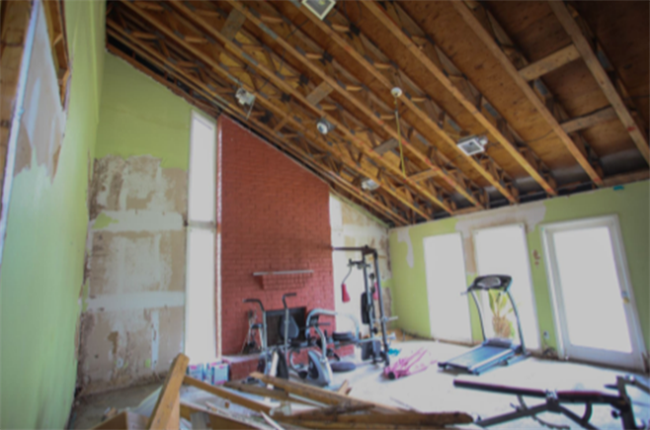
SB 608’s Repair/Renovation Qualifying Landlord Exemption requires that the Landlord “intends to undertake repairs or renovations to the dwelling unit within a reasonable time and: (a) The premises is unsafe or unfit for occupancy; or (b) The dwelling unit will be unsafe or unfit for occupancy during the repairs or renovations.”  The statute’s operative words, “unsafe” and “unfit,” are not defined. Alas, your habitability knowledge can supplant those definitional gaps by knowing what it takes to meet the statutory threshold: The more your repairs/renovations make the place uninhabitable, the more likely you are to defeat a tenant’s argument that you didn’t qualify for the Repair/Renovation Qualifying Landlord Exemption. In other words, the worse off your property is (or will be), the better off your Exemption argument will be.

Remember that SB 608 is state law and does not universally preempt local jurisdictional laws. For example, Portland has its own rules, requirements and exemptions that often differ from those crafted by the state legislature. Accordingly, regardless of your right to serve No Cause Notices under SB 608’s Repair/Renovation Landlord Exemption, make sure you comply with local laws.

The penalties for failing to serve valid notices that fall neatly within the Repair/Renovation Landlord Exemption can be costly, so understand your rights, know when to think like a tenant, and contact a skilled Landlord/Tenant attorney, should you have any questions.

Think Like A Tenant: Qualifying Repair and Renovation Landlord Exemption Under SB 608

About the author:

Brad Kraus is an attorney at Warren Allen LLP. His primary practice area is Landlord/Tenant law, but he also assists clients with various litigation matters, probate matters, real estate disputes, and family law matters. A native of New Ulm, Minnesota, he continues to root for Minnesota sports teams in his free time. He is an avid sports fan, enjoys exercise, spending time friends and his fiancée, Vicky. You can reach Mr. Kraus via email at kraus@warrenallen.com, or by phone at 503-255-8795.