Home Blog Page 160

Portland Rents Increase Sharply Over The Past Month

Portland Rents Increase Sharply Over The Past Month

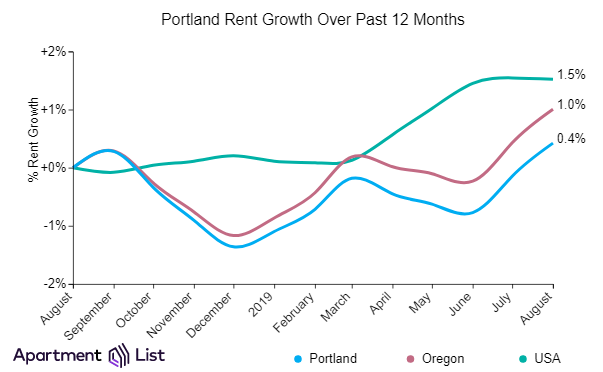
For the second month in a row Portland rents have increased, this time 0.6% over the past month, but have been relatively flat at 0.4% in comparison to the same time last year, according to the August report from Apartment List.

Currently, median rents in Portland stand at $1,137 for a one-bedroom apartment and $1,342 for a two-bedroom. This is the second straight month that the city has seen rent increases after a decline in June. Portland’s year-over-year rent growth lags the state average of 1.0%, as well as the national average of 1.5%.

Portland Rents Increase Sharply Over The Past Month

Rents rising across cities in the Portland Metro

Throughout the past year, rents have remained steady in the city of Portland, but other cities across the entire metro have seen rents increase. Of the largest 10 cities that Apartment List has data for in the Portland metro, all of them have seen prices rise. Oregon as a whole logged rent growth of 1.0% over the past year.

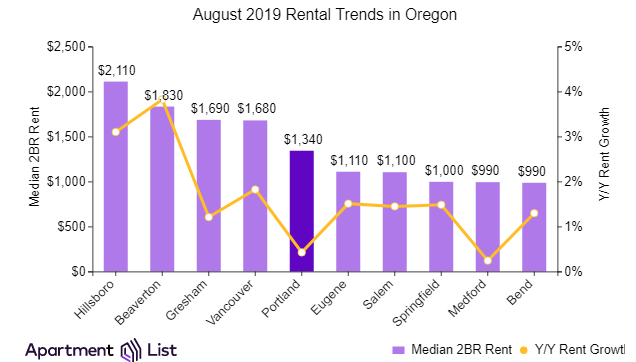
Here’s a look at how rents compare across some of the largest cities in the metro.

  • Looking throughout the metro, Hillsboro is the most expensive of all Portland metro’s major cities, with a median two-bedroom rent of $2,110; of the 10 largest Oregon metro cities that we have data for, all have seen rents rise year-over-year, with Beaverton experiencing the fastest growth (+3.8%).
  • Hillsboro, Vancouver, and Eugene have all experienced year-over-year growth above the state average (3.1%, 1.8%, and 1.5%, respectively).

Rents more affordable than many comparable cities nationwide

Rent growth in Portland has been relatively stable over the past year – some other large cities have seen more substantial increases. Portland is still more affordable than most other large cities across the country.

  • Portland’s median two-bedroom rent of $1,342 is above the national average of $1,191. Nationwide, rents have grown by 1.5% over the past year compared to the stagnant growth in Portland.
  • While rents in Portland remained moderately stable this year, similar cities saw increases, including Las Vegas (+3.9%), Phoenix (+3.7%), and Austin (+3.2%); note that median 2BR rents in these cities go for $1,187, $1,089, and $1,465 respectively.
  • Renters will find more reasonable prices in Portland than most similar cities, the report says.

Last month’s report:

Portland Rents Inch Up After Two Months Of Declines

Related article:

Stop Raising Rents In Portland

New Teachers Spend Nearly Half Their Income on Rent

New Teachers Spend Nearly Half Their Income on Rent

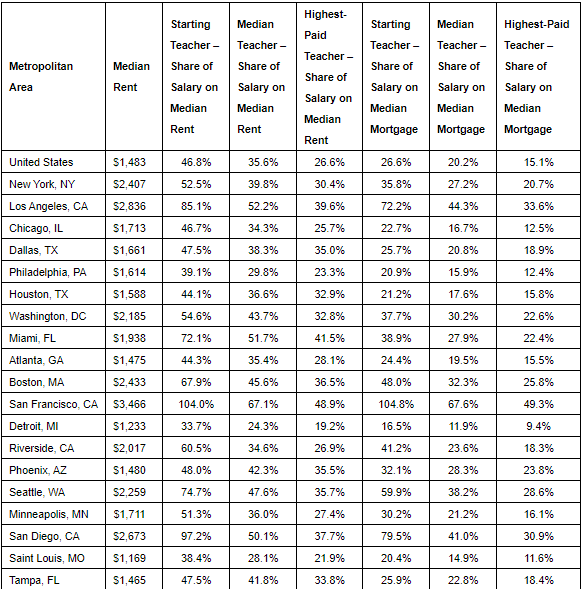
New teachers will find the typical rent unaffordable in 49 of the 50 largest metro areas in the United States, according to new analysis from Zillow.

  • The median-market-rate rent payment would take 46.8 percent of a typical starting teacher’s salary, 35.6 percent of a mid-career teacher’s salary and 26.6 percent of the highest-paid teacher’s salary.
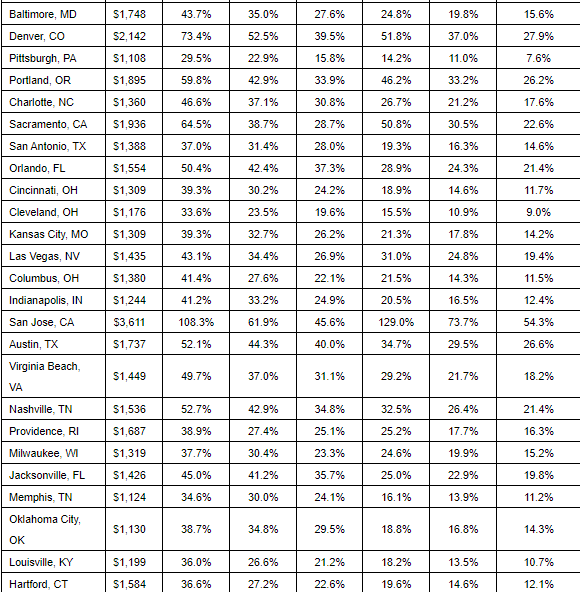
  • Pittsburgh is the only large U.S. metro where market-rate-rent prices are affordable for entry-level teachers.
  • Mortgage payments are relatively more affordable, taking 26.6 percent of a typical starting teacher’s salary – assuming a 20 percent down payment.

“Most acknowledge that building more homes is required to address the root cause of eroding housing affordability,” said Skylar Olsen, Zillow’s director of economic research, in the release.

“Without that new influx to take the pressure off rent and aggressive home value growth, it’s the public servants, like teachers, firefighters, and nurses – the professions that keep us safe, our kids smart, and our families healthy – that often feel the pinch most. So don’t think of housing affordability policies as a choice between change and the status quo. Crowded, job-rich communities will change — and it will be either the buildings that change or the mix of people who can afford to live in them,” Olsen said.

It is not only the most expensive markets where teachers are cost burdened. New teachers spend more  than half of their income on market-rate rent in some broadly affordable metros, such as Salt Lake City, Minneapolis and Raleigh.

Of the 50 largest metro areas, only Pittsburgh offers affordable rent for starting teachers. And even the highest-paid teachers would find the typical rental affordable in just over half of large metros.

Teachers who own a home are in a better position, due in part to the benefit of low mortgage interest rates and decades-long terms that lock in payments even as home prices rise, the Zillow report said.

New Teachers Spend Nearly Half Their Income on Rent

Related story:

National Average Multifamily Rents Up Again in July, Hitting $1,469

New Teachers Spend Nearly Half Their Income on Rent
Photo credit Weedezign via istockphoto.com

3 Of The Most Common Traps Rental Property Owners Encounter

Rent Payment Issues Primarily Send Property Managers To Court

As a new or experienced landlord, you probably know that there are all kinds of things (both big and small) that can cause problems and consume your precious time. Between dealing with building maintenance, difficult tenants, and financial concerns, being a rental property owner can be exceptionally stressful.

There are certainly some pitfalls that you are more likely to encounter than others. Here are three of the top traps that property owners commonly find themselves stuck in. We’ll also discuss some of the ways you can escape these traps and make your job easier.

1. Trusting a Tenant Based on Their Word Alone

 Unfortunately, there’s a reason that seasoned property owners always, always conduct background checks on their rental applicants. They want to know as much as possible to ensure that they’re accepting a tenant who will be responsible and trustworthy.

Many landlords, at some point in their careers, get burned for trusting a tenant without the proper evidence to support their claims. It’s a common trap and one that can get messy really quickly.

In some cases, you might rent to someone who feels like a friend (or who actually is). You wind up leasing to a tenant who you don’t actually know that well, and in the end, your assumption about their character could backfire dramatically. Never assume that someone will make a good tenant just because they’re friendly or they tell you a believable story about their life.

At the end of the day, you should never accept a tenant based on their word alone. You need hard evidence that they haven’t committed any crimes and are going to be a good renter. The only way you can get this evidence is by requesting it from all applicants.

Don’t just ask your tenant about their history – confirm it by gathering the following information:

  • Their full name and social security number
  • Their age
  • Current and previous addresses
  • Information from previous landlords
  • Their current income (and proof of payment)
  • Their employer’s contact information
  • Banking and credit references
  • Personal references you can follow up with (not family)

Besides following up with references, employers, and previous landlords, you should also pull a background check on your applicant from a verified tenant screening company. Services like My Smart Move and My Rental are fairly inexpensive – but will quickly help you identify your top candidates.

As much as you’d like to think you can trust the word of your current applicants, it’s your job as a rental property owner to take that extra step and do some research behind the scenes. Otherwise, you run the risk of falling into the common trap of working with bad, untrustworthy tenants.

2. Taking on the Accounting Jobs By Yourself

3 Of The Most Common Traps Rental Property Owners Encounter
As a rental property owner, your job isn’t to make sure that dollars and expenses don’t slip through the cracks.

Regardless of how organized or experienced you may be; you’ll juggle a lot as a property owner. Too many landlords find out later that they can’t actually handle everything at once, at least not without proper assistance.

If you repeatedly find yourself swamped with issues in the finance sector of your business, you might be dealing with tasks that a real accountant should be handling. Whether you have one tenant or 100, it’s a smart idea to hire an accounting partner that can prevent problems, including:

  • Bookkeeping mistakes
  • Poor account and finance records
  • Failure to deduct expenses properly
  • Inconsistent salary management

Wondering why you would need an accountant if you can manage all of the finances on your own? As a rental property owner, your job isn’t to make sure that dollars and expenses don’t slip through the cracks. Your job is to keep the property running smoothly, and an accountant can help you do that more accurately.

Outsourcing your accounting tasks is likely easier than you think it is. You don’t necessarily have to hire an accountant full time. Instead, you could use a service like Ardem or RSM to handle the issues you don’t have the time or knowledge to tackle.

3. Collecting Rent in Too Many Forms

One tenant pays by cash. One pays by check. One sends you funds on Venmo whenever they get around to it.

Does this sound like your rent payment situation?

If so, you’re likely stuck in the trap of complicated rent collection. This can lead to accounting problems, as well as stress and frustration due to confusing interactions with your tenants.

In order to maintain a consistent cash flow that you can easily keep track of, you should automate your rent collection process ASAP. This will lead to better, clearer interactions with your tenants, and you won’t waste time chasing after the rent payments you’re owed as a rental property owner.

The best way to automate your rent collection is to set up a central tenant platform where they can pay all of their fees, including their rent and any late payments. There are dozens of services available at your fingertips that will allow you to build a clean, simple tenant portal that all of your renters can use.

Some reliable tenant payment platforms for rental property owners include:

Centralizing your payment system won’t just make things easier for you. It will also completely change how your tenants manage their payments, and overall, the process will become easier for everyone.

3 Of The Most Common Traps Rental Property Owners Encounter
Centralizing your payment system won’t just make things easier for you. It will also completely change how your tenants manage their payments.

Rental property owners summary and conclusion

Many rental property owners fall into the traps listed above without even realizing it. If you’re wasting your time with challenging tenants, complicated accounting problems, or late rent payments, then you’re taking away time from your most important tasks as a landlord.

If you learn one thing from this article, let it be this: it’s often smart to ask for help as a property owner.

Use tools to thoroughly evaluate your tenants instead of taking their word as proof. Outsource your accounting issues so that you can feel secure in your finances. Simplify and automate your rent collection process so you experience fewer issues.

There are many resources out there that can help you escape these common traps. Don’t be afraid to try them, regardless of how old or new you may be to owning rental properties.

About the Author:

Eric D. Davis is the Founder of Davis Property Management; we help property managers and potential tenants looking for Seattle Property Management and Maintenance services. We have been the front-runners in providing best-in-class property management services in the Puget Sound

8 Rental Property Deck Maintenance Do’s And Don’ts

How A Regular Maintenance Schedule For Rental Property Can Help Busy Landlords

Tenants love decks, so the 8 rental property deck maintenance do’s and don’ts is the maintenance checkup from Keepe this week, and some of the don’ts may surprise you.

Decks are a unique feature that adds both value and living space to a property’s exteriors, and alongside pools and playgrounds, tops the charts as one of the most beloved amenities among tenants.

This week’s article will provide a helpful series of contractor-approved guidelines for keeping decks in top-shape as well as overviewing common mistakes that are actually damaging to a deck’s materials and structure.

Four Do’s of Rental Property Deck Maintenance

Here are the top 4 things you should think about when it comes to rental property deck maintenance.

No. 1 – Schedule an Annual Deep Cleaning Procedure

A deep cleaning procedure works as an “exfoliator” that both cleans the deck and also allows for the wood’s surface to become better primed for treatments.

Scrubbers and pressure washers can be used for this procedure, which apply proper friction for the porous surface to “open up” and better absorb sealants and treatments. Our experts warn that being mindful about exterior temperatures is fundamental: for example, when it’s too hot, cleaning solutions and treatments lose efficacy as they evaporate more quickly. Deep cleaning should be performed when it’s dry and about 60-70 degrees Fahrenheit outside.

No. 2 – Familiarize Yourself With Available Treatments and Treat Accordingly

Sealing decks is essential for protecting their look and structure and thus prolonging their lives.

Untreated wood is vulnerable to surface damages, cracking, rotting and discoloration caused by weather, water, pest and UV rays. Available sealants include natural and synthetic sealants, stains and paint.

Certain characteristics contribute to making some of those treatments more ideal than others. For instance, natural sealants can include oils that pests and algae find appealing. Paint is known to chip and bubble over time instead of aging well like stains do. It’s always best to consult an expert before settling with a treatment that has never been applied to a deck before.

No. 3 – Allow for Proper Drying

After being cleaned, sanded and treated, decks need time to thoroughly dry.

Checking the weekly forecast and keeping tenants from using the deck too soon are final but vital steps to ensure time spent treating was time well spent

No. 4 – Pay Attention and Inspect Seasonally

Decks should be inspected regularly to ensure that any damage, cracks, rusting and loose components are noted and repaired as soon as possible.

If a problem is noticed in the wintertime, it’s not ideal to wait until the warmer season to address it as it might then not only be completely forgotten about – and thus allow for injuries to occur once the deck is used more often – but could potentially be worsened by being exposed to harsh seasonal weather for several weeks.

8 Rental Property Deck Maintenance Dos And Don’ts
Remember your rental property deck maintenance checklist because a sealed deck is not maintenance-free.

4 Don’ts of Rental Property Deck Maintenance

OK, here are some of those things you should not do when it comes to deck maintenance.

No. 1 – Be Overconfident After Sealing

A sealed deck is not maintenance-free. While sealing takes care of protecting the deck from most elements, areas that are not covered are still exposed and thus prone to damage and wear.

It’s important to keep the deck clean and free of debris and dirt to prevent staining, and still inspect the deck with regularity.

No. 2 – Go the Do-It-Yourself Route

For major procedures – sanding, sealing, deep cleaning – it’s always best to turn to a professional, as botched maintenance job almost always results in visibly damaged areas that require being completely replaced. Sanding and pressure washing can permanently warp the surface of the wood.

No. 3 – Get Too Aggressive With Cleaning

Cleaning is supposed to complement the protective and nurturing purpose of sealants. It’s important to avoid utilizing harsh chemicals, like bleach. These can permanently stain and ruin the natural coloration of the wood.

Pressure washing can also do more harm than good when it’s used too much or incorrectly, which is why maintenance professionals emphasize keeping in mind that it has the ability to strip off the wood.

No. 4 – Forget About Nearby Vegetation

The products utilized for cleaning and treating wood are typically not plant-friendly. It’s important to cover surrounding vegetation with a plastic or cloth tarp – the latter allows for better ventilation and is recommended for longer projects – to keep it from being killed by the chemicals.

Resources: Other recent rental property maintenance Keepe posts

4 Outdoor Flooring Options For Your Rentals

20 Easy, Affordable Maintenance Projects To Update Your Rentals

5 Maintenance Tips For Long-Lasting Rental Carpet Flooring

Is The Water Heater At Your Rental Property Ready For The Big One?

7 Types Of Kitchen Countertops For Your Apartments

Which Cooktop Is Best For Your Rental Property?

About Keepe:

Keepe is an on-demand maintenance solution for property managers and independent landlords. The company makes hundreds of independent contractors and handymen available for maintenance projects at rental properties. Keepe is available in the Greater Seattle area, Portland, Phoenix, San Francisco Bay and San Diego areas.


HUD Charges Colorado Landlords with Discriminating Against Families with Children

HUD Charges Colorado Landlords with Discriminating Against Families with Children

The owners and manager of a condominium complex in Gunnison, Colorado have been charged with discriminating against families with children in violation of the Fair Housing Act according to a release from the U.S. Department of Housing and Urban Development (HUD).

The charge further alleges that the condominium management team refused to rent a unit to a fair housing tester who claimed to have a 4-year-old child. Read HUD’s charge.

The HUD complaint states, “advertisements for the subject property published in the Gunnison County Shopper stated, “1 or 2 people max, both over 40 years of age, no exception.”

The tester informed the apartment manager that the apartment would be for herself and her 4-year-old daughter. The manager “told the tester the subject property was an older community, that they like to keep the community rules, and she did not think she could bend the rules for her.”

The Fair Housing Act makes it unlawful to deny or limit housing because a family has children under the age of 18 or to make statements that are discriminating against families with children.

“It’s difficult enough for families to find suitable housing without having their options further limited because they have children,”  said Anna María Farías, HUD’s Assistant Secretary for Fair Housing and Equal Opportunity, in the release. This action “reinforces HUD’s commitment to taking appropriate action against housing providers that engage in unlawful practices.”

The case came to HUD’s attention when Denver Metro Fair Housing Center, a HUD Fair Housing Initiatives Program agency, filed a complaint alleging that the owners of the condominium complex discriminated against families with children when they posted ads in a local newspaper. HUD’s charge alleges that the ads described the complex as a “private, restricted adult … community” where renters must be 35 years or older.

“The Fair Housing Act has prohibited ‘adult-only’ housing since 1989. HUD will enforce the law against housing providers that unlawfully keep out families with children,” said Paul Compton, HUD’s General Counsel, in the release.

The charge will be heard by a United States Administrative Law Judge unless any party elects for the case to be heard in federal court. If the administrative law judge finds after a hearing that discrimination has occurred, he or she may award damages to the complainant for any losses as a result of the discrimination. The judge may also order other injunctive or equitable relief, as well as payment of attorney fees. In addition, the judge may impose civil penalties to vindicate the public interest.

Resources:

4 Things To Do To Avoid Discrimination Against Families With Children

Why You Should Consider Deferring Your Capital Gains Taxes

Kay Properties and 1031 and 1033 exchanges and eminent domain options details

Sponsored Article

By Jason Salmon
Senior Vice President and Managing Director of Research Kay Properties and Investments, LLC

The basics: If you own investment real estate—that means a rental condo or home, apartment building, a commercial building, raw or vacant land or otherwise—you do not have to pay taxes when you sell the property. Uncle Sam has had section 1031 of the Internal Revenue Code in place since 1921. Also known as a 1031 exchange, this provision allows a seller of property held for investment or business purposes to “replace” their “relinquished” property in a “like-kind” exchange.

Implications of paying taxes: In certain cases, taxes on highly appreciated real estate in high-tax states can pack a pretty mean punch; potentially around 50%. This is comprised of taxes for long-term capital gains (up to 20%), depreciation recapture tax (25%), the net investment income tax (NIIT) that was embedded in the Affordable Care Act (3.8%), and state tax (from 0-13.3% depending on the state you live in).

By the numbers: As an example, if you owned an investment property valued at $1 million that was yielding an annual return of 5%, and when you sold the property and paid the taxes (let’s say 50% for illustrative purposes), you would have been left with only $500,000. You would have to go considerably higher up the risk- spectrum to receive a 10% return in order to receive the same $50,000 of projected income for the year. Many would say, that from a financial standpoint, it is wise to exchange your property, defer your taxes and keep your full $1 million working for you.

Death and taxes: In a 1031 exchange, the real estate basis is being carried forward. It will continue to do so with all subsequent exchanges. When a property owner passes away, their beneficiaries receive a stepped-up basis. This can prove to be quite advantageous when considering estate planning as the capital gains taxes are eliminated.

–Message to the reader– I realize that some of the terms and content in the first part of this article may seem technical. Notwithstanding, if you own investment real estate, this is important. Your CPA and attorney will be familiar with the jargon and with the subject matter. If they are not, find another CPA and/or attorney.

Maximizing value: Many private real estate investors have a buy and hold approach; and this conventional wisdom is a sound strategy. If we look to the institutional real estate investment model (that followed by university endowments, pension funds, foreign governments and real estate investment trusts), the exit is a vital part of how a deal is underwritten. It is tremendously important to seek to sell an asset when opportunity presents itself. Having the ability to monetize your asset and get a potential premium in the marketplace makes sense, especially when a tool as valuable as the 1031 exchange can play a part in taking real estate investing to the next level.

Options: There are several directions to go for real estate investors in a 1031 exchange.

One way is to find an asset with active management responsibilities—that means tenants, toilets and trash. If an investor wants a hands-on property with day-to-day landlord responsibilities, this would be the appropriate way to go.

Another is a passive real estate investment—a net-leased asset, specifically NNN (triple-net) real estate passes through taxes, insurance and property maintenance expenses to the tenant that occupies the property. These types of investments can be attractive, but the investor must be sophisticated and understand the space (i.e., lease negotiations for renewals, how inflation affects value, financing implications, etc.).

There are also truly passive real estate investments that allow those in 1031 exchanges (as well as those wishing to make a direct cash investment) to own a fractional interest in a large institutional asset or portfolio of assets. Utilizing this strategy allows an investor to diversify across multiple asset classes, geographies and asset managers. The structure that is often used for this model is a Delaware Statutory Trust or DST.

Summary: The 1031 exchange is a fantastic tool that many real estate investors have employed for years. It is used for $100,000 transactions; it is used for $100,000,000 transactions—and everything in between. The process can be quite straightforward with the guidance of a professional that has expertise in the space. This topic will be expanded upon in future articles with the hope that you will gain insight on how to make the most of your real estate investments.

Note: The content of this article is not meant to be tax or legal advice. Always consult your CPA and attorney before making any investment decisions.

For more information or feedback, contact Jason Salmon via email at: jason@kpi1031.com as well as visit the Kay Properties and Investments, LLC website at kpi1031.com
IRC Section 1031, IRC Section 1033 and IRC Section 721 are complex tax codes therefore you should consult your tax or legal professional for details regarding your situation. This material is not intended as tax or legal advice.

This material does not constitute an offer to sell nor a solicitation of an offer to buy any security. Such offers can be made only by the confidential Private Placement Memorandum (the “Memorandum”). Please be aware that this material cannot and does not replace the Memorandum and is qualified in its entirety by the Memorandum. This material contains information that has been obtained from sources believed to be reliable. However, Kay Properties and Investments, LLC, WealthForge Securities, LLC and their representatives do not guarantee the accuracy and validity of the information herein. Investors should perform their own investigations before considering any investment.

There are material risks associated with investing in real estate, Delaware Statutory Trust (DST) properties and real estate securities. These include tenant vacancies, potential loss of investment principal, that past performance is not a guarantee of future results, that potential cash flow, potential returns and potential appreciation are not guaranteed in any way and that real estate is typically an illiquid investment. For an investor to qualify for any type of investment, there are both financial requirements and suitability requirements that must match specific objectives, goals and risk tolerances.

Securities products offered through WealthForge Securities, LLC, member FINRA/SIPC. Kay Properties and Investments, LLC is independent of WealthForge Securities, LLC. All information provided is for educational purposes only. The material contained herein does not constitute an offer to sell and is not an offer to buy real estate, real estate offerings, DST properties or securities. Such offers are made only by a sponsor’s memorandum, which is always controlling and available to accredited investors and accredited entities only. There are material risks associated with the ownership of real estate, real estate offerings and DST properties, including but not limited to, tenant vacancies, loss of entire principal amount invested, and that potential distributions, cash flows, returns, and appreciation are not guaranteed.

All information herein has been prepared from sources believed to be reliable, but is not guaranteed by WealthForge Securities, LLC and Kay Properties and Investments and is not a complete summary or statement of all available data necessary for making an investment decision. Any information provided is for informational purposes only and does not constitute a recommendation.

 

3 Things to Consider in Repairing or Replacing Rental Housing Appliances

3 Things to Consider in Repairing or Replacing Rental Housing Appliances

Replacing rental housing appliances can present serious budget questions so how do you know when to fix and when to replace appliances is the maintenance tip this week from Keepe.

Rental housing appliances can be major expenses for landlords and property managers, and it can be a stressful time on the budget when the time comes to repair or replace appliances.

Because of the high costs, it’s important to know what you’re doing when it comes to repairing or replacing your home appliances.

Before even looking at which parts are broken, think about these 3 questions in replacing rental housing appliances:

No. 1 – How old is the appliance?

Typically, the rule is to replace appliances that are more than halfway through their life span and if the cost of repair is more than half of the original cost. This is called the “50-Percent Rule.”

According to HouseLogic, the average life span  of common major household appliances is:

  • Compactor: 6 years
  • Dishwasher: 9 years
  • Disposal: 12 years
  • Dryer: 13 years
  • Electric range: 13 years
  • Exhaust Fan: 10 years
  • Freezer: 11yars
  • Gas Range: 15 years
  • Microwave: 9 years
  • Range hood: 14 years
  • Refrigerator: 13 years
  • Washer: 10 years

3 Things to Consider in Repairing or Replacing Rental Housing Appliances

No. 2 – Do you need a more energy-efficient appliance?

There should be a black-and-yellow Energy Guide label attached to every appliance. If the old appliance has low energy efficiency, it may be time to consider replacing it to save money in the long run. Tenants will appreciate it if they are the ones paying utility bills.

Some appliances carry an Energy Star label. These label certifies that the appliance is energy efficient and uses about 20 percent less energy than standard models

No. 3 – Do you and your tenants like the style?

3 Things to Consider in Repairing or Replacing Rental Housing Appliances

Style is a completely personal preference and depends on the unit and your tenants’ preferences.

If you want coordination to keep the style of an upper-end rental, it is advised to replace everything at once to keep the design consistent. If you have recently replaced the refrigerator and the dishwasher is looks outdated compared to the fridge, it may be time to replace the dishwasher to keep the look cohesive throughout the kitchen.

7 signs that mean it is time to consider replacing rental housing appliances:

  • A dryer is emitting smoke
  • Rust on the sides of an oven
  • Fridge compressor isn’t running
  • A washer won’t spin or clothes are not getting clean
  • A dishwasher stops its cycle before fully finished
  • The appliance won’t turn on
  • High water/electricity bill

Recent Keepe Maintenance Tips You May Have Missed:

6 Tips for Fixing Those Annoying Tenant Clogged Toilets

More Tips on Fixing Tenants’ Clogged Drains

7 Types Of Kitchen Countertops For Your Apartments

Are Ceiling Fans In Your Rental Property Worth It?

About Keepe:

Keepe is an on-demand maintenance solution for property managers and independent landlords. We make hundreds of independent contractors and handymen available for maintenance projects at rental properties in the Greater Seattle, Greater Phoenix, Greater San Francisco Bay and Greater Portland areas. We’re also expanding. Learn more about Keepe at http://www.keepe.com


Tips to Keep Your Tenants and Properties Safe During Hurricane Season

Tips to Keep Your Tenants and Properties Safe During Hurricane Season

By Erin Osterhaus
Hurricane season is June 1 through November 30, so you know what that means: time to batten down the hatches and prepare yourself – and your tenants – to weather the storm. While the Insurance Information Institute’s 2019 hurricane season outlook is relatively mild in comparison to 2017, it’s still a good idea to remind your tenants of the best ways to stay safe in the event of a storm.

Here’s what you and your tenants need to know to keep calm in the chaos of severe weather, as well as what to do when a hurricane hits and your rental properties.

Before a Hurricane

While no one would likely choose to live through a hurricane, as natural disasters go, they have one advantage: forewarning. Luckily, you and your tenants prepare for these storms before they come through. As such, there are few things to keep in mind in the build-up to a storm to make sure your tenants and rental properties remain as secure as possible.

Know the Difference Between Watch and Warning

The amount of time you and your tenants have to plan/prepare depends on which one is issued. A watch gives you more time and usually means that the storm will arrive within 36 hours. A warning, however, only gives you about 24 hours. Be sure to get moving quickly if the latter comes along.

Brush Up on Your Insurance Knowledge and Encourage Your Tenants To Do the Same

As a landlord, you should double-check to make sure your landlord insurance covers flooding and any potential damage to the structure of the rental dwellings that could be caused by water or high winds. Do you know what you need in order to file a claim? Be sure to keep an inventory of the property for these purposes, as well as know what you’ll need in order to be covered.

And if you don’t include renters insurance as a condition of your lease – or even if you do – now would be a good time to send a friendly reminder to your tenants that your landlord insurance will not cover any damage to their personal belongings. Encourage your renters to review the terms of their renters insurance to make sure it covers any potential damage to their personal belongings due to floods.

Provide Instructions on How to Create an Emergency Kit

Most of the things your tenants need they probably already have on hand, but the trick is to make sure everything is in one place. That way when they need it, they can simply grab and go. In your communication with tenants, include tips for how to create an emergency kit, which should include things like non-perishable food items, water, flashlights and batteries, a battery-powered radio, cash, some clothing items, basic tools, and a first aid kit – just to name a few items.

During a Hurricane

While you can prepare to some extent for a hurricane, what you and your tenants do during the storm is also crucial to ensure their safety. No matter the severity of the storm, communication is key.

Encourage Tenants to Follow Directions and Evacuate if Necessary

If the area housing your rental properties is hit with an evacuation order, don’t ignore it! People often think that these are not as serious as they actually are, but it’s always better to be safe than sorry. Make sure all your tenants are aware of the evacuation, and actively encourage them to leave the property and seek a safer location. After all, no one wants to be stuck in an apartment when a hurricane does hit. But, if your tenants are…

Advise Tenants to Stay in Small, Windowless Areas

Recommend they stay in a bathroom, closet, or hallway on the lowest possible floor as their safest bet. The emergency kit they created previously will come in handy here, especially if the power goes out. If they have a battery-powered radio, they should to listen for updates on the storm, and try to remain as calm as possible.

Keep Tenants Up to Date

Let tenants know they can keep up with the storm on their phones (if they still have service) through the National Weather Service or listen for updates on the local radio station.

After a Hurricane

Once the hurricane has passed, communicate as needed with your residents to make sure they’re safe and to make sure they have all the necessary services (e.g. water and electricity) in the wake of severe weather. If their belongings have been damaged, for instance furniture, there are interim resources available that are often covered by their insurance – such as furniture rental – that they can utilize to ensure they remain comfortable as things get back to normal.

While hurricane season can be a stressful time everyone, with these tips, you and your tenants will be well-prepared to successfully weather the storm.

disaster relief Cort Furniture


Stop Raising Rents In Portland

Rents Rise Again To $1,472 Average As Signs Stay Favorable

Micah Perry of the Cascade Policy Institute weighs in on his opinion on why Portland’s new rental fee ordinance means raising rents in Portland.

By Micah Perry

The Portland City Council passed yet another ordinance that will harm the housing market in the city. Landlords will now be required to register all their rental units with the city and pay a $60 yearly registration fee for each unit.

Any economist, or even a student who has taken Econ 101, can tell you that countries with more regulations are less prosperous than nations that enjoy greater economic freedom. Entrepreneurship, from the opening of a small bakery to the development of an apartment complex, is seriously disincentivized by regulations.

Rules and fees placed on the housing industry cause any would-be entrepreneurs and developers—individuals who could provide a solution to Portland’s housing problem—to think twice and reconsider investment in housing rentals. This new ordinance joins a slew of deterrent regulations on rental housing within Portland.

Raising rents in Portland

Stop Raising Rents In Portland
Micah Perry

Over the past few years, Portland’s City Council has approved policies that restrict or complicate a landlord’s ability to reject a rental applicant for reasons such as criminal background or ability to pay rent, and that require landlords to help pay for a renter’s relocation costs. Those who have already built rental housing may find it more lucrative and safer simply to sell the property they own rather than continue to rent it. Those considering building new rentals may now balk at the opportunity altogether.

Proponents of the new ordinance will argue that the fee is critical because it funds the city’s Rental Services Office, but the necessity of the office itself is questionable. Most of the office’s responsibilities seem to involve explaining the complex landlord-tenant laws passed by the city in recent years, a self-induced problem that could be solved by simply repealing them. In addition, while the office is portrayed as a resource for tenants who are being treated unfairly, the office’s website notes that it often refers those in need of help to previously existing nonprofits and advocacy groups, which would help without the city’s intervention.

There also are at least two clear structural problems with the ordinance. First, mobile homes, which provided an affordable housing solution long before the city stepped in, will be subject to the fee and will almost certainly see rents rise. Second, the fee’s structure makes it an especially steep price to pay for landlords managing large complexes throughout the city, even though city bureaucrats claim that it is a moderate cost.

To use an example from the testimony of one landlord: Seattle, which has a similar program, charges landlords a base rate of $175, plus two dollars for every additional unit they own. So, the owner of a 200-unit apartment in Seattle would pay $575 a year, but an identical building in Portland would be charged $12,000 a year. Landlords most likely will pass along these costs to tenants in the form of higher rent.

This new ordinance will do more harm than good. It will raise rents on most people and, more importantly, further constrict the supply of rental housing in the city.

Author Credit: Micah Perry is a Research Associate at the Portland-based Cascade Policy Institute, Oregon’s free market public policy research organization. He can be reached at info@cascadepolicy.org.

Related stories:

Landlords Say Portland City Council Proposed $60 Per Unit Fee Is ‘Nothing But A Tax On Renters’

Portland City Council Approves $60-Per-Rental-Unit Fee Over Landlords’ Objections

Portland’s City Council Wants Rent to Go Up

Stop Raising Rents In Portland
Photo credit Andrii Yalanskyi via istockphoto.com

Apartment Construction Declines In 2019 But More In The Pipeline

Lack of New Construction Underlying Cause of Oregon Housing Affordability Crisis

Apartment construction across the United States is projected to continue slowing down in 2019, according to the latest report from RentCafe.

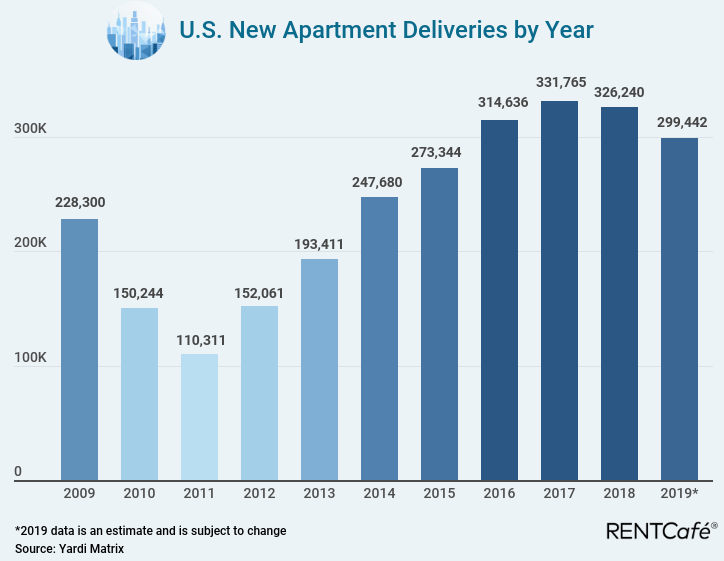
Based on Yardi Matrix market data, there will be an estimated 299,442 new units forecasted to be delivered this year. This marks a significant drop of 8.2 percent compared to 2018, when the total number of deliveries was 326,240, almost matching 2017’s nine-year peak of 331,765 new units.

“Rising construction costs and a tight labor supply certainly contribute to a flattening and decline of expected completions, but 2019 is part of a larger trend of developers gearing up for next cycle,”  said Tara Jeffcoat, senior research analyst at Yardi Matrix, in a release. “Although completions peaked in 2017, there is a significant number of prospective properties in the pipeline.”

Apartment Construction Declines In 2019 But More In The Pipeline

Highlights of the apartment construction report

  • Apartment construction slows down compared to last year, from 326,000 new deliveries in 2018 to a projection of under 300,000 in 2019.
  • Construction has been thriving in the last decade at 2.3M, but it’s no match for the impressive levels seen in the ’70s and ’80s.
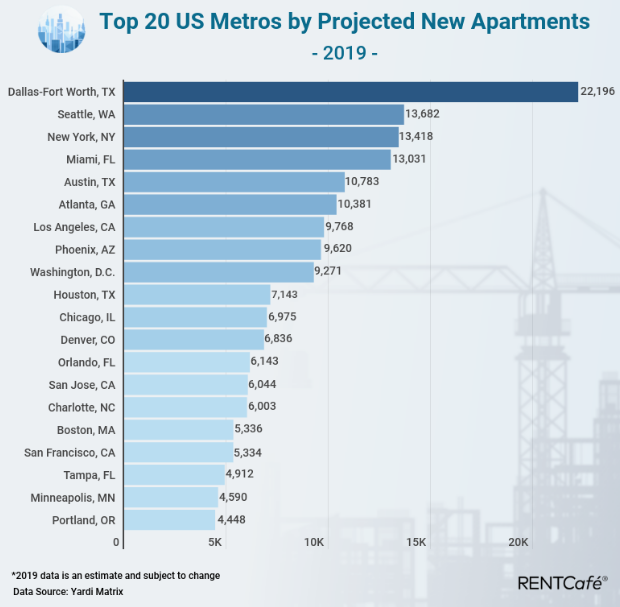
  • New York metro is dethroned by DFW metro and Seattle metro in terms of projected apartments for this year.

Apartment Construction Declines In 2019 But More In The Pipeline

Portland metro lags behind bigger markets

Compared to last year’s projections, the Denver metro is taking it easy, with far fewer units expected to be delivered this year. In 2018, the metro occupied the third place in our Top 20 with an estimated 15,187 new units, while this year it’s expected to build about half of that – 6,836, taking the 12th spot in our list.

California, Florida, and Texas each feature three metros in the Top 20, with Texas being represented by DFW metro, Austin metro, and Houston metro, which are higher up in the top occupying the first, fifth, and 10th place, respectively.

The Portland metro, on the other hand, is last on the list, with a projection of 4,448 new units, which is close to last year’s estimate of 4,804. Possible reasons for this low number could be the metro’s lack of available land, and/or the restrictive regulations in the area.

Seattle is expected to add an impressive number of almost 6,900 new apartments

Apartment Construction Declines In 2019 But More In The Pipeline

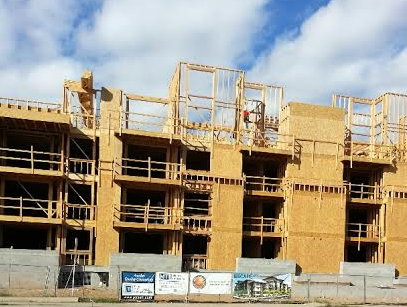
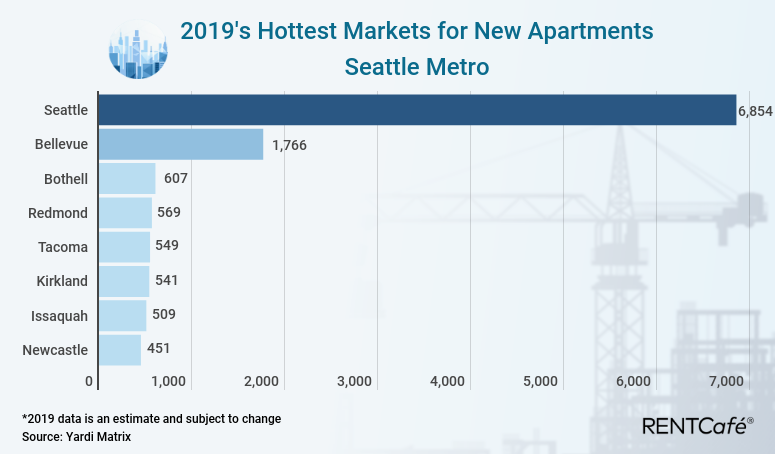
With construction cranes spread across the city, Seattle is booming with new apartments. Our projected number of deliveries for 2019 is 6,854, which could mean a possible slowdown in rent growth.

Given its strong economy, Seattle should encounter no issues filling up the newly built apartments as the area keeps creating new jobs.

Building considerably less than Seattle, Issaquah is the runner-up, with an estimated 509 new apartments for 2019. It’s followed by Newcastle, with an even lower number of 451 projected deliveries.

Rent growth is slowing down after picking up speed last year

Apartment Construction Declines In 2019 But More In The Pipeline

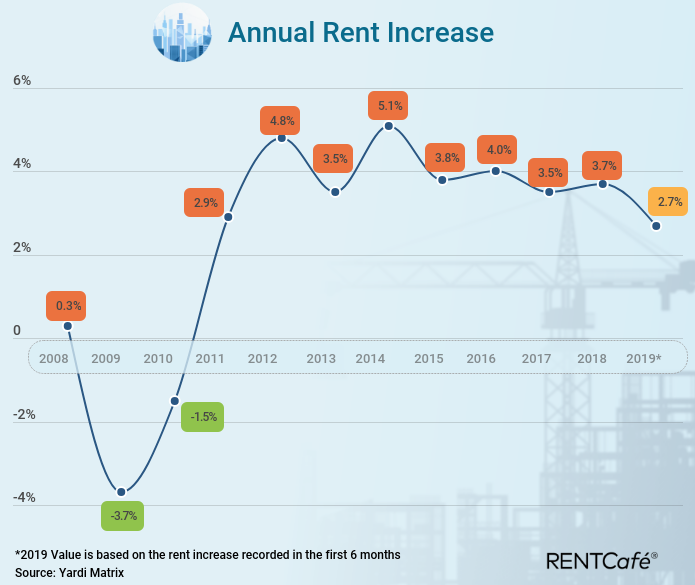
Zigzagging since 2010, the average rent growth has hit the brakes in the last 6 months, witnessing a 2.7 percent increase since 2018 when it went up by 3.7 percent.

The glut of new apartments built in previous years could be one of the reasons for this slowdown, taking the wind out of rent increases.

The influence of new deliveries on rent growth is no new occurrence; whenever supply is abundant, rent growth weakens. A relevant example is the one between 2009-2011, when apartment construction hit its lowest numbers (decreasing from 228,300 to 110,300) while rent growth skyrocketed from -3.7 percent to 2.9 percent.