Home Blog Page 157

Rising Rent Control Is Slowing Development And Investment

Rising Rent Control Is Slowing Development And Investment

States and municipalities threatening to or imposing rent control are losing interest from multifamily firms, causing them to reconsider their investment decisions, according to the latest survey from the National Multifamily Housing Council (NMHC).

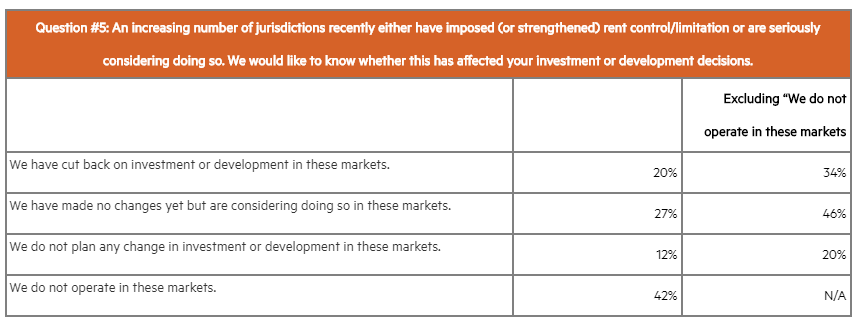
The NMHC’s Quarterly Survey of Apartment Market Conditions, conducted in October 2019, says with the continuing expansion of rent-control legislation 58 percent of survey respondents say they now operate in jurisdictions that have either recently imposed rent control or are seriously considering doing so.

Of respondents who operate in these markets:

  • 34 percent have already cut back on investment or development, up from 20 percent last quarter.
  • 49 percent are considering cutting back on investment or development going forward.
Rising Rent Control Is Slowing Development And Investment

Despite rent control, the market remains strong

While rent control has led to increased concerns, the survey found that national market conditions remain strong as the Market Tightness (54), Equity Financing (55), and Debt Financing (75) indexes all came in above the break-even level (50). The Sales Volume Index (46) indicated a continued softness in property sales.

“While there has been much speculation recently about a coming recession, these latest survey figures suggest that apartment demand continues to drive rent growth and occupancy,”  said NMHC Chief Economist Mark Obrinsky in a release.

“Twenty percent of respondents reported improving market conditions, compared to just 12 percent who observed a looser market. Lower interest rates continue to create a more favorable environment for debt financing, as 58 percent of respondents reported improving conditions.”

  • The Market Tightness Index decreased from 60 to 54, indicating improving conditions for the third consecutive quarter.  Twenty percent of respondents reported tighter market conditions than three months prior, compared to 12 percent who reported looser conditions. Over two-thirds (69 percent) of respondents felt that conditions were no different from last quarter.
  • The Sales Volume Index decreased from 48 to 46, with 31 percent of respondents reporting lower sales volume than three months prior. A slightly smaller group – 23 percent of respondents – reported higher sales volume, while 41 percent regarded volume as unchanged. Although the share of respondents indicating increased sales volume was the highest in 5 quarters, the share indicating lower sales volume grew slightly as well, causing the index to remain below 50.
  • The Equity Financing Index inched down from 56 to 55, marking the eighth straight quarter of relatively unchanged conditions. Eighteen percent of respondents reported that equity financing was more available than in the three months prior, compared to only nine percent who believed equity financing was less available. Meanwhile, the majority of respondents (60 percent) thought that conditions were unchanged in the equity market.
  • The Debt Financing Index decreased from 80 to 75. For the third straight quarter, the majority of respondents (58 percent) reported better conditions for debt financing compared to three months prior, while eight percent felt that financing conditions were less favorable. More than a quarter (27 percent) of respondents reported unchanged conditions.

Rising Rent Control Is Slowing Development And Investment

About the Survey:
The October 2019 Quarterly Survey of Apartment Market Conditions was conducted October 7-14, 2019; 102 CEOs and other senior executives of apartment-related firms nationwide responded.
 

4 Easy Steps to Furnishing Your Short-Term Rental Or Your Airbnb

4 Easy Steps to Furnishing Your Short-Term Rental Or Your Airbnb

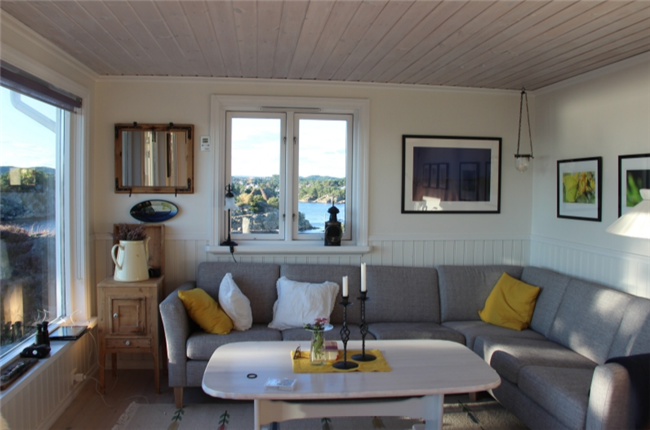
Here are four easy steps to furnishing your short-term rental or Airbnb short-term rental to create a home-like appeal, in contrast to feeling like a traditional hotel room.

Guests who like traveling on their own or who are there just for a few days need a pleasant place to sleep with excellent wi-fi and a bit of advice on public transport or places to visit if they have time to do so. One suggestion: equip your rentals with anything one might need on their stay, from cutlery to city maps.

However, as any landlord would know, that kind of look that seems welcoming and effortless actually takes effort to create. Good online rankings and comments don’t come from you just having a place with a bed available for rent.

4 easy steps to furnishing your short-term rental or your Airbnb

So to help out landlords with their short-term rentals, here are four pieces of advice to easily make your rental more desirable.

No. 1: Consider the lighting

A large percentage of Airbnb guests are couples on a romantic getaway wanting to explore the city and spend some quality time together.

It would be thoughtful to consider the lighting sources in the place so they won’t be greeted by harsh,   unpleasant light. Also, from the perspective of a homeowner, you should definitely opt for LED lighting since it provides more lighting for less energy and will influence your electricity bill significantly.

As for the lighting arrangement, in the living room, you might want to go with soft white tones so that guests can watch TV or make plans about which parts of the city to visit. For the bedroom, you should invest in ambient lights to set a relaxing mood, so no harsh overhead lights or any over-the-top light displays because the lights need to be subdued and gentle.

4 Easy Steps to Furnishing Your Short-Term Rental Or Your Airbnb

No. 2: Combine cozy and practical

Forget about minimalistic sinuous furniture, which may look great but is uncomfortable. And honestly, people are not even certain how to sit without sliding off of it.

4 Easy Steps to Furnishing Your Short-Term Rental Or Your Airbnb

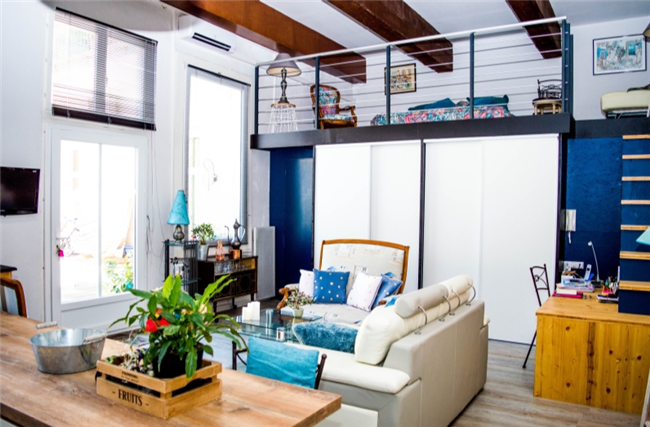
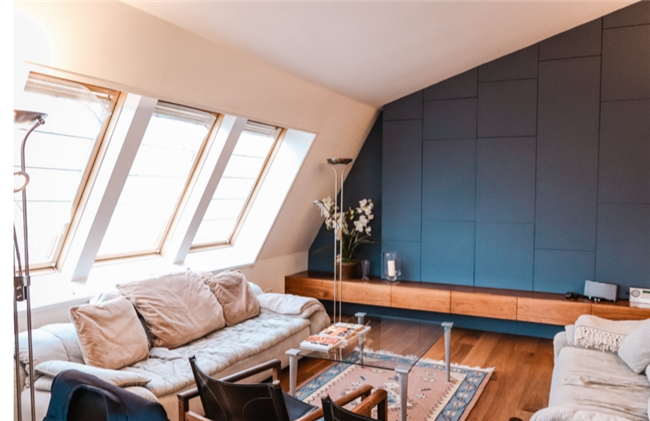
In the living room, go with a solution that doesn’t take up too much space and that has a storage option so that the room is always neat. To achieve that balance, use modular couches that come with shelves and are luxurious-looking but incredibly flexible in the sense that pieces can be moved. Your guests will like the fact that they can rearrange the couch based on their needs as well as being able to use its accessories to charge their smartphone wirelessly.
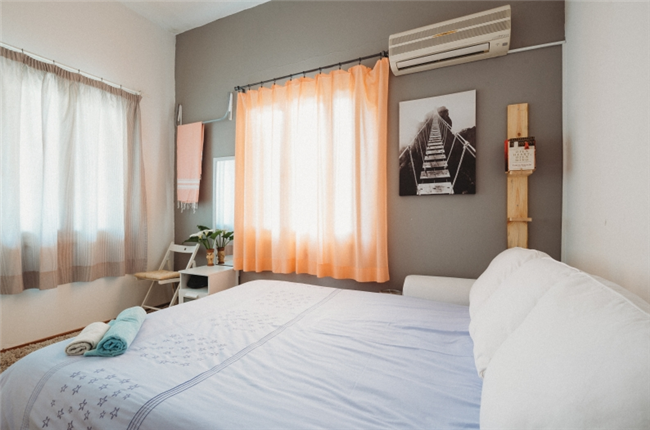
In the bedroom, your main focus should be on providing a quality bed – nothing is more appreciated by guests than a great night’s sleep. Then you can focus on making the room cozy and aesthetically pleasing.

No. 3: Add some artsy details

It’s true that you can’t please everyone, but your short-term rental will be more popular if it has a unique atmosphere about it as opposed to looking like a big hotel room

4 Easy Steps to Furnishing Your Short-Term Rental Or Your Airbnb

You can achieve that homey vibe, for example, by creating a travel corner so that you can place trinkets from different countries you visited; your guests might be coming from all around the world, so they might find it interesting. Otherwise, you can have different posters and interesting photographs framed and placed on the walls. Kitchen utensils and mugs don’t have to come from the same set – mix-and-match has a rustic appeal. Your guests will value those little things because they would make them feel more comfortable, and more inclined to give you a high rating.

One caution: Don’t use fragile figurines and vases; they’re just accident waiting to happen, especially if the place is pet-friendly. If you must, make sure they’re on a high shelf.

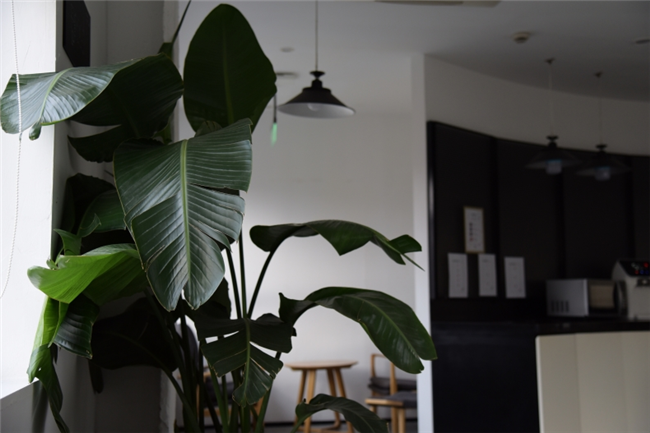
No. 4 – Place plants around the place

4 Easy Steps to Furnishing Your Short-Term Rental Or Your Airbnb

No. 4: Place plants around the place

You can achieve that homey vibe, for example, by creating a travel corner so that you can place trinkets from different countries you visited; your guests might be coming from all around the world, so they might find it interesting. Otherwise, you can have different posters and interesting photographs framed and placed on the walls. Kitchen utensils and mugs don’t have to come from the same set – mix-and-match has a rustic appeal. Your guests will value those little things because they would make them feel more comfortable, and more inclined to give you a high rating


Seattle Rents Continue Upward for 9th Straight Month

Seattle Rents Continue Upward for 9th Straight Month

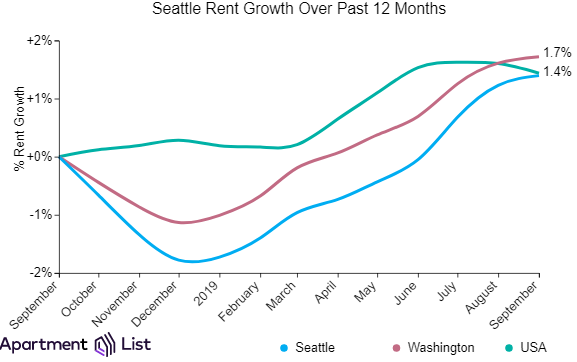
Seattle rents increased again in September, marking the ninth straight month that the city has seen rent increases after a decline in December of last year, according to the September report from Apartment List.

Over the past month, Seattle rents have increased 0.2 percent, and have increased slightly by 1.4 percent in comparison to the same time last year.

Currently, median rents in Seattle stand at $1,364 for a one-bedroom apartment and $1,698 for a two-bedroom. Seattle’s year-over-year rent growth lags the state average of 1.7 percent, but is in line with the national average of 1.4 percent.

Rents rising across the metro

Throughout the past year, rent increases have been occurring across the entire Seattle metro.

Seattle Rents Continue Upward for 9th Straight Month

Of the largest 10 cities that Apartment List has data for in the Seattle metro, all have seen prices rise.

Here’s a look at how rents compare across some of the largest cities in the metro.

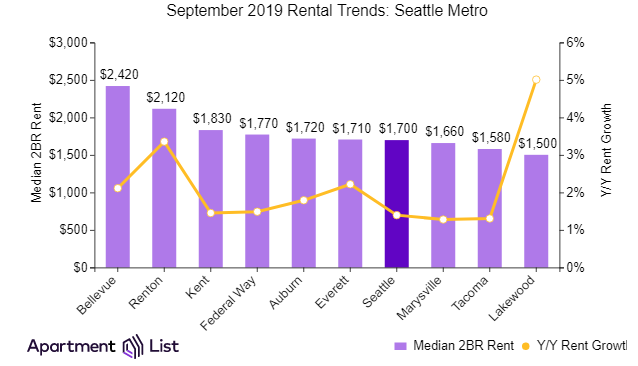
  • Lakewood has the least expensive rents in the Seattle metro, with a two-bedroom median of $1,502; the city has also experienced the fastest rent growth in the metro, with a year-over-year increase of 5 percent.
  • Over the past month, Renton has seen the biggest rent drop in the metro, with a decline of 0.7 percent. Median two-bedrooms there cost $2,116, while one-bedrooms go for $1,699.
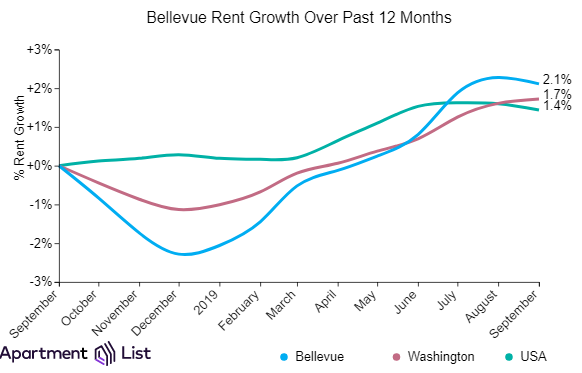
  • Bellevue has the most expensive rents of the largest cities in the Seattle metro, with a two-bedroom median of $2,420; rents decreased 0.2 percent over the past month but were up 2.1 percent over the past year.

Seattle Rents Continue Upward for 9th Straight Month

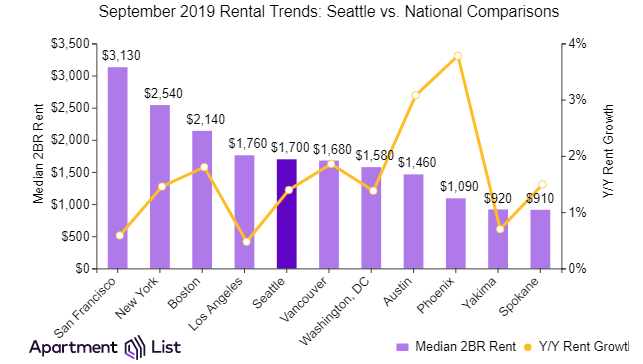
As rents have increased slightly in Seattle, a few similar cities nationwide have also seen rents grow modestly. Compared to most other large cities across the country, Seattle is less affordable for renters.

  • Rents increased slightly in other cities across the state, with Washington as a whole logging rent growth of 1.7 percent over the past year. For example, rents have grown by 1.9 percent in Vancouver and 1.5 percent in Spokane.
  • Seattle’s median two-bedroom rent of $1,698 is above the national average of $1,189. Nationwide, rents have grown by 1.4 percent over the past year, which matches the increase in Seattle.
  • While Seattle’s rents rose slightly over the past year, many cities nationwide also saw increases, including Phoenix (+3.8 percent), Austin (+3.1 percent), and Boston (+1.8 percent).

Metro trends

Last month’s report:

Seattle Rents Increase Again For Eighth Straight Month

Salt Lake City Rents Decline For Third Straight Month

Salt Lake City Rents Decline For Third Straight Month

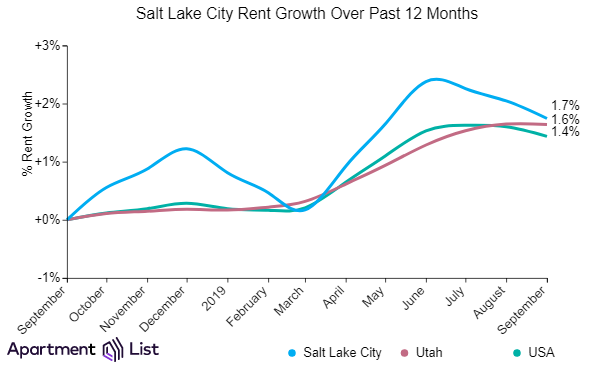
Salt Lake City rents have declined 0.3% over the past month, but have increased slightly by 1.7% in comparison to the same time last year, according to the latest report from Apartment List.

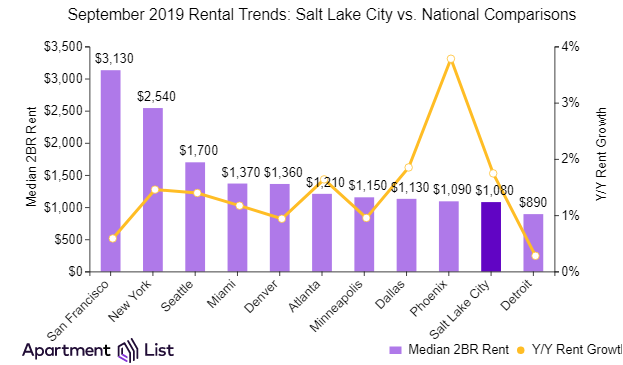
Median rents stand at $870 for a one-bedroom apartment and $1,080 for a two-bedroom.

This is the third straight month that the city has seen rent decreases after an increase in June. Salt Lake City’s year-over-year rent growth leads the state average of 1.6%, as well as the national average of 1.4%.

Ogden rents increased slightly over the past month

Ogden rents

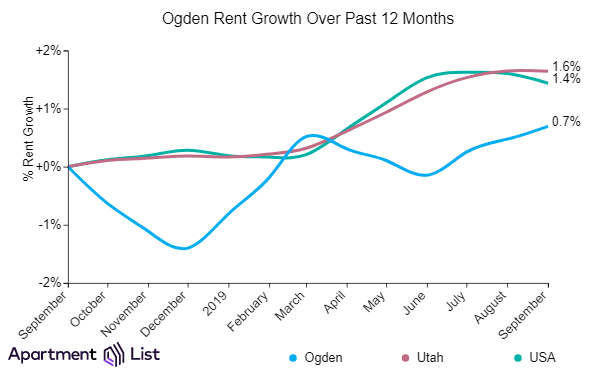
Meanwhile, Ogden rents have increased 0.2% over the past month, and are up marginally by 0.7% in comparison to the same time last year.

Currently, median rents in Ogden stand at $698 for a one-bedroom apartment and $895 for a two-bedroom. This is the third straight month that the city has seen rent increases after a decline in June.

Ogden’s year-over-year rent growth lags the state average of 1.6%, as well as the national average of 1.4%.

Rents more affordable than many large cities nationwide

Rents more affordable than many cities

As rents have increased slightly in Salt Lake City, a few large cities nationwide have also seen rents grow modestly. Salt Lake City is still more affordable than most large cities across the country.

  • Salt Lake City’s median two-bedroom rent of $1,080 is below the national average of $1,189. Nationwide, rents have grown by 1.4% over the past year compared to the 1.7% increase in Salt Lake City.
  • While rents rose slightly over the past year, many cities nationwide also saw increases, including Phoenix (+3.8%), Dallas (+1.8%), and Atlanta (+1.6%).

Renters will find more reasonable prices in Salt Lake City than most large cities.

Report from last month:

Salt Lake City Rents Declined Slightly Over The Past Month

5 Top Technologies That Renters Want

5 Top Technologies That Renters Want

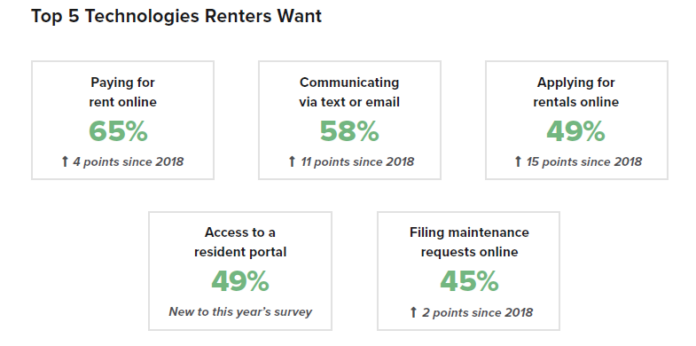
A new survey shows the 5 top technologies that renters want and that, over the last year, residents’ interest in rental technologies has grown by an average of 7 points.

The 2020 State of the Property Management Industry Report by Buildium and the National Association of Residential Property Managers (NARPM), surveyed both property managers and renters.

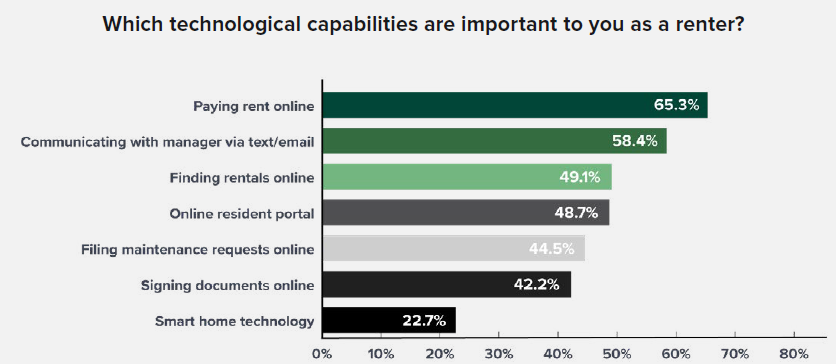
In the annual survey of 1,188 renters across the county, Buildium and NARPM found the biggest gains in interest among renters were in applying for rentals online (+15 points), communicating with their property manager via text or email (+11 points), and signing leases and other documents electronically (+8 points).

Though interest has stayed roughly constant among Gen Z and Millennial renters over time, Gen X residents and Baby Boomers are far more interested in technology than they were just a year ago: On average, interest in rental technologies has grown by 8 points among Gen Xers and 10 points among Baby Boomers, according to Buildium’s 5th Annual State of The Property Management Industry Report.

Though Millennials are the most enthusiastic about technology overall, more than half of Gen Z, Millennial, Gen X, and Baby Boomer renters want the ability to pay rent online and communicate with their property manager via text or email.

How residents want to pay

technologies renters want and capabilities


Gen Z, Millennial, and Gen X renters all agree that they prefer to pay their rent via electronic payment, electronic bank transfer, or credit/debit card over writing a check.

Though most Baby Boomers still feel more comfortable paying by check, nearly 1 in 3 would rather pay online. Residents of all ages appreciate having the option to pay their rent online, and their expectation to be able to handle this and other tasks digitally increases with every year.

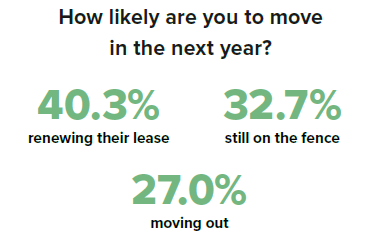
The survey also showed two in five renters definitely plan on renewing their lease for another year—a number that stayed constant from 2018 to 2019.

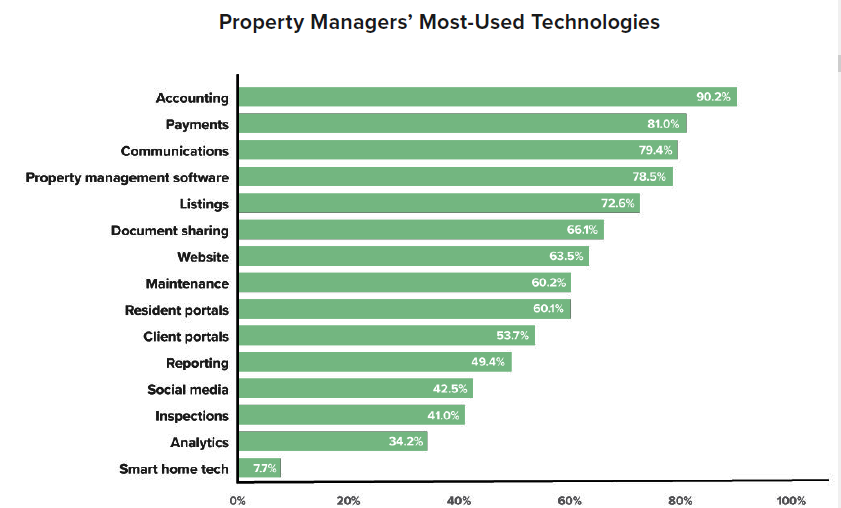
technologies property managers use

How the “typical renter” definition is evolving and what renting means to residents

“In the past, we’ve thought of renting as a temporary rite of passage for those who haven’t yet set down roots or saved enough for a down payment on a home of their own. But for many Americans today, renting is a lifestyle choice, as well as a necessary alternative to homeownership for those whose finances were irreparably altered by the Great Recession,” the report says.

As a result, property managers’ strategies for attracting and retaining renters will need to evolve to fit a broader demographic than they’ve seen in the past.

how likely are residents to move in the next year

Renters’ desire to own a home of their own varies logically by age: Gen Z residents are happy renting for now, but assume that they’ll want to become homeowners down the road.

Millennials and Gen X renters are highly interested in homeownership, but are waiting for the right time to buy. Baby Boomer residents are largely former homeowners who either prefer to rent or have financial reasons for doing so at this time in their lives.

The report was produced by Buildium in partnership with the National Association of Property Managers (NARPM).

Strong Demand For Apartments Shows In Strong Demand For Apartment Jobs

Strong Demand For Apartments Shows In Strong Demand For Apartment Jobs

The strong demand for apartments across the country also shows up in the strong demand for apartment jobs, according to the latest report from the National Apartment Association.

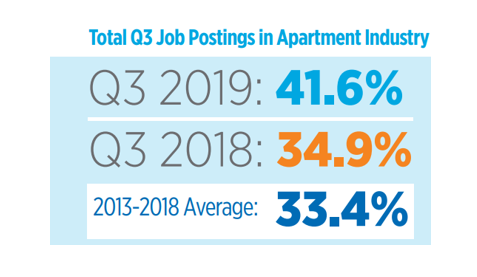
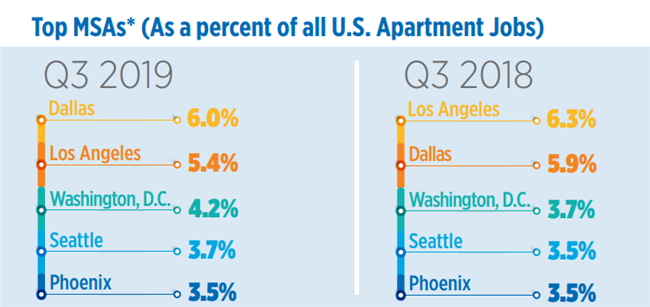
More than 41 percent of available real estate jobs in the U.S. were in the apartment sector, increasing from 34.9 percent in from the third quarter in 2018, according to the NAAEI’s Apartment Jobs Snapshot.

Strong Demand For Apartments Shows In Strong Demand For Apartment Jobs

Occupancy up to 96.3 percent

A hectic leasing season yielded 118,000 move-ins during the third quarter.

Also, occupancy soared to 96.3 percent, as reported by RealPage.

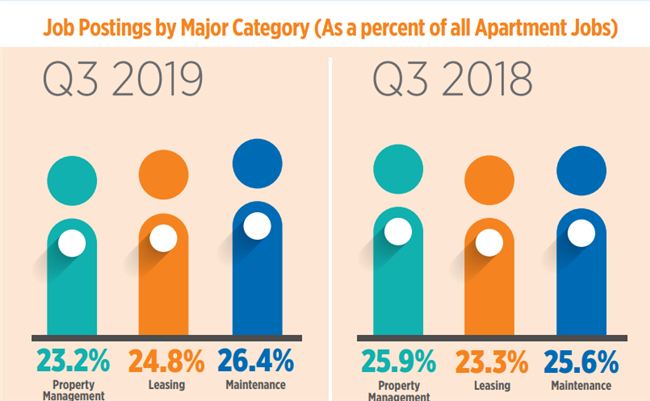
Maintenance positions remained in greatest demand during the third quarter, increasing by 0.8 percentage points since the second quarter of 2018.

Leasing consultant apartment jobs in high demand

Strong Demand For Apartments Shows In Strong Demand For Apartment Jobs

Leasing consultant job postings had the largest growth in demand year-over-year with an increase of 1.5 percentage points.

In fact, leasing consultants had the highest growth in demand over the past five years, increasing by 1.7 percentage points.

Compared to five years ago, there has been an increase in employers seeking candidates who are skilled in Yardi Software, Microsoft Office and teamwork/collaboration.

Phoenix led nation in rent growth

Consistent with third quarter of 2018, Dallas, Los Angeles, and Washington D.C. had the greatest demand for apartment jobs in 2019. However, Phoenix continues to rank as one of the top preforming apartment markets. According to RealPage, Phoenix led the nation in annual rent growth with an increase of 8.2 percent.

Strong Demand For Apartments Shows In Strong Demand For Apartment Jobs

National apartment association jobs report background

 The NAA jobs report focuses on jobs that are being advertised in the apartment industry as being available, according to Paula Munger, Director, Industry Research and Analysis, for the National Apartment Association’s Education Institute.

“Our education institute is a credentialing body for the apartment industry. They hear often that one of the biggest problems keeping our industry leaders up at night is the difficulty in finding talent, attracting talent and retaining talent,” Munger said.  “Labor-market issues are happening in a lot of industries, certainly with the tight labor market we have.”

NAA partnered with Burning Glass Technologies. “They have a labor-job posting database that is proprietary,” she said, and they can “layer on data from the Bureau of Labor Statistics (BLS). We looked at that and thought we could do something that is really going to help the industry and help benchmark job titles and trends as we go forward,” Munger said.

August report from the NAA:

Portland Apartment Jobs Almost 60 Percent Of All Real Estate Jobs


Apartment Rental Rates Declined In Many Markets For First Time Since 2017

Apartment Rental Rates Declined In Many Markets For First Time Since 2017

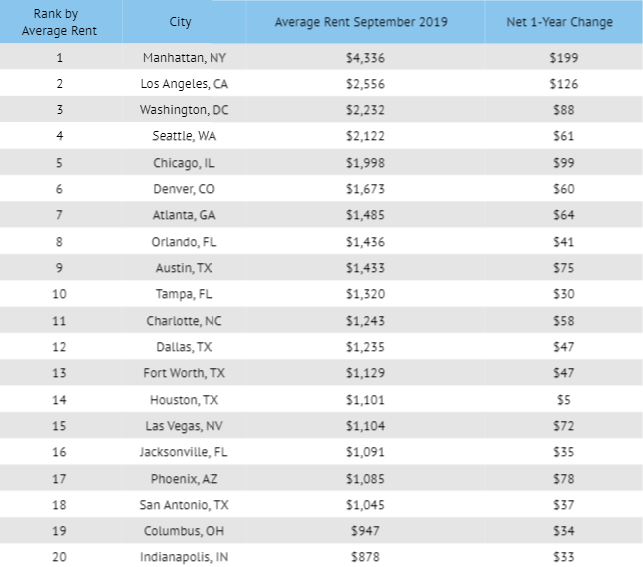
Apartment rental rates in a majority of small and large cities registered either minor decreases or stagnated during September, according to the latest report from RentCafe.

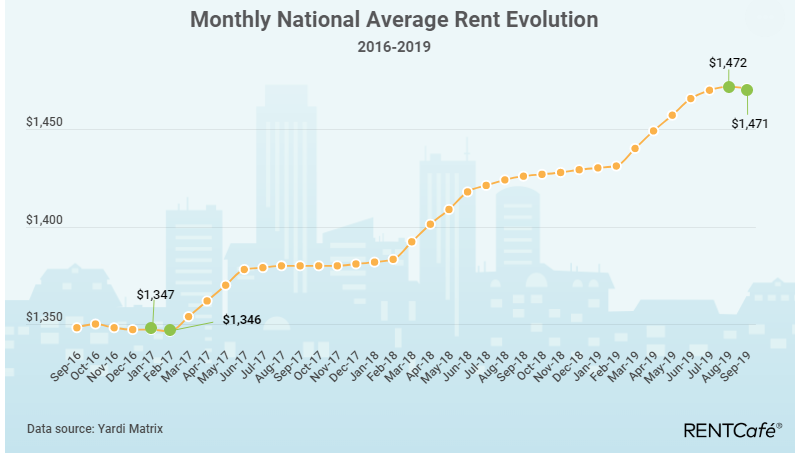
“As part of a seasonal respite, the national average rent decreased for the first time since February 2017, dipping by –0.1% ($1) from last month to $1,471. The decrease might seem insignificant, but coupled with the slowest year-over-year hike in the past 13 months, 3.2% ($45), it points to a slight wind-down in rent prices in the context of a more volatile financial climate,” the report says according to Yardi Matrix.

Apartment Rental Rates Declined In Many Markets For First Time Since 2017

Since last month, apartment rents saw minor declines in more than half of the cities we analyzed. Small and large cities lead the trend, with prices dropping in 59% of small cities and 56% of large cities, while 42% of mid-sized cities saw their rates dwindle in September.

Apartment Rental Rates Declined In Many Markets For First Time Since 2017

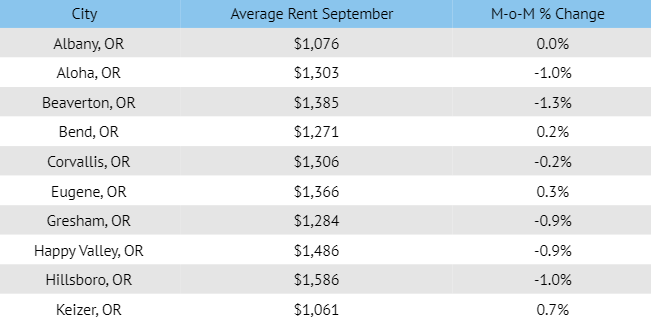
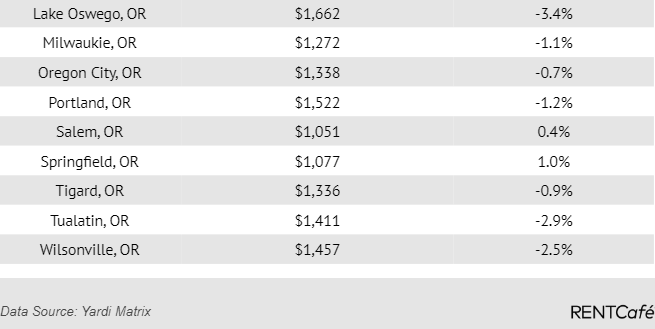
Apartment rental rates in Oregon in September 2019

The average rent in Oregon cities is generally lower than the national average rent.

The fastest growing rents in September were in Springfield, where rental apartment prices increased by 1.0% month over month, or $11. Keizer apartments saw the second highest monthly increase, jumping by 0.7% and making them $7 more expensive than last month, while in Lake Oswego prices decreased by 3.4% ($58) compared to August.

Apartment Rental Rates Declined In Many Markets For First Time Since 2017

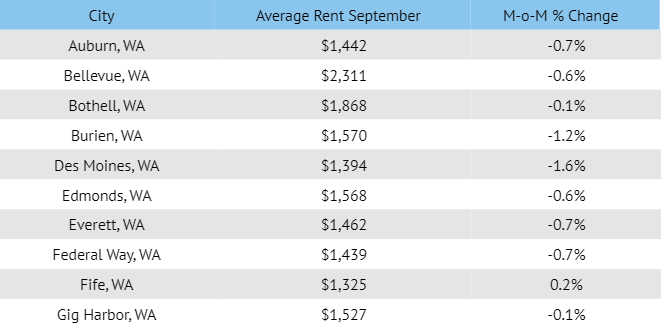
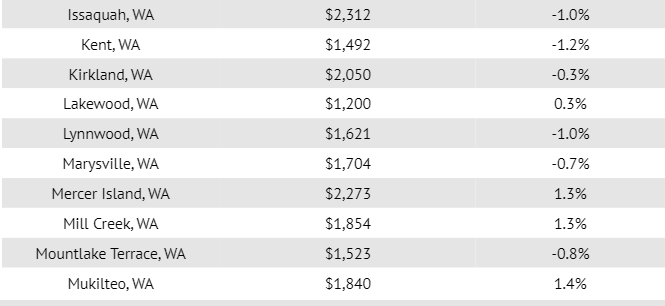
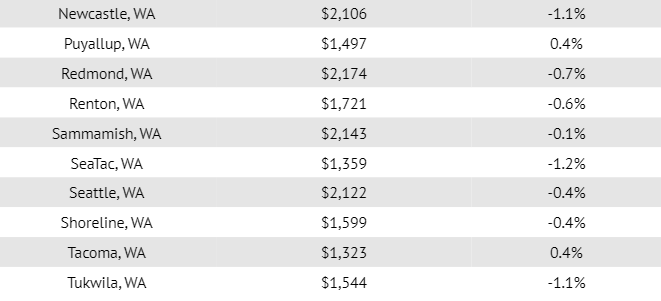
 Renting in Seattle Metro in September 2019

The average rent in Seattle Metro cities is generally higher than the national average rent.

The fastest growing rents in September were in Mukilteo, where rental apartment prices increased by 1.4% month over month, or $25. Mercer Island and Mill Creek apartments saw the second highest monthly increase, jumping by 1.3%, making them $30 and $24, respectively, more expensive than last month. In Des Moines, prices decreased by 1.6% ($22) compared to August.

The fastest growing rents in September were in Springfield, where rental apartment prices increased by 1.0% month over month, or $11. Keizer apartments saw the second highest monthly increase, jumping by 0.7% and making them $7 more expensive than last month, while in Lake Oswego prices decreased by 3.4% ($58) compared to August.

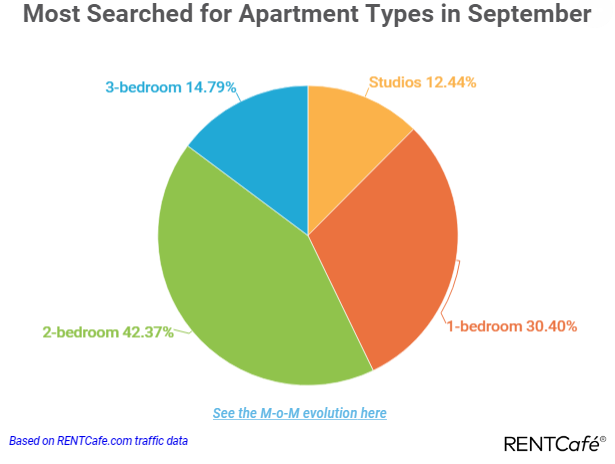
Two-bedroom apartments are by far the most popular among renters

Traffic data from RENTCafé.com shows two-bedroom apartments are the most popular among renters searching for new homes, making up 42% of searches on the website.

The second most popular units have one-bedroom floor plans (30%). three-bedroom apartments (15%) follow in popularity, while renters show the least interest in studios (12%).

The fastest growing rents in September were in Springfield, where rental apartment prices increased by 1.0% month over month, or $11. Keizer apartments saw the second highest monthly increase, jumping by 0.7% and making them $7 more expensive than last month, while in Lake Oswego prices decreased by 3.4% ($58) compared to August.

Related Story:

Slowdown in Month-Over-Month Rent Increases Seen Across the U.S.

Methodology:

RENTCafe.com is a nationwide apartment search website that enables renters to easily find apartments and houses for rent throughout the United States. To compile this report, RENTCafe’s research team analyzed rent data across the 260 largest cities in the US.  The data on average rents comes directly from competitively-rented (market-rate) large-scale multifamily properties (50+ units in size), via telephone survey.

4 Types of Water-Intrusion Problems in Rental Property

4 Types of Water-Intrusion Problems in Rental Property

Water-intrusion problems in rental property can be a major cause of alarm for property managers, so this week’s maintenance tip from Keepe offers some helpful ideas.

This can be caused by many things, including faulty waterproofing during construction, poor drainage, incorrect water structure, and more commonly, the age of the property.

Next time you need to tackle water intrusion at your rental property, take note of these areas of concern.

Problems caused by water intrusions problems in rental property and leakages

Water intrusion in rental property can be disastrous on many levels, especially any part of the structure that is wood. Water damages wood, making leakage a major concern.

Secondly, water leakage causes a health threat to the occupants of the rental property; it can enable mold to grow when it goes undetected, and it provides a breeding ground for mosquitoes and other insects. If a substantial water leak comes in contact with electricity, there’s also the danger of electric shock or electrocution.

Why basements and crawl spaces leak

Basements and crawl spaces are the places most susceptible to water intrusion. In property management, it is critical to be keen about the following:

  1. Construction codes: These are the regulations that govern the design, construction, alteration and maintenance of structures. By adhering to these standards, you will uphold the health, safety and welfare of building occupants and, in this case, avoid water intrusion.
  2. Proper drainage: A faulty drainage system can result in water intrusion in your property. This is why it is important to make sure your drainage is well-structured, because while a water intrusion may take a long time to manifest, when it does, it will cost more to repair.
  3. Problems with water vapor: A family of 4 people yields about 3.5 gallons of water vapor on a daily basis, aside from the water vapor generated by activities like cooking, ironing and other heat-generating activities. Indoor air quality is affected by moisture. If water vapor is not managed well, the result is that mold can form in the room. There is also condensation and an increase in dust mites, which can be a big cause for concern.
  4. Waterproofing: Water intrusion can sometimes come through the floor of the basement. This is an indication that the waterproofing part of the original build of the floor was not efficient. If your property is in the process of being built, there is still time. However, if it is an existing property and you notice water intrusion from the floor, the floor has to be replaced.

Summary

The water-intrusion in rental property threat should always be considered because of potential consequences to both occupants and property. To be vigilant, routine maintenance practices are a must.

Related story:

4 Ways You Can Spot Water Damage Early In Your Rentals

4 Ways You Can Spot Water Damage Early In Your Rentals

Here are other recent rental property maintenance Keepe posts you may have missed:

 How To Pick The Perfect Exterior Paint Color For Your Rental Property

4 Outdoor Flooring Options For Your Rentals

20 Easy, Affordable Maintenance Projects To Update Your Rentals

7 Tech Gadgets For A Safer And More Efficient Rental Property

5 Maintenance Tips For Long-Lasting Rental Carpet Flooring

Is The Water Heater At Your Rental Property Ready For The Big One?

7 Types Of Kitchen Countertops For Your Apartments

Which Cooktop Is Best For Your Rental Property?

A Guide To 4 Types Of Flat Roof Systems

6 Ways To Trash Your Apartment Waste Management Issues

Top 5 Apartment Maintenance Emergencies vs. Maintenance Requests

5 Tips for Preparing Your Apartments for the Summer Season

4 Air Conditioning Maintenance Best Practices For Summer

About Keepe:

Keepe is an on-demand maintenance solution for property managers and independent landlords. We make hundreds of independent contractors and handymen available for maintenance projects at rental properties. Keepe is available in the Greater Seattle area, Greater Phoenix area, San Francisco Bay area, and Portland area, and we are continuing to expand. Learn more at http://www.keepe.com


5 Tenant-Friendly Amenities That Increase Your Profits

5 Tenant-Friendly Amenities That Increase Your Profits

Tenant-friendly amenities, those that attract and keep high-paying tenants, are a must in today’s rental housing world – but some features cost so much to add that it’s difficult to recoup your investment.

Fortunately, there are some attractive elements you can include in your rentals that won’t cost a fortune.

In recent years, the cost to rent an unfurnished apartment increased by about 50 percent over a 10-year period. In some big cities such as New York, nearly half a person’s salary goes to paying rent.

Sure, high prices are good for landlords. However, since renters are paying so much, they expect a lot in return. Discover tenant-friendly amenities that will attract new renters and secure higher rent rates.

1. Offer high-speed Internet

If you’re leasing a commercial space, fast internet is a must. A high-speed connection as part of your rental package will attract those who work from home, such as busy professionals.

Is fiber optic available in your area? If so, extend the offer to the entire building so each unit is wired and ready to connect. You can even include free internet as part of your rental package or add an up-charge for the service.

2. Include pet deposits in your tenant-friendly amenities

There are millions of families with some type of pet. Even busy singles often have a dog or cat for companionship. However, as much as we all love those furry critters, they can create thousands of dollars in damage to your building. Cats with claws may dig at the carpet and leave a frayed mess. Dogs may have accidents or chew through doors if they have anxiety http://affectivebrain.com/?attachment_id=5776.

Many building owners find it essential to charge a pet deposit and monthly fees to offset costs. A deposit is typically not refundable, and you can customize the amount based on the type of animal. Some landlords charge fees based on their experience with similar pets. You should also consider insurance, as some dog breeds and animal species will ramp up your rates.

3. Install a laundry center

5 Tenant-Friendly Amenities That Increase Your Profits
Adding a vending area to your laundry room with laundry soaps and softeners, plus snacks for those doing their laundry, is an idea to consider.

Most renters expect to have on-site laundry facilities to wash clothes and bedding. It’s much more convenient than dragging everything to an off-site location. For landlords, this is an opportunity to make additional money. You can invest in modern machines that are coin-operated. Add a vending area with laundry soaps and softeners, plus snacks for those doing their laundry.

If you have the staff and want to ramp up your profit-making potential, offer a dry-cleaning delivery service. You can run dry-cleaning items to a local store, pick them up when finished and deliver to tenants’ front doors. This type of add-on is particularly attractive to those who work long hours. Plus, it adds a nice side income to your real estate business.

4. Vet new tenants

The people you rent to can save or cost you money. Look for people who will treat the rental as their own home and take good care of it. You can earn a profit from people who pay rent on time, don’t damage the property, and offer reasonable complaints. Low-maintenance renters are a landlord’s dream come true. You won’t have to spend money on costly repairs or invest in a lawyer to start eviction proceedings.

While it isn’t possible to avoid every bad tenant, running background checks and conducting an interview process helps. You should also ask for references from previous landlords. Just make sure you follow state and federal laws to ensure you don’t discriminate based on age, race or other important factors.

5. Tenant-friendly amenities: Install desirable finishes

5 Tenant-Friendly Amenities That Increase Your Profits
A fresh coat of paint can make any apartment too like it is worth more to the tenant.

If you want to demand higher rent on your units, you must compete with similarly priced buildings in the area offering quality amenities. While you don’t need to transform your property into a luxury complex, take a look at competitors to see what they provide. Do they have a gym or 24/7 doorman? In 2018, the top amenities included dog parks, bike storage, workshop areas and more.

Make any apartment look pricier by adding a coat of fresh paint to the walls. Install granite countertops, add a backsplash in the kitchen and swap old carpet for beautiful hardwood floors. Upgrade one unit at a time until they’re all completed. Remember, however, buying materials in bulk can save you money.

Choosing Amenities That Increase Your Profits

These tenant-friendly amenities and upgrades above are a good start, but you should also consider what your tenants want.

For young people, a social outlet, like shared common areas, is particularly important. You can also implement small things that tenants appreciate, such as green plants and beautiful artwork.

Determining which amenities your renters want most is key to keeping profits high. You don’t have to go over budget to provide luxury amenities in a market that doesn’t support it, but there are great ways to provide an improved living experience for your tenants while maximizing the revenue you bring in.


Multifamily Growth on Track to Continue at 3 Percent Annually

Multifamily Growth on Track to Continue at 3 Percent Annually

Multifamily growth is on track to keep its string of 3 percent full-year rent growth numbers alive, despite flat September growth, according to the latest report from Yardi Matrix.

“As volatility again rears its head in the larger financial world, the multifamily market remains the picture of stability,” the report says.

This will be the sixth time in the past seven years that annual multifamily growth has hit the 3 percent level, despite a weak third-quarter performance.

Apartment rents have increased by at least the 2.5 percent long-term average for seven years running, with no signs that the trend will slow, the report says.

Plus, the average national occupancy rate has been above 95 percent for several years, and “housing trends would indicate that demand will remain strong for some time to come.,” the report says.

“Contrast the recent up-and-down of the stock and bond markets with the consistent growth in the multifamily industry, and it’s easy to see why investor demand for apartments remains so strong.

Highlights of the multifamily growth report

  • Multifamily rent growth flattened in September, as the average U.S. multifamily rent declined by $1 to $1,471. Year-over-year rent growth fell 20 basis points but remains at a healthy 3.2 percent.
  • S. rents rose 0.3 percent in the third quarter of 2019, and rents have grown 2.9 percent through the first three quarters of 2019. That represents a slight slowdown from the same periods over the last few years, but the performance is very respectable compared to long-term historical trends.
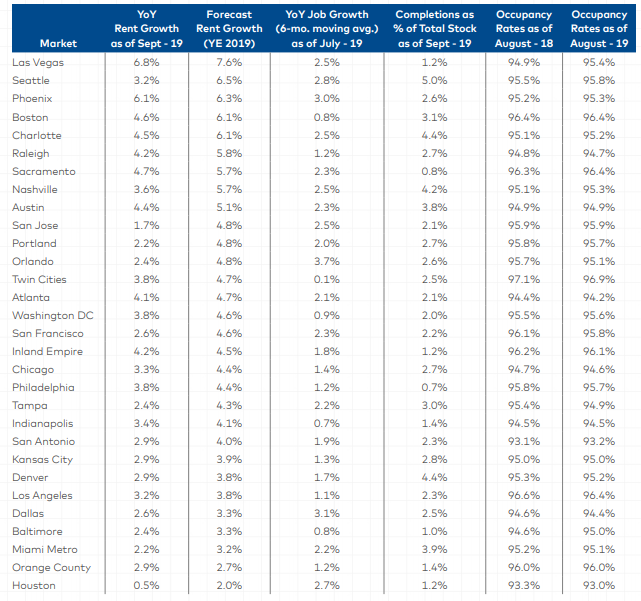
  • Las Vegas (6.8 percent), Phoenix (6.1 percent) and Sacramento (4.7 percent) remain unshakeable at the top of the metro rankings, but beyond those markets there is a lot of movement. For example, growth has moderated in Florida metros Tampa and Orlando (both 2.4 percent) and Miami (2.2 percent).

Yardi Matrix Multifamily Growth Chart Below:

Multifamily Growth on Track to Continue at 3 Percent Annually