Home Blog Page 136

Grateful To Be Debt-Free: A Client 1031 Exchange Success Story

Kay Properties and 1031 and 1033 exchanges and eminent domain options details

Grateful to be Debt-Free: Kay Properties Helps a Client Stay Debt-Free in their $1million 1031 Exchange into DST Properties for Sale

Kay Properties is proud to announce the successful completion of five debt-free DST purchases for a couple selling a single-family home in Southern California.  They were excited to be able to defer the accumulated capital gains and depreciation recapture taxes that they have accumulated over the many years of owning and managing the property by utilizing Internal Revenue Code, Section 1031.  In addition to deferring the taxes by successfully utilizing the 1031 exchange, the clients were grateful to invest and diversify into more passive real estate investments by utilizing the Kay Properties 1031 DST marketplace at www.kpi1031.com.

The Delaware Statutory Trust exchange investments were completed by Kay Properties and Investments team members Chay Lapin, Senior Vice President, and Matt McFarland, Associate.

Chay Lapin, Senior Vice President, stated, “Over a period of approximately 6 months, we helped educate the clients on the potential pros and cons of real estate, 1031 exchanges and DST structured investments.  Through ongoing dialogue and correspondence, the clients decided that they wanted to remain debt-free and take a conservative position in their DST 1031 investments.  By the time their single-family investment property sold and they officially entered into a 1031 exchange, we were able to work with them to select 5 different debt free DST properties, diversified across five states and across 4 different asset classes.”

Matt McFarland, Associate at Kay Properties, stated, “After successfully completing their DST 1031 investment purchases, the clients informed me that they were confident with their purchases and diversification profile of their 1031 DST portfolio as we head into an ever-changing and uncertain future.”

About Kay Properties and www.kpi1031.com

Kay properties 1031 exchange and Delaware Statutory Trust information

Kay Properties is a national Delaware Statutory Trust (DST) investment firm. The www.kpi1031.com platform provides access to the marketplace of DSTs from over 25 different sponsor companies, custom DSTs only available to Kay clients, independent advice on DST sponsor companies, full due diligence and vetting on each DST (typically 20-40 DSTs) and a DST secondary market. Kay Properties team members collectively have over 115 years of real estate experience, are licensed in all 50 states, and have participated in over $15 billion of DST 1031 investments.

*Diversification does not guarantee profits or protect against losses.
*This case study may not be representative of the experience of other clients. Past performance does not guarantee or indicate the likelihood of future results. Please speak with your attorney and CPA before considering an investment.

This material does not constitute an offer to sell nor a solicitation of an offer to buy any security. Such offers can be made only by the confidential Private Placement Memorandum (the “Memorandum”). Please read the entire Memorandum paying special attention to the risk section prior to investing. IRC Section 1031, IRC Section 1033 and IRC Section 721 are complex tax codes therefore you should consult your tax or legal professional for details regarding your situation. There are material risks associated with investing in real estate securities including illiquidity, vacancies, general market conditions and competition, lack of operating history, interest rate risks, general risks of owning/operating commercial and multifamily properties, financing risks, potential adverse tax consequences, general economic risks, development risks and long hold periods. There is a risk of loss of the entire investment principal. Past performance is not a guarantee of future results. Potential cash flow, potential returns and potential appreciation are not guaranteed. Securities offered through WealthForge Securities, LLC. Member FINRA/SIPC. Kay Properties and Investments, LLC and WealthForge Securities, LLC are separate entities.


Looking for DST Properties for Sale? See Our 1031 DST Marketplace

In a 1031 Exchange? Why waiting until after COVID-19 to complete your exchange could potentially be a bad idea

Group Says Multifamily Should Ban Smoking Inside and Near Buildings

multifamily smoking should be banned in buildings and near buildings group says

Multifamily buildings should have complete smoking bans inside and near buildings in order to protect nonsmoking adults and children, according to the American Society of Heating, Refrigerating and Air-Conditioning Engineers (ASHRAE).

The association said in information provided by the Colorado Group to Alleviate Smoking Pollution that while smoking has become less common in recent years, the only way to ensure nonsmoking adults and children are protected is a full multifamily ban on smoking because “the building and its systems can reduce odor and discomfort but cannot eliminate exposure when smoking is allowed inside or near a building.

“This position is supported by the conclusions of health authorities that any level of environmental-tobacco-smoke (ETS) exposure leads to adverse health effects.”

The multifamily smoking ban is needed because:

  • “Even when all practical means of separation and isolation of smoking areas are employed, adverse health effects from exposure in non-smoking spaces in the same building cannot be eliminated.
  • “Neither dilution ventilation, air distribution (e.g., “air curtains”) nor air cleaning should be relied upon to control ETS exposure.”

The association said that while smoking has become less common, it continues to have significant impacts on health and maintenance costs.

“While ASHRAE does not conduct research on the health effects of indoor contaminants, ASHRAE has been involved in this topic for many years. Through its committees, standards, handbooks, guides, and conferences, ASHRAE has long been providing information to support healthful and comfortable indoor environments, including efforts to reduce indoor ETS exposure.”

  • ASHRAE is committed to encouraging lawmakers, policymakers and others who exercise control over buildings to eliminate smoking inside and near buildings.
  • ASHRAE’s current policy is that its Standards and Guidelines shall not prescribe ventilation rates or claim to provide acceptable indoor air quality in smoking spaces.
  • ASHRAE holds the position that the only means of avoiding health effects and eliminating indoor ETS exposure is to ban all smoking activity inside and near buildings. This position is supported by the conclusions of health authorities that any level of ETS exposure leads to adverse health effects. Therefore,
  • ASHRAE recommends that building-design practitioners work with their clients to define their intent, where smoking is still permitted, for addressing ETS exposure in their buildings and educate and inform their clients of the limits of engineering controls in regard to ETS.
  • ASHRAE recommends that multifamily buildings have complete smoking bans inside and near them in order to protect nonsmoking adults and children.
  • ASHRAE recommends, given current and developing trends, that further research be conducted by cognizant health authorities on the health effects of involuntary exposure in the indoor environment from smoking cannabis, using hookahs, using electronic nicotine delivery systems (ENDS) and engaging in other activities commonly referred to as vaping or using e-cigarettes.

See the full report here: https://www.ashrae.org/File%20Library/About/Position%20Documents/pd_environmental-tobacco-smoke-2020-07-1.pdf

About:

This information was provided by the Colorado Group to Alleviate Smoking Pollution and Pete Bialick, President. He can be reached at info@gaspco.org. The organization provides tips for housing providers looking to make their communities smoke-free at mysmokefreehousing.org.

Ask Landlord Hank: I Think My Tenants Have Been Smoking Inside; How Do I Prove it?

multifamily smoking should be banned in buildings and near buildings group says
Photo credit idil toffolo via istockimages.com

Sign Up For Our Newsletter And Get Apartment News And Helpful, Useful Content Each Week.

* indicates required

Negative Rent Growth Year-Over-Year For First Time Since 2010

Negative rent growth has showed up for the first time since 2010 according to the June Multifamily Report from Yardi Matrix

The pandemic is impacting rents now and negative rent growth year-over-year is showing up in statistics across the country for the first time since 2010, according to Yardi Matrix.

National rents declined by $2 in June, falling to $1,457, Yardi Matrix reported in the June National Multifamily Report.

“Since January, U.S. multifamily average rents have declined by $12. A few months ago, many were hopeful that economic expansion would return by July, but with a rise in cases in many southern states, the economic recovery will likely be pushed out further than many initially hoped,” the report said.

“Given the rapid decline in rents since March, we may not see positive year-over-year rent growth for the remainder of 2020.”

Highlights of the report:

  • Multifamily rents decreased by $2 in June, falling to $1,457, continuing the four-month trend of negative rent growth. Year-over-year growth turned negative for the first time since December 2010, falling to -0.4 percent, a 70-basis-point decline from May.
  • Average U.S. rents declined by 0.8 percent in the first half of 2020 and 0.4 percent in the second quarter. This is a stark contrast from 2.6 percent rent growth in the first half of 2019 and 1.2 percent growth in the second quarter. Rent growth typically slows down in the second half of the year, but we could see a reversal of that trend if the fall becomes the new leasing season.
  • West Coast and tech hub markets were among the hardest hit in the first half of 2020. Since the beginning of the year, rents are down 4.6 percent in San Jose and 3.8 percent in San Francisco. On the other hand, more affordable California markets like Sacramento (2.2 percent) and the Inland Empire (2.9 percent) have held up relatively well. The ability to work remotely and the desire to live in a less densely populated area are likely contributing to the strength of the latter two California markets.

Yardi Matrix said another stimulus package “seems even more likely now than it did a month ago, as coronavirus cases continue to skyrocket in many Southern states and the economy doesn’t recover as quickly as many had hoped.

“Second quarter GDP is scheduled to be released by the end of July, as well. Estimates currently range from -30 percent to -50 percent. The passage of another stimulus package could help to boost spending for the second half of the year.

About Yardi Matrix

Yardi Matrix is a leading source for originating, pre-underwriting and managing assets for profitable loans and investments. Yardi Matrix Multifamily provides accurate data on 18+ million units, covering over 90% of the U.S. population.

Negative rent growth for the first time since 2010.

Rent Growth Shows Significant 1-Month Decline

Sign Up For Our Newsletter And Get Apartment News And Helpful, Useful Content Each Week.

* indicates required

Apartment Market Conditions Weaken Due to Continued COVID-19 Impact

Apartment Market Conditions Weaken Due to Continued COVID-19 Impact

Apartment market conditions weakened in the National Multifamily Housing Council’s Quarterly Survey of Apartment Market Conditions for July 2020, as the industry continues to deal with the ongoing COVID-19 pandemic, according to a release.

The Market Tightness (19), Sales Volume (18) and Equity Financing (34) indexes all came in well below the breakeven level (50). However, in a positive sign, the index for Debt Financing (60) signaled improving conditions.

“Recent spikes in COVID-19 cases have caused many areas of the U.S. to scale back or completely reverse their attempts at reopening their local economy. As a result, unemployment levels stand elevated in double digits, as much of the nation’s business activity remains temporarily shuttered,” said NMHC Chief Economist Mark Obrinsky in the release.

“Amidst this COVID economy, 71 percent of respondents reported looser market conditions this quarter compared to the prior three months, marking the second consecutive quarter of deteriorating conditions.

“The Federal Reserve has countered this economic malaise with aggressively accommodative monetary policy, resulting in historically low interest rates. This, in turn, has created favorable pricing for debt financing, leading more respondents than not (44 percent to 25 percent) in this round of the survey to report improving conditions for borrowing. Nevertheless, these improved financing conditions have been largely confined to stabilized multifamily assets, and underwriting standards remain fairly stringent,” he said.

  • The Market Tightness Index increased from 12 to 19, indicating looser market conditions. The majority (71 percent) of respondents reported looser market conditions than three months prior, compared to 8 percent who reported tighter conditions. One in five respondents (21 percent) felt that conditions were no different from last quarter.
  • The Sales Volume Index rose from 6 to 18, with 73 percent of respondents reporting lower sales volume than three months prior. While a small group of respondents (13 percent) deemed sales volume unchanged, even fewer (8 percent) indicated higher sales volume.
  • The Equity Financing Index rose from 13 to 34, indicating the second consecutive quarter of worsening conditions for the equity market, albeit with less of a consensus among respondents than last quarter. Nearly half (49 percent) of respondents reported that equity financing was less available than in the three months prior, while a small portion (16 percent) believed equity financing was more available. Over a fifth of respondents (22 percent), meanwhile, thought that conditions were unchanged in the equity market.
  • The Debt Financing Index increased from 20 to 60, the only index to rise above the breakeven mark of 50 this quarter. While one quarter (25 percent) of respondents reported worse conditions for debt financing compared to the three months prior, 44 percent felt that financing conditions were more favorable. A number of respondents (17 percent) felt that conditions were unchanged in the debt market.

Given the extraordinary pandemic-related economic shutdown in March and April, residents in many apartment communities asked for, and received, short-term lease renewals. The majority of respondents (51 percent) thought that, while this will result in a somewhat more difficult summer leasing season with lease expirations being greater than normal, renewals will likely continue at an above-average rate and/or new lease-up activity should remain healthy. Nearly one-third (30 percent) of respondents believed, however, that it will be a much more difficult leasing season this summer, with larger-than-normal expirations and uncertain renewal and new lease rates. Still, a small portion (13 percent) believed there should not be any serious problems this leasing season, as apartments remain the preferred housing option for most current renters. (The remaining 6 percent of respondents were unsure.)

About the Survey:

The July 2020 Quarterly Survey of Apartment Market Conditions was conducted July 13-July 20, 2020; 96 CEOs and other senior executives of apartment-related firms nationwide responded.

View the full data online


Unemployed Renters Stand to Lose Lifeline of Federal Unemployment Benefits

Unemployed Renters Stand to Lose Lifeline of Federal Unemployment Benefits

Unemployed renters stand to lose the weekly federal $600 payments which, along with eviction moratoriums, have been a lifeline for many renters out of work, a Zillow analysis shows. Expiration dates loom for both measures.

More than 32 million people collected an extra $600 a week in unemployment benefits at the end of June as part of the Federal Pandemic Unemployment Compensation (FPUC) program, helping to keep missed rent payments only slightly higher than last year, according to a Zillow analysis.

Unemployed renters suffer financially 

Expanded unemployment benefits have had an incredible impact on unemployed renters households suffering financially from the coronavirus pandemic. However, missed rent payments have grown — 12.4 percent of renter households paid no rent during the first two weeks of July, up from 9.9 percent the previous year — but by much less than might be expected given record levels of unemployment.

“The boost to unemployment benefits from the federal government has played a crucial role in keeping renters afloat, and has helped insulate the rental market as a whole,” said Zillow economist Jeff Tucker in a release.

“The rate of missed rental payments hasn’t risen nearly as much as expected, and eviction moratoriums are keeping many of those unable to make payments in their homes. But those temporary measures are mostly expiring soon, so without some form of extension to the unemployment benefits boost or eviction moratoriums, we could see a widespread eviction crisis as summer turns to fall,”  he said.

Evictions in Milwaukee up 17 percent

The additional federal benefits are set to expire around the same time that many eviction moratoriums will end, potentially causing a wave of double problems.

Early signs of this wave have been seen in areas where evictions have resumed — evictions in Milwaukee in June were 17 percent higher than average, though some of that could be attributed to a backlog built while they were largely halted in April and May with a moratorium.

Contact-intensive workers are 28 percent of renters

Zillow’s analysis illustrates the potential difficulties unemployed renters might face. Contact-intensive workers — those in jobs that require a high degree of face-to-face and close physical interaction, such as healthcare professionals and front-line service workers — are present in about 28 percent of renter households, and have been vulnerable to both job loss and a risk of illness during the pandemic.

With the assistance currently provided, an estimated three percent of renter households with at least one earner in a contact-intensive occupation who is receiving all available benefits would spend more than half of their income on rent. If benefits from the FPUC program were to cease altogether, 41 percent would face this severe housing cost burden. Even if FPUC benefits were extended at half their current scale — $300 per week — just 14 percent would.

Renters with contact-intensive jobs who rent their homes typically have lower incomes than their homeowner counterparts — $32,000 is the median income for renters in these jobs, compared to $49,800 for homeowners.

These renters are also more likely to be the primary earners, so income shocks usually have a greater effect on overall household income.

Contact-intensive workers contribute 72 percent of household income in African-American households, compared to 53 percent in white households, even though the median household income of African-American households with a contact-intensive worker is 15 percent lower than that of similar white households. This means African-American renters are more vulnerable to the widespread income loss prevalent in these industries.

Almost a Third of Renters Failed To Make Full Rent Payments July 1

Landlord Must Pay Tenant Allergic to Neighbor’s Emotional Support Dog

Emotional support dog - Landlord must pay tenant whose allergies were triggered by neighbor's emotional support dog

A court has ruled that a landlord caught in a “pickle” must pay a tenant with dog allergies the value of one month’s rent because a nearby apartment was leased to another tenant with an emotional support dog, according to The Gazette, in Cedar Rapids, Iowa.

The apartment building had a no-pet policy, but the landlord made an accommodation required under Fair Housing rules for the tenant with the emotional-support dog.

After years of litigation, In a 4-3 decision, the Iowa Supreme Court overturned a district court ruling that concluded the landlord, 2800-1 LLC, shouldn’t have allowed the tenant to have a dog because of the other tenant’s pet allergies; the lower court then dismissed the case because the law governing accommodations for emotional-support animals wasn’t clear, The Gazette newspaper said.

Iowa Supreme Court Chief Justice Susan Christensen, who wrote for the majority, said the two tenants — Karen Cohen, who had severe allergies, and David Clark, who had the emotional support dog — had the landlord in a “pickle” trying to accommodate both of them.


Apartment emotional support dog and nearby tenant with dog allergy
Landlord was caught “in a pickle” trying to accommodate emotional support dog and a nearby tenant with allergies to dogs.

Should landlord have denied emotional support dog request?

However, the landlord, who isn’t identified by name in the ruling, should have denied the dog request because Cohen lived there first and the dog posed a direct threat to her health.

Christensen pointed out that this ruling is based on the specific facts of this case.

“Our balancing in this case is not a one-size-fits-all test that will create the same result under different circumstances, such as when the animal at issue is a service animal for a visually disabled person,” Christensen told the newspaper.

The court concluded that Cohen, who suffered allergic attacks, was entitled to her claims of breach of lease and breach of the “covenant of quiet enjoyment.”

The ruling shows Cohen has a “medically documented severe allergy” to pet dander that causes nasal congestion, swollen sinuses and excess coughing. Her allergic reaction is more severe when exposed to cats, requiring her to carry an epinephrine auto-injectable device to protect against anaphylactic shock.

She needed an apartment that didn’t allow pets and signed a lease from 2800-1 LLC on Nov. 11, 2015 for the term of July 2016 to July 2017. Cohen relied on the lease that stated no pets were allowed in the building.

On Jan. 18, 2016, Clark signed a lease to rent an apartment down the hall from Cohen during the same lease period, according to the ruling. Clark’s lease also included the no-pet provision.

On or around Aug. 23, 2016, Clark gave the landlord a letter from his psychiatrist that explained he had an “impairment in his ability to function.” The psychiatrist asked the landlord to allow Clark to have an emotional support dog to benefit his “health and well-being.”

The leasing and property manager notified other tenants in the building to see if anyone had allergies to dogs, according to the ruling. Cohen responded, detailing her allergies to dogs and cats.

The property manager then contacted the Iowa Civil Rights Commission and requested a formal agency determination, even though nobody had filed a complaint, the ruling states. The commission employee said the property manager and landlord should accommodate Clark and Cohen, instead of denying the request for the emotional support dog.

There was no formal finding by the commission regarding this situation, according to the ruling.

The first-in-time factor and emotional support dog

The Davis Brown law firm writes on https://www.jdsupra.com/legalnews/conflict-over-emotional-support-animals-36699/  that “The court noted that the first-in-time factor ‘tipped the balance’ in Cohen’s favor.” The court also explained that the first-in-time factor aligned with those of other courts that have rejected requested changes to a residential complex’s contract when those changes interfere with the rights of third parties.

“The takeaway: Landlords can and should consider this first-in-time principle in their analysis of accommodation requests where the well-being of two tenants conflict with one another. Though, landlords must remember the first-in-time principle is only one factor in their analysis,” the Davis Brown firm writes.

Landlord tried to work things out with emotional support dog

The landlord allowed the dog and assigned Cohen and Clark to use separate stairwells to keep Cohen free from pet dander, according to the ruling. The landlord also bought an air purifier for Cohen’s apartment.

The yearlong efforts were insufficient to prevent Cohen from having allergic reactions to the dog, and she had to limit the time she spent in her apartment. Cohen said she felt as if she had a permanent cold.

Then Cohen filed a small-claims action against the landlord for one month’s rent as damages. After a hearing, the court dismissed Cohen’s case, concluding the landlord made reasonable accommodations of both Clark’s and Cohen’s needs. There was no breach of contract of quiet enjoyment.

Cohen appealed to the district court, which concluded that the landlord made sufficient efforts that would justify denying Clark’s request for the emotional support dog, and dismissed Cohen’s claims because the law was unclear. The Iowa Supreme Court then overturned that decision.

Final Thoughts

The Brown Davis law firm on JD Supra writes, “While this landlord seemed to try its best navigating the waters of fair-housing law and conflicting tenant interests, such efforts were not sufficient.

“Hindsight is always 20/20, but perhaps this landlord should have continued to work through the interactive process with both tenants to find a goal that was acceptable to both tenants, should have informed Clark of the option of moving to another building, could have tried to obtain a formal opinion ruling from the ICRC (Iowa Civil Rights Commission) on, and/or should have sought legal counsel earlier in the process.”

Ultimate guide to assistance animals in rental housing


Resources:

Conflict over Emotional Support Animals – What are landlords to do?

Landlord must pay tenant whose allergies were triggered by neighbor’s support dog, court rules

Iowa Supreme Court sides with pet allergies over support animal in tenant dispute

Sign Up For Our Newsletter And Get Apartment News And Helpful, Useful Content Each Week.

* indicates required

Apartment Search Data Not Showing Exit from Cities

Apartment Search Data Not Showing Exit from Cities

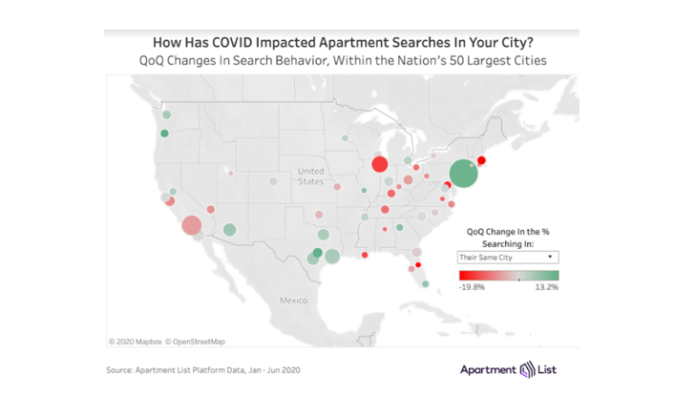
Apartment search data and behavior show subtle regional shifts, but no overwhelming evidence of a large-scale urban exodus, according to behavior on the Apartment List marketplace, the company says.

“While the coronavirus’s short-term impact on the housing market has already started to materialize in the form of softening rents, the long-term implications for the urban landscape are still far from certain and being hotly debated,” the release said.

“We’ve heard a lot of talk recently about an oncoming ‘urban exodus,’ but our data simply isn’t showing any evidence of such a trend at this point,” said Chris Salviati, Housing Economist at Apartment List.

“While there are certainly plenty of anecdotes about folks who have been spurred to make major moves out of the city since the onset of the pandemic, this isn’t something that we see happening at a large enough scale to really move the needle.

“Since the start of the pandemic, we actually see a slightly greater share of suburban renters looking to move into urban areas, rather than the other way around,” Salviati said.

Apartment search data report key findings

  • Nationally, America’s appetite for urban life remains strong. Since the start of the pandemic, apartment search data shows searches targeting higher-density cities rose from 33.8 percent to 35.2 percent.
  • In recent months, the share of users living in suburban areas and searching to move to large central cities increased, not the other way around. Suburb-to-central city searches are up 11 percent quarter-over-quarter.
  • Data trends vary by city. While users in New York and San Francisco don’t appear to be fleeing for the suburbs, those in Chicago and Boston appear more interested in suburban life.

apartment search data shows renters looking for something new

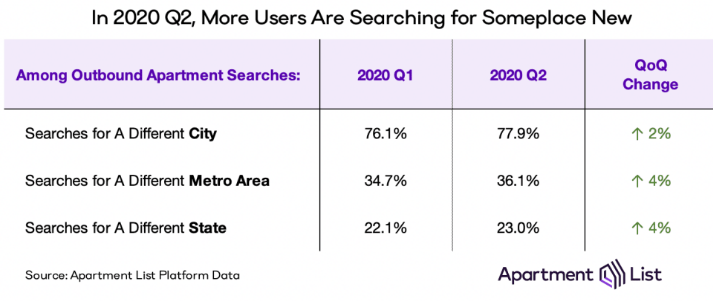
Renters looking for someplace new

“We do see a slight uptick in the share of renters looking to move someplace new,” the study says, with 78 percent of renters “searching in a different city from where they currently live” in the second quarter, up from 76 percent in the first quarter of 2020.

“Similarly, the share of users searching in a different metro rose slightly from 35 percent to 36 percent, and the share searching out-of-state ticked up from 22 percent to 23 percent.

“But even if renters are a bit more likely to search in new locations, they are not eschewing density,” the apartment search data report says.

Summary

While stories of Americans abandoning cities proliferate, “our apartment search data present a far more nuanced account of COVID-19’s impact on housing choice,” Apartment List says in the study.

“That said, these aggregate statistics mask that in certain markets, we are seeing early signs of a shift away from downtown. In Boston and the Bay Area, for example, search activity is up in the more affordable suburbs. In New York City, however, the opposite is true. If anything, these data show that search patterns in the COVID(-19) era defy broad generalizations.

“In prior research, we have found that to the extent that the pandemic is incentivizing moves, it is doing so primarily among those who have fallen victim to the economic fallout of the crisis and who now need to find more affordable housing.

“In this sense, the pandemic’s impact on migration trends may not be so different from what we’ve seen in prior recessions. We also find evidence that a growing embrace of remote work will play a role, but this represents an acceleration of trends observed prior to the pandemic, and these shifts are likely to play out over years, not months. The long-term implications of this continually evolving situation are still far from clear — we will continue monitoring the data closely and reporting changes as they occur,” the apartment search data report says.

Renters Still Optimistic About Finding New Apartments

Sign Up For Our Newsletter And Get Apartment News And Helpful, Useful Content Each Week.

* indicates required

5 Tips for Child-proofing Rental Property as a Property Manager

5 Tips for Child-proofing Rental Property as a Property Manager

Here are 5 tips for child-proofing rental property to help property managers keep their rentals safe, according to Keepe the maintenance company.

As a property manager, there are lots of safety upgrades that you can do to attract prospective tenants. Baby/child-proofing your rental property is a simple yet effective way to not only attract families but protect your tenants from danger.

For most renters with kids looking to rent an apartment, safety is usually their topmost priority.

Thankfully, proper child-proofing upgrades often do not require a large investment.

Below are five ways you can childproof your rental property to protect your tenants’ children and prevent lawsuits.

Child-proofing rental property stairs

 If you have staircases within your property, you should ensure that the railings are locked in place to prevent pulling by kids.

Install stair gates at the top and bottom of each outdoor staircase to prevent falls. You should also make use of non-slip materials around staircase areas to prevent slip-and-fall accidents.

For child-proofing needs on a stairway inside a unit, consider allowing a tenant with very young children to install a baby gate (at their own expense) at the top of stairwells.

Window Locks

 A simple slip-and-fall accident can have a severe effect on a child. It is advisable that you ensure that your windows are made from strong materials.

Install secure window locks and latches on all windows within the property and units.

In states like New York, window guards must be installed in a building with 3 or more apartments if a child under 10 is a resident. Child-proofing your property windows are important for preventing children from opening and tumbling out the window.

Pools

 If your property has a pool in the garden, bear in mind that a baby can drown in just 2 inches of water. Fence pools off or cover them securely. Check your local jurisdictions’ rules on this and size of fence required.

Depending on the number of kids in your rental, you should consider installing a pool cover that prevents kids from falling in.

Most importantly, place warning signs around the pool area. A simple “Children under age five must be accompanied by an adult” sign will save you from lawsuits and liability.

In-Unit Hazard Prevention

Every year, thousands of children are hospitalized for injuries sustained at home. As a property manager, one of your goals is to make sure that your property units are safe for living.

For electrical appliances, make sure you keep all extension cables out of reach to avoid strangulation.

Provide plug guards to any sockets within reach to prevent children from putting their fingers in. Also, protect all cabinets that may be used to store harmful substances (such as bleach and cleaners) with  magnetic locks or adhesive strips.

Alarms and Detectors

 Make sure that all the alarms and detectors are properly installed and functional.

It is important that you regularly inspect your smoke alarms and carbon monoxide detectors. Even if there hasn’t been any incident, this simple step can save your tenants’ lives and save your property from unexpected danger.

In conclusion

Many property managers think that child-proofing would be a costly endeavor, and end up paying huge fines or facing liability lawsuits.

When renting your property to a family with kids, you need to take multiple precautions and safety investments. It is important to sit down with your renters and discuss their opinions about child-proofing.

4 Steps to Make Rental Home Carpet Last Longer

About Keepe:

Keepe is an on-demand maintenance solution for property managers and independent landlords. The company makes a network of hundreds of independent contractors and handymen available for maintenance projects at rental properties.

Keepe is available in the Greater Seattle area, Greater Phoenix area, San Francisco Bay area, Portland, San Diego and is coming soon to an area near you. Learn more about Keepe at https://www.keepe.com.

Sign Up For Our Newsletter And Get Apartment News And Helpful, Useful Content Each Week.

* indicates required

Window locks can be importing in Child-proofing Rental Property
Photo credit bukharova via istockphoto.com

How Property Managers Are Managing COVID-19 Cautions in Apartment Communal Spaces

How Property Managers Are Managing COVID-19 Cautions in Apartment Communal Spaces

How property managers, landlords and other apartment operators are making decisions on how to open apartment communal spaces.

By Holly Welles

It’s now time for many businesses across different industries to reopen their doors amid the COVID-19 pandemic. Unfortunately, it’s impossible to predict the future. That’s why most companies have heeded health guidelines while they remain flexible. There’s no one-size-fits-all approach — even for property managers.

Here’s a look at how property managers,  landlords and other apartment operators have decided to open apartment communal spaces.

What Does the CDC Recommend?

The Centers for Disease Control and Protection continue to release information geared toward company owners. They update their coronavirus rules and recommendations frequently, providing an essential resource for many. The CDC maintains a few guides that detail how to clean and disinfect various surfaces — whether or not someone has become sick.

A property manager who wants to reopen apartment communal spaces such as gyms, lounges and pools should reference these regulations when necessary. It’s also essential to keep employees informed about personal protective equipment. All businesses need to establish maintenance practices before they open, so they can keep everyone safe from the start. It’s far better to take time to prepare than to open immediately without precautions.

Landlords must keep their residents informed. It’s clear that many people don’t want to take any risks, preferring to reintroduce themselves gradually to public spaces. The more educated people are about the process, the longer these areas can stay open.

Government Regulations on Masks

Masks are another factor that many business owners have to handle. There’s currently no national government mandate on whether the public needs to wear a mask. Instead, it’s up to state jurisdictions to decide where and when they want their residents to do so. Those who own a few properties shouldn’t have to keep up with many different rules unless they manage facilities across county lines.

Property managers should make masks mandatory for their employees. It’s a move many essential businesses in the housing industry are making to reduce virus spread and exposure on site. While it may not be possible or enforceable to mandate masks for residents, it’s also smart to post signs reminding people of safety guidelines and requirements for community spaces.

All apartment operators should keep up with their state’s mask guidelines so they can make safe choices for their employees and residents.

Reconfigurations for Public Areas

It may be necessary for property managers to make alterations to communal areas. It’s essential to keep people separated so that COVID-19 doesn’t have a chance to spread from a carrier. Places like fitness centers and leasing offices may need to undergo a reconfiguration to keep everyone protected. The same goes for outdoor areas, where residents may gather by the pool, for example.

The National Apartment Association recommends that staff workspaces should maintain a 6-foot distance as a precaution. Property managers should also place markers to keep residents within specific boundaries when necessary. If there’s a clubhouse, it’s vital to rearrange tables and chairs so that they’re not too close together. The same goes for gym equipment.

These spaces should also feature hand sanitizer and other products to keep everyone healthy. Additionally, property managers should consider how they’ll clean every area before they make any changes. Property managers and their employees should work out a dedicated cleaning schedule.

cleaning apartment common areas and property maintenance cleaning covid 19

Reduced Capacity Procedures

Those who wish to reopen communal spaces must consider reduced-capacity procedures. Property managers who have already opened their public spaces have done so with extra caution regarding how many people can visit a location at once. Areas like pools and gyms should contain as few residents as possible to prevent any risks. It’s also easier to clean a space when there are fewer people present.

It’s up to property managers to figure out their state’s guidelines as to how many people can gather safely. Apartment operators need to implement these reduce- capacity regulations beforehand, so residents know what to expect. It’s also crucial for property managers to maintain these guidelines. If people can come and go to a pool or fitness center as they please, it’s highly likely that the virus will spread.

These reduced-capacity rules should be a top priority for anyone who operates an apartment complex.

Property Managers Should Take Several Precautions

As property managers reopen their apartment communal spaces, it’s essential to consider regulations on overall maintenance. Many rules are up to individual states, so these companies must consult their local area’s recommendations. Those who create a comprehensive plan can provide a safe environment for their employees and residents.

How to Manage Tenant Communication During COVID-19

How to Avoid Crossing the Line with Tenants’ Privacy 

Sign Up For Our Newsletter And Get Apartment News And Helpful, Useful Content Each Week.

* indicates required

Rental Has No-Pet Policy;  What Are My Rights Regarding Therapy Or Service Dogs?

Rental Has No-Pet Policy;  What Are My Rights Regarding Therapy Or Service Dogs?

The Ask Landlord Hank question this week for veteran real estate investor and landlord Hank Ross involves a landlord’s question about a no-pet policy and therapy or service dogs

Dear Landlord Hank:

I am in the process of re-renting a home in Puyallup. There is a no-pet policy in place at this property, as previous tenants with a dog destroyed some areas. Now that the house has been upgraded, with a no pet policy. What are my rights regarding the “therapy or service dog?” Can I ask for paperwork and/or anything else???

Dear Landlady Lois:

I am not able to give legal advice. Here is my understanding of the situation.

The federal Fair Housing Act requires landlords to make reasonable accommodations for tenants with disabilities, and allowing an assistive animal in a no-pet building can be such an accommodation. (See Fair Housing Amendments Act, 42 U.S.C. -3601-3619.) There are service animals that provide assistance to disabled people, like Seeing Eye dog, for instance, and there are emotional-support animals that have not been trained to perform a service, but are a companion animal. In this case, a letter from a medical doctor or therapist is all that is needed to classify the animal as an assistance animal.

My understanding is that when a person’s disability is not readily apparent, the landlord can request information to support the claim of a disability. This proof could be state disability benefits or a letter from a treating health provider stating that this person does indeed have a disability.

OK, so once it’s determined the applicant has a disability, they need to establish the need for an emotional-support animal.

If the need is not apparent, you can ask for supporting documentation that the person has a need for an emotional-support animal. The information or proof that the animal provides assistance should come from https://phenadip.com a qualified health care provider who is licensed or certified, is in good standing with their professional regulatory board, and has personal knowledge of the individual. Under the new law in Florida, a certificate or online registration from the internet, by itself, does not establish a disability or the need for an emotional=support animal.

What you can’t do is ask for a pet deposit, as the animal is not classified as a pet but as a medical device. You also cannot require information disclosing the actual diagnosis of the person, nor any medical records relating to that diagnosis. If the applicant is willing to provide that information, it would be at the applicant’s discretion.

I suggest, as always, that you do an in-depth background screening of all individuals, at their expense. If you have a good rental history, and prior landlords have said that the tenants were good tenants and that they would re rent to them, I’m normally satisfied with that portion of the screening. I like a 5-year residential history. If a tenant can’t control their service animal or emotional support animal or they damage property or are a nuisance, this is not something you have to put up with. Be very careful here though.

Sincerely,

Hank Rossi

No-pet policy and rules
Landlord Hank

Ask Landlord Hank Your Question

Ask veteran landlord and property manager Hank Rossi your questions from tenant screening to leases to pets and more! He provides answers each week to landlords.

  • This field is for validation purposes and should be left unchanged.

Do I Have to Paint and Replace Flooring for a Long-Term Tenant?

Sign Up For Our Newsletter And Get Apartment News And Helpful, Useful Content Each Week.

* indicates required