Home Blog Page 137

Landlords to Appeal Rent Control Case to Oregon Supreme Court

Oregon Supreme Court Hears Landlords’ Appeal of Relocation Ordinance

Portland landlords plan to appeal to the Oregon Supreme Court after losing the appeal of the Portland rent control ordinance in the Oregon Court of Appeals.

John DiLorenzo, attorney for the landlords who filed suit, confirmed the landlords plan to appeal the rent control issue to the Oregon Supreme Court.

The landlords argue the city ordinance is in conflict with state laws that ban rent control. On March 7, 2018, the Portland City Council made the ordinance permanent and extended its application to landlords who own as few as one rental unit.

DiLorenzo said the petition for the Supreme Court to review the case would likely be filed before it goes back to Multnomah County Circuit Court, pausing the lower court process until the higher court rules on whether to hear the case.

“We are talking about narrowing our appeal this time. We will likely dispense with the impairment of contract arguments since the leases which that argument pertained to are long since expired,” DiLorenzo said.

“Also, we may further our Sims argument, i.e., the city has no right to establish a cause of action for the state courts.  Here, the City of Portland has created a private right of action which can be enforced by tenants in Circuit Court.  We do not believe the City of Portland has a right to do that,” he said.

Rent control is a state-wide matter

“The legislature has determined that rent control is a matter of statewide concern and proclaimed that no local government may enact any ordinance that either ‘controls the rent that may be charged for the rental of any dwelling unit,’ ORS 91.225(2), or that is inconsistent with that prohibition, ORS 91.225(7).,” DiLorenzo said when the trial court’s decision was appealed to the Court of Appeals.

“Notwithstanding the legislature’s unambiguously expressed intent to preempt local rent control legislation, the city enacted the ordinance, which requires landlords to pay thousands of dollars to tenants upon the tenants’ demand when a landlord gives notice of a rent increase of 10 percent or more in a 12-month period—meaning the ordinance penalizes rent increases that cumulatively total 10 percent or more in any rolling 12-month period.”

Landlords to Appeal Rent Control Case to Oregon Supreme Court

Tenants not required to use the money for relocation

DiLorenzo explained why the ordinance is in violation of state law.

“The ordinance calls the payments ‘relocation assistance,’ but tenants are not required to use the money for that or any other designated purpose. Further, the requirement to make the payments is triggered solely by the size of the rent increase and is intended to limit those rent increases. By penalizing rent increases greater than a certain size, the ordinance is designed to control the rent that may be charged. Accordingly, the ordinance runs afoul of ORS 91.225(2) and ORS 91.225(7), which forbid the rent-control aspects of the ordinance.

“In a separate provision, the ordinance also imposes payment requirements when a landlord issues a ‘no-cause stated’ termination; that is, the landlord exercises her state-granted right to terminate a periodic tenancy by giving notice without having to state a reason for the termination. See ORS 90.427. Under the ordinance, a landlord cannot give notice and regain possession of the property at the end of the notice period, as the legislature has chosen to allow.

“Instead, the ordinance requires a landlord to give more notice than state law requires and also to pay thousands of dollars to the tenant before the landlord may regain possession. Given those requirements, the ordinance is incompatible and with and contrary to ORS 90.427 and is preempted for that reason.

“The ordinance has yet a third provision that state law preempts. Where a landlord and tenant have a fixed-term lease, the ordinance requires the landlord ‘to renew or replace an expiring fixed-term lease on substantially the same terms except for the amount of rent or associated housing costs’ or pay relocation assistance to the tenant. That requirement destroys the very essence of a fixed-term lease, which by definition terminates without further notice or obligations. The ordinance’s fixed-term provision is incompatible and cannot operate concurrently with state law authorizing fixed-term leases.

“Finally, the ordinance, in violation of the Oregon Constitution, impairs existing contracts because it applies retrospectively to contracts entered into before the ordinance was adopted.

“Before the ordinance, landlords could raise rent or issue a no-cause-stated termination without penalty. Tenants also had an obligation to vacate the premises upon expiration of a fixed-term lease. The ordinance dramatically changes the landlords’ rights and tenants’ obligations by imposing significant penalties if landlords exercise their preexisting contractual rights, unconstitutionally impairing the parties’ contracts,” DiLorenzo said.

How Rent Control Limits Owner Profits and Maintenance in Portland, Seattle

Sign Up For Our Newsletter And Get Apartment News And Helpful, Useful Content Each Week.

* indicates required

Why Is The Internet In Apartment Complexes So Bad?

Why internet in apartment complexes so bad is a complicated question so here are some explanations.

Sponsored Blog

Can A Multifamily Internet System With WiFi Installation Be The Ticket?

By Hart Steen

An Educational Series for Apartment Owners Part 1 – Modem Service

A busy, always connected lifestyle demands the Internet. So much so the FCC, in a 2016 ruling, deemed the Internet a utility and it will be regulated as such. Regardless of government policy, the fact remains, access and experience are extremely important to consumers. Internet, as a utility, is an important distinction in today’s marketplace. Most Internet users experience a “Dirty City Water” Internet experience because its poorly maintained and rarely managed by monopolistic Internet Service providers (ISPs ) leaving a bad taste in the consumers mouth. Most agree the Industry needs improving; just as there are quality options for drinking water in the market, there are quality options for Internet. A “Glacier Water” Internet experience stands apart from typical Internet offerings for the residents, simultaneously generating revenue, increasing brand loyalty and maximizing retention for an apartment owner.

Comparing “Dirty City Water” to “Crystal Clean Glacier Water” is like comparing best-effort Cable Modem or DSL services (a.k.a. Modem Service) to a professionally managed, highly reliable, Fiber Backed Property-Wide WiFi service (a.k.a. Pure Internet). When a network is installed and managed correctly, the true essence of “Pure Internet” can be achieved; if not, the likely experience is the status-quo (or worse) that plagues American Internet services today. Most have always known they’re paying too much for an inconsistent, inferior service and it ‘s no secret Big Box Internet Service Providers (ISPs) are often ranked last in customer surveys. What’s not as intuitive is why.

4 Pillars of Slow Internet

Internet Speeds – Pillar 1

Calculating Internet speeds are often misunderstood by consumers. The industry has done a fabulous job of masking what’s important in achieving true speeds and a pure Internet experience. But why is interest in apartment complexes so bad?

A) Internet Speeds: Bad news! Buying more Mbps (Megabits per Second) seemed the answer to faster Internet speeds but that’s not exactly true. Purchasing more Mbps buys capacity not speed. Speed, how we comprehend it, is perceived in distance; like with miles per hour (MPH). Contrary to most beliefs, Internet speed is more accurately expressed as latency. Lower the latency, increase webpage load times. Isn’t that what we are looking for?

Picture the Internet like a freeway; purchasing more Mbps buys you more lanes not a higher speed limit. Unknown by most, your lanes still move at the speed of your latency regardless of how many lanes you buy. Latency is something most ISP’s won’t discuss. They cannot control, manage or sell lower latencies effectively; instead they sell you more slow lanes of capacity. What’s important to note here, and this confuses a lot of people, is that your internet isn’t any faster from 1 Mbps to 5 Mbps, or however much bandwidth your connection has. Your data is just transferred to you at a faster rate because more data can be sent at the same time. It’s more efficient, making your internet perceptually faster, not technically faster.

Your true Internet speed is the relationship between bandwidth (how much) and latency (how fast); not just bandwidth alone.

B) Over subscription: Modem Services are notorious for over-subscription ratios that routinely surpass 100 to 1. Meaning, 100 people are sharing the same allocation of bandwidth on the same internet pipe. There’s nothing inherently wrong with oversubscribing bandwidth; most people aren’t fully utilizing their bandwidth. Further, it increases the cost efficiencies of a network. However, when over subscriptions are high, it causes peak period slow-downs for end-users. One hundred (100) households with 5 devices or more, all sharing the same internet pipe, is simply too much.

C) Symmetrical Speeds: Many forms of Internet, namely modem services, have asymmetrical speeds. This means higher downloads speeds than upload speeds. It’s common to see a 10-to-1 ratio. This can be a problem for live communication applications; like video streaming (e.g. Skype), VoIP or chat. If you are... running any real-time applications like Microsoft Office365, VPN, VoIP, video conferencing, web conferencing, and/or you have a need for large file transfers, you will benefit from high speeds in both directions.Read more about this here. A growing number of businesses facilitate remote work from home. Hence, the virtual work force is rapidly growing; it’s imaginable to see a majority of the workforce working remotely in the future.

D) Privacy: Make no mistake your Internet habits are being monitored, recorded and stored. With recent Internet laws being passed, it’s now legal for ISPs to collect and sell ALL of your browser history and other relevant data. IT professionals can dodge this; however, for the rest of us, prepare to share your online habits with your ISP.


Why Is The Internet In Apartment Complexes So Bad?

Managed Internet & Support – Pillar 2

A) Dirty Data: Modem services are a WIDE OPEN pipe from the Internet to your home. This means that hackers have the ability to penetrate your network; the only obstacle is your $60 router from Best Buy, configured and managed by you. The average Joe is expected to configure their router in an attempt to protect against these professional hackers. Managing a network at this level is not for the faint at heart, yet we have been relegated to figuring-it-out. Millions of Americans are on-their-own which creates legitimate risks and concerns.

B) Customer Support: Unfortunately support from most Big Box companies only exists to maintain THEIR wiring and equipment. If they confirm it’s not THEIR fault, you’re on your own. In some cases, you may find they offer expensive network support to help guide you through the perils. However, most ISPs simply confirm the signal to your modem and don’t support it further. A perfect storm of bad equipment, bad wiring, monopolistic attitudes and profit-first philosophies fuel this lackluster and inept support experience. In the end, customer support falls short of par for most ISPs. Without competition, there’s no incentive for internet providers to improve infrastructure. These massive telecom companies create a bottleneck in the last mile of service by refusing to upgrade critical infrastructure. And they can charge exorbitant prices for the sub-par service while they’re at it.

C) Best Effort Service: Unfortunately, most Americans are relegated to “Dirty City Water” because they have “best effort” modem service as their primary residential connection. Somehow the industry has thrived by offering lowest-common-dominator-services. They even named it similarly, Best Effort. The ISP is saying they will try their best to provide what you paid for. Only, there are no Internet-quality-police to hold them accountable. Worst yet, there’s often a monopoly or duopoly which creates very little incentive to improve quality of service and customer support. That’s why the industry’s biggest providers are routinely voted the most hated in the U.S.

D) Security: You are on your own in terms of security. Relying on virus protection or your operating systems firewalls can certainly help stop certain types of online threats. However, you are still in grave danger from hackers. Without professional management the network is left with a Mom and Pop security environment that lamely attempts to thwart determined threats.

A study by CNET.com stated …

all 14 top home routers had critical security vulnerabilities that could be exploited by a remote adversary and could lead to unauthorized remote control of the router.

Wifi Design & Configuration – Pillar 3 

A) WiFi Installation & Design: In a small space it may appear like WiFi design doesn’t really matter and there isn’t enough square footage to cause coverage issues, right? Not exactly, the WiFi radio frequencies (RF) from neighboring routers are all fighting for the same limited air space, with zero synergy. This is compounded in a multifamily environment; more WiFi interference means slower connections and decreased security, effectively creating a hodge-podge design that is counter-productive to Pure Internet.

B) Configuration: Configuring a home router may seem intuitive if you know the basics. However, your home network is inherently disadvantaged because of the limited-feature-set found in a home router. They usually don’t include enterprise firewalls, bandwidth shaping, black lists and interference mitigation. The lack of features vastly limits proper security. Even if an enterprise router was used, the weakest link is still the novice home network engineer. A BBC article titled How easy is it to hack a home network? puts novice configurations and home networking blunders into perspective.

I found out just how severely compromised my home network was in a very creepy fashion. I was on the phone when the web-connected camera sitting on the window sill next to me started moving. The lens crept round until it pointed right at me. I knew that the attackers were on the other end watching what I was doing, and potentially, listening to the conversation.

Why is internet so bad in apartment complexes

Internet & Wifi Installation – Pillar 4

A) Competition: It’s all about the bottom line, thus your local ISP plans on using their antiquated wiring infrastructure for as long as possible. Most ISPs enjoy monopolistic environments. They won’t ordinarily upgrade unless there are extenuating forces. For example, in Google Fiber territories, local ISPs magically upgraded their fiber infrastructure to compete. Googles expansion has since come to a halt. Google knows if they expand to new cities the local incumbents will simply ramp-up services in that area. Atlanta is the perfect example — 99% of the country is not so fortunate to have a turf war driving down prices and forcing fiber upgrades. With little to no competition there’s no incentive to upgrade wiring and cannibalize profits. Unless something changes, most of America will have to wait for fiber — hunker down and get used to antiquated wiring for decades.

B) Antiquated Delivery: Bandwidth delivered over coaxial or copper wire is outdated, and, by association, the entire delivery process has technological bottlenecks. Your delivery is only as strong as the weakest link. Even with fiber-to-the-home (FTTH), your bottleneck may still be the wiring inside the home, fiber media convertor, router or modem. There are many places the delivery could be bottle necked when dealing with old wiring which is one reason internet is so bad in apartment complexes.

Most of America’s telecommunications infrastructure relies on outdated technology, and it runs over the same copper cables invented by Alexander Graham Bell over 100 years ago. This copper infrastructure made up of twisted pair and coaxial cables was originally designed to carry telephone and video services. The internet wasn’t built to handle streaming video or audio.

C) Over-the-Counter Routers: Most people either rent a modem/router or buy one and, while over-the-counter WiFi equipment is priced to sell, it does not provide premium technology. Bigger living spaces can experience dead spots and most turn to mesh equipment, repeaters or other consumer grade Whole-Home WiFi Solutions. These types of solutions commonly relay the WiFi signal, which slows speeds around 50% per hop.Internet is only as fast as the weakest link. Next to bandwidth, equipment is the most common area that contributes to bad Internet experiences. Underserved/Overpriced The typical Internet connection sucks and is overpriced. The average cost of residential Internet is around $75. Additionally, most pay $10 a month to rent their modem. The cost of Internet is not necessarily more than other utilities but definitely comes with the lowest quality and reliability. It is as essential as running water, but has all the problems of a do-it-your-self environment. Other utilities don’t pose the same dynamics. For most, the water pressure doesn’t drop every time neighbors run a bath. We pay $75+ for an essential utility service; we want the service to work; no headaches or training involved. From an antiquated infrastructure to user-error the entire experience is often a nightmare which is why internet in apartment complexes is so bad.

Next month: Part II How to Fix Slow Internet for Apartment Residents, Generate Revenue and Ditch the Cable Guys With a Multifamily Internet Service

Fiber Stream is a provider of futuristic high speed Internet and TV services. Fiber Stream’s target markets include Apartments, HOA’s, MDU’s, and senior living communities. Headquartered in Phoenix, Arizona, Fiber Stream is a nationwide Full Service Internet provider, offering Fiber to the Unit (FTTU), Fiber-Backed Property-Wide Wi-Fi, Gigabit Internet, Managed Wi-Fi solutions and IPTV. Fiber Stream developed one of the first Revenue Generating Internet Systems of its kind. For more information visit www.FiberStreamWIFI.com or call 1-888-644-9434.

Photos courtesy of FiberStream

Sign Up For Our Newsletter And Get Apartment News And Helpful, Useful Content Each Week.

* indicates required


Apartment Jobs Hiring Resilient in 2nd Quarter

Apartment Jobs Hiring Resilient in 2nd Quarter

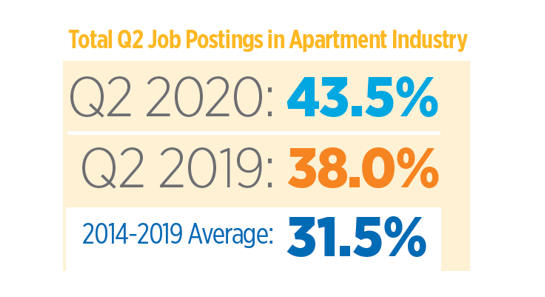
Despite the uncertainty and economic damage caused by the COVID-19 pandemic, apartment jobs hiring was resilient during the second quarter of 2020, according to the latest report from the National Apartment Association.

In the June report of the National Apartment Association’s Education Institute (NAAEI) Apartment Jobs Snapshot, job openings in the apartment industry comprised nearly 44 percent of positions available in real-estate sector jobs across the county.

This level of available apartment jobs is well above the 5-year average of 31.5 percent.

Many property management companies have increased hiring and staffing efforts in preparation for pent-up apartment demand due to stay at home orders.

Property manager jobs in high demand due to Covid-19

Property manager jobs were in high demand in June 2020
Charts courtesy of the National Apartment Association

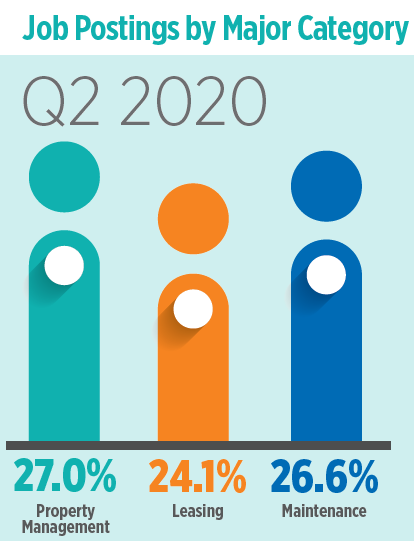
In terms of specific jobs, property-manager positions were the most sought after. Property management positions were in high demand during Q2 2020 and had the largest growth in demand, increasing three percentage points. Property managers are on the front lines for ensuring that all COVID-19 safety precautions are in effect and making residents feel safe in their communities.

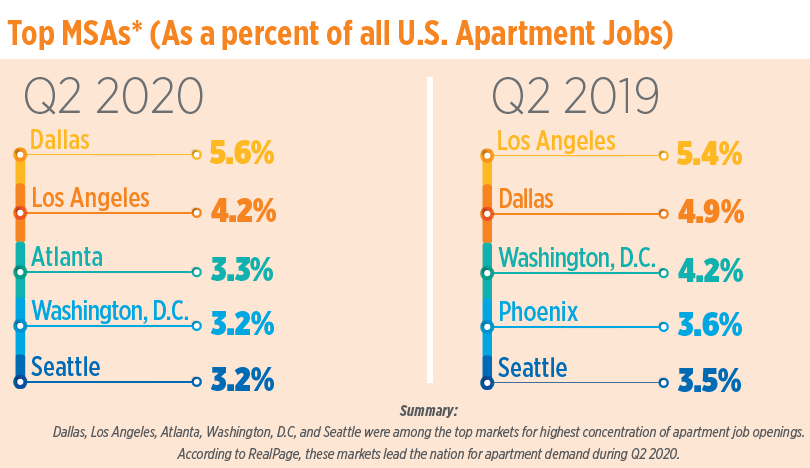
Around the country, Seattle, Dallas, Los Angeles, Atlanta and Washington, D.C. ranked highest for apartment-job demand.

Leasing momentum for student housing is increasing as universities plan to open on-campus classes, resulting in high demand for leasing consultants. However, this could be subject to change depending on pandemic issues in certain states.

Student housing

During the past 12 months ending June 30, 2020, demand for student housing management professionals was highest in Columbus, College Station, Chicago, Austin, and Tempe.

Leasing consultants were in highest demand, accounting for almost 14.0 percent of all student housing job postings. As of late June, leasing velocity for the fall semester has regained momentum, only 2.3 percentage points down from 2019. According to CBRE, demand for on-campus student housing has remained steady since 92.0 percent of international students have stayed in the U.S and 80 percent of American students studying abroad have returned home.

Summary:

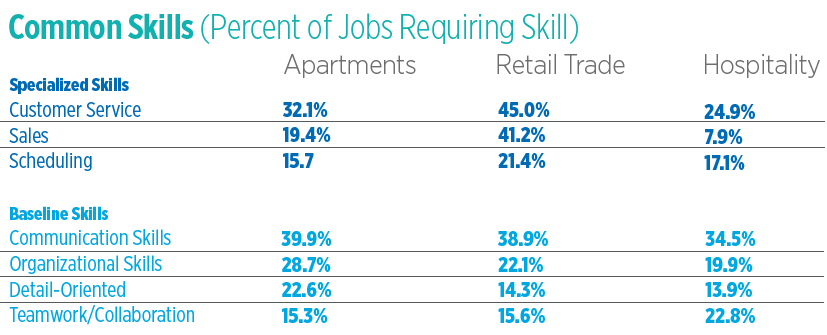
The apartment sector often competes with the hospitality and retail sectors for personnel with similar experience and skills. Customer service, communication, and organizational skills were among the most desired skills across all three sectors.

Common skills needed for working apartments

The hiring back of retail and hospitality employees has intensified competition for talent, particularly since the labor pool has begun to shrink. In June, the retail and hospitality sectors led the US in job growth. The leisure and hospitality industry hired back 2.1 million employees. The retail trade hired 740,000 people, nearly doubling the job growth it made in May.

Cities That Keep the Most Jobs During Downturns

Sign Up For Our Newsletter And Get Apartment News And Helpful, Useful Content Each Week.

* indicates required

Rent Control Still Not the Solution to Housing Affordability

California Voters Reject Rent Control

The pandemic is intensifying the housing affordability problems that have existed for decades, according to Growing Homes Together, a National Multifamily Housing Council (NMHC) resource center, however, they are firm in believing that rent control is still not the solution.

In a recent blog post, “Rent Control: The Wrong Prescription Then, The Wrong Prescription Now,” Growing Homes together points outA significant percentage of renters were already struggling before the pandemic. According to Harvard’s Joint Center for Housing Studies, nearly half of all U.S. renters were cost-burdened, meaning they are spending more than 30 percent of their monthly income on rent. A May 2019 report from the Federal Reserve highlighted that 40 percent of Americans didn’t have $400 available for an emergency bill. At a time when incomes have been decimated from this pandemic, these issues are only getting more severe.”

Not the time for politicians to try and advance rent-control agendas

“Naturally, housing providers and elected officials have been looking for smart solutions to keep Americans safe and secure in these trying times. Some, though, are attempting to politicize this moment to take advantage of the crisis and advance their own agendas,” Growing Homes Together writes in the blog.

“Namely, we’re seeing a resurgence of calls for rent control from activists bent on forcing property owners — who themselves are being challenged by this pandemic — to bear the brunt of this crisis. Groups such as Tenants Together have taken even more extreme measures and gone as far to call for rent strikes – yet again demonstrating that they are not above taking advantage of this pandemic to achieve their political goals. Rent-control proposals vary from state-to-state and across municipalities. Some call for cutting rents by 25 percent across the board; others follow in the footsteps of previous failed ballot initiatives already rejected by voters. All of them are built on the false premise that price controls are an adequate solution to a supply-and-demand imbalance.

“Now more than ever, it’s incumbent upon us to find smart solutions to the problems facing working Americans. Many housing providers have taken steps to work with residents to implement rent=payment plans, waive late fees, and freeze rents for 90 days. But the truth is that longer-term rent control would only hinder housing providers from fulfilling their own financial obligations and further endangering apartment communities.

“Make no mistake: Rrent control wasn’t a viable solution to our housing affordability crisis before this pandemic started. And it certainly isn’t any better of an idea now. Instead of pursuing misguided policies like rent control, there’s plenty our leaders in Congress can do to help residents and property owners. To start, Congress should create an Emergency Rental Assistance Program for those who have been impacted by the crisis and do not already receive federal housing subsidies. Additionally, mortgage forbearance protections should be expanded to match any eviction moratoriums to help property owners maintain their residences.

“We all have a role to play in overcoming this crisis. Housing providers will continue to work with residents to keep apartment communities safe and whole. At the same time, elected officials should reject tired and misguided policies like rent control and instead work towards meaningful solutions that address the challenges of residents and housing providers,” Growing Homes Together writes in the blog post.

About the author:

Growing Homes Together (GHT), a project of the National Multifamily Housing Council (NMHC), is a resource center designed to spark discussions at the state and local levels about policy solutions to improve America’s housing crisis. NMHC is a national organization of more than 1,100 member firms involved in the multifamily housing industry.

See related stories below:

What Is Rent Control?

How Rent Control Limits Owner Profits and Maintenance in Portland, Seattle

Sign Up For Our Newsletter And Get Apartment News And Helpful, Useful Content Each Week.

* indicates required

Pandemic Will Lead To Companies, Millennials Moving To Suburbs, Research Says

Pandemic Will Lead To Companies, Millennials Moving To Suburbs, Research Says

Companies and millennials will be moving to suburbs as a result of the pandemic and the increasing trend of working from home and desire for shorter commuting times, according to new research and special report  from Marcus & Millichap.

The research says the pandemic will increase the trend of moving to the suburbs, which will potentially create “a structural shift” in demand for multifamily housing, single-family housing and suburban office space.

“Even without additional health concerns, suburban popularity had already begun to rise. While a decade ago the pace of population growth was higher in downtown areas, now that activity has shifted to the suburbs. This trend is being accelerated by health concerns, but demographics are at the root,” Marcus & Millichap says in the report.

Other research has shown people value more living space now that they stay at home more, and they need home office space as well. Plus they prefer not to have to commute into the office in a downtown location.

The other research, a poll conducted by The Harris Poll, finds that 75 percent of Americans working from home due to COVID-19 say they would prefer to continue doing so at least half the time, if given the option, after the pandemic subsides.

Pandemic Will Lead To Companies, Millennials Moving To Suburbs, Research Says
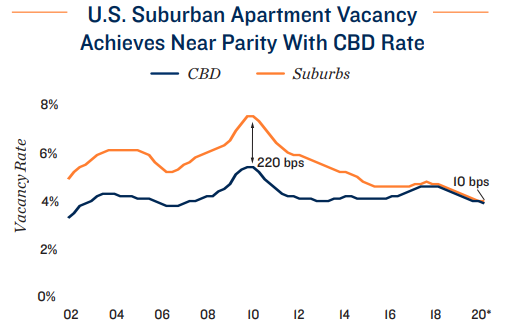
Chart courtesy of Marcus & Millichap

Companies will follow workers moving to suburbs

As millennials lead the move to suburban multifamily and single-family residences, this will drive the need for nearby office as well as retail space.

“The gap between suburban and urban apartment and office vacancies, which both reached peaks of over 200 basis points during the Great Recession, has since fallen to less than 40 basis points,” Marcus & Millichap write in the report.

“While partly influenced by varying construction levels, this near parity is largely a result of more millennials moving out of urban cores. Firms are following suit, with rising foot-traffic levels also catching the eye of retailers.”

The survey also points out that even if a company wanted to bring back workers to a central urban location, “there are several logistical challenges to overcome. Taking public transit to the center of town and riding an elevator to a top-floor suite pose health risks that a drive to a low-rise suburban office does not,” the report says.

Costs are lower in the suburbs, so companies may move there while holding on to a central business location. However, the shift to suburban office space “in conjunction with suburban residential growth, would also influence the retail and industrial sectors. Retailers will want to be close to both suburban residential and commercial hubs, with distributors seeking space to support last-mile deliveries to consumers,” Marcus & Millichap says in the report.

Sign Up For Our Newsletter And Get Apartment News And Helpful, Useful Content Each Week.

* indicates required

Almost a Third of Renters Failed To Make Full Rent Payments July 1

rent payments missed in July

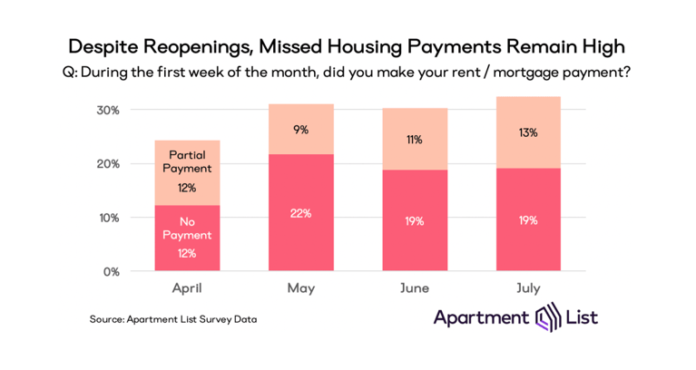
A recent rent-payments survey shows that 32 percent of renters failed to make their full July housing payments on time as new cases of COVID-19 surge and reopening plans have been paused or rolled back throughout the country, according to Apartment List.

“This is the highest non-payment of rent since we began running this survey in April,” Apartment List said in the survey results. “Fears around evictions and foreclosures have also worsened, and more Americans today are considering a move as a result of the pandemic.”

Key findings in the rent payments survey

  • 19 percent of respondents have not yet made a housing payment for July, and an additional 13 percent have made only a partial payment. Missed payments remain common for renters and homeowners alike.
  • 21 percent of renters say they are “very” or “extremely” concerned about facing eviction in the next six months, up from 18 percent in June. Meanwhile, 17 percent of homeowners expressed serious concern about foreclosure, up from 14 percent last month.
  • More than half of respondents have had their moving plans affected by the pandemic. About  33 percent  say that they are now less likely to move during the remainder of 2020, driven primarily by health concerns, while 21 percent say that they are now more likely to move, driven primarily by the need to find more affordable housing.

Renters in large multifamily buildings have less trouble paying rent

Almost a Third of Renters Failed To Make Full Rent Payments July 1

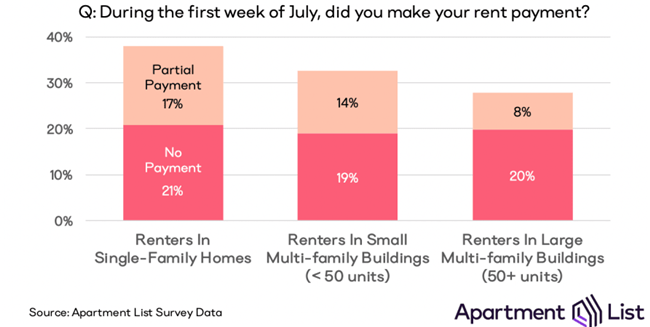
In July, here is what Apartment List found in terms of which renters were missing payments:

  • 38 percent of renters in single-family homes had the most difficulty affording their housing, with 21 percent making no payment and 17 percent made a partial payment.
  • 33 percent of residents of small-to-medium-sized multifamily buildings with fewer than 50 units missed payments.
  • 28 percent of those in large multifamily buildings containing 50 or more units missed payments.

Coronavirus is Having a Greater Impact on Moving Plans

According to last month’s Apartment List survey, the financial fallout from the pandemic is simultaneously encouraging and discouraging people thinking about moving.

“Loss of income has left some households with no choice but to move to a more-affordable home. For others, the costs associated with moving now seem overly burdensome, leading them to stay put. We also find that the virus itself is continuing to have a major impact on moving plans, with many reporting they are less likely to move because they do not believe it is safe to do so.

“Meanwhile, the opportunity to work remotely is inspiring some to consider locations that, prior to the pandemic, were not feasible because of work constraints.

“This month’s survey shows that the pandemic’s impact on migration is deepening in both directions. The share of Americans who say that they are more likely to move this year due to the pandemic increased from 17 to 21 percent, while the share who say that they are less likely to move increased from 30 to 33 percent.

“Health risks continue to be the biggest factor discouraging moves, and the percentage who cite safety concerns rose from 37 percent to 44 percent. As for those considering a move, the opportunity to work from home is becoming more of a driver, as 23 percent say it’s playing a role in their decision, up from 19 percent last month.”

Conclusion

Economic reopenings swept the nation in June and provided some unemployment relief, but did little to ease the rent payments crisis. Despite some Americans getting back to work in June, the rate of missed housing payments actually increased. Looking ahead to July, the majority of states have either paused or are reversing their scheduled re-openings. If local displacement bans are allowed to expire before local economies begin to recover, the missed payments we have been tracking over the past four months could lead to a wave of downgrade moves as renters and homeowners seek more affordable housing. We are already witnessing unprecedented declines in rent prices as demand for expensive housing wanes.

Rental Payments Slow Down in Early July, Fall to 77 Percent

Sign Up For Our Newsletter And Get Apartment News And Helpful, Useful Content Each Week.

* indicates required

Greater Seattle Area Mid-Year Residential Rental Housing Update  

New Seattle Ordinance Attempts to Limit Tenants’ Personal Liability in Commercial Leases

By Corey Brewer

While the world has been all but flipped on its axis during the first half of 2020 in reaction to the COVID-19 pandemic, let’s take a look at what has been going on in the single-family rental market throughout King and Snohomish Counties.

For context, we review data published by our local Northwest Multiple Listing Service (NWMLS) which includes primarily single-family rental houses and condominium units.  There are some apartment units mixed in with the condominium category, but the vast majority of apartments in the region are not listed by NWMLS member brokerages.

 With that in mind…

The total number of homes rented decreased by about 15 percent from the same period last year.

Like the real-estate sales industry, our ability to tour homes with prospective renters was (and to some degree still is) affected by health-protection measures.  We also attribute this drop-off to the reality that people didn’t move as much as they normally do this spring compared to previous years.  Mobility has been restricted and a lot more people have chosen to renew their leases instead.  Compared to the first half of last year, renewals increased by 10.9 percent among our portfolio (1,500+ homes), and looking back two years, renewals spiked by 29.4 percent comparatively.

We have also executed lots of short-term lease extensions for residents who had planned to move, but put their plans on hold for the time being.

Generally speaking, for the homes that did hit the market and rent between January and June, you would barely know that COVID-19 was a factor (at least on paper).  Average days-on-market slowed from 38 to 40, but this is a minor difference; 40 days on market is identical to this time in 2018. Overall rental values are up 2.8 percent from last year, and price per square foot jumped even more, by approximately 4.8 percent.

The migrating demand trend

As you start to look closer, however, you’ll see where the true impact of COVID-19 hit the Seattle rental-housing market, and that is with condominium and multifamily units.  I am going to call this a “migrating demand” trend.

“Migrating demand” is the story of housing in response to COVID-19.

Around the world, people are fleeing dense city centers and searching for housing in suburbs or even in remote areas.  Recently published articles from sources such as the Wall Street Journal document this trend around New York City, and in other parts of the world migrant workers are leaving crowded cities and making their way back to the more remote areas from where their families originate.

Back to our specific region, market times for condos and multifamily specifically in the city of Seattle have suffered, slowing down by a significant 38.8 percent compared to the same time period last year.  As mentioned earlier, rents across the board have trended up in Seattle rental housing, but what you can’t see in the NWMLS data is how often concessions are being offered on executed leases (such as “first month free” on a condo or apartment rental, which is prevalent if you go looking around the various advertising sites).

We believe there are three key factors that explain the “migrating-demand” trend in Seattle rental housing.

 No. 1 – Health concerns:

The term “social distancing” has become inescapable and this speaks directly to the proximity of neighbors in condo and multifamily settings.  Shared amenities such as entryways, elevators, mail rooms, and other common areas have residents on edge as they yearn for more private living spaces.

No. 2 – Square footage:

Another familiar term is “sheltering in place,” which is a lot easier to do when there is a basement, deck, or back yard to retreat to.  Some local readers may have seen the TV commercial that our brokerage ran earlier this year, highlighting one of our residents who was in a big hurry to move out of her smaller rental unit and into a two-story house.

No. 3 – Working From Home: 

If a large number of jobs are moving out of offices and into a more remote scenario, then the need to live in close proximity to downtown office buildings is no more.  Without a commute to worry about, living further away from the city is not as much of a concern for many.

When you start to look beyond housing, there may be even more changes to the way people live their lives. Crowded restaurants, concerts, festivals, and sporting events – are they a thing of the past?  At least temporarily?

Given the non-permanent nature of renting a home (as opposed to buying), expect to see this “migrating-demand” trend intensify for renters as they look to take a break from in-city living, and maybe come back in a few years when pandemic concerns have softened.

We expect this will also give significant rise to the demand for the Accessory Dwelling Unit (“ADU”) housing product.  Also known as a “backyard cottage” or a “mother-in-law” apartment, whether attached or detached, this type of housing unit offers a good mix of affordability and personal space.

Since the term “essential” also became a buzzword in reaction to the pandemic, we have taken the position that housing is always essential.  In relation to some other industries such as restaurants or airlines, we are grateful to be involved in an industry that continues to show resilience, stability, and strength.

Cory Brewer writes about Seattle rental housing.
Cory Brewer

About the author:

Cory Brewer is the general manager at Windermere Property Management / Lori Gill & Associates. He oversees a team of property managers in the greater Seattle area who manage approximately 1,500 rental properties. Brewer can be reached via www.wpmnorthwest.com or coryb@windermere.com

Landlord Regulations – Should I Just Give Up?

Sign Up For Our Newsletter And Get Apartment News And Helpful, Useful Content Each Week.

* indicates required

25 Percent of Renters Say They Will Never Buy A Home

25 Percent of Renters Say They Will Never Buy A Home

A significant share of current renters now say they will never be homeowners, according to a survey of 7,000 renters from RentCafe.

Also, one in 10 renters were ready to buy a home this year, but the pandemic forced 43 percent of them to delay their homeownership plans.

Some survey highlights:

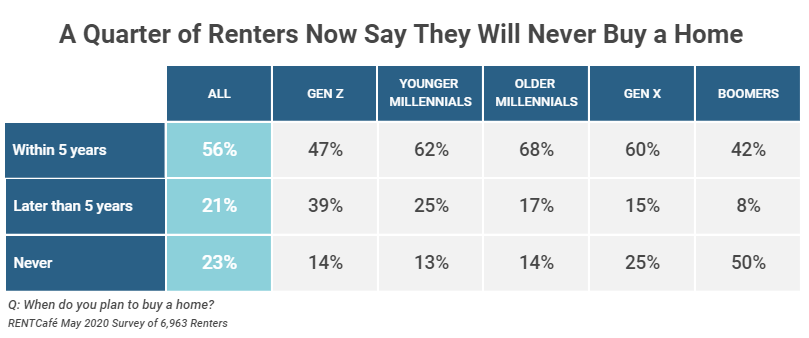
  • Things were finally looking up for Gen X and older millennial renters, of whom 15 percent and 14 percent, respectively, were confident they’d become homeowners by the end of the year.
  • As 43 percent of would-be home buyers changed their plans due to the pandemic, “economic uncertainty” and “loss of income” were the most cited reasons for delaying homeownership.
  • As many as 50 percent of older millennials were forced by the crisis to let go of their dream, followed by younger millennials (43 percent) and Gen Xers (42 percent).
  • Considering the current market conditions, “We asked renters about when they would finally be able to buy a home; while 56 percent were optimistic about becoming owners in the next 5 years, a significant 23 percent said that they’re never buying,” the survey says.
  • Millennials were most eager to buy a home soon, particularly the older cohort, with 68 percent of older millennials planning to become homeowners in the next 5 years. Long-considered renters-at-heart, this cohort is now set on making the transition.
  • On the other side, half of baby-boomer renters expressed no intention of ever buying again, as they seem to be getting more and more comfortable with renting.

Renters not buying homes

Doug Ressler, manager of business intelligence at Yardi Matrix, had these answers to questions posed about the survey:

renters are not buying houses for several reasons says Doug Ressler of Yardi Matrix
Doug Ressler

Q: What one piece of advice would you give to Gen Zers and younger millennials who want to become homeowners sooner?

A: The buy vs. rent analysis is partially financial and partially emotional. The financial part of the analysis is difficult to work out because of future assumptions. However, one also needs to understand the level of risk and flexibility that come with each option, as well as individual desires, before making a purchase-vs-rental decision.

Q: There’s a large share of renters who think they’ll never become homeowners. Why is that?

A: When it comes to the complexities of real-estate investment, personal finances, and future economic time horizons, the conventional wisdom of buying being better than renting does not always hold true.

Many renters don’t think that they’ll ever own a home because they might not be able to afford the additional expenses that come with this decision, such as interest, property taxes, insurance, and maintenance for the entire ownership period. On the other hand, renting consists only of monthly rent and a possible one-time deposit; therefore, economically, renting might make more sense than buying a home.

Q: In your opinion, what is the No. 1 reason millennials, Gen Xers, and boomers do not purchase a home, renting instead?

A: As more millennials are moving up the earnings ladder, get married, and start families, housing is increasingly taking center stage. Although they have a higher number of graduates than Gen Xers and baby boomers, they are less likely to own a home. Some of the barriers to homeownership could be delayed marriage, student debt, and choosing to live in high-cost cities.

Q: Is it a good idea to buy a home now? In which cities?

A: This would depend on financial considerations and the targeted area of purchase. In more than half (59 percent) of housing markets nationwide — 442 of 755 U.S. counties — renting a three-bedroom property is now more affordable than buying a median-priced home.

The lowest median home prices would be in the Houston metro area, Orlando metro area, or Chicago metro area, all three of which boast a high percentage of millennials.

Doug Ressler is the director of business intelligence at Yardi Matrix, where he is responsible for the creation of business and statistical research models for the commercial real estate industry. Previously, he was an analyst at the multifamily market research company Pierce-Eislen. He holds a master’s degree in business administration from Arizona State University and a bachelor’s degree in business administration from Pennsylvania State University.

Potential Tenants Like Self-Guided Rental Housing Tours Without The Agent

Sign Up For Our Newsletter And Get Apartment News And Helpful, Useful Content Each Week.

* indicates required

25 Percent of Renters Say They Will Never Buy A Home
Photo credit fizkes via istockphoto.com

Rental Payments Slow Down in Early July, Fall to 77 Percent

Rental Payments Slow Down in Early July, Fall to 77 Percent

The National Multifamily Housing Council’s most recent rent tracker shows a decline in rental payments in early July compared to previous months.

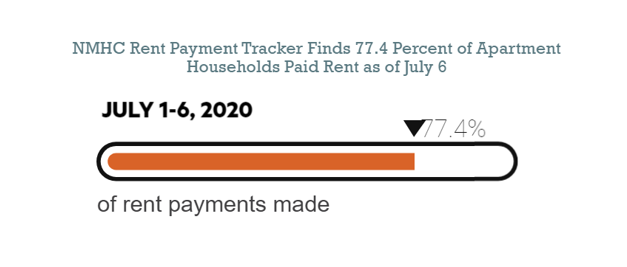
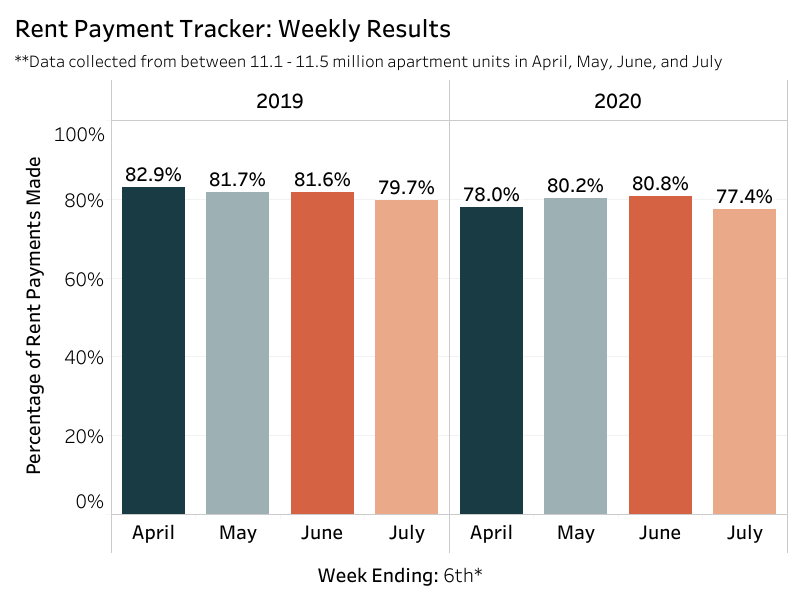
The most recent July Rent Payment Tracker found 77.4 percent of apartment households made a full or partial rent payment by July 6 in its survey of 11.4 million units of professionally managed apartment units across the country.

“This is a 2.3-percentage-point decrease from the share who paid rent through July 6, 2019 and compares to 80.8 percent that had paid by June 6, 2020. These data encompass a wide variety of market-rate rental properties across the United States, which can vary by size, type and average rental price,” the NMHC said in a release.

More government assistance needed for renters and landlords for rental payments

“It is clear that state and federal unemployment assistance benefits have served as a lifeline for renters, making it possible for them to pay their rent,” said Doug Bibby, NMHC President, in the release.

“Unfortunately, there is a looming July 31 deadline when that aid ends.  Without an extension or a direct renter-assistance program, that NMHC has been calling for since the start of the pandemic, the U.S. could be headed toward historic dislocations of renters and business failures among apartment firms, exacerbating both unemployment and homelessness.”

Rental payments over the past two years
Chart courtesy of the National Multifamily Housing Council.

Rent Payment Tracker: 92.2 Percent of Apartment Households Paid Rent as of June 20

Sign Up For Our Newsletter And Get Apartment News And Helpful, Useful Content Each Week.

* indicates required

Need A Parking Lot Makeover At Your Property?

parking lot makeover contest

Enter to win our parking lot makeover contest and get your potholes and rough pavement fixed to keep you and your tenants happy.

NYS Enterprises is providing $2,500 of paving services in the State of Washington to make your parking lot look a lot better and keep your on-going maintenance much lower.

It’s easy to enter. Just put in your email address and you are in.

enter the parking lot makeover contest here

nys paving