Home Blog Page 132

5 Ways To Lower Rental Property Heating Costs

5 Ways To Lower Rental Property Heating Costs

Whether you or your tenants are paying the heating bills, it’s a significant expense; heating accounts for about 42 percent of our energy consumption. With winter approaching, it will benefit you to think ahead. Here are five ways to lower rental property heating costs for everyone from Keepe the maintenance company.

No. 1 – Have Your Furnace Cleaned and Checked

Regular maintenance is a simple step that can lower energy needs and utility bills.

When your furnace is running at its best, it can save you money every month, and it will continue operating longer without needing expensive repairs.  Check for soot, rust, and corrosion in, on and around the furnace and on the floor surrounding it and the flue.  These indicate the system requires immediate service.

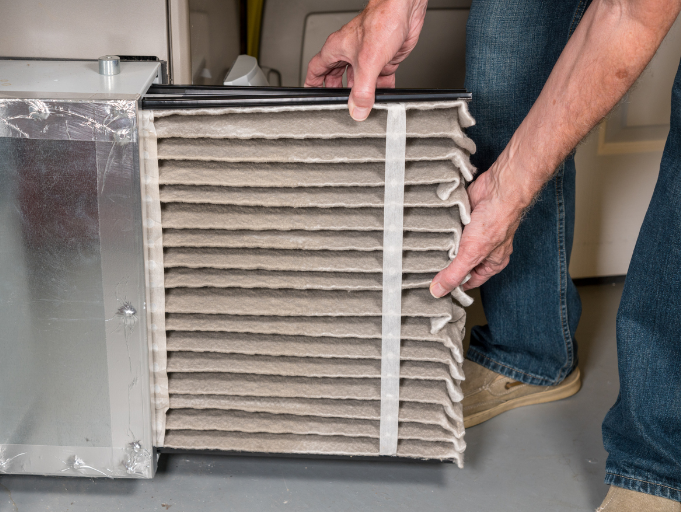
Getting tenants to change the air filter every month is a challenge, but it will save them money and save you maintenance costs.

No. 2 – Turn Down the Temperature

The U.S. Energy Department says that setting the thermostat to 68 degrees when tenants are home and awake, and lowering it when they’re away or sleeping, saves money. This may be harder to do in the time of the pandemic, as many people are working from home.

Lowering the thermostat seven to 10 degrees for eight hours daily from its normal setting can save as much as 10 percent a year, on average, depending on your location.

No. 3 – Get Smart with Your Thermostat

The thermostat is a valve between your energy supplier and lower rental property heating costs.

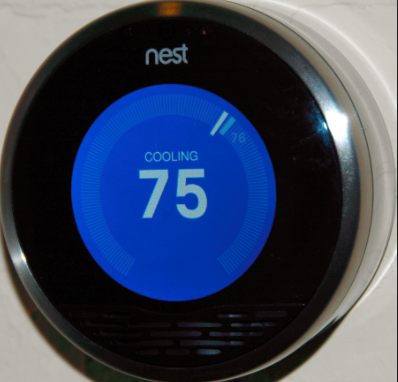
For every degree it is turned down, you use as much as two percent less heating energy. A 10-degree setback overnight cuts the heating bill by up to 10 percent. More importantly, you can switch to a smart programmable thermostat, which saves energy without you even thinking about it.

Adjust the settings to turn down the temperature to fit your lifestyle. When programming, keep in mind that it may take as little as 15 minutes to heat your home to a comfortable level.
5 Ways To Lower Rental Property Heating Costs

No. 4 – Stop the Drafts

Warm air leaking out of your rental property can be responsible for about 20 percent of heating costs, according to the Department of Energy.

The irony is that this problem could easily be fixed after a quick shopping trip to the local hardware store; weather stripping for doors can cost less than $15 and is easy to install.

Don’t forget the windows, which are another big source of drafts. There are a variety of solutions –from hot-air-sealed window plastic to window films and window shades – that could fit your needs. Be careful, though, because sunlight filtering through your windows can actually provide heating benefits.

No. 5 – Wrap the Water Heater

While you’re at it, give the water heater or water tank a hug by wrapping it in an insulation blanket.

An insulating blanket on the water heater and insulating wraps on your hot-water pipes prevents them from losing heat to the outside air. It helps you save energy and money, and you won’t have to wait as long for the water to get hot at the faucet.

Lower rental property heating costs conclusion

There are several ways to reduce your rental property heating and lower heating costs during the winter season. From conducting regular maintenance to adopting an energy-saving lifestyle, you are guaranteed of a lower monthly energy cost.

You can also hire the services of an energy auditor to help you discover new ways to reduce heating costs in your property.
About Keepe:

Keepe is an on-demand maintenance solution for property managers and independent landlords. The company makes a network of hundreds of independent contractors and handymen available for maintenance projects at rental properties.

Keepe is available in the Greater Seattle area, Greater Phoenix area, San Francisco Bay area, Portland, San Diego and is coming soon to an area near you. Learn more about Keepe at https://www.keepe.com.
5 Maintenance Tips For Long-Lasting Carpet In Your Rentals

Kitchen Range Hood Options for Your Rentals

Sign Up For Our Newsletter And Get Apartment News And Helpful, Useful Content Each Week.

* indicates required

California newspapers unite in fighting rent control “rehash”

California Voters Reject Rent Control

The San Francisco Chronicle has joined many other newspapers in California warning against passage of Proposition 21, the “housing-freeze” initiative, joining nearly all of the other state’s major newspaper editorial boards in opposing the measure.

In an editorial titled, “Vote no on Prop. 21, a rent-control retread unimproved by age,” the Chronicle’s editorial board notes “the case for rent control, overwhelmingly rejected by experts and refuted by research, might have seemed unlikely to grow weaker. And yet it has.

“In the two years since Californians rejected the last attempt to double down on the failed policy by letting more cities impose and expand rent control, the reasons to vote against this fall’s rehash, Proposition 21, have multiplied… Californians should vote no on Prop. 21 or risk aggravating the crisis it purports to address,” the newspaper writes.

The San Jose Mercury News writes in an editorial:

The basic principles of economics haven’t changed in two years.

That’s when 59 percent of California voters wisely rejected a measure that would have allowed cities to impose tougher local rent-control restrictions.

Since then, the legislature and Gov. Gavin Newsom have nevertheless approved legislation imposing rent control statewide, albeit a more-tempered version. Now rent-control advocates have gone back to the ballot to try once again to enable tougher local standards.

Throughout all this, however, the economic fundamentals remain the same: High rents in California are due to a shortage in the housing supply. We simply haven’t built homes fast enough to keep up with population growth. As a result, more people are competing for limited numbers of dwellings.

But the tougher the rent restrictions in the state, the less likely developers will construct desperately needed units. Rent control will only make the housing shortage worse. Which is why voters should reject Proposition 21 on the Nov. 3 ballot.

Rent control is a feel-good idea. A quick fix to a complicated problem. But it is not very effective at protecting poor or vulnerable tenants. In the short run, rent control helps those who live in rent-controlled units. But in the long-run it drives up the overall cost of rental housing because it exacerbates the short supply, the San Jose Mercury News writes.

According to a release, The Chronicle is the latest California in urging its readers to vote no on Proposition 21. McClatchy Newspapers, the publishers of the Sacramento Bee, Fresno Bee, Modesto Bee, San Luis Obispo Tribune, and Merced Sun-Star, urged their readers to oppose Proposition 21 month. The Bakersfield Californian, the Bay Area News Group (San Jose Mercury News, East Bay Times, Marin Independent Journal), the Santa Rosa Press Democrat, and the Southern California Newspaper Group (publishers of multiple newspapers including the Los Angeles Daily News, Riverside Press Enterprise, and Orange County Register) also have issued editorials opposing Proposition 21.

Rent Control Could Erase a Year’s Worth of Housing Creation in Washington State, Research Says

Become a Master Strategist: Today’s Key for Successful Landlords

Sign Up For Our Newsletter And Get Apartment News And Helpful, Useful Content Each Week.

* indicates required

Pandemic Rent Debt Piling Up as Renters Continue to Struggle

Pandemic Rent Debt Piling Up as Renters Continue to Struggle

A new survey shows 32 percent of renters had pandemic-rent debt from previous months still due in the first week of September, but that number had dropped to 10 percent by the second week of the month, according to Apartment List.

“Renters continue to struggle to make housing payments. This month, we found 10 percent of renters failed to make their full August payment by the end of the month, and one in six started September owing about $1,000 in missed rent,” the survey said.

“While our first-week non-payment rate came in at 32 percent, most of these are made up with late payments throughout the remainder of the month,” said Chris Salviati, Housing Economist for Apartment List.   He said non-payment of rent is less prevalent in large multifamily buildings.

Many still struggling to catch up on pandemic rent debt from prior months

“Despite the slight improvement in September payments, many renters are still worried about unpaid rent obligations from prior months.

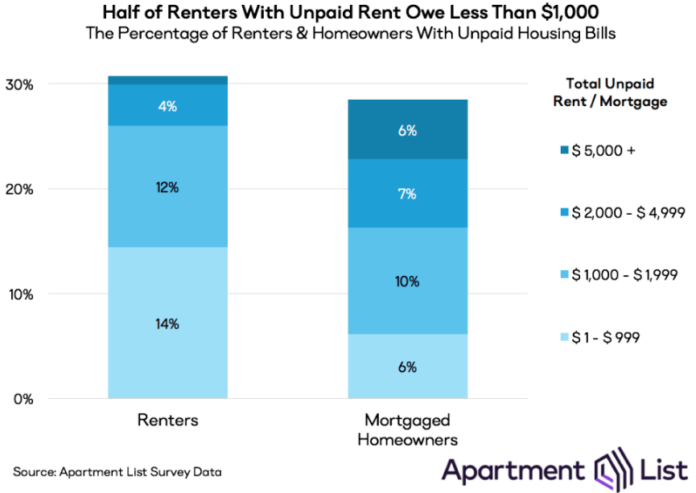
“One-in-three renters started September with outstanding back rent owed, nearly unchanged from August. Among those with unpaid rent bills, close to half owe their landlords less than $1,000, while just five percent of all renters owe more than $2,000.

“These results indicate that another round of stimulus payments of a scale similar to those that went out earlier this year could help a significant share of renters catch up on their rent,” the report said.

Rent struggles illuminate racial disparities

The pandemic has exacerbated long-standing concerns around financial instability and housing insecurity.

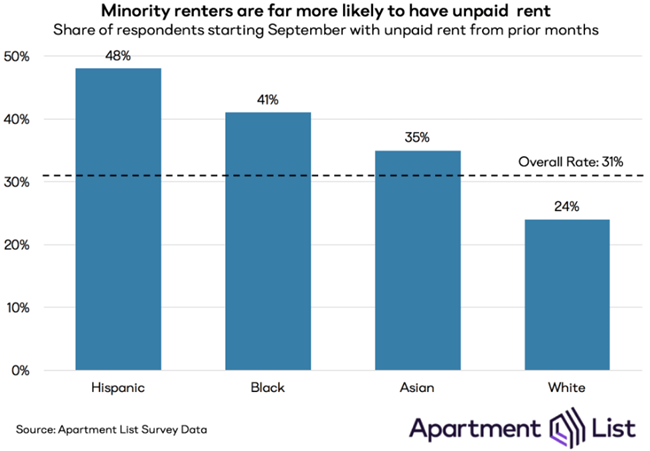
“These challenges, however, have not affected all segments of the population evenly. Segmenting our survey data by race illuminates significant variation in the prevalence of unpaid housing bills.

“The share of white renters with unpaid rent is well below the overall rate at 24 percent. Meanwhile, black and Hispanic renters are far more likely to owe unpaid rent, with rates of 48 percent and 41 percent, respectively,” the report says.

With less discretionary spending to cut and fewer savings to draw on, these households are more likely to turn to other sources. Black respondents are most likely to have borrowed money from family or friends (28 percent compared to the overall rate of 18 percent) and Hispanic respondents are most likely to have sold assets (23 percent compared to 16 percent overall).

Pandemic Rent Debt Piling Up as Renters Continue to Struggle

Pandemic Rent Debt Conclusion

“As the COVID-19 pandemic continues to disrupt all aspects of daily life, making housing payments remains a struggle for a startlingly high share of Americans.

Although this month’s data represents a slight improvement, nearly one in three survey respondents started this month with unpaid rent or mortgage owed from a prior month. In order to meet their financial obligations amid heightened economic uncertainty, renters and homeowners alike are making a variety of financial sacrifices as a direct result of the pandemic.

“Although the CDC’s recent pause on evictions has delayed the worst outcomes, missed housing payments remain a major concern in today’s economy,” Apartment List says in the report.

Rent Payments Slowing In Early September

3 In 10 Americans Missed Housing Payments in June

Sign Up For Our Newsletter And Get Apartment News And Helpful, Useful Content Each Week.

* indicates required

Rent Payments Slowing In Early September

Rent Payments Slowing In Early September

Rent payments are slowing in early September, according to a national rent-tracking service.

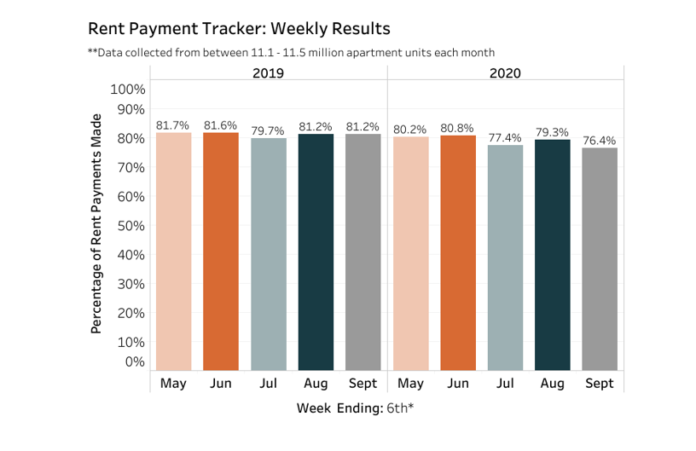
The National Multifamily Housing Council (NMHC) rent-payment tracker survey found that 76.4 percent of apartment households had paid rent in early September. The survey included 11.4 million units of professionally managed apartment units across the country.

“The initial rent payment figures from September have begun to demonstrate the increasing challenges apartment residents are facing,” said NMHC President Doug Bibby in a statement.

“Falling rent payments mean that apartment owners and operators will increasingly have difficulty meeting their mortgages, paying their taxes and utilities, and meeting payroll. The enactment of a nationwide eviction moratorium last week did nothing to help renters or alleviate the financial distress they are facing. Instead, it only is a stopgap measure that puts the entire housing finance system at jeopardy and saddles apartment residents with untenable levels of debt.

“Federal policymakers would have been better advised to continue to provide support as they successfully did through the CARES Act,” Bibby said.

The September payments are an almost 5 percent decrease compared to the same time in August.

These data encompass a wide variety of market-rate rental properties across the United States, which can vary by size, type and average rental price.

“NMHC strongly urges members of Congress and administration leaders to come back to the table and pass meaningful legislation to protect, support and assist America’s tens of millions of apartment residents,” Bibby said.

“It is worth noting that the Labor Day weekend, which occurred a week later than in 2019, may have impacted the collections data for the first week of the month, just as our data showed a comparable dip the first week of July because of the Fourth of July holiday,” said Bibby.  “Next week’s rent-payment tracker numbers will help indicate the degree to which the drop in payments was a result of the holiday weekend or a decreased ability of residents to pay their rent.”

The NMHC Rent Payment Tracker metric provides insight into changes in resident rent-payment behavior over the course of each month, and, as the dataset ages, between months. While the tracker is intended to serve as an indicator of resident financial challenges, it is also intended to track the recovery as well, including the effectiveness of government stimulus and subsidies.

However, noteworthy technical issues may make historical comparisons imprecise. For example, factors such as varying days of the week on which data are collected; individual companies’ differing payment collection policies; shelter-in-place orders’ effects on residents’ ability to deliver payments in person or by mail; the closure of leasing offices, which may delay operators’ payment processing; and other factors can affect how and when rent data is processed and recorded.

Rent Payment Tracker: 92.2 Percent of Apartment Households Paid Rent as of June 20

3 In 10 Americans Missed Housing Payments in June

Sign Up For Our Newsletter And Get Apartment News And Helpful, Useful Content Each Week.

* indicates required

Residents Working from Home Require More Space in Apartments, Homes

Apartments have gotten smaller in the past 10 years while single-family homes have grown

The pandemic has meant our homes are required to double as entertainment and working spaces, with nearly half of the U.S. labor force working from home full-time, StorageCafe writes in a new report, but apartments have gotten smaller in the past 10 years.

Colorado, the top state for working from home pre-pandemic, barely had 7.7 percent of its population working from home then.

How prepared are American homes for this new reality, space-wise?

Apartments have gotten smaller as homes have gotten bigger

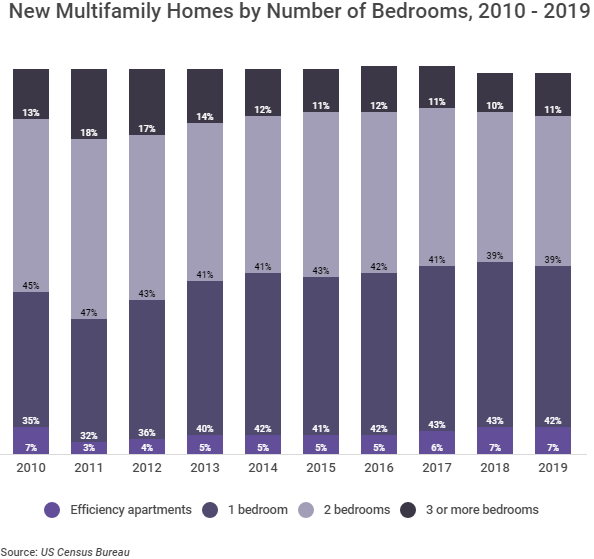
“On a national average level, apartments lost a bedroom over the last decade, while single family homes gained one,” Yardi Matrix says in the report.

“Single-family homes are generally large enough to respond to the growing need for space. Apartments, however, will make it harder for people to adjust, as space is at a premium in most cities.”

apartments have gotten smaller with fewer bedrooms

Some highlights from the report:

  • The McMansion comes in handy for a change as it’s now in line with people’s need for more space. New single-family homes built in 2019 have an average of 2,611 square feet, 18 percent bigger than the overall U.S. inventory.
  • Multi-bedroom homes grew considerably — 43 percent of the single family homes built in 2019 have 4+ bedrooms, compared to 35 percent in 2010. The percentage of newly built homes with two bedrooms or fewer decreased from 13 percent in 2010 to 11 percent in 2019.
  • Apartments, however, lag behind in responding to this need for more space at home. The average size of an apartment built in 2019 was 1,156 square feet, 90 square feet smaller than those built in 2010.
  • One-bedroom apartments saw an increase in new construction, from 35 percent in 2010 to 42 percent in 2019, while two-bedroom apartments lost ground, from 45 percent of newly built apartments having two bedrooms in 2010 to 39 percent in 2019.
  • Among the nation’s largest 20 cities, Chicago saw the highest increase in home sizes. New homes in Chicago are now 916 sq. ft. larger than those built in 2010, and offer a whopping 3,330 sq. ft. of living space on average.
  • San Francisco experienced the highest increase in new apartment size among the country’s largest 20 cities, adding a significant 107 square feet between 2010 and 2019.

 Size of single-family homes growing

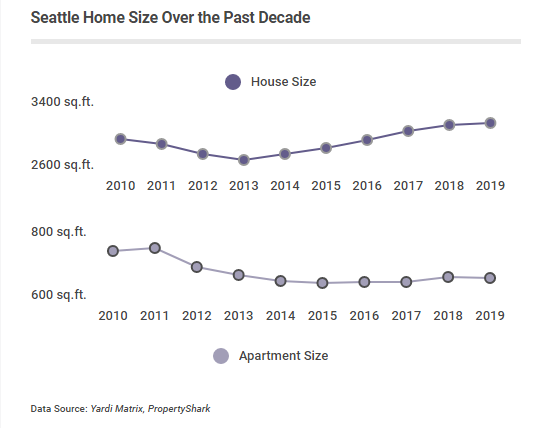
Seattle is a good example of a city that saw a definite increase in single-family-home space from 2010 to 2019. Houses built in 2010 had 3,025 square feet, while new 2019 houses were 192 square feet larger, encompassing an average of 3,217 square feet.

At the same time, Seattle built smaller apartments in 2019 than in 2010. New apartments built in Seattle in 2010 had 762 square feet on average, and shrunk to a meager average 676 square feet in 2019.

apartments have gotten smaller in the past 10 years in Seattle while single-family homes have grown in size

Apartment residents need storage space

Living in smaller apartments doesn’t mean that Americans like to live small. Incomes rose over the last decade and so did consumer spending, which gave way to a need for more space – enter self-storage.

Yardi Matrix data shows that there’s currently over 1.4 billion square feet of self-storage space in the United States, out of which 190 million square feet – or 13 percent – were built over the last five years.

Residents of cities like Seattle, for example, where apartments are notoriously small (and continue to shrink), can really benefit from using self-storage. There are 4.5 square feet of storage space per capita in the city, and the monthly rent for a 10×10 self-storage unit is around $178.

Security Deposit vs. Move-In Fee: Which is Better?

Sign Up For Our Newsletter And Get Apartment News And Helpful, Useful Content Each Week.

* indicates required

Remote Work Means Renters in Expensive Cities May Move to Homes

Remote Work Means Renters in Expensive Cities May Move to Homes

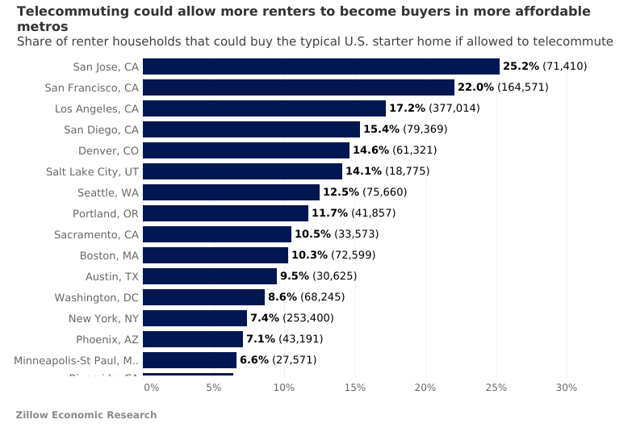
Remote work trends mean many renter households could likely telecommute and afford monthly payments on the typical U.S. starter home, but couldn’t afford a starter home in their current metro, says a new Zillow analysis.

Zillow’s analysis looked at renter households for whom monthly payments on a starter home in their metro are unaffordable, but would be affordable on the typical U.S. starter home.  Those households were then assigned a probability of being able to telecommute based on income, the worker’s industry and occupation.

“If remote work becomes a bona fide long-term option, especially with the pandemic, that could reshape the U.S. housing market by opening up home-ownership to people renting in expensive parts of the country,”  said Zillow economist Jeff Tucker in a release.

“However, it’s unclear how many people would make the move to buy their first home. Proximity to work is just one of the factors people consider when choosing where to live. Other factors may keep them from moving, including proximity to friends and family, cultural and natural amenities, and their kids’ schools.”

Remote work and housing costs

The numbers are more pronounced in expensive coastal metros like San Francisco, where 22 percent of renters priced out of their metro could afford monthly payments on a typical U.S. starter home, estimated at $725.

Monthly payments on a typical San Francisco city starter home are more than seven times higher, at $5,181. More than 10 percent of renters who couldn’t afford to buy in the city of San Francisco, could afford a starter home within the greater San Francisco metro area, offering more options farther afield to aspiring buyers who no longer need to commute to the office five days a week.

In cities such as Minneapolis, Phoenix and Denver, the opposite is true.  In Denver, for example, starter homes in the city are more affordable than in the metro area, yet 14.5 percent of renter households priced out of homeownership in the Denver metro could afford a typical starter home elsewhere in the country.

Remote work means more renter households could become homebuyers

Millennials are now buyers

“Two-thirds of our buyers are millennials,” said Zillow Premier Agent Holly Mellstrom, a Pelham, NY-based associate broker at Julia B. Fee Sotheby’s International Realty, in the release. “They’re looking to put down roots and get more space for their money after high-rise city living. Many have young families and were planning to move to the suburbs in the future, but they’re making the move now because they don’t anticipate having to commute into the city to work every day.”

Chris Chan, 40, and his wife, Eunice Lee, 35, became home buyers during the pandemic, moving from a two-bedroom co-op in Brooklyn to a five-bedroom house in Westchester County, NY.

“The tipping point was envisioning both of us working from home indefinitely alongside our daughter and a second child on the way,” said Chan, who works in Connecticut, in the release. “We wanted to maintain the balance between space and proximity to the city. We could get more for our money just outside city limits and we’re still only 30 minutes from Grand Central Station.”

A Rise in Work From Home Could Lead to a New Suburban Boom

Sign Up For Our Newsletter And Get Apartment News And Helpful, Useful Content Each Week.

* indicates required


Washington Attorney General Files Suit for Violation of Eviction Moratorium

Washington Attorney General Files Suit for Violation of Eviction Moratorium

Washington Attorney General Bob Ferguson has filed suit against a property management company in Spokane for violation of the eviction moratorium in the state and threatening residents with eviction for unpaid rent.

Ferguson sued Whitewater Creek, an Idaho company that manages low-income housing complexes in Spokane, according to a release.

“Emails obtained by the attorney general’s office show that at the express direction of Maryann Prescott, a majority owner of Whitewater Creek, Whitewater Creek personnel verbally threatened at least four residents at properties it was responsible for,” Ferguson said in the release.

“Prescott wanted tenants to know they would be evicted for unpaid rent and/or fees as soon as courts reopened for eviction proceedings. These residents were also informed that they would be responsible for unspecified legal fees associated with their evictions.

“These threats came one month after Gov. Jay Inslee’s eviction moratorium was well-known throughout the state. Whitewater Creek personnel did not disclose the eviction moratorium protected the residents from such action,” according to the release.

An April 20 email Prescott sent to a Whitewater Creek site manager asked to, “confirm you explained that (the resident) will be evicted for past due rent when courts reopen.” Ms. Prescott received the response, “yes she did tell them all about the eviction.” On April 21, Prescott sent another email noting a site manager needed “to hold these (residents) accountable” to pay past-due rent.

Violation of eviction moratorium in Washington

“Washingtonians are struggling, yet Whitewater Creek illegally threatened tenants with evictions in the middle of a pandemic,” Ferguson said in the release. “They violated the clear text of the governor’s emergency proclamation. Their actions were cruel, unacceptable and illegal. They will be held accountable.”

Whitewater Creek, Inc. is a Hayden, Idaho-based real-estate company that, through a number of related entities, manages and owns 1,000 low-income housing units across 12 housing complexes in eastern Washington. Many of their properties were developed with millions of dollars in taxpayer funding in the form of tax-credit equity and tax-exempt notes authorized by the Washington State Housing Finance Commission.

The attorney general’s office received complaints from multiple tenants at Whitewater Creek properties alleging various violations of the eviction moratorium and the governor’s proclamations, including verbal threats of eviction for non-payment of rent or other fees, according to the release.

In April, one tenant suspected that the threats were not being memorialized in writing to avoid evidence of violating the eviction proclamations.

Another resident asked to make a partial payment or go on a repayment plan based on the federal stimulus payment she expected. Whitewater Creek informed the resident, who is a single mother of young children, she would be evicted the day courts reopened for eviction proceedings if she did not pay the full balance owed.

When she attempted to contact Whitewater Creek’s corporate office to dispute the eviction threat and find out how much the legal fees would be, she was informed that she would be “charged with harassment” if she did not stop calling. This resident expressed fear of retaliation for attempting to contest the eviction threat and also worried she would lose custody of her children if evicted.

Around the same time in April, Whitewater Creek personnel threatened another resident with eviction for being one month behind on the balance she owed. After the resident, who is an unemployed single mother with two young children, informed Whitewater Creek staff that she had just been approved for unemployment and hoped to soon be caught up on payments by the end of the month, a Whitewater Creek property manager instructed her to “turn in any monies (she has) to help avoid eviction.”

The Attorney General’s Office sent a letter in May requesting, among other actions, that Whitewater Creek immediately notify all residents the Emergency Proclamations prohibit threats of eviction and that Whitewater Creek would comply with the Proclamations. Instead of issuing such notices and providing copies to the Attorney General’s Office, as requested, Whitewater Creek consistently and falsely denied that it threatened to evict anyone, contrary to internal email communications confirming that it threatened residents with eviction at Prescott’s direction.

This is the second lawsuit Ferguson filed to enforce the eviction moratorium. The previous lawsuit against JRK Residential, a Nevada-based property management company with units in Tacoma, Silverdale and Marysville, resulted in May of a payment of nearly $350,000 — including almost $300,000 directly to tenants in the form of refunds, payments and rent forgiveness.

Property Management Company to Pay Tenants $300,000 to Settle Eviction Moratorium Lawsuit

Seattle City Council Sets Rules for Unpaid-Rent Installment Payments

Sign Up For Our Newsletter And Get Apartment News And Helpful, Useful Content Each Week.

* indicates required


CDC Orders Nationwide Eviction Moratorium, But No Help for  Landlords

CDC Orders Nationwide Eviction Moratorium, But No Help for  Landlords

A new nationwide eviction moratorium has been ordered through the Centers for Disease Control (CDC) to halt residential evictions through the end of December.

However, the new ban on evictions of tenants does not offer any relief for landlords to be able to recoup unpaid rent.

“We are disappointed that the administration has chosen to enact a federal eviction moratorium without the existence of dedicated, long-term funding for rental and unemployment assistance,” said National Multifamily Housing Council President Doug Bibby in a statement.

“An eviction moratorium will ultimately harm the very people it aims to help by making it impossible for housing providers, particularly small owners, to meet their financial obligations and continue to provide shelter to their residents,” Bibby said.

Owners face financial crisis

“Without direct rental assistance, rents cannot be paid, and owners face a financial crisis of their own by not being able to maintain properties and pay their mortgages or property taxes,” said National Apartment Association President & CEO Bob Pinnegar in a release.

“This action risks creating a cascade that will further harm the economy, amplify the housing-affordability crisis and destroy the rental-housing industry. This global housing crisis cannot be blamed on the rental-housing industry, nor can the industry bear the brunt of the pandemic alone. We need balanced, reasonable solutions for all Americans,” Pinnegar said.

Bibby added, “Not only does an eviction moratorium not address renters’ real financial needs, a protracted eviction moratorium does nothing to address the financial pressures and obligations of rental-property owners. Without mortgage-forbearance protections and protections from other property-level financial obligations such as property taxes, insurance payments, and utility service, the stability of the entire rental-housing sector is thrown into question.”

Moratorium decisions should be left to state and local officials

“We believe renter protections are best left to state and local officials, who better know their housing markets and can tailor protections to the varied and unique eviction laws and judicial processes across jurisdictions,” Bibby said.

At the federal level, Bibby said, “We agree with Secretary (Steve) Mnuchin, Speaker (Nancy) Pelosi and Leader (Chuck) Schumer that policymakers need to come back and negotiate a strong rental-assistance program.”

National Rental Home Council Rips National Eviction Ban

“President Trump’s eviction moratorium might work in a fantasy world. But in this one, it only kicks the problem down the road. Once the moratorium expires, renters will owe back rent for several months, and their landlords may no longer be in business, the National Rental Home Council said in a statement.

“Over half of all rental properties in the United States, 23 million, are single-family homes. Ninety-seven percent of these properties are held by “mom-and-pop” landlords, who own between one and three properties. At the end of this year, many of these landlords will have foregone rent for nine and a half months.

“It’s not quite clear how the administration expects these landlords to cover their mortgage payments, property taxes, community fees, and maintenance costs. With no corresponding ban on foreclosures, mortgage holders still can and will foreclose on landlords who can’t meet their financial obligations.

Go deeper in debt or sell

“The order leaves landlords with two grim options — go deeper into debt, or sell.

“This moratorium also capitalizes on the false narrative that landlords are lining up at the courthouse to file eviction notices. The exact opposite is true. Many landlords have created flexible payment plans, allowed tenants to access security deposits, and waived fees.

“The federal government has failed to provide genuine financial assistance to renters and landlords alike. We urge Congress and the Trump administration to change that state of affairs.

“America needs sensible, well-constructed rental assistance programs that provide immediate relief to both renters and landlords. That’s the only way to bring any sense of certainty to the rental housing market.”


Governor Extends Oregon Foreclosure Moratorium to End Of The Year

Sign Up For Our Newsletter And Get Apartment News And Helpful, Useful Content Each Week.

* indicates required

I am Renting My Property: Do I Need Home Insurance?

I am renting my property so do I need homeowners insurance or landlord insurance in order to protect my investment in case bad things happen?

By Bernadine Racoma

Have you decided that you want to become a landlord? Renting out your property can be a very profitable move, especially if you buy the right property in the right area. This is particularly true if you have a house or apartment lying empty. You can make good money depending on how big and where the property is.

But you have to be aware of your responsibilities as a landlord and then some. You have to ensure that you look after your renters and protect them against hazards such as loud music, assistance animals and noisy children. In addition, you also need to make sure that you protect yourself. Unfortunately, bad situations can happen when you are renting out your property to others. Instead of letting this stop you from becoming a landlord, you just need to know how to protect your investment. One way to do this is insurance

Homeowners Insurance or Landlord Insurance?

 If you are new to renting out properties, you may wonder what type of insurance is going to be best for your needs. Should this be homeowners insurance or landlord insurance? Indeed, there is a time and place for both of these options. Let’s take a look at the differences between them.

Homeowners Insurance

Most homeowners insurance policies will require you to live in the home. But this does not mean that you cannot make it work as a landlord. In fact, if you are planning on still living in your property and simply renting out one of the rooms, this could be a good option for you. Just make sure that this is going to be suitable for your insurance policy.

Your homeowners insurance is going to cover everything you want if you are still living in the house. For example, it is going to protect you against damage to your property, whether this is caused by a fire or extreme weather. You can also make sure that your insurance policy covers your belongings inside the home. If anything is damaged, you are going to receive assistance when it comes to repairing or replacing them. Make sure that you compare home insurance quote costs before you decide the one for you. You want to ensure that you are getting the best deal and one that is suitable for your needs.

It is important to realize that homeowners insurance can cover you against liability in your home. For example, if someone is injured on your property. This can be good if you have someone renting with you. But if you are not going to be present in the house, you may want to take a look at landlord insurance and see if this suits your needs.

Landlord Insurance

You may have guessed by the name that landlord insurance is going to be beneficial for you. Indeed, it can be a better option if this is something you want to do long term. For example, this type of insurance is going to help you if damage is caused to the building. Therefore, if there were a fire or adverse weather conditions that caused damage to your property, this type of insurance is going to help you pay for repairs.

One thing to know about landlord insurance is that it does not always offer the same coverage as homeowners insurance. For example, if you leave behind contents that belong to you in your property, it is likely they will not be covered. You can insure your contents but they might not be automatically covered. You will need to examine your policy very carefully before you choose landlord insurance.

Before You Choose Insurance

It is always important to shop around before jumping at an insurance policy so you can make the right decision. Before you choose between homeowners insurance and landlord insurance, make sure that you think about your circumstances. For example, consider whether you are going to be present in the home or you are going to leave your renters in charge of the whole property. The last thing you want is to choose a policy that does not cover you for what you need. Therefore, sit down and make a list of factors before choosing an insurance policy. This is going to ensure that you get everything you need and for a price that is going to suit your budget.

About the author:

I am renting my property so do I need homeowners insurance or landlord insurance in order to protect my investment in case bad things happen?

Bernadine Racoma is the Content Manager of eTranslation Services. Her long experience in an international development institution and extensive travels have provided her a wealth of knowledge and insights into cultural diversity. She writes to inform, engage, and share the idea of the Internet being a useful platform for communicating, knowledge sharing, educating, and entertaining.  You can find Bernadine Racoma at Twitter.

I am renting my property so do I need homeowners insurance or landlord insurance in order to protect my investment in case bad things happen?
https://pixabay.com/photos/architecture-building-driveway-1867187/

Tenant Occupancy Issues During COVID-19: Occupants, Sublessors, and Squatters

Tenant Occupancy Issues During COVID-19: Occupants, Sublessors, and Squatters

Tenant issues around occupants, sublessors and squatters have increased during the pandemic.

Bradley S. Kraus
Attorney at Law, Warren Allen, LLP

One of the most common issues I have encountered in my time as a landlords’ attorney is dealing with unauthorized individuals living in my clients’ properties.

These issues have only increased with COVID-19. If you have been a landlord long enough, you have likely heard individuals utter the words “squatter’s rights” or some other formulation of the phrase.

Such rights do not exist in the Oregon Residential Landlord and Tenant Act. Oddly enough though, without a strong rental agreement, arguing that an individual is living in the premises without your consent can also be the most difficult tenant default to prove.

The above point is clearer when you think about how to prove someone is actually “living” somewhere. After all, it would be awkward—and illegal—to set up cameras in your tenants’ leased premises. It is important to remember that the phrase “unauthorized occupant” appears nowhere in the ORLTA. Therefore, landlords are left with what their rental agreements define as an “unauthorized occupant” in framing the default under the ORLTA.

Unauthorized tenant

If you have a solid rental agreement from any reputable company, it will likely contain a prohibition against individuals occupying the premises without the consent of the landlord. If you think you have an unauthorized occupant, your first step is to analyze the amount of time your rental agreement allows someone to stay or visit the premises before becoming an unauthorized occupant. That is the easy part; proving someone lives somewhere—as opposed to a tenant having a friend visiting—can prove daunting.

Before considering whether to serve a notice upon a tenant for an unauthorized occupant, you should confer with your attorney about your chances of success, should such an issue be challenged. The question I ask my clients is, “How do you know he/she/they live there?” A hunch simply will not do. Seeing someone every couple of days also likely will not suffice—after all, your tenants can have friends visit. However, if you see the unauthorized occupant’s car parked overnight—arriving at night, leaving in the morning—or if this new individual begins receiving packages at the premises, such evidence may be useable.

Tenant subletting

Subletting is a similar issue to unauthorized occupants. There are no express prohibitions in the residential portion of the ORLTA against subletting. Hence, the same rules and potential proof issues apply to subletting issues. Ensuring your rental agreement contains an express prohibition against assignment and subletting is the first step. Proving that you have a sublessor is the largest hurdle in the race. With the advent of sites like AirBnB and Craigslist, if your premises is listed on one of these sites—as they often are—such evidence will be useful as you and your attorney navigate a way forward.

Finally, I have encountered many situations during COVID-19 where tenants simply abandon a dwelling unit, and random people appear to take their place. If this issue arises, you may have rights under the unauthorized possessor statute—ORS 90.403—of the ORLTA. If you satisfy the elements listed therein, a 24-hour notice directed at the unauthorized possessor can get you on track to recover your property as quickly as the law allows.

Many individuals will cry “no-harm-no-foul” when it comes to the aforementioned situations.

However, landlords have the right, and an obligation—not only to the owners of the properties they manage, but also their other tenants—to know who is living within their properties. The outbreak of COVID-19 does not change these rights or obligations, and nothing in House Bill 4213 or any other eviction moratoriums prohibit taking action to address the above issues.

Tenant Occupancy Issues During COVID-19: Occupants, Sublessors, and Squatters
Bradley Kraus, Portland attorney

kraus@warrenallen.com  or 503-255-8795

Landlord Rights and Remedies After HB 4213: A Path Forward

Sign Up For Our Newsletter And Get Apartment News And Helpful, Useful Content Each Week.

* indicates required