Home Blog Page 103

Rents Continue Rising But At Slightly Slower Pace

Rents Continue Rising But At Slightly Slower Pace

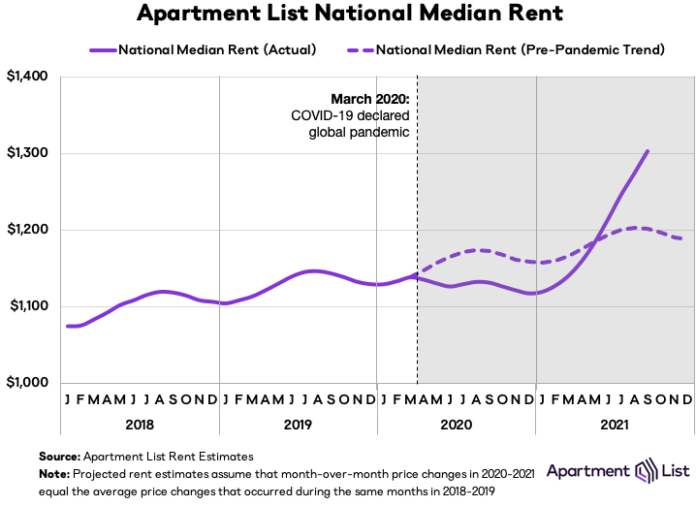
Nationwide rents continued rising from August to September but at a slightly slower pace – as 2.1 percent – than in previous months, according to the latest report from Apartment List.

“Although month-over-month growth has slowed slightly from its July peak, rents are still growing much faster than the pre-pandemic trend,” Apartment List said in the report.

“Since January of this year, the national median rent has increased by a staggering 16.4 percent. To put that in context, rent growth from January to September averaged just 3.4 percent in the pre-pandemic years from 2017-2019,” the report says.

This is the time of year when rents typically begin declining due to seasonality, but that has not yet showed up in so far in reports as rents continue rising. So no signs yet of a seasonal dip in rents.

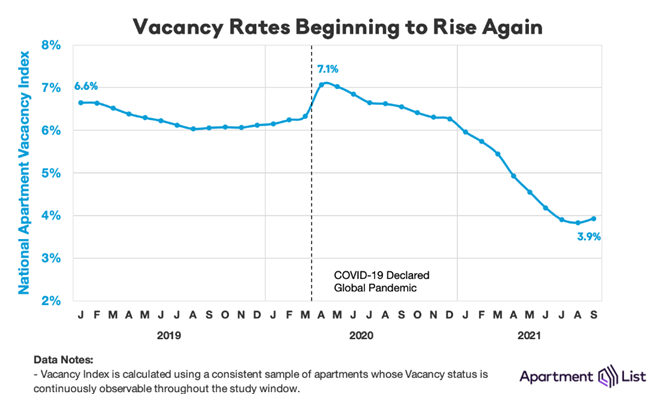
Vacancy rate increases for first time since last April

“As we’ve explored in detail, much of this year’s boom in rent prices can be attributed to a tight market in which more and more households are competing for fewer and fewer vacant units. Our vacancy index spiked from 6.2 percent to 7.1 percent last April, as many Americans moved in with family or friends amid the uncertainty and economic disruption of the pandemic’s onset.

“Since then, however, vacancies have been steadily declining. For the past several months, our vacancy index has been hovering just below 4 percent, significantly lower than the 6 percent rate that was typical pre-pandemic,” the report says.

Rents Continue Rising But At Slightly Slower Pace

Conclusion

As prices rebound rapidly even in the cities that saw the sharpest declines last year, there are now just five cities remaining where rents have yet to surpass pre-pandemic levels.

That said, certain markets, such as Boise, Idaho and Spokane, Wash., appear to be cooling off.

“While the market remains extremely tight, we’re now seeing the first signals of that pressure beginning to ease,” the report says.

Sign Up For Our Newsletter And Get Rental Property And Apartment News And Helpful, Useful Content Each Week.

* indicates required


Average National Monthly Rent Tops $1,500 For 1st Time

Everything Landlords Should Know About Emotional Support Animals

Portland, Seattle Among Top Cities for Apartment Jobs

Portland, Seattle Among Top Cities for Apartment Jobs

Portland and Seattle are among the top cities for apartment jobs in the latest jobs report from the National Apartment Association (NAA).

In August’s edition of the NAA Education Institute’s Apartment Jobs Snapshot, nearly 13,000 positions were available in the multifamily sector across the country.

Markets with the highest concentration of job postings included Virginia Beach, San Antonio, Portland, Nashville and Seattle.

Portland, Seattle Among Top Cities for Apartment Jobs

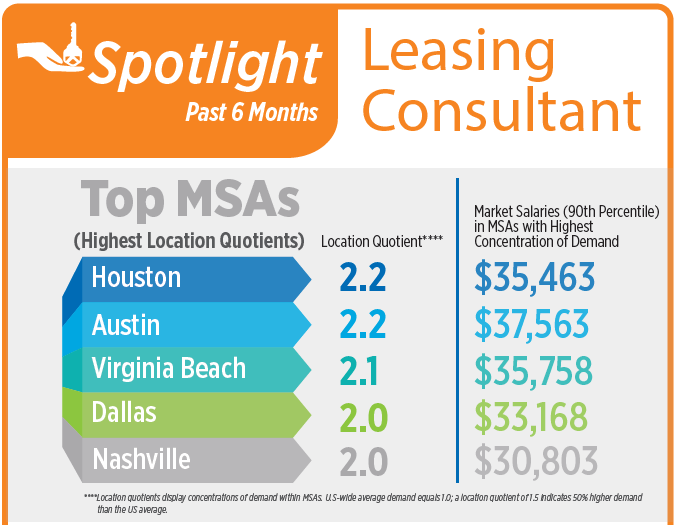
This month’s spotlight highlights leasing consultants.

The demand for these positions was twice the national average in Houston, Austin, Virginia Beach, Dallas and Nashville. The top specialized skills employers are looking for include leasing, property management, customer service, sales and Yardi Software.

Portland, Seattle Among Top Cities for Apartment Jobs

Sign Up For Our Newsletter And Get Rental Property And Apartment News And Helpful, Useful Content Each Week.

* indicates required


Portland Apartment Jobs Almost 60 Percent Of All Real Estate Jobs

Rental Maintenance Jobs In High Demand In Portland, Seattle

Tenant Fired A Gun And Bullet Went Into Apartment Below Now What?

Tenant Fired A Gun And Bullet Went Into Apartment Below Now What Should Landlord Do?

We get regular questions for landlords and attorneys and this question comes from a concerned tenant who says the upstairs tenant fired a gun and the bullet came through the celling in the apartment below. Here is some guidance for landlords on how to handle this type of situation.

Here attorney Denny Dobbins provides his personal take, as a landlord attorney, on the information provided below by the tenant on what happened in a question-and-answer format based on Arizona law.

1. Question from the tenant

The tenant above me discharged a firearm into the floor and the bullet came through my ceiling.

Answer from Dobbins

The way this is worded raises the question of whether the discharge is accidental or intentional.  My experience shows that the landlord’s duty to deal with such a matter does not matter if the shooting was accidental or intentional.  However, if intentional you will see a landlord move swiftly to remove the tenant.

2. Question

I had the police come out and file a report. The officer confirmed that it was a discharged firearm and filed it in the report. The tenants would not answer the door when the officer went up there to address them. However, I gave the officer the tag and car information of the tenants. I subsequently filed a complaint with the leasing office for an immediate termination of the tenants’ lease along with the pictures of the bullet hole, police report and picture of their car and tag.

Answer

Once the complaint has been delivered to the landlord, the landlord has a duty to investigate and to act accordingly.  Regardless of the investigation, the non-shooting tenant has a right to be fearful when a bullet comes through the ceiling.  Further, the non-shooting tenant has an absolute right to peaceful and quiet enjoyment of the property.  The non-shooting tenant’s peace-and-quiet enjoyment has been obviously shattered and will continue to be shattered as long as the shooting-tenant remains upstairs. I would advise the landlord to evict the shooting-tenant or let the shooting-tenant out of his/her lease in some fashion – but to get rid of the shooting tenant immediately.  It is better to lose a little rent, make the downstairs tenant happy, and avoid later liability or lawsuit. Leaving the shooting-tenant in the property puts too much liability on the landlord.  And the landlord either knows about this liability, or should know.  The landlord’s attorney should be advising the landlord to remove this shooting tenant.  There is ample case law on this issue.  In the future, if ANYTHING causing damage by this same shooting-tenant happens to anyone else on the property the landlord is looking at almost a strict liability situation for negligence in letting that shooting-tenant stay on the property.  It would be an ugly situation for the landlord.  No reasonable landlord wants this situation, and any knowledgeable attorney would so advise their landlord.  Any good landlord, in my opinion, will find a way to get rid of the shooting-tenant.  I do not know any judge that would allow that tenant to stay even if the shoot was accidental.

3. Question

Can the leasing office withhold information about what they are doing to address this situation when the tenant fired a gun?

Answer:

Yes, at least until the non-shooting tenant files a complaint in court over the matter due to a landlord’s refusal to remove the shooting-tenant.  However, a good landlord would do everything they could to keep the non-shooting tenant informed of what is going on, and that landlord should move as quickly as possible to remedy the situation. Constant communication with the non-shooting tenant is key to assuring the non-shooting tenant that the landlord is taking the matter seriously and that they care about the non-shooting tenant.  The non-shooting tenant knows the incident itself is not the landlord’s fault.  But what happens now is in the landlord’s hands, and everyone in the community is watching.

4. Question

What are my rights as the victim? I could have been killed had I been in that room at the time the tenant fired a gun.

Answer

The non-shooter’s rights are woven into my response above.  There is nothing that covers this exact situation in the Arizona Residential Landlord and Tenant Act (and that is true of most situations), but 33-1311, 33-1312, 33-1324, 33-1341(7) [for this reason alone the landlord has a duty to remove the shooting-tenant] all apply.  It is my opinion that if the landlord does not take action and remove the shooting-tenant that the non-shooting party has a right to damages against the landlord for basically forcing the non-shooting tenant to move to find a safe and peaceful place to live.  Landlords are usually not dumb enough to not take care of the non-shooting tenant and to not remove the shooting-tenant.

Dobbins adds, “In the alternative, the landlord may just allow the non-shooting tenant out of the lease.  Not the best idea.  The moving tenant may want the landlord to pay the cost of moving and other damages, especially if the landlord refuses to remove the shooting-tenant, and the non-shooting tenant may well be entitled to such damages.  As a landlord and for my landlord clients I would rather fight the battle removing the shooting-tenant rather than to fight the possible consequences of leaving the shooting-tenant at the property.

“Under the Arizona landlord and tenant act I would consider it unconscionable to force the non-shooting tenant to remain in his/her lease with the shooting tenant remaining on the property.  The landlord may offer to allow the non-shooting tenant to relocate to another unit on the property.  I would not accept that as the non-shooting tenant.  The purpose of the lease has been frustrated, and the peaceful and quiet enjoyment of the non-shooting tenant has been destroyed. “

Note from the author: I have dealt with these types of matters in the past, and each incident is specific with its own unique set of facts.  However, in every instance of a shooting, intentional or accidental, the landlord moved on the shooting party to remove them from the property.

About the author:

Denny Dobbins is a Mesa, Ariz. attorney who has represented landlords’ issues for more than 30 years.

Sign Up For Our Newsletter And Get Rental Property And Apartment News And Helpful, Useful Content Each Week.

* indicates required


No Guns In My Apartments: Can A Landlord Say That And Put It In A Lease?

Suburbs Where Renters Became the Majority Over Owners

Suburbs Where Renters Became the Majority Over Owners

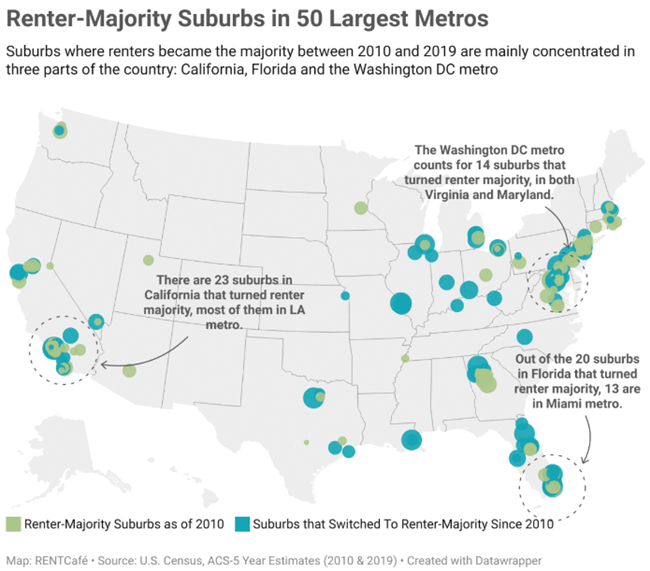
Renters are now “the majority in 103 suburbs that were previously homeowner territory 10 years ago, and 57 other suburbs are expected to follow suit in the next five years,” according to research from RentCafe.

Renters became the majority in many suburbs in the nation’s 50 largest metros, which gained a total of 4.7 million people since 2010 — and of these, 79 percent were renters, according to the latest U.S. Census data.

Nearly 40 of the suburbs that transitioned to renter-majority in the last decade belong to just three metros: Washington, D.C. (14); Miami (13); and Los Angeles (12).

“We have reimagined the American dream for a modern, more diverse society where people are having fewer children and getting married much later in life (if at all), and where most good job/career opportunities require one to be flexible,” said Dr. Kenneth Laundra, associate professor of sociology at Millikin University. He said today’s suburbia is far different from the “Baby Boomer fantasyland” it used to be.

According to Dr. Laundra, many people will take advantage of the flexibility that remote work offers in the post-COVID era — to the benefit of the suburbs closest to urban areas.

“With the increase in remote work, short-term projects and ‘side hustles,’ there’s every reason to believe that the future will be a more transitory, migratory existence. Most of this migration will be toward cities and urban landscapes, where even the suburbs will cluster most closely to urban areas,” he said

The RentCafé report points out that, “During the past decade, the migration toward the suburbs developed fast: The number of suburban areas where renters are the majority grew by a staggering 69 percent. Now, following the switch to renter majority of these 103 suburbs, there are a total of 242 renter-dominated suburbs out of 1,105 suburbs analyzed in our 50 largest metros.”

Suburbs with Fastest Growth in Share of Renters

Since 2010, the rental market has been building up in places previously dominated by homeowners.

Specifically, the largest increases in renter share took place in a number of suburbs in the Midwest and were led by Maple Heights, Ohio, where the share of renters grew by 87 percent. Second was Eastpointe, MI — a bedroom community located within a short drive of Detroit that registered a record 83 percent increase in renter share.

“We estimate that 57 more suburbs will be dominated by renters during the next five years if their share of renters continues to grow at the same rate. Notably, the pandemic has further extended this trend, having triggered an acute need for more living and breathing space — which the suburbs traditionally offer — as more Americans try to make the most of the new work-from-home trend,” the report says.

Sign Up For Our Newsletter And Get Rental Property And Apartment News And Helpful, Useful Content Each Week.

* indicates required


Average National Monthly Rent Tops $1,500 For 1st Time

Everything Landlords Should Know About Emotional Support Animals

Self-Guided Tours Evolving For Single-Family Rentals

Self-Guided Tours Evolving For Single-Family Rentals

Self-guided tours for single-family rentals have been evolving and providing landlords with good productivity and satisfied residents.

By Mickey Cummings

 With all the buzz surrounding self-guided tours in the apartment sector since the start of the pandemic, it’s easy to forget that they’ve long been an important part of the professionally managed single-family rental space.

Single-family operators have been leaving keys in drop boxes for residents to independently peruse homes for several years.

The argument can be made that self-guided tours are even more crucial in the single-family space, where professional operators may have hundreds of homes in a single metro area, each of which can be a considerable distance from another. It simply places too big of a burden on leasing associates to crisscross a city all day giving tours of homes, and prospects often don’t have the patience or flexibility to accommodate a leasing agent’s schedule.

But just because single-family has such extensive experience with self-guided tours, it doesn’t mean operators should rest on their laurels and not work to refine the offering for the modern-day prospects. Forward-thinking single-family operators have been deploying increasingly cutting-edge self-guided tour options and are reaping the benefits—both in the satisfaction level of prospective residents and the productivity of associates.

Here are some of the specific benefits of sophisticated self-guided tours for single-family rentals:

Seamless prospect experience

When marketing a home to modern-day prospective renters, convenience is nearly as important as the home itself. If they have difficulty scheduling a tour, they’ll quickly move along to the next option.

Prospects were already gravitating toward self-service experiences prior to the pandemic. That tendency—while at first a necessity in a temporarily touchless world—appears poised to persist in the post-pandemic landscape. Self-guided tours allow single-family operators to extend their tour availability to seven days a week and enable prospects to have a no-pressure tour experience.

Quick-scan QR codes are quickly becoming a key component of the modernized self-guided tour process, as they allow prospects to apply on the spot and view multiple homes with one registration.

Efficient operations

When a significant sample size of prospects opts for self-guided tours, it benefits the operator as well. Leasing specialists can spend more time on the crucial follow-up process rather than driving from site to site. They can analyze lead details in a more data-centric way when they receive instant feedback from tours delivered via API from the software provider.

Operators can also delegate staff members to other key duties within the company rather than deploy an overabundance of leasing agents for tours on a daily basis.

Granted, this doesn’t eliminate the need to fully prep homes for visitors prior to tours. At Progress Residential, our teams aim to set the stage with a fully branded self-showing experience. From the branded doormat and wall decals to the brand’s fresh signature scent, the company cultivates an in-person experience that is unique to our homes. We have worked closely with our smart-access partner to ensure the ease-of-use of the self-guided tour system, from the registration process to accessing entry codes.

Newfound capabilities

Over the past year, self-guided tours have evolved quickly. These tours became more than a prospective resident visiting a single-family home on his or her own—they became an experience.

The aforementioned QR codes have become perhaps the biggest convenience enhancer. For instance, Progress Residential offers a QR code to its Spotify playlist so the prospect can access a playlist developed by the operator while touring the home. Likewise, prospective residents are prompted to use voice activation by asking Google for information about the management company. Prospects are also more frequently encouraged to take a survey immediately after the tour so the leasing team can immediately address feedback.

By providing prospects with the self-showing experience, leasing teams can be centralized and agents are afforded the opportunity to focus on the crucial follow-up process with prospective residents. Naturally, this means teams must inspect and prep vacant homes more frequently due to the lack of an onsite leasing agent at every tour.

While the benefits are clear, operators aiming to implement a self-guided tour platform should understand that it’s not an instantaneous process. It requires due diligence and a thorough vetting process when selecting a provider. Done too hastily, self-guided tours won’t have the desired impact. By necessity, some were rolled out rapidly during the pandemic, and some lacked an easy registration process, an easy-to-use app to gain access to homes, and did not feature an API integration for notifications. This made it difficult for teams to follow up in a timely fashion.

When implemented properly, however, self-guided tours modernize the single-family leasing process—and their potential impact can even be greater down the road. In the near future, smart-home hubs and locks will remove the need for “hang-on” boxes to create an even more seamless journey for the renter. The smart-home hub, used in tandem with the self-guided tour platform, will also create the potential for prospects to instantly connect to a leasing specialist while inside a vacant home.

Simply put, self-guided tours are about convenience while providing a differentiated brand experience. And when today’s prospects are met with that combination, they are more likely to lease one of your homes.

About the author:

Mickey Cummings is the Executive Vice President of Market Operations for Progress Residential.

Sign Up For Our Newsletter And Get Rental Property And Apartment News And Helpful, Useful Content Each Week.

* indicates required


See the full report here.

Can I Say “No Pot In My Apartments” When It’s Legal In My State?

No Guns In My Apartments: Can A Landlord Say That And Put It In A Lease?

The Scoop On How Pet DNA Testing Fixes Your Apartment Poop Problem

Consumer Agency Cautions As Pandemic Relief Ends For Renters

As pandemic relief ends for renters, a new Consumer Financial Protection Bureau (CFPB) report is cautioning that renters and their families will face higher risks.

The report, a follow-up to 2020’s Making Ends Meet survey, warns that “millions of renters and their families may suffer previously avoided economic harms of the COVID-19 pandemic as federal and state relief programs end.”

Some government relief efforts likely helped maintain the financial stability of renters and their families, suggesting that many may be at risk as those programs expire.

“Despite improvements relative to the early pandemic, financial conditions for many renters are still tenuous relative to those of owners. Renters’ finances are more sensitive to public-policy interventions than those of homeowners, and pandemic-related supports that may have helped renters are slowly going away,” the report said.

The report, which compared homeowners and renters, found that, on average, renters’ economic conditions were significantly more responsive to relief measures such as stimulus payments and changes in unemployment benefits. When these pandemic relief programs end, renters and their families may be at heightened risk.

Many renters still behind in rent payments

According to the U.S. Census Bureau, 16 percent of renters said that their household is not current on their rent payment as of June 2021.

And as of May 2021, renters owed an estimated $29.7 billion in back rent. Rental assistance from more recent relief bills has been slow to arrive.

How renters compare to homeowners

  • Compared to homeowners, renters are more likely to be Black or Hispanic, are younger, and have lower incomes. Prior to the pandemic, average credit scores among renters were 86 points lower than those of homeowners with a mortgage, and 106 points lower than those homeowners who reported paying no mortgage. Renters’ Financial Well-Being Scores were nearly eight points lower than those of homeowners with a mortgage, and more than 13 points lower than homeowners who reported paying no mortgage.
  • Renters’ debt obligations also differed considerably from those of homeowners before the pandemic. In June 2019, renters were more likely than homeowners to have student debt and to have used some form of alternative financial service, such as payday, pawn shop, or auto-title loans.
  • During the pandemic, despite poor labor-market conditions, renters’ financial conditions on average appeared to improve as much as or more than those of homeowners. Renters’ credit scores grew by 16 points during the pandemic, compared to 10 points for mortgagors and seven points for other homeowners, for example. However, renters’ credit scores, though improved, remained substantially below those of homeowners, even accounting for the modest improvements of renters’ credit scores.
  • Renters’ financial conditions throughout the pandemic have been more responsive to changes in government financial assistance than those of homeowners. Delinquency, credit-card use, and credit-card debt among renters rose and fell in conjunction with stimulus payments and changes in federal unemployment benefits, while homeowners’ delinquency, credit-card use, and credit-card debt remained comparatively stable.
  • Among renters, some credit outcomes among groups who qualified for targeted pandemic relief appeared to be more responsive to policy changes than those among other groups. For example, credit scores among renters with student debt rose 40 points during the first months of the pandemic. Additionally, delinquency rates among renters with children saw a considerable decline following stimulus payments during the pandemic (dropping from 42.1 percent to 34.4 percent), perhaps reflecting that stimulus payments could be larger depending on the presence of children in the family.

Summary

Without the pandemic-relief efforts of the government, “many renters may have experienced more financial difficulty than they did during the pandemic. As pandemic-related recovery continues and these programs phase out, our results suggest that renters’ finances may begin to deteriorate, as they did after the cessation of previous pandemic policy interventions.

“They also suggest that, while the financial status of renters may be sensitive to the recent or upcoming termination of various supports, they may also respond favorably to the availability of new assistance from Child Tax Credits and rental assistance,” the Consumer Financial Protection Bureau report said.

Sign Up For Our Newsletter And Get Rental Property And Apartment News And Helpful, Useful Content Each Week.

* indicates required


See the full report here.

Can I Say “No Pot In My Apartments” When It’s Legal In My State?

No Guns In My Apartments: Can A Landlord Say That And Put It In A Lease?

The Scoop On How Pet DNA Testing Fixes Your Apartment Poop Problem

Survey Of Landlords Shows Rent Collection Down Significantly

Survey Of Landlords Shows Rent Collection Down Significantly

A survey of landlords in 10 cities across the United States shows rent collection was down significantly in 2020, and an increasing number of owners have a large share of their portfolio behind on rent.

The survey was conducted by researchers from the Bloomberg Harvard City Leadership Initiative, the Harvard Joint Center for Housing Studies, and the Housing Initiative at the University of Pennsylvania.

Smaller and mid-sized landlords are experiencing more significant financial strain, while larger landlords are exhibiting greater business adaptability, the survey shows.

Some highlights of the 50-page report on rent collection, done from February through April of 2021.

  • The share of landlords collecting 90 percent or more of yearly rent fell 30 percent from 2019 to 2020.
  • Ten percent of all landlords collected less than half of their yearly rent in 2020, with smaller landlords (from one to five units) most likely to have tenants deeply behind on rental payments.
  • While instances of severe non-payment grew the most for mid-sized owners, small owners had the highest exposure to deep tenant arrears because they were more likely to face this challenge prior to the pandemic.
  • In each of the study cities, “we observe three- to fourfold increases in the proportion of landlords owed 10 percent or more of charged rent by 2020’s end,” the researchers said.
  • A larger share of landlords in the coastal cities of the sample reported being owed 50 percent or more of charged 2020 rent.

Survey Of Landlords Shows Rent Collection Down Significantly

YieldPro.com reported that “the researchers sent out nearly 60,000 questionnaires to landlords in 10  cities and received just under 3,000 replies. The majority of the respondents were small landlords, with 66 percent owning one to five rental units, 17.2 percent owning six to 19 rental units and 17.2 percent owning 20 or more rental units. Only 22 percent of respondents reported owning apartment buildings (defined as five or more units per building).

“The majority of landlords managed their own properties, with only 28 percent stating that they used a property management company. Most landlords who responded have market-rate properties, with only 21 percent saying that they have at least one renter using Section 8 vouchers,” YieldPro.com said.

The researchers also said owners of all sizes adjusted their practices during the pandemic, with dramatic increases in the share of landlords granting tenants rent collection extensions or forgiving back rent.

Survey Of Landlords Shows Rent Collection Down Significantly

Many owners also deferred maintenance to their properties, and those facing challenges around non-payment were more likely to list their properties for sale.

Renters of color have disproportionately borne the negative impact of landlord decisions during the pandemic, as rental properties in communities of color were more likely to be moderately and severely behind on rent in 2020.

The 10 cities in the survey were Akron, Ohio; Albany and Rochester, N.Y.; Indianapolis, Ind.; Los Angeles, Calif.; Minneapolis, Minn.; Philadelphia, Pa.; Racine, Wis.; San Jose, Calif.; and Trenton, N.J. The researchers said, “While these municipalities were chosen with an eye towards achieving geographic spread, we caution that our sample is not necessarily representative of all cities in the U.S.  Nonetheless, our sample of survey cities resembles the universe of U.S. cities along several dimensions.”

Some conclusions

“Our findings show that small owners had the highest exposure to rental non-payment both prior to and during the pandemic, but mid-sized owners saw the largest increase in non-payment. These findings highlight the preexisting financial precarity of small property owners, as well as the tenuous financial position of mid-sized owners in 2020.

“Our limited sample size and response rate, coupled with a dearth of information on property owners from national sources, makes it difficult to assess the representativeness of our respondents relative to all owners in our markets, as well as the generalizability of our findings to owners nationally.

“Of the pandemic’s many important lessons, one is that we still know little about who owns rental properties and how these owners behave. Thus, the results of our paper are critical to filling this gap, but should be considered in concert with other local and national owner studies.”

The full 50-page report can be found here.

Sign Up For Our Newsletter And Get Rental Property And Apartment News And Helpful, Useful Content Each Week.

* indicates required


Average National Monthly Rent Tops $1,500 For 1st Time

Everything Landlords Should Know About Emotional Support Animals

Fair Housing and Sexual Harassment – Staff and Resident Relationships

HUD settled with a California apartment and property management firm on a sexual harassment complaint involving maintenance worker

What needs to be done to avoid fair housing sexual harassment complaints involving staff, residents and vendors from the Fair Housing Institute.

By The Fair Housing Institute

What is sexual harassment in fair housing? Sexual harassment in fair housing focuses on staff or vendor interactions with residents as well as interaction between residents.

Just as your staff is trained about  sexual harassment between fellow employees, there needs to be training that focuses on how the staff interacts with residents – with clear policies that define what is and isn’t acceptable behavior. This article will discuss different scenarios that could affect staff/resident relationships and what needs to be done to avoid fair housing sexual harassment complaints.

Courteous or Too Friendly?

Of course, we always want our staff members to be courteous and respectful, but when can that cross the line? Consider, for example, an employee who pays a resident a compliment, perhaps on an article of clothing. This may seem totally acceptable. But what if this staff member continues on with compliments, or is noted to pay certain residents more attention than others?

When we talk about sexual harassment, it may be difficult to make distinctions about what’s legal and illegal, because there are broader definitions that include the culture or environment.

The legal definition of sexual harassment is asking for sexual favors and doing it in a manner that suggests there will be a benefit to the person: they’ll get their rent reduced, they’ll get better services, and so on. Does this mean we are free to say anything as long as we aren’t getting something in return?

A casual conversation or compliment dropped one time is probably not going to end in a sexual harassment complaint. However, the concern comes in when there is an environment that makes it OK to say things on an increasing basis, or that it becomes too personal.

We need to remember that what one person thinks is OK may not be acceptable for another. The point being that to avoid a possible fair housing/sexual harassment complaint, there needs to be clear policies that ensure no lines are crossed and things are always kept on a professional level.

Personal Relationships

What is your company policy regarding staff and residents dating? This can lead to all sorts of problems. If your company does not have a strict “no-dating” policy, you will need at the very least policies and procedures that outline clear action that will be taken if a complaint is ever made.

Some companies have a general policy that personal relationships need to be reported so that the company is aware of them. If this is the case, there needs to be an exact reporting protocol that is well-known, and should include specifically to whom these types of relationships need to be disclosed.

What if the relationship is between two residents? What responsibility does management have then? Under the Fair Housing Act, you are required to investigate if one resident makes a claim that another resident is sexually harassing them. Suppose the investigation finds the claim to be true; in that case, the offending party needs to be notified that the behavior should stop immediately and that sexual harassment in housing is not permitted. It will be viewed as a violation of the lease and they may lose their residence.

Vendors and Residents – Who Is Responsible?

While vendors are not technically employees, you are still responsible if a claim is made. Perhaps a resident tells you that the pes- control technician made them feel uncomfortable or made an inappropriate joke. What is your responsibility in this situation?

Ignoring this kind of complaint can lead to litigation and a fair housing complaint. The best way to mitigate this liability is to have a fair housing clause in your contract or agreement explaining that the vendor and its staff cannot discriminate against anybody and list all the reasons, including sexual harassment. And if you don’t have that kind of fair housing clause, you can always write a letter to each vendor that includes the same information.

This sets clear guidelines that have to be followed. If a sexual harassment claim is made, your policies can be referenced and action can be taken accordingly, with everything being documented as per fair housing best practices.

A Sexual Harassment Claim Has Been Filed – Now What?

Despite your best efforts, a claim still may be made. Here are five recommendations on how to properly handle a sexual harassment claim:

  1. Contact person(s)
    All employees and residents should be informed of the name of the person to contact with any allegations of harassment, sexual or otherwise. There should be a second person also named, in case the allegation is against the first contact person.
  2. Conduct an investigation
    If a resident complaint is made that the statements or actions of another are offensive (even if the term “sexual harassment” is not used), regardless of the expected outcome, management should immediately conduct an investigation of the matter.
  3. Document interviews
    An investigation includes interviewing all relevant parties, documenting the interviews, and responding to the complainant in writing.
  4. Take appropriate action
    If the investigation shows that the conduct was offensive or a violation of company policy, appropriate action should be taken with the employee, resident, or vendor, and documented. The definition of “appropriate action” will depend upon the seriousness of the conduct and who is involved (employee, resident, or vendor).
  5. Document the file
    If the investigation does not substantiate the allegations of the complainant, the file should be documented with a statement by the supervisor of why it appears the allegations were without merit, and an appropriate letter should be sent to the person who made the complaint.

Best Practices to Find Balance and Avoid a Sexual Harassment Claim

As stated before, determining a clear line that is not to be crossed can be difficult. We want our staff members to be friendly with our residents, but we need them to be keenly aware of what is considered unacceptable behavior as well as how to respond if a claim is made.

One of the best ways to teach balance is through role-playing. Have your staff brainstorm scenarios that they think are relevant and then practice how to properly handle them. Doing this also shows people’s differing tolerance levels. What one staff member may feel is acceptable, another may feel meets the definition of sexual harassment. This will open up the opportunity to have some great dialogue and drill down on specifics.

Along with regular training and practice sessions, it is a best practice that each employee annually sign a statement that sexual harassment is illegal and the employee understands that sexual harassment is a violation of company policy that will likely result in termination.

The takeaway is this: Fair housing training, policies, and documentation are all an absolute must to avoid a sexual harassment claim; or in the event one is made despite best efforts, the ability to handle it properly and legally.

About the author:

What needs to be done to avoid fair housing sexual harassment complaints involving staff, residents and vendors from the Fair Housing Institute

In 2005, The Fair Housing Institute was founded as a company with one goal: to provide educational and entertaining fair housing compliance training at an affordable price, all at the click of a button.

Landlords Agree to Pay $100,000 To Settle Sexual Harassment Lawsuit

Sign Up For Our Newsletter And Get Rental Property And Apartment News And Helpful, Useful Content Each Week.

* indicates required

Everything Landlords Should Know About Emotional Support Animals

Multifamily Rent Growth Breaks Records Across Country In August

Multifamily Rent Growth Breaks Records Across Country In August

Multifamily asking rents increased an astounding 10.3 percent in August on a year-over-year basis and overall rents increased by $25, to $1,539 a month, according to the Yardi Matrix National Multifamily Report.

The 10.3 percent increase “was the first ever double-digit increase in the history of our dataset,” the report said.

All metros that Yardi Matrix tracks had positive year-over-year rent growth in August, with a couple of exceptions, as “the rebound is no longer concentrated in tech-hub metros in the Southwest and Southeast, although some year-over-year numbers seem inflated as they are comparing current rents to last summer, when many metros were struggling,” the report said.

Some highlights from the report:

  • Tech-hub metros that have led the nation in rent growth over the last year and a half continued to outperform.
  • Not only are tech-hub markets doing well, all top 30 metros had positive year-over-year rent growth for the first time since the beginning of the pandemic.
  • Single-family (built-to-rent) rents continue to grow at an even faster pace than multifamily, with national rents up 13.9 percent year-over-year.
  • Occupancy continues to rise as well, up 1.1 percent year-over-year.
  • Fast-growing tech hub markets continue to lead the list. Phoenix (22 percent), Tampa (20.2 percent), and Las Vegas (19.2 percent) are all benefiting from strong job growth coupled with excess savings that was built up over the last year and a half, enabling renters to afford higher-end apartments.

“Many people who were living at home during the pandemic or were living with roommates are now able to afford their own apartments, creating a surge in demand,” the report said.

Seattle stands out as a metro that struggled throughout the pandemic, due in part to a surge in remote work, especially in the tech sector, that drove people to leave the metro. This month, however, Seattle rents increased by an astounding 3.1 percent.

Single-family rentals have strong fundamentals

“As the eye-popping rent growth continues in the single-family rental sector, institutional investors are getting more active,” the report said.

“Blackstone Real Estate Income Trust Inc. and Invesco Real Estate Trust announced deals in June totaling a combined $11 billion.

“As millennials reach home-buying age, the price of single-family homes continues to be out of reach for many. The continued single-family home price appreciation, coupled with a need for more space, is fueling strong demand for the sector that is unlikely to slow,” Yardi Matrix said in the report.

Read the full report here.

About Yardi Matrix:

Yardi Matrix researches and reports on multifamily, office and self-storage properties across the United States, serving the needs of a variety of industry professionals. Yardi Matrix Multifamily provides accurate data on 18+ million units, covering more than 90 percent of the U.S. population. Contact the company at (480) 663-1149

Multifamily Rent Growth Breaks Records Across Country In August

Sign Up For Our Newsletter And Get Rental Property And Apartment News And Helpful, Useful Content Each Week.

* indicates required


Average National Monthly Rent Tops $1,500 For 1st Time

Will You Be Ready When the Eviction Moratorium Ends?

Everything Landlords Should Know About Emotional Support Animals

Can We Charge The Tenant for a Big Stain in New Granite Top?

Can We Charge The Tenant for a Big Stain in New Granite Top? Ask Attorney Brad

Ask attorney Brad is a feature with attorney Bradley S. Kraus and the question is about whether a landlord can charge the tenant for a big stain in newly installed granite top. If you have a landlord question for Brad, please feel out the form below. He cannot answer questions from tenants.

Ask Attorney Brad:

We completely remodeled a townhouse apartment, adding granite. After a tenant of only a year, there is a 4-inch blue stain on the granite top. Can we charge the tenant for a new top if we cannot get the stain removed?
-Landlord Tom

Hello Tom,

Thanks for reaching out. It’s unfortunate to see your work quickly ruined by a tenant. Nevertheless, the answer to your question is likely “yes.” You’re allowed to charge a tenant for damages beyond normal wear and tear. I would classify a 4-inch blue stain as “beyond normal wear and tear,” but the proof would be in the photos of the same.

With regard to damages beyond normal wear and tear, landlords can withhold money from the security deposit when the tenant moves out. If the issue can be repaired now, you may be able to do so, and serve a for-cause notice for the damages/repairs. Keep in mind that if the property is in Portland, there may be other prerequisites you need to follow before you can withhold those damages from the deposit—i.e. compliance with Portland’s FAIR Ordinance—but that’s a specific jurisdictional issue. That situation can be tricky, so working with an attorney through that issue is also advised.

Thanks,
Brad
Bradley S. Kraus is an attorney at Warren Allen LLP. His primary practice area is landlord/tenant law, but he also assists clients with various litigation matters, probate matters, real estate disputes, and family law matters. You can reach him at kraus@warrenallen.com or at 503-255-8795.

Ask Attorney Brad: Can We Charge The Tenant for a Big Stain in New Granite Top?
Bradley Kraus, Portland attorney

Ask Attorney Brad

Please enter your rental housing management question below for Ask Attorney Brad Kraus. Unfortunately he cannot answer questions from tenants.

  • This field is for validation purposes and should be left unchanged.

Sign Up For Our Newsletter And Get Rental Housing and Apartment News And Helpful, Useful Content Each Week.

* indicates required


Ask Attorney Brad: How Do I Prove a Tenant Smoking Inside My Rental?