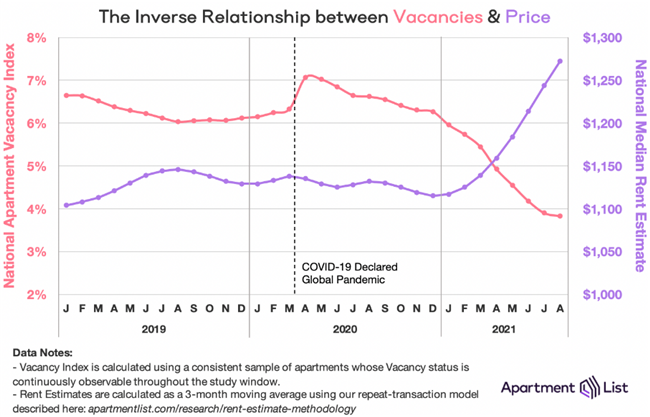
Rents were up another 2.1 percent nationally in August as rent growth continued, while vacancies reached historic lows, according to the latest report from Apartment List.
The report says that since January of 2021, the national median rent “has increased by a staggering 13.8 percent. To put that in context, rent growth from January to August averaged just 3.6 percent in the pre-pandemic years from 2017-2019.”
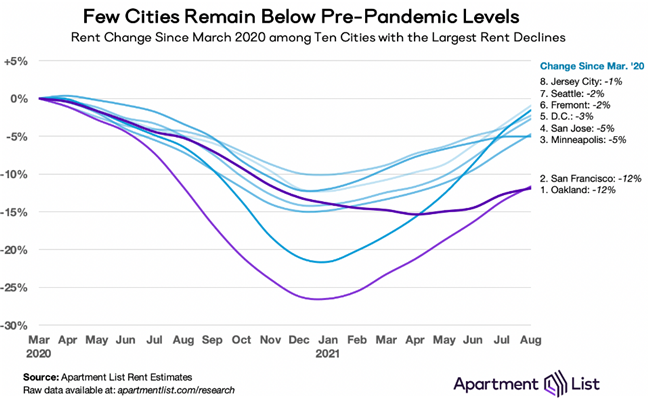
Rent growth in 2021 so far is outpacing pre-pandemic averages in 98 of the nation’s 100 largest cities, and only a few cities remain cheaper than they were pre-pandemic.
For example, San Francisco rents are still 12 percent lower than they were in March 2020, but rent prices have gone up 20 percent since January. Many mid-sized markets that have seen rents grow rapidly through the pandemic are only continuing to boom. For example, rents in Boise are now up 39 percent since March 2020.
Apartment vacancies reach historic lows
The tight housing market with few homes available to purchase has led many renters to have to stay where they are.
“As would-be home buyers get priced out of the for-sale market, they continue to rent. This high demand has created a tight market, resulting in our vacancy index dropping sharply throughout 2021 as prices increase rapidly.”
Few cities remain below pre-pandemic rent levels.
Some of the cities that saw dramatic pandemic-era rent drops, such as New York and Los Angeles, are finally back to pre-pandemic prices.
“That means that, ‘pandemic pricing’ is over in most of the country. Rents remain below pre-pandemic levels in just eight large cities: four California cities in the San Francisco Bay Area (San Francisco, Oakland, San Jose, and Fremont); Minneapolis, MN; Washington, DC; Seattle, WA; and Jersey City, NJ.”
2021: Fastest rent growth on record
Following the pandemic rent prices last year, “2021 has brought the fastest rent growth we have on record in our data,” Apartment List said in the report.
“As prices rebound rapidly even in the cities that saw the sharpest declines last year, there are very few cities remaining where rents have yet to surpass pre-pandemic levels. As we approach the winter, a seasonal slowdown in the rental market should relieve some of this pressure, but with historically low apartment vacancies and growing household mobility, a winter cooldown is unlikely to reverse much of the dramatic price growth we’ve measured throughout the year.”
Wilhelm joins Ashcroft from RXR Realty, where she served as senior vice president of multifamily operations and asset management, managing a $2.7 billion portfolio of properties in the Northeast.
At Ashcroft, she will oversee all of the asset management functions across the company’s entire portfolio, implementing tools and systems to optimize operational performance and drive value appreciation. Her expertise includes an in-depth understanding of the new technologies being introduced to the multifamily industry.
Traci Wilhelm, Ashcroft Capital Director of Asset Management
During her time at RXR Realty, she both led a digital lab team’s creation of a resident-facing mobile application and acted as a consultant to property technology investment committees as they determined the reasonability of investments.
“We are very excited for Traci to join us at Ashcroft Capital,” Frank Roessler, founder and chief executive officer of Ashcroft Capital, said in a release. “Her experience and skillsets are a perfect complement to the growth trajectory that our firm is endeavoring on. As we continue to institutionalize each department of the firm, it is critical that they are led by premier industry talent like Traci.”
Before her time with RXR Realty, Wilhelm was director of multifamily asset management at CBRE Global Investors, where she managed a $1.2 billion portfolio of Class A and value-add assets across the country, including 3,700 multifamily units and 76,000 square feet of retail space.
Earlier in her career, she served as director of asset management at JPI and as asset manager at Gables Residential. Wilhelm also practiced real estate transaction law for three years in Denver.
“I have admired Ashcroft’s impressive track record in the multifamily space, and I could not be more excited about the opportunity to become part of its leadership team,” Wilhelm said. “Ashcroft has a proven history of creating value through the rebranding and repositioning of the communities it acquires, bringing a better quality of life to their existing and new residents. I am looking forward to working with the tremendous team here at Ashcroft to continue and even accelerate the successes seen thus far.”
Wilhelm has a Bachelor of Arts from University of Colorado Boulder, a Juris Doctorate from Washington and Lee School of Law and a Master of Science in Real Estate Finance and Construction Management from the University of Denver.
About Ashcroft Capital
Founded in 2015, Ashcroft Capital has acquired over $1.4 billion of assets and more than 11,700 units. The firm focuses on capital preservation while striving to return strong, risk-adjusted cash-on-cash to investors. Ashcroft is capitalized with high net worth, family office and institutional capital. Within the real estate industry, Ashcroft specializes in value-add real estate and exhibits an expertise in extracting maximum value from every asset it acquires. Rather than attempting to play market timing, the firm strives to acquire excellent apartment communities within well-located submarkets of large and growing U.S. metroplexes.
Garbage disposals are my company’s No. 1 maintenance request. Here is your guide to troubleshooting and fixing a garbage disposal.
We like fixing garbage disposals because, most of the time, they’re super-easy fixes. Chances are your broken garbage disposal isn’t broken at all – it’s either jammed, the disposal motor tripped, the circuit breaker tripped, or it’s simply not plugged in. We’ll get into all this in a moment, but first, let’s go over how to properly use your garbage disposal to avoid most of these problems in the first place.
Tenants need to know how to properly use the garbage disposal
Misuse of the garbage disposal can lead to jams and trips.
Only food waste should go into a garbage disposal, but even then there are foods that should be avoided. When the wrong foods are thrown down the disposer, it can clog and overwork the device. You also might experience unpleasantries like foul odors and leaks. In order to avoid these issues and more, here’s a quick list of 10 things that should never go down your garbage disposal in the first place:
Any non-food item
Bones or shells
Coffee grounds
Vegetable peels
Banana peels
Shredded lettuce
Nuts, seeds, and pits
Fibrous food scraps, like corn husks or celery
Sticky food like oatmeal, rice, or quinoa
Fats, oils, and grease
Now we’re ready to start troubleshooting
First, a safety warning! If you like having fingers, never, ever, we repeat, ever, work on a garbage disposal that is plugged in. (Maybe some of you noticed that when you went to unplug the device from the outlet under the sink, that it was already unplugged. So you plugged it back and it’s working beautifully. Congrats. You can stop reading now!)
For everyone else still working with a non-functioning garbage disposal, after you unplug the disposal, check that the outlet is getting power. Plug something else into the outlet and check if it works. If not, the circuit breaker likely tripped. Locate the control panel and the garbage disposal switch. If it’s in the off position, we’ve found your problem. Switch it on and go check if the disposal is now working.
If your disposal still isn’t working and it’s not a power-supply issue, press the reset button on the bottom of the disposal. This is usually a red button that trips when the disposer works too hard.
Still not working? Unplug the garbage disposal and inspect the inside of it through the sink drain hole. If the spinning blades are not easy to wiggle around, then there is likely a jam stopping the unit from turning. Using an Allen wrench, turn the center bolt underneath the unit a few times – this typically dislodges any stuck material. Still no luck? As a last resort you can take it all apart and unclog whatever is stuck inside.
Using an Allen wrench, turn the center bolt underneath the unit a few times – this typically dislodges any stuck material.
The garbage disposal is connected in three spots: the hose, the drain to the sewer system, and the main connection at the top to the bottom of the sink. Disconnect everything and unscrew the disposal from the bottom of the sink. Remove the rubber lid and check inside. Hopefully, you’ll find the source of the jam, because if not, you most likely do have a broken motor, in which case, you need to buy a replacement.
Hopefully, you were lucky and were able to fix your broken garbage disposal from these steps!
About the author:
If you have any questions or concerns about troubleshooting your garbage disposal, or if you are interested in learning more about RentalRiff’s rental property maintenance service, give us a call at 541-600-3200. Phil Schaller is an experienced landlord and the founder/CEO of RentalRiff – an alternative service to traditional property management that provides ongoing oversight and upkeep of rental properties, while serving as the main point of contact for tenants. Maintenance and repair costs are included and property specialists are licensed/insured. Phil is a Pacific Northwest native, father of two, and fly-fishing addict.
Oregon landlords have become accustomed to the frequency with which laws, regulations, and obligations change. This has been even more true during COVID-19, and this column has detailed many of those changes. This past month was filled with more of the same. At a national level, the Center for Disease Control eviction moratoriums case made its way to the U.S. Supreme Court. At a local level, the Chief Justice of the Oregon Supreme Court issued another order related to eviction cases and scheduling. In my opinion, only one of these items is likely to have a real effect on Oregon landlords.
The challenge to the CDC’s actions finally made its way to the U.S. Supreme Court . . . again. The first time around, even though landlords won on summary judgment at the lower court level, they lost their request to vacate a stay related to the judgment, and the moratoriums were allowed to stay in place. The request to vacate the stay was denied because, as Justice Kavanaugh noted, the CDC’s moratorium was set to expire only weeks later. Landlords had won on the issues, but effectively had the clock run out on them.
After the previous CDC moratorium expired, Congress did not act to extend the moratorium. But due to political pressure, the CDC soon enacted another moratorium. This second action by the CDC was quickly challenged, briefed, and decided. After following a similar path through the lower federal courts, the Supreme Court held that the CDC lacked the authority to impose such a nationwide moratorium, and this time, overturned the stay in place. Thus, the CDC eviction moratorium is no more.
But what does this mean for Oregon landlords? Surprisingly, not much in my opinion. For most of the time frame in which the CDC moratorium was effective, Oregon landlords had their hands full with HB 4401, a much more troubling law. HB 4401 allowed a tenant to self-declare hardship with no ability for a landlord to challenge it, thus providing more protections for tenants than did the CDC moratorium. Many believed this “self-declare” provision was unconstitutional. As it turns out, the U.S. Supreme Court in early August enjoined enforcement of a similar provision of a New York law. Nevertheless, CDC Declarations—a requirement to trigger the protections under the CDC moratorium—were effectively non-existent in Oregon because of more stringent state law protections.
“If one thing is clear, new rules and laws can pop up in an instant,” says attorney Brad Kraus
If an Oregon landlord had received a CDC Declaration after the expiration of HB 4401, it could be challenged. The availability of rental assistance for tenants likely rendered one portion of any such declaration—that the tenant had used their best efforts to obtain government assistance—on shaky ground. Still, with the CDC moratorium now struck down, landlords should be on the lookout for “documentation” from their tenants consistent with SB 278.
At a local level, recent orders from the Oregon Supreme Court are more likely to affect your business. On August 19, Chief Justice Martha Walters issued CJO 21-031. The new order extended the timeline for a first appearance for an eviction in a non-payment case to 21 days (up from 7 per ORS 105.132(2)). In all other cases, the first appearance can be scheduled within 14 days. As for trials related to non-payment cases, they can be heard no earlier than 20 days and no later than 30 days after the first appearance. In all other cases, trials may be scheduled in the normal course but no later than 30 days from the first appearance.
As a practical matter, these delays are designed to allow a tenant more opportunity to apply for rental assistance and invoke the protections of SB 278. However, given the amount of notice, opportunity, and disclosures tenants receive related to the availability of rental assistance, it is unclear to this author why further delays are needed at the expense of landlords. Those who are interested in rental assistance have no doubt acted. Further delays likely only protect those who have no interest in making their landlord whole.
The main takeaway is that landlords should anticipate these delays—and potentially others—as they move forward with their non-payment notices. If one thing is clear, new rules and laws can pop up in an instant.
About the Author:
Bradley Kraus, Portland attorney
Brad Kraus is a partner at Warren Allen LLP. His primary practice area is landlord/tenant law, but he also assists clients with various litigation matters, probate matters, real estate disputes, and family-law matters. A native of New Ulm, Minnesota, he continues to root for Minnesota sports teams in his free time. You can reach him via email kraus@warrenallen.com or 503-255-8795.
As the end of summer looms, I am looking back fondly on all the adventures this season held for me. Like many of you, I found myself behind the wheel driving long distances. One of the things that I have come to realize over the past 25 years of summer travel are that there are two kinds of drivers: those who use cruise control and those I call “tinkerers.”
I myself am a cruise-control guy, while my wife falls squarely in the tinkerer category. It’s been my experience that despite these very different driving styles, we typically end up reaching our destination at nearly the same time. These same titles can be applied to investors as you manage the tenants of your properties (read that again, because you aren’t managing properties, you are really managing relationships with people.)
CRUISE CONTROL: I often find myself on long, straight stretches of freeway in the Southwestern United States, and putting the car in cruise control is one way to make sure things don’t get too crazy in regard to speed. The cruise-control management style is more conservative and usually has a combination of the following characteristics:
Set it and forget it: What has worked in the past will more than likely work in the future. Also known as the “if it ain’t broke, don’t fix it” approach.
Comfortable with consistency: You are satisfied with the same process and the same results. You like predictable outcomes.
Low-risk tolerance: You know that by using your tried-and-true, proven methods, you get the results you are satisfied with. The potential gain of change is not worth the pain.
Stay in your lane: You typically invest one way, whether that is long-term holds, flips, or short-term rentals.
There is absolutely nothing wrong with this style of management; think of it as being a successful, lazy landlord. Predictable patterns create predictable returns, and depending on what you want and where you are in your investment life cycle, this approach makes sense. We always stress the importance of finding the right “business partner” to be your tenant, and when done properly, that tenant can be expected to pay you $120,000 over five years. Identifying that right tenant is critical when you consider those numbers.
THE TINKERER: We’ve all ridden in a car with the tinkerer, and for some it creates great anxiety; for others it is as natural as breathing. The stop-and-go style of driving, weaving in and out of lanes, always looking for a way to get to the destination a little bit quicker, easily define the tinkerer. Considered a more aggressive approach to investing and managing, the tinkerer can be characterized as follows:
Speed up, slow down… on repeat: Unsettled by doing the same old thing, you find the ever-changing pace of managing in this style exhilarating. Imagine riding the waves of real estate and you will have a clearer vision of this characteristic.
Changing lanes: You are always looking for the latest and greatest opportunities, often willing to give up on one good thing in hope for two of a better thing.
Head on a swivel: Rather than focusing on the ultimate destination, you are constantly looking all around you for opportunities to accelerate your business.
Drafting: Just like on the highway where you fall in behind a larger vehicle, drafting as an investor will often place you behind someone moving faster than you, letting them break the wind and allowing you to capitalize on their successes and style.
Again, there is absolutely nothing wrong with this style of management.
Being inquisitive and willing to take chances has helped generate billions of dollars for investors. Choosing this management style requires more of a risk-taker mentality that many find intimidating, but for those who do it well, the rewards are generous. On a recent podcast, industry expert and Rent Perfect President David Pickron cautioned that “when you start chasing after every new idea or way of investing, it’s easy to spread yourself too thin and become distracted.” Having the right tenant is even more critical to this type of investor versus the cruise controller. You are constantly changing directions, and using the proper screening tools to identify your perfect tenant is key because you don’t have the time or focus to deal with the issues that a less-than-ideal tenant is sure to bring.
Of course, there is always a hybrid model of these management styles, but the majority of investors settle into one of these two major categories. Regardless of your management style, knowing and sticking to the fundamentals is critical to your success. Having a consistent set of criteria, a personalized lease, and a way to collect rent easily make life easier for all investors. Using professionals who know the industry inside and out will be some of the best money you spend today, and will save you thousands in the future. Finally, knowing who your renter really is by doing professional background screens will help you avoid the pitfalls of having the wrong person occupying your property. As stated before, having the right “business partner” is paramount for whatever investing strategy you adopt.
Having lots of time for “windshield therapy” and contemplating life for you, my fellow landlords, leads me to the same conclusion every time: We are in the best business in the world, with amazing growth potential. Knowing the type of investor you are helps as you navigate through times like those we’ve been experiencing for the last 18 months. And seeing others’ investment styles can generate ideas for the future, as your investing goals may change over time. Most of all, get out there and enjoy the journey and the adventure that comes with being a real estate investor.
About the author:
Scot Aubrey is vice-president of Rent Perfect, a private investigator, and a fellow landlord who manages short-term rentals. Subscribe to the weekly Rent Perfect podcast (available on YouTube, Spotify, and Apple Podcasts) to stay up to date on the latest industry news and for expert tips on how to manage your properties.
The heads of three federal agencies are urging state and local governments to enact or extend their own eviction moratoriums until emergency rental assistance is processed after the U.S. Supreme Court ruled the Centers for Disease Control and Prevention (CDC) had exceeded its authority in putting a nationwide eviction moratorium in place.
The government agencies are urging governors, mayors and state courts to not allow tenants to be evicted before they have the chance to apply for rental assistance, and “no eviction should move forward until that application has been processed.”
U.S. Secretary of the Department of Housing and Urban Development (HUD) Marcia L. Fudge, U.S. Secretary of the Treasury Janet L. Yellen, and Attorney General of the U.S. Department of Justice Merrick B. Garland sent a letter to state and local government leaders addressing the eviction moratorium, according to a release.
“Our three departments are working closely together and with other agencies across the federal government to make rental assistance available to households in need,” the letter said.
“We also know we cannot address this challenge alone. State and local governments play a crucial role as administrators of programs like Emergency Rental Assistance (ERA) and as leaders of their own housing agencies, judiciary systems, and other components of government that are essential to keeping Americans in their homes. We are urging you to exercise your own authorities-as states, cities, and counties representing millions of Americans already have to take action to prevent unnecessary evictions, including:
“Enacting state and local eviction moratoriums during the remainder of the public health emergency. Six states and the District of Columbia already have eviction moratoriums in place. As the president called for, we are encouraging all other state and local governments to use their legal authorities to appropriately put in place or extend their own eviction moratoriums.
“Working with state and local courts to require landlords to apply for ERA before they commence eviction proceedings. State and local governments or courts should ensure that all tenants have the opportunity to apply for rental assistance before any proceedings begin, and landlords seeking eviction should be required to apply for rental assistance first – a policy already implemented in some states and localities.
“Staying eviction proceedings while an ERA application is pending. By taking this step, as some states and localities already have, courts can ensure that tenants have a fair opportunity to apply for federal aid and that unnecessary evictions are avoided. While we call on courts to stay eviction proceedings, state and local governments must also speed the delivery of rental assistance to meet courts’ deadlines.
“Using ERA and American Rescue Plan State and Local Fiscal Recovery Funds to support the right to counsel and eviction-diversion strategies. Tenants are more likely to avoid eviction and remain stably housed when they have access to legal representation. Legal counsel can also aid in the successful completion of ERA applications. We encourage state and local governments to use ERA and Fiscal Recovery Funds to launch right-to-counsel programs and invest in court navigators and diversion programs.
“Helping tenants navigate the ERA application process. The Treasury Department has issued recent guidance streamlining the ERA application process, for example, by making clear that grantees can rely on self-attestation from tenants for certain eligibility requirements. State and local governments can continue to build on these efforts by removing unnecessary barriers to ERA funds.”
The letter said the ERA program and the state and local fiscal-recovery funds have provided tens of billions of dollars to support renters and landlords. The Treasury Department reported recently than about 89 percent of the funds had yet not gotten into the hands of landlords or tenants due to state and local processing delays.
“It is critical that renters be given the chance to receive that aid before being subject to eviction. Many state and local governments are working hard to get rental assistance to those in need as quickly as possible, and these policies will help ensure renters are not evicted before those resources reach them.
“We applaud the efforts of the state and local governments that have already taken these and other actions to prevent unnecessary evictions, as we know many of you have. However, we also know more must be done and that effective and comprehensive policies to prevent unnecessary evictions have never been more urgent. We stand ready to partner with and support you in any way we can to protect renters and landlords and make programs like emergency rental assistance as effective as possible,” the letter said.
The recent fluctuations in the United States stock market have many investors looking for more conservative and less volatile investments. On top of that, traditional investment instruments like stocks and bonds are similarly not looking very attractive because of their lackluster yield performances. Therefore, more and more investors are attracted to Real Estate Income Funds.
While Kay Properties & Investments is best known for its expert-level knowledge of Delaware Statutory Trust 1031 exchange investment strategies and opportunities, the company also has a great reputation for working with nationally recognized real estate sponsors to source and structure All-Cash/Debt-Free Real Estate Income Funds for accredited investors.
What is a Real Estate Income Fund?
In general terms, any “income fund” is simply a pool of capital that has been assembled on behalf of a group of investors. There are literally tens-of-thousands of different types of investment funds, including equity funds, bond funds, money market funds, mutual funds, and hedge funds. While direct ownership of real estate has been a popular investment for centuries, recently many investors have also started investing in real estate through participation in a fund.
A Real Estate Income Fund is a specific subset of funds that is focused exclusively on investing in potentially income-generating real estate. Real estate income funds provide another entry point for those looking to invest in large commercial or multifamily real estate portfolios. Real Estate Income Funds are particularly appealing to retail investors who want to own institutional quality real estate that would normally be out of reach for them. A Real Estate Income Fund pools capital from many investors, and then the fund’s sponsor oversees all the fund’s activities, including performing due diligence, underwriting, and property management. Investing in a Real Estate Income Fund is a great way to potentially generate passive income, gain access to institutional level assets, and avoid the responsibilities of direct ownership.
An Example of a Typical Real Estate Investment Fund Exclusively Offered by Kay Properties
Net Lease Income Fund 18 LLC: Focused on acquiring, owning, and actively managing a portfolio of single-tenant, Long-term, NNN lease, income producing tenants operating in the industrial, medical, and retail spaces throughout select United States markets.
This Real Estate Income Fund targets an 8% preferred return* for investors with monthly distributions generated through corporate backed leases. The offering size of this fund is $50,000,000 with a minimum investment of $50,000.
Example properties the funds seeks to acquire include those leased to recessionary-resistant, essential businesses that remained open and paying rent during the pandemic, such as: Amazon, FedEx, Davita Kidney Care, Frito Lay, Walgreens, UPS, CVS, Coca-Cola, In-N-Out Burger, and 7 Eleven.
*Preferred return is not guaranteed and is subject to available cash flow. Past performance is not a guarantee of future results. For further information about cash flow distributions from operations and capital events, please refer to the Private Placement Memorandum.
Three Distinct Benefits of Investing in a Real Estate Income Funds
Diversification
The ability to diversify in real estate funds has attracted conservative investors that want to avoid the concentration risk that often accompanies purchasing one piece of real estate. Typically, real estate investing requires a large down payment in order to obtain a loan with reasonable terms, tying up a significant portion of investors’ wealth in a single asset. Funds allow an investor to often place a smaller amount of cash into a highly diversified portfolio, therefore mitigating risk through diversification. Not only do funds allow investors to diversify in different pieces of real estate all over the country but investors can also diversify their investment by asset type and tenants. Funds may hold multifamily apartments, net lease commercial assets, medical, industrial, etc. Asset types can have varying market cycles. Diversifying one’s investment across asset types and geography can potentially insulate their investment from market volatility.
*Diversification does not guarantee profits or protect against losses.
Depreciation
An additional benefit to real estate income funds is the potential for depreciation. Many real estate income funds allow investors to depreciate their basis in the fund. The non-cash expense lowers the taxable income incurred from fund’s distributions. This may hold significant benefits for investors in high tax states such as California and New York. Investors should speak to their CPA to determine their own potential tax efficiencies from investing in real estate income funds.
Able to Optimize Both Inflationary and Deflationary Market Cycles
Finally, the ability for funds to continue to purchase real estate over time allows investors to optimize both inflationary and deflationary market cycles. An inflationary market will theoretically drive up the value of the fund. In a deflationary cycle, the fund may continue acquiring assets, cost dollar averaging as the market retreats. Funds have the flexibility to pick up these assets at a discount. Cap rates often expand in a deflationary market, which will allow investors to potentially realize higher distributions as they wait for the market to turn around.
Additional Potential Benefits of Real Estate Income Funds
Passive income and/or distribution potential
May provide monthly cash flow and/or distributions
Capital appreciation/equity growth potential
Tax advantages
Typically low minimum investment amounts ($25k – $50k)
Professional asset management
Elimination of day-to-day management headaches
While it is almost impossible to predict what the economic future will look like, many prudent investors are posturing their portfolios to mitigate risk while optimizing their upside potential no matter which direction the market turns. As more investors learn about the potential benefits of Real Estate Income Funds, their popularity will continue to grow throughout the coming years.
Securities offered through Growth Capital Services, member FINRA, SIPC, Office of Supervisory Jurisdiction located at 582 Market Street, Suite 300, San Francisco, CA 94104. Potential returns and appreciation are never guaranteed, and loss of principal is possible. Please speak with your CPA and attorney for tax and legal advice.
About the Author:
Steve Haskell
Steve Haskell is Vice President and DST 1031 specialist at Kay Properties and Investments where he works with 1031 exchange and direct investment clients throughout San Diego County and the rest of the United States.
Prior to coming to Kay Properties and Investments, Steve served for seven years as an officer in the United States Air Force in the special operations community where he led small teams as well as a large staff of hundreds of military and civilian personnel. He has served in numerous locations around the world, including multiple deployments to Afghanistan and locations throughout Africa. Though Steve has retired from active duty, he still serves in the Air Force Reserves.
Prior to his military service, Steve worked in sales and marketing for multiple businesses, which included providing energy management solutions to institutional multifamily apartment owners.
Steve holds a Master’s Degree from the American Military University and a Bachelors in Accounting from Point Loma Nazarene University where he graduated as International Development Student of The Year for his work providing business education to entrepreneurs in impoverished areas in Mexico, Nicaragua, and San Diego.
A new company has entered the Phoenix market after success in Denver offering guaranteed rent and two-year leases for rental property to landlords to help ease pandemic concerns and vacancy issues with tenants.
Nomad, which started in Denver, said their research shows the Phoenix metro market is a good market for their expansion, according to P.J. O’Neil, founder and a veteran operator of Opendoor.com, which buys homes from individual sellers.
A key is that the company is not a property manager, but it does guarantee leases, so landlords can continue to manage their own properties if they desire, or choose a third-party property management company.
O’Neil said the Phoenix market was chosen for three key reasons:
A stable economy with growing job market
Rentals are easier to price in the Phoenix metro market
The team comes from Opendoor.com, which launched originally in Phoenix
“We want to pay our landlord clients market rent, guaranteed, and charge them a fee equivalent to how risky it is for us to do that every month. So they’re never worried about vacancy costs. They’re never worried about a delinquent tenant,” O’Neil said.
“When we’re guaranteeing rent, we’re taking risks that we may be guaranteeing rent too high, or if we are guaranteeing too low, no one’s going to sign up with us. We wanted to make sure that we could accurately predict rental rates in Phoenix and because of the housing stock in Phoenix, it’s a little bit more homogenous than many other markets,” O’Neil said.
The company has about 20 homes under lease in Phoenix right now and a little over 300 in Denver. O’Neil predicts they will be getting closer to about 750 properties by the end of this year in the two markets.
Why the guaranteed rent model works for landlords
With the guaranteed-rent model, “We want to pay our landlord clients market rent, guaranteed, and charge them a fee equivalent to how risky it is for us to do that every month. So they’re never worried about vacancy costs. They’re never worried about a delinquent tenant.
Noman is a guaranteed rent company but does not do property management.
“If you’re a big investor, you experience vacancy as sort of an average across your portfolio, but if you’re a small mom-and-pop landlord, you experience vacancy in a very binary, very visceral way.
“One month you have rent supporting your mortgage. The next month you don’t. And then in the time during COVID, during these eviction moratoriums, that fear is even greater for landlords. They may have a tenant who loses their job and they can’t evict them and they’re now stuck paying a mortgage without any rent coming in for an unforeseeable amount of time.
“We really want to limit some of that downside risk for property investors and give them more certainty over a long period of time. That’s the pain point we’re trying to solve,” O’Neil said.
“You really choose your adventure. You decide, ‘Hey, how long do I want certainty for, and how much am I willing to pay for that certainty?’ “O’Neil said.
What is the cost to landlords of the guaranteed rent model?
The cost to landlords of the guaranteed rent model depends on the risk to the company and the length of the lease. However, Nomad does the tenant screening to help the landlord get a good tenant.
O’Neil said, “The guarantee fee ranges we offer are a one-year guarantee, a two-year guarantee, or a three-year guarantee.
“So a three-year guarantee is the riskiest for us because inevitably over three years there will be vacancy or delinquency on that property, or there’s a higher likelihood of that happening.
“And then the one-year, there’s less risk of those things. The one-year lease can range from anywhere from two percent to five percent of monthly rent, and the three-year can range anywhere from seven percent to 10 percent of monthly rent. And then the two-year falls in between.
“You really choose your adventure. You decide, ‘Hey, how long do I want certainty for, and how much am I willing to pay for that certainty?’ “O’Neil said.
The guaranteed rent fees are reflective of time and “how risky we think the property is. A single-family home in central Phoenix is going to have a lower risk fee than a condo further outside of town.”
“The product really works for smaller landlords and so we’re single-family, but that includes single-family homes, condos, and town homes. We’re not doing a lot of multifamily yet,” O’Neil said.
Guaranteed rent is not property management
O’Neil reiterated that “We are not property managers ourselves. If you do want property management, we introduce you to a partner property manager in the area.
If a landlord or property owner wants to layer on property management on top of the guaranteed-rent plan, “You’re introduced to a partner on the ground who charges seven percent a month of rent.
“We have a lot of owners who are getting property management plus guaranteed rent for 10 percent a month. That includes a one-year guarantee plus seven percent property management fee,” O’Neil said.
Any plans for guaranteed rent for multifamily properties?
While O’Neil says the company is focused on single-family right now, they can work with multifamily owners as an individual unit turns.
“The product really works for smaller landlords and so we’re single-family, but that includes single-family homes, condos, and town homes. We’re not doing a lot of multifamily yet,” he said.
He said they have found there are multifamily owners “who are getting guaranteed rent from us every time one of their doors turns.
“They may have a 10-unit building and every time one of those units comes available for rent, they’re handing it over to Nomad to guarantee the rent, get it leased, et cetera, but then they’re handing them over to us as they turn.
“They’re not necessarily handing the whole building over to us. They’re getting guaranteed rent as each of the units turns,” he said.
Do you strictly deal with landlords or could tenants contact Nomad directly?
O’Neil said a Nomad resident has a better or at least a more consistent experience with Nomad and guaranteed rent than with individual landlords.
“We are the ones collecting rent from the resident. The way it’s structured is we sign a master lease with the landlord, so we are technically the landlord’s tenant and that’s how the landlord thinks of us, and then the resident is our sub-tenant.
“(The tenant pays) us rent every month. We give them a better experience. They accrue rewards with us over time. The more often they pay rent on time, every time they renew a lease, they’re accruing rewards with Nomad and those rewards can be turned in for discounted rent.
“We’re still building the rewards platform out, but the idea is you as a Nomad resident should have a superior experience, and so when you’re ready to move to your next place, you’re starting at Nomad – not Zillow – to look for your next place because you understand the experience you get with Nomad,” he said.
The Guaranteed Rent Innovation Model following Opendoor.com
O’Neil said many of the Nomad Lease team came from Opendoor.com, which was founded in Phoenix and has had a lot of success there.
“We were able to pretty quickly grow the team from ex-Opendoor.com talent who understand the business very well. It’s a pretty powerful story for the first i-renter, is how we think of ourselves.
“We’re pioneering the i-rental business to launch in the birthplace of the i-buyer movement. Opendoor.com was founded in Phoenix. Zillow offers has a big operation in Phoenix. OfferPad has a big operation in Phoenix. We thought that the population of Phoenix was more accustomed to these new offerings than some of the other markets out there.”
The company does plan expansion of the guaranteed rent model.
“There’s a lot of un-served markets in the middle of the country that often are overlooked by Silicon Valley startups and so we want to address those markets. As a Denver-based company, I think we have a real spirit of helping to solve problems for everyone in between LA and New York.”
O’Neil’s own story of rental property
“When I graduated from college, I bought my first investment property. When I was very young, I put as little money down as I possibly could, because I had not a lot of money to put down, and I rented it to college students.
“I started my investment journey early and I’ve kind of grown my portfolio, but every month any of my properties are vacant, that’s a really painful month for me.
“I may cut back that month. I may not be going out to dinner as often with my wife and it’s just the uncertainty around vacancy and delinquency is something I’ve historically solved for that by keeping the rent low on my properties and actually not maximizing my rent to ensure that I kept tenants in there for a long period of time.”
“And so, at Nomad , we figured there’s a better way.”
Co-founders of Nomad, P.J. O’Neil right and Matt Thelen.
Hot and humid summers can breed mold especially if your tenants are not keeping things clean, so here are mold preventative maintenance checkup items, provided by Keepe. Knowledge about what causes mold growth and mold preventative maintenance is key to guaranteeing a safe, healthy living environment for tenants.
Property managers need to know not only causes of mold growth, but how to prevent it in certain parts of the rental property.
What makes a room mold-friendly?
Mold only grows and thrives in spaces that present its ideal living conditions, especially basements, bathrooms and kitchens.
To prevent mold from forming and continue growing, it’s fundamental to address the elements causing a certain environment to become mold-friendly.
Simply cleaning up a moldy area won’t be effective on the long run. Mold will eventually grow back.
Mold that is easy to see and smell (molds generally smell musty and earthy) indicates an advanced state of mold growth. Living spaces where mold is easily visible must be treated as soon as possible.
Moisture and ventilation are the factors to consider first when aiming to eradicate a mold problem. Piping, HVAC and insulation should then become some of the first elements to inspect upon discovering mold.
Preventive maintenance projects can help you achieve a safe and mold-proof space while also addressing lingering maintenance issues that you might be overlooking.
Simply cleaning up a moldy area won’t be effective on the long run. Mold will eventually grow back.
7 basement mold preventative maintenance steps
Basements provide ideal living conditions for mold to grow and thrive. They are dark, humid and not ventilated. Low air flow and high moisture are the main culprits aiding mold to form.
1. Monitoring humidity levels. The more humid a basement is, the more mold-friendly it becomes. Our experts recommend utilizing a hygrometer to measure humidity levels. Make sure they do not surpass readings of 45% or higher, which can indicate excessive humidity.
2. Reducing high humidity levels via insulation. It is important to check the insulation of all piping located in proximity of the basement. Make sure to have a professional plumber repair any loose insulation or leaks. Second, exposed pipes – which typically exhibit condensation during the cold seasons – should be insulated by a professional, which removes extra moisture.
3. Reducing high humidity levels via water drainage. It is fundamental to have an effective water drainage system. Direct water away from the property: if your property is already experiencing flooding and poor drainage after rain and seasonal weather, it is a clear sign that the property’s drainage system is ineffective, which could lead to even more severe structural issues.
4. Reducing high humidity levels from appliances. Appliances like washers, dryers, heaters and air conditioners should have their exhaust systems be checked to guarantee that they are properly functioning. They should be directing exhaust away from the property’s interiors and pushing moisture outside.
5. Avoid moisture-absorbing flooring. Carpet and wooden flooring absorb moisture and remain damp. This creates the perfect living condition for mold. It also contributes to the overall humidity of the space. It is best to substitute carpet and wooden flooring with more impermeable flooring, such as tiles, linoleum, or natural stone.
6. Improve ventilation. Having an exhaust fan installed allows to proper ventilation of basements. It is also recommended to open windows regularly to air out the space. Our experts recommend hiring an HVAC specialist. The specialist can perform an evaluation of the rental property’s ventilation capacities and suggest necessary improvements.
7. Bonus Tip. Inform tenants about why being mindful of humidity and ventilation is essential to ensure optimal mold prevention. Very simple steps can be taken by tenants to avoid creating mold-friendly conditions. Our mold experts suggest avoiding drying clothes and growing houseplants in the basement, which contributes to raising humidity levels and welcoming mold growth.
6 bathroom mold preventative maintenance steps
Bathrooms present plenty of damp spaces for mold to growth. Resolving lingering moisture is the first step for preventing mold.
1. Monitoring humidity levels. Just like for basements, the more humid a space is, the more mold-friendly it becomes. Humidity levels over 45% indicate excessive indoor humidity.
2. Repairing leaks. Considering the significant volume of water being used daily, bathroom fixtures and piping can easily develop leaks. Those leaks will result in moist areas that welcome mold growth. It is important to promptly turn to a professional who can repair the leaks. Additionally, it is always wise to schedule seasonal plumbing checks. You want to make sure that pipes are in good shape and no hidden leaking is taking place.
3. Improving ventilation. Moisture can linger if the ventilation system is not allowing air to circulate. Circulation can speed up drying times for residual water in showers, bathtubs, sinks and any other “splash zones.” It is ideal to have an HVAC specialist assess the ventilation efficiency of your property’s bathroom. Ensure the bathroom exhaust fan is working properly.
4. Replace moldy caulking. If you notice mold growing on the caulking or sealant of bathtubs and showers, our experts encourage completely stripping the moldy layer and having a professional re-caulk the area. This will ensure that the mold growing in the area will be completely removed, thus eliminating the likelihood of leftover spores starting a new growth.
5. Avoid moisture-absorbing furnishings. Furnishing and decorating bathrooms with moisture-absorbing materials can impact the overall level of moisture. It’s best to avoid wallpaper and turn to a specialist for sealing unsealed wood countertops.
6. Bonus Tip. Encourage tenants to use exhaust fans when they take showers or baths. This will allow for condensation and lingering moisture to be removed. Additionally, it’s best if bathtubs and showers are kept as bare as possible. Mold can grow and hide in damp loofahs, sponges, brushes and bottles of shampoo and shower gel.
6 kitchen mold preventative maintenance steps
Abundant plumbing and cooking-related moisture increase the availability of moist spaces for mold to easily grow.
1. Actively check for and repair leaks. Leaking sinks and pipes create new moist areas for mold to easily grow in. It’s important to ensure that leaks are repaired as soon as possible. It is ideal to schedule seasonal rental property maintenance checks to make sure that there are no hidden leaks or damaged, leak-prone pipes in the property.
2. Check cabinets. Kitchen cabinets that house or are found in proximity of main pipes are likely to entrap moisture. This is true especially if they are made of moisture-absorbing material, like unsealed wood. We recommend having a plumbing professional evaluate whether the location of pipes and the material of kitchen cabinets are adequate for your kitchen.
3. Check the garbage disposal. Older and faulty garbage disposal systems will often fail to allow wet food scraps to be properly flushed and disposed. The garbage disposal then becomes a dark, wet, and organic material-filled space for mold to grow in. Repairing a broken garbage disposal as soon as it exhibits issues can prevent the mold.
4. Seal permeable surfaces. Countertops and cabinets generally take up the majority of the space in the kitchen. Some materials are prone to absorbing moisture more easily than others. Choosing materials for your countertops and cabinets is an important process. Our experts find that wooden countertops – or butcher block – have been known to rot due to lingering moisture. This can be prevented by regularly sealing the countertops. Overall, it’s always recommended to consult a maintenance professional about the maintenance needs of your rental property’s kitchen countertops and cabinets. Following the suggested procedures and checkups is the best way to avoid wear and tear on the long run.
5. Bonus Tip. Remind tenants that cleanliness should always be a priority when it comes to the kitchen. Making sure that dirty dishes, food scraps and food in general are not left out will decrease the likelihood of mold to grow on organic material. Spills – especially under and behind fixtures and countertops – should be cleaned up promptly. Food should be always stored mindfully.
Summary
Mold preventative maintenance is a serious issue. Mold can compromise the health of tenants and the overall safety, appeal and look of a rental property. Molds and fungi can develop into parasitic growths harmful to humans in their indoor living spaces. The Centers for Disease Control and Prevention (CDC) warn about the dangers of mold exposure. Mold can significantly worsen respiratory conditions and cause severe rashes, irritation and infections for those with weakened immune systems or respiratory conditions. The Institute of Medicine (IOM) similarly linked indoor mold exposure to the development of coughing, wheezing and reported difficulty with breathing by otherwise healthy people. Not only is this harmful, but it can quickly get out of hand: mold can grow rapidly when it is not addressed immediately.
About Keepe:
Keepe is an on-demand maintenance solution for property managers and independent landlords. The company makes a network of hundreds of independent contractors and handymen available for maintenance projects at rental properties. Keepe is available in the Greater Seattle area, Greater Phoenix area, San Francisco Bay area, Portland, San Diego and is coming soon to an area near you. Learn more about Keepe at https://www.keepe.com
In a major victory for landlords and rental property owners, the U. S. Supreme Court on Thursday ended the nation-wide eviction moratorium in an eight-page ruling saying “It is up to Congress, not the CDC, to decide whether the public interest merits further action here.”
Realtor associations and rental-property managers in Alabama and Georgia had sued saying the CDC lacked the authority to impose the eviction moratorium.
“The applicants not only have a substantial likelihood of success on the merits—it is difficult to imagine them losing,” the court said in its ruling.
“The moratorium has put the applicants, along with millions of landlords across the country, at risk of irreparable harm by depriving them of rent payments with no guarantee of eventual recovery. Despite the CDC’s determination that landlords should bear a significant financial cost of the pandemic, many landlords have modest means. And preventing them from evicting tenants who breach their leases intrudes on one of the most fundamental elements of property ownership—the right to exclude,” the court said in its ruling.
“As harm to the applicants has increased, the Government’s interests have decreased. Since the District Court entered its stay, the Government has had three additional months to distribute rental-assistance funds to help ease the transition away from the moratorium. Whatever interest the Government had in maintaining the moratorium’s original end date to ensure the orderly administration of those programs has since diminished. And Congress was on notice that a further extension would almost surely require new legislation, yet it failed to act in the several weeks leading up to the moratorium’s expiration,” the court said.
Eviction moratoriums still in place in states and cities
The current nationwide eviction moratorium had been set to expire on October 3.
However, many states and localities, including California, have extended their own moratoriums, providing another layer of protection for some renters. Also in some locations judges, aware of the potential for large numbers of people to be put out on the street even as the pandemic intensifies again, have said they would “slow-walk cases” and make greater use of eviction-diversion programs.
The National Apartment Association (NAA) and the Multifamily Housing Council (NMHC) both said it is time to move on to other solutions besides an eviction moratorium.
“The government must move past failed policies and begin to seriously address the nation’s debt tsunami, which is crippling both renters and housing providers alike,” said Bob Pinnegar, the president of the NAA, in a release.
“At the onset of the pandemic, NMHC supported a voluntary, short-term halt to evictions to keep families safely and securely housed. However, a long-term eviction moratorium was never the right policy. It does nothing to speed the delivery of real solutions for America’s renters and ignores the unsustainable and unfair economic burden placed on millions of housing providers, jeopardizing their financial stability and threatening the loss of affordable housing stock nationwide,” the NMHC said in a release.