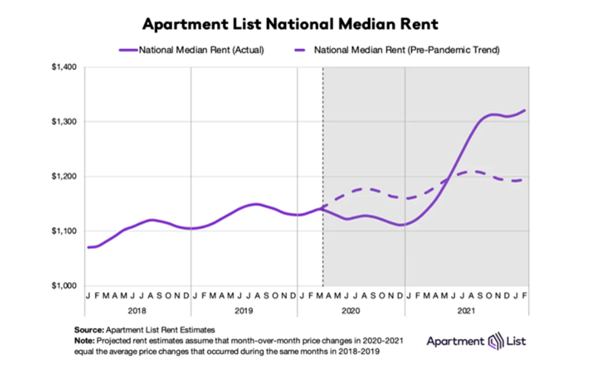
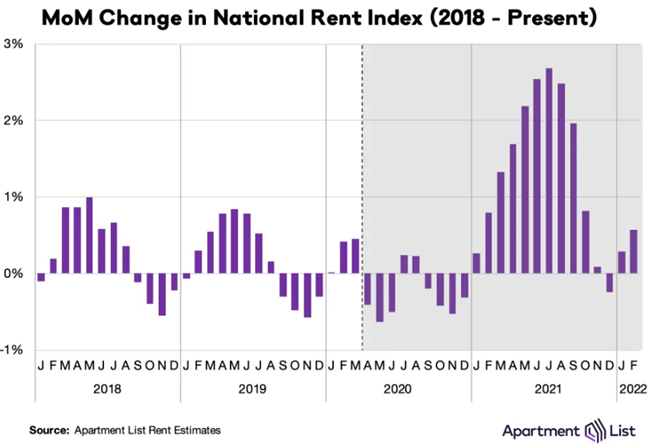
After a few months of cool down, national rent growth is now back on an upward trend, according to the March report from Apartment List.
The rent-growth gain of 0.6 percent in February month-over-month in national rents reversed the slowing rents over the past few months, in which total rent growth was just 0.7 percent.
Plus, the most recent month’s rent growth was still faster than the pre-pandemic norm for this time of year.
“Even though month-over-month rent growth has moved back into positive territory, it remains substantially cooler than last summer, when rents grew by more than 2 percent per month for four straight months,” write housing economists Chris Salviati, Igor Popov, Rob Warnock, and Lilla Szini.
“As we enter the spring and summer months, it’s likely that rent growth will speed up amid increased moving activity. Even if prices don’t rise as rapidly as they did in 2021, we’re already seeing signs that 2022 will be another year of above-average growth.”
Vacancy Rate Continues To Climb
The report says the vacancy rate has continued to climb but that increase “has been modest and gradual.”
Vacancy still remains historically tight. “Over the past six months, our vacancy index has been increasing by an average of 0.1 percent per month. If that pace continues, we won’t hit a vacancy rate of 6 percent – the pre-pandemic norm – until next summer. Nonetheless, the gradual increase in vacancies in recent months has likely been contributing to the slowdown in rent growth.”
Fastest Growing Metros
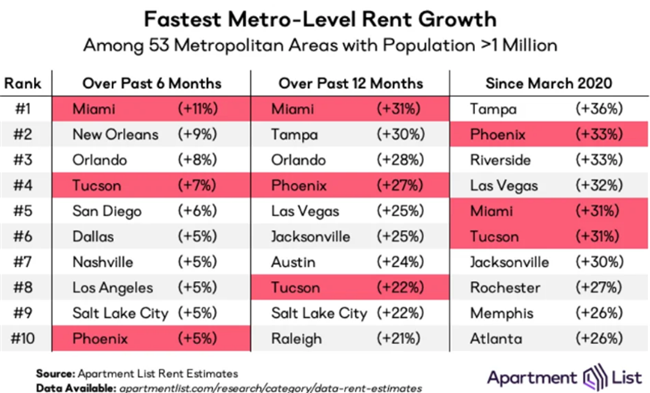
Major markets throughout the Sun Belt have experienced virtually-uninterrupted rent growth since the start of the pandemic.
The following table shows rent growth for the ten metropolitan areas that have experienced the fastest rent growth over the past six months, over the past year, and since the pandemic started in March 2020.
National Rent Growth Summary
Apartment List reports that while rent growth has cooled from last summer’s peak, “it continues to exceed pre-pandemic trends. While the apartment market has shown some signs of easing, our vacancy index still sits at 4.5 percent.
“As we enter the spring and summer months, rental activity is likely to pick up, and rent growth is likely to accelerate … Many American renters are likely to remain burdened throughout 2022 by historically high housing costs.”
A landlord is dealing with a tenant who moved out early while the lease in still in place and is wondering about entering the rental. That is the question this week for Ask Landlord Hank. Remember Hank is not an attorney and he is not offering legal advice. If you have a question for him please fill out the form below.
Dear Landlord Hank:
Does a tenant retain possession of their apartment, after they vacate their unit, but before their 30 days’ moving-out notice expires?
And does the landlord need to have an authorization to enter the unit, for getting the unit move-in ready (cleaning and painting) for the new tenant, before the 30-day notice expires?
Dear Landlady Danielle,
It is customary for a landlord to retake possession of a property when the tenant moves out and turns in the property keys unless the tenant has made some other arrangement with the landlord.
We have tenants leave early all the time because it suits their lives better than staying until the last minute.
If the landlord believes a tenant has moved out, then there is no reason to wait to ready your unit for the next resident.
Usually your lease will stipulate under what conditions you have right of entry.
A reasonable person would think that when a tenant moves and turns in their keys, they are relinquishing their claim to the property – BUT, that being said, why don’t you talk to your tenant and let them know what is on your mind?
Clear communication is the best way for everyone to be on the same page.
You could just ask for the forwarding address for the return of the security deposit and tell the tenant it is OK to turn off the utilities if they’ve moved, so you can access the unit and prepare it for the next resident.
Sincerely,
Hank Rossi
Each week I answer questions from landlords and property managers across the country in my “Dear Landlord Hank” blog in the digital magazine Rental Housing Journal. https://rentalhousingjournal.com/asklandlordhank/
Landlord Hank says, “A reasonable person would think that when a tenant moves and turns in their keys, they are relinquishing their claim to the property – BUT, that being said, why don’t you talk to your tenant and let them know what is on your mind?”
Ask Landlord Hank Your Question
Ask veteran landlord and property manager Hank Rossi your questions from tenant screening to leases to pets and more! He provides answers each week to landlords.
Whether you are an investor or a real estate broker, selling investment or business real estate can be an expensive venture unless you are prepared to conduct a 1031 exchange.
Section 1031 of the federal tax code dictates that no gain or loss shall be recognized upon the sale of a real estate property held for business or investment purposes, as long as the seller purchases a replacement property of equal or greater value. This can be a solid opportunity, potentially, to preserve the gain and accrue additional wealth. However, the 1031 exchange can be a tricky process that has frustrated many amateur and professional real estate investors alike.
So, to help potentially avoid having your 1031 exchange blow up in your face, here are six steps to consider as you advise a client on undertaking and entering into a 1031 exchange:
Step 1: Know the applicable deadlines
The IRS requires an investor to identify a replacement property within 45 days, and to close on the target property within 180 days of selling the relinquished property. That doesn’t leave much time to hunt for the right deal, but it’s enough time. Working with an expert 1031 exchange investment firm like Kay Properties can help investors successfully complete their 1031 exchange within these timelines.
Step 2: Get educated about acceptable types of replacement properties
The IRS requires an exchanger to reinvest in a “like kind” property. However, “like kind” does not necessarily mean the same type of property. There are a variety of options available. For example, if you are selling a duplex in San Diego, that doesn’t mean you need to replace it with another duplex. The 1031 exchange allows investors to replace relinquished real estate with a variety of asset types. It can be a medical building, single-family home, multifamily apartment building, raw land, self-storage facility or any other investment real estate. The type doesn’t matter as long as it is held for investment or business purposes. Ideally, investors should know what they are looking for in a replacement property well before going into escrow on the property they are selling. Again, working with a 1031 exchange investment firm like Kay Properties can greatly reduce the stress and confusion surrounding 1031 exchanges.
Step 3: Narrow down the options while in escrow
I cannot tell you how many times I have seen 1031 exchange investors in a desperate panic once they hit day 30 of their 45-day window with not a single replacement option identified for their exchange. This is an extremely stressful position. But don’t worry, this article should help spare you the anguish.
One good strategy is to locate five to 10 potential replacement properties as the closing date of the property you are selling gets closer. But be prepared that as you move through escrow, many of the new properties you have identified will likely be acquired by other buyers or will not prove to be satisfactory under the scrutiny of some due diligence. That’s why developing a short list of potential replacement properties prior to relinquishing the original asset can be one of the most important strategies for preventing having your 1031 exchange blow up!
Step 4: Make sure your financing is lined up ahead of time
Investors will often call me in a panic because they’ve located their replacement property, but they cannot access the financing necessary to purchase the asset. It is important to make sure that they have the financing lined up before closing on the property being sold to spare themselves from a stressful and potentially expensive predicament. That’s one reason fractional ownership structures for 1031 exchanges can be attractive for investors wanting to complete a 1031 exchange. For accredited investors, a Delaware Statutory Trust (DST) investment may be a suitable option. In addition, DSTs have a non-recourse financing component baked-in to each investment so the investor does not need to sign for a loan. A DST may be an ideal opportunity for an investor looking to a 1031 exchange to be a passive, turn-key solution with required financing already established.
Step 5: Have a backup property identified just in case
The IRS code allows investors to identify replacement properties using different rules. The most common rules used are to either identify three properties for their 1031 exchange or identify real estate valued at up to 200% of the property that’s being (or been) sold. This means there is room for back-ups. Take advantage of the opportunity. An exchanger should never leave an empty space on their ID form, which is submitted and filed with a qualified intermediary. More often than not, the exchanger’s primary option won’t work out … even if it looks like a sure thing! Also, I have often seen unscrupulous sellers exploit the buyer’s 45-day time clock in order to press their back against the wall, forcing the exchanger into an inferior negotiating position. Backup property options can strengthen the exchanger’s negotiating power by providing additional options.
For accredited investors, a DST can be an excellent option for a backup strategy. DST properties are already purchased, stabilized, and can potentially provide monthly distributions to investors. There is no negotiating and the due diligence is already complete. Additionally, an exchanger can often close on a DST in three to five business days. I often recommend my clients use a DST as a backup ID if there is room in their exchange and it is appropriate for their situation.
Step 6: Make sure to start to negotiate a 1031 contingency in your purchase and sale agreement
Many buyers are willing to allow a 1031 contingency that will permit the seller to extend escrow on the property being sold if the seller can’t find a replacement property. For example, try to negotiate a clause that extends escrow for you by including an additional 30 days if you are unable to identify a suitable replacement property. This can be a quick and easy way to buy additional time should you have difficulty locating the right 1031 exchange investment.
Bottom Line: a 1031 exchange can be a potentially great tool for building and preserving wealth, but it can be a daunting process if not properly prepared. If you decide to do a 1031 exchange, make a point to start early, get educated, narrow down their options, line up financing, have a backup ID, and negotiate for more time in case they need it. When appropriate and if they qualify as an accredited investor, use a DST as part of your 1031 exchange strategy. There are no guarantees in real estate, so it is always best to plan ahead when considering a 1031 exchange.
Ask Bill Exeter
Ask Bill Exeter and his team your questions about 1031 exchanges and he and his team will get back to you.
About the author:
Steve Haskell, Vice President, Kay Properties
Steve Haskell serves as Vice President at Kay Properties and Investments working with 1031 exchange and direct investment clients throughout the country. Steve is based out of Kay Properties San Diego office. Steve comes to Kay Properties and Investments after serving for seven years as an officer in the United States Air Force in the special operations community where he led small teams as well as a large staff of hundreds of military and civilian personnel. He has served in numerous locations
around the world, including multiple deployments to Afghanistan and locations throughout Africa.
Though Steve has retired from active duty, he still serves in the Air Force Reserves.
Prior to his military service, Steve worked in sales and marketing for multiple businesses, which included providing energy management solutions to REITs and multifamily apartment owners.
Steve holds a Masters degree from the American Military University and a Bachelors in
Accounting from Point Loma Nazarene University where he graduated as International
Development Student of The Year for his work providing business education to entrepreneurs in impoverished areas in Mexico, Nicaragua, and San Diego
About Kay Properties and www.kpi1031.com
Kay Properties is a national Delaware Statutory Trust (DST) investment firm. The www.kpi1031.com platform provides access to the marketplace of DSTs from over 25 different sponsor companies, custom DSTs only available to Kay clients, independent advice on DST sponsor companies, full due diligence and vetting on each DST (typically 20-40 DSTs) and a DST secondary market. Kay Properties team members collectively have over 150 years of real estate experience, are licensed in all 50 states, and have participated in over $30 Billion of DST 1031 investments.
This material does not constitute an offer to sell nor a solicitation of an offer to buy any security. Such offers can be made only by the confidential Private Placement Memorandum (the “Memorandum”). Please read the entire Memorandum paying special attention to the risk section prior investing. IRC Section 1031, IRC Section 1033 and IRC Section 721 are complex tax codes therefore you should consult your tax or legal professional for details regarding your situation. There are material risks associated with investing in real estate securities including illiquidity, vacancies, general market conditions and competition, lack of operating history, interest rate risks, general risks of owning/operating commercial and multifamily properties, financing risks, potential adverse tax consequences, general economic risks, development risks and long hold periods. There is a risk of loss of the entire investment principal. Past performance is not a guarantee of future results. Potential cash flow, potential returns and potential appreciation are not guaranteed.
Nothing contained on this website constitutes tax, legal, insurance or investment advice, nor does it constitute a solicitation or an offer to buy or sell any security or other financial instrument. Securities offered through FNEX Capital , member FINRA, SIPC
Customer relationship management in multifamily has skyrocketed as apartment managers have unearthed a wide range of crucial capabilities over the last few years.
By Morgan Dzak
Customer relationship management (CRM) systems have been around for decades, but multifamily has unearthed their wide range of crucial capabilities over the last few years.
The rapid rise of CRMs was due to major changes in the leasing process, with new technology rollouts, software integrations and self-service models. But the value of CRMs extend beyond a solution to leasing changes, and the technology now plays a central role in data tracking and lease conversions.
CRM use in multifamily skyrocketed as the “PropTech” boom launched multifamily into a new era of technology and software solutions for virtual and self-service leasing. Apartment operators have recently started tapping into the true potential of CRMs and how to further operationalize their systems in a new age of leasing. CRMs are the leasing professional’s main tool, and without one, companies lose a vital piece of effective data-driven leasing and customer service.
“We need to understand what’s actually working, what’s converting traffic and what we can either amplify because it’s working, or scale back because it’s not providing the conversions we want,” said Jennifer Staciokas, executive managing director of property management at Western Wealth. “In this industry, we really need transparency into all the sources we’re tracking and insight to make the best decisions.”
Multifamily has transformed into a data-driven industry, and CRMs provide the necessary data and reporting functionality to glean that highly coveted competitive advantage and optimize conversion rates. While CRMs have become an invaluable tool, many operators are now experimenting with new ways to maximize its impact.
Tracking and Optimizing the Customer Journey
More and more operators have started integrating automation and artificial intelligence (AI) chatbots into their CRMs to enhance multitouch attribution efforts. Once thought of as something that would replace leasing teams, automation and AI chatbots have proven to be supplemental tools that help leasing teams execute their jobs more effectively and efficiently. Leasing teams get a key snapshot into where leads are coming from and what’s truly driving lease conversions.
“We always talk about the different touchpoints in the customer journey and being able to attribute where all that traffic is coming from,” Staciokas said. “Coupling a CRM with automation efforts and looking at which sources are truly driving conversions helps us adjust the spend so more money can be allocated to those sources. Then we can focus the automation on the sources that are actually converting to leases.”
Automation provides the necessary touchpoints customers of today need, and the touchpoints are delivered consistently. Guest cards are often closed after two or three touchpoints, but automation offers a much more engaging eight to 12 touchpoints, and without getting the leasing team involved. When synced with a CRM, automation tools and AI chatbots aggregate guest card information so leasing teams are set up to analyze lead sources and data around successful conversions.
“Lead and conversion tracking has to become part of the day-to-day and it’s important to hold team members accountable to the process,” Staciokas said. “It really comes down to discipline and accountability and making sure leasing teams understand the importance of every single lead they receive. We show them the reporting on how much leads and leases cost and how it actually impacts the overall value of the community. One lead can be extremely important when you think about the true value of the property.”
Automating Communication
CRM integrations like automation and setting up marketing-based triggers also provide consistent, timely follow-up communication for all customers. This is difficult for leasing teams to do manually when there is such an influx in online leads from different platforms. This functionality has been revolutionary for the modern apartment search experience.
“Customers often send information requests to five or seven different communities and hear back from only one or two,” Staciokas said. “When a customer doesn’t get a call or an email back, the lead dies, and that’s not good for either party. When they get a quick response with continued communication, it shows them we care for them as a resident and makes their decision to lease there much easier.”
According to data from Nurture Boss, only 55 percent of customers hear back from an apartment community they contacted for more information. With automation in place, 100 percent of customers hear back with personalized follow-ups developed with CRM data gathered from the guest cards. That maximizes not only CRM impact, but boosts lease conversions, and it delivers more qualified leads to onsite teams.
“If we’re able to keep that constant communication going, then leasing teams can close leads faster,” Staciokas said. “The onsite teams have to do less legwork because they know who truly has the intent to sign a lease and the real need to move.”
Automated communication with ample touchpoints moves customers further down the funnel without burdening leasing teams. By the time a customer speaks to a leasing associate, they are ready to become a resident. Automating the customer journey can ultimately automate lease conversions, and leasing teams can then focus more on customer service and closing leads.
Leveraging Data for Personalization
A CRM is the gatekeeper of the data. While it’s integrated into the property management system, the CRM is the true gold mine of actionable insight. Clean data becomes an especially important piece of maximizing CRM impact and lease conversion.
“It’s crucial to make sure the data is clean, and what that means is all of the ad sources are linked properly and leasing teams are monitoring the data that is of the utmost importance,” Staciokas said.
Clean data also ensures customers are getting appropriate information and follow up. CRM data combined with an automation or machine-learning tool can personalize correspondence, and modern consumer behavior patterns point to the need for personalization.
According to research from Statista, 90 percent of U.S. consumers think personalized marketing content is somewhat to very appealing. Another survey of U.S. marketers found 63 percent of participants noted that the primary benefit of personalization is increased conversion rates.
“There has been a notable shift in how the multifamily industry views consumerism, and the emphasis is now being placed on the overall experience the customer has,” said Jacob Carter, CEO of Nurture Boss. “Multifamily is dialing into creating better experiences for people looking for an apartment. Technology really changed everything, and modern customers expect more seamless, personal interactions.”
As multifamily continues to integrate more machine-learning tools into the leasing process, the path to personalization will become more streamlined and refined. An apartment search is a deeply personal experience, so this level of attention to detail enhances the customer journey and leads to satisfied customers who are more likely to sign a lease.
CRMs have rapidly become a foundation of leasing strategies and customer experiences. As operators continue to experiment with ways to operationalize their CRMs and maximize impact, customer experiences will only get better and lease conversion rates will climb.
“It makes everybody more efficient,” Staciokas said. “Onsite it cuts down the time to conversion and to actually signing a lease, and it creates a better overall customer experience. It’s a complete win-win.”
About the author:
Morgan Dzak is an account manager for LinnellTaylor Marketing and previously spent time as a digital content specialist for Cornerstone Apartment Services in Denver.
Are you concerned about pets at your rental communities, well don’t be, because pet owner behavior creates most rental housing pet-related concerns from residents.
Apartment communities across the nation are making concerted efforts to strengthen their pet-friendliness, which is both uplifting and necessary.
More than ever, residents consider pets to be part of their families, and the pandemic-fueled adoption boom has added even more pets to the rental-housing landscape.
When increasing pet-friendliness levels, however, property teams also have to consider the comfort level of non-pet owners.
That makes it natural to first worry about things such as pet-related behaviors and the potential for onsite incidents. But according to a recent large-scale survey of apartment residents, most residents are more concerned about irresponsible pet-owner tendencies and nuisance-related issues rather than specific behaviors of pets at your rental communities.
Fear of pets, biting and aggression were not among the top three pet-related concerns among non-pet owning residents, according to the Pet Policies and Amenities in Multifamily report, released earlier this year by PetScreening and J Turner Research. The survey, which took into account the feedback of more than 22,000 residents and included both pet owners and non-pet owners, indicated that pet waste, barking and off-leash pets were the primary concerns of non-pet owners.
The good news for property managers is that they have the power to significantly limit these primary concerns. While it might be difficult to conquer a resident’s fear of pets, only 11 percent cited this as a top concern (12 percent cited biting and 28 percent cited pet aggression). Meanwhile, an overwhelming 84 percent of non-pet owners cited pet waste as a top concern, while 62 percent cited barking and 37 percent cited off-leash pets.
These nuisance-related complaints generally trace back to the owner—even barking, which is often due to pets being left unattended for too long in homes or on patios and balconies. So how do property managers alleviate these concerns? Largely by providing resources for pet owners such as:
Pets At Your Rental Communities and Pet Waste
As much as property managers hope their residents are responsible and will pick up after their pets, residents will never be 100 percent compliant—anywhere. But onsite teams can help by installing pet-waste bag stations across the community and ensuring they are regularly stocked. Regular encouragement and reminders to residents about responsible pet-owner habits often have a positive measurable impact, as well.
If properties continue to struggle on the waste front, they can adopt a doggie DNA service to help pinpoint the offending pet and owner and issue consequences, if necessary. While that might seem off-putting to residents at first thought, 71 percent of residents (including pet owners) support the idea of charging higher pet fees for irresponsible rental housing pet ownership.
Pet Behavior And Barking
Dogs are going to bark. It’s inevitable. But the occasional exuberant display isn’t what irks non-pet owners. It’s the consistent stream of barking that disrupts the day or evening for neighboring home dwellers. Oftentimes, this occurs when the pet owner isn’t at home, which means the pet owner may be oblivious to the nuisance-barking activity.
Like humans, pets need an outlet for pent-up energy. A dedicated onsite pet area works wonders to give pets that necessary outlet, but that doesn’t necessarily factor in when a resident is gone for the day. Property managers can work with local dog-walking services in an effort to provide resources for residents with noisy pets. Onsite pet-concierge services also greatly assist in keeping pets active and happy, and in limiting extraneous barking.
Off-leash pets
An onsite pet park or dog run is ideal and allows pets to escape the leash in a dedicated area.
Granted, not all communities have the space for one, but property-management teams can provide literature for residents outlining the pet parks in the area. That being said, properties would be well-served to work within their allotted space to provide a pet area of some form.
Pet owners tend to agree with the sentiments of non-pet owners, who were defined in the study as not owning a pet and without the intention of acquiring one within the next year. When asked which three pet amenities were most important to them, 65 percent of pet owners had pet-waste stations among their top selections, while 64 percent cited an onsite pet park and 45 percent said an outdoor dog run.
When apartment operators consider property upgrades, they naturally first think of resident-facing amenities. But investing in rental housing pet-related features and amenities is making an increasing amount of sense—particularly as the comfort level of their pets becomes more and more of a deterministic factor for potential renters.
About the author:
John Bradford is the founder and CEO of PetScreening as well as the founder of Park Avenue Properties. He started his companies after working 14 years in corporate America for ExxonMobil and IBM Corporation. He also serves in the North Carolina House of Representatives, where he represents the state’s 98th House district. Before serving as a North Carolina State Representative, John also served two consecutive terms as a Town of Cornelius Commissioner. He is married to his high school sweetheart and has four children. In his spare time, he loves to fish, camp and travel with his family.
The Federal Communication Commission (FCC) in a ruling, criticized by many multifamily housing operators, says it is prohibiting revenue sharing agreements between broadband companies and apartment building owners, according to a release.
“The Federal Communications Commission has long banned internet service providers from entering into sweetheart deals with landlords that guarantee they are the only provider in the building. But the record in this proceeding has made it clear that our existing rules are not doing enough and that we can do more to pry open to the door for providers who want to offer competitive service in apartment buildings,” said FCC Chairwoman Jessica Rosenworcel in a release.
“One third of this country live in multi-tenant buildings where there often is only one choice for a broadband provider, and no ability to shop for a better deal,” Rosenworcel said. “The rules we adopt will crack down on practices that prevent competition and effectively block a consumer’s ability to get lower prices or higher quality services.”
Multifamily buildings are denser than single-family housing, “which should make them less costly to serve. For this reason, the multifamily market should be at the leading edge of competition, but too often, that’s just not the case. One reason why is that there is a complex web of agreements between incumbent service providers and landlords that keep out competitors and undermine choice,” Rosenworcel said.
The FCC order contains three main requirements
Prohibits broadband providers from entering into certain revenue-sharing agreements with a building owner who keeps competitive providers out of buildings.
Requires providers to inform tenants about the existence of exclusive marketing arrangements in simple, easy-to-understand language that is readily accessible.
Clarifies that existing FCC rules regarding cable inside wiring to prohibit so-called sale-and-leaseback arrangements that block competitive access to alternative providers. The FCC said companies have circumvented rules by selling the wiring to the building and leasing it back on an exclusive basis.
Criticism of the FCC Broadband Order for Multifamily
The National Multifamily Housing Council (NMHC) and National Apartment Association (NAA) criticized the apartment broadband move by the FCC.
“The FCC claims its actions will increase competition, lower costs, and promote broadband in apartment buildings,” the NMHC and NAA said in a statement.
“Yet, by nullifying existing, legal agreements between broadband providers and property owners, the order may very well discourage investment and harm deployment and maintenance of broadband networks, particularly in already underserved properties most in need of broadband deployment and modernization. Unfortunately, the order does nothing to help Americans living in these communities that lack adequate broadband service, including lower-income, affordable and smaller rental properties.
“The multifamily industry cares deeply about equitable access and providing the highest quality of broadband to our residents. Industry data shows competition and superior broadband service already exists, with 80 percent of apartments surveyed having two or more providers on site,” the NMHC and NAA said in the release.
As landlords we want to know who is on our rental properties and what they are doing there, but we are not always on our property but often neighbors are nearby. So what is the solution? That is this month’s article by veteran real estate investor and property manager David Pickron.
Back in 2013, a small company named DoorBot appeared on Shark Tank pitching a doorbell connected to a camera that would then call your smartphone, letting you know who was at your door.
The panel, made up of successful, savvy investors, decided to pass for a variety of reasons, with one of them being that they didn’t think there was a need or demand for the technology in the residential sector.
DoorBot left the stage with no deal, changed their name to Ring, and sold to Amazon in 2018 for $839 million. Obviously, there was a demand for this type of service in the market; people are interested in seeing who is on their property without the confrontation of a face-to-face interaction.
As landlords, we have a similar desire to know who is on our property and what they are doing there. The challenge lies in the fact that we aren’t always at the property and it’s kind of creepy to put cameras on your rental property.
What is the solution, or better yet, who is the solution?
All of the rental properties I own have one thing in common: neighbors.
Yes, neighbors, who have decided to settle into the homes next to or across from my rental properties. Neighbors who have invested their time and money into creating the perfect homes for themselves and/or their families. Nosy neighbors who value the safety and security of their community and would fiercely fight to protect those values are good. And what thing do all of those neighbors have? Eyes.
Here’s a walkthrough of what I recommend for investors who are considering purchasing or have recently purchased a new investment property:
Drive the neighborhood to get a feel for how the residents care for their homes. The overall appeal of a neighborhood, and an investment there, is affected by the look and feel of the community.
Before purchasing the property, get acquainted with a few neighbors. A knock on the door and a short conversation will tell you a lot about the property history. Laying the groundwork of being an investor who is concerned about the value of the neighbors’ property, as well as your own, goes a long way in building a strong relationship. If you already own the property, you can follow the same process and apologize for not coming over sooner.
Introduce your tenants to the neighbors. Knowing that you have a relationship with the neighbors has a twofold benefit: 1) It creates a sense of accountability between you, the tenant, and the neighbor, and 2) It indicates that there is a clear and open line of communication between you and the neighbors. Research indicates that when someone feels that they are being watched, it affects their behavior in a positive manner. Better behavior means less calls to you.
Encourage the neighbors to communicate larger issues or concerns to you. If you’ve already introduced your tenants to the neighbors, hopefully they can resolve the small things with each other. I don’t necessarily want to know if their sprinkler is spraying the neighbors’ window, but I do want to know if the teenagers in my rental are putting a mattress out the second story window and onto the roof to sunbathe (true story).
One of my tenants moved out recently after a number of years, and one of the neighbors came over to tell me all of the things that had been going on at the property.
I was aware of most of them, as they had been communicated to me by another neighbor. Because we had all gone through this four-step process, my investment-property neighbors felt comfortable reaching out and sharing issues they felt would affect their property values – and mine. I don’t mean to encourage you to turn those neighbors into your property watchdogs, but it is beneficial to know them and have them advocate for the properties where you are invested.
Don’t be like the Shark Tank investors and overlook what is definitely a valuable opportunity.
Having the right relationships with the “nosy” neighbors could save you thousands of dollars. Landlords need to refresh their thinking from time to time and realize that the investment they have made may not be the home or property, but actually is the person in that property.
As you look for what we call the right “business partner” to become your tenant, it is critical to know their history. Also critical is knowing how they are taking care of your property, and that is most easily accomplished by knowing, trusting, and communicating with your tenant… and their neighbors.
About the author
David Pickron is president of Rent Perfect, a private investigator, and a fellow landlord who manages several short- and long-term rentals. Subscribe to his weekly Rent Perfect Podcast (available on YouTube, Spotify, and Apple Podcasts) to stay up to date on the latest industry news and for expert tips on how to manage your properties.
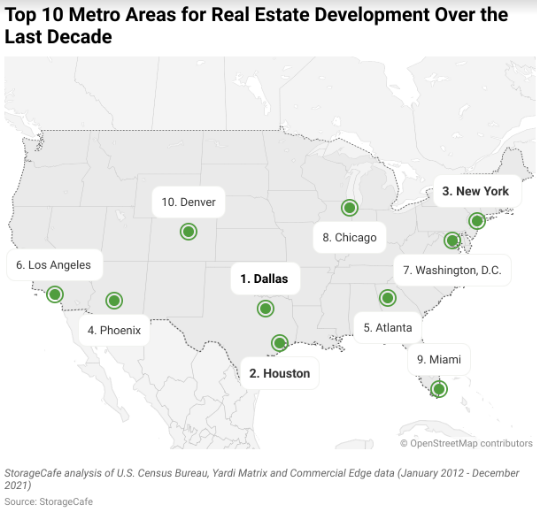
Throughout the past decade, Texas metros acted as powerhouses of real estate development and construction, with Dallas and Houston taking the first two spots in the top 10 most active metros for new construction, according to a new report from Storage Cafe.
Researchers at StorageCafe analyzed multiple data sources on new construction in the single family, multifamily, self-storage, office, retail and industrial sectors in the 50 largest metropolitan areas.
Here are other major findings from the report:
Residential construction, arguably the hottest real estate sector, picked up great speed in the second half of the decade with single family additions at the forefront. In the past decade, across the 50 metros, more than four million building permits have been issued for single family construction. The leading metro area was Greater Houston with 392,000 permits.
For multifamily units, a total of 3.3 million building permits were issued. The New York metro area easily took the crown with more than 410,000 permits issued in the past 10 years, almost double the number of permits issued in Dallas-Fort Worth, which ranked second.
The self-storage sector, which generally mimics residential construction patterns, has also seen considerable growth over the past decade. It totaled more than 299 million square feet of new construction at the end of the decade. Among the 50 metro areas analyzed, the Dallas-Fort Worth metro area ranks first for self-storage construction with around 22.9 million square feet added to its inventory in the past 10 years.
The office sector also experienced inventory increases, with 740 million square feet of new office space added in the country’s 50 biggest metros over the past decade. The New York metro area was at the forefront once again, with more than 78 million square feet of office space built.
Overall, the Dallas-Fort Worth metro area ranks as the most active real estate market among the country’s 50 biggest metros. It ticked all the boxes when it came to real estate development, from residential to industrial to self-storage.
How to figure if vacancy rates in your rental property are good or bad, and 3 possible reasons for high vacancy rates and tenant turnover can chip away any landlord profits.
By Justin Becker
What most independent landlords want is to avoid rental property vacancy at all costs. High vacancy rates and tenant turnover can chip away any profits a real estate investor may have earned in more lucrative years.
When you have vacant units, there are still a lot of costs to bear each month. At the same time, you have no rental income from these units to cover the cost of repairs, maintenance, applicant screening, and rental listings.
The average costs of vacant rental properties can go over a thousand dollars a month quite easily. Real estate investing might seem like a great way to earn regular income, but high vacancy rates are definitely one of its biggest risks. This is why landlords and real estate investors should focus on retaining quality, high-paying tenants for the long run.
What are vacancy rates?
We’ve talked a bit about vacancy rates now, but what actually are they?
The traditional definition of a vacancy rate was the percentage of available, vacant units in a property. More specifically, that property consisted of multiple units, such as an apartment complex or a hotel.
Today, landlords renting out single-family homes, condominiums, and other types of units also measure their progress in terms of vacancy rates. Landlords can determine the vacancy rate of their properties by looking at the conditions of the rental market in that specific area.
With information about vacancy rates, both landlords and real estate agents can determine the ratio of rental properties versus the total number of properties within that area.
With high vacancy rates, the indication might be that potential renters don’t like the area. In the case of low vacancy rates, there are probably a lot of renters looking for a space here.
Of course, the ideal situation is to have a low vacancy rate all year round. If not that, then a landlord will aim to have a high occupancy rate for as long as possible. As long as things remain fairly stable that way, real estate investors can hope to keep earning a respectable cash flow from their rental property.
Property Management Vacancy Rate
The vacancy rate of rental properties determines the rental income you get from occupied units or the rental income you lose from unoccupied units.
Real estate investors will use their vacancy rates to make predictions about how their rental property might perform in the market in the near future. A low vacancy rate means that the cash flow should be relatively stable and the market is beneficial to the landlords.
What Influences the Vacancy Rates in a Rental Property?
The vacancy rates in any specific rental property may vary according to several factors. Those concerned with property management may want to check these out:
The rental rates listed for the rental property are higher than in the rest of the market, causing the rental-vacancy rate to go up.
There is a long time between tenants due to extended time required for repairs.
A lot of updating can also result in increases in vacancy rates. The increased rental income may offset that loss, though.
If the rental property is not in a very well-developed area, it may not be the best fit for most people who want modern amenities.
The rental property might not be in great demand due to the type of structure; a humble single-family rental is more likely to get tenants than an overwhelming mansion.
How to Calculate the Vacancy Rate of Your Rental Property
Reasonable property management includes many tasks. One of them is to carefully calculate vacancy rates regularly.
Vacancy rates are relatively easy to work out when we’re just talking about a single-family rental or single-family home. The same goes for small multifamily structures and property portfolios. The vacancy rates calculation here is applicable for any kind of rental property.
Simply put: Vacancy Rate = Number of Vacant Days / Number of Rented Days
To calculate the vacancy rate for various units, keep reading:
Single-family home vacancy rate
If a single-family house or apartment is vacant for a month out of the year, property management will divide those empty days by the number of occupied days.
Let’s say the month was 30 days. Divide 30 by the 365 days of the year. The result will be 0.084 or 8.4 percent. This is the rental vacancy rate you get with this situation.
By determining the vacancy rate of a multifamily property, a landlord or other type of investor can keep an eye out for signs of trouble
Multifamily rental vacancy rate
If the rental property can hold around three independent units, we can calculate the vacancy rate by looking at the occupancy rate of each unit. This also means the total number of empty days divided by the rented days for each unit.
For Unit 1, there might be no vacant days at all. This will result in a zero vacancy rate.
For Unit 2, the vacant days may only add up to 10 a year. This results in a 2.7 percent vacancy rate.
For Unit 3, the rental property might stay vacant for two months. This brings its vacancy rate up to 16.4 percent.
Here, we’re assuming that every year consists of 365 days and every month consists of 30 days. If you start calculating the vacancy rates of your own rental property, the property management will be according to the year it is (leap year or not) and the number of days in each specific month.
With the three-unit rental property in the example above, the average vacancy rate is 6.37 percent. Whether this is deemed high or not will depend on the average vacancy rate in the rental market in that particular locality. Any property management company can also get the vacancy rate by dividing the vacant days number by the rentable days’ total number.
By determining the vacancy rate of a property, a landlord or other type of investor can keep an eye out for signs of trouble. If the vacancy rate goes down, they will know that a certain unit or rental property requires action.
This could be an updating project, renovation, or some much-needed repairs. If the issue still persists, there’s always the option of lowering the rent a little. In the meantime, the vacancy-rate information will help to predict the potential rental income in the coming months at least.
If you don’t have information about the rental-vacancy rate per unit, you won’t be able to pinpoint the problem areas. For instance, in the example above, if one unit out of three has a consistently high vacancy rate, this indicates something is wrong with that particular unit or area.
You might want to get some feedback from the previous tenants or launch a thorough investigation into what might be the problem. There could be a shoddy plumbing system there, a mold infestation, or something equally serious. If these issues are neglected, a high vacancy rate isn’t your only problem; infestations of mold and pests may easily spread to other units and increase your costs.
Portfolio rental vacancy rate
A rental property portfolio could have several types of properties. For example, there may be three single-family units and one 4-unit multifamily area.
Again, you can calculate the rental vacancy rate for each single-family unit separately or together. The same goes for the multifamily units. Add up all the percentages and divide by the number of properties in the portfolio.
The resulting vacancy rate will tell any investor how much they might be potentially losing out on rental income. If a unit seems to be empty for too long, you’re probably losing money on it. The gross rental income on all the rented units will need to supplement the costs for the empty units.
What are the Possible Reasons for High Vacancy Rates?
There might be several reasons and factors why your rental vacancy rates are disturbingly high. A good property management company will probably be able to tell you the correct vacancy rates for your properties. If you get a high vacancy rate back, here are some of the possible reasons to look into:
1. The rental rate is very high
Yes, a rental income might be a great way to generate cash flow, but you have to think long and hard before setting those rates.
When tenants find a unit’s rent too high, they will probably go for other, similar options in a lower range. This extends the rental vacancy into an alarmingly high rate. Plus, an overpriced rent will drive away tenants that you already have; they might simply not be able to live there anymore after the price hike.
Take a look at the comparable properties in your area and check out their rates to determine whether you’re being realistic. Alternatively, you can also join an online forum, put up photos of your property, and ask whether the rent seems too high.
If you don’t respond to their maintenance requests quickly and promptly, tenants may plan to leave instead of living with the daily inconveniences.
2. Falling behind on maintenance requests
One of the biggest perks of renting in the United States is that the landlord is usually the one responsible for all sorts of maintenance efforts and costs. Please note that this is an expectation that your tenants will have in mind. If you don’t respond to their maintenance requests quickly and promptly, tenants may plan to leave instead of living with the daily inconveniences.
Whether it’s a leak or the smoke detector needs new batteries, it is essential that a landlord address repair issues and property maintenance. This is just part of keeping tenants happy. So, pay attention to them.
If they are quality tenants that pay their rent on time, you may even want to go the extra mile to retain them. After all, you don’t want them wondering how to move-out of an apartment anytime soon.
3. The property doesn’t measure up to its counterparts
A rental vacancy that goes on for some time may be due to the kind of property itself. If an apartment unit doesn’t give tenants the amenities and conveniences that similar options do in the same price range, you might face a high vacancy rate. Compare the number of bedrooms you offer, along with the square footage and amenities, such as walk-in closets, in-unit washer-dryers, patios, balconies, pools, and garages.
The competition might be what’s ratcheting up that rental vacancy rate, so see how they’re faring. When you get the answer, you might want to reduce the rent a bit or update the units to match the amenities of your competitors.
Should You Be Worried about Rental Vacancy Rates?
So, now you have your yearly rental vacancy rates. How does one determine whether these vacancy rates are high enough to cause alarm? Also, how do we know when the vacancy rates are low enough for us to relax a little?
At the end of the day, property owners may utilize vacancy rates as a measure of how their property management is going. However, rental vacancy is also a means of assessing the health of the rental market within the whole real estate industry.
Consider the average vacancy rate in your area: One good way to determine whether your rental vacancy rate is worrisome or not is to look at the average rate in your state or country. With that said, the vacancy rate will also vary among the property types, as well as different corners of the world. You may want to explore whether apartments are better or worse than houses with regards to vacancy rate before investing in any one property type.
A decent vacancy rate should probably lie between two to four percent. That is, if we assume the property is within a metropolitan area. Rental vacancy rates will probably be higher in rural places where the tenants might even be seasonal instead of the regular, long-term variety.
How Else Can You Determine the Rental-Vacancy Rate?
If you don’t want to completely rely on a property management company, there are three resources that might help to determine the rental vacancy rate in any locality.
Local landlords or property managers
You can approach other landlords and property managers in the area. Ask them about their vacancy rate, what they’re seeing right now, and how it was in the past. You might be able to get some specific data about immediate neighborhoods this way.
A local real estate agent and company could help find out all the details about the vacancy rate in a certain area.
Real estate agents
Instead of a property management company, consider approaching a local real estate company to find out all the details about the vacancy rate in a certain area. Some of these agents may even have access to a comparative market analysis regarding local rental property and rental vacancy statistics. This analysis will show how long similar properties to yours have stayed vacant.
The other important information points you need to focus on are:
How long the properties around you were vacant before their current tenants came into the picture
What the original list prices were versus the actual renting prices after bargaining or negotiations
The Takeaway
High vacancy rates aren’t good news for any landlord or real estate investor. When you have a high rental vacancy rate on several units, or even one, it’s time to take some serious action. If the vacancy rate is high on one unit, but low on another, you may have to take steps for retaining your current tenants, as well as attracting new ones.
Remember, a happy tenant is the key to getting a low rental vacancy rate on any property. Whether this means updating the units, giving them more appliances, reducing the rent, or any other benefit, you have to do what it takes.
Of course, you may want to conduct a pro-and-con analysis first to determine if the rental income will be worth it. Start providing incentives for people to come and stay at your rental property today; a quality tenant is bound to know the difference very soon!
About the author:
Justin Becker is a property owner in the state of Michigan and has a passion for managing communities. He owns apartment complexes and mobile home communities, and has been writing his own blogs for his properties for several years
An upsurge of tenants requesting reasonable accommodation due to allergies can create a challenges for rental housing providers.
By the Fair Housing Institute
There has been a noticeable upsurge of residents requesting reasonable accommodations due to allergies. This is likely due to an increase in people suffering from both chemical and environmental sensitivities. A resident requesting accommodation due to allergies can create a challenging situation for the housing provider. This raises two questions:
Are properties required to offer reasonable accommodations for allergies?
If yes, what are some best practices to follow?
What Criteria Do Allergies Need to Meet?
In order to determine if an allergy meets the criteria for a reasonable accommodation, we must first determine if the allergy qualifies as a disability. The Fair Housing Act defines a disability as a mental or physical impairment that substantially limits one or more major life activities.
For most of us with allergies, while the reactions may be uncomfortable, it is probably reasonable to state that those reactions do not “substantially limit one or more major life activity,” thereby rising to the level of a disability.
To help you determine whether the allergies meet the criteria, you need to have reasonable-accommodation request and verification forms that can be filled out by a third-party verifier. It is okay for your reasonable-accommodation forms to highlight the difference between a disability and an impairment. Your forms can also include a section for the verifier to provide pertinent information regarding allergy testing to determine what the tenant is allergic to. It is important to note that only a third-party verifier can make the determination if the allergy is in fact a disability and what accommodations need to be met.
If the allergy is not a disability, then management is not legally required to accommodate the resident. On the other hand, if the allergy results in the resident’s throat closing and hives, these symptoms would probably be considered a fairly substantial limitation to major life activities and would meet the criteria for a reasonable accommodation. Now you are faced with how, and to what extent, modifications can be offered. This can be especially difficult in a multifamily setting.
Creating a Reasonable Accommodation Plan
Once a reasonable-accommodation request has been verified, it is time to create a plan that addresses the needs of the resident. The housing provider wants to provide reasonable accommodations, while also not limiting the use of chemicals and products by other residents and staff, particularly those that are critical to building maintenance. This is where open communication to discuss alternatives is critical between the resident, the property owner or manager, and the verifier. HUD and the courts now view the “interactive process” as an essential step by housing providers during the reasonable-accommodation process, whether the property plans to deny or offer the resident an alternative accommodation. Documenting the plan is also a critical best practice and ensures that everyone clearly understands the plan.
Fair Housing Training Is a Must
Dealing with reasonable-accommodation requests can be quite dynamic. Regular Fair Housing training is a must for property-management professionals. Property-management professionals are best served when regularly trained to identify the issues and then discuss them as a team. If you are not clear on the legal requirements, reach out to a qualified fair housing attorney. The more you know, the better you will be when dealing with complex reasonable accommodation requests.
About the author:
In 2005, The Fair Housing Institute was founded as a company with one goal: to provide educational and entertaining fair-housing compliance training at an affordable price at the click of a button.