Home Blog Page 91

What is Real Estate Syndication?

What is real estate syndication - a way to invest in real estate as a passive investor.

What is real estate syndication – a way to invest in real estate as a passive investor.

By Kim Lisa Taylor, Esq.

If you have a self-directed IRA or substantial investment funds, you probably have considered investing in real estate. But perhaps you have concluded that you lack the funds to invest on your own. Or maybe you simply don’t want to deal with the hassles of property management.

Good news! There IS another way. You can invest in real estate syndication as a passive investor.

So, what exactly does that mean?

Very simply, syndication is a group of individuals or entities pooling their money together to invest in real estate.

Here’s how real estate syndication works:

A sponsor or syndicator (which may be an individual or an entity) first will typically identify a real estate asset. It could be:

  • An existing commercial or multifamily property.
  • Vacant land for development.
  • A single-family fix-and-flip.

The idea is that it will yield a sufficient return to pay the sponsor and investors from cash flow during operations and/or equity on resale.

The sponsor might obtain institutional financing for a portion of the purchase price and then pool funds from private investors to finance the down payment and closing costs. Or the sponsor may raise all of the purchase money from private investors.

The sponsor’s job

The sponsor’s job is to find a suitable property, put the group of investors together and manage the asset on their behalf. As compensation, the sponsor receives fees and/or a percentage of the distributable cash (or profits) left after all expenses and loan obligations have been paid.

Typical investor returns can range from 6 percent to 20 percent (or more) annualized, calculated against the amount of money invested. The range varies based on the type of investment and the level of risk to which an investor may be exposed. The higher the return offered, the greater the risk.

Returns vary, according to risk

For example, an investor or self-directed IRA might take a position as a debt partner or private lender. In that case the returns may be calculated as interest on the amount invested. Such returns may be lower than an equity investment, but the debt position may be “preferred” or secured by a lien against the real estate. That is a lower-risk position.

Another option for investors is an equity investment. That is where the distributable cash is split proportionately between the group of investors and the sponsor. The sponsor’s compensation can range from 25 percent to 50 percent of the distributable cash. In this case, the investor returns may be greater. But they will depend on the performance of the property and the sponsor’s ability to maximize returns by increasing income and minimizing expenses.

Sponsor provides offering documents

U.S. securities laws require the sponsor to provide a set of offering documents prior to accepting any investor funds. The offering documents explain the terms and disclose the risks of the offering to prospective investors. In addition, the sponsor may have to file some regulatory documents with the SEC or state securities agencies.

Throughout the process, sponsors typically communicate with and answer to investors in a variety of ways. These may include:

  • Periodic newsletters.
  • Financial reports.
  • Teleconferences.

Unlike with a stock investment, investors may also have some limited voting rights regarding major decisions affecting the company or their investment.

If you are an investor seeking an investment in a syndication, above all, seek the advice of your attorney, financial adviser or accountant. Your advisers can discuss the investment and whether it is right for you. If you are a prospective sponsor who wants to syndicate a project, find an experienced securities attorney to help you confidently navigate securities laws.

Dangers of disregarding the law

A sponsor that disregards the applicable laws (or drafts its own documents) may expose itself and the entire investment to unnecessary civil or criminal liability. Or it may be unaware of its fiduciary obligations to its investors. That could expose you or the sponsor to unnecessary tax liability.

Your CPA or financial adviser should evaluate the financial merits of the investment based on:

  • Past financial statements for the property and pro forma projections provided by the sponsor/
  • Its suitability for your investment portfolio.

Our firm, Syndication Attorneys PLLC, has vast experience in this area. We are happy to answer your questions in a free 30-minute consultation. To schedule a free consultation, click here.

About the Author:

invest in real estate syndication as a passive investor
Kim Lisa Taylor

Kim Lisa Taylor is the founding attorney of Syndication Attorneys, PLLC, a boutique corporate securities law firm that helps clients nationwide with their federal real estate securities offerings. She has been licensed in California since 2002 and in Florida since 2012 and has made securities transactional law the focus of her practice since 2008. The firm employs additional of-counsel attorneys as well as other support staff. You can schedule an appointment at our website, www.syndicationattorneys.com.

Sign Up For Our Newsletter And Get Apartment And Rental Housing News And Helpful, Useful Content Each Week.

* indicates required

Strong Occupancy Growth Continues To Boost Multifamily

National Rent Growth Back On Upward Trajectory

Six Ways to Ensure Your 1031 Exchange is Successfully Completed

Strong Occupancy Growth Continues To Boost Multifamily

Strong Occupancy Growth Continues To Boost Multifamily

Strong occupancy growth continued to boost multifamily in February as the market defied expectations, according to the latest report from Yardi Matrix.

“Multifamily demand remained strong in February, as the industry prepares to enter the spring leasing season. Occupancy rates are extremely high in markets across the country, with housing demand outstripping supply,” Yardi Matrix writes in the latest report.

The report also shows rent growth once again rose to record levels, although it cautions “the pace is likely to decelerate in coming months.”

Some highlights from the report:

  • Multifamily rent growth continues to exceed normal seasonal patterns, as average U.S. asking rents rose $10 in February to yet another record of $1,628. Year-over-year growth increased to 15.4 percent, a new peak and up a full percentage point from January.
  • The solid demand that created last year’s explosive rent growth seemingly has not been satiated. Nationally, occupancy rates are up 120 basis points year-over-year. Occupancy growth is strong in Texas and Florida metros, but also in gateway markets that lost residents during the pandemic.
  • Multifamily’s exceptional rent performance is matched by single-family rentals. SFR rents increased by 14.9 percent year-over-year through February, while the national occupancy rate remained the same.

The continued strong performance of multifamily and occupancy growth highlights the continued problem of the long-term shortage of housing in the U.S.

“In January 2021, occupancy rates were 95.0 percent or higher in just 13 of the top 30 markets, but a year later only two of the top 30 are below that level,” the report says.

The report points out that some of the occupancy growth has been the markets that suffered the most during the pandemic, such as New York and San Jose.

However the report cautions on rent growth.

“Rent growth is likely to start decelerating soon relative to the big increases that began in March 2021, but demand shows little sign of slowing,” the report says.

Get the full report here.

About Yardi Matrix:

Yardi Matrix researches and reports on multifamily, office and self-storage properties across the United States, serving the needs of a variety of industry professionals. Yardi Matrix Multifamily provides accurate data on 18+ million units, covering more than 90 percent of the U.S. population. Contact the company at (480) 663-1149.

Sign Up For Our Weekly Newsletter And Get Rental Property And Apartment News And Helpful, Useful Content Each Week.

* indicates required

10 Ways to Combat Common Tenant Complaints

Common tenant complaints can be solved with more natural light

When you’re a landlord, complaints from tenants are a fact of life, so here are 10 ways to combat common tenant complaints.

By Jen Baker

Being a landlord is hard work, especially if you want to be a great one who keeps your tenants happy and your units occupied. The best landlords are masters of business and people skills, able to manage their books and their properties while also handling tenant issues and managing employees. But even they get complaints from their tenants from time to time. Here are some ways to manage the most common tenant complaints.

Common Tenant Complaint #1: Insufficient Natural Light

As people continue to spend more time in their homes due to remote working during the pandemic, natural light can have a considerable influence on how a tenant feels in a space. Adding windows is a costly renovation, but you can make a rental that’s low on natural light look more inviting with a few simple changes:

  • Furnish the apartment with lamps where overhead lighting isn’t sufficient, especially in corners.
  • Repaint using light glossy paint to reflect light around the room.

Complaint #2: Bugs

Wherever people gather, there are bound to also be ants, spiders, and other unwanted pests. As a landlord, you should do your part in the fight against bugs with a pest control routine to keep them from entering the rental.

However, pests can often invade a rental if the tenant doesn’t keep it clean enough. In that case, you can suggest the following solutions or do the treatments yourself:

  • Sprinkle diatomaceous earth (DE) near baseboards and window sills to kill bed bugs. If the rental is furnished, consider sprinkling it in drawers as well.
  • Spray peppermint oil, water, and witch hazel near doors and windows.
  • Spray a solution of water and dish soap on cockroaches.

Complaint #3: Temperature Issues

Whether your unit is old or new, drafts have a way of making their presence known. Unfortunately, in extreme climates, drafts have the potential to make your tenant uncomfortable.

If the temperature issues are extreme, it may be time to explore some renovations to upgrade windows or add more insulation, but in most cases, a few simple DIY solutions can help:

  • Place a door snake on the bottom of the door or window to prevent drafts from sneaking in.
  • Add weatherstripping to doors and windows.
  • Replace door sweeps.

Complaint #4: Lack of Sufficient Storage

Whether your rental is furnished or not, your tenant may complain about not having enough space for all their belongings. In that case, consider the following options:

  • Hang floating shelves on the wall to free up floor space, which will make the room feel less cluttered.
  • Provide furniture that does double-duty: storage ottomans or bookcase headboards can make a difference!
  • Decorate with storage baskets that fit under beds, benches, or tables to tuck things out of sight in unused space.

Complaint #5: Tight Spaces

Unfortunately, you can’t manufacture space where there isn’t any. You can, however, make sure your rental is painted in light and cohesive colors to make the rental feel bigger.

If the rental is furnished, hang mirrors on the wall and invest in dual-purpose decor.

Complaint #6: Unpleasant Odors

Some odors can’t be helped, like when a neighbor decides to cook spicy food. But if your tenant is complaining of a musty or stale smell in their rental, there are a few deodorant tricks to try:

  • Clean the washing machine with white vinegar, baking soda, and essential oil. Run it on the hottest cycle.
  • Deodorize the fridge with essential oils and a box of baking soda.
  • Sprinkle baking soda on the carpet, let it sit, and vacuum after an hour.

Complaint #7: Privacy Concerns

Everyone wants to feel safe in their home, so it’s understandable why some common tenant complaints are about privacy. To help your tenant feel safer, it’s best to invest in the following:

  • Privacy screens in a studio apartment
  • Window shades or blinds to keep people from looking in
  • New locks for every new tenant

Complaint #8: Unsightly Fluorescent Lighting

Tenants want their homes to be cozy, but fluorescent lighting often screams industrial or commercial spaces. Replace fluorescent fixtures with traditional ones and put in warm LED light bulbs. For lights with shades, don’t replace the entire fixture; instead, swap out the shade for a more modern look.

Complaint #9: Noisy Neighbors

When you’re a landlord, complaints from tenants are a fact of life, so here are 10 ways to combat common tenant complaints including noisy neigbors

Some problems are beyond your control, like a neighbor who has people over and cheers a little too enthusiastically during the big game. If it’s in the afternoon, there’s no recourse other than politely asking the sports fan to tone it down a little bit.

But an excellent landlord can also suggest a few DIY solutions for their tenants:

  • Move big items of furniture like bookcases against a shared wall.
  • Hang fabric panels on the wall.

As the landlord, you can also make sure all cracks in drywall are sealed to minimize sound.

Complaint #10: Outdated Finishes

Long-term tenants may complain that their rental is starting to look a little outdated. While a full-scale renovation may be out of the budget, there are a few relatively low-cost changes you can make:

  • Replace old hardware on bathroom and kitchen cabinets with updated models.
  • Repaint the walls or cabinets.

When you’re a landlord, complaints from tenants are a fact of life, but it doesn’t have to be the end of the world. Stay calm, communicate, and be proactive, and your tenants will stick around for the long haul.

About the author:

After teaching English for 13 years, Jen Baker pivoted to content marketing as a way to indulge her passion for writing. She enjoys developing content for her clients and learning everything she can about real estate. When not writing, she’s hard at work on her novel or avoiding the real world with an epic fantasy novel.

Infographic that explains 10 common apartment complaints and how to address them
7 Ways To Handle Noise Complaints In Rental Housing The Right Way

Sign Up For Our Weekly Newsletter And Get Rental Property And Apartment News And Helpful, Useful Content Each Week.

* indicates required

Not Everyone Loves Remote Work, Survey Says

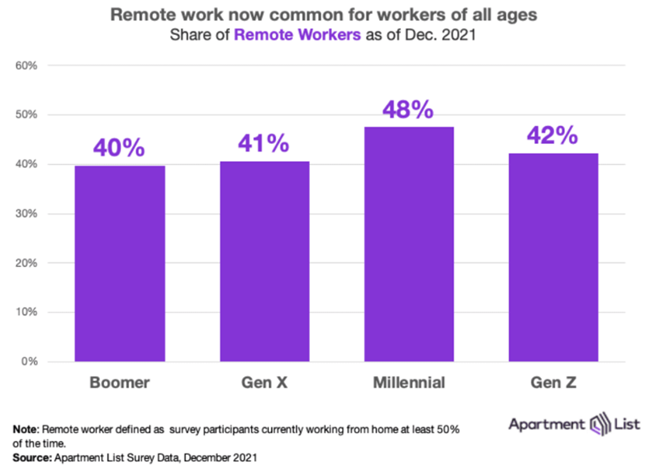
More than 40 percent of workers are still working from home, but new survey data from Apartment List shows that not everyone loves remote work.

“In our latest report, Not Everyone Loves the Remote Work Revolution, we find that remote work is common across workers of all ages, but the youngest generation is least enthused about doing it long-term.

“While older workers appreciate the flexibility afforded by working at home, younger workers miss the in-person connections afforded by working on-site,” write Rob Warnock and Lilla Szini, research associates at Apartment List.

Boomers Find Remote Work Extremely Desirable

Different generations feel differently about working remotely in the post-pandemic economy.

More than 40 percent of workers are still working from home, but new survey data from Apartment List shows that not everyone loves remote work.
Chart courtesy of Apartment List

“It has its obvious pros and cons, most notably a healthier work/life balance coming at the expense of feeling less connected to co-workers,” according to one study. But not everyone weighs these competing effects in the same way at different stages of their careers.

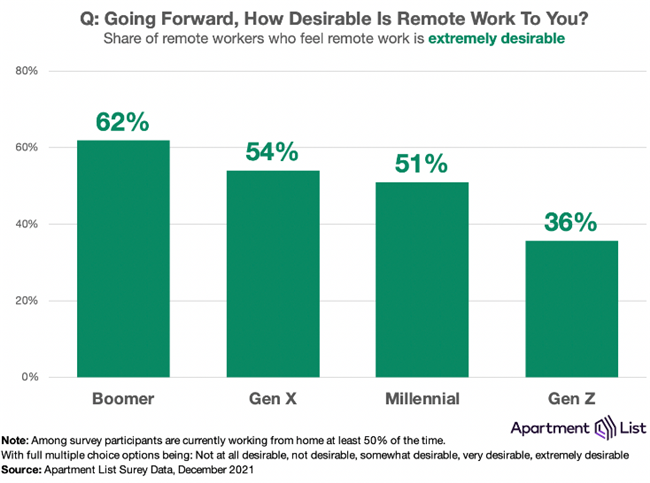
“Our survey finds that more than any other generation, 62 percent of boomer remote workers believe working from home is “extremely desirable” going forward; 54 percent of remote workers from Generation X agree, as do just over half of all millennial remote workers.

“Generation Z is the only group in which a majority of workers feel differently; among this youngest batch of remote workers who were ages 25 or younger at the time of our survey, 36 percent said remote work is “extremely” desirable, 27 percent described it as “very” desirable, 28 percent as “somewhat” desirable, and the remaining 9 percent as “not so” or “not at all” desirable.

(Baby boomers, born from 1946-1964, are ages 58-76 today; Gen X, born from 1965-1980, are 42-57 today; millennials, born from 1981-1996, are 26-41 today, and Gen Z, born from 1997-2012, are ages 10-25 today.)

More than 40 percent of workers are still working from home, but new survey data from Apartment List shows that not everyone loves remote work.

Implications for Housing Markets

The remote-work revolution and its impact on employers “has implications for local housing markets, as some large employers announce plans to roll back work-from-home policies or adopt hybrid arrangements,” said Chris Salviati, Housing Economist at Apartment List.

Apartment List writes in the report that the growing popularity of hybrid remote work is beginning to repair the threads that connect homes and jobs. However there is a difference between hybrid work and true full-time remote work.

“Hybrid work is significantly more restrictive than full-time remote work when it comes to workers’ abilities to relocate,” the report says. True remote workers can work from anywhere with an internet connection, while hybrid workers “are limited to a fairly narrow radius around their job site. If remote workers must endure commutes only a couple times per week, they could expand the commuting zones of major metropolitan areas, but long-distance cross-metro moves will generally not be feasible. Throughout 2021, as hybrid arrangements were becoming more common, we saw rent prices picking back up everywhere, in urban and suburban markets alike.”

Read the full survey report here.

Sign Up For Our Weekly Newsletter And Get Rental Property And Apartment News And Helpful, Useful Content Each Week.

* indicates required

Apartment Associations File Suit Over LA County Eviction Moratorium Extension

Two apartment associations have sued over LA County’s residential eviction moratorium extension which goes to June of 2023.. Lawsuit filed

Two Los Angeles apartment associations have filed a lawsuit asking for a preliminary injunction against the county’s residential eviction moratorium extension, which has recently been pushed to June of 2023.

The Apartment Association of Greater Los Angeles (AAGLA) and the Apartment Owners Association of California, Inc. (AOA) filed a joint lawsuit in Los Angeles County Superior Court for the State of California on behalf of their members and the county’s rental housing providers seeking a preliminary Injunction against the County of Los Angeles’s residential eviction moratorium extension, according to a release.

The move follows close on the heels of the County of Los Angeles’s recent extension of its COVID-19 related residential-eviction protections until June 30, 2023.

On January 25, 2022, the Los Angeles County Board of Supervisors voted to extend its “temporary” eviction moratorium in three separate phases, leaving eviction protections in place until June 30, 2023.

“These same or similar ‘temporary’ residential-eviction protections have been in place since approximately March 2020, and in establishing these protections, the county has claimed jurisdiction not only over unincorporated areas, but also most of the incorporated cities within the county,” the two associations said in the release.

In their joint complaint, AOA and AAGLA said that “there is no rational basis for extending the eviction moratorium and creating what is, in effect, a ‘rent holiday’ that has not only allowed the county’s renters to remain housed without paying rent for up to two years, but which has now been extended by the county until June 2023.“

The joint lawsuit hinges upon the county’s permitted self-certification practice, which allows renters to merely declare they have been adversely affected by COVID-19 without offering any kind of proof or being required to provide a declaration of COVID-19 impact under penalty of perjury to their landlord.  According to the lawsuit, the U.S. Supreme Court, in a recent ruling, has declared self-certification “schemes” like that of Los Angeles County unconstitutional.

Jeffrey Faller, president of AOA, stated: “For nearly two years, more than 700 days, some renters have taken advantage of the situation created by the county’s ordinance and been able to forgo rent payments by alleging they have been impacted by COVID-19 without any burden of proof. The unsubstantiated ‘financial impacts’ of any tenant’s self-certification are woefully vague.

“Tenants are merely allowed to unilaterally decide to not pay rent based on the facts and circumstances they determine. Eviction bans such as the county’s merely encourage unscrupulous renters to skip paying rent, with past-due rental debts continually piling up that in most instances will never be repaid.

“How could this create a situation that is good for renters, let alone housing providers?  Moratoria on evictions are unfair for those residents who have worked hard and sacrificed to pay their rent.  Many of our property-owning members have been forced to sit idly by as their renters have forgone making rent payments for months, and in some cases years, while at the same time making major purchases of luxury automobiles or expensive vacations owners view on Facebook.

“From the very beginning, the ‘solution’ should have consisted of rental relief provided by our government, not a ‘free-pass’ on rent,” Faller said.

Read the full release here.

Sign Up For Our Weekly Newsletter And Get Rental Property And Apartment News And Helpful, Useful Content Each Week.

* indicates required

Will A Chain Smoker Next Door Mean I Have To Move?

Ask Landlord Hank Will A Chain Smoker Next Door Mean I Have To Move from my rental duplex?

A tenant is dealing with a chain smoker next door in a non-smoking rental duplex so how to deal with that is the question this week for Ask Landlord Hank. Remember Hank is not an attorney and he is not offering legal advice. If you have a question for him please fill out the form below.

Dear Landlord Hank,

I live in a rental duplex that was represented to me as non-smoking. My lease says no smoking and even has a penalty for smoking of having to bear the cost of repainting.

All was well until the landlord herself moved in next door and is one of the worst chain smokers I have ever seen. I tried to speak to her in a kind way to please stop; she has refused and told me her duplex side has nothing to do with mine.

This is an old duplex built in 1924 with plaster walls. I have smoke coming from everywhere. I have three autoimmune diseases that she is very aware of. I am trying to move but it is a real hardship for me. The only plus I have is I can give 30 days’ notice and get out. Please help!

-Val

Hi Val,

Sorry to hear about your situation dealing with secondhand smoke coming through from your neighbor/owner.

This owner is the boss in this situation and I don’t see any solution for you except to move.

If she is a chain smoker, she is not going to change. I’m glad she is allowing you to break the lease. Best of luck.

Sincerely,

Hank Rossi

Each week I answer questions from landlords and property managers across the country in my “Dear Landlord Hank” blog in the digital magazine Rental Housing Journal.    https://rentalhousingjournal.com/asklandlordhank/

Ask Landlord Hank - Will A Chain Smoker Next Door Mean I Have To Move from my rental duplex?
Landlord Hank says, “This owner is the boss in this situation and I don’t see any solution for you except to move.”

Ask Landlord Hank Your Question

Ask veteran landlord and property manager Hank Rossi your questions from tenant screening to leases to pets and more! He provides answers each week to landlords.

  • This field is for validation purposes and should be left unchanged.

Do I Have to Paint and Replace Flooring for a Long-Term Tenant?

Sign Up For Our Newsletter And Get Rental Housing And Apartment News And Helpful, Useful Content Each Week.

* indicates required

Federal Judge Halts Ban on ‘Love Letters’ Between Buyers and Sellers

A federal judge in Oregon has issued a preliminary injunction prohibiting enforcement of an Oregon law against what are called “love letters” between buyers and sellers of real estate.

A federal judge in Oregon has issued a preliminary injunction prohibiting enforcement of an Oregon law against what are called “love letters” between buyers and sellers of real estate.

In his court order, District Judge Marco A. Hernández says Oregon’s House Bill 2550 “likely violates” the First Amendment rights of real estate agents. “It is not in the public interest to enforce a law that is likely unconstitutional, even one aimed at the laudable goal of reducing unlawful discrimination in housing,” the judge said in his legal opinion.

The Pacific Legal Foundation filed a lawsuit on behalf of the Bend-based Total Real Estate Group, according to Oregon Public Broadcasting. They filed the lawsuit against Oregon Attorney General Ellen Rosenblum and Real Estate Commissioner Steve Strode, alleging that forbidding these communications violates First Amendment rights.

The “ruling preserves the opportunity of home buyers to speak freely to sellers and make the case why their purchase offers should win out,” Pacific Legal Foundation attorney Daniel Ortner said in a release. “Love letters communicate information that helps sellers select the best offer. The state cannot ban important speech because someone might misuse it. Oregon’s overly broad speech restriction is clearly not justified, and the decision is a major victory for free speech and economic opportunity.

“Last year, Oregon became the first state to pass a law banning real estate brokers from transmitting non-customary communications between home buyers and sellers, fearing that so-called “love letters” might be used to discriminate in housing transactions—but without any evidence of such discrimination.

“For Total Real Estate Group, the ban on love letters harms their ability to match potential homebuyers with their dream homes. The letters often prompt sales below the top monetary offer, creating opportunities for first-time homeowners and giving sellers peace of mind that their home ends up in caring hands,” Pacific Legal Foundation said in the release.

What Are “Love Letters” And Why Are They Used?

“At a time when home sales have become a cutthroat business, every bargaining chip matters—to buyers, sellers, and the real estate companies in between. Prospective buyers commonly use so-called ‘love letters’ to move sellers’ hearts—and sales—in their direction,” the Pacific Legal Foundation said.

“These conversations give less-privileged buyers a chance at their dream home, which might otherwise be out of reach, while helping sellers ensure their homes are well-loved.

“Buying a home is not like buying a pair of pants; it can be a highly personal and emotional transaction for buyers and sellers. Such letters help ensure that all of these other factors are taken into account.

“These letters are also integral to the work of Oregon-based Total Real Estate Group, a mid-sized real estate firm with brokers throughout Oregon and Southern Washington. As many as 75 percent of the firm’s offers have some form of love letter or broker-written cover letter that allows buyers to go beyond the financial offer to tell sellers why they love a home and how they’ll use it.

“As one of the firm’s brokers puts it, ‘Without a love letter, it feels like an incomplete offer.”

“And they work. The letters often prompt sales below a seller’s asking price, create many first-time homeowners, and give sellers peace of mind that their home ends up in caring hands rather than an out-of-state, house-flipping investor or developer,” the foundation said in the release.

Sign Up For Our Weekly Newsletter And Get Rental Property And Apartment News And Helpful, Useful Content Each Week.

* indicates required

The End of the Grace Period, Part Deux

The end of the grace period in March brings the biggest change for Oregon landlords - the ability to pursue debts from the Emergency Period.

The end of the grace period in March brings the biggest change for Oregon landlords – the ability to pursue debts from the Emergency Period.

By Bradley S. Kraus
Partner, Warren Allen LLP
kraus@warrenallen.com

March is upon us, and with it, a renewed sense of normalcy begins to return as of this writing. Many of the COVID-era laws have expired and were not renewed, but some remain. Last month, I discussed some changes that would come as March approached. This article is a continuation of, and expansion upon, some of those topics.

As discussed last month, the biggest change March brings is the ability to pursue debts from the Emergency Period. However, exactly what to put in those notices, given payments likely occurred from July forward, requires an understanding of how payments were applied during COVID-era protections. Those will also be going back to the old rules as of March 1.

During the COVID-era protections, payments that were received from any source on or on behalf of the tenant were required to be applied in a certain manner. First, they were applied to the current month’s rent, followed by utilities, late fees, and finally, any other claims against the tenant. It is important that landlords scrutinize their ledgers to ensure they have applied payments correctly over the past months.

As of March 1, the old application of payments method found in ORS 90.220(9) returns. That means that payments received from the tenant are now applied as follows:

(A) Outstanding rent from prior rental periods;

(B) Rent for the current rental period;

(C) Utility or service charges;

(D) Late rent payment charges; and

(E) Fees or charges owed by the tenant under ORS 90.302 or other fees or charges related to damage claims or other claims against the tenant.

The above may provide landlords with additional strategies as it relates to pursuing unpaid balances, even if the tenant tenders payment during the month of March.

Unauthorized Guests

Another change as of March 1 is the sunsetting of Senate Bill 282’s protections against unauthorized guests.

During the COVID-era rules, landlords were unable to enforce unauthorized-guest provisions in their rental agreements. Landlords were required to offer these guests the ability to apply to become temporary occupants, if the guests could satisfy their criminal criteria and enter into a temporary occupancy agreement. As of March 1, landlords are now free to enforce the unauthorized-occupant restrictions in their leases in the normal course. That means, assuming the landlord can prove that an unauthorized possessor is staying at the premises, a Notice of Termination For Cause may be an option.

Finally, landlords should keep in mind that eviction protections related to rent assistance remain in place throughout most of this year pursuant to Senate Bill 891.

That means that landlords must continue to serve non-payment notices with the SB 891 disclosures, which can be found in the bill itself. Any notice without these disclosures is defective. If a landlord has non-payment termination rights, even one based upon the emergency balance, a tenant’s provision of rent-assistance documentation may still require a landlord to pause termination efforts. Documentation can come in many forms, but if a tenant provides written proof—not simply verbal statements—that they have a pending application for rental assistance, landlords may not serve a non-payment notice or initiate or continue an eviction based upon non-payment.

About the author:

Bradley S. Kraus is an attorney at Warren Allen LLP. His primary practice area is landlord/tenant law, but he also assists clients with various litigation matters, probate matters, real estate disputes, and family law matters. You can reach him at kraus@warrenallen.com or at 503-255-8795.
The end of the grace period in March brings the biggest change for Oregon landlords - the ability to pursue debts from the Emergency Period.
Bradley Kraus, Portland attorney

Sign Up For Our Weekly Newsletter And Get Apartment News And Helpful, Useful Content Each Week.

* indicates required


National Rent Growth Back On Upward Trajectory

national rent growth and median rent

After a few months of cool down, national rent growth is now back on an upward trend, according to the March report from Apartment List.

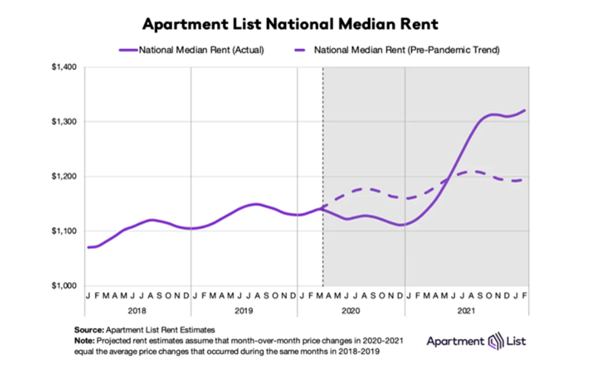
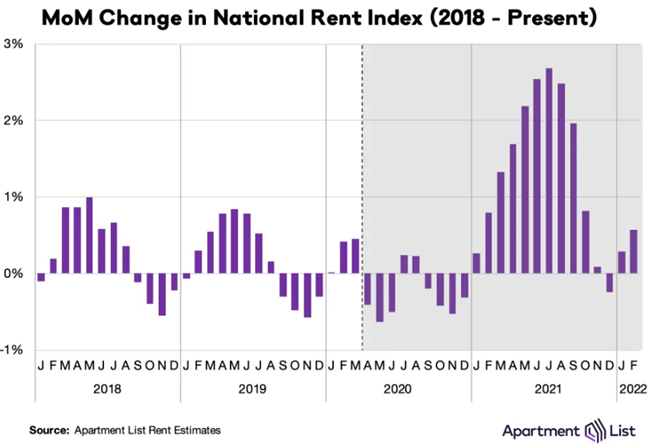
The rent-growth gain of 0.6 percent in February month-over-month in national rents reversed the slowing rents over the past few months, in which total rent growth was just 0.7 percent.

Plus, the most recent month’s rent growth was still faster than the pre-pandemic norm for this time of year.

“Even though month-over-month rent growth has moved back into positive territory, it remains substantially cooler than last summer, when rents grew by more than 2 percent per month for four straight months,” write housing economists Chris SalviatiIgor PopovRob Warnock, and Lilla Szini.

“As we enter the spring and summer months, it’s likely that rent growth will speed up amid increased moving activity. Even if prices don’t rise as rapidly as they did in 2021, we’re already seeing signs that 2022 will be another year of above-average growth.”

After a few months of cool down, national rent growth is now back on an upward trend, according to the March report from Apartment List.

Vacancy Rate Continues To Climb

The report says the vacancy rate has continued to climb but that increase “has been modest and gradual.”

Vacancy still remains historically tight. “Over the past six months, our vacancy index has been increasing by an average of 0.1 percent per month. If that pace continues, we won’t hit a vacancy rate of 6 percent – the pre-pandemic norm – until next summer. Nonetheless, the gradual increase in vacancies in recent months has likely been contributing to the slowdown in rent growth.”

Fastest Growing Metros

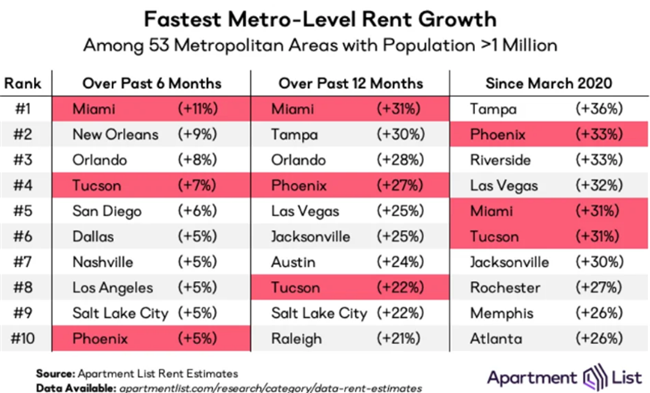
Major markets throughout the Sun Belt have experienced virtually-uninterrupted rent growth since the start of the pandemic.

The following table shows rent growth for the ten metropolitan areas that have experienced the fastest rent growth over the past six months, over the past year, and since the pandemic started in March 2020.

After a few months of cool down, national rent growth is now back on an upward trend, according to the March report from Apartment List with the sun belt areas exploding in mast metro level rent growth

National Rent Growth Summary

Apartment List reports that while rent growth has cooled from last summer’s peak, “it continues to exceed pre-pandemic trends. While the apartment market has shown some signs of easing, our vacancy index still sits at 4.5 percent.

“As we enter the spring and summer months, rental activity is likely to pick up, and rent growth is likely to accelerate … Many American renters are likely to remain burdened throughout 2022 by historically high housing costs.”

Sign Up For Our Weekly Newsletter And Get Rental Property And Apartment News And Helpful, Useful Content Each Week.

* indicates required

Can I Enter My Rental If Tenant Moves Out Early But Lease Is Still In Place?

Can I Enter My Rental If Tenant Moves Out Early But Lease Is Still In Place?

A landlord is dealing with a tenant who moved out early while the lease in still in place and is wondering about entering the rental. That is the question this week for Ask Landlord Hank. Remember Hank is not an attorney and he is not offering legal advice. If you have a question for him please fill out the form below.

Dear Landlord Hank:

Does a tenant retain possession of their apartment, after they vacate their unit, but before their 30 days’ moving-out notice expires?

And does the landlord need to have an authorization to enter the unit, for getting the unit move-in ready (cleaning and painting) for the new tenant, before the 30-day notice expires?

Dear Landlady Danielle,

It is customary for a landlord to retake possession of a property when the tenant moves out and turns in the property keys unless the tenant has made some other arrangement with the landlord.

We have tenants leave early all the time because it suits their lives better than staying until the last minute.

If the landlord believes a tenant has moved out, then there is no reason to wait to ready your unit for the next resident.

Usually your lease will stipulate under what conditions you have right of entry.

A reasonable person would think that when a tenant moves and turns in their keys, they are relinquishing their claim to the property – BUT, that being said, why don’t you talk to your tenant and let them know what is on your mind?

Clear communication is the best way for everyone to be on the same page.

You could just ask for the forwarding address for the return of the security deposit and tell the tenant it is OK to turn off the utilities if they’ve moved, so you can access the unit and prepare it for the next resident.

Sincerely,
Hank Rossi

Each week I answer questions from landlords and property managers across the country in my “Dear Landlord Hank” blog in the digital magazine Rental Housing Journal. https://rentalhousingjournal.com/asklandlordhank/

Can I Enter My Rental If Tenant Moves Out Early But Lease Is Still In Place?
Landlord Hank says, “A reasonable person would think that when a tenant moves and turns in their keys, they are relinquishing their claim to the property – BUT, that being said, why don’t you talk to your tenant and let them know what is on your mind?”

Ask Landlord Hank Your Question

Ask veteran landlord and property manager Hank Rossi your questions from tenant screening to leases to pets and more! He provides answers each week to landlords.

  • This field is for validation purposes and should be left unchanged.

Do I Have to Paint and Replace Flooring for a Long-Term Tenant?

Sign Up For Our Newsletter And Get Rental Housing And Apartment News And Helpful, Useful Content Each Week.

* indicates required