Home Blog Page 88

Landlord To Pay $135,000 In Sexual Harassment Lawsuit Settlement

An Iowa landlord will pay $135,000 to settle with the U.S. Department of Justice and resolve a lawsuit alleging sexual harassment.

An Iowa landlord will pay $135,000 to settle with the U.S. Department of Justice and resolve a lawsuit alleging that the Davenport, Iowa, landlord Juan Goitia violated the Fair Housing Act by sexually harassing female tenants, according to a release.

The settlement also resolves claims against 908 Bridge Cooperative which, along with Goitia, owned the properties where the harassment occurred.

Under the consent order, which still must be approved by the U.S. District Court for the Southern District of Iowa, defendants are required to pay $135,000 to compensate individuals harmed by the harassment and pay a civil penalty to the United States. The consent order also:

  • Prohibits Goitia from continuing to manage rental housing;
  • Requires Goitia to retain an independent property manager to manage any rental properties he owns now or in the future; and
  • Requires defendants to obtain fair housing training and implement comprehensive non-discrimination policies and complaint procedures to prevent sexual harassment at their properties in the future.

“Sexual harassment by housing providers is an illegal and egregious abuse of power that deprives tenants of their right to be safe and secure in their homes,” Assistant Attorney General Kristen Clarke for the Justice Department’s Civil Rights Division said in the release.

“The Justice Department is committed to protecting the rights of vulnerable tenants subjected to sexual harassment and will continue to hold landlords accountable and obtain relief for survivors.”

The lawsuit, filed in 2020, alleged that since at least 2010, Goitia subjected female tenants to harassment that included making unwelcome sexual comments and advances, touching tenants’ bodies without their consent, entering the homes of female tenants without their consent and without prior notice, and taking adverse actions against tenants who resisted his sexual overtures or complained about the harassment, according to the release.

This case was litigated by attorneys in the department’s Civil Rights Division and the Civil Division of the U.S. Attorney’s Office for the Southern District of Iowa. The Justice Department’s Sexual Harassment in Housing Initiative is led by the Civil Rights Division, in coordination with U.S. Attorneys’ Offices across the country. The goal of the department’s initiative is to address and raise awareness about sexual harassment by landlords, property managers, maintenance workers, loan officers, or other people who have control over housing. Since launching the initiative in October 2017, the Department of Justice has filed 23 lawsuits alleging sexual harassment in housing and recovered over $9.6 million for victims of such harassment.

Landlord Charged With Sexually Harassing Female Tenant

Sign Up For Our Weekly Newsletter And Get Rental Property And Apartment News And Helpful, Useful Content Each Week.

* indicates required

5 Signs You Need To Call A Professional About Water Damage

Here are 5 signs you need to know when to call a professional about water damage in your rental property instead of doing it yourself.

Here are 5 signs that you need to know that will tell you when to call an expert and professional about water damage in your rental property instead of doing it yourself.

1. Moisture has gone from one unit to another unit or space

  • The professional will make appropriate recommendations based on type of water damage, how long it has been wet, if materials can be salvaged and more.

2. When you have identified microbial growth on any building surface

  • The company can determine if it related to plumbing, siding or roof failures, poor air circulation or other causes to then make recommendations as to how to best handle it.

3. Drain water backs up out of a toilet, sink or tub

  • The company professional knows how to properly handle these situations as this type of back up can have adverse health effects along with be a super fuel for other types of microbial growth.
Here are 5 signs you need to know when to call a professional about water damage in your rental property instead of doing it yourself.
Water backing up in sink can be an issue that requires expert help.

4. When you need help finding a leak

  • You need an expert who has the experience to help expose if something is coming from the roof, windows, siding or more along with eliminating various sources to determine the root cause.

5. To assess the extent of a complex water-related incident

  • The expert can also address the many issues related to a complex water related incident based on proper knowledge, skill and experience. Your tenants will appreciate this.

It is always best to err on the side of caution and call a professional when dealing with the many scenarios that arise to get the proper care and to prevent something small from becoming bigger over time in your rental property.

About the author:

For more than 40 years, the Fischer family of companies has proudly served the greater Seattle community – starting with Fischer Plumbing in 1977, and adding restoration, electric, and heating and air divisions over the years. Fischer Restoration at 6608 220th St. SW. Mountlake Terrace, WA 98043. Call us today at 206-633-2065!

Sign Up For Our Newsletter And Get Rental Housing And Apartment News And Helpful, Useful Content Each Week.

* indicates required

The Green Resident Wave Is Coming Are You Ready?

The green resident wave is coming to the multifamily industry as environmentally conscious residents begin to dominate the leasing market.

The green resident wave is already bearing down on the multifamily industry as more environmentally conscious residents begin to dominate the leasing market.

By Regan Hartley

Environmental measures have faced slow adoption in the multifamily industry. The reluctance is understandable. After all, owner/operators, along with everyone else, have been told for years that the green boom was on the way.

The truth, however, is that the green resident wave is already bearing down on the multifamily industry. As more environmentally conscious residents begin to dominate the leasing market, it’s the green buildings that are set to rise above the competition. Multifamily communities are faced with taking action now to adapt and thrive in the shifting leasing environment. Those that don’t will face the inevitable consequences of needing to rebuild.

Greater Demand for Sustainability Pushing Multifamily Investing

About 36 percent of multifamily developers are involved in green projects, a number that’s expected to increase to 47 percent in 2022, according to a recent report by the National Association of Home Builders. In addition, a recent analysis by Bloomberg predicted that global environmental, social and governance (ESG) assets are expected to top $53 trillion by 2025, which is more than double what they were in 2016 and which make up around 33 percent of the market.

Sound environmental preparation is not only important for a community to distinguish itself from competitors, but it’s also developing into a necessity to secure investment funding for new projects, updates and conversions. ESG is becoming an important factor for investors, looking at the increased demand by society and becoming more green-conscious themselves. Fannie Mae offers preferential pricing on loans for multifamily projects that seek one of the lender’s recognized green building certifications.

ESG certifications, such as LEED, significantly raise the value of a building, making them necessary moving forward. The multifamily industry is reaching the point where ESG certification and sustainable building practices will become an unavoidable part of projects. ESG is no longer daunting, and both private and public companies are putting greater focus on it. Private companies are creating policies and programs, as well as sharing their efforts online. On the public side, earnings calls contain a greater focus on the company’s ESG efforts, and even private companies are beginning to feel the pressure.

The race to be at the forefront of ESG allows owner/operators to begin implementing the amenities that are soon to be must-haves, not nice-to-haves.

Explosive Growth for EV Driving Mandates Charging Stations

Electric vehicle (EV) demand among consumers has been on the rise for years. It regained steam after a brief dip in sales during the pandemic, bolstered by economic and global turmoil. Sales of EVs more than doubled from 2020 to 2021 and tripled from 2019, according to sales data from Green Car Report.

Nearly 23 percent of licensed U.S. drivers stated they would purchase a new or used electric vehicle, according to a YouGov poll conducted for Forbes Wheels. While this may not seem jarring, this number is significant, as it’s eight times the number currently on the road. In the same group, 65 percent of respondents said they believed EV is the future of the automobile industry.

The auto industry is in agreement with this view, developing fully electric and hybrid vehicles at unprecedented and accelerated rates. There are more than 50 electric vehicle and plug-in hybrid electric vehicles (PHEV) models currently available on the market. Acura, Audi, Chevy, Chrysler, GMC, Honda and every other major car manufacturer is slated to release at least one, if not many, EV models in the next five years. Ford recently stopped reservations on the base model of its new 2022 F-150 Lightning after receiving 200,000 requests in just months.

New companies, such as Rivian, Canoo, and Byton, are not making splashes in the auto industry, but massive waves. California-based FISKER has more than 40,000 reservations for their Ocean SUV model being fulfilled in July 2022. Lucid, another new electric company, had their model Air named the 2022 MotorTrend Car of the Year.

As the number of electric vehicles on the road begins to increase, owners need EV chargers – and they’re going to put their rental dollars into housing and communities that offer this amenity. This is going to create a snowball effect: As the number of communities that supply chargers increases, sales of electric vehicles are predicted to increase, thus creating greater demand for chargers.

Smart Tech Now a Priority for Residents

A recent study by NMHC/Grace Hill showed that close to half of millennial and Gen Z renters put a greater emphasis on smart tech than other generations. In 2021, Gen Z was the only generation that saw an increase in the number of leasing applications, and they are credited with the recent resurgence in urban multifamily leasing.

Of the top two smart tech gadgets these green residents desire, one of those is smart thermostats, which provide residents greater control over energy use and access to local usage programs. They aren’t just for residents, however. Owner/operators can utilize smart tech to control utilities in unoccupied units to maximize savings.

In addition, there is smart tech that can detect leaks, control water usage, control lighting and HVAC in common areas, and improve building health, along with a whole host of other environmentally friendly, cost-saving measures. Not only will these increase net operating income, but they’re also the green items residents are seeking out.

The Next Wave

When it comes to the environment, “As California goes, so goes the nation” tends to hold true. The state has been a bellwether for social change for a while now, even if many don’t want to agree. California ushered in a composting requirement, which includes multifamily, at the beginning of 2022. There are several other states, counties and municipalities that have also started efforts to require or encourage composting efforts.

Denver ran a pilot program for recycling to reduce waste in the near future. The goal is to eventually make proper recycling a condition of a resident’s lease.

The number of people who grew at least a portion of their own food rose to around 35 percent in the summer of 2020 during the pandemic. Now that restrictions have eased, community gardens in multifamily housing is a great amenity that brings residents together and can provide people with a new skill.

The EPA Water Score provides owner/operators with an analysis of their water use compared to similar properties and shows how to make adjustments to a property to maximize its water, energy and sewage systems.

After years of false starts and predictions, the green resident wave is arriving on the shores of the United States with full force. Multifamily owner/operators will need to begin a serious evaluation of their current portfolio and upcoming projects to determine if they’re ready for this unstoppable change in the culture.

About the author:

Regan Hartley serves as the vice president of sales for Xeal Energy, where her focus is on strategic partnerships and new business development, sales strategy and collateral development, national accounts, marketing and brand development, and product and market growth. Regan is an investor, innovator, and advisor with more than 8 years of experience in the multifamily industry.

Renter Preferences Survey Report Shows The Future Is Remote Work

Sign Up For Our Newsletter And Get Rental Property And Apartment News And Helpful, Useful Content Each Week.

* indicates required

Why I Like My Rental Properties’ Nosy Neighbors

Three Steps to Becoming a Successful, Lazy Landlord

Can We Put A Stop To Renters Using Small Portable Washers And Dryers?

Can a landlord prohibit tenants using small portable washers and dryers in a rental unit is the question this week for Ask Landlord Hank.

Can a landlord prohibit tenants using small washers and dryers in a rental unit is the question this week for Ask Landlord Hank. Remember Hank is not an attorney and he is not offering legal advice. If you have a question for him please fill out the form below.

Dear Landlord Hank:

A lot of our renters are using small washers and dryers in their unit. Can we put a stop to it and how many people per unit?

Dear Landlord John:

You had two questions:

  1. How many people per unit?  Normally the lease will detail who is renting (adults) and other occupants (children) and a clause about guests (how long they can stay without written permission). The general rule of thumb is maximum occupancy is two people per bedroom.
  2. Some tenants are using portable washers and dryers in the units and can landlord stop this practice?  Again, John, check your lease – often under the Use of Premises clause there is this language: Tenant shall secure insurance for any water filled devices with loss payable to landlord. You could also add that to your lease – a prohibition of portable washers and dryers since there is the possibility of flooding and damage to your property. Good luck!

Sincerely,

Hank Rossi

Each week I answer questions from landlords and property managers across the country in my “Dear Landlord Hank” blog in the digital magazine Rental Housing Journal.    https://rentalhousingjournal.com/asklandlordhank/

Can a landlord prohibit tenants using small portable washers and dryers in a rental unit is the question this week for Ask Landlord Hank.
Landlord Hank says, “often under the Use of Premises clause there is this language: Tenant shall secure insurance for any water filled devices with loss payable to landlord.”

Ask Landlord Hank Your Question

Ask veteran landlord and property manager Hank Rossi your questions from tenant screening to leases to pets and more! He provides answers each week to landlords.

  • This field is for validation purposes and should be left unchanged.

Do I Have to Paint and Replace Flooring for a Long-Term Tenant?

Sign Up For Our Newsletter And Get Rental Housing And Apartment News And Helpful, Useful Content Each Week.

* indicates required

Portland Rents Increase For Third Straight Month

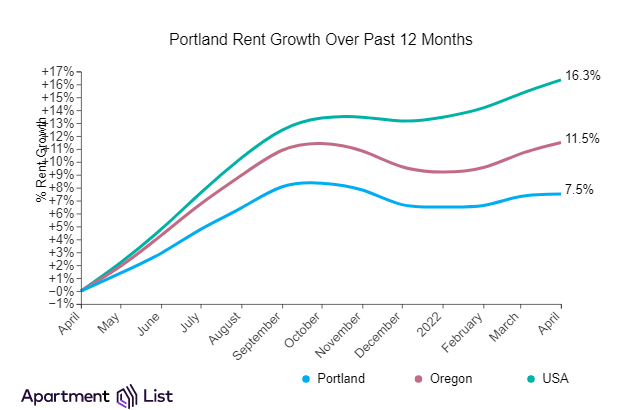
Portland rents increased again in April for the third straight month and are up by 7.5 percent year-over-year, according to the latest report from Apartment List.

Portland rents increased again in April for the third straight month and are up by 7.5 percent year-over-year, according to the latest report from Apartment List.

With the 0.2 percent increase in April, median rents in Portland are now $1,220 for a one-bedroom apartment and $1,423 for a two-bedroom.

Portland’s last rent decline was in January. Portland’s year-over-year rent growth lags the state average of 11.5 percent, as well as the national average of 16.3 percent.

Beaverton rents increase sharply over the past month

Beaverton rents have increased 1.6 percent over the past month, and have increased sharply by 17.0% percent in comparison to the same time last year.

Median rents in Beaverton are $1,544 for a one-bedroom apartment and $1,874 for a two-bedroom. This is the third straight month that the city has seen rent increases.

Hillsboro rents also increase sharply

Hillsboro rents have increased 1.0 percent over the past month, and have increased sharply by 18.7 percent in comparison to the same time last year.

Median rents in Hillsboro are $1,685 for a one-bedroom apartment and $1,850 for a two-bedroom.

Vancouver rents also up over the past month

Vancouver rents have increased 0.7 percent over the past month, and are up sharply by 12.3 percent in comparison to the same time last year.

Median rents in Vancouver are $1,390 for a one-bedroom apartment and $1,641 for a two-bedroom.

Eugene rents increase sharply

Portland rents increased again in April for the third straight month and are up by 7.5 percent year-over-year, according to the latest report from Apartment List.

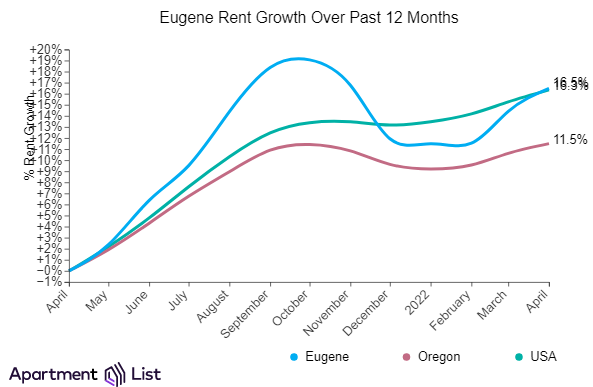
Eugene rents have increased 1.8 percent over the past month, and have increased sharply by 16.5 percent year-over-year.

Median rents in Eugene are $1,026 for a one-bedroom apartment and $1,364 for a two-bedroom. This is the third straight month that the city has seen rent increases.

National rent growth      

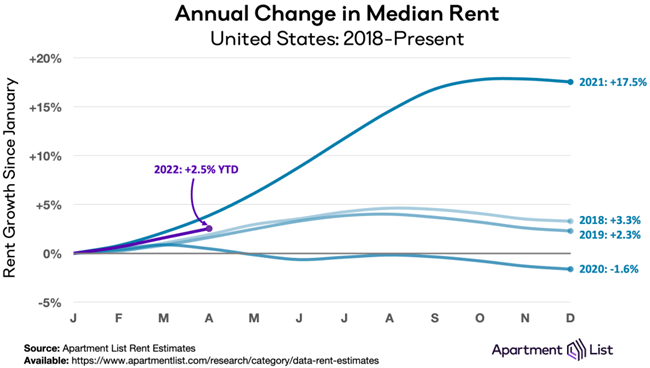
“Over the first four months of 2022, rents have increased by a total of just 2.5 percent, though we’re only beginning to enter the busy season for the rental market, when the bulk of annual rent growth typically occurs,” according to the Apartment List Research Team.

“Even if prices don’t rise as rapidly as they did in 2021, it’s likely that this year will continue to bring rent growth in excess of the pre-pandemic trend,” the report says.

Sign Up For Our Weekly Newsletter And Get Rental Property And Apartment News And Helpful, Useful Content Each Week.

* indicates required

Application of Rental Payments – A Reminder About ORS 90.220(9)

A reminder about application of rental payments, Oregon laws, and how landlords must comply to correctly apply tenants back rent payments.

A reminder about application of rental payments and the Oregon laws that landlords must comply with to correctly apply tenants back rent payments.

Bradley S. Kraus
Partner, Warren Allen LLP

With the March 1 deadline come and gone, the landlord/tenant world continues to return to some semblance of normalcy. Due to the same, large debts remain due, and bewildered landlords are rediscovering previously enacted laws governing how and where to apply tenants’ payments. I’m talking about ORS 90.220(9), affectionately known as the “application of payments statute” in the ORLTA.

Prior to ORS 90.220(9), any payments received from tenants could be applied in the manner described in the rental agreement. If the rental agreement was silent, the landlord could simply “fill the bottom of the barrel first.” During COVID, amounts had to be applied first toward the current month’s rent, thanks to SB 282. With ORS 90.220(9), the legislature requires landlords to apply payments received by tenants in a predetermined order. Pursuant to ORS 90.220(9), any payments received from your tenants must now be applied as follows:

“(A) Outstanding rent from prior rental periods;

(B) Rent for the current rental period;

(C) Utility or service charges;

(D) Late-rent-payment charges; and

(E) Fees or charges owed by the tenant under ORS 90.302 or other fees or charges related to damage claims or other claims against the tenant.”

At first glance, the statute is pretty straightforward. However, when put into practice, the statute causes waiver problems galore, especially when tenants carry arrearages from one month to the next. A simple example will illustrate the waiver problem:

Terry’s monthly rent is $1,000.00. If Terry pays only $500.00 in January, and the landlord accepts it, a partial payment has been created. If Terry thereafter pays $1,000.00 in February, $500.00 of that would first go to January’s outstanding balance. The remainder could then either be applied to February’s rent (thereby creating another partial-payment issue) or returned pursuant to ORS 90.414 (thereby preserving the landlord’s non-payment termination rights under ORS 90.394).

Simple enough… right? Not so fast! Here’s where it could get complicated . . .

Terry’s monthly rent is $1,000.00, but Terry also owes the landlord utilities every month (and hasn’t paid them for more than 10 months, causing a utility arrearage of $600.00). Terry also hasn’t paid his rent on time for the past 10 months, incurring a $100.00 late fee each month. Accordingly, Terry’s ledger balance, including his January and February unpaid rent, is $3,600.00. Yikes!

Let’s say that Terry tenders a payment of $1,500.00, which the landlord accepts. The landlord wrongly assumes that, due to Terry’s large balance, $2,100.00 (of the $3,600.00 balance) is still owed for rent. Accordingly, the landlord serves a Non-Payment of Rent Notice, Terry fails to cure, and the landlord files an FED. The parties then appear at the first appearance, and a tenants’ attorney appears on Terry’s behalf, demanding a dismissal (due to the waiver problem) and $750.00 in attorney’s fees. Unfortunately, the tenants’ attorney’s position is legally sound, and the landlord is in trouble.

Why? Remember, due to the application-of-payments statute, the first $1,000.00 applied to January’s outstanding rent due. The remaining $500.00 then applied to February’s outstanding rent, regardless of how much money Terry owed. Maddening, right?

So, what can be done to prevent such a disastrous outcome? While every situation must be analyzed on its own merits, some best practices can be articulated. First, landlords must know how the application-of-payments statute works in practice. This can be difficult when the landlord’s ledger software merely throws payments at the oldest (or total) balance. Second, landlords should protect themselves (and their books) by serving valid for-cause notices. Third, if the landlord desires to accept a partial payment, the parties should execute a partial-payment agreement, in order to protect the landlord. Finally, prior to service of any non-payment-of-rent notice upon tenants who carry a substantial balance, landlords should look at their ledgers and determine whether or not, in the current month, a payment of larger than the outstanding previous month’s rent was made. If so, the application of payments statute may negate the landlord’s ability to serve a non-payment-of-rent notice, and a for-cause notice may be the only remaining option.

While it’s difficult to discuss and outline every possible way ORS 90.220(9) can complicate your life, knowing that the statute exists is half the battle. Once you acclimate yourself with the statute, and understand its practical effects, you can better protect yourself from potential waiver issues.

About the author:

Bradley S. Kraus is an attorney at Warren Allen LLP. His primary practice area is landlord/tenant law, but he also assists clients with various litigation matters, probate matters, real estate disputes, and family law matters. You can reach him at [email protected] or at 503-255-8795.
A reminder about application of rental payments and the Oregon laws that landlords must comply with to correctly apply tenants back rent payments.
Bradley Kraus, Portland attorney

Sign Up For Our Weekly Newsletter And Get Apartment News And Helpful, Useful Content Each Week.

* indicates required

Portable Cooling Devices and the ORLTA: How SB 1536 Affects You

The End of the Grace Period, Part Deux

The End of the Grace Period, and How Landlords Should Approach it

Senate Bill 891: More Changes to Ring in the New Year

National Rent Growth Continues Up 0.9 Percent in April

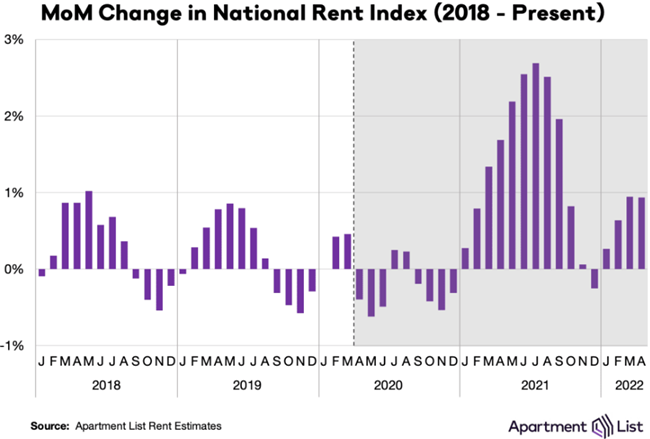
National rent growth continued upward with a national index increase of 0.9 percent over the course of April, according to Apartment List.

National rent growth continued upward with a national index increase of 0.9 percent over the course of April, according to the latest report from Apartment List.

While rents are growing more slowly than they did in 2021 at this point in the year, they are still growing faster than in the years immediately preceding the pandemic.

In April, rents were up in 93 of the 100 largest cities.

Year-over-year national rent growth currently stands at a staggering 16.3 percent, but most of that growth took place last spring and summer.

National rent growth continued upward with a national index increase of 0.9 percent over the course of April, according to Apartment List.

“Over the first four months of 2022, rents have increased by a total of just 2.5 percent, though we’re only beginning to enter the busy season for the rental market, when the bulk of annual rent growth typically occurs,” according to the Apartment List Research Team.

“Even if prices don’t rise as rapidly as they did in 2021, it’s likely that this year will continue to bring rent growth in excess of the pre-pandemic trend,” the report says.

Vacancy remains low entering the busy rental season

National rent growth continued upward with a national index increase of 0.9 percent over the course of April, according to the latest report from Apartment List.

“As we’ve explored in detail, much of the 2021 rent boom was attributed to a tight market in which more households were competing for fewer vacant units.

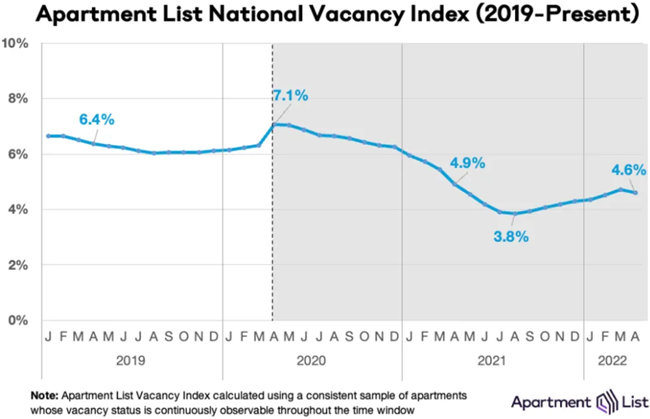
“Our vacancy index spiked above 7 percent at the onset of the pandemic in 2020, as many Americans moved in with family or friends amid the uncertainty and economic disruption of the pandemic’s onset. After that, however, vacancies began a steady decline, eventually falling below 4 percent,” the report says.

After bottoming out at 3.8 percent last August, “Our vacancy index slowly ticked back up for seven consecutive months, until dipping slightly this month. Our index fell from 4.7 percent in March to 4.6 percent in April.

“We should be hesitant to put too much stock into a single data point, but it’s possible that as we enter the traditional busy season for the rental market, the gradual easing of our vacancy index may begin to level off. The vacancy situation remains historically tight, and even if it were to continue gradually easing, it will likely be some time before we get back to the pre-pandemic norm.”

Miami Continues As King of Rent Growth

National rent growth continued upward with a national index increase of 0.9 percent over the course of April, according to the latest report from Apartment List.

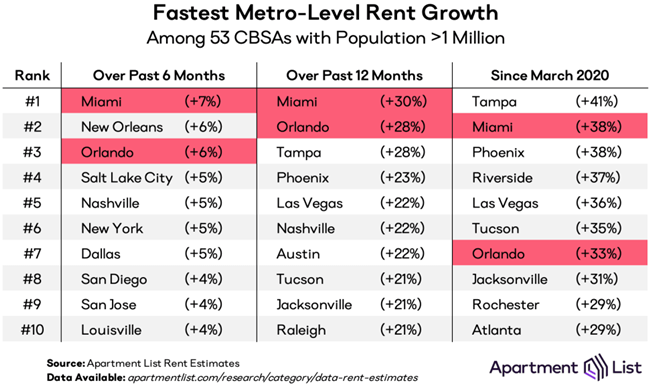
The Miami metro has seen the nation’s fastest growth over the past six months (+7 percent), nearly tripling the growth rate of the national index over that period.

The Miami metro also ranks No. 1 for year-over-year rent growth, and No. 2 for growth since March 2020.

Conclusion

“As we enter the spring and summer months, rental activity is likely to pick up, and rent growth is likely to accelerate. Despite a recent cool-down, many American renters are likely to remain burdened throughout 2022 by historically high housing costs,” the report says.

Read the full report here.

Sign Up For Our Weekly Newsletter And Get Rental Property And Apartment News And Helpful, Useful Content Each Week.

* indicates required

Four Market Fundamentals That Will Affect Your Rental Properties in 2022

Four Market Fundamentals That Will Affect Your Rental Properties in 2022

Here are four market fundamentals that will impact your rental properties in 2022, from inflation to changing work patterns and more.

By Joan Rohrer
Founder and President, JMR Company, Inc.

It has been a difficult few years for property owners. With the events of 2020 and 2021 creating uncertainty and upheaval on a universal level, we have dealt with so many challenges – from eviction bans and rising inflation to new tax laws that plagued investors and property managers. We have even seen the single-family home real estate market explode, flooding the rental market and contributing to rising prices for everyone.

In this environment filled with pressure and uncertainty, there are four fundamentals that property owners and managers should be watching closely as the market evolves. These factors can have an impact on market rental rates and the cost of doing business, determining how profitable your properties will be in the coming year:

1. Inflation looms large

As products shrink and prices rise, consumers are feeling the pinch of inflation from every corner.

Renters are especially susceptible to the rising cost of living. Inflation was higher than predicted in 2021, and the Federal Reserve has already raised rates once in 2022. The Fed also stated that they may increase the interest rate at least two more times this year, with a potential total increase up to 0.9 percent. The rate of inflation often affects renters’ willingness to pay premium prices, since rent is typically tied to consumer prices and rises with inflation. It’s a tricky dynamic with the demand for rentals continuing to surge. Your properties will need to be priced aggressively, but flexibility will be needed throughout the coming year.

2. Remote work is here to stay, and so are changed living priorities

The pandemic brought us to remote work, and it looks like as a culture, the home office is here to stay.

Home offices were once a “nice-to-have” feature but are now a critical factor for potential tenants. Do your properties offer a flex space or extra room for virtual work or schooling? Is there an opportunity to add or make simple renovations to accommodate work spaces in your properties? Additionally, with all of this isolation at home, millennials and Generation Z are also seeking community and connection. Ask yourself what the community around your property offers: Are there opportunities for tenants to engage with others in shared activities? The addition of outdoor spaces for small gardens or common areas to create the “feel” of a neighborhood can add value that justifies premium rates and generates fully leased units. A final checklist item for renters is technology. Does your building have good WiFi/data access? That factor alone is a deal breaker for new renters.

 3. More demand than ever before

Overall, the market for rentals has never been stronger.

As we emerge from the pandemic, property owners are strongly positioned to make up for lost profits. Millennials, who make up the largest population of renters, are the biggest participants in the gig economy, and value flexibility and freedom more than the generations before them. Because they are less interested in purchasing homes that will lock them down to one location long-term, they will continue to be a strong market for rentals. With the explosion of the real estate market in the past year, more people are cashing out of homes and turning to rental units for a place to live, adding more boomers and Generation Xers to the mix. Since the housing crisis in 2008, the supply of rental properties has not caught up with demand, and construction of new complexes has essentially halted. It will be years before supply matches demand again, so rentals will continue to be a premium.

4. Be aware of 1031 exchange laws and potential changes

These laws will only affect those who wish to sell or transfer ownership of rental properties, but for them, that impact could be huge.

Many property investors began to panic when they saw that the current administration was considering changing the tax laws around 1031 exchanges. However, in the final draft of the law, this provision was not included. The new law would have placed a cap on gains above $500,000 per year on an investment-property exchange. While this addition may be revisited in the future, the current 1031 exchange laws remain intact for now.


Overall, the outlook for the rental property market is stronger than ever, especially for investors that stay aware of what is happening in the market and adjust accordingly. We know that along with increasing rental unit prices, tenants’ expectations for their rental experiences have also elevated. Many multifamily property owners are rising to the occasion to meet these additional demands, while taking advantage of the larger number of renters in the marketplace. Even though there have been plenty of reasons for concern over the last two years, property owners have every reason to look at the future with high expectations for growth and profitability.

About the Author

Joan Rohrer is the founder and president of JMR Company, Inc., a certified Woman-Owned Small Business (WOSB) entity in the state of Missouri. With more than 20 years’ experience as a private investor and helping property owners manage their investments, she is passionate about helping individuals and families find homes as tenants with her clients. Joan is a member of the St. Louis Realtors Association, the Missouri Realtors Association, the National Realtors Association, and the Institute of Real Estate Management.

Sign Up For Our Weekly Newsletter And Get Rental Property And Apartment News And Helpful, Useful Content Each Week.

* indicates required

5 Summer Maintenance Checklist Items for Multifamily Communities

5 Summer Maintenance Checklist Items for Multifamily Communities

A surplus of maintenance issues is expected on the first weekend of summer in multifamily communities so beat the calls and requests with this summer maintenance checklist.

By Kris Servidio
Senior Associate Director of Facilities and Support
Mark-Taylor Residential

Summer is on the horizon for many multifamily communities, especially those across the Southwest. While the change in season may appear to be a harmless shift to warmer temperatures, it opens communities to several maintenance-related areas of opportunity.

To uphold exceptional standards of service, proactivity is the most important element in summer maintenance. At Mark-Taylor, we begin our summer maintenance efforts in the spring, prior to the influx of emergency requests due to a change in season. It also helps us get a jump start on pool season, alleviating the additional pressure that mass use puts on our amenities.

Being hyper-proactive benefits all parties – residents, community management and maintenance staff. The following checklist, outlining our tried-and-true summertime maintenance methods, will help you bring our proactive approach to your community:

1. Beat the heat with your supply orders

A surplus of maintenance issues is expected on the first weekend of summer and the first weekend of winter; the drastic changes in temperatures may throw off your teams’ maintenance routines if practices do not adjust to evolving needs.

It is imperative that community service teams plan ahead by ordering supplies before the new season begins. For example, purchase chlorine, clarifier and phosphate removers for increased pool and spa maintenance in advance. This is especially important as we face ongoing nationwide supply chain issues with increased costs and delivery delays.

2. Communicate with residents early and often

Keeping residents proactively informed is a best practice that creates an enjoyable living experience for residents, and an efficient work environment for your teams. Before the start of a new season, start communicating with residents about what to expect, how to submit requests and what to do in cases of emergency. When issues triggered by the heat occur, residents will feel supported and prepared with the correct information, providing a more seamless maintenance experience for everyone.

3. Solve issues before they begin

Preventative maintenance could be the difference between a chaotic season of maintenance and a successful one.

Cycling units that are empty and vacant is a recommended practice. However, for occupied units, it remains important to tend to systems, amenities and the surrounding community grounds to avoid pitfalls during the demand of the season. Significant areas to focus on include:

  • HVAC System Checks – Change out air filters once a month
  • Swimming Pool and Spa Maintenance – Test the water chemistry on a daily basis and check jets regularly
  • Landscaping – Replenish plants and perfect your watering schedule

4. The key to success is working together

The best community maintenance teams have a strong partnership with their community management. Staying in close contact as one united team helps maintain a well-connected and efficient internal operation. Community management teams are essential partners in times of need, as well as when budgeting for the season, conducting resident communications and identifying key areas of opportunity.

5. Create a well-oiled machine, year-round

Preventative maintenance is not the end-all, be-all; day-to-day maintenance must not be overlooked. Once a new schedule has been put into action, maintenance teams should work together to become aligned. Getting into a streamlined cadence is guaranteed to save your teams’ time and energy.There are evident benefits to preparing and implementing maintenance before summer is in full swing: heightened resident satisfaction, a result of receiving a 5-star experience, and positive-minded maintenance and community management teams, to name a few. Altogether, these practices support the cultivation of a multifamily community that is not only highly desirable but exceptional in every regard.

About the Author:

A surplus of maintenance issues is expected in early summer in multifamily communities so beat requests with our summer maintenance checklist.
Kris Servidio

Kris Servidio is the Senior Associate Director of Facilities and Service for Mark-Taylor Residential. As a leader and a mentor in the organization, he is responsible for overseeing an exceptional group of service teams that care for luxury communities across Arizona and Nevada. His depth of knowledge in maintenance operations, as well as his extensive experience in the multifamily industry, has equipped him to ensure that Mark-Taylor’s 5-star signature standards of service are upheld.

6 Community Maintenance Tips For Exceptional Tenant Experience

Sign Up For Our Newsletter And Get Rental Housing and Apartment News And Helpful, Useful Content Each Week.

* indicates required

3 Best Practices for Communicating with Residents

4 Ways to Balance the Needs of Pets and Residents in Multifamily Communities

Why Tenant Screening Must Include Nationwide Checks

Why Tenant Screening Must Include Nationwide background Checks and criminal history

Tenant screening must include nationwide background checks because gone are the days of knowing most of the people in our communities and getting referrals from those same people – trusted friends or family – to fill our properties

By David Pickron

For the first 100 years of being a country, the United States was comprised of small, rural family or ethnic groups that thrived upon sharing resources to support their entire communities.  Over the last 100 years of our history and with the massive population growth in our major cities, many of us have become “strangers” to even our closest neighbors.  Being a landlord today requires so much more than in the past.  Gone are the days of knowing most of the people in our communities and getting referrals from those same people – trusted friends or family – to fill our properties.  In the past a person’s actions might be known town-wide, but now people can live and move anonymously within our neighborhoods.  How does that affect you as a property owner? And how does that affect your ability to operate as a “successful, lazy landlord,” a concept I teach and live by?  I’ll tell you; it affects both dramatically.

A disclaimer before you read too far: I’m not advising you to never rent to any individual with a criminal history.  I am advising you to utilize criminal history checks as just another tool in your landlord “toolbox.”

Criminal Histories

When it comes to understanding criminal behavior, we have to rely on the criminal statistics to give us a true and accurate look at our current situation.  Recidivism, the tendency of a convicted criminal to reoffend, and the rates of reoffending are a powerful indicator for you as a landlord as you analyze a potential tenant.  The Bureau of Justice recently released the results of a 10-year study of individuals that were released from prison in 2008.  This is what they found:

  • 66 percent of prisoners released across 24 states in 2008 were arrested within three years.
  • 82 percent were arrested within 10 years.
  • Of those that were arrested within 10 years, 47 percent were arrested for offenses involving property and another 47 percent for drug-related offenses.
  • The average inmate committed nine crimes before they were sentenced.

Based on just this data, what risks are you willing to take?  Though this is federal data, state recidivism rates closely mirror them.

A Country on the Move  

The moving industry reports that more than 15 million American households move annually, with an average of three people per household: great news for us as housing providers.  That equates to 45 million people a year calling somewhere new “home.”  More than three million of those moves are considered interstate, meaning they are leaving one state for another.  What that means for you as a landlord is that a “current state only” search of any history, criminal or otherwise, for your applicant during tenant screening is likely insufficient.  Specific to criminal, 16 percent of those who were arrested within 10 years of release from prison were arrested in a state other than the one they were convicted in.  Would you as a landlord be happy with a one in six chance for anything, but especially when searching an applicant’s criminal history?

One reason individuals with a criminal history move is to get away from their communities, especially in small towns.  For better or worse, it’s hard to escape the stigma of being the town drunk when the whole town knows your history.  Also, individuals with criminal histories often move to states that have less stringent research and reporting laws, seeking asylum where their history can’t even be reported to you as a landlord, leaving you feeling handcuffed in managing your property.  And finally, 33 percent of the individuals released from prison could not find active employment within the first three years of their release.  These factors combined with the transient nature of our country indicate that including a nationwide check during tenant screening shouldn’t just be an option, it should be a necessity for successful landlords.

Applying Consistent Criteria        

What kind of criteria do you have when it come to an applicant’s criminal history?  If you don’t have one, I’d encourage you to visit with your attorney to determine what is fair and legal in your state when it comes to criminal background research and use in housing.  We have a sample criteria you can request at [email protected].  If you do have criteria, make sure you are applying it fairly and equally across the board for each applicant.  A question I get often is “Is it okay to have property-specific criteria?”  Not only is it OK, but I would also encourage you to make this a key part of your practice.  Your portfolio may contain properties of varying locations, values, and restrictions, and each of these will affect how you manage the property.  For example, you may have a property that qualifies as low-income housing.  Would the criteria you use for a tenant there differ from the criteria you might have in place for a property in an age-restricted community?  Of course it would.  What doesn’t differ is your enforcement of whatever criteria you use for each specific property.  Consistency is king whether you are considering criminal, credit, or eviction history.

As much as we might like a return to the old days where agreements were sealed with a handshake, our future is much different.  Knowing criminal histories, seeing moving patterns, and using consistent criteria make us better landlords and more profitable investors.  This is why it is so important to include a nationwide criminal history check on every tenant from whom you receive an application.

About the author

David Pickron is president of Rent Perfect, a private investigator, and a fellow landlord who manages several short- and long-term rentals.  Subscribe to his weekly Rent Perfect Podcast (available on YouTube, Spotify, and Apple Podcasts) to stay up to date on the latest industry news and for expert tips on how to manage your properties.

Why Tenant Screening Must Include Nationwide background Checks
David Pickron

3 Tips to Keep You Out of Landlord Rehab

Sign Up For Our Newsletter And Get Rental Property And Apartment News And Helpful, Useful Content Each Week.

* indicates required

Why I Like My Rental Properties’ Nosy Neighbors

Three Steps to Becoming a Successful, Lazy Landlord