Home Blog Page 78

Can I Enter My Rental If It Is Vacated And Eviction Pending?

This week a landlord asks

This week a landlord asks “can I enter my rental property” if the tenant has vacated and the eviction is still pending is the question for Ask Landlord Hank. Remember Hank is not an attorney and is not offering legal advice. If you have a question for him please fill out his form below.

Dear Landlord Hank:

My tenant has not paid rent in three months, and there are still four months left on the lease.

She has completely vacated the property and has not waited for the eviction process to run its course.

She has done a lot of damage, so I need to get work done before I can advertise for new tenants.

Do I have the right to enter my rental property unit now and start to clean up before the eviction case has been presented to the judge?

–Frances

Dear Landlady Frances,

Has the tenant told you she is leaving, and did she leave her keys?

Usually in a lease, there is a “default” clause that says that if the tenant abandons the premises, that constitutes default and that the landlord may retake possession of the premises.

That is my understanding of the law here in Florida and Georgia, but if the tenant told you she was leaving and terminating her lease, I would change locks and ready the property for the next tenant.

Even though she owes back rent, go through all proper protocol for your state regarding the security deposit, notices, etc.

Sincerely,

Hank Rossi

Each week I answer questions from landlords and property managers across the country in my “Dear Landlord Hank” blog in the digital magazine Rental Housing Journal.  https://rentalhousingjournal.com/asklandlordhank/

Can I Enter My Rental If It Is Vacated And Eviction Pending
Landlord Hank says, “Usually in a lease, there is a “default” clause that says that if the tenant abandons the premises, that constitutes default and that the landlord may retake possession of the premises.”

Ask Landlord Hank Your Question

Ask veteran landlord and property manager Hank Rossi your questions from tenant screening to leases to pets and more! He provides answers each week to landlords.

  • This field is for validation purposes and should be left unchanged.

Do I Have to Paint and Replace Flooring for a Long-Term Tenant?

A Tenant Poured Grease Down Drain Who Is Responsible?

Sign Up For Our Newsletter And Get Rental Housing And Apartment News And Helpful, Useful Content Each Week.

* indicates required

Guide to Purchasing Rental Properties With Existing Tenants

There are many reasons to consider purchasing rental properties with existing tenants in your search for properties in your area.

There are many reasons you may want to consider purchasing rental properties with existing tenants in your search for buying commercial properties in your area.

By Brian Kidder

Finding a property that suits your needs can be difficult. There are approximately 20 million rental properties in America, with more properties expected to be built every year.

The commercial rental rates in your area may differ depending on whether they’re currently occupied or not.

When deciding whether to buy a commercial property for sale, there are so many factors to take into consideration and so many questions to answer.

What will you do if there are already tenants living in the building? What if you wanted to create and enforce new contracts for commercial leases?

Keep reading for details.

Purchasing rental properties with existing tenants is an excellent way to get started in real estate

There are many reasons you may want to consider buying commercial properties in your area with existing tenant populations when searching for commercial rentals in your neighborhood.

  • If you don’t want to deal with finding tenants or screening potential renters, you can avoid that hassle by buying an apartment building that has already been leased.
  • You can also get higher prices for the property because of the additional income it generates.
  • You’ve found the perfect property and don’t want to wait for it to become available without commercial real estate occupants before buying it.

Most commercial properties for sale with existing tenants are tenant-occupied properties.

This means the tenant has an agreement with the current landlord to rent the space.

However, the property may also be owned by someone who rents out the space. Depending on where you’re located, this kind of tenant might have different rights.

When purchasing an investment property, here are some tips to protect yourself against potential legal issues.

It is important to know the rules and regulations before buying a property that is already inhabited.

Speak to your local council or your housing association to find out exactly what they require from commercial landlords who rent properties.

First, understand that existing tenant leases are still valid

Even if there are existing tenants, the lease is still valid. As long as the existing tenants don’t violate any laws, they’re free to stay there.

They can stay there as long as they pay their rent and don’t cause any trouble, according to their lease terms.

But if you want to break them, then offer a contingency.

A contingency is a situation that must occur before the deal goes through. It’s an accepted condition before signing the contract.

If you want to be able to sell a property without having to evict any current tenants, you could say that you would like to include a condition where the property must be empty when you sell it.

Secondly, understand that existing tenants can sign new lease agreements

If existing tenants want to renew their leases with you, even though they currently live there, they can.

If you buy out the existing owner, you can enter into an entirely new lease agreement with these tenants.

This is an ideal method for bringing current tenants onboard because it allows them to know that they won’t be charged any extra fees and that you’re committed to the property.

Consult with the previous landlord

If you’re purchasing a rental property with existing tenants, it’s a good idea to contact the previous landlords and ask them how they vetted and screened their tenants.

Make sure to ask what screenings they did and whether their approaches were thorough enough so that they could catch any red flags.

You need to thoroughly investigate any potential tenants before renting an apartment to them. Otherwise, you might end up finding out that they have a long history of bad tenant behavior.

If you’re not sure how much screening to perform, ask the previous landlords or owners.

They might be able to give you an idea of what they look for when selecting new tenants.

You should enforce your new lease terms

If you buy a rental property with tenants living there, make sure to enforce any new lease terms even if they were allowed under the old lease with your former landlord.

It can be especially important when dealing with situations like rent increases and tenant evictions.

It is possible that they may have assumed that the previous landlord had permitted them to continue doing something that was not permitted by their old lease.

Lastly, know that you can hire experts to help you

Buying commercial rental properties in your local area can be a good investment strategy, but it’ll take time to get started.

Property managers need to be ready for everything that comes with managing a rental property, including making repairs and maintaining tenant happiness.

You don’t need to be an expert at everything to get started. There are experts out there who can guide you through the steps.

Working with a property management company

Property managers can help you negotiate the right lease terms for your situation and budget, and they can also handle any tenant issues you may encounter, from eviction to rent increases.

They can help landlords with tenant issues, including handling lease renewals, evictions, and complaints from tenants.

Don’t forget about the attorney who handles commercial real estate transactions.

Before buying a rental property, choosing an experienced commercial real estate attorney is among the most important things you need to do.

Depending on the type of property that you’re buying, there are many different ways to approach it. However, one thing you need to be sure of is that you have an attorney who knows both the legal and financial sides of being a landlord.

Commercial real estate lawyers usually have experience with both residential property and commercial property and have also been trained to handle challenges and deal with potential problems, such as construction delays and tenant turnover.

They may also be willing to help you find commercial properties for sale with tenants.

About the author:

Brian Kidder of MyEListing.com started in finance as a retail broker, started his own office at age 25, co-headed an investment banking department, launched with Gexa Energy funding in 2002, acted as a chief compliance and anti-money laundering officer for multiple firms, institutional sell-side broker, then ran an OTC equity trade desk. He has put together or participated in over 100 equity offerings and held 8 federal licenses including three principals’ licenses.

Sign Up For Our Weekly Newsletter And Get Rental Property And Apartment News And Helpful, Useful Content Each Week.

* indicates required

HUD Settles Sexual Harassment Over Maintenance Worker

HUD settled with a California apartment and property management firm on a sexual harassment complaint involving maintenance worker

The U.S. Department of Housing and Urban Development (HUD) has settled a complaint with a California apartment and property management firm for $21,000 over a sexual harassment complaint involving a maintenance worker, according to a release.

The HUD complaint states that a female tenant was subjected to sexual harassment and complained that a male maintenance worker at the apartments “offered to provide maintenance services on her unit in exchange for sexual favors.”

HUD approved a conciliation agreement with Indio, California, property owners Perris Family Apartments, LLC., Perris Family Apartments L.P., and The Coachella Valley Housing Coalition, as well as their property manager, Hyder & Company dba Hyder Property Management Professionals, Perris Family Apartments employee Terry Valdespino, and maintenance person Kenneth Parker, resolving allegations of housing discrimination because of sex.

Under the agreement, Perris Family Apartments will pay the tenant $21,000 and take other actions to prevent sexual harassment, including providing training for employees. The respondents denied the allegations but voluntarily agreed to settle the matter.

The settlement agreement “resolves allegations that a female tenant was subjected to sexual harassment by Parker and that the owners and manager failed to prevent further incidents of sexual harassment. This Conciliation Agreement does not constitute an admission by Respondents or evidence of a determination by HUD of any violation of the Fair Housing Act or any other law. Read the Conciliation Agreement here.

The Fair Housing Act prohibits sexual harassment of tenants and other forms of housing discrimination because of race, color, national origin, religion, sex, disability, and familial status.

“Tenants should not have to endure sexual harassment in their homes,” said Demetria L. McCain, HUD’s Principal Deputy Assistant Secretary for Fair Housing and Equal Opportunity, in the release.

The conciliation agreement “should send a clear message that HUD is committed to ensuring housing providers meet their obligations under the Fair Housing Act.”

Sign Up For Our Newsletter And Get Rental Property And Apartment News And Helpful, Useful Content Each Week.

* indicates required

Fair Housing and Sexual Harassment – Staff and Resident Relationships

Landlord To Pay $135,000 In Sexual Harassment Lawsuit Settlement

Landlord Charged With Sexually Harassing Female Tenant

Oregon Landlords Can Raise Rent 14.6 Percent Next Year

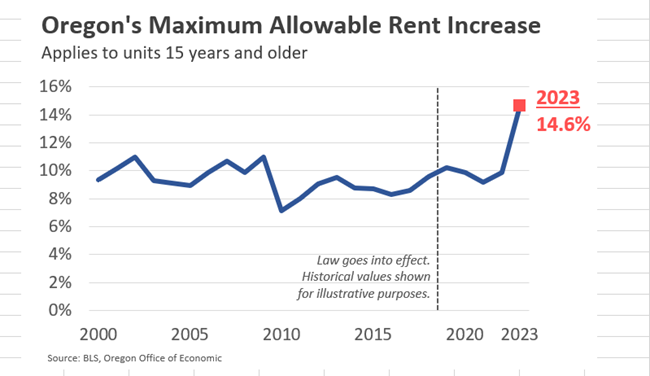
Oregon landlords can raise rent as much as 14.6 next year under the state’s new rent-control law, but landlords are unlikely to increase rents that much.

Oregon landlords can raise rent as much as 14.6 next year under the state’s new rent-control law, but landlords are unlikely to increase rents that much.

This statewide cap applies to housing that’s at least 15 years old. Newer rentals are not included.

Meanwhile, Gov. Kate Brown said in a statement it may be time to review the state’s rent-control law next year. Brown signed the rent-control bill into law in 2019, the first of its kind in the nation. It caps rent increases annually at 7 percent, plus the average consumer price index measure of inflation.

In response to the new number, Brown’s office put out a statement saying in part, “The governor is deeply concerned about the maximum rental increases that will be allowed under Oregon law in 2023, and she urges the legislature to prioritize action to mitigate future increases.

“In 2019, the Legislature established the formula for our current maximum annual rent increases through Senate Bill 608, tying allowable increases to changes in key markers of inflation. While this was the right policy move at the time, when rent increases were not a primary factor driving measures of inflation (and CPI was under 2 percent), with today’s inflation rates it makes sense to reexamine state law.

“Because the limit announced does not take effect until 2023, the governor believes the legislature can and should take this up during the 2023 session. It’s important for Oregon renters and landlords to note that the maximum allowable increase announced today does not take effect until 2023. For the remainder of the calendar year, landlords are still bound to the 2022 maximum increase amount of 9.9 percent,” the governor said in the statement.

Landlords will not be able to raise rent that much

“I’m sure it sounds like, to a lot of people, that’s a big hike,” said Christian Bryant, president of the Portland Area Rental Owners Association, to kgw.com. He also teaches people the rental business.

Bryant said he understands the concern but does not believe most landlords who could raise rent 14.6 percent next year will do so.

But he added, “The way it’s set up right now is if you’re a landlord, you’re a business. And if your costs go up, (like) at a restaurant or the Home Depot, they charge the end user more.”

The Oregon Office of Economic Analysis is responsible for calculating and publishing, by September 30 of each year, the maximum annual rent increase percentage allowed by statute.

Portland Rents Increased Again In August

Portland Update: Changes to FAIR Ordinance Bring (Some) Necessary Changes

Governor Kate Brown Signs Landmark Oregon Rent Control Bill

Sign Up For Our Weekly Newsletter And Get Rental Property And Apartment News And Helpful, Useful Content Each Week.

* indicates required

Do I Have To Pay For New Paint and Carpet If No Lease In Place For Long-Term Tenant?

This week a landlord asks if he should have to pay for new paint and carpet for a long-term tenant who does not have a lease

This week a landlord asks if he should have to pay for new paint and carpet for a long-term tenant who does not have a lease just because the tenant’s daughter asks, is the question this week for Ask Landlord Hank. Remember Hank is not an attorney and is not offering legal advice. If you have a question for him please fill out his form below.

Hi Landlord Hank:

I have a tenant renting a three-bedroom apartment in a two-family home from me for the past 30 years. He has never had a lease. He lived mostly on his own. His daughter now lives with him on and off when she’s around.

She now tells me she wants me to paint the entire apartment and change all the carpet.

Is this my responsibility?

I have always paid for any repairs, plumbing, heating, electrical new refrigerator, new stove.

Am I responsible for paint and carpet? Again, no lease.

–Frank

Hi Landlord Frank,

It is your responsibility to take care of your property.

It’s great that you’ve had the same tenant for 30 years, but I don’t think it is too much for a tenant to ask for a paint job and new carpeting.

Did the daughter tell you that they are going to foot the bill and just ask for your permission to do the job or are they asking for you to pay for this?

I suggest you put your tenant on a lease so everything is spelled out.

If this were my tenant, and they had been a great tenant for many years, I would want to keep them happy.

Sincerely,

Hank Rossi

Each week I answer questions from landlords and property managers across the country in my “Dear Landlord Hank” blog in the digital magazine Rental Housing Journal.    https://rentalhousingjournal.com/asklandlordhank/

This week a landlord asks if he should have to pay for new paint and carpet for a long-term tenant who does not have a lease
Landlord Hank working on renovation in one of his rentals. Hank says, “If this were my tenant, and they had been a great tenant for many years, I would want to keep them happy.”

Ask Landlord Hank Your Question

Ask veteran landlord and property manager Hank Rossi your questions from tenant screening to leases to pets and more! He provides answers each week to landlords.

  • This field is for validation purposes and should be left unchanged.

A Tenant Poured Grease Down Drain Who Is Responsible?

Sign Up For Our Newsletter And Get Rental Housing And Apartment News And Helpful, Useful Content Each Week.

* indicates required

Handling Relay Operators the Fair Housing Way

Did you know refusing to talk to a relay operator and provide information is discriminatory and denying access to housing because of a disability and a fair housing issue?

Did you know refusing to talk to a relay operator and provide information is discriminatory and denying access to housing because of a disability and a fair housing issue? Learn more in this article.

By The Fair Housing Institute

Although not frequent, relay calls do come into leasing offices. What are your policies and procedures when it comes to how to navigate these types of calls? Do they comply with fair housing laws? Does everyone have sufficient training to avoid a fair housing complaint?

What Are Relay Operator Calls?

While technology is evolving to help people with communication disabilities, the use of relay operator calls still exists. Relay operator calls are a service that is used by hard-of-hearing or deaf individuals. It employs the use of a Communication Assistant or Relay Operator who relays the call between two parties by reading out what the hard-of-hearing or deaf individual types using a specific machine while typing back whatever the speaking individual says. While this form of communication can be helpful, it is also time-consuming, posing a problem for a very busy leasing office.

Fair Housing Relay Operator Testing

A recent testing campaign shared some pretty concerning results. Nearly half of the properties tested did not know how to correctly respond to or handle relay operator calls. Even worse were some of the comments that were recorded, such as,  “I don’t have time for this” or “I don’t know what this is about,” followed by the leasing agent hanging up the phone.

As a result of this campaign, multiple lawsuits were filed, since refusing to talk to a relay operator and provide information is discriminatory and denying access to housing because of a disability.

Proper Fair Housing Training Is a Must

The relay operator testing campaign clearly highlights the need for training. That training needs to target specific situations like this. Training should include practicing the many different situations that can arise when handling a relay operator call.

For example, how would you or your staff handle being on a relay call and having another prospect walk into the leasing office looking for information? The easy thing may seem to be to tell the relay operator that they will have to call back, but that could be perceived as discrimination, that the leasing agent would rather work with a person without disabilities. Best practices would be to quickly and respectfully tell the person that walked in that you are on a call that may take some time and that you will be with them as soon as possible.

Another pitfall that proper training can help you avoid is over-explaining or offering information without it being requested. For instance, just because you are talking to a hard-of-hearing or deaf person, you do not need to launch into describing your units that accommodate their disability. Go about your regular presentation and only offer this information if asked.

Work with your team to brainstorm other situations that might arise and work together to find fair housing-friendly solutions.

Avoid a Fair Housing Complaint By Being Compliant

Remembering to treat every person that walks in, calls, or contacts your leasing office the same way will aid greatly in maintaining compliance.

Although relay operator calls may take a considerable amount of time, and we may already be very busy, these calls need to be handled in a timely and respectful manner. Be sure to give all the same information that you would for any other call, regardless of how long that might take, so as to avoid a possible fair housing complaint.

Even though the technology is changing and relay calls may be happening less frequently, proper protocols on how to handle them still need to be part of your fair housing training program.

About the author:

In 2005, The Fair Housing Institute was founded as a company with one goal: to provide educational and entertaining fair-housing compliance training at an affordable price at the click of a button.


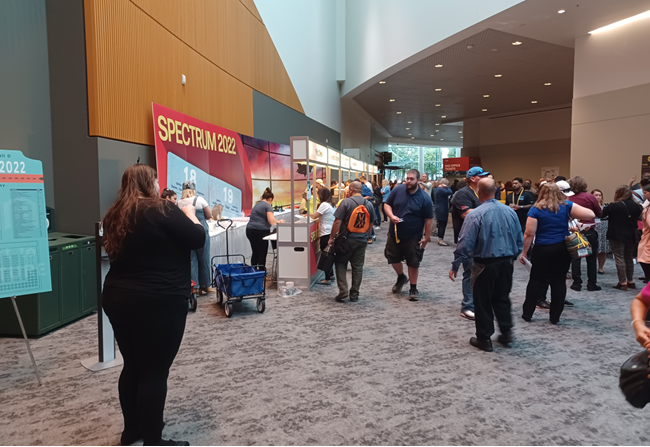
Spectrum 2022 Is A Wrap At The Oregon Convention Center

Kennedy Restoration at Spectrum 2022

Nice to see our friends from Kennedy Restoration at Spectrum 2022. Spectrum wrapped up Thursday, September 15, after a good day of learning and seeing our friends. See you again next year!

Spectrum 2022 underway

Attendees are filtering in to the show.

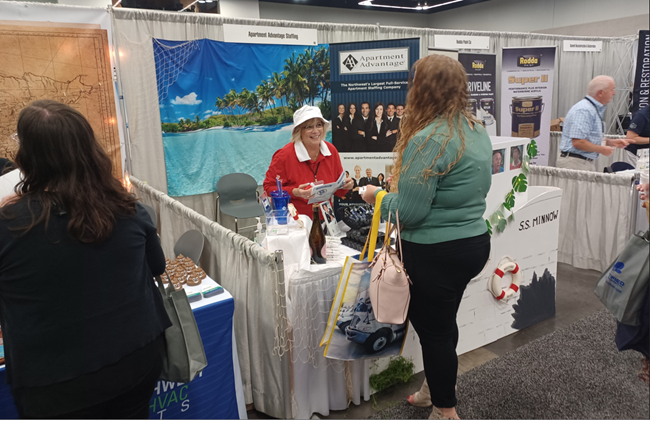
Spectrum 2022 in Portland Apartment Advantage booth
Jennifer with Apartment Advantage on the SS Minnow of Gilligan’s Island cChatting with a potential client about staffing needs.
Bryan with Safe Sidewalks at Spectrum 2022
Bryan with Safe Sidewalks assisting with trip hazards.
GT Landscape Solutions at Spectrum 2022
Libby with GT Landscape Solutions
Ball Janik LLP
Julia Rovea talking to attendees about legal issues and needs at Ball Janik LLP
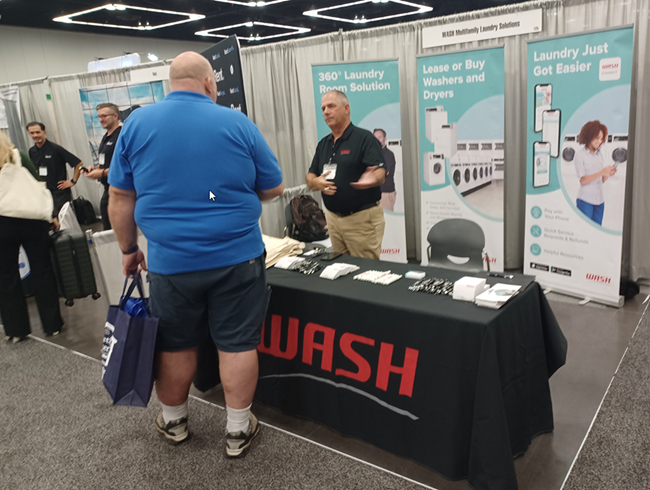
WASH laundry
Bob Frediani with Wash Laundry answering questions with a potential future client

Portland Rents Increased Again In August

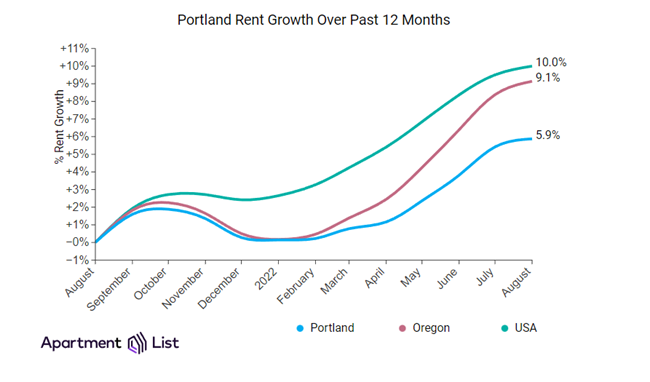
Portland rents increased 0.4 percent over the past month, the seventh straight month the city has seen rent increases Apartment List reports

Portland rents increased 0.4 percent over the past month, the seventh straight month the city has seen rent increases, according to the September report from Apartment List.

With the latest increase, Portland rents are up 5.9 percent year-over-year.

Median rents in Portland are $1,300 for a one-bedroom apartment and $1,518 for a two-bedroom.

While the city has seen steady rent increases year-over-year, Portland still lags the state average increase of 9.1 percent as well as the national average of 10.0 percent.

Beaverton Rents Show Big Jump In August

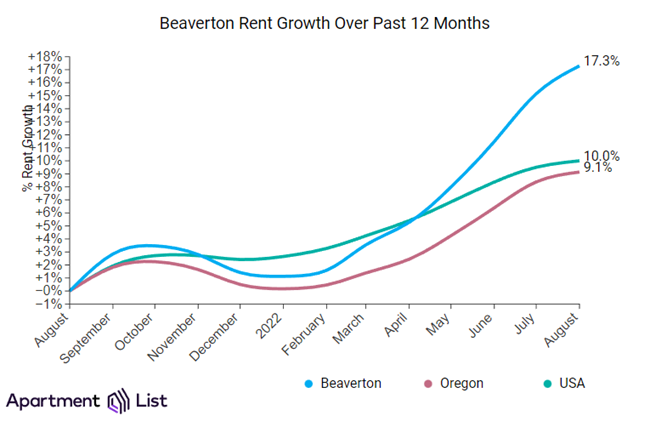
Beaverton rents have increased 1.9 percent over the past month, and have increased sharply by 17.3 percent year-over-year.

Median rents in Beaverton are $1,627 for a one-bedroom apartment and $1,889 for a two-bedroom.

Portland rents increased 0.4 percent over the past month, the seventh straight month the city has seen rent increases Apartment List reports


Hillsboro Rents Also Increase

Hillsboro rents increased 0.4 percent in August and have increased sharply by 11.5 percent in comparison to the same time last year. Currently, median rents in Hillsboro stand at $1,857 for a one-bedroom apartment and $2,054 for a two-bedroom.

Vancouver rents increase sharply over the past month

Vancouver rents have increased 1.3 percent over the past month, and are up sharply by 9.9 percent in comparison to the same time last year. Currently, median rents in Vancouver are $1,392 for a one-bedroom apartment and $1,604 for a two-bedroom.

National Multifamily Rent Growth Hits A Wall In August

Sign Up For Our Weekly Newsletter And Get Rental Property And Apartment News And Helpful, Useful Content Each Week.

* indicates required

Ask The Attorney: Handling a Notice of Deficient Conditions In Utah

Jeremy Shorts, Esq.
Utah Eviction Law

Question:

I just received a notice of deficient conditions from my resident, what do I do now?

Answer:

Begin by reviewing the notice of deficient conditions carefully.

It should state a few critical pieces of information, including a description of the problem and the deadline to work on correcting the problem. You need to decide whether to:

  1. Fix the problem or
  2. Terminate the lease If you decide to terminate the lease, you must:
  3. Give them a written notice prior to the corrective period deadline, and
  4. Refund pro-rated rent and the deposit.

The tenant then has to leave after 10 days. If you decide to correct the problem, you have to take substantial action toward correcting the problem within the corrective time period listed in the notice. This does not mean that you have to correct the problem by the deadline, but you must take substantial action toward correcting the problem by the deadline.

As with most problems, communication is key. We recommend that you report to the resident at the end of the corrective period, in writing, that outlines:

  1. What you have accomplished within the corrective period
  2. What still needs to be done, and
  3. The plan to continue to work on what needs to be done.
Handling a Notice of Deficient Conditions In Utah
Jeremy Shorts

About the author:
Jeremy Shorts is a licensed Utah attorney. Mr. Shorts has always enjoyed representing and assisting landlords. These services provide clients/landlords with peace of mind and additional legal protections. If you have any questions, please feel free to contact us to schedule a landlord consultation to discuss your case. Utah Eviction Law Phone: 801-610-9879 Fax: 801-494-2058 Email: info@utahevictionlaw.com

Utah Apartment Association Officially Becomes Rental Housing Association of Utah

Salt Lake City Rents Increase Sharply Over The Past Month

Renters Are Stressed Trying to Find A Place To Live

Renters are stressed and a new survey says 40 percent of renters report losing sleep while trying to find a new apartment or home to rent

Renters are stressed and a new survey says 40 percent of renters report losing sleep while trying to find a new apartment or home to rent with many fretting about cost, communication and competition, according to a Zillow survey.

Another 77 percent of recent renters made compromises to afford their home amid record-high rents. The most common was settling for a place that didn’t have all of the features they wanted (i.e., new appliances, AC, balcony).

“Rising rents are only adding to the pressure renters feel during what is already an emotional and challenging process,” said Zillow home trends expert Amanda Pendleton in a release.

“Renters are often staring down a deadline to leave their current rental, and with competition so intense, they need to make decisions quickly. This survey shows even if renters are making compromises to land an apartment, many are still suffering emotional and physical strain.”

Not being able to find an affordable rental is the most common stressor, with 38 percent of renters noting it as one of the most stressful parts of their search, which coincides with rents jumping 24 percent in just the past two years. According to census data, the typical renter household brings in $3,800 each month, meaning they’d have to spend more than half (53 percent) of their income to rent the typical apartment or house.

Landlord communication an issue

In addition to stress caused by runaway prices, 26 percent of renters said keeping track of emails or messages from landlords they contacted was a concern.

And 22 percent reported the same of having to compete against other renters. Recent renters, about 30 percent, said they ended up renting a smaller home than they had planned.

Zillow’s survey found 76 percent of renters said they would have done at least one thing differently in their most recent rental search. The rental market is expensive and competitive, so renters need to take steps to relieve stress.

About the survey:

This survey was conducted online within the United States by The Harris Poll on behalf of Zillow from August 9-11, 2022 among 2,064 U.S. adults ages 18 and older, among whom 406 have moved into a rental unit in the past 2 years.

Using A Code Word Helps You Get the Right Tenant

Sign Up For Our Weekly Newsletter And Get Rental Property And Apartment News And Helpful, Useful Content Each Week.

* indicates required